Artificial Intelligence · arXiv:2610.20939 v1 · submitted 14 Oct 2026 · 72 references
MAI-Gym: An Open All-in-One Platform for GUI Agent Evaluation and RL Training across Mobile and Computer Environments
The paper says
“Online reinforcement learning (RL) with verifiable rewards has driven rapid progress in mathematics, coding, and tool use, but scaling this success to GUI agents remains challenging due to the high cost of interactive environments and the scarcity of realistic training tasks.”
more of the abstract
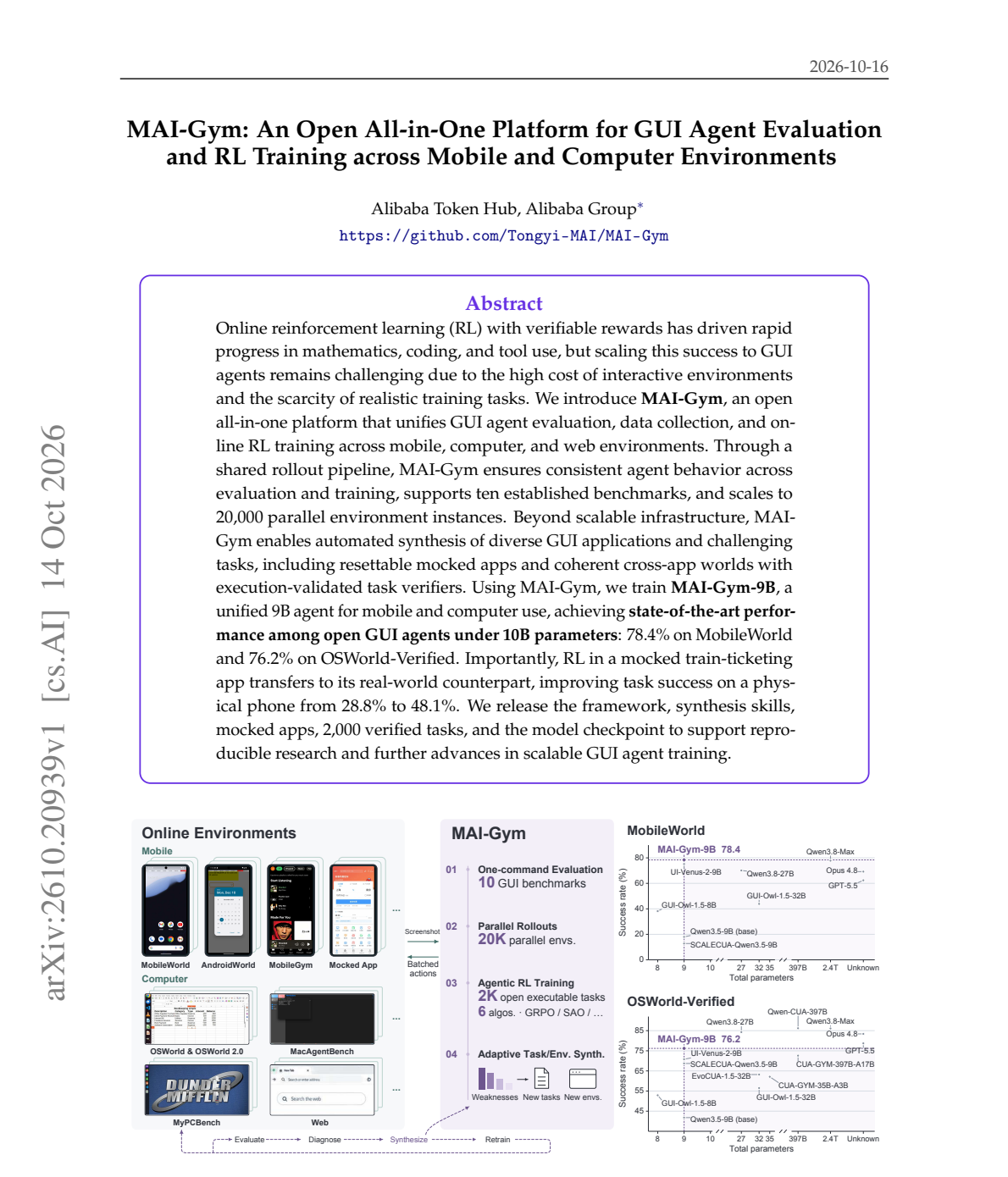
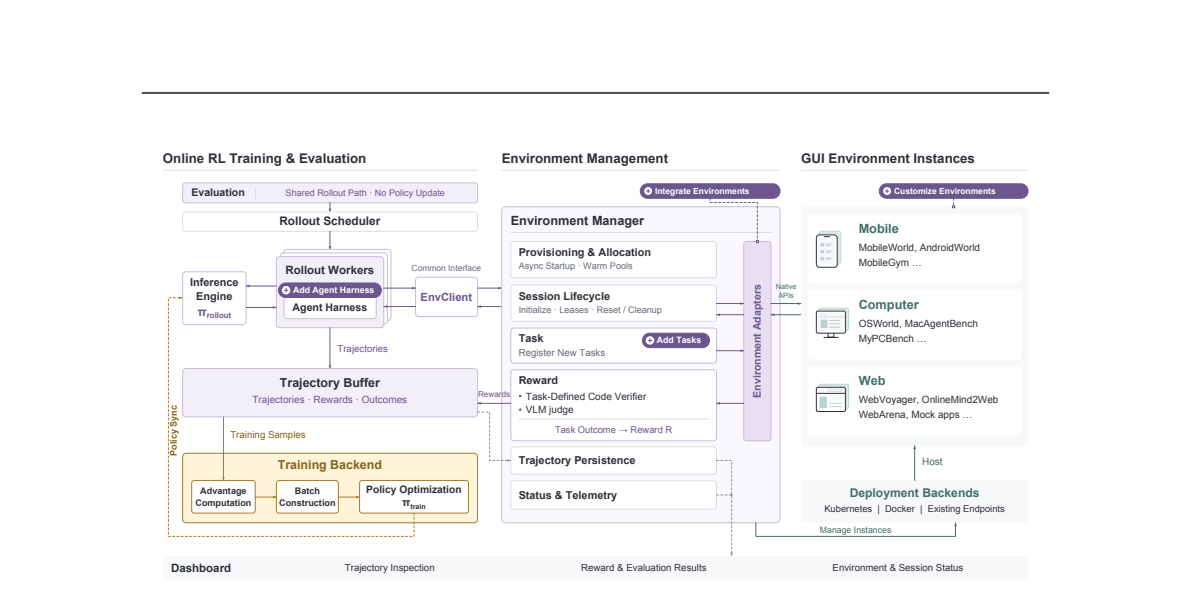
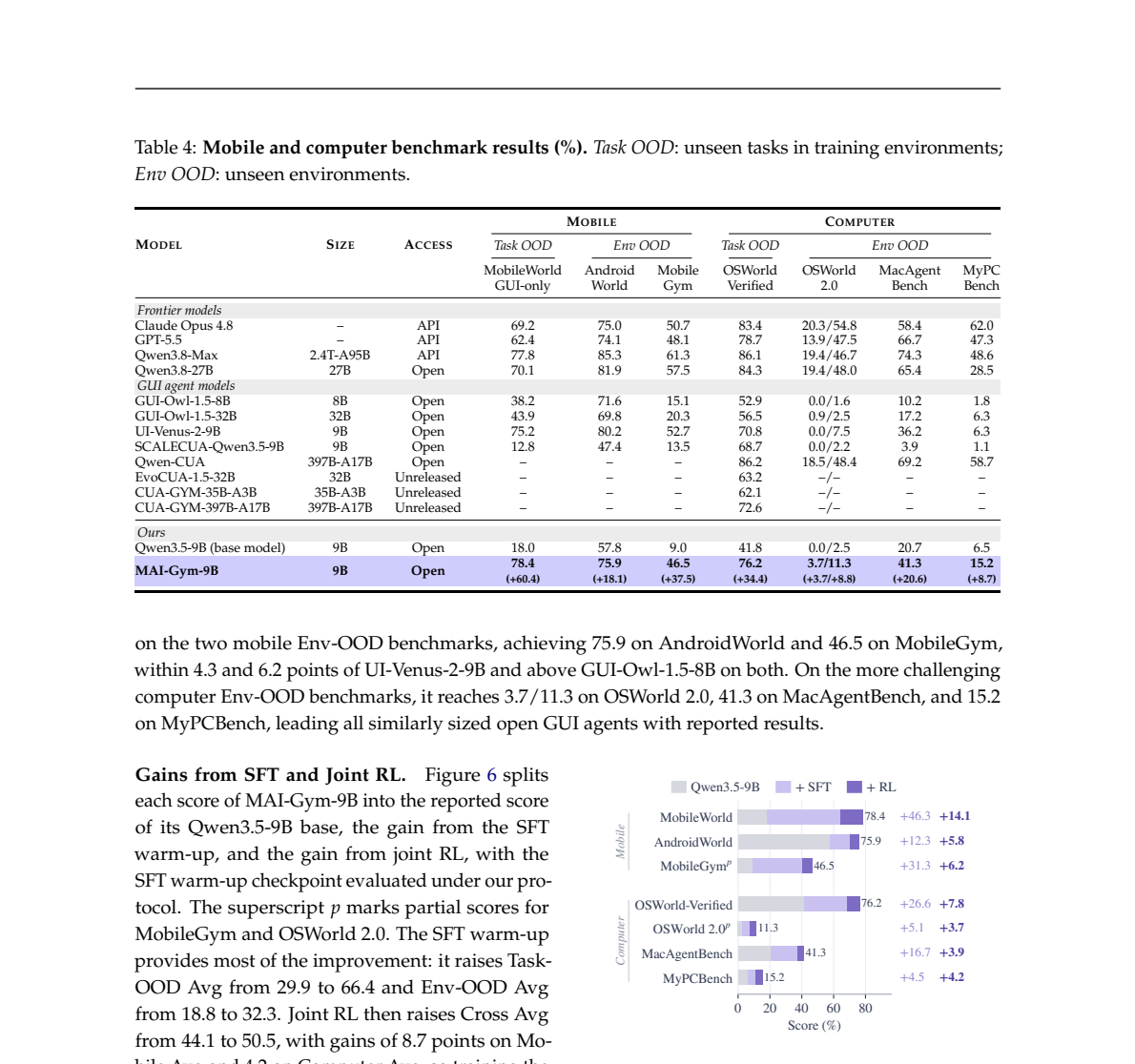
We introduce MAI-Gym, an open all-in-one platform that unifies GUI agent evaluation, data collection, and online RL training across mobile, computer, and web environments. Through a shared rollout pipeline, MAI-Gym ensures consistent agent behavior across evaluation and training, supports ten established benchmarks, and scales to 20,000 parallel environment instances. Beyond scalable infrastructure, MAI-Gym enables automated synthesis of diverse GUI applications and challenging tasks, including resettable mocked apps and coherent cross-app worlds with execution-validated task verifiers. Using MAI-Gym, we train MAI-Gym-9B, a unified 9B agent for mobile and computer use, achieving state-of-the-art performance among open GUI agents under 10B parameters: 78.4% on MobileWorld and 76.2% on OSWorld-Verified. Importantly, RL in a mocked train-ticketing app transfers to its real-world counterpart, improving task success on a phys- ical phone from 28.8% to 48.1%. We release the framework, synthesis skills, mocked apps, 2,000 verified tasks, and the model checkpoint to support repro- ducible research and further advances in scalable GUI agent training.
from the abstract
Pith says
Machine review · deepseek-v4-flash · 16 Oct 2026 · what was read was not recorded · not checked by a person
It can be wrong. Challenge this review or reply to it.
Holds up. A well-engineered platform that fills a real infrastructure gap; the sim-to-real evidence is thin but the paper doesn't oversell it. This line is wrong
5 minor
How often objections from reviews like this one are right: not yet measured
Not checked: figures, code, what the 72 references say.
5 minor objections
The paper says, at 1 (Introduction) and 6 (Conclusion)
Pith says: minor objection 1 of 5
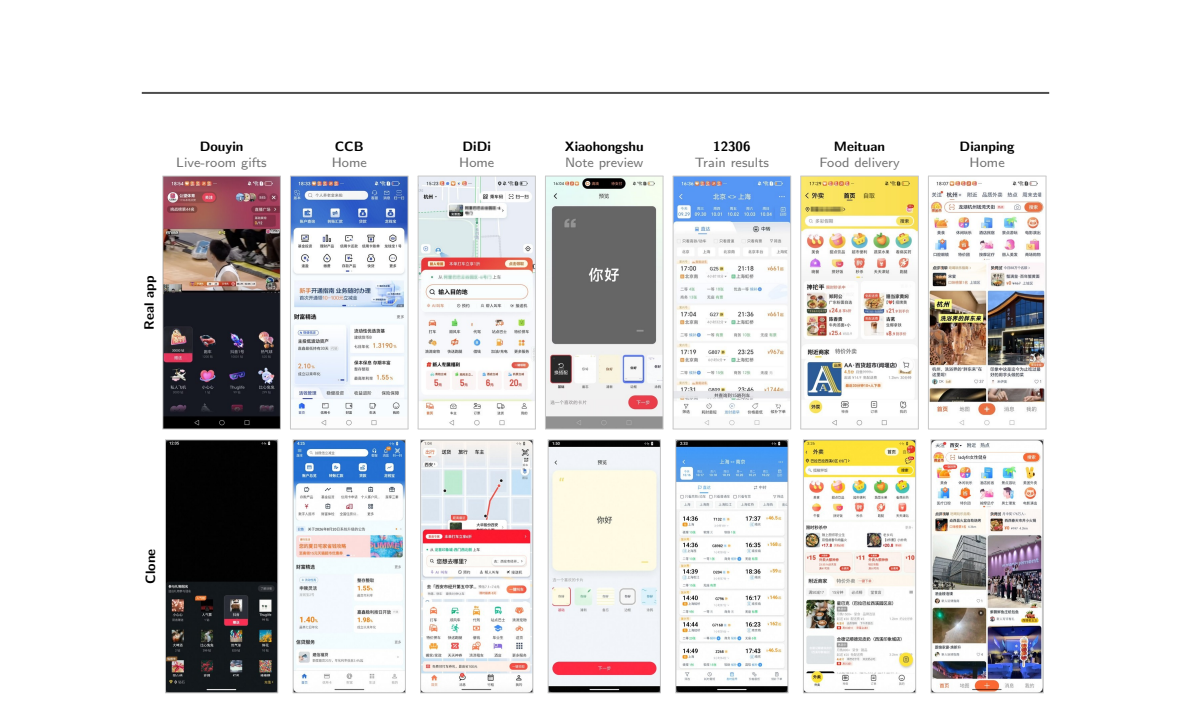
The conclusion states 'skills learned in a real-world clone transfer to the real app' and the introduction says 'training in real-world clones transfers effectively to the real apps' (plural). Only one of the seven released real-world clones (12306, Section 4.3.4) has been evaluated on its real counterpart. The plural claim is not supported by the presented evidence. Recommend rephrasing to 'a real-world clone' and acknowledging that the other six clones have not been tested for transfer.
The paper says, at Table 1
Pith says: minor objection 2 of 5
The MAI-Gym row contains garbled text ('10(34/dest3/g♀be)') that appears to be a font/substitution artifact in the plain-text arXiv listing. The intended content (10 benchmarks: 3 mobile, 4 computer, 3 web) should be rendered unambiguously.
show 3 more
The paper says, at 3.3 (Evaluation and Diagnostics)
Pith says: minor objection 3 of 5
The paper honestly notes that the automated diagnosis–synthesis loop 'is not yet evaluated in repeated rounds.' This is a valid limitation. Consider stating it more prominently in the abstract or introduction alongside the claimed capabilities, so that readers are aware that the loop has only been demonstrated in a single pass.
The paper says, at Figure 6
Pith says: minor objection 4 of 5
The superscript 'p' marking partial scores for MobileGym and OSWorld 2.0 is defined in the caption but could be more prominent (e.g., repeated in the figure legend or in a footnote) to avoid confusion with binary success rates.
The paper says, at Appendix A.5
Pith says: minor objection 5 of 5
The training configuration YAML template uses placeholders like '<mobile task pool>'. Releasing the exact YAML files used in the paper (with concrete pool names and sizes) would further improve reproducibility for researchers who wish to replicate the training runs.
What would settle it
For at least one additional clone (e.g., DiDi ride-hailing or Meituan food delivery), repeat the methodology of Section 4.3.4: run clone-only RL on that app's tasks, then evaluate the policy on the corresponding real app on a physical phone. Report success rates before and after RL, and the clone–real gap. A positive gain (e.g., >10 pp) on a second domain would substantially strengthen the generalizability claim; a null or negative result would limit the claim to the 12306 case.
from the skeptic's reading
How the review went
4 readings by deepseek-v4-flash · 16 Oct 2026
- Reader holds up
- Skeptic agrees
- Editor wrote the verdict above
- Referee minor revision: 5 minor
Not run on this paper: the simulated authors' defence.
Pith did not check this review's objections against the paper.
The review in full
The review in brief, machine-written
MAI-Gym is the real deal as an infrastructure contribution. The central idea—a shared rollout path for evaluation, data collection, and RL training—sounds obvious but has been missing, and the paper shows why it matters (drift between training and eval harnesses is a known pain). They back this up with solid engineering: 20K parallel environments, reliable resets, window-wise history for KV-cache reuse, and a clean environment manager interface that already trained Qwen-UI-Agent. The release of code, skills, 49 mocked apps, and 2,000 verified tasks makes this a serious reproducibility package.
What's new and done well: cross-app world construction (generating coherent file/app states before tasks) is a meaningful step beyond input-level synthesis, and execution-validated verifiers (initial-completed-reset sequence) address a real quality problem. The empirical evaluation is thorough: comparisons on 7 benchmarks, ablations on joint versus merged training, task scaling, clone-to-real transfer, and RL algorithm comparison. The model results are credible—MAI-Gym-9B leads under 10B parameters, and the gain over SFT is clean.
Keeping an eye on: the most load-bearing claim about sim-to-real transfer rests on one app (12306). The paper reports the clone-real gap widening from 7.7 to 25.0 pp after training, which is honest but leaves the generalizability question open. The stress-test note is fair: we don't know whether the effect repeats for banking, ride-hailing, etc. The paper acknowledges this implicitly by only claiming transfer for the 12306 case, but the abstract and conclusion phrase it more broadly. A revision should tighten the wording to match the evidence. Also, the diagnosis-synthesis loop is not evaluated in repeated rounds—the paper says so—so long-term stability of automated curriculum is untested. Finally, RL gains over SFT, while mostly positive, are modest on several Env-OOD benchmarks (e.g., OSWorld 2.0 +3.7 binary, MyPCBench +4.2). This doesn't undermine the platform's value but tempers claims about generalization.
Verdict: This paper should go to peer review. The engineering is sound, the release is generous, and the claims are mostly supported. Minor revision to scope the sim-to-real claim. I'd bring it to a reading group if someone works on GUI agents; I'd cite it as infrastructure. The authors are serious thinkers—the paper is coherent, well-structured, and honest about limitations. Recommend accept with minor revision.
The strongest objection
The paper claims that training in a real-world clone transfers to the real app, citing the 12306 result (Section 4.3.4) where RL improved real-phone success from 28.8% to 48.1%. This result is used to support the broader conclusion that 'skills learned in a real-world clone transfer to the real app' (Conclusion) and that synthesized environments can 'learn generalizable GUI capabilities' (Section 1). However, only one of the seven released real-world clones (12306) is evaluated on its real counterpart. The other six clones (banking, ride-hailing, food delivery, local services, two social media apps) are not tested for transfer, so we cannot know whether the effect is broad or specific to the 12306 domain. The paper acknowledges that the clone–real gap widened from 7.7 to 25.0 pp, suggesting that gains do not fully transfer even in this one case. Without evidence on a second domain, the claim that the platform yields policies that transfer to real apps remains under-supported. This is load-bearing because the paper repeatedly presents sim-to-real transfer as a key capability of the platform (abstract, introduction, conclusion, Figure 1).
The paper makes a strong engineering contribution with its open platform, shared rollout path, scalable infrastructure, and automated task synthesis. These platform claims are well-supported by the described architecture, quantitative scaling measurements (20K envs, 512 GPUs, reset times), and open release. The sim-to-real transfer result on 12306 is a promising proof of concept but is limited to one app. The reader's weakest assumption (that synthetic tasks generalize to real apps) is exactly the point at issue. Both the reader and I identify this as the least secure support for the paper's broader narrative. However, the platform's core value does not depend on this one result; the paper also demonstrates strong benchmark performance and provides extensive ablations. Therefore the reader's ACCEPT verdict stands, and I recommend no change. The concrete test would confirm or bound the generality of the transfer claim, but the absence of that test does not invalidate the rest of the contribution.
The referee's report
If the empirical results hold, MAI-Gym fills an important infrastructure gap. Prior GUI gyms either focus on evaluation or on task synthesis and often cover a single platform; MAI-Gym integrates both into one codebase with a consistent agent harness, enabling reproducible RL training across mobile, desktop, and web. The open release of 49 mocked apps, 2,000 verified tasks with execution-tested verifiers, and the trained 9B model is a concrete, reusable contribution to the community. The scale demonstrations (20k parallel environments, 512-GPU training) and the thorough ablations (joint vs. merging, task scaling, clone-to-real transfer, novel-app learning, GRPO vs. SAO) make the paper a strong systems contribution for GUI-agent research.
Pith's reading of the paper (a machine's summary, not the authors')
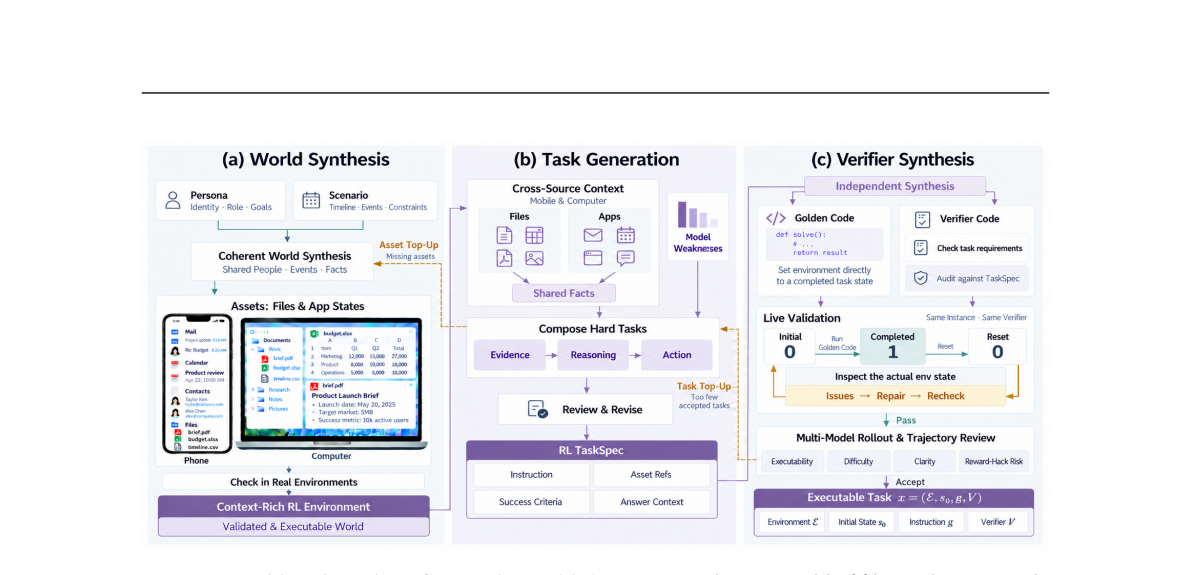
The paper sets out to bring the verifiable-reward reinforcement learning that reshaped math and coding agents to GUI agents, whose interactive environments are normally too costly and too scarce in realistic tasks. Its claim is that one open platform can close that gap: MAI-Gym unifies evaluation, data collection, and online RL behind a single rollout path across mobile, computer, and web, runs ten benchmarks, and scales to 20,000 parallel environment instances. It also generates the missing training material, including resettable mocked apps, coherent cross-app worlds, and tasks whose code verifiers pass execution tests, so the environment is never the bottleneck. On that material the authors train MAI-Gym-9B, a single 9B policy that reaches 78.4% on MobileWorld and 76.2% on OSWorld-Verified, the best reported results among open GUI agents under 10B parameters. The result that would matter most if it holds is transfer: RL on a mocked clone of a train-ticketing app improved success on the physical real app from 28.8% to 48.1%.
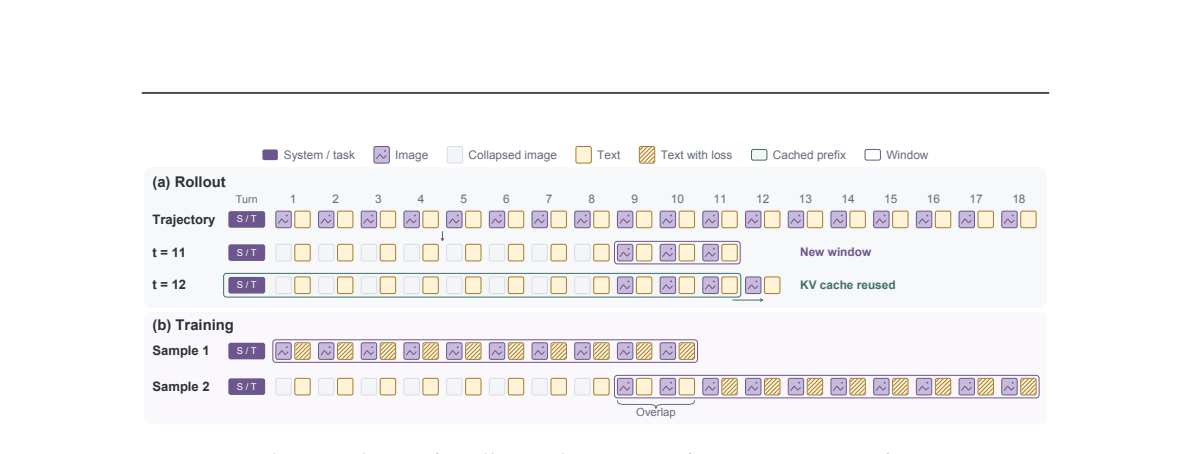
What carries the argument. The load-bearing object is the executable task $x=(E, s_0, g, V)$, an environment, an initial state, an instruction, and a verifier, together with the platform's guarantee that every attempt runs in an isolated instance reset to $s_0$; rewards give partial credit $r=\sum_j w_j b_j / \sum_j w_j$ while success requires all mandatory criteria, $S=\prod_{j\in C} b_j$. On top of that contract sit three mechanisms. First, a shared rollout path with one agent harness for evaluation, data collection, and training, so the scored agent is the trained agent. Second, an automated synthesis pipeline that builds resettable mocked apps (real-world clones and novel apps), constructs cross-app worlds of interlinked files and records, fixes task requirements before two independent synthesis calls produce golden and verifier code, and accepts a task only after its verifier passes an initial–completed–reset execution test. Third, a training recipe adapted to long screenshot trajectories: window-wise history with $K=10$ and overlap $O=2$ that lets prompts extend cached prefixes, window-wise packing that encodes each screenshot once per window, policy-adaptive task sampling that spends rollout groups where the policy sometimes succeeds, and GRPO with rewards from code verifiers only.
Core claim. On its own terms, the paper's central discovery is that the evaluate–diagnose–synthesize–retrain loop, run as one open system, is sufficient to train a unified GUI policy that generalizes beyond its training tasks and environments. The trained agent, MAI-Gym-9B, never saw the benchmark tasks in training, yet it outperforms all open GUI agents under 10B parameters on MobileWorld (78.4%) and OSWorld-Verified (76.2%), and RL measurably improves every environment-out-of-distribution benchmark relative to the SFT warm-up checkpoint. The paper further reports three mechanisms behind that result: joint RL on mobile and computer tasks beats merging per-domain experts; enlarging the synthesized task pool from 500 to 5,000 tasks raises both Task-OOD scores at constant rollout budget; and learning transfers from synthetic to real, both for a real-world clone (28.8% to 48.1% on a physical phone) and for entirely novel apps (25.8% to 45.2% on held-out tasks with no demonstrations).
The premise it rests on. The load-bearing premise is that skills practiced in mocked apps and scripted cross-app worlds carry over to real applications; the paper tests this on a single real app (a train-ticketing clone evaluated on a physical phone) and acknowledges that the automated diagnosis-synthesis loop has not yet been evaluated over repeated rounds.
If the paper is right (Pith's inferences, not the authors')
If the platform claim holds, GUI-agent evaluation and training no longer need separate harnesses: the same rollout path that scores a checkpoint is the one that collects its RL data, so measured scores reflect the model actually being trained.
Scaling stops being the blocker — 20,000 parallel instances, 1,000 phones ready in 328 seconds, and under 2% unscored aborts — so the bottleneck shifts to the supply of verified tasks, which the synthesis pipeline is designed to produce.
A single jointly trained policy beats merging per-domain experts on both mobile and computer benchmarks (78.4 vs. 76.4 on MobileWorld; 76.2 vs. 74.8 on OSWorld-Verified), implying one RL run can cover multiple device types.
More synthesized tasks improve generalization on unseen tasks at fixed rollout budget (69.2 to 78.4 on MobileWorld; 69.7 to 76.2 on OSWorld-Verified), so task diversity rather than algorithm choice is the main lever the authors rely on.
If clone-to-real transfer is real, transactional workflows that are too risky to practice live can be rehearsed safely in resettable mock apps; RL on entirely novel apps (25.8 to 45.2 on held-out tasks) shows unfamiliar interfaces can be learned from reward without demonstrations.
The authors leave implicit that their seven real-world clones move money, place orders, or publish posts, so the same infrastructure could serve as a safe rehearsal ground for exactly the workflows that are dangerous to automate live; the natural next check is repeating the 12306 experiment on banking and food-delivery clones.
A general lesson the paper does not state is that prompt construction, inference caching, and training packing should be co-designed rather than treated as harness plumbing; the window-wise history trick could transfer to other long-horizon multimodal agent domains.
If the synthesized-task scaling curve continues past 5,000 tasks, the binding constraint becomes verifying task quality at scale, and the failure-driven loop turns evaluation itself into a data source — contingent on the repeated-round stability the paper has not yet measured.
The fact that a 9B model trained on synthetic tasks surpasses much larger frontier and open agents on MobileWorld suggests that benchmark difficulty is sensitive to task-appropriate training data, a hypothesis the paper reports the numbers for but does not itself advance.
Check this review
Pith stored no record of this review's passes and took no fingerprint of it. Reviews made by code from 13 Nov 2026 on carry both.
How often reviews like this one are right
Reviews like this one: written by deepseek-v4-flash, where what was read was not recorded.
How often objections from reviews like this one are right: not yet measured
Reviews by people
This review was written by a machine. No person has reviewed this paper on Pith yet. A scientist listed on Pith can review it for a fee, and their review is published here whatever it concludes.
The paper
Abstract
Online reinforcement learning (RL) with verifiable rewards has driven rapid progress in mathematics, coding, and tool use, but scaling this success to GUI agents remains challenging due to the high cost of interactive environments and the scarcity of realistic training tasks. We introduce MAI-Gym, an open all-in-one platform that unifies GUI agent evaluation, data collection, and online RL training across mobile, computer, and web environments. Through a shared rollout pipeline, MAI-Gym ensures consistent agent behavior across evaluation and training, supports ten established benchmarks, and scales to 20,000 parallel environment instances. Beyond scalable infrastructure, MAI-Gym enables automated synthesis of diverse GUI applications and challenging tasks, including resettable mocked apps and coherent cross-app worlds with execution-validated task verifiers. Using MAI-Gym, we train MAI-Gym-9B, a unified 9B agent for mobile and computer use, achieving state-of-the-art performance among open GUI agents under 10B parameters: 78.4% on MobileWorld and 76.2% on OSWorld-Verified. Importantly, RL in a mocked train-ticketing app transfers to its real-world counterpart, improving task success on a phys- ical phone from 28.8% to 48.1%. We release the framework, synthesis skills, mocked apps, 2,000 verified tasks, and the model checkpoint to support repro- ducible research and further advances in scalable GUI agent training.
The paper's own sentences, arranged, kept beside the review and separate from it. Each label is drawn from a closed vocabulary; the number beside it is the probability the classifier gave that label. No sentence in this record was written by a model.
abstract compiled · 2026-10-16
The authors' main claim, as the classifier picked it out 0.85
“Using MAI-Gym, we train MAI-Gym-9B, a unified 9B agent for mobile and computer use, achieving state-of-the-art performance among open GUI agents under 10B parameters: 78.4% on MobileWorld and 76.2% on OSWorld-Verified.”
How the main claim is stated: asserted 1.00
What the abstract itself states, as probabilities: claims first 0.08 · states limitation 0.21 · human participants 0.07 · controlled comparison 0.54 · randomized assignment 0.01 · states quantitative result 0.99 · compares with prior results 0.83 · mentions code or data availability 0.98
The abstract, sentence by sentence
This table labels the abstract only (arXiv listing abstract v1). The number is the probability the classifier gave the label.
| Sentence | Role | The authors' own work | States the main conclusion | Strength |
|---|---|---|---|---|
| Online reinforcement learning (RL) with verifiable rewards has driven rapid progress in mathematics, coding, and tool use, but scaling this success to GUI agents remains challenging due to the high cost of interactive environments and the scarcity of realistic training tasks. | background 0.77 | 0.06 | 0.03 | asserted 1.00 |
| We introduce MAI-Gym, an open all-in-one platform that unifies GUI agent evaluation, data collection, and online RL training across mobile, computer, and web environments. | contribution 1.00 | 0.90 | 0.15 | asserted 1.00 |
| Through a shared rollout pipeline, MAI-Gym ensures consistent agent behavior across evaluation and training, supports ten established benchmarks, and scales to 20,000 parallel environment instances. | method 0.70 | 0.84 | 0.09 | asserted 1.00 |
| Beyond scalable infrastructure, MAI-Gym enables automated synthesis of diverse GUI applications and challenging tasks, including resettable mocked apps and coherent cross-app worlds with execution-validated task verifiers. | method 0.61 | 0.88 | 0.08 | asserted 0.98 |
| Using MAI-Gym, we train MAI-Gym-9B, a unified 9B agent for mobile and computer use, achieving state-of-the-art performance among open GUI agents under 10B parameters: 78.4% on MobileWorld and 76.2% on OSWorld-Verified. | result 0.97 | 0.97 | 0.39 | asserted 1.00 |
| Importantly, RL in a mocked train-ticketing app transfers to its real-world counterpart, improving task success on a phys- ical phone from 28.8% to 48.1%. | result 0.98 | 0.95 | 0.21 | asserted 1.00 |
| We release the framework, synthesis skills, mocked apps, 2,000 verified tasks, and the model checkpoint to support repro- ducible research and further advances in scalable GUI agent training. | contribution 0.88 | 0.89 | 0.11 | asserted 0.99 |
What kind of paper the classifier reports this is: method or tool 1.00 · evidence from observation or experiment 0.88
What was examined, and what was not
Sources read
- arXiv listing abstract v1
Not examined
- full text
- figures and tables
- references and citing sentences
- relations to other papers
Levels run
- P abstract
Not run
- S sections
- T body sentences
- C citations
- R cross-paper relations
How the labels were made
Compiled by classifier-1.13.0 via TypeSafe API, question bank abstract-p1-20260923, 2026-10-16: 1 request, 5,921 input tokens.
Every quoted sentence on this record is the authors'. Every label is from Pith's closed vocabulary, with the probability shown beside it. This record as JSON
Figures (15)


Showing 13 of the paper's 15 figures. Figures are the authors', reproduced from the paper.
References (72)
- [1] Hanzhang Zhou, Panrong Tong, Xu Zhang, et al. Qwen-UI-Agent technical report: Toward next- generation real-world centric foundation GUI agents.arXiv preprint arXiv:2607.28227, 2026. URL https://arxiv.org/abs/2607.28227 on PithPith's reviewarXiv
- [2] DeepSeek-AI. DeepSeek-R1: Incentivizing reasoning capability in llms via reinforcement learning. Nature, 645:633–638, 2025 on Pith
- [3] Jiayi Pan, Xingyao Wang, Graham Neubig, et al. Training software engineering agents and verifiers with SWE-Gym.arXiv preprint arXiv:2412.21139, 2024 on PithPith's reviewarXiv
- [4] Naman Jain, Jaskirat Singh, Manish Shetty, et al. R2E-Gym: Procedural environments and hybrid verifiers for scaling open-weights SWE agents.arXiv preprint arXiv:2504.07164, 2025 on PithPith's reviewarXiv
- [5] John Yang, Kilian Lieret, Carlos E. Jimenez, et al. SWE-smith: Scaling data for software engineering agents.arXiv preprint arXiv:2504.21798, 2025 on PithPith's reviewarXiv
- [6] RUC-NLPIR. EnvScaler: Scaling tool-interactive environments for llm agent via programmatic synthesis.arXiv preprint arXiv:2601.05808, 2026 on PithPith's reviewarXiv
- [7] Guanting Dong, Junting Lu, Junjie Huang, Wanjun Zhong, and Longxiang Liu. Agent-World: Scaling real-world environment synthesis for evolving general agent intelligence.arXiv preprint arXiv:2604.18292, 2026 on PithPith's reviewarXiv
- [8] Hao Bai, Yifei Zhou, Mert Cemri, et al. DigiRL: Training in-the-wild device-control agents with autonomous reinforcement learning. InAdvances in Neural Information Processing Systems (NeurIPS), 2024 on Pith
- [9] THUDM. MobileRL: Online agentic reinforcement learning for mobile gui agents.arXiv preprint arXiv:2509.18119, 2025 on PitharXiv
- [10] Zehan Qi, Xiao Liu, Iat Long Iong, et al. WebRL: Training LLM web agents via self-evolving online curriculum reinforcement learning. InInternational Conference on Learning Representations (ICLR), 2025 on Pith
- [11] Hanyu Lai, Xiao Liu, Yanxiao Zhao, et al. ComputerRL: Scaling end-to-end online reinforcement learning for computer use agents.arXiv preprint arXiv:2508.14040, 2025 on PitharXiv
- [12] ByteDance Seed. UI-TARS-2 technical report: Advancing gui agent with multi-turn reinforcement learning.arXiv preprint arXiv:2509.02544, 2025 on PithPith's reviewarXiv
- [13] Wenyi Wu, Sibo Zhu, Kun Zhou, et al. StructAgent: Harness Long-horizon Digital Agents with Unified Causal Structure.arXiv preprint arXiv:2607.11388, 2026. URL https://arxiv.org/abs/26 07.11388 on PithPith's reviewarXiv
- [14] Thibault Le Sellier De Chezelles, Maxime Gasse, Alexandre Drouin, et al. The BrowserGym ecosys- tem for web agent research. InTransactions on Machine Learning Research (TMLR), 2025 on Pith
- [16] Dingbang Wu, Rui Hao, Haiyang Wang, Shuzhe Wu, Han Xiao, Zhenghong Li, Bojiang Zhou, Zheng Ju, Zichen Liu, Lue Fan, and Zhaoxiang Zhang. MobileGym: A verifiable and highly parallel simulation platform for mobile gui agent research.arXiv preprint arXiv:2605.26114, 2026. 22 on PithPith's reviewarXiv
- [17] Bowen Lv, Xiao Liu, Yanyu Ren, et al. SCALECUA: Scaling Computer Use Agents with Verifiable Task Synthesis and Efficient Online RL.arXiv preprint arXiv:2607.11185, 2026. URL https://arxiv. org/abs/2607.11185 on PithPith's reviewarXiv
- [18] Fei Tang, Zhiqiong Lu, Boxuan Zhang, et al. ClawGUI: A Unified Framework for Training, Evaluating, and Deploying GUI Agents.arXiv preprint arXiv:2604.11784, 2026. URL https: //arxiv.org/abs/2604.11784 on PithPith's reviewarXiv
- [19] Bowen Wang, Dunjie Lu, Junli Wang, Tianyi Bai, Shixuan Liu, Zhipeng Zhang, Haiquan Wang, Hao Hu, Tianbao Xie, Shuai Bai, Dayiheng Liu, Que Shen, Junyang Lin, and Tao Yu. CUA-Gym: Scaling verifiable training environments and tasks for computer-use agents.arXiv preprint arXiv:26... on PithPith's reviewarXiv
- [20] Pranjal Aggarwal, Graham Neubig, and Sean Welleck. Gym-anything: Turn any software into an agent environment.arXiv preprint arXiv:2604.06126, 2026. URL https://arxiv.org/abs/2604.061 26 on PithPith's reviewarXiv
- [21] Yuan Cao, Dezhi Ran, Mengzhou Wu, Yuzhe Guo, Xin Chen, Ang Li, Gang Cao, Zhi Gong, Hao Yu, Linyi Li, Wei Yang, and Tao Xie. GUI-GENESIS: Automated synthesis of efficient environments with verifiable rewards for gui agent post-training.arXiv preprint arXiv:2602.14093, 2026 on PithPith's reviewarXiv
show 52 more
- [22] Yuxuan Liu, Xin Lai, Junyi Li, et al. PhoneWorld: From Real-App Trajectories to Dynamic and Verifiable Environments for Phone-Use Agents.arXiv preprint arXiv:2605.29486, 2026. URL https: //arxiv.org/abs/2605.29486 on PithPith's reviewarXiv
- [23] Venus Team. UI-Venus-2 technical report.arXiv preprint arXiv:2609.00028, 2026. URL https: //arxiv.org/html/2609.00028 on PithPith's reviewarXiv
- [24] Haiyang Xu, Xi Zhang, Haowei Liu, et al. Mobile-Agent-v3.5: Multi-platform fundamental GUI agents.arXiv preprint arXiv:2602.16855, 2026. URLhttps://arxiv.org/html/2602.16855 on PitharXiv
- [25] Zhihong Shao, Peiyi Wang, Qihao Zhu, et al. DeepSeekMath: Pushing the limits of mathematical reasoning in open language models.arXiv preprint arXiv:2402.03300, 2024 on PithPith's reviewarXiv
- [26] Remote Android Project. Redroid: A multi-arch, gpu-enabled android in cloud container solution. https://github.com/remote-android/redroid-doc, 2024 on Pith
- [27] MobileWorld Team. MobileWorld: Benchmarking autonomous mobile agents in agent-user interac- tive and mcp-augmented environments.arXiv preprint arXiv:2512.19432, 2025 on PitharXiv
- [28] Christopher Rawles, Sarah Clinckemaillie, Yifan Chang, et al. AndroidWorld: A dynamic bench- marking environment for autonomous agents. InInternational Conference on Learning Representations (ICLR), 2025 on Pith
- [29] Tianbao Xie, Danyang Zhang, Jixuan Chen, et al. OSWorld: Benchmarking multimodal agents for open-ended tasks in real computer environments. InAdvances in Neural Information Processing Systems (NeurIPS) Datasets and Benchmarks, 2024 on Pith
- [30] Mengqi Yuan, Zilong Zhou, Xinzhuang Xiong, Weiming Wu, Jiayang Sun, Jiamin Song, Kaiqian Cui, Bowen Wang, Haoyuan Wu, Yitong Li, et al. OSWorld 2.0: Benchmarking computer use agents on long-horizon real-world tasks.arXiv preprint arXiv:2606.29537, 2026 on PithPith's reviewarXiv
- [31] Y. Fu, B. Fu, Z. Wu, S. Cheng, X. Sun, B. Yang, Z. Li, Y. Zhao, Z. Ding, Z. Liu, S. Wang, B. Qi, and B. Zhou. MacAgentBench: Benchmarking AI agents on real-world macOS desktop.arXiv preprint arXiv:2606.22557, 2026. URLhttps://arxiv.org/abs/2606.22557. 23 on PithPith's reviewarXiv
- [32] L. K. Jang, A. K. Jang, J. Y. Koh, and R. Salakhutdinov. MyPCBench: A benchmark for personally intelligent computer-use agents.arXiv preprint arXiv:2606.16748, 2026. URL https://arxiv.org/ab s/2606.16748 on PitharXiv
- [33] Hongliang He, Wenlin Yao, Kaixin Ma, Wenhao Yu, Yong Dai, Hongming Zhang, Zhenzhong Lan, and Dong Yu. Webvoyager: Building an end-to-end web agent with large multimodal models. In Proceedings of the 62nd Annual Meeting of the Association for Computational Linguistics (Volume 1... on Pith
- [34] Tianci Xue, Weijian Qi, Tianneng Shi, Chan Hee Song, Boyu Gou, Dawn Song, Huan Sun, and Yu Su. An illusion of progress? assessing the current state of web agents. InSecond Conference on Language Modeling, 2025. URLhttps://openreview.net/forum?id=6jZi4HSs6o on Pith
- [35] Shuyan Zhou, Frank F. Xu, Hao Zhu, et al. WebArena: A realistic web environment for building autonomous agents. InInternational Conference on Learning Representations (ICLR), 2024 on Pith
- [36] Anthropic. Claude code. https://github.com/anthropics/claude-code, 2026. GitHub repository. Accessed: 2026-10-10 on Pith
- [37] OpenAI. Codex. https://github.com/openai/codex , 2026. GitHub repository. Accessed: 2026-10-10 on Pith
- [38] Chenyu Yang, Shiqian Su, Shi Liu, et al. ZeroGUI: Automating online gui learning at zero human cost.arXiv preprint arXiv:2505.23762, 2025 on PithPith's reviewarXiv
- [39] Ram Ramrakhya, Andrew Szot, Omar Attia, et al. Scaling synthetic task generation for agents via exploration.arXiv preprint arXiv:2509.25047, 2025 on PitharXiv
- [40] Yifan Wu, Yiran Peng, Yuyao Zhai, Bang Liu, Chenglin Wu, and Yuyu Luo. AutoWebWorld: Pro- grammatic synthesis of verified web environments for agent training.arXiv preprint arXiv:2602.14296, 2026 on PitharXiv
- [41] THUDM. slime: An SGLang-native post-training framework for RL scaling. https://github.com /THUDM/slime, 2025 on Pith
- [42] Mohammad Shoeybi, Mostofa Patwary, Raul Puri, Patrick LeGresley, Jared Casper, and Bryan Catan- zaro. Megatron-LM: Training multi-billion parameter language models using model parallelism. arXiv preprint arXiv:1909.08053, 2019 on PithPith's reviewarXiv
- [43] Lianmin Zheng, Liangsheng Yin, et al. SGLang: Efficient execution of structured language model programs. InAdvances in Neural Information Processing Systems (NeurIPS), 2024 on Pith
- [44] Qiying Yu, Zheng Zhang, Ruofei Zhu, et al. DAPO: An open-source llm reinforcement learning system at scale.arXiv preprint arXiv:2503.14476, 2025 on PithPith's reviewarXiv
- [45] Chujie Zheng, Shixuan Liu, Mingze Li, et al. Group sequence policy optimization.arXiv preprint arXiv:2507.18071, 2025 on PithPith's reviewarXiv
- [46] Jian Hu, Jason Klein Liu, Haotian Xu, and Wei Shen. REINFORCE++: Stabilizing critic-free policy optimization with global advantage normalization.arXiv preprint arXiv:2501.03262, 2025 on PithPith's reviewarXiv
- [47] Zhenyu Hou, Yujiang Li, Jie Tang, and Yuxiao Dong. Single-rollout asynchronous optimization for agentic reinforcement learning.arXiv preprint arXiv:2607.07508, 2026 on PithPith's reviewarXiv
- [48] John Schulman, Filip Wolski, Prafulla Dhariwal, Alec Radford, and Oleg Klimov. Proximal policy optimization algorithms.arXiv preprint arXiv:1707.06347, 2017 on PithPith's reviewarXiv
- [49] Qwen Team. Qwen3.5-9B model card.https://huggingface.co/Qwen/Qwen3.5-9B, 2026. 24 on Pith
- [50] Anthropic. Claude Opus 4.8 system card. https://www-cdn.anthropic.com/0b4915911bb0d19ec a5b5ee635c80fef830a37ea.pdf, 2026 on Pith
- [51] OpenAI. Introducing GPT-5.5.https://openai.com/index/introducing-gpt-5-5/, 2026 on Pith
- [52] Qwen Team. Qwen3.8-Max: A new bar for coding and cowork. https://qwen.ai/blog?id=qwen3. 8, 2026. Visual benchmark chart also available at https://github.com/AlibabaCloud-Official/ Qwen3.8-max on Pith
- [53] Qwen Team. Qwen3.8-27B model card.https://huggingface.co/Qwen/Qwen3.8-27B, 2026 on Pith
- [54] Mianqiu Huang, Taofeng Xue, Chong Peng, et al. EvoCUA-1.5: Online reinforcement learning for multi-turn computer-use agents.arXiv preprint arXiv:2607.09773, 2026. URL https://arxiv.org/ html/2607.09773 on PithPith's reviewarXiv
- [55] Qwen Team and XLANG Lab. Qwen-CUA: Native computer use for (almost) everything.arXiv preprint arXiv:2608.02352, 2026. URLhttps://arxiv.org/html/2608.02352v1 on PitharXiv
- [56] Charles Goddard, Shamane Siriwardhana, Malikeh Ehghaghi, Luke Meyers, Vladimir Karpukhin, Brian Benedict, Mark McQuade, and Jacob Solawetz. Arcee’s MergeKit: A toolkit for merging large language models. InProceedings of the 2024 Conference on Empirical Methods in Natural Langu... on Pith
- [57] Taiyi Wang, Zhihao Wu, et al. DistRL: An asynchronous distributed reinforcement learning frame- work for on-device control agents. InInternational Conference on Learning Representations (ICLR), 2025 on Pith
- [58] Yucheng Shi, Wenhao Yu, Zaixi Li, et al. MobileGUI-RL: Advancing mobile gui agent through reinforcement learning in online environment.arXiv preprint arXiv:2507.05720, 2025 on PithPith's reviewarXiv
- [59] Zhepei Wei, Wenlin Yao, Yao Liu, et al. WebAgent-R1: Training web agents via end-to-end multi-turn reinforcement learning. InConference on Empirical Methods in Natural Language Processing (EMNLP), 2025 on Pith
- [60] Pengxiang Li, Zechen Hu, Zirui Shang, Jingrong Wu, Yang Liu, Hui Liu, Zhi Gao, Chenrui Shi, Bofei Zhang, Zihao Zhang, Xiaochuan Shi, Zedong Yu, Yuwei Wu, Xinxiao Wu, Yunde Jia, Liuyu Xiang, Zhaofeng He, and Qing Li. Efficient multi-turn rl for gui agents via decoupled training... on PitharXiv
- [61] Zihan Ding, Longxu Dou, Qi Gao, et al. UI-Mate: Advancing Open-Weight Foundation GUI Agents with In-Context Demonstrations.arXiv preprint arXiv:2608.15930, 2026. URL https://arxiv.org/ abs/2608.15930 on PithPith's reviewarXiv
- [62] Zhiheng Xi, Wenxiang Chen, Boyang Hong, et al. AgentGym: Evolving large language model-based agents across diverse environments. InAnnual Meeting of the Association for Computational Linguistics (ACL), 2025 on Pith
- [63] GEM Team. GEM: A gym for agentic llms. InInternational Conference on Learning Representations (ICLR), 2026 on Pith
- [64] Guangming Sheng, Chi Zhang, Zilingfeng Ye, et al. HybridFlow: A flexible and efficient RLHF framework. InEuropean Conference on Computer Systems (EuroSys), 2025 on Pith
- [65] Jian Hu, Xibin Wu, Weixun Wang, et al. OpenRLHF: An easy-to-use, scalable and high-performance RLHF framework.arXiv preprint arXiv:2405.11143, 2024. 25 on PithPith's reviewarXiv
- [66] Wei Fu, Jiaxuan Gao, et al. AReaL: A large-scale asynchronous reinforcement learning system for language reasoning.arXiv preprint arXiv:2505.24298, 2025 on PithPith's reviewarXiv
- [67] Qiushi Sun, Kanzhi Cheng, Zichen Ding, et al. OS-Genesis: Automating gui agent trajectory construction via reverse task synthesis. InAnnual Meeting of the Association for Computational Linguistics (ACL), 2025 on Pith
- [68] Ziyun Zhang, Zezhou Wang, Xiaoyi Zhang, Zongyu Guo, and Yan Lu. InfiniteWeb: Scalable web environment synthesis with verifiable evaluation.arXiv preprint arXiv:2601.04126, 2026 on PithPith's reviewarXiv
- [69] Jiahui Sun, Zhichao Hua, and Yubin Xia. AutoEval: A practical framework for autonomous evaluation of mobile agents.arXiv preprint arXiv:2503.02403, 2025 on PitharXiv
- [70] Jinbiao Wei, Qianran Ma, Yilun Zhao, et al. OpenComputer: Verifiable Software Worlds for Computer-Use Agents.arXiv preprint arXiv:2605.19769, 2026. URL https://arxiv.org/abs/ 2605.19769 on PithPith's reviewarXiv
- [71] Hangoo Kang, Tarun Suresh, Jon Saad-Falcon, and Azalia Mirhoseini. TRACE: Turning recurrent agent failures into capability-targeted training environments.arXiv preprint arXiv:2604.05336, 2026 on PithPith's reviewarXiv
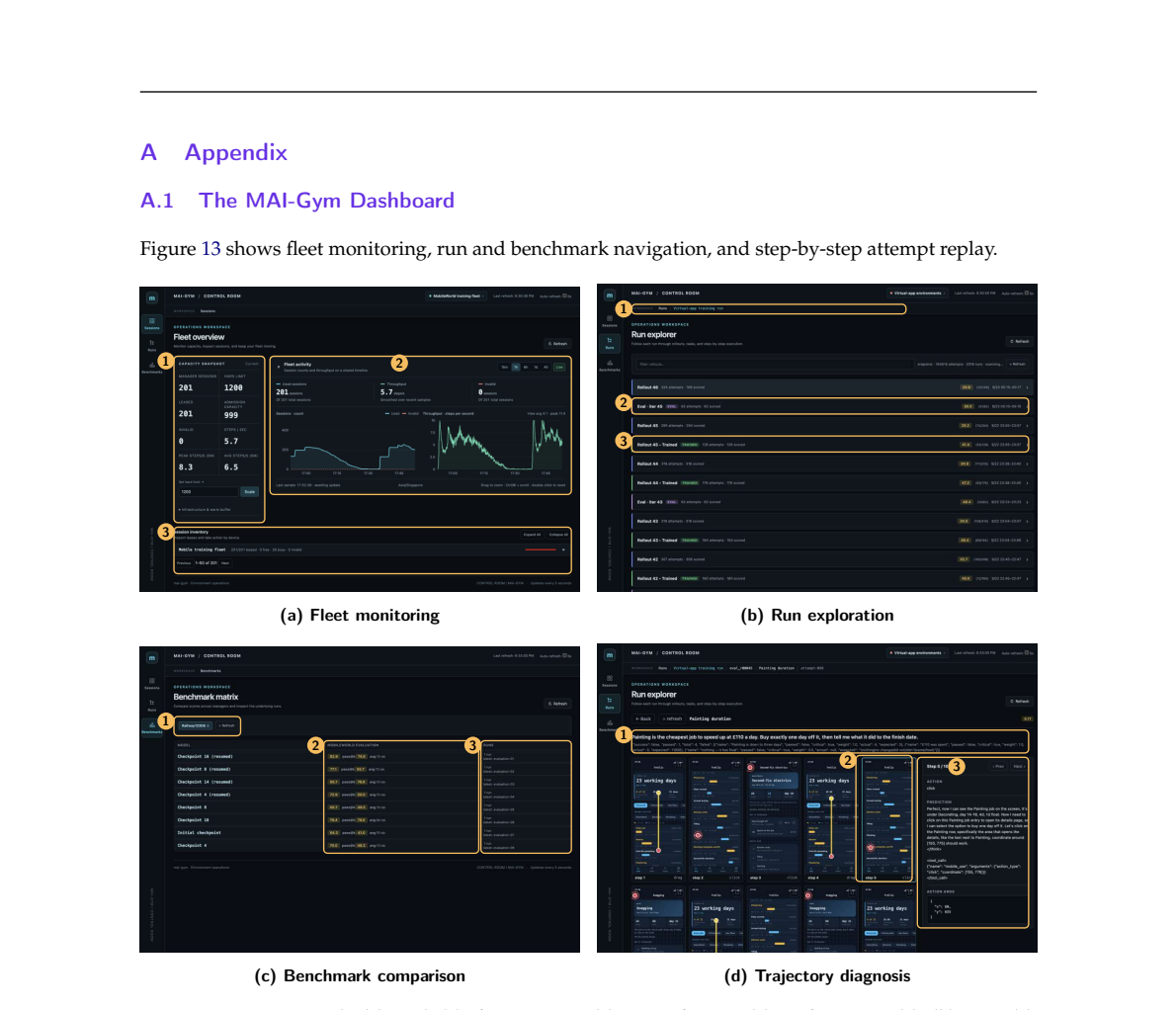
- [72] Jiacheng Guo, Ling Yang, Peter Chen, Qixin Xiao, Yinjie Wang, Xinzhe Juan, Jiahao Qiu, Ke Shen, and Mengdi Wang. GenEnv: Environment simulator co-evolution with difficulty-aligned curriculum. arXiv preprint arXiv:2512.19682, 2025. 26 A Appendix A.1 The MAI-Gym Dashboard Figure... on PitharXiv
- [2026] URLhttps://arxiv.org/abs/2601.02439 on PithPith's reviewarXiv
Cited by 2 Pith papers
Reviewed papers on Pith that cite this one. The full citation record
Challenges and discussion
Disagree with the review, or know something it missed? Leave a comment, or challenge this review formally: a challenge becomes a permanent entry in this paper's record, and its decision is published here.
Come back by email
A short list of the week's newly reviewed papers. Nothing is sent until you confirm from your inbox, and every email has a link that stops it. No account.
No comments yet.
Sign in to comment