Artificial Intelligence · arXiv:2610.27488 v1 · submitted 20 Oct 2026 · 18 references
The More the Better? A Comparison of Single- and Multi-Agent LLM Setups on a Financial Review Task
The paper says
“Practitioner guidance holds that a large language model reviews a document better when the work is divided among agents.”
more of the abstract
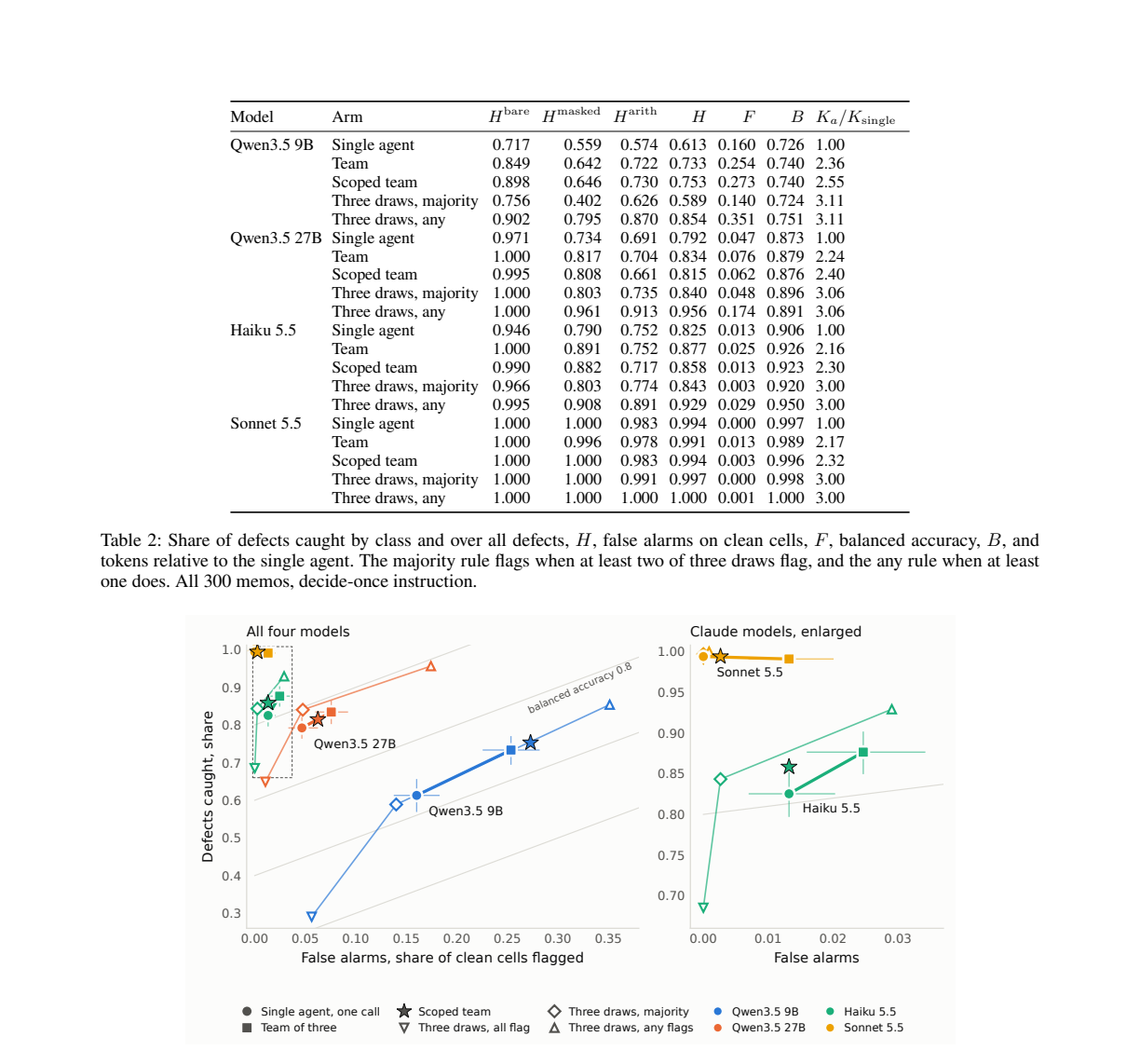
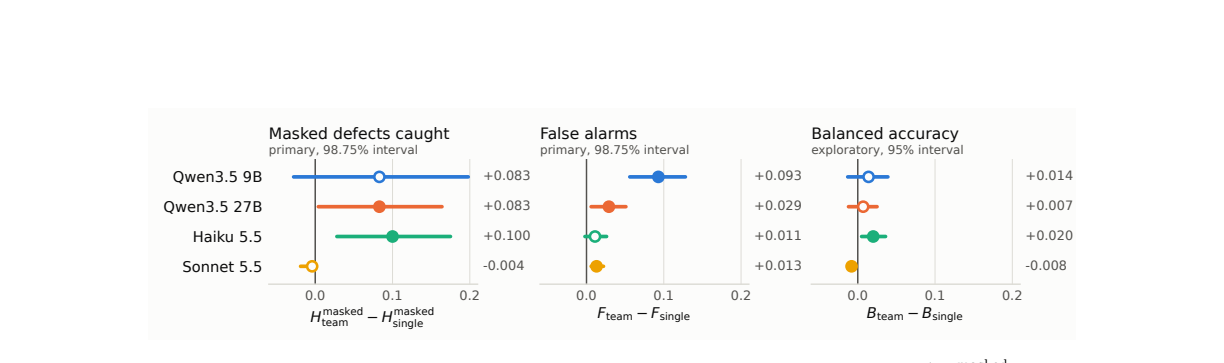
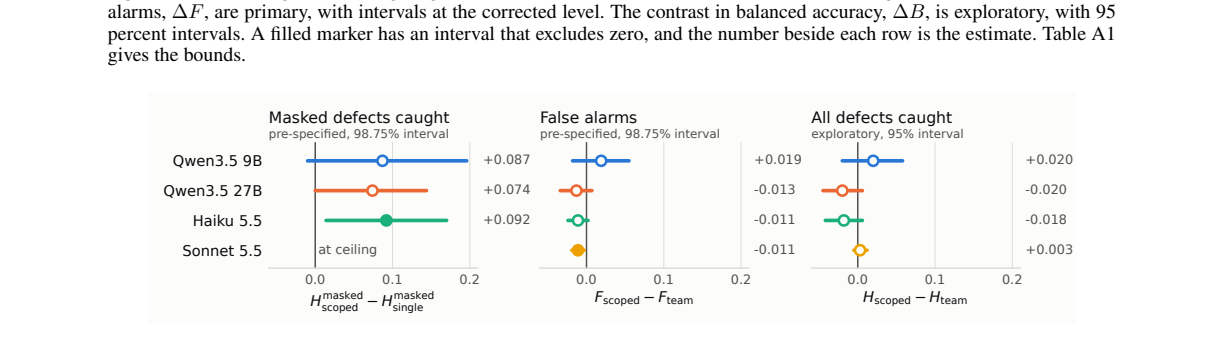
We test a narrow form of it in a controlled comparison of single-agent and multi-agent setups on a financial task, reviewing credit assessment memos against requirements. One agent checks six requirements in one call. A team of three on the same model checks the same memo, two requirements each, in the same words, with no roles or later stage. Labels are known for every requirement on 300 synthetic memos, so misses and false alarms are measured separately. Two primary predictions are tested on four models at a Bonferroni-corrected level. Under an instruction to decide each requirement once, the team catches 0.08 to 0.10 more of the defects that carry an explanation on the three models whose single agent misses some, at the corrected level on two. It raises more false alarms on all four, at the corrected level on three. Balanced accuracy, an exploratory measure, changes by 0.02 or less, and the team uses 2.2 to 2.4 times the tokens. Showing each agent the requirements it was not given reduces the added false alarms on the two Claude models, at the corrected level on one. In exploratory comparisons, sampling the single agent three times and flagging on any draw gives higher balanced accuracy than the team on those models, and the team's results depend on the instruction.
from the abstract
Pith says
Machine review · deepseek-v4-flash · 21 Oct 2026 · what was read was not recorded · not checked by a person
It can be wrong. Challenge this review or reply to it.
Holds up. Careful empirical comparison of single- vs. multi-agent LLM review, showing trade-off, but the primary results depend on an instruction that qualitatively changes outcomes on one model. This line is wrong
6 minor
How often objections from reviews like this one are right: not yet measured
Not checked: figures, code, what the 18 references say.
6 minor objections
The paper says, at Abstract
Pith says: minor objection 1 of 6
The phrase 'uses 2.2 to 2.4 times the tokens' is clear from context, but specifying 'of the single agent's tokens' would improve readability for a broader audience.
The paper says, at Section 3.4, Models and instruction
Pith says: minor objection 2 of 6
The decide-once instruction is introduced as a main condition for a measurement reason. A brief forward reference to Appendix C (where the preliminary run is described) would help the reader understand the motivation earlier.
show 4 more
The paper says, at Table 2, caption
Pith says: minor objection 3 of 6
The caption states 'All 300 memos, decide-once instruction.' The token ratio column K_a/K_single is defined in Section 3.5 but not restated here. Adding a footnote or parenthetical note that this ratio includes both input and output tokens would aid immediate comprehension.
The paper says, at Section 4.3, Repeated draws
Pith says: minor objection 4 of 6
The temperature confound on Qwen3.5 models is noted, but the sentence 'On Qwen3.5 9B the estimate is above zero, but on the Qwen3.5 models the comparison is confounded with temperature' appears twice. Consider consolidating the warning to avoid repetition.
The paper says, at Section 5, Threats to validity
Pith says: minor objection 5 of 6
The ranking of follow-up studies (instruction first, false-alarm measurement second, division third) is valuable. The paper could add a sentence indicating that the instruction study is underway or planned, if applicable.
The paper says, at Appendix A, Labels
Pith says: minor objection 6 of 6
The description of the three-source label verification is clear. It would be helpful to note explicitly that Claude Opus 5.5 is a larger model from the same family as the two Claude models tested, but not one of them; this is already stated but could be repeated for emphasis.
What would settle it
Run the full 300-memo comparison without the decide-once instruction on all arms (single agent, team, scoped team, three draws) using the same four models. If on Qwen3.5 27B the team's ΔF remains large (≥0.08) and ΔB is significantly negative (≤−0.02), then the primary claim that balanced accuracy changes by ≤0.02 does not replicate under the natural instruction-free condition, and the headline trade is narrower than reported.
from the skeptic's reading
How the review went
4 readings by deepseek-v4-flash · 21 Oct 2026
- Reader holds up
- Skeptic partly agrees
- Editor wrote the verdict above
- Referee accept: 6 minor
Not run on this paper: the simulated authors' defence.
Pith did not check this review's objections against the paper.
The review in full
The review in brief, machine-written
Pei,
Here's my read on 2610.27488.
What's new: a clean within-model comparison of single-agent and divided-agent LLM review on a financial compliance task, with ground-truth labels for every cell so both misses and false alarms are measured separately. No prior work supplies false-alarm rates on known-clean cells for a division without added stages, and the scoped-team arm is a useful control. The design is pre-registered, the analysis is transparent, and the limitations are stated explicitly.
Main result: under the decide-once instruction, the team catches 0.08–0.10 more masked defects on models below ceiling and raises false alarms on all four models. Balanced accuracy changes ≤0.02. So the trade-off is real but the net effect on a cost-weighted metric is small, which is useful for practitioners.
The soft spot is that the primary tests were all run under the decide-once instruction, added to avoid uneven call failures. On the 100-memo subset run without it, the team's advantage on Qwen3.5 27B disappears and its false-alarm excess more than triples. The paper flags this as the top threat to validity (Section 5) and ranks a full-memo replication without the instruction as the most important follow-up. So the central claim has been demonstrated only under a condition that interacts with division in nontrivial ways. That doesn't undo the results but limits their generality.
Other caveats (single pairing of requirements, short synthetic memos with high defect rate, ceiling effects on Sonnet 5.5) are acknowledged.
Recommendation: this paper deserves peer review. The measurement template is rigorous, the false-alarm data are new, and the transparency is a model for this kind of work. The biggest open question – robustness to the instruction – is already identified, and the authors could address it by running the full 300-memo set without the instruction. A desk reject would be a loss.
The strongest objection
The primary findings hold under the decide-once instruction, which was introduced after a preliminary run where Qwen3.5 27B failed to produce verdicts on ~6% of calls (Section 3.4, Appendix C). On the 100-memo subset run without it, the team's false alarm excess on Qwen3.5 27B more than triples (+0.123 vs +0.035) and its defect gain disappears (+0.004, not significant), making balanced accuracy significantly lower than the single agent's (Table 3). The paper itself ranks this as the top threat to validity (Section 5). Because the primary tests were all performed under this instruction, the central claim – that division trades false alarms for defects caught and the effects largely cancel – has been demonstrated only when the reviewer is explicitly told to decide each requirement once. The instruction was not part of the original design; it was added to prevent uneven call failures across arms. Without it, the trade-off changes qualitatively on at least one model. The full 300-memo comparison without the instruction has not been run, so the robustness of the primary finding to this plausible condition is an open empirical question.
The reader's weakest_assumption listed the decide-once instruction among several scope conditions, but did not single it out as a load-bearing threat that could alter the primary conclusion. The paper's own data show that removing the instruction changes the team's relative performance on Qwen3.5 27B from a near-cancelling trade to a clear loss in balanced accuracy. Because the primary results are conditional on a non-default instruction introduced for operational reasons, and because the instruction's interaction with division is itself a novel finding, the paper's strongest_claim should be read with that condition emphasized. However, the paper pre-registered the primary tests under the instruction, reports the conditional analysis honestly, and flags the threat explicitly. The reader's ACCEPT verdict is reasonable given the paper's transparency; no verdict change is needed. The stress-test merely refines the condition that carries the most weight for replication.
The referee's report
The study addresses a gap in the literature on multi-agent LLM systems by measuring misses and false alarms separately rather than reporting only accuracy. This allows the trade-off between detection gain and false-alarm cost to be sized. The design is methodologically strong: pre-registered predictions, Bonferroni correction, explicit scope conditions, and systematic testing of alternative explanations (scoped team, repeated draws, instruction effect). The results are relevant to practitioners building review systems and to researchers evaluating agent architectures. The paper's transparency about limitations and threats to validity sets a good standard for empirical work in this area.
Pith's reading of the paper (a machine's summary, not the authors')
The paper tests a practitioner rule that dividing a review task among multiple LLM agents improves performance. In a controlled experiment with 300 synthetic credit memos, a single agent checking six requirements in one call is compared to a team of three agents checking two requirements each, with no roles or later stage. Under a 'decide-once' instruction, the team catches 0.08 to 0.10 more masked defects on models below ceiling, but raises false alarms on all four models. Balanced accuracy, which weights misses and false alarms equally, changes by at most 0.02. The paper argues that dividing the work changes what is flagged rather than improving overall accuracy, and that the trade-off must be evaluated with known rates. Showing each agent the requirements it was not given reduces false alarms on some models.
What carries the argument. The key machinery is a controlled comparison of three arms: a single agent that checks all six requirements in one call, a team of three agents each checking two requirements (the fixed pairs of Table 1), and a scoped team where each agent also sees the other four requirements for context. All arms use the same model, the same prompt wording (except for the division and scoping), and the same decide-once instruction. The design isolates the effect of division from added roles, stages, or different models. The primary predictions are tested at a Bonferroni-corrected level of 98.75%.
Core claim. The paper's central finding is that under a decide-once instruction, dividing six requirements among three LLM agents trades false alarms for defects caught: on models below ceiling, the team's share of masked defects caught is 0.08 to 0.10 higher than the single agent's, while the false-alarm rate rises on all four models. Balanced accuracy moves by 0.02 or less, meaning the two errors largely cancel. The scoped team, which shows each agent the requirements it was not given, reduces false alarms on the two Claude models. Repeated sampling of the single agent (three draws, flag on any) gives higher balanced accuracy than the team on those models. The effect of division depends on the instruction: without it, the team's false-alarm excess grows and its balanced accuracy may fall.
The premise it rests on. The measured trade-off depends on the specific pairing of requirements (two per call, fixed pairs), the short synthetic memos with a defect rate of 37% of cells, and the decide-once instruction; generalization to longer documents with rare defects, different pairings, or standard reviewer instructions is unsupported by the study.
If the paper is right (Pith's inferences, not the authors')
Designers should measure miss and false-alarm rates separately for single and divided setups before adopting a multi-agent review, because the trade-off is specific to the model, the instruction, and the defect share of the setting.
Under the decide-once instruction, a divided review should be treated as a change in what is flagged, not as an unqualified improvement; its cost in false alarms should be weighed against the value of catching additional defects.
When the single agent misses some defects, sampling it three times and flagging on any draw can achieve higher balanced accuracy than a divided team, at least on some models, and may be a cheaper alternative.
The instruction given to the reviewer can reverse the effect of division: on one model the team's balanced accuracy was lower than the single agent's without the instruction but not significantly different with it.
Repeated draws of a single prompt vary as much as the team's gain on some models, so the stability of the single agent's verdicts should be assessed before concluding that division adds value.
The paper's results are consistent with the view that dividing a review without adding stages or specialized roles slides the operating point along a fixed decision curve rather than lifting it, as suggested by prior work on LLM judges.
The finding that repeated draws of the single agent can outperform the team suggests that the apparent benefit of division may partly be an artifact of giving multiple calls to the same prompt, not of dividing the task itself.
In real-world settings with rare defects (e.g., 1-2% of cells), the break-even cost of a miss relative to a false alarm is high (10-60 times), so a division that raises false alarms may be harmful unless the cost of missing a defect is extreme.
The scoped team's reduction in false alarms implies that some of the team's added flags stem from agents not knowing what other requirements cover, a design detail often overlooked in multi-agent architectures.
Check this review
Pith stored no record of this review's passes and took no fingerprint of it. Reviews made by code from 13 Nov 2026 on carry both.
How often reviews like this one are right
Reviews like this one: written by deepseek-v4-flash, where what was read was not recorded.
How often objections from reviews like this one are right: not yet measured
Reviews by people
This review was written by a machine. No person has reviewed this paper on Pith yet. A scientist listed on Pith can review it for a fee, and their review is published here whatever it concludes.
The paper
Abstract
Practitioner guidance holds that a large language model reviews a document better when the work is divided among agents. We test a narrow form of it in a controlled comparison of single-agent and multi-agent setups on a financial task, reviewing credit assessment memos against requirements. One agent checks six requirements in one call. A team of three on the same model checks the same memo, two requirements each, in the same words, with no roles or later stage. Labels are known for every requirement on 300 synthetic memos, so misses and false alarms are measured separately. Two primary predictions are tested on four models at a Bonferroni-corrected level. Under an instruction to decide each requirement once, the team catches 0.08 to 0.10 more of the defects that carry an explanation on the three models whose single agent misses some, at the corrected level on two. It raises more false alarms on all four, at the corrected level on three. Balanced accuracy, an exploratory measure, changes by 0.02 or less, and the team uses 2.2 to 2.4 times the tokens. Showing each agent the requirements it was not given reduces the added false alarms on the two Claude models, at the corrected level on one. In exploratory comparisons, sampling the single agent three times and flagging on any draw gives higher balanced accuracy than the team on those models, and the team's results depend on the instruction.
The paper's own sentences, arranged, kept beside the review and separate from it. Each label is drawn from a closed vocabulary; the number beside it is the probability the classifier gave that label. No sentence in this record was written by a model.
abstract compiled · 2026-10-21
The authors' main claim, as the classifier picked it out 0.51
“In exploratory comparisons, sampling the single agent three times and flagging on any draw gives higher balanced accuracy than the team on those models, and the team's results depend on the instruction.”
How the main claim is stated: asserted 0.97
What the abstract itself states, as probabilities: claims first 0.04 · states limitation 0.85 · human participants 0.03 · controlled comparison 0.96 · randomized assignment 0.04 · states quantitative result 0.99 · compares with prior results 0.90 · mentions code or data availability 0.03
The abstract, sentence by sentence
This table labels the abstract only (arXiv listing abstract v1). The number is the probability the classifier gave the label.
| Sentence | Role | The authors' own work | States the main conclusion | Strength |
|---|---|---|---|---|
| Practitioner guidance holds that a large language model reviews a document better when the work is divided among agents. | background 1.00 | 0.03 | 0.03 | asserted 0.92 |
| We test a narrow form of it in a controlled comparison of single-agent and multi-agent setups on a financial task, reviewing credit assessment memos against requirements. | contribution 0.77 | 0.94 | 0.03 | asserted 0.90 |
| One agent checks six requirements in one call. | method 1.00 | 0.84 | 0.02 | asserted 0.96 |
| A team of three on the same model checks the same memo, two requirements each, in the same words, with no roles or later stage. | method 0.99 | 0.91 | 0.02 | asserted 0.91 |
| Labels are known for every requirement on 300 synthetic memos, so misses and false alarms are measured separately. | method 1.00 | 0.90 | 0.02 | asserted 1.00 |
| Two primary predictions are tested on four models at a Bonferroni-corrected level. | method 0.95 | 0.88 | 0.03 | asserted 0.90 |
| Under an instruction to decide each requirement once, the team catches 0.08 to 0.10 more of the defects that carry an explanation on the three models whose single agent misses some, at the corrected level on two. | result 1.00 | 0.96 | 0.40 | asserted 1.00 |
| It raises more false alarms on all four, at the corrected level on three. | result 1.00 | 0.94 | 0.14 | asserted 1.00 |
| Balanced accuracy, an exploratory measure, changes by 0.02 or less, and the team uses 2.2 to 2.4 times the tokens. | result 1.00 | 0.96 | 0.17 | asserted 1.00 |
| Showing each agent the requirements it was not given reduces the added false alarms on the two Claude models, at the corrected level on one. | result 0.98 | 0.95 | 0.06 | asserted 1.00 |
| In exploratory comparisons, sampling the single agent three times and flagging on any draw gives higher balanced accuracy than the team on those models, and the team's results depend on the instruction. | result 0.96 | 0.95 | 0.21 | asserted 0.97 |
What kind of paper the classifier reports this is: empirical study 1.00 · evidence from observation or experiment 0.97
What was examined, and what was not
Sources read
- arXiv listing abstract v1
Not examined
- full text
- figures and tables
- references and citing sentences
- relations to other papers
Levels run
- P abstract
Not run
- S sections
- T body sentences
- C citations
- R cross-paper relations
How the labels were made
Compiled by classifier-1.13.0 via TypeSafe API, question bank abstract-p1-20260923, 2026-10-21: 1 request, 8,169 input tokens.
Every quoted sentence on this record is the authors'. Every label is from Pith's closed vocabulary, with the probability shown beside it. This record as JSON
Figures (3)
Figures are the authors', reproduced from the paper.
References (18)
- [3] MARG: Multi-Agent Review Generation for Scientific Pa- pers. arXiv:2401.04259. Fox, S.; Markham, L.; Lail, R.; and Karotsieris, M on PithPith's reviewarXiv
- [5] Towards a Science of Scaling Agent Systems. arXiv:2512.08296. Lee, Y.; Kim, J.; Kim, J.; Cho, H.; Kang, J.; Kang, P.; and Kim, N on PithPith's reviewarXiv
- [6] CheckEval: A Reliable LLM-as-a-Judge Framework for Evaluating Text Generation Using Check- lists. InProceedings of the 2025 Conference on Empirical Methods in Natural Language Processing, 15771–15798. Li, J.; Zhang, Q.; Yu, Y.; Fu, Q.; and Ye, D on Pith
- [7] More AgentsIsAllYouNeed.Transactions on Machine Learning Research. ArXiv:2402.05120. Li, Z.; Guo, Z.; Lu, X.; Wang, J.; Song, J.; Shen, C.; Wu, J.; and Sun, M on PithPith's reviewarXiv
- [8] OptArgus: A Multi-Agent System to De- tect Hallucinations in LLM-based Optimization Modeling. arXiv:2605.11738. Liu, W.; Zhao, R.; Yuan, W.; Xu, J.; Xu, Z.; Zhang, X.; and Ngai, E. C.-H on PithPith's reviewarXiv
- [9] Dude: A Dual-Detection Multi-AgentSystem forPaper-CodeDiscrepancyDetection. arXiv:2609.03416. To appear in Proceedings of the 2026 ConferenceonEmpiricalMethodsinNaturalLanguagePro- cessing. Peng, Y.; Qi, Y.; Xia, H.; He, G.; Shi, X.; Xuan, R.; Lu, S.; Liu, Y.; Hu, Z.; Liu, Y.;... on PithPith's reviewarXiv
- [10] Can LLM- as-a-Judge Reliably Verify Rubrics in Agentic Scenarios? arXiv:2606.29920. To appear in Proceedings of the 2026 ConferenceonEmpiricalMethodsinNaturalLanguagePro- cessing. Rao, D.; and Callison-Burch, C on PithPith's reviewarXiv
- [11] JEV vs. LLMs as Rubric Judges: Cheaper, Faster, and Wrong in the Same Places. arXiv:2609.29769. Schluntz, E.; and Zhang, B on PithPith's reviewarXiv
- [12] LLM Judges as Raters: A Pre- Registered Audit of Severity, Halo, Reliability, and Ver- sion Instability in LLM Essay Scoring on Public Corpora. arXiv:2608.29517. Teo, R. S. Y.; Yamada, Y.; Kotyan, S.; Imajuku, Y.; and Clanuwat, T on PithPith's reviewarXiv
- [13] Beyond Imitation: A Framework and BenchmarkforLLM-AssistedPeerReview.Transactions on Machine Learning Research. ArXiv:2610.11087. Tran, D.; and Kiela, D on PithPith's reviewarXiv
- [14] Single-Agent LLMs Outper- form Multi-Agent Systems on Multi-Hop Reasoning Under Equal Thinking Token Budgets. arXiv:2604.02460. Wang, X.; Wei, J.; Schuurmans, D.; Le, Q.; Chi, E. H.; Narang, S.; Chowdhery, A.; and Zhou, D on PithPith's reviewarXiv
- [16] Multi-Crit: Benchmarking Multimodal Judges on Pluralistic Criteria- Following. arXiv:2511.21662. To appear in Proceedings of the IEEE/CVF Conference on Computer Vision and Pattern Recognition on PitharXiv
- [17] When Do Multi-Agent Systems Help? An Information Bottleneck Perspective. arXiv:2607.16133. Zhang, H.; Cui, Z.; Chen, J.; Wang, X.; Zhang, Q.; Wang, Z.;Wu,D.;andHu,S.2025. StopOvervaluingMulti-Agent Debate—We Must Rethink Evaluation and Embrace Model Heterogeneity. arXiv:2502.0... on PithPith's reviewarXiv
- [18] The scoped team was run one day after the other arms. The first requirement in the single agent’s list is rotatedbymemoindexacrossthethreepairs,andeachdraw advances the rotation by one. Scoring rules.A missing verdict counts as a miss on a defect and as a flag on a clean cell.... on Pith
- [2023] Self- Consistency Improves Chain of Thought Reasoning in Lan- guage Models. InInternational Conference on Learning Representations. ArXiv:2203.11171. Xiong,T.;Ge,Y.;Li,M.;Zhang,Z.;Kulkarni,P.;Wang,K.; He,Q.;Zhu,Z.;Liu,C.;Chen,R.;Zheng,T.;Chen,Y.;Wang, X.; Zhang, R.; Chen, W.; ... on PithPith's reviewarXiv
- [2024] Are More LLM Calls All You Need?TowardstheScalingPropertiesofCompoundAISys- tems. InAdvances in Neural Information Processing Systems 37, 45767–45790. ArXiv:2403.02419. Chen, Y.; Niu, G.; Cheng, J.; Han, B.; and Sugiyama, M on PithPith's reviewarXiv
- [2025] When and Why Does Multi-Agent Debate Fail and Does It Really Underperform? arXiv:2510.20963. D’Arcy, M.; Hope, T.; Birnbaum, L.; and Downey, D on PithPith's reviewarXiv
- [2026] LLM Judges Verify Presence, Not Absence: Omission Blindness in AI Clinical Notes and What Recovers It. arXiv:2608.31016. He, Y.; Gu, Z.; Hu, Z.; Zhou, Y.; Shen, H.; Liang, J.; Dai, Z.;Ma,S.;Yu,F.;Xiao,Y.;andLi,Z.2026. AreLargeLan- guage Models Reliable Reviewers? A Benchmark f... on PithPith's reviewarXiv
Challenges and discussion
Disagree with the review, or know something it missed? Leave a comment, or challenge this review formally: a challenge becomes a permanent entry in this paper's record, and its decision is published here.
Come back by email
A short list of the week's newly reviewed papers. Nothing is sent until you confirm from your inbox, and every email has a link that stops it. No account.
No comments yet.
Sign in to comment