Artificial Intelligence · arXiv:2610.27572 v1 · submitted 20 Oct 2026 · 58 references
RaspAssistant as an Agentic Framework for Automating Adsorption Simulation Research in Porous Materials
The paper says
“Porous-material adsorption studies require coordinated structure preparation, force-field selection, simulation, validation, and interpretation, making end-to-end automation difficult. We test whether RaspAssistant, a hierarchical multi-agent framework, can carry an adsorption study from force-field preparation through validation and downstream separation analysis.”
more of the abstract
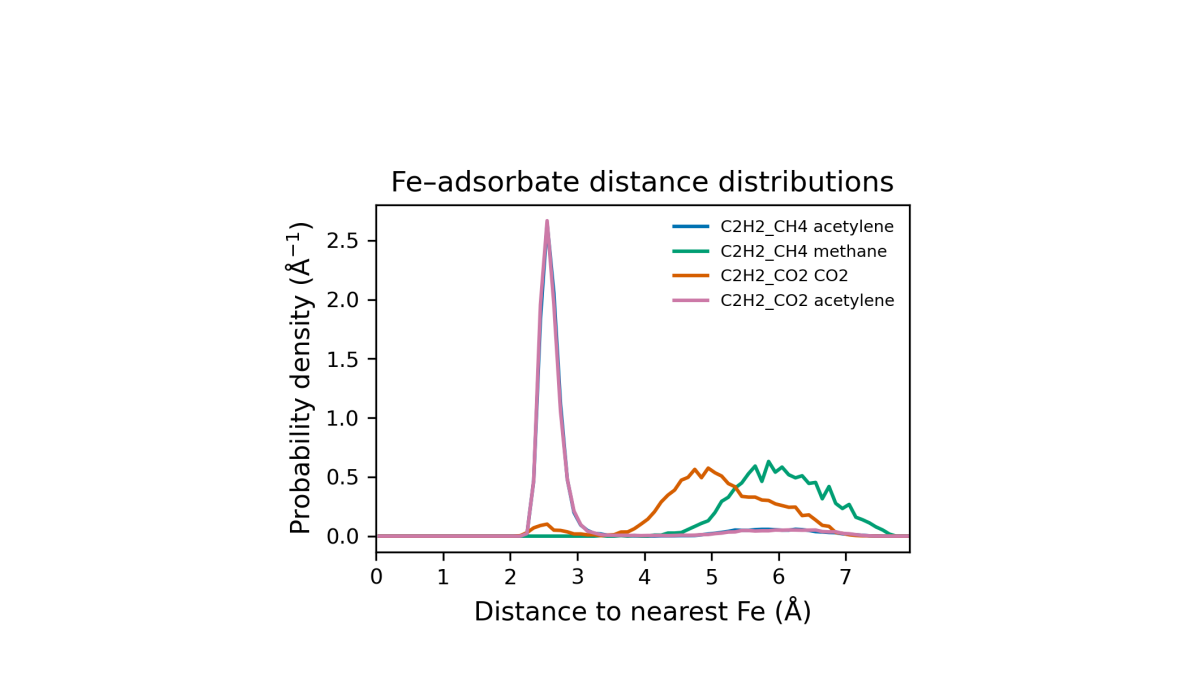
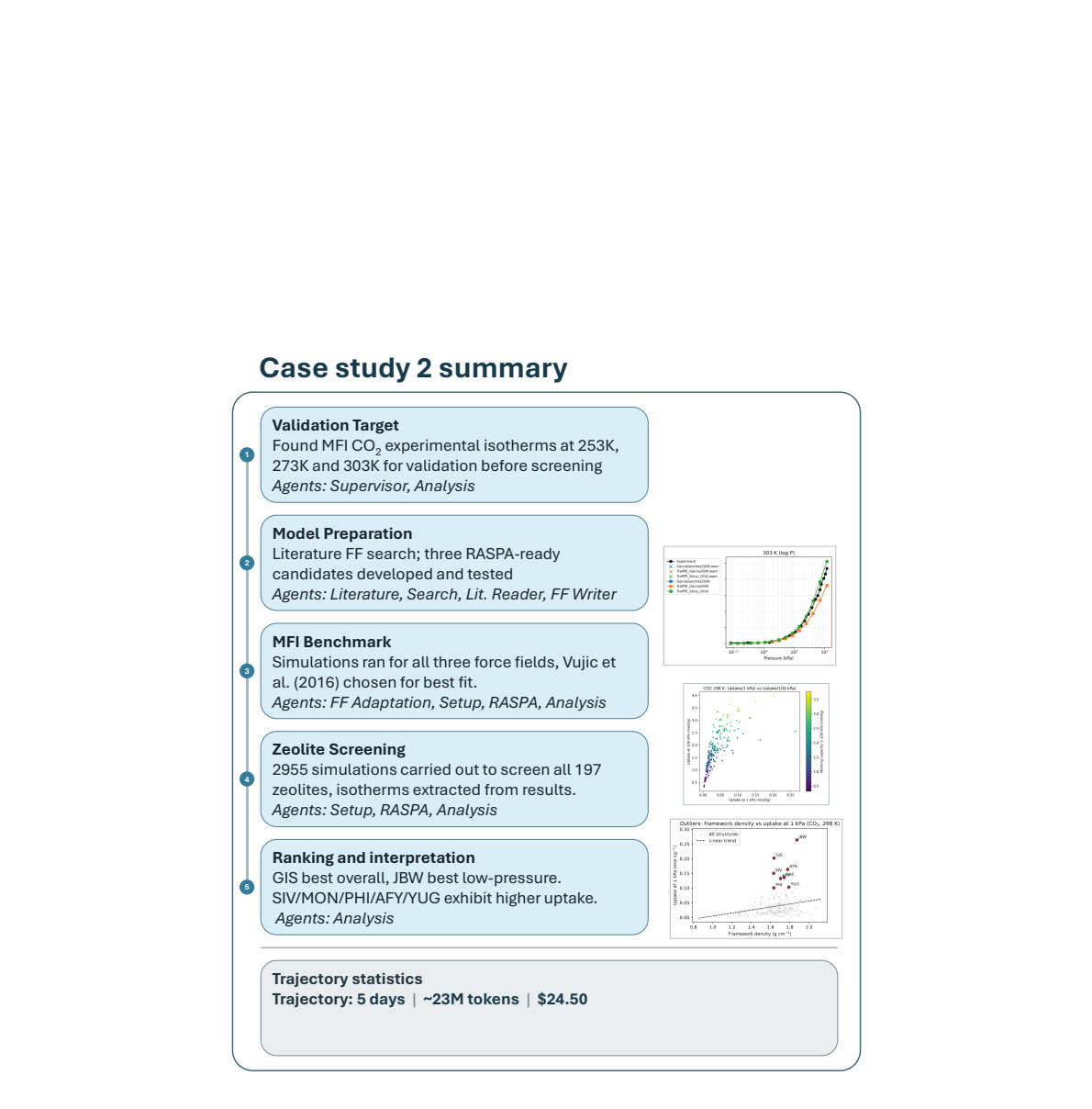
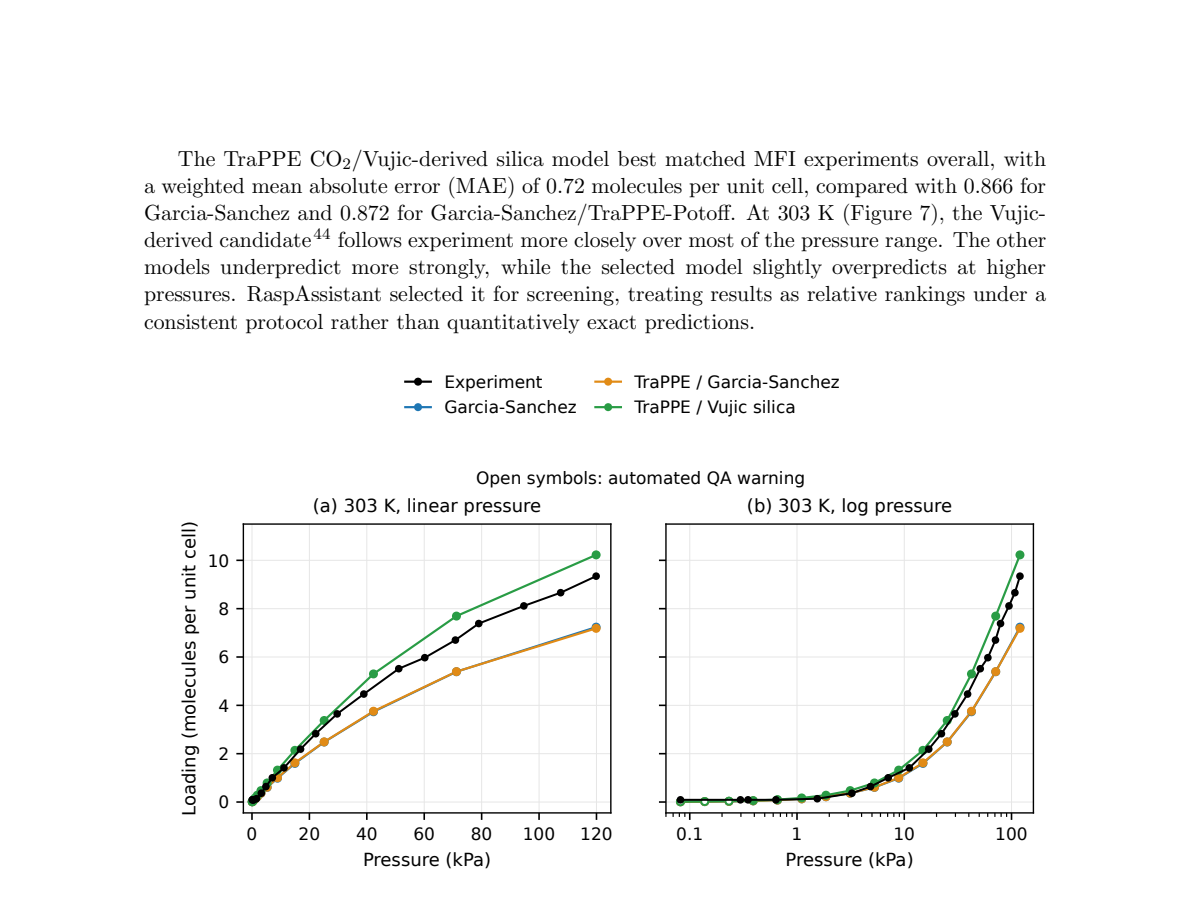
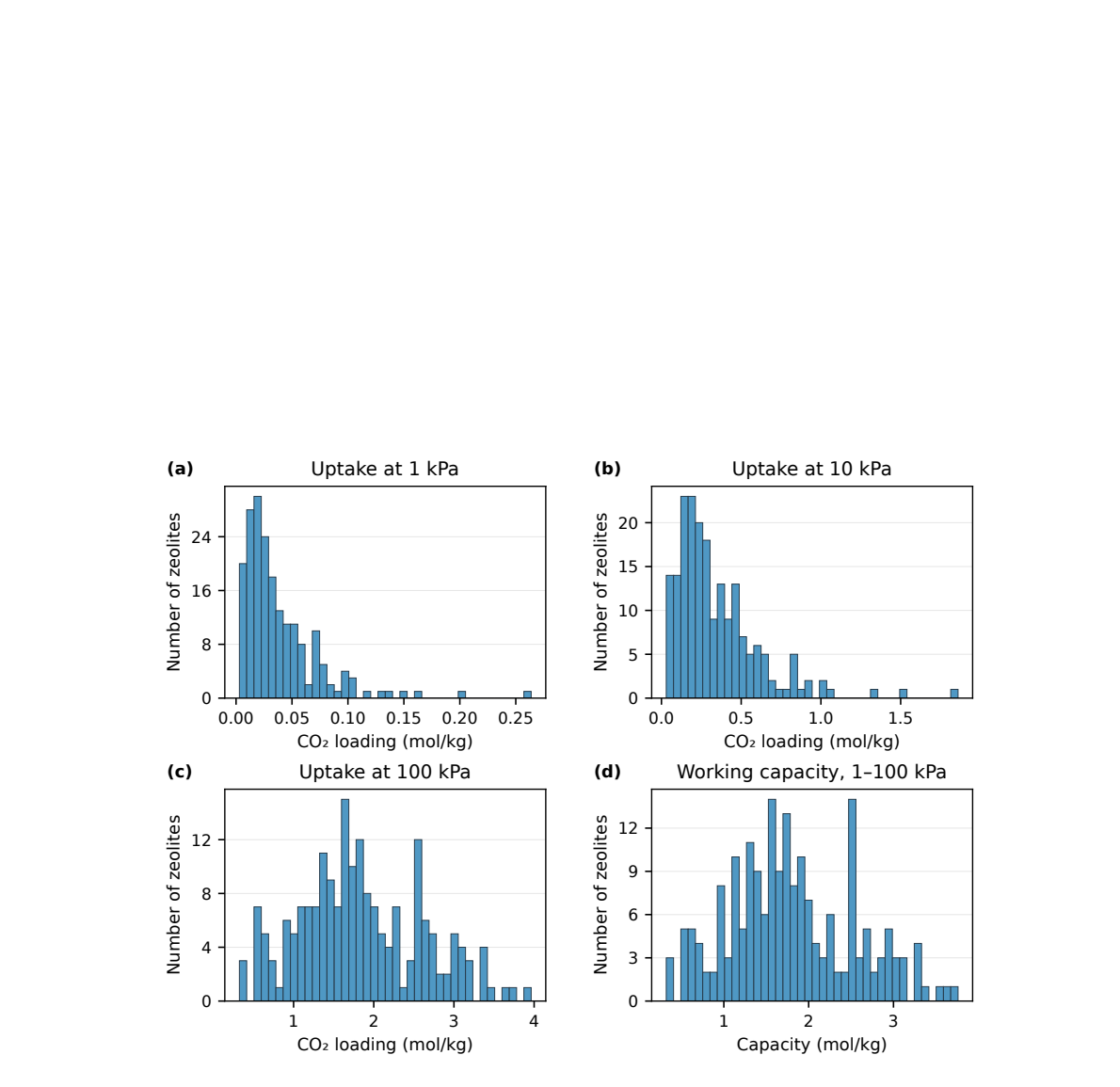
Across twelve multi-agent workflow-reproduction runs spanning four adsorption and separation benchmarks, overall scores ranged from 8.50 to 10.00 on a rubric evaluating workflow correctness, simulation validity, and analysis consistency. In a separate eight-case force-field extraction benchmark, the mean weighted score was 0.967, combining parameter agreement and RASPA readiness. In open-ended studies, the system diagnosed and refined an acetylene force field and, after validating a CO2 force field against MFI experiments, screened 197 pure-silica zeolites that passed automated input checks. These results demonstrate autonomous workflow execution after task specification and input provision: RaspAssistant coordinates, validates, adapts, and documents extended adsorption-simulation workflows while exposing model sensitivity and methodological limitations for expert review.
from the abstract
Pith says
Machine review · deepseek-v4-flash · 21 Oct 2026 · what was read was not recorded · not checked by a person
It can be wrong. Challenge this review or reply to it.
The passes disagreed. Reader: holds up. Skeptic: holds up only with conditions. Referee: minor revision.
RaspAssistant builds a credible case for autonomous adsorption simulation workflows, but the evaluation's dependence on a single non-independent assessor leaves room for skepticism. This line is wrong
2 major objections · 5 minor
How often objections from reviews like this one are right: not yet measured
Not checked: figures, code, what the 58 references say.
The paper says, at SI §5, Tables S1–S4, §3.4
The review did not quote this passage.
Pith says: Objection 1 of 2 · major
The workflow-reproduction scores are assigned by one human assessor, with no disclosure of whether this assessor was independent of the research team or blind to the intended conclusions. Subjectivity in scoring complex, multi-step workflows (e.g., the 40/40/20 rubric for correctness, validity, and consistency) can lead to systematic leniency, and the reported overall average of 9.13/10 is consistent with that concern.
more of objection 1
This vulnerability is load-bearing because the quantitative score range is used to support the central claim of autonomous execution. The authors should either (a) provide evidence of independence and blindness, (b) report a second, blinded scorer’s results, or (c) explicitly discuss the potential for assessor bias and explain why the scores remain interpretable despite this limitation. I note that the paper acknowledges other limitations honestly (e.g., descriptor gap, model sensitivity) but does not address this one.
The paper says, at §2.1, Table 1, §3.2.3
The review did not quote this passage.
Pith says: Objection 2 of 2 · major
The single-agent baseline comparison (4 runs, scores 6.78–9.05) is described as 'descriptive' and 'not model-, token-, or cost-matched', which is appropriate. However, the text presents multi-agent scores as consistently higher, and readers may infer architectural superiority despite the unmatched inference budgets and model mixes. The authors should explicitly state that the baseline does not support a controlled ablation conclusion, or add a sentence clarifying what can and cannot be concluded from this comparison.
5 minor objections
The paper says, at SI §5.2.1 (Study 2 prompt)
Pith says: minor objection 1 of 5
The selectivity expression in the supplied task prompt reads 'S = (x_CO2/ x_N2) / (y_CO2/y_N2)' rather than the correct C2H2/CO2 and C2H2/CH4 labels. This is a copy-paste error from the TAMOF-1 prompt; the authors should correct the prompt to avoid confusion, even if the agents interpreted it correctly.
The paper says, at Table 1, §2.1
Pith says: minor objection 2 of 5
The benchmark labelled 'Acetylene' would be more informative if renamed to 'C2H2/CO2 and C2H2/CH4 separation (open-metal-site MOFs)' for consistency with the text and the other benchmark names.
show 3 more
The paper says, at Figure 2
Pith says: minor objection 3 of 5
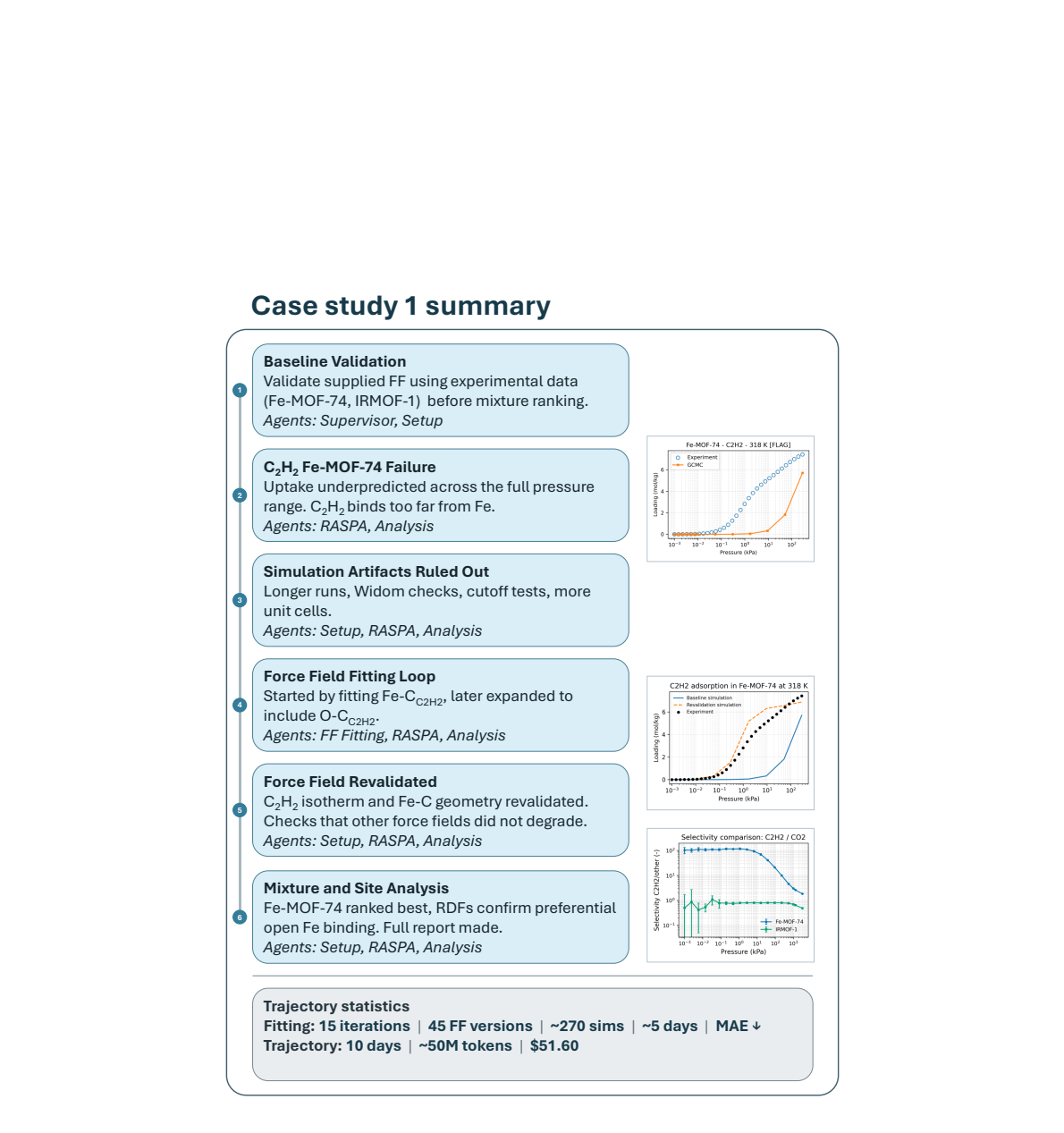
The schematic of the Case Study 1 workflow is very helpful, but the font size in the figure appears small; consider enlarging it for readability in print or screen viewing.
The paper says, at §3 (Discussion)
Pith says: minor objection 4 of 5
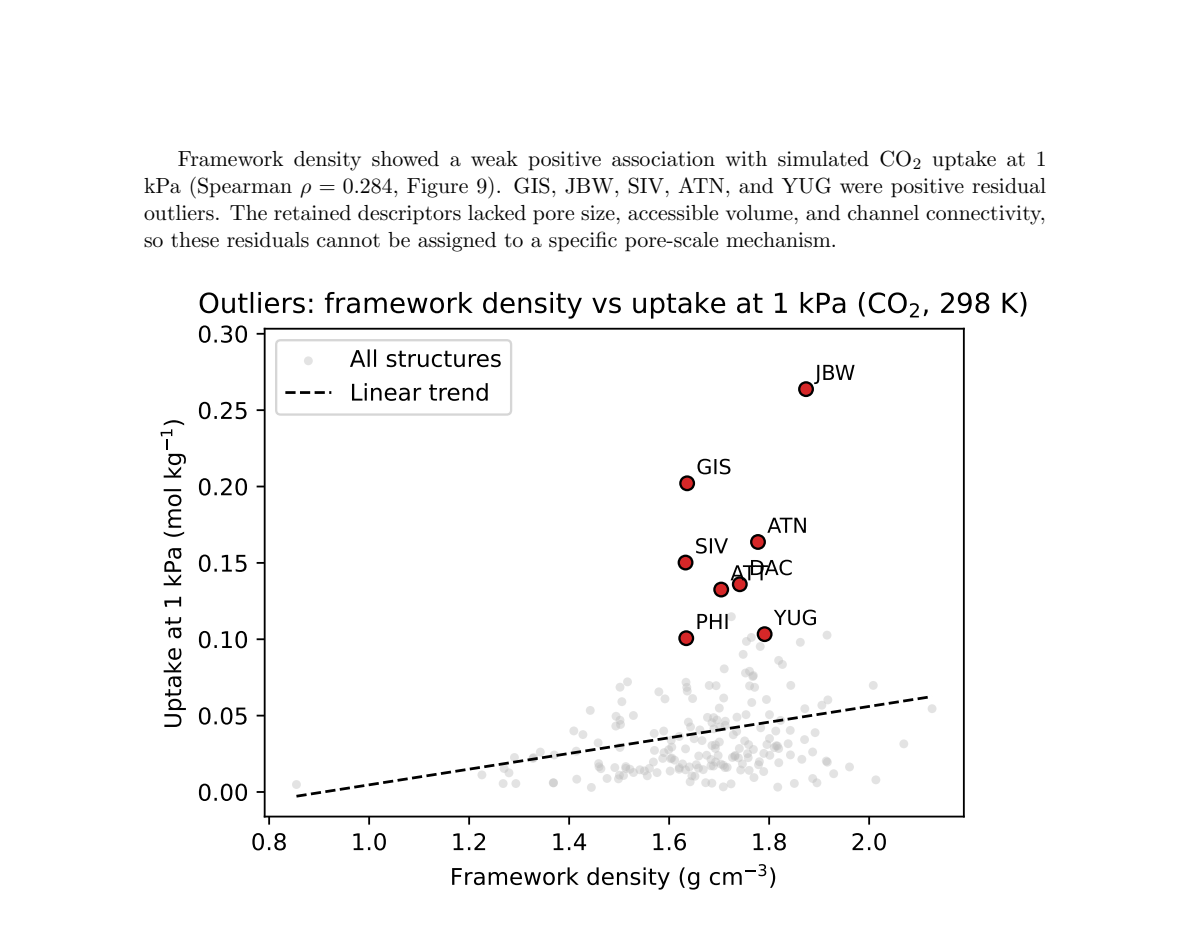
The paper notes that 'the retained descriptors lacked pore size, accessible volume, and channel connectivity' and mentions Zeo++ as a future extension. Adding a brief sentence about how such geometric descriptors would connect to the screening results (e.g., enabling identification of confinement-driven outliers) would strengthen the forward-looking discussion that is already present in the last paragraph.
The paper says, at §5 (Methods) and Data Availability
Pith says: minor objection 5 of 5
The code is not publicly released; the authors state it is available confidentially to editors and reviewers. Given the journal's likely reproducibility expectations, the authors should clarify whether the frozen code and prompts will be released upon publication, and if not, whether the detailed workflow records on Zenodo are sufficient to reproduce the central results independently.
What would settle it
Commission a second assessor, blinded to the original scores and unaffiliated with the authors, to independently re-score all 12 multi-agent workflow-reproduction runs (SI §3.2, Tables S1–S4) using the same detailed rubrics (SI Tables S6, S8, S9, S10–S13). Compute the mean absolute difference in overall score per run and Cohen's kappa for inter-rater agreement. If the mean absolute difference exceeds 0.5 points or Cohen's kappa falls below 0.70 (substantial agreement), the reported scores are not robust and the central claim weakens.
from the skeptic's reading
How the review went
4 readings by deepseek-v4-flash · 21 Oct 2026
- Reader holds up
- Skeptic partly agrees: says it holds up only with conditions Single-assessor scoring without stated independence is the most load-bearing vulnerability; a blinded second-scorer check would determine robustness.
- Editor wrote the verdict above
- Referee minor revision: 2 major objections, 5 minor
Not run on this paper: the simulated authors' defence.
Pith did not check this review's objections against the paper.
The review in full
The review in brief, machine-written
This paper is a serious effort to automate end-to-end adsorption simulation studies. It goes beyond input generation by showing coordination, validation, and adaptation across multiple stages: force-field selection, experimental validation, pure-component and mixture simulations, and breakthrough analysis. The force-field extraction benchmark is thorough, and the two open-ended case studies demonstrate real diagnostic and fitting capability—especially the acetylene force-field refinement, which shows the system can identify model inadequacy, propose corrections, and validate them independently.
The evaluation is well-designed: detailed rubrics, multiple runs per benchmark, honest discussion of limitations (descriptor gaps, experiment-cost awareness, model sensitivity). The authors are upfront about what they did and did not test.
The most load-bearing vulnerability is the single-assessor scoring. The SI states that one human assessor scored the runs, with no mention of independence or blinding. The scores are high (8.50–10.00), and in the absence of a second independent rater, it is difficult to rule out unconscious leniency. I would not call this fatal—the case studies provide qualitative evidence that stands on its own—but it weakens the precision of the quantitative claims. A blinded second scorer would settle the question.
Other soft spots: the code is not released (only confidential upon request), the architectural baseline is descriptive rather than controlled, and the sample size (three runs per benchmark) is modest. These are acknowledged or inherent to the setting.
Who this is for: researchers in agentic scientific AI, computational materials screening, and anyone building LLM-based simulation pipelines. The paper provides a concrete template for evaluation and honest reporting.
Recommendation: send to peer review. The work is novel and empirically grounded. Referees should ask for independent scoring and code release, but the core contribution is solid enough to warrant publication with those additions.
The strongest objection
The central claim of autonomous workflow execution is primarily supported by rubric scores assigned by one human assessor (SI §5, §5.1). The manuscript does not disclose whether the assessor was independent of the research team or blind to the intended conclusions. Without independence, scores could be consciously or unconsciously lenient, especially for borderline cases. The overall average of 9.13/10 and run-level scores of 8.50–10.00 are consistent with such leniency. Although the rubrics are detailed (SI Tables S6–S13), their application is inherently subjective: the assessor judges workflow correctness, simulation validity, and analysis consistency across multiple criteria. The single-assessor design means there is no check on systematic bias. This is load-bearing because if scores are inflated, the demonstration of autonomy is weaker than claimed. The authors acknowledge other limitations but do not address assessor independence.
The reader's weakest assumption concerned LLM correctness across limited runs. That is related but distinct — it focuses on the capabilities of the model, not the objectivity of the evaluation. My concern is about the evidence base itself: if scores are biased, even perfect LLM reasoning would not be correctly assessed. The paper's scoring procedure is thorough, but single-assessor, non-blinded evaluation is a standard methodological vulnerability. The proposed test is concrete, feasible, and would directly settle whether the scores are reliable. I recommend conditional acceptance because the concern is addressable: if independent scoring confirms the original results, the verdict stands; if not, the claim must be tempered.
The referee's report
If the results hold, this work represents a substantial advance in autonomous computational materials science. RaspAssistant connects literature-derived interaction models, experimental validation, atomistic simulation, and process-level analysis within a coordinated research workflow, addressing a gap left by agentic systems that focus on single stages. The open-ended case studies demonstrate adaptive decision-making: the system diagnosed an inadequate force field, carried out a multi-stage fitting campaign, and then used the refined model for downstream mixture and site analysis. The force-field extraction benchmark shows high fidelity in converting published parameters into runnable inputs, a common bottleneck. The modular architecture and detailed supporting records facilitate expert review and future extension to other simulation packages or material classes.
Pith's reading of the paper (a machine's summary, not the authors')
The paper introduces RaspAssistant, a multi-agent system that uses large language models to autonomously plan, execute, validate, and adapt the full pipeline of adsorption simulations in porous materials. Across 12 workflow-reproduction runs covering four published studies, the system scored between 8.50 and 10.00 out of 10 on a rubric that evaluates workflow correctness, simulation validity, and analysis consistency. In eight force-field extraction cases it achieved a mean weighted score of 0.967, and in two open-ended studies it independently refined a force field for acetylene in open-metal-site MOFs and screened 197 pure-silica zeolites for CO₂ adsorption after experimental validation. The authors argue that the framework demonstrates autonomous coordination across coupled simulation stages, leaving expert review to focus on model sensitivity and scientific conclusions rather than routine execution.
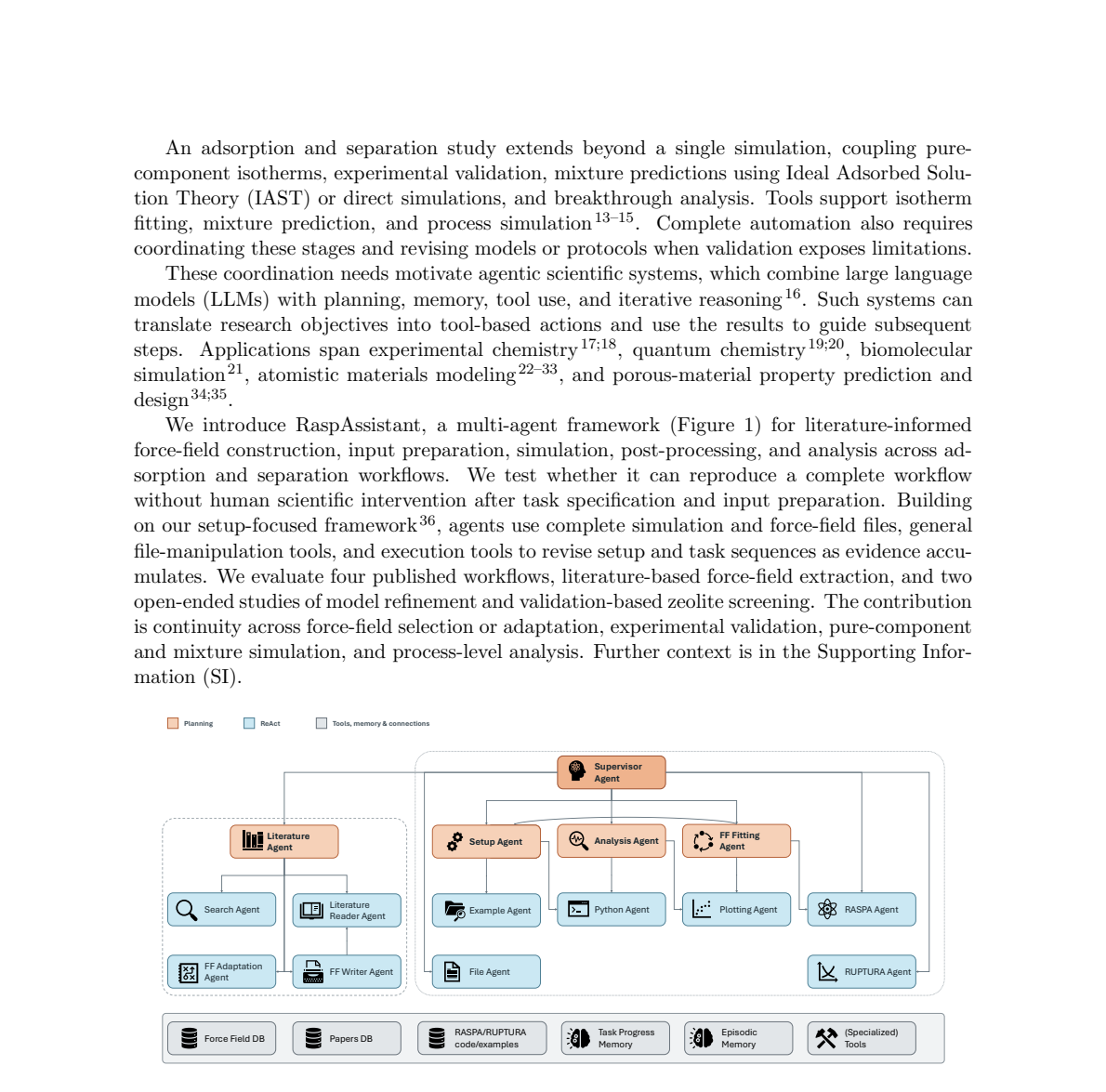
What carries the argument. The key is the hierarchical multi-agent architecture: a Supervisor agent decomposes the research objective into subtasks and delegates to specialist agents (Setup, RASPA, Analysis, FF Fitting, Literature, etc.). High-level agents use iterative plan–execute–verify–replan reasoning, while lower-level agents use the ReAct paradigm (reasoning–acting loops) with file access, simulation backends (RASPA 2.0.47, RUPTURA), and structured memory. A force-field fitting harness enforces a controlled parameter-selection → simulation → analysis → continuation loop. The design allows agents to modify complete input files rather than select from predefined schemas, enabling adaptation to unanticipated situations.
Core claim. RaspAssistant can carry an extended adsorption study from literature-informed force-field construction or adaptation through experimental validation, pure-component and mixture simulation, and process-level analysis (breakthrough, IAST) without human scientific intervention after the task and input data are provided. The system combines a hierarchical supervisor that plans and verifies with specialist agents that execute, analyse, and revise. It demonstrates that an LLM-based multi-agent architecture can preserve scientific context across coupled simulation stages and make adaptive decisions—such as expanding a force-field fitting space when initial attempts fail—while exposing methodological limitations for expert judgement.
The premise it rests on. The LLM agents (primarily GPT-5 family) will make correct scientific decisions and interpretations—such as diagnosing force-field errors, selecting appropriate simulation parameters, and interpreting validation mismatches—without human intervention, across the variety of cases encountered in multi-step adsorption workflows.
If the paper is right (Pith's inferences, not the authors')
Force-field extraction from literature can be automated with high fidelity (mean parameter IoU 0.983), removing a major bottleneck in preparing simulation inputs.
Computational screening of porous materials can be preceded by automated experimental validation of candidate force fields, increasing confidence in rankings.
The hierarchical agent design can be extended to other simulation domains (e.g., DFT, MD) where the workflow requires sequential decision-making and revision based on intermediate results.
Reproducibility of computational adsorption studies can be improved because the framework records every step, decision, and output in auditable workflow records.
RaspAssistant's ability to detect force-field inadequacy and conduct a multi-parameter fitting campaign suggests a route toward autonomous model development for complex host–guest systems.
The paper implicitly shows that the main remaining bottleneck for full automation is not execution but scientific validation: the system can produce plausible results that still require expert review of model sensitivity and methodological soundness.
A natural next step is to connect the framework to geometric pore-characterization tools (e.g., Zeo++) and uncertainty-quantification routines, which would let screening results be interpreted in terms of pore-scale mechanism rather than simple density correlations.
Because the LLM agents make all planning and interpretation decisions, performance will likely vary with LLM version and prompt design; the descriptive baseline does not isolate which architectural choices matter most, so systematic ablation studies would clarify the design principles.
The limited sample of 12 workflow runs and two case studies means the reliability of the framework on entirely new classes of porous materials or simulation types remains untested; extending the benchmark suite is the most direct path to building trust.
Check this review
Pith stored no record of this review's passes and took no fingerprint of it. Reviews made by code from 13 Nov 2026 on carry both.
How often reviews like this one are right
Reviews like this one: written by deepseek-v4-flash, where what was read was not recorded.
How often objections from reviews like this one are right: not yet measured
Reviews by people
This review was written by a machine. No person has reviewed this paper on Pith yet. A scientist listed on Pith can review it for a fee, and their review is published here whatever it concludes.
The paper
Abstract
Porous-material adsorption studies require coordinated structure preparation, force-field selection, simulation, validation, and interpretation, making end-to-end automation difficult. We test whether RaspAssistant, a hierarchical multi-agent framework, can carry an adsorption study from force-field preparation through validation and downstream separation analysis. Across twelve multi-agent workflow-reproduction runs spanning four adsorption and separation benchmarks, overall scores ranged from 8.50 to 10.00 on a rubric evaluating workflow correctness, simulation validity, and analysis consistency. In a separate eight-case force-field extraction benchmark, the mean weighted score was 0.967, combining parameter agreement and RASPA readiness. In open-ended studies, the system diagnosed and refined an acetylene force field and, after validating a CO2 force field against MFI experiments, screened 197 pure-silica zeolites that passed automated input checks. These results demonstrate autonomous workflow execution after task specification and input provision: RaspAssistant coordinates, validates, adapts, and documents extended adsorption-simulation workflows while exposing model sensitivity and methodological limitations for expert review.
The paper's own sentences, arranged, kept beside the review and separate from it. Each label is drawn from a closed vocabulary; the number beside it is the probability the classifier gave that label. No sentence in this record was written by a model.
abstract compiled · 2026-10-21
The authors' main claim, as the classifier picked it out 1.00
“These results demonstrate autonomous workflow execution after task specification and input provision: RaspAssistant coordinates, validates, adapts, and documents extended adsorption-simulation workflows while exposing model sensitivity and methodological limitations for expert review.”
How the main claim is stated: asserted 1.00
What the abstract itself states, as probabilities: claims first 0.04 · states limitation 0.86 · human participants 0.04 · controlled comparison 0.06 · randomized assignment 0.02 · states quantitative result 0.99 · compares with prior results 0.10 · mentions code or data availability 0.04
The abstract, sentence by sentence
This table labels the abstract only (arXiv listing abstract v1). The number is the probability the classifier gave the label.
| Sentence | Role | The authors' own work | States the main conclusion | Strength |
|---|---|---|---|---|
| Porous-material adsorption studies require coordinated structure preparation, force-field selection, simulation, validation, and interpretation, making end-to-end automation difficult. | background 0.91 | 0.07 | 0.02 | asserted 1.00 |
| We test whether RaspAssistant, a hierarchical multi-agent framework, can carry an adsorption study from force-field preparation through validation and downstream separation analysis. | contribution 0.95 | 0.83 | 0.05 | hedged possibility 0.53 |
| Across twelve multi-agent workflow-reproduction runs spanning four adsorption and separation benchmarks, overall scores ranged from 8.50 to 10.00 on a rubric evaluating workflow correctness, simulation validity, and analysis consistency. | result 1.00 | 0.95 | 0.13 | asserted 1.00 |
| In a separate eight-case force-field extraction benchmark, the mean weighted score was 0.967, combining parameter agreement and RASPA readiness. | result 1.00 | 0.94 | 0.05 | asserted 1.00 |
| In open-ended studies, the system diagnosed and refined an acetylene force field and, after validating a CO$_2$ force field against MFI experiments, screened 197 pure-silica zeolites that passed automated input checks. | result 0.93 | 0.92 | 0.08 | asserted 1.00 |
| These results demonstrate autonomous workflow execution after task specification and input provision: RaspAssistant coordinates, validates, adapts, and documents extended adsorption-simulation workflows while exposing model sensitivity and methodological limitations for expert review. | interpretation 1.00 | 0.90 | 0.91 | asserted 1.00 |
What kind of paper the classifier reports this is: method or tool 0.99 · evidence from simulation or computation 0.93
What was examined, and what was not
Sources read
- arXiv listing abstract v1
Not examined
- full text
- figures and tables
- references and citing sentences
- relations to other papers
Levels run
- P abstract
Not run
- S sections
- T body sentences
- C citations
- R cross-paper relations
How the labels were made
Compiled by classifier-1.13.0 via TypeSafe API, question bank abstract-p1-20260923, 2026-10-21: 1 request, 5,119 input tokens.
Every quoted sentence on this record is the authors'. Every label is from Pith's closed vocabulary, with the probability shown beside it. This record as JSON
Figures (9)
Figures are the authors', reproduced from the paper.
References (58)
- [1] Dral, P. O.; Nawaz, H.; Ullah, A. Science Done on a Machine by a Machine: AI Agents in Computational Chemistry.arXiv preprint arXiv:2608.185082026, DOI: 10.48550/arXiv.2608.18508 on PithPith's reviewarXivdoi:10.48550/arxiv.2608.18508
- [2] Bran, A. M.; Cox, S.; Schilter, O.; Baldassari, C.; White, A. D.; Schwaller, P. Augmenting large language models with chemistry tools.Nature Machine Intelligence2024,6, 525–535, DOI:10.1038/s42256-024-00832-8 on Pithdoi:10.1038/s42256-024-00832-8
- [3] Boiko, D. A.; MacKnight, R.; Kline, B.; Gomes, G. Autonomous chemical research with large language models.Nature2023,624, 570–578, DOI:10.1038/s41586-023-06792-0 on Pithdoi:10.1038/s41586-023-06792-0
- [4] Burger, B.; Maffettone, P. M.; Gusev, V. V.; Aitchison, C. M.; Bai, Y.; Wang, X.; Li, X.; Alston, B. M.; Li, B.; Clowes, R. et al. A mobile robotic chemist.Nature2020,583, 237–241 on Pith
- [5] Abolhasani, M.; Kumacheva, E. The rise of self-driving labs in chemical and materials sciences.Nature Synthesis2023,2, 483–492 on Pith
- [6] Szymanski, N. J.; Rendy, B.; Fei, Y.; Kumar, R. E.; He, T.; Milsted, D.; McDer- mott, M. J.; Gallant, M.; Cubuk, E. D.; Merchant, A. et al. An autonomous labora- tory for the accelerated synthesis of inorganic materials.Nature2023,624, 86–91, DOI: 10.1038/s41586-023-06734-w on Pithdoi:10.1038/s41586-023-06734-w
- [7] Zou, Y.; Cheng, A. H.; Aldossary, A.; Bai, J.; Leong, S. X.; Campos-Gonzalez-Angulo, J. A.; Choi, C.; Ser, C. T.; Tom, G.; Wang, A. et al. El Agente: An autonomous agent for quantum chemistry.Matter2025,8, 102263, DOI:10.1016/j.matt.2025.102263 on Pithdoi:10.1016/j.matt.2025.102263
- [8] Gustin, I.; Calder´ on, L. M.; P´ erez-S´ anchez, J. B.; Gonthier, J. F.; Nakamura, Y.; Pan- icker, K.; Ramprasad, M.; Zhang, Z.; Zou, Y.; Bernales, V. et al. El Agente Cuan- tico: Automating quantum simulations.arXiv preprint arXiv:2512.188472025, DOI: 10.48550/arXiv.2512.18847 on Pithdoi:10.48550/arxiv.2512.18847
- [9] Choi, C.; Zou, Y.; M¨ uller, M.; Hao, H.; Kang, Y.; P´ erez-S´ anchez, J. B.; Gustin, I.; Xu, H.; Wang, A.; Vakili, M. G. et al. El agente estructural: An artificially intelligent molecular editor.arXiv preprint arXiv:2602.048492026, on Pith
- [10] P´ erez-S´ anchez, J. B.; Zou, Y.; Campos-Gonzalez-Angulo, J. A.; M¨ uller, M.; Gustin, I.; Wang, A.; Hao, H.; Ko, T. W.; Choi, C.; Isbrandt, E. S. et al. El Agente Quntur: A research collaborator agent for quantum chemistry.arXiv preprint arXiv:2602.048502026, on Pith
- [11] Wang, Z.; Huang, H.; Zhao, H.; Xu, C.; Zhu, S.; Janssen, J.; Viswanathan, V. DREAMS: Density functional theory based research engine for agentic materials simulation.arXiv preprint arXiv:2507.142672025, on Pith
- [12] Liu, J.; Zhu, T.; Ye, C.; Fang, Z.; Weng, H.; Wu, Q. V ASPilot: MCP-facilitated multi-agent intelligence for autonomous V ASP simulations.Chinese Physics B2025,34, 117106, DOI: 10.1088/1674-1056/ae0681 on Pithdoi:10.1088/1674-1056/ae0681
- [13] Rothfarb, S.; Davis, M. C.; Matanovic, I.; Li, B.; Holby, E. F.; Kort-Kamp, W. J. Hierarchical Multi-agent Large Language Model Reasoning for Autonomous Het- erogeneous Catalyst Discovery.npj Computational Materials2026,12, 309, DOI: 10.1038/s41524-026-02139-1. 46 on Pithdoi:10.1038/s41524-026-02139-1
- [14] Chaudhari, A.; Ock, J.; Barati Farimani, A. Modular large language model agents for multi-task computational materials science.Communications Materials2026,7, 131, DOI: 10.1038/s43246-025-00994-x on Pithdoi:10.1038/s43246-025-00994-x
- [15] Liu, G.; Yang, S.; Zhong, Y. Masgent: an AI-assisted materials simulation agent.Digital Discovery2026,5, 2151–2171, DOI:10.1039/D6DD00043F on Pithdoi:10.1039/d6dd00043f
- [16] Vriza, A.; Kornu, U.; Koneru, A.; Chan, H.; Sankaranarayanan, S. K. R. S. Multi-agentic AI framework for end-to-end atomistic simulations.Digital Discovery2026,5, 440–452, DOI:10.1039/D5DD00435G on Pithdoi:10.1039/d5dd00435g
- [17] Somasundaram, R.; Habib, A.; Dang, K.; Shivakumar, S.; Hill, R. G.; Wim- mer, G.; Mishra, A.; Pachalieva, A.; Lui, A.; Viswanathan, H. et al. An Agentic Orchestration of Atomistic Simulations.arXiv preprint arXiv:2607.225962026, DOI: 10.48550/arXiv.2607.22596 on PithPith's reviewarXivdoi:10.48550/arxiv.2607.22596
- [18] Huang, H.; Li, Y.; Xu, A.; Liu, B.; Wang, C.; Tang, K.; Yang, N.; Liu, S.; Liu, H.; Zhang, P. et al. ALKEMIE Agent: an autonomous platform for computational materials design.arXiv preprint arXiv:2608.157762026, DOI:10.48550/arXiv.2608.15776 on PithPith's reviewarXivdoi:10.48550/arxiv.2608.15776
- [19] Yang, F.; Evans, J. D. QUASAR: A universal autonomous system for atomistic simulation and a benchmark of its capabilities.Journal of Chemical Information and Modeling2026, 66, 5911–5918, DOI:10.1021/acs.jcim.6c00295 on Pithdoi:10.1021/acs.jcim.6c00295
- [20] Ghafarollahi, A.; Buehler, M. J. Automating alloy design and discovery with physics-aware multimodal multiagent AI.Proceedings of the National Academy of Sciences2025,122, e2414074122, DOI:10.1073/pnas.2414074122 on Pithdoi:10.1073/pnas.2414074122
show 38 more
- [21] Shi, Z.; Xin, C.; Huo, T.; Jiang, Y.; Wu, B.; Chen, X.; Qin, W.; Ma, X.; Huang, G.; Wang, Z.; Jing, X. A fine-tuned large language model based molecular dynamics agent for code generation to obtain material thermodynamic parameters.Scientific Reports2025, 15, 10295, DOI:10.103... on Pithdoi:10.1038/s41598-025-92337-6
- [22] Pham, T. D.; Tanikanti, A.; Ke¸ celi, M. ChemGraph as an agentic framework for computational chemistry workflows.Communications Chemistry2026,9, 33, DOI: 10.1038/s42004-025-01776-9 on Pithdoi:10.1038/s42004-025-01776-9
- [23] Soleymanibrojeni, M.; Aydin, R.; Guedes-Sobrinho, D.; Dias, A. C.; Piotrowski, M. J. et al. GENIUS: an agentic AI framework for autonomous design and execution of simulation protocols.Communications Materials2026,7, 115, DOI:10.1038/s43246-026-01167-0 on Pithdoi:10.1038/s43246-026-01167-0
- [24] Holbrook, E.; Verduzco, J. C.; Strachan, A. Evaluating LLM-generated code for domain- specific languages: Molecular dynamics with LAMMPS.Computational Materials Science 2026,272, 114839, DOI:10.1016/j.commatsci.2026.114839 on Pithdoi:10.1016/j.commatsci.2026.114839
- [25] Yu, J.; Jiang, Z.; He, D. AI agents for MOFs and COFs discovery.AI Agent2026,2, 18, DOI:10.20517/aiagent.2026.33 on Pithdoi:10.20517/aiagent.2026.33
- [26] Lee, J.; Bae, T.; Kim, J. SimMOF: AI agent for Automated MOF Simulations.arXiv preprint arXiv:2603.291522026, DOI:10.48550/arXiv.2603.29152 on PithPith's reviewarXivdoi:10.48550/arxiv.2603.29152
- [27] Willems, T. F.; Rycroft, C. H.; Kazi, M.; Meza, J. C.; Haranczyk, M. Algorithms and tools for high-throughput geometry-based analysis of crystalline porous materials.Microporous and Mesoporous Materials2012,149, 134–141. 47 on Pith
- [28] Dubbeldam, D.; Calero, S.; Ellis, D. E.; Snurr, R. Q. RASPA: molecular simulation software for adsorption and diffusion in flexible nanoporous materials.Molecular Simulation2016, 42, 81–101 on Pith
- [29] Kresse, G.; Hafner, J. Ab initio molecular dynamics for liquid metals.Physical review B 1993,47, 558–561, DOI:10.1103/PhysRevB.47.558 on Pithdoi:10.1103/physrevb.47.558
- [30] Thompson, A. P.; Aktulga, H. M.; Berger, R.; Bolintineanu, D. S.; Brown, W. M.; Crozier, P. S.; In’t Veld, P. J.; Kohlmeyer, A.; Moore, S. G.; Nguyen, T. D. et al. LAMMPS- a flexible simulation tool for particle-based materials modeling at the atomic, meso, and continuum scale... on Pith
- [31] Petkovi´ c, M.; Menkovski, V.; Calero, S. Towards Fully Automated Molecular Simulations: Multi-Agent Framework for Simulation Setup and Force Field Extraction.arXiv preprint arXiv:2509.102102025, on Pith
- [32] Li, Y.; Zhao, J.; Cao, X.; Li, S. A large language model-based multi-agent methodology for intelligent materials screening: A case study on MOFs for CO2 capture.Separation and Purification Technology2026,394, 137462, DOI:10.1016/j.seppur.2026.137462 on Pithdoi:10.1016/j.seppur.2026.137462
- [33] Zhang, J.; Liang, B.; Li, T.; Li, Y. et al. AI agent-driven discovery of metal-organic frame- works for radon capture: Integrating machine learning and molecular simulation.Chemical Engineering Science2026,335, 124406, DOI:10.1016/j.ces.2026.124406 on Pithdoi:10.1016/j.ces.2026.124406
- [34] Wang, Y.; Yin, Z.-Y.; Tang, Z.; Chu, X. Agent-MD: Selective LLM Intervention with Event- Driven Escalation for Stateful GCMC–MD Campaigns.arXiv preprint arXiv:2608.07637 2026, DOI:10.48550/arXiv.2608.07637 on PithPith's reviewarXivdoi:10.48550/arxiv.2608.07637
- [35] Ammar, W.; Groeneveld, D.; Bhagavatula, C.; Beltagy, I.; Crawford, M.; Downey, D.; Dunkelberger, J.; Elgohary, A.; Feldman, S.; Ha, V. et al. Construction of the literature graph in semantic scholar. Proceedings of the 2018 Conference of the North American Chapter of the Assoc... on Pithdoi:10.18653/v1/n18-3011
- [36] Artifex Software, Inc. PyMuPDF4LLM. Software available athttps://github.com/ pymupdf/pymupdf4llm, 2024; Accessed September 3, 2026 on Pith
- [37] Yao, S.; Zhao, J.; Yu, D.; Du, N.; Shafran, I.; Narasimhan, K. R.; Cao, Y. ReAct: Syner- gizing Reasoning and Acting in Language Models. The Eleventh International Conference on Learning Representations. 2023 on Pith
- [38] Gooijer, S.; Capelo-Avil´ es, S.; Sharma, S.; Giancola, S.; Gal´ an-Mascaros, J.; Vlugt, T.; Dubbeldam, D.; Vicent-Luna, J.; Calero, S. TAMOF-1 for capture and separation of the main flue gas components.Journal of Materials Chemistry A2025,13, 16879–16892, DOI: 10.1039/D5TA01362C on Pithdoi:10.1039/d5ta01362c
- [39] Luna-Triguero, A.; Vicent-Luna, J.; Madero-Castro, R.; G´ omez- ´Alvarez, P.; Calero, S. Acetylene storage and separation using metal–organic frameworks with open metal sites.ACS applied materials & interfaces2019,11, 31499–31507, DOI: 10.1021/acsami.9b09010 on Pithdoi:10.1021/acsami.9b09010
- [40] Wasik, D. O.; Vicent-Luna, J. M.; Luna-Triguero, A.; Dubbeldam, D.; Vlugt, T. J.; Calero, S. The impact of metal centers in the M-MOF-74 series on carbon dioxide and hydrogen separation.Separation and Purification Technology2024,339, 126539, DOI: 10.1016/j.seppur.2024.126539. 48 on Pithdoi:10.1016/j.seppur.2024.126539
- [41] Luna-Triguero, A.; S lawek, A.; S´ anchez-de Armas, R.; Guti´ errez-Sevillano, J. J.; Ania, C. O.; Parra, J. B.; Vicent-Luna, J. M.; Calero, S.π-Complexation for olefin/paraffin separation using aluminosilicates.Chemical Engineering Journal2020,380, 122482, DOI: 10.1016/j.cej.... on Pithdoi:10.1016/j.cej.2019.122482
- [42] Baerlocher, C.; McCusker, L. B.; Olson, D. H.Atlas of zeolite framework types, 6th ed.; Elsevier: Amsterdam, 2007 on Pith
- [43] Baerlocher, C.; Brouwer, D.; Marler, B.; McCusker, L. B. Database of Zeolite Struc- tures. Structure Commission of the International Zeolite Association,https://www. iza-structure.org/databases/, Accessed 7 October 2026 on Pith
- [44] Garcia-Sanchez, A.; Ania, C. O.; Parra, J. B.; Dubbeldam, D.; Vlugt, T. J.; Krishna, R.; Calero, S. Transferable force field for carbon dioxide adsorption in zeolites.The Journal of Physical Chemistry C2009,113, 8814–8820 on Pith
- [45] Myers, A. L.; Prausnitz, J. M. Thermodynamics of mixed-gas adsorption.AIChE Journal 1965,11, 121–127, DOI:10.1002/aic.690110125 on Pithdoi:10.1002/aic.690110125
- [46] Walton, K. S.; Sholl, D. S. Predicting multicomponent adsorption: 50 years of the ideal adsorbed solution theory.AIChE Journal2015,61, 2757–2762 on Pith
- [47] Krishna, R.; van Baten, J. M. How reliable is the ideal adsorbed solution theory for the estimation of mixture separation selectivities in microporous crystalline adsorbents?ACS omega2021,6, 15499–15513 on Pith
- [48] Sharma, S.; Balestra, S. R.; Baur, R.; Agarwal, U.; Zuidema, E.; Rigutto, M. S.; Calero, S.; Vlugt, T. J.; Dubbeldam, D. RUPTURA: simulation code for breakthrough, ideal adsorp- tion solution theory computations, and fitting of isotherm models.Molecular Simulation 2023,49, 893–953 on Pith
- [49] Hassan, M.; Yoon, S.; Chen, Y.; Kim, P.; Yun, H.; Kwon, H. T.; Bae, Y.-S.; Yoo, C.-Y.; Koh, D.-Y.; Hong, C.-S. et al. AIM: A user-friendly GUI workflow pro- gram for isotherm fitting, mixture prediction, isosteric heat of adsorption estimation, and breakthrough simulation.Comp... on Pithdoi:10.1016/j.cpc.2025.109944
- [50] Simon, C. M.; Smit, B.; Haranczyk, M. pyIAST: Ideal adsorbed solution theory (IAST) Python package.Computer Physics Communications2016,200, 364–380 on Pith
- [51] Harris, J. G.; Yung, K. H. Carbon dioxide’s liquid-vapor coexistence curve and critical properties as predicted by a simple molecular model.The Journal of Physical Chemistry 1995,99, 12021–12024 on Pith
- [52] Fang, H.; Kamakoti, P.; Ravikovitch, P. I.; Aronson, M.; Paur, C.; Sholl, D. S. First principles derived, transferable force fields for CO 2 adsorption in Na-exchanged cationic zeolites.Physical Chemistry Chemical Physics2013,15, 12882–12894 on Pith
- [53] Vuji´ c, B.; Lyubartsev, A. P. Transferable force-field for modelling of CO2, N2, O2 and Ar in all silica and Na+ exchanged zeolites.Modelling and simulation in Materials science and Engineering2016,24, 045002 on Pith
- [54] Bai, P.; Tsapatsis, M.; Siepmann, J. I. TraPPE-zeo: Transferable potentials for phase equilibria force field for all-silica zeolites.The Journal of Physical Chemistry C2013,117, 24375–24387. 49 on Pith
- [55] Findley, J. M.; Boulfelfel, S. E.; Fang, H.; Muraro, G.; Ravikovitch, P. I.; Sholl, D. S. A transferable force field for predicting adsorption and diffusion of hydrocarbons and small molecules in silica zeolites with coupled-cluster accuracy.The Journal of Physical Chemistry C... on Pith
- [56] Rapp´ e, A. K.; Casewit, C. J.; Colwell, K. S.; Goddard III, W. A.; Skiff, W. M. UFF, a full periodic table force field for molecular mechanics and molecular dynamics simulations. Journal of the American chemical society1992,114, 10024–10035 on Pith
- [57] Mayo, S. L.; Olafson, B. D.; Goddard, W. A. DREIDING: a generic force field for molecular simulations.Journal of Physical chemistry1990,94, 8897–8909 on Pith
- [58] Bloch, E. D.; Queen, W. L.; Krishna, R.; Zadrozny, J. M.; Brown, C. M.; Long, J. R. Hydrocarbon separations in a metal-organic framework with open iron(II) coordination sites.Science2012,335, 1606–1610, DOI:10.1126/science.1217544. 50 on Pithdoi:10.1126/science.1217544
Challenges and discussion
Disagree with the review, or know something it missed? Leave a comment, or challenge this review formally: a challenge becomes a permanent entry in this paper's record, and its decision is published here.
Come back by email
A short list of the week's newly reviewed papers. Nothing is sent until you confirm from your inbox, and every email has a link that stops it. No account.
No comments yet.
Sign in to comment