Artificial Intelligence · arXiv:2610.32223 v1 · submitted 23 Oct 2026 · 46 references
Correct Answers, Closed Gates: SolveBind for GUI Agents at the Verification Barrier
The paper says
“Websites and applications deploy CAPTCHAs and anti-automation mechanisms that use behavioral signals such as interaction trajectories and timing, not outcomes alone, to distinguish humans from automated agents.”
more of the abstract
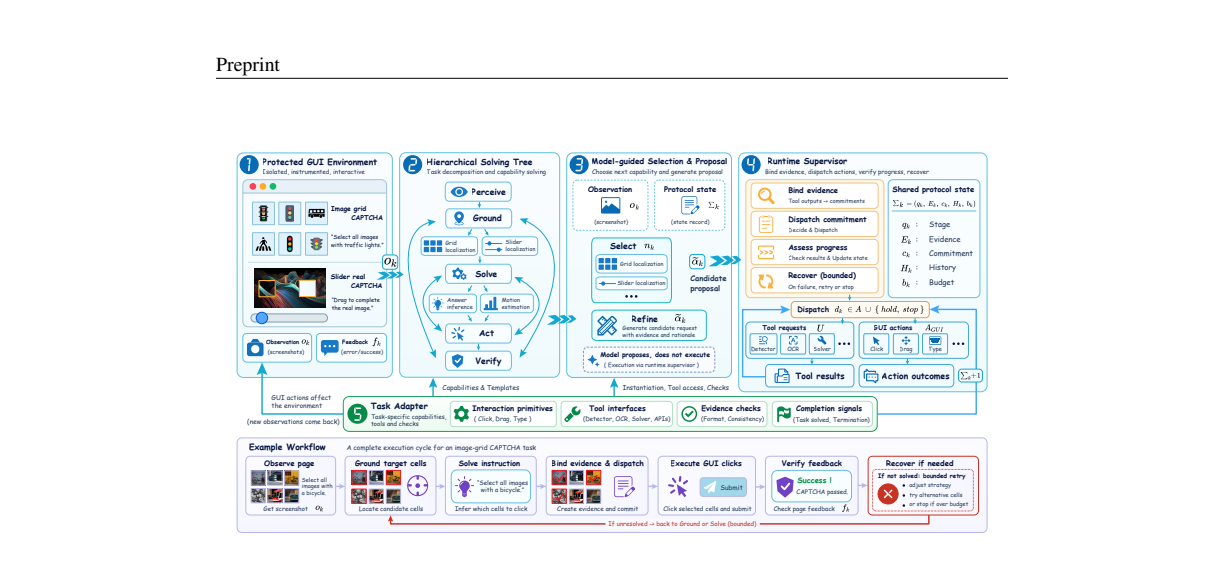
We call these protected GUI environments, where correctly solving a verification task is insufficient for end-to-end task completion. Agents must turn solver outputs into accepted interactions and adapt execution to runtime feedback under time constraints. We introduce SolveBind, a GUI-agent framework combining hierarchical solving with runtime supervision. A hierarchical solving tree decomposes verification into interdependent Perceive, Ground, Solve, Act, and Verify capabilities. A runtime supervisor grounds action commitments in tool-derived evidence, revises them as evidence arrives, and mediates execution under explicit recovery budgets. Across nine CAPTCHA task families and nine backbone models, SolveBind achieves the highest success rate on eight backbones, outperforming the strongest baseline by 13.3-34.5 percentage points. It achieves the highest success rate on all six AndroidWorld backbones. In a paired GPT-5.5 analysis, MobileAgent produces correct answers but fails dynamic verification on 13 of 90 tasks; SolveBind succeeds on seven of these tasks. With automatic submission, removing binding reduces success from 82.22% to 71.56% and increases latency and token usage. Recovery caps reduce execution cost with a small observed success trade-off: removing them raises success from 82.22% to 83.56%, while increasing latency and token usage to 3.7x and 2.4x their full-supervision values, respectively. These results support evidence-grounded execution control while identifying a success-cost trade-off in recovery and failure boundaries of heuristic submission rules.
from the abstract
Pith says
Machine review · deepseek-v4-flash · 26 Oct 2026 · what was read was not recorded · not checked by a person
It can be wrong. Challenge this review or reply to it.
Holds up, with conditions. The evidence-bound dispatch mechanism is real and mostly well evaluated, but the 'isolates dispatch precedence' claim outruns the ablation as described, and missing code plus single-run headline tables cap how much the magnitudes can be trusted. This line is wrong
3 major objections · 4 minor
How often objections from reviews like this one are right: not yet measured
Not checked: figures, code, what the 46 references say.
The paper says, at §5.4 and §D.7.1 (Eq. 23)
The review did not quote this passage.
Pith says: Objection 1 of 3 · major
The no-binding ablation is described in the Introduction and Section 5.4 as isolating the effect of dispatch precedence, but D.7.1 specifies only that the condition removes forced dispatch precedence while retaining model access to evidence; it does not state whether the pending commitment c_k and its bound operation a_c remain in the model's permitted view Sigma^pi_k used in Eq. 23.
more of objection 1
If c_k is removed from that view, the model's proposals can change independently of the supervisor's override rule, so the 185/225 to 161/225 drop would conflate information loss with removal of Eq. 5 enforcement. If c_k is retained, the paper should say so explicitly and report whether the model's proposal distribution is unchanged across the two conditions; this is necessary to support the isolation claim.
The paper says, at §D.6 vs. §5.4 (Tables 17-18 and Table 3)
The review did not quote this passage.
Pith says: Objection 2 of 3 · major
The mechanism traces record only 7 commitment-based operation changes per 90 GPT-5.5 episodes, which scales to roughly 17-18 such events in the 225-episode ablation batch, fewer than the 24 successes lost when binding is removed; since only a subset of overrides would flip an episode outcome, the reported counts do not by themselves account for the ablation effect.
more of objection 2
The paper correctly notes that the trace and ablation batches use different instance draws, so this is not a contradiction, but the claimed causal channel is therefore left unquantified. Please report override counts and per-episode success outcomes on the same 225 instances used in Table 3, or identify the additional channel (shifted model proposals, budget cascades, or interaction with automatic submission) through which removing binding produces 24 fewer successes.
The paper says, at §5.1-5.2, Table 1, §D.4
The review did not quote this passage.
Pith says: Objection 3 of 3 · major
The headline claim of highest success on eight of nine backbones rests on single 90-instance runs, while D.4 provides repeated runs for only three backbones and shows substantial dispersion (e.g., GPT-5.5 SolveBind 87.4±8.3 versus MobileAgent 60.0±6.9), with no significance testing on the main table.
more of objection 3
Because the smallest reported gain is 13.3 percentage points and one backbone regresses, please provide confidence intervals or paired permutation tests over the 90 tasks for Table 1, or explicitly qualify the eight-of-nine claim as resting on unreplicated runs for six of the nine backbones.
4 minor objections
The paper says, at Table 1
Pith says: minor objection 1 of 4
The Claude Opus 4.6 row lacks a separator between the token count 47.76 and the MobileAgent success rate 38.9, making the row difficult to read.
The paper says, at Header code link
Pith says: minor objection 2 of 4
The code link in the header appears as '/githubSolveBind'; it should be a complete URL and, ideally, a stable repository or DOI.
show 2 more
The paper says, at Figure 10 caption
Pith says: minor objection 3 of 4
The caption notes that the reproduced reasoning excerpt belongs to a different task; it would be clearer to omit the unrelated excerpt entirely from the figure rather than include it with a corrective note.
The paper says, at §5.2
Pith says: minor objection 4 of 4
The percentages such as 'a 33.05% reduction' and 'an 84.66% reduction' are computed from rounded displayed values; stating that they are based on the displayed values, as is done for the Gemini comparison, would avoid false precision.
What would settle it
Re-run the full-supervision and no-binding configurations on the same 225 ablation instances with the D.6 per-step decision log enabled (recording model proposal, pending commitment c_k, dispatch decision, override category, and episode outcome), and verify two things: (i) whether c_k remains in the model's state view Sigma^pi_k under no-binding; (ii) whether the 24 lost successes coincide with episodes in which full supervision dispatches an admissible committed action over a conflicting model proposal. If fewer than roughly 24 such episodes exist, or if c_k is removed from the model's view in no-binding, the ablation does not isolate Eq. 5's dispatch precedence, and the headline should be re-scoped to 'commitment visibility plus enforced dispatch, under fixed automatic submission.'
from the skeptic's reading
How the review went
4 readings by deepseek-v4-flash · 26 Oct 2026
- Reader holds up, with conditions
- Skeptic partly agrees
- Editor wrote the verdict above
- Referee major revision: 3 major objections, 4 minor
Not run on this paper: the simulated authors' defence.
Pith did not check this review's objections against the paper.
The review in full
The review in brief, machine-written
Two things to know. The core idea is real: in CAPTCHA and anti-automation settings where a correct answer can still fail interaction-level verification, SolveBind's runtime supervisor converts tool outputs into revisable action commitments and gives admissible commitments dispatch priority over conflicting proposals. That mechanism is genuinely new relative to the verifier-harness literature it cites, and the central ablation — 185/225 with binding versus 161/225 without, submission fixed — is a well-designed experiment pointing the right way. Second: the paper overclaims how cleanly that ablation isolates dispatch precedence. The stress-test is right that Table 19's no-binding condition keeps "model access to that evidence" but never states whether the pending commitment ck remains in the model's state view used by Eq. 23. If ck is hidden, information loss and lost dispatch authority are confounded; if it is visible, the drop must flow through override events, and the D.6 traces show only about 17-18 commitment-based overrides scaled to 225 episodes — below the 24 episodes lost, though on a different instance draw. Either way, "isolating the effect of dispatch precedence" is stronger than what is demonstrated. The paper itself admits (D.7.3) that traces would connect configurations to mechanisms, so this is a fixable clarity gap, not a refutation.
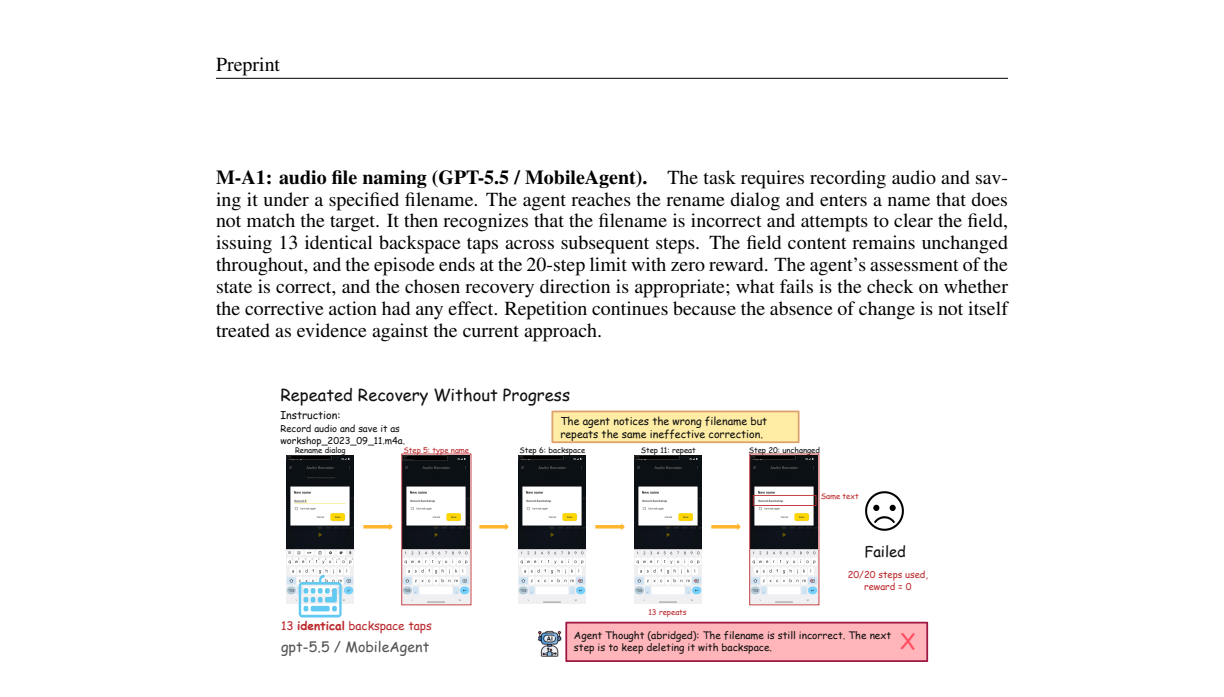
What is good: the evaluation discipline. All-run latency is kept separate from success-conditioned latency, token accounting is explicit about what is counted, and the failure-mode appendix documents exactly the targeted failure class — correct diagnosis, same action reissued (M-C1, M-A1, A-C1). The cost side is honest: unbounded recovery buys 3 successes at 3.7x latency and is presented as a trade-off. The paper also flags its own external-validity limits: recorded interaction evidence rather than production detectors, no oracle for visual changes, and the missing 2x2 factorial for binding by submission.
Remaining soft spots, in proportion: the headline tables are single runs, and the three-run stability check (D.4) uses fixed instances whose means do not match the main numbers; the Claude Opus 4.6 regression (-4.5 points) sits in Table 10 while the "eight of nine" wording is technically accurate but should be surfaced; and "our code: /githubSolveBind" is a placeholder, so independent verification is impossible until the release happens. Using the authors' own HLL benchmark is worth noting, though it is a separate published artifact.
Bottom line: I agree with the reader's conditional verdict. Four related ablations move success in the same direction, so the effect is probably real; only the magnitude attribution to Eq. 5 specifically needs work. This deserves a serious referee — send it out, and ask for the model-view clarification, the 2x2, per-seed dispersion aligned with the main tables, and the code.
The strongest objection
The central claim - that the binding rule of Eq. 5, commitment dispatch precedence over conflicting model proposals, is what drives the verification-side gains - rests on the no-binding ablation (185/225 to 161/225), which the paper twice describes as 'isolating the effect of dispatch precedence' (Introduction and Section 5.4). That isolation is not yet demonstrated, for two reasons found in the paper's own text.
First, D.7.1/Table 19 defines no-binding as removing only 'forced dispatch precedence' while retaining 'model access to that evidence,' but nowhere states whether the pending commitment c_k remains in the model's permitted state view Sigma^pi_k used in Eq. 23. Because the model conditions its proposals on that view, hiding c_k would change proposal behavior as well as the supervisor's override rule, so part of the 24-episode drop could reflect information loss rather than Eq. 5.
Second, the paper's own mechanism traces (D.6, Tables 17-18) record only 7 commitment-based operation overrides per 90 GPT-5.5 episodes (26 overrides, 6.91% override rate, 0.289 overrides per episode). Scaled to 225 episodes that is roughly 17-18 override events, below the 24 reported successes lost, and only a subset of overrides would flip an episode outcome. The trace and ablation batches use different instance draws, so this is not a contradiction; it means the residual effect must flow through an untested channel - model-side proposal shifts, budget cascades, or interaction with the retained submission rule. D.7.3 explicitly acknowledges that traces would be needed to connect configuration-level results to mechanisms and that aggregate means are not used to infer step counts; the causal attribution to Eq. 5 is therefore asserted but not yet supported by the paper's own evidence.
The paper's contribution is a runtime-supervision mechanism, and its load-bearing result is that the binding rule of Eq. 5 causes the verification-side gains - exactly the reader's strongest_claim. The supporting evidence is the no-binding ablation, which the paper describes as isolating the effect of dispatch precedence. My stress-test asks whether that isolation actually holds, and the paper's own text exposes two gaps.
Gap A, underspecified ablation condition: no-binding retains 'model access to that evidence' but says nothing about whether the pending commitment c_k remains in the model's view Sigma^pi_k. Since Eq. 23 lets the model condition its proposals on that view, removing c_k from it would change proposal behavior, not just supervisor overrides; the 24-episode drop could then reflect information loss rather than Eq. 5. The paper never states whether c_k is part of Sigma^pi_k in any configuration, so the ablation's controlled variable is not fully defined.
Gap B, mechanism-footprint mismatch: Table 17 records only 7 commitment-based operation overrides per 90 GPT-5.5 episodes, under 0.08 per episode, yet the ablation credits binding with 24 episode-level successes over 225 episodes. The two batches use different instance draws, so this is not a contradiction; it means the residual effect must be carried by an unmeasured channel. D.7.3 acknowledges that traces would be needed to connect configuration-level results to mechanisms and that per-step counts are not inferred from aggregate means - which is precisely the missing evidence for the causal claim. The paper's 'isolating' language in the Introduction and Section 5.4 is therefore stronger than what the provided data establish.
I deliberately did not pick the external-validity concern the reader emphasized. The paper states twice that HLL uses recorded interaction evidence rather than production detectors and lists deployment transfer as future work (Section 6, Ethics Statement), so that limitation is acknowledged and scoped. The admissibility-oracle limitation is likewise acknowledged in Appendix B.2 ('the protocol does not assume an oracle for all visual changes'). The internal attribution gap, by contrast, is not acknowledged and bears directly on whether the central mechanism claim is established.
Credit where due: Section 5.4 and D.7.2 carefully scope the ablation, explicitly disclaim the missing factorial cell (binding on, submission off), and D.6 provides mechanism traces that make my concern testable rather than speculative. The direction and rough magnitude of the binding effect are plausible; the issue is attribution, not integrity. This preserves the reader's CONDITIONAL verdict and adds one specific acceptance condition: per-episode decision logs for the no-binding condition plus a documented statement of the model's state view in that condition.
The referee's report
If the results hold, the paper makes a useful contribution: it separates goal achievement from environmental acceptance, formalizes a protected-environment task model, and provides an execution-control layer that is independent of the backbone policy. The strongest parts are the clean definition of all-run versus success-conditioned latency, the Eq. 5 dispatch rule stated before the experiments rather than tuned to a target result, the ablation that fixes automatic submission while removing binding, and the paired diagnostic showing that correct answers can still fail dynamic verification. The paper is also careful to state its own limitations, including the use of recorded interaction evidence rather than production detectors and the absence of a formal information-flow proof. These strengths make the framework a reasonable architectural proposal. The main risk is that the central attribution of the verification gains to the binding rule is not yet fully quantified at the mechanism level.
Pith's reading of the paper (a machine's summary, not the authors')
This paper claims that GUI agents fail behind verification gates not because they get the wrong answer, but because correct answers are executed in ways the environment rejects. In protected GUI environments, where sites score interaction trajectories and timing rather than outcomes alone, SolveBind treats tool outputs as revisable evidence and lets a runtime supervisor bind that evidence to concrete action commitments before anything is dispatched. Across nine CAPTCHA task families and nine foundation models, the framework reports the highest success rate on eight backbones, beating the strongest baseline by 13.3–34.5 percentage points, and a dedicated ablation ties the gain to the binding rule itself: removing it drops success from 82.22% to 71.56%. If the claim holds, the verification bottleneck for GUI agents is partly an execution-control problem that a mediating dispatch layer can fix without changing the underlying model.
What carries the argument. The load-bearing object is the commitment-binding rule of the runtime supervisor. When a tool output passes the binding checks, the supervisor records a commitment $c_k = (n, a_c, E_c)$ linking a concrete operation to the capability it serves and the evidence supporting it; as long as the commitment stays admissible — supporting evidence still valid, stage and budget checks pass, no terminal condition — full control gives it dispatch precedence over any conflicting proposal the model generates ($d_k = a_c$). Once dispatched, the commitment is no longer pending for repetition, and its supporting evidence is reassessed only when new observations arrive. This rule does the work of converting correct answers into accepted interactions: it stops the model from re-proposing rejected actions, carries evidence-supported operations (including submission) into execution, and preserves still-valid evidence across bounded recovery attempts. The three design principles drawn from rational metareasoning — evidence-grounded commitment, progress-checked transition, and feedback-directed bounded recovery — are the paper's stated rationale for this mechanism, which it presents as an empirical design choice rather than an optimal-control result.
Core claim. The central claim is that task success in a protected GUI environment requires both achieving the goal and having the interaction accepted, and that the two can come apart: a submitted answer can be statically correct yet dynamically rejected on behavioral evidence. To close that gap, SolveBind separates "the model proposes" from "the runtime dispatches." A hierarchical solving tree (Perceive, Ground, Solve, Act, Verify) organizes what to do, while a runtime supervisor maintains a shared protocol state $\Sigma_k = (q_k, E_k, c_k, H_k, b_k)$ — active stage, retained evidence, pending commitment, outcome history, recovery budgets — and enforces the rule that an admissible evidence-supported commitment takes dispatch precedence over a conflicting model proposal (Eq. 5: $c_k \neq \emptyset \wedge \mathrm{Admissible}(c_k, \Sigma_k) \Rightarrow d_k = a_c$). The paper reports that this mechanism, not the backbone model, carries the verification-side gains: with automatic submission fixed, removing binding lowers success from 185/225 (82.22%) to 161/225 (71.56%), while removing recovery caps raises success only to 188/225 at 3.7× the latency. A paired diagnostic on 90 tasks shows the targeted failure mode is real — a strong baseline produces correct answers that fail dynamic verification on 13 tasks, and SolveBind succeeds on seven of those — and the paper reads this as evidence that evidence-grounded execution control, rather than solver accuracy alone, is what moves the reported success rates.
The premise it rests on. The measured gains rest on the assumption that the HLL validator's recorded-interaction-evidence checks are a faithful proxy for real behavioral anti-automation detectors — the paper states it used recorded evidence rather than production detectors — and that the supervisor's admissibility checks can tell when supporting evidence has changed, a capability the paper concedes is not an oracle for visual changes.
If the paper is right (Pith's inferences, not the authors')
GUI-agent harnesses should treat dispatch as a controlled decision separate from model proposals: the ablation isolates a 10.67-percentage-point success loss when evidence-bound commitments lose dispatch precedence, with automatic submission held fixed.
The "correct answer, rejected interaction" failure mode is measurable and partly fixable: it accounts for 13 of 90 GPT-5.5 tasks under a strong baseline, and the supervisor resolves seven of those thirteen.
Bounded recovery is the operating point the paper argues for: uncapping recovery buys +1.33 percentage points (185 to 188 of 225) at 3.7× latency and 2.4× tokens, so recovery budgets trade a small success gain for a large cost saving.
The gains transfer across backbones and environments: SolveBind leads on eight of nine verification backbones and all six AndroidWorld backbones, indicating the runtime layer complements model capability rather than replacing it.
GUI specialization alone does not clear the barrier: the native UI-TARS-1.5-7B policy completes only 36.11% of 900 verification tasks, and the task families it solves least are the ones on which it spends the most time and tokens.
If the binding rule is what carries the gain, then the verification bottleneck is partly architectural: the same backbones paired with a mediating dispatch layer beat harnesses that let the model's own proposal drive execution, which suggests better dispatch governance may be a cheaper lever than stronger perception for protected tasks.
The paper evaluates against recorded interaction evidence and explicitly leaves deployment open; a direct consequence the authors do not draw is that the gains, and the optimal recovery budget, may shift once the validator is a production detector scoring raw trajectories and timing.
The commitment mechanism resembles a consistency device that could generalize beyond CAPTCHAs to any rejection-prone workflow where agents repeat invalid proposals against stale grounding — for instance form validation or multi-step transactions with confirmation gates.
The success–cost trade-off of recovery caps suggests a testable refinement: an adaptive budget that tracks whether recent recovery attempts produced new evidence might capture most of the +1.33 points without the 3.7× latency.
Check this review
Pith stored no record of this review's passes and took no fingerprint of it. Reviews made by code from 13 Nov 2026 on carry both.
How often reviews like this one are right
Reviews like this one: written by deepseek-v4-flash, where what was read was not recorded.
How often objections from reviews like this one are right: not yet measured
Reviews by people
This review was written by a machine. No person has reviewed this paper on Pith yet. A scientist listed on Pith can review it for a fee, and their review is published here whatever it concludes.
The paper
Abstract
Websites and applications deploy CAPTCHAs and anti-automation mechanisms that use behavioral signals such as interaction trajectories and timing, not outcomes alone, to distinguish humans from automated agents. We call these protected GUI environments, where correctly solving a verification task is insufficient for end-to-end task completion. Agents must turn solver outputs into accepted interactions and adapt execution to runtime feedback under time constraints. We introduce SolveBind, a GUI-agent framework combining hierarchical solving with runtime supervision. A hierarchical solving tree decomposes verification into interdependent Perceive, Ground, Solve, Act, and Verify capabilities. A runtime supervisor grounds action commitments in tool-derived evidence, revises them as evidence arrives, and mediates execution under explicit recovery budgets. Across nine CAPTCHA task families and nine backbone models, SolveBind achieves the highest success rate on eight backbones, outperforming the strongest baseline by 13.3-34.5 percentage points. It achieves the highest success rate on all six AndroidWorld backbones. In a paired GPT-5.5 analysis, MobileAgent produces correct answers but fails dynamic verification on 13 of 90 tasks; SolveBind succeeds on seven of these tasks. With automatic submission, removing binding reduces success from 82.22% to 71.56% and increases latency and token usage. Recovery caps reduce execution cost with a small observed success trade-off: removing them raises success from 82.22% to 83.56%, while increasing latency and token usage to 3.7x and 2.4x their full-supervision values, respectively. These results support evidence-grounded execution control while identifying a success-cost trade-off in recovery and failure boundaries of heuristic submission rules.
The paper's own sentences, arranged, kept beside the review and separate from it. Each label is drawn from a closed vocabulary; the number beside it is the probability the classifier gave that label. No sentence in this record was written by a model.
abstract compiled · 2026-10-26
The authors' main claim, as the classifier picked it out 0.95
“These results support evidence-grounded execution control while identifying a success-cost trade-off in recovery and failure boundaries of heuristic submission rules.”
How the main claim is stated: asserted 0.74
What the abstract itself states, as probabilities: claims first 0.06 · states limitation 0.92 · human participants 0.04 · controlled comparison 0.96 · randomized assignment 0.02 · states quantitative result 0.99 · compares with prior results 0.98 · mentions code or data availability 0.04
The abstract, sentence by sentence
This table labels the abstract only (arXiv listing abstract v1). The number is the probability the classifier gave the label.
| Sentence | Role | The authors' own work | States the main conclusion | Strength |
|---|---|---|---|---|
| Websites and applications deploy CAPTCHAs and anti-automation mechanisms that use behavioral signals such as interaction trajectories and timing, not outcomes alone, to distinguish humans from automated agents. | background 1.00 | 0.07 | 0.03 | asserted 1.00 |
| We call these protected GUI environments, where correctly solving a verification task is insufficient for end-to-end task completion. | background 0.86 | 0.17 | 0.10 | asserted 0.99 |
| Agents must turn solver outputs into accepted interactions and adapt execution to runtime feedback under time constraints. | background 0.82 | 0.08 | 0.09 | asserted 0.98 |
| We introduce SolveBind, a GUI-agent framework combining hierarchical solving with runtime supervision. | contribution 0.99 | 0.89 | 0.07 | asserted 1.00 |
| A hierarchical solving tree decomposes verification into interdependent Perceive, Ground, Solve, Act, and Verify capabilities. | method 0.98 | 0.82 | 0.04 | asserted 1.00 |
| A runtime supervisor grounds action commitments in tool-derived evidence, revises them as evidence arrives, and mediates execution under explicit recovery budgets. | method 0.96 | 0.78 | 0.08 | asserted 0.99 |
| Across nine CAPTCHA task families and nine backbone models, SolveBind achieves the highest success rate on eight backbones, outperforming the strongest baseline by 13.3-34.5 percentage points. | result 1.00 | 0.96 | 0.33 | asserted 1.00 |
| It achieves the highest success rate on all six AndroidWorld backbones. | result 1.00 | 0.92 | 0.10 | asserted 1.00 |
| In a paired GPT-5.5 analysis, MobileAgent produces correct answers but fails dynamic verification on 13 of 90 tasks; SolveBind succeeds on seven of these tasks. | result 1.00 | 0.71 | 0.09 | asserted 1.00 |
| With automatic submission, removing binding reduces success from 82.22% to 71.56% and increases latency and token usage. | result 1.00 | 0.92 | 0.07 | asserted 1.00 |
| Recovery caps reduce execution cost with a small observed success trade-off: removing them raises success from 82.22% to 83.56%, while increasing latency and token usage to 3.7x and 2.4x their full-supervision values, respectively. | result 0.99 | 0.94 | 0.12 | asserted 0.98 |
| These results support evidence-grounded execution control while identifying a success-cost trade-off in recovery and failure boundaries of heuristic submission rules. | interpretation 1.00 | 0.91 | 0.74 | asserted 0.74 |
What kind of paper the classifier reports this is: method or tool 1.00 · evidence from observation or experiment 0.99
What was examined, and what was not
Sources read
- arXiv listing abstract v1
Not examined
- full text
- figures and tables
- references and citing sentences
- relations to other papers
Levels run
- P abstract
Not run
- S sections
- T body sentences
- C citations
- R cross-paper relations
How the labels were made
Compiled by classifier-1.13.0 via TypeSafe API, question bank abstract-p1-20260923, 2026-10-26: 1 request, 8,948 input tokens.
Every quoted sentence on this record is the authors'. Every label is from Pith's closed vocabulary, with the probability shown beside it. This record as JSON
Figures (16)





Figures are the authors', reproduced from the paper.
References (46)
- [1] Large-scale kernel machines , author=. 2007 , publisher= on Pith
- [2] Principles of metareasoning , author=. Artificial intelligence , volume=. 1991 , publisher= on Pith
- [3] Nicholas Hay and Stuart Russell and David Tolpin and Solomon Eyal Shimony , title =. Proceedings of the Twenty-Eighth Conference on Uncertainty in Artificial Intelligence, Catalina Island, CA, USA, August 14-18, 2012 , pages =. 2012 , url = on Pith
- [4] HLL: Can Agents Cross Humanity's Last Line of Verification? , author=. arXiv preprint arXiv:2606.02449 , year= on PithPith's reviewarXiv
- [5] Turing Test on Screen: A Benchmark for Mobile GUI Agent Humanization , author=. arXiv preprint arXiv:2604.09574 , year= on PithPith's reviewarXiv
- [6] Ui-tars: Pioneering automated gui interaction with native agents , author=. arXiv preprint arXiv:2501.12326 , year= on PithPith's reviewarXiv
- [7] Androidworld: A dynamic benchmarking environment for autonomous agents , author=. International Conference on Learning Representations , volume= on Pith
- [8] Mobile-agent: Autonomous multi-modal mobile device agent with visual perception , author=. arXiv preprint arXiv:2401.16158 , year= on PithPith's reviewarXiv
- [9] Appagent: Multimodal agents as smartphone users , author=. Proceedings of the 2025 CHI conference on human factors in computing systems , pages= on Pith
- [10] Agent s2: A compositional generalist-specialist framework for computer use agents , author=. arXiv preprint arXiv:2504.00906 , year= on PithPith's reviewarXiv
- [11] Cogagent: A visual language model for gui agents , author=. 2024 IEEE/CVF Conference on Computer Vision and Pattern Recognition (CVPR) , pages=. 2024 , organization= on Pith
- [12] Seeclick: Harnessing gui grounding for advanced visual gui agents , author=. Proceedings of the 62nd Annual Meeting of the Association for Computational Linguistics (Volume 1: Long Papers) , pages= on Pith
- [13] Navigating the digital world as humans do: Universal visual grounding for gui agents , author=. International Conference on Learning Representations , volume= on Pith
- [14] Li, Ning and Qu, Xiangmou and Zhou, Jiamu and Wang, Jun and Wen, Muning and Du, Kounianhua and Lou, Xingyu and Peng, Qiuying and Wang, Jun and Zhang, Weinan , title =. 2025 , eprint = on Pith
- [15] Webarena: A realistic web environment for building autonomous agents , author=. International Conference on Learning Representations , volume= on Pith
- [16] Osworld: Benchmarking multimodal agents for open-ended tasks in real computer environments , author=. Advances in Neural Information Processing Systems , volume= on Pith
- [17] Mind2web: Towards a generalist agent for the web , author=. Advances in Neural Information Processing Systems , volume= on Pith
- [18] Androidinthewild: A large-scale dataset for android device control , author=. Advances in Neural Information Processing Systems , volume= on Pith
- [19] Osworld-human: Benchmarking the efficiency of computer-use agents , author=. Proceedings of Machine Learning and Systems , volume= on Pith
- [20] Verisafe agent: Safeguarding mobile gui agent via logic-based action verification , author=. Proceedings of the 31st Annual International Conference on Mobile Computing and Networking , pages= on Pith
show 26 more
- [21] VLAA-GUI: Knowing When to Stop, Recover, and Search, A Modular Framework for GUI Automation , author=. arXiv preprint arXiv:2604.21375 , year= on PithPith's reviewarXiv
- [22] StructAgent: Harness Long-horizon Digital Agents with Unified Causal Structure , author=. arXiv preprint arXiv:2607.11388 , year= on PithPith's reviewarXiv
- [23] MAPLE: A Mobile Assistant with Persistent Finite State Machines for Recovery Reasoning , author=. arXiv e-prints , pages= on Pith
- [24] Don’t act blindly: Robust gui automation via action-effect verification and self-correction , author=. Proceedings of the 64th Annual Meeting of the Association for Computational Linguistics (Volume 1: Long Papers) , pages= on Pith
- [25] React: Synergizing reasoning and acting in language models , author=. arXiv preprint arXiv:2210.03629 , year= on PithPith's reviewarXiv
- [26] Reflexion: Language agents with verbal reinforcement learning , author=. Advances in neural information processing systems , volume= on Pith
- [27] Large language models cannot self-correct reasoning yet , author=. International conference on learning representations , volume= on Pith
- [28] I am robot:(deep) learning to break semantic image captchas , author=. 2016 IEEE European Symposium on Security and Privacy (EuroS&P) , pages=. 2016 , organization= on Pith
- [29] An empirical study & evaluation of modern \ CAPTCHAs \ , author=. 32nd usenix security symposium (usenix security 23) , pages= on Pith
- [30] BeCAPTCHA-Mouse: Synthetic mouse trajectories and improved bot detection , author=. Pattern Recognition , volume=. 2022 , publisher= on Pith
- [31] FP-Agent: Fingerprinting AI Browsing Agents , author=. arXiv preprint arXiv:2605.01247 , year= on PithPith's reviewarXiv
- [32] CAPTCHA Solving for Native GUI Agents: Automated Reasoning-Action Data Generation and Self-Corrective Training , author=. 2026 , eprint= on Pith
- [33] Yaxin Luo and Zhaoyi Li and Jiacheng Liu and Jiacheng Cui and Xiaohan Zhao and Zhiqiang Shen , title =. Advances in Neural Information Processing Systems 38: Annual Conference on Neural Information Processing Systems 2025, NeurIPS 2025, San Diego, CA, USA, December 2-7, 2025 /... on Pith
- [34] Xiwen Teoh and Yun Lin and Siqi Li and Ruofan Liu and Avi Sollomoni and Yaniv Harel and Jin Song Dong , title =. 34th USENIX Security Symposium (USENIX Security 25) , year = on Pith
- [35] Deng, Gelei and Ou, Haoran and Liu, Yi and Zhang, Jie and Zhang, Tianwei and Liu, Yang , title =. Proceedings of the 2025 ACM SIGSAC Conference on Computer and Communications Security , year =. doi:10.1145/3719027.3744872 , url = on Pithdoi:10.1145/3719027.3744872
- [36] Next-Gen CAPTCHAs: Leveraging the Cognitive Gap for Scalable and Diverse GUI-Agent Defense , author=. arXiv preprint arXiv:2602.09012 , year= on PithPith's reviewarXiv
- [37] CAPTCHAs in the Agentic Era: Solvers That Learn from Every Encounter , author=. 2026 , eprint= on Pith
- [38] Supervisory control of a class of discrete event processes , author=. SIAM journal on control and optimization , volume=. 1987 , publisher= on Pith
- [39] Safe reinforcement learning via shielding , author=. Proceedings of the AAAI conference on artificial intelligence , volume= on Pith
- [40] Reasoning about beliefs and actions under computational resource constraints , author=. arXiv preprint arXiv:1304.2759 , year= on PithPith's reviewarXiv
- [41] Using anytime algorithms in intelligent systems , author=. AI magazine , volume= on Pith
- [42] Resource-rational analysis: Understanding human cognition as the optimal use of limited computational resources , author=. Behavioral and brain sciences , volume=. 2020 , publisher= on Pith
- [43] Webvoyager: Building an end-to-end web agent with large multimodal models , author=. Proceedings of the 62nd Annual Meeting of the Association for Computational Linguistics (Volume 1: Long Papers) , pages= on Pith
- [44] Agent s: An open agentic framework that uses computers like a human , author=. International Conference on Learning Representations , volume= on Pith
- [45] 2025 , howpublished = on Pith
- [46] 2026 , howpublished = on Pith
Challenges and discussion
Disagree with the review, or know something it missed? Leave a comment, or challenge this review formally: a challenge becomes a permanent entry in this paper's record, and its decision is published here.
Come back by email
A short list of the week's newly reviewed papers. Nothing is sent until you confirm from your inbox, and every email has a link that stops it. No account.
No comments yet.
Sign in to comment