Computer Vision and Pattern Recognition · arXiv:2610.33857 v4 · submitted 24 Oct 2026
TrackTok: Semantically Persistent Tokens for Latent Video Generation
The paper says
“We introduce TrackTok, an efficient video tokenization framework that produces object-aligned tokens, i.e., tokens that consistently encode the same semantic object across time, even as it moves, deforms, or undergoes partial occlusion.”
more of the abstract
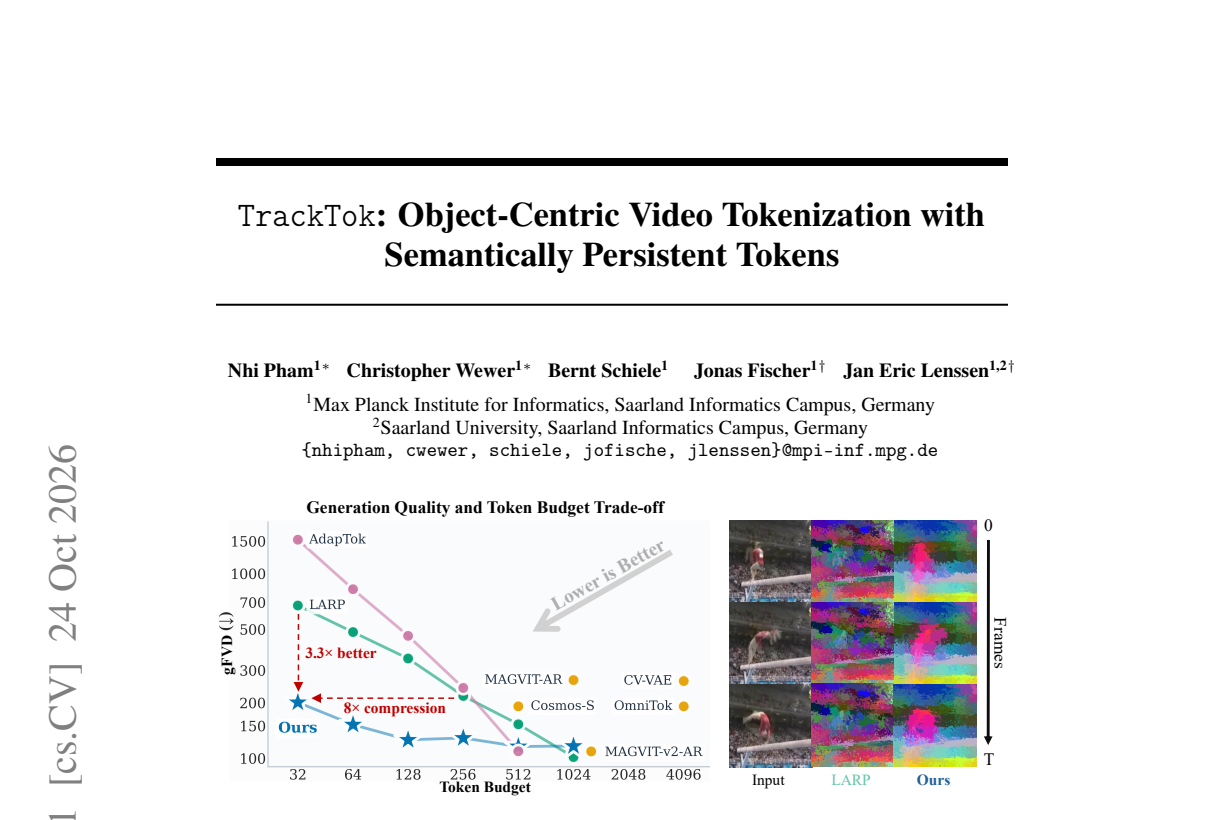
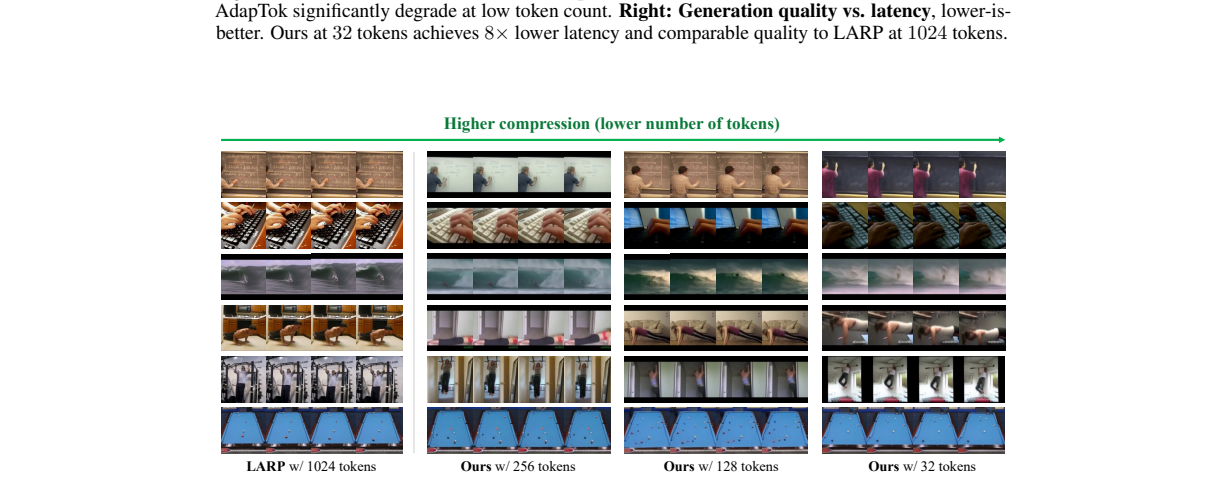
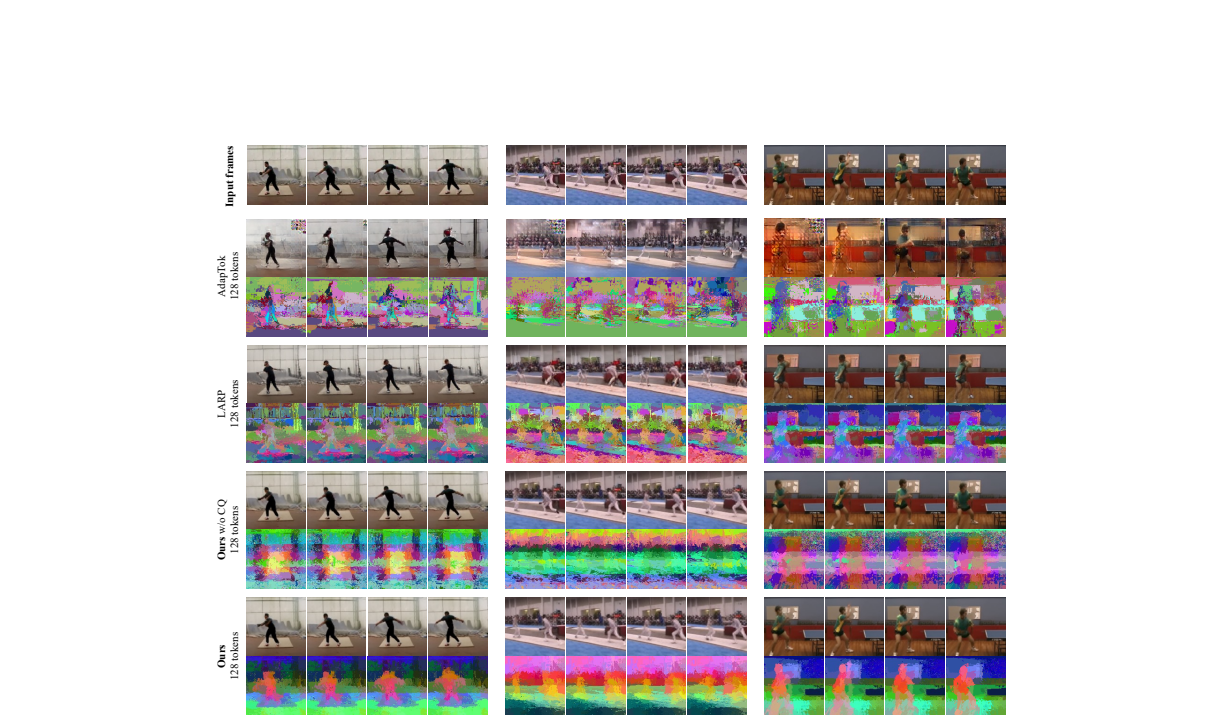
Conventional patch-based or existing holistic tokenizers produce token identities often tied to fixed image locations. In contrast, our approach learns temporally persistent object-aligned representations that bind visual features across frames into stable semantic units. This enables substantially more compact, continuous latent video representations, reducing the number of tokens required for downstream generative modeling with state-of-the-art flow models, while preserving the semantic structure needed for high-quality synthesis. Our tokenizer offers a favorable quality-efficiency trade-off. TrackTok achieves comparable class-conditional generative FVD on UCF-101 dataset at 8 times fewer latent tokens and better latency, and outperforms existing 1D tokenization baselines on frame prediction task on Kinetics-600 across low token budgets. These results suggest that object-aligned and temporally persistent tokenization is a promising direction for scalable video generation, where reducing latent token counts is critical for efficient modeling. Our code for this work is available at github.com/phamleyennhi/tracktok.
from the abstract
Pith says
Machine review · deepseek-v4-flash · 27 Oct 2026 · of version 1 of the paper; version 4 is newer · what was read was not recorded · not checked by a person
It can be wrong. Challenge this review or reply to it.
Holds up. TrackTok delivers on its core claim—comparable generation at 8× fewer tokens—with careful evaluation and honest limitations; this paper is ready for review. This line is wrong
2 major objections · 4 minor
How often objections from reviews like this one are right: not yet measured
Not checked: figures, code, what the references say.
The paper says, at Appendix A.1.2, Table A2
The review did not quote this passage.
Pith says: Objection 1 of 2 · major
The denoiser configuration table lists the sequence length as '2N (condition + target)' for both the class-conditional generation and the frame-prediction tasks. However, in class-conditional generation the class label is added to the timestep embedding, not prepended as additional tokens. The sequence length for this task should therefore be N (the number of latent tokens). This is a minor inconsistency that should be corrected to avoid confusing readers.
The paper says, at §3.1, 1st paragraph of Section 3
The review did not quote this passage.
Pith says: Objection 2 of 2 · major
The paper describes the encoder as 'perceiver-based' in the introduction and methods overview, but the actual implementation (Section 3.1) uses a standard ViT with full self-attention, not a perceiver cross-attention architecture. The term 'perceiver-based' is misleading. The authors should either adopt the term consistently or state explicitly that the encoder is a transformer with input-dependent queries rather than a perceiver.
4 minor objections
The paper says, at Abstract
Pith says: minor objection 1 of 4
The phrase 'better latency' is vague. Consider replacing with a quantitative statement e.g., 'up to 8× faster sampling at comparable quality' as reported in Section 4.2.
The paper says, at Table 1
Pith says: minor objection 2 of 4
For clarity, consider adding a footnote that the training data size includes the combined Kinetics-600 and UCF-101 for the tokenizer, while the denoiser is trained on a single dataset per task.
show 2 more
The paper says, at §4.1, 'Object Discovery and Tracking'
Pith says: minor objection 3 of 4
The metric 'mBO' is defined in the text but not in the main paper; it appears only in the appendix. Consider adding a brief definition in the main paper for readability.
The paper says, at Fig. 2
Pith says: minor objection 4 of 4
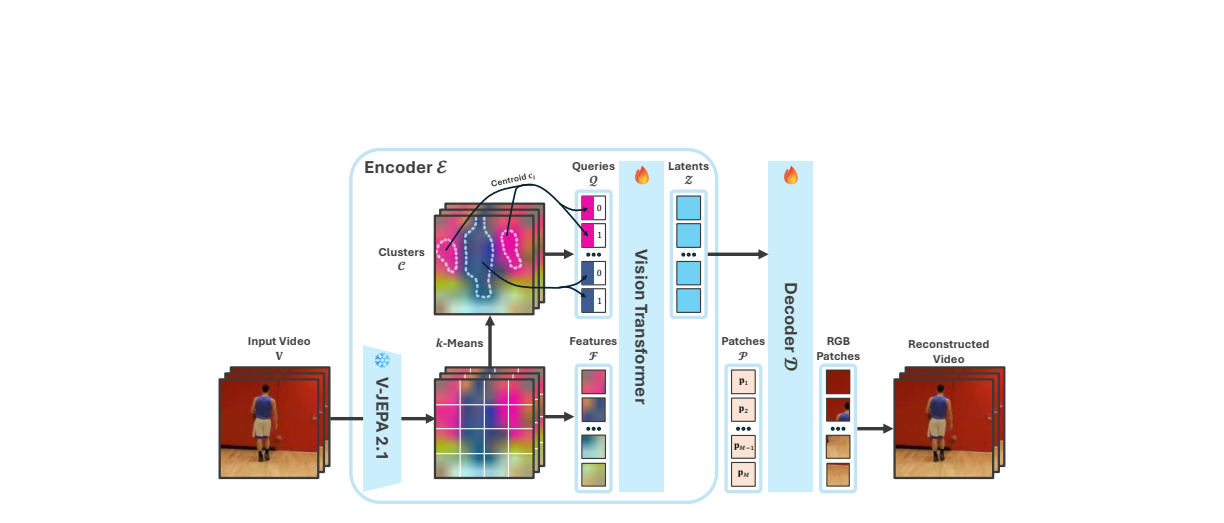
The figure shows a straight arrow from k-Means clusters to Queries, but the actual construction (Eq. 1–3) uses both the centroid and a positional encoding. The figure could be slightly misleading; a dashed line indicating the computation of ρ(Cj) would improve clarity.
What would settle it
Repeat the k-means clustering (20 Lloyd iterations) on V-JEPA 2.1 features with 10 different random seeds for centroid initialization on a random subset of 100 video clips from YouTube-VIS; compute the mean and standard deviation of token purity and FG-ARI across runs. If the standard deviation exceeds 5% of the mean for either metric, the clustering is not robust to initialization, which would weaken the claim that k-means reliably produces semantic groupings and could affect the reproducibility of object-aligned tokenization.
from the skeptic's reading
How the review went
4 readings by deepseek-v4-flash · 27 Oct 2026
- Reader holds up
- Skeptic agrees
- Editor wrote the verdict above
- Referee minor revision: 2 major objections, 4 minor
Not run on this paper: the simulated authors' defence.
Pith did not check this review's objections against the paper.
The review in full
The review in brief, machine-written
TrackTok is a solid, clearly written paper that does exactly what it advertises: a video tokenizer that produces object-centric tokens that persist across time, enabling much higher compression than existing 1D tokenizers like LARP and AdapTok without sacrificing generative quality. The key novelty—using k-means on frozen V-JEPA 2.1 features to initialize input-dependent cluster queries for a perceiver-style encoder—is simple and effective. The paper earns its conclusions with thorough quantitative work: direct comparison to multiple baselines with re-training under the same recipe, extensive ablations (cluster counts, token dimensions, positional encoding variants), and an insightful analysis of token object-alignment via ablation-based impact maps on YouTube-VIS.
The paper is also refreshingly open about its limitations. The authors state that V-JEPA 2.1 features do not encode high-frequency RGB details, which caps reconstruction fidelity at higher token budgets (where baselines surpass TrackTok). They acknowledge that cluster-query allocation can sometimes let a moving object drift between tokens, and they frame this as a deliberate flexibility trade-off rather than a bug. These are genuine design choices, not oversights.
The soft spots are modest and mostly follow from the paper's scope. First, the generative evaluation is limited to class-conditional UCF-101 and frame-prediction on Kinetics-600; the paper does not touch text-to-video, which is where the field is headed. That is fine for a first demonstration, but it tempers the claim of a ``new frontier.'' Second, the tokenizer is trained for only 100k steps (15 epochs) compared to 75 epochs for LARP; the retrained LARP baselines help, but one wonders whether TrackTok could improve further with longer training. Third, the reconstruction bottleneck from frozen V-JEPA features means that at high token budgets conventional methods win, so the practical value is in the very-low-token regime—which the paper owns.
Overall, this is a well-executed contribution with no hidden flaws. The reasoning is sound, the evidence matches the claims, and the code is provided. I would send this to peer review without hesitation. It is a clear incremental advance that opens a promising direction for efficient video tokenization.
The strongest objection
The paper is methodologically sound and presents a clear, well-supported argument. The central claim—that TrackTok achieves comparable class-conditional generative FVD on UCF-101 at 8× fewer tokens than LARP, and outperforms 1D baselines on Kinetics-600 frame prediction at low token budgets—is backed by controlled ablations, multiple evaluation metrics, and careful comparison protocols including re-training LARP under the same recipe. The weakest assumption identified by the reader, that k-means clustering on frozen V-JEPA 2.1 features yields semantically meaningful groupings, is explicitly tested: object discovery and tracking metrics (Table 2) show large improvements over baselines, and ablations removing cluster queries confirm their importance for generation quality. The authors also acknowledge known limitations (e.g., reconstruction bottleneck from V-JEPA features, occasional token reallocation across frames, short training duration) without concealing them. No internal inconsistency or unsupported leap was found. The evidence is sufficient to support the conclusions within the stated scope.
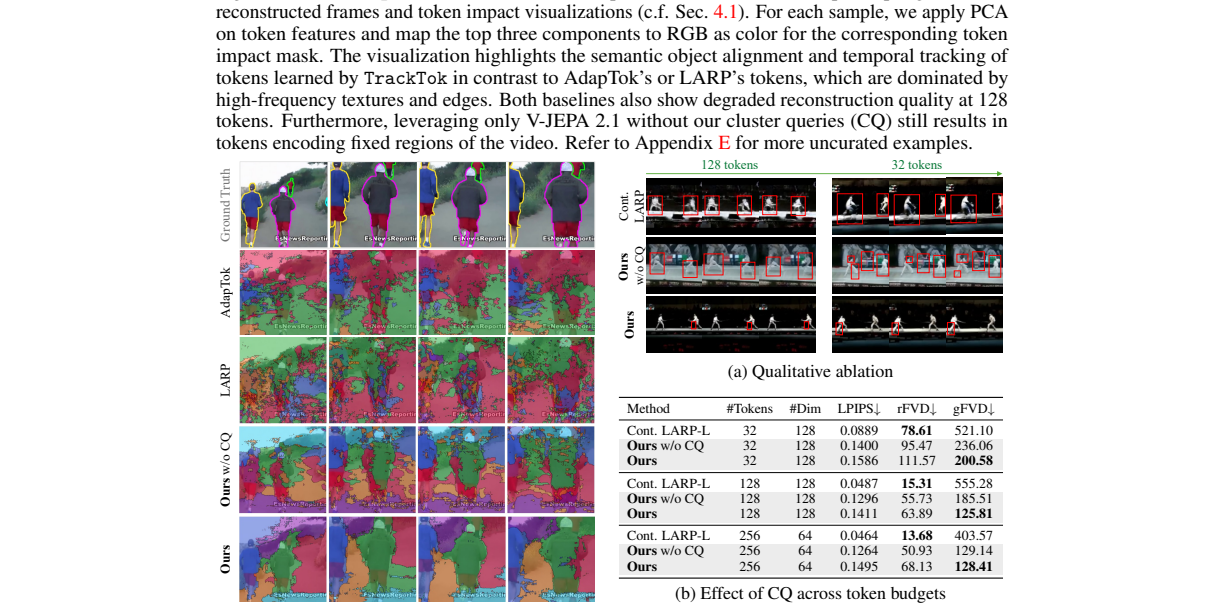
The reader's weakest assumption correctly pinpoints the reliance on k-means clustering for semantic grouping. However, the paper provides substantial evidence that this assumption holds: (1) object discovery metrics on YouTube-VIS show significantly higher FG-ARI and J&F than baselines; (2) ablations demonstrate that removing cluster queries degrades gFVD across all token budgets; (3) the authors discuss the occasional limitation of token reallocation as a deliberate flexibility rather than a failure. No other assumption appears less secure. The evaluation is fair: baselines are re-trained when possible, token-to-pixel ratios are used for cross-resolution comparison, and latency is measured under identical hardware. The claims are scoped to short clips (16 frames) and standard benchmarks, leaving long-video generalization as future work. Overall, the paper's evidence supports its central claims without critical gaps.
The referee's report
If the results hold, TrackTok provides a practical advance in video tokenization for latent generative modeling. The ability to reduce the latent token count by a factor of 8 while retaining similar generation quality directly reduces the cost of downstream diffusion or autoregressive models. Additionally, the object-centric nature of the tokens opens possibilities for controllable generation (e.g., editing a single token) and may serve as a bridge between object-centric representation learning and scalable video generation. The paper is thorough: it compares against multiple baselines (including re-trained versions with matched recipes), evaluates both reconstruction and generation, and provides quantitative object-discovery metrics that validate the claimed semantic alignment.
Pith's reading of the paper (a machine's summary, not the authors')
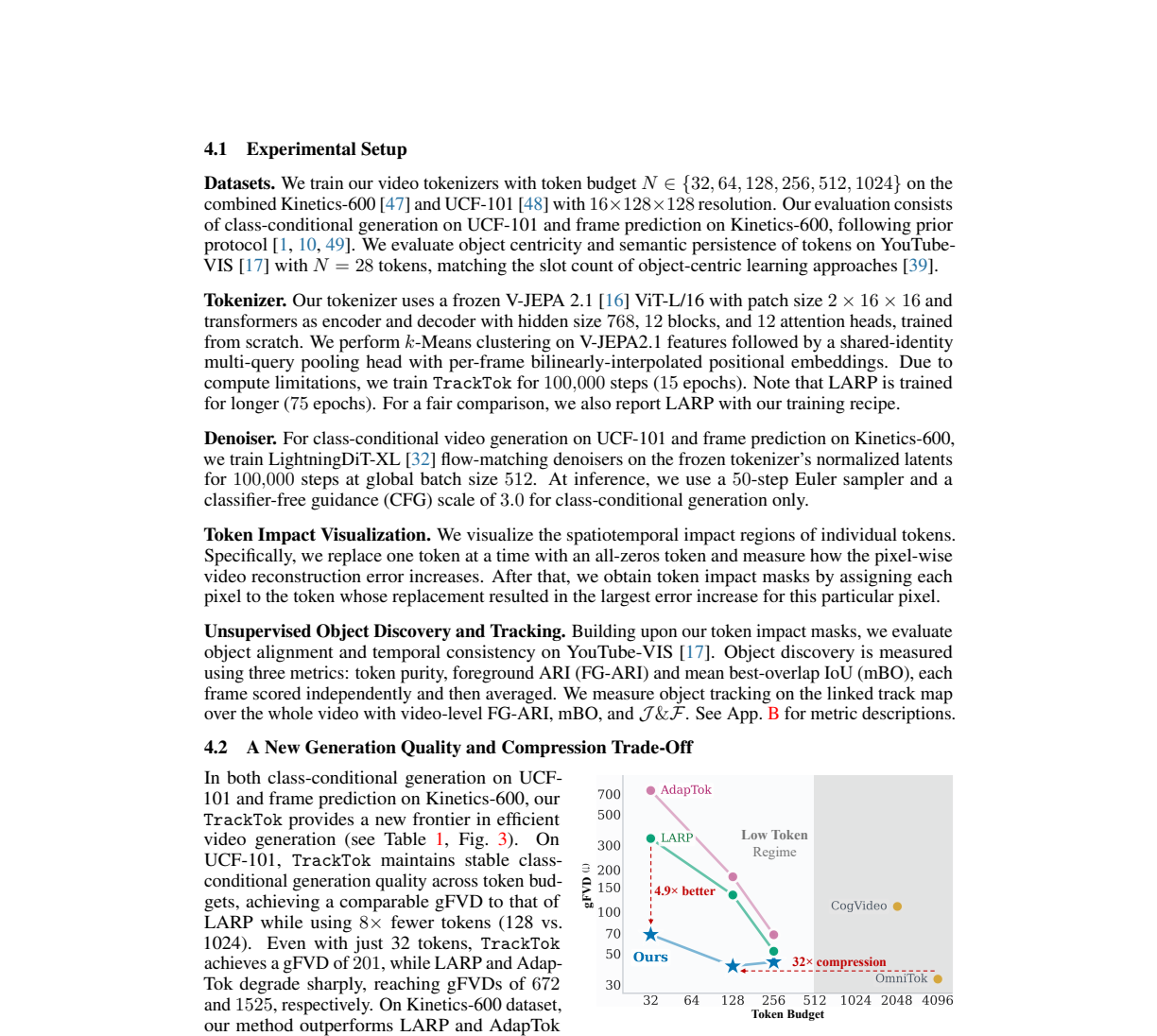
TrackTok is a video tokenizer that learns tokens tied to semantic objects rather than fixed spatial locations. This allows high compression without losing generative quality: with 128 tokens it matches LARP at 1024 tokens on UCF-101 class-conditional generation, and outperforms at low token budgets on Kinetics-600 frame prediction. The approach matters because video generation models are bottlenecked by token count; reducing tokens speeds up generation and cuts compute. The paper demonstrates that object-aligned, temporally persistent tokenization is a promising direction for scalable video generation.
What carries the argument. Cluster queries: k-means clustering on V-JEPA 2.1 feature patches produces semantic centroids that, combined with trajectory-aware positional encodings, serve as input-dependent queries for the encoder's cross-attention. This replaces the usual fixed-positional queries and forces tokens to specialise on semantic content rather than spatial locations.
Core claim. The paper introduces cluster queries: initializing encoder queries with k-means centroids of frozen V-JEPA 2.1 features, so that cross-attention is guided by semantic similarity rather than spatial position. This provides an inductive bias that makes latent tokens bind to objects and track them over time. The resulting tokenizer achieves a state-of-the-art compression–quality trade-off, with 8× fewer tokens at comparable generative FVD on UCF-101 and 4.9× better gFVD than LARP at equal low token counts on Kinetics-600.
The premise it rests on. That k-means clustering on frozen V-JEPA 2.1 features yields semantically meaningful groupings that correspond to objects or coherent regions; if clusters instead split objects or merge unrelated content, the tokenization loses object alignment.
If the paper is right (Pith's inferences, not the authors')
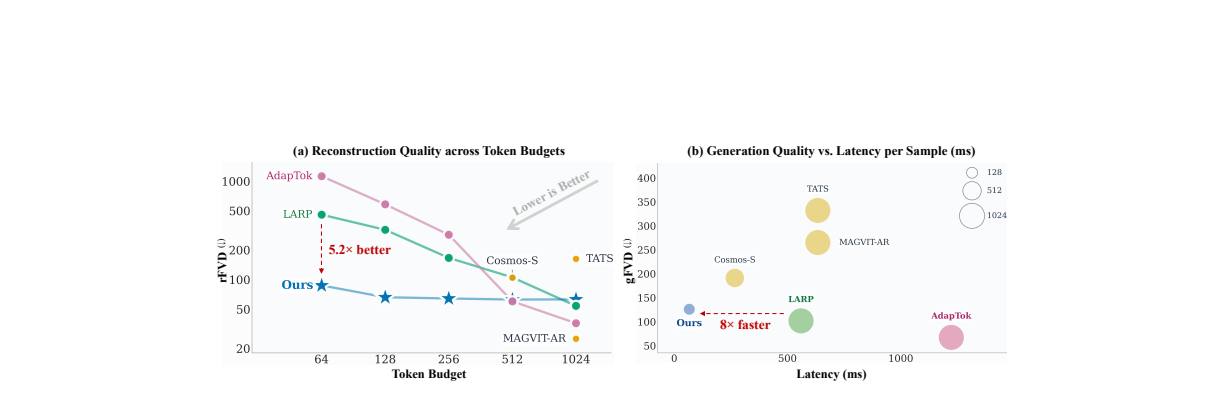
Video generation models can be trained and sampled much faster because the denoiser processes fewer tokens, with TrackTok achieving up to 8× lower latency at comparable quality.
Object-centric tokenization may enable better video editing and tracking applications, since each token encode a single persistent object.
The approach suggests that semantic foundation features can replace the spatial-positional priors used in most video tokenizers, opening a design space for content-allocated representations.
Extreme compression becomes possible: 32 tokens still produce recognizable video on UCF-101, which could enable generative modeling on very long videos with constant per-clip token budget.
The reliance on V-JEPA 2.1 features means the tokenizer inherits any biases or failure modes of that self-supervised model; a different foundation model could yield different object groupings.
The soft inductive bias allows token re-allocation when scene content changes rapidly, which is the intended flexibility but may limit strict identity persistence needed for object tracking over very long videos.
TrackTok uses a continuous latent representation, requiring a flow-matching denoiser rather than the discrete autoregressive paradigm common in other 1D tokenizers; this may limit compatibility with existing autoregressive video generation pipelines.
The reconstruction bottleneck from V-JEPA features means that at high token budgets TrackTok cannot match the pixel fidelity of patch-based tokenizers, suggesting a hybrid approach if reconstruction quality is critical.
Check this review
Pith stored no record of this review's passes and took no fingerprint of it. Reviews made by code from 13 Nov 2026 on carry both.
How often reviews like this one are right
Reviews like this one: written by deepseek-v4-flash, where what was read was not recorded.
How often objections from reviews like this one are right: not yet measured
Reviews by people
This review was written by a machine. No person has reviewed this paper on Pith yet. A scientist listed on Pith can review it for a fee, and their review is published here whatever it concludes.
The paper
Abstract
We introduce TrackTok, an efficient video tokenization framework that produces object-aligned tokens, i.e., tokens that consistently encode the same semantic object across time, even as it moves, deforms, or undergoes partial occlusion. Conventional patch-based or existing holistic tokenizers produce token identities often tied to fixed image locations. In contrast, our approach learns temporally persistent object-aligned representations that bind visual features across frames into stable semantic units. This enables substantially more compact, continuous latent video representations, reducing the number of tokens required for downstream generative modeling with state-of-the-art flow models, while preserving the semantic structure needed for high-quality synthesis. Our tokenizer offers a favorable quality-efficiency trade-off. TrackTok achieves comparable class-conditional generative FVD on UCF-101 dataset at 8 times fewer latent tokens and better latency, and outperforms existing 1D tokenization baselines on frame prediction task on Kinetics-600 across low token budgets. These results suggest that object-aligned and temporally persistent tokenization is a promising direction for scalable video generation, where reducing latent token counts is critical for efficient modeling. Our code for this work is available at github.com/phamleyennhi/tracktok.
The paper's own sentences, arranged, kept beside the review and separate from it. Each label is drawn from a closed vocabulary; the number beside it is the probability the classifier gave that label. No sentence in this record was written by a model.
abstract compiled · 2026-10-27
The authors' main claim, as the classifier picked it out 0.94
“These results suggest that object-aligned and temporally persistent tokenization is a promising direction for scalable video generation, where reducing latent token counts is critical for efficient modeling.”
How the main claim is stated: hedged possibility 1.00
What the abstract itself states, as probabilities: claims first 0.08 · states limitation 0.10 · human participants 0.03 · controlled comparison 0.90 · randomized assignment 0.01 · states quantitative result 0.98 · compares with prior results 0.98 · mentions code or data availability 0.98
The abstract, sentence by sentence
This table labels the abstract only (arXiv listing abstract v1). The number is the probability the classifier gave the label.
| Sentence | Role | The authors' own work | States the main conclusion | Strength |
|---|---|---|---|---|
| We introduce TrackTok, an efficient video tokenization framework that produces object-centric tokens, i.e., tokens that consistently encode the same semantic objects across time, even as it moves, deforms, or undergoes partial occlusion. | contribution 1.00 | 0.86 | 0.20 | asserted 1.00 |
| Conventional patch-based or existing holistic tokenizers produce token identities often tied to fixed image locations. | background 0.89 | 0.06 | 0.03 | asserted 0.91 |
| In contrast, our approach learns temporally persistent object-centric representations that bind visual features across frames into stable semantic units. | method 0.66 | 0.85 | 0.11 | asserted 1.00 |
| This enables substantially more compact, continuous latent video representations, reducing the number of tokens required for downstream generative modeling with state-of-the-art flow models, while preserving the semantic structure needed for high-quality synthesis. | result 0.43 | 0.76 | 0.24 | asserted 0.97 |
| Our tokenizer offers a favorable quality-efficiency trade-off. | result 0.57 | 0.70 | 0.14 | asserted 1.00 |
| TrackTok achieves comparable class-conditional generative FVD on UCF-101 dataset at 8 times fewer latent tokens and better latency, and outperforms existing 1D tokenization baselines on frame prediction task on Kinetics-600 across low token budgets. | result 1.00 | 0.96 | 0.20 | asserted 1.00 |
| These results suggest that object-aligned and temporally persistent tokenization is a promising direction for scalable video generation, where reducing latent token counts is critical for efficient modeling. | interpretation 1.00 | 0.42 | 0.73 | hedged possibility 1.00 |
| Our code for this work is available at https://github.com/phamleyennhi/tracktok. | contribution 0.74 | 0.44 | 0.02 | asserted 0.97 |
What kind of paper the classifier reports this is: method or tool 1.00 · evidence from observation or experiment 0.93
What was examined, and what was not
Sources read
- arXiv listing abstract v1
Not examined
- full text
- figures and tables
- references and citing sentences
- relations to other papers
Levels run
- P abstract
Not run
- S sections
- T body sentences
- C citations
- R cross-paper relations
How the labels were made
Compiled by classifier-1.13.0 via TypeSafe API, question bank abstract-p1-20260923, 2026-10-27: 1 request, 6,338 input tokens.
Every quoted sentence on this record is the authors'. Every label is from Pith's closed vocabulary, with the probability shown beside it. This record as JSON
Figures (8)
Showing 7 of the paper's 8 figures. Figures are the authors', reproduced from the paper.
Cited by 1 Pith paper
Reviewed papers on Pith that cite this one. The full citation record
- DeltaRAE: Derivative Tokenization for Long Video Generation cs.CV · Nov 2026
Challenges and discussion
Disagree with the review, or know something it missed? Leave a comment, or challenge this review formally: a challenge becomes a permanent entry in this paper's record, and its decision is published here.
Come back by email
A short list of the week's newly reviewed papers. Nothing is sent until you confirm from your inbox, and every email has a link that stops it. No account.
No comments yet.
Sign in to comment