Computer Vision and Pattern Recognition · arXiv:2611.33886 v1 · submitted 25 Nov 2026 · 59 references
DeltaRAE: Derivative Tokenization for Long Video Generation
The paper says
“Latent video generators are trained on clips of a few seconds, and much of this limit lies in their tokenizers, which spend as many tokens on a static frame as on a moving one and need future frames that do not exist during generation.”
more of the abstract
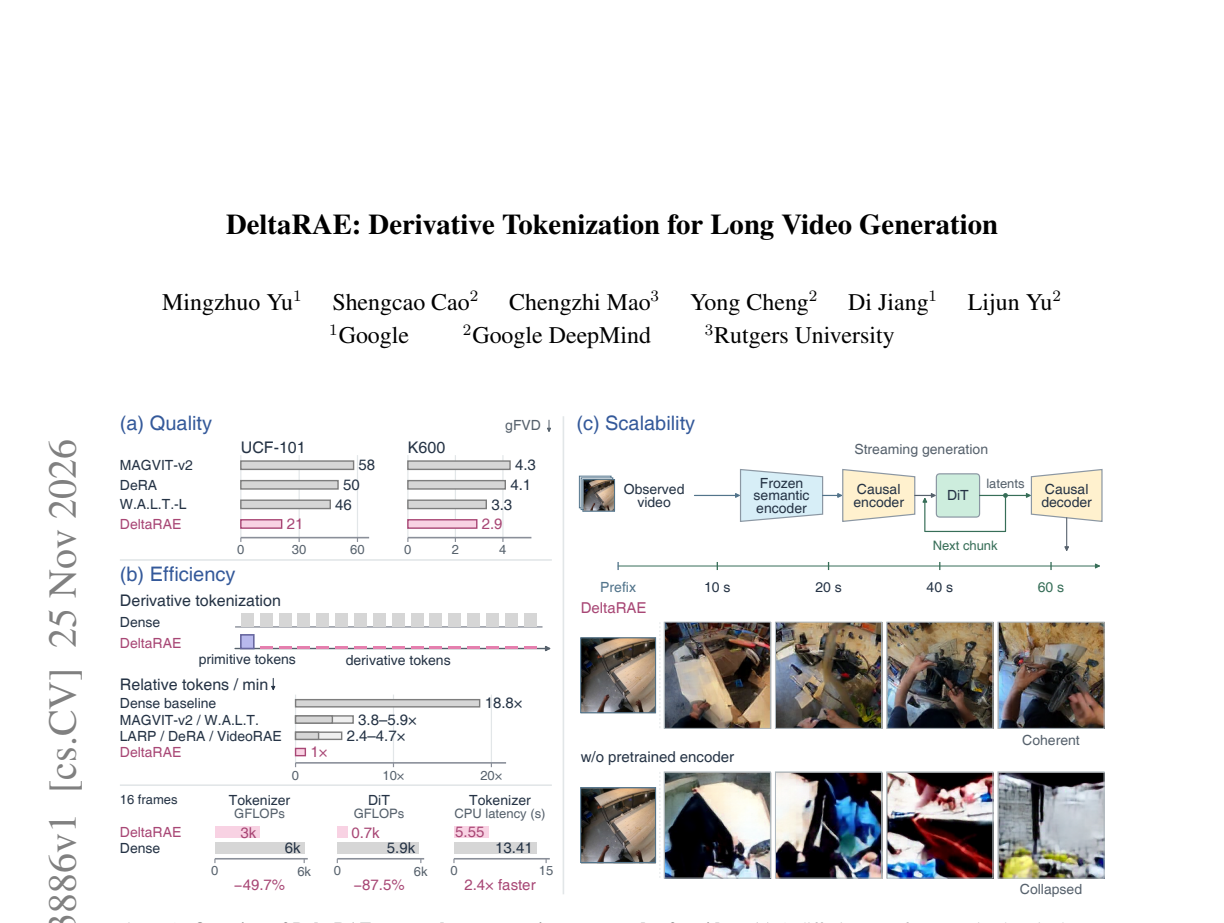
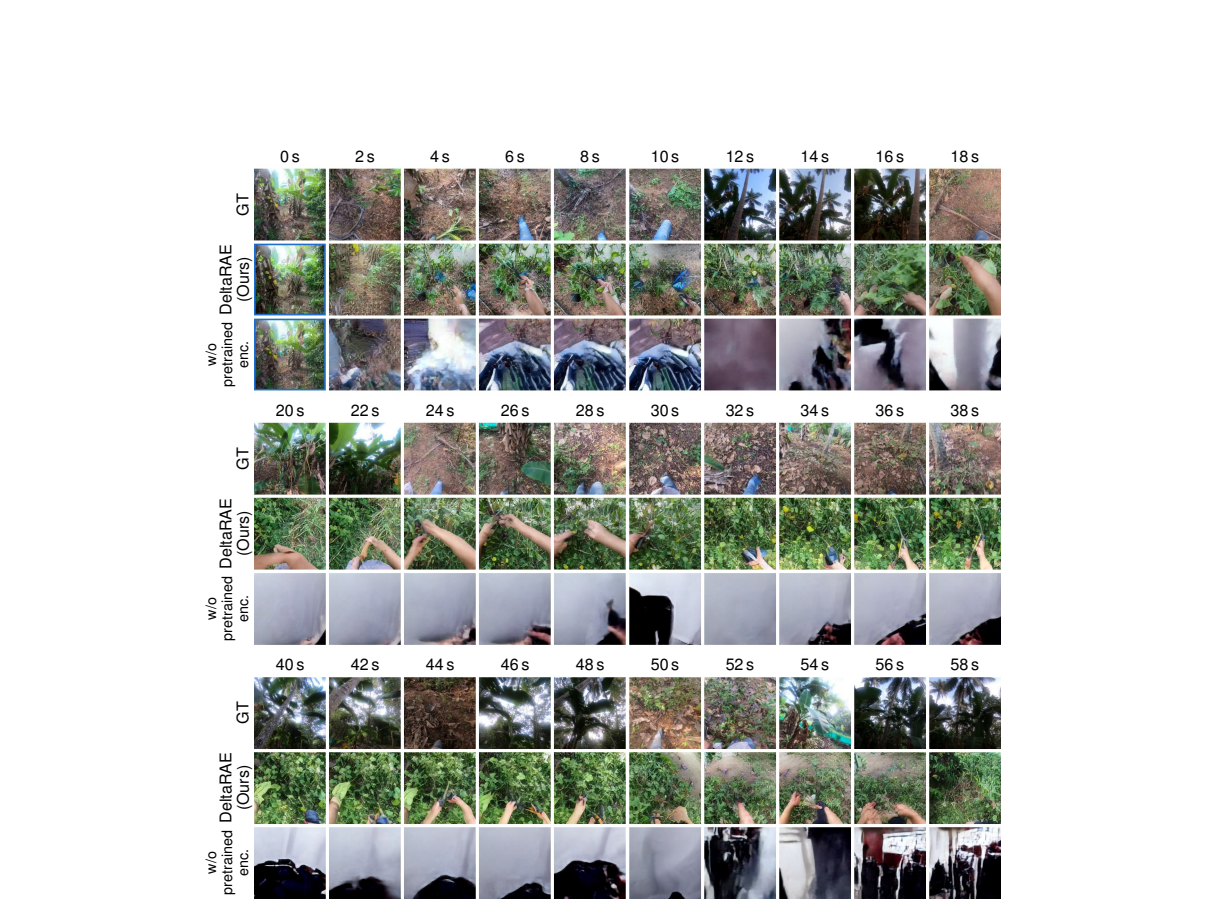
We introduce DeltaRAE, a causal representation autoencoder for video. Its derivative tokenization encodes periodic anchor frames in full and all remaining frames with a few tokens each, and its causal encoder and decoder read a frozen pretrained image encoder. On UCF-101 and Kinetics-600, a standard diffusion transformer trained on DeltaRAE latents is competitive with state-of-the-art video tokenizers. DeltaRAE halves the tokenizer GFLOPs on 16-frame clips relative to keeping the same number of patch tokens for every frame, and it represents a minute of video with 18.8x fewer tokens. The tokenizer trains end to end on one-minute videos, and in video prediction a generator on its latents produces a full minute of video. The same generator collapses within 15 seconds in most videos when the tokenizer has the same token budget but no pretrained encoder.
from the abstract
Pith says
Machine review · deepseek-v4-flash · 26 Nov 2026 · read the full text (111,772 characters) · not checked by a person
It can be wrong. Challenge this review or reply to it.
Holds up, with conditions. DeltaRAE introduces derivative tokenization for video, giving periodic anchor frames full tokens and intermediate frames few tokens, and uses a frozen semantic encoder to make the latent space easier to generate, enabling a single diffusion transformer to produce a coherent minute of video. This line is wrong
2 minor
How often objections from reviews like this one are right: not yet measured
The paper, first character to last
The reviewer was given the whole text, 111,772 characters. Not checked: figures, code, what the 59 references say.
2 minor objections
The paper says, at §4.3, Table 3
Pith says: minor objection 1 of 2
The long-video generation comparison in Table 3 only contrasts DeltaRAE with its own variant without the pretrained encoder. It does not compare with other long-video generation approaches (e.g., iVideoGPT, Reducio, or stitching of short-clip models). Adding such a comparison would clarify the practical advantage of the proposed streaming generation over existing alternatives.
The paper says, at §1
Pith says: minor objection 2 of 2
The paper claims 'state-of-the-art generation quality' in the contributions list. While DeltaRAE achieves the lowest gFVD among the methods listed in Table 1, ViTok (which uses extra training data) is excluded from direct comparison. The claim should be qualified to reflect that it is state-of-the-art among methods trained without external data, or the comparison should be discussed more explicitly.
What would settle it
Train a tokenizer with the same derivative schedule and causal masks but using a different frozen semantic encoder (e.g., CLIP or SigLIP 2) and evaluate one-minute generation with the same generator recipe. If the advantage over the no-pretrained-encoder baseline disappears or is much smaller, the claim that DINOv2 specifically provides a generation-friendly latent space would be weakened. Alternatively, if a tokenizer without a frozen encoder but with a different training objective (e.g., perceptual loss only) also enables stable long generation, the claim that the frozen encoder is essential would be falsified.
from Pith's summary of the paper
How the review went
5 passes by deepseek-v4-flash · 26 Nov 2026
- Reader holds up, with conditions
- Skeptic concern withdrawn: the paper already says this
- Referee 2 minor
- Check against the paper kept 0 of 3 objections
- Editor wrote the verdict above
Not run on this paper: the simulated authors' defence.
Pith's passes raised 3 objections. A check against the paper's text kept 0, withdrew 2 (2 the paper already says) and moved 1 to the minor objections.
The review in full
The review in brief, machine-written
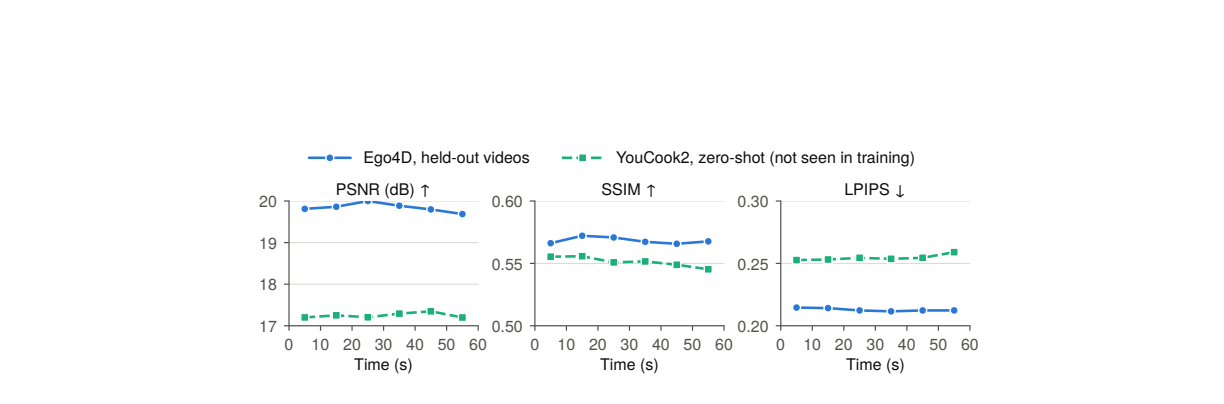
This paper does something genuinely useful for long-video generation. It treats video tokens the way a video codec treats frames: periodic anchor frames get a full set of tokens, and every frame in between gets a few tokens that describe the change from the past. Combined with a causal representation autoencoder that reads from a frozen DINOv2 encoder, the resulting latent sequence is 18.8× shorter than a dense per-frame grid, short enough to train a single diffusion transformer on 10-second chunks and then generate a full minute chunk by chunk. On 16-frame benchmarks the method is competitive: gFVD of 21 on UCF-101 and 2.9 on Kinetics-600 frame prediction, both among the lowest reported. The ablations are thorough and tell a clear story: the frozen encoder is what makes the latents easy to generate, not reconstruction quality. A tokenizer with the same token budget but no pretrained encoder reconstructs better but collapses within 15 seconds in nearly all 455 held-out videos, while DeltaRAE stays coherent in all of them. The paper is well written and the method is reproducible in principle. The soft spots are the ones the authors acknowledge: the long-video evaluation is on Ego4D only, qualitative, and uses a subjective coherence criterion. The mechanism behind the frozen encoder's advantage is not fully explained. The chunk-boundary handling relies on noise augmentation during training, which is outside the proven prefix invariance. These are real limitations but they are stated openly and do not undermine the central result. This paper deserves a serious referee. It presents a novel, well-supported approach to a hard problem, and the long-video results, while preliminary, are striking enough to warrant further investigation.
The stress test's concern
Withdrawn: the paper already says this.
The paper says
“One-minute generation is shown on Ego4D only, qualitatively and without a standard distributional metric for long videos.”
The referee's report
Not published. Pith's referee wrote this assessment before its objections were checked against the paper, and 1 of its 2 major objections did not survive that check.
Pith's reading of the paper (a machine's summary, not the authors')
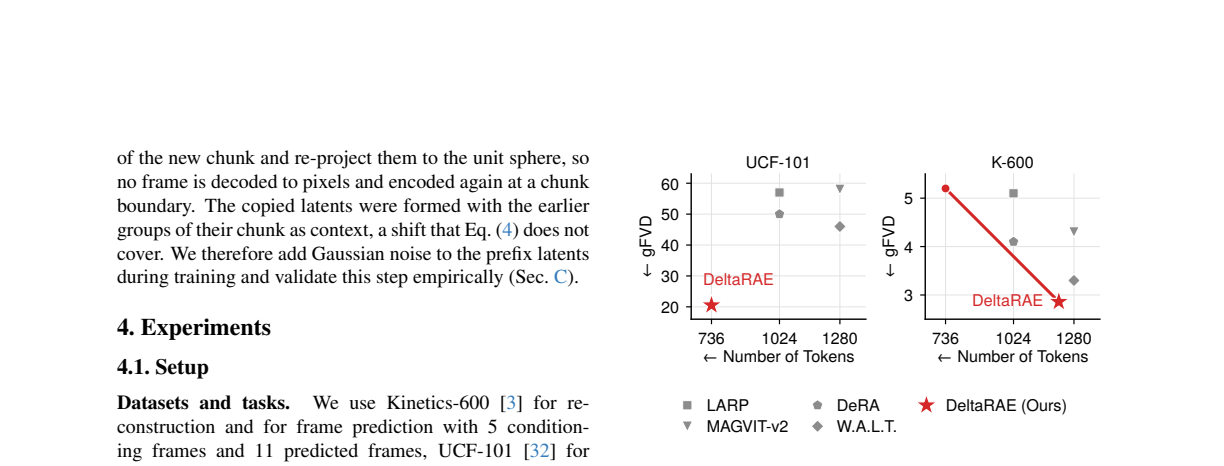
The paper introduces DeltaRAE, a causal representation autoencoder for video that treats tokens like a video codec treats frames: periodic anchor frames get a full set of tokens, and all intermediate frames get only a few derivative tokens. This derivative tokenization, combined with a frozen semantic encoder (DINOv2) that provides a generation-friendly latent space, reduces the token count for a minute of video by 18.8× compared to dense per-frame tokens. A standard diffusion transformer trained on 10-second chunks of these latents generates a full minute of video that stays coherent in all 455 held-out videos, while the same generator collapses within 15 seconds when the tokenizer has the same token budget but no pretrained encoder. On short benchmarks (UCF-101, Kinetics-600), DeltaRAE achieves competitive or state-of-the-art generation FVD with fewer tokens and half the tokenizer GFLOPs.
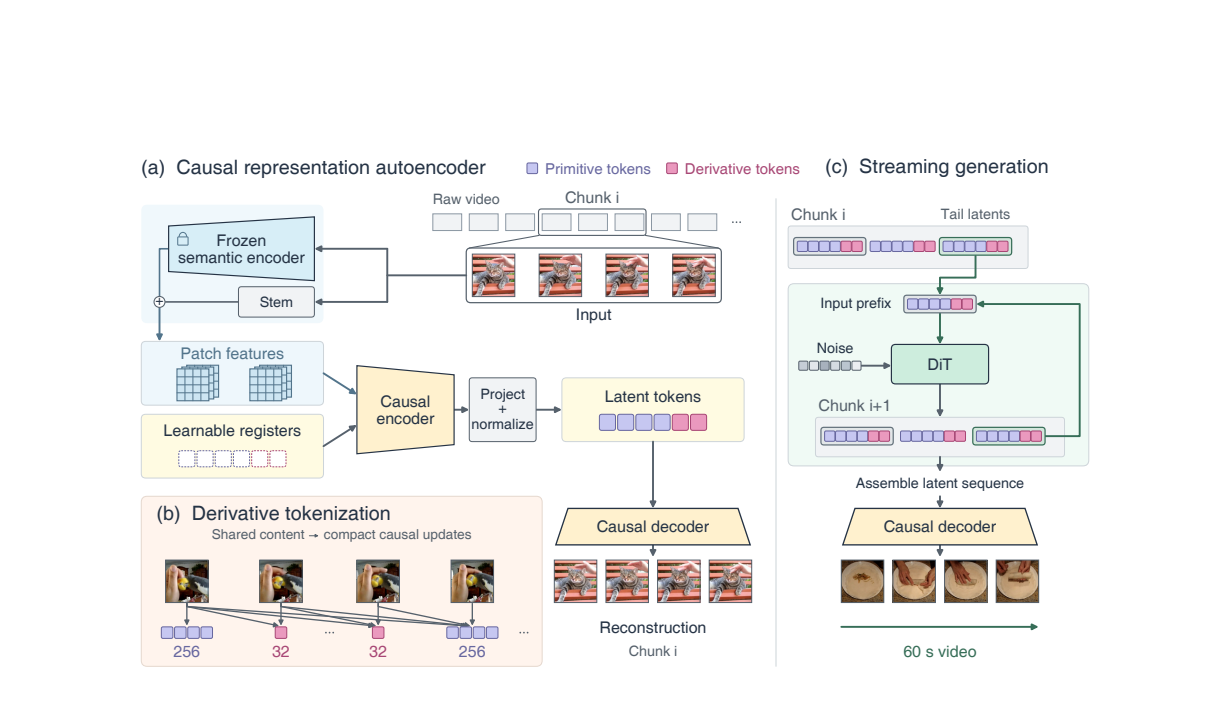
What carries the argument. Derivative tokenization: periodic anchor groups receive a full set of 256 primitive tokens, and all remaining groups receive a small number (32 or 64) of derivative tokens, defined over groups of frames (1 frame for short clips, 4 frames for one-minute videos). A causal encoder reads frozen DINOv2 features through learnable registers under a block-causal mask, and a causal decoder reconstructs pixels from the latent tokens. The pixel-residual stem adds low-level detail from the current and previous frame. Chunk-wise streaming generation reuses the last latents of a chunk as the prefix of the next, with Gaussian noise augmentation during training to tolerate the context shift.
Core claim. The paper claims that DeltaRAE, a causal representation autoencoder with derivative tokenization, produces a latent sequence that is short enough (19,584 tokens per minute, 18.8× fewer than dense per-frame tokens) and causal enough to train a standard diffusion transformer on 10-second chunks and generate a full minute of video that stays coherent in all 455 held-out videos. The same generator collapses within 15 seconds in most videos when the tokenizer has the same token budget but no frozen pretrained encoder (DINOv2), even though the variant reconstructs pixels better. This shows that the frozen semantic encoder provides a latent space that is easier to generate, and that reconstruction quality alone does not determine generation quality.
The premise it rests on. The frozen DINOv2 encoder provides a latent space that is easier to generate than pixel-level features, and this advantage is not due to other factors such as the higher reconstruction quality of the pixel-level tokenizer. The paper provides strong evidence through ablations (the tokenizer without the pretrained encoder collapses), but the mechanism is not fully explained. Additionally, the chunk-wise streaming generation relies on the assumption that the noise augmentation during training sufficiently covers the shift at chunk boundaries, which the paper acknowledges is outside the proven prefix invariance.
If the paper is right (Pith's inferences, not the authors')
Long video generation becomes feasible with standard diffusion transformers trained on short chunks, without specialized architectures or test-time training.
Tokenizers should be designed for generation-friendliness (ease of generating the latent space) rather than solely for reconstruction fidelity, as the gap between the two is large.
The 18.8× reduction in tokens per minute makes training on full-minute videos affordable, potentially enabling end-to-end long-video models.
Derivative tokenization halves tokenizer GFLOPs on 16-frame clips and reduces DiT forward-pass cost by 87.5%, lowering the compute barrier for video generation.
The streaming generation method (chunk-wise with latent reuse) can be applied to any causal tokenizer, not just DeltaRAE.
The approach may generalize to other frozen encoders (e.g., SigLIP 2, CLIP) or to video foundation models, potentially improving generation quality further.
The separation of primitive and derivative tokens could be exploited for controllable generation: swapping derivative tokens between videos transfers motion while keeping appearance, suggesting a path to motion editing without finetuning.
The streaming generation method (chunk-wise with latent reuse) could be applied to other causal tokenizers (e.g., AdapTok, ElasticTok) to extend their effective generation length.
The large gap between reconstruction and generation quality for pixel-level tokenizers suggests that standard reconstruction metrics (PSNR, rFVD) are poor predictors of generation performance, motivating new evaluation protocols.
Check this review
What was read
The passes were given all 111,772 characters of the paper's LaTeX source.
Fingerprint of that text (SHA-256): 61b8d1d68abdd0c636aaea12e3512dd9f268ffb79475bb4c40de5447cced8894
Pith does not keep that text. Rebuilt from the paper's source or PDF by the same code, it has this fingerprint if it is the same text. From a copy of Pith's code:
PYTHONPATH=. python scripts/review_input_check.py 2611.33886
The passes, in the order they ran
- Reader deepseek-v4-flash · medium effort · $0.0039 · instructions of the Reader, fingerprint f9ead7300382…
- Skeptic deepseek-v4-flash · medium effort · $0.0037 · instructions of the Skeptic, fingerprint 8f88c0f61488…
- Referee deepseek-v4-flash · medium effort · $0.0038 · instructions of the Referee, fingerprint a852d99aea0d…
- Check against the paper deepseek-v4-flash · medium effort · $0.0038 · instructions of the Check against the paper, fingerprint 6c7a6883d551…
- Editor deepseek-v4-flash · medium effort · $0.0034 · instructions of the Editor, fingerprint e7211f6a3d27…
- Circularity check deepseek-v4-flash · medium effort · $0.0033 · instructions of the Circularity check, fingerprint e9946e39d67b…
- Summary for the page deepseek-v4-flash · medium effort · temperature 0.2 · $0.0037 · instructions of the Summary for the page, fingerprint e4f56bf568e7…
The passes cost $0.026 in model calls together.
Version stamped on this review: pith-pipeline@v1.4.1-daily-deepseek-or-medium+deepseek/deepseek-v4-flash+p.d60f54226f00
Each link opens a pass's instructions as plain text, the exact bytes its fingerprint was taken over. Every stored set of instructions.
curl -s https://pith.science/methodology/prompts/f9ead730038216984cfb56d7cb34332bdf691828296a1de4245f3d6667d4bf56 | sha256sum
prints the fingerprint of the reader's instructions. The same works for every pass.
The receipt
The review's fingerprint was taken on 26 Nov 2026. The review you are reading still matches it.
Fingerprint of the review (SHA-256): 81b57416aaef156d575ddfde996beeef40107fe0754fc5ed7d20472045292395
curl -s 'https://pith.science/api/v1/verdicts/2611.33886?form=canonical' | sha256sum
prints the fingerprint of the review as it stands now. The rule, in four steps.
A matching fingerprint shows the review has not changed since that date. It does not show that the review is right.
How often reviews like this one are right
Reviews like this one: written by deepseek-v4-flash, from the paper's LaTeX source.
How often objections from reviews like this one are right: not yet measured
Reviews by people
This review was written by a machine. No person has reviewed this paper on Pith yet. A scientist listed on Pith can review it for a fee, and their review is published here whatever it concludes.
The paper
Abstract
Latent video generators are trained on clips of a few seconds, and much of this limit lies in their tokenizers, which spend as many tokens on a static frame as on a moving one and need future frames that do not exist during generation. We introduce DeltaRAE, a causal representation autoencoder for video. Its derivative tokenization encodes periodic anchor frames in full and all remaining frames with a few tokens each, and its causal encoder and decoder read a frozen pretrained image encoder. On UCF-101 and Kinetics-600, a standard diffusion transformer trained on DeltaRAE latents is competitive with state-of-the-art video tokenizers. DeltaRAE halves the tokenizer GFLOPs on 16-frame clips relative to keeping the same number of patch tokens for every frame, and it represents a minute of video with 18.8x fewer tokens. The tokenizer trains end to end on one-minute videos, and in video prediction a generator on its latents produces a full minute of video. The same generator collapses within 15 seconds in most videos when the tokenizer has the same token budget but no pretrained encoder.
The paper's own sentences, arranged, kept beside the review and separate from it. Each label is drawn from a closed vocabulary; the number beside it is the probability the classifier gave that label. No sentence in this record was written by a model.
abstract compiled · 2026-11-26
The authors' main claim, as the classifier picked it out 0.61
“On UCF-101 and Kinetics-600, a standard diffusion transformer trained on DeltaRAE latents is competitive with state-of-the-art video tokenizers.”
How the main claim is stated: asserted 1.00
What the abstract itself states, as probabilities: claims first 0.06 · states limitation 0.44 · human participants 0.03 · controlled comparison 0.92 · randomized assignment 0.01 · states quantitative result 0.99 · compares with prior results 0.94 · mentions code or data availability 0.03
The abstract, sentence by sentence
This table labels the abstract only (arXiv listing abstract v1). The number is the probability the classifier gave the label.
| Sentence | Role | The authors' own work | States the main conclusion | Strength |
|---|---|---|---|---|
| Latent video generators are trained on clips of a few seconds, and much of this limit lies in their tokenizers, which spend as many tokens on a static frame as on a moving one and need future frames that do not exist during generation. | background 0.94 | 0.13 | 0.05 | asserted 0.98 |
| We introduce DeltaRAE, a causal representation autoencoder for video. | contribution 0.99 | 0.92 | 0.08 | asserted 0.99 |
| Its derivative tokenization encodes periodic anchor frames in full and all remaining frames with a few tokens each, and its causal encoder and decoder read a frozen pretrained image encoder. | method 0.98 | 0.87 | 0.09 | asserted 1.00 |
| On UCF-101 and Kinetics-600, a standard diffusion transformer trained on DeltaRAE latents is competitive with state-of-the-art video tokenizers. | result 1.00 | 0.92 | 0.28 | asserted 1.00 |
| DeltaRAE halves the tokenizer GFLOPs on 16-frame clips relative to keeping the same number of patch tokens for every frame, and it represents a minute of video with 18.8x fewer tokens. | result 1.00 | 0.94 | 0.23 | asserted 1.00 |
| The tokenizer trains end to end on one-minute videos, and in video prediction a generator on its latents produces a full minute of video. | result 0.71 | 0.93 | 0.21 | asserted 1.00 |
| The same generator collapses within 15 seconds in most videos when the tokenizer has the same token budget but no pretrained encoder. | result 0.97 | 0.91 | 0.13 | asserted 1.00 |
What kind of paper the classifier reports this is: method or tool 1.00 · evidence from observation or experiment 0.97
What was examined, and what was not
Sources read
- arXiv listing abstract v1
Not examined
- full text
- figures and tables
- references and citing sentences
- relations to other papers
Levels run
- P abstract
Not run
- S sections
- T body sentences
- C citations
- R cross-paper relations
How the labels were made
Compiled by classifier-1.13.0 via TypeSafe API, question bank abstract-p1-20260923, 2026-11-26: 1 request, 5,680 input tokens.
Every quoted sentence on this record is the authors'. Every label is from Pith's closed vocabulary, with the probability shown beside it. This record as JSON
Figures (6)
Figures are the authors', reproduced from the paper.
References (59)
- [1] Andrei Atanov, Jesse Allardice, Roman Bachmann, O˘guzhan Fatih Kar, R Devon Hjelm, David Griffiths, Pe- ter Fu, Afshin Dehghan, and Amir Zamir. VideoFlex- Tok: Flexible-length coarse-to-fine video tokenization.arXiv preprint arXiv:2604.12887, 2026. 2 on PithPith's reviewarXiv
- [2] Jianhong Bai, Xiaoshi Wu, Xintao Wang, Xiao Fu, Yuanxing Zhang, Qinghe Wang, Xiaoyu Shi, Menghan Xia, Zuozhu Liu, Haoji Hu, Pengfei Wan, and Kun Gai. Semantic- Gen: Video generation in semantic space.arXiv preprint arXiv:2512.20619, 2025. 2 on PitharXiv
- [3] Joao Carreira, Eric Noland, Andras Banki-Horvath, Chloe Hillier, and Andrew Zisserman. A short note about Kinetics- 600.arXiv preprint arXiv:1808.01340, 2018. 5, 12 on PithPith's reviewarXiv
- [4] Boyuan Chen, Diego Martí Monsó, Yilun Du, Max Sim- chowitz, Russ Tedrake, and Vincent Sitzmann. Diffusion forcing: Next-token prediction meets full-sequence diffu- sion. InNeurIPS, 2024. 2 on Pith
- [5] Karan Dalal, Daniel Koceja, Gashon Hussein, Jiarui Xu, Yue Zhao, Youjin Song, Shihao Han, Ka Chun Cheung, Jan Kautz, Carlos Guestrin, Tatsunori Hashimoto, Sanmi Koyejo, Yejin Choi, Yu Sun, and Xiaolong Wang. One- minute video generation with test-time training. InCVPR, on Pith
- [6] Timothée Darcet, Maxime Oquab, Julien Mairal, and Piotr Bojanowski. Vision transformers need registers. InICLR, on Pith
- [7] Jia Deng, Wei Dong, Richard Socher, Li-Jia Li, Kai Li, and Li Fei-Fei. ImageNet: A large-scale hierarchical image database. InCVPR, 2009. 4, 12 on Pith
- [8] Patrick Esser, Sumith Kulal, Andreas Blattmann, Rahim Entezari, Jonas Müller, Harry Saini, Yam Levi, Dominik Lorenz, Axel Sauer, Frederic Boesel, et al. Scaling recti- fied flow transformers for high-resolution image synthesis. InICML, 2024. 1, 3, 4, 12 on Pith
- [9] Songwei Ge, Thomas Hayes, Harry Yang, Xi Yin, Guan Pang, David Jacobs, Jia-Bin Huang, and Devi Parikh. Long video generation with time-agnostic VQGAN and time- sensitive transformer. InECCV, 2022. 2, 6, 13 on Pith
- [10] Raghav Goyal, Samira Ebrahimi Kahou, Vincent Michal- ski, Joanna Materzynska, Susanne Westphal, Heuna Kim, Valentin Haenel, Ingo Fruend, Peter Yianilos, Moritz Mueller-Freitag, et al. The “something something” video database for learning and evaluating visual common sense. InI... on Pith
- [11] Kristen Grauman, Andrew Westbury, Eugene Byrne, Zachary Chavis, Antonino Furnari, Rohit Girdhar, Jack- son Hamburger, Hao Jiang, Miao Liu, Xiaoming Liu, et al. Ego4D: Around the world in 3,000 hours of egocentric video. InCVPR, 2022. 5, 12 on Pith
- [12] Pengbo Guo, Junke Wang, Zhen Xing, Chengxu Liu, Daoguo Dong, Xueming Qian, and Zuxuan Wu. DeRA: De- coupled representation alignment for video tokenization. In ECCV, 2026. 2, 6, 7, 13 on Pith
- [13] Agrim Gupta, Lijun Yu, Kihyuk Sohn, Xiuye Gu, Meera Hahn, Li Fei-Fei, Irfan Essa, Lu Jiang, and José Lezama. Photorealistic video generation with diffusion models. In ECCV, 2024. 1, 2, 6, 7, 13 on Pith
- [14] Philippe Hansen-Estruch, David Yan, Ching-Yao Chung, Orr Zohar, Jialiang Wang, Tingbo Hou, Tao Xu, Sriram Vish- wanath, Peter Vajda, and Xinlei Chen. Learnings from scal- ing visual tokenizers for reconstruction and generation. In ICML, 2025. 2, 6, 13, 24 on Pith
- [15] Martin Heusel, Hubert Ramsauer, Thomas Unterthiner, Bernhard Nessler, and Sepp Hochreiter. GANs trained by a two time-scale update rule converge to a local Nash equi- librium. InNeurIPS, 2017. 12 on Pith
- [16] Jonathan Ho, Ajay Jain, and Pieter Abbeel. Denoising diffu- sion probabilistic models. InNeurIPS, 2020. 6, 12 on Pith
- [17] Wenyi Hong, Ming Ding, Wendi Zheng, Xinghan Liu, and Jie Tang. CogVideo: Large-scale pretraining for text-to- video generation via transformers. InICLR, 2023. 2 on Pith
- [18] Zhihao Hu, Guo Lu, and Dong Xu. FVC: A new framework towards deep video compression in feature space. InCVPR, on Pith
- [19] Huiwon Jang, Sihyun Yu, Jinwoo Shin, Pieter Abbeel, and Younggyo Seo. Efficient long video tokenization via coordinate-based patch reconstruction. InCVPR, 2025. 2 on Pith
- [20] Tommie Kerssies, Gabriele Berton, Ju He, Qihang Yu, Wufei Ma, Daan de Geus, Gijs Dubbelman, and Liang-Chieh Chen. A frame is worth one token: Efficient generative world mod- eling with delta tokens. InCVPR, 2026. 2 on Pith
show 39 more
- [21] Yan Li, Changyao Tian, Renqiu Xia, Ning Liao, Weiwei Guo, Junchi Yan, Hongsheng Li, Jifeng Dai, Hao Li, and Xue Yang. AdapTok: Learning adaptive and temporally causal video tokenization in a 1D latent space. InCVPR, 2026. 2, 6, 13 9 on Pith
- [22] Yaron Lipman, Ricky T. Q. Chen, Heli Ben-Hamu, Maxi- milian Nickel, and Matt Le. Flow matching for generative modeling. InICLR, 2023. 3 on Pith
- [23] Xingchao Liu, Chengyue Gong, and Qiang Liu. Flow straight and fast: Learning to generate and transfer data with rectified flow. InICLR, 2023. 3, 4, 12 on Pith
- [24] Guo Lu, Wanli Ouyang, Dong Xu, Xiaoyun Zhang, Chun- lei Cai, and Zhiyong Gao. DVC: An end-to-end deep video compression framework. InCVPR, 2019. 2 on Pith
- [25] Maxime Oquab, Timothée Darcet, Théo Moutakanni, Huy V o, Marc Szafraniec, Vasil Khalidov, Pierre Fernandez, Daniel Haziza, Francisco Massa, Alaaeldin El-Nouby, et al. DINOv2: Learning robust visual features without supervi- sion.TMLR, 2024. 2, 3, 13 on Pith
- [26] William Peebles and Saining Xie. Scalable diffusion models with transformers. InICCV, 2023. 1, 4, 12 on Pith
- [27] Nhi Pham, Christopher Wewer, Bernt Schiele, Jonas Fis- cher, and Jan Eric Lenssen. TrackTok: Semantically per- sistent tokens for latent video generation.arXiv preprint arXiv:2610.33857, 2026. 2 on PithPith's reviewarXiv
- [28] Alec Radford, Jong Wook Kim, Chris Hallacy, Aditya Ramesh, Gabriel Goh, Sandhini Agarwal, Girish Sastry, Amanda Askell, Pamela Mishkin, Jack Clark, et al. Learn- ing transferable visual models from natural language super- vision. InICML, 2021. 24 on Pith
- [29] Robin Rombach, Andreas Blattmann, Dominik Lorenz, Patrick Esser, and Björn Ommer. High-resolution image syn- thesis with latent diffusion models. InCVPR, 2022. 2 on Pith
- [30] Tim Salimans and Jonathan Ho. Progressive distillation for fast sampling of diffusion models. InICLR, 2022. 12 on Pith
- [31] Jiaming Song, Chenlin Meng, and Stefano Ermon. Denois- ing diffusion implicit models. InICLR, 2021. 12 on Pith
- [32] Khurram Soomro, Amir Roshan Zamir, and Mubarak Shah. UCF101: A dataset of 101 human actions classes from videos in the wild.arXiv preprint arXiv:1212.0402, 2012. 5, 12 on PithPith's reviewarXiv
- [33] Jianlin Su, Yu Lu, Shengfeng Pan, Ahmed Murtadha, Bo Wen, and Yunfeng Liu. RoFormer: Enhanced trans- former with rotary position embedding.arXiv preprint arXiv:2104.09864, 2021. 3, 17, 24 on PithPith's reviewarXiv
- [34] Gary J Sullivan, Jens-Rainer Ohm, Woo-Jin Han, and Thomas Wiegand. Overview of the high efficiency video coding (HEVC) standard.IEEE TCSVT, 2012. 2 on Pith
- [35] Zhentao Tan, Ben Xue, Jian Jia, Junhao Wang, Wencai Ye, Shaoyun Shi, Mingjie Sun, Wenjin Wu, Quan Chen, and Peng Jiang. SweetTok: Semantic-aware spatial-temporal to- kenizer for compact video discretization. InICCV, 2025. 2, 6, 13 on Pith
- [36] Rui Tian, Qi Dai, Jianmin Bao, Kai Qiu, Yifan Yang, Chong Luo, Zuxuan Wu, and Yu-Gang Jiang. REDUCIO! generat- ing 1K video within 16 seconds using extremely compressed motion latents. InICCV, 2025. 2 on Pith
- [37] Michael Tschannen, Alexey Gritsenko, Xiao Wang, Muham- mad Ferjad Naeem, Ibrahim Alabdulmohsin, Nikhil Parthasarathy, Talfan Evans, Lucas Beyer, Ye Xia, Basil Mustafa, et al. SigLIP 2: Multilingual vision-language en- coders with improved semantic understanding, localization, ... on PithPith's reviewarXiv
- [38] Thomas Unterthiner, Sjoerd van Steenkiste, Karol Kurach, Raphael Marinier, Marcin Michalski, and Sylvain Gelly. To- wards accurate generative models of video: A new metric & challenges.arXiv preprint arXiv:1812.01717, 2019. 5, 12 on PithPith's reviewarXiv
- [39] Aaron van den Oord, Oriol Vinyals, and Koray Kavukcuoglu. Neural discrete representation learning. InNeurIPS, 2017. 2 on Pith
- [40] Hanyu Wang, Saksham Suri, Yixuan Ren, Hao Chen, and Abhinav Shrivastava. LARP: Tokenizing videos with a learned autoregressive generative prior. InICLR, 2025. 2, 6, 7, 13 on Pith
- [41] Junke Wang, Yi Jiang, Zehuan Yuan, Binyue Peng, Zuxuan Wu, and Yu-Gang Jiang. OmniTokenizer: A joint image- video tokenizer for visual generation. InNeurIPS, 2024. 2, 6, 13 on Pith
- [42] Zhou Wang, Alan C. Bovik, Hamid R. Sheikh, and Eero P. Simoncelli. Image quality assessment: From error visibility to structural similarity.IEEE Transactions on Image Pro- cessing, 13(4):600–612, 2004. 5, 12 on Pith
- [43] Jialong Wu, Shaofeng Yin, Ningya Feng, Xu He, Dong Li, Jianye Hao, and Mingsheng Long. iVideoGPT: Interactive VideoGPTs are scalable world models. InNeurIPS, 2024. 2 on Pith
- [44] Zhihao Xie, Junfeng Wu, Xinting Hu, Junchao Huang, and Li Jiang. VideoRAE: Taming video foundation models for generative modeling via representation autoencoders.arXiv preprint arXiv:2607.14088, 2026. 2, 5, 6, 7, 13, 24 on PithPith's reviewarXiv
- [45] Tianwei Xiong, Jun Hao Liew, Zilong Huang, Zhijie Lin, Jiashi Feng, and Xihui Liu. EV ATok: Adaptive length video tokenization for efficient visual autoregressive generation. In CVPR, 2026. 2 on Pith
- [46] Wilson Yan, Yunzhi Zhang, Pieter Abbeel, and Aravind Srinivas. VideoGPT: Video generation using VQ-V AE and transformers.arXiv preprint arXiv:2104.10157, 2021. 2 on PithPith's reviewarXiv
- [47] Wilson Yan, V olodymyr Mnih, Aleksandra Faust, Matei Za- haria, Pieter Abbeel, and Hao Liu. ElasticTok: Adaptive tokenization for image and video. InICLR, 2025. 2 on Pith
- [48] Haotian Ye, Qiyuan He, Jiaqi Han, Puheng Li, Jiaojiao Fan, Zekun Hao, Fitsum Reda, Yogesh Balaji, Huayu Chen, Sheng Liu, Angela Yao, James Zou, Stefano Ermon, Haox- iang Wang, and Ming-Yu Liu. InfoTok: Adaptive discrete video tokenizer via information-theoretic compression. In... on Pith
- [49] Jiahui Yu, Xin Li, Jing Yu Koh, Han Zhang, Ruoming Pang, James Qin, Alexander Ku, Yuanzhong Xu, Jason Baldridge, and Yonghui Wu. Vector-quantized image modeling with improved VQGAN. InICLR, 2022. 2, 4 on Pith
- [50] Lijun Yu, Yong Cheng, Kihyuk Sohn, José Lezama, Han Zhang, Huiwen Chang, Alexander G Hauptmann, Ming- Hsuan Yang, Yuan Hao, Irfan Essa, and Lu Jiang. MAGVIT: Masked generative video transformer. InCVPR, 2023. 2, 4, 5, 6, 12, 13 on Pith
- [51] Lijun Yu, José Lezama, Nitesh B Gundavarapu, Luca Ver- sari, Kihyuk Sohn, David Minnen, Yong Cheng, Vighnesh Birodkar, Agrim Gupta, Xiuye Gu, et al. Language model beats diffusion – tokenizer is key to visual generation. In ICLR, 2024. 2, 6, 7, 13 10 on Pith
- [52] Qihang Yu, Mark Weber, Xueqing Deng, Xiaohui Shen, Daniel Cremers, and Liang-Chieh Chen. An image is worth 32 tokens for reconstruction and generation. InNeurIPS, on Pith
- [53] Sihyun Yu, Sangkyung Kwak, Huiwon Jang, Jongheon Jeong, Jonathan Huang, Jinwoo Shin, and Saining Xie. Representation alignment for generation: Training diffusion transformers is easier than you think. InICLR, 2025. 2 on Pith
- [54] Xiaohua Zhai, Basil Mustafa, Alexander Kolesnikov, and Lucas Beyer. Sigmoid loss for language image pre-training. InICCV, 2023. 2 on Pith
- [55] Lvmin Zhang, Shengqu Cai, Muyang Li, Gordon Wetzstein, and Maneesh Agrawala. Frame context packing and drift prevention in next-frame-prediction video diffusion models. arXiv preprint arXiv:2504.12626, 2025. 2 on PitharXiv
- [56] Richard Zhang, Phillip Isola, Alexei A. Efros, Eli Shecht- man, and Oliver Wang. The unreasonable effectiveness of deep features as a perceptual metric. InCVPR, 2018. 4, 12 on Pith
- [57] Boyang Zheng, Nanye Ma, Shengbang Tong, and Saining Xie. Diffusion transformers with representation autoen- coders.arXiv preprint arXiv:2510.11690, 2025. 2, 7 on PithPith's reviewarXiv
- [58] Tianxiong Zhong, Xingye Tian, Boyuan Jiang, Xuebo Wang, Xin Tao, Pengfei Wan, and Zhiwei Zhang. VFRTok: Vari- able frame rates video tokenizer with duration-proportional information assumption. InNeurIPS, 2025. 2, 6, 13 on Pith
- [59] Luowei Zhou, Chenliang Xu, and Jason J Corso. Towards automatic learning of procedures from web instructional videos. InAAAI, 2018. 5, 13 11 DeltaRAE: Derivative Tokenization for Long Video Generation Supplementary Material Sec. A gives the training and evaluation protocols fo... on Pith
Challenges and discussion
Disagree with the review, or know something it missed? Leave a comment, or challenge this review formally: a challenge becomes a permanent entry in this paper's record, and its decision is published here.
Come back by email
A short list of the week's newly reviewed papers. Nothing is sent until you confirm from your inbox, and every email has a link that stops it. No account.
No comments yet.
Sign in to comment