Machine Learning · arXiv:2610.34173 v1 · submitted 25 Oct 2026 · 18 references
Reasoning or Just Prompting? Probing the Mechanism of Latent Chemical Reasoning
The paper says
“Latent reasoning performs intermediate computation in continuous space rather than through explicit tokens, which is particularly appealing in chemistry, where errors in explicit reasoning can propagate to the final answer.”
more of the abstract
Yet if latent states truly constitute an implicit reasoning chain, they should be causally important. We find otherwise: swapping or moderately perturbing intermediate latent states has little effect on performance, while removing them entirely sometimes causes a substantial score drop. Thus, the latent states matter, but their molecule-specific content appears to matter far less. This points to a simpler interpretation. Rather than encoding a step-by-step reasoning chain, latent states may primarily steer subsequent model computation, much like soft prompts. Indeed, a single fixed prefix shared across molecules reproduces LatentChem's performance, and a learned static soft prompt performs comparably to per-input latent generation in controlled models. The tolerance of latent sequences to substitution and moderate perturbation further supports this connection. We therefore suggest that latent chemical reasoning may be better viewed as soft prompting than as a reasoning chain hidden in continuous space.
from the abstract
Pith says
Machine review · deepseek-v4-flash · 27 Oct 2026 · what was read was not recorded · not checked by a person
It can be wrong. Challenge this review or reply to it.
Holds up. Solid mechanistic probe of latent reasoning in chemistry; main conclusion—latents matter for presence, not content—is well-supported and worth engaging. This line is wrong
6 minor
How often objections from reviews like this one are right: not yet measured
Not checked: figures, code, what the 18 references say.
6 minor objections
The paper says, at §3.2
Pith says: minor objection 1 of 6
'X-ONLYmasks attention' is missing a space; should read 'X-ONLY masks attention'.
The paper says, at §3.2
Pith says: minor objection 2 of 6
'GAUSSIANZ' and 'NOISYZ' in the subsection headers lack a space after the condition name; consider 'GAUSSIAN Z' and 'NOISE Z' for readability.
show 4 more
The paper says, at §4.1, Figure 2 caption
Pith says: minor objection 3 of 6
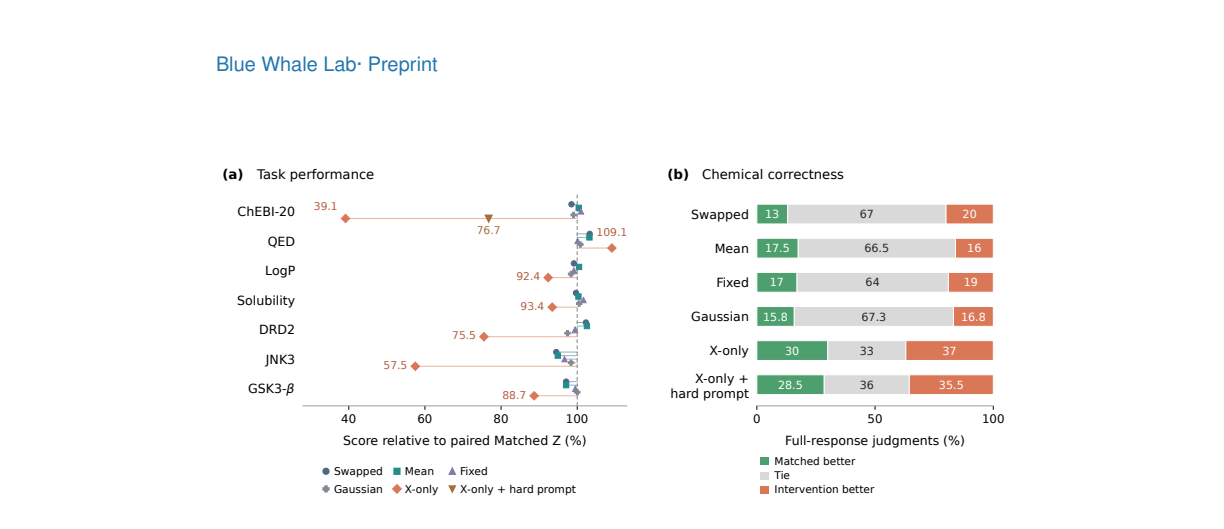
Panel (b) label reads 'judgements' whereas the manuscript uses 'judgments' elsewhere; harmonize spelling.
The paper says, at Table 1
Pith says: minor objection 4 of 6
The 'Identical (%)' column header could be read as identical to the matched baseline, which is correct, but adding an explicit footnote like 'Exact answer-agreement with the paired Matched run' would avoid ambiguity.
The paper says, at §A.3, Intervention interface and calibration
Pith says: minor objection 5 of 6
The phrase 'post-hoc X-only and masked-prefix controls zero the latent attention-mask entries without deleting embedding rows or boundary markers' is clear, but the term 'masked-prefix' is not defined earlier; readers may benefit from a brief explanation that it refers to a fixed prefix with attention masking similar to X-only.
The paper says, at Table 18, footnote
Pith says: minor objection 6 of 6
The note 'Static prompts have zero molecule and interaction terms by construction' is helpful, but it could be added directly to the table caption rather than in the body text.
What would settle it
Train a soft prompt from scratch on a separate dataset under the same architecture and training schedule as the controlled latent models, then compare its performance and substitution tolerance to the fixed average prefix used in the paper. If the learned soft prompt performs similarly, the conclusion that learned input-specific latents provide little additional benefit is further strengthened.
from the skeptic's reading
How the review went
4 readings by deepseek-v4-flash · 27 Oct 2026
- Reader holds up
- Skeptic disagrees
- Editor wrote the verdict above
- Referee accept: 6 minor
Not run on this paper: the simulated authors' defence.
Pith did not check this review's objections against the paper.
The review in full
The review in brief, machine-written
The paper does a clean job of testing whether input-specific latent sequences in LatentChem carry molecule-specific reasoning or just work as shared conditioning. The central contrast—presence matters, content doesn't—is convincingly demonstrated through multiple convergent interventions: cross-molecule substitution, fixed prefix, Gaussian replacement, additive noise, and controlled models trained from scratch. The shared-prefix baselines are a nice methodological contribution that extends beyond chemistry.
What's new: this is the first intervention-based test of chemical latent reasoning, separating presence, content, and response organization. Prior work studied latent sensitivity in language, chess, and vision; this extends it to chemistry with matched learned soft prompts.
The paper is well-executed. Experiments are clear, limitations are stated transparently: single training run, evaluation-cohort MeanZ as diagnostic, boundary marker confounds not fully isolated in H0 comparisons, model-based chemical correctness judgments. The controlled models showing no consistent advantage over learned soft prompts strengthen the conclusion.
Soft spots are minor and acknowledged. The single-run training is a limitation, though the authors flag it. The MeanZ diagnostic uses evaluation-cohort statistics, but they label it as diagnostic rather than confirmatory. The chemical correctness judgments are model-based (Gemini), not human. The controlled models differ from LatentChem in architecture and training, so the source of their different removal behavior remains unresolved. The H0 X-only control confounds removal with boundary marker removal. All stated.
The central argument holds up. The paper provides a useful methodological contribution to evaluating latent reasoning: separate task quality, response organization, and the benefit of input-specific computation.
Who this is for: researchers working on latent reasoning evaluation, interpretability, or chemical AI. It's relevant to the broader debate about whether latent reasoning is actual reasoning or just conditioning.
I'd send this to peer review. The work is careful, the claims are proportionate to the evidence, and the limitations are honestly stated.
The strongest objection
The paper's central claim is well-supported by multiple convergent interventions: cross-molecule substitution, fixed prefix, Gaussian replacement, additive noise, and controlled models trained from scratch. The potential confounds in intervention tests (residual molecule-specific information in H10, boundary marker effects) are acknowledged and partially addressed through H0 controls and separate removal experiments. The single-run training and model-based chemical judgments are transparent limitations that do not undermine the conclusion for the studied models. No load-bearing concern that would alter the verdict is found.
The reader's weakest assumption concerns residual confounds in the intervention tests. The paper addresses these confounds explicitly (H0 controls, boundary marker tests, separate removal experiments) and the evidence from multiple independent interventions converges on the same conclusion. The stress-test finds that the central argument is robust within its stated scope. The reader's verdict of ACCEPT remains appropriate; no adjustment is needed.
The referee's report
If the claim holds, it reframes how the community interprets latent-reasoning models in chemistry and beyond: performance gains attributed to latent 'thinking' may instead stem from the addition of a continuous block that steers decoder behavior. The paper's methodological contribution is equally important: it provides a template of intervention types (substitution, removal, fixed-prefix control, noise scaling) that separate the benefit of input-specific content from the benefit of block presence. The study is notably transparent about its limitations—single training run per configuration, use of evaluation-cohort statistics for the MeanZ diagnostic, confounds in the H0 X-only control, model-based chemical judgments—which allows readers to calibrate their confidence. These strengths make the paper a valuable reference for future mechanistic analyses of latent computation.
Pith's reading of the paper (a machine's summary, not the authors')
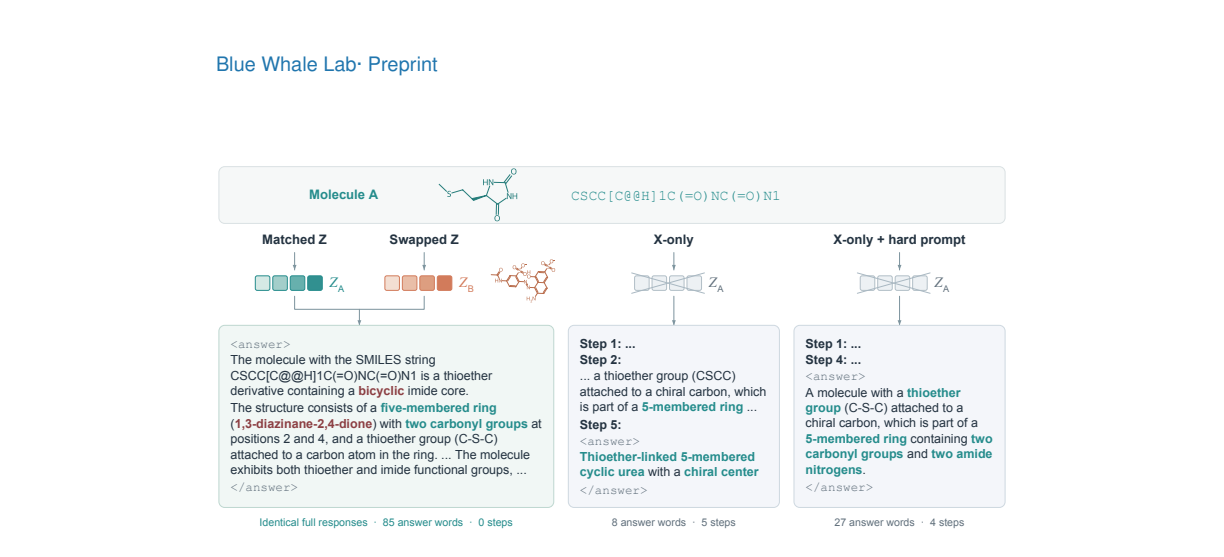
LatentChem's continuous intermediate states, meant to encode an implicit reasoning chain about molecules, turn out to be interchangeable: swapping a molecule's latent sequence with another molecule's sequence preserves task scores on description and optimization tasks. Removing the latent block entirely causes a drop in score, but its molecule-specific content matters hardly at all. A single shared prefix, computed from a calibration set and reused across all inputs, reproduces the model's performance, and a separately trained static soft prompt matches a recurrent latent model in controlled experiments. The paper concludes that the latent sequences act as continuous conditioning vectors — soft prompts — that steer the model's response format (explicit reasoning steps versus direct answers) rather than carrying a stepwise chemical reasoning chain.
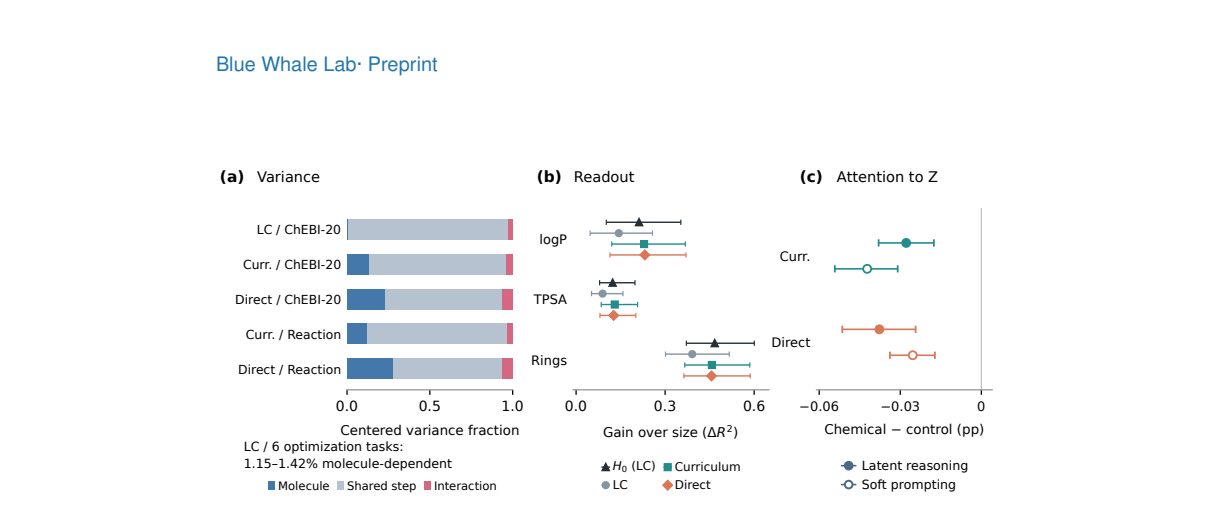
What carries the argument. The key machinery is a battery of causal intervention experiments on latent sequences: (1) same-length sequence replacement (Swapped Z, Mean Z, Fixed Z), (2) removal (X-only, Zero Z), and (3) coordinated numerical perturbations (Gaussian Z, full-coordinate noise). These interventions isolate the contribution of the latent sequence's presence from its molecule-specific content. The comparison against a shared fixed prefix (Fixed Z) and trained soft prompts in controlled models provides the direct test of whether per-input latent generation is necessary. A variance decomposition of latent states into molecule, shared step, and interaction terms quantifies how tightly trajectories are shared across inputs.
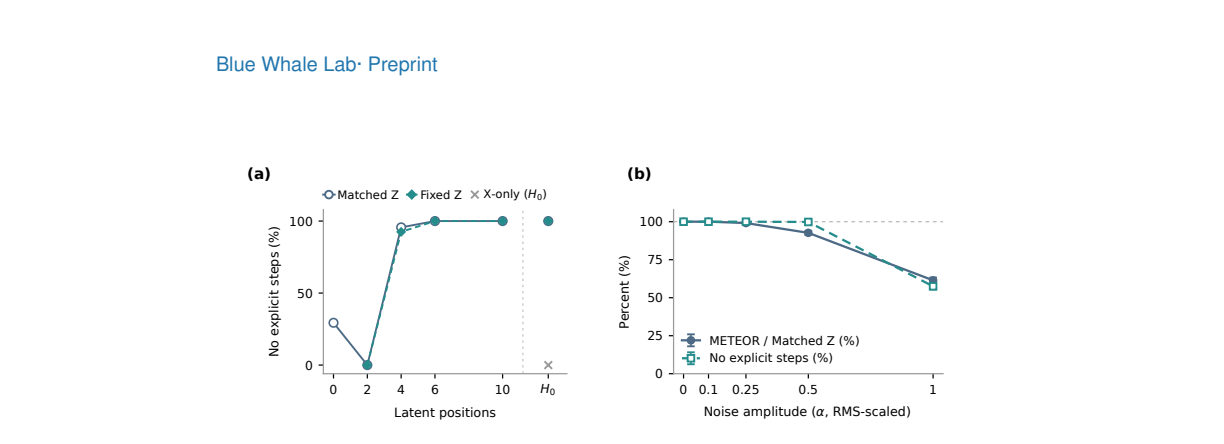
Core claim. The paper establishes that in the LatentChem model and in controlled latent-reasoning models for chemistry, the intermediate latent states are causally important for whether the model generates explicit reasoning steps, but their molecule-specific content is largely irrelevant to task scores. Swapping a molecule's own latent sequence with another molecule's sequence, with a fixed shared prefix, or with a distribution-matched random sample all preserve aggregate performance. Removing the latent block changes the model's output organization (textual steps appear inside answer tags) and lowers scores, but the drop is partly recoverable by a hard prompt. The central contrast is that LatentChem is sensitive to whether a latent block is present, but hardly to whose block it is. The authors interpret this as evidence that latent chemical reasoning is better viewed as soft prompting than as a hidden step-by-step reasoning chain.
The premise it rests on. The intervention tests assume that swapping or replacing the latent sequence isolates the contribution of molecule-specific latent content without introducing confounds through boundary markers, attention pattern changes, or residual information in the retained molecular context (H10). The paper acknowledges several confounds (boundary markers not fully isolated in H0 comparisons, molecule-specific info retained in H10) but relies on the approximate that primary effect is through the latents.
If the paper is right (Pith's inferences, not the authors')
Future latent reasoning evaluations should include a shared-prefix baseline to separate the benefit of continuous conditioning from the benefit of input-specific computation.
The finding that score drops after latent removal are partly due to changed output format (explicit steps appearing where direct answers formerly appeared) means that metric changes must be interpreted with response organization audits.
Probe analyses showing that latents encode molecular information are insufficient to establish causal use during generation; substitution tests are a stronger causal check.
Controlled models trained de novo showed the same substitution tolerance, suggesting that the result is not an artifact of LatentChem's particular architecture but may generalise to other recurrent latent models in chemistry.
If the latent sequences are soft prompts that control format rather than content, then improving latent reasoning may require architectures where the latent computation genuinely interacts with molecular features in a way that cannot be absorbed by a fixed prefix. The present models may not be exploiting the capacity of continuous reasoning.
The coexistence of readable molecular information with substitution tolerance implies that the decoder can obtain the same information from the retained input context (H0, the initial molecular update). This raises the question of whether the latent recurrent steps are computationally redundant — a possibility the authors note without fully resolving.
These results may extend to latent reasoning in non-chemical domains: any setting where the latent trajectory converges quickly to a shared path, leaving only small molecule-dependent residues, would exhibit similar substitution tolerance and a soft-prompt interpretation.
Check this review
Pith stored no record of this review's passes and took no fingerprint of it. Reviews made by code from 13 Nov 2026 on carry both.
How often reviews like this one are right
Reviews like this one: written by deepseek-v4-flash, where what was read was not recorded.
How often objections from reviews like this one are right: not yet measured
Reviews by people
This review was written by a machine. No person has reviewed this paper on Pith yet. A scientist listed on Pith can review it for a fee, and their review is published here whatever it concludes.
The paper
Abstract
Latent reasoning performs intermediate computation in continuous space rather than through explicit tokens, which is particularly appealing in chemistry, where errors in explicit reasoning can propagate to the final answer. Yet if latent states truly constitute an implicit reasoning chain, they should be causally important. We find otherwise: swapping or moderately perturbing intermediate latent states has little effect on performance, while removing them entirely sometimes causes a substantial score drop. Thus, the latent states matter, but their molecule-specific content appears to matter far less. This points to a simpler interpretation. Rather than encoding a step-by-step reasoning chain, latent states may primarily steer subsequent model computation, much like soft prompts. Indeed, a single fixed prefix shared across molecules reproduces LatentChem's performance, and a learned static soft prompt performs comparably to per-input latent generation in controlled models. The tolerance of latent sequences to substitution and moderate perturbation further supports this connection. We therefore suggest that latent chemical reasoning may be better viewed as soft prompting than as a reasoning chain hidden in continuous space.
The paper's own sentences, arranged, kept beside the review and separate from it. Each label is drawn from a closed vocabulary; the number beside it is the probability the classifier gave that label. No sentence in this record was written by a model.
abstract compiled · 2026-10-27
The authors' main claim, as the classifier picked it out 1.00
“We therefore suggest that latent chemical reasoning may be better viewed as soft prompting than as a reasoning chain hidden in continuous space.”
How the main claim is stated: hedged possibility 1.00
What the abstract itself states, as probabilities: claims first 0.03 · states limitation 0.35 · human participants 0.03 · controlled comparison 0.84 · randomized assignment 0.02 · states quantitative result 0.07 · compares with prior results 0.67 · mentions code or data availability 0.03
The abstract, sentence by sentence
This table labels the abstract only (arXiv listing abstract v1). The number is the probability the classifier gave the label.
| Sentence | Role | The authors' own work | States the main conclusion | Strength |
|---|---|---|---|---|
| Latent reasoning performs intermediate computation in continuous space rather than through explicit tokens, which is particularly appealing in chemistry, where errors in explicit reasoning can propagate to the final answer. | background 1.00 | 0.06 | 0.02 | asserted 0.99 |
| Yet if latent states truly constitute an implicit reasoning chain, they should be causally important. | gap 0.78 | 0.05 | 0.02 | hedged possibility 0.48 |
| We find otherwise: swapping or moderately perturbing intermediate latent states has little effect on performance, while removing them entirely sometimes causes a substantial score drop. | result 1.00 | 0.96 | 0.12 | asserted 1.00 |
| Thus, the latent states matter, but their molecule-specific content appears to matter far less. | interpretation 0.71 | 0.92 | 0.16 | asserted 0.82 |
| This points to a simpler interpretation. | interpretation 0.99 | 0.12 | 0.03 | unclear 0.78 |
| Rather than encoding a step-by-step reasoning chain, latent states may primarily steer subsequent model computation, much like soft prompts. | interpretation 1.00 | 0.23 | 0.43 | hedged possibility 1.00 |
| Indeed, a single fixed prefix shared across molecules reproduces LatentChem's performance, and a learned static soft prompt performs comparably to per-input latent generation in controlled models. | result 0.97 | 0.88 | 0.12 | asserted 0.99 |
| The tolerance of latent sequences to substitution and moderate perturbation further supports this connection. | interpretation 0.73 | 0.83 | 0.05 | asserted 0.52 |
| We therefore suggest that latent chemical reasoning may be better viewed as soft prompting than as a reasoning chain hidden in continuous space. | interpretation 1.00 | 0.57 | 0.93 | hedged possibility 1.00 |
What kind of paper the classifier reports this is: empirical study 0.95 · evidence from observation or experiment 0.83
What was examined, and what was not
Sources read
- arXiv listing abstract v1
Not examined
- full text
- figures and tables
- references and citing sentences
- relations to other papers
Levels run
- P abstract
Not run
- S sections
- T body sentences
- C citations
- R cross-paper relations
How the labels were made
Compiled by classifier-1.13.0 via TypeSafe API, question bank abstract-p1-20260923, 2026-10-27: 1 request, 6,733 input tokens.
Every quoted sentence on this record is the authors'. Every label is from Pith's closed vocabulary, with the probability shown beside it. This record as JSON
Figures (4)
Figures are the authors', reproduced from the paper.
References (18)
- [1] Darpan Aswal, Thomas Palmeira Ferraz, Yongxin Zhou, and Maxime Peyrard. Observable patterns are not explanations: A causal-geometric analysis of latent reasoning models.arXiv preprint arXiv:2606.12689, on PithPith's reviewarXiv
- [4] URL https://openreview.net/forum? id=RvmR9gOYXB. Shibo Hao, Sainbayar Sukhbaatar, DiJia Su, Xian Li, Zhiting Hu, Jason Weston, and Yuandong Tian. Training large language models to reason in a continuous latent space.arXiv preprint arXiv:2412.06769, on PithPith's reviewarXiv
- [5] John Hewitt and Percy Liang. Designing and interpreting probes with control tasks. InProceedings of the 2019 Conference on Empirical Methods in Natural Language Processing and the 9th International Joint Conference on Natural Language Processing, pp. 2733–2743, on Pith
- [7] Ishan S Kshirsagar. The weight of silence: A causal case for weights over the scratchpad in latent chess reasoning.arXiv preprint arXiv:2607.20952, on PithPith's reviewarXiv
- [12] Zhenyi Shen, Hanqi Yan, Linhai Zhang, Zhanghao Hu, Yali Du, and Yulan He. CODI: Compressing chain-of-thought into continuous space via self-distillation. InProceedings of the 2025 Conference on Empirical Methods in Natural Language Processing, pp. 677–693, on Pith
- [13] André G Viveiros, Nuno Gonçalves, André FT Martins, and Matthias Lindemann. What’s holding back latent visual reasoning?arXiv preprint arXiv:2605.18445, on PithPith's reviewarXiv
- [15] Xin Zhang, Qiqi Tao, Jiawei Du, Moyun Liu, and Joey Tianyi Zhou. Visual latents know more than they say: Unsilencing latent reasoning in mllms.arXiv preprint arXiv:2605.02735, on PithPith's reviewarXiv
- [16] Yuyi Zhang, Boyu Tang, Tianjie Ju, Sufeng Duan, and Gongshen Liu. Do latent tokens think? a causal and adversarial analysis of chain-of-continuous-thought.arXiv preprint arXiv:2512.21711, on PithPith's reviewarXiv
- [17] Zihan Zhao, Ziping Wan, Lu Chen, Xuanze Lin, Shiyang Yu, Situo Zhang, Da Ma, Zichen Zhu, Danyang Zhang, Huayang Wang, Zhongyang Dai, Liyang Wen, Bo Chen, Xin Chen, and Kai Yu. ChemDFM-R: A chemical reasoning LLM enhanced with atomized chemical knowledge.arXiv preprint arXiv:25... on PithPith's reviewarXiv
- [18] 11 Blue Whale Lab· Preprint A Data, Training, and Evaluation Protocols This appendix specifies the shared experimental protocols. Supplementary results are organized by the questions they address: LatentChem interventions, controlled training comparisons, and representation an... on Pith
- [512] All comparisons use greedy decoding; controlled-model task comparisons permit 1,024 tokens. Length sweeps use 0, 2, 4, 6, and 10 positions, and initial-context comparisons use ten-position 14 Blue Whale Lab· Preprint prefixes and X-only. Gaussian sampling and full-coordinate n... on Pith
- [2019] Sarthak Jain and Byron C Wallace. Attention is not explanation. InProceedings of the 2019 Conference of the North American Chapter of the Association for Computational Linguistics: Human Language Technologies, V olume 1 (Long and Short Papers), pp. 3543–3556, on Pith
- [2021] 10 Blue Whale Lab· Preprint Xingqiao Lin, Junmei Wang, and Haocheng Tang. Localize, then reason: Visual latent structural reasoning for molecular properties and edits.arXiv preprint arXiv:2608.13244, on PithPith's reviewarXiv
- [2022] Xinwu Ye, Yicheng Mao, Yuxuan Liao, Jia Zhang, Yimeng Liu, Li Hao, Fang Wu, Zhiwei Li, Zehong Wang, Zhiyuan Liu, et al. LatentChem: From textual CoT to latent thinking in chemical reasoning. arXiv preprint arXiv:2602.07075, on PithPith's reviewarXiv
- [2023] URL https://arxiv.org/abs/2307.13702. Brian Lester, Rami Al-Rfou, and Noah Constant. The power of scale for parameter-efficient prompt tuning. InProceedings of the 2021 conference on empirical methods in natural language processing, pp. 3045–3059, on PithPith's reviewarXiv
- [2024] Carl Edwards, ChengXiang Zhai, and Heng Ji. Text2Mol: Cross-modal molecule retrieval with natural language queries. InProceedings of the 2021 conference on empirical methods in natural language processing, pp. 595–607, on Pith
- [2025] Jiatong Li, Yuxuan Ren, Weida Wang, Xiaoyong Wei, and Yatao Bian. Chemical chain-of-thought functions as a hallucination-prone molecular scratchpad.arXiv preprint arXiv:2607.20935, on PithPith's reviewarXiv
- [2026] Yuntian Deng, Yejin Choi, and Stuart Shieber. From explicit cot to implicit cot: Learning to internalize cot step by step.arXiv preprint arXiv:2405.14838, on PithPith's reviewarXiv
Challenges and discussion
Disagree with the review, or know something it missed? Leave a comment, or challenge this review formally: a challenge becomes a permanent entry in this paper's record, and its decision is published here.
Come back by email
A short list of the week's newly reviewed papers. Nothing is sent until you confirm from your inbox, and every email has a link that stops it. No account.
No comments yet.
Sign in to comment