Statistical Mechanics · arXiv:2610.34710 v2 · submitted 26 Oct 2026
Simplified Parisi Ansatz III: Constructive Cavity Method and Ultrametricity
The paper says
“We present a physical explaination of the Constructive Cavity Method (CCM) for the Sherrington–Kirkpatrick model, which identifies the decomposition of the cavity variables into layers with the random overlap structure of Aizenman–Sims–Starr.”
more of the abstract
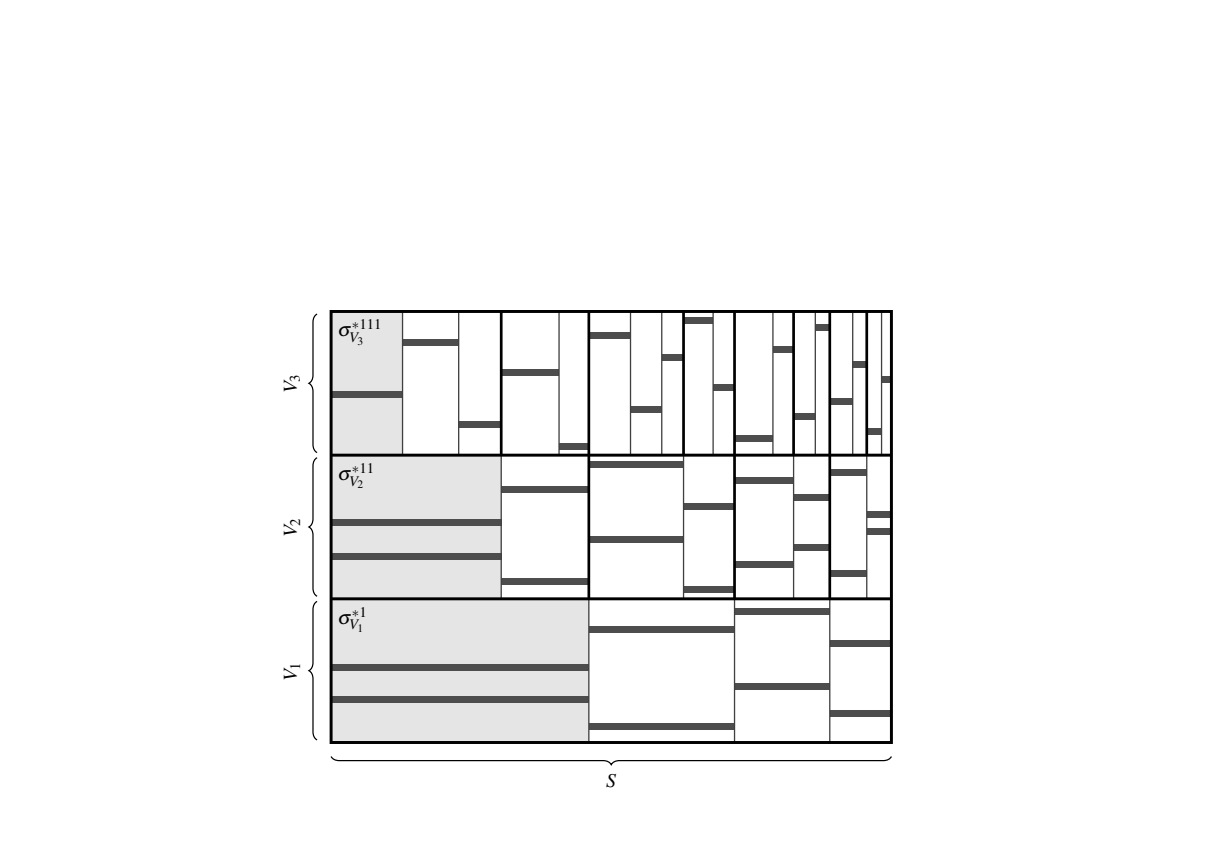
We describe the low-temperature excitations through a dilute gas of defects relative to the ground state. The sharing of these defects among the descendants and the renewal of the fluctuations along new branches produce the GREM structure and the ultrametricity of the overlaps. This mechanism is developed first with a finite number of defects and then extended to exponential populations of states. At fixed kernel, the Gaussian covariances of the fresh fields connect the complete cavity variables, including their common components, to the same hierarchy that determines the Gibbs masses. We also correct some ambiguities of earlier formulations.
from the abstract
Pith says
Machine review · deepseek-v4-flash · 27 Oct 2026 · of version 1 of the paper; version 2 is newer · what was read was not recorded · not checked by a person
It can be wrong. Challenge this review or reply to it.
Holds up, with conditions. Ambitious physical derivation of the Parisi solution via cavity method, but the central GREM approximation is heuristically motivated and not proven, so the paper works better as a conceptual picture than a rigorous proof. This line is wrong
3 major objections · 6 minor
How often objections from reviews like this one are right: not yet measured
Not checked: figures, code, what the references say.
The paper says, at Section 3.3, Eq. (3.19) and surrounding text
The review did not quote this passage.
Pith says: Objection 1 of 3 · major
The passage from the exact conditional factorization of increments in Eq. (3.19) to a common REM law for all nodes at the same level is the crucial step that enables the entire GREM representation. The paper argues that nodes at the same level have the same marginal sampling law and that control of intersections (inequality 3.15) keeps corrections small.
more of objection 1
However, the field coefficients in (3.19) depend on the actual spin configuration of the prefix (the σ*_j), not merely on its magnetization. Different prefixes with the same magnetization can produce different coefficient populations, yet the approximation replaces all these with a single common law. The paper does not quantify the error introduced by this replacement, nor does it prove that the dependence on the prefix vanishes in the thermodynamic limit. This is load-bearing: without this step, the GREM energy decomposition and thus the ROSt identification are not derived from the SK Hamiltonian. A major revision should either provide a rigorous estimate of the approximation error or significantly strengthen the heuristic argument.
The paper says, at Section 4.8, Tilt between Blanket and Gibbs measures
The review did not quote this passage.
Pith says: Objection 2 of 3 · major
The argument that the tilt becomes constant on the fiber in the stepwise model of Ref. [4] is used to substitute the Blanket measure for the Gibbs measure in the cavity formula. This constancy is claimed to hold on the 'joint profile of fields, volumes, and magnetizations of the stepwise model'.
more of objection 2
However, the stepwise model itself is an approximation, and the paper does not show that the error in the cavity functional due to this approximation vanishes under refinement. The recomposition over fibers includes the Gibbs weights, and the relationship between the Blanket-measure recursion and the Gibbs-measure recursion is not fully derived. For the identification (4.40)–(4.41) to hold, one needs to control how the tilt affects the random cavity functional. The paper should either provide the necessary estimates or state clearly that this step is a further approximation and discuss its status.
The paper says, at General
The review did not quote this passage.
Pith says: Objection 3 of 3 · major
The paper repeatedly relies on results from the author's own previous works (Refs. [1,2,4,8,10,19,20]) for essential steps, such as the REM universality, the control of the shell, and the Blanket theory. While cross-referencing is normal, the paper does not provide an independent verification or a self-contained account of these results.
more of objection 3
The regularity argument for the local REM problem (Section 3.3) is only heuristic, and the reader is referred to Refs. [19,20] for the rigorous statements. This makes the current paper's derivation of the Parisi functional from the SK Hamiltonian incomplete as a stand-alone work. A major revision should at least summarize the relevant rigorous findings and explain how they apply to the setting here, or, if the argument is meant to be purely physical, state this explicitly and accept the consequent limitations.
6 minor objections
The paper says, at Abstract
Pith says: minor objection 1 of 6
Typo: 'explaination' should be 'explanation'.
The paper says, at Section 2.1, Eq. (2.24)
Pith says: minor objection 2 of 6
The bound is correctly written as |log Z - log \bar Z| / (\beta N) ≤ ..., but a brief comment on why this holds with the same bound on the minimum energy per spin would help readability.
show 4 more
The paper says, at Section 2.2, Eq. (2.46)
Pith says: minor objection 3 of 6
The expression for the excitation energy is given for the interface-only (IO) model, but this is not explicitly stated until later. Clarifying that intra-layer interactions are absent (by construction) would avoid potential confusion.
The paper says, at Section 3.4, Eq. (3.21)
Pith says: minor objection 4 of 6
The notation 'd≃' is used but not defined. It presumably means 'approximately equal in distribution' with corrections that vanish in the thermodynamic limit. Please define the symbol and state the nature of the approximation.
The paper says, at Section 4.7
Pith says: minor objection 5 of 6
The correspondence between the physical overlaps (4.54) and the operational block fractions (4.55) is clear, but a table summarizing the notation for physical vs. operational layers would be helpful, given the many indices.
The paper says, at References
Pith says: minor objection 6 of 6
References [16]–[18] (Borgs, Chayes, Mertens, Nair) are cited for the local REM conjecture, but the paper also relies on the later Refs. [19,20] for the linear problem. A brief note on how the current setting fits into these established results would strengthen the credibility of the REM universality step.
What would settle it
Fix a small number of layers (e.g., L=2) and a disorder realization. Compute the exact distribution of the increment (3.19) for nodes at level 2, conditional on two different source configurations σ*_{Q1}^{(1)} and σ*_{Q1}^{(2)} with the same magnetization m1 but distinct defect patterns, in the dilute regime. Compare the empirical distributions (e.g., variance and tail exponent) for system sizes N=200, 400, 800. If the distributions differ significantly beyond O(N^{-1/2}) fluctuations, the common-law assumption fails.
from the skeptic's reading
How the review went
4 readings by deepseek-v4-flash · 27 Oct 2026
- Reader holds up, with conditions
- Skeptic partly agrees
- Editor wrote the verdict above
- Referee major revision: 3 major objections, 6 minor
Not run on this paper: the simulated authors' defence.
Pith did not check this review's objections against the paper.
The review in full
The review in brief, machine-written
You should know that this is the third in a series developing a non-replica physical derivation of the Parisi solution for the SK model. The paper is ambitious and systematically lays out a defect-gas justification for the Constructive Cavity Method (CCM), culminating in the identification of the cavity contributions with the Aizenman–Sims–Starr ROSt. The correction of an earlier error on the product of PPPs is a genuine improvement. If you work on spin-glass theory, the physical picture here—excitation layers, rectified fields, and REM universality—is interesting and worth engaging with.
The soft spot is exactly what the stress-test flags: the load-bearing step (Section 3.3) replaces the conditional law of energy increments for each source prefix with a common REM law, controlling only the intersection of defect supports (inequality 3.15). The paper does not show that the field term's fluctuation across prefixes vanishes, so the common-law assumption is unjustified. Without it, the GREM representation and therefore the ROSt identification collapse. The authors acknowledge that parameters ‘remain free’, but this is the central approximation, not a harmless detail. The derivation is heuristic throughout; no code or data supports the claims, and the heavy reliance on self-citation (refs 1,2,4,8,10) means the machinery is not independently verified.
That said, the paper is a serious attempt at a difficult problem. The conceptual picture is coherent, and the correction of the PPP product is a valuable technical point. It is not a proof, but it may be a useful physical proposal. I would send this to a referee who knows the SK cavity method and ask for a careful evaluation of the GREM approximation. Let the authors make the case stronger or more explicitly state the limitations. For me, the paper is a maybe for the reading group—worth discussing exactly for this tension between ambition and rigor.
The strongest objection
The central claim that the two cavity contributions converge to the Aizenman–Sims–Starr ROSt uses the GREM representation derived in Section 3. The load-bearing step is the passage from the exact conditional factorization of increments (Eq. 3.19) to a common REM law for all nodes at the same level, independent of the source prefix. In Eq. (3.19), the increment for a node at level ℓ contains the field ∑_{j∈Q_{ℓ-1}} (J*_{ij}+J*_{ji}) σ*_j, which depends on the actual spin configuration of the prefix, not merely its magnetization. Different prefixes with the same magnetization but different defect arrangements give different coefficient populations, yet the approximation replaces all these with a single law. The paper controls only the intersection of defect supports (inequality 3.15), not the fluctuation of this field term across prefixes. Since the energy law of the level is determined by this field, the common-law assumption is unjustified. Without it, the GREM energy decomposition and thus the ROSt identification collapse.
The reader identified the physical GREM approximation as the weakest assumption, and I agree. However, my concern is more specific: the approximation ignores the dependence of the energy increment distribution on the precise source configuration, not just its magnetization. The reader focused on the REM replacement and the control of intersections; I emphasize the prefix-dependent field in (3.19). This strengthens the correctness risk without changing the verdict—the paper remains conditional, requiring stronger justification of this step. The concrete test would reveal whether the approximation is even plausible at finite sizes, which could guide future rigorous work.
The referee's report
If the identification is correct, the paper provides a unified physical picture of replica symmetry breaking without replicas, directly connecting microscopic excitations to the variational principle. The paper contributes a detailed mechanistic story for ultrametricity and the emergence of the GREM structure from the SK Hamiltonian. However, the significance is tempered by the heuristic nature of the central approximation—the physical GREM approximation in Section 3.3—which lacks rigorous control. The paper's claim to provide a 'physical justification' rather than a rigorous derivation is accurate, but the justification is incomplete for a load-bearing step.
Pith's reading of the paper (a machine's summary, not the authors')
The paper aims to establish an exact physical equivalence between the hierarchical organization of excitations in the Sherrington–Kirkpatrick (SK) model and the Random Overlap Structure (ROSt) of Aizenman, Sims, and Starr. The central mechanism is a dilute gas of defects (flipped spins relative to the ground state) whose sharing and renewal along branches produces a GREM structure with ultrametric overlaps. This equivalence identifies the two cavity contributions (linear and correction fields) with those of the ROSt, enabling a first-principles derivation of the Parisi functional. The work also corrects earlier ambiguities in the Constructive Cavity Method, particularly the erroneous identification of the product of Poisson point processes with a Cartesian product of independent REM measures.
What carries the argument. The key machinery is the defect gas representation combined with the GREM hierarchy. Excitations are described as sets of flipped spins (defects) relative to the globally rectified ground state. The energy cost decomposes into contributions from the Blanket interfaces, and the sharing of defects among descendant states determines the ultrametric geometry of overlaps. The passage to exponential populations is controlled by inequality (3.15) on the relative intersections of defect supports. Independent Poisson point processes per level, ancestor assignment, and global normalization reconstruct the Ruelle cascade, preserving the joint law of masses and fields.
Core claim. The core discovery is the joint identification of the two cavity contributions with those of the Aizenman–Sims–Starr ROSt, formulated in equations (4.40) and (4.41). At a fixed kernel, the complete cavity fields, including their common components, are Gaussian with covariances determined by the spin overlaps. The masses and overlaps come from the same hierarchical construction: states share the defects and energy contributions of their common ancestors, and new nodes add new fluctuations after separation. This yields the Parisi functional (4.53) by averaging the random cavity functional over the construction, correcting earlier errors in the treatment of the product of Poisson point processes.
The premise it rests on. The physical GREM approximation (Section 3.3) assumes that nodes at the same level can be described by a common REM law with independent realizations, while controlling the relative intersections of defect supports via inequality (3.15); this approximation is not derived from the SK Hamiltonian but motivated by heuristic dilution and regularity arguments.
If the paper is right (Pith's inferences, not the authors')
The free energy of the SK model can be obtained without replicas from a microscopic description of low-temperature excitations as a dilute gas of defects.
Ultrametricity of the overlap arises naturally from the physical mechanism of defect sharing among branches that separate.
The operational form of the CCM (Subsection 4.7) provides a parameterization of the Parisi functional through block dimensions that directly correspond to physical overlap increments.
The corrected interpretation of the product of Poisson point processes (Section 3.6) yields the correct recursive evaluation of the cavity functional, resolving an error in earlier CCM formulations.
The defect-gas picture offers a testable connection to droplet theory: the boundary of a defect set in the interaction graph may correspond to the energy cost scaling with overlap distance, bridging mean-field and short-range spin glasses.
The hierarchical construction might extend to other mean-field models with replica-symmetry breaking, such as the p-spin model, by identifying analogous defect populations and energy laws.
If the GREM approximation can be rigorously justified (e.g., through a control of the intersections stronger than inequality 3.15), the entire derivation could be turned into a proof of the Parisi formula via the cavity method.
Check this review
Pith stored no record of this review's passes and took no fingerprint of it. Reviews made by code from 13 Nov 2026 on carry both.
How often reviews like this one are right
Reviews like this one: written by deepseek-v4-flash, where what was read was not recorded.
How often objections from reviews like this one are right: not yet measured
Reviews by people
This review was written by a machine. No person has reviewed this paper on Pith yet. A scientist listed on Pith can review it for a fee, and their review is published here whatever it concludes.
The paper
Abstract
We present a physical explaination of the Constructive Cavity Method (CCM) for the Sherrington–Kirkpatrick model, which identifies the decomposition of the cavity variables into layers with the random overlap structure of Aizenman–Sims–Starr. We describe the low-temperature excitations through a dilute gas of defects relative to the ground state. The sharing of these defects among the descendants and the renewal of the fluctuations along new branches produce the GREM structure and the ultrametricity of the overlaps. This mechanism is developed first with a finite number of defects and then extended to exponential populations of states. At fixed kernel, the Gaussian covariances of the fresh fields connect the complete cavity variables, including their common components, to the same hierarchy that determines the Gibbs masses. We also correct some ambiguities of earlier formulations.
The paper's own sentences, arranged, kept beside the review and separate from it. Each label is drawn from a closed vocabulary; the number beside it is the probability the classifier gave that label. No sentence in this record was written by a model.
abstract compiled · 2026-10-27
The authors' main claim, as the classifier picked it out 0.71
“The sharing of these defects among the descendants and the renewal of the fluctuations along new branches produce the GREM structure and the ultrametricity of the overlaps.”
How the main claim is stated: asserted 1.00
What the abstract itself states, as probabilities: claims first 0.05 · states limitation 0.15 · human participants 0.01 · controlled comparison 0.03 · randomized assignment 0.01 · states quantitative result 0.04 · compares with prior results 0.52 · mentions code or data availability 0.02
The abstract, sentence by sentence
This table labels the abstract only (arXiv listing abstract v1). The number is the probability the classifier gave the label.
| Sentence | Role | The authors' own work | States the main conclusion | Strength |
|---|---|---|---|---|
| We present a physical explaination of the Constructive Cavity Method (CCM) for the Sherrington--Kirkpatrick model, which identifies the decomposition of the cavity variables into layers with the random overlap structure of Aizenman--Sims--Starr. | contribution 0.99 | 0.86 | 0.39 | asserted 1.00 |
| We describe the low-temperature excitations through a dilute gas of defects relative to the ground state. | contribution 0.54 | 0.79 | 0.08 | asserted 1.00 |
| The sharing of these defects among the descendants and the renewal of the fluctuations along new branches produce the GREM structure and the ultrametricity of the overlaps. | interpretation 0.49 | 0.71 | 0.36 | asserted 1.00 |
| This mechanism is developed first with a finite number of defects and then extended to exponential populations of states. | method 0.93 | 0.85 | 0.07 | asserted 0.99 |
| At fixed kernel, the Gaussian covariances of the fresh fields connect the complete cavity variables, including their common components, to the same hierarchy that determines the Gibbs masses. | result 0.63 | 0.74 | 0.13 | asserted 1.00 |
| We also correct some ambiguities of earlier formulations. | contribution 0.96 | 0.85 | 0.03 | asserted 0.97 |
What kind of paper the classifier reports this is: theoretical result 0.79 · evidence from argument 0.51
What was examined, and what was not
Sources read
- arXiv listing abstract v1
Not examined
- full text
- figures and tables
- references and citing sentences
- relations to other papers
Levels run
- P abstract
Not run
- S sections
- T body sentences
- C citations
- R cross-paper relations
How the labels were made
Compiled by classifier-1.13.0 via TypeSafe API, question bank abstract-p1-20260923, 2026-10-27: 1 request, 4,919 input tokens.
Every quoted sentence on this record is the authors'. Every label is from Pith's closed vocabulary, with the probability shown beside it. This record as JSON
Figures (1)
Figures are the authors', reproduced from the paper.
Cited by 2 Pith papers
Reviewed papers on Pith that cite this one. The full citation record
- Constructive Cavity Method for Ising Restricted and Deep Boltzmann Machines with Gaussian Couplings cond-mat.stat-mech · Oct 2026
- The Constructive Cavity Method for the Ising Perceptron cond-mat.stat-mech · Oct 2026
Challenges and discussion
Disagree with the review, or know something it missed? Leave a comment, or challenge this review formally: a challenge becomes a permanent entry in this paper's record, and its decision is published here.
Come back by email
A short list of the week's newly reviewed papers. Nothing is sent until you confirm from your inbox, and every email has a link that stops it. No account.
No comments yet.
Sign in to comment