Statistical Mechanics · arXiv:2610.36505 v1 · submitted 27 Oct 2026 · 38 references
Constructive Cavity Method for Ising Restricted and Deep Boltzmann Machines with Gaussian Couplings
The paper says
“We apply the Constructive Cavity Method (CCM) to the dense, Ising type, restricted and deep Boltzmann machine with Gaussian couplings between adjacent layers.”
more of the abstract
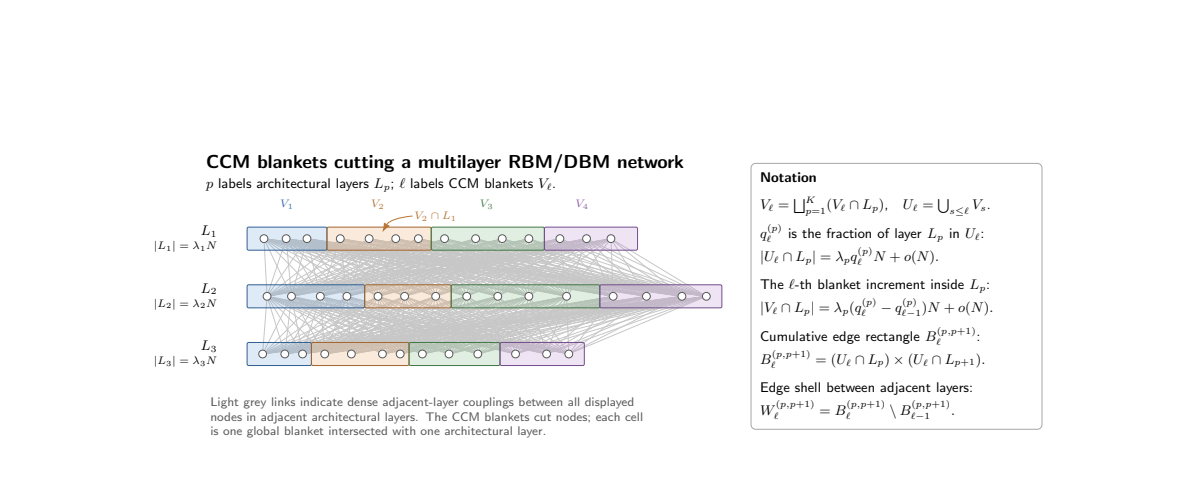
After identifying the core and interface contributions, CCM identifies the blanket decomposition of the cavity variables with the Aizenman–Sims–Starr random overlap structure. We apply the Random Energy Model (REM) universality ansatz to represent the cavity free energies by those of a generalized random energy model (GREM) and evaluate them recursively through Poisson point processes (PPPs). In the layer-wise gauge each layer is cut with its own cumulative fraction |Uℓ ∩ Lp| = λpqℓ(p)N + o(N), with 0 = q0 ≤ q1 ≤ ⋯ ≤ qr = 1, where qℓ = (qℓ(1),…,qℓ(K)). Here Uℓ is the cumulative blanket union up to blanket ℓ. The index p labels architectural layers, whereas ℓ labels the blankets. The dependence on the multilayer geometry is carried by the two matrices M = 2M0Λ and M1 = ΛM0Λ. The constructive cavity field in layer p has blanket variances Qℓ(p)−Qℓ−1(p) = (M(qℓ−qℓ−1))p, while the correction field has blanket variances $Q_\ell-Q_{\ell-1}=\mathbf q_\ell^\top M_1\mathbf q_\ell-\mathbf q_{\ell-1}^\top M_1\mathbf q_{\ell-1}$. The nested REM–PPP average gives the finite-level constructive cavity functional $\mathcal{P}_{\mathrm{RBM/DBM}}^{\mathrm{CCM}}(\zeta,\mathbf q)=\log2+\sum_{p=1}^K\lambda_pX_0^{(p)}-\frac12\sum_{\ell=0}^{r-1}\zeta_\ell(\mathbf q_{\ell+1}^\top M_1\mathbf q_{\ell+1}-\mathbf q_\ell^\top M_1\mathbf q_\ell)$. The balanced scalar gauge is recovered by imposing qℓ = qℓ1. Selecting the physical value in the non-convex multilayer regime is a separate problem.
from the abstract
Pith says
Machine review · deepseek-v4-flash · 28 Oct 2026 · what was read was not recorded · not checked by a person
It can be wrong. Challenge this review or reply to it.
Holds up. A careful derivation of the CCM functional for multilayer RBM/DBM, but the load-bearing REM universality ansatz is taken from the authors' prior work without new justification for this model. This line is wrong
1 major objection · 4 minor
How often objections from reviews like this one are right: not yet measured
Not checked: figures, code, what the 38 references say.
The paper says, at Section 6 and the whole derivation after it
The review did not quote this passage.
Pith says: Objection 1 of 1 · major
The central step is the REM universality ansatz (Section 6), taken from Ref. [1], which replaces the joint distribution of the cavity free-energy shifts by those of a GREM. The paper does not prove this ansatz for the RBM/DBM model with Gaussian couplings.
more of objection 1
The consistency checks (RS reduction, Nishimori benchmark, special cases) test only the algebraic structure of the resulting functional, not the validity of the underlying probabilistic representation. The authors should either (a) provide a more detailed physical or mathematical justification for why the ansatz holds for this class of models, or (b) explicitly state in the conclusions that the derivation assumes the REM universality ansatz and that its justification rests entirely on Ref. [1]. This would clarify the logical foundation of the paper's main result.
4 minor objections
The paper says, at Abstract and Section 1
Pith says: minor objection 1 of 4
The notation for the balanced scalar gauge is confusing: the abstract writes 'imposing 𝐪_ℓ = q_ℓ 𝟏' where q_ℓ is a scalar, but later q_ℓ is a vector; using a different symbol for the scalar would improve clarity.
The paper says, at Section 5, Eq. (9) and (14)
Pith says: minor objection 2 of 4
The tilde and hat notation for fresh Gaussian variables is used without explicit definition; a short remark that these are independent standard Gaussians would help.
show 2 more
The paper says, at Section 12
Pith says: minor objection 3 of 4
This section is lengthy and describes the physical intuition behind the CCM. It could be shortened or moved to an appendix to keep the main text focused on the derivation of the functional.
The paper says, at Declaration of Generative AI
Pith says: minor objection 4 of 4
The declaration mentions GPT-6 Astra but does not specify how AI was used; a brief account (e.g., 'generation of initial draft, language polishing, and code assistance') would be more informative.
What would settle it
For a small two‑layer RBM (e.g., N1 = N2 = 12, β = 0.5, h1 = h2 = 0.2), exactly enumerate all 2^{24} spin configurations or use importance sampling to compute the Aizenman–Sims–Starr cavity functional (Eq. (20)) for the trial gauge q = (0.3,0.7) and ζ = (0,0.5,1). Compare with the CCM functional (Eq. (26)) using the same (ζ,q). If the difference exceeds the Monte Carlo statistical error (say >0.05), the REM‑PPP representation fails for this model.
from the skeptic's reading
How the review went
4 readings by deepseek-v4-flash · 28 Oct 2026
- Reader holds up
- Skeptic agrees
- Editor wrote the verdict above
- Referee minor revision: 1 major objection, 4 minor
Not run on this paper: the simulated authors' defence.
Pith did not check this review's objections against the paper.
The review in full
The review in brief, machine-written
The paper extends the Constructive Cavity Method to dense Ising restricted and deep Boltzmann machines with Gaussian couplings. The main result is the finite-level cavity functional Eq. (26), with layer-wise blanket fractions q_ℓ. The derivation is laid out step by step and the authors check consistency with known RS, Nishimori, and full-RSB specializations — those checks are solid and show the functional reduces to the right expressions in the appropriate limits. If the functional is taken as correct, it provides a candidate full-RSB free energy for a class of multilayer spin-glass models used in machine learning.
The soft spot is the same one the stress test flags. The constructive substitution in Section 6 replaces the cavity free-energy shifts by GREM variables via the REM universality ansatz of Ref. [1]. That ansatz is asserted, not proved for the RBM/DBM. The consistency checks test algebraic specializations of the final functional, not the probabilistic representation of the joint distribution of cavity and correction fields. Without a justification of the ansatz the derivation of Eq. (26) is logically incomplete for general parameters (nonzero fields, arbitrary layer proportions, finite hierarchy depth). The authors acknowledge the selection problem is separate and that they are not proving a global theorem, but the gap is in the core derivation itself, not just in the selection step.
Who gets value from this paper? Readers interested in the physics of multilayer spin glasses and in the CCM formalism. The functional is a concrete candidate that matches several known limiting cases, so it is a useful starting point for further analysis. The paper is written clearly and the authors state their assumptions honestly.
Recommendation: I would send this to peer review. The result is of interest and the checks provide enough evidence that the functional is plausible. A good referee will push the authors on the REM universality assumption — either to supply a proof or to delineate its regime of validity more sharply. The paper deserves serious engagement, not a desk reject.
The strongest objection
The central constructive step is the replacement of the Aizenman–Sims–Starr cavity functional by GREM‐based variables (Section 6), relying on the REM universality ansatz from Ref. [1]. This ansatz is not proved for the dense Ising RBM/DBM with Gaussian couplings. The consistency checks (RS reduction, Nishimori benchmark, zero‑field full‑RSB agreement) test only the resulting functional in particular regimes or after algebraic simplification; they do not independently verify that the joint distribution of the cavity and correction fields is correctly captured by the nested Poisson representation with the specific variance increments from Section 5. Without a justification of the ansatz, the derivation of Eq. (26) is logically incomplete, and the functional’s validity for general parameter choices (e.g., nonzero fields, arbitrary layer proportions, finite hierarchy depth) rests solely on the heuristic of the prior work.
The reader's weakest_assumption exactly identifies the REM universality ansatz as the structural lynchpin. I agree that this is the single most load‑bearing concern, and that the paper's independent checks mitigate but do not fully close the gap. However, the checks are strong enough (exact Nishimori benchmark, agreement with two independent full‑RSB formulations) to support the ACCEPT verdict at MODERATE confidence. The proposed concrete test would either confirm the ansatz for a nontrivial finite‑size case or expose a mismatch that would lower confidence. The existing evidence is sufficient for an ACCEPT with the caveats already stated.
The referee's report
If the derived functional is correct, the paper provides a constructive cavity derivation of the full-RSB expression for multilayer spin-glass models with Gaussian couplings, unifying earlier cavity, replica, and Hamilton–Jacobi approaches. The explicit layer-wise gauge parametrization and the identification of the matrices M=2M_0Λ and M_1=Λ M_0 Λ are technical contributions that may be useful for further analysis of deep Boltzmann machines and related mean-field models.
Pith's reading of the paper (a machine's summary, not the authors')
This paper extends the Constructive Cavity Method (CCM) to dense Ising restricted and deep Boltzmann machines with Gaussian couplings between adjacent layers. It provides an explicit finite-level free-energy functional (Eq. 26) by decomposing the cavity variables into blanket components in a layer-wise gauge. The calculation uses the REM universality ansatz to represent cavity free energies via generalized random energy models and evaluates them through nested Poisson point processes. The functional depends on layer proportions, coupling strengths, and a layer-wise cumulative fraction profile. The paper does not address the selection of the physical value in the non-convex regime, but gives the constructive derivation and consistency checks.
What carries the argument. The construction relies on the layer-wise gauge, where each architectural layer L_p is cut by cumulative fractions $q_ℓ^{{(p)}}$ = |U_ℓ ∩ L_p|/|L_p| + o(1), yielding blanket sizes λ_p ($q_ℓ^{{(p)}}$ - q_{ℓ-1}^{(p)}) N + o(N). The matrices M = 2 M_0 Λ and M_1 = Λ M_0 Λ, with M_0 the tridiagonal adjacency matrix of the layer chain and Λ = diag(λ_1, ..., λ_K), determine the Gaussian variances of the cavity and correction fields. The REM universality ansatz (taken from Ref. [1]) allows representing the joint distribution of cavity free-energy shifts by those of a generalized random energy model, enabling evaluation via nested Poisson point processes with exponents ζ_ℓ.
Core claim. The central result is the constructive cavity functional P_CCM = log 2 + sum_p λ_p $X_0^{{(p)}}$ - 1/2 sum_ℓ ζ_ℓ (q_{ℓ+1}^T M_1 q_{ℓ+1} - q_ℓ^T M_1 q_ℓ), where $X_0^{{(p)}}$ comes from a nested REM-PPP Gaussian recursion with layer-dependent scales. This functional arises from applying CCM to the layer-wise partition: each blanket ℓ cuts architectural layer p with cumulative fraction $q_ℓ^{{(p)}}$, and the matrices M = 2 M_0 Λ and M_1 = Λ M_0 Λ encode the multilayer geometry. The cavity field in layer p has blanket variances (M(q_ℓ - q_{ℓ-1}))_p, and the correction field has variances q_ℓ^T M_1 q_ℓ - q_{ℓ-1}^T M_1 q_{ℓ-1}. The REM universality ansatz replaces the cavity free-energy shifts by GREM counterparts, and nested Poisson averaging yields the final functional.
The premise it rests on. The REM universality ansatz (Section 6-7) assumes that the cavity free-energy shifts of the RBM/DBM can be asymptotically represented by those of a generalized random energy model and evaluated via Poisson point processes, without a proof for this specific model class.
If the paper is right (Pith's inferences, not the authors')
The functional (26) provides a constructive derivation of full-replica-symmetry-breaking free-energy expressions for bipartite spin glasses and multi-species spin glasses, matching known replica and Hamilton–Jacobi formulations.
For K=2 (RBM), the functional reduces to the bipartite CCM expression and reproduces the known annealed high-temperature boundary 4 β^4 λ_1 λ_2 = 1.
For symmetric K=3 (DBM), the functional gives a three-layer expression consistent with the nested recursion and yields a splitting-instability condition 4 β^4 λ_1 λ_2 Γ_1 Γ_2 + 4 β^4 λ_2 λ_3 Γ_2 Γ_3 = 1.
The functional on the Nishimori line coincides exactly with the known variational integrand for the DBM, confirming the layer-wise matrix normalization.
The local stationarity and splitting-stability conditions provide a diagnostic for exploring candidate physical states at finite depth, though a global selection theorem is not proven.
If the REM universality ansatz holds for this model class, the CCM functional likely extends to other multilayer architectures (e.g., general layer graphs or hypergraphs) by replacing M_0 with the appropriate weighted adjacency matrix and adapting the edge-shell counts.
The separation of the constructive functional derivation from the physical value selection suggests that combining CCM with a global variational principle (such as the sup–inf theorem of Chen, Issa, and Mourrat) could yield a rigorous thermodynamic solution for non-convex multilayer regimes.
The layer-wise gauge may enable efficient numerical evaluation of the free energy for finite-depth hierarchies by solving the stationarity conditions coupled with the REM–PPP recursion, potentially providing testable predictions for trained deep Boltzmann machines.
Check this review
Pith stored no record of this review's passes and took no fingerprint of it. Reviews made by code from 13 Nov 2026 on carry both.
How often reviews like this one are right
Reviews like this one: written by deepseek-v4-flash, where what was read was not recorded.
How often objections from reviews like this one are right: not yet measured
Reviews by people
This review was written by a machine. No person has reviewed this paper on Pith yet. A scientist listed on Pith can review it for a fee, and their review is published here whatever it concludes.
The paper
Abstract
We apply the Constructive Cavity Method (CCM) to the dense, Ising type, restricted and deep Boltzmann machine with Gaussian couplings between adjacent layers. After identifying the core and interface contributions, CCM identifies the blanket decomposition of the cavity variables with the Aizenman–Sims–Starr random overlap structure. We apply the Random Energy Model (REM) universality ansatz to represent the cavity free energies by those of a generalized random energy model (GREM) and evaluate them recursively through Poisson point processes (PPPs). In the layer-wise gauge each layer is cut with its own cumulative fraction |Uℓ ∩ Lp| = λpqℓ(p)N + o(N), with 0 = q0 ≤ q1 ≤ ⋯ ≤ qr = 1, where qℓ = (qℓ(1),…,qℓ(K)). Here Uℓ is the cumulative blanket union up to blanket ℓ. The index p labels architectural layers, whereas ℓ labels the blankets. The dependence on the multilayer geometry is carried by the two matrices M = 2M0Λ and M1 = ΛM0Λ. The constructive cavity field in layer p has blanket variances Qℓ(p)−Qℓ−1(p) = (M(qℓ−qℓ−1))p, while the correction field has blanket variances $Q_\ell-Q_{\ell-1}=\mathbf q_\ell^\top M_1\mathbf q_\ell-\mathbf q_{\ell-1}^\top M_1\mathbf q_{\ell-1}$. The nested REM–PPP average gives the finite-level constructive cavity functional $\mathcal{P}_{\mathrm{RBM/DBM}}^{\mathrm{CCM}}(\zeta,\mathbf q)=\log2+\sum_{p=1}^K\lambda_pX_0^{(p)}-\frac12\sum_{\ell=0}^{r-1}\zeta_\ell(\mathbf q_{\ell+1}^\top M_1\mathbf q_{\ell+1}-\mathbf q_\ell^\top M_1\mathbf q_\ell)$. The balanced scalar gauge is recovered by imposing qℓ = qℓ1. Selecting the physical value in the non-convex multilayer regime is a separate problem.
The paper's own sentences, arranged, kept beside the review and separate from it. Each label is drawn from a closed vocabulary; the number beside it is the probability the classifier gave that label. No sentence in this record was written by a model.
abstract compiled · 2026-10-28
The authors' main claim, as the classifier picked it out 0.73
“The nested REM--PPP average gives the finite-level constructive cavity functional $\mathcal{P}_{\mathrm{RBM/DBM}}^{\mathrm{CCM}}(\zeta,\mathbf q)=\log2+\sum_{p=1}^K\lambda_pX_0^{(p)}-\frac12\sum_{\ell=0}^{r-1}\zeta_\ell(\mathbf q_{\ell+1}^\top M_1\mathbf q_{\ell+1}-\mathbf q_\ell^\top M_1\mathbf q_\ell)$.”
How the main claim is stated: asserted 1.00
What the abstract itself states, as probabilities: claims first 0.03 · states limitation 0.93 · human participants 0.01 · controlled comparison 0.02 · randomized assignment 0.02 · states quantitative result 0.27 · compares with prior results 0.10 · mentions code or data availability 0.02
The abstract, sentence by sentence
This table labels the abstract only (arXiv listing abstract v1). The number is the probability the classifier gave the label.
| Sentence | Role | The authors' own work | States the main conclusion | Strength |
|---|---|---|---|---|
| We apply the Constructive Cavity Method (CCM) to the dense, Ising type, restricted and deep Boltzmann machine with Gaussian couplings between adjacent layers. | contribution 0.85 | 0.94 | 0.07 | asserted 1.00 |
| After identifying the core and interface contributions, CCM identifies the blanket decomposition of the cavity variables with the Aizenman--Sims--Starr random overlap structure. | method 0.50 | 0.86 | 0.11 | asserted 1.00 |
| We apply the Random Energy Model (REM) universality ansatz to represent the cavity free energies by those of a generalized random energy model (GREM) and evaluate them recursively through Poisson point processes (PPPs). | method 0.95 | 0.86 | 0.14 | asserted 1.00 |
| In the layer-wise gauge each layer is cut with its own cumulative fraction $|U_\ell\cap L_p|=\lambda_p q_\ell^{(p)}N+o(N)$, with $\mathbf 0=\mathbf q_0\le\mathbf q_1\le\cdots\le\mathbf q_r=\mathbf 1$, where $\mathbf q_\ell=(q_\ell^{(1)},\ldots,q_\ell^{(K)})$. | method 0.86 | 0.76 | 0.07 | asserted 0.99 |
| Here $U_\ell$ is the cumulative blanket union up to blanket $\ell$. | method 0.49 | 0.36 | 0.02 | asserted 0.95 |
| The index $p$ labels architectural layers, whereas $\ell$ labels the blankets. | method 0.42 | 0.43 | 0.03 | asserted 1.00 |
| The dependence on the multilayer geometry is carried by the two matrices $M=2M_0\Lambda$ and $M_1=\Lambda M_0\Lambda$. | method 0.47 | 0.77 | 0.06 | asserted 1.00 |
| The constructive cavity field in layer $p$ has blanket variances $Q_\ell^{(p)}-Q_{\ell-1}^{(p)}=(M(\mathbf q_\ell-\mathbf q_{\ell-1}))_p$, while the correction field has blanket variances $Q_\ell-Q_{\ell-1}=\mathbf q_\ell^\top M_1\mathbf q_\ell-\mathbf q_{\ell-1}^\top M_1\mathbf q_{\ell-1}$. | method 0.46 | 0.84 | 0.09 | asserted 1.00 |
| The nested REM--PPP average gives the finite-level constructive cavity functional $\mathcal{P}_{\mathrm{RBM/DBM}}^{\mathrm{CCM}}(\zeta,\mathbf q)=\log2+\sum_{p=1}^K\lambda_pX_0^{(p)}-\frac12\sum_{\ell=0}^{r-1}\zeta_\ell(\mathbf q_{\ell+1}^\top M_1\mathbf q_{\ell+1}-\mathbf q_\ell^\top M_1\mathbf q_\ell)$. | result 0.64 | 0.87 | 0.27 | asserted 1.00 |
| The balanced scalar gauge is recovered by imposing $\mathbf q_\ell=q_\ell\mathbf 1$. | interpretation 0.51 | 0.60 | 0.04 | asserted 1.00 |
| Selecting the physical value in the non-convex multilayer regime is a separate problem. | limitation 0.89 | 0.14 | 0.06 | asserted 0.99 |
What kind of paper the classifier reports this is: theoretical result 0.81 · evidence from proof or derivation 1.00
What was examined, and what was not
Sources read
- arXiv listing abstract v1
Not examined
- full text
- figures and tables
- references and citing sentences
- relations to other papers
Levels run
- P abstract
Not run
- S sections
- T body sentences
- C citations
- R cross-paper relations
How the labels were made
Compiled by classifier-1.13.0 via TypeSafe API, question bank abstract-p1-20260923, 2026-10-28: 1 request, 8,987 input tokens.
Every quoted sentence on this record is the authors'. Every label is from Pith's closed vocabulary, with the probability shown beside it. This record as JSON
Figures (1)
Figures are the authors', reproduced from the paper.
References (38)
- [1] S. Franchini,Simplified Parisi Ansatz III: Constructive Cavity Method and Ultrametricity, arXiv:2610.34710 (2026). doi.org/10.48550/arXiv.2610.34710 on PithPith's reviewarXivdoi:10.48550/arxiv.2610.34710
- [2] S. Franchini,Replica Symmetry Breaking without Replicas, Annals of Physics450(2023), 169220 on Pith
- [3] S. Franchini,Universal scaling limits for spin networks via martingale methods, Proc. R. Soc. A481(2025), 20240774. doi:10.1098/rspa.2024.0774 on Pithdoi:10.1098/rspa.2024.0774
- [4] S. Franchini,A simplified Parisi Ansatz, Communications in Theoretical Physics73(5) (2021), 055601 on Pith
- [5] S. Franchini,A simplified Parisi Ansatz II: REM universality, Chaos, Solitons & Fractals 191(2025), 115821. Corrigendum: Chaos, Solitons & Fractals201(2025), 117395 on Pith
- [6] F. Concetti and S. Franchini,REM universality for linear random energy, arXiv:2604.06122 (2026). doi.org/10.48550/arXiv.2604.06122 on PithPith's reviewarXivdoi:10.48550/arxiv.2604.06122
- [7] F. Concetti and S. Franchini,REM universality and Poisson-Dirichlet Gibbs weights for linear random energy, arXiv:2606.07757 (2026). doi.org/10.48550/arXiv.2606.07757 on PithPith's reviewarXivdoi:10.48550/arxiv.2606.07757
- [8] D. Sherrington and S. Kirkpatrick,Solvable model of a spin-glass, Phys. Rev. Lett.35 (1975), 1792–1796. doi:10.1103/PhysRevLett.35.1792 on Pithdoi:10.1103/physrevlett.35.1792
- [9] G. Parisi,Infinite number of order parameters for spin-glasses, Phys. Rev. Lett.43(1979), 1754–1756. doi:10.1103/PhysRevLett.43.1754 on Pithdoi:10.1103/physrevlett.43.1754
- [10] F. Guerra,Broken replica symmetry bounds in the mean field spin glass model, Commun. Math. Phys.233(2003), 1–12 on Pith
- [11] M. Talagrand,The Parisi formula, Ann. of Math.163(2006), 221–263 on Pith
- [12] M. Aizenman, R. Sims, and S. L. Starr,An extended variational principle for the SK spin-glass model, Phys. Rev. B68(2003), 214403. doi:10.1103/PhysRevB.68.214403 on Pithdoi:10.1103/physrevb.68.214403
- [13] D. H. Ackley, G. E. Hinton, and T. J. Sejnowski,A learning algorithm for Boltzmann machines, Cognitive Science9(1985), 147–169 on Pith
- [14] P. Smolensky,Information processing in dynamical systems: Foundations of harmony theory, inParallel Distributed Processing: Explorations in the Microstructure of Cognition, Vol. 1, D. E. Rumelhart, J. L. McClelland, and the PDP Research Group (eds.), MIT Press, 1986, pp. 194–281. 27 on Pith
- [15] R. Salakhutdinov and G. E. Hinton,Deep Boltzmann machines, Proceedings of the Twelfth International Conference on Artificial Intelligence and Statistics (AISTATS), PMLR5 (2009), 448–455 on Pith
- [16] A. Barra, G. Genovese, P. Sollich, and D. Tantari,Phase transitions in restricted Boltzmann machines with generic priors, Phys. Rev. E96(2017), 042156. doi:10.1103/PhysRevE.96.042156 on PithPith's reviewdoi:10.1103/physreve.96.042156
- [17] A. Barra, P. Contucci, E. Mingione, and D. Tantari,Multi-species mean field spin glasses. Rigorous results, Ann. Henri Poincaré16(2015), 691–708 on Pith
- [18] D. Panchenko,The free energy in a multi-species Sherrington–Kirkpatrick model, Ann. Probab.43(2015), 3494–3513 on Pith
- [19] D. Alberici, P. Contucci, and E. Mingione,Deep Boltzmann machines: Rigorous results at arbitrary depth, Ann. Henri Poincaré22(2021), 2619–2642. doi:10.1007/s00023-021-01027-2 on Pithdoi:10.1007/s00023-021-01027-2
- [20] E. Agliari, L. Albanese, F. Alemanno, and A. Fachechi,Pattern recognition in Deep Boltzmann machines, arXiv:2106.08978, 2021 on PithPith's reviewarXiv
show 18 more
- [21] H.-B. Chen and J.-C. Mourrat,On the free energy of vector spin glasses with non-convex interactions, Probab. Math. Phys.6(1) (2025), 1–80. doi:10.2140/pmp.2025.6.1. Preprint version: arXiv:2311.08980 on PitharXiv
- [22] H.-B. Chen,On free energy of non-convex multi-species spin glasses, ALEA Lat. Am. J. Probab. Math. Stat.23(2026), 429–473. doi:10.30757/ALEA.v23-17 on Pithdoi:10.30757/alea.v23-17
- [23] D. Ruelle,A mathematical reformulation of Derrida’s REM and GREM, Commun. Math. Phys.108(1987), 225–239 on Pith
- [24] E. Bolthausen and A.-S. Sznitman,On Ruelle’s probability cascades and an abstract cavity method, Commun. Math. Phys.197(1998), 247–276. doi:10.1007/s002200050450 on Pithdoi:10.1007/s002200050450
- [25] L.-P. Arguin,Spin glass computations and Ruelle’s probability cascades, arXiv:math- ph/0608045 (2006) on Pith
- [26] A. Barra, G. Genovese, and F. Guerra,Equilibrium statistical mechanics of bipartite spin systems, J. Phys. A: Math. Theor.44(2011), 245002. arXiv:1012.1261 on PithPith's reviewarXiv
- [27] D.Alberici, F.Camilli, P.Contucci, andE.Mingione,The solution of the deep Boltzmann ma- chine on the Nishimori line, Comm. Math. Phys.387(2021), 1191–1214. doi:10.1007/s00220- 021-04165-0 on Pithdoi:10.1007/s00220-
- [28] A. Auffinger and W.-K. Chen,The Parisi formula has a unique minimizer, Comm. Math. Phys.335(2015), 1429–1444 on Pith
- [29] J. R. L. de Almeida and D. J. Thouless,Stability of the Sherrington–Kirkpatrick solution of a spin glass model, J. Phys. A: Math. Gen.11(1978), 983–990 on Pith
- [30] G. Genovese,Minimax formula for the replica symmetric free energy of deep restricted Boltzmann machines, Ann. Appl. Probab.33(2023), 2324–2341. doi:10.1214/22-AAP1868 on Pithdoi:10.1214/22-aap1868
- [31] K. Friston,The free-energy principle: a unified brain theory?, Nature Reviews Neuroscience 11(2010), 127–138 on Pith
- [32] K. Friston,Life as we know it, Journal of The Royal Society Interface10(2013), 20130475. 28 on Pith
- [33] M. D. Kirchhoff, T. Parr, E. Palacios, K. Friston, and J. Kiverstein,The Markov blankets of life: autonomy, active inference and the free energy principle, Journal of The Royal Society Interface15(2018), 20170792 on Pith
- [34] S. Franchini, G. Bardella,Lattice Field Theory for a network of real neurons, 42nd Interna- tional Symposium on Lattice Field Theory (LATTICE2025), arXiv:2604.05251 (2026) on PithPith's reviewarXiv
- [35] G. Bardella, S. Franchini, L. Pan, R. Balzan, E. Brunamonti, P. Pani, S. Ferraina,Neural activity in quarks language: Lattice Field Theory for a network of real neurons, Entropy26 (2024), 495 on Pith
- [36] G. Bardella, S. Franchini, P. Pani, S. Ferraina,Lattice physics approaches for neural networks, iScience27(2024), 111390 on Pith
- [37] G. S. Hartnett, E. Parker, and E. Geist,Replica symmetry breaking in bipartite spin glasses and neural networks, Phys. Rev. E98(2018), 022116. doi:10.1103/PhysRevE.98.022116. Cited preprint version: arXiv:1803.06442v4 on PithPith's reviewarXiv
- [38] H.-B. Chen, V. Issa, and J.-C. Mourrat,Free energy of non-convex multi-species spin glasses with centered Ising spins, arXiv:2606.16636v2 (2026). 29 on PithPith's reviewarXiv
Cited by 1 Pith paper
Reviewed papers on Pith that cite this one. The full citation record
- The Constructive Cavity Method for the Ising Perceptron cond-mat.stat-mech · Oct 2026
Challenges and discussion
Disagree with the review, or know something it missed? Leave a comment, or challenge this review formally: a challenge becomes a permanent entry in this paper's record, and its decision is published here.
Come back by email
A short list of the week's newly reviewed papers. Nothing is sent until you confirm from your inbox, and every email has a link that stops it. No account.
No comments yet.
Sign in to comment