Artificial Intelligence · arXiv:2610.37482 v1 · submitted 27 Oct 2026 · 41 references
From Interaction to Capability: Task Advancement as State and Supervision for GUI Agents
The paper says
“GUI memory should preserve the results of past actions and learn reusable operations. This is difficult in long-horizon workflows, where agents must use information across applications and useful operations are interleaved with failed attempts.”
more of the abstract
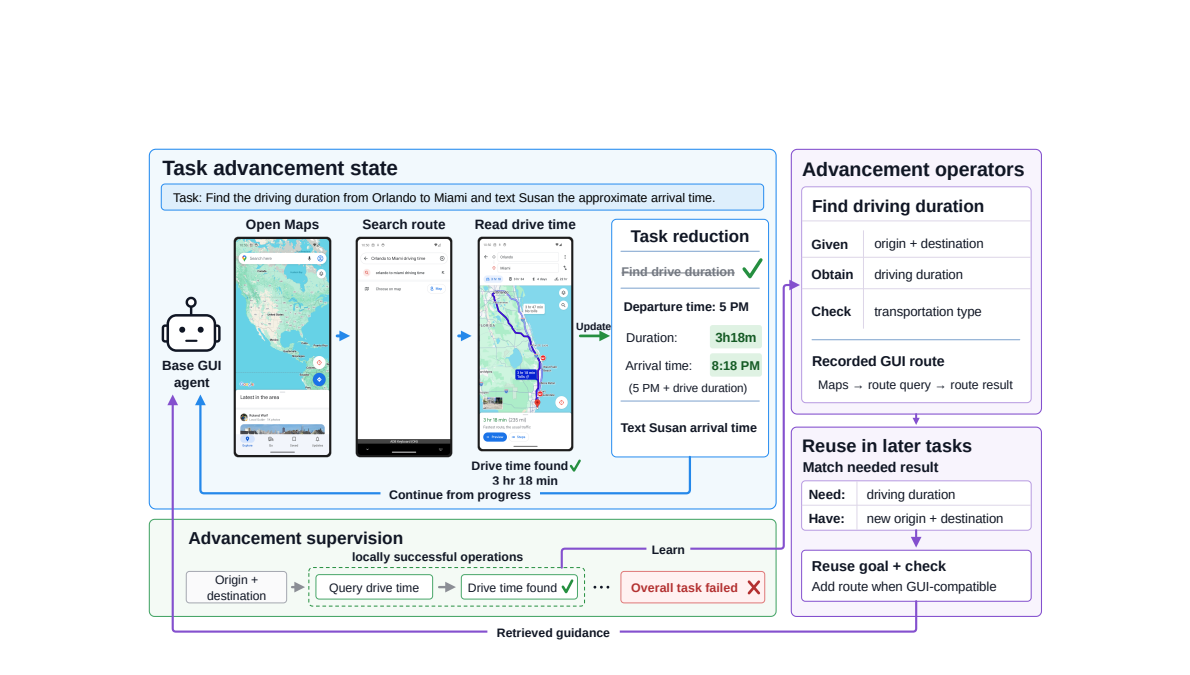
We introduce Task Advancement Memory (TAM), which defines task advancement as verified task progress, and supports ongoing task execution and learns reusable operations. During execution, Task Advancement State represents how verified task progress changes the remaining goals, allowing the agent to build on earlier achievements across applications. After each task, advancement supervision identifies and abstracts the interactions that produced a verified local result. The learned operations preserve the relation between required inputs, expected outcomes, and verification conditions. This retains locally successful operations from both successful and failed tasks. On MobileWorld GUI-only tasks, Advancement State alone raises success from 12.0% to 28.2%. Full TAM achieves a 17.6% relative gain in task success over the strongest evaluated baseline and reduces lifecycle tokens per solved task by 38.7%. On SPA-Bench, TAM achieves state-of-the-art task success in the single-app English Level 3 setting.
from the abstract
Pith says
Machine review · deepseek-v4-flash · 28 Oct 2026 · what was read was not recorded · not checked by a person
It can be wrong. Challenge this review or reply to it.
Holds up, with conditions. A genuinely new memory mechanism — verified task progress used as both state and supervision — anchored by one solid ablation (12→28.2); the comparative headline numbers need variance, a no-verification control, and released artifacts before they will convince. This line is wrong
3 major objections · 5 minor
How often objections from reviews like this one are right: not yet measured
Not checked: figures, code, what the 41 references say.
The paper says, at §4.3 / Table 4; §A.2-A.3
The review did not quote this passage.
Pith says: Objection 1 of 3 · major
The headline state gain is not an isolation of the verification mechanism. The 'Advancement State' row of Table 4 differs from the base agent in at least three ways beyond verified task state: LLM-based task compilation of the requirement graph (A.2), a modified actor output contract that requires the actor to report task-relevant observations alongside its action (A.3), and model-based outcome-extraction calls; the base agent has none of these.
more of objection 1
The 12.0-to-28.2 gain could therefore reflect the enriched prompt and output format rather than the Vq-based acceptance rule in Eq. (1) or the state readout. Because the abstract and Section 4.3 present this gain as establishing the value of advancement state, an isolation condition is needed, for example a control that keeps task compilation and structured observation reporting but admits observations into state without Vq verification (an accept-all rule), or a control with the TAM readout but with the verification step removed. The flat-state control in D.3 targets prerequisite links and covers only 18 field instances; it does not speak to the Vq accept/reject decision. Without such an experiment, the central novelty of TAM (verified progress, not merely recorded facts) is under-supported even though the empirical gain may persist.
The paper says, at §D.5; Eq. (4)
The review did not quote this passage.
Pith says: Objection 2 of 3 · major
The verification-quality evidence is post-hoc rather than online. The 93.8% correctness figure in D.5 scores values that TAM's storage decided to retain for operator learning; it does not measure the online behavior of Vq in Eq. (1) when it accepts or rejects evidence during execution.
more of objection 2
The task-reduction updates in Eqs. (2)-(3) remove requirements from the remaining-work readout only on verified evidence, so false rejections by Vq would silently drop valid requirements and false acceptances would bind wrong values into state; neither failure mode is measured by the D.5 audit, and the small D.3 panel cannot detect them. An online precision/recall audit of Vq acceptances, or the accept-all control proposed in the previous comment, is required to support the 'verified' component of the central claim; as it stands, the audit leaves open the possibility that the state gain comes from structured observation reporting rather than from verification.
The paper says, at Appendix C; Table 1
The review did not quote this passage.
Pith says: Objection 3 of 3 · major
The comparative MobileWorld claim rests on author re-integrations of five published systems. The Table 1 numbers for AWM, Mobile-Agent-E, StructAgent, GUI-explorer, and ConAct are produced by the authors' adapters described in Appendix C, with no released code available to certify fidelity to the original methods.
more of objection 3
The appendix is unusually detailed about the adaptations, which mitigates but does not remove the concern, and the 17.6% relative gain over ConAct is a headline claim. I recommend that the adapter code and prompts be released with the revision and that the internal ablation in Table 4, rather than the cross-baseline comparison, carry the main argument.
5 minor objections
The paper says, at §B.3, Eq. (5)
Pith says: minor objection 1 of 5
The per-sequence SPA-Bench results and the standard deviation s_m defined in Eq. (5) are never reported; with only two evaluation sequences, the reported 57.0% has wide uncertainty. Please report both sequence-level percentages and s_m (or an equivalent error measure).
The paper says, at Abstract / §4.2
Pith says: minor objection 2 of 5
The 17.6% relative gain computed from Table 1 is 5.1/29.1 = 17.5%; please correct the rounding.
show 3 more
The paper says, at Table 2
Pith says: minor objection 3 of 5
The rows produced by the authors' runs (TAM, ConAct) and the rows quoted from Xie et al. (2025) are distinguished only in the text; a marker or footnote in the table itself would prevent misreading.
The paper says, at §4.4 / D.3
Pith says: minor objection 4 of 5
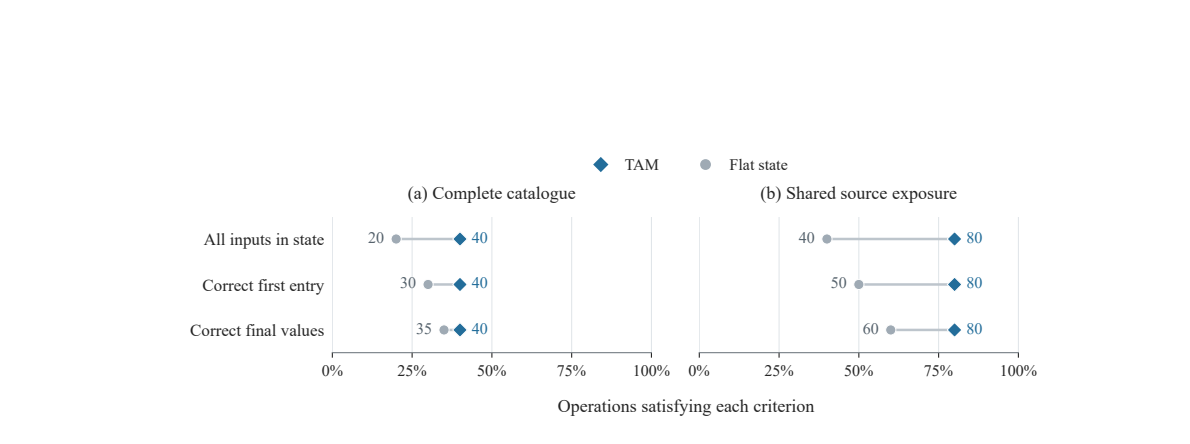
The sample sizes for the flat-state comparison appear in different forms (18 field instances in Section 4.4; 20 operation instances from 10 operations in the full panel and 10 shared-source instances in D.3); one consolidated statement of the panel composition and its overlap would help readers calibrate the 80%-versus-40% result.
The paper says, at §A.10
Pith says: minor objection 5 of 5
The retrieval and compatibility pipeline has numerous reference thresholds (tau_m,0, tau_sem,0, tau_gui,0, tau_a,0, and the 0.80 fallback threshold); reporting sensitivity to the two or three most consequential thresholds would strengthen the claim that the main results are not artifacts of these settings.
What would settle it
Add one Table 4 arm on the same 117 MobileWorld GUI-only tasks: 'Unverified State' runs the full Advancement State code path and actor prompt/output format, but every proposed source or effect update is accepted without applying Vq (Eq. (1)), so no requirement is ever excluded for lack of verification. If Unverified State reproduces roughly 28.2% success, the state gain is not attributable to verified task advancement and the mechanism claim must be weakened; if it stays near 12.0%, Vq is causally necessary and the concern is resolved.
from the skeptic's reading
How the review went
4 readings by deepseek-v4-flash · 28 Oct 2026
- Reader holds up, with conditions
- Skeptic partly agrees
- Editor wrote the verdict above
- Referee major revision: 3 major objections, 5 minor
Not run on this paper: the simulated authors' defence.
Pith did not check this review's objections against the paper.
The review in full
The review in brief, machine-written
Here is the short version. TAM has a genuinely new mechanism: verified task progress used at once as online state reduction (Eqs. 1–3) and as offline supervision, with learned operators carrying entry inputs, expected outcome, and verification condition together (Eq. 4). The cited task-state methods (StructAgent, TSR, ATMem, MGA) and skill-memory methods (Synapse, AWM, SkillGen) each do part of this; none carry verification through both timescales. The paper deserves a serious referee.
The strongest evidence is the Advancement State ablation: 12.0% to 28.2% with the base policy, action interface, and 50-round budget all fixed. With 117 tasks that effect is far beyond noise, and success is judged by MobileWorld's native evaluators, so the system is not scoring itself. The paper is also transparent. Limitations openly names the dependence on model-based evidence checks. A.10 discloses that retrieval thresholds are calibrated on the evaluation sequence itself. Appendix C says plainly which baselines were re-integrated and at what cost. The documentation is unusually complete; a competent group could re-implement from it.
Soft spots, in proportion.
First, the 28.2% row is a package, not an isolation of the verification rule Vq. It bundles task compilation, a modified actor output contract (A.3), and extra model calls. The stress-test concern — that part of the gain could come from the enriched prompt rather than the evidence check — is fair as a missing control, but I would not call the novelty unsupported. The claim as worded is about Advancement State, and the flat-state panel (D.3: 80% vs 40% prepared operations) shows the relational organization does something a flat summary does not. What is unmeasured is Vq's specific accept/reject contribution. A state-without-verification arm would settle it.
Second, variance. MobileWorld runs are single-sequence; the 5.1-point edge over ConAct is about one standard error. The SPA-Bench 57.0% vs 53.7% mixes author-run TAM with a published baseline and is within noise on 50 tasks; the paper defines sm in Eq. 5 but never reports it. The 16.2-point ablation is the robust number; the comparative claims are not established to the same standard.
Third, operator learning is in-sample — operators are learned from and evaluated on the same task sequence, with thresholds calibrated on it. Disclosed, and the benchmark protocol does this for every method, but it makes the 5.1-point operator contribution an optimistic estimate rather than a held-out one.
Fourth, no code or data. The 38.7% token savings and the ConAct gap both rest on author-run baseline adaptations nobody can audit.
Who this is for: people working on GUI memory, verified execution, or long-horizon mobile agents. I would bring it to a reading group and would cite the state ablation. If I were the editor: send to review, and ask for variance, the no-verification control, and artifacts.
The strongest objection
The paper's mechanism is that Vq in Eq. (1) decides which observations count as progress; Eqs. (2)-(3) then delete only verified requirements and Eq. (4) learns only from verified local results. Every headline gain therefore inherits the behavior of Vq. The authors acknowledge model-based interpretation in Limitations, but no experiment separates Vq from the rest of the Advancement State package. The Table 4 row 'Advancement State' is not base agent + verified memory; it adds task compilation (A.2), a modified actor output format ('The actor reports task-relevant observations alongside its action', A.3), and model-based extraction calls, while the base agent has none of these. The flat-state control in D.3 is a small, separate panel (18 field instances) and targets prerequisite links, not the accept/reject decision. The only verification-quality audit, D.5, reports 93.8% correctness among retained learning values, which is a post-hoc storage audit, not a measure of online Vq acceptances; it leaves room for false deletions during task reduction. If any large part of the 16.2-point state gain comes from the enriched prompt/output contract rather than from the Vq acceptance rule, the central novelty of TAM is unsupported even though the empirical gain may persist.
I read the paper as making a specific mechanistic claim: verified task progress, not memory in general, is what helps frozen GUI policies. The Table 4 ablation is the strongest evidence, and I credit the fixed-base-policy design, the flat-state comparison in D.3, and the local-learning audits in D.5 as genuine supporting evidence. My concern is narrower than the reader's: the base-agent row and the Advancement State row differ in more than the presence of Vq, because Advancement State also supplies a compiler, an observation-reporting protocol, and structured readouts. No current experiment removes the verification gate while holding all other components fixed, so the 12.0→28.2 state gain cannot yet be attributed to the 'verified' part of the mechanism. The reader's weakest assumption correctly centers Vq, but the decisive check is not only Vq accuracy on unseen apps; it is a counterfactual ablation that tests whether the Vq gate itself contributes. Since the reader already conditionalizes acceptance on additional evidence, my read does not move the verdict; it sharpens the condition. If the proposed unverified-state arm matches Advancement State, the paper should reframe its central claim; if it drops toward the base rate, the verification mechanism is empirically confirmed.
The referee's report
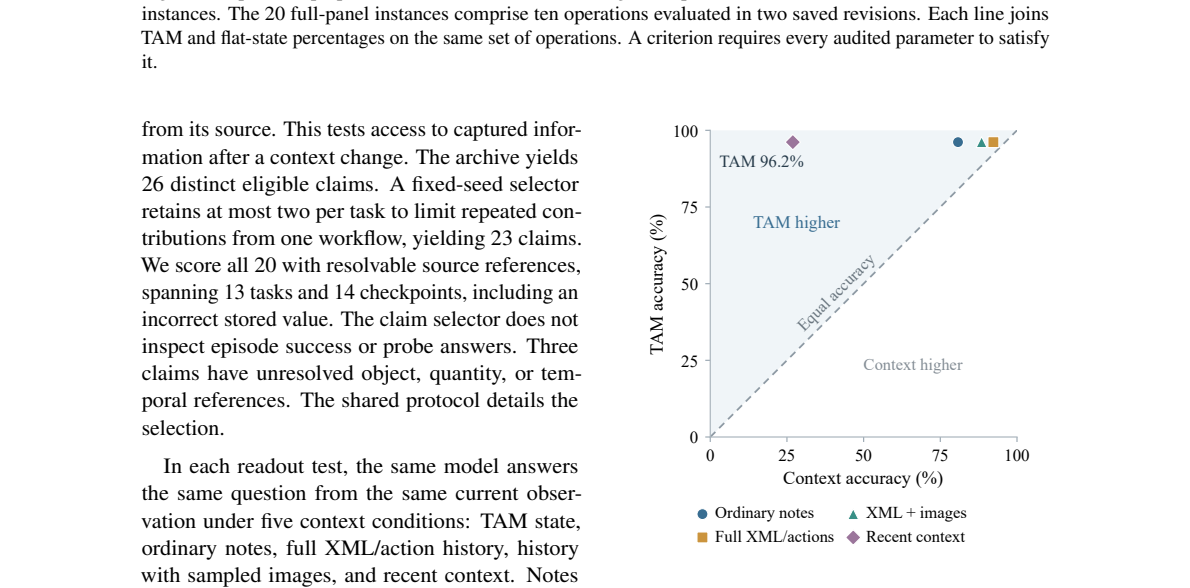
The central empirical claim, that a memory organized around verified task progress improves frozen-policy GUI agents at both the state and the supervision timescale, is plausible, and if the mechanism attribution holds it is a genuine step beyond trajectory-, workflow-, and note-based memories. The paper has real strengths: task success is judged by external native evaluators (MobileWorld per-action checks; SPA-Bench official evaluator), not by TAM; metric definitions are transparent and include failed attempts in lifecycle cost; the Table 4 ablation holds the base policy, action interface, and interaction budget fixed; and the D.5-D.7 diagnostics are falsifiable, showing that verified local results from failed workflows expand the pool of correct learning material (88.3% vs 64.3% coverage at 93.8% retained correctness) and that recalled operators adapt to changed input values (20/24 matched fields). The D.4 readout test is a clean fixed-checkpoint comparison.
Pith's reading of the paper (a machine's summary, not the authors')
Task Advancement Memory (TAM) tries to establish that a GUI agent's memory should be organized around verified progress, meaning screen observations that confirm a previously unresolved requirement, rather than around action logs or whole-task outcomes. At run time, verified progress is used as state: satisfied requirements drop out of the remaining problem while their values stay available to later goals, which is what lets information survive application switches. After each task, verified local results are used as supervision: the interactions that produced them become reusable operators, each stating its entry inputs, expected result, and verification condition, so partial successes inside failed episodes are not wasted. On MobileWorld GUI-only tasks, Advancement State alone raises success from 12.0% to 28.2%, and full TAM reaches 34.2% while using 38.7% fewer lifecycle tokens per solved task than the strongest evaluated baseline; on SPA-Bench English Level 3, TAM reaches 57.0%. The reason to care is that the gains come from reorganizing memory rather than retraining the policy.
What carries the argument. The carrying mechanism is the verified advancement defined in Eq. (1): requirement $q$ advances exactly when it flips from UNRESOLVED to ESTABLISHED and the evidence rule $V_q(\xi)$ accepts the observed screen. Everything else hangs off that unit. Task reduction removes established requirements from the residual problem while keeping their bound values attached to the requirements that consume them, so a value read in one app remains available after the agent switches apps. The Advancement Frontier, Eq. (2), is the set of unfinished requirements whose input dependencies and branch conditions are already satisfied, and TAM retrieves evidence and operators for that frontier. The Advancement Operator, Eq. (4), stores entry requirements $R_\kappa$, expected advancement $\Delta_\kappa$, verification condition $V_\kappa$, object roles $B_\kappa$, applicability $\Gamma_\kappa$, and reviewed GUI realizations $A_\kappa$. The design separates an operation's semantic contract from the specific GUI route, so the same learned operation can be re-checked against a changed interface.
Core claim. TAM's central claim is that task advancement, the moment GUI evidence verifies that a previously unresolved requirement is satisfied, is the right unit of memory for long-horizon GUI agents. The paper formalizes advancement as a requirement status flipping from UNRESOLVED to ESTABLISHED under an evidence rule, and then uses it twice. During execution, Task Advancement State reduces the task: established requirements leave the residual problem while their values and object bindings remain attached to the requirements that consume them, and the Advancement Frontier selects which pending requirements are ready to pursue; an Evidence Cache recalls source images so a value stays usable after it leaves recent context. After the task, advancement supervision reviews each verified local result and stores an Advancement Operator that separates entry requirements from internally acquired values, pairs the expected outcome with a verification condition, and keeps recorded GUI routes separately. The reported consequence is that on MobileWorld GUI-only tasks success rises from 12.0% for the base policy to 28.2% with state alone and 34.2% with the full system versus 29.1% for the strongest evaluated memory baseline, lifecycle tokens per solved task fall 38.7%, and on SPA-Bench English Level 3 the system reaches 57.0% against a previously reported 53.7%.
The premise it rests on. The load-bearing premise is that the model-based evidence check correctly recognizes when a GUI observation truly satisfies a task requirement; the state gain, the operator learning, and the cost savings all flow through that judgment, and the paper itself notes that outcome cues can be ambiguous.
If the paper is right (Pith's inferences, not the authors')
If the central claim is right, memory built on verified progress helps most where information must survive an application change: TAM's multi-app advantage over ConAct is +8.1 points versus +1.8 points on single-app tasks.
If the central claim is right, failed episodes are not wasted: the appendix reports 88.3% of correct learning material retained versus 64.3% for success-only filtering, and 74.8% of audited failed executions with verified local results contribute retained material.
If the central claim is right, the memory also lowers cost: 0.771M lifecycle tokens per solved task, 38.7% below ConAct's 1.257M, and it wins even when success is scored together with fewer controller rounds.
If the central claim is right, the approach transfers to harder single-app workflows: 57.0% on SPA-Bench English Level 3, above the 53.7% reported for GUI-explorer.
If the central claim is right, the gains require no policy retraining, since all components change only the memory context supplied to a fixed Qwen3-VL-32B-Instruct or GPT-4o actor.
A consequence the paper leaves implicit is that each verified advancement is a per-step credit-assignment signal, so the same machinery could label trajectories for training rather than only for in-context memory.
Because the operator contract is separated from its GUI realizations, the design supports a concrete adaptation policy for interface drift: keep the semantic operator and retire or rewrite its recorded routes, the maintenance regime the paper names as future work.
If the evidence check is the bottleneck the limitation section describes, then stronger visual grounding or multi-modal outcome verification should improve both online state and operator quality; this is a testable extrapolation, not a reported result.
The evaluated surface is mobile-only, so extending the advancement unit to web and desktop workflows is a directly testable next step that the paper names as future work.
Check this review
Pith stored no record of this review's passes and took no fingerprint of it. Reviews made by code from 13 Nov 2026 on carry both.
How often reviews like this one are right
Reviews like this one: written by deepseek-v4-flash, where what was read was not recorded.
How often objections from reviews like this one are right: not yet measured
Reviews by people
This review was written by a machine. No person has reviewed this paper on Pith yet. A scientist listed on Pith can review it for a fee, and their review is published here whatever it concludes.
The paper
Abstract
GUI memory should preserve the results of past actions and learn reusable operations. This is difficult in long-horizon workflows, where agents must use information across applications and useful operations are interleaved with failed attempts. We introduce Task Advancement Memory (TAM), which defines task advancement as verified task progress, and supports ongoing task execution and learns reusable operations. During execution, Task Advancement State represents how verified task progress changes the remaining goals, allowing the agent to build on earlier achievements across applications. After each task, advancement supervision identifies and abstracts the interactions that produced a verified local result. The learned operations preserve the relation between required inputs, expected outcomes, and verification conditions. This retains locally successful operations from both successful and failed tasks. On MobileWorld GUI-only tasks, Advancement State alone raises success from 12.0% to 28.2%. Full TAM achieves a 17.6% relative gain in task success over the strongest evaluated baseline and reduces lifecycle tokens per solved task by 38.7%. On SPA-Bench, TAM achieves state-of-the-art task success in the single-app English Level 3 setting.
The paper's own sentences, arranged, kept beside the review and separate from it. Each label is drawn from a closed vocabulary; the number beside it is the probability the classifier gave that label. No sentence in this record was written by a model.
abstract compiled · 2026-10-28
The authors' main claim, as the classifier picked it out 0.95
“Full TAM achieves a 17.6% relative gain in task success over the strongest evaluated baseline and reduces lifecycle tokens per solved task by 38.7%.”
How the main claim is stated: asserted 1.00
What the abstract itself states, as probabilities: claims first 0.06 · states limitation 0.24 · human participants 0.05 · controlled comparison 0.94 · randomized assignment 0.02 · states quantitative result 0.99 · compares with prior results 0.98 · mentions code or data availability 0.03
The abstract, sentence by sentence
This table labels the abstract only (arXiv listing abstract v1). The number is the probability the classifier gave the label.
| Sentence | Role | The authors' own work | States the main conclusion | Strength |
|---|---|---|---|---|
| GUI memory should preserve the results of past actions and learn reusable operations. | background 0.99 | 0.07 | 0.06 | asserted 0.97 |
| This is difficult in long-horizon workflows, where agents must use information across applications and useful operations are interleaved with failed attempts. | background 0.80 | 0.09 | 0.02 | asserted 1.00 |
| We introduce Task Advancement Memory (TAM), which defines task advancement as verified task progress, and supports ongoing task execution and learns reusable operations. | contribution 0.97 | 0.86 | 0.21 | asserted 1.00 |
| During execution, Task Advancement State represents how verified task progress changes the remaining goals, allowing the agent to build on earlier achievements across applications. | method 0.90 | 0.46 | 0.07 | asserted 1.00 |
| After each task, advancement supervision identifies and abstracts the interactions that produced a verified local result. | method 0.97 | 0.78 | 0.06 | asserted 1.00 |
| The learned operations preserve the relation between required inputs, expected outcomes, and verification conditions. | method 0.97 | 0.60 | 0.05 | asserted 1.00 |
| This retains locally successful operations from both successful and failed tasks. | method 0.86 | 0.61 | 0.04 | asserted 1.00 |
| On MobileWorld GUI-only tasks, Advancement State alone raises success from 12.0% to 28.2%. | result 1.00 | 0.94 | 0.12 | asserted 1.00 |
| Full TAM achieves a 17.6% relative gain in task success over the strongest evaluated baseline and reduces lifecycle tokens per solved task by 38.7%. | result 1.00 | 0.96 | 0.52 | asserted 1.00 |
| On SPA-Bench, TAM achieves state-of-the-art task success in the single-app English Level 3 setting. | result 1.00 | 0.94 | 0.16 | asserted 1.00 |
What kind of paper the classifier reports this is: method or tool 1.00 · evidence from observation or experiment 0.98
What was examined, and what was not
Sources read
- arXiv listing abstract v1
Not examined
- full text
- figures and tables
- references and citing sentences
- relations to other papers
Levels run
- P abstract
Not run
- S sections
- T body sentences
- C citations
- R cross-paper relations
How the labels were made
Compiled by classifier-1.13.0 via TypeSafe API, question bank abstract-p1-20260923, 2026-10-28: 1 request, 7,387 input tokens.
Every quoted sentence on this record is the authors'. Every label is from Pith's closed vocabulary, with the probability shown beside it. This record as JSON
Figures (13)





Showing 12 of the paper's 13 figures. Figures are the authors', reproduced from the paper.
References (41)
- [1] Zhou, Shuyan and Xu, Frank F. and Zhu, Hao and Zhou, Xuhui and Lo, Robert and Sridhar, Abishek and Cheng, Xianyi and Ou, Tianyue and Bisk, Yonatan and Fried, Daniel and Alon, Uri and Neubig, Graham , booktitle =. 2024 , url = on Pith
- [2] Xie, Tianbao and Zhang, Danyang and Chen, Jixuan and Li, Xiaochuan and Zhao, Siheng and Cao, Ruisheng and Toh, Jing Hua and Cheng, Zhoujun and Shin, Dongchan and Lei, Fangyu and Liu, Yitao and Xu, Yiheng and Zhou, Shuyan and Savarese, Silvio and Xiong, Caiming and Zhong, Victo... on Pith
- [3] Rawles, Christopher and Clinckemaillie, Sarah and Chang, Yifan and Waltz, Jonathan and Lau, Gabrielle and Fair, Marybeth and Li, Alice and Bishop, William and Li, Wei and Campbell-Ajala, Folawiyo and Toyama, Daniel and Berry, Robert and Tyamagundlu, Divya and Lillicrap, Timoth... on Pith
- [4] Kong, Quyu and Zhang, Xu and Yang, Zhenyu and Gao, Nolan and Liu, Chen and Tong, Panrong and Cai, Chenglin and Zhou, Hanzhang and Zhang, Jianan and Chen, Liangyu and Liu, Zhidan and Hoi, Steven and Wang, Yue , booktitle =. 2026 , publisher =. doi:10.18653/v1/2026.acl-long.278 , url = on Pithdoi:10.18653/v1/2026.acl-long.278
- [5] Chen, Jingxuan and Yuen, Derek and Xie, Bin and Yang, Yuhao and Chen, Gongwei and Wu, Zhihao and Li, Yixing and Zhou, Xurui and Liu, Weiwen and Wang, Shuai and Zhou, Kaiwen and Shao, Rui and Nie, Liqiang and Wang, Yasheng and Hao, Jianye and Wang, Jun and Shao, Kun , booktitle... on Pith
- [6] Tian, Shizuo and Wen, Hao and Chen, Yuxuan and Liu, Jiacheng and Zhao, Shanhui and Liu, Guohong and Ren, Ju and Liu, Yunxin and Li, Yuanchun , booktitle =. 2026 , publisher =. doi:10.1145/3745756.3809245 , url = on Pithdoi:10.1145/3745756.3809245
- [7] Cheng, Weihua and Liu, Junming and Sun, Yifei and Shi, Botian and Chen, Yirong and Wang, Ding , year =. 2510.24168 , archivePrefix = on PithPith's reviewarXiv
- [8] Liu, Chen and Chen, Ling and Zhou, Hanzhang and Zhang, Xu and Kong, Quyu and Tong, Panrong and Wang, Wenhao and Yu, Xin and Hoi, Steven and Wang, Yue , year =. What Memory Do. 2606.31612 , archivePrefix = on PithPith's reviewarXiv
- [9] Zheng, Yujie and Liu, Zikang and Zhao, Xin and Wen, Ji-Rong , year =. A Task-State Representation for Long-Horizon Mobile. 2607.00502 , archivePrefix = on PithPith's reviewarXiv
- [10] Wu, Wenyi and Zhu, Sibo and Zhou, Kun and Salvi, Aayush and Song, Zixuan and Huang, Biwei , year =. 2607.11388 , archivePrefix = on PithPith's reviewarXiv
- [11] Wang, Junyang and Xu, Haiyang and Zhang, Xi and Zhu, Zhaoqing and Yan, Ming and Ye, Jieping and Sang, Jitao , year =. 2605.29324 , archivePrefix = on PithPith's reviewarXiv
- [12] Zeng, Ziyun and Hua, Hang and Zou, Bocheng and Cai, Mu and Feris, Rogerio and Luo, Jiebo , year =. 2605.18652 , archivePrefix = on PithPith's reviewarXiv
- [13] Shi, Yibo and Li, Jungang and Zhang, Linghao and Dongfang, Zihao and Wu, Biao and Tao, Sicheng and Yan, Yibo and Qin, Chenxi and Liu, Weiting and Lin, Zhixin and Li, Hanqian and Huang, Yu and Dai, Song and Hei, Yonghua and Ding, Yue and Li, Xiang and Wang, Shikang and Xu, Chen... on PitharXiv
- [14] Choi, Seoyoung and Ko, Minseok and Lee, Hyunseok and Kim, Kunwoong and Song, Woomin and Jeon, Chanseok and Shin, Jinwoo , year =. Naive Visual Memory Is Not Enough: A Failure-Mode Study of. 2606.14106 , archivePrefix = on PitharXiv
- [15] Zhang, Zhuoran and Li, Bowen and Ju, Jingcheng and Shi, Yang and Wang, Qixun and Wang, Haotian and Chen, Wei and Wang, Tengjiao , year =. 2608.04530 , archivePrefix = on PithPith's reviewarXiv
- [16] Agent Workflow Memory , author =. Proceedings of the 42nd International Conference on Machine Learning , volume =. 2025 , publisher = on Pith
- [17] Wang, Zhenhailong and Xu, Haiyang and Wang, Junyang and Zhang, Xi and Yan, Ming and Zhang, Ji and Huang, Fei and Ji, Heng , year =. 2501.11733 , archivePrefix = on PithPith's reviewarXiv
- [18] Xiao, Han and Wang, Guozhi and Wang, Hao and Liu, Shilong and Chai, Yuxiang and Pan, Yue and Zhou, Yufeng and Chen, Xiaoxin and Wen, Yafei and Li, Hongsheng , year =. 2602.05832 , archivePrefix = on PitharXiv
- [19] Xie, Bin and Shao, Rui and Chen, Gongwei and Zhou, Kaiwen and Li, Yinchuan and Liu, Jie and Zhang, Min and Nie, Liqiang , booktitle =. 2025 , publisher =. doi:10.18653/v1/2025.acl-long.282 , url = on Pithdoi:10.18653/v1/2025.acl-long.282
- [20] Qin, Zerui and Yue, Sheng and Hua, Xingyuan and Fu, Yongjian and Ren, Ju , year =. Executable Agentic Memory for. 2605.12294 , archivePrefix = on PithPith's reviewarXiv
show 21 more
- [21] Li, Runze and Zhai, Yuwen and Xu, Bo and Xu, Liwu and Shi, Nian and Zhang, Wei and Lin, Ran and Wang, Liang , booktitle =. 2026 , url = on Pith
- [22] Sun, Libo and Zhang, Jiwen and Wang, Siyuan and Wei, Zhongyu , booktitle =. 2026 , publisher =. doi:10.18653/v1/2026.acl-long.1299 , url = on Pithdoi:10.18653/v1/2026.acl-long.1299
- [23] Xu, Wujiang and Liang, Zujie and Mei, Kai and Gao, Hang and Tan, Juntao and Zhang, Yongfeng , booktitle =. 2025 , doi = on Pith
- [24] Reflexion: Language Agents with Verbal Reinforcement Learning , author =. Advances in Neural Information Processing Systems , volume =. 2023 , doi = on Pith
- [25] Zhao, Andrew and Huang, Daniel and Xu, Quentin and Lin, Matthieu and Liu, Yong-Jin and Huang, Gao , journal =. 2024 , doi = on Pith
- [26] Sun, Yuchen and Zhao, Shanhui and Yu, Tao and Wen, Hao and Va, Samith and Xu, Mengwei and Li, Yuanchun and Zhang, Chongyang , booktitle =. 2025 , url = on Pith
- [27] Zhong, Hongbin and Faisal, Fazle and Fran. 2026 , url =. 2602.20502v1 , archivePrefix = on PithPith's reviewarXiv
- [28] Synapse: Trajectory-as-Exemplar Prompting with Memory for Computer Control , author =. The Twelfth International Conference on Learning Representations , year = on Pith
- [29] Ouyang, Siru and Yan, Jun and Hsu, I-Hung and Chen, Yanfei and Jiang, Ke and Wang, Zifeng and Han, Rujun and Le, Long T. and Daruki, Samira and Tang, Xiangru and Tirumalashetty, Vishy and Lee, George and Rofouei, Mahsan and Lin, Hangfei and Han, Jiawei and Lee, Chen-Yu and Pfi... on Pith
- [30] Ma, Yuchen and Huang, Yue and Bao, Han and Zhuang, Haomin and Shukla, Swadheen and Galley, Michel and Zhang, Xiangliang and Feuerriegel, Stefan , year =. 2605.10999 , archivePrefix = on PithPith's reviewarXiv
- [31] Zhang, Chi and Yang, Zhao and Liu, Jiaxuan and Li, Yanda and Han, Yucheng and Chen, Xin and Huang, Zebiao and Fu, Bin and Yu, Gang , booktitle =. 2025 , publisher =. doi:10.1145/3706598.3713600 , url = on Pithdoi:10.1145/3706598.3713600
- [32] Wen, Hao and Li, Yuanchun and Liu, Guohong and Zhao, Shanhui and Yu, Tao and Li, Toby Jia-Jun and Jiang, Shiqi and Liu, Yunhao and Zhang, Yaqin and Liu, Yunxin , booktitle =. 2024 , publisher =. doi:10.1145/3636534.3649379 , url = on Pithdoi:10.1145/3636534.3649379
- [33] Hong, Wenyi and Wang, Weihan and Lv, Qingsong and Xu, Jiazheng and Yu, Wenmeng and Ji, Junhui and Wang, Yan and Wang, Zihan and Dong, Yuxiao and Ding, Ming and Tang, Jie , booktitle =. 2024 , url = on Pith
- [34] Bai, Hao and Zhou, Yifei and Cemri, Mert and Pan, Jiayi and Suhr, Alane and Levine, Sergey and Kumar, Aviral , booktitle =. 2024 , doi = on Pith
- [35] Wang, Junyang and Xu, Haiyang and Jia, Haitao and Zhang, Xi and Yan, Ming and Shen, Weizhou and Zhang, Ji and Huang, Fei and Sang, Jitao , booktitle =. 2024 , doi = on Pith
- [36] Zheng, Boyuan and Gou, Boyu and Kil, Jihyung and Sun, Huan and Su, Yu , booktitle =. 2024 , publisher = on Pith
- [37] Bai, Shuai and Cai, Yuxuan and Chen, Ruizhe and Chen, Keqin and Chen, Xionghui and Cheng, Zesen and Deng, Lianghao and Ding, Wei and Gao, Chang and Ge, Chunjiang and Ge, Wenbin and Guo, Zhifang and Huang, Qidong and Huang, Jie and Huang, Fei and Hui, Binyuan and Jiang, Shutong... on PithPith's reviewarXiv
- [38] Wang, Xuehui and Wu, Zhenyu and Xie, JingJing and Ding, Zichen and Yang, Bowen and Li, Zehao and Liu, Zhaoyang and Li, Qingyun and Dong, Xuan and Chen, Zhe and Wang, Weiyun and Zhao, Xiangyu and Chen, Jixuan and Duan, Haodong and Xie, Tianbao and Yang, Chenyu and Su, Shiqian a... on Pith
- [39] Yang, Ke and Liu, Yao and Chaudhary, Sapana and Fakoor, Rasool and Chaudhari, Pratik A. and Karypis, George and Rangwala, Huzefa , booktitle =. 2025 , url = on Pith
- [40] Agashe, Saaket and Han, Jiuzhou and Gan, Shuyu and Yang, Jiachen and Li, Ang and Wang, Xin , booktitle =. 2025 , url = on Pith
- [41] Liu, Guangyi and Wu, Gao and Liu, Congxiao and Zhao, Pengxiang and Liu, Liang and Li, Mading and Zhang, Qi and Wang, Mengyan and Guo, Liang and Liu, Yong , year =. 2606.19926 , archivePrefix = on PithPith's reviewarXiv
Challenges and discussion
Disagree with the review, or know something it missed? Leave a comment, or challenge this review formally: a challenge becomes a permanent entry in this paper's record, and its decision is published here.
Come back by email
A short list of the week's newly reviewed papers. Nothing is sent until you confirm from your inbox, and every email has a link that stops it. No account.
No comments yet.
Sign in to comment