Artificial Intelligence · arXiv:2610.37624 v1 · submitted 27 Oct 2026 · 24 references
Rare, Relevant, and Still Wrong: How Memory Fails LLM Group Decisions
The paper says
“When an LLM group's discussion is compressed into a short memory for a final decision maker, what should the memory keep? Two natural heuristics keep the rarest claims or the claims relevant to the decision criteria.”
more of the abstract
On hidden-profile tasks both look attractive, because how widely a fact is held is confounded with whether it helps. We introduce CrossProfile, a diagnostic benchmark of 60 templates with automatically verified answer keys, in which the ownership of supporting, decoy, and irrelevant facts is crossed while their text is held fixed (480 tasks). Across Qwen2.5-7B, Llama-3.1-8B, and two DeepSeek models, both heuristics fail in predictable places. Selecting by relevance readmits decoys, because decoys are on topic: even a perfect relevance filter loses 23 to 31 points to rarest-first selection in the classic hidden-profile configuration. Rarest-first selection is no better than random selection on average and wins only where the rare facts happen to be the useful ones. In both cases accuracy follows the balance of evidence the memory keeps, not the policy that kept it. The decision model adds a third failure, a form of social proof: it gives extra weight to facts attributed to many agents. Removing the attribution tags, or reassigning them at random with line order fixed, raises accuracy in the classic configuration by 13 to 24 points. In natural discussions the evidence is lost before any memory acts: the complete transcript yields lower accuracy than no notes at all.
from the abstract
Pith says
Machine review · deepseek-v4-flash · 28 Oct 2026 · what was read was not recorded · not checked by a person
It can be wrong. Challenge this review or reply to it.
Holds up, with conditions. A genuinely useful diagnostic benchmark with new crossed-ownership design and well-controlled findings; the per-cell results hold up, but the unifying 'balance of evidence' story is measured against the paper's own constructed answer key, so treat the prescriptive conclusion as conditional on that key. This line is wrong
2 major objections · 4 minor
How often objections from reviews like this one are right: not yet measured
Not checked: figures, code, what the 24 references say.
The paper says, at §3.2, §5.3, Conclusion
The review did not quote this passage.
Pith says: Objection 1 of 2 · major
The paper's unifying claim ('What drives the decision is the balance of evidence between options that the memory leaves' and 'Memory designs for agent groups should therefore aim at that balance') is measured entirely in terms of the constructed answer key.
more of objection 1
In §3.2 the key is defined by unit additive scoring (favorable +1, unfavorable −1, irrelevant 0), accuracy is agreement with that key, and the decision prompt does not state the rule; in §5.3 the net lead among kept facts is 'counted as in the answer key.' Both the dependent and the explanatory variable therefore come from the same evaluator labels, so the monotone lead–accuracy curve partly reflects the model's conformity to the key rather than decision quality under an external standard. The authors explicitly acknowledge that accuracy measures agreement with a constructed key, but no robustness analysis addresses how much of the explanation and prescription depends on the additive rule. The task description supports only 'equally weighted criteria,' not unit weights per fact, and criteria contain different numbers of facts (template M01: a one-batch leakage failure, f07, counts as one unit against an 8% price difference, f08, and a nine-day urgent-callout delay, f02, which an external rater could weigh differently). The per-cell policy and tag effects are not in question; the prescriptive step is. Concretely, recompute leads and re-key accuracy under alternative plausible aggregations (per-criterion equal weighting, bounded perturbations of fact weights, or human/expert ratings of valence and importance) and report whether the lead–accuracy relationship, the 'policy adds little' conclusion, and the main contrasts survive; alternatively, restrict the design prescription to the evaluator's additive aggregation and discuss the dependence.
The paper says, at §5.3
The review did not quote this passage.
Pith says: Objection 2 of 2 · major
The claim that 'once that lead is known the policy adds little' is load-bearing for the abstract's statement that accuracy follows the balance of evidence rather than the policy, but the supporting analysis is reported in one sentence. The template random-intercept logistic model is not specified: there is no unit of analysis (per-decision or per-memory), no statement of how the …
more of objection 2
… lead enters (linear or binned), no definition of the 'tone of the kept irrelevant facts' covariate, no coefficient table, and no discussion of collinearity between lead and policy (R1 and B4 produce very different leads by construction in the extreme cells). Please provide the full model specification and coefficients in an appendix, and include a cross-check such as a within-policy lead–accuracy analysis or a template-bootstrap for the policy coefficients.
4 minor objections
The paper says, at §5.2, Table 2
Pith says: minor objection 1 of 4
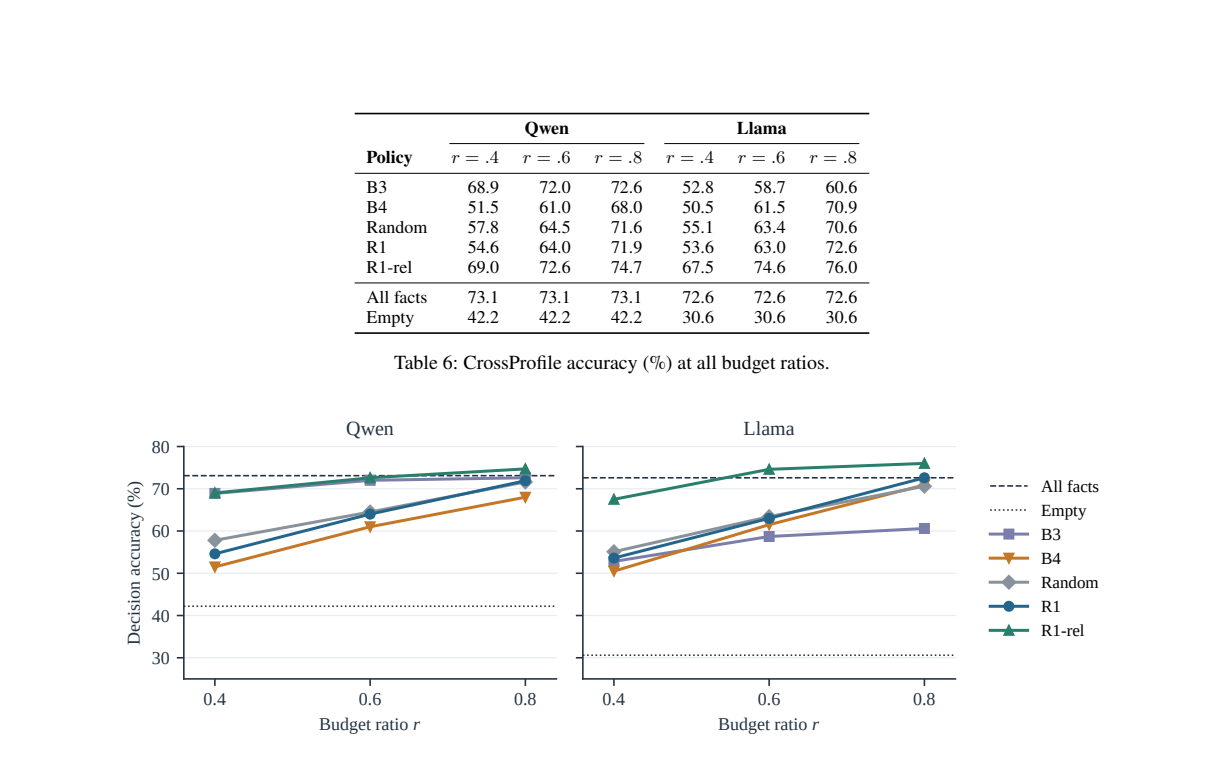
The statement that R1 is no better than Random on average is supported by the means (64.0 vs 64.5 on Qwen; 63.0 vs 63.4 on Llama) but no interval or test is reported for the full 60-template comparison at r=.6; only the 30-template common subset carries intervals. Reporting R1 minus Random with a template bootstrap would complete the null claim.
The paper says, at §5.5
Pith says: minor objection 2 of 4
State explicitly whether the REF condition hands the decision call the initial and final votes in addition to the messages. The REF-below-Empty result is interpreted as evidence loss, but if votes are included, the transcript's own (mostly wrong) conclusions are a confound; a sentence clarifying the contents, or a decomposition of the transcript's effect, would sharpen the interpretation.
show 2 more
The paper says, at Appendix A.1
Pith says: minor objection 3 of 4
Report how often the R1-rel filter returns an invalid list and falls back to R1; the fallback silently equates R1-rel with R1 in those templates, which matters for interpreting the filter's recall figures.
The paper says, at §5.2
Pith says: minor objection 4 of 4
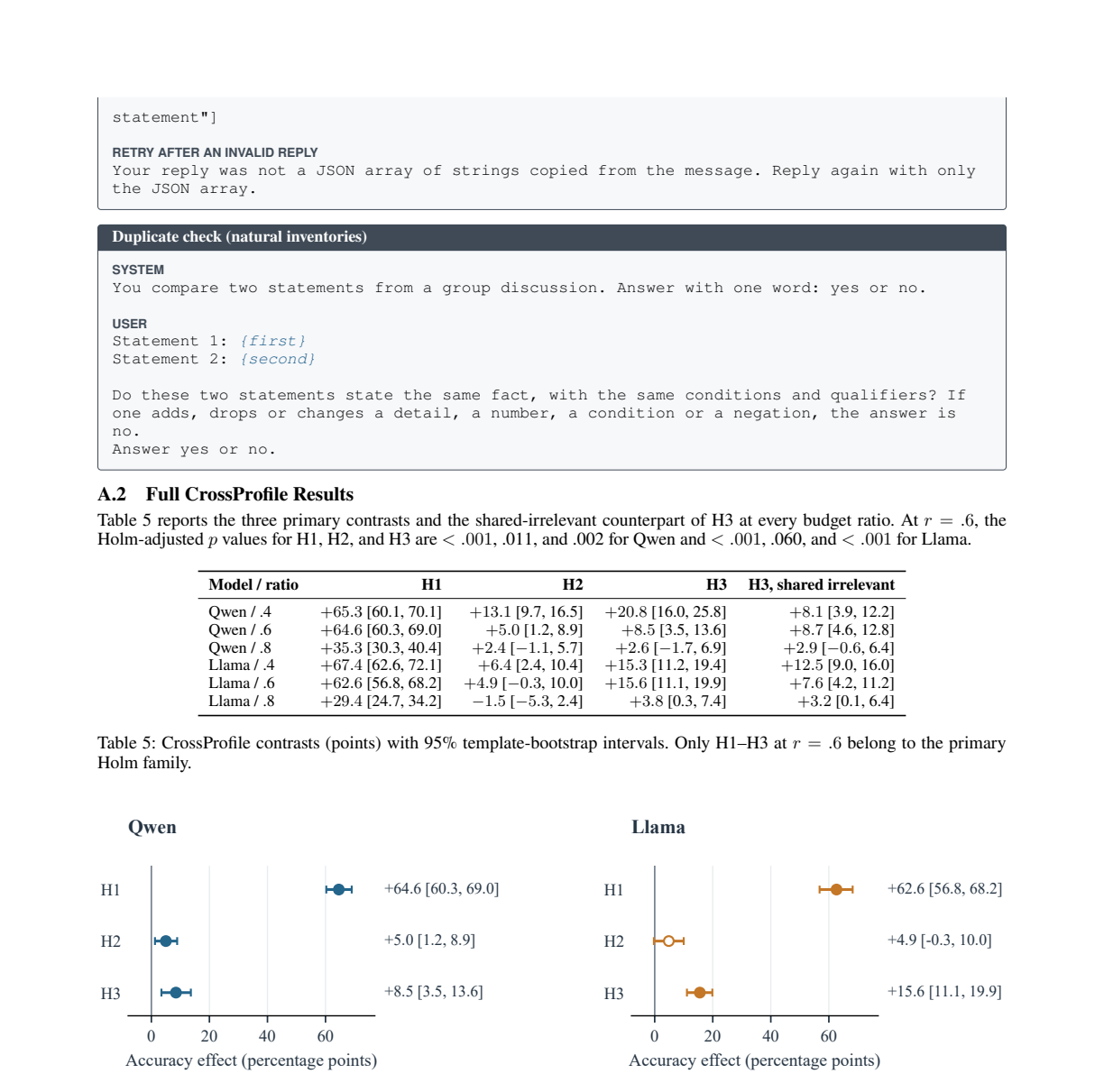
The wording 'Private irrelevant facts cost R1 little' summarizes a Qwen-only significant H2 effect (Holm p=.011) and a Llama effect that does not survive Holm (p=.060); consider stating this asymmetry in the main text for the reader.
What would settle it
External validation of the answer keys with re-scoring: recruit independent human raters (or a held-out judge model from a different family, never shown the role schema) to answer a sample of about 30 of the 60 CrossProfile templates from the full 12-fact sets, with no labels and no stated scoring rule, mirroring the decision call. Measure agreement with the additive key; then re-score the released decision outputs against the raters' majority labels and recompute (a) the classic-cell oracle-relevance minus R1 gap and (b) the accuracy-by-lead curve and the 'policy adds little' regression with the lead counted under the external labels.
from the skeptic's reading
How the review went
4 readings by deepseek-v4-flash · 28 Oct 2026
- Reader holds up, with conditions
- Skeptic agrees
- Editor wrote the verdict above
- Referee major revision: 2 major objections, 4 minor
Not run on this paper: the simulated authors' defence.
Pith did not check this review's objections against the paper.
The review in full
The review in brief, machine-written
You should read this one if you care about multi-agent LLM memory or hidden-profile benchmarks. The design is the contribution. CrossProfile holds fact text fixed and independently crosses support, decoy, and irrelevant facts between shared and private (2x2x2 = 8 variants per template, 480 tasks), which finally separates rarity from usefulness in a hidden-profile setting. On HiddenBench those are confounded, private facts are the useful ones, so rarest-first selection looks good for the wrong reason, and the paper shows this cleanly with private-only vs shared-only reference memories (91% vs 6% on Qwen).
The empirical results are strong and internally consistent. Rarest-first is no better than random on average but its advantage swings by 28 to 41 points depending on who holds the decoys. Relevance-first readmits decoys even with a perfect filter: oracle relevance loses 23 to 31 points to R1 in the classic hidden-profile cell. And the decision model overweights facts with many holder tags: removing or randomly reassigning tags, with line order fixed, raises classic-cell accuracy by 13 to 24 points, and the same weighting helps in the mirror cell, where removing tags actually lowers Qwen's accuracy. The statistical practice is above the field's norm. Pre-specified contrasts, template-level bootstrap, Holm correction, and honest reporting of the null H2 on Llama and the exploratory status of Llama's HiddenBench runs.
Soft spots, in proportion. The unifying explanation, that accuracy tracks the net evidence lead among kept facts and once the lead is known the policy adds little, computes that lead from the same additive labels that define the answer key, and accuracy is agreement with that key. The authors are upfront that the key is constructed and the prompt withholds the scoring rule, but they never attach that scope condition to the headline recommendation. The per-cell policy failures are direct observations and would survive any re-keying that preserves template roles; what is conditional is the prescriptive step: aim at the balance of evidence. A human-agreement or weighting-sensitivity check on the keys would close this, and its absence is the main reason I would not call the paper definitive. The other real gap is artifacts: templates, code, and outputs are promised upon publication, not shipped. For a benchmark paper, the artifacts are the contribution, so acceptance should be conditional on release. Minor: the natural-discussion disclosure rate rests partly on a one-seed string-matching heuristic, though the REF-below-empty finding itself is robust across models.
This is for anyone building memory or summarization pipelines for LLM agent groups, and anyone evaluating multi-agent benchmarks. It deserves a serious referee, with the release condition attached. I agree with the reader's conditional verdict.
The strongest objection
In Section 3.2 the answer key is defined by additive scoring (favorable +1, unfavorable −1, irrelevant 0), and the authors state that the decision prompt does not give this rule, so accuracy is agreement with the constructed key. The unifying claim in Section 5.3 and the conclusion ([b135], [b136]) is that decisions track the balance of evidence, measured as the net lead of the keyed option among kept facts 'counted as in the answer key,' and that once that lead is known the policy adds nothing. Both the dependent variable (accuracy) and the explanatory variable (the lead) are computed from the same evaluator labels, so the monotone lead–accuracy curve can be read as the model's conformity to the key rather than as decision quality under any external standard. The per-cell results (R1 vs. R1-rel, oracle relevance, tag removal and reshuffle) are direct observations and would survive any re-keying that preserves the template roles; what is not protected is the prescriptive step: 'memory designs should aim at that balance' presupposes that the additive score is the right way to aggregate the 12 facts. In template M01 a scanner-batch leakage-test failure counts as exactly one unit against an 8% price difference and a nine-day urgent-callout delay; a reasonable external rater could weigh these differently, and because the decision prompt withholds the scoring rule, the model's agreement with the key is emergent rather than prompted. The authors acknowledge the key is constructed (Section 3.2) but do not attach the corresponding scope condition to the headline claims, and no external validation of the keys (human or independent-judge agreement, or a weighting sensitivity analysis) is reported.
The paper's empirical work is well controlled: the 2×2×2 ownership crossing holds fact text fixed; H1–H3 are pre-specified with template-level bootstrap intervals and Holm correction; the oracle-relevance, fixed-item-count (seven retained items), and tag-removal/tag-reshuffle controls address the main confounds; and the pattern replicates across four models including two hosted ones. The reversed cell in §5.4 (tag removal hurts accuracy when support is shared and decoys are private) is a genuine falsification check for the social-proof account. Within the benchmark's own terms the claims are internally consistent.
The single most load-bearing concern is the one the reader identified: both sides of the central correlation are defined by the same constructed labels. Accuracy is agreement with the additive key (§3.2), and the explanatory 'net evidence lead of the correct option' is 'counted as in the answer key' (§5.3), so the monotone lead–accuracy curve and the vanishing policy coefficients could reflect the model's conformity to the key rather than decision quality under any external standard. The per-cell policy failures and the tag effects are direct observations and would survive any re-keying that preserves template roles; the risk falls on the paper's explanatory and prescriptive conclusions ([b135], [b136]): that what drives decisions is 'the balance of evidence' and that memory design should aim at that balance. Since the decision prompt deliberately withholds the scoring rule, the model's agreement with the key is an emergent behavioral fact, but the normative force of the design target inherits the key's equal-weight additive aggregation without external validation. The automatic verifier checks internal consistency, not external agreement; no human or independent-judge validation, and no weighting sensitivity, is reported. A decision-maker who weighted the safety-critical leakage-test failure in template M01 differently from one point of price difference could reasonably want a different balance handed to the reader.
Because the same concern drives the reader's CONDITIONAL verdict and its requested scope condition, my read does not move the verdict; the concrete test above would settle whether the key dependence is benign.
The referee's report
The experimental design is a genuine strength: contrasts H1-H3 were pre-specified at r=.6 with template-level bootstrap intervals and Holm correction; oracle-relevance, random-reference, fixed-item-count, tag-removal, and tag-shuffle controls isolate the mechanisms; and the authors are transparent about which analyses are exploratory, even flagging Llama's HeadlessBench results as exploratory after the headroom check. The per-cell findings are large, consistent across four models, and directly observed: the classic-cell R1 versus R1-rel gap, the oracle-relevance losses, and the tag effects would survive any re-keying that preserves template roles. If the central explanation holds, the paper makes a useful design point: memory selection should target the sign and magnitude of the retained evidence balance rather than prevalence or topicality, and holder multiplicity should not be presented as credibility.
Pith's reading of the paper (a machine's summary, not the authors')
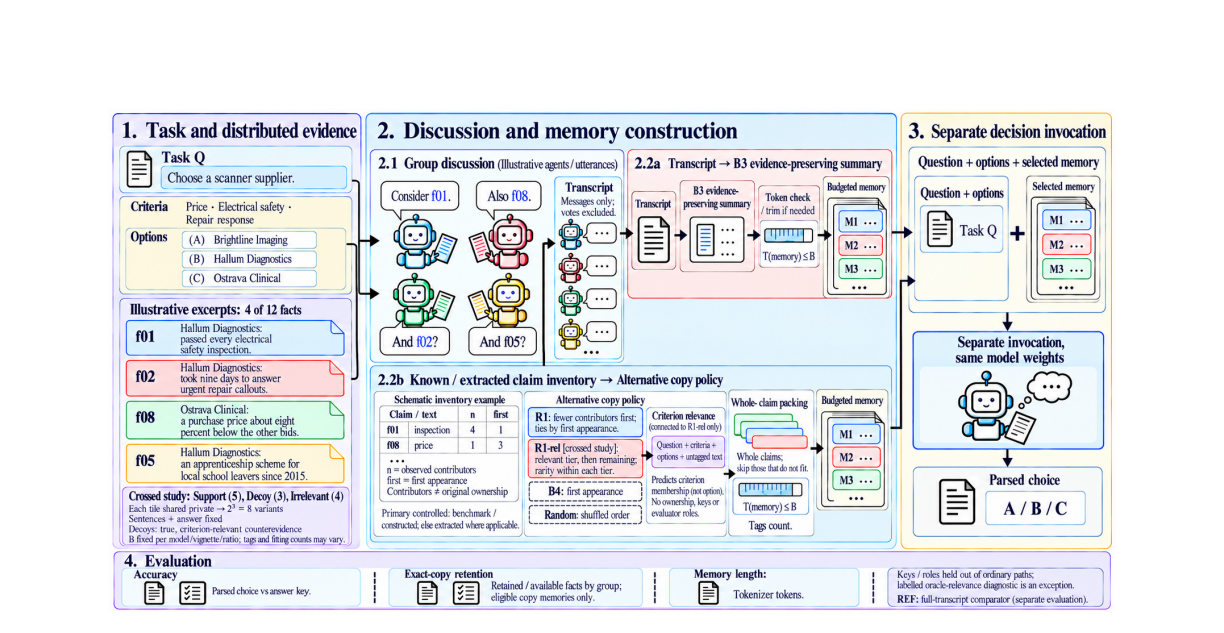
When a group of LLM agents discusses a decision and the discussion is compressed into a short memory for a final decision maker, what should that memory keep? The paper tries to establish that the two natural answers—keep the rarest claims, or keep the claims relevant to the decision criteria—both fail in predictable ways, because rarity is a bet on who happens to hold the decoy facts and relevance cannot tell a supporting fact from an on-topic decoy. Its central claim is that decision accuracy follows the balance of evidence the memory leaves between options, not the policy that selected the evidence, and that the reader model adds a social-proof bias by giving extra weight to facts attributed to many agents. The authors build CrossProfile, a benchmark of 60 templates (480 tasks) in which fact text is held fixed while the ownership of supporting, decoy, and irrelevant facts is crossed, and show on four models that both heuristics win and lose exactly in the cells the design predicts. If the paper is right, aggregate accuracy hides both failures, and memory design should aim at evidence balance and strip holder attribution rather than at prevalence or topic.
What carries the argument. The load-bearing object is CrossProfile, a diagnostic benchmark of 60 templates (480 tasks) in which each template fixes twelve fact sentences—five support, three decoy, four irrelevant—and independently assigns each role group to be shared by all four agents or held by one, producing $2 \times 2 \times 2$ ownership variants with identical text. The answer key is additive and automatically verified: each favorable fact adds one to its option's score, each unfavorable fact subtracts one, and irrelevant facts contribute zero. Against this design the paper compares memory policies (rarest-first R1, first-mention B4, random, relevance-first R1-rel, and the summarizing B3) and reads all results through a single quantity, the net evidence lead of the correct option among the kept facts. The mechanism the paper claims to identify is that this lead, not the selection rule, predicts the decision, and that the holder tags printed on each memory line are a separate attribution channel that the reader model overweights.
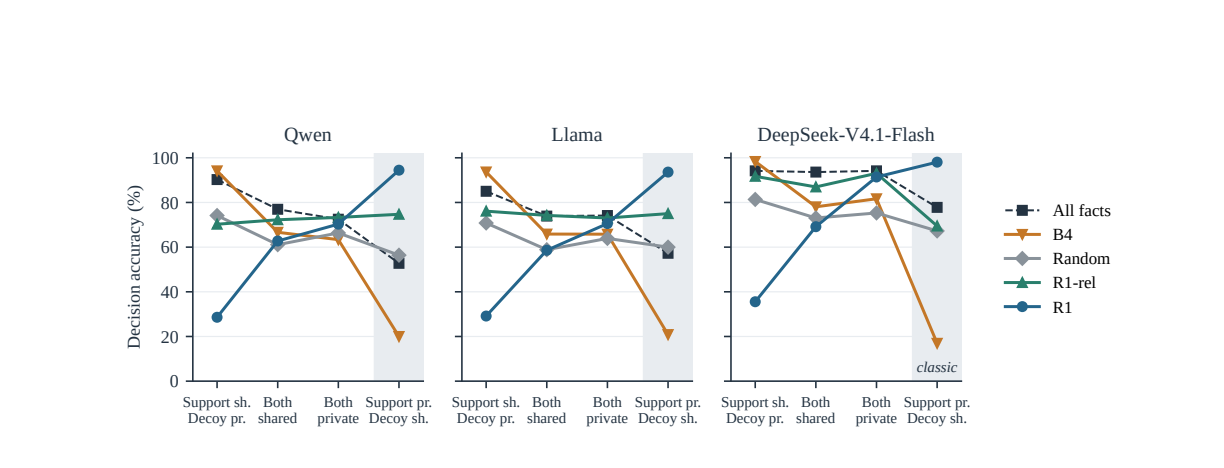
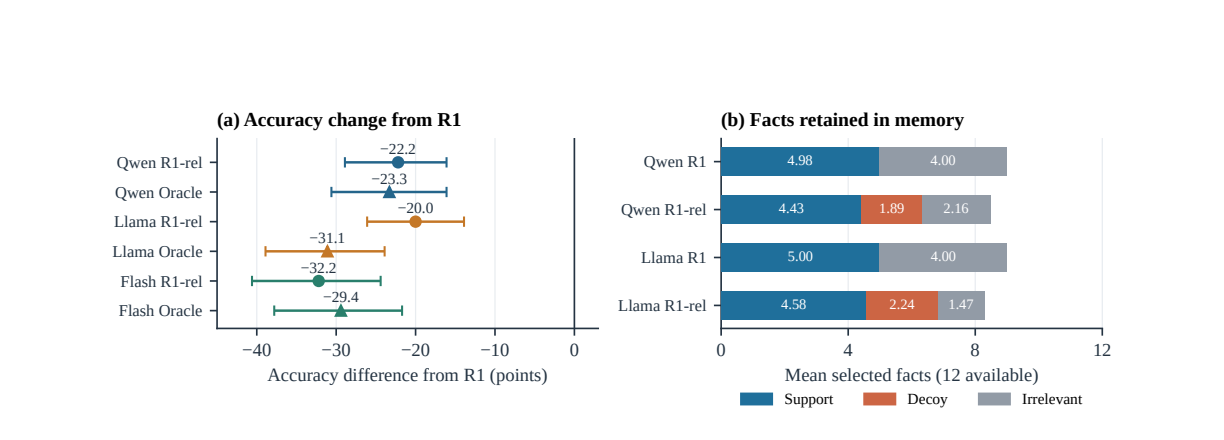
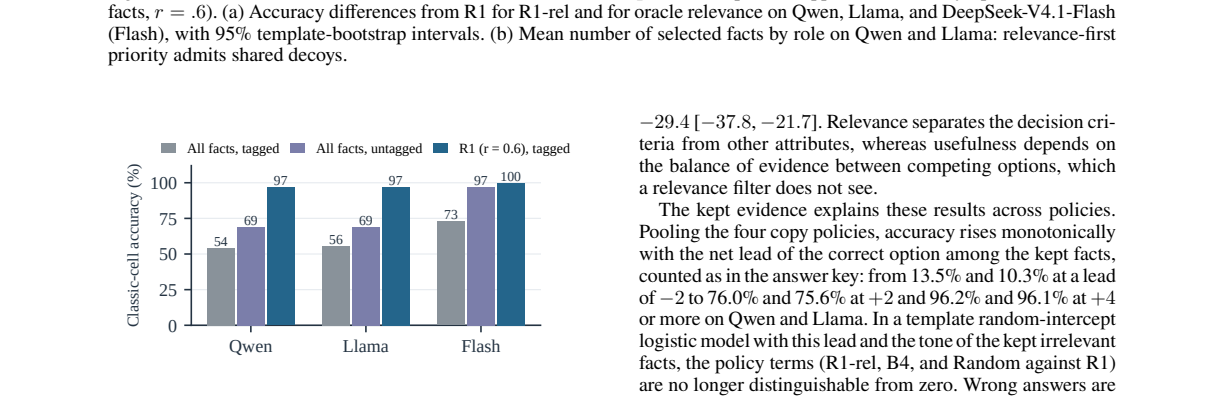
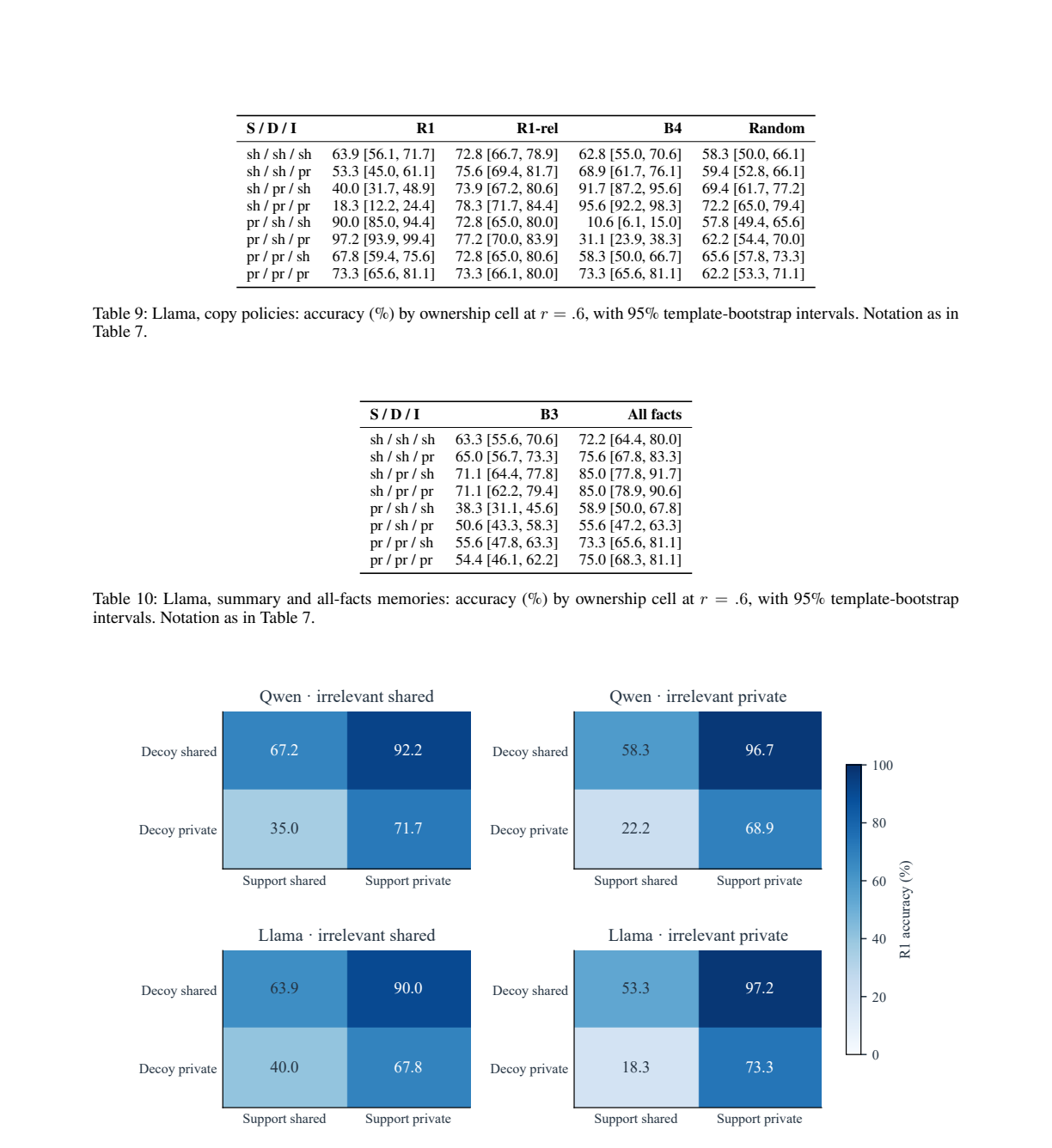
Core claim. The paper's finding is that hidden-profile memory failures in LLM groups decompose into three separable problems, and the two popular heuristics solve none of them in general. Rarest-first selection is no better than random selection on average (64.0% versus 64.5% on Qwen, 63.0% versus 63.4% on Llama) and flips from 90 to 97% accuracy to 18 to 40% depending on whether the private facts support the correct option or the decoy; its advantage over random selection changes by 28 to 41 points with decoy ownership on all four models. Relevance-first selection helps on average but readmits decoys because decoys are criterion-relevant by construction, and even an oracle-perfect relevance filter loses 23 to 31 points to rarest-first in the classic hidden-profile configuration of private support, shared decoys, and private irrelevant facts. Pooling all copy policies, accuracy rises monotonically with the net evidence lead of the correct option among the kept facts under the additive key, and once that lead is known the policy identity adds little. A third failure sits in the decision model: holder tags act as social proof, so removing them, or reassigning them at random with line order fixed, raises classic-cell accuracy by 13 to 24 points, although in these tasks shared facts were assigned, not independently observed. In natural discussions the bottleneck lies upstream of memory: private facts are almost never stated, and the full transcript scores below an empty memory on all three models.
The premise it rests on. The load-bearing premise is that the constructed additive answer key is the right normative standard for decision quality, since both the accuracy labels and the explanatory net-evidence-lead measure come from that same key while the decision prompt never states the scoring rule.
If the paper is right (Pith's inferences, not the authors')
Rarity is a bet on who holds the decoys: the rarest-first advantage over random selection swings by 28 to 41 points with decoy ownership, and averaged over all ownership variants rarest-first is no better than random.
Relevance cannot substitute for usefulness: decoys are on-topic by construction, so even an oracle-perfect relevance filter loses 23 to 31 points to rarest-first in the classic hidden-profile cell (private support, shared decoys, private irrelevant facts).
Across all copy policies, decision accuracy rises monotonically with the net evidence lead of the correct option among the kept facts, and once that lead is known the policy identity adds little.
Holder tags are a separate failure channel: the reader model gives extra weight to facts attributed to many agents, and removing or randomly reassigning the tags with line order fixed raises classic-cell accuracy by 13 to 24 points, even though shared facts were assigned, not independently observed.
In natural discussions the evidence is lost before any memory acts: private facts are stated in full in under 2% of discussions on the hosted model, and the complete transcript scores below an empty memory, so no memory policy can recover what was never said.
The paper leaves the mitigation untested: its balance-of-evidence account predicts that explicitly telling the reader that holder counts carry no evidential weight when facts were assigned rather than independently observed should shrink the tag effect, and that a memory policy selecting facts to maximize the correct option's net lead should beat both heuristics in every ownership cell.
The evidence-first prompt result suggests a priority order for practitioners: fix disclosure first, then memory balance, then attribution; the paper shows that once Llama states evidence before recommending, its memory policies spread apart by roughly 25 to 30 points, implying memory design only pays once the discussion actually carries the facts.
The unifying balance-of-evidence claim is keyed to the additive scoring rule, so a natural robustness check is whether the same monotonic accuracy-versus-lead relationship holds under weighted or lexicographic decision rules where a single decisive negative fact could outweigh several favorable ones.
The crossed-template method is transferable: holding text fixed while crossing who holds each role could diagnose memory failures in retrieval-augmented settings or mixed human-LLM pipelines, where the 'agents' are sources with different trust levels.
Check this review
Pith stored no record of this review's passes and took no fingerprint of it. Reviews made by code from 13 Nov 2026 on carry both.
How often reviews like this one are right
Reviews like this one: written by deepseek-v4-flash, where what was read was not recorded.
How often objections from reviews like this one are right: not yet measured
Reviews by people
This review was written by a machine. No person has reviewed this paper on Pith yet. A scientist listed on Pith can review it for a fee, and their review is published here whatever it concludes.
The paper
Abstract
When an LLM group's discussion is compressed into a short memory for a final decision maker, what should the memory keep? Two natural heuristics keep the rarest claims or the claims relevant to the decision criteria. On hidden-profile tasks both look attractive, because how widely a fact is held is confounded with whether it helps. We introduce CrossProfile, a diagnostic benchmark of 60 templates with automatically verified answer keys, in which the ownership of supporting, decoy, and irrelevant facts is crossed while their text is held fixed (480 tasks). Across Qwen2.5-7B, Llama-3.1-8B, and two DeepSeek models, both heuristics fail in predictable places. Selecting by relevance readmits decoys, because decoys are on topic: even a perfect relevance filter loses 23 to 31 points to rarest-first selection in the classic hidden-profile configuration. Rarest-first selection is no better than random selection on average and wins only where the rare facts happen to be the useful ones. In both cases accuracy follows the balance of evidence the memory keeps, not the policy that kept it. The decision model adds a third failure, a form of social proof: it gives extra weight to facts attributed to many agents. Removing the attribution tags, or reassigning them at random with line order fixed, raises accuracy in the classic configuration by 13 to 24 points. In natural discussions the evidence is lost before any memory acts: the complete transcript yields lower accuracy than no notes at all.
The paper's own sentences, arranged, kept beside the review and separate from it. Each label is drawn from a closed vocabulary; the number beside it is the probability the classifier gave that label. No sentence in this record was written by a model.
abstract compiled · 2026-10-28
The authors' main claim, as the classifier picked it out 0.97
“In both cases accuracy follows the balance of evidence the memory keeps, not the policy that kept it.”
How the main claim is stated: asserted 1.00
What the abstract itself states, as probabilities: claims first 0.09 · states limitation 0.62 · human participants 0.05 · controlled comparison 0.89 · randomized assignment 0.11 · states quantitative result 0.99 · compares with prior results 0.92 · mentions code or data availability 0.05
The abstract, sentence by sentence
This table labels the abstract only (arXiv listing abstract v1). The number is the probability the classifier gave the label.
| Sentence | Role | The authors' own work | States the main conclusion | Strength |
|---|---|---|---|---|
| When an LLM group's discussion is compressed into a short memory for a final decision maker, what should the memory keep? | background 0.85 | 0.04 | 0.02 | unclear 1.00 |
| Two natural heuristics keep the rarest claims or the claims relevant to the decision criteria. | background 0.97 | 0.09 | 0.05 | asserted 0.97 |
| On hidden-profile tasks both look attractive, because how widely a fact is held is confounded with whether it helps. | background 0.93 | 0.13 | 0.04 | asserted 0.94 |
| We introduce CrossProfile, a diagnostic benchmark of 60 templates with automatically verified answer keys, in which the ownership of supporting, decoy, and irrelevant facts is crossed while their text is held fixed (480 tasks). | method 0.73 | 0.95 | 0.03 | asserted 0.99 |
| Across Qwen2.5-7B, Llama-3.1-8B, and two DeepSeek models, both heuristics fail in predictable places. | result 0.97 | 0.92 | 0.15 | asserted 1.00 |
| Selecting by relevance readmits decoys, because decoys are on topic: even a perfect relevance filter loses 23 to 31 points to rarest-first selection in the classic hidden-profile configuration. | result 0.97 | 0.88 | 0.14 | asserted 1.00 |
| Rarest-first selection is no better than random selection on average and wins only where the rare facts happen to be the useful ones. | result 0.98 | 0.91 | 0.17 | asserted 1.00 |
| In both cases accuracy follows the balance of evidence the memory keeps, not the policy that kept it. | interpretation 0.69 | 0.85 | 0.54 | asserted 1.00 |
| The decision model adds a third failure, a form of social proof: it gives extra weight to facts attributed to many agents. | result 0.94 | 0.83 | 0.09 | asserted 1.00 |
| Removing the attribution tags, or reassigning them at random with line order fixed, raises accuracy in the classic configuration by 13 to 24 points. | result 1.00 | 0.92 | 0.07 | asserted 1.00 |
| In natural discussions the evidence is lost before any memory acts: the complete transcript yields lower accuracy than no notes at all. | result 0.95 | 0.87 | 0.18 | asserted 1.00 |
What kind of paper the classifier reports this is: dataset or benchmark 0.65 · evidence from observation or experiment 0.79
What was examined, and what was not
Sources read
- arXiv listing abstract v1
Not examined
- full text
- figures and tables
- references and citing sentences
- relations to other papers
Levels run
- P abstract
Not run
- S sections
- T body sentences
- C citations
- R cross-paper relations
How the labels were made
Compiled by classifier-1.13.0 via TypeSafe API, question bank abstract-p1-20260923, 2026-10-28: 1 request, 8,231 input tokens.
Every quoted sentence on this record is the authors'. Every label is from Pith's closed vocabulary, with the probability shown beside it. This record as JSON
Figures (9)


Figures are the authors', reproduced from the paper.
References (24)
- [1] Alsobay, M.; Rothschild, D. M.; Hofman, J. M.; and Goldstein, D. G. 2025. Bringing Everyone to the Table: An Experimental Study of LLM -Facilitated Group Decision Making. arXiv:2508.08242 on PithPith's reviewarXiv
- [2] Babu, A.; Kaur, R.; Pramanik, V.; Kotevska, O.; Bastian, N. D.; Jha, S.; Raj, S.; Wu, Y.; Jha, S. K.; and Roy, A. 2026. Consilience: Conformally Calibrated Communication Control for Hidden-Profile Multi-Agent Reasoning. arXiv:2608.20564 on PithPith's reviewarXiv
- [3] Du, Y.; Li, S.; Torralba, A.; Tenenbaum, J. B.; and Mordatch, I. 2024. Improving Factuality and Reasoning in Language Models through Multiagent Debate. In Proceedings of the 41st International Conference on Machine Learning, volume 235 of PMLR, 11733--11763 on Pith
- [4] Flint, A.; Aiello, L. M.; Pastor-Satorras, R.; and Baronchelli, A. 2026. Group Size Effects and Collective Misalignment in LLM Multi-Agent Systems. Proceedings of the National Academy of Sciences. doi:10.1073/pnas.2531697123 on Pithdoi:10.1073/pnas.2531697123
- [5] Gigone, D.; and Hastie, R. 1993. The Common Knowledge Effect: Information Sharing and Group Judgment. Journal of Personality and Social Psychology, 65(5): 959--974 on Pith
- [6] Holm, S. 1979. A Simple Sequentially Rejective Multiple Test Procedure. Scandinavian Journal of Statistics, 6(2): 65--70 on Pith
- [7] Hu, C.; Li, T.; Gao, X.; Chen, H.; Bai, Y.; Xu, D.; Lin, T.; Li, X.; Han, Y.; Pei, J.; and Deng, Y. 2026. Evaluating Long-Horizon Memory for Multi-Party Collaborative Dialogues. arXiv:2602.01313 on PitharXiv
- [8] Imel, A.; and Qi, J. 2026. Do ``True'' and ``False'' Add Up to One? Complement Consistency in LLM -Agent Opinion Simulations. arXiv:2610.32874 on PithPith's reviewarXiv
- [9] Jiang, H.; Wu, Q.; Lin, C.-Y.; Yang, Y.; and Qiu, L. 2023. LLMLingua : Compressing Prompts for Accelerated Inference of Large Language Models. In Proceedings of the 2023 Conference on Empirical Methods in Natural Language Processing, 13358--13376 on Pith
- [10] Kwon, W.; Li, Z.; Zhuang, S.; Sheng, Y.; Zheng, L.; Yu, C. H.; Gonzalez, J. E.; Zhang, H.; and Stoica, I. 2023. Efficient Memory Management for Large Language Model Serving with PagedAttention . In Proceedings of the 29th Symposium on Operating Systems Principles (SOSP) on Pith
- [11] Li, Y.; Dong, B.; Guerin, F.; and Lin, C. 2023. Compressing Context to Enhance Inference Efficiency of Large Language Models. In Proceedings of the 2023 Conference on Empirical Methods in Natural Language Processing, 6342--6353 on Pith
- [12] Li, Y.; Naito, A.; and Shirado, H. 2026. Systematic Failures in Collective Reasoning under Distributed Information in Multi-Agent LLMs . In Proceedings of the 43rd International Conference on Machine Learning, volume 306 of PMLR, 69250--69268 on Pith
- [13] Liu, N. F.; Lin, K.; Hewitt, J.; Paranjape, A.; Bevilacqua, M.; Petroni, F.; and Liang, P. 2024. Lost in the Middle: How Language Models Use Long Contexts. Transactions of the Association for Computational Linguistics, 12: 157--173 on Pith
- [14] Llama Team, AI @ Meta . 2024. The Llama 3 Herd of Models. arXiv:2407.21783 on PithPith's reviewarXiv
- [15] Lu, L.; Yuan, Y. C.; and McLeod, P. L. 2012. Twenty-Five Years of Hidden Profiles in Group Decision Making: A Meta-Analysis. Personality and Social Psychology Review, 16(1): 54--75 on Pith
- [16] Maharana, A.; Lee, D.-H.; Tulyakov, S.; Bansal, M.; Barbieri, F.; and Fang, Y. 2024. Evaluating Very Long-Term Conversational Memory of LLM Agents. In Proceedings of the 62nd Annual Meeting of the Association for Computational Linguistics, 13851--13870 on Pith
- [17] Packer, C.; Wooders, S.; Lin, K.; Fang, V.; Patil, S. G.; Stoica, I.; and Gonzalez, J. E. 2023. MemGPT : Towards LLMs as Operating Systems. arXiv:2310.08560 on PithPith's reviewarXiv
- [18] Park, J. S.; O'Brien, J. C.; Cai, C. J.; Morris, M. R.; Liang, P.; and Bernstein, M. S. 2023. Generative Agents: Interactive Simulacra of Human Behavior. In Proceedings of the 36th Annual ACM Symposium on User Interface Software and Technology (UIST) on Pith
- [19] Qwen Team . 2024. Qwen2.5 Technical Report. arXiv:2412.15115 on PithPith's reviewarXiv
- [20] Smit, A. P.; Grinsztajn, N.; Duckworth, P.; Barrett, T. D.; and Pretorius, A. 2024. Should We Be Going MAD ? A Look at Multi-Agent Debate Strategies for LLMs . In Proceedings of the 41st International Conference on Machine Learning, volume 235 of PMLR, 45883--45905 on Pith
show 4 more
- [21] Stasser, G.; and Titus, W. 1985. Pooling of Unshared Information in Group Decision Making: Biased Information Sampling During Discussion. Journal of Personality and Social Psychology, 48(6): 1467--1478 on Pith
- [22] Subrahmanyam, B.; and Choudhary, N. 2026. Beyond Marginal Influence: Interaction-Aware Memory Selection for LLM Agents. In NeurIPS 2026 Workshop on Personalized, Aligned, Long-Term Memory for AI Systems on Pith
- [23] Wu, Q.; Bansal, G.; Zhang, J.; Wu, Y.; Li, B.; Zhu, E.; Jiang, L.; Zhang, X.; Zhang, S.; Liu, J.; Awadallah, A. H.; White, R. W.; Burger, D.; and Wang, C. 2024. AutoGen : Enabling Next-Gen LLM Applications via Multi-Agent Conversation. In Conference on Language Modeling (COLM)... on PithPith's reviewarXiv
- [24] Yang, J.; Lai, K.-H.; Wang, X.; Chang, S.; Harari, Y.; and Gabrilovich, E. 2026. GroupMemBench : Benchmarking LLM Agent Memory in Multi-Party Conversations. arXiv:2605.14498 on PithPith's reviewarXiv
Cited by 1 Pith paper
Reviewed papers on Pith that cite this one. The full citation record
Challenges and discussion
Disagree with the review, or know something it missed? Leave a comment, or challenge this review formally: a challenge becomes a permanent entry in this paper's record, and its decision is published here.
Come back by email
A short list of the week's newly reviewed papers. Nothing is sent until you confirm from your inbox, and every email has a link that stops it. No account.
No comments yet.
Sign in to comment