Artificial Intelligence · arXiv:2610.40186 v1 · submitted 29 Oct 2026 · 50 references
Locating and Closing Information Gaps in Multi-Agent Systems
The paper says
“Multi-step Web tasks often require several LLM agents to gather and combine evidence.”
more of the abstract
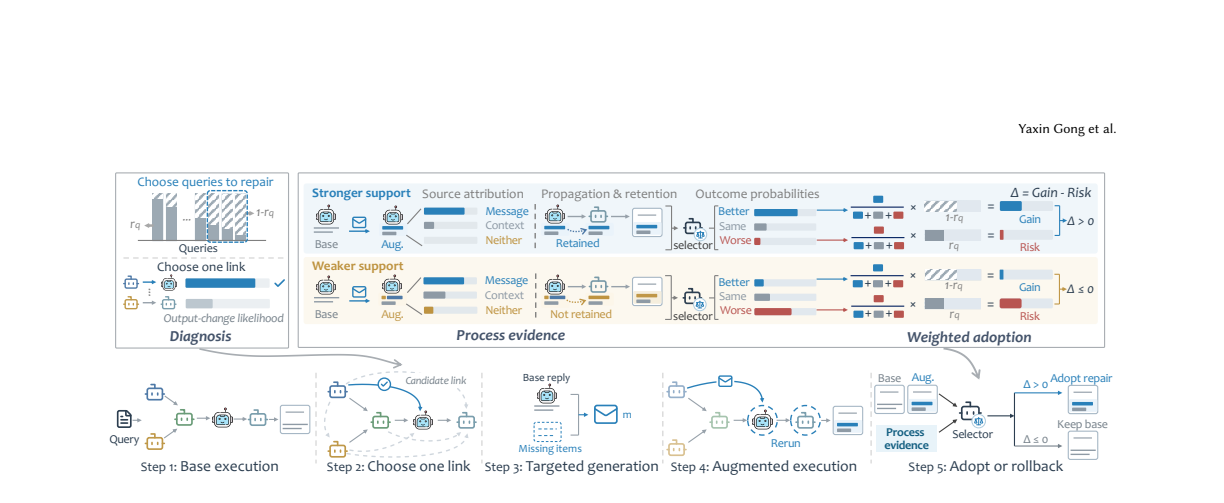
The communication graph of a fixed workflow restricts which agents can read each other's outputs: evidence retrieved by one agent may never reach the agent that needs it, leaving an information gap and an incomplete or incorrect answer. Adding a connection can deliver the missing evidence, but can also lead the receiver to adopt an incorrect upstream conclusion that displaces a correct answer; the final output alone does not separate the two. We propose Selective Probing and Link Insertion for Closing information gaps in multi-agent Execution (SPLICE), which locates information gaps per query and decides what to adopt after adding an edge. After the original workflow runs, SPLICE uses the query and node outputs to locate a possible gap, adds one directed edge from a source to a receiver to deliver the relevant evidence, and re-executes the receiver and affected downstream nodes, producing a candidate answer. The adoption decision reads both the final answers of the two runs and the process changes the edit caused inside the workflow: how far the receiver moved, where its new content came from, and whether the change reached the final answer. A selector trained on these process features chooses between adopting the candidate answer and retaining the original. On five benchmarks, SPLICE raises the task score on Web tool use by 8.0% and the mean score on four reasoning and planning benchmarks by 5.7% relative to the static skeleton, at 1.25 to 1.44× the skeleton's cost, and transfers zero-shot to four unseen backbones.
from the abstract
Pith says
Machine review · deepseek-v4-flash · 30 Oct 2026 · what was read was not recorded · not checked by a person
It can be wrong. Challenge this review or reply to it.
Holds up, with conditions. A genuinely new process-conditioned rollback mechanism, evaluated carefully on ToolBench; the four-benchmark generalization claim is the one soft spot and needs calibration panels before I'd call it fully supported. This line is wrong
3 major objections · 5 minor
How often objections from reviews like this one are right: not yet measured
Not checked: figures, code, what the 50 references say.
The paper says, at 5.2 and 5.3, Tables 1, 3, 4
The review did not quote this passage.
Pith says: Objection 1 of 3 · major
The four-benchmark branch of the headline claim rests on end-to-end scores and paired differences only, while every component-level validation is ToolBench-only: r_hat calibration (Table 3), the ablation ladder (Table 4), gap precision (Table 5), the gap audit (Table 6), and evidence support (Table 7).
more of objection 1
This matters because the adoption margin Delta = p_b(1 - r_hat) - p_h r_hat in Section 4.2 uses r_hat as a probability-like weight, and the decision is asymmetric: an under-predicting r_hat relaxes the harm penalty and admits more harmful repairs, the only direction in which net gain can turn negative. Token F1 and the binary PlanCraft verifier have different scales and shapes from ToolBench Micro, and no calibration or component-level diagnostic is reported for them. Please either add calibration and the key component ablations on the four benchmarks' validation splits, or explicitly re-scope the mechanism claims to ToolBench while presenting the other benchmarks only as end-to-end transfers.
The paper says, at 5.3, Table 4, row 'adopt by p_b - p_h'
The review did not quote this passage.
Pith says: Objection 2 of 3 · major
The row 'adopt by p_b - p_h' (-0.0118 on ToolBench) is the direct ablation that isolates the asymmetric weighting of gain against headroom and harm against score-in-hand. This weighting is a central component of the proposed method, yet the ablation is shown on one benchmark only.
more of objection 2
Given that the weighted margin is what differentiates SPLICE from an unweighted process-based selector, a single-benchmark demonstration is not enough to support the conclusion that the weighting is generally responsible for the observed net benefit. At minimum, provide the same ablation or a calibration analysis of the margin on the other four benchmarks, or restrict the causal claim.
The paper says, at 5.4, Tables 5 and 6
The review did not quote this passage.
Pith says: Objection 3 of 3 · major
The gap-localisation results treat LLM judge labels as ground truth for an unobservable construct (a source-held fact absent from the receiver's context). The evidence-support protocol in Appendix A.10 reports a human re-check with 0.90 per-claim agreement, but Tables 5 and 6 do not report a corresponding human validation of the gap labels.
more of objection 3
The claim that 67% of top-ranked edges are 'true gaps' should therefore be phrased as judge-labelled gap precision, and the paper should state explicitly whether any human agreement was measured for the four-condition audit.
5 minor objections
The paper says, at Abstract and Table 1
Pith says: minor objection 1 of 5
The abstract's cost range '1.25 to 1.44x' refers to the b=0.5 operating point; the full-budget setting costs 1.50x--1.90x in Table 1. Please make the operating point explicit in the abstract.
The paper says, at 5.3, Layer 2
Pith says: minor objection 2 of 5
The 0.61 versus 0.46 fix-ratio comparison is computed on the 535 training queries, and the text presents it as evidence that rho selects better edges. The held-out precision@1 in Table 5 is stronger evidence; either move the fix-ratio analysis to test or explicitly label the training-split numbers as in-sample.
show 3 more
The paper says, at A.2 and Table 1
Pith says: minor objection 3 of 5
The decisive-edge filter restricts the adopt/fix/harm counts, so the 'Net %' column in Table 1 has a denominator that is not simply the number of test questions or trialled questions. Please state the exact denominator used for the reported net percentages.
The paper says, at 5.5 and Figure 3
Pith says: minor objection 4 of 5
The skeleton scan is run on DROP only; the sentence 'The direction is positive throughout' should identify the benchmark and note that the scan does not cover MuSiQue, 2WikiMultihopQA, or PlanCraft.
The paper says, at 2.2
Pith says: minor objection 5 of 5
The claim that harm from honest agents 'has never been managed as an intrinsic property of collaboration' is supported by an author preprint [7]; if a peer-reviewed version exists, citing it would strengthen the related-work framing.
What would settle it
Produce Table-3-style quintile calibration panels for r_hat on each of the four benchmarks' test splits, then re-run the b=0.5 end-to-end evaluation with the margin perturbed to Delta = p_b(1 - (r_hat + delta)) - p_h(r_hat + delta) for delta in {-0.10, -0.05, +0.05, +0.10}, reporting the weighted mean gain over static and the fix/harm counts. A uniform shift leaves the budget ordering unchanged, so budget selection is unaffected; non-uniform bias would appear in the calibration panels. If the +0.0377 mean gain stays above zero for all delta <= 0, the direction that admits harmful repairs, the four-benchmark claim is robust to r_hat miscalibration and the concern closes; if it inverts or crosses zero, the headline depends on calibration the paper does not demonstrate.
from the skeptic's reading
How the review went
4 readings by deepseek-v4-flash · 30 Oct 2026
- Reader holds up, with conditions
- Skeptic agrees
- Editor wrote the verdict above
- Referee major revision: 3 major objections, 5 minor
Not run on this paper: the simulated authors' defence.
Pith did not check this review's objections against the paper.
The review in full
The review in brief, machine-written
Short version: this paper is better than the stress-test note makes it look. The central contribution is real: prior rewiring methods commit to the modified output after one run, while SPLICE trials a single edge and decides whether to keep the candidate using process-level trace changes—how far the receiver moved, where new content came from, whether it survived to the final answer—rather than final answers alone. That is a useful and fairly new mechanism for a crowded area.
What the paper does well: the evaluation is careful. Question-level splits, one held-out test evaluation, paired bootstrap CIs against 13 baselines, and a message-ablation ladder that isolates a single factual statement. The adoption margin Δ = pb(1 − r_hat) − ph r_hat is a sensible asymmetry: it protects answers already likely correct and penalizes potential harm proportionally. The composability results on G-Designer, AgentPrune, and a generic chain are genuinely informative, and the paper is honest about the deployment gap: the information-gap construct is defined against the reference answer and unobservable at deployment (b68), with the regressor standing in as proxy.
Soft spots, in proportion. First and most important: every component-level validation is ToolBench-only. r_hat calibration, edge-selection precision, gap audit, evidence-support audit, and the ablation table all run on ToolBench. For the four reasoning and planning benchmarks we only get end-to-end gains and paired differences. The failure mode is directional: an under-predicting r_hat relaxes the harm penalty and could admit harmful repairs. End-to-end gains stay positive at b=0.3 and b=1.0, so this is a generalization-evidence gap rather than a refutation, but it is the thinnest part of the argument. Adding calibration panels for token F1 and the PlanCraft verifier would address it.
Second, the headline operating point b=0.5 was selected after inspecting the test-split budget curve. They disclose this, but the headline number is still the most favorable point on a curve they saw. Minor: no code or data artifacts are released, and the evaluation depends on API-backed runs and 2026-dated references, so exact replication is impossible today. The judge audits also carry an anchoring risk—judges read the outputs they label—though the reported agreement and the API-response evidence protocol soften that.
Bottom line: the central claim holds up as a conditional. This deserves a serious referee. I would send it out and ask for the calibration panels, artifact release, and a fixed operating-point rule, and I would expect a solid conditional accept. Anyone building multi-agent pipelines should read the process-conditioned rollback layer now. I would cite it.
The strongest objection
Every component-level validation in the paper is ToolBench-only: r_hat calibration (Table 3), the four-layer ablation ladder (Table 4), rho precision@1 (Table 5), the gap audit (Table 6), and evidence support (Table 7). For the four reasoning/planning benchmarks the paper offers only end-to-end gains (Table 1), paired differences (Table 14), and a three-benchmark backbone transfer (Table 10, no MuSiQue). The adoption margin Delta = p_b(1 - r_hat) - p_h r_hat (Section 4.2) is a product of three estimated quantities with a fixed zero threshold that, per A.6, needs no tuning. The failure mode is directional: rollback retains the original whenever Delta <= 0, so an r_hat that over-predicts base scores only forfeits available repairs, while an r_hat that under-predicts relaxes the harm penalty and admits harmful repairs, the only direction in which net gain can turn negative. Table 3 establishes quintile-mean calibration on ToolBench's Micro metric, but Token F1 (MuSiQue, DROP, 2Wiki) and the binary PlanCraft executable verifier have different scales and shapes, and no calibration panel exists for them. The ablation that isolates the margin's weighting, 'adopt by p_b - p_h' (-0.0118 on ToolBench), is likewise ToolBench-only. The claim that process-conditioned selection is why repairs are net beneficial is therefore fully evidenced on one benchmark; the four-benchmark +0.0377 at b=0.5 is a positive end-to-end number without a component decomposition. This is a conditionality rather than a refutation, since end-to-end gains stay positive at b=0.3 and b=1.0, but it is the point where the argument is thinnest, and the paper's own b68 admits the gap construct is unobservable at deployment.
The central claim is that per-query single-edge insertion with process-conditioned rollback converts missing-evidence failures into net repairs, carried by the Table 1 headline (+0.0509 ToolBench Micro, +0.0377 weighted mean on four benchmarks at b=0.5) and by Table 14's claim that all paired differences are above zero. Before attacking, I checked what independent support exists. The internal arithmetic coheres: the abstract's 8.0%/5.7% relative gains match Table 1; the b=1.0 ToolBench score (0.6813) equals Table 4's 'w/o diagnosis' row (0.6813), anchoring the ablation ladder to the same pipeline; the message-ladder claim that roughly seven tenths of the filler-to-full gain comes from the single key fact checks out (0.0111/0.0159 = 0.70); the 8,454 decisive edges in A.2 equal A.6's 5,950 + 1,279 + 1,225; and the 14,280-query probe pool matches a 70/15/15 split with Table 2's test counts. ToolBench scores rest on StableToolBench replay and PlanCraft on an executable verifier, so the score claims are objective rather than judge-dependent. The load-bearing weakness is the proxy stack. The information gap is defined against the reference answer and is unobservable at deployment; the paper says this explicitly (b68) and substitutes r_hat for budget selection, rho for edge selection, and the margin Delta = p_b(1 - r_hat) - p_h r_hat for adoption. That margin is a product of three estimated quantities with a fixed zero threshold, and its failure mode is asymmetric: because Delta <= 0 rolls back to the original, an over-predicted r_hat only forfeits repairs, while an under-predicted r_hat admits harmful ones, the only direction in which the net-gain claim can break. The paper validates r_hat calibration (Table 3) and the margin's contribution (Table 4's 'adopt by p_b - p_h' row) on ToolBench only; the four benchmarks get no calibration panel, no ablation decomposition, and no transfer test on MuSiQue (Table 10 covers DROP, 2Wiki, and PlanCraft). If r_hat under-predicts on Token-F1 and plan-success metrics, the b=0.5 gain could shrink or, in the worst case, turn negative. Countervailing evidence: gains are positive at all three budgets (b=0.3: +0.0422/+0.0204; b=1.0: +0.0466/+0.0447), across nine topologies, and on four unseen backbones, so the disclosed post-hoc b=0.5 choice is not decisive; judge-audit anchoring affects the RQ3 narrative but not the objective score claims. The concern lands as a conditionality, not a refutation, and the reader's weakest_assumption identified the same point. The proposed test, per-benchmark r_hat calibration panels plus a signed perturbation sweep of the margin, would settle whether the four-benchmark gains survive the unvalidated proxy; until then CONDITIONAL with medium correctness risk is the right verdict, so the reader's verdict stands unchanged.
The referee's report
If the central mechanism claim is accepted, the paper makes a useful contribution: it formalizes the distinction between changing a workflow's communication graph and deciding whether the resulting repair should be kept, and it provides evidence that process-level trace features, not just final answers, are informative for that decision. The empirical protocol is careful in several respects: question-level splits, a single held-out test evaluation, bootstrap confidence intervals, paired-difference tests against many baselines, a message-level ablation ladder, and two independent judge audits with reported agreement. The main weakness is that the component-level evidence for the mechanism is concentrated on ToolBench, while the four-benchmark half of the headline gain is supported only by end-to-end numbers; this leaves the generalizability of the adoption-margin mechanism less established than the paper's broad claims suggest.
Pith's reading of the paper (a machine's summary, not the authors')
Multi-step Web requests are increasingly answered by pipelines of specialised LLM agents, and the communication graph of such a pipeline decides which agent may read another's output; the paper's thesis is that a substantial class of wrong answers comes from an information gap, evidence one agent derived that never reaches the agent that needs it. SPLICE is a post-hoc repair layer: after the original workflow has run, it locates the gap per query, adds one directed edge from the agent holding the evidence to the agent missing it, sends a targeted message, and re-executes the affected downstream nodes. The paper's central claim is that the resulting candidate answer cannot be accepted or rejected by comparing final answers alone, because an inserted message can displace a correct answer while looking like a helpful rewrite; the decision must read process evidence, how far the receiver moved, where its new content came from, and whether the change reached the final answer. On five benchmarks the paper reports that this repair raises ToolBench Micro by $+0.0509$ and the weighted mean of four reasoning and planning benchmarks by $+0.0377$ over the static skeleton at $1.25$–$1.44\times$ cost, with every paired difference against the compared baselines above zero.
What carries the argument. The central object is the process-conditioned adoption decision. After a trial, the paper extracts three groups of measurements from the paired traces: how far the receiver moved (whether and how much of its answer was added or dropped), where the revision came from (share of new content attributable to the inserted message, to prior context, or to neither, plus number-level conflicts), and whether the change survived (propagation reach toward the terminal node and presence of message content in the final answer). A three-class language-model selector trained with direct preference optimisation converts these features into probabilities for beneficial, neutral, and harmful outcomes. The deployment action is then fixed by the asymmetry in the margin $\Delta = \hat{p}_b(1-\hat{r}_q) - \hat{p}_h\hat{r}_q$: the better the predicted base answer, the stronger the evidence required to adopt the candidate. The paper's ablations claim that removing the process evidence, shuffling it, dropping the attribution group, or replacing the margin with an unweighted difference each shrinks the gain.
Core claim. SPLICE casts a multi-agent workflow as a directed acyclic graph in which each node is an LLM agent and each edge grants read access to an upstream output. Because the query is visible to every node but intermediate products travel only along edges and are rewritten at every hop, a fact derived on one branch either reaches the node that needs it in compressed form or never reaches it at all. After the base run, SPLICE spends a trial budget on the questions with the largest predicted headroom $1-\hat{r}_q$, picks the single candidate edge most likely to change the final output, and sends a message that foregrounds the items the receiver's subtask mentions but none of its parents supply. The candidate answer and the original are then compared by an adoption margin $\Delta = \hat{p}_b(1-\hat{r}_q) - \hat{p}_h\hat{r}_q$ that weights a potential gain by the headroom and a potential loss by the score already in hand. The probabilities come from a three-class selector trained by direct preference optimisation on process evidence — receiver movement, attribution of new content to the message versus prior context, and propagation of the change to the terminal node — which is what separates a true repair from an unrelated rewrite that final answers alone cannot distinguish.
The premise it rests on. The load-bearing premise is that the predicted base score $\hat{r}_q$ and the predicted benefit and harm probabilities stay calibrated on the deployment distribution, because the information gap itself is defined against the reference answer and is unobservable at deployment; if the proxy miscalibrates, the trial budget lands on the wrong questions and the adoption margin admits harmful repairs or rejects useful ones.
If the paper is right (Pith's inferences, not the authors')
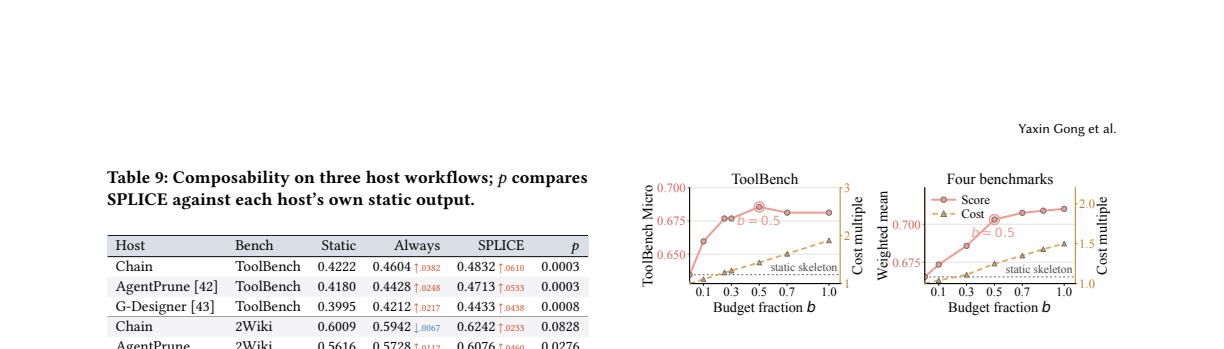
Per-query single-edge repair with rollback converts missing-evidence failures into net gains: the reported paired differences against every compared competitor stay above zero on both workloads, at 1.25–1.44× cost.
The method layers on top of existing orchestration rather than replacing it: it improves the outputs of two published host systems and a generic chain, including a 2Wiki chain cell whose unconditional edge-opening baseline is net negative.
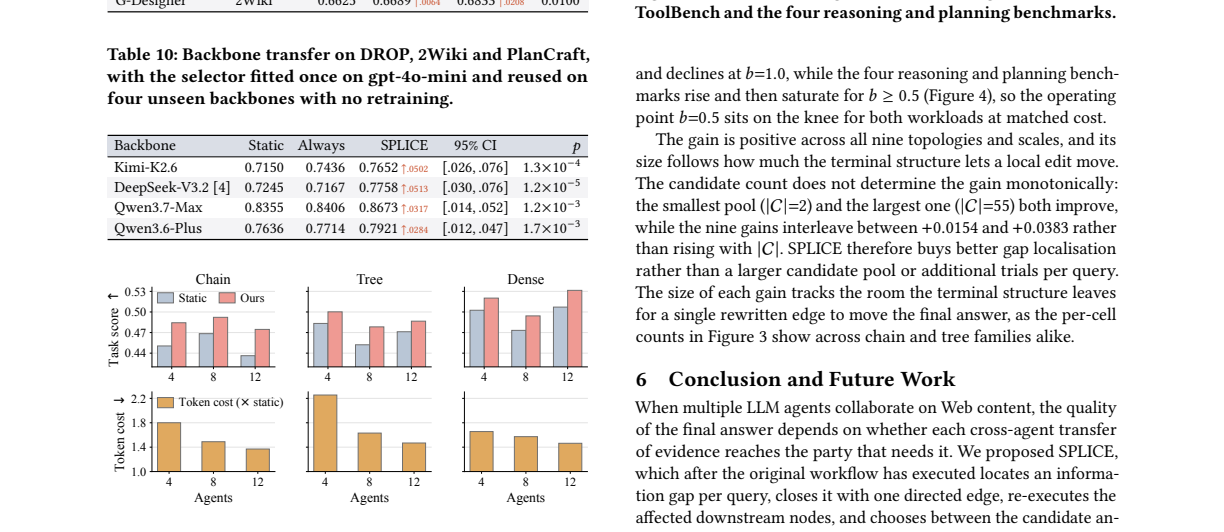
The adoption signal transfers across backbones: a selector fitted once on one backbone yields positive gains on four unseen backbones with no retraining, so the mechanism does not depend on backbone-specific artifacts.
Restraint is a feature of the mechanism: the half budget scores higher on ToolBench Micro than the full budget because extra trials displace answers that needed no repair at all.
The message, not just the edge, carries the effect: removing only the key factual statement from the message costs most of the improvement, placing roughly seven tenths of the gain over filler on a single located fact.
If process-conditioned rollback is the mechanism, the same selection rule should transfer to graph edits other than edge insertion — node deletion for cost, agent substitution, or chained multi-edge repairs — as long as the paired-trace features remain computable; the paper's zero-shot backbone transfer suggests the selector reads generic process structure rather than workflow-specific artifacts.
The paper's judge-audited rates (all four gap conditions hold on 0.71–0.74 of adopted repairs) could be turned into a deployment-time monitor: if a trace-derived estimate of 'source holds the fact, receiver lacks it' drifts downward, the adoption margin should be re-tuned, a testable extension the paper does not run.
Moving from read-only Web to transactional or writing APIs — which the paper names as future work — would stress the harm side of the margin hardest, because a harmful edit there cannot be rolled back by retaining the old answer; the adoption threshold would need recalibration on actual harm rates.
Check this review
Pith stored no record of this review's passes and took no fingerprint of it. Reviews made by code from 13 Nov 2026 on carry both.
How often reviews like this one are right
Reviews like this one: written by deepseek-v4-flash, where what was read was not recorded.
How often objections from reviews like this one are right: not yet measured
Reviews by people
This review was written by a machine. No person has reviewed this paper on Pith yet. A scientist listed on Pith can review it for a fee, and their review is published here whatever it concludes.
The paper
Abstract
Multi-step Web tasks often require several LLM agents to gather and combine evidence. The communication graph of a fixed workflow restricts which agents can read each other's outputs: evidence retrieved by one agent may never reach the agent that needs it, leaving an information gap and an incomplete or incorrect answer. Adding a connection can deliver the missing evidence, but can also lead the receiver to adopt an incorrect upstream conclusion that displaces a correct answer; the final output alone does not separate the two. We propose Selective Probing and Link Insertion for Closing information gaps in multi-agent Execution (SPLICE), which locates information gaps per query and decides what to adopt after adding an edge. After the original workflow runs, SPLICE uses the query and node outputs to locate a possible gap, adds one directed edge from a source to a receiver to deliver the relevant evidence, and re-executes the receiver and affected downstream nodes, producing a candidate answer. The adoption decision reads both the final answers of the two runs and the process changes the edit caused inside the workflow: how far the receiver moved, where its new content came from, and whether the change reached the final answer. A selector trained on these process features chooses between adopting the candidate answer and retaining the original. On five benchmarks, SPLICE raises the task score on Web tool use by 8.0% and the mean score on four reasoning and planning benchmarks by 5.7% relative to the static skeleton, at 1.25 to 1.44× the skeleton's cost, and transfers zero-shot to four unseen backbones.
The paper's own sentences, arranged, kept beside the review and separate from it. Each label is drawn from a closed vocabulary; the number beside it is the probability the classifier gave that label. No sentence in this record was written by a model.
abstract compiled · 2026-10-30
The authors' main claim, as the classifier picked it out 0.97
“On five benchmarks, SPLICE raises the task score on Web tool use by 8.0% and the mean score on four reasoning and planning benchmarks by 5.7% relative to the static skeleton, at 1.25 to 1.44$\times$ the skeleton's cost, and transfers zero-shot to four unseen backbones.”
How the main claim is stated: asserted 1.00
What the abstract itself states, as probabilities: claims first 0.05 · states limitation 0.40 · human participants 0.03 · controlled comparison 0.93 · randomized assignment 0.02 · states quantitative result 0.99 · compares with prior results 0.92 · mentions code or data availability 0.04
The abstract, sentence by sentence
This table labels the abstract only (arXiv listing abstract v1). The number is the probability the classifier gave the label.
| Sentence | Role | The authors' own work | States the main conclusion | Strength |
|---|---|---|---|---|
| Multi-step Web tasks often require several LLM agents to gather and combine evidence. | background 1.00 | 0.05 | 0.02 | asserted 0.83 |
| The communication graph of a fixed workflow restricts which agents can read each other's outputs: evidence retrieved by one agent may never reach the agent that needs it, leaving an information gap and an incomplete or incorrect answer. | background 0.96 | 0.10 | 0.04 | hedged possibility 0.59 |
| Adding a connection can deliver the missing evidence, but can also lead the receiver to adopt an incorrect upstream conclusion that displaces a correct answer; the final output alone does not separate the two. | background 0.90 | 0.15 | 0.07 | hedged possibility 0.65 |
| We propose Selective Probing and Link Insertion for Closing information gaps in multi-agent Execution (SPLICE), which locates information gaps per query and decides what to adopt after adding an edge. | contribution 0.96 | 0.86 | 0.16 | asserted 0.99 |
| After the original workflow runs, SPLICE uses the query and node outputs to locate a possible gap, adds one directed edge from a source to a receiver to deliver the relevant evidence, and re-executes the receiver and affected downstream nodes, producing a candidate answer. | method 1.00 | 0.86 | 0.06 | asserted 1.00 |
| The adoption decision reads both the final answers of the two runs and the process changes the edit caused inside the workflow: how far the receiver moved, where its new content came from, and whether the change reached the final answer. | method 0.99 | 0.88 | 0.06 | asserted 1.00 |
| A selector trained on these process features chooses between adopting the candidate answer and retaining the original. | method 0.99 | 0.89 | 0.07 | asserted 0.99 |
| On five benchmarks, SPLICE raises the task score on Web tool use by 8.0% and the mean score on four reasoning and planning benchmarks by 5.7% relative to the static skeleton, at 1.25 to 1.44$\times$ the skeleton's cost, and transfers zero-shot to four unseen backbones. | result 1.00 | 0.96 | 0.65 | asserted 1.00 |
What kind of paper the classifier reports this is: method or tool 1.00 · evidence from observation or experiment 0.97
What was examined, and what was not
Sources read
- arXiv listing abstract v1
Not examined
- full text
- figures and tables
- references and citing sentences
- relations to other papers
Levels run
- P abstract
Not run
- S sections
- T body sentences
- C citations
- R cross-paper relations
How the labels were made
Compiled by classifier-1.13.0 via TypeSafe API, question bank abstract-p1-20260923, 2026-10-30: 1 request, 6,503 input tokens.
Every quoted sentence on this record is the authors'. Every label is from Pith's closed vocabulary, with the probability shown beside it. This record as JSON
Figures (4)

Figures are the authors', reproduced from the paper.
References (50)
- [1] Akari Asai, Zeqiu Wu, Yizhong Wang, Avirup Sil, and Hannaneh Hajishirzi. 2024. Self-RAG: Learning to Retrieve, Generate, and Critique through Self-Reflection. InThe Twelfth International Conference on Learning Representations on Pith
- [2] Abhijith Babu, Ramneet Kaur, Vishal Pramanik, Olivera Kotevska, Nathaniel D. Bastian, Susmit Jha, Sunny Raj, Yanzhao Wu, Sumit Kumar Jha, and Anirban Roy. 2026. Consilience: Conformally Calibrated Communication Control for Hidden-Profile Multi-Agent Reasoning. arXiv:2608.20564 on PithPith's reviewarXiv
- [3] Weize Chen, Yusheng Su, Jingwei Zuo, Cheng Yang, Chenfei Yuan, Chi-Min Chan, Heyang Yu, Yaxi Lu, Yi-Hsin Hung, Chen Qian, Yujia Qin, Xin Cong, Ruobing Xie, Zhiyuan Liu, Maosong Sun, and Jie Zhou. 2024. AgentVerse: Facilitating Multi-Agent Collaboration and Exploring Emergent B... on Pith
- [4] DeepSeek-AI, Aixin Liu, Aoxue Mei, Bangcai Lin, Bing Xue, et al. 2025. DeepSeek- V3.2: Pushing the Frontier of Open Large Language Models. arXiv:2512.02556 on PithPith's reviewarXiv
- [5] Yilun Du, Shuang Li, Antonio Torralba, Joshua B. Tenenbaum, and Igor Mor- datch. 2024. Improving Factuality and Reasoning in Language Models through Multiagent Debate. InProceedings of the 41st International Conference on Machine Learning on Pith
- [6] Yaxin Gong, Chongming Gao, Chenxiao Fan, Haoyan Liu, et al. 2026. Breaking User-Centric Agency: A Tri-Party Framework for Agent-Based Recommendation. arXiv:2603.10673 on PithPith's reviewarXiv
- [7] Yaxin Gong, Gangyi Zhang, Chongming Gao, Leyang Shen, Chenxiao Fan, Jiakai Wang, Dong Wang, Yang Liu, Wenjie Wang, and Xiangnan He. 2026. When Upstream Messages Override Correct Answers: A Controlled Study of Multi- Agent LLM Collaboration. arXiv:2609.36855 on PithPith's reviewarXiv
- [8] Yao Guan, Lin Wang, Zhihui Lu, Ziyi Wang, Wenzhu Yan, and Qiang Duan on Pith
- [9] Zhicheng Guo, Sijie Cheng, Hao Wang, Shihao Liang, Yujia Qin, Peng Li, Zhiyuan Liu, Maosong Sun, and Yang Liu. 2024. StableToolBench: Towards Stable Large- Scale Benchmarking on Tool Learning of Large Language Models. InFindings of the Association for Computational Linguistics... on Pith
- [10] Travis C. Hill and Karen Zito. 2013. LTP-induced long-term stabilization of individual nascent dendritic spines.The Journal of Neuroscience33, 2 (2013), 678–686 on Pith
- [11] Sirui Hong, Mingchen Zhuge, Jonathan Chen, Xiawu Zheng, Yuheng Cheng, et al on Pith
- [12] Yunsong Hong. 2026. Learning How Much to Collaborate: Difficulty-Aware Topology Selection for Multi-Agent Code Generation. arXiv:2609.13890 on PithPith's reviewarXiv
- [13] Jie Hu. 2026. Oracle Gap and Signal Fidelity: A Fixed-Pool Diagnostic for Test- Time Collaboration. arXiv:2607.17531 on PithPith's reviewarXiv
- [14] Guohao Li, Hasan Hammoud, Hani Itani, Dmitrii Khizbullin, and Bernard Ghanem. 2023. CAMEL: Communicative Agents for "Mind" Exploration of Large Language Model Society. InAdvances in Neural Information Processing Systems on Pith
- [15] Xiao Liu, Hao Yu, Hanchen Zhang, Yifan Xu, Xuanyu Lei, et al. 2024. AgentBench: Evaluating LLMs as Agents. InThe Twelfth International Conference on Learning Representations on Pith
- [16] Zijun Liu, Yanzhe Zhang, Peng Li, Yang Liu, and Diyi Yang. 2024. A Dynamic LLM-Powered Agent Network for Task-Oriented Agent Collaboration. InFirst Conference on Language Modeling on Pith
- [17] Ming Ma, Jue Zhang, Fangkai Yang, Yu Kang, Qingwei Lin, Saravan Rajmohan, and Dongmei Zhang. 2026. DoVer: Intervention-Driven Auto Debugging for LLM Multi-Agent Systems. InInternational Conference on Learning Representations on Pith
- [18] Aman Madaan, Niket Tandon, Prakhar Gupta, Skyler Hallinan, Luyu Gao, Sarah Wiegreffe, Uri Alon, Nouha Dziri, Shrimai Prabhumoye, Yiming Yang, Shashank Gupta, Bodhisattwa Prasad Majumder, Katherine Hermann, Sean Welleck, Amir Yazdanbakhsh, and Peter Clark. 2023. Self-Refine: It... on Pith
- [19] Joon Sung Park, Joseph O’Brien, Carrie Jun Cai, Meredith Ringel Morris, Percy Liang, and Michael S. Bernstein. 2023. Generative Agents: Interactive Simulacra of Human Behavior. InProceedings of the 36th Annual ACM Symposium on User Interface Software and Technology on Pith
- [20] Chen Qian, Wei Liu, Hongzhang Liu, Nuo Chen, Yufan Dang, et al. 2024. ChatDev: Communicative Agents for Software Development. Association for Computa- tional Linguistics, Bangkok, Thailand on Pith
show 30 more
- [21] Chen Qian, Zihao Xie, YiFei Wang, Wei Liu, Kunlun Zhu, Hanchen Xia, Yu- fan Dang, Zhuoyun Du, Weize Chen, Cheng Yang, Zhiyuan Liu, and Maosong Sun. 2025. Scaling Large Language Model-based Multi-Agent Collaboration. In International Conference on Learning Representations on Pith
- [22] Yujia Qin, Shihao Liang, Yining Ye, Kunlun Zhu, Lan Yan, et al. 2024. ToolLLM: Facilitating Large Language Models to Master 16000+ Real-world APIs. InThe Twelfth International Conference on Learning Representations on Pith
- [23] Rafael Rafailov, Archit Sharma, Eric Mitchell, Christopher D Manning, Stefano Ermon, and Chelsea Finn. 2023. Direct Preference Optimization: Your Language Model is Secretly a Reward Model. InAdvances in Neural Information Processing Systems on Pith
- [24] Xu Shen, Yixin Liu, Yiwei Dai, Yili Wang, Rui Miao, Yue Tan, Shirui Pan, and Xin Wang. 2025. Understanding the Information Propagation Effects of Commu- nication Topologies in LLM-based Multi-Agent Systems. InProceedings of the 2025 Conference on Empirical Methods in Natural L... on Pith
- [25] Noah Shinn, Federico Cassano, Ashwin Gopinath, Karthik Narasimhan, and Shunyu Yao. 2023. Reflexion: language agents with verbal reinforcement learning. InAdvances in Neural Information Processing Systems on Pith
- [26] Jinwei Su, Qizhen Lan, Yinghui Xia, Lifan Sun, Weiyou Tian, Tianyu Shi, and Lewei He. 2026. Difficulty-Aware Agentic Orchestration for Query-Specific Multi-Agent Workflows. InProceedings of the ACM Web Conference 2026 on Pith
- [27] Nurbek Tastan, Alex Iacob, Lorenzo Sani, Meghdad Kurmanji, Nicholas D. Lane, Samuel Horvath, and Karthik Nandakumar. 2026. Response-Conditioned Parallel- to-Sequential Orchestration for Multi-Agent Systems. arXiv:2605.15573 on PithPith's reviewarXiv
- [28] Vishal Venkataramani, Haizhou Shi, Zixuan Ke, Austin Xu, Xiaoxiao He, Yingbo Zhou, Semih Yavuz, Hao Wang, and Shafiq Joty. 2026. MAS-ProVe: Understand- ing the Process Verification of Multi-Agent Systems. InProceedings of the 43rd International Conference on Machine Learning on Pith
- [29] Shilong Wang, Guibin Zhang, Miao Yu, Guancheng Wan, Fanci Meng, Chongye Guo, Kun Wang, and Yang Wang. 2025. G-Safeguard: A Topology-Guided Security Lens and Treatment on LLM-based Multi-agent Systems. InProceedings of the 63rd Annual Meeting of the Association for Computationa... on Pith
- [30] Xuezhi Wang, Jason Wei, Dale Schuurmans, Quoc V Le, Ed H. Chi, Sharan Narang, Aakanksha Chowdhery, and Denny Zhou. 2023. Self-Consistency Improves Chain of Thought Reasoning in Language Models. InThe Eleventh International Conference on Learning Representations on Pith
- [31] Zhexuan Wang, Yutong Wang, Xuebo Liu, Liang Ding, Miao Zhang, Jie Liu, and Min Zhang. 2025. AgentDropout: Dynamic Agent Elimination for Token-Efficient and High-Performance LLM-Based Multi-Agent Collaboration. InProceedings of the 63rd Annual Meeting of the Association for Com... on Pith
- [32] Jialong Wu, Wenbiao Yin, Yong Jiang, Zhenglin Wang, Zekun Xi, Runnan Fang, Linhai Zhang, Yulan He, Deyu Zhou, Pengjun Xie, and Fei Huang. 2025. Web- Walker: Benchmarking LLMs in Web Traversal. InProceedings of the 63rd Annual Meeting of the Association for Computational Lingui... on Pith
- [33] Qingyun Wu, Gagan Bansal, Jieyu Zhang, Yiran Wu, Beibin Li, Erkang Zhu, Li Jiang, Xiaoyun Zhang, Shaokun Zhang, Jiale Liu, Ahmed Hassan Awadallah, Ryen W White, Doug Burger, and Chi Wang. 2024. AutoGen: Enabling Next- Gen LLM Applications via Multi-Agent Conversations. InFirst... on Pith
- [34] Tongtong Wu, Yanming Li, Ziye Tang, Chen Jiang, Linhao Luo, Guilin Qi, Shirui Pan, and Gholamreza Haffari. 2026. CARD: Towards Conditional Design of Multi-agent Topological Structures. InInternational Conference on Learning Rep- resentations on Pith
- [35] T. Xu, X. Yu, A. J. Perlik, W. F. Tobin, J. A. Zweig, K. Tennant, T. Jones, and Y. Zuo. 2009. Rapid formation and selective stabilization of synapses for enduring motor memories.Nature462, 7275 (2009), 915–919 on Pith
- [36] An Yang, Baosong Yang, Beichen Zhang, Binyuan Hui, Bo Zheng, Bowen Yu, et al. 2025. Qwen2.5 Technical Report. arXiv:2412.15115 on PithPith's reviewarXiv
- [37] Chih-Hsuan Yang, Anjir Ahmed Chowdhury, Cheng-Hau Yang, Weijian Zheng, Fernando Llorente, Xiaolong Ma, Xinyang Li, Eliu A. Huerta, Ian T. Foster, and Rajeev Thakur. 2026. Wrong but Useful: Trajectory Value Beyond Answer Correctness in Multi-Agent Messages. arXiv:2608.14375 on PithPith's reviewarXiv
- [38] Bin Yu, Xinming Wang, Shijie Lian, Haotian Li, Changti Wu, Ruina Hu, Bail- ing Wang, Yuliang Wei, and Kai Chen. 2025. TrajSelector: Harnessing Latent Representations for Efficient and Effective Best-of-N in Large Reasoning Model. arXiv:2510.16449 on PitharXiv
- [39] Jinxi Yu, Yubei Li, Eric Hanchen Jiang, Zhi Zhang, Dong Liu, Wenxiao Zhao, Levina Li, Kai-Wei Chang, and Ying Nian Wu. 2026. Codebook Agent: Amortized Topology Design for LLM Multi-Agent Systems. arXiv:2609.02264 on PithPith's reviewarXiv
- [40] Cenwei Zhang, Teng Fang, Yuxia Wang, Derek Li, Bryan Dai, and Lei You. 2026. Best-of-Evidence: Best-of-N Selection under Partial Verification. arXiv:2607.20950 on PithPith's reviewarXiv
- [41] Guibin Zhang, Luyang Niu, Junfeng Fang, Kun Wang, Lei Bai, and Xiang Wang on Pith
- [42] Guibin Zhang, Yanwei Yue, Zhixun Li, Sukwon Yun, Guancheng Wan, Kun Wang, Dawei Cheng, Jeffrey Yu, and Tianlong Chen. 2025. Cut the Crap: An Economical Communication Pipeline for LLM-based Multi-Agent Systems. InInternational Conference on Learning Representations on Pith
- [43] Guibin Zhang, Yanwei Yue, Xiangguo Sun, Guancheng Wan, Miao Yu, Junfeng Fang, Kun Wang, Tianlong Chen, and Dawei Cheng. 2025. G-Designer: Archi- tecting Multi-agent Communication Topologies via Graph Neural Networks. In Proceedings of the 42nd International Conference on Machi... on Pith
- [44] Jiayi Zhang, Jinyu Xiang, Zhaoyang Yu, Fengwei Teng, XiongHui Chen, Jiaqi Chen, Mingchen Zhuge, Xin Cheng, Sirui Hong, Jinlin Wang, Bingnan Zheng, Bang Liu, Yuyu Luo, and Chenglin Wu. 2025. AFlow: Automating Agentic Yaxin Gong et al. Workflow Generation. InInternational Confer... on Pith
- [45] Lunjun Zhang, Arian Hosseini, Hritik Bansal, Mehran Kazemi, Aviral Kumar, and Rishabh Agarwal. 2025. Generative Verifiers: Reward Modeling as Next-Token Prediction. InThe Thirteenth International Conference on Learning Representa- tions on Pith
- [46] Han Zhou, Xingchen Wan, Ruoxi Sun, Hamid Palangi, Shariq Iqbal, Ivan Vulić, Anna Korhonen, and Sercan Arik. 2026. Multi-Agent Design: Optimizing Agents with Better Prompts and Topologies. InInternational Conference on Learning Representations on Pith
- [47] Mingchen Zhuge, Wenyi Wang, Louis Kirsch, Francesco Faccio, Dmitrii Khizbullin, and Jürgen Schmidhuber. 2024. GPTSwarm: Language Agents as Op- timizable Graphs. InProceedings of the 41st International Conference on Machine Learning. A Reproducibility and Supplementary Tables A... on Pith
- [2024] MetaGPT: Meta Programming for A Multi-Agent Collaborative Framework. InThe Twelfth International Conference on Learning Representations on Pith
- [2025] Multi-agent Architecture Search via Agentic Supernet. InProceedings of the 42nd International Conference on Machine Learning on Pith
- [2026] MOC: Multi-Order Communication in LLM-based Multi-Agent Systems. InProceedings of the 43rd International Conference on Machine Learning on Pith
Challenges and discussion
Disagree with the review, or know something it missed? Leave a comment, or challenge this review formally: a challenge becomes a permanent entry in this paper's record, and its decision is published here.
Come back by email
A short list of the week's newly reviewed papers. Nothing is sent until you confirm from your inbox, and every email has a link that stops it. No account.
No comments yet.
Sign in to comment