Artificial Intelligence · arXiv:2611.00783 v1 · submitted 31 Oct 2026 · 31 references
A Tool in the Forward Pass: Frozen Tape Modules as Layers of a Small Language Model
The paper says
“Calling a tool through generated text adds decoding steps, even when the computation itself is short. We study an alternative: a small neural module that runs inside a language model's forward pass.”
more of the abstract
A learned writer turns hidden states into a symbolic tape, a short sequence of discrete symbols that encodes the computation. The module, trained separately and then frozen, reduces the tape to a result, and a learned reader returns that result to the model. We evaluate arithmetic and object tracking in gemma-3-1b-it. With a writer trained on labelled tapes, the layer answers all 750 items of BIG-Bench Hard's tracking shuffled objects correctly. At seven people it needs about 1/10 of the GPU kernel time of a text-tool baseline that uses the same host model and exact code, with accuracy 1.00 against 0.99. The writer can also be learned from answers alone, guided by a hand-written copying prior, but less reliably: 5 of 6 runs succeed in the 1B host and 2 of 4 in the 4B host. Two independently trained layers keep their task accuracy when attached to one model, and a learned gate keeps them silent on the tested general-text and look-alike prompts. The results support a narrow use case: a bounded computation that returns one symbol can avoid the decoding cost of a textual tool call. Extracting the right input reliably, and deciding when to act, remain the main open problems.
from the abstract
Pith says
Machine review · deepseek-v4-flash · 3 Nov 2026 · what was read was not recorded · not checked by a person
It can be wrong. Challenge this review or reply to it.
Holds up, with conditions. Real measured cost win for forward-pass tool calls; the headline accuracy row depends on a held-out repair the abstract understates. This line is wrong
2 major objections · 4 minor
How often objections from reviews like this one are right: not yet measured
Not checked: figures, code, what the 31 references say.
The paper says, at Abstract and Section 5.1, Table 5
The review did not quote this passage.
Pith says: Objection 1 of 2 · major
The abstract states: 'With a writer trained on labelled tapes, the layer answers all 750 items of BIG-Bench Hard's tracking shuffled objects correctly,' and Section 5.1 states that on the held-out task 'the layer is likewise exact on every split (1.00 for accuracy, tapes and swap, all 3 seeds)... with the reader off it falls to chance (0.15-0.24; Table 5).'
more of objection 1
Table 5 contradicts the attribution. The row '+ frozen swap module as a layer, tape labels' reports BBH-7 accuracy 0.80-0.86, synthetic tapes exact 0.59-0.60, BBH tapes exact 0.00, and reader-off 0.76-0.86: with tape labels alone, no BBH tape is exact and the answer does not go through the tape (the adapters alone reach 0.78-0.83 without any tape). Only the next row, 'the writer's marks taught too', achieves tapes exact 1.00 with reader off 0.15-0.24, and Section 5.1's 'What we learn' paragraph states that this token-mark supervision was 'a repair... decided on the held-out task.' Because the central result (b51) is cost reduction at near-equal accuracy, the accuracy leg of the headline comparison (1.00 vs 0.99) is carried by a configuration whose additional supervision signal was chosen on the evaluation data, while the 'labelled tapes' configuration named in the abstract is the one Table 5 shows failing. The body is honest about this, but the abstract and the Section 5.1 result sentence are not. Please re-state the headline to name the marks-taught configuration and to flag the held-out-informed repair, or, if the tape-labels-only row is intended as the claim, report it as such. As written, the central accuracy-parity claim is not supported for any interface fixed before seeing the benchmark.
The paper says, at Contribution bullet (RQ4), Section 5.4, Table 3, Appendix A
The review did not quote this passage.
A classifier read this sentence of the paper as acknowledging the concern (probability 0.86):
“Our prompts contain few such distractors.”
Pith says: Objection 2 of 2 · major
The scope of 'near-equal accuracy' across wording needs to be carried into the claims as phrased. The near-equal pairing is established on the benchmark's templated wording, and the paper's own tables bound it sharply elsewhere: Table 3 shows the arithmetic layer at 0.55-0.59 on unseen templates versus the text tool's 0.93-0.98; Table 6 shows the adapter marks-taught layer falling to …
more of objection 2
… 0.27-0.85 at seven people on the rewrites (while the no-adapter layers hold 0.87-0.94); and Appendix A reports the writer copying an unrelated day number on a held-out arithmetic template and failing (0.09). The paper acknowledges each of these facts (b119, b271, Section 5.4, Appendix A), and the Discussion's b256 concedes that no single configuration demonstrates all three benefits. My concern is with the claims as stated: the contribution bullet 'Unseen wording (RQ4)' says that writers 'reach 0.87-0.96' without the conditions that the rewrites keep the names and structure and that only 234 of 300 judged rewrites are evaluated, and the phrase 'near-equal accuracy' in the abstract is not qualified as holding on templated wording with few distractors. I ask that the abstract and the RQ4 bullet carry the scope that the body establishes, so that the central claim is not read as robust to wording.
4 minor objections
The paper says, at Abstract
Pith says: minor objection 1 of 4
The sentence 'At seven people it needs about 1/10 of the GPU kernel time' holds at batch size one; Section 5.2 reports that at batch size sixteen the text tool uses about 3x the layer's kernel time per item. Please add 'at batch size one', as the contributions bullet already does.
The paper says, at Figure 1(b) and Table 4
Pith says: minor objection 2 of 4
Figure 1(b) shows '8 generated tokens = 8 more forward passes' for the text tool, while Table 4 reports 17 tokens per item at seven people for the same baseline; the caption should state that the figure shows the three-person example, so the two numbers do not appear inconsistent.
show 2 more
The paper says, at Terminology throughout, especially Abstract and Table 5
Pith says: minor objection 3 of 4
The paper uses 'labelled tapes' in the abstract for the configuration that Table 5 shows failing (tapes exact 0.00) and 'tape labels' in Table 5 for the same thing, while the headline result requires 'the writer's marks taught too'. Please introduce distinct, consistent terms (for example 'tape labels' versus 'token-mark supervision') and apply them in the abstract, Section 5.1, and Table 5 so that the headline configuration is unambiguous.
The paper says, at Section 5.4 and contribution bullet (RQ4)
Pith says: minor objection 4 of 4
The rewritten-wording numbers are computed on the 234 judge-accepted items; please state in the contribution bullet and in the Section 5.4 opening that the rewrites keep the names and that 66 of 300 rewrites were rejected, so that the range 0.87-0.96 is not read as covering all 300 rewrites or as testing coreference.
What would settle it
Re-run, with the published Zenodo artifacts, the tape-labels-only configuration of Table 5 on the 750 BBH items: writer trained on labelled tapes, no mark teaching, frozen module, reader. Report tapes exact, swap, reader-off, and accuracy at three/five/seven people. If this row again shows tapes exact 0.00 and seven-person accuracy 0.80-0.86 (indistinguishable from the no-tape adapters row, with reader-off near accuracy), then the answer does not pass through the tape without the mark-supervision repair, the abstract's attribution of the 1.00 headline to 'a writer trained on labelled tapes' is contradicted by the paper's own data, and the near-equal-accuracy leg of the central claim holds only for the benchmark-informed configuration. If the labels-only writer instead writes exact tapes, the concern is settled in the paper's favour.
from the skeptic's reading
How the review went
4 readings by deepseek-v4-flash · 3 Nov 2026
- Reader holds up, with conditions
- Skeptic agrees
- Editor wrote the verdict above
- Referee major revision: 2 major objections, 4 minor
Not run on this paper: the simulated authors' defence.
Pith did not check this review's objections against the paper.
The review in full
The review in brief, machine-written
Bottom line: this is a real experimental system, honestly reported, and the cost measurement is the strongest part. The tape layer answers BBH tracking at 1.00 with reader-off at chance, and the 10x GPU-kernel saving over a text-tool baseline is measured, not assumed. The swap control, the registered predictions including refutations, and the Zenodo artifacts all make the empirical claims checkable. That is more than most papers in this area ship.
What is genuinely new is not the idea of a tool inside the forward pass — IGC and OccamLLM are cited — but the combination: a learned writer producing a variable-length discrete tape from hidden states, a separately trained frozen module, a learned reader, and answer-only training with priors. The module's length extrapolation is also credible: one local rule applied repeatedly, trained to six operators and exact at twenty-four.
Soft spots, in order. The abstract's "writer trained on labelled tapes" overstates the configuration that carries the headline. Table 5 shows the tape-labels-only row writes 0 exact tapes on BBH; accuracy 0.80–0.86 equals adapters alone, and reader-off stays near that, so the answer does not go through the tape. Only after the writer was additionally taught which tokens to mark — a repair decided on the held-out task — do tapes become exact and reader-off drop to chance. The paper discloses this in Section 5.1, which is to its credit, but the abstract and the "likewise exact on every split" sentence do not. That mismatch should be fixed before publication.
Second, extraction reliability is the load-bearing assumption and is still narrow. The writer needs hidden states that already distinguish names, digits, and operators, and one held-out arithmetic template with an unrelated number breaks it (Appendix A). The authors acknowledge this, but it means the main result covers prompts with few distractors, and the templated benchmark wording does not test much beyond that. The RQ4 rewrites help but keep the names and structure.
Third, answer-only training is honestly described as unreliable: 5 of 6 runs at 1B, 2 of 4 at 4B, with validation blind to a gamed run. That is not a flaw to attack, since it is reported and analyzed, but it limits the significance.
Verdict: accept-shaped with conditions. This deserves serious peer review. The central cost claim and the controls hold; the accuracy-parity leg needs an abstract correction and ideally a fresh-task test with a fixed interface. I would send it to review and expect meaningful revision.
The strongest objection
The cost leg of the central claim is solid: the 10x GPU-kernel advantage at batch 1 (3x at batch 16) is measured, and the swap/reader-off controls, the Zenodo artifacts, and the registered predictions with disclosed refutations (Table 9) are genuine support. The load-bearing leg is accuracy parity, and it is carried only by a configuration repaired using the evaluation data. Section 5.1: 'Only after the writer was taught which tokens to mark... did the answers go through the tape. This repair was decided on the held-out task.' Table 5 quantifies the dependence: with tape labels but without taught marks, the writer produces 0 exact tapes on the 750 BBH items, seven-person accuracy is 0.80-0.86 against 0.78-0.83 for adapters with no tool, and reader-off leaves accuracy at 0.76-0.86, so the answer does not go through the tape at all. Only the marks-taught row, or the answer-only priors (5 of 6 runs at 1B, 2 of 4 at 4B, with validation blind to the gamed run), reach tapes exact 1.00 with reader-off at chance. Yet the abstract states 'With a writer trained on labelled tapes, the layer answers all 750 items... correctly', which the paper's own table contradicts, and Section 5.1's 'likewise exact on every split' does not flag the missing mark step. What remains untested is any fixed interface at parity: on the RQ4 rewrites (same names, same structure, LM-judged) accuracy drops to 0.87-0.94 at seven people, and the one held-out arithmetic template with a distractor number breaks the writer (Appendix A). The authors acknowledge the scope, but the abstract overstates which configuration carries the headline.
The paper is unusually transparent: it discloses the held-out-task repair, the distractor failure, the unreliable answer-only runs, and the untested fixed-interface question ('A new task evaluated only after freezing the final design is still needed'). Given that honesty, my concern is narrower but load-bearing: the headline 1.00-versus-0.99 parity is not produced by the configuration the abstract names. Table 5's tape-labels-only row shows 0 exact tapes on the benchmark and accuracy equal to adapters without any tool, so without the mark-supervision repair the tape contributes nothing and the answer demonstrably does not pass through it. The label-free alternative is explicitly unreliable (5/6 and 2/4 runs, with validation unable to identify the gamed run). The economic value of the central claim (10x cheaper at 'near-equal accuracy') depends on that parity, and the Appendix A failure (writer copies an unrelated number on one held-out template) plus the RQ4 rewrites (6-13 point drops at seven people) show the writer's extraction does not generalize beyond the training/repair distribution. None of this overturns the measured cost reduction or the mechanism: the swap and reader-off controls, the registered predictions with disclosed refutations, and the published artifacts are real independent support, and the paper's own limitations section already concedes most of the scope. The issue is that the abstract overstates which configuration carries the headline, and the full text does not flag, at the point of the headline claim, that the tape-labels-only writer fails on the benchmark. The reader's CONDITIONAL verdict already captures this concern; my stress-test sharpens it with the paper's own Table 5 datum (tapes exact 0.00 without taught marks) and the configuration-attribution inconsistency, but it does not move the verdict. Conditions remain: reproduce the labels-only row on BBH, evaluate a frozen fixed interface on fresh wording with distractors, and correct the abstract's attribution of the 1.00 result.
The referee's report
Assuming the results hold, this is a useful feasibility result for attaching bounded computations to frozen language models. Its concrete strengths are real: the cost advantage is measured (Tables 3-4; about 10x GPU kernel time at batch 1 and about 3x at batch 16), with the layer's own kernels adding roughly 1.4 ms; the swap, reader-off, and tapes-exact measures genuinely test that the answer goes through the tape; the module alone extrapolates to four times its training length (Table 1, 0.97-1.00 at 24 operators); the gradient-through-module negative results (straight-through, ReinMax, I-MLE) are a clean and useful caution; and the paper runs registered predictions with disclosed refutations (Table 9) and publishes code, configurations, results, and frozen modules on Zenodo. The claimed scope is properly narrow (b60, b25): two hand-designed tape languages, bounded single-symbol outputs, and prompts with few distractors. The main open burden, reliably extracting the tape from hidden states, is acknowledged by the authors (b111, b119, b271), and it is precisely there that the abstract overreaches (major comment 1).
Pith's reading of the paper (a machine's summary, not the authors')
The paper sets out to show that a language model can use a tool without paying for a textual tool call: instead of generating the call token by token, a small learned writer reads the model's hidden states and places the computation's inputs on a symbolic tape, a frozen module reduces that tape to a single result symbol, and a learned reader hands the result back — all inside the one forward pass that already reads the prompt. On BIG-Bench Hard's tracking shuffled objects, the layer with a writer trained on labelled tapes answers all 750 items correctly at about one tenth of the GPU kernel time of a text-tool baseline using the same host model and the same exact code, accuracy 1.00 against 0.99. On arithmetic it answers in 20 ms per question against 235 ms for the text tool, and the frozen module extrapolates from six to twenty-four operators. The benchmark is a transfer case study rather than an untouched test: its items were never trained on, but later interface decisions were informed by experiments on it. If the claim holds, any bounded computation that returns one symbol — a calculation inside a word problem, the state of a few objects in a story — could be attached to a frozen model and skip decoding cost entirely, and the paper is explicit that this narrow use case, not a general tool interface, is what the results support.
What carries the argument. The tape layer. A symbolic tape is a short row of cells, each holding one discrete symbol from a task-specific alphabet; a tape language fixes which tapes are well formed and what they mean. The tape module is a 64k-parameter network that rewrites the tape step by step: in each round a selector chooses one inner cell or a no-op, a column computes a replacement symbol from that cell and its two neighbours, and a hand-written splice replaces the three cells by one, closing the gap; after a fixed number of rounds the result sits in the first cell. The module is trained alone on tapes (soft during training, argmax at use) and then frozen. A learned writer reads the hidden states at layer 8 of the 26-layer host and gives each prompt token a mark and a symbol; a cumulative sum packs the marked tokens into the tape in prompt order. A learned reader maps the result cell to a vector scaled to the hidden state's norm and adds it at the last prompt position, from which the upper layers answer. Two tape languages carry the experiments: arithmetic modulo ten, where the module must learn precedence, and object tracking, where each round reduces the rightmost triple $(a, b, x)$ to the owner who held the asked person's object before the swap.
Core claim. The central result is a cost reduction at near-equal accuracy: the layer performs the computation during prompt processing, while the text-tool baseline generates its inputs token by token. With a writer trained on labelled tapes, the layer answers all 750 items of BIG-Bench Hard's tracking shuffled objects correctly, and at seven people it uses about 1/10 of the GPU kernel time of a text-tool baseline on the same host model with exact code, accuracy 1.00 against 0.99. Two checks show the answer flows through the tape: replacing the learned module with exact code leaves accuracy unchanged, and switching the reader off drops it to chance. The module alone, trained only on its final tape, learns operator precedence (4 of 4 seeds exact at six operators, holding at 0.97–1.00 at twenty-four), and the layer answers 1.00 at twelve operators where adapters alone reach 0.10–0.12. The paper further reports that the writer can be learned from answers alone, treating the module as a black box and rewarding tapes whose result is right, guided by a hand-written prior that supplies each token's symbol — 5 of 6 runs succeed in the 1B host and 2 of 4 in the 4B host — and that two independently trained layers share one frozen model while a learned gate keeps both silent on 3,800 general and look-alike prompts.
The premise it rests on. The whole construction rests on the writer being able to tell, from the frozen model's hidden states alone, which tokens are the computation's inputs and which are mere look-alike numbers or names; the paper's own experiments show that an unrelated number in a word problem is copied onto the tape and breaks the answer.
If the paper is right (Pith's inferences, not the authors')
Bounded computations that return one symbol can be attached to a frozen host and avoid token-by-token decoding: the layer's kernel time grows little with input length (10.2 to 11.0 ms from three to seven people), while the text tool's cost grows with its generated call.
A frozen module extrapolates beyond its training length because it applies one local rule per round — a longer tape needs more rounds, not new parameters, and the host only has to write the longer tape, not compute on it.
Tape labels can sometimes be replaced by answers: reward on the module's outcome, a hand-written symbol prior, a validity check and enough samples train the writer without any annotation, though reliability is the weak point (5 of 6 runs at 1B, 2 of 4 at 4B).
Independently trained layers can share one frozen model without disturbing it or each other, provided each requires a tape that computes something and a learned gate over the whole prompt decides when to act.
On rewritten, unseen wording, writers on an otherwise frozen host read better than a four-times-larger model with chain of thought (0.87–0.96 against 0.71 on the same rewritten items), though the gating needed for silence lowers coverage.
The cost advantage is measured against a token-by-token decoder; if text tools are served with speculative decoding, which verifies several drafted tokens per forward pass, the 10× gap would narrow — the paper acknowledges this and does not measure it.
The failure on a single unrelated number suggests the real bottleneck is extraction, not computation: a writer trained on a distractor-rich curriculum would directly test whether hidden states can disambiguate tape symbols in more realistic prompts.
Because the tape is a discrete, inspectable object, the same plumbing offers a verification interface — one could read what the model 'thought' it was computing and audit wrong answers — though the paper itself only uses this property for its correctness checks.
Multi-symbol results and calls in the middle of a generated solution are the untested steps toward tasks such as math word problems; a natural trial is attaching the arithmetic layer to a decoder that can fire mid-generation.
Check this review
Pith stored no record of this review's passes and took no fingerprint of it. Reviews made by code from 13 Nov 2026 on carry both.
How often reviews like this one are right
Reviews like this one: written by deepseek-v4-flash, where what was read was not recorded.
How often objections from reviews like this one are right: not yet measured
Reviews by people
This review was written by a machine. No person has reviewed this paper on Pith yet. A scientist listed on Pith can review it for a fee, and their review is published here whatever it concludes.
The paper
Abstract
Calling a tool through generated text adds decoding steps, even when the computation itself is short. We study an alternative: a small neural module that runs inside a language model's forward pass. A learned writer turns hidden states into a symbolic tape, a short sequence of discrete symbols that encodes the computation. The module, trained separately and then frozen, reduces the tape to a result, and a learned reader returns that result to the model. We evaluate arithmetic and object tracking in gemma-3-1b-it. With a writer trained on labelled tapes, the layer answers all 750 items of BIG-Bench Hard's tracking shuffled objects correctly. At seven people it needs about 1/10 of the GPU kernel time of a text-tool baseline that uses the same host model and exact code, with accuracy 1.00 against 0.99. The writer can also be learned from answers alone, guided by a hand-written copying prior, but less reliably: 5 of 6 runs succeed in the 1B host and 2 of 4 in the 4B host. Two independently trained layers keep their task accuracy when attached to one model, and a learned gate keeps them silent on the tested general-text and look-alike prompts. The results support a narrow use case: a bounded computation that returns one symbol can avoid the decoding cost of a textual tool call. Extracting the right input reliably, and deciding when to act, remain the main open problems.
The paper's own sentences, arranged, kept beside the review and separate from it. Each label is drawn from a closed vocabulary; the number beside it is the probability the classifier gave that label. No sentence in this record was written by a model.
abstract compiled · 2026-11-03
The authors' main claim, as the classifier picked it out 1.00
“The results support a narrow use case: a bounded computation that returns one symbol can avoid the decoding cost of a textual tool call.”
How the main claim is stated: hedged possibility 0.62
What the abstract itself states, as probabilities: claims first 0.04 · states limitation 0.98 · human participants 0.03 · controlled comparison 0.94 · randomized assignment 0.03 · states quantitative result 0.99 · compares with prior results 0.96 · mentions code or data availability 0.04
The abstract, sentence by sentence
This table labels the abstract only (arXiv listing abstract v1). The number is the probability the classifier gave the label.
| Sentence | Role | The authors' own work | States the main conclusion | Strength |
|---|---|---|---|---|
| Calling a tool through generated text adds decoding steps, even when the computation itself is short. | background 0.99 | 0.18 | 0.04 | asserted 0.99 |
| We study an alternative: a small neural module that runs inside a language model's forward pass. | contribution 0.92 | 0.55 | 0.05 | asserted 0.83 |
| A learned writer turns hidden states into a symbolic tape, a short sequence of discrete symbols that encodes the computation. | method 0.98 | 0.71 | 0.04 | asserted 1.00 |
| The module, trained separately and then frozen, reduces the tape to a result, and a learned reader returns that result to the model. | method 0.99 | 0.76 | 0.08 | asserted 1.00 |
| We evaluate arithmetic and object tracking in gemma-3-1b-it. | method 0.93 | 0.93 | 0.02 | asserted 0.92 |
| With a writer trained on labelled tapes, the layer answers all 750 items of BIG-Bench Hard's tracking shuffled objects correctly. | result 1.00 | 0.95 | 0.08 | asserted 1.00 |
| At seven people it needs about 1/10 of the GPU kernel time of a text-tool baseline that uses the same host model and exact code, with accuracy 1.00 against 0.99. | result 1.00 | 0.95 | 0.10 | asserted 1.00 |
| The writer can also be learned from answers alone, guided by a hand-written copying prior, but less reliably: 5 of 6 runs succeed in the 1B host and 2 of 4 in the 4B host. | result 0.92 | 0.95 | 0.04 | asserted 0.99 |
| Two independently trained layers keep their task accuracy when attached to one model, and a learned gate keeps them silent on the tested general-text and look-alike prompts. | result 1.00 | 0.94 | 0.06 | asserted 1.00 |
| The results support a narrow use case: a bounded computation that returns one symbol can avoid the decoding cost of a textual tool call. | interpretation 0.99 | 0.86 | 0.87 | hedged possibility 0.62 |
| Extracting the right input reliably, and deciding when to act, remain the main open problems. | limitation 0.64 | 0.41 | 0.07 | asserted 1.00 |
What kind of paper the classifier reports this is: method or tool 0.99 · evidence from observation or experiment 0.96
What was examined, and what was not
Sources read
- arXiv listing abstract v1
Not examined
- full text
- figures and tables
- references and citing sentences
- relations to other papers
Levels run
- P abstract
Not run
- S sections
- T body sentences
- C citations
- R cross-paper relations
How the labels were made
Compiled by classifier-1.13.0 via TypeSafe API, question bank abstract-p1-20260923, 2026-11-03: 1 request, 8,158 input tokens.
Every quoted sentence on this record is the authors'. Every label is from Pith's closed vocabulary, with the probability shown beside it. This record as JSON
Figures (1)
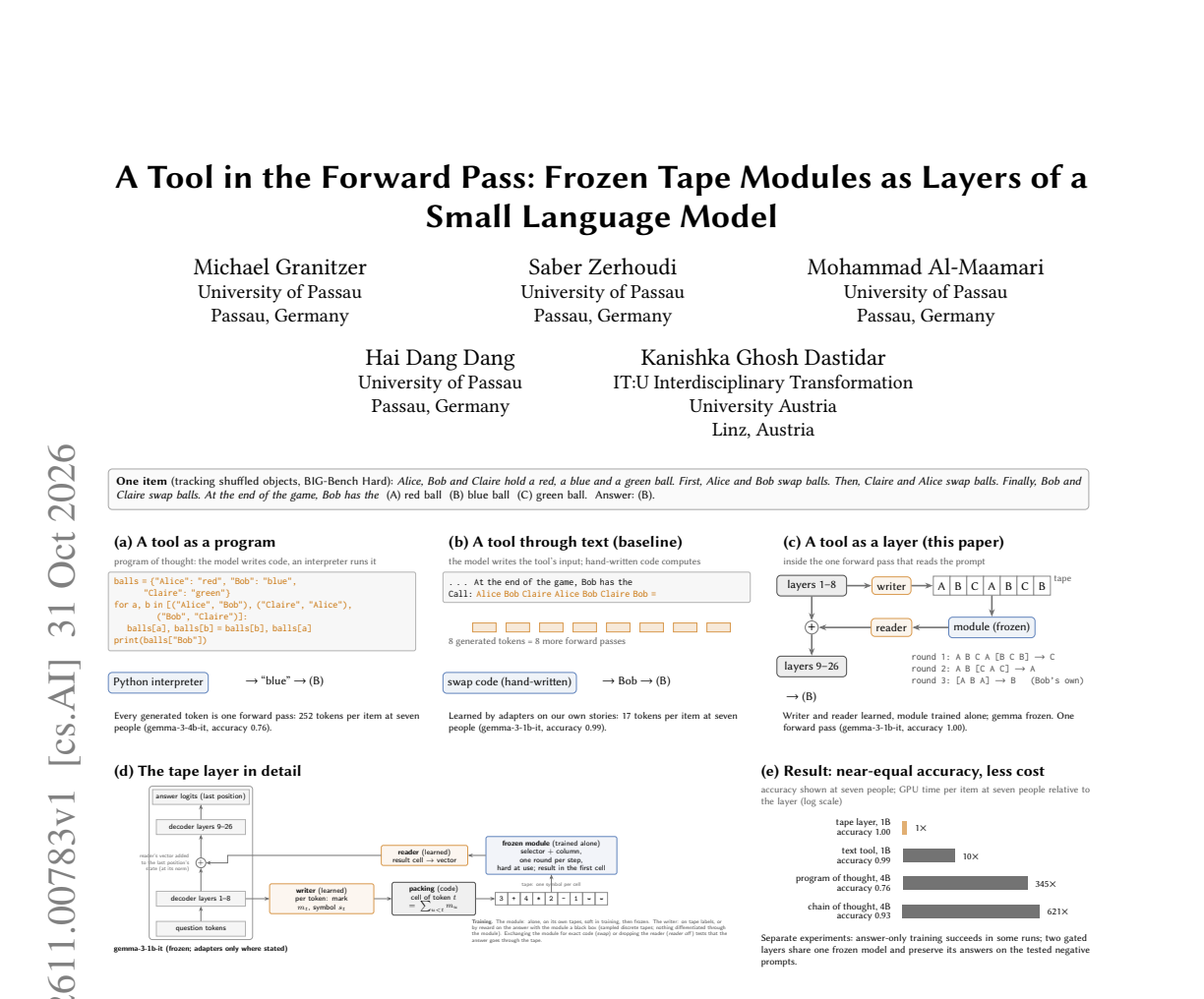
Figures are the authors', reproduced from the paper.
References (31)
- [1] Jacob Andreas, Marcus Rohrbach, Trevor Darrell, and Dan Klein. 2016. Neural Module Networks. InProceedings of the IEEE Conference on Computer Vision and Pattern Recognition (CVPR) on Pith
- [2] Rachit Bansal et al. 2024. LLM Augmented LLMs: Expanding Capabilities through Composition. InInternational Conference on Learning Representations (ICLR). arXiv:2401.02412 on PithPith's reviewarXiv
- [3] Yoshua Bengio, Nicholas Léonard, and Aaron Courville. 2013. Estimating or Prop- agating Gradients Through Stochastic Neurons for Conditional Computation. arXiv:1308.3432 on PithPith's reviewarXiv
- [4] Wilfried Bounsi et al. 2024. Transformers meet Neural Algorithmic Reasoners. arXiv:2406.09308 on PithPith's reviewarXiv
- [5] Wenhu Chen, Xueguang Ma, Xinyi Wang, and William W. Cohen. 2023. Pro- gram of Thoughts Prompting: Disentangling Computation from Reasoning for Numerical Reasoning Tasks.Transactions on Machine Learning Research(2023). arXiv:2211.12588 on PithPith's reviewarXiv
- [6] Christopher Clark, Kenton Lee, Ming-Wei Chang, Tom Kwiatkowski, Michael Collins, and Kristina Toutanova. 2019. BoolQ: Exploring the Surprising Difficulty of Natural Yes/No Questions. InProceedings of NAACL-HLT on Pith
- [7] Karl Cobbe, Vineet Kosaraju, Mohammad Bavarian, Mark Chen, Heewoo Jun, Lukasz Kaiser, Matthias Plappert, Jerry Tworek, Jacob Hilton, Reiichiro Nakano, Christopher Hesse, and John Schulman. 2021. Training Verifiers to Solve Math Word Problems.arXiv preprint arXiv:2110.14168(2021) on PithPith's reviewarXiv
- [8] Yuntian Deng, Kiran Prasad, Roland Fernandez, Paul Smolensky, Vishrav Chaud- hary, and Stuart Shieber. 2023. Implicit Chain of Thought Reasoning via Knowl- edge Distillation.arXiv preprint arXiv:2311.01460(2023) on PithPith's reviewarXiv
- [9] Varun Dhanraj and Chris Eliasmith. 2025. Improving Rule-based Reasoning in LLMs using Neurosymbolic Representations. InProceedings of the 2025 Conference on Empirical Methods in Natural Language Processing (EMNLP). 30589–30608 on Pith
- [10] Florian Dietz and Dietrich Klakow. 2025. IGC: Integrating a Gated Calculator into an LLM to Solve Arithmetic Tasks Reliably and Efficiently. arXiv:2501.00684 on PithPith's reviewarXiv
- [11] Owen Dugan, Donato Jiménez-Benetó, Charlotte Loh, Zhuo Chen, Rumen Dan- govski, and Marin Soljačić. 2024. OccamLLM: Fast and Exact Language Model Arithmetic in a Single Step. InAdvances in Neural Information Processing Systems (NeurIPS). arXiv:2406.06576 on PithPith's reviewarXiv
- [12] Luyu Gao et al. 2023. PAL: Program-aided Language Models. InProceedings of the 40th International Conference on Machine Learning (ICML). arXiv:2211.10435 on PithPith's reviewarXiv
- [13] Leo Gao, Stella Biderman, Sid Black, Laurence Golding, Travis Hoppe, Charles Foster, Jason Phang, Horace He, Anish Thite, Noa Nabeshima, Shawn Presser, and Connor Leahy. 2020. The Pile: An 800GB Dataset of Diverse Text for Language Modeling.arXiv preprint arXiv:2101.00027(2020) on PithPith's reviewarXiv
- [14] Gemma Team. 2025. Gemma 3 Technical Report. arXiv:2503.19786 on PithPith's reviewarXiv
- [15] Michael Granitzer, Saber Zerhoudi, Mohammad Al-Maamari, Kanishka Ghosh Dastidar, and Hai Dang Dang. 2026. A Tool in the Forward Pass: Frozen Tape Modules as Layers of a Small Language Model. Companion code, configu- rations, results and frozen modules. doi:10.5281/zenodo.23831494 on Pithdoi:10.5281/zenodo.23831494
- [16] Kelvin Guu, Panupong Pasupat, Evan Zheran Liu, and Percy Liang. 2017. From Language to Programs: Bridging Reinforcement Learning and Maximum Mar- ginal Likelihood. InProceedings of the 55th Annual Meeting of the Association for Computational Linguistics (ACL). arXiv:1704.07926 on PithPith's reviewarXiv
- [17] Shibo Hao, Sainbayar Sukhbaatar, DiJia Su, Xian Li, Zhiting Hu, Jason Weston, and Yuandong Tian. 2024. Training Large Language Models to Reason in a Continuous Latent Space.arXiv preprint arXiv:2412.06769(2024) on PithPith's reviewarXiv
- [18] Dan Hendrycks, Collin Burns, Steven Basart, Andy Zou, Mantas Mazeika, Dawn Song, and Jacob Steinhardt. 2021. Measuring Massive Multitask Language Un- derstanding. InInternational Conference on Learning Representations. Granitzer et al on Pith
- [19] Edward J. Hu et al. 2022. LoRA: Low-Rank Adaptation of Large Language Models. InInternational Conference on Learning Representations (ICLR). arXiv:2106.09685 on PithPith's reviewarXiv
- [20] Yaniv Leviathan, Matan Kalman, and Yossi Matias. 2023. Fast Inference from Transformers via Speculative Decoding. InProceedings of the 40th International Conference on Machine Learning (ICML) on Pith
show 11 more
- [21] Chen Liang, Jonathan Berant, Quoc Le, Kenneth D. Forbus, and Ni Lao. 2017. Neural Symbolic Machines: Learning Semantic Parsers on Freebase with Weak Supervision. InProceedings of the 55th Annual Meeting of the Association for Computational Linguistics (ACL). arXiv:1611.00020 on PithPith's reviewarXiv
- [22] Chen Liang, Mohammad Norouzi, Jonathan Berant, Quoc Le, and Ni Lao. 2018. Memory Augmented Policy Optimization for Program Synthesis and Seman- tic Parsing. InAdvances in Neural Information Processing Systems (NeurIPS). arXiv:1807.02322 on PithPith's reviewarXiv
- [23] Liyuan Liu et al. 2023. Bridging Discrete and Backpropagation: Straight-Through and Beyond. InAdvances in Neural Information Processing Systems (NeurIPS). arXiv:2304.08612 on PithPith's reviewarXiv
- [24] Mathias Niepert, Pasquale Minervini, and Luca Franceschi. 2021. Implicit MLE: Backpropagating Through Discrete Exponential Family Distributions. InAd- vances in Neural Information Processing Systems (NeurIPS). arXiv:2106.01798 on PithPith's reviewarXiv
- [25] Arkil Patel, Satwik Bhattamishra, and Navin Goyal. 2021. Are NLP Models really able to Solve Simple Math Word Problems?. InProceedings of NAACL-HLT on Pith
- [26] Timo Schick et al. 2023. Toolformer: Language Models Can Teach Themselves to Use Tools. InAdvances in Neural Information Processing Systems (NeurIPS). arXiv:2302.04761 on PithPith's reviewarXiv
- [27] Mirac Suzgun et al. 2023. Challenging BIG-Bench Tasks and Whether Chain- of-Thought Can Solve Them. InFindings of the Association for Computational Linguistics: ACL 2023. arXiv:2210.09261 on PithPith's reviewarXiv
- [28] Ronald J. Williams. 1992. Simple Statistical Gradient-Following Algorithms for Connectionist Reinforcement Learning.Machine Learning8 (1992), 229–256 on Pith
- [29] Yujun Yan, Kevin Swersky, Danai Koutra, Parthasarathy Ranganathan, and Milad Hashemi. 2020. Neural Execution Engines: Learning to Execute Subroutines. In Advances in Neural Information Processing Systems (NeurIPS). arXiv:2006.08084 on PithPith's reviewarXiv
- [30] Kexin Yi, Jiajun Wu, Chuang Gan, Antonio Torralba, Pushmeet Kohli, and Joshua B. Tenenbaum. 2018. Neural-Symbolic VQA: Disentangling Reasoning from Vision and Language Understanding. InAdvances in Neural Information Processing Systems (NeurIPS). arXiv:1810.02338 on PithPith's reviewarXiv
- [31] Tianhua Zhang, Jiaxin Ge, Hongyin Luo, Yung-Sung Chuang, Mingye Gao, Yuan Gong, Yoon Kim, Xixin Wu, Helen Meng, and James Glass. 2024. Natural Lan- guage Embedded Programs for Hybrid Language Symbolic Reasoning. InFindings of the Association for Computational Linguistics: NAAC... on Pithdoi:10.18653/v1/2024.findings-naacl.259
Cited by 1 Pith paper
Reviewed papers on Pith that cite this one. The full citation record
Challenges and discussion
Disagree with the review, or know something it missed? Leave a comment, or challenge this review formally: a challenge becomes a permanent entry in this paper's record, and its decision is published here.
Come back by email
A short list of the week's newly reviewed papers. Nothing is sent until you confirm from your inbox, and every email has a link that stops it. No account.
No comments yet.
Sign in to comment