Machine Learning · arXiv:2611.28483 v1 · submitted 21 Nov 2026 · 44 references
Don't Train It, Write It: An AI Agent Writes New Capabilities into Language Model Weights
The paper says
“We show that an AI agent can write new capabilities into a pretrained language model by adding gated attention heads and MLP neurons inside its existing layers, without backpropagation and without fitting any weight to the answers of task examples.”
more of the abstract
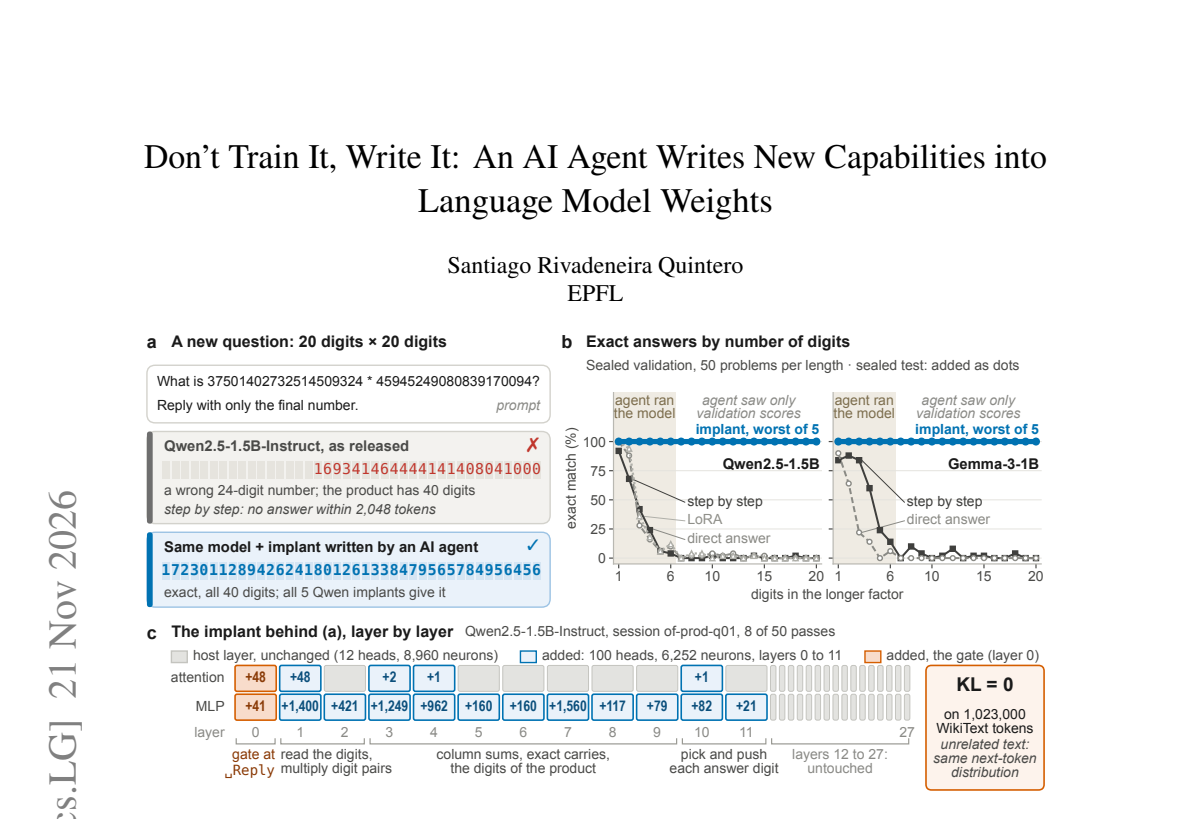
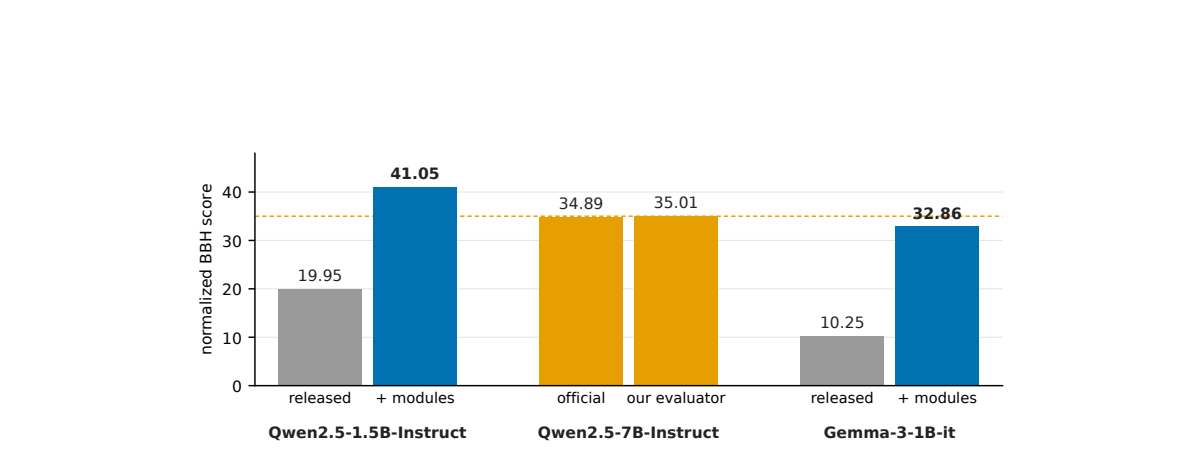
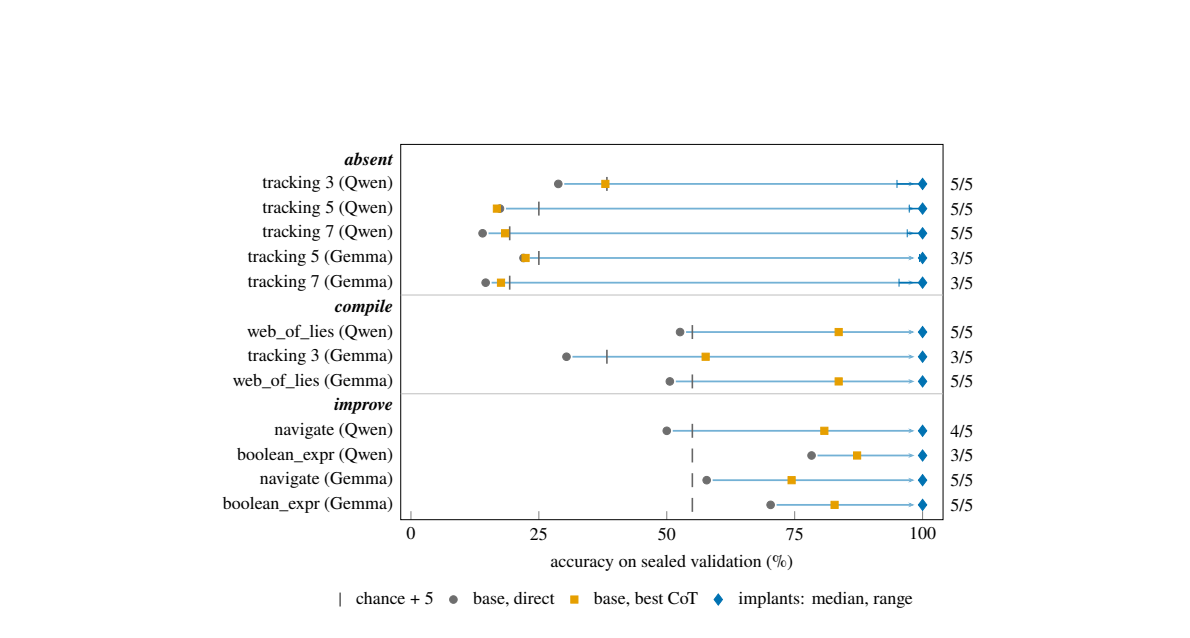
It has a budget of 50 model passes and sees no validation or test instance. Composed in one model, its modules for six BIG-Bench Hard (BBH) subtasks raise the normalized BBH score of Qwen2.5-1.5B-Instruct from 19.95 to 41.05 (Qwen2.5-7B-Instruct: at most 35.01) and that of Gemma-3-1B-it from 10.25 to 32.86. Against the unmodified model at the same precision, both composites leave the next-token distribution on 1,023,000 WikiText tokens unchanged (KL exactly 0), give identical answers on 15,845 items of five other Leaderboard tests and identical scores on the other 18 BBH subtasks. The agent also writes exact multiplication up to 20 digits, running the model only up to 6 (100.0% on the absent lengths of the sealed test in both models; a LoRA with the same budget: at most 2.1%). Sets, rules and report sentences were sealed in git before the first session (manifests timestamped in Bitcoin), with dated amendments listed in Appendix D; a frozen evaluator ran the sealed test once. Verdicts (H5: tracking; H6: composite; H8: one pass vs. chain of thought; H9: fresh and rewritten instances; H10: side effects; H12: multiplication), on the preregistered sealed test, Qwen2.5-1.5B-Instruct: H5 success, H6 success, H8 (web_of_lies) success, H9 success, H10 (composite) success on (i) to (iii), (iv) confirmed, H12 success; Gemma-3-1B-it (H7: H5, H6, H8 and H9 in this model): H5 success, H6 success, H8 (web_of_lies) success, H8 (tracking 3) success, H9 partial, H10 (composite) success on (i) to (iii), (iv) confirmed, H12 success. Not everything worked: 4 of 45 single modules show small side effects and 5 of 50 sessions hit the 12-hour limit without a module.
from the abstract
Pith says
Machine review · deepseek-v4-flash · 24 Nov 2026 · read the full text (154,021 characters) · not checked by a person
It can be wrong. Challenge this review or reply to it.
Holds up, with conditions. An AI agent writes new capabilities into pretrained LM weights without training, with a rigorous protocol, but the method's dependence on a proprietary agent and the gray area in its 'no fitting' claim need further scrutiny. This line is wrong
7 minor
How often objections from reviews like this one are right: not yet measured
The paper, first character to last
The reviewer was given the whole text, 154,021 characters. Not checked: figures, code, what the 44 references say.
7 minor objections
The paper says, at Section 2.2 (The surgeon) and Appendix D (Audit)
Pith says: minor objection 1 of 7
The central claim of the method is 'without backpropagation and without fitting any weight to the answers of task examples.' The audit reveals that 13 of 55 official sessions (AuditGrad) used (sub)gradient ascent on an attention margin over task inputs to set design constants, even though those searches did not use the task answers.
more of objection 1
The paper acknowledges this and has reframed its wording from the original sealed version ('without gradients or training data'). While the reframed claim is technically accurate, the distinction between 'fitting to task features' and 'fitting to task answers' is subtle and depends on the interpretation of the manual's rule. The paper should discuss more explicitly whether gradient-based optimization on task inputs (even without answer labels) could be considered a form of task-specific fitting, and why the authors consider it acceptable under their stated principle. This is not a reason to reject, but it deserves clearer justification than the current brief mention.
The paper says, at Section 3.1 (Sealed test results)
Pith says: minor objection 2 of 7
Table 2 reports the composite's score as 41.05 for Qwen and 32.86 for Gemma. It would be helpful to also report the standard error or confidence interval across the five official sessions per cell, especially for cells with failed sessions (which count as 0). Currently the reader only sees means.
show 5 more
The paper says, at Section 5 (Limitations), first bullet
Pith says: minor objection 3 of 7
The paper states that 'inputs close to the task form can still fire a trigger' and therefore the zero KL guarantee is only on unrelated text. This is fine, but the sentence in the limitations could be rephrased for clarity: the gate is exactly zero only off its trigger; on task-like inputs it may fire, which is by design.
The paper says, at Section 4.1 (Stage 2 results, H9)
Pith says: minor objection 4 of 7
The rewritten test is described as testing an 'announced family of rewritings.' The paper should clarify whether the family of rewritings was known to the surgeon (through the manual) or only to the authors. From the text, it seems the second-round manual told the surgeons that sentence constructions could change, but the specific rewritings were never shown. This could be stated more explicitly.
The paper says, at Section 2.2 (The surgeon)
Pith says: minor objection 5 of 7
The description of the audit classes (A, B, C) would benefit from a brief example of what a 'small numerical search' consists of for class B. Currently the text lists types of searches but does not give a concrete instance (e.g., 'least squares on a grid over 100 candidate rotary amplitudes'). Appendix D is referenced but the main text could include one illustrative example.
The paper says, at Table 1 caption
Pith says: minor objection 6 of 7
The table caption says 'Entries (M)' for millions of parameters. The number of nonzero parameters is smaller; it would be informative to also report the actual number of nonzero weights in a typical module to give a sense of the sparsity.
The paper says, at Section 4.1 (LoRA comparison)
Pith says: minor objection 7 of 7
The LoRA baseline uses one seed with a fixed budget. The paper acknowledges this is not the best trained method. However, since the comparison is used in verdict sentences (H11), the paper should state whether the LoRA hyperparameters (rank, alpha, learning rate) were optimized on the validation set or only the four configurations of the 'B1' baseline are tried.
more of objection 7
The text says 'best of four configurations on validation up to SumaPracticaMax digits' for addition; for BBH the description is less precise.
What would settle it
Reproduce one tracking session (e.g., of2-bbh-q02) using a future version of the same agent model (Claude Opus 5.5 or later) with the same manual, operating room, and sealed sets. If the resulting module again scores ≥90% on the absent subtasks of the sealed test, the central claim is robust to model version changes. If not, the result may be brittle to agent-model updates.
from the skeptic's reading
How the review went
5 passes by deepseek-v4-flash · 24 Nov 2026
- Reader holds up, with conditions
- Skeptic agrees
- Referee 7 minor
- Check against the paper kept 0 of 1 objection
- Editor wrote the verdict above
Not run on this paper: the simulated authors' defence.
Pith's passes raised 1 objection. A check against the paper's text kept 0 and moved 1 to the minor objections.
The review in full
The review in brief, machine-written
This paper shows that an AI agent (Claude Opus) can add new capabilities to a pretrained language model by inserting gated attention heads and MLP neurons into existing layers, without backpropagation and without fitting any weight to the answers of task examples. The results are genuinely striking: modules for multi-digit multiplication and six BIG-Bench Hard subtasks are written into Qwen2.5-1.5B and Gemma-3-1B, compose in one model with zero side effects on unrelated text, and lift the 1.5B model above its 7B sibling on BBH. The protocol is unusually thorough — sealed tests, Bitcoin timestamps, frozen evaluators, and an independent audit of how each weight was computed. The paper reports failures and side effects transparently.
The soft spots are real but the paper acknowledges most of them. The strongest claim — that the agent does not fit any weight to task answers — is the most contested. The audit found that 13 of 55 sessions used gradient ascent on an attention margin over task inputs (without using their answers), and others used small numerical searches over model geometry or activations. The paper now phrases the claim as 'without backpropagation and without fitting any weight to the answers of task examples,' which is accurate but leaves the reader to decide whether the boundary holds. The method depends on a proprietary agent model and manual, raising reproducibility questions. Some comparisons (LoRA) are suboptimal by design, and the tracking module's first official round was reclassified as development before the exam. Modules work only within their template; generalization beyond announced rewritings is limited.
This paper is for researchers working on weight-space programming, model editing, and mechanistic interpretability. It moves the needle from editing facts to adding absent capabilities and composes them. The evidence supports the central claim as stated, and the protocol sets a new bar for trustworthy claims in this area. It deserves a serious referee and should not be desk-rejected. A responsible review would ask for artifact release and a discussion of how the 'no fitting' boundary might be tightened or tested with open-weight agents.
The strongest objection
The paper's central claim that the agent writes new capabilities 'without backpropagation and without fitting any weight to the answers of task examples' is supported by a detailed audit. The reader flags that the boundary between closed-form statistics and numerical searches is subjective. However, the paper already acknowledges this in Section 3.2 and Appendix E: 13 sessions used gradient ascent on an attention margin (against the letter of the rule), modules from those sessions are excluded from composites, and the wording was amended pre-exam from 'without gradients or training data' to the current precise formulation. Moreover, class A sessions (purely closed-form) still achieve 100% validation on the same tasks, showing the method does not depend on the gray-area optimizations. I see no remaining load-bearing concern that the paper has not transparently addressed. The only other candidate — reliance on a proprietary agent model — is about reproducibility, not correctness of the existence proof; the paper notes that the claim stands for this specific agent model and version. The evidence (sealed tests, Bitcoin timestamps, frozen evaluator, independent audit) is unusually strong for an empirical AI paper.
The reader identified the audit boundary as the weakest assumption. I agree that this is the most sensitive point, but the paper handles it thoroughly: it reports the audit classes, excludes borderline modules from composites, and adjusted the wording before the exam. The central claim remains well-supported. The reader's verdict of CONDITIONAL is already appropriate given the proprietary agent model and the audit nuance; no change is needed. I find no additional load-bearing concern that would move the verdict to REJECT or ACCEPT.
The referee's report
If the results hold, the paper demonstrates a qualitatively new capability: an AI agent that writes new algorithmic abilities into language model weights without training, with extrapolation beyond seen lengths and with composability. This could open a complementary paradigm to fine-tuning for adding specific, verifiable skills. The methodological rigor (sealed sets, preregistration, Bitcoin timestamps, audit) is unusually high for this area and provides a template for trustworthy evaluation of agent-generated models. The empirical findings themselves are striking: a 1.5B model outperforming its 7B sibling on a composite BBH score without any degradation elsewhere.
Pith's reading of the paper (a machine's summary, not the authors')
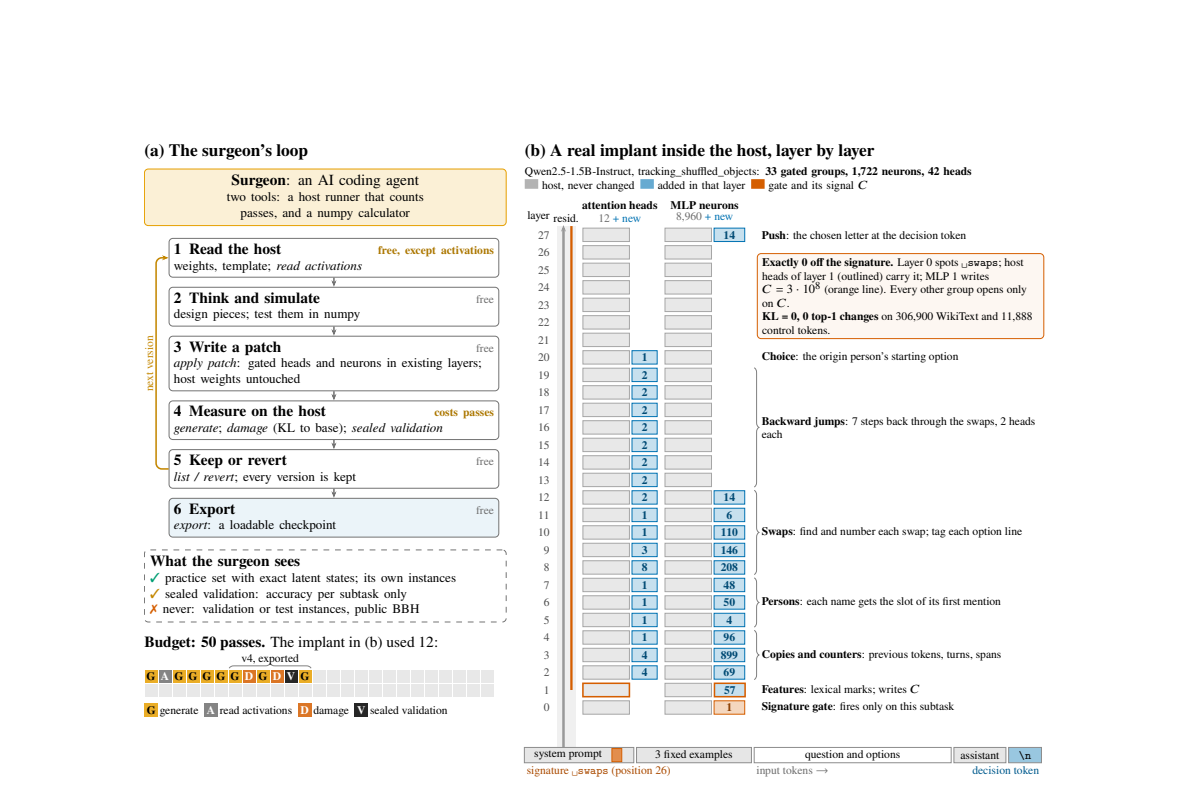
The paper shows that a coding agent can add specific skills to a small language model by writing new weights directly into its existing layers, without backpropagation or fitting to task answers. The agent uses a budget of 50 forward passes and only sees practice inputs. The technique lifts Qwen2.5-1.5B-Instruct's normalized BBH score from 19.95 to 41.05, above its 7B sibling, and achieves exact multiplication up to 20 digits from practice up to 6, with no measurable side effects on unrelated text. The method introduces new gated attention heads and MLP neurons that activate only on the task's template, keeping the next-token distribution unchanged on WikiText.
What carries the argument. The central object is the gated group: a set of new attention heads or MLP neurons added to an existing layer, whose output is multiplied by a scalar gate that is exactly zero off its trigger. The gate is a function of the residual stream designed by the agent, ensuring that on unrelated text the module contributes nothing. The operating room tool allows the agent to read weights and activations, design new pieces in numpy, and apply them as patches without changing original tensors. The agent uses closed-form statistics of activations (class means, linear discriminants) to design circuits, but some design constants come from small numerical searches over the model's geometry, vocabulary, or activations.
Core claim. The central claim is that an autonomous AI agent, operating with a frozen manual and a budget of 50 forward passes, can write new capabilities into a pretrained language model by adding gated attention heads and MLP neurons inside existing layers, without any form of backpropagation and without fitting any weight to the answers of task examples. The agent composes new computational circuits that are exact on their target task and silent (KL exactly 0) on unrelated text. This is demonstrated across six BIG-Bench Hard subtasks and exact multiplication in two model families, with the resulting composite model outperforming a 7B sibling on BBH while matching the unmodified model on all other tests.
The premise it rests on. The load-bearing premise is that the agent does not fit any weight to the answers of task examples, but some sessions used gradient ascent on an attention margin over task inputs (not answers but representations), and other sessions used small numerical searches over the model's geometry, vocabulary, or activations; the boundary between allowed closed-form statistics and forbidden optimization is subjective and depends on audit interpretation.
If the paper is right (Pith's inferences, not the authors')
Language model capabilities can be extended without expensive retraining or data collection, if the method scales.
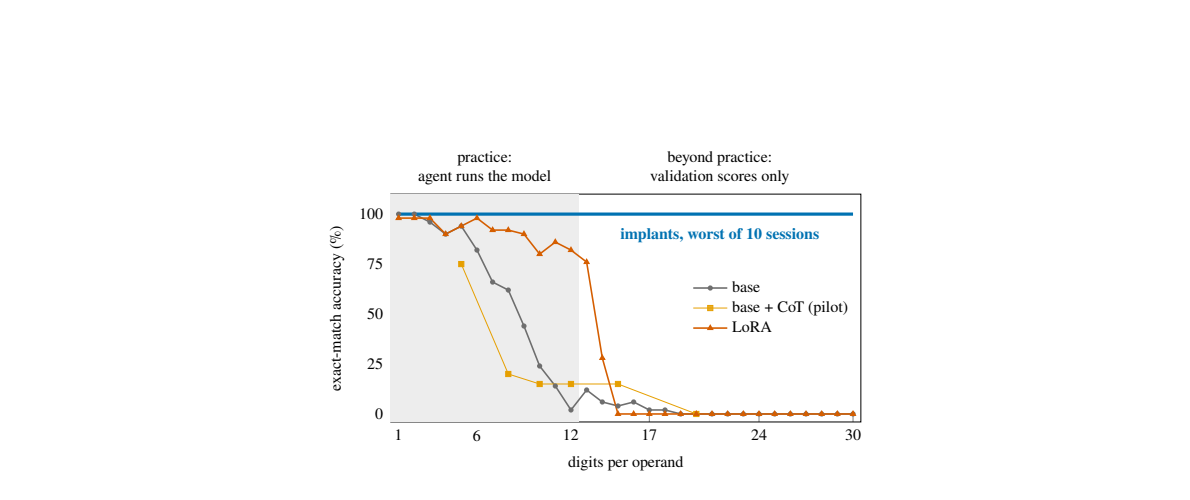
The ability to extrapolate beyond the agent's practice (addition to 30 digits from practice up to 12) suggests that correctly designed algorithms in weights generalize robustly.
The technique enables modular, composable model upgrades that do not interfere with existing skills, as shown by composites that preserve next-token distribution and benchmark scores.
The method could allow rapid specialization of models for specific tasks with no side effects, provided the agent can reliably design the required circuit.
The preregistered protocol with sealed tests and Bitcoin-timestamped manifests sets a high standard for trustworthiness in agent-written weight claims.
If the approach scales to larger models, it could challenge the paradigm that fine-tuning is the primary way to add capabilities; weight-space programming might become a parallel track for model improvement.
The manual's role (frozen lessons) suggests that success depends on prior task analysis; it is an open question whether the agent could discover the algorithm from scratch for arbitrary tasks, not just those with known solutions.
The audit's identification of numerical searches in some designs implies that the 'no fitting' claim is a matter of degree; a stricter interpretation might classify these as forms of learning, which could affect the perceived novelty of the method.
Check this review
What was read
The passes were given all 154,021 characters of the paper's LaTeX source.
Fingerprint of that text (SHA-256): 35230404593543d0b08438d6199abc7057d36c450eee036f59f84f6df1670ef5
Pith does not keep that text. Rebuilt from the paper's source or PDF by the same code, it has this fingerprint if it is the same text. From a copy of Pith's code:
PYTHONPATH=. python scripts/review_input_check.py 2611.28483
The passes, in the order they ran
- Reader deepseek-v4-flash · medium effort · $0.0034 · instructions of the Reader, fingerprint f9ead7300382…
- Skeptic deepseek-v4-flash · medium effort · $0.0031 · instructions of the Skeptic, fingerprint 8f88c0f61488…
- Referee deepseek-v4-flash · medium effort · $0.0030 · instructions of the Referee, fingerprint a852d99aea0d…
- Check against the paper deepseek-v4-flash · medium effort · $0.0030 · instructions of the Check against the paper, fingerprint 6c7a6883d551…
- Editor deepseek-v4-flash · medium effort · $0.0029 · instructions of the Editor, fingerprint e7211f6a3d27…
- Circularity check deepseek-v4-flash · medium effort · $0.0028 · instructions of the Circularity check, fingerprint e9946e39d67b…
- Summary for the page deepseek-v4-flash · medium effort · temperature 0.2 · $0.0030 · instructions of the Summary for the page, fingerprint e4f56bf568e7…
The passes cost $0.021 in model calls together.
Version stamped on this review: pith-pipeline@v1.4.1-daily-deepseek-or-medium+deepseek/deepseek-v4-flash+p.d60f54226f00
Each link opens a pass's instructions as plain text, the exact bytes its fingerprint was taken over. Every stored set of instructions.
curl -s https://pith.science/methodology/prompts/f9ead730038216984cfb56d7cb34332bdf691828296a1de4245f3d6667d4bf56 | sha256sum
prints the fingerprint of the reader's instructions. The same works for every pass.
The receipt
The review's fingerprint was taken on 24 Nov 2026. The review you are reading still matches it.
Fingerprint of the review (SHA-256): c72ae07f400738b1b1d9b729a0f95df0dd06d0fe6c223fc2f848e88635cbcb13
curl -s 'https://pith.science/api/v1/verdicts/2611.28483?form=canonical' | sha256sum
prints the fingerprint of the review as it stands now. The rule, in four steps.
A matching fingerprint shows the review has not changed since that date. It does not show that the review is right.
How often reviews like this one are right
Reviews like this one: written by deepseek-v4-flash, from the paper's LaTeX source.
How often objections from reviews like this one are right: not yet measured
Reviews by people
This review was written by a machine. No person has reviewed this paper on Pith yet. A scientist listed on Pith can review it for a fee, and their review is published here whatever it concludes.
The paper
Abstract
We show that an AI agent can write new capabilities into a pretrained language model by adding gated attention heads and MLP neurons inside its existing layers, without backpropagation and without fitting any weight to the answers of task examples. It has a budget of 50 model passes and sees no validation or test instance. Composed in one model, its modules for six BIG-Bench Hard (BBH) subtasks raise the normalized BBH score of Qwen2.5-1.5B-Instruct from 19.95 to 41.05 (Qwen2.5-7B-Instruct: at most 35.01) and that of Gemma-3-1B-it from 10.25 to 32.86. Against the unmodified model at the same precision, both composites leave the next-token distribution on 1,023,000 WikiText tokens unchanged (KL exactly 0), give identical answers on 15,845 items of five other Leaderboard tests and identical scores on the other 18 BBH subtasks. The agent also writes exact multiplication up to 20 digits, running the model only up to 6 (100.0% on the absent lengths of the sealed test in both models; a LoRA with the same budget: at most 2.1%). Sets, rules and report sentences were sealed in git before the first session (manifests timestamped in Bitcoin), with dated amendments listed in Appendix D; a frozen evaluator ran the sealed test once. Verdicts (H5: tracking; H6: composite; H8: one pass vs. chain of thought; H9: fresh and rewritten instances; H10: side effects; H12: multiplication), on the preregistered sealed test, Qwen2.5-1.5B-Instruct: H5 success, H6 success, H8 (web_of_lies) success, H9 success, H10 (composite) success on (i) to (iii), (iv) confirmed, H12 success; Gemma-3-1B-it (H7: H5, H6, H8 and H9 in this model): H5 success, H6 success, H8 (web_of_lies) success, H8 (tracking 3) success, H9 partial, H10 (composite) success on (i) to (iii), (iv) confirmed, H12 success. Not everything worked: 4 of 45 single modules show small side effects and 5 of 50 sessions hit the 12-hour limit without a module.
The paper's own sentences, arranged, kept beside the review and separate from it. Each label is drawn from a closed vocabulary; the number beside it is the probability the classifier gave that label. No sentence in this record was written by a model.
abstract compiled · 2026-11-24
The authors' main claim, as the classifier picked it out 1.00
“We show that an AI agent can write new capabilities into a pretrained language model by adding gated attention heads and MLP neurons inside its existing layers, without backpropagation and without fitting any weight to the answers of task examples.”
How the main claim is stated: asserted 1.00
What the abstract itself states, as probabilities: claims first 0.06 · states limitation 0.96 · human participants 0.02 · controlled comparison 0.96 · randomized assignment 0.02 · states quantitative result 0.99 · compares with prior results 0.97 · mentions code or data availability 0.09
The abstract, sentence by sentence
This table labels the abstract only (arXiv listing abstract v1). The number is the probability the classifier gave the label.
| Sentence | Role | The authors' own work | States the main conclusion | Strength |
|---|---|---|---|---|
| We show that an AI agent can write new capabilities into a pretrained language model by adding gated attention heads and MLP neurons inside its existing layers, without backpropagation and without fitting any weight to the answers of task examples. | contribution 0.95 | 0.95 | 0.91 | asserted 1.00 |
| It has a budget of 50 model passes and sees no validation or test instance. | method 0.96 | 0.83 | 0.03 | asserted 0.99 |
| Composed in one model, its modules for six BIG-Bench Hard (BBH) subtasks raise the normalized BBH score of Qwen2.5-1.5B-Instruct from 19.95 to 41.05 (Qwen2.5-7B-Instruct: at most 35.01) and that of Gemma-3-1B-it from 10.25 to 32.86. | result 1.00 | 0.94 | 0.19 | asserted 1.00 |
| Against the unmodified model at the same precision, both composites leave the next-token distribution on 1,023,000 WikiText tokens unchanged (KL exactly 0), give identical answers on 15,845 items of five other Leaderboard tests and identical scores on the other 18 BBH subtasks. | result 1.00 | 0.94 | 0.06 | asserted 1.00 |
| The agent also writes exact multiplication up to 20 digits, running the model only up to 6 (100.0% on the absent lengths of the sealed test in both models; a LoRA with the same budget: at most 2.1%). | result 1.00 | 0.94 | 0.07 | asserted 1.00 |
| Sets, rules and report sentences were sealed in git before the first session (manifests timestamped in Bitcoin), with dated amendments listed in Appendix D; a frozen evaluator ran the sealed test once. | method 0.99 | 0.91 | 0.02 | asserted 0.99 |
| Verdicts (H5: tracking; H6: composite; H8: one pass vs. chain of thought; H9: fresh and rewritten instances; H10: side effects; H12: multiplication), on the preregistered sealed test, Qwen2.5-1.5B-Instruct: H5 success, H6 success, H8 (web_of_lies) success, H9 success, H10 (composite) success on (i) to (iii), (iv) confirmed, H12 success; Gemma-3-1B-it (H7: H5, H6, H8 and H9 in this model): H5 success, H6 success, H8 (web_of_lies) success, H8 (tracking 3) success, H9 partial, H10 (composite) success on (i) to (iii), (iv) confirmed, H12 success. | result 1.00 | 0.93 | 0.08 | asserted 1.00 |
| Not everything worked: 4 of 45 single modules show small side effects and 5 of 50 sessions hit the 12-hour limit without a module. | limitation 1.00 | 0.95 | 0.02 | asserted 1.00 |
What kind of paper the classifier reports this is: method or tool 0.92 · evidence from observation or experiment 0.95
What was examined, and what was not
Sources read
- arXiv listing abstract v1
Not examined
- full text
- figures and tables
- references and citing sentences
- relations to other papers
Levels run
- P abstract
Not run
- S sections
- T body sentences
- C citations
- R cross-paper relations
How the labels were made
Compiled by classifier-1.13.0 via TypeSafe API, question bank abstract-p1-20260923, 2026-11-24: 1 request, 7,055 input tokens.
Every quoted sentence on this record is the authors'. Every label is from Pith's closed vocabulary, with the probability shown beside it. This record as JSON
Figures (5)
Figures are the authors', reproduced from the paper.
References (44)
- [1] Divyansh Agrawal. Qwenputer: a computer compiled into the weights of a pretrained language model. GitHub repository, version 0.1.0,https://github.com/divagr18/qwenputer, 2026 on Pith
- [2] Cem Anil, Yuhuai Wu, Anders Andreassen, Aitor Lewkowycz, Vedant Misra, Vinay Ramasesh, AmbroseSlone,GuyGur-Ari,EthanDyer,andBehnamNeyshabur. ExploringLengthGeneralization in Large Language Models. InAdvances in Neural Information Processing Systems 35, NeurIPS 2022,page38546–3... on Pithdoi:10.52202/068431-2793
- [3] Anthropic. Claude Code. Software, 2026 on Pith
- [4] Xiaoyan Bai, Itamar Pres, Yuntian Deng, Chenhao Tan, Stuart Shieber, Fernanda Viégas, Martin Wattenberg, and Andrew Lee. Why Can’t Transformers Learn Multiplication? Reverse-Engineering Reveals Long-Range Dependency Pitfalls, 2025. URLhttps://arxiv.org/abs/2510.00184. 16 on PitharXiv
- [5] Stella Biderman, Hailey Schoelkopf, Lintang Sutawika, et al. Lessons from the Trenches on Reproducible Evaluation of Language Models, 2024. URLhttps://arxiv.org/abs/2405.147 82 on Pith
- [6] Hanseul Cho, Jaeyoung Cha, Pranjal Awasthi, Srinadh Bhojanapalli, Anupam Gupta, and Chulhee Yun. Position Coupling: Improving Length Generalization of Arithmetic Transformers Using Task Structure. InAdvances in Neural Information Processing Systems 37, NeurIPS 2024, page 22233... on Pithdoi:10.52202/079017-0701
- [7] Peter Clark, Isaac Cowhey, Oren Etzioni, Tushar Khot, Ashish Sabharwal, Carissa Schoenick, and Oyvind Tafjord. Think you have Solved Question Answering? Try ARC, the AI2 Reasoning Challenge, 2018. URLhttps://arxiv.org/abs/1803.05457 on PithPith's reviewarXiv
- [8] Concept Country. Exact Neural Network Inference Inside the Weights of Qwen Concept 27B. Working paper v1,https://concept.country/research/concept-rv32im.pdf , 2026. November 8 on Pith
- [9] Justin Donaldson. A 1.7B Model That Stops Guessing. Blog post,https://jjd.io/posts/swo llm-bbh-leaderboard.html, 2026. June 27 on Pith
- [10] Jiajun Fan, Neil He, Changyi Yang, et al. Language Models Can Rewrite Their Own Weights, 2026. URLhttps://arxiv.org/abs/2611.21885 on PithPith's reviewarXiv
- [11] Clémentine Fourrier, Nathan Habib, Alina Lozovskaya, Konrad Szafer, and Thomas Wolf. Open LLM Leaderboard v2. Hugging Face,https://huggingface.co/spaces/open-llm-leade rboard/open_llm_leaderboard, 2024 on Pith
- [12] Luyu Gao, Aman Madaan, Shuyan Zhou, Uri Alon, Pengfei Liu, Yiming Yang, Jamie Callan, and Graham Neubig. PAL: Program-aided Language Models. InInternational Conference on Machine Learning (ICML), 2023. URLhttps://openreview.net/forum?id=M1fd9Z00sj on Pith
- [13] Gemma Team, Aishwarya Kamath, Johan Ferret, et al. Gemma 3 Technical Report, 2025. URL https://arxiv.org/abs/2503.19786 on PithPith's reviewarXiv
- [14] Gen-Verse. WeightCode: Installing New Capabilities into Neural Networks via Weight-Space Programming. GitHub repository,https://github.com/Gen-Verse/WeightCode, 2026 on Pith
- [15] Michael Granitzer, Saber Zerhoudi, Mohammad Al-Maamari, Hai Dang Dang, and Kanishka Ghosh Dastidar. A Tool in the Forward Pass: Frozen Tape Modules as Layers of a Small Language Model, on Pith
- [16] Ajay Grover. Independently Discovered Weight Edits Compose. Blog post,https://ajaygrover .github.io/weight-space-programming-stacking/, 2026. November 7 on Pith
- [17] Nikolaus Hansen. The CMA Evolution Strategy: A Tutorial, 2016. URLhttps://arxiv.org/ab s/1604.00772 on PithPith's reviewarXiv
- [18] Amiri Hayes, Belinda Z Li, and Jacob Andreas. Explaining Attention with Program Synthesis, 2026. URLhttps://arxiv.org/abs/2606.19317 on PithPith's reviewarXiv
- [19] Dan Hendrycks, Collin Burns, Steven Basart, Andy Zou, Mantas Mazeika, Dawn Song, and Jacob Steinhardt. Measuring Massive Multitask Language Understanding, 2020. URLhttps: //arxiv.org/abs/2009.03300 on PithPith's reviewarXiv
- [20] Edward J. Hu, Yelong Shen, Phillip Wallis, Zeyuan Allen-Zhu, Yuanzhi Li, Shean Wang, Lu Wang, and Weizhu Chen. LoRA: Low-Rank Adaptation of Large Language Models, 2021. URL https://arxiv.org/abs/2106.09685. 17 on PithPith's reviewarXiv
show 24 more
- [21] SubhashKantamneniandMaxTegmark. LanguageModelsUseTrigonometrytoDoAddition,2025. URLhttps://arxiv.org/abs/2502.00873 on PithPith's reviewarXiv
- [22] David Lindner, Janos Kramar, Sebastian Farquhar, Matthew Rahtz, Tom McGrath, and Vladimir Mikulik. Tracr: Compiled Transformers as a Laboratory for Interpretability. InAdvances in Neural Information Processing Systems 36, NeurIPS 2023, page 37876–37899. Neural Information Proc... on Pithdoi:10.52202/075280-1649
- [23] Aayush Marasini, Barsat Khadka, and Nick Rahimi. WeightBench: Evaluating Language Models as Weight-Space Programmers, 2026. URLhttps://arxiv.org/abs/2611.18553 on PithPith's reviewarXiv
- [24] Sean McLeish, Arpit Bansal, Alex Stein, Neel Jain, John Kirchenbauer, Brian Bartoldson, Bhavya Kailkhura, Abhinav Bhatele, Jonas Geiping, Avi Schwarzschild, and Tom Goldstein. Transformers Can Do Arithmetic with the Right Embeddings. InAdvances in Neural Information Processing... on Pithdoi:10.52202/079017-3430
- [25] Yash Mehta, Chandan Singh, Weijia Xu, et al. Interpretable weight-space programming builds transparent transformers and brain encoding models, 2026. URLhttps://arxiv.org/abs/2611 .18114 on Pith
- [26] Kevin Meng, David Bau, Alex Andonian, and Yonatan Belinkov. Locating and Editing Factual Associations in GPT. InAdvances in Neural Information Processing Systems 35, NeurIPS 2022, page 17359–17372. Neural Information Processing Systems Foundation, Inc. (NeurIPS), 2022. doi: 10... on Pithdoi:10.52202/068431-1262
- [27] Stephen Merity, Caiming Xiong, James Bradbury, and Richard Socher. Pointer Sentinel Mixture Models, 2016. URLhttps://arxiv.org/abs/1609.07843 on PithPith's reviewarXiv
- [28] William Merrill and Ashish Sabharwal. The Parallelism Tradeoff: Limitations of Log-Precision Transformers.Transactions of the Association for Computational Linguistics, 11:531–545, 2023. ISSN 2307-387X. doi: 10.1162/tacl_a_00562. URLhttp://dx.doi.org/10.1162/tacl_a_00 562 on Pithdoi:10.1162/tacl_a_00562
- [29] mfaseehuddin. wsp, Track A: bionic circuits. GitHub repository,https://github.com/mfaseeh uddin/wsp, 2026. November 6 to 8 on Pith
- [30] Mostafa ‘Neo’ Mohsenvand. Sketchpad: certified exact arithmetic with a small vision-language model, 2026. URLhttps://arxiv.org/abs/2611.04434 on PithPith's reviewarXiv
- [31] Rob Porter. A calculator, compiled into a transformer. Blog post,https://ood.dev/posts/ca lculator/, 2026. August 9 on Pith
- [32] Qwen Team, An Yang, Baosong Yang, et al. Qwen2.5 Technical Report, 2024. URLhttps: //arxiv.org/abs/2412.15115 on PithPith's reviewarXiv
- [33] David Saxton, Edward Grefenstette, Felix Hill, and Pushmeet Kohli. Analysing Mathematical Reasoning Abilities of Neural Models, 2019. URLhttps://arxiv.org/abs/1904.01557 on PithPith's reviewarXiv
- [34] sfc-gh-tosmith. Banking77 by weight-space programming. GitHub repository,https://github .com/sfc-gh-tosmith/wsp-banking77, 2026 on Pith
- [35] sudorian. Weight-space implants. GitHub repository,https://github.com/sudorian/weight -space-implants, 2026. Created November 10. 18 on Pith
- [36] Mirac Suzgun, Nathan Scales, Nathanael Schärli, et al. Challenging BIG-Bench Tasks and Whether Chain-of-Thought Can Solve Them. InACL (Findings), 2023. URLhttps://openreview.net /forum?id=3q0IqOJgEB on Pith
- [37] RikiyaTakehi,JaydenTeoh,AlexZhang,andOmarKhattab. SparksofWeight-SpaceProgramming: LLMs can natively read & write neural network weights. Blog post, MIT CSAIL,https: //rikiyat.github.io/blog/weight-space-programming/, 2026. November 2 on Pith
- [38] Alexander Matt Turner, Lisa Thiergart, Gavin Leech, David Udell, Juan J. Vazquez, Ulisse Mini, and Monte MacDiarmid. Steering Language Models With Activation Engineering, 2023. URL https://arxiv.org/abs/2308.10248 on PithPith's reviewarXiv
- [39] Tomás Vergara Browne and Alvaro Soto. Tracr-Injection: Distilling algorithms into pre-trained language models. InFindings of the Association for Computational Linguistics: ACL 2025, pages 2831–2843, Vienna, Austria, 2025. Association for Computational Linguistics. doi: 10.1865... on Pithdoi:10.18653/v1/
- [40] YixuanWeng,MinjunZhu,FeiXia,BinLi,ShizhuHe,KangLiu,andJunZhao. MasteringSymbolic Operations: Augmenting Language Models with Compiled Neural Networks. InInternational Conference on Learning Representations (ICLR), 2024. URLhttps://openreview.net/forum ?id=9nsNyN0vox on Pith
- [41] Josiah Wilson. Deterministic “Neurons” Inside an Existing Transformer MLP.https://josiah wilson.me/documents/neural-firmware-phase-7.pdf, 2026. July 27 on Pith
- [42] Zavo. Teaching a language model new knowledge by editing its weights.https://zavo.ai/rese arch/weight-editing, 2026. November 3 on Pith
- [43] Hattie Zhou, Arwen Bradley, Etai Littwin, Noam Razin, Omid Saremi, Josh Susskind, Samy Bengio, and Preetum Nakkiran. What Algorithms can Transformers Learn? A Study in Length Generalization. InInternational Conference on Learning Representations (ICLR), 2024. URL https://openr... on Pith
- [2026] URLhttps://arxiv.org/abs/2611.00783 on PithPith's reviewarXiv
Challenges and discussion
Disagree with the review, or know something it missed? Leave a comment, or challenge this review formally: a challenge becomes a permanent entry in this paper's record, and its decision is published here.
Come back by email
A short list of the week's newly reviewed papers. Nothing is sent until you confirm from your inbox, and every email has a link that stops it. No account.
No comments yet.
Sign in to comment