Machine Learning · arXiv:2611.02270 v1 · submitted 1 Nov 2026 · 46 references
Hinted Scaling Laws
The paper says
“Scaling laws predict the outcome of large, expensive training runs by extrapolating trends from smaller, cheaper runs.”
more of the abstract
On downstream accuracy evaluations, these predictions fail when the weaker models produced by the cheaper runs score near zero accuracy, because these scores give no trend to extrapolate to larger scales. We introduce hinted scaling laws, which use privileged information to turn a benchmark into a continuum of easier versions so that even the small models score above zero. We find that accuracy rises smoothly and predictably with the hint level, enabling new types of scaling laws that operate below the noise threshold. On the Delphi pretraining ladder, a hinted scaling law fit on models trained with at most 1020 FLOPs forecasts the GSM8K accuracy of a 1023 FLOP model (25.9%) to within 3 percentage points; a standard scaling law under-forecasts it by 13 percentage points when fit on the same models and by 12 even with models up to 1022 FLOPs in the fit. Across both this pretraining ladder and a collection of post-trained model families, hinted scaling laws reduce the median forecasting error on GSM8K, AIME and HLE from 21 percentage points to 4.3. Hinting also reduces the number of test examples needed to tell whether one model is better than another by widening the accuracy gaps between models while approximately preserving their order: a single hinted rollout per problem ranks nearly indistinguishable models as accurately as five unhinted rollouts. Our results suggest that hinting is a general primitive for improving the accuracy and cost of downstream scaling laws and other prediction tasks in model development.
from the abstract
Pith says
Machine review · deepseek-v4-flash · 4 Nov 2026 · what was read was not recorded · not checked by a person
It can be wrong. Challenge this review or reply to it.
Holds up, with conditions. A genuine methodological contribution with an honest formal control; the panel-level result is credible, but the flagship Delphi 'within 3pp' forecast rests on an extrapolation the fitted data cannot identify in-sample. This line is wrong
3 major objections · 5 minor
How often objections from reviews like this one are right: not yet measured
Not checked: figures, code, what the 46 references say.
The paper says, at §4.2, Eq. (2), Fig. 7, Appendix E
The review did not quote this passage.
A classifier read this sentence of the paper as acknowledging the concern (probability 0.62):
“Certainly, our simple joint law is an imperfect model of the true joint effect of hint level and model capability on accuracy.”
Pith says: Objection 1 of 3 · major
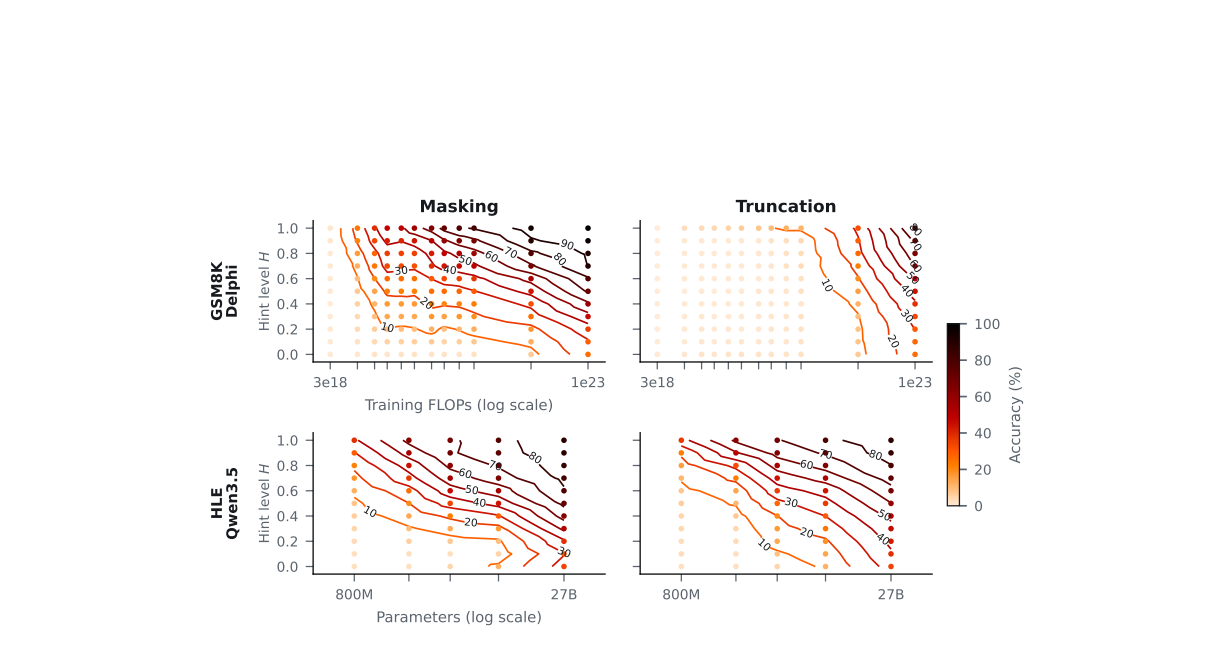
The Delphi 3-percentage-point forecast is not identified from any measured H=0 rise among the fitted models. The text reports that the fitted floor F=2.5% sits just above the 0.5-2% unhinted accuracy of every model below 10^22 FLOPs, so every fitted H=0 cell is pinned to the floor; the predicted emergence at 10^23 FLOPs is entirely a transfer of the parallel iso-accuracy contour structure (constant -beta1/beta2) learned at H>0.
more of objection 1
Appendix E states that on Delphi the empirical contours deviate from parallel lines near the floor, with masking contours flattening across the smaller models, which is precisely the small-C, near-floor region that supplies the fit. The authors acknowledge in Section 7 that Eq. (2) is an approximation, but the headline claim still needs a quantitative robustness analysis: for example, nested alternatives with H-dependent exchange rates, fits with the H=0 cells excluded, and predictive intervals for the target. This is an extrapolation-risk concern rather than a circularity claim, but as written the reader cannot tell how much of the Delphi result is measured signal and how much is the assumed functional form.
The paper says, at §4.2 and §A (GSM8K)
The review did not quote this passage.
Pith says: Objection 2 of 3 · major
The target accuracy of 25.9% is measured on a single seed of the 10^23-FLOP model over the first 256 GSM8K problems. If the evaluation were collapsed to one binary outcome per problem, the binomial standard error would be about 2.7 percentage points; with 64 rollouts per problem the sampling noise may be smaller, but problem heterogeneity and seed variance are not quantified.
more of objection 2
The abstract's 'within 3 percentage points' is therefore close to the measurement noise floor. Please report a confidence interval for the target measurement, a bootstrap over problems and seeds where possible, and a predictive interval for the forecast, and state how the 3pp claim survives that uncertainty.
The paper says, at §4 Methods and data, Figs. 5-6
The review did not quote this passage.
Pith says: Objection 3 of 3 · major
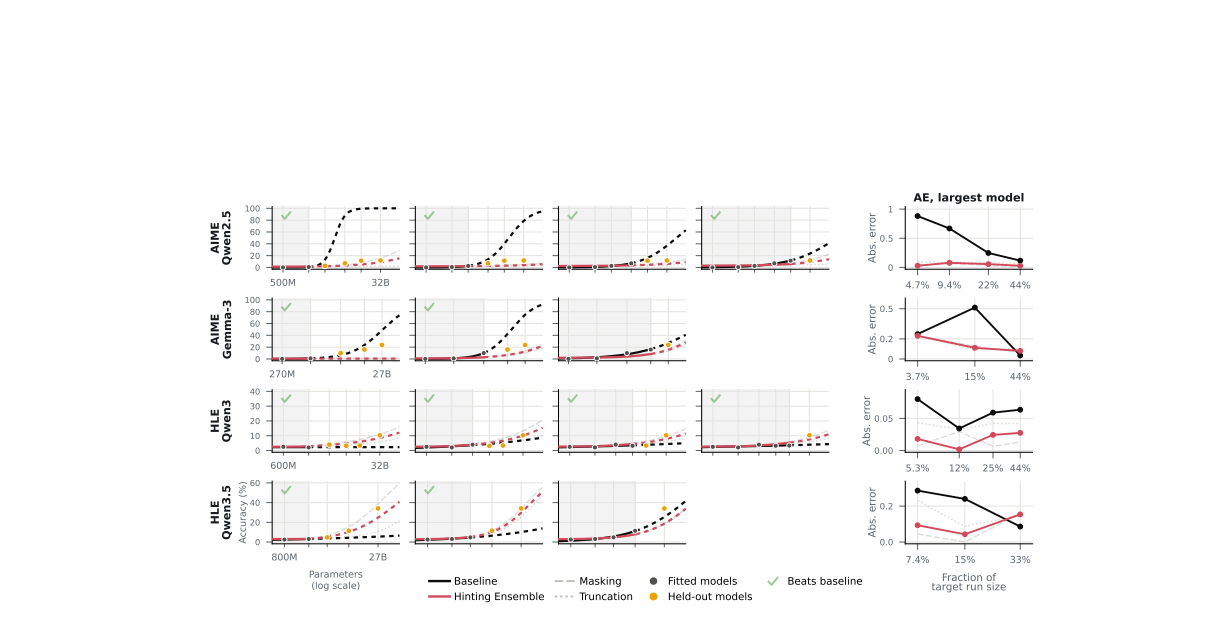
The headline median reduction from 21 to 4.3 percentage points and the 17/19 success count are computed over panels that are not independent: the same family-benchmark pairs appear at multiple training-set sizes, and family-benchmark pairs are excluded when all H=0 accuracies are zero or all are positive.
more of objection 3
The exclusion rule is motivated, but the claims would be much clearer with per-family-benchmark medians, the aggregate over the full set of pairs, and the number of distinct family-benchmark combinations rather than panels. As written, the strength of the broad 'across both this pretraining ladder and post-trained families' claim is difficult to assess.
5 minor objections
The paper says, at Eq. (2)
Pith says: minor objection 1 of 5
The parameter constraints 0 <= F <= L <= A <= 1 should be stated explicitly; without them the max and the sigmoid can produce non-monotone or otherwise unreasonable fitted surfaces.
The paper says, at §2.1
Pith says: minor objection 2 of 5
The hint range is defined as H in [0, infinity) in Section 2, but truncation and masking are only used on H in [0,1]; please state the range separately for each method to avoid ambiguity.
show 3 more
The paper says, at Abstract and §5
Pith says: minor objection 3 of 5
The claim that one hinted rollout ranks as accurately as five unhinted rollouts is AIME-specific: Section 5 reports about five rollouts on AIME and six on HLE. The abstract should use the AIME number only if the sentence is about AIME, or otherwise report both.
The paper says, at §G.2, Eq. (3)
Pith says: minor objection 4 of 5
The choice lambda=8 is made after inspecting the same benchmarks used for evaluation; the sensitivity sweep in Fig. 19 is reassuring, but the selected value should be explicitly labeled as a tuned hyperparameter in the main text.
The paper says, at Fig. 7
Pith says: minor objection 5 of 5
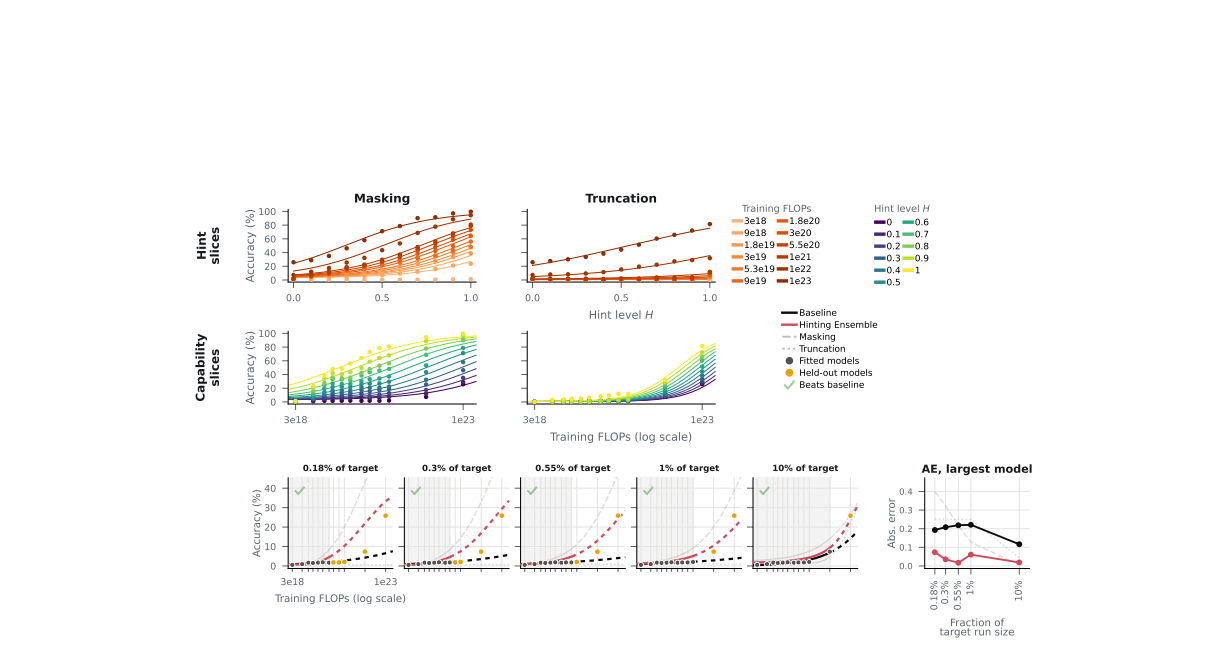
The top row uses an H/(1+H) axis while Eq. (2) is fitted in H; the caption already notes this, but a short sentence in the text would help readers interpret the apparent spacing of the fitted slices.
What would settle it
Re-fit the Delphi logit-mixing law of Eq. (2) on models at or below 10^20 FLOPs twice. (i) Exclude from the fit every measured cell with accuracy below 2·F (i.e., below ~5%), keeping only genuinely above-floor cells, and re-forecast the 10^23 model at H=0. (ii) Add an interaction term inside σ, e.g., β4·C·H, which breaks parallel contours; report β4 and its standard error, and the resulting H=0 forecast. If (i) shifts the forecast by more than ~4pp, or (ii) gives a material β4 and a forecast outside 22–30%, then the headline rests on the floored cells and the parallel-contour assumption rather than on transferable signal. If the forecast is stable to within 2–3pp under both perturbations, the concern is minor and the extrapolation is robust. This test uses only in-paper machinery (the 12-rung Delphi ladder with 3 seeds per budget below 10^23, and the 29 swept logit-mixing H values).
from the skeptic's reading
How the review went
4 readings by deepseek-v4-flash · 4 Nov 2026
- Reader holds up, with conditions
- Skeptic partly agrees
- Editor wrote the verdict above
- Referee major revision: 3 major objections, 5 minor
Not run on this paper: the simulated authors' defence.
Pith did not check this review's objections against the paper.
The review in full
The review in brief, machine-written
Two things to know up front. This is a genuine methodological contribution: a continuous hint-level axis, a joint scale-hint law, and a formal control that separates hinting methods that carry forecast information from those that cannot. And the flagship Delphi number is the weakest evidence in the paper, not the strongest. What will survive scrutiny is the panel-level ensemble result; the 'within 3pp' forecast of the 1023 model is carried by an extrapolation the fitted data cannot identify in-sample.
What is new: prior work uses discrete hint tiers, prefix-conditioned RL, pass@k, or soft likelihoods. This paper makes the hint level continuous and fits one law in both scale and hint, then evaluates its H=0 slice on held-out models. The protocol is honest: the law is fit on small models at all hint levels, and forecasts are evaluated on larger models at H=0, neither used in the fit. Code and data are posted, which counts for an empirical paper like this. Proposition 1 is worth a cite on its own: for 'unhinted-determined' methods, hinted data provably cannot beat unhinted data, and the answer-mixing control fails exactly as it predicts. They also test the bits-per-byte two-stage baseline from Held and show it fails without external reference models. The ranking application is solid: one hinted rollout ranks near-zero models as well as five unhinted ones, with disclosure that large-budget convergence to avg@k holds by construction and that pass@k and avg@k disagree on HLE near zero.
Where it is soft. The stress-test's identification point is correct: at H=0, every fitted Delphi cell (0.5-2%) lies below the fitted floor F=2.5%, so no fitted H=0 cell measures where accuracy lifts off. The forecast of where the 1023 model emerges comes entirely from transferring the measured H-rise through the assumed parallel contours. Appendix E documents contours flattening near the floor for masking on Delphi, the same small-scale near-floor regime the fit relies on, though that flattening is for masking, not the logit-mixing flagship, whose measured contours do look parallel. My reading: a real fragility, not a demonstrated failure, and the authors already call the law an approximation (Section 7, Appendix E). Two smaller issues: the 21 to 4.3 median excludes pairs where all models sit at or above zero at H=0, disclosed and defensible but worth reporting both ways, and the 1023 target has a single seed, so the 3pp band is roughly a one-sigma statement over 256 problems.
This is a paper for people who build or use downstream scaling laws and cheap evaluation pipelines. Bottom line: send it to peer review. The ensemble and ranking results stand up; the single-ladder Delphi claim needs uncertainty intervals and at least one more controlled ladder before it deserves headline status. If I were the editor I would ask for the all-pairs table, errors on the flagship, and a second true scaling ladder.
The strongest objection
The central claim is that Eq. (2), max(F, L+(A−L)σ(β1C+β2H+β3)), fit to small models at all hint levels, forecasts the H=0 accuracy of the 10^23 Delphi model to within 3pp. The load-bearing premise is the parallel iso-accuracy contour structure: constancy of the C/H exchange rate −β1/β2 across the whole surface. On the Delphi logit-mixing fit that produces the headline, this premise does all the work and is not checkable in-sample. §4.2 reports the fitted floor F=2.5% sits just above the 0.5–2% unhinted accuracy of every model below 10^22 FLOPs, so every fitted H=0 cell is pinned to the floor. The H=0 emergence location at large C is therefore determined not by any measured H=0 rise (there is none among fitted models) but purely by transferring the β2 (H-rise) and β1 (C-rise) measured at H>0 through the assumed parallel structure. Appendix E documents that near the floor the empirical contours deviate from the parallel structure — for masking on Delphi the contours 'flatten across the smaller models' — i.e., the transfer breaks down in exactly the region (small C, near-floor accuracy) that supplies the fit. The law is an approximation whose deviation is largest where it must be most accurate, and the target model has a single seed whose 25.9% measurement itself carries roughly ±2–3pp rollout noise over 256 problems, so the flagship 'within 3pp' band is not tightly pinned. This does not refute the claim: the 17/19-panel ensemble wins, the answer-mixing control (Prop. 1), the BPB baseline, and the multi-seed averaging all support the method, and the authors honestly flag the approximation (b258, App E). But it means the flagship Delphi forecast is carried by an assumption whose failure mode (non-parallel contours) is documented as present near the fitted region.
The reader's weakest_assumption locates the risk in Eq. (2) failing outside the fitted region. I agree the parametric form is the crux, but I sharpen the failure mode: the risk is not merely out-of-region extrapolation. On the flagship Delphi logit-mixing fit, the H=0 slice of every fitted model is floored at F=2.5%, so the location of the H=0 emergence along C is unidentified from in-region H=0 data; the forecast is a pure transfer of the H>0 structure through the assumption that iso-accuracy contours are parallel straight lines. Appendix E then documents that the contours deviate from parallel exactly at the near-floor, small-C boundary of the fitted region. So the assumption is being relied on precisely where its documented deviation sits, and the single-seed target adds ±2–3pp measurement noise on top of the claimed 3pp accuracy. I rate this as the most load-bearing concern because both the 25.9% Delphi headline and, derivatively, the median-error claims inherit the structural transfer. I do not elevate it beyond CONDITIONAL: the paper is transparent about the approximation (b258, Section 7, App E), supplies a formal control (Prop. 1) ruling out degenerate unhinted-determined hinting, shows the two-stage BPB alternative is worse (§E.1), averages over seeds for smaller rungs, and reports all 19 panels in the appendix, so exclusions are disclosed rather than hidden. The concern is a well-identified epistemic limit, tested by the proposed robustness re-fits, not an internal inconsistency or a discovered error. Hence the reader's CONDITIONAL verdict stands and my read does not change it. Agreement with the reader is partial: we name the same assumption as weakest, but I relocate the risk from 'outside the fitted region' to the in-region degeneracy of the H=0 slice plus the documented near-floor contour deviation, which is a stronger and more specific statement of the same concern.
The referee's report
If the claims hold, this is a practically useful and unusually well-controlled empirical contribution to downstream scaling laws. The held-out evaluation design is genuine: the joint law is fit on small models and hinted cells and evaluated at H=0 on larger held-out models, and the forecast target is never used as a teacher or in the fit. The answer-mixing control and Proposition 1 are an honest negative result and substantially strengthen the non-circularity of the method. The paper also ships code and data and is explicit about limitations: scarcity of open ladders, the approximate nature of Eq. (2), and the restricted post-trained logit-mixing setup. The residual risk is concentrated in the flagship Delphi forecast and the headline median error, both of which currently rest on an unquantified extrapolation of the parallel-contour structure assumed by Eq. (2).
Pith's reading of the paper (a machine's summary, not the authors')
This paper claims that the reason downstream scaling laws fail — small models score near zero on hard benchmarks, leaving no trend to extrapolate — can be removed by hinting: turning a benchmark into a continuum of easier versions indexed by a hint level $H$, so that even tiny models score above zero. Measured across a pretraining ladder and several post-trained families, accuracy then rises smoothly in both $H$ and model scale, and a single six-parameter law over the two variables, fit only to small models at every hint level, forecasts held-out large models' unhinted accuracy. On the Delphi ladder this predicts the $10^{23}$-FLOP model's 25.9% GSM8K accuracy within 3 percentage points from fits on models trained with at most $10^{20}$ FLOPs, where a standard law under-forecasts by 13 points; the median absolute forecasting error across all evaluated panels falls from 21 to 4.3 percentage points. The same smoothing also makes model comparison cheaper, with one hinted rollout per problem ranking nearly indistinguishable models as accurately as five unhinted rollouts. If the claim holds, benchmark hinting is a general primitive that makes expensive large-scale outcomes predictable from cheap small-scale evaluations.
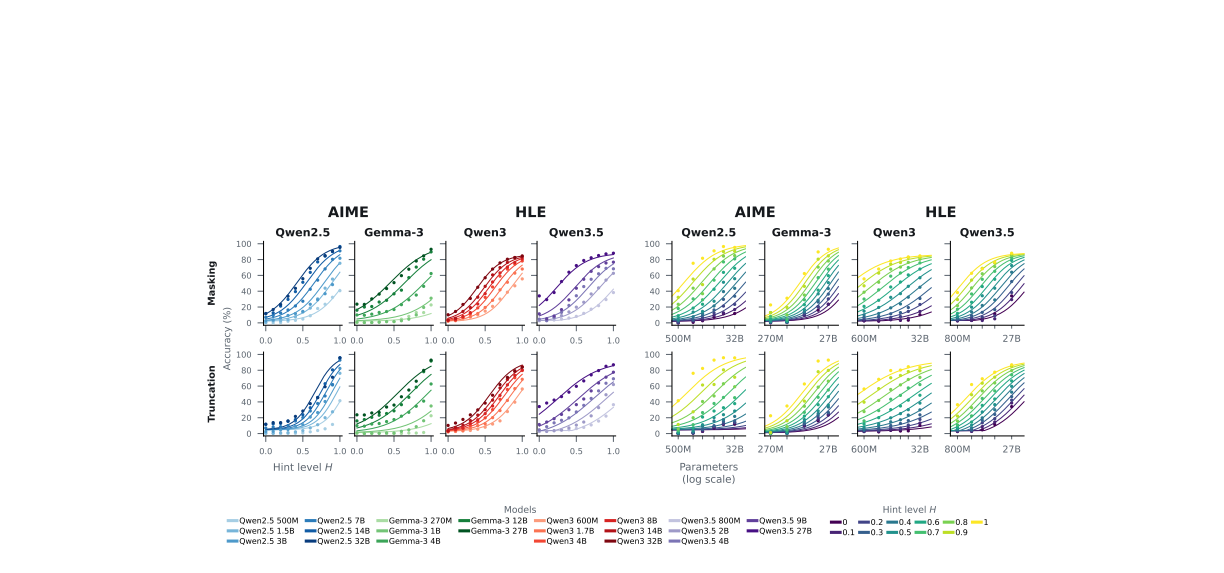
What carries the argument. The load-bearing object is the floored sigmoid law of Eq. (2), $L(C,H)=\max(F,\, L+(A-L)\sigma(\beta_1 C+\beta_2 H+\beta_3))$, a six-parameter surface whose iso-accuracy contours above the floor are parallel straight lines of slope $-\beta_1/\beta_2$ — an exchange rate at which hint level substitutes for model scale. The floor $F$ and lower asymptote $L$ let accuracy sit flat near zero until an emergence point, and the upper asymptote $A$ captures saturation or a teacher-imposed ceiling. The surface is driven by three hinting mechanisms — truncation and masking, which reveal parts of a reference solution, and logit mixing, which interpolates between the evaluated model's and a stronger teacher's next-token distributions — plus the empirical observation that each slice is a sigmoid in both directions. Proposition 1 supplies the contrast case: hinting methods whose accuracies are determined by $H$ and unhinted accuracy alone (call them unhinted-determined, as in answer mixing) can never improve any forecast, showing that the method's power comes from hints that separate pre-emergence models along a new axis.
Core claim. The central discovery is that benchmark accuracy, which sits at a noise floor for small models, becomes a smooth function of a second variable: the hint level $H$. Revealing the first $H$ fraction of a reference solution (truncation), a random $H$ fraction of its words (masking), or mixing the evaluated model's logits with a stronger teacher's logits with weight $H$ (logit mixing) produces a continuum of easier benchmarks on which even models below $10^{22}$ FLOPs score above zero. Accuracy then follows a floored sigmoid law in log-scale compute $C$ and $H$, whose iso-accuracy contours run as roughly parallel diagonals: increasing $H$ acts like increasing model scale. Fit to the smallest models at all hint levels and evaluated at $H=0$, the law forecasts the largest model's accuracy on the original, unhinted benchmark — on Delphi GSM8K it predicts the $10^{23}$-FLOP model's 25.9% within 3 percentage points from models at most $10^{20}$ FLOPs, while a standard law fit to the same models under-forecasts by 13. Because the $H=0$ slice is exactly the original benchmark, the forecast is a prediction of the metric of interest, not of a proxy.
The premise it rests on. The load-bearing premise is that the floored sigmoid law of Eq. (2), with its parallel straight iso-accuracy contours, remains valid outside the fitted region, so extrapolating from small models at positive hint levels to large models at $H=0$ is reliable; the paper itself shows contours flattening near the floor for masking on Delphi GSM8K and calls the law an approximation.
If the paper is right (Pith's inferences, not the authors')
Downstream capability forecasting no longer requires the smallest ladder models to score above chance on the target benchmark: their $H>0$ hinted scores carry the trend, so laws become identifiable in exactly the regime where unhinted scaling laws are unidentifiable.
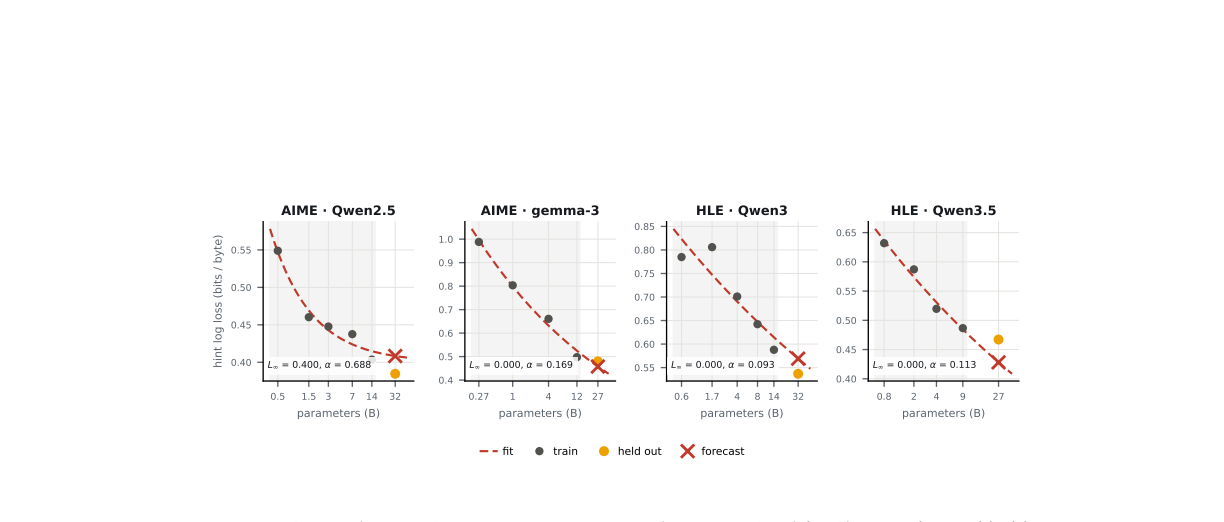
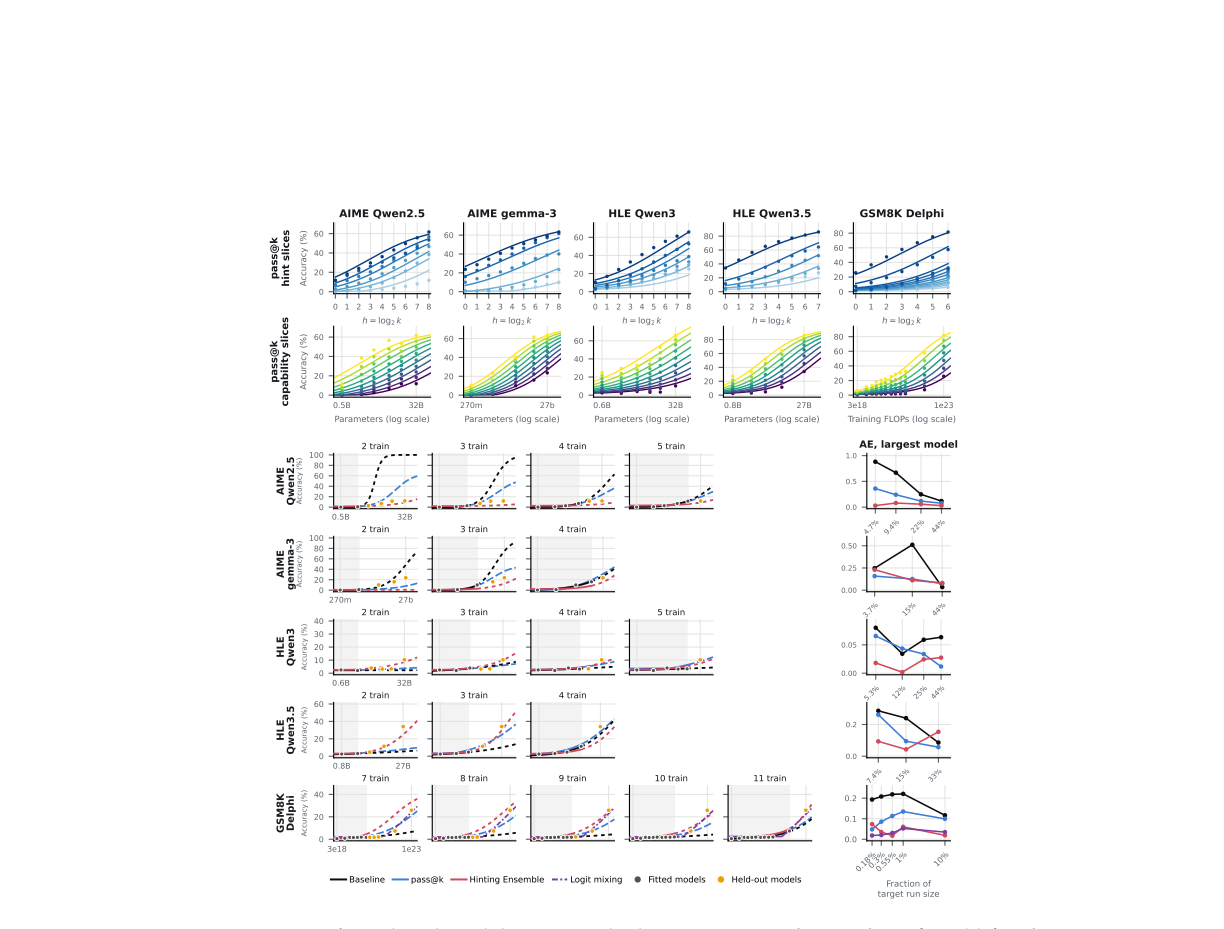
Cheaper fits: on the Delphi ladder the logit-mixing forecast stabilizes at roughly 0.2% of the target compute budget, and the masking/truncation ensemble beats the standard sigmoid on seventeen of the nineteen evaluated panels.
Sample-efficient comparison: because hinting widens accuracy gaps while largely preserving order, one truncation-hinted rollout per problem outperforms five unhinted rollouts on ranking nearly indistinguishable models, and the hint-prior ranking never falls behind unhinted averaging by more than 0.02 in Kendall's $\tau$ at any tested budget.
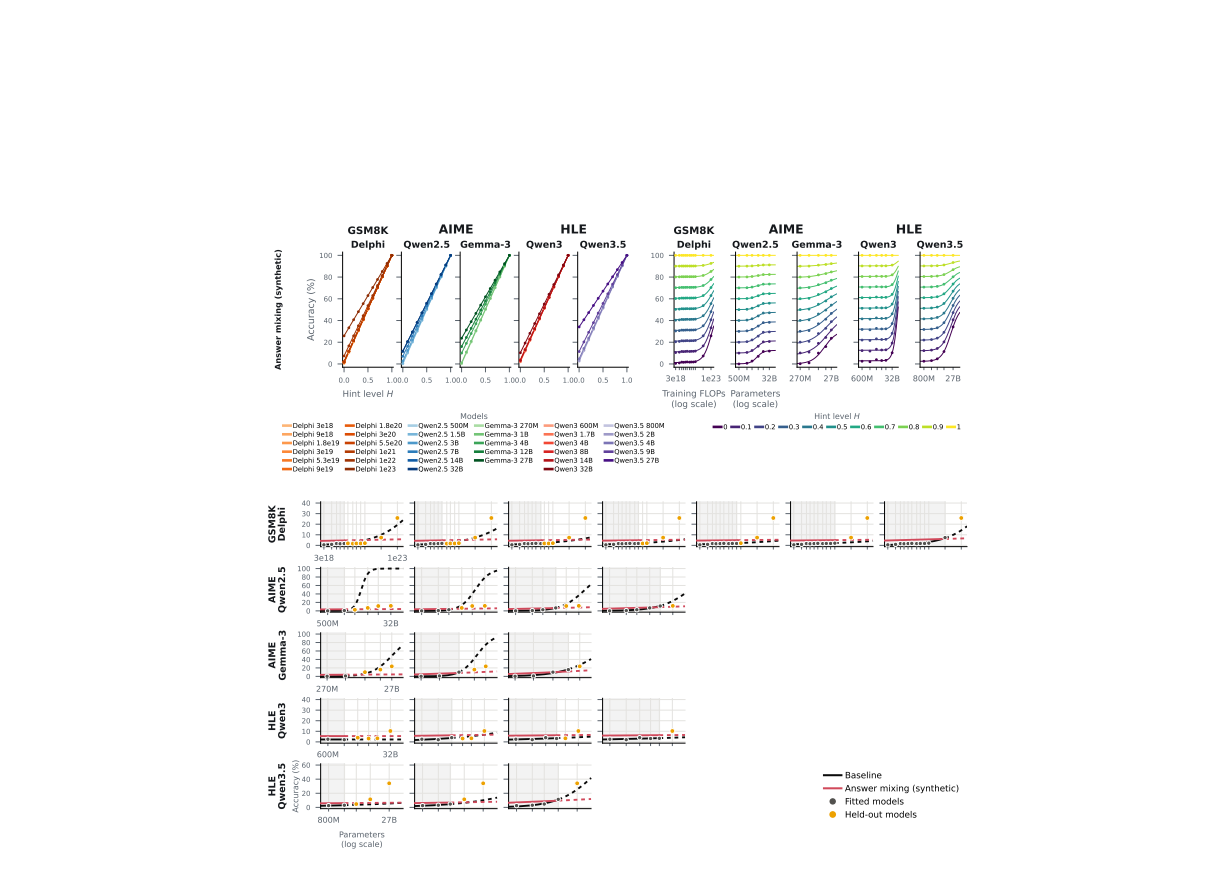
There is a proven boundary on the method: by Proposition 1, any hinting scheme whose accuracy is a function of $H$ and the unhinted accuracy alone cannot beat the best unhinted forecaster, so the benefit specifically comes from hints that reveal information not already present in the near-zero scores.
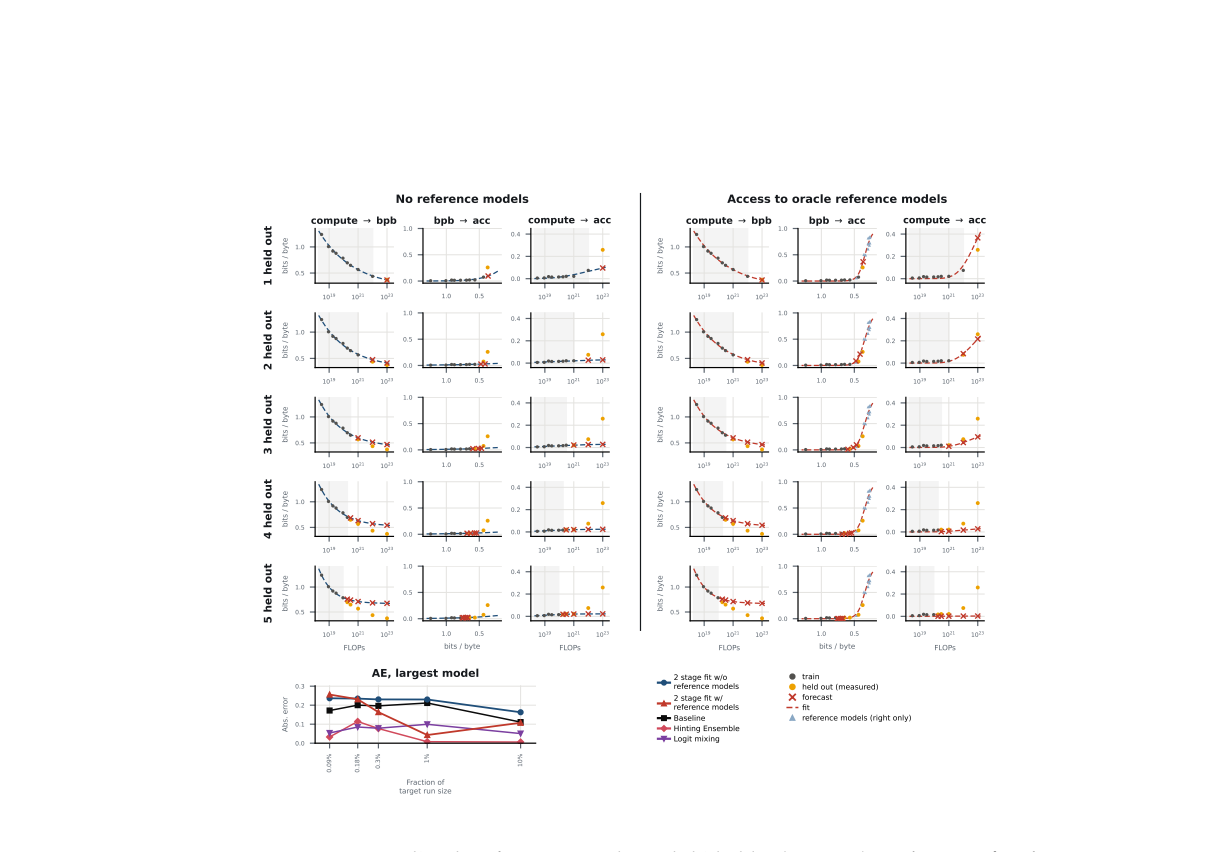
The two-stage alternative of extrapolating bits-per-byte and mapping it to accuracy via external reference models fails on the same ladder, because its second stage refits a sigmoid to near-zero unhinted accuracies; hinting supplies the missing signal directly in the metric of interest.
Editorial extension: the fitted exchange rate $-\beta_1/\beta_2$ between hint level and log-scale compute quantifies how many FLOPs one unit of privileged information is worth on a given benchmark; that number could be used directly to decide whether to spend evaluation budget on more compute or on better hints.
Editorial extension: the paper's hinting axis and its pass@k axis (already treated as a hinting method) could be unified with information-budget schemes into a single 'privileged information' continuum whose fitted contours reveal which axis is cheapest to move along.
Editorial extension: a decisive stress test is a genuinely new pretraining ladder trained on a different data recipe, since the authors themselves note that only Delphi is a true scaling ladder and that post-trained-family results may reflect family artifacts; a clean success there would separate the law's generality from ladder-specific structure.
Editorial extension: for expensive agentic safety evaluations, replaying a prefix of a successful trajectory as a hint is a direct transfer of the ranking recipe, with the caveat the authors acknowledge that it requires benchmarks with verified, legible reference solutions.
Check this review
Pith stored no record of this review's passes and took no fingerprint of it. Reviews made by code from 13 Nov 2026 on carry both.
How often reviews like this one are right
Reviews like this one: written by deepseek-v4-flash, where what was read was not recorded.
How often objections from reviews like this one are right: not yet measured
Reviews by people
This review was written by a machine. No person has reviewed this paper on Pith yet. A scientist listed on Pith can review it for a fee, and their review is published here whatever it concludes.
The paper
Abstract
Scaling laws predict the outcome of large, expensive training runs by extrapolating trends from smaller, cheaper runs. On downstream accuracy evaluations, these predictions fail when the weaker models produced by the cheaper runs score near zero accuracy, because these scores give no trend to extrapolate to larger scales. We introduce hinted scaling laws, which use privileged information to turn a benchmark into a continuum of easier versions so that even the small models score above zero. We find that accuracy rises smoothly and predictably with the hint level, enabling new types of scaling laws that operate below the noise threshold. On the Delphi pretraining ladder, a hinted scaling law fit on models trained with at most 1020 FLOPs forecasts the GSM8K accuracy of a 1023 FLOP model (25.9%) to within 3 percentage points; a standard scaling law under-forecasts it by 13 percentage points when fit on the same models and by 12 even with models up to 1022 FLOPs in the fit. Across both this pretraining ladder and a collection of post-trained model families, hinted scaling laws reduce the median forecasting error on GSM8K, AIME and HLE from 21 percentage points to 4.3. Hinting also reduces the number of test examples needed to tell whether one model is better than another by widening the accuracy gaps between models while approximately preserving their order: a single hinted rollout per problem ranks nearly indistinguishable models as accurately as five unhinted rollouts. Our results suggest that hinting is a general primitive for improving the accuracy and cost of downstream scaling laws and other prediction tasks in model development.
The paper's own sentences, arranged, kept beside the review and separate from it. Each label is drawn from a closed vocabulary; the number beside it is the probability the classifier gave that label. No sentence in this record was written by a model.
abstract compiled · 2026-11-03
The authors' main claim, as the classifier picked it out 0.99
“Our results suggest that hinting is a general primitive for improving the accuracy and cost of downstream scaling laws and other prediction tasks in model development.”
How the main claim is stated: hedged possibility 1.00
What the abstract itself states, as probabilities: claims first 0.09 · states limitation 0.23 · human participants 0.04 · controlled comparison 0.90 · randomized assignment 0.02 · states quantitative result 0.99 · compares with prior results 0.96 · mentions code or data availability 0.03
The abstract, sentence by sentence
This table labels the abstract only (arXiv listing abstract v1). The number is the probability the classifier gave the label.
| Sentence | Role | The authors' own work | States the main conclusion | Strength |
|---|---|---|---|---|
| Scaling laws predict the outcome of large, expensive training runs by extrapolating trends from smaller, cheaper runs. | background 1.00 | 0.04 | 0.03 | asserted 1.00 |
| On downstream accuracy evaluations, these predictions fail when the weaker models produced by the cheaper runs score near zero accuracy, because these scores give no trend to extrapolate to larger scales. | background 0.56 | 0.21 | 0.04 | asserted 1.00 |
| We introduce hinted scaling laws, which use privileged information to turn a benchmark into a continuum of easier versions so that even the small models score above zero. | contribution 0.79 | 0.86 | 0.15 | asserted 1.00 |
| We find that accuracy rises smoothly and predictably with the hint level, enabling new types of scaling laws that operate below the noise threshold. | result 0.98 | 0.96 | 0.17 | asserted 1.00 |
| On the Delphi pretraining ladder, a hinted scaling law fit on models trained with at most $10^{20}$ FLOPs forecasts the GSM8K accuracy of a $10^{23}$ FLOP model (25.9%) to within 3 percentage points; a standard scaling law under-forecasts it by 13 percentage points when fit on the same models and by 12 even with models up to $10^{22}$ FLOPs in the fit. | result 1.00 | 0.96 | 0.14 | asserted 1.00 |
| Across both this pretraining ladder and a collection of post-trained model families, hinted scaling laws reduce the median forecasting error on GSM8K, AIME and HLE from 21 percentage points to 4.3. | result 1.00 | 0.95 | 0.23 | asserted 1.00 |
| Hinting also reduces the number of test examples needed to tell whether one model is better than another by widening the accuracy gaps between models while approximately preserving their order: a single hinted rollout per problem ranks nearly indistinguishable models as accurately as five unhinted rollouts. | result 1.00 | 0.94 | 0.08 | asserted 1.00 |
| Our results suggest that hinting is a general primitive for improving the accuracy and cost of downstream scaling laws and other prediction tasks in model development. | interpretation 1.00 | 0.48 | 0.84 | hedged possibility 1.00 |
What kind of paper the classifier reports this is: method or tool 0.99 · evidence from observation or experiment 0.82
What was examined, and what was not
Sources read
- arXiv listing abstract v1
Not examined
- full text
- figures and tables
- references and citing sentences
- relations to other papers
Levels run
- P abstract
Not run
- S sections
- T body sentences
- C citations
- R cross-paper relations
How the labels were made
Compiled by classifier-1.13.0 via TypeSafe API, question bank abstract-p1-20260923, 2026-11-03: 1 request, 6,525 input tokens.
Every quoted sentence on this record is the authors'. Every label is from Pith's closed vocabulary, with the probability shown beside it. This record as JSON
Figures (20)





Showing 17 of the paper's 20 figures. Figures are the authors', reproduced from the paper.
References (46)
- [1] Priyank Agrawal, Ankur Samanta, Shervin Ghasemlou, Boris Vidolov, Jalaj Bhandari, Kavosh Asadi, Daniel Jiang, and Aditya Modi. Off-context grpo: Learning to reason on hard problems using privileged information, 2026. URL https://arxiv.org/abs/2607.19313 on PithPith's reviewarXiv
- [2] AI Security Institute . How fast is autonomous AI cyber capability advancing? https://www.aisi.gov.uk/blog/how-fast-is-autonomous-ai-cyber-capability-advancing, 2026. Accessed: 2026-09-01 on Pith
- [3] Rico Angell, Raghav Singhal, Zachary Horvitz, Zhou Yu, Rajesh Ranganath, Kathleen McKeown, and He He. Estimating tail risks in language model output distributions. In International Conference on Machine Learning, 2026. URL https://arxiv.org/abs/2604.22167 on PithPith's reviewarXiv
- [4] Esma Balkır, Alice Pernthaller, Marco Basaldella, José Hernández-Orallo, and Nigel Collier. Confident rankings with fewer items: Adaptive llm evaluation with continuous scores, 2026. URL https://arxiv.org/abs/2601.13885 on PithPith's reviewarXiv
- [5] Akshita Bhagia, Jiacheng Liu, Alexander Wettig, David Heineman, Oyvind Tafjord, Ananya Harsh Jha, Luca Soldaini, Noah A. Smith, Dirk Groeneveld, Pang Wei Koh, Jesse Dodge, and Hannaneh Hajishirzi. Establishing task scaling laws via compute-efficient model ladders. In Second Co... on Pith
- [6] Bradley Brown, Jordan Juravsky, Ryan Ehrlich, Ronald Clark, Quoc V. Le, Christopher Ré, and Azalia Mirhoseini. Large language monkeys: Scaling inference compute with repeated sampling, 2024. URL https://arxiv.org/abs/2407.21787 on PithPith's reviewarXiv
- [7] Chirag Chawla, Pratinav Seth, and Vinay Kumar Sankarapu. ALIGNBEAM : Inference-time alignment transfer via cross-vocabulary logit mixing. In Proceedings of the 2026 Conference on Empirical Methods in Natural Language Processing, pages 60438--60464. Association for Computationa... on Pith
- [8] Yangyi Chen, Binxuan Huang, Yifan Gao, Zhengyang Wang, Jingfeng Yang, and Heng Ji. Scaling laws for predicting downstream performance in LLM s. Transactions on Machine Learning Research, 2025. ISSN 2835-8856. URL https://openreview.net/forum?id=PJUbMDkQVY on Pith
- [9] Samir Yitzhak Gadre, Georgios Smyrnis, Vaishaal Shankar, Suchin Gururangan, Mitchell Wortsman, Rulin Shao, Jean Mercat, Alex Fang, Jeffrey Li, Sedrick Keh, Rui Xin, Marianna Nezhurina, Igor Vasiljevic, Luca Soldaini, Jenia Jitsev, Alex Dimakis, Gabriel Ilharco, Pang Wei Koh, S... on Pith
- [10] Aaron Grattafiori et al. The llama 3 herd of models, 2024. URL https://arxiv.org/abs/2407.21783 on PithPith's reviewarXiv
- [11] Jonathan Hayase, Alisa Liu, Noah A. Smith, and Sewoong Oh. Sampling from your language model one byte at a time. In International Conference on Machine Learning, volume 306, pages 40999--41026. PMLR, 2026. URL https://proceedings.mlr.press/v306/hayase26a.html on Pith
- [12] David Heineman, Valentin Hofmann, Ian Magnusson, Yuling Gu, Noah A. Smith, Hannaneh Hajishirzi, Kyle Lo, and Jesse Dodge. Signal and noise: A framework for reducing uncertainty in language model evaluation. In The Thirty-ninth Annual Conference on Neural Information Processing... on Pith
- [13] Will Held. Scaling laws that extrapolate 300× past the fit. https://www.openathena.ai/blog/delphi/, May 2026. Open Athena Blog on Pith
- [14] Danny Hernandez and Tom B. Brown. Measuring the algorithmic efficiency of neural networks, 2020. URL https://arxiv.org/abs/2005.04305 on PithPith's reviewarXiv
- [15] Jordan Hoffmann, Sebastian Borgeaud, Arthur Mensch, Elena Buchatskaya, Trevor Cai, Eliza Rutherford, Diego de Las Casas, Lisa Anne Hendricks, Johannes Welbl, Aidan Clark, Thomas Hennigan, Eric Noland, Katherine Millican, George van den Driessche, Bogdan Damoc, Aurelia Guy, Sim... on Pith
- [16] Valentin Hofmann, David Heineman, Ian Magnusson, Kyle Lo, Jesse Dodge, Maarten Sap, Pang Wei Koh, Chun Wang, Hannaneh Hajishirzi, and Noah A. Smith. Fluid language model benchmarking. In Second Conference on Language Modeling, 2025. URL https://openreview.net/forum?id=mxcCg9YRqj on Pith
- [17] Shengding Hu, Xin Liu, Xu Han, Xinrong Zhang, Chaoqun He, Weilin Zhao, Yankai Lin, Ning Ding, Zebin Ou, Guoyang Zeng, Zhiyuan Liu, and Maosong Sun. Predicting emergent abilities with infinite resolution evaluation. In The Twelfth International Conference on Learning Representa... on Pith
- [18] Andy L. Jones. Scaling scaling laws with board games, 2021. URL https://arxiv.org/abs/2104.03113 on PithPith's reviewarXiv
- [19] Erik Jones, Meg Tong, Jesse Mu, Mohammed Mahfoud, Jan Leike, Roger Grosse, Jared Kaplan, William Fithian, Ethan Perez, and Mrinank Sharma. Forecasting rare language model behaviors, 2025. URL https://arxiv.org/abs/2502.16797 on PithPith's reviewarXiv
- [20] Jared Kaplan, Sam McCandlish, Tom Henighan, Tom B. Brown, Benjamin Chess, Rewon Child, Scott Gray, Alec Radford, Jeffrey Wu, and Dario Amodei. Scaling laws for neural language models, 2020. URL https://arxiv.org/abs/2001.08361 on PithPith's reviewarXiv
show 26 more
- [21] M. G. Kendall. A new measure of rank correlation. Biometrika, 30 0 (1/2): 0 81--93, 1938. ISSN 00063444. URL http://www.jstor.org/stable/2332226 on Pith
- [22] Woosung Koh, Juyoung Suk, Sungjun Han, Se-Young Yun, and Jay Shin. Predicting LLM reasoning performance with small proxy model. In The Fourteenth International Conference on Learning Representations, 2026. URL https://openreview.net/forum?id=JSE40ljyKm on Pith
- [23] Jakub Krajewski, Amitis Shidani, Dan Busbridge, Sam Wiseman, and Jason Ramapuram. Revisiting the scaling properties of downstream metrics in large language model training. In The Fourteenth International Conference on Learning Representations, 2026. URL https://openreview.net/... on Pith
- [24] Ziheng Li, Zexu Sun, Jinman Zhao, Erxue Min, Yongcheng Zeng, Hui Wu, Hengyi Cai, Shuaiqiang Wang, Dawei Yin, Xu Chen, and Zhi-Hong Deng. Staying in the sweet spot: Responsive reasoning evolution via capability-adaptive hint scaffolding, 2025. URL https://arxiv.org/abs/2509.06923 on PithPith's reviewarXiv
- [25] Hong Liu, Sang Michael Xie, Zhiyuan Li, and Tengyu Ma. Same pre-training loss, better downstream: Implicit bias matters for language models. In International Conference on Machine Learning, pages 22188--22214. PMLR, 2023 on Pith
- [26] Nicholas Lourie, Michael Y. Hu, and Kyunghyun Cho. Scaling laws are unreliable for downstream tasks: A reality check. In Christos Christodoulopoulos, Tanmoy Chakraborty, Carolyn Rose, and Violet Peng, editors, Findings of the A ssociation for C omputational L inguistics: EMNLP... on Pithdoi:10.18653/v1/2025.findings-emnlp.877
- [27] Ian Magnusson, Nguyen Tai, Ben Bogin, David Heineman, Jena D. Hwang, Luca Soldaini, Akshita Bhagia, Jiacheng Liu, Dirk Groeneveld, Oyvind Tafjord, Noah A. Smith, Pang Wei Koh, and Jesse Dodge. D ata D ecide: How to predict best pretraining data with small experiments. In Aarti... on Pith
- [28] Felipe Maia Polo, Lucas Weber, Leshem Choshen, Yuekai Sun, Gongjun Xu, and Mikhail Yurochkin. tiny B enchmarks: evaluating LLM s with fewer examples. In Ruslan Salakhutdinov, Zico Kolter, Katherine Heller, Adrian Weller, Nuria Oliver, Jonathan Scarlett, and Felix Berkenkamp, e... on Pith
- [29] Team Olmo, Allyson Ettinger, Amanda Bertsch, Bailey Kuehl, David Graham, David Heineman, Dirk Groeneveld, Faeze Brahman, Finbarr Timbers, Hamish Ivison, Jacob Morrison, Jake Poznanski, Kyle Lo, Luca Soldaini, Matt Jordan, Mayee Chen, Michael Noukhovitch, Nathan Lambert, Pete W... on PithPith's reviewarXiv
- [30] Arkil Patel, Siva Reddy, Marius Mosbach, and Dzmitry Bahdanau. Forecasting downstream performance of LLMs with proxy metrics, 2026. URL https://arxiv.org/abs/2605.18607 on PithPith's reviewarXiv
- [31] Yuxiao Qu, Amrith Setlur, Virginia Smith, Ruslan Salakhutdinov, and Aviral Kumar. POPE : Learning to reason on hard problems via privileged on-policy exploration, 2026. URL https://arxiv.org/abs/2601.18779 on PitharXiv
- [32] Yangjun Ruan, Chris J. Maddison, and Tatsunori Hashimoto. Observational scaling laws and the predictability of langauge model performance. In The Thirty-eighth Annual Conference on Neural Information Processing Systems, 2024. URL https://openreview.net/forum?id=On5WIN7xyD on Pith
- [33] Rylan Schaeffer, Brando Miranda, and Sanmi Koyejo. Are emergent abilities of large language models a mirage? In A. Oh, T. Naumann, A. Globerson, K. Saenko, M. Hardt, and S. Levine, editors, Advances in Neural Information Processing Systems, volume 36, pages 55565--55581. Curra... on Pithdoi:10.52202/075280-2425
- [34] Rylan Schaeffer, Joshua Kazdan, John Hughes, Jordan Juravsky, Sara Price, Aengus Lynch, Erik Jones, Robert Kirk, Azalia Mirhoseini, and Sanmi Koyejo. How do large language monkeys get their power ( L aws)? In Aarti Singh, Maryam Fazel, Daniel Hsu, Simon Lacoste-Julien, Felix B... on Pith
- [35] Amrith Setlur, Zijian Wang, Andrew Cohen, Paria Rashidinejad, and Sang Michael Xie. Reuse your FLOP s: Scaling RL on hard problems by conditioning on very off-policy prefixes. In Forty-third International Conference on Machine Learning, 2026. URL https://openreview.net/forum?i... on Pith
- [36] Charlie Victor Snell, Eric Wallace, Dan Klein, and Sergey Levine. Predicting emergent capabilities by finetuning. In First Conference on Language Modeling, 2024. URL https://openreview.net/forum?id=vL8BIGuFTF on Pith
- [37] Jacob Mitchell Springer, Sachin Goyal, Kaiyue Wen, Tanishq Kumar, Xiang Yue, Sadhika Malladi, Graham Neubig, and Aditi Raghunathan. Overtrained language models are harder to fine-tune. In Aarti Singh, Maryam Fazel, Daniel Hsu, Simon Lacoste-Julien, Felix Berkenkamp, Tegan Maha... on Pith
- [38] Ishaan Watts, Catherine Li, Sachin Goyal, Jacob Mitchell Springer, and Aditi Raghunathan. Sharpness-aware pretraining mitigates catastrophic forgetting. arXiv preprint arXiv:2605.02105, 2026 on PithPith's reviewarXiv
- [39] Jason Wei, Yi Tay, Rishi Bommasani, Colin Raffel, Barret Zoph, Sebastian Borgeaud, Dani Yogatama, Maarten Bosma, Denny Zhou, Donald Metzler, Ed H. Chi, Tatsunori Hashimoto, Oriol Vinyals, Percy Liang, Jeff Dean, and William Fedus. Emergent abilities of large language models, 2... on PithPith's reviewarXiv
- [40] Kaiyue Wen, Tengyu Ma, and Percy Liang. Priced guidance: Can language models generate future research ideas?, 2026. URL https://arxiv.org/abs/2610.04976 on PithPith's reviewarXiv
- [41] Gabriel Wu and Jacob Hilton. Estimating the probabilities of rare outputs in language models. In Y. Yue, A. Garg, N. Peng, F. Sha, and R. Yu, editors, International Conference on Learning Representations, volume 2025, pages 82678--82706, 2025. URL https://proceedings.iclr.cc/p... on Pith
- [42] Yangyifan Xu, Jinliang Lu, and Jiajun Zhang. Bridging the gap between different vocabularies for LLM ensemble. In Proceedings of the 2024 Conference of the North American Chapter of the Association for Computational Linguistics: Human Language Technologies (Volume 1: Long Pape... on Pithdoi:10.18653/v1/2024.naacl-long.395
- [43] Gregory Yauney, Shahzaib Saqib Warraich, and Swabha Swayamdipta. How reliable is language model micro-benchmarking? In The Fourteenth International Conference on Learning Representations, 2026. URL https://openreview.net/forum?id=cReExMQLiK on Pith
- [44] Tan Yu, Alexander Bukharin, Khushi Bhardwaj, Jennifer Williams, Zirui Liu, Jonathan Lingjie Li, Soumye Singhal, Joseph Jennings, Sanjeev Satheesh, Yash Jain, Ashish Vaswani, Venkat Krishna Srinivasan, Matthew Papakipos, Hyunwoo Kim, Jian Zhang, Oleksii Kuchaiev, Markus Kliegl,... on PithPith's reviewarXiv
- [45] Guanhua Zhang, Florian E. Dorner, and Moritz Hardt. How benchmark prediction from fewer data misses the mark. In The Thirty-ninth Annual Conference on Neural Information Processing Systems, 2025. URL https://openreview.net/forum?id=o3bftqj17e on Pith
- [46] Jin Peng Zhou, S \'e b Arnold, Nan Ding, Kilian Q Weinberger, Nan Hua, and Fei Sha. Graders should cheat: Privileged information enables expert-level automated evaluations. In Christos Christodoulopoulos, Tanmoy Chakraborty, Carolyn Rose, and Violet Peng, editors, Proceedings ... on Pithdoi:10.18653/v1/2025.emnlp-mai
Cited by 2 Pith papers
Reviewed papers on Pith that cite this one. The full citation record
Challenges and discussion
Disagree with the review, or know something it missed? Leave a comment, or challenge this review formally: a challenge becomes a permanent entry in this paper's record, and its decision is published here.
Come back by email
A short list of the week's newly reviewed papers. Nothing is sent until you confirm from your inbox, and every email has a link that stops it. No account.
No comments yet.
Sign in to comment