Robotics · arXiv:2611.02691 v1 · submitted 2 Nov 2026 · 13 references
Closing the Dynamics Gap through Self-Directed Robotic Interaction
The paper says
“Agentic Real2Sim2Real systems can reconstruct a scene in simulation from camera observations, but contact-rich dynamics such as friction and restitution cannot be observed without interaction.”
more of the abstract
We call this the dynamics gap and present CUE, an agentic system that closes it by interacting with the environment itself. Given only a high-level instruction and no resets, the agent builds its own perception, identifies physical parameters, and targets interactions where its simulation is least accurate. On billiards, CUE reduces held-out ball-position error by 72% relative to the strongest baseline across 25 hidden-physics conditions in simulation, and we further deploy it on a real pool table. More details can be found on the project website: https://cue-dynamics.github.io/
from the abstract
Pith says
Machine review · deepseek-v4-flash · 3 Nov 2026 · what was read was not recorded · not checked by a person
It can be wrong. Challenge this review or reply to it.
Holds up, with conditions. A genuinely new agentic probe-and-refit loop with a plausible headline number, but the 72% claim is unverifiable as written because the paper never defines what 'held-out' means. This line is wrong
4 major objections · 4 minor
How often objections from reviews like this one are right: not yet measured
Not checked: figures, code, what the 13 references say.
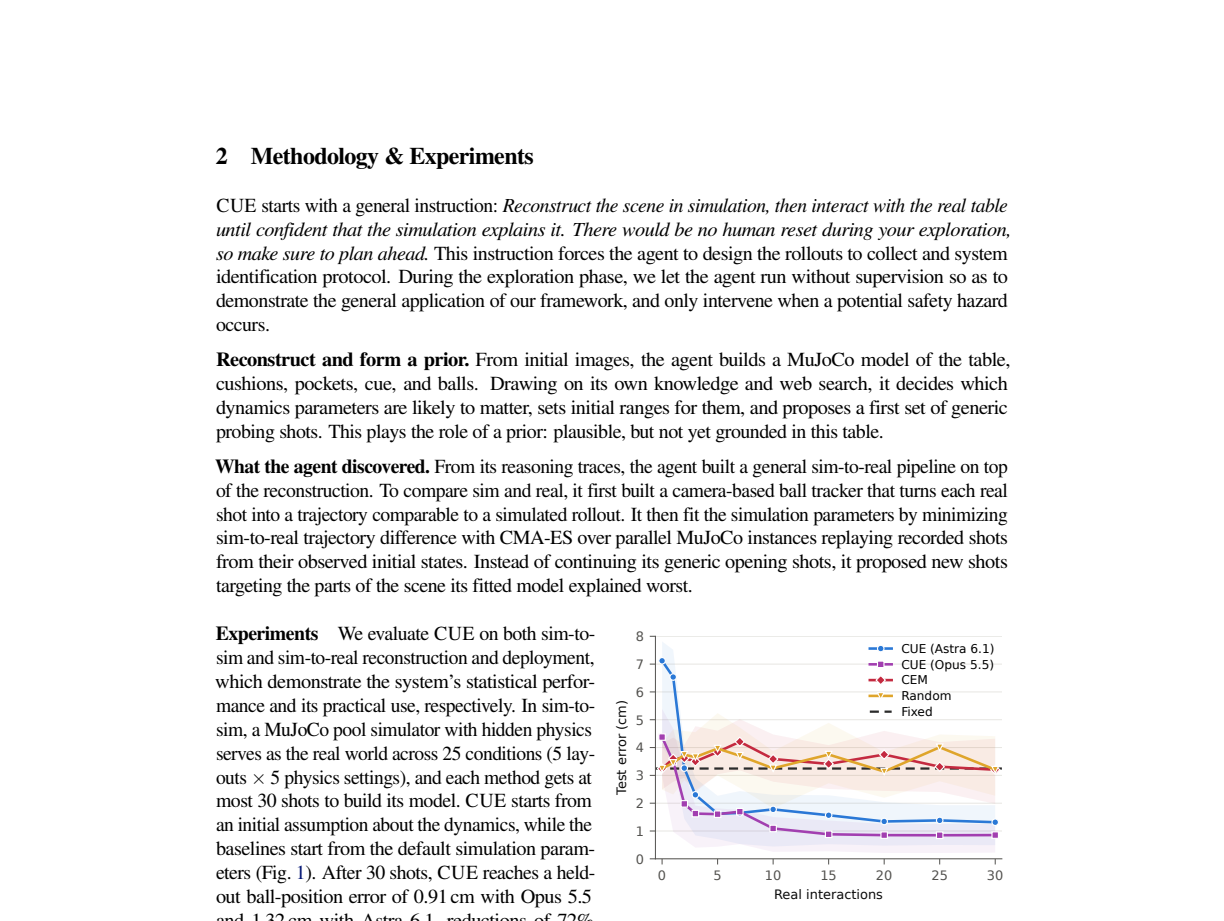
The paper says, at §2, Fig. 1, and the sentence 'After 30 shots, CUE reaches...'
The review did not quote this passage.
Pith says: Objection 1 of 4 · major
The term 'held-out' is never defined. The manuscript does not state that the 30 fitting shots are disjoint from the evaluation shots, does not specify how evaluation shots are sampled, and does not state whether the evaluation distribution avoids the regions that CUE deliberately targeted because its fitted model explained them worst.
more of objection 1
This matters because the agent is explicitly rewarded for probing the parts of the scene where its model is least accurate; if the held-out evaluation set is drawn from the same targeted regions, CUE is evaluated on the distribution it chose to optimize, while CEM, random search, and the fixed model are evaluated on a distribution they never selected. The authors must specify the sampling procedure for evaluation shots, prove or enforce disjointness from fitting shots, and report evaluation error separately on targeted and untargeted regions. The limitations list (b29–b32) acknowledges model-class and vision-pipeline risk, but not this evaluation-protocol risk, which is the central gap.
The paper says, at §2, description of the camera-based ball tracker
The review did not quote this passage.
Pith says: Objection 2 of 4 · major
The same camera-based ball tracker is used to convert real shots into trajectories for CMA-ES fitting and to measure the reported held-out error. If the tracker has a systematic bias, that bias can be absorbed into fitted restitution, friction, and damping parameters, and the held-out error would then measure tracker consistency rather than simulation fidelity.
more of objection 2
The paper should report tracker accuracy on independently labeled data, ideally with a separate measurement modality for evaluation, or at minimum quantify how much of the 0.91 cm error is attributable to perception noise.
The paper says, at §2, baseline comparison paragraph
The review did not quote this passage.
Pith says: Objection 3 of 4 · major
The comparison is confounded by prior information. The text says CUE starts from an initial assumption about the dynamics while the baselines start from the default simulation parameters. Since the headline claim is about the value of self-directed interaction, the reported 72% reduction does not isolate that contribution from the advantage of an LLM-informed prior.
more of objection 3
The authors should include an ablation in which CUE uses only its initial probing shots without active retargeting, or in which the baselines are initialized with the same prior ranges, so that the improvement attributable to active exploration can be separated from the improvement attributable to the prior.
The paper says, at §2, sim-to-real paragraph
The review did not quote this passage.
Pith says: Objection 4 of 4 · major
The real-world deployment is described only by the sentence 'results are shown in the project page' and by the earlier claim of 'zero human involvement.' A project website is not part of the peer-reviewed manuscript, so the real-world claim cannot currently be assessed for apparatus, protocol, number of trials, safety interventions, or quantitative outcomes.
more of objection 4
The real-world results, including the number of human interventions and the measured error, should be reported in the manuscript or the real-world claims should be explicitly labeled as preliminary.
4 minor objections
The paper says, at Fig. 1 caption
Pith says: minor objection 1 of 4
The caption says 'after k real interactions,' but the main quantitative experiment is sim-to-sim with hidden physics; clarify whether the horizontal axis denotes physical real-world interactions or simulated interactions in the hidden-physics world.
The paper says, at §2, uncertainty reporting
Pith says: minor objection 2 of 4
The shaded region is only the 25th–75th percentile; the paper should report the number of seeds per hidden-physics condition and provide explicit confidence intervals or per-condition error bars for the headline 0.91 cm and 1.32 cm numbers.
show 2 more
The paper says, at Throughout
Pith says: minor objection 3 of 4
There are typographical errors, including 'W e' instead of 'We' and 'it's scalability' instead of 'its scalability'; these should be corrected in revision.
The paper says, at References
Pith says: minor objection 4 of 4
Several references are arXiv preprints or conference papers from 2026 that may have published versions by the time of revision; please update the citations where final versions exist.
What would settle it
Re-run the sim-to-sim benchmark with a pre-registered evaluation set of 100 shots sampled uniformly over initial ball configurations and stroke parameters, generated before any agent interaction and never shown to CUE. Report CUE's error on that fixed set after 0 interactions (both with default MuJoCo parameters and with the web-search prior) and after 30 self-directed shots, and report the same error restricted to the regions CUE targeted. If the fixed-set error is close to the 3.20 cm baseline, or if the zero-interaction prior already reaches about 0.91 cm, then the 72% reduction is not evidence for self-directed interaction.
from the skeptic's reading
How the review went
4 readings by deepseek-v4-flash · 3 Nov 2026
- Reader holds up, with conditions
- Skeptic agrees
- Editor wrote the verdict above
- Referee major revision: 4 major objections, 4 minor
Not run on this paper: the simulated authors' defence.
Pith did not check this review's objections against the paper.
The review in full
The review in brief, machine-written
The one thing to know: this is a three-page extended abstract whose value is the integrated loop — an LLM agent that builds its own perception, chooses probing shots, fits MuJoCo parameters, then targets new shots where its model is worst, all without human resets. That loop is not in the cited prior art. ASID is active but human-bounded; PhysimCode and RoboSimStudio are passive. The authors deserve credit for the integration.
What is also good: the headline evaluation has the right shape — held-out error, not training-curve fit. The arithmetic checks out (0.91 vs 3.20 cm is a 71.6% reduction, so the 72% is not inflated). The limitations section is honest: they admit the vision pipeline was fragile and that parameter tuning cannot capture effects outside the model class. I looked for citation problems and found none.
Now the soft spots, in proportion. The load-bearing one is exactly what the stress-test flags: the paper never defines the held-out protocol. It does not state that the 30 fitting shots are disjoint from the evaluation shots, how evaluation shots are sampled, or whether they overlap the regions CUE deliberately targeted. CUE probes where its model explains worst, so if evaluation comes from those same regions, the agent is rewarded for matching the very distribution it chose to probe, while the baselines are measured on a distribution they never optimized against. This looks like an omission in a short paper rather than evidence of cheating, but it makes the headline unverifiable as written. The same self-built camera tracker feeding both fitting and evaluation adds a smaller, separate risk: a biased tracker would be absorbed into the fitted parameters, and no calibration evidence is given.
Two minor points. CUE starts from an LLM-informed prior while the baselines start from MuJoCo defaults, so the comparison conflates prior quality with exploration quality; a zero-interaction ablation would separate them. And the real-world results are deferred to a project website, so the sim-to-real claim corroborates nothing a referee can check.
Who is this for: people in Real2Sim2Real, active system identification, or agentic robotics. It is a good discussion piece and a fair example of evaluation-protocol discipline lagging behind system-building ambition.
Recommendation: send it to referees. The verdict should be conditional, not reject. The missing protocol, code, and data are supplyable; the concept is coherent and worth a full version.
The strongest objection
The central quantitative claim (b26, echoed in b3) is that CUE reaches a held-out ball-position error of 0.91 cm after 30 shots, a 72% reduction over the strongest baseline, but the manuscript never says what held out means. The only experimental description in Section 2 says each method gets at most 30 shots and that CUE proposed new shots targeting the parts of the scene its fitted model explained worst. If the held-out evaluation shots are drawn from the same regions the agent deliberately targeted, CUE is being rewarded for matching the exact distribution it chose to probe, while the untargeted baselines are measured on a distribution they never optimized against. The text also does not state that the 30 fitting shots are disjoint from the evaluation shots, does not specify how evaluation shots are sampled, and does not say whether the agent's camera-based tracker is used for both fitting and evaluation. A tracker with systematic bias would be absorbed into fitted restitution and friction parameters. The real-world deployment is deferred to the project page, so it does not corroborate the number. The paper's own limitations (b29-b32) acknowledge model-class and vision-pipeline risk, but not the evaluation-protocol risk, which is the load-bearing gap.
The reader's weakest assumption identifies the same missing evaluation protocol, and I agree that it is load-bearing: the 72% figure is the only quantitative support for the central claim, and no manuscript text defines the train/test split, the sampling distribution, or the measurement chain. An externally specified, pre-registered test set is the minimal condition under which the headline number is meaningful. I do not see this as a reason to reject the work: the idea is coherent and the reported direction is plausible, but it is currently unverifiable from the manuscript. The paper's own lessons-learned paragraphs already concede the vision-pipeline and model-class limitations, so those are acknowledged limitations rather than new objections. No load-bearing citation gaps were found. Therefore the stress-test pass does not change the reader's CONDITIONAL verdict; the condition should include a precise held-out protocol and the zero-interaction ablation.
The referee's report
If the headline result is reproducible, the contribution is significant: it demonstrates that an agent operating without human resets can actively choose interactions to make a reconstructed simulation predictive of contact-rich dynamics, and it does so across 25 hidden-physics conditions. The paper should be credited for choosing a held-out evaluation design as the right non-circular shape for the claim, for testing multiple layouts and physics settings, and for attempting a real-world deployment. However, the current manuscript does not provide enough experimental specification to support the quantitative claim: the held-out protocol is undefined, the baselines are not controlled for the informed prior, the same tracker feeds both fitting and evaluation, and the real-world numbers are deferred to a project website. These are load-bearing gaps, not presentation issues.
Pith's reading of the paper (a machine's summary, not the authors')
The paper aims to establish that an autonomous agent can close the dynamics gap—the part of a physical scene that cannot be inferred from static views—by choosing its own interactions and refitting its simulator. On billiards, CUE builds a table model from images, proposes probing shots, fits hidden friction and restitution parameters by replaying trajectories, and then targets the regions its model explains worst. The headline result is that after 30 self-directed shots the held-out ball-position error falls to 0.91 cm and 1.32 cm with the two tested model variants, cuts of 72% and 59% relative to the strongest baselines, across 25 hidden-physics conditions in simulation. A real pool-table deployment runs without human resets. The reason this matters is that self-directed exploration could replace human-curated data and hand-specified system identification in Real2Sim2Real systems.
What carries the argument. The load-bearing object is CUE (Calibration Using Exploration), a closed loop of reconstruct, fit, and target. From initial images the agent builds a physics-simulator model of the table, cushions, pockets, cue, and balls; creates a camera-based ball tracker that turns each real shot into a trajectory comparable to a simulated rollout; fits simulation parameters by minimizing sim-to-real trajectory difference with CMA-ES over parallel simulator instances replaying recorded shots from their observed initial states; and proposes new shots targeting the parts of the scene its fitted model explains worst. The loop's targeting step is the mechanism that distinguishes CUE from passive baselines, and the paper attributes the error reduction to this decision-making.
Core claim. Stated on the paper's own terms, the central discovery is that an agent's simulation becomes increasingly predictive of real outcomes through self play. CUE starts from a single high-level instruction, assembles its own perception and system-identification pipeline, and sequentially proposes experiments where its current model is least accurate. After 30 interactions it reports held-out ball-position error of 0.91 cm (Opus 5.5) and 1.32 cm (Astra 6.1), against 3.20 cm for the strongest baseline (CEM and random search tie) and 3.25 cm for the unfitted model, averaged over 25 hidden-physics conditions. The paper presents these numbers as evidence that the dynamics gap can be narrowed by actively gathering the right interaction data, and it reports a real pool-table deployment as initial proof that the loop can run outside simulation.
The premise it rests on. The 72% headline depends on an unstated evaluation protocol: shots used to fit the model must be disjoint from held-out evaluation shots and must not cover exactly the regions the agent targeted, and the camera-based tracker must measure trajectories without systematic bias—if either condition fails, the reported reduction can be inflated.
If the paper is right (Pith's inferences, not the authors')
Fully autonomous Real2Sim2Real systems could run from a high-level instruction, with the agent itself choosing what to perceive, what to fit, and what to try next, rather than relying on human-designed experiments.
Active self-directed probing should reduce the need for large passive interaction datasets, because the agent spends its interaction budget on the least-explained parts of the scene.
The 25-condition simulation sweep and the real pool-table run suggest the procedure is not tied to a single table or physics setting, although more contact-rich tasks are needed to establish generality.
The paper's own lessons point to the next bottleneck: richer dynamics models that combine physics with data-driven corrections, and vision tools reliable enough for agents to assemble without supervision.
Inference: a matched ablation that keeps perception, replay, and fitting fixed while varying only the shot-targeting rule would isolate how much of the 72% reduction comes from self-direction rather than from the extra fitting iterations.
Inference: because the agent's own tracker mediates both fitting and evaluation, an external motion-capture or high-speed camera check would tell whether the centimeter numbers are true world-coordinate accuracy or merely tracker-consistent measurements.
Inference: the same instruction-driven loop is a natural fit for other contact-rich manipulation tasks—friction in pushing, restitution in throwing, compliance in insertion—whenever the simulator exposes tunable parameters and the agent can generate feasible exploratory actions.
Check this review
Pith stored no record of this review's passes and took no fingerprint of it. Reviews made by code from 13 Nov 2026 on carry both.
How often reviews like this one are right
Reviews like this one: written by deepseek-v4-flash, where what was read was not recorded.
How often objections from reviews like this one are right: not yet measured
Reviews by people
This review was written by a machine. No person has reviewed this paper on Pith yet. A scientist listed on Pith can review it for a fee, and their review is published here whatever it concludes.
The paper
Abstract
Agentic Real2Sim2Real systems can reconstruct a scene in simulation from camera observations, but contact-rich dynamics such as friction and restitution cannot be observed without interaction. We call this the dynamics gap and present CUE, an agentic system that closes it by interacting with the environment itself. Given only a high-level instruction and no resets, the agent builds its own perception, identifies physical parameters, and targets interactions where its simulation is least accurate. On billiards, CUE reduces held-out ball-position error by 72% relative to the strongest baseline across 25 hidden-physics conditions in simulation, and we further deploy it on a real pool table. More details can be found on the project website: https://cue-dynamics.github.io/
The paper's own sentences, arranged, kept beside the review and separate from it. Each label is drawn from a closed vocabulary; the number beside it is the probability the classifier gave that label. No sentence in this record was written by a model.
abstract compiled · 2026-11-03
The authors' main claim, as the classifier picked it out 0.77
“On billiards, CUE reduces held-out ball-position error by 72% relative to the strongest baseline across 25 hidden-physics conditions in simulation, and we further deploy it on a real pool table.”
How the main claim is stated: asserted 1.00
What the abstract itself states, as probabilities: claims first 0.08 · states limitation 0.25 · human participants 0.04 · controlled comparison 0.93 · randomized assignment 0.03 · states quantitative result 0.98 · compares with prior results 0.97 · mentions code or data availability 0.40
The abstract, sentence by sentence
This table labels the abstract only (arXiv listing abstract v1). The number is the probability the classifier gave the label.
| Sentence | Role | The authors' own work | States the main conclusion | Strength |
|---|---|---|---|---|
| Agentic Real2Sim2Real systems can reconstruct a scene in simulation from camera observations, but contact-rich dynamics such as friction and restitution cannot be observed without interaction. | gap 0.53 | 0.11 | 0.05 | asserted 1.00 |
| We call this the dynamics gap and present CUE, an agentic system that closes it by interacting with the environment itself. | contribution 0.98 | 0.86 | 0.34 | asserted 0.99 |
| Given only a high-level instruction and no resets, the agent builds its own perception, identifies physical parameters, and targets interactions where its simulation is least accurate. | method 0.96 | 0.75 | 0.10 | asserted 0.99 |
| On billiards, CUE reduces held-out ball-position error by 72% relative to the strongest baseline across 25 hidden-physics conditions in simulation, and we further deploy it on a real pool table. | result 1.00 | 0.96 | 0.56 | asserted 1.00 |
| More details can be found on the project website: https://cue-dynamics.github.io/ | future work 0.82 | 0.10 | 0.01 | unclear 0.86 |
What kind of paper the classifier reports this is: method or tool 1.00 · evidence from observation or experiment 0.80
What was examined, and what was not
Sources read
- arXiv listing abstract v1
Not examined
- full text
- figures and tables
- references and citing sentences
- relations to other papers
Levels run
- P abstract
Not run
- S sections
- T body sentences
- C citations
- R cross-paper relations
How the labels were made
Compiled by classifier-1.13.0 via TypeSafe API, question bank abstract-p1-20260923, 2026-11-03: 1 request, 4,261 input tokens.
Every quoted sentence on this record is the authors'. Every label is from Pith's closed vocabulary, with the probability shown beside it. This record as JSON
Figures (1)
Figures are the authors', reproduced from the paper.
References (13)
- [1] S. Gao, M. Pagnucco, T . Bednarz, and Y . Song. NVIDIA isaac sim: Enabling scalable, GPU- accelerated simulation for robotics, 2026. URLhttps://arxiv.org/abs/2606.03551 on PithPith's reviewarXiv
- [2] NVIDIA. Isaac lab: A GPU-accelerated simulation framework for multi-modal robot learning, 2025. URLhttps://arxiv.org/abs/2511.04831 on PithPith's reviewarXiv
- [3] OpenAI. GPT -6 Astra: A new generation of intelligence. https://openai.com/index/ gpt-6-astra/, 2026. Accessed: 2026-10-24 on Pith
- [4] Y . Li, Y . Feng, S. Sun, J. Chen, H. Ren, B. Y ang, W . Xu, Q. Wu, H. Cheng, and R. Xu. Agentic rsr: Real-to-sim-to-real through scene reconstruction and execution-grounded robot policies, 2026. URL https://arxiv.org/abs/2610.10479 on PithPith's reviewarXiv
- [5] K. Ren, Y . Xu, K. Song, L. Xu, B. Dai, M. Y u, and T . Lu. Real2gym: Building gyms from videos, bringing skills to robots, 2026. URLhttps://arxiv.org/abs/2609.37089 on PithPith's reviewarXiv
- [6] Y .-J. W ang, H. Jiang, S. Deng, H. Xue, W . Y e, R. Duan, N. Haghtalab, S. S. Sastry, P . Abbeel, and H. Qi. Reconstruct, practice, go real: Guided self-improvement for embodied agents, 2026. URL https://arxiv.org/abs/2610.02204 on PithPith's reviewarXiv
- [7] G. Huh, C. Gu, T . E. Truong, C. K. Liu, and G. Tevet. HomeBody: A humanoid that explores, remembers, and acts on its own, 2026. URLhttps://tml.stanford.edu/homebody/ on Pith
- [8] Z. Xiao, M. Pan, N. He, D. Zhou, and Y . W ang. VPT win: Real-sim-real video prediction for robotic manipulation planning, 2026. URLhttps://arxiv.org/abs/2609.33104 on PithPith's reviewarXiv
- [9] S. Kundu, A. Gupta, J. Julin, Y . Zhao, L. Xie, and L. A. Jeni. Physimcode: A benchmark and evaluation method for physics video to code generation, 2026. URLhttps://arxiv.org/abs/ 2610.15722 on PithPith's reviewarXiv
- [10] K. Chen, S. Xie, U. Y oo, X. Zhu, C. Magner, A. Zhu, D. Kim, E. Heiden, E. Coumans, M. Macklin, et al. Robosimstudio: An interactive toolkit for rapid real2sim of robot manipulation tasks.arXiv preprint arXiv:2610.18835, 2026 on PithPith's reviewarXiv
- [11] P . Huang, X. Zhang, Z. Cao, S. Liu, M. Xu, W . Ding, J. Francis, B. Chen, and D. Zhao. What went wrong? closing the sim-to-real gap via differentiable causal discovery. InConference on Robot Learning, 2023 on Pith
- [12] X. Zhang, S. Liu, P . Huang, W . J. Han, Y . Lyu, M. Xu, and D. Zhao. Dynamics as prompts: In-context learning for sim-to-real system identifications, 2024. URLhttps://arxiv.org/abs/2410.20357 on PithPith's reviewarXiv
- [13] M. Memmel, A. W agenmaker, C. Zhu, D. Fox, and A. Gupta. Asid: Active exploration for system identification in robotic manipulation. InInternational Conference on Learning Representations, volume 2024, pages 39979–39997, 2024. 3 on Pith
Challenges and discussion
Disagree with the review, or know something it missed? Leave a comment, or challenge this review formally: a challenge becomes a permanent entry in this paper's record, and its decision is published here.
Come back by email
A short list of the week's newly reviewed papers. Nothing is sent until you confirm from your inbox, and every email has a link that stops it. No account.
No comments yet.
Sign in to comment