Machine Learning · arXiv:2611.06661 v1 · submitted 4 Nov 2026 · 38 references
Fingerprinting the Dispatchers behind Distributed Model Extraction
The paper says
“API distillation campaigns try to hide model-stealing traffic by splitting requests across thousands of load-balanced accounts, which standard content classifiers often miss.”
more of the abstract
However, request timestamps, specifically arrival time and stream completion time, reveal the underlying dispatching strategy, such as round-robin counters or key-shuffling pools. Using a 20 percent seed set, this timing analysis can forensically rank the remaining accounts of a campaign with 0.92 to 1.00 AUC within 20 minutes, even across thousands of real production accounts. While adaptive attackers struggle to hide rotating dispatchers using jitter, pinning keys successfully evades detection, though it can severely throttle throughput when quotas bind. Ultimately, timing exposes shared infrastructure patterns even when content filters fail.
from the abstract
Pith says
Machine review · deepseek-v4-flash · 5 Nov 2026 · what was read was not recorded · not checked by a person
It can be wrong. Challenge this review or reply to it.
Holds up, with conditions. The parameter-free ring-profile prediction is genuine and confirmed on live data; the headline expansion claim is still only tested against campaigns the author wrote, and the two real relay groups sitting in the production trace would fix that. This line is wrong
3 major objections · 8 minor
How often objections from reviews like this one are right: not yet measured
Not checked: figures, code, what the 38 references say.
The paper says, at §VI, Table II, §XIII (R7)
The review did not quote this passage.
Pith says: Objection 1 of 3 · major
The expansion claim is validated only on positives the authors wrote. §XIII, Data, states that eleven synthetic pools 'are simulated with each window's own answer durations and a quota of 15 requests per minute per key' and added to real background, and §XV confirms that every campaign in the experiments is synthetic.
more of objection 1
The real shared-dispatch evidence in the trace — the 46-account W0 and 56-account W2 relays of Table X — is used only for classification, never as an expansion seed. This matters more than the general caveat, because of an internal tension the paper does not confront: the pool type of those relays, a shared round-robin ring, is the one Table II shows expands worst from a seed (0.72 in both Two-replica phases, versus 0.94–1.00 for hashing and hedging), and §XI-B says outright that 'rings expand poorly from a seed.' The production R7 result is therefore demonstrated on the four pool types that already expand well, while the campaigns actually found in the trace belong to the type that does not. The test is feasible with the released logs: seed nine of the 46 W0 accounts and rank the remaining 37 against the 3,014 real accounts. I also ask for precision-at-pool-size and an interval alongside the production AUCs; with 8–9 positives per pool the AUC carries real sampling error, and the Repeat-run precision at pool size (0.72 for shuffle) is a much less favourable summary than AUC 0.95.
The paper says, at Table IV, Table V, §XI-C, §XI-D
The review did not quote this passage.
Pith says: Objection 2 of 3 · major
The frozen-classification tallies of 12/12 correct include at least two rows whose class was re-designated in hindsight. In Table IV the LiteLLM least-busy pool (P2) is scored correct with class 'sticky,' and §XI-C justifies this after the fact through the watermark result that about 85% of its follow-up requests return to the same key.
more of objection 2
In Table V the shared-pointer rotate-on-429 pool (F1) is scored correct with class 'per-worker,' and §XI-D says this 'makes sense' in hindsight because each key's successor is fixed. Prediction M4 named locked classes only for hashing (shuffle) and the sticky limit (sticky), so F1's correctness has no locked basis. As printed, the 12/12 rows overstate what the frozen classifier achieved. Please mark the re-designated rows explicitly in the captions and report the tally under the original dispatcher names as well as under the collapsed class set.
The paper says, at §VII, Proposition 4; §XIII R6/R6b; Table IX; Table XII
The review did not quote this passage.
A classifier read this sentence of the paper as acknowledging the concern (probability 0.64):
“This is a weak test, though, because all but one cell predicted no recovery within the hour, and none occurred.”
Pith says: Objection 3 of 3 · major
Proposition 4 is presented as a proposition but Appendix A concedes that it 'is therefore a calibrated approximation, not a theorem,' and its operative content is the constant κ (1.9 in simulation, about 3.2 on production). That is fine as a modelling choice, but the ledger treatment is not.
more of objection 3
The R6b check is called weak by the authors themselves, since all but one cell predicted no recovery and none occurred, yet Table XII counts it as ten held predictions (4/4 and 6/6). Predictions of non-recovery are satisfied by detector failure, so counting them alongside R7 in the 52-of-68 total inflates the score. The count also depends on an undefined tolerance: Table IX footnote † rules one cell consistent 'under the factor-of-2 rule,' and I cannot find that rule defined anywhere in the text, nor a statement of when it was fixed. Please define it and its provenance, and separate predictions of the form 'no recovery will occur' from predictions of recovery in both Table IX and Table XII.
8 minor objections
The paper says, at Abstract
Pith says: minor objection 1 of 8
The phrase 'even across thousands of real production accounts' invites the reading that real campaigns were ranked; since the positives are injected, say so in the abstract sentence itself, not only in §XIII and §XV.
The paper says, at §XI-H and Table VII (E5)
Pith says: minor objection 2 of 8
The claim that the ring 'held for keys kept for 5 requests' rests on ring z = 6.4 against an alarm threshold of 6. Report the spread of that statistic across surrogate seeds before calling it held, or soften the claim.
show 6 more
The paper says, at §XI-C versus Appendix A
Pith says: minor objection 3 of 8
§XI-C says the worker count came within 0.4 of the truth for all ten always-busy pools, while Appendix A reports that the batch-means intervals cover the truth in 7 of 14 pool-runs and that biases run to +0.36. Add the interval-coverage caveat where the accuracy is claimed.
The paper says, at Table V caption
Pith says: minor objection 4 of 8
The hedged pool F5 reports K = 9.2 and 9.4 for 6 workers. State in the caption that the statistic counts in-flight streams rather than workers, since otherwise the row reads as a counting failure.
The paper says, at §V and §XI
Pith says: minor objection 5 of 8
R, R5, R20, R60, z_R and the multi-scale ring z all appear in the decision list without a consolidated definition. A short symbol table, and an explicit statement of which scale steps 1 and 3 of the classifier use, would make the classifier reproducible from the text alone.
The paper says, at §XIII, Table X
Pith says: minor objection 6 of 8
Proposition 1 assumes K < M so that no key holds two requests at once. Say whether that was checked for the two real relays (about 185 and 170 requests per hour, so presumably yes) and for the injected pools, since an account in this trace can in principle hold concurrent streams.
The paper says, at §III and Table VIII
Pith says: minor objection 7 of 8
The content column and the campaign gains (+10.4, +7.6, +2.2, +4.4 points) are inherited from the companion preprint [5]. The text says this once; repeat it in the table caption so a reader can tell which numbers are measured in this paper and which are imported.
The paper says, at §XIII, Data, and Fig. 2
Pith says: minor objection 8 of 8
The eleven injected pools use the same injection seed in every window, so W1 and W2 are not independent replications of R4 and R7; note this where the ledger counts the two held-out windows as separate validations. For Fig. 2, state how the visit-delay distribution is estimated from the logs, since the parameter-free prediction depends on that estimate.
What would settle it
Using the released Chutes logs, take the W0 46-account relay and the W2 56-account relay from Table X. For each, draw 100 random 20% seeds (9 and 11 accounts), run the frozen expansion code exactly as in R7 with its label-free score selection, rank all active accounts in the same window, and report AUC and precision at the full group size for the held-out members. Run on the first 20 minutes of the window to match the claimed timescale. The concern lands if the median AUC falls materially below the R7 threshold of 0.85 or if precision at pool size is low; it is substantially reduced if both real groups reproduce AUC ≥0.85 with tight seed-to-seed spread.
from the skeptic's reading
How the review went
4 readings by deepseek-v4-flash · 5 Nov 2026
- Reader holds up, with conditions
- Skeptic agrees
- Editor wrote the verdict above
- Referee major revision: 3 major objections, 8 minor
Not run on this paper: the simulated authors' defence.
Pith did not check this review's objections against the paper.
The review in full
The review in brief, machine-written
Two things to know. The ring-profile result is real: Proposition 1 predicts c(d) for a shared round-robin counter from the pool's own answer durations and visit delays, nothing fitted, and it lands at RMSE 0.015–0.020 with theta1 matched to about a percent on live runs (Fig. 2). The harmonics corollary then explains eigenvalue pairs the earlier detector had left unexplained. That is not a fit dressed as a prediction. Second, the central practical claim — expansion from a 20% seed — is validated only on campaigns the author wrote. Section XIII says it plainly: eleven synthetic pools, injected with each window's own durations, against real accounts as negatives; Section XV repeats it.
Credit where earned. The protocol is unusually disciplined for a preprint: predictions hashed before the data was opened, code frozen per version, two held-out windows, all 68 predictions in Table XII with 16 failures named. Holm correction is applied even where it cost them a result (the jittered pool's halves test at p=0.0095). Appendix B is the best part of the paper — each statistic is derived as the score test against the pattern its dispatcher creates, so they are principled rather than ad hoc. Proposition 6 is a clean impossibility statement and Proposition 7 prices evasion in throughput, which is what a provider actually needs.
The stress-test concern lands. The two real relay groups (46 accounts at chi-square 0.89, 56 at 1.4) are found and classified but never used as expansion seeds. That is the one real-dispatch test of the headline claim and, since the logs are released, it costs nothing to run. Related: Table XI shows 2 s of jitter cutting counter expansion from 0.91–0.97 to 0.69, so the abstract's 0.94–1.00 should be flagged as a default-tooling number. Blind discovery is not established either — R5 failed 0 of 3 in the held-out windows, and the discoverability law needed kappa refitted from 1.9 to 3.2. The authors say this themselves at [b538].
Where I part with the reader: a circularity score of 3.0 is too harsh on Proposition 4. It is labelled “a calibrated approximation, not a theorem” in Appendix A, and the post-hoc real-ring check uses a constant fixed on an injected W0 cell before W2 was opened. That is honest bookkeeping. Proposition 5's exactness is likewise real — Fisher randomisation with the provider's own coins.
Who should read it: anyone working on LLM API abuse, traffic analysis, or side channels in serving systems, and anyone who wants a model of how to pre-register a systems paper.
Send it to referees. The theory is checkable, the code is out, and the open question — does expansion survive an independently written client — is one the authors can answer themselves.
The strongest objection
The central practical claim is expansion: from a 20% seed, rank the rest of a campaign among thousands of real accounts (abstract; R7 [b530]). The production evidence for this is not a real campaign. Section XIII, Data, states that eleven synthetic pools 'are simulated with each window's own answer durations and a quota of 15 requests per minute per key' and added to the real background; Section XV confirms 'Every campaign in our experiments is synthetic and was written by us' [b662]. The real accounts are negatives. The paper does find two real rotation groups in the trace—46 accounts in W0 and 56 in W2, Table X—but uses them only to demonstrate blind discovery and classification, not expansion. This is the one available real-dispatch test of the central claim, and it is missing. The concern is not merely that proxies exist; it is that the expansion scores and the label-free score choice are validated only on pools whose timestamps were generated under the paper's own closed-loop, independent-duration assumptions. The paper's Table XI already shows how sensitive expansion is to one realistic perturbation: 2 s of jitter cuts counter AUC from 0.91–0.97 to 0.69. If real gateway or retry layers perturb the seed-to-pool timing similarly, the 0.94–1.00 production AUC does not transfer. The authors acknowledge the synthetic-positive limitation, but the headline result (R7, [b6]) is still stated for 'real accounts' without a real-positive expansion check. The two relay groups would provide that check without new data collection.
The reader's conditional verdict is well placed, and the weakest-assumption note identifies the right family of concern. The paper's real strengths are substantial: Proposition 1 predicts c(d) from measured durations and visit delays with no fitted parameter, the live profiles match at RMSE 0.015–0.020 (Section XI-E, Fig. 2), the production study locks predictions and code, and the frozen classifier finds two real rotation groups with uniform request counts (Table X). Those are not cosmetic. The unresolved issue is narrower but load-bearing for the main use case. Expansion is the headline application—'from a 20% seed it ranked the remaining keys ... among 1,611–3,069 real accounts' [b6]—and the production R7 test achieves this by injecting synthetic pools into real background. The paper's own two real relay groups are exactly the kind of real shared-dispatch positive that could test expansion, but they are used only for blind discovery and classification. The authors disclose the synthetic-positive limitation in Section XV [b662], so this is not a hidden flaw; it is a gap that the disclosed limitation leaves open. The concrete check above is feasible with released data and would either convert the real relays into real-positive expansion evidence or show that the 0.94–1.00 production AUC depends on simulator regularity. I would not change the reader's CONDITIONAL verdict: the core theory and frozen-detector work support continued use behind an alarm, but the headline expansion number should not be read as validated on real campaigns until a real-seed expansion test is reported.
The referee's report
If the expansion claim holds, a provider can extend a precise content alarm to keys the classifier never flagged, inside the roughly two-hour alarm-to-ban window. The paper is unusually disciplined for a preprint and the credit is real: predictions were hashed before data access, all 68 locked predictions are tabulated with the 16 failures named, Holm correction was applied even where it overturned the authors' own conclusions (the least-busy router turning out to be mostly pinned; the random-relay echo not replicating), and code, request logs, and frozen-code hashes are released. Proposition 1 is the strongest single result — an RMSE of 0.015–0.020 on c(d) and θ1 predicted to within about 1–2% cannot be a fit — and Proposition 6 is a genuinely useful negative result that bounds the whole programme, as is the measured cost of every evasion. These are strengths independent of the verdict on the production study.
Pith's reading of the paper (a machine's summary, not the authors')
This paper claims that two timestamps per request — when it arrives and when its streamed answer finishes — suffice to identify the dispatching software that distributes a model-extraction campaign's traffic across thousands of API keys, and to rank the accounts the campaign has not yet used. If correct, a provider that already flags a few accounts by a content alarm can extend the alarm to the whole pool within minutes, from its own logs alone. The claim is tested on a 0.5B model behind a gateway, on two replicas with per-key quotas, and on 2.2 million requests from three hours of a real public serving trace, with decisions locked and code frozen before the held-out windows were opened. The paper also states where the method provably ends: pinning each worker to its own key, or a steady open loop, is statistically indistinguishable from honest batch traffic.
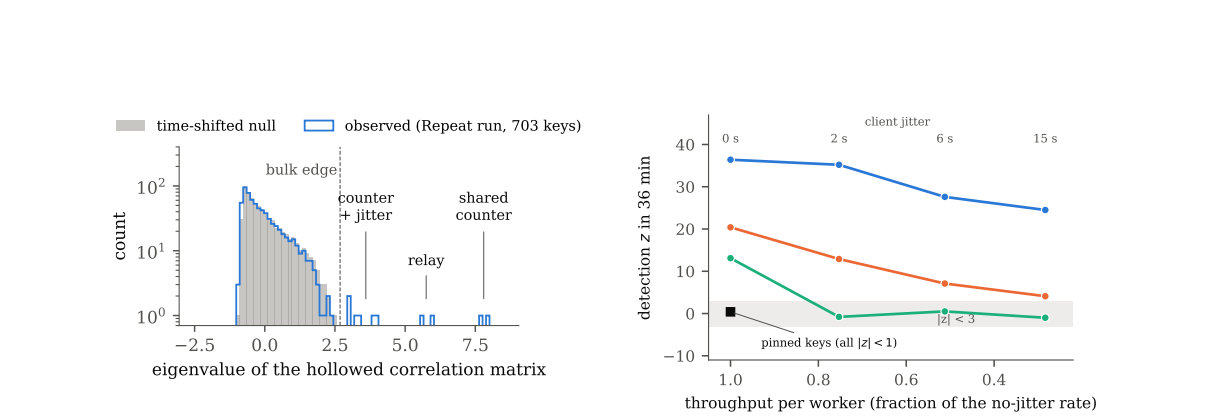
What carries the argument. The carrying mechanism is the ring profile $c(d)$ of Proposition 1: keys $d$ apart on the client's ring correlate as $c(d) = (EO(S_d; D, D')/T_c - p^2)/(p(1-p))$, where $O(\tau; D, D') = (\min(D, \tau + D') - \max(0, \tau))^+$ is the overlap of two on-intervals starting $\tau$ apart — the travelling wave whose shape and harmonics the paper predicts from a pool's own measured durations and visit delays, with no fitted parameter. Because a shared counter treats all keys alike, the pool's correlation matrix is approximately circulant, its eigenvalues are Fourier sums of the profile, and the top eigen-pair places each key at its ring position, which is what lets a 20% seed recover the client's own key ordering. Around it sit three supporting statistics, each derived as a score test against the pattern its dispatcher creates: the occupancy ratio $R$ for turn-taking versus bunching, successor concentration for per-worker counters' fixed hand-off partners, and the hand-off graph's excess end-to-start pairs.
Core claim. The central claim is that the way a campaign's client hands its workers to API keys — the dispatcher — is written into the provider's logs through the timing of request starts and stream completions, and that each dispatcher leaves a distinct signature. A shared round-robin counter makes neighbouring keys busy at overlapping times while distant keys rarely are, a 'travelling wave' whose correlation profile the paper predicts in Proposition 1 from the pool's own answer durations and visit delays with no fitted parameter; measured and predicted top eigenvalues matched closely (6.83/6.91, 4.58/4.67, 2.73/2.79). From a 20% seed of accounts a reliable alarm already named, forensic expansion ranked the rest of shuffling, hashing, hedging and company pools at AUC 0.92–1.00 within 20 minutes, among 742 keys of a live two-replica deployment and among 1,611–3,069 accounts of the production trace, in frozen tests on held-out windows. The paper further reports that an adaptive attacker cannot hide a rotating dispatcher even with 30 seconds of jitter, but that pinning keys escapes every timing test, costing roughly 40% of throughput only when per-key quotas bind and concurrency is scarce.
The premise it rests on. Every positive campaign tested is software the author wrote, and real campaigns' traffic passes through proxies, relays and SDK retry layers that the simulator does not model; if an independently authored client blurs the end-to-start timing structure, the reported AUC figures do not transfer.
If the paper is right (Pith's inferences, not the authors')
A content alarm that names a minority of a campaign's accounts can be extended to the rest within minutes — expansion reached AUC 0.82–0.98 in ten minutes — fitting between the first alarm and a ban.
Blind site-wide discovery finds persistent rotation rings that content never flags, but needs hours: about 3.4 h at $10^5$ keys for a strong ring, and about 2.8 times longer on real production noise than simulation predicts.
Rotating dispatchers cannot be hidden by jitter — an adaptive attacker with 30 s of jitter is still classified as a shared ring — so timing's value is against default tooling, which documented campaigns used.
Pinning keys and steady open loops are provably invisible to every timing test, the watermark included, and escape freely unless per-key quotas bind and concurrency is scarce, where the best evasion keeps 55–61% of throughput.
A provider can run an exact active test, delaying answer ends by a secret random amount, which gives exact p-values on suspect pools at a measured average cost of +76 ms per request.
My read is that deployment is gated by benign shared dispatch, not by the detectors' power: the Chutes trace shows about one rotation group per hour per few thousand accounts across unlinked accounts, and the paper's own precision formula implies blind alarms need a second channel before anyone acts on them.
Because real campaigns relay through proxies and SDK retry layers with per-hop backoff that the simulator does not model, I suspect expansion is the most transferable result (it averages over the seed) and the ring statistic the most fragile; the paper's own misfit of the discoverability constant $\kappa$ (1.9 in simulation, about 3.2 on production noise) says to expect site-by-site calibration.
A testable extension the paper does not run: take a provider's grounded, confirmed campaign and measure expansion AUC against its true roster, which would settle how much of 0.92–1.00 survives outside the author's testbed.
Check this review
Pith stored no record of this review's passes and took no fingerprint of it. Reviews made by code from 13 Nov 2026 on carry both.
How often reviews like this one are right
Reviews like this one: written by deepseek-v4-flash, where what was read was not recorded.
How often objections from reviews like this one are right: not yet measured
Reviews by people
This review was written by a machine. No person has reviewed this paper on Pith yet. A scientist listed on Pith can review it for a fee, and their review is published here whatever it concludes.
The paper
Abstract
API distillation campaigns try to hide model-stealing traffic by splitting requests across thousands of load-balanced accounts, which standard content classifiers often miss. However, request timestamps, specifically arrival time and stream completion time, reveal the underlying dispatching strategy, such as round-robin counters or key-shuffling pools. Using a 20 percent seed set, this timing analysis can forensically rank the remaining accounts of a campaign with 0.92 to 1.00 AUC within 20 minutes, even across thousands of real production accounts. While adaptive attackers struggle to hide rotating dispatchers using jitter, pinning keys successfully evades detection, though it can severely throttle throughput when quotas bind. Ultimately, timing exposes shared infrastructure patterns even when content filters fail.
The paper's own sentences, arranged, kept beside the review and separate from it. Each label is drawn from a closed vocabulary; the number beside it is the probability the classifier gave that label. No sentence in this record was written by a model.
abstract compiled · 2026-11-05
The authors' main claim, as the classifier picked it out 1.00
“Ultimately, timing exposes shared infrastructure patterns even when content filters fail.”
How the main claim is stated: asserted 1.00
What the abstract itself states, as probabilities: claims first 0.05 · states limitation 0.76 · human participants 0.03 · controlled comparison 0.14 · randomized assignment 0.03 · states quantitative result 0.99 · compares with prior results 0.43 · mentions code or data availability 0.03
The abstract, sentence by sentence
This table labels the abstract only (arXiv listing abstract v1). The number is the probability the classifier gave the label.
| Sentence | Role | The authors' own work | States the main conclusion | Strength |
|---|---|---|---|---|
| API distillation campaigns try to hide model-stealing traffic by splitting requests across thousands of load-balanced accounts, which standard content classifiers often miss. | background 0.99 | 0.08 | 0.05 | asserted 0.95 |
| However, request timestamps, specifically arrival time and stream completion time, reveal the underlying dispatching strategy, such as round-robin counters or key-shuffling pools. | method 0.47 | 0.67 | 0.19 | asserted 0.99 |
| Using a 20 percent seed set, this timing analysis can forensically rank the remaining accounts of a campaign with 0.92 to 1.00 AUC within 20 minutes, even across thousands of real production accounts. | result 0.99 | 0.89 | 0.25 | asserted 0.91 |
| While adaptive attackers struggle to hide rotating dispatchers using jitter, pinning keys successfully evades detection, though it can severely throttle throughput when quotas bind. | result 0.85 | 0.75 | 0.07 | asserted 0.97 |
| Ultimately, timing exposes shared infrastructure patterns even when content filters fail. | interpretation 0.95 | 0.63 | 0.88 | asserted 1.00 |
What kind of paper the classifier reports this is: method or tool 0.89 · evidence from observation or experiment 0.85
What was examined, and what was not
Sources read
- arXiv listing abstract v1
Not examined
- full text
- figures and tables
- references and citing sentences
- relations to other papers
Levels run
- P abstract
Not run
- S sections
- T body sentences
- C citations
- R cross-paper relations
How the labels were made
Compiled by classifier-1.13.0 via TypeSafe API, question bank abstract-p1-20260923, 2026-11-05: 1 request, 4,284 input tokens.
Every quoted sentence on this record is the authors'. Every label is from Pith's closed vocabulary, with the probability shown beside it. This record as JSON
Figures (3)

Showing 2 of the paper's 3 figures. Figures are the authors', reproduced from the paper.
References (38)
- [1] Anthropic, “Detecting and preventing distillation at- tacks,” Feb. 23, 2026. https://www.anthropic.com/news/ detecting-and-preventing-distillation-attacks on Pith
- [2] Anthropic, “Strengthening our defenses against distillation attacks,” Oct. 12, 2026. https://www.anthropic.com/research/distillation-defenses on Pith
- [3] Anthropic, “Detecting and countering misuse of AI: September 2026,” threat intelligence report, Sept. 2026. https://www.anthropic.com/ threat-intelligence-report-september-2026 on Pith
- [4] Google Threat Intelligence Group, “GTIG AI threat tracker: distillation, experimentation, and (continued) integration of AI for adversarial use,” Feb. 2026 on Pith
- [5] S. C. Khilar, “The limits of query monitoring against distributed model extraction,” preprint, 2026. https://github.com/nssprogrammer/ query-monitoring on Pith
- [6] RooCodeInc/Roo-Code, “Support for round-robin API key rotation to prevent request limit blocking,” GitHub discussion #6833 on Pith
- [7] anomalyco/opencode, “Support multiple API keys/credentials with round-robin rotation per provider,” GitHub issue #29085 on Pith
- [8] F. Tram `er, F. Zhang, A. Juels, M. K. Reiter, and T. Ristenpart, “Stealing machine learning models via prediction APIs,” inUSENIX Security, 2016 on Pith
- [9] G. Hinton, O. Vinyals, and J. Dean, “Distilling the knowledge in a neural network,” arXiv:1503.02531, 2015 on PithPith's reviewarXiv
- [10] M. Juuti, S. Szyller, S. Marchal, and N. Asokan, “PRADA: protecting against DNN model stealing attacks,” inIEEE EuroS&P, 2019 on Pith
- [11] S. Liuet al., “An embarrassingly simple detector for model extraction attacks in large language model API traffic,” inProc. EMNLP, 2026, to appear. arXiv:2606.05725 on PithPith's reviewarXiv
- [12] C. Herley, “Estimating the amount of script-generated traffic in a mixture,” inUSENIX Security, 2026 on Pith
- [13] A. Beutel, W. Xu, V . Guruswami, C. Palow, and C. Faloutsos, “Copy- Catch: stopping group attacks by spotting lockstep behavior in social networks,” inWWW, 2013 on Pith
- [14] Q. Cao, X. Yang, J. Yu, and C. Palow, “Uncovering large groups of active malicious accounts in online social networks,” inACM CCS, 2014 on Pith
- [15] G. Gu, R. Perdisci, J. Zhang, and W. Lee, “BotMiner: clustering analysis of network traffic for protocol- and structure-independent botnet detection,” inUSENIX Security, 2008 on Pith
- [16] S. Kumar, J. Cheng, J. Leskovec, and V . S. Subrahmanian, “An army of me: sockpuppets in online discussion communities,” inWWW, 2017 on Pith
- [17] Y . Zhang and V . Paxson, “Detecting stepping stones,” inUSENIX Security, 2000 on Pith
- [18] X. Wang and D. S. Reeves, “Robust correlation of encrypted attack traffic through stepping stones by manipulation of interpacket delays,” inACM CCS, 2003 on Pith
- [19] W. Yu, X. Fu, S. Graham, D. Xuan, and W. Zhao, “DSSS-based flow marking technique for invisible traceback,” inIEEE S&P, 2007 on Pith
- [20] A. Houmansadr, N. Kiyavash, and N. Borisov, “RAINBOW: a robust and invisible non-blind watermark for network flows,” inNDSS, 2009 on Pith
show 18 more
- [21] D. Schluter, “A variance test for detecting species associations, with some example applications,”Ecology, vol. 65, no. 3, 1984 on Pith
- [22] L. M. Hallettet al., “Biotic mechanisms of community stability shift along a precipitation gradient,”Ecology, vol. 95, no. 6, 2014 on Pith
- [23] H. J. Kimble, M. Dagenais, and L. Mandel, “Photon antibunching in resonance fluorescence,”Phys. Rev. Lett., vol. 39, 1977 on Pith
- [24] R. Hanbury Brown and R. Q. Twiss, “Correlation between photons in two coherent beams of light,”Nature, vol. 177, 1956 on Pith
- [25] F. J. Sigworth, “The variance of sodium current fluctuations at the node of Ranvier,”J. Physiol., vol. 307, 1980 on Pith
- [26] P. J. Denning and J. P. Buzen, “The operational analysis of queueing network models,”ACM Comput. Surv., vol. 10, no. 3, 1978 on Pith
- [27] B. Schroeder, A. Wierman, and M. Harchol-Balter, “Open versus closed: a cautionary tale,” inNSDI, 2006 on Pith
- [28] A. Recanati, T. Kerdreux, and A. d’Aspremont, “Reconstructing latent orderings by spectral clustering,” arXiv:1807.07122, 2018 on PithPith's reviewarXiv
- [29] J. Baik, G. Ben Arous, and S. P ´ech´e, “Phase transition of the largest eigenvalue for nonnull complex sample covariance matrices,”Ann. Probab., vol. 33, no. 5, 2005 on Pith
- [30] F. Benaych-Georges and R. R. Nadakuditi, “The eigenvalues and eigen- vectors of finite, low rank perturbations of large random matrices,”Adv. Math., vol. 227, 2011 on Pith
- [31] R. A. Fisher,The Design of Experiments. Oliver and Boyd, 1935 on Pith
- [32] Qwen Team, “Qwen2.5 technical report,” arXiv:2412.15115, 2024 on PithPith's reviewarXiv
- [33] W. Kwonet al., “Efficient memory management for large language model serving with PagedAttention,” inACM SOSP, 2023 on Pith
- [34] W. Nixon, J. Durbin, F. Standhartinger, H. S. Gunawi, and J. Yang, “A year in LLM serving: workload evolution, caching and load-balancing,” arXiv:2608.13573, 2026 on PithPith's reviewarXiv
- [35] QuantumNous, “new-api: LLM API gateway (multi-key round-robin mode),” https://github.com/QuantumNous/new-api on Pith
- [36] W. Zhao, X. Ren, J. Hessel, C. Cardie, Y . Choi, and Y . Deng, “WildChat: 1M ChatGPT interaction logs in the wild,” inICLR, 2024 on Pith
- [37] R. Weiss, D. Ayzenshteyn, G. Amit, and Y . Mirsky, “What was your prompt? A remote keylogging attack on AI assistants,” inUSENIX Security, 2024 on Pith
- [38] N. Carlini and M. Nasr, “Remote timing attacks on efficient language model inference,” arXiv:2410.17175, 2024 on PithPith's reviewarXiv
Challenges and discussion
Disagree with the review, or know something it missed? Leave a comment, or challenge this review formally: a challenge becomes a permanent entry in this paper's record, and its decision is published here.
Come back by email
A short list of the week's newly reviewed papers. Nothing is sent until you confirm from your inbox, and every email has a link that stops it. No account.
No comments yet.
Sign in to comment