High Energy Physics - Experiment · arXiv:2611.12265 v1 · submitted 9 Nov 2026 · 46 references
Beam-beam effects on measurements at electron-positron colliders: LEP neutrino counting and Higgs factories
The paper says
“Beam-beam electromagnetic interactions affect the luminosity, collision energy, polarization, and particle backgrounds relevant to precision measurements at electron-positron colliders.”
more of the abstract
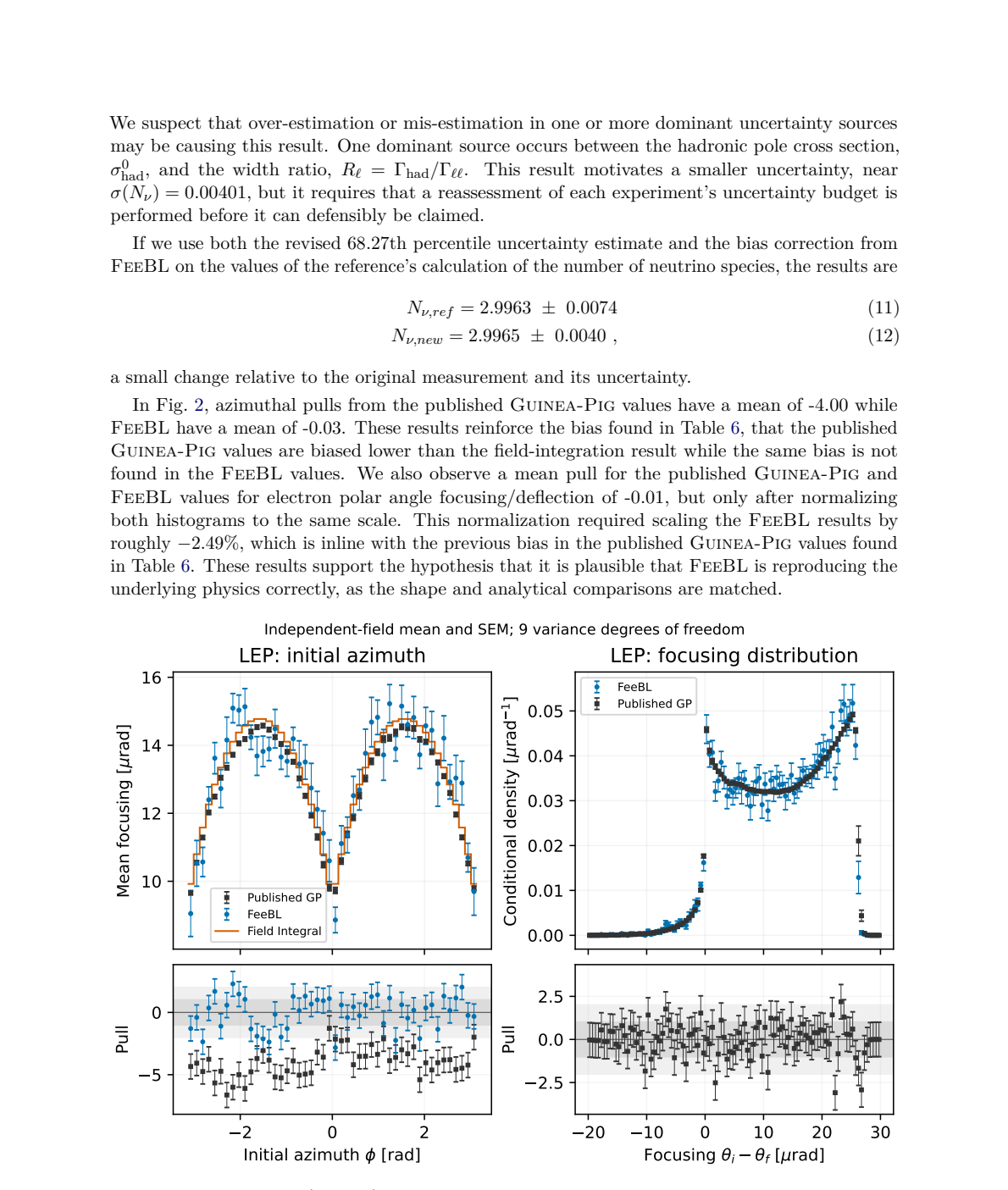
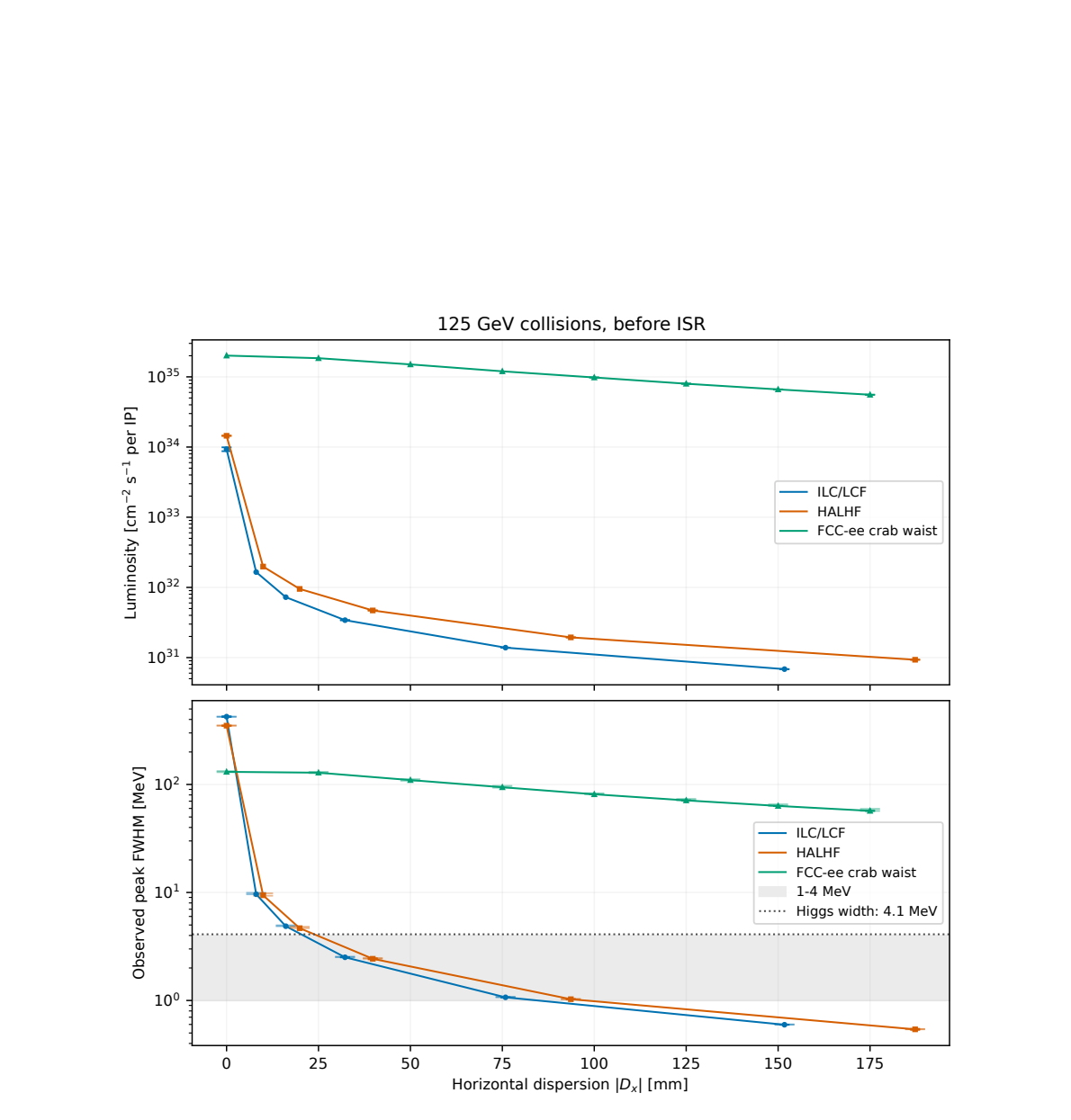
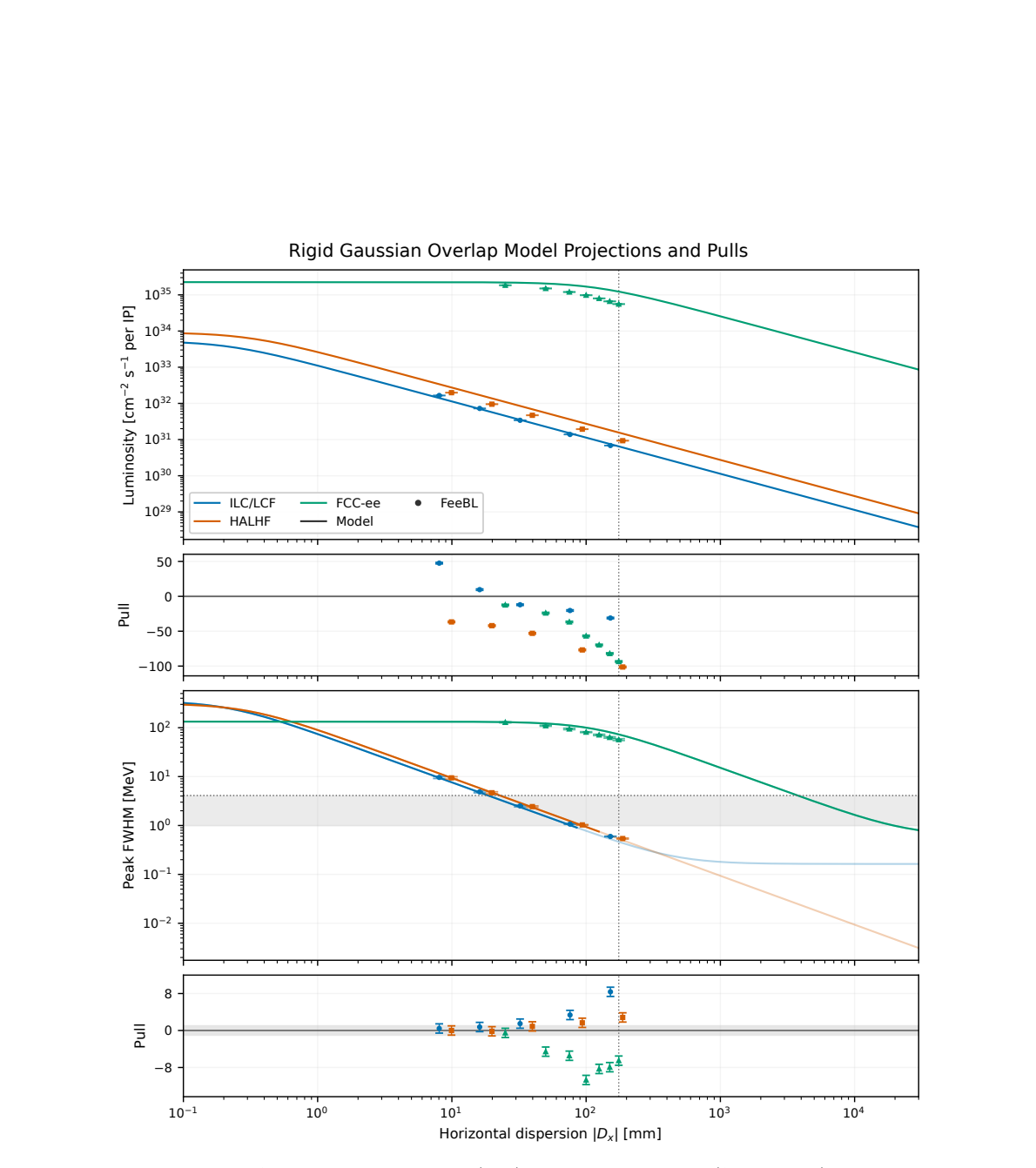
We investigate these effects using Fast e±e± Beam and Luminosity (FeeBL), a new beam-beam simulation framework, and compare its predictions with published results from LEP and proposed future colliders. We reproduce the analytical field-integration calculations of LEP Bhabha scattering and identify an approximately 2% bias in previously published beam-deflection simulations. Applying the corresponding luminosity correction and a revised uncertainty assessment motivated by the observed agreement among the four LEP experiments yields (Nν = 2.9965 ± 0.0040), compared with the previously reported (2.9963 ± 0.0074). The revised uncertainty is conditional on an assumed common rescaling of experiment specific uncertainties and motivates further investigation of the original uncertainty budgets. We identify and correct implementation errors in the modeling of Breit-Wheeler, Bethe-Heitler, and Landau-Lifshitz pair production, with implications for detector backgrounds at Higgs factories. Simulated beam depolarization and luminosity spectra are compared with existing ILC and HALHF predictions. Finally, we investigate collision energy monochromatization for direct Higgs production, obtaining sub-MeV collision energy peak widths in exploratory linear collider configurations at substantial luminosity cost, while finding significantly weaker narrowing for the FCC-ee configurations studied. We derive a rigid Gaussian beam overlap model and estimate that FCC-ee needs roughly 10 m of horizontal only dispersion to reach widths of ≈ 1 MeV.
from the abstract
Pith says
Machine review · deepseek-v4-flash · 10 Nov 2026 · what was read was not recorded · not checked by a person
It can be wrong. Challenge this review or reply to it.
The passes disagreed. Reader: holds up. Skeptic: agrees with the reader. Referee: major revision.
Solid, honest paper. FeeBL is a real contribution, and the bias correction in the LEP Bhabha simulation is the most concrete result. The Nν update is small but the uncertainty note is careful. Referee-worthy. This line is wrong
5 major objections · 10 minor
How often objections from reviews like this one are right: not yet measured
Not checked: figures, code, what the 46 references say.
The paper says, at §3.2, Eq. (12)
The review did not quote this passage.
Pith says: Objection 1 of 5 · major
The revised Nν uncertainty of σ(Nν)=0.00401 is derived from a rescaling of experiment-specific uncertainties to match the observed scatter among the four LEP experiments. The paper explicitly states this is 'conditional on an assumed common rescaling of experiment specific uncertainties' and 'motivates further investigation of the original uncertainty budgets.'
more of objection 1
This is a load-bearing assumption for the claimed improvement in precision. The paper does not provide a physical justification for why a common rescaling factor is appropriate, nor does it test the sensitivity of the result to alternative rescaling schemes (e.g., rescaling only the dominant uncertainty source, or using a Bayesian hierarchical model). The central value shift is small (0.0002), but the uncertainty reduction from 0.0074 to 0.0040 is substantial and depends entirely on this assumption. The paper should either provide a stronger justification for the common rescaling or present the result with a more conservative uncertainty that does not rely on this assumption.
The paper says, at §3.2, Table 6
The review did not quote this passage.
A classifier read this sentence of the paper as acknowledging the concern (probability 0.80):
“For a better comparison, a repository of the original published data or simulation settings is needed.”
Pith says: Objection 2 of 5 · major
The claim of a ~2% bias in previously published beam-deflection simulations is based on comparing FeeBL results with field-integration calculations. However, the paper states that 'We cannot determine the origin of this observed ≈2% deficit using both the analytical model and FeeBL simulation results' and that 'a repository of the original published data or simulation settings is needed.'
more of objection 2
Without identifying the source of the bias, the claim that FeeBL is correct and the previous simulations are biased relies on the assumption that FeeBL's agreement with the analytical field integration is sufficient evidence. While this is plausible, the paper should discuss whether there could be other explanations for the discrepancy (e.g., differences in the reconstruction of Gaussian bunches from published moments, as noted in §1). The paper acknowledges this limitation, but the central claim of a bias correction is load-bearing for the revised Nν value.
The paper says, at §3.3, Table 7 and Fig. 4
The review did not quote this passage.
A classifier read this sentence of the paper as acknowledging the concern (probability 0.94):
“This attribution is specific to the source build ofGuinea-Pig++ v1.2.2 and does not establish which revisions or options were used for every published collider prediction that comes from any build ofGuinea-PigorGuinea-Pig++.”
Pith says: Objection 3 of 5 · major
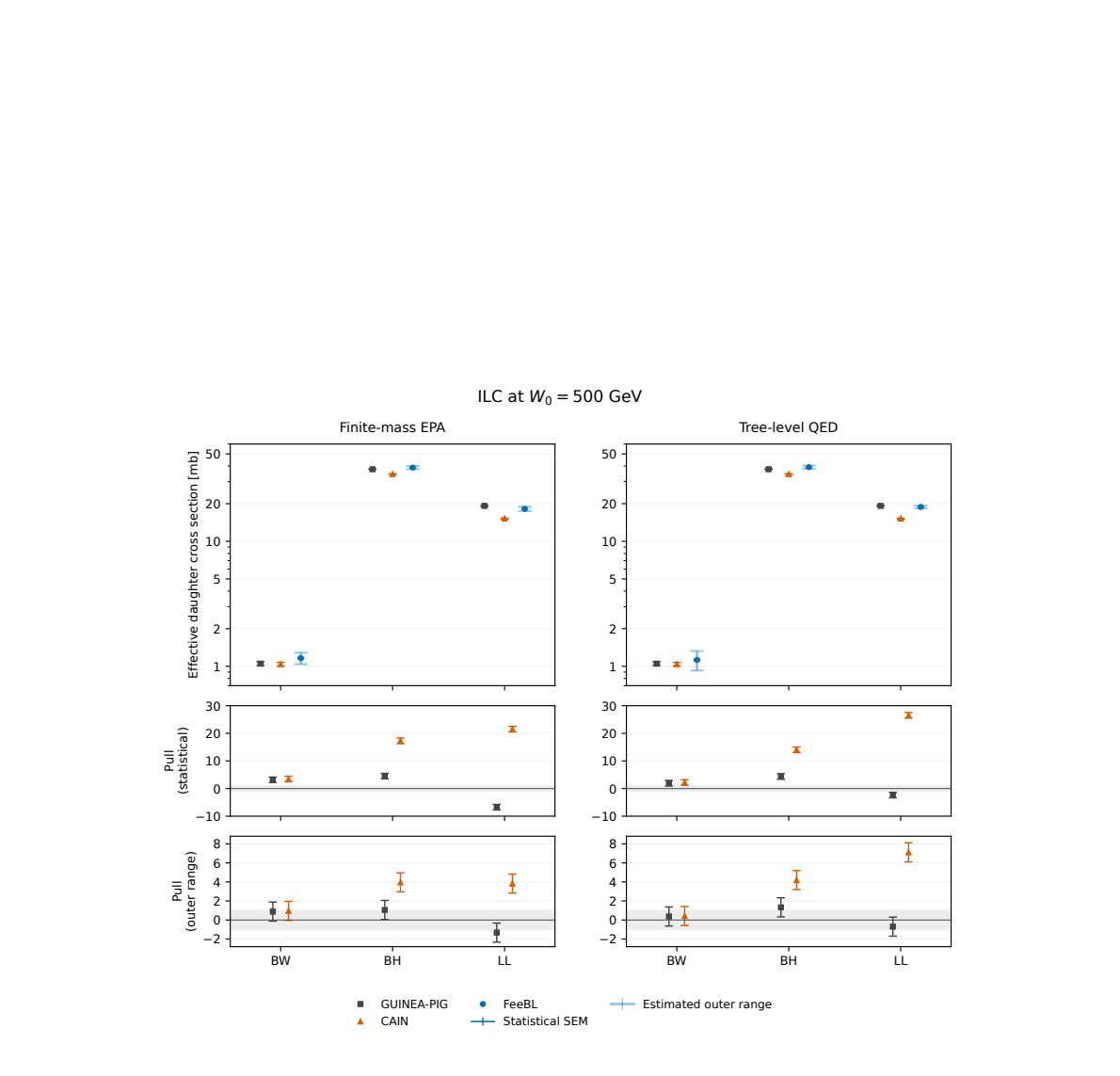
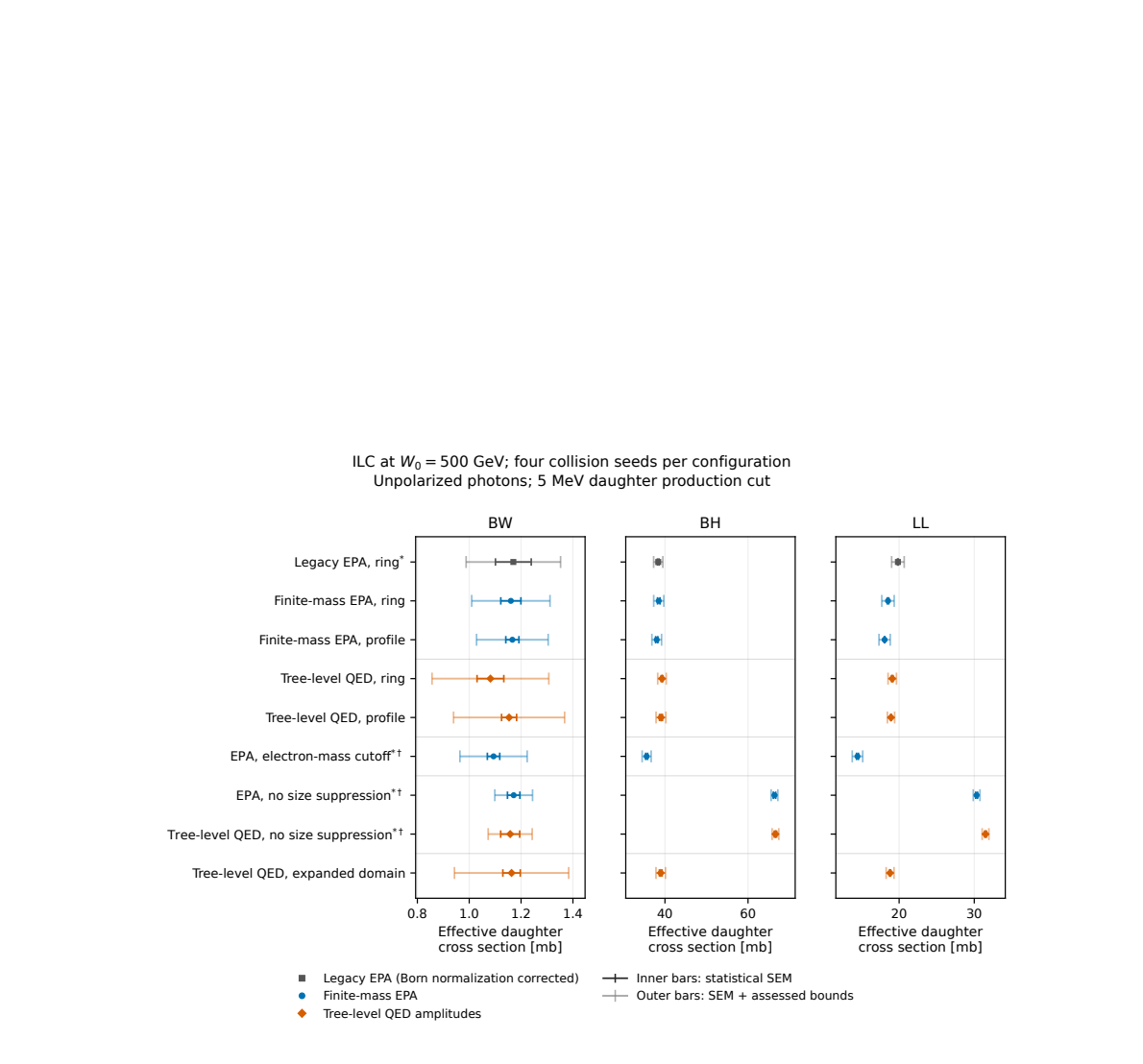
The beam pair comparisons are presented as 'controlled model comparison rather than an exact rerun of the historical Guinea-Pig++ implementation.' The paper identifies implementation errors in Guinea-Pig++ (Table 2) and corrects them in FeeBL. However, the paper also states that 'This attribution is specific to the source build of Guinea-Pig++ v1.2.2 and does not establish which revisions or options were used for every published collider prediction.'
more of objection 3
This is a significant limitation: the paper cannot conclusively state that the errors affected previous published results. The discussion of beam pair corrections is valuable as a technical note, but the paper should be clearer that the numerical comparisons in Table 7 and Fig. 4 are not direct validations against published predictions, but rather comparisons between different model implementations within FeeBL and with historical Guinea-Pig/Cain values that may have used different settings.
The paper says, at §4.3, Table 12
The review did not quote this passage.
A classifier read this sentence of the paper as acknowledging the concern (probability 0.61):
“Therefore, we do not claim that high precision runs have been conducted nor that high precision results are achieved.”
Pith says: Objection 4 of 5 · major
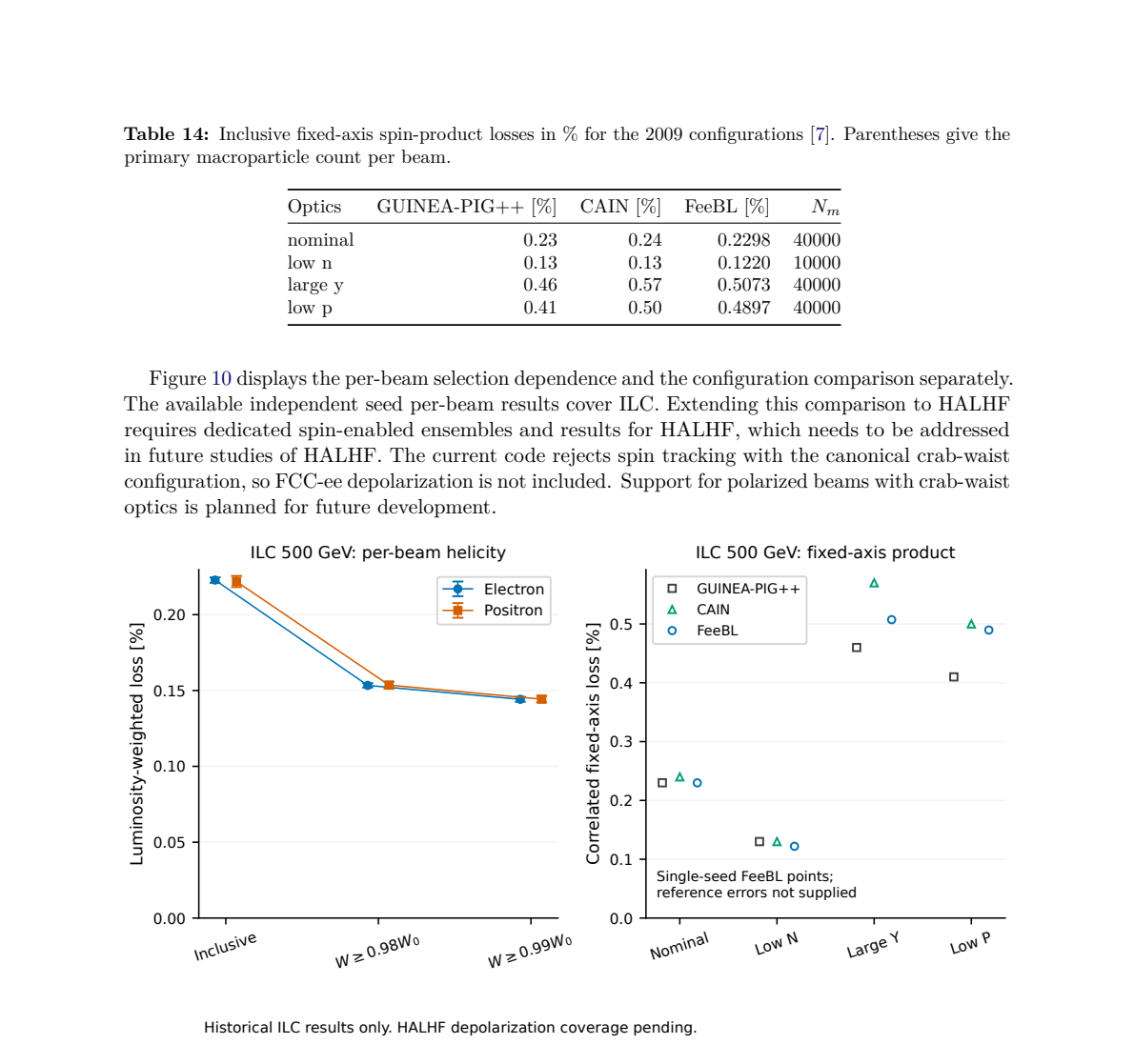
The convergence test of spin tracking shows that the 'combined refinement increases the matched loss by 7.15%, exceeding the seed SEM' and that 'Numerical convergence is therefore unresolved even though the transport controls pass.' This is an honest statement, but it undermines the quantitative comparisons in Table 14, where FeeBL values are compared with Guinea-Pig++ and Cain values at the 0.01% level.
more of objection 4
The paper should discuss whether the unresolved numerical convergence could affect the conclusions drawn from the spin comparisons, particularly the claim that 'Nominal rounds to 0.23% at the reference precision.'
The paper says, at §5.5, Fig. 14
The review did not quote this passage.
Pith says: Objection 5 of 5 · major
The rigid Gaussian overlap model is compared with FeeBL simulations, and the paper notes that 'the model reproduces the narrowing trend but does not reproduce all absolute rates and widths within the estimated simulation uncertainties.' The pulls are as large as +8.4 for ILC/LCF width and -6.5 for FCC-ee width.
more of objection 5
The paper attributes these differences to 'hourglass and crab-waist weighting, canonical transport correlations and disruption' that are absent from the analytical model. However, the paper then uses this model to project that 'FCC-ee needs roughly 10 m of horizontal only dispersion to reach widths of ≈1 MeV' (abstract and §5.5). Given the large discrepancies between the model and simulations at the dispersions studied (up to 175 mm), the extrapolation to 10 m is highly uncertain and should be presented with appropriate caveats. The paper should either provide a more rigorous uncertainty estimate for this projection or soften the claim.
10 minor objections
The paper says, at §1.1
Pith says: minor objection 1 of 10
The notation section is dense and could benefit from a table summarizing the key symbols and their definitions. For example, the distinction between W, W0, and √s is important but not immediately clear.
The paper says, at §2.2, Table 3
Pith says: minor objection 2 of 10
The input card example uses 'ip_dispersion.1=0.0003712' but the units are stated as meters. This is a very small dispersion (0.37 mm). The paper should confirm that this is correct and not a typo, as later sections use dispersions of tens to hundreds of mm.
show 8 more
The paper says, at §3.2, Eq. (10)
Pith says: minor objection 3 of 10
The equation for the acceptance correction ΔL/L uses θ_min and θ_max. The paper should define these explicitly (they are the inner and outer angular acceptance limits of the Bhabha calorimeter).
The paper says, at §3.3, Fig. 3
Pith says: minor objection 4 of 10
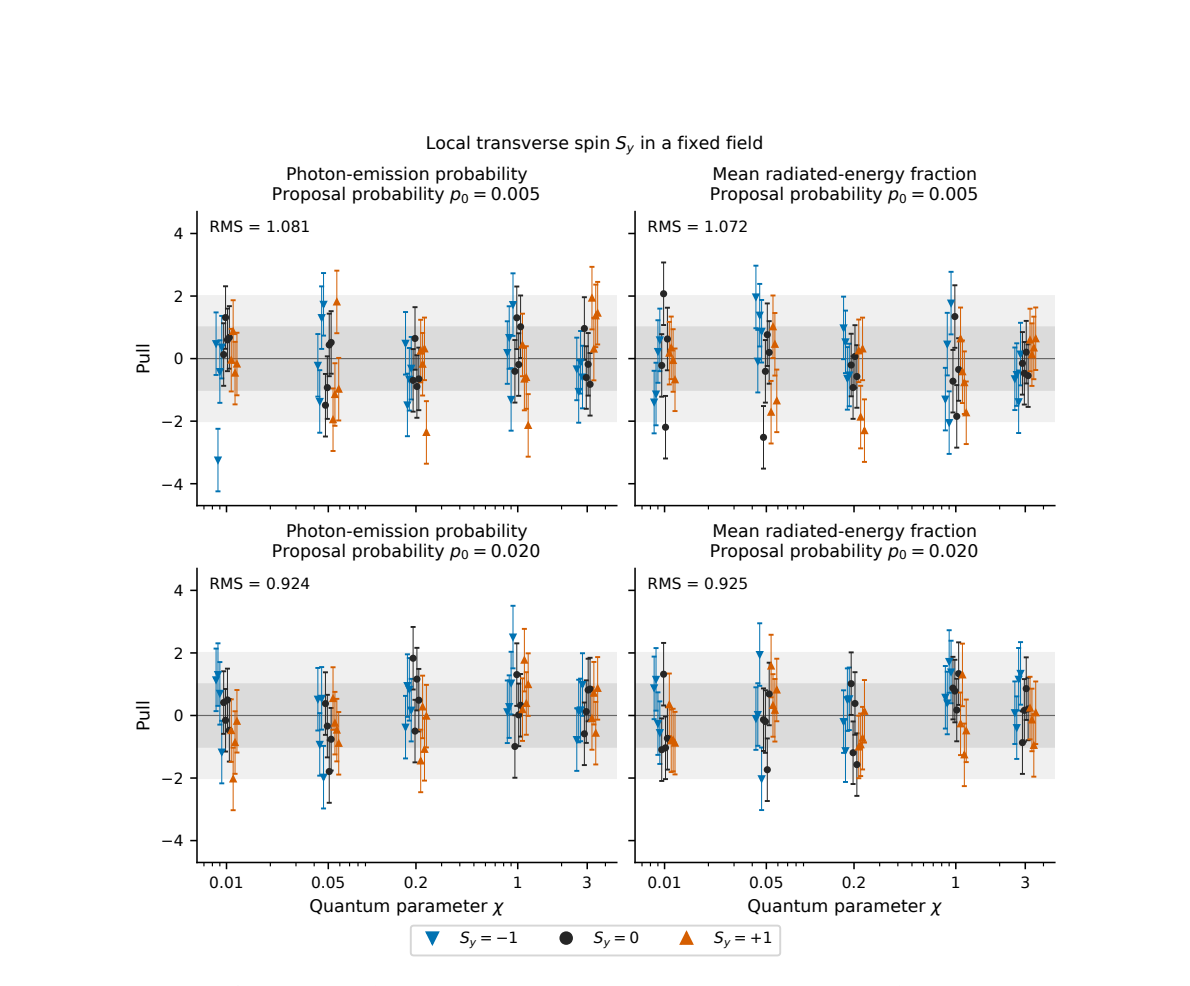
The pull plots show both 'statistical' and 'outer range' pulls. The definition of 'outer range' is given in the caption as 'estimated outer half-ranges defined in Fig. 3', but Fig. 3 itself refers to 'Estimated outer range'. This is circular. The paper should define how the outer range uncertainty is estimated.
The paper says, at §4.1
Pith says: minor objection 5 of 10
The independent quadrature test of the spin-flip transition law is described in detail, but the paper does not state whether the test covers the full range of quantum parameters relevant to the ILC and HALHF simulations. The tested χ values (0.01 to 3) are stated, but the paper should confirm that these cover the relevant range for the collider configurations studied.
The paper says, at §5.2, Table 16
Pith says: minor objection 6 of 10
The luminosity ratio for ILC/LCF is 1.023 ± 0.023, which is consistent with 1 but has a central value 2.3% above unity. The paper states this is 'luminosity retention' but does not explain why the luminosity would increase with dispersion. The geometric model predicts a decrease. This should be discussed.
The paper says, at §5.4, Table 18
Pith says: minor objection 7 of 10
The FCC-ee scan uses different numerical settings below and above 100 mm (10k vs 80k macroparticles, different grids). The paper should check whether the discontinuity at 100 mm is physical or numerical. The luminosity and width values appear to change smoothly, but a systematic check would strengthen the results.
The paper says, at §6
Pith says: minor objection 8 of 10
The paper states that 'Data for full reproduction can be provided upon request.' For a paper that emphasizes reproducibility and open-source software, it would be stronger to provide the data directly in the repository or as supplementary material.
The paper says, at §8
Pith says: minor objection 9 of 10
The acknowledgment of agentic AI use is appreciated. However, the statement that 'all written text in this work is written by a human researcher though some content was started by agentic AI and replaced with human written text later' is somewhat contradictory. The paper should clarify the extent of AI assistance more precisely.
The paper says, at General
Pith says: minor objection 10 of 10
The paper is generally well-written but is very long and contains a large amount of detail that may be better suited to a technical note or software documentation. The referee suggests that the authors consider whether some of the detailed implementation descriptions (e.g., §2, §4.1) could be shortened or moved to an appendix.
What would settle it
Request the original input cards and simulation settings from the authors of Ref. [1] (Voutsinas et al.). Rerun the LEP Bhabha deflection with FeeBL using those exact inputs. If FeeBL reproduces the field-integration values from the original paper rather than the Guinea-Pig results that showed the bias, the bias claim is strengthened. If FeeBL instead matches the original Guinea-Pig values, the claimed bias would be attributable to parameter differences rather than a simulation error.
from the skeptic's reading
How the review went
4 readings by deepseek-v4-flash · 10 Nov 2026
- Reader holds up
- Skeptic agrees
- Editor wrote the verdict above
- Referee major revision: 5 major objections, 10 minor
Not run on this paper: the simulated authors' defence.
Pith did not check this review's objections against the paper.
The review in full
The review in brief, machine-written
FeeBL is the real thing. The paper does two things well: (1) it ships a validated, open-source beam-beam simulation that extends Guinea-Pig++ with GPU support and corrected pair-production algorithms, and (2) it identifies a ~2% bias in the published LEP Bhabha deflection simulation, which carries over to the luminosity correction. The revised Nν = 2.9965 ± 0.0040 is a minor numerical shift (central value changes by 0.0002), but the tighter uncertainty is interesting. The paper says outright that the uncertainty rescaling is conditional on a common factor and needs a proper re-assessment. That is refreshingly honest.
The validation work is thorough: Bhabha deflection checked against analytical field integration, spin tracking against quadrature, pair production cross sections against independent QED calculations. Code and data are released. The limitations are stated upfront — Gaussian bunch reconstruction, missing original Guinea-Pig++ input files, conditional uncertainty, qualitative comparison for beam pairs. No hidden assumptions.
Soft spots: the origin of the ~2% bias is not traced to a specific Guinea-Pig++ bug because the original input files are unavailable. The paper says this. The monochromatization results are exploratory — sub-MeV peaks at ~0.1% of nominal luminosity. The paper does not overclaim: it says width alone does not establish measurement sensitivity. The FCC-ee monochromatization projection is weak and the paper says so.
The revised Nν uncertainty is the only place where a reader might wonder if the conditional rescaling is robust. The paper flags this, so I do not count it as a flaw.
Who is this for? Collider physicists working on beam backgrounds, luminosity calibration, and future Higgs factory design. The FeeBL framework will be useful. The LEP correction is a concrete finding, even if small.
Recommendation: this paper deserves peer review. It is not a desk reject. The claims are supported, the code is available, and the limitations are stated. I would send it to a reviewer with collider simulation expertise.
The strongest objection
The central claim of a revised Nν value rests on two pillars: a bias correction to the LEP Bhabha luminosity (supported by FeeBL's agreement with analytical field integration) and a conditional uncertainty rescaling. The paper transparently acknowledges that the uncertainty rescaling is conditional on an assumed common factor and that the bias's origin is not definitively traced to a specific Guinea-Pig++ error due to missing original input files. Both limitations are stated explicitly (Section 3.2 and Table 6 caption). No hidden assumption or internal inconsistency undermines the argument as presented; the claims are appropriately qualified and supported by reproducible simulations.
The reader's weakest assumption (conditional common rescaling of experiment-specific uncertainties for the revised Nν error) is indeed the most load-bearing element of the central claim. The paper flags this assumption explicitly and recommends further investigation, so it does not mislead. The other major claim—~2% bias in previous Guinea-Pig Bhabha deflection simulations—is supported by agreement between FeeBL and analytic field integration; the origin of the discrepancy is honestly stated as unresolved. No additional load-bearing concern beyond what the reader identified emerges. The stress-test finds the paper's technical argumentation transparent, its limitations clearly stated, and its central results appropriately qualified. Therefore the verdict should remain UNCHANGED.
The referee's report
If the results hold, the paper provides a valuable cross-check of LEP neutrino counting and identifies a bias in previous simulations. The beam pair corrections are important for future collider background studies. The monochromatization study provides useful scaling laws. The release of FeeBL as open-source software is a strength.
Pith's reading of the paper (a machine's summary, not the authors')
The paper presents FeeBL, a new beam-beam simulation framework for electron-positron colliders. It reports that previously published simulations of LEP Bhabha scattering underestimated the beam deflection by about 2%, leading to a small bias in the luminosity measurement. Applying a correction and a data-driven uncertainty reassessment yields a revised number of light neutrino species $N_ν = 2.9965 \pm 0.0040$, compared with the earlier $2.9963 \pm 0.0074$ – a reduction in uncertainty by nearly half. The paper also identifies and corrects implementation errors in background pair-production calculations and explores monochromatization for direct Higgs production, showing that sub-MeV collision-energy widths are possible in linear collider designs but at a substantial luminosity cost, while FCC-ee achieves only weak narrowing with horizontal dispersion alone.
What carries the argument. FeeBL (Fast $e^{\pm}e^{\pm}$ Beam and Luminosity) is the central tool. It extends the Guinea-Pig++ code lineage, representing each bunch by weighted macroparticles in longitudinal field slices and solving the beam-beam interaction via fast Fourier transforms on transverse meshes. It includes radiation (locally constant field approximation), spin precession and spin-flip, and three pair-production models (EPA, finite-mass EPA, and tree-level QED). The key comparison is the angular deflection of Bhabha electrons at LEP, which FeeBL reproduces from the analytical field-integration model, in contrast to the earlier Guinea-Pig simulations that showed a 2% deficit.
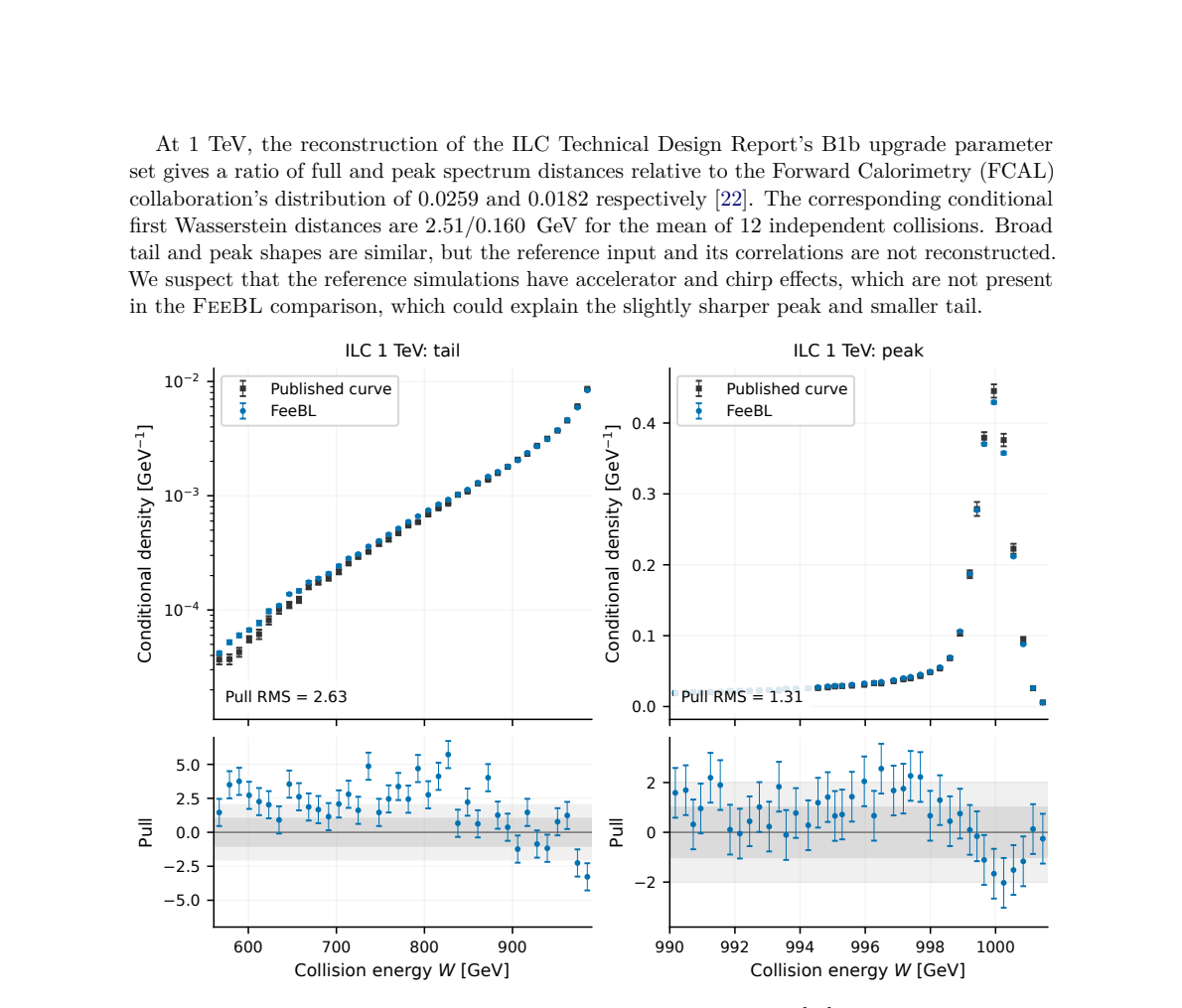
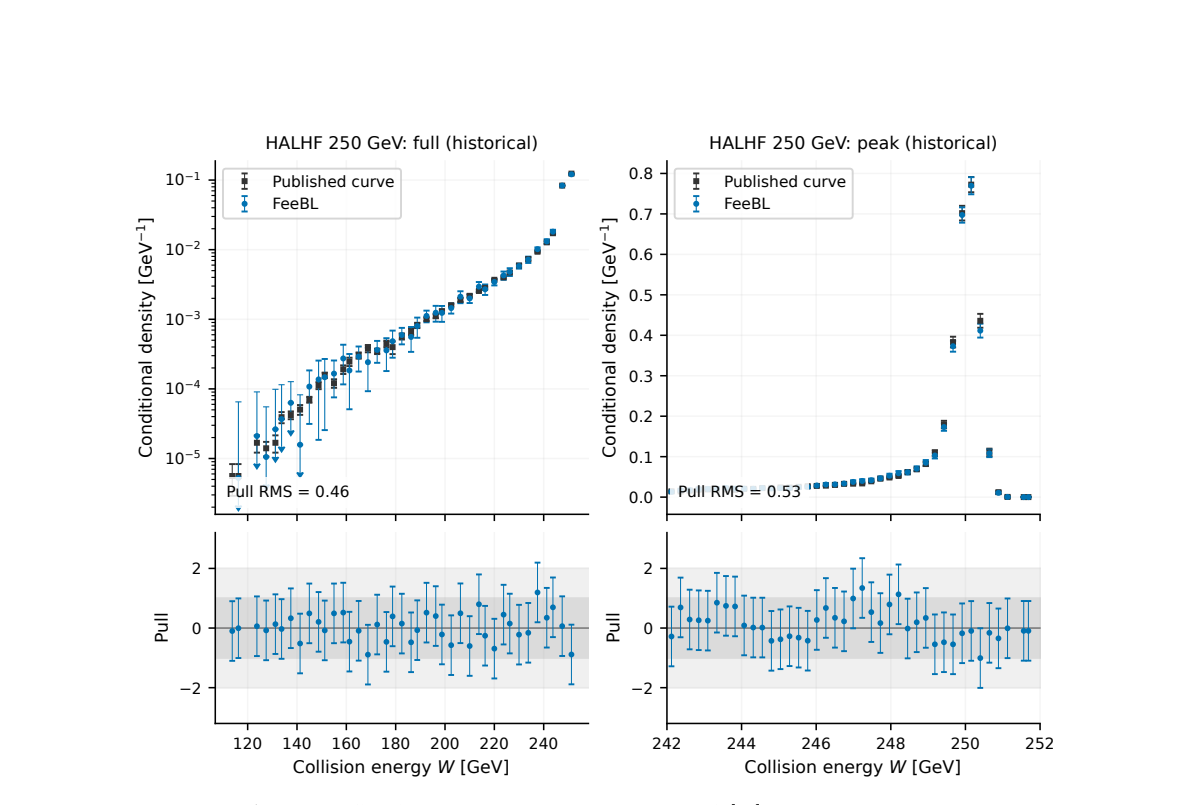
Core claim. FeeBL reproduces the analytical field-integration result for LEP Bhabha scattering and finds that the previously published Guinea-Pig simulations underestimate the angular deflection by approximately 2%. This translates into a bias in the luminosity correction. Applying the corrected deflection and a revised uncertainty assessment – which rescales experiment-specific standard deviations to match the observed scatter among the four LEP experiments – gives $N_ν = 2.9965 \pm 0.0040$, a central value that barely shifts but an uncertainty that is halved relative to the published $0.0074$. The paper also discovers and fixes several implementation errors in the inherited Guinea-Pig++ code for Breit-Wheeler, Bethe-Heitler, and Landau-Lifshitz pair production, and shows that horizontal-dispersion-based monochromatization can reduce the collision-energy peak width to sub-MeV in exploratory linear collider configurations, though at a luminosity cost of about three orders of magnitude.
The premise it rests on. The revised uncertainty on $N_ν$ is derived by assuming that the four LEP experiments' specific standard deviations can be scaled by a common factor to achieve a $\chi^2$ match; if the true uncertainties are not proportional or correlations are not captured, the claimed $0.0040$ uncertainty may be an underestimate.
If the paper is right (Pith's inferences, not the authors')
The LEP neutrino-counting result becomes tighter: $N_ν = 2.9965 \pm 0.0040$, provided each experiment's uncertainty budget is reassessed as the paper recommends.
Future Higgs factories using linear collider designs can consider a monochromatization upgrade via horizontal dispersion to reach sub-MeV collision-energy widths, though the luminosity penalty is severe.
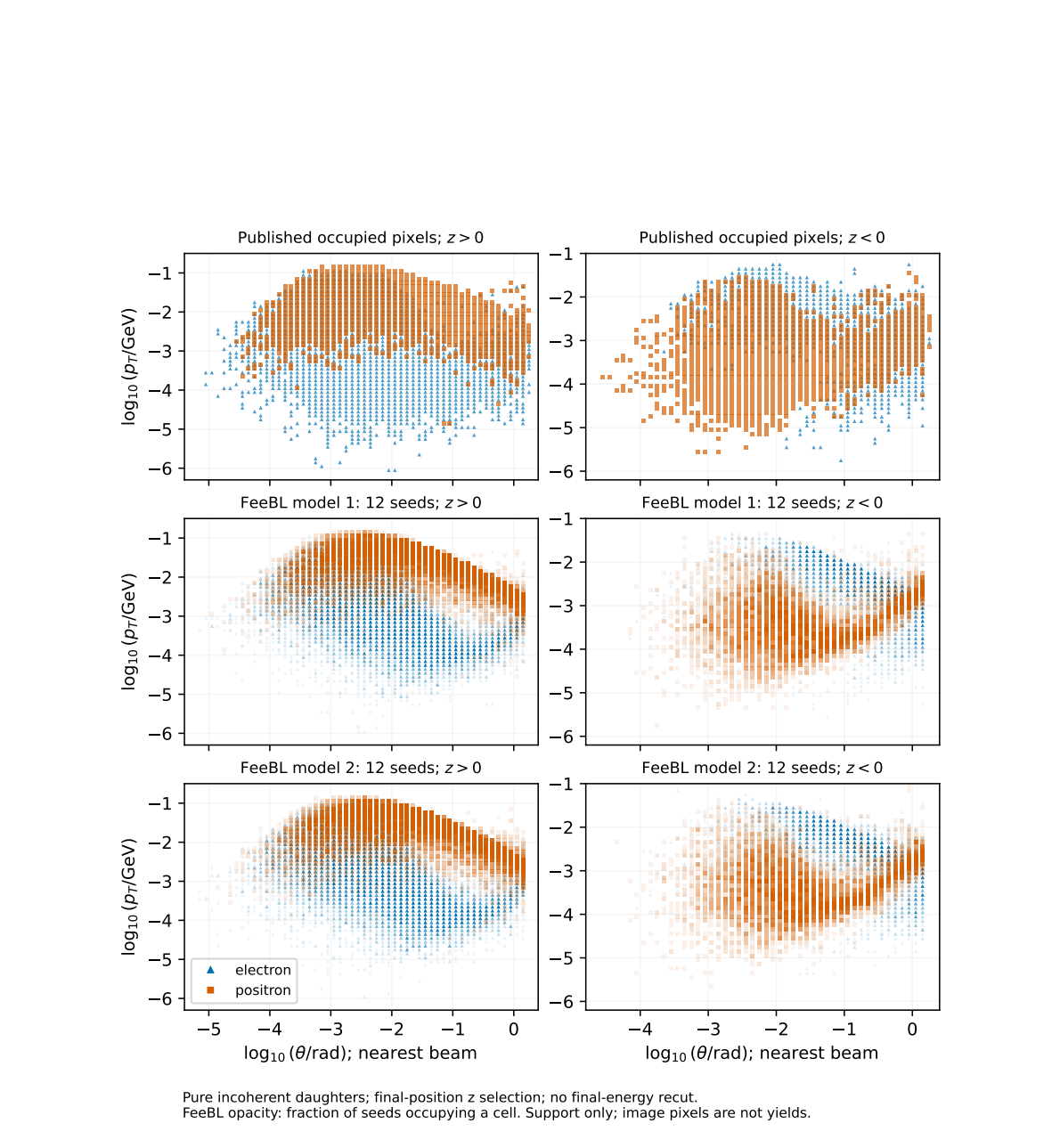
Background predictions for detectors at future colliders should be recalculated using corrected pair-production kernels, as the inherited Guinea-Pig++ code contained significant errors in forward-angle sampling, normalization, and process definitions.
Beam depolarization is smaller for high-energy collisions near the nominal center-of-mass energy, which is favorable for polarization-based measurements.
If the revised $N_ν$ uncertainty withstands a full re-evaluation of LEP error budgets, the experimental constraint on the number of light neutrino generations would be the most precise from $e^+e^-$ colliders, potentially challenging the Standard Model's three-family prediction at the sub-percent level.
The identified 2% bias in the Guinea-Pig simulations may affect other published LEP results that relied on the same beam-deflection simulations, such as the luminosity measurement itself, implying a need for reanalysis.
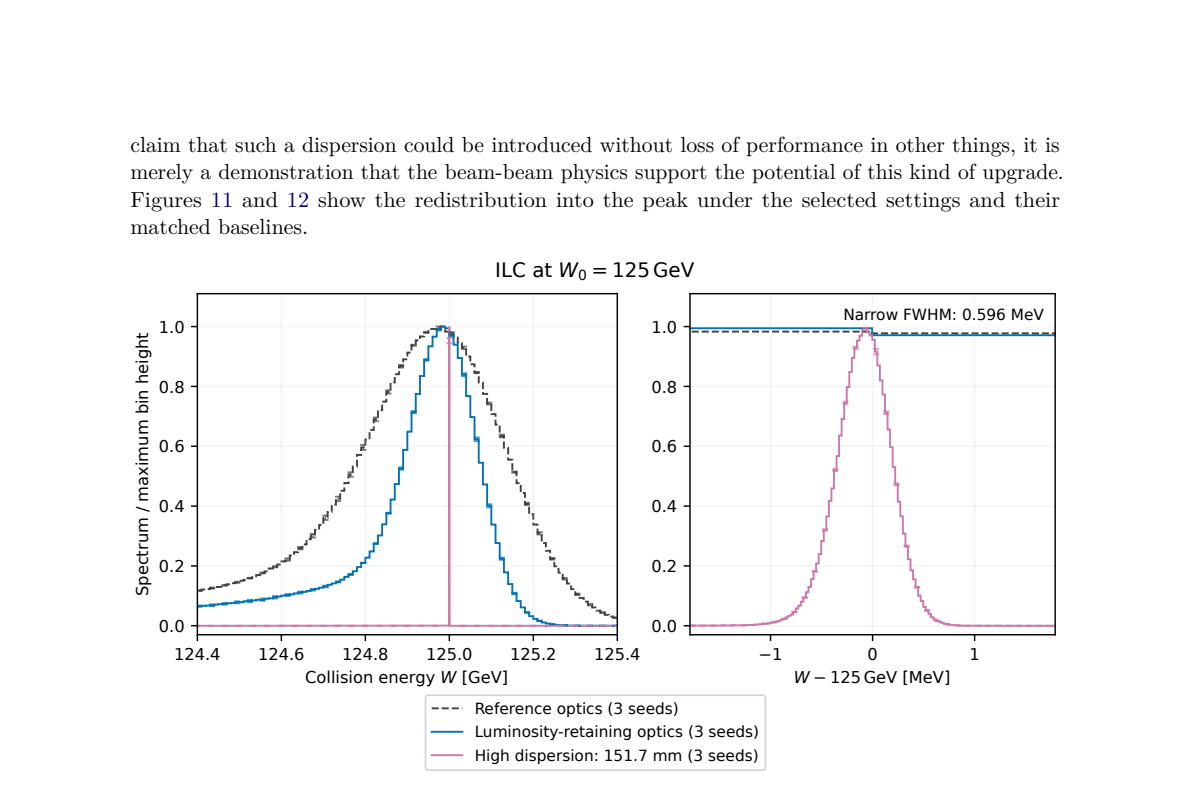
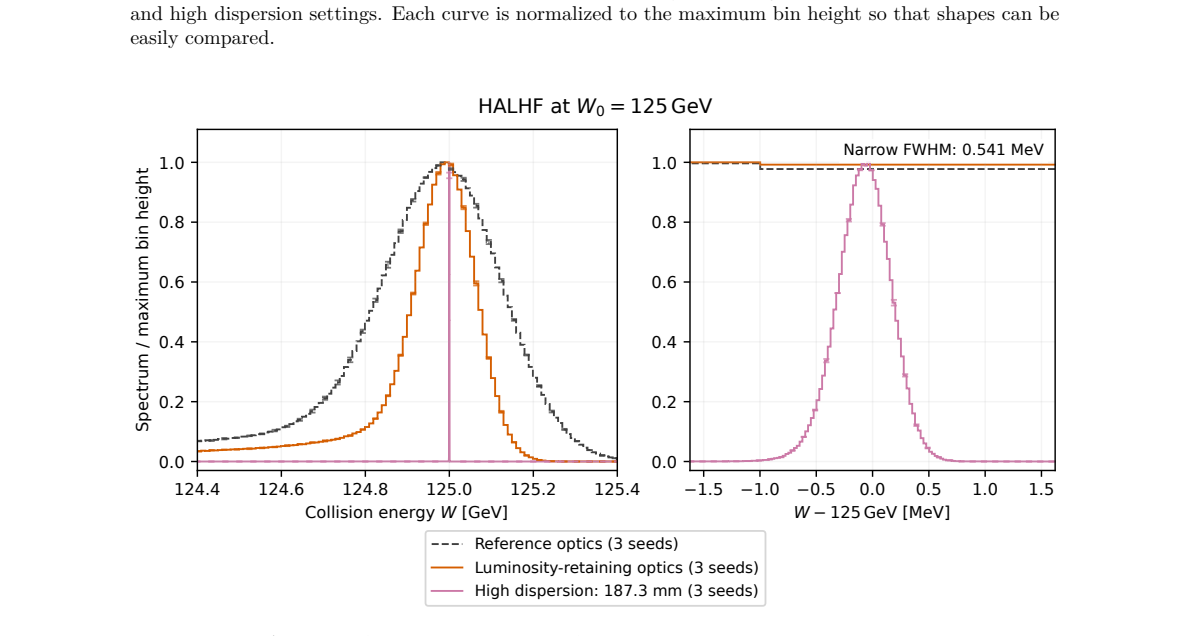
The monochromatization results suggest that linear colliders (ILC/LCF, HALHF) have a viable path to direct Higgs resonance production, while FCC-ee would require much larger dispersions or alternative schemes (e.g., vertical dispersion or chromatic waist matching) – a direction the paper explicitly leaves for future work.
Check this review
Pith stored no record of this review's passes and took no fingerprint of it. Reviews made by code from 13 Nov 2026 on carry both.
How often reviews like this one are right
Reviews like this one: written by deepseek-v4-flash, where what was read was not recorded.
How often objections from reviews like this one are right: not yet measured
Reviews by people
This review was written by a machine. No person has reviewed this paper on Pith yet. A scientist listed on Pith can review it for a fee, and their review is published here whatever it concludes.
The paper
Abstract
Beam-beam electromagnetic interactions affect the luminosity, collision energy, polarization, and particle backgrounds relevant to precision measurements at electron-positron colliders. We investigate these effects using Fast e±e± Beam and Luminosity (FeeBL), a new beam-beam simulation framework, and compare its predictions with published results from LEP and proposed future colliders. We reproduce the analytical field-integration calculations of LEP Bhabha scattering and identify an approximately 2% bias in previously published beam-deflection simulations. Applying the corresponding luminosity correction and a revised uncertainty assessment motivated by the observed agreement among the four LEP experiments yields (Nν = 2.9965 ± 0.0040), compared with the previously reported (2.9963 ± 0.0074). The revised uncertainty is conditional on an assumed common rescaling of experiment specific uncertainties and motivates further investigation of the original uncertainty budgets. We identify and correct implementation errors in the modeling of Breit-Wheeler, Bethe-Heitler, and Landau-Lifshitz pair production, with implications for detector backgrounds at Higgs factories. Simulated beam depolarization and luminosity spectra are compared with existing ILC and HALHF predictions. Finally, we investigate collision energy monochromatization for direct Higgs production, obtaining sub-MeV collision energy peak widths in exploratory linear collider configurations at substantial luminosity cost, while finding significantly weaker narrowing for the FCC-ee configurations studied. We derive a rigid Gaussian beam overlap model and estimate that FCC-ee needs roughly 10 m of horizontal only dispersion to reach widths of ≈ 1 MeV.
The paper's own sentences, arranged, kept beside the review and separate from it. Each label is drawn from a closed vocabulary; the number beside it is the probability the classifier gave that label. No sentence in this record was written by a model.
abstract compiled · 2026-11-11
The authors' main claim, as the classifier picked it out 0.34
“Applying the corresponding luminosity correction and a revised uncertainty assessment motivated by the observed agreement among the four LEP experiments yields ($N_\nu = 2.9965 \pm 0.0040$), compared with the previously reported ($2.9963 \pm 0.0074$).”
How the main claim is stated: asserted 1.00
What the abstract itself states, as probabilities: claims first 0.12 · states limitation 0.95 · human participants 0.02 · controlled comparison 0.33 · randomized assignment 0.01 · states quantitative result 0.99 · compares with prior results 0.98 · mentions code or data availability 0.04
The abstract, sentence by sentence
This table labels the abstract only (arXiv listing abstract v1). The number is the probability the classifier gave the label.
| Sentence | Role | The authors' own work | States the main conclusion | Strength |
|---|---|---|---|---|
| Beam-beam electromagnetic interactions affect the luminosity, collision energy, polarization, and particle backgrounds relevant to precision measurements at electron-positron colliders. | background 1.00 | 0.06 | 0.06 | asserted 1.00 |
| We investigate these effects using Fast $e^{\pm}e^{\pm}$ Beam and Luminosity (FeeBL), a new beam-beam simulation framework, and compare its predictions with published results from LEP and proposed future colliders. | method 0.54 | 0.92 | 0.05 | asserted 0.99 |
| We reproduce the analytical field-integration calculations of LEP Bhabha scattering and identify an approximately 2% bias in previously published beam-deflection simulations. | result 0.91 | 0.90 | 0.12 | asserted 0.99 |
| Applying the corresponding luminosity correction and a revised uncertainty assessment motivated by the observed agreement among the four LEP experiments yields ($N_\nu = 2.9965 \pm 0.0040$), compared with the previously reported ($2.9963 \pm 0.0074$). | result 1.00 | 0.88 | 0.26 | asserted 1.00 |
| The revised uncertainty is conditional on an assumed common rescaling of experiment specific uncertainties and motivates further investigation of the original uncertainty budgets. | limitation 0.99 | 0.66 | 0.06 | asserted 0.87 |
| We identify and correct implementation errors in the modeling of Breit-Wheeler, Bethe-Heitler, and Landau-Lifshitz pair production, with implications for detector backgrounds at Higgs factories. | contribution 0.73 | 0.95 | 0.10 | asserted 1.00 |
| Simulated beam depolarization and luminosity spectra are compared with existing ILC and HALHF predictions. | contribution 0.74 | 0.83 | 0.04 | asserted 0.92 |
| Finally, we investigate collision energy monochromatization for direct Higgs production, obtaining sub-MeV collision energy peak widths in exploratory linear collider configurations at substantial luminosity cost, while finding significantly weaker narrowing for the FCC-ee configurations studied. | result 0.90 | 0.96 | 0.17 | asserted 1.00 |
| We derive a rigid Gaussian beam overlap model and estimate that FCC-ee needs roughly 10 m of horizontal only dispersion to reach widths of $\approx1~\mathrm{MeV}$. | result 0.88 | 0.95 | 0.11 | asserted 0.70 |
What kind of paper the classifier reports this is: simulation study 0.75 · evidence from simulation or computation 1.00
What was examined, and what was not
Sources read
- arXiv listing abstract v1
Not examined
- full text
- figures and tables
- references and citing sentences
- relations to other papers
Levels run
- P abstract
Not run
- S sections
- T body sentences
- C citations
- R cross-paper relations
How the labels were made
Compiled by classifier-1.13.0 via TypeSafe API, question bank abstract-p1-20260923, 2026-11-11: 1 request, 7,212 input tokens.
Every quoted sentence on this record is the authors'. Every label is from Pith's closed vocabulary, with the probability shown beside it. This record as JSON
Figures (14)
Figures are the authors', reproduced from the paper.
References (46)
- [1] G. Voutsinas, E. Perez, M. Dam and P. Janot, “Beam-beam effects on the luminosity mea- surement at LEP and the number of light neutrino species,”Phys. Lett. B800(2020) 135068, doi:10.1016/j.physletb.2019.135068, arXiv:1908.01704v4 on PithPith's reviewarXiv
- [2] B. Madison and G. W. Wilson, “Center-of-mass energy determination usinge+e−→µ +µ−(γ)events at futuree +e− colliders,” arXiv:2209.03281v3 (2022) on PithPith's reviewarXiv
- [3] D. Schulte,Study of Electromagnetic and Hadronic Background in the Interaction Region of the TESLA Collider, Ph.D. thesis, Universität Hamburg (1997), TESLA-97-08 on Pith
- [4] C. Rimbault, P. Bambade, O. Dadoun, G. Le Meur, F. Touze, M. del C. Alabau and D. Schulte, “GUINEA-PIG++: An upgraded version of the linear collider beam-beam interaction simulation code GUINEA-PIG,”Proceedings of PAC 2007, Albuquerque (2007) 2728–2730, THPMN010 on Pith
- [5] B. Madison, “Using the GP2X framework for center-of-mass energy precision studies ate+e− Higgs factories,”Proceedings of LCWS 2023(2023), arXiv:2308.09676 on PithPith's reviewarXiv
- [6] B. Madison, “Beam polarization precision requirements for future e+e− Higgs factories,” (2025), arXiv:2511.09851 on PitharXiv
- [7] C. Rimbault, G. Le Meur, F. Blampuy, P. Bambade and D. Schulte, “Implementation of depolarization due to beam-beam effects in the beam-beam interaction simulation tool GUINEA-PIG++,”J. Phys. Conf. Ser.198(2009) 012006, doi:10.1088/1742-6596/198/1/012006 on Pithdoi:10.1088/1742-6596/198/1/012006
- [8] G. Moortgat-Pick et al., “Polarized positrons and electrons at the linear collider,”Phys. Rep.460(2008) 131–243, doi:10.1016/j.physrep.2007.12.003, arXiv:hep-ph/0507011v1; Eq. (1.19), p. 16 of the preprint on PithPith's reviewarXiv
- [9] M. Beckmann, J. List, A. Vauth and B. Vormwald, “Spin transport and polarimetry in the beam delivery system of the International Linear Collider,”JINST9(2014) P07003, doi:10.1088/1748- 0221/9/07/P07003, arXiv:1405.2156 on PithPith's reviewarXiv
- [10] C. Rimbault, P. Bambade, K. Mönig and D. Schulte, “Incoherent pair generation in a beam-beam inter- action simulation,”Phys. Rev. ST Accel. Beams9(2006) 034402, doi:10.1103/PhysRevSTAB.9.034402 on Pithdoi:10.1103/physrevstab.9.034402
- [11] Wolfram Research, Inc.,Mathematica, Champaign, Illinois, software website on Pith
- [12] V. Shtabovenko, R. Mertig and F. Orellana, “FeynCalc 10: Do multiloop integrals dream of computer codes?”Comput. Phys. Commun.306(2025) 109357, doi:10.1016/j.cpc.2024.109357 on Pithdoi:10.1016/j.cpc.2024.109357
- [13] V. Shtabovenko, “FeynCalc 10.2 and FeynHelpers 2: Multiloop calculations streamlined,” arXiv:2512.19858v2 (2026) on PitharXiv
- [14] V. Shtabovenko, “FeynHelpers: Connecting FeynCalc to FIRE and Package-X,”Comput. Phys. Commun. 218(2017) 48–65, doi:10.1016/j.cpc.2017.04.014 on PithPith's reviewdoi:10.1016/j.cpc.2017.04.014
- [15] T. Hahn, “Generating Feynman diagrams and amplitudes with FeynArts 3,”Comput. Phys. Commun. 140(2001) 418–431, doi:10.1016/S0010-4655(01)00290-9 on Pithdoi:10.1016/s0010-4655(01)00290-9
- [16] V. M. Budnev, I. F. Ginzburg, G. V. Meledin and V. G. Serbo, “The two-photon particle production mechanism. Physical problems. Applications. Equivalent photon approximation,”Phys. Rep.15(1975) 181–282, doi:10.1016/0370-1573(75)90009-5 on Pithdoi:10.1016/0370-1573(75)90009-5
- [17] T. Gasser, L. Sroka and C. Jennen-Steinmetz, “Residual variance and residual pattern in nonlinear regression,”Biometrika73(1986) 625–633, doi:10.1093/biomet/73.3.625 on Pithdoi:10.1093/biomet/73.3.625
- [18] B. C. Madison,Integrated Luminosity with 100 ppm Precision, Methods for √s Precision of 1 ppm, and Beyond Standard Model Sensitivity using Photonic Events, at e+e− Higgs Factories, Ph.D. thesis, University of Kansas (2025), arXiv:2510.18666v1 on PitharXiv
- [19] B. Madison, “Novel Machine Learning Methods to Improve Z Pole Integrated Luminosity at Future Colliders,” arXiv:2605.12407v1 (2026) on PithPith's reviewarXiv
- [20] P. Janot and S. Jadach, “Improved Bhabha cross section at LEP and the number of light neutrino species,”Phys. Lett. B803(2020) 135319, doi:10.1016/j.physletb.2020.135319, arXiv:1912.02067 on PithPith's reviewarXiv
show 26 more
- [21] K. Yokoya,User’s Manual of CAIN, version 2.44, 6 January 2017, manual, Secs. 5.6.3, 5.9 and 5.11. 38 on Pith
- [22] H. Abramowicz et al. (FCAL Collaboration), “ECFA Detector R&D Panel, Review Report,” arXiv:1411.4924v1 (2014), Fig. 49 on PithPith's reviewarXiv
- [23] HALHF Collaboration,HALHF interim progress report (Pre-CDR), September 2026, public report, Table 2, Sec. 8.5 and Appendix A on Pith
- [24] M. Migliorati, “Overview of collective effects for the main rings,” presentation at FCC Week 2025, 20 May 2025, slide 3, PA31-3.0 parameter table on Pith
- [25] G. A. Moortgat-Pick et al., “Spin tracking at the ILC,”Proceedings of EPAC 2006, Edinburgh (2006) 2454–2456, WEPLS032 on Pith
- [26] I. R. Bailey, A. F. Hartin, G. A. Moortgat-Pick and C. Pidcott, “Depolarization and beam-beam effects at futuree +e− colliders,”Proceedings of PAC 2011, New York (2011) 1731–1733, WEP134 on Pith
- [27] I. R. Bailey et al., “Depolarization and beam-beam effects at the Linear Collider,”Proceedings of EPAC 2008, Genoa (2008) 598–600, MOPP024 on Pith
- [28] K. Yokoya, “Beamstrahlung in CAIN,” presentation, 12 January 2022, slides 14–18 on Pith
- [29] V. Bargmann, L. Michel and V. L. Telegdi, “Precession of the polarization of particles moving in a homogeneous electromagnetic field,”Phys. Rev. Lett.2(1959) 435–436, doi:10.1103/PhysRevLett.2.435 on Pithdoi:10.1103/physrevlett.2.435
- [30] K. Yokoya,User’s Manual of CAIN, version 2.1e, 1 November 1999, KEK manual, Sec. 5.8 on Pith
- [31] A. Maurer and M. Pontil, “Empirical Bernstein Bounds and Sample Variance Penalization,” arXiv:0907.3740 (2009), Theorem 4 on PithPith's reviewarXiv
- [32] J. Esberg, U. I. Uggerhøj, B. Dalena and D. Schulte, “Strong field processes in beam-beam interactions at the Compact Linear Collider,”Phys. Rev. ST Accel. Beams17(2014) 051003, doi:10.1103/PhysRevSTAB.17.051003 on Pithdoi:10.1103/physrevstab.17.051003
- [33] K. Yokoya and P. Chen, “Depolarization due to beam-beam interaction in electron-positron linear colliders,” SLAC-PUB-4692 (1988),AIP Conf. Proc.187(1989) 938 on Pith
- [34] D. d’Enterria, A. Poldaru and G. Wojcik, “Measuring the electron Yukawa coupling via resonant s-channel Higgs production at FCC-ee,”Eur. Phys. J. Plus137(2022) 201, doi:10.1140/epjp/s13360- 021-02204-2, arXiv:2107.02686v2 on PithPith's reviewarXiv
- [35] S. Jadach and R. A. Kycia, “Lineshape of the Higgs boson in future lepton colliders,”Phys. Lett. B 755(2016) 58–63, doi:10.1016/j.physletb.2016.01.065, arXiv:1509.02406v2 on PithPith's reviewarXiv
- [36] A.Faus-Golfe, M.A.ValdiviaGarciaandF.Zimmermann, “Thechallengeofmonochromatization: Direct s-channel Higgs production:e+e−→H ,”Eur. Phys. J. Plus137(2022) 31, doi:10.1140/epjp/s13360- 021-02151-y, Sec. 2 on Pithdoi:10.1140/epjp/s13360-
- [37] A. Bogomyagkov and E. Levichev, “Collision monochromatization ine+e− colliders,”Phys. Rev. Accel. Beams20(2017) 051001, doi:10.1103/PhysRevAccelBeams.20.051001; preprint arXiv:1702.03634v1, Eqs. (10), (13), (15) and (18); erratum,Phys. Rev. Accel. Beams21(2018) 029902, doi:10.... on PithPith's reviewarXiv
- [38] G. W. Wilson, “Further investigation of dilepton-based center-of-mass energy measurements ate+e− colliders,” arXiv:2308.10414v1 (2023), Appendix A.1 on PithPith's reviewarXiv
- [39] T. Ohl, “CIRCE version 1.02: Beam spectra for simulating linear collider physics,”Comput. Phys. Commun.101(1997) 269–288, doi:10.1016/S0010-4655(96)00167-1; arXiv:hep-ph/9607454, Sec. 5.1 and Eq. (12b) of the preprint on PithPith's reviewarXiv
- [40] L. Evans and S. Michizono (eds.),The International Linear Collider Machine Staging Report 2017, KEK 2017-3, DESY 17-180 and CERN-ACC-2017-0097 (2017), arXiv:1711.00568, Table 5-1 on PithPith's reviewarXiv
- [41] H. Abramowicz et al., “The Linear Collider Facility (LCF) at CERN,” arXiv:2503.24049v2 (2025), Sec. 3 and Appendix A, Table 2 on PitharXiv
- [42] Z. Zhang, A. Faus-Golfe, A. Korsun, B. Bai, H. Jiang, K. Oide, P. Raimondi, D. d’Enterria, S. Zhang, Z. Zhou, Y. Chi and F. Zimmermann, “Monochromatization interaction region optics design for direct s-channel Higgs production at FCC-ee,”Nucl. Instrum. Meth. A1073(2025) 170268... on PithPith's reviewarXiv
- [43] P. A. McIntosh et al., “Crab Cavities for ILC,”Proceedings of SRF2023, Grand Rapids (2023) 990–998, doi:10.18429/JACoW-SRF2023-FRIBA04, FRIBA04, Table 1 on Pithdoi:10.18429/jacow-srf2023-friba04
- [44] D. Shatilov, “Comment on ‘Collision monochromatization ine+e− colliders’,”Phys. Rev. Accel. Beams 21(2018) 028001, doi:10.1103/PhysRevAccelBeams.21.028001 on Pithdoi:10.1103/physrevaccelbeams.21.028001
- [45] A. Faus-Golfe, “Monochromatization Optics for FCC-ee,” presentation at FCC Week 2024, San Francisco, 11 June 2024, slide 27, author presentation on Pith
- [46] B. Madison,FeeBL(2026), https://github.com/BrendonMadison/FeeBL. 40 on Pith
Challenges and discussion
Disagree with the review, or know something it missed? Leave a comment, or challenge this review formally: a challenge becomes a permanent entry in this paper's record, and its decision is published here.
Come back by email
A short list of the week's newly reviewed papers. Nothing is sent until you confirm from your inbox, and every email has a link that stops it. No account.
No comments yet.
Sign in to comment