Software Engineering · arXiv:2611.13125 v1 · submitted 9 Nov 2026 · 35 references
MiniZoo: An Evolving Dataset of Mini Apps for the Research Community
The paper says
“Mini apps run within host applications (apps) such as WeChat, Alipay, Baidu, and Telegram, providing services without requiring users to install separate native apps.”
more of the abstract
Their growing ecosystem has attracted research on software quality, security, and privacy, creating a need for reusable datasets. However, building and maintaining such datasets is challenging, requiring platform-specific collection infrastructure and mechanisms to handle incomplete packages, changing availability, and heterogeneous metadata. A shared, continuously maintained collection is still lacking, therefore motivating the development of a common research resource, whose value has been demonstrated by the experience of AndroZoo in the Android ecosystem. In this paper, we present MiniZoo, an evolving corpus of mini apps and associated metadata. The initial release comprises 16,273 mini-app packages, with multiple versions of the same mini apps. The dataset is managed and distributed through AndroZoo under its existing access conditions. To facilitate its reuse, we describe the collection process, data organization, provenance, and limitations, and explain how researchers can select and access the data. MiniZoo is designed to grow continuously through the addition of newly discovered mini apps, the inclusion of further host ecosystems, and the collection of successive versions of previously collected apps. This ongoing expansion will enable both comparisons across ecosystems and longitudinal studies of how mini apps evolve over time.
from the abstract
Pith says
Machine review · deepseek-v4-flash · 11 Nov 2026 · what was read was not recorded · not checked by a person
It can be wrong. Challenge this review or reply to it.
Holds up. A sincere, well-scoped dataset paper for the mini-app community: MiniZoo delivers 16k WeChat mini-app packages with version history, clear crawling methodology, and an honest limitations section. This line is wrong
4 minor
How often objections from reviews like this one are right: not yet measured
Not checked: figures, code, what the 35 references say.
4 minor objections
The paper says, at Section III (Mini App Discovery)
Pith says: minor objection 1 of 4
The sentence 'These results are then combined with existing catalogue and collection records to build the discovery catalogue' leaves the origin, size, and provenance of the 'existing catalogue and collection records' unspecified; since the paper presents provenance as part of its contribution, please state what these records are, where they come from, and how much of the 13,009 mini apps each discovery source contributed.
The paper says, at Section II, Table I
Pith says: minor objection 2 of 4
Please state explicitly whether the 16,273 'distinct package contents (SHA-256)' count individual .wxapkg files including subpackages; if subpackages are counted as separate entries, clarify how readers should map this figure to app-version snapshots, and consider reporting the number of distinct (AppID, version code) pairs.
show 2 more
The paper says, at Section III vs. Section VI
Pith says: minor objection 3 of 4
The collection environment is reported precisely (en-US locale, Europe/Luxembourg timezone, WeChat 8.0.72, Android 16), but the possible effect of language and region on WeChat search results is not discussed in the limitations; a sentence in Section VI on this source of selection bias would help reusers assess representativeness.
The paper says, at Section II (minizoo_metadata.jsonl)
Pith says: minor objection 4 of 4
The JSON Lines metadata is described only through representative fields; listing the exact field names and value formats, or pointing to the schema within the archive, would make the metadata description self-contained.
What would settle it
Obtain a test AndroZoo API key, download the current minizoo.tar.gz archive, and run an independent consistency check: count rows in minizoo.csv, verify that all SHA-256 hashes are unique and match the provided .wxapkg files, confirm that each AppID in minizoo_metadata.jsonl appears in minizoo.csv, and recompute the total package volume from the size field to compare with Table I. If these checks pass, the central availability claim is confirmed; any mismatch would pinpoint the exact record needing correction.
from the skeptic's reading
How the review went
4 readings by deepseek-v4-flash · 11 Nov 2026
- Reader holds up
- Skeptic partly agrees
- Editor wrote the verdict above
- Referee minor revision: 4 minor
Not run on this paper: the simulated authors' defence.
Pith did not check this review's objections against the paper.
The review in full
The review in brief, machine-written
Quick take: this is a solid, honest dataset paper, and the only genuinely new thing in it is the resource itself — a publicly hosted, versioned, growing WeChat mini-app corpus, distributed through AndroZoo. That resource is worth having; the paper that describes it is competent but not deep.
What it does well: the authors separate mini-app identity (AppID) from package content (SHA-256), which is exactly the right schema for reuse and for any longitudinal work. The crawler section is concrete: discovery by keyword search (688 queries, Sec. III), AppID verification before acquisition, WeChat checksum verification, re-inspection after copying, and AppID–SHA-256 deduplication that keeps different apps separate even when content hashes collide. Those are real safeguards, and the Web-facing description (access via AndroZoo API key, nightly tar.gz refresh) is enough for someone to actually use the dataset tomorrow. The authors also state their limitations plainly — coverage is not exhaustive [b104–b105], version histories have temporal gaps [b106–b107], maintenance cost is acknowledged [b108–b109], and only WeChat is covered [b110]. I did not find a load-bearing technical flaw. The reader's weakest-assumption point (keyword discovery bias) is real but explicitly acknowledged, and it does not contradict the stated contribution of "as many as possible, not exhaustive."
Where it is soft, in proportion: the novelty is genuinely modest — the crawler is adapted from MiniCrawler, the distribution reuses AndroZoo's infrastructure, and the paper does not report any measurement or validation beyond package counts and size distribution. The claim that the metadata supports privacy/security research is plausible but unverified; the paper does not show, for example, that the 1,149 multi-version apps actually exhibit meaningful evolution, or that the corpus reproduces any prior result. The only real external trust anchor is the live site (androzoo.uni.lu/minizoo) matching the reported counts; that is a verification issue, not an argument flaw. One small oddity: the retained discovery log lists 688 queries and the corpus is 13k apps — fine, but the paper gives no sense of how many queries failed or how discovery will scale past the backlog.
Who this is for: researchers working on WeChat mini-app security, privacy, or quality who need a shared body of packages with version information. That audience will reach for the dataset, not the paper. It deserves peer review — a serious editor should send it out because the community needs a citable artifact description and the data is verifiable. My recommendation: accept with the usual request to tighten the validation story in the research-opportunities section.
Cheers.
The strongest objection
The paper's central claim is that MiniZoo provides a usable, growing corpus of WeChat mini-app packages with metadata, distributed through AndroZoo. The least secure condition is the representativeness of the keyword-based discovery queue (Section III), since 688 queries cannot cover the whole WeChat ecosystem. However, the authors explicitly disclaim exhaustive coverage (b104) and frame the goal as collecting and preserving as many mini apps as possible rather than guaranteeing completeness (b105), so the acknowledged coverage bias does not contradict the stated contribution. The crawler design also includes concrete safeguards: AppID checks, WeChat checksum verification, re-inspection after acquisition, and AppID–SHA-256 deduplication (Section III). The only remaining trust anchor is external—whether the live archive at androzoo.uni.lu/minizoo actually matches the reported counts and metadata schema—which is a verification issue, not a flaw in the paper's argument. I therefore find no load-bearing technical concern.
The paper is a dataset-description paper; its main claims are existence, scale, organization, and planned evolution. I checked the arithmetic and definitions: 13,009 apps with 1,149 multi-version apps can yield 16,273 distinct packages under plausible per-app version counts, and the SHA-256/AppID distinction is coherent. The collection pipeline is described in enough detail to be reproducible, with crawler code released. The authors' Section VI limitations accurately cover coverage, temporal gaps, maintenance, and platform scope; no unacknowledged internal contradiction surfaced. The reader's weakest assumption—keyword-discovery representativeness—is real but explicitly disclaimed, so it does not undermine the dataset's stated research value. The only load-bearing unverified element is external availability of the live archive, which is a deployment check rather than a scientific flaw. The verdict therefore remains unchanged.
The referee's report
The paper addresses a real gap: prior mini-app collections are either very small, not publicly shared, or static snapshots, and none is tied to the AndroZoo distribution infrastructure that the community already uses. The strengths are concrete rather than rhetorical. First, the integrity checks in Section III (AppID verification before and after acquisition, WeChat checksum validation, re-inspection, and (AppID, SHA-256) deduplication) give reusers a falsifiable basis for trusting the packages. Second, the weakest methodological point, the representativeness of keyword-based discovery, is explicitly acknowledged in Section VI, where the authors disclaim exhaustive coverage and frame the goal as preservation of as many mini apps as possible; that acknowledged bias does not contradict the stated contribution, so I do not treat it as a load-bearing objection. Third, both the crawler code (GitHub) and the dataset (androzoo.uni.lu/minizoo) are public, making the reported counts checkable. Fourth, the platform-agnostic metadata schema is a credible foundation for the stated extension to Alipay, Baidu, and Telegram. The paper makes no claim stronger than its methodology supports.
Pith's reading of the paper (a machine's summary, not the authors')
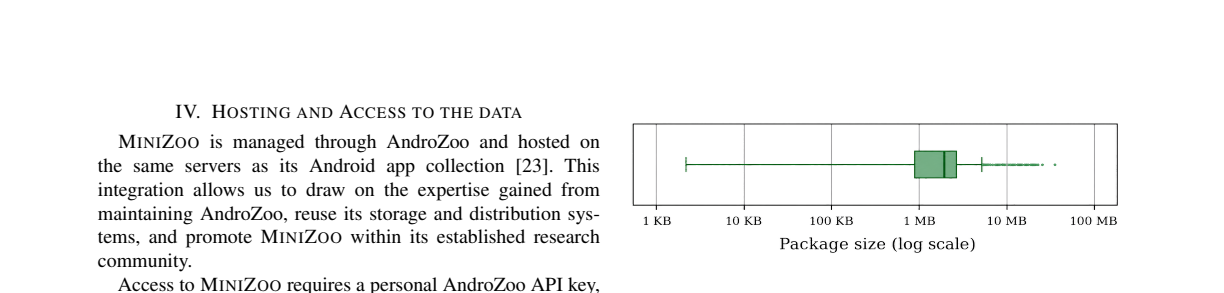
MiniZoo sets out to give the mini-app research community what AndroZoo gave Android research: a shared, continuously maintained collection rather than scattered one-off snapshots. The initial release holds 13,009 WeChat mini apps, 16,273 distinct package contents, and 30.33 GiB of data, including 1,149 apps captured in more than one version. Its central organizational idea is to separate the mini app's stable identity, the AppID, from the hash of a specific package file, so the same app can accrue a version history. The collection is rebuilt nightly and distributed under AndroZoo's access conditions, with plans to add further host ecosystems. The value is that security, privacy, and quality studies of mini apps have been hard to compare because each research team collected its own small or partial dataset; a common evolving corpus makes independent evaluation and longitudinal analysis feasible.
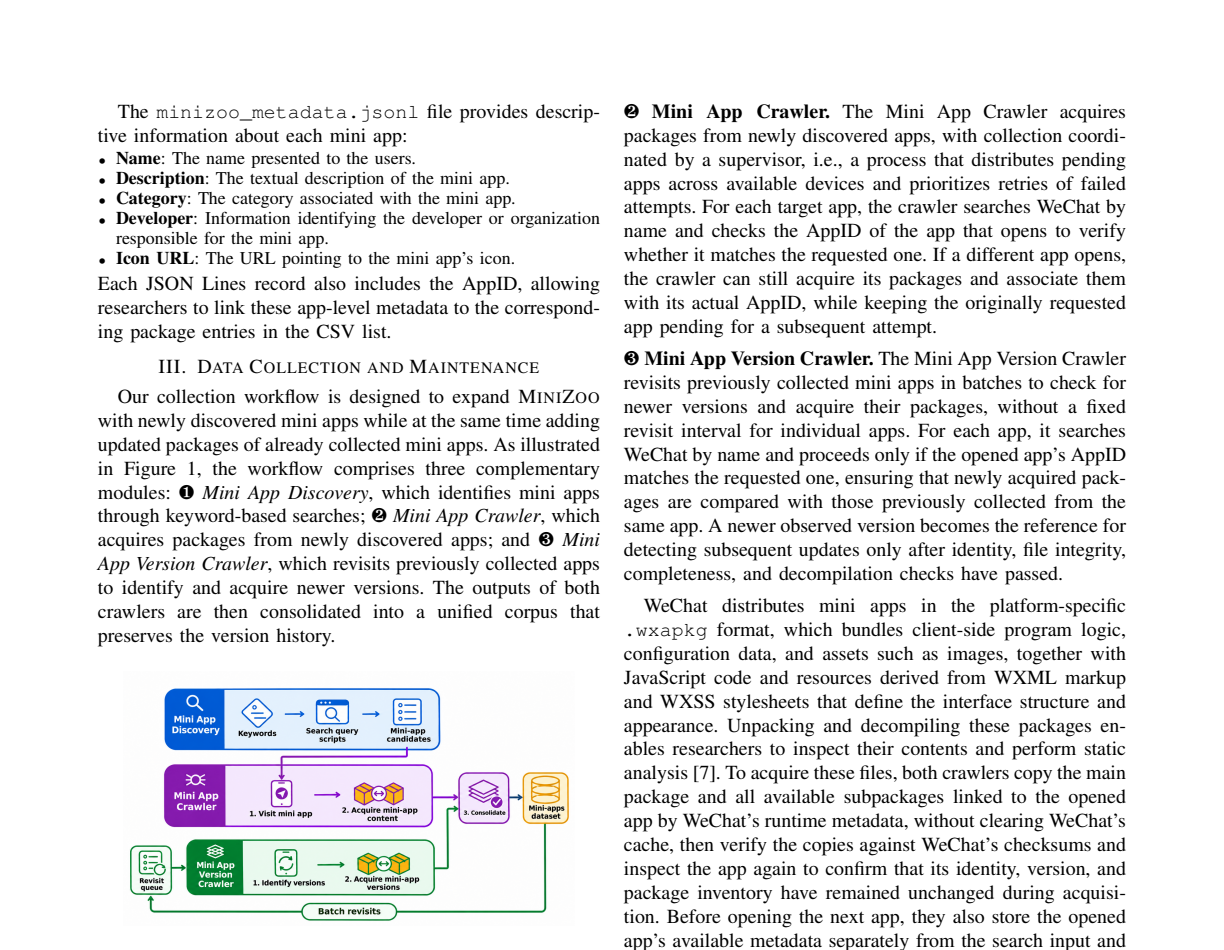
What carries the argument. The load-bearing abstraction is the identity split: AppID names the mini app, the way an Android package name names an app; SHA-256 names a specific package archive, the way an APK hash does; and the pair of the two is the corpus's deduplication key. That split is what lets the dataset grow by versions instead of by raw file count and is the premise behind the metadata schema and the version crawler. Around it sits the three-module collection workflow — discovery seeded by 688 keyword queries, a crawler for newly found apps, and a revisiting version crawler — which is the mechanism that keeps the corpus evolving between nightly archive rebuilds.
Core claim. The paper's central claim is that a shared, continuously maintained corpus of mini apps is not just desirable but feasible, and that MiniZoo is that corpus. Its foundational distinction is between a mini app's stable identity, the WeChat AppID, and a package's content identity, its SHA-256 hash: the same AppID maps to many packages over time, and that mapping is what makes version history and longitudinal study possible. On this basis the paper reports 13,009 mini apps with at least one associated package, 16,273 distinct package contents, a total volume of 30.33 GiB, and 1,149 apps (8.83 percent) with multiple recorded versions as of November 9, 2026. Collection runs through three modules — keyword-based discovery, a crawler for new apps, and a version crawler that revisits known apps — whose outputs are consolidated and deduplicated on the AppID-hash pair. The authors argue the resource fills a concrete gap: existing mini-app collections are tiny fixed snapshots, or large corpora whose owners share only selected samples, so tool evaluations and measurements cannot be compared or repeated. Hosting through AndroZoo supplies a maintenance model, access conditions, and a distribution channel already established in the Android research community, with a nightly-updated archive and planned selective downloads.
The premise it rests on. The resource is only as representative as its discovery method: MiniZoo's usefulness to mini-app research generally assumes that keyword searches on WeChat surface a sufficiently diverse and representative slice of the ecosystem, and the authors themselves state that they cannot enumerate all mini apps to measure what share they captured.
If the paper is right (Pith's inferences, not the authors')
TaintMini, WeMinT, and any other mini-app analysis tool can be run on identical packages from one corpus, making published security and privacy measurements directly comparable rather than dependent on each team's private collection.
The 1,149 apps with multiple recorded versions already provide a base for studying how package size, API usage, and dependencies change; continued collection widens that base.
Because the archive is rebuilt nightly, researchers always obtain a fresh, dated snapshot of the ecosystem rather than a frozen release.
Planned selective downloads by SHA-256 or AppID will let researchers retrieve only the packages they need, following AndroZoo's established download model.
Extending dedicated crawlers to Alipay, Baidu, and Telegram would produce cross-ecosystem comparisons under the same metadata schema.
If MiniZoo follows AndroZoo's growth trajectory, a testable consequence is that published mini-app studies will begin citing it as their data source, which would make independent replication of security and privacy measurements routine.
The AppID-hash schema is claimed to be platform-agnostic; a concrete test is whether Alipay, Baidu, or Telegram packages fit the existing CSV and JSON Lines structure without schema changes.
The authors acknowledge gaps in version histories; a follow-up they do not propose is publishing per-app revisit schedules so longitudinal studies can model the irregular sampling explicitly.
The discovery log's coverage is unmeasured, so an external benchmark comparing MiniZoo's AppID set against known reference lists would let researchers quantify the corpus's biases before drawing ecosystem-wide conclusions.
Check this review
Pith stored no record of this review's passes and took no fingerprint of it. Reviews made by code from 13 Nov 2026 on carry both.
How often reviews like this one are right
Reviews like this one: written by deepseek-v4-flash, where what was read was not recorded.
How often objections from reviews like this one are right: not yet measured
Reviews by people
This review was written by a machine. No person has reviewed this paper on Pith yet. A scientist listed on Pith can review it for a fee, and their review is published here whatever it concludes.
The paper
Abstract
Mini apps run within host applications (apps) such as WeChat, Alipay, Baidu, and Telegram, providing services without requiring users to install separate native apps. Their growing ecosystem has attracted research on software quality, security, and privacy, creating a need for reusable datasets. However, building and maintaining such datasets is challenging, requiring platform-specific collection infrastructure and mechanisms to handle incomplete packages, changing availability, and heterogeneous metadata. A shared, continuously maintained collection is still lacking, therefore motivating the development of a common research resource, whose value has been demonstrated by the experience of AndroZoo in the Android ecosystem. In this paper, we present MiniZoo, an evolving corpus of mini apps and associated metadata. The initial release comprises 16,273 mini-app packages, with multiple versions of the same mini apps. The dataset is managed and distributed through AndroZoo under its existing access conditions. To facilitate its reuse, we describe the collection process, data organization, provenance, and limitations, and explain how researchers can select and access the data. MiniZoo is designed to grow continuously through the addition of newly discovered mini apps, the inclusion of further host ecosystems, and the collection of successive versions of previously collected apps. This ongoing expansion will enable both comparisons across ecosystems and longitudinal studies of how mini apps evolve over time.
The paper's own sentences, arranged, kept beside the review and separate from it. Each label is drawn from a closed vocabulary; the number beside it is the probability the classifier gave that label. No sentence in this record was written by a model.
abstract compiled · 2026-11-11
The authors' main claim, as the classifier picked it out 0.59
“In this paper, we present MiniZoo, an evolving corpus of mini apps and associated metadata.”
How the main claim is stated: asserted 1.00
What the abstract itself states, as probabilities: claims first 0.17 · states limitation 0.73 · human participants 0.05 · controlled comparison 0.02 · randomized assignment 0.01 · states quantitative result 0.97 · compares with prior results 0.15 · mentions code or data availability 0.91
The abstract, sentence by sentence
This table labels the abstract only (arXiv listing abstract v1). The number is the probability the classifier gave the label.
| Sentence | Role | The authors' own work | States the main conclusion | Strength |
|---|---|---|---|---|
| Mini apps run within host applications (apps) such as WeChat, Alipay, Baidu, and Telegram, providing services without requiring users to install separate native apps. | background 1.00 | 0.05 | 0.02 | asserted 1.00 |
| Their growing ecosystem has attracted research on software quality, security, and privacy, creating a need for reusable datasets. | background 0.98 | 0.06 | 0.03 | asserted 1.00 |
| However, building and maintaining such datasets is challenging, requiring platform-specific collection infrastructure and mechanisms to handle incomplete packages, changing availability, and heterogeneous metadata. | background 0.68 | 0.08 | 0.03 | asserted 1.00 |
| A shared, continuously maintained collection is still lacking, therefore motivating the development of a common research resource, whose value has been demonstrated by the experience of AndroZoo in the Android ecosystem. | gap 0.98 | 0.07 | 0.11 | asserted 1.00 |
| In this paper, we present MiniZoo, an evolving corpus of mini apps and associated metadata. | contribution 1.00 | 0.90 | 0.26 | asserted 1.00 |
| The initial release comprises 16,273 mini-app packages, with multiple versions of the same mini apps. | result 0.54 | 0.92 | 0.07 | asserted 1.00 |
| The dataset is managed and distributed through AndroZoo under its existing access conditions. | method 0.66 | 0.67 | 0.04 | asserted 1.00 |
| To facilitate its reuse, we describe the collection process, data organization, provenance, and limitations, and explain how researchers can select and access the data. | contribution 0.61 | 0.83 | 0.06 | asserted 0.98 |
| MiniZoo is designed to grow continuously through the addition of newly discovered mini apps, the inclusion of further host ecosystems, and the collection of successive versions of previously collected apps. | future work 0.55 | 0.52 | 0.13 | asserted 0.98 |
| This ongoing expansion will enable both comparisons across ecosystems and longitudinal studies of how mini apps evolve over time. | interpretation 0.46 | 0.25 | 0.19 | asserted 0.54 |
What kind of paper the classifier reports this is: dataset or benchmark 1.00 · evidence from observation or experiment 0.58
What was examined, and what was not
Sources read
- arXiv listing abstract v1
Not examined
- full text
- figures and tables
- references and citing sentences
- relations to other papers
Levels run
- P abstract
Not run
- S sections
- T body sentences
- C citations
- R cross-paper relations
How the labels were made
Compiled by classifier-1.13.0 via TypeSafe API, question bank abstract-p1-20260923, 2026-11-11: 1 request, 7,467 input tokens.
Every quoted sentence on this record is the authors'. Every label is from Pith's closed vocabulary, with the probability shown beside it. This record as JSON
Figures (2)
Figures are the authors', reproduced from the paper.
References (35)
- [1] M. Schreieck, A. Ou, and H. Krcmar, “Mini-app ecosystems,”Business & Information Systems Engineering, vol. 65, no. 1, pp. 85–93, Feb on Pith
- [2] Tencent, “WeChat Mini Program Development Guide,” https://developers.weixin.qq.com/miniprogram/dev/framework/, accessed: 2026-11-03 on Pith
- [3] Alipay, “Alipay Mini Program Documentation,” https://opendocs.alipay. com/mini, accessed: 2026-11-03 on Pith
- [4] Baidu, “Baidu Smart Mini Program Documentation,” https://smartprogram.baidu.com/docs/develop/api/open/, accessed: 2026-11-03 on Pith
- [5] Telegram, “Telegram Mini Apps,” https://core.telegram.org/bots/ webapps, accessed: 2026-11-03 on Pith
- [6] T. Wang, Q. Xu, X. Chang, W. Dou, J. Zhu, J. Xie, Y . Deng, J. Yang, J. Yang, J. Wei, and T. Huang, “Characterizing and detecting bugs in WeChat mini-programs,” inProc. ICSE, 2022, pp. 363–375 on Pith
- [7] C. Wang, R. Ko, Y . Zhang, Y . Yang, and Z. Lin, “TaintMini: Detecting Flow of Sensitive Data in Mini-Programs with Static Taint Analysis,” inProc. ICSE, 2023, pp. 932–944 on Pith
- [8] S. Meng, L. Wang, S. Wang, K. Wang, X. Xiao, G. Bai, and H. Wang, “WeMinT: Tainting Sensitive Data Leaks in WeChat Mini-Programs,” inProc. ASE, 2023, pp. 1403–1415 on Pith
- [9] Y . Wang, M. Fan, J. Liu, J. Tao, W. Jin, H. Wang, Q. Xiong, and T. Liu, “Do as You Say: Consistency Detection of Data Practice in Program Code and Privacy Policy in Mini-App,”IEEE Transactions on Software Engineering, vol. 50, no. 12, pp. 3225–3248, 2024 on Pith
- [10] S. Wang, Y . Li, K. Wang, Y . Liu, H. Li, Y . Liu, and H. Wang, “MiniS- cope: Automated UI Exploration and Privacy Inconsistency Detection of MiniApps via Two-phase Iterative Hybrid Analysis,”ACM Transactions on Software Engineering and Methodology, vol. 34, no. 6, pp. 1–29, 2025 on Pith
- [11] L. Ferrari, M. Ceccato, and L. Verderame, “TeleGapper: On the (un)reliability of Privacy Policies in Telegram Mini apps,” arXiv preprint arXiv:2608.13390, 2026. [Online]. Available: https: //arxiv.org/abs/2608.13390 on PithPith's reviewarXiv
- [12] Y . Shi, Z. Yang, K. Zhong, G. Yang, Y . Yang, X. Zhang, and M. Yang, “The Skeleton Keys: A Large Scale Analysis of Credential Leakage in Mini-apps,” inProc. NDSS, 2025 on Pith
- [13] Y . Zhang, B. Turkistani, A. Y . Yang, C. Zuo, and Z. Lin, “A Mea- surement Study of Wechat Mini-Apps,”Proceedings of the ACM on Measurement and Analysis of Computing Systems, vol. 5, no. 2, pp. 1–25, 2021 on Pith
- [14] S. Li, Z. Yang, Y . Yang, D. Liu, and M. Yang, “Identifying Cross- User Privacy Leakage in Mobile Mini-Apps at a Large Scale,”IEEE Transactions on Information F orensics and Security, vol. 19, pp. 3135– 3147, 2024 on Pith
- [15] W. Li, B. Yang, H. Ye, L. Xiang, Q. Tao, X. Wang, and C. Zhou, “Mini- Tracker: Large-Scale Sensitive Information Tracking in Mini Apps,” IEEE Transactions on Dependable and Secure Computing, vol. 21, no. 4, pp. 2099–2114, 2024 on Pith
- [16] C. Wang, Y . Zhang, and Z. Lin, “One Size Does Not Fit All: Uncovering and Exploiting Cross Platform Discrepant APIs in WeChat,” inProc. USENIX Security, 2023, pp. 6629–6646. [Online]. Available: https: //www.usenix.org/conference/usenixsecurity23/presentation/wang-chao on Pith
- [17] Y . Yang, Y . Zhang, and Z. Lin, “Cross Miniapp Request Forgery: Root Causes, Attacks, and Vulnerability Detection,” inProc. ACM CCS, 2022, pp. 3079–3092 on Pith
- [18] C. Wang, Y . Zhang, and Z. Lin, “Uncovering and exploiting hidden apis in mobile super apps,” inProceedings of the 2023 ACM SIGSAC Conference on Computer and Communications Security, ser. CCS ’23. New York, NY , USA: Association for Computing Machinery, 2023, p. 2471–2485. [On... on Pithdoi:10.1145/3576915
- [19] Z. Zhang, Q. Hou, L. Ying, W. Diao, Y . Gu, R. Li, S. Guo, and H. Duan, “MiniCAT: Understanding and Detecting Cross-Page Request Forgery Vulnerabilities in Mini-Programs,” inProc. ACM CCS, 2024, pp. 525– 539 on Pith
- [20] Y . Yang, Y . Zhang, and Z. Lin, “Understanding Miniapp Malware: Identification, Dissection, and Characterization,” inProc. NDSS, 2025 on Pith
show 15 more
- [21] MiniSec Community, “Welcome to the MiniSec Store,” https:// minimalware.github.io/, accessed: 2026-10-23 on Pith
- [22] Y . Shi, Z. Yang, D. Liu, K. Zhong, J. Dai, and M. Yang, “Better Safe than Sorry: Uncovering the Insecure Resource Management in App-in- App Cloud Services,” inProc. NDSS, 2026 on Pith
- [23] K. Allix, T. F. Bissyandé, J. Klein, and Y . Le Traon, “AndroZoo: collecting millions of Android apps for the research community,” in Proc. MSR, 2016, pp. 468–471 on Pith
- [24] M. Alecci, P. J. R. Jiménez, K. Allix, T. F. Bissyandé, and J. Klein, “AndroZoo: A Retrospective with a Glimpse into the Future,” inProc. MSR, 2024, pp. 389–393 on Pith
- [25] Frida, “Frida: Dynamic Instrumentation Toolkit,” https://frida.re/, ac- cessed: 2026-11-06 on Pith
- [26] senzhk, “ADBKeyBoard: Android Virtual Keyboard Input via ADB,” https://github.com/senzhk/ADBKeyBoard, accessed: 2026-11-06 on Pith
- [27] Appium contributors, “Appium Documentation,” https://appium.io/docs/ en/latest/, accessed: 2026-11-06 on Pith
- [28] M. Alecci, J. Samhi, T. F. Bissyandé, and J. Klein, “Secrets Unlocked: Evaluating LLMs for Secrets Detection in Android Apps,”Proceedings of the ACM on Software Engineering, vol. 3, no. ISSTA, pp. 1124–1146, Oct. 2026. [Online]. Available: https://doi.org/10.1145/3832140 on Pithdoi:10.1145/3832140
- [29] P. Calciati, K. Kuznetsov, X. Bai, and A. Gorla, “What Did Really Change with the New Release of the App?” inProc. MSR, 2018 on Pith
- [30] S. Almanee, A. Ünal, M. Payer, and J. Garcia, “Too Quiet in the Library: An Empirical Study of Security Updates in Android Apps’ Native Code,” inProc. ICSE, 2021 on Pith
- [31] D. He, L. Li, L. Wang, H. Zheng, G. Li, and J. Xue, “Understanding and Detecting Evolution-Induced Compatibility Issues in Android Apps,” in Proc. ASE, 2018, pp. 167–177 on Pith
- [32] F. Pendlebury, F. Pierazzi, R. Jordaney, J. Kinder, and L. Cavallaro, “TESSERACT: Eliminating Experimental Bias in Malware Classification across Space and Time,” inProc. USENIX Security, 2019, pp. 729–746. [Online]. Available: https: //www.usenix.org/conference/usenixsecurity1... on Pith
- [33] X. Zhang, Y . Zhang, M. Zhong, D. Ding, Y . Cao, Y . Zhang, M. Zhang, and M. Yang, “Enhancing State-of-the-art Classifiers with API Seman- tics to Detect Evolved Android Malware,” inProc. ACM CCS, 2020 on Pith
- [34] Y . Chen, Z. Ding, and D. Wagner, “Continuous Learning for Android Malware Detection,” inProc. USENIX Security, 2023, pp. 1127–1144. [Online]. Available: https://www.usenix.org/conference/ usenixsecurity23/presentation/chen-yizheng on Pith
- [2023] [Online]. Available: https://doi.org/10.1007/s12599-022-00773-9 on Pithdoi:10.1007/s12599-022-00773-9
Challenges and discussion
Disagree with the review, or know something it missed? Leave a comment, or challenge this review formally: a challenge becomes a permanent entry in this paper's record, and its decision is published here.
Come back by email
A short list of the week's newly reviewed papers. Nothing is sent until you confirm from your inbox, and every email has a link that stops it. No account.
No comments yet.
Sign in to comment