Machine Learning · arXiv:2611.13322 v1 · submitted 9 Nov 2026 · 25 references
MicroLens: Read, Trace, and Rewire the Residual Stream with Two Lenses
The paper says
“Lenses that decode hidden states into words are a popular way to look inside language models, but a heatmap of decoded words only shows what a vector reads as and cannot distinguish whether, or how much, the model uses the information.”
more of the abstract
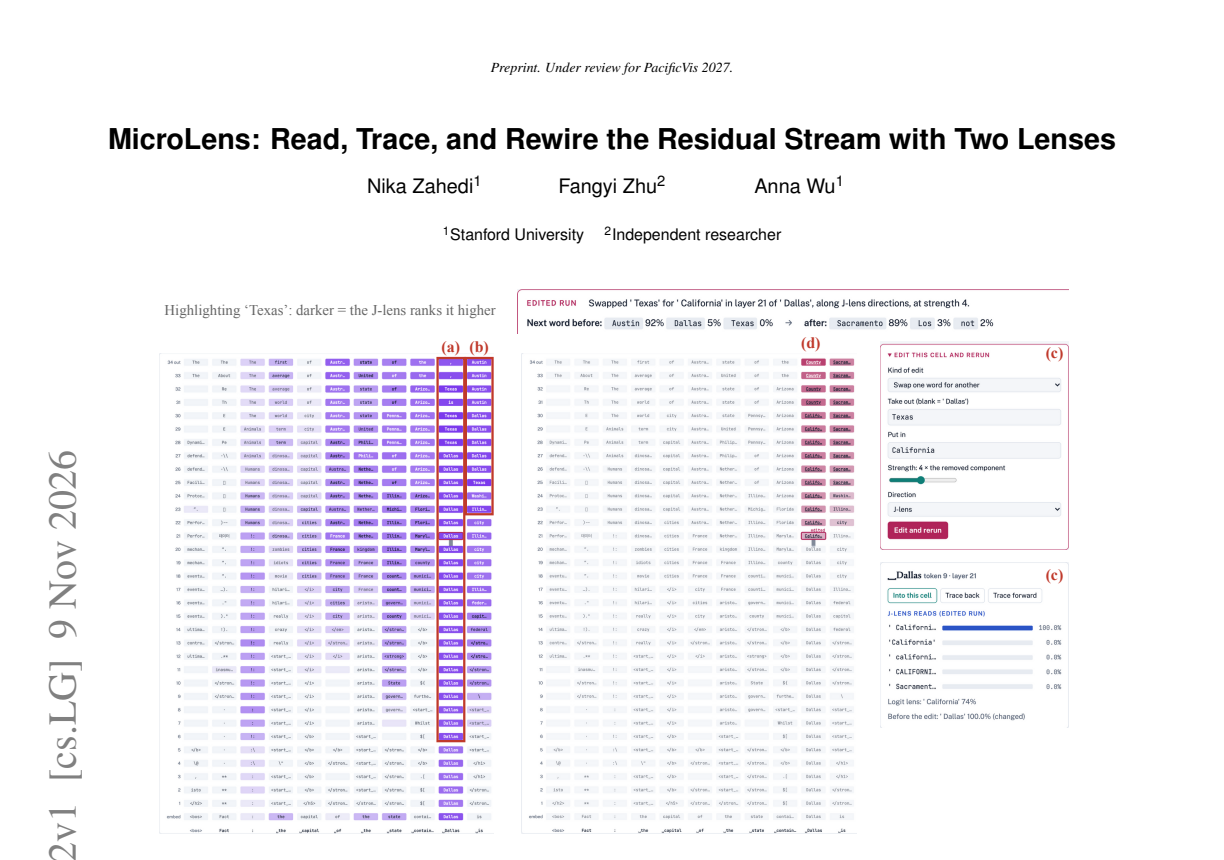
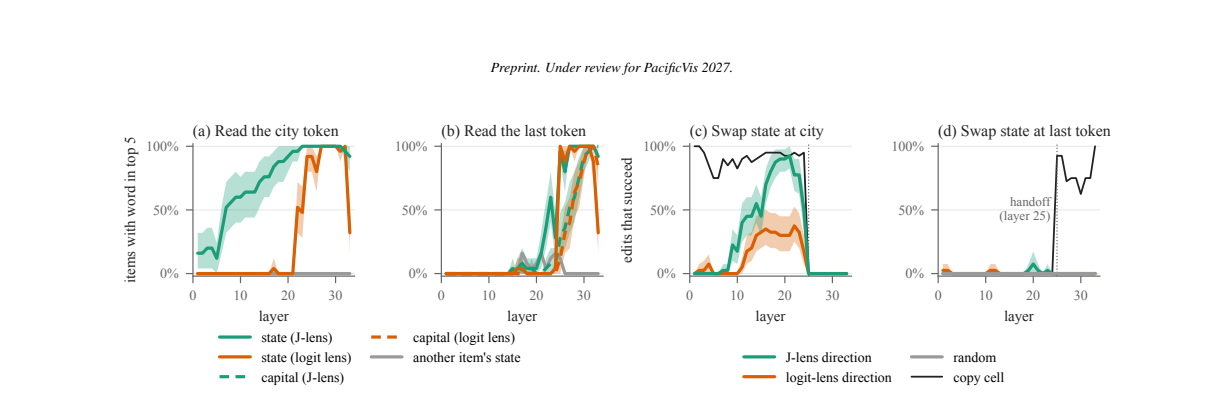
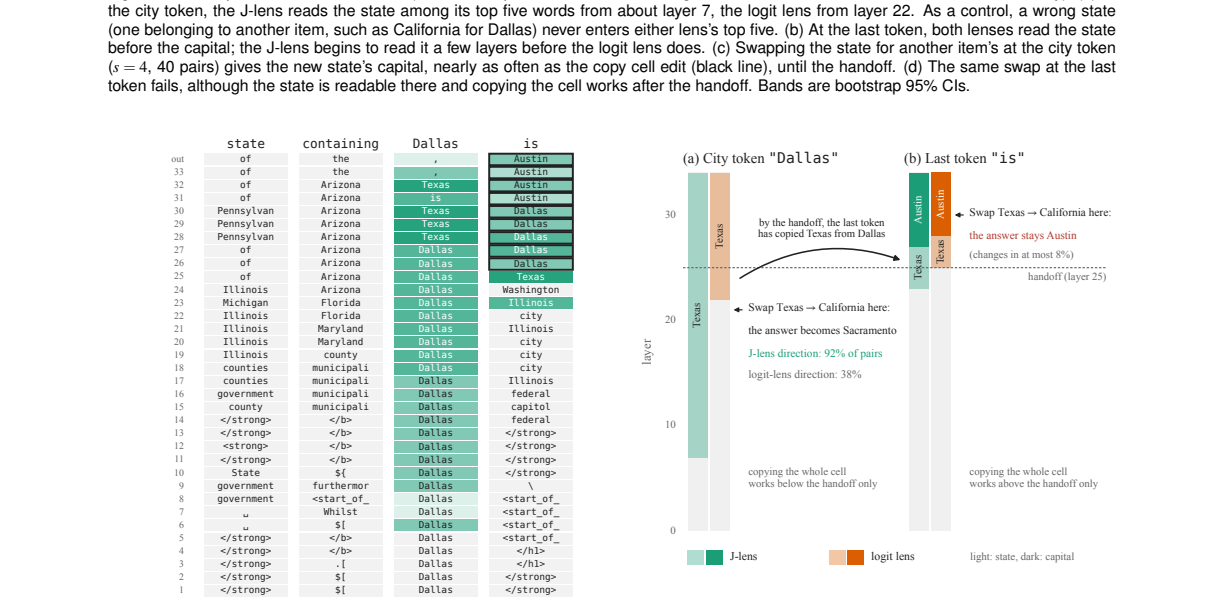
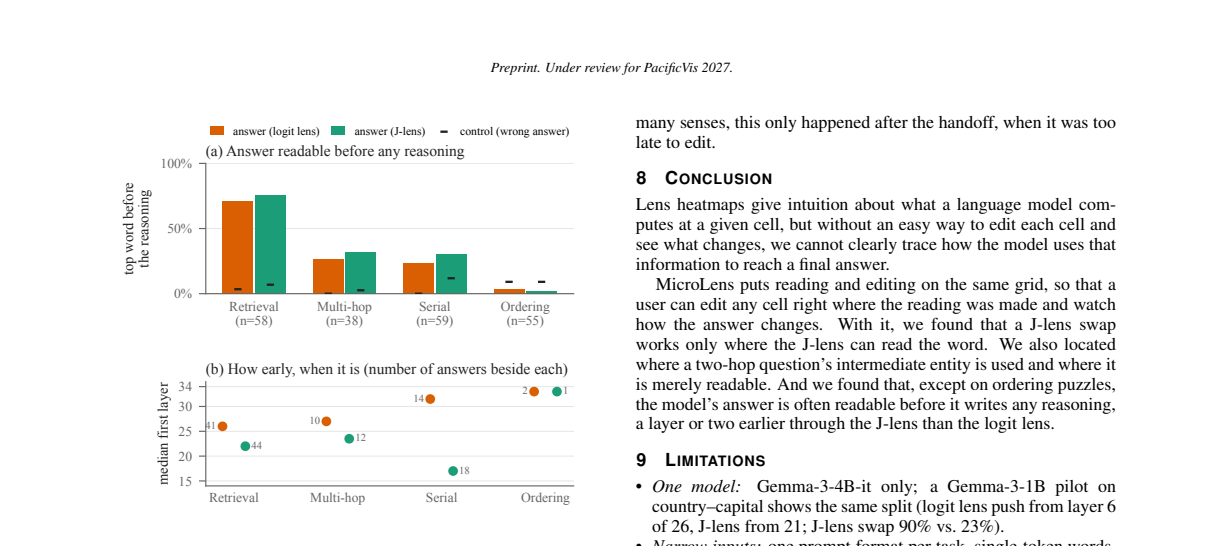
We present an interactive viewer that puts reading, tracing and editing on the same layers-by-tokens grid of the residual stream. In the viewer, every cell can be decoded with two lenses, the logit lens and the Jacobian lens (J-lens), traced back to the tokens it drew from, and edited, with the rest of the model rerun on the spot. We demonstrate three usage scenarios on Gemma-3-4B-it, backed by sweeps over a few hundred prompts, to show what this tool can discover. First, the two lenses give different directions to write with, each suiting a different edit: the logit lens's word direction sets what a token outputs, while the J-lens's direction changes what later tokens read. Second, in two-hop trivia questions (the capital of the state or country containing a given city), the state or country is readable at the city token from as early as layer 7, and swapping it there can redirect the answer 92-98% of the time; however, at the answer position, the state or country information is not used. Third, when a chat model answers questions with a step-by-step reasoning prompt, the correct answer is often already the top word in the residual stream before any reasoning is written: for 89-92% of retrieval questions and 39-63% of multi-hop and serial ones, far above their respective distractors (at most 5%). However, ordering puzzles are an exception, as the model works them out only once it writes its final reasoning steps. Furthermore, for answers that are visible in the residual stream, the J-lens reads them a layer or two earlier than the logit lens across the different types of question.
from the abstract
Pith says
Machine review · deepseek-v4-flash · 11 Nov 2026 · what was read was not recorded · not checked by a person
It can be wrong. Challenge this review or reply to it.
The passes disagreed. Reader: holds up. Skeptic: holds up only with conditions. Referee: major revision.
A well-executed tool paper with two genuinely interesting empirical findings, but the headline claim about answer-before-reasoning is correlational and the paper says so itself. This line is wrong
4 major objections · 10 minor
How often objections from reviews like this one are right: not yet measured
Not checked: figures, code, what the 25 references say.
The paper says, at §6, Scenario C
The review did not quote this passage.
A classifier read this sentence of the paper as acknowledging the concern (probability 0.92):
“Future work:The viewer makes the missing test for Scenario C easy to run: swap the answer at the question’s cells and see whether the reasoning, or only the final answer, changes.”
Pith says: Objection 1 of 4 · major
The central claim that 'the correct answer is often already the top word in the residual stream before any reasoning is written' (Abstract, §6) is presented as a finding, but the paper explicitly states in §9 that 'No edits in Scenario C: the answer is present before the reasoning, but we do not show that it is used.'
more of objection 1
This is a load-bearing gap: the observation is correlational and does not distinguish between the answer being precomputed and used, versus being a spurious correlate of the prompt's token statistics or a memorized shortcut that plays no role in generation. The control (plausible wrong answer) only rules out that the lens is reading the question's topic word, not that the answer's presence is causally relevant. Without a causal intervention (e.g., swapping the answer direction at the question's cells and observing whether the written reasoning or final answer changes), the claim remains a hypothesis. The paper acknowledges this gap and proposes it as future work, but the headline claim is stated as a finding. For a paper that otherwise pairs lens readings with causal edits (Scenarios A and B), the absence of an edit in Scenario C weakens the strength of the claim. I recommend that the authors either (a) add a causal test (even a small-scale one) to support the claim, or (b) explicitly rephrase the claim as a hypothesis or correlational observation throughout the paper, including the abstract and conclusion.
The paper says, at §4, Table 1 and Figure 3
The review did not quote this passage.
Pith says: Objection 2 of 4 · major
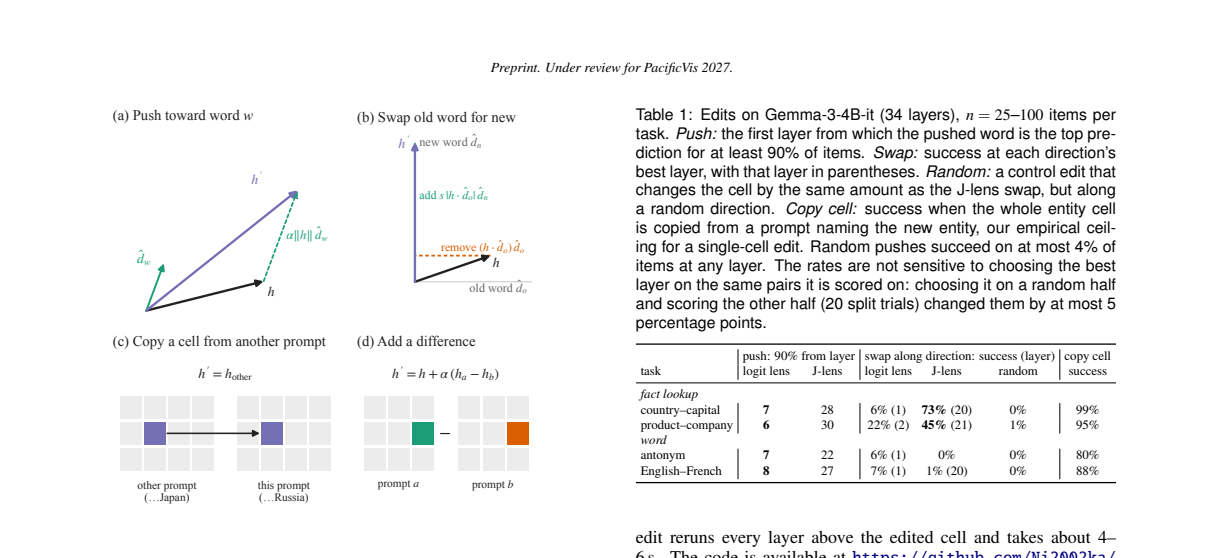
The swap experiments use a fixed strength s=2. The paper reports that the J-lens swap achieves 73% and 45% success on fact-lookup tasks, while the copy-cell ceiling is higher. However, the sensitivity of these results to the choice of s is not explored.
more of objection 2
Since the swap operation removes the component along the old word and adds s times that amount along the new word, the success rate may depend on s. The paper should either justify the choice s=2 (e.g., by a small grid search) or report results for a range of s values to show robustness. Without this, the comparison between J-lens and logit lens swaps may be confounded by suboptimal scaling.
The paper says, at §5, Figure 8 and Table 1
The review did not quote this passage.
Pith says: Objection 3 of 4 · major
The two-hop experiments use 25 U.S. items and 30 world items that the model answers correctly. The sample sizes are small (25 and 30), and the confidence intervals in Figure 8 are wide (e.g., 82–100% for U.S. swap success). The paper should explicitly discuss the statistical power of these comparisons and whether the results generalize beyond these specific items.
more of objection 3
Additionally, the world items do not show the serial pattern (capital appears at the same layer as the country or earlier in 77% of items), which the paper attributes to a 'memorized city→capital shortcut.' This interpretation is plausible but speculative; the paper should consider alternative explanations (e.g., tokenization differences, frequency of co-occurrence in training data) and note that the sample size is too small to draw strong conclusions about the mechanism.
The paper says, at §4, 'Where the J-lens cannot see the word'
The review did not quote this passage.
Pith says: Objection 4 of 4 · major
The paper reports that for antonym and translation words, the J-lens swap fails because the J-lens cannot see the word in its own cell. The correlation with WordNet senses (ρ=0.45 and 0.71) is suggestive but based on only 20 pairs per task.
more of objection 4
The paper should report the p-values for these correlations and discuss whether they survive multiple-testing correction. Moreover, the claim that 'the worse the J-lens ranks the old word at its own token, the less the swap's change matches the paste's' (Spearman ρ=−0.62) is based on 100 pairs across tasks; the paper should clarify whether this is pooled or per-task, and report confidence intervals.
10 minor objections
The paper says, at §3, Equation (2)
Pith says: minor objection 1 of 10
The swap equation uses s|h·d̂_o| d̂_n. The absolute value |h·d̂_o| is taken, but the sign of h·d̂_o is already accounted for in the removal term. This means the added component is always positive along d̂_n, regardless of whether the original component was positive or negative.
more of objection 1
Is this intentional? If the original component is negative, the removal term adds a positive component along d̂_o, and the addition term adds a positive component along d̂_n. This could lead to unexpected behavior. Please clarify the rationale or adjust the equation.
The paper says, at §3, 'Edits'
Pith says: minor objection 2 of 10
The paper describes four edits but does not specify how the strength parameter s in the swap is chosen. For the experiments, s=2 is used. The paper should state this explicitly in the main text (it is only in the figure caption of Figure 3 and in the setup paragraph of §4).
show 8 more
The paper says, at §4, Table 1
Pith says: minor objection 3 of 10
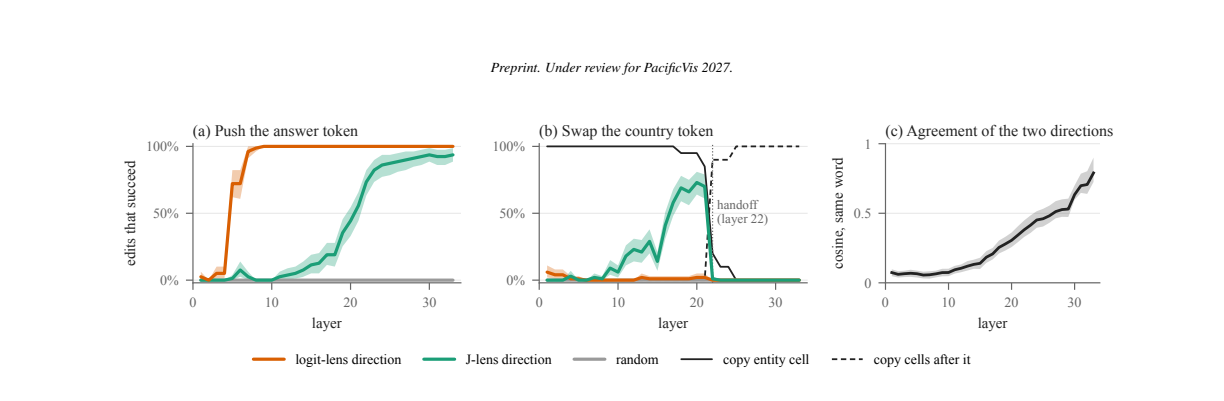
The table reports 'push: 90% from layer' with values like 728, 630, 722, 827. These numbers appear to be the layer number at which the push succeeds for 90% of items, but the formatting is confusing (e.g., '728' likely means layer 7 for country–capital, layer 28 for J-lens?
more of objection 3
Actually reading the text: 'the logit lens push makes the target the top prediction for at least 90% of items from layer 6–8 on; the J-lens push gets there only at layer 22–30.' The table entries seem to be concatenated without clear separation. Please reformat the table for clarity.
The paper says, at §5, Figure 8 caption
Pith says: minor objection 4 of 10
The caption says '25 U.S. items the model answers correctly' but the text says 25 out of 46 U.S. prompts are correct. Please ensure consistency between the figure caption and the main text.
The paper says, at §6, Table 2
Pith says: minor objection 5 of 10
The table reports 100 questions per task type, but the number of correct answers varies (80, 44, 73, 61). The paper should report the total number of questions and the number correct for each task type in a consistent format. Also, the serial task has 73 correct but the figure shows n=59 for serial; this discrepancy should be explained (perhaps some were excluded due to tokenization or other criteria).
The paper says, at §6, Figure 11
Pith says: minor objection 6 of 10
The figure shows 'n=58' for retrieval, but Table 2 says 80 correct. The paper should explain the discrepancy (e.g., some correct answers may be multi-token and excluded). This should be stated in the caption or text.
The paper says, at §9, Limitations
Pith says: minor objection 7 of 10
The paper states 'No external users: our own usage scenarios backed by sweeps, not a user study.' This is appropriate, but the paper could also mention that the viewer's utility for other researchers has not been evaluated. This is not a flaw but could be noted as future work.
The paper says, at General
Pith says: minor objection 8 of 10
The paper uses 'J-lens' and 'logit lens' throughout. The J-lens is defined as the transpose of the average Jacobian applied to the unembedding vector. The paper should explicitly state that the J-lens directions are precomputed on WikiText and are independent of the experimental prompts, which is already mentioned but could be reiterated in the main text for clarity.
The paper says, at References
Pith says: minor objection 9 of 10
Reference [13] for Neuronpedia is listed as 'J. Lin. Neuronpedia: Interactive reference and tooling for analyzing neural networks, 2023.' This appears to be a website or software, not a peer-reviewed publication. Please provide a more complete citation (e.g., URL, version).
The paper says, at §3, 'Implementation'
Pith says: minor objection 10 of 10
The paper says 'It loads the published J-lenses for GPT-2 and every size of Gemma 3 (270M to 27B, base and instruction-tuned), which were fit on WikiText [13].' Reference [13] is Neuronpedia, which seems incorrect for the WikiText dataset. Please correct the reference.
What would settle it
Run the same 258 correct-answer prompts from Scenario C, but for each prompt where the answer is readable before reasoning, perform a J-lens swap of the answer word at the earliest question token where it appears (e.g., at the question mark token, layer 24). Use a plausible wrong answer of the same type as the target (e.g., another capital, another truth value). Measure: (1) does the final answer change to the swapped-in word? (2) does the written reasoning change? If the answer changes in ≥50% of cases, the pre-reasoning presence is causally relevant. If it changes in <10%, the claim that the model 'has already worked out the answer' is unsupported.
from the skeptic's reading
How the review went
4 readings by deepseek-v4-flash · 11 Nov 2026
- Reader holds up
- Skeptic partly agrees: says it holds up only with conditions Scenario C (answer-before-reasoning) lacks a causal test, and the paper explicitly flags this as missing; the claim that the answer is 'already the top word' is a correlational observation that does not distinguish between a precomputed answer and a spurious correlation with the prompt's surface…
- Editor wrote the verdict above
- Referee major revision: 4 major objections, 10 minor
Not run on this paper: the simulated authors' defence.
Pith did not check this review's objections against the paper.
The review in full
The review in brief, machine-written
This is a solid piece of work that does more than just ship a viewer. The two empirical findings—that the logit lens and J-lens give complementary edit directions, and that in two-hop recall the intermediate entity is readable at two tokens but used at only one—are real contributions. The authors back them with controlled sweeps, proper statistics, and explicit limitations. The viewer itself looks useful, and the fact that they open-source it with published J-lenses for several model sizes is a concrete service to the community.
The soft spots are real but mostly acknowledged. Scenario C (answer-before-reasoning) is the one that will get the most attention, and the stress-test note is right to flag it: the paper explicitly says 'No edits in Scenario C' and proposes it as future work. The headline claim that the answer is 'already the top word' is a correlational observation. The control (a plausible wrong answer) is a reasonable sanity check but does not rule out spurious correlation with prompt surface statistics. The authors are honest about this gap, but the abstract and §6 present the finding as a result, not a hypothesis. That mismatch will bother some readers. For a paper that otherwise pairs lens readings with causal edits, the missing edit in Scenario C is a load-bearing gap.
The other limitation is scope: one model (Gemma-3-4B-it), single-token answers, correct items only, 25–100 items per condition. The authors state this clearly. It is not a flaw, but it means the generality of the findings is untested.
Who this is for: interpretability researchers who want a practical tool for residual-stream inspection and who value the methodological point that lens readings must be paired with causal edits. The two-hop finding is a nice case study of that principle.
Recommendation: This deserves peer review. The tool is real, the two-hop finding is well-supported, and the Scenario C gap is acknowledged. A good reviewer will push the authors to either add causal edits for Scenario C or tone down the claim. Either way, the paper has enough substance to warrant a serious referee.
The strongest objection
The central claim of Scenario C is that 'the correct answer is often already the top word in the residual stream before any reasoning is written' (Abstract, §6). The paper explicitly states in its Limitations (§9) that 'No edits in Scenario C: the answer is present before the reasoning, but we do not show that it is used.' This is not a minor omission: the entire argument that the model has 'already worked out the answer' rests on a correlational reading. The control (a plausible wrong answer) is a weak check—it only rules out that the lens is reading the question's topic word, not that the answer's presence is a byproduct of the prompt's token statistics or a memorized shortcut that is not actually used in the generation. Without a causal intervention (e.g., swapping the answer direction at the question's cells and observing whether the written reasoning or the final answer changes), the observation is compatible with the answer being a spurious correlate that plays no role in the model's computation. The paper acknowledges this gap and proposes it as future work, but the headline claim is presented as a finding, not a hypothesis. For a paper that otherwise pairs lens readings with causal edits (Scenarios A and B), the absence of an edit in Scenario C undermines the strength of the claim.
The reader's verdict is ACCEPT with high confidence, and the weakest_assumption focuses on the J-lens direction's validity. I agree that the J-lens assumption is a concern, but the paper validates it on the tested prompts (Section 4) and acknowledges its limits. The more load-bearing issue is the missing causal test in Scenario C, which the paper itself flags as a limitation. The reader's rationale notes that 'the authors do not overclaim the Scenario C result,' but the abstract and §6 present it as a finding ('the correct answer is often already the top word'), not a hypothesis. The paper's own Limitations say 'we do not show that it is used,' which is exactly the gap. A correlational observation without a causal test is not a finding about computation; it is a finding about representation. The paper's strength is pairing reading with editing; Scenario C breaks that pattern. The concrete test I propose is feasible with the existing viewer (swap edit) and would settle whether the pre-reasoning presence is causally relevant. If the test passes, the claim is strengthened; if it fails, the claim should be downgraded to a correlational observation. I recommend CONDITIONAL: accept if the authors add the causal test or explicitly downgrade the claim to a correlational observation (e.g., 'the answer is readable before reasoning, but we do not know if it is used'). The agreement_with_reader is 'partial' because the reader identified a different weakest assumption (J-lens validity) and did not flag the missing causal test as a load-bearing concern, though the reader did note the limitation.
The referee's report
If the findings hold, the paper makes several contributions: (1) a practical open-source tool that integrates lens reading with causal editing on the same grid, lowering the barrier for interpretability experiments; (2) empirical evidence that the J-lens and logit lens provide distinct and complementary directions for editing, with practical guidance on which to use for what purpose; (3) a demonstration that in two-hop questions, the intermediate entity is used at the city token but not at the answer token, illustrating that lens readability does not imply causal use; (4) a surprising observation that for many reasoning questions, the answer is already present in the residual stream before any reasoning tokens are generated, challenging the naive interpretation of chain-of-thought as the locus of computation. The paper is honest about its limitations (one model, correct items only, single-token words, no causal test for Scenario C). The tool is released open-source and the experiments are reproducible. The significance is moderate but solid for a visualization/interpretability venue.
Pith's reading of the paper (a machine's summary, not the authors')
This paper introduces MicroLens, a visual tool that combines lens reading with causal editing on a single grid of a language model's residual stream. Using this tool on Gemma-3-4B-it, the authors establish three findings. First, the logit lens and the Jacobian lens (J-lens) provide complementary edit directions: the logit lens direction sets what a token outputs, while the J-lens direction changes what later tokens read. Second, in two-hop trivia questions, the intermediate entity (e.g., the state containing a city) is readable at multiple token positions, but the model uses it at only one of them—a distinction a static heatmap cannot make. Third, when a chat model answers questions with step-by-step reasoning, the correct answer is often the top word in the residual stream before any reasoning is written, for 89–92% of retrieval questions and 39–63% of multi-hop and serial questions. The paper argues that lens readouts must be paired with causal edits to establish use, and that written chain-of-thought is not necessarily where the answer is computed.
What carries the argument. The central machinery is the residual-stream grid combined with two lenses and four types of causal edits. The logit lens decodes a hidden state by applying the model's final unembedding matrix directly, showing what a token would predict as the next word. The Jacobian lens (J-lens) first multiplies the unembedding vector by the transpose of the average Jacobian of the layers above, giving a direction that reflects what later layers typically turn a vector into—this reveals what a cell passes on to later tokens, not just what it outputs. The four edits—push, swap, copy cell, and add difference—allow causal testing of whether a readable word is actually used. The key identity is that the logit lens direction is the word's row in the unembedding matrix, while the J-lens direction is $J_\ell^\top u_w$, where $J_\ell$ is the layer's average Jacobian and $u_w$ is the word's unembedding vector. These two directions are nearly orthogonal through the middle layers (cosine ~0.06 at layer 8), explaining why they suit different edit purposes.
Core claim. The paper's central claim is that combining two complementary lenses—the logit lens and the Jacobian lens—with causal editing on the same residual-stream grid reveals where and when a language model actually uses information, as opposed to where it is merely readable. Specifically, the paper demonstrates three discoveries: (1) The two lenses provide different directions for editing: the logit lens direction is effective for setting what a token outputs (pushing), while the J-lens direction is effective for changing what later tokens read (swapping), because the J-lens direction reflects how the layers above typically transform a vector into a word, making it suitable for reasoning inputs. (2) In two-hop recall questions, the intermediate entity (e.g., the state containing a city) is readable at both the city token and the last token, but editing shows the model uses it only at the city token—swapping the state at the city token redirects the answer 92–98% of the time, while the same swap at the last token fails. (3) For step-by-step reasoning, the answer is often the top word in the residual stream before any reasoning tokens are written, with the J-lens reading it one to two layers earlier than the logit lens, except for ordering puzzles where the answer emerges only during the written reasoning.
The premise it rests on. The J-lens direction, defined as the transpose of a model-wide average Jacobian applied to a word's unembedding vector, is a valid local direction for changing what later tokens read in a specific prompt, which fails for words with many senses (like antonyms and translations) where the J-lens cannot see the word in its own cell.
If the paper is right (Pith's inferences, not the authors')
Interpretability researchers can use MicroLens to quickly generate and test hypotheses about where information is stored and used in language models, reducing the gap between observational lens readings and causal activation patching.
The finding that the answer is often readable before any reasoning is written suggests that chain-of-thought prompting may not always reflect the model's internal computation path; the model may already know the answer and write reasoning post-hoc.
The complementary roles of the logit lens and J-lens directions provide a principled guide for designing edits: use the logit lens direction to change the model's output directly, and use the J-lens direction to change what the model reasons with at intermediate tokens.
The handoff phenomenon—where editing an intermediate token stops working after a certain layer because later tokens have already read the information—provides a clear bound for where causal interventions can be effective.
The J-lens's failure to read words with many senses (like antonyms or translations) at their own tokens suggests that averaged Jacobian lenses are unreliable for words whose meaning is context-dependent, limiting the applicability of J-lens-based edits for such words.
If the answer-before-reasoning finding generalizes to other models and tasks, it would challenge the common interpretation of chain-of-thought as the model's actual reasoning process, suggesting instead that the reasoning is generated to justify or communicate a conclusion already reached internally.
The handoff layer could serve as a diagnostic: if an edit at an intermediate token fails above a certain layer, it indicates that the information has already been propagated to later tokens. This could be used to automatically map the temporal flow of information through the residual stream.
The J-lens's inability to read polysemous words suggests that a context-dependent lens (e.g., one conditioned on the prompt or the token's surrounding context) might be needed to reliably edit such words, pointing to a natural extension of the method.
The two-lens framework could be extended to other interpretability tasks beyond the three scenarios shown, such as locating where factual associations are stored, detecting when a model is using shortcuts versus genuine reasoning, or identifying where safety-relevant information (like refusal directions) is computed.
Check this review
Pith stored no record of this review's passes and took no fingerprint of it. Reviews made by code from 13 Nov 2026 on carry both.
How often reviews like this one are right
Reviews like this one: written by deepseek-v4-flash, where what was read was not recorded.
How often objections from reviews like this one are right: not yet measured
Reviews by people
This review was written by a machine. No person has reviewed this paper on Pith yet. A scientist listed on Pith can review it for a fee, and their review is published here whatever it concludes.
The paper
Abstract
Lenses that decode hidden states into words are a popular way to look inside language models, but a heatmap of decoded words only shows what a vector reads as and cannot distinguish whether, or how much, the model uses the information. We present an interactive viewer that puts reading, tracing and editing on the same layers-by-tokens grid of the residual stream. In the viewer, every cell can be decoded with two lenses, the logit lens and the Jacobian lens (J-lens), traced back to the tokens it drew from, and edited, with the rest of the model rerun on the spot. We demonstrate three usage scenarios on Gemma-3-4B-it, backed by sweeps over a few hundred prompts, to show what this tool can discover. First, the two lenses give different directions to write with, each suiting a different edit: the logit lens's word direction sets what a token outputs, while the J-lens's direction changes what later tokens read. Second, in two-hop trivia questions (the capital of the state or country containing a given city), the state or country is readable at the city token from as early as layer 7, and swapping it there can redirect the answer 92-98% of the time; however, at the answer position, the state or country information is not used. Third, when a chat model answers questions with a step-by-step reasoning prompt, the correct answer is often already the top word in the residual stream before any reasoning is written: for 89-92% of retrieval questions and 39-63% of multi-hop and serial ones, far above their respective distractors (at most 5%). However, ordering puzzles are an exception, as the model works them out only once it writes its final reasoning steps. Furthermore, for answers that are visible in the residual stream, the J-lens reads them a layer or two earlier than the logit lens across the different types of question.
The paper's own sentences, arranged, kept beside the review and separate from it. Each label is drawn from a closed vocabulary; the number beside it is the probability the classifier gave that label. No sentence in this record was written by a model.
abstract compiled · 2026-11-11
The authors' main claim, as the classifier picked it out 0.40
“First, the two lenses give different directions to write with, each suiting a different edit: the logit lens's word direction sets what a token outputs, while the J-lens's direction changes what later tokens read.”
How the main claim is stated: asserted 1.00
What the abstract itself states, as probabilities: claims first 0.06 · states limitation 0.63 · human participants 0.05 · controlled comparison 0.14 · randomized assignment 0.02 · states quantitative result 0.99 · compares with prior results 0.44 · mentions code or data availability 0.07
The abstract, sentence by sentence
This table labels the abstract only (arXiv listing abstract v1). The number is the probability the classifier gave the label.
| Sentence | Role | The authors' own work | States the main conclusion | Strength |
|---|---|---|---|---|
| Lenses that decode hidden states into words are a popular way to look inside language models, but a heatmap of decoded words only shows what a vector reads as and cannot distinguish whether, or how much, the model uses the information. | background 0.56 | 0.08 | 0.07 | asserted 1.00 |
| We present an interactive viewer that puts reading, tracing and editing on the same layers-by-tokens grid of the residual stream. | contribution 0.88 | 0.88 | 0.10 | asserted 1.00 |
| In the viewer, every cell can be decoded with two lenses, the logit lens and the Jacobian lens (J-lens), traced back to the tokens it drew from, and edited, with the rest of the model rerun on the spot. | method 0.89 | 0.80 | 0.09 | asserted 1.00 |
| We demonstrate three usage scenarios on Gemma-3-4B-it, backed by sweeps over a few hundred prompts, to show what this tool can discover. | method 0.60 | 0.96 | 0.04 | asserted 1.00 |
| First, the two lenses give different directions to write with, each suiting a different edit: the logit lens's word direction sets what a token outputs, while the J-lens's direction changes what later tokens read. | result 0.92 | 0.87 | 0.19 | asserted 1.00 |
| Second, in two-hop trivia questions (the capital of the state or country containing a given city), the state or country is readable at the city token from as early as layer 7, and swapping it there can redirect the answer 92-98% of the time; however, at the answer position, the state or country information is not used. | result 1.00 | 0.95 | 0.13 | asserted 1.00 |
| Third, when a chat model answers questions with a step-by-step reasoning prompt, the correct answer is often already the top word in the residual stream before any reasoning is written: for 89-92% of retrieval questions and 39-63% of multi-hop and serial ones, far above their respective distractors (at most 5%). | result 1.00 | 0.95 | 0.19 | asserted 0.91 |
| However, ordering puzzles are an exception, as the model works them out only once it writes its final reasoning steps. | result 0.87 | 0.89 | 0.04 | asserted 1.00 |
| Furthermore, for answers that are visible in the residual stream, the J-lens reads them a layer or two earlier than the logit lens across the different types of question. | result 1.00 | 0.92 | 0.07 | asserted 1.00 |
What kind of paper the classifier reports this is: method or tool 1.00 · evidence from observation or experiment 0.87
What was examined, and what was not
Sources read
- arXiv listing abstract v1
Not examined
- full text
- figures and tables
- references and citing sentences
- relations to other papers
Levels run
- P abstract
Not run
- S sections
- T body sentences
- C citations
- R cross-paper relations
How the labels were made
Compiled by classifier-1.13.0 via TypeSafe API, question bank abstract-p1-20260923, 2026-11-11: 1 request, 7,301 input tokens.
Every quoted sentence on this record is the authors'. Every label is from Pith's closed vocabulary, with the probability shown beside it. This record as JSON
Figures (11)

Showing 8 of the paper's 11 figures. Figures are the authors', reproduced from the paper.
References (25)
- [1] S. Abnar and W. Zuidema. Quantifying attention flow in transformers. InProceedings of the Annual Meeting of the Association for Compu- tational Linguistics (ACL), 2020. 2 on Pith
- [2] E. Ameisen, J. Lindsey, A. Pearce, W. Gurnee, N. L. Turner, B. Chen, C. Citro, et al. Circuit tracing: Revealing computational graphs in language models. Transformer Circuits Thread, 2025. 2 on Pith
- [3] N. Belrose, Z. Furman, L. Smith, D. Halawi, I. Ostrovsky, L. McKin- ney, S. Biderman, and J. Steinhardt. Eliciting latent predictions from transformers with the tuned lens.arXiv preprint arXiv:2303.08112, on PithPith's reviewarXiv
- [4] E. Biran, D. Gottesman, S. Yang, M. Geva, and A. Globerson. Hop- ping too late: Exploring the limitations of large language models on multi-hop queries. InProceedings of the Conference on Empirical Methods in Natural Language Processing (EMNLP), 2024. 2 on Pith
- [5] Gemma Team. Gemma 3 technical report.arXiv preprint arXiv:2503.19786, 2025. 1, 3 on PithPith's reviewarXiv
- [6] M. Geva, J. Bastings, K. Filippova, and A. Globerson. Dissecting recall of factual associations in auto-regressive language models. In Proceedings of the Conference on Empirical Methods in Natural Lan- guage Processing (EMNLP), 2023. 2 on Pith
- [7] M. Geva, A. Caciularu, G. Dar, P. Roit, S. Sadde, M. Shlain, B. Tamir, and Y . Goldberg. LM-Debugger: An interactive tool for inspection and intervention in transformer-based language models. InProceed- ings of the Conference on Empirical Methods in Natural Language Processing... on Pith
- [8] A. Ghandeharioun, A. Caciularu, A. Pearce, L. Dixon, and M. Geva. Patchscopes: A unifying framework for inspecting hidden represen- tations of language models. InInternational Conference on Machine Learning (ICML), 2024. 2 on Pith
- [9] W. Gurnee, N. Sofroniew, A. Pearce, M. Piotrowski, I. Kauvar, R. Chen, A. Soligo, P. Bogdan, E. Ong, R. Wang, B. Thompson, D. Abrahams, S. Kantamneni, E. Ameisen, J. Batson, and J. Lind- sey. Verbalizable representations form a global workspace in language models. Transformer ... on Pith
- [10] S. Heimersheim and N. Nanda. How to use and interpret activation patching.arXiv preprint arXiv:2404.15255, 2024. 2 on PithPith's reviewarXiv
- [11] F. Hohman, M. Kahng, R. Pienta, and D. H. Chau. Visual analytics in deep learning: An interrogative survey for the next frontiers.IEEE Transactions on Visualization and Computer Graphics, 25(8):2674– 2693, 2019. 2 on Pith
- [12] G. Kobayashi, T. Kuribayashi, S. Yokoi, and K. Inui. Attention is not only a weight: Analyzing transformers with vector norms. InProceed- ings of the Conference on Empirical Methods in Natural Language Processing (EMNLP), 2020. 2 on Pith
- [13] J. Lin. Neuronpedia: Interactive reference and tooling for analyzing neural networks, 2023. 2, 3 on Pith
- [14] J. Lindsey, W. Gurnee, E. Ameisen, B. Chen, A. Pearce, N. L. Turner, C. Citro, et al. On the biology of a large language model. Transformer Circuits Thread, 2025. 2, 5 on Pith
- [15] K. Meng, D. Bau, A. Andonian, and Y . Belinkov. Locating and edit- ing factual associations in GPT. InAdvances in Neural Information Processing Systems (NeurIPS), 2022. 2 on Pith
- [16] nostalgebraist. interpreting GPT: the logit lens. LessWrong, 2020. 1, 2 on Pith
- [17] E. Todd, M. L. Li, A. S. Sharma, A. Mueller, B. C. Wallace, and D. Bau. Function vectors in large language models. InInternational Conference on Learning Representations (ICLR), 2024. 2, 3 on Pith
- [18] I. Tufanov, K. Hambardzumyan, J. Ferrando, and E. V oita. LM trans- parency tool: Interactive tool for analyzing transformer language mod- els.arXiv preprint arXiv:2404.07004, 2024. 2 on PithPith's reviewarXiv
- [19] A. M. Turner, L. Thiergart, D. Udell, G. Leech, U. Mini, and M. Mac- Diarmid. Activation addition: Steering language models without op- timization.arXiv preprint arXiv:2308.10248, 2023. 2, 3 on PithPith's reviewarXiv
- [20] J. Vig. A multiscale visualization of attention in the transformer model. InProceedings of the Annual Meeting of the Association for Computational Linguistics: System Demonstrations, 2019. 2 on Pith
show 5 more
- [21] C. Wendler, V . Veselovsky, G. Monea, and R. West. Do llamas work in English? On the latent language of multilingual transformers. InPro- ceedings of the Annual Meeting of the Association for Computational Linguistics (ACL), 2024. 2 on Pith
- [22] T. Wolf, L. Debut, V . Sanh, et al. Transformers: State-of-the-art natu- ral language processing. InProceedings of EMNLP: System Demon- strations, pp. 38–45, 2020. 3 on Pith
- [23] S. Yang, E. Gribovskaya, N. Kassner, M. Geva, and S. Riedel. Do large language models latently perform multi-hop reasoning? InPro- ceedings of the Annual Meeting of the Association for Computational Linguistics (ACL), 2024. 2 on Pith
- [24] F. Zhang and N. Nanda. Towards best practices of activation patching in language models: Metrics and methods. InInternational Confer- ence on Learning Representations (ICLR), 2024. 2 Repository Link:https://github.com/Ni2002ka/residual_stream_vis/tree/v1.0-pacificvis9 on Pith
- [2023] 2 Repository Link:https://github.com/Ni2002ka/residual_stream_vis/tree/v1.0-pacificvis8 Preprint. Under review for PacificVis 2027 on Pith
Cited by 1 Pith paper
Reviewed papers on Pith that cite this one. The full citation record
Challenges and discussion
Disagree with the review, or know something it missed? Leave a comment, or challenge this review formally: a challenge becomes a permanent entry in this paper's record, and its decision is published here.
Come back by email
A short list of the week's newly reviewed papers. Nothing is sent until you confirm from your inbox, and every email has a link that stops it. No account.
No comments yet.
Sign in to comment