Artificial Intelligence · arXiv:2611.26590 v1 · submitted 19 Nov 2026 · 61 references
Probing the "Conscious" Mind: Selective Access and Global Workspace in Vision-Language Models
The paper says
“Vision-language models (VLMs) integrate visual and textual information, but their outputs do not reveal internal concept representations.”
more of the abstract
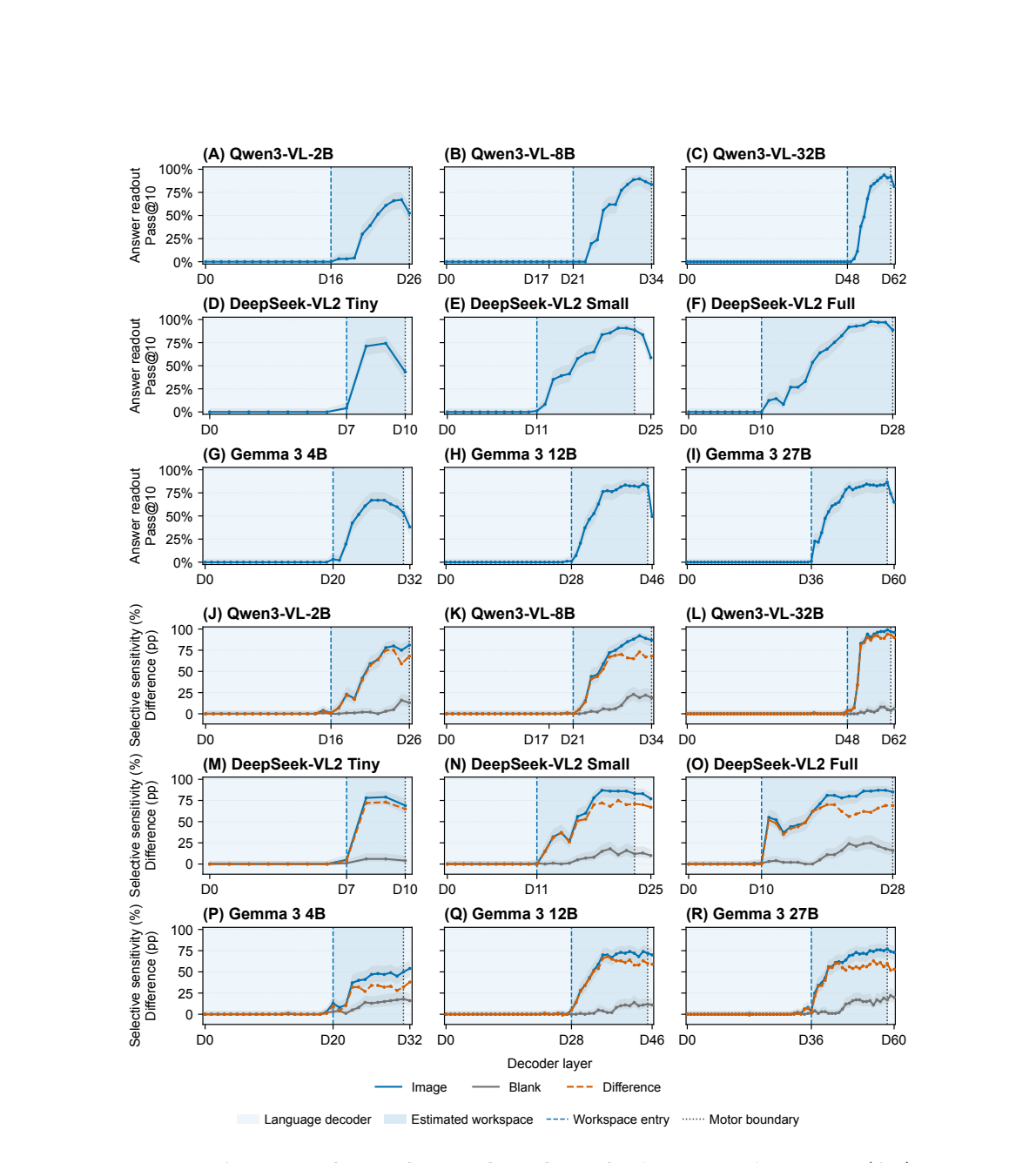
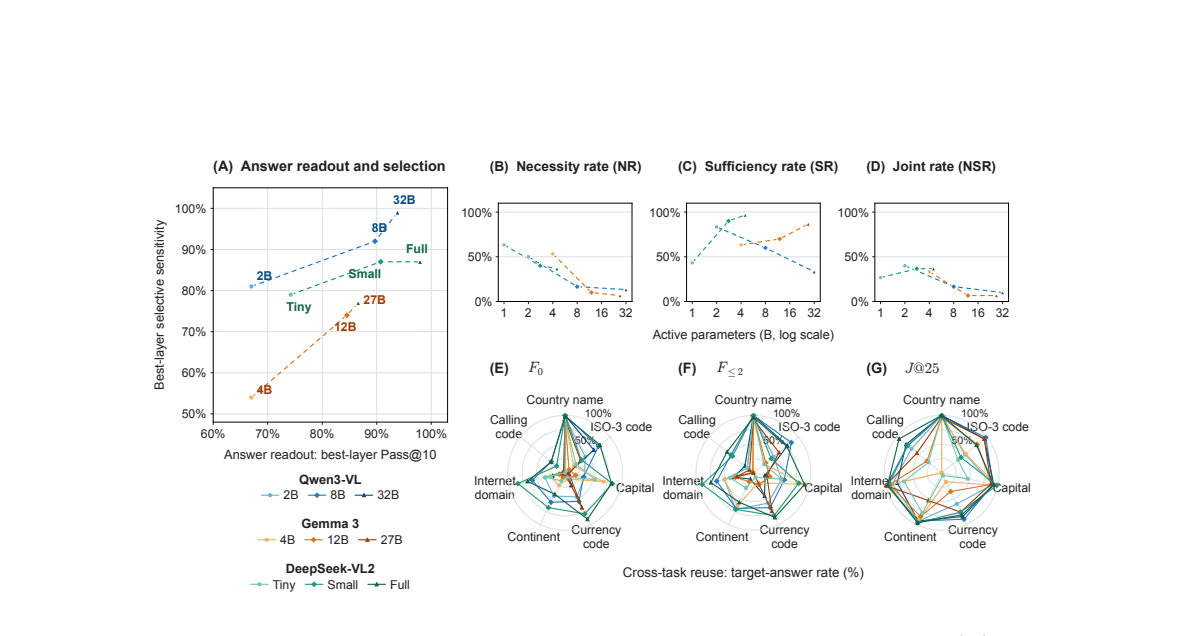
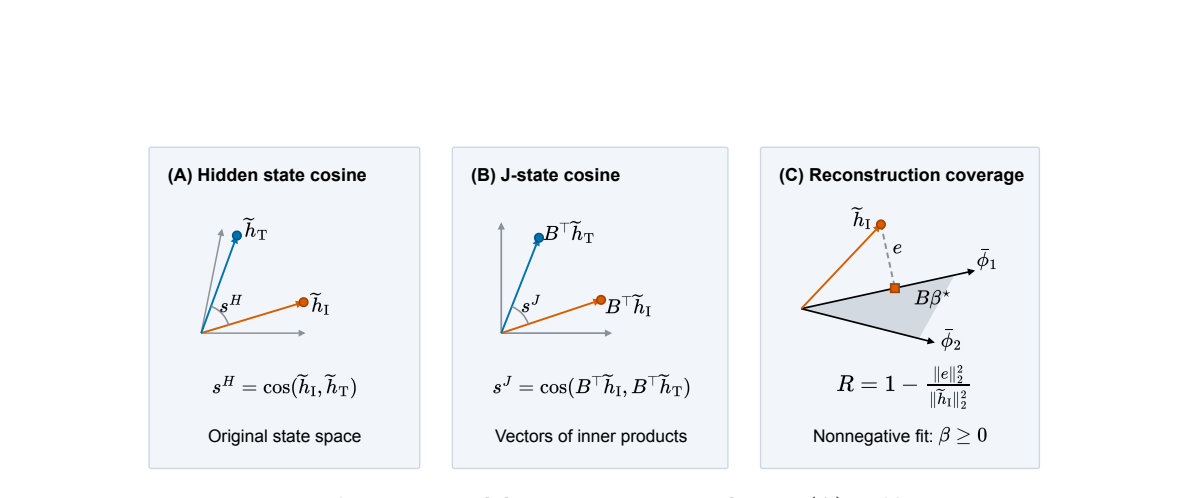
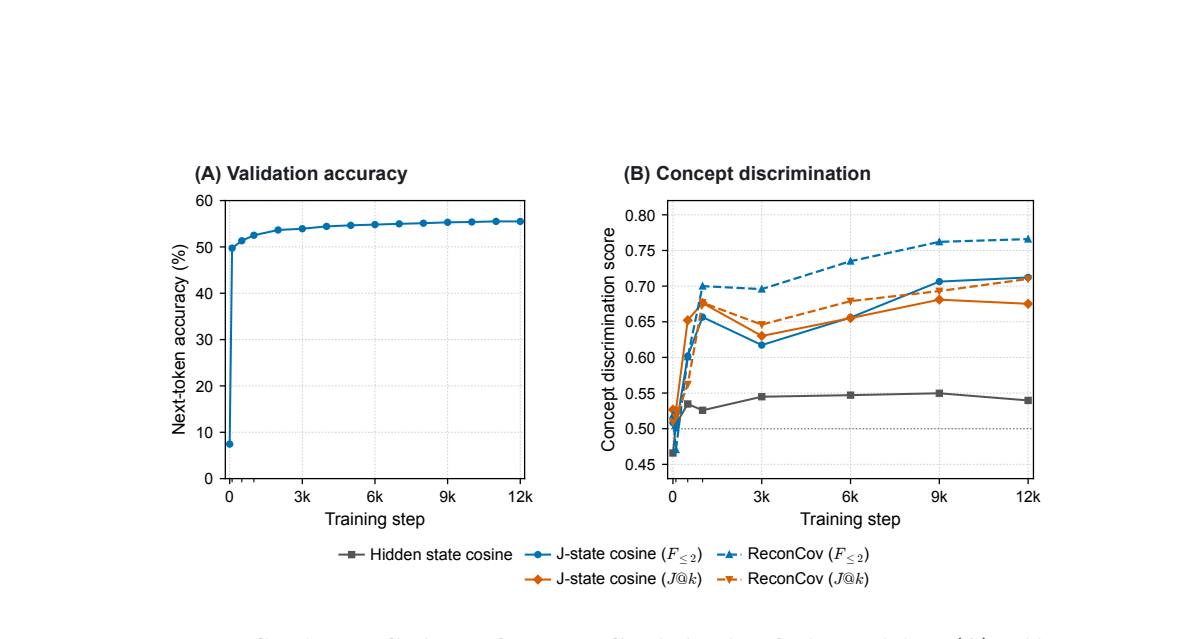
Global workspace theory (GWT) proposes that information is selected from parallel brain processes, integrated in a shared workspace, and made available to specialised processes. We introduce the Multimodal Concept Lens (MC-Lens), a multimodal Jacobian lens, to study these functions in VLM concept processing. Its vision encoder and language decoder lenses map intermediate states to a shared semantic space defined by the decoder's output vocabulary to compare concept accessibility across modalities. MC-Lens supports internal concept interventions to examine the role of accessed concepts in downstream computation. (i) Accessibility and selective access. Multimodal concept information is readable in intermediate states and selectively accessible as tasks require. We extend "readout carriers" from one name token to a token set to better capture and express concept information and support counterfactual experiments. (ii) Concepts in downstream computation. Counterfactual experiments show that accessed concept information participates in downstream computation and reasoning. (iii) Development of cross-modal alignment and selective access. We develop two J-space metrics tracking the development of cross-modal concept alignment more clearly than hidden state cosine in controlled VLM training. The experiment also shows that reliable selective access develops later than concept accessibility. (iv) Shared functions across models. Across VLM families and sizes, we find shared patterns of concept accessibility, query-dependent selectivity and cross-task intervention effects despite differences in internal organisation. These findings offer an experimental basis to study GWT in multimodal artificial systems and how it can guide cross-modal alignment improvements.
from the abstract
Pith says
Machine review · deepseek-v4-flash · 20 Nov 2026 · read the full text (209,647 characters) · not checked by a person
It can be wrong. Challenge this review or reply to it.
Holds up, with conditions. One sentence, published on the paper's page as the review's top line. This line is wrong
10 minor · 1 open question
How often objections from reviews like this one are right: not yet measured
The paper, first character to last
The reviewer was given the whole text, 209,647 characters. Not checked: figures, code, what the 61 references say.
10 minor objections
The paper says, at §1
Pith says: minor objection 1 of 10
The term 'Multimodal Concept Lens' is used throughout, but the method is fundamentally an extension of J-Lens to VLMs. The novelty lies in the multimodal application and the concept direction sets, not in the lens formulation itself. This should be stated more clearly.
The paper says, at §2.1, Eq. (4)
Pith says: minor objection 2 of 10
The Jacobian is defined as the derivative of the final decoder state with respect to intermediate states. However, the paper does not discuss how these derivatives are computed in practice (e.g., whether they require backpropagation through the entire model for each input, and the computational cost). This practical detail would be helpful for reproducibility.
show 8 more
The paper says, at §2.3, Eq. (14)–(15)
Pith says: minor objection 3 of 10
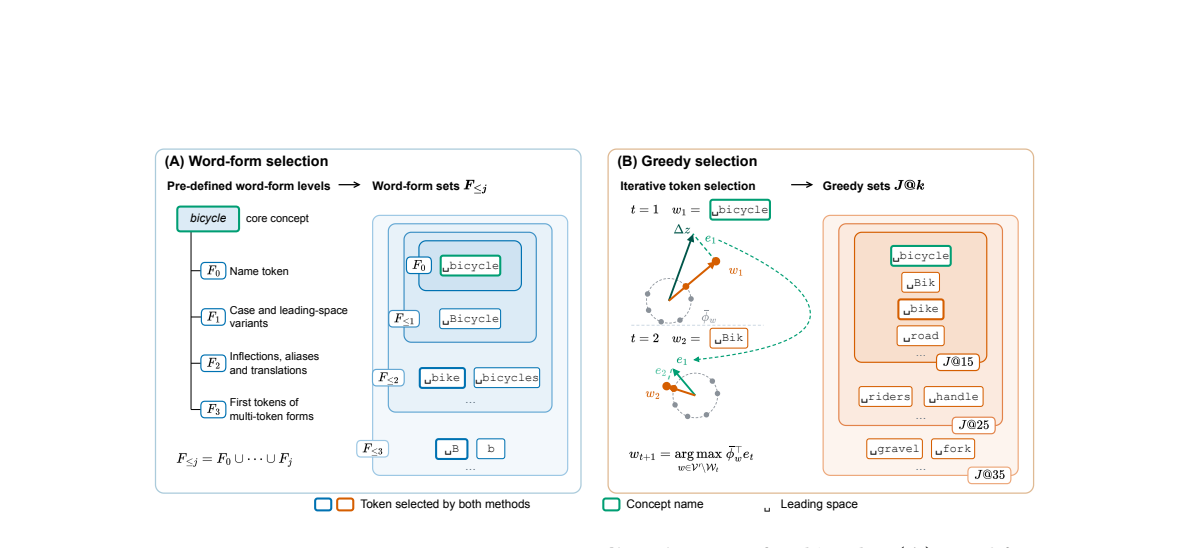
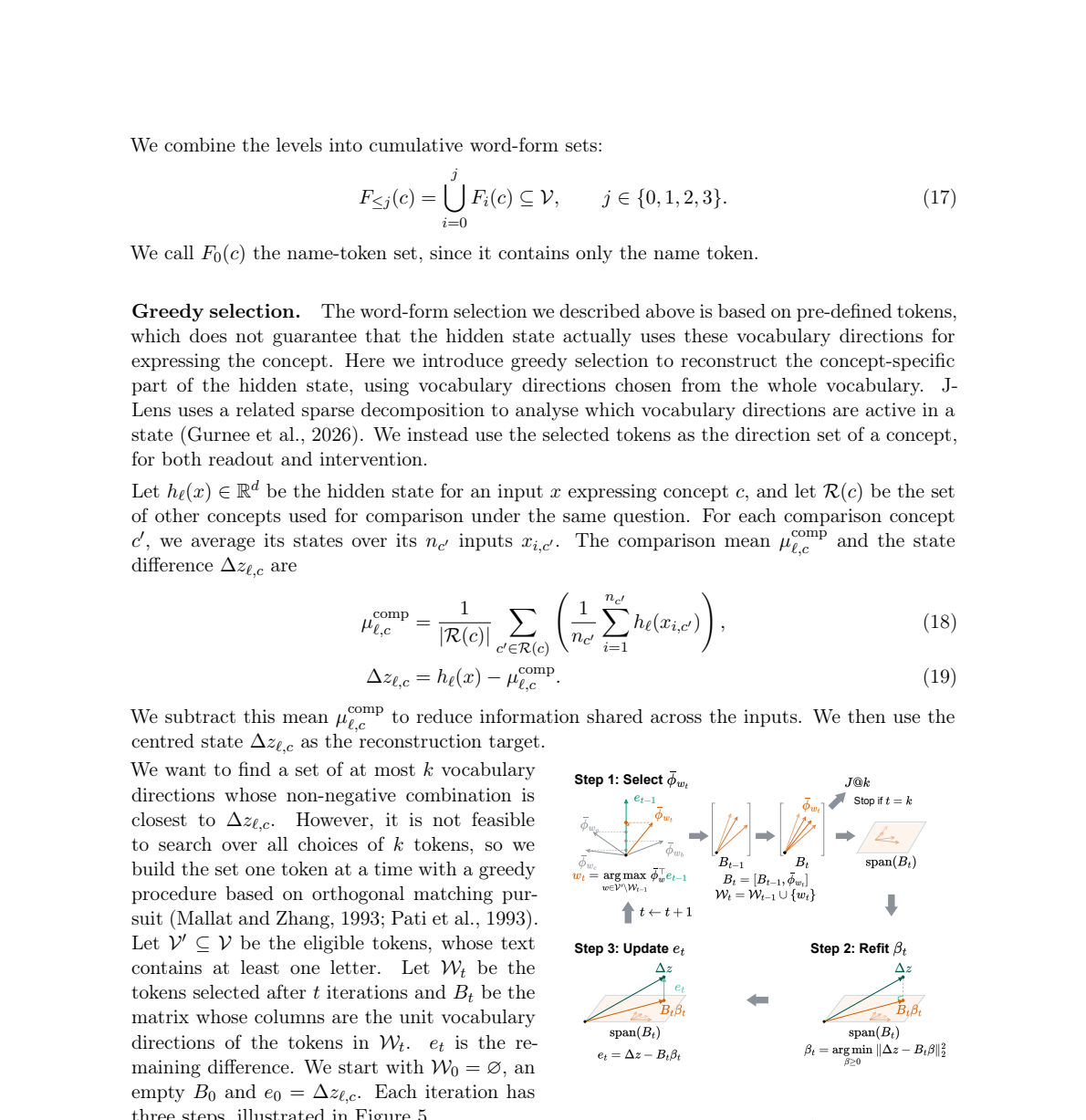
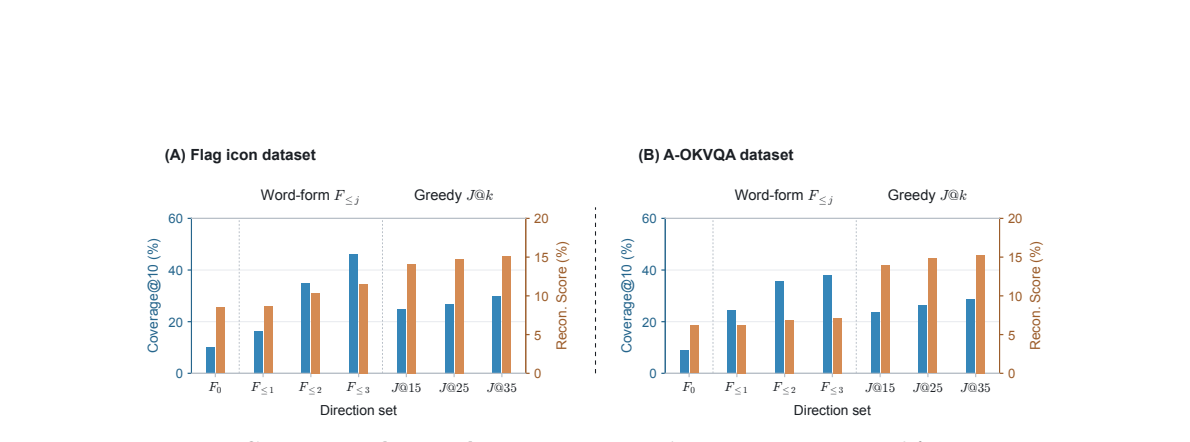
The greedy selection procedure uses orthogonal matching pursuit with non-negative least squares. The stopping criterion is 'until k tokens have been selected, or earlier if no remaining direction has a positive inner product with e_t'. This second condition could stop early with very few tokens; the paper should report how often this occurs in practice.
The paper says, at §3.1, Fig. 5
Pith says: minor objection 4 of 10
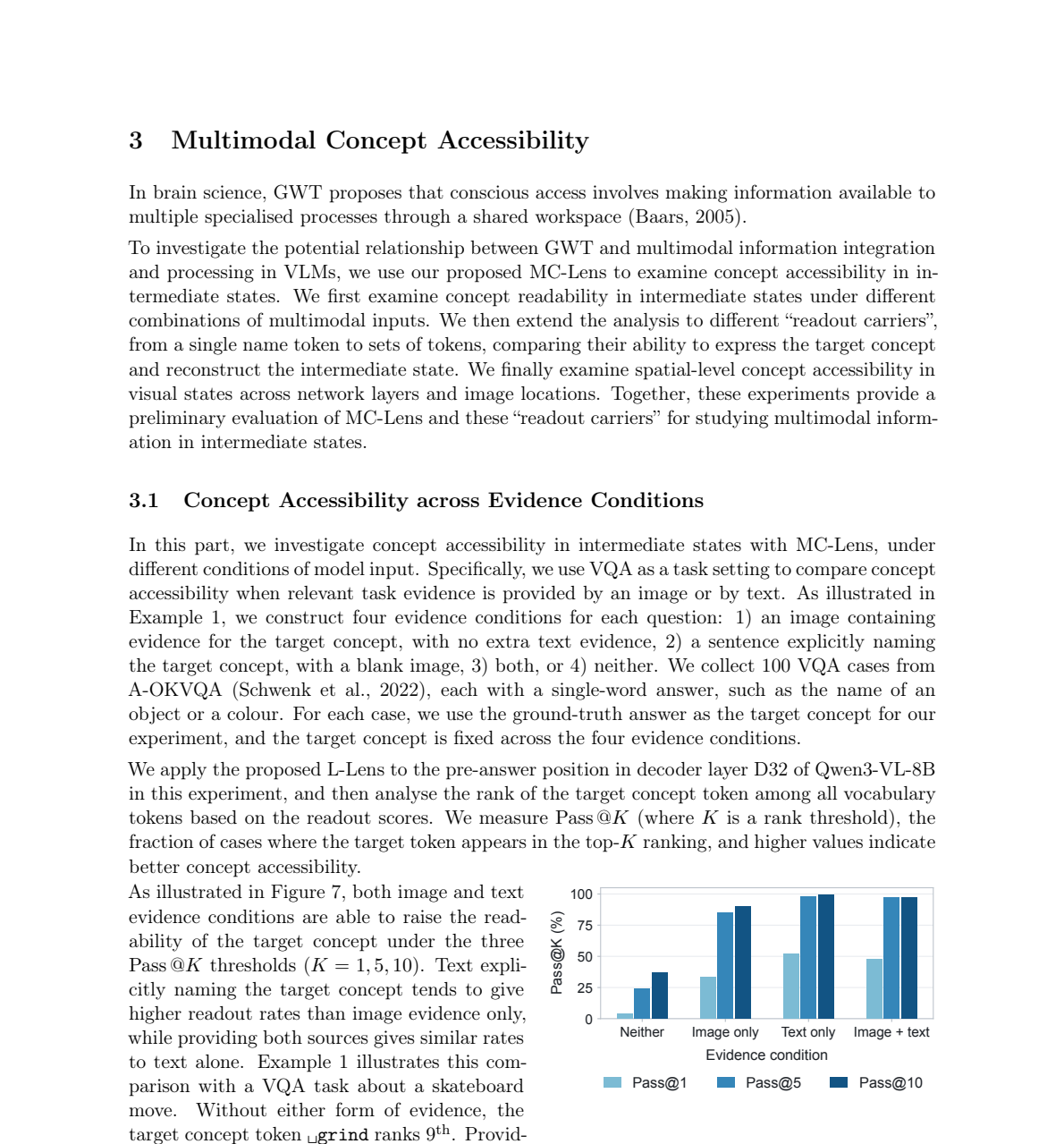
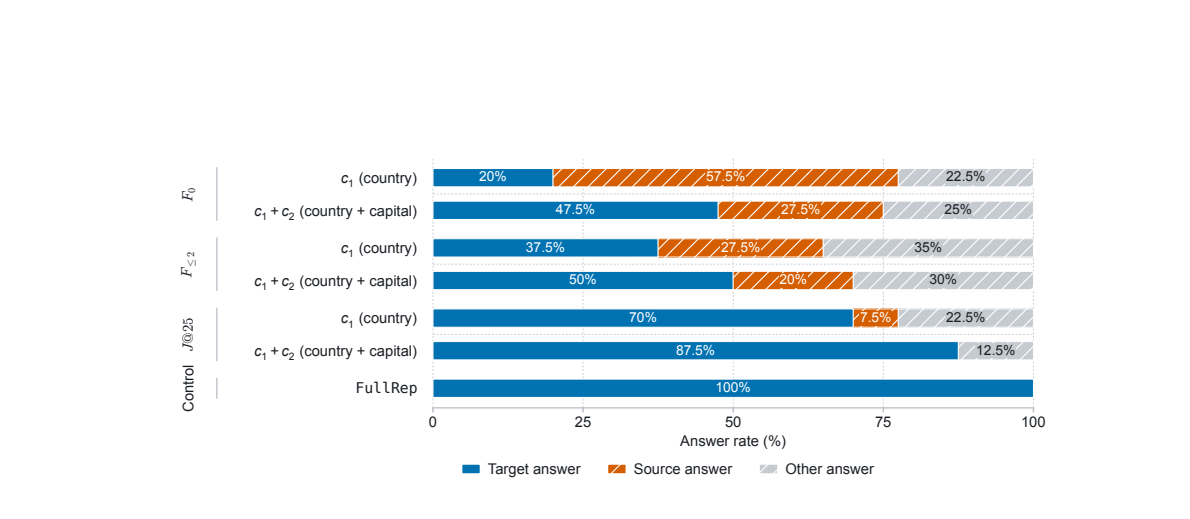
The paper uses A-OKVQA for multiple experiments but does not specify whether the same 100 cases are reused across experiments or whether different subsets are drawn. If the same cases are reused, this could lead to overfitting of the analysis to specific examples.
The paper says, at §4.1, Fig. 9
Pith says: minor objection 5 of 10
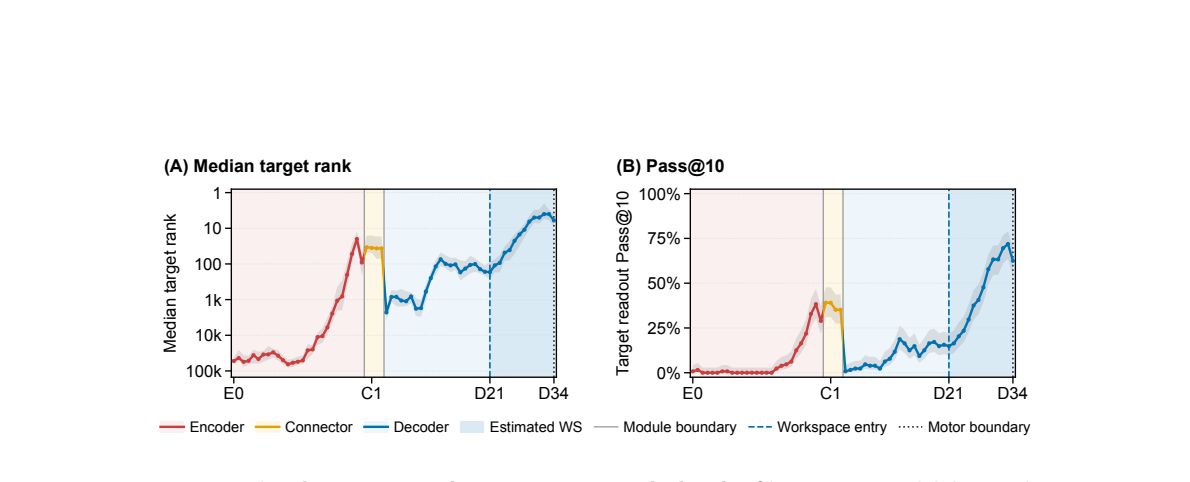
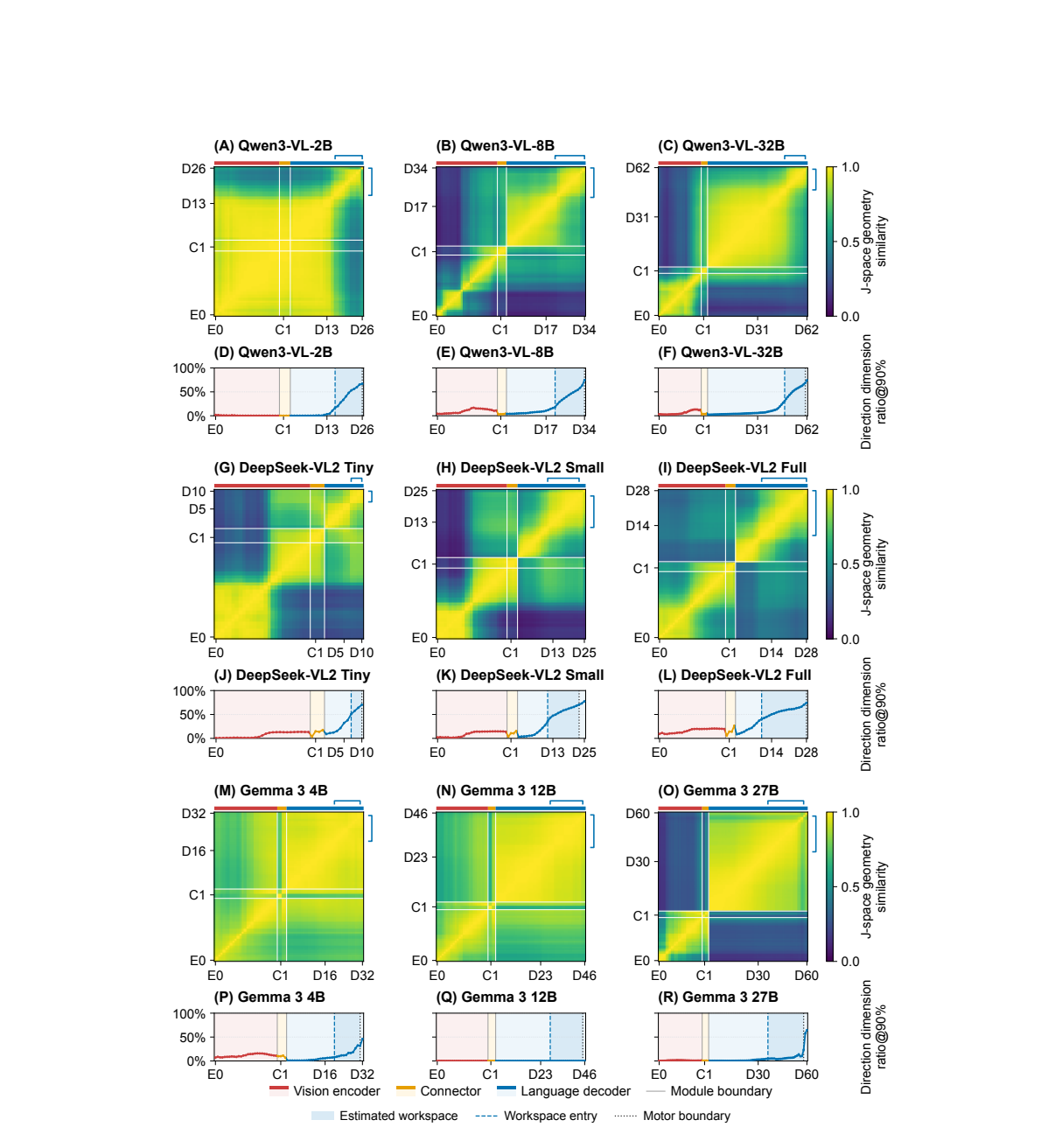
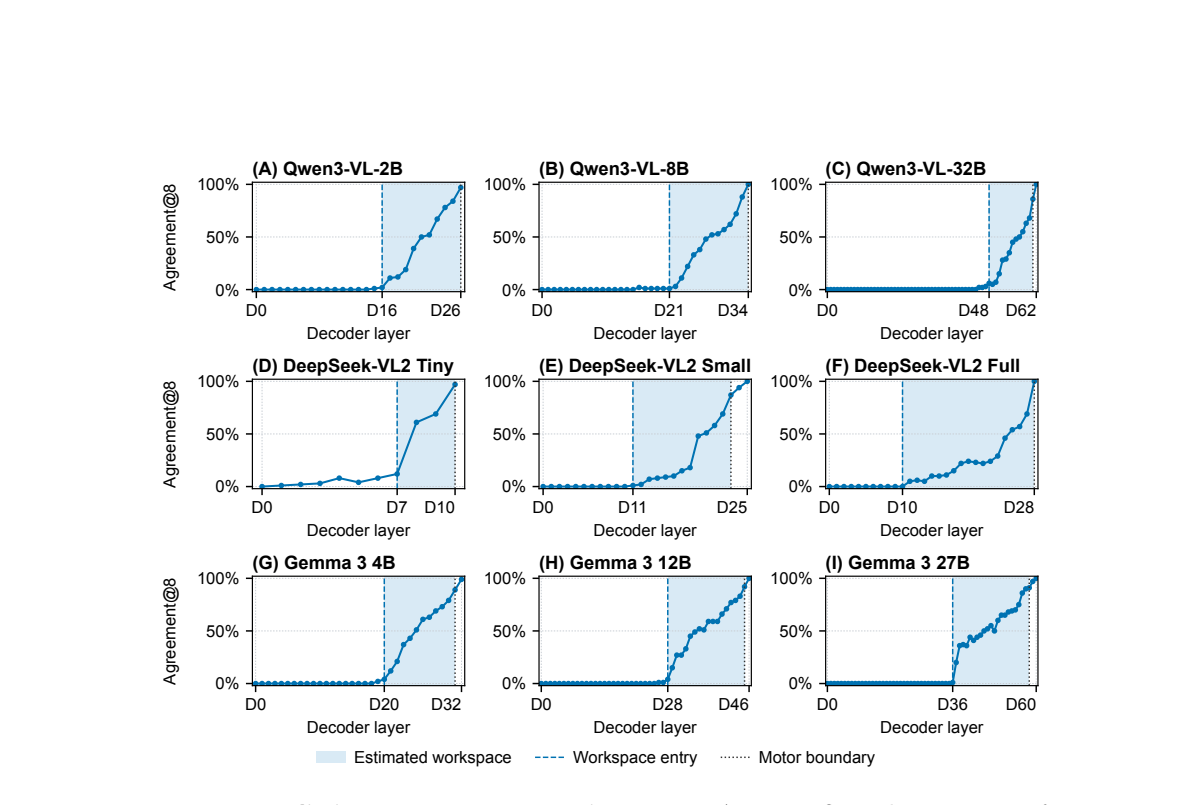
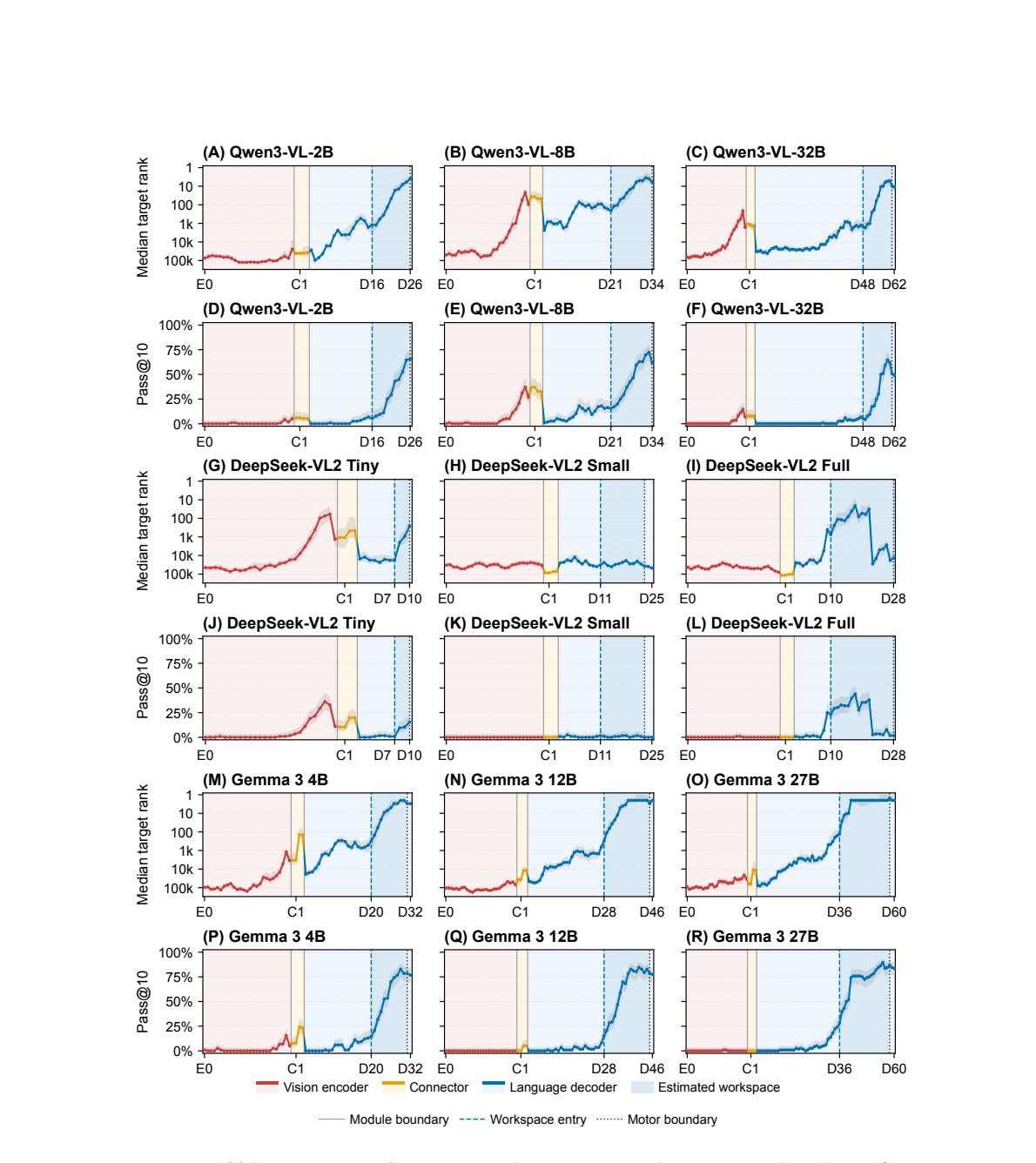
The manual estimation of workspace boundaries is subjective. The paper should provide a reproducible algorithm or at least report inter-rater reliability if multiple annotators were involved.
The paper says, at §5.1, Fig. 11
Pith says: minor objection 6 of 10
The intervention experiments edit 'all decoder layers' by default. Appendix A.4 examines depth windows, but the main experiments use full-decoder intervention. This is a strong intervention that may produce unnatural states. The paper should discuss potential artifacts from editing many layers simultaneously.
The paper says, at §6.1, Fig. 14
Pith says: minor objection 7 of 10
The CKA analysis compares vocabulary-direction geometry across layers within each model, but does not compare across models. The claim of 'shared workspace structure across model families' would be strengthened by cross-model CKA comparisons.
The paper says, at §8
Pith says: minor objection 8 of 10
The connection to GWT is a framing device, but the paper does not establish that VLMs implement GWT mechanisms. The findings show functional similarities (selective access, downstream availability) that are consistent with GWT but also with other information-processing frameworks. The paper should temper the GWT claims or clarify that they are analogical.
The paper says, at Appendix A.3
Pith says: minor objection 9 of 10
This is an important caveat that should appear in the main text, not just the appendix. The current main text presentation of workspace boundaries as established fact is misleading.
The paper says, at Throughout
Pith says: minor objection 10 of 10
The paper uses many bespoke metrics (Pass@K, Coverage@10, Recon. Score, selective sensitivity, NR/SR/NSR, J-state cosine, ReconCov) without always clearly defining them in one place. A summary table of all metrics with definitions would improve readability.
Open questions (1)
Pith raised these and could not confirm them against the text of the paper it read. They are questions for the authors, not findings.
- §2.1, Eq. (6)–(8) Pith raised a concern here that it could not check against the text of the paper it was given, so it is not published as an objection.
What would settle it
If the averaged Jacobian matrices do not generalise across inputs—for example, if concept readouts from held-out inputs do not rank the target concept above chance, or if counterfactual interventions using the lens directions fail to change model outputs more often than random perturbations—then the central claim that MC-Lens accesses causally relevant concept representations would be undermined.
from Pith's summary of the paper
How the review went
5 passes by deepseek-v4-flash · 20 Nov 2026
- Reader holds up, with conditions
- Skeptic concern withdrawn: Pith's reviewer misread the paper
- Referee 10 minor
- Check against the paper kept 0 of 7 objections
- Editor wrote the verdict above
Not run on this paper: the simulated authors' defence.
Pith's passes raised 7 objections. A check against the paper's text kept 0, withdrew 6 (6 Pith's reviewer misread the paper) and left 1 as a question.
The review in full
The review in brief, machine-written
200-500 words, published on the paper's page as the editor's note.
The stress test's concern
Withdrawn: Pith's reviewer misread the paper.
The paper says
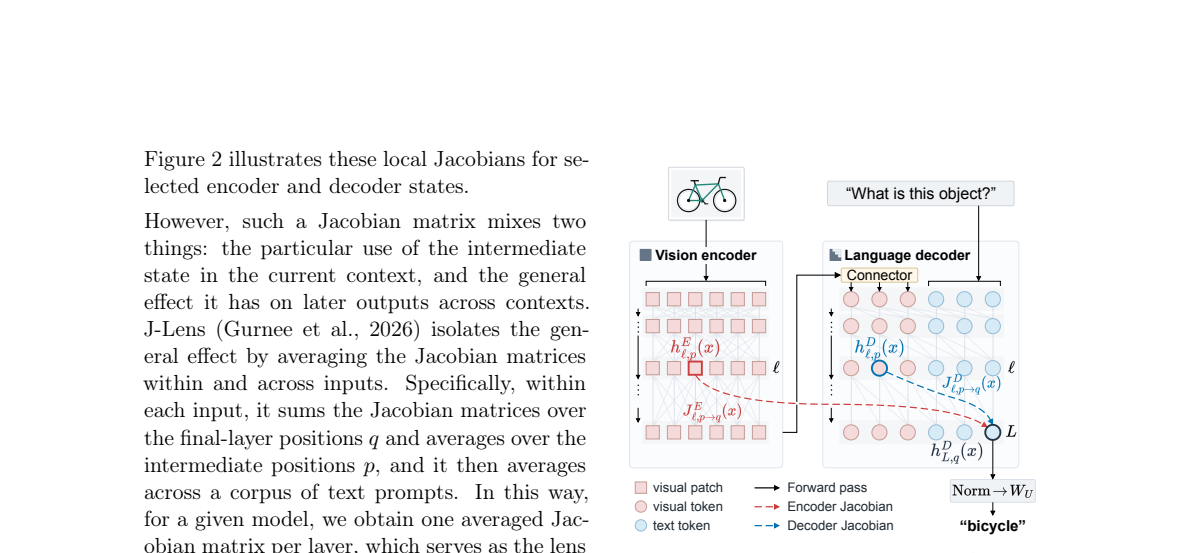
“However, such a Jacobian matrix mixes two things: the particular use of the intermediate state in the current context, and the general effect it has on later outputs across contexts. J-Lens~\citep{gurnee2026verbalizable} isolates the general effect by averaging the Jacobian matrices within and across inputs.”
The referee's report
Not published. Pith's referee wrote this assessment before its objections were checked against the paper, and 6 of its 6 major objections did not survive that check.
Pith's reading of the paper (a machine's summary, not the authors')
The paper introduces the Multimodal Concept Lens (MC-Lens), a Jacobian-based method to read concept information from intermediate states of vision-language models (VLMs) and to intervene on those states. Using MC-Lens, the authors claim that multimodal concept information is readable in intermediate visual and language states, can be selectively accessed according to task demands, and participates in downstream computation and reasoning, as demonstrated by counterfactual interventions that redirect answers in direct, one-hop, and multi-hop tasks. They also report that across VLM families and sizes, there are shared patterns of concept accessibility, query-dependent selectivity, and cross-task intervention effects, despite differences in internal organisation. The paper further tracks the development of cross-modal alignment and selective access during controlled VLM training, finding that reliable selective access develops later than concept accessibility. The authors argue these findings provide an experimental basis for studying global workspace theory in multimodal artificial systems.
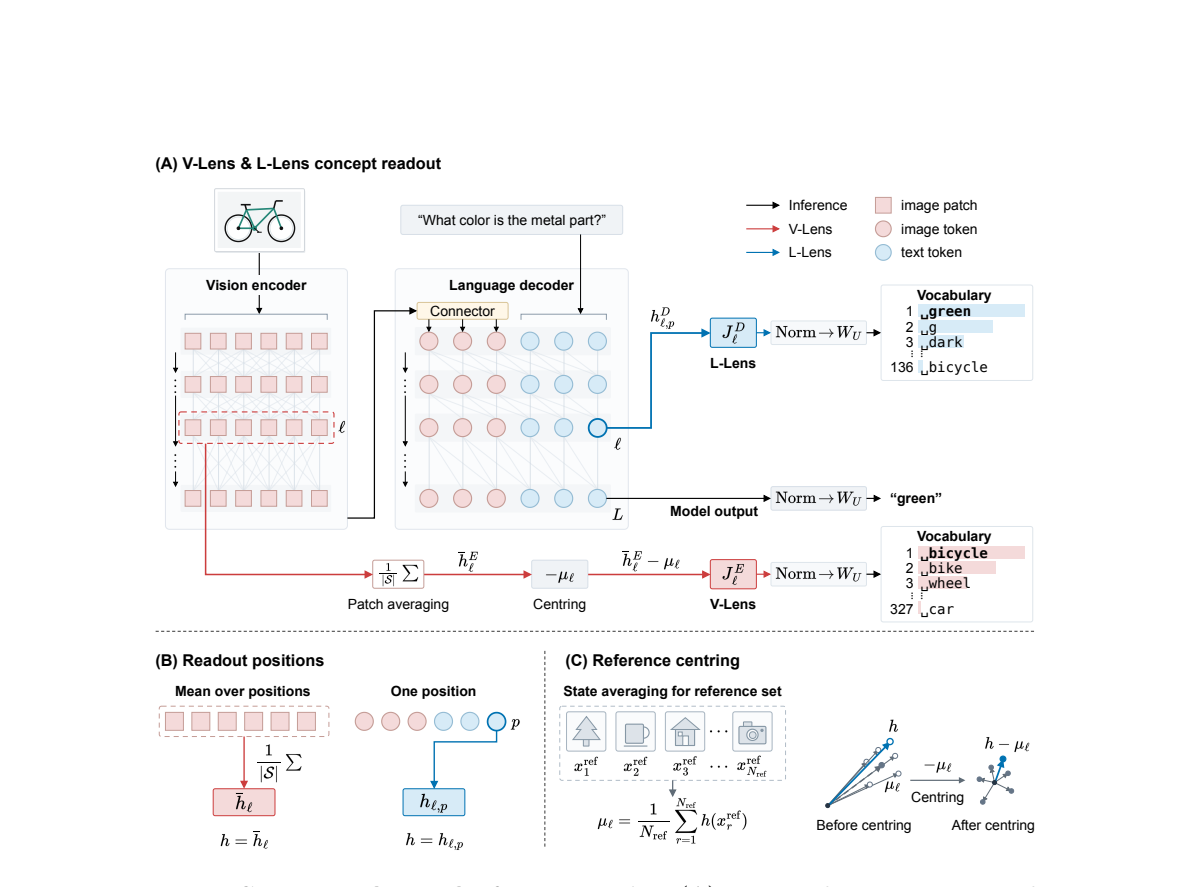
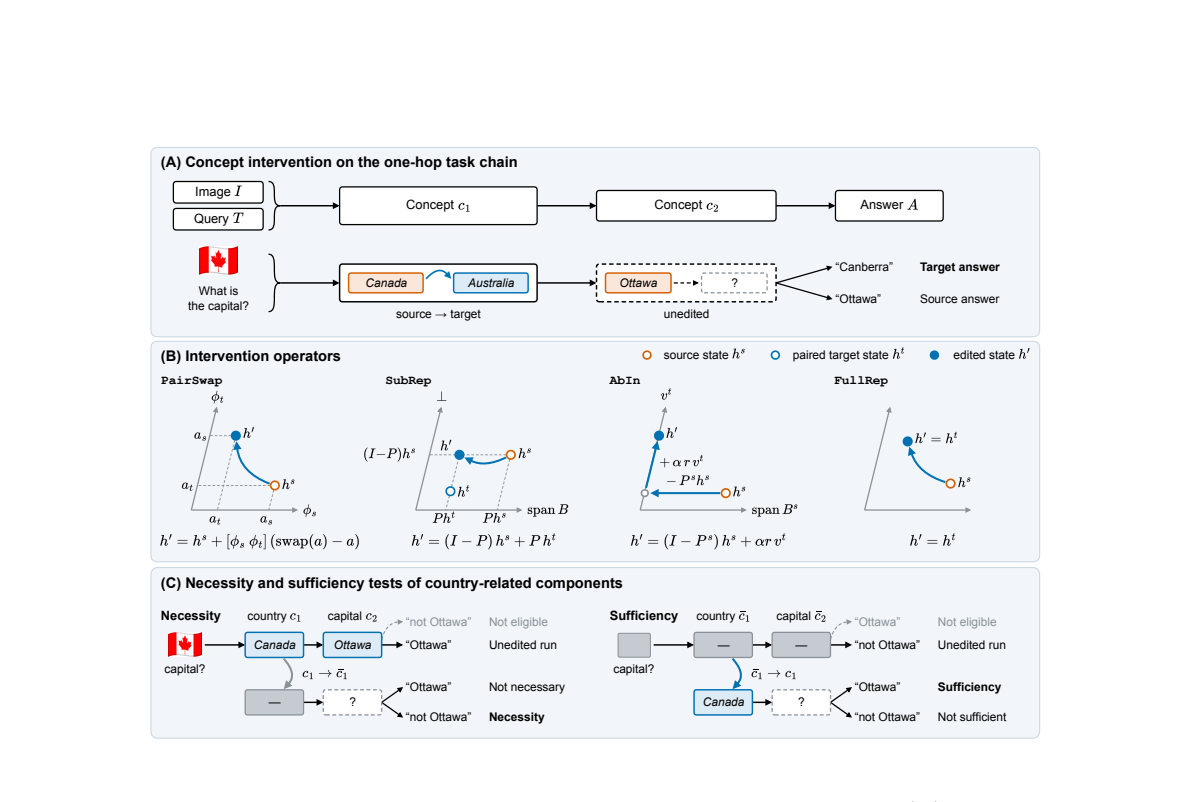
What carries the argument. The Multimodal Concept Lens (MC-Lens) is the central object. It is a multimodal Jacobian lens that combines a vision encoder lens (V-Lens) and a language decoder lens (L-Lens). Both lenses map intermediate states into a shared semantic space defined by the decoder's output vocabulary via averaged Jacobian matrices, allowing comparison of concept accessibility across visual and language processing. MC-Lens also supports internal concept interventions (SubRep, PairSwap, AbIn) to examine the causal role of accessed concepts in downstream computation. The key identity is the averaged Jacobian matrix J_ℓ^m that isolates the general effect of an intermediate state on the final output, separating it from context-specific effects.
Core claim. The paper claims that multimodal concept information in VLMs is not only readable from intermediate states but also causally involved in downstream reasoning, and that this information can be selectively accessed based on task demands. The central discovery is that concept representations in VLMs exhibit functional properties analogous to those described by global workspace theory: information is selected from multiple parallel processes (visual and textual), integrated in a shared workspace (the decoder layers), and made available to different downstream computations. The authors demonstrate this through counterfactual interventions that redirect answers in direct, one-hop, and multi-hop reasoning tasks, showing that the accessed concept information is causally relevant for the model's outputs.
The premise it rests on. The averaged Jacobian matrix (the lens) isolates the 'general effect' of an intermediate state on the final output, separating it from context-specific effects; if this averaging does not successfully separate general from context-specific effects, the concept readouts and intervention directions may be contaminated by spurious correlations.
If the paper is right (Pith's inferences, not the authors')
If the paper's claims are correct, then VLM internal states can be read and manipulated to control model outputs, enabling new forms of interpretability and model editing for multimodal systems.
The finding that concept accessibility improves early in training while selective access develops later suggests that training strategies could be designed to accelerate the emergence of selective access.
The shared patterns across model families imply that global workspace-like organisation may be a general property of well-trained VLMs, not an artifact of a particular architecture.
The ability to redirect one-hop and multi-hop answers via concept interventions indicates that factual knowledge in VLMs is stored in a distributed but localisable manner, with implications for model editing and debiasing.
The J-space metrics for cross-modal alignment could serve as training objectives to improve vision-language alignment beyond what token prediction alone provides.
The paper's method could be extended to other modalities (audio, video) to study cross-modal concept processing in multimodal models beyond vision and language.
The finding that selective access develops later than concept accessibility suggests that the model learns to represent concepts before it learns to selectively attend to them based on queries, which may reflect a general learning principle in multimodal systems.
The paper's approach could be used to study whether similar workspace-like organisation emerges in other types of neural networks, such as those for reinforcement learning or robotics, where selective attention to task-relevant information is critical.
The concept direction sets (greedy sets) could be used to probe for biases or spurious correlations in VLMs by examining which concepts are co-activated with target concepts.
Check this review
What was read
The passes were given all 209,647 characters of the paper's LaTeX source.
Fingerprint of that text (SHA-256): f9b2e13f10c218a1bd23776ea3091a3512096301b737dd4435b07ad2d149fd63
Pith does not keep that text. Rebuilt from the paper's source or PDF by the same code, it has this fingerprint if it is the same text. From a copy of Pith's code:
PYTHONPATH=. python scripts/review_input_check.py 2611.26590
The passes, in the order they ran
- Reader deepseek-v4-flash · medium effort · $0.0060 · instructions of the Reader, fingerprint f9ead7300382…
- Skeptic deepseek-v4-flash · medium effort · $0.0052 · instructions of the Skeptic, fingerprint 8f88c0f61488…
- Referee deepseek-v4-flash · medium effort · $0.0055 · instructions of the Referee, fingerprint a852d99aea0d…
- Check against the paper deepseek-v4-flash · medium effort · $0.0075 · instructions of the Check against the paper, fingerprint 6c7a6883d551…
- Editor deepseek-v4-flash · medium effort · $0.0052 · instructions of the Editor, fingerprint e7211f6a3d27…
- Circularity check deepseek-v4-flash · medium effort · $0.0051 · instructions of the Circularity check, fingerprint e9946e39d67b…
- Summary for the page deepseek-v4-flash · medium effort · temperature 0.2 · $0.0055 · instructions of the Summary for the page, fingerprint e4f56bf568e7…
The passes cost $0.040 in model calls together.
Version stamped on this review: pith-pipeline@v1.4.1-daily-deepseek-or-medium+deepseek/deepseek-v4-flash+p.d60f54226f00
Each link opens a pass's instructions as plain text, the exact bytes its fingerprint was taken over. Every stored set of instructions.
curl -s https://pith.science/methodology/prompts/f9ead730038216984cfb56d7cb34332bdf691828296a1de4245f3d6667d4bf56 | sha256sum
prints the fingerprint of the reader's instructions. The same works for every pass.
The receipt
The review's fingerprint was taken on 20 Nov 2026. The review you are reading still matches it.
Fingerprint of the review (SHA-256): a83dbd93dc13ce192bd1b0f05f11eb87666bd1df538bda36114212aa0cadee68
curl -s 'https://pith.science/api/v1/verdicts/2611.26590?form=canonical' | sha256sum
prints the fingerprint of the review as it stands now. The rule, in four steps.
A matching fingerprint shows the review has not changed since that date. It does not show that the review is right.
How often reviews like this one are right
Reviews like this one: written by deepseek-v4-flash, from the paper's LaTeX source.
How often objections from reviews like this one are right: not yet measured
Reviews by people
This review was written by a machine. No person has reviewed this paper on Pith yet. A scientist listed on Pith can review it for a fee, and their review is published here whatever it concludes.
The paper
Abstract
Vision-language models (VLMs) integrate visual and textual information, but their outputs do not reveal internal concept representations. Global workspace theory (GWT) proposes that information is selected from parallel brain processes, integrated in a shared workspace, and made available to specialised processes. We introduce the Multimodal Concept Lens (MC-Lens), a multimodal Jacobian lens, to study these functions in VLM concept processing. Its vision encoder and language decoder lenses map intermediate states to a shared semantic space defined by the decoder's output vocabulary to compare concept accessibility across modalities. MC-Lens supports internal concept interventions to examine the role of accessed concepts in downstream computation. (i) Accessibility and selective access. Multimodal concept information is readable in intermediate states and selectively accessible as tasks require. We extend "readout carriers" from one name token to a token set to better capture and express concept information and support counterfactual experiments. (ii) Concepts in downstream computation. Counterfactual experiments show that accessed concept information participates in downstream computation and reasoning. (iii) Development of cross-modal alignment and selective access. We develop two J-space metrics tracking the development of cross-modal concept alignment more clearly than hidden state cosine in controlled VLM training. The experiment also shows that reliable selective access develops later than concept accessibility. (iv) Shared functions across models. Across VLM families and sizes, we find shared patterns of concept accessibility, query-dependent selectivity and cross-task intervention effects despite differences in internal organisation. These findings offer an experimental basis to study GWT in multimodal artificial systems and how it can guide cross-modal alignment improvements.
The paper's own sentences, arranged, kept beside the review and separate from it. Each label is drawn from a closed vocabulary; the number beside it is the probability the classifier gave that label. No sentence in this record was written by a model.
abstract compiled · 2026-11-20
The authors' main claim, as the classifier picked it out 0.51
“These findings offer an experimental basis to study GWT in multimodal artificial systems and how it can guide cross-modal alignment improvements.”
How the main claim is stated: asserted 0.69
What the abstract itself states, as probabilities: claims first 0.08 · states limitation 0.20 · human participants 0.03 · controlled comparison 0.26 · randomized assignment 0.02 · states quantitative result 0.06 · compares with prior results 0.76 · mentions code or data availability 0.03
The abstract, sentence by sentence
This table labels the abstract only (arXiv listing abstract v1). The number is the probability the classifier gave the label.
| Sentence | Role | The authors' own work | States the main conclusion | Strength |
|---|---|---|---|---|
| Vision-language models (VLMs) integrate visual and textual information, but their outputs do not reveal internal concept representations. | gap 0.69 | 0.09 | 0.02 | asserted 1.00 |
| Global workspace theory (GWT) proposes that information is selected from parallel brain processes, integrated in a shared workspace, and made available to specialised processes. | background 1.00 | 0.03 | 0.02 | asserted 0.93 |
| We introduce the Multimodal Concept Lens (MC-Lens), a multimodal Jacobian lens, to study these functions in VLM concept processing. | contribution 0.81 | 0.91 | 0.04 | asserted 0.96 |
| Its vision encoder and language decoder lenses map intermediate states to a shared semantic space defined by the decoder's output vocabulary to compare concept accessibility across modalities. | method 0.99 | 0.68 | 0.04 | asserted 0.99 |
| MC-Lens supports internal concept interventions to examine the role of accessed concepts in downstream computation. | method 0.81 | 0.76 | 0.04 | asserted 0.99 |
| (i) Accessibility and selective access. | result 0.72 | 0.14 | 0.06 | unclear 0.95 |
| Multimodal concept information is readable in intermediate states and selectively accessible as tasks require. | result 1.00 | 0.87 | 0.25 | asserted 1.00 |
| We extend "readout carriers" from one name token to a token set to better capture and express concept information and support counterfactual experiments. | method 0.76 | 0.91 | 0.04 | asserted 0.96 |
| (ii) Concepts in downstream computation. | contribution 0.50 | 0.12 | 0.03 | unclear 0.95 |
| Counterfactual experiments show that accessed concept information participates in downstream computation and reasoning. | result 1.00 | 0.94 | 0.18 | asserted 1.00 |
| (iii) Development of cross-modal alignment and selective access. | contribution 0.60 | 0.58 | 0.04 | unclear 0.82 |
| We develop two J-space metrics tracking the development of cross-modal concept alignment more clearly than hidden state cosine in controlled VLM training. | contribution 0.46 | 0.96 | 0.07 | asserted 1.00 |
| The experiment also shows that reliable selective access develops later than concept accessibility. | result 1.00 | 0.94 | 0.07 | asserted 1.00 |
| (iv) Shared functions across models. | result 0.81 | 0.68 | 0.05 | unclear 0.67 |
| Across VLM families and sizes, we find shared patterns of concept accessibility, query-dependent selectivity and cross-task intervention effects despite differences in internal organisation. | result 1.00 | 0.97 | 0.27 | asserted 1.00 |
| These findings offer an experimental basis to study GWT in multimodal artificial systems and how it can guide cross-modal alignment improvements. | interpretation 0.93 | 0.39 | 0.55 | asserted 0.69 |
What kind of paper the classifier reports this is: method or tool 0.90 · evidence from observation or experiment 0.98
What was examined, and what was not
Sources read
- arXiv listing abstract v1
Not examined
- full text
- figures and tables
- references and citing sentences
- relations to other papers
Levels run
- P abstract
Not run
- S sections
- T body sentences
- C citations
- R cross-paper relations
How the labels were made
Compiled by classifier-1.13.0 via TypeSafe API, question bank abstract-p1-20260923, 2026-11-20: 1 request, 11,147 input tokens.
Every quoted sentence on this record is the authors'. Every label is from Pith's closed vocabulary, with the probability shown beside it. This record as JSON
Figures (22)

Showing 21 of the paper's 22 figures. Figures are the authors', reproduced from the paper.
References (61)
- [1] Alain, Guillaume and Bengio, Yoshua , title =. 2016 , howpublished =. 1610.01644 , archivePrefix = on PithPith's reviewarXiv
- [2] Alayrac, Jean-Baptiste and Donahue, Jeff and Luc, Pauline and Miech, Antoine and Barr, Iain and Hasson, Yana and Lenc, Karel and Mensch, Arthur and Millican, Katherine and Reynolds, Malcolm and Ring, Roman and Rutherford, Eliza and Cabi, Serkan and Han, Tengda and Gong, Zhitao... on Pith
- [3] Arditi, Andy and Obeso, Oscar and Syed, Aaquib and Paleka, Daniel and Panickssery, Nina and Gurnee, Wes and Nanda, Neel , title =. Advances in Neural Information Processing Systems , volume =. 2024 , eprint = on Pith
- [4] Baars, Bernard J. , title =. The Boundaries of Consciousness: Neurobiology and Neuropathology , editor =. 2005 , doi = on Pith
- [5] Baars, Bernard J. and Franklin, Stan , title =. Neural Networks , volume =. 2007 , doi = on Pith
- [6] Bai, Shuai and Cai, Yuxuan and Chen, Ruizhe and Chen, Keqin and Chen, Xionghui and Cheng, Zesen and Deng, Lianghao and Ding, Wei and Gao, Chang and Ge, Chunjiang and Ge, Wenbin and Guo, Zhifang and Huang, Qidong and Huang, Jie and Huang, Fei and Hui, Binyuan and Jiang, Shutong... on PithPith's reviewarXiv
- [7] Belrose, Nora and Ostrovsky, Igor and McKinney, Lev and Furman, Zach and Smith, Logan and Halawi, Danny and Biderman, Stella and Steinhardt, Jacob , title =. 2023 , howpublished =. 2303.08112 , archivePrefix = on PithPith's reviewarXiv
- [8] Blank, Camila and Bhatia, Agam and Nanda, Neel , title =. 2026 , month = aug, howpublished = on Pith
- [9] Blum, Lenore and Blum, Manuel , title =. Proceedings of the National Academy of Sciences , volume =. 2022 , doi = on Pith
- [10] Bricken, Trenton and Templeton, Adly and Batson, Joshua and Chen, Brian and Jermyn, Adam and Conerly, Tom and Turner, Nick and Anil, Cem and Denison, Carson and Askell, Amanda and Lasenby, Robert and Wu, Yifan and Kravec, Shauna and Schiefer, Nicholas and Maxwell, Tim and Jose... on Pith
- [11] Butlin, Patrick and Long, Robert and Elmoznino, Eric and Bengio, Yoshua and Birch, Jonathan and Constant, Axel and Deane, George and Fleming, Stephen M. and Frith, Chris and Ji, Xu and Kanai, Ryota and Klein, Colin and Lindsay, Grace and Michel, Matthias and Mudrik, Liad and P... on PithPith's reviewarXiv
- [12] Chen, Liang and Zhao, Haozhe and Liu, Tianyu and Bai, Shuai and Lin, Junyang and Zhou, Chang and Chang, Baobao , title =. Computer Vision -- ECCV 2024 , series =. 2024 , eprint = on Pith
- [13] Chun, Chanwoo and Polo, Alexandre and Chung, SueYeon , title =. 2026 , howpublished =. 2602.20338 , archivePrefix = on PithPith's reviewarXiv
- [14] Dehaene, Stanislas and Kerszberg, Michel and Changeux, Jean-Pierre , title =. Proceedings of the National Academy of Sciences , volume =. 1998 , doi = on Pith
- [15] Dehaene, Stanislas and Naccache, Lionel , title =. Cognition , volume =. 2001 , doi = on Pith
- [16] Dehaene, Stanislas and Sergent, Claire and Changeux, Jean-Pierre , title =. Proceedings of the National Academy of Sciences , volume =. 2003 , doi = on Pith
- [17] Dehaene, Stanislas and Lau, Hakwan and Kouider, Sid , title =. Science , volume =. 2017 , doi = on Pith
- [18] Deitke, Matt and Clark, Christopher and Lee, Sangho and Tripathi, Rohun and Yang, Yue and Park, Jae Sung and Salehi, Mohammadreza and Muennighoff, Niklas and Lo, Kyle and Soldaini, Luca and Lu, Jiasen and Anderson, Taira and Bransom, Erin and Ehsani, Kiana and Ngo, Huong and C... on Pith
- [19] Deng, Ailin and Cao, Tri and Chen, Zhirui and Hooi, Bryan , title =. Proceedings of the IEEE/CVF Conference on Computer Vision and Pattern Recognition , pages =. 2025 , eprint = on Pith
- [20] Devillers, Benjamin and Mayti. Semi-Supervised Multimodal Representation Learning Through a Global Workspace , journal =. 2025 , doi =. 2306.15711 , archivePrefix = on PitharXiv
show 41 more
- [21] Fawcett, Tom , title =. Pattern Recognition Letters , volume =. 2006 , doi = on Pith
- [22] Fountas, Zafeirios and Wieser, Frederico and Benfeghoul, Martin and Oomerjee, Adnan and Wang, Jun , title =. 2026 , howpublished = on Pith
- [23] Fu, Stephanie and Bonnen, Tyler and Guillory, Devin and Darrell, Trevor , title =. Conference on Language Modeling , year =. 2506.08008 , archivePrefix = on PithPith's reviewarXiv
- [24] Geiger, Atticus and Wu, Zhengxuan and Potts, Christopher and Icard, Thomas and Goodman, Noah , title =. Proceedings of the Third Conference on Causal Learning and Reasoning , series =. 2024 , url = on Pith
- [25] 2024 , howpublished =. 2408.00118 , archivePrefix = on PithPith's reviewarXiv
- [26] 2025 , howpublished =. 2503.19786 , archivePrefix = on PithPith's reviewarXiv
- [27] Ghandeharioun, Asma and Caciularu, Avi and Pearce, Adam and Dixon, Lucas and Geva, Mor , title =. Proceedings of the 41st International Conference on Machine Learning , series =. 2024 , url = on Pith
- [28] Gong, Xijie and Huang, Zimeng and Wang, Tonghan , title =. 2026 , month = sep, howpublished =. 2608.31084 , archivePrefix = on PithPith's reviewarXiv
- [29] Goyal, Anirudh and Didolkar, Aniket and Lamb, Alex and Badola, Kartikeya and Ke, Nan Rosemary and Rahaman, Nasim and Binas, Jonathan and Blundell, Charles and Mozer, Michael and Bengio, Yoshua , title =. International Conference on Learning Representations , year =. 2103.01197... on PithPith's reviewarXiv
- [30] Gurnee, Wes and Sofroniew, Nicholas and Pearce, Adam and Piotrowski, Mateusz and Kauvar, Isaac and Chen, Runjin and Soligo, Anna and Bogdan, Paul and Ong, Euan and Wang, Rowan and Thompson, Ben and Abrahams, David and Kantamneni, Subhash and Ameisen, Emmanuel and Batson, Joshu... on PithPith's reviewarXiv
- [31] Hebart, Martin N. and Dickter, Adam H. and Kidder, Alexis and Kwok, Wan Y. and Corriveau, Anna and Van Wicklin, Caitlin and Baker, Chris I. , title =. PLoS ONE , volume =. 2019 , doi = on Pith
- [32] Hernandez, Evan and Sharma, Arnab Sen and Haklay, Tal and Meng, Kevin and Wattenberg, Martin and Andreas, Jacob and Belinkov, Yonatan and Bau, David , title =. International Conference on Learning Representations , year =. 2308.09124 , archivePrefix = on PithPith's reviewarXiv
- [33] Kaduri, Omri and Bagon, Shai and Dekel, Tali , title =. Proceedings of the IEEE/CVF Conference on Computer Vision and Pattern Recognition , pages =. 2025 , eprint = on Pith
- [34] Kawada, Sebastien and Kellis, Manolis , title =. 2026 , month = sep, howpublished =. 2609.04290 , archivePrefix = on PithPith's reviewarXiv
- [35] Kornblith, Simon and Norouzi, Mohammad and Lee, Honglak and Hinton, Geoffrey , title =. Proceedings of the 36th International Conference on Machine Learning , series =. 2019 , url = on Pith
- [36] Krojer, Benno and Nayak, Shravan and Ma. Proceedings of the 43rd International Conference on Machine Learning , series =. 2026 , eprint = on Pith
- [37] Lawson, Charles L. and Hanson, Richard J. , title =. 1995 , doi = on Pith
- [38] Li, Junnan and Li, Dongxu and Savarese, Silvio and Hoi, Steven , title =. Proceedings of the 40th International Conference on Machine Learning , series =. 2023 , url = on Pith
- [39] Lin, Tsung-Yi and Maire, Michael and Belongie, Serge and Hays, James and Perona, Pietro and Ramanan, Deva and Doll. Microsoft. Computer Vision -- ECCV 2014 , series =. 2014 , doi = on Pith
- [40] Liu, Haotian and Li, Chunyuan and Wu, Qingyang and Lee, Yong Jae , title =. Advances in Neural Information Processing Systems , volume =. 2023 , url = on Pith
- [41] Mallat, St. Matching pursuits with time-frequency dictionaries , journal =. 1993 , doi = on Pith
- [42] Meng, Kevin and Bau, David and Andonian, Alex and Belinkov, Yonatan , title =. Advances in Neural Information Processing Systems , volume =. 2022 , url = on Pith
- [43] Neo, Clement and Ong, Luke and Torr, Philip and Geva, Mor and Krueger, David and Barez, Fazl , title =. International Conference on Learning Representations , year =. 2410.07149 , archivePrefix = on PithPith's reviewarXiv
- [44] interpreting. 2020 , howpublished = on Pith
- [45] Palit, Vedant and Pandey, Rohan and Arora, Aryaman and Liang, Paul Pu , title =. 2023 , howpublished =. 2308.14179 , archivePrefix = on PithPith's reviewarXiv
- [46] Pati, Y. C. and Rezaiifar, R. and Krishnaprasad, P. S. , title =. Proceedings of 27th Asilomar Conference on Signals, Systems and Computers , pages =. 1993 , doi = on Pith
- [47] Pearl, Judea , title =. 2009 , doi = on Pith
- [48] Radford, Alec and Kim, Jong Wook and Hallacy, Chris and Ramesh, Aditya and Goh, Gabriel and Agarwal, Sandhini and Sastry, Girish and Askell, Amanda and Mishkin, Pamela and Clark, Jack and Krueger, Gretchen and Sutskever, Ilya , title =. Proceedings of the 38th International Co... on Pith
- [49] Salazar, Israfel and Frank, Stella and Oneata, Dan and Elliott, Desmond and Fierro, Constanza , title =. Advances in Neural Information Processing Systems , year =. 2607.03358 , archivePrefix = on PithPith's reviewarXiv
- [50] Schwenk, Dustin and Khandelwal, Apoorv and Clark, Christopher and Marino, Kenneth and Mottaghi, Roozbeh , title =. Computer Vision -- ECCV 2022 , series =. 2022 , eprint = on Pith
- [51] Shukor, Mustafa and Cord, Matthieu , title =. Advances in Neural Information Processing Systems , volume =. 2024 , url = on Pith
- [52] Simons, Daniel J. and Chabris, Christopher F. , title =. Perception , volume =. 1999 , doi = on Pith
- [53] Turner, Alexander Matt and Thiergart, Lisa and Leech, Gavin and Udell, David and Vazquez, Juan J. and Mini, Ulisse and MacDiarmid, Monte , title =. 2023 , howpublished =. 2308.10248 , archivePrefix = on PithPith's reviewarXiv
- [54] Urbina-Rodriguez, Pedro and Fountas, Zafeirios and Rosas, Fernando E. and Wang, Jun and Luppi, Andrea I. and Bou-Ammar, Haitham and Shanahan, Murray and Mediano, Pedro A. M. , title =. 2026 , howpublished =. 2601.06851 , archivePrefix = on PitharXiv
- [55] VanRullen, Rufin and Kanai, Ryota , title =. Trends in Neurosciences , volume =. 2021 , eprint = on Pith
- [56] Wu, Zhiyu and Chen, Xiaokang and Pan, Zizheng and Liu, Xingchao and Liu, Wen and Dai, Damai and Gao, Huazuo and Ma, Yiyang and Wu, Chengyue and Wang, Bingxuan and Xie, Zhenda and Wu, Yu and Hu, Kai and Wang, Jiawei and Sun, Yaofeng and Li, Yukun and Piao, Yishi and Guan, Kang ... on PithPith's reviewarXiv
- [57] Yan, Shi-Qi and Ding, Kai-Xuan and Tan, Chao-Hong and Chen, Qian and Wang, Wen and Li, Xiangang and Ling, Zhen-Hua , title =. 2026 , month = aug, howpublished =. 2608.25347 , archivePrefix = on PithPith's reviewarXiv
- [58] Yang, Sohee and Gribovskaya, Elena and Kassner, Nora and Geva, Mor and Riedel, Sebastian , title =. Proceedings of the 62nd Annual Meeting of the Association for Computational Linguistics (Volume 1: Long Papers) , year =. doi:10.18653/v1/2024.acl-long.550 , url = on Pithdoi:10.18653/v1/2024.acl-long.550
- [59] Yang, Senqiao and Chen, Yukang and Tian, Zhuotao and Wang, Chengyao and Li, Jingyao and Yu, Bei and Jia, Jiaya , title =. Proceedings of the IEEE/CVF Conference on Computer Vision and Pattern Recognition , pages =. 2025 , eprint = on Pith
- [60] Yu, Xiangning and Wang, Zhuohan and Yang, Linyi and Li, Haoxuan and Liu, Anjie and Xue, Xiao and Wang, Jun and Yang, Mengyue , title =. Advances in Neural Information Processing Systems , volume =. 2025 , eprint = on Pith
- [61] Zahedi, Nika and Zhu, Fangyi and Wu, Anna , title =. 2026 , howpublished =. 2611.13322 , archivePrefix = on PithPith's reviewarXiv
Challenges and discussion
Disagree with the review, or know something it missed? Leave a comment, or challenge this review formally: a challenge becomes a permanent entry in this paper's record, and its decision is published here.
Come back by email
A short list of the week's newly reviewed papers. Nothing is sent until you confirm from your inbox, and every email has a link that stops it. No account.
No comments yet.
Sign in to comment