Cryptography and Security · arXiv:2611.13578 v1 · submitted 10 Nov 2026 · 32 references
POEM: Output-Relative Block-Sparse Attention for Long-Context Prefilling
The paper says
“Large language models (LLMs) have shown strong capabilities across diverse applications, making both safety and utility essential for reliable deployment. Jailbreak attacks use diverse forms of adversarial prompting to bypass alignment safeguards and induce LLMs to generate harmful responses.”
more of the abstract
Some representation-based defenses regulate internal activations using predefined steering directions or learned safety regions. However, adapting intervention to each input without a predefined representational target while limiting over-refusal remains a challenge. In this paper, we propose Target-free Entropy-guided Residual Modulation (TERM), an inference-time defense that uses prompt-calibrated attention entropy deviations to guide adaptive modulation of the model's own residual updates. Attention patterns vary across prompts and decoding steps, making raw entropy values difficult to interpret as a consistent signal for intervention. We therefore calibrate attention entropy against each prompt's own prefill baseline to establish an input-specific reference for reducing unnecessary intervention on benign requests. Adaptive scale normalization and temporal accumulation then account for differences in deviation scale and persistence to determine intervention strength. The resulting signal controls bounded scaling of the model's own residual updates, without relying on a predefined safety direction. We compare our method with seven defenses on seven jailbreak attacks and two over-refusal benchmarks across Llama, Qwen, and Gemma models, including Qwen3 models from 0.6B to 32B. Results show our method improves jailbreak robustness while maintaining low over-refusal on benign safety-sensitive requests with modest inference overhead.
from the abstract
Pith says
Machine review · deepseek-v4-flash · 11 Nov 2026 · what was read was not recorded · not checked by a person
It can be wrong. Challenge this review or reply to it.
Holds up, with conditions. A solid sparse-prefill method paper with one real gap: the practical output-relative score's fidelity to the exact deviation it approximates is not directly tested, and 'accuracy parity' overstates the RULER 128K gaps. This line is wrong
3 major objections · 4 minor
How often objections from reviews like this one are right: not yet measured
Not checked: figures, code, what the 32 references say.
The paper says, at Abstract / front matter
The review did not quote this passage.
Pith says: Objection 1 of 3 · major
The abstract provided for this submission describes TERM, an inference-time jailbreak defense using entropy-guided residual modulation, and is entirely unrelated to POEM, block-sparse attention, LongBench, RULER, and the experiments reported in the full text. The full text itself contains a different, correct POEM abstract. A manuscript submitted with two mutually unrelated abstracts cannot be assessed as a coherent submission; the front matter must be unified before the paper can be considered.
The paper says, at Section 4.1, Eq. 6; Appendix B.1; Appendices D.1-D.2
The review did not quote this passage.
A classifier read this sentence of the paper as acknowledging the concern (probability 0.74):
“Cosine similarity measures direction, not vector-magnitude error; it does not by itself bound the error in the block-output norm or guarantee that approximate scores preserve the exact block ranking.”
Pith says: Objection 2 of 3 · major
The practical score s_ib replaces the exact block output vbar_ib and the dense output o_i with the first-order estimate vhat_ib = vbar_b + qbar_i C_b / sqrt(d_h) and the coarse reference ohat_i. The paper's own diagnostics state that cosine similarity does not guarantee that approximate scores preserve the exact block ranking (sentence b387) and that the coarse reference provides limited output information in less-aligned heads (sentence b397).
more of objection 2
Yet no experiment compares the block set selected by Eq. 6 with the block set selected by the exact importance I_ib, and no rank-agreement metric is reported on the Stage-2 candidate pool. Table 5 shows that the deviation term helps end-to-end, but a heuristic can help without faithfully approximating the stated objective. I request a direct selection-fidelity experiment: top-k overlap or rank correlation (e.g., Kendall tau) between Eq. 6 and exact I_ib restricted to candidate-pool blocks, stratified by heads with low or negative cosine, together with the resulting output error on the retained blocks.
The paper says, at Section 5 and Figure 4
The review did not quote this passage.
Pith says: Objection 3 of 3 · major
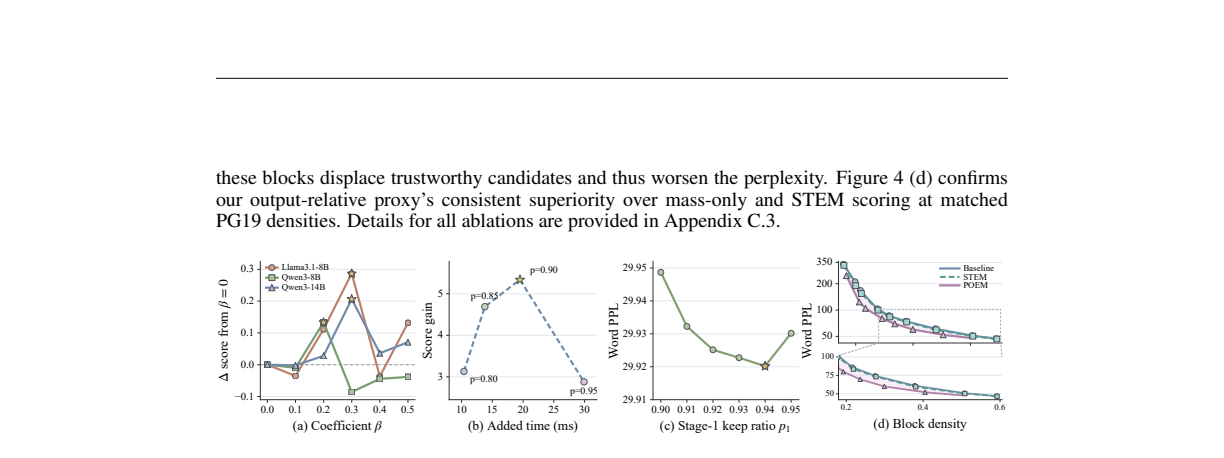
The headline hyperparameters beta (0.2 or 0.3), p = 0.9, and p1 = 0.94 are selected from ablations reported in Figure 4, with the p sweep performed on RULER (Figure 4b), p1 swept on PG19 (Figure 4c), and beta swept per model (Figure 4a) without an explicit statement of which split is used.
more of objection 3
The baselines in Table 3 are run with fixed released configurations. Because Table 3 reports the same RULER benchmark used for tuning p, part of POEM's measured advantage may reflect selection on the test benchmark rather than a property of the output-relative score. The held-out calibration manifests in Appendix F do not cover these main hyperparameters. Please lock beta, p, and p1 on a validation split, or report a sensitivity analysis across these hyperparameters and compare baselines under an equivalent tuning protocol.
4 minor objections
The paper says, at Section 4.2, Eq. 9
Pith says: minor objection 1 of 4
The prediction-to-layer-output bound is derived under the assumption that only one layer is sparsified (sentence b269), while the main experiments sparsify all layers. Since the bound is used as motivation rather than as a quantitative guarantee for the full model, this is acceptable, but the main text should state explicitly that the bound is local and motivational for the full-model setting.
The paper says, at Section 5, Figure 5
Pith says: minor objection 2 of 4
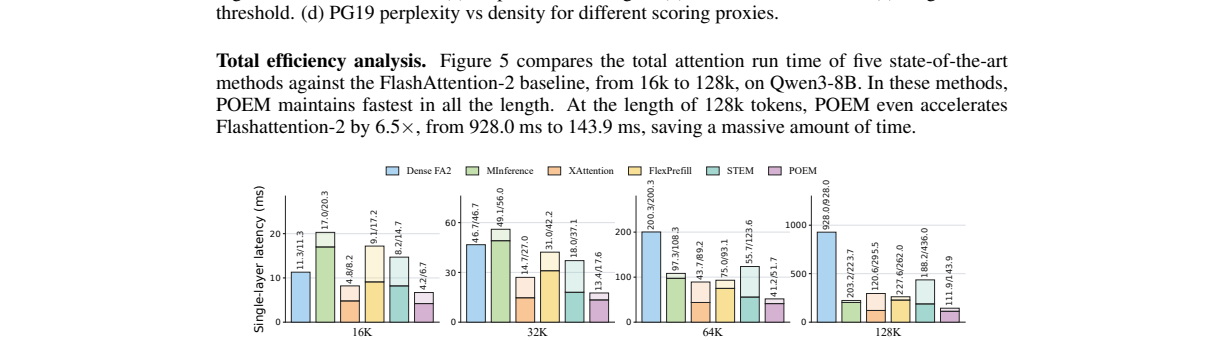
The text says '6.5x speedup' while 928.0 ms / 143.9 ms equals approximately 6.45x; please use the unrounded ratio or state the rounded value consistently.
show 2 more
The paper says, at Throughout
Pith says: minor objection 3 of 4
There are several typographical and formatting issues: 'Flashattention-2' in Figure 5, 'analysis' for 'analyze' in Section 5, 'OUTPUT-RELATIVEBLOCK-SPARSE' in the running title, 'Finallogits' in Table 2, and the missing space in 'O(n2)computation' in Section 4.1. These should be cleaned up.
The paper says, at Appendix C.3, Figure 4(b)
Pith says: minor objection 4 of 4
Figure 4(b) plots incremental score and latency differences relative to the preceding p level, which is easy to misread as absolute scores. Please state this explicitly in the caption as well as in the appendix, or plot absolute values.
What would settle it
Rerun the PG19 (Table 4) and RULER-128K (Table 5) component and ablation experiments replacing the practical deviation term in Eq. 6 with the exact deviation ||v_exact_ib - o_i||, using Eq. D.1 for the token-level causal block output and the true dense head output as the reference, with beta, p1, p2, the calibration protocol, and the FlashAttention-2 backend unchanged and density matched. Compare exact-scored versus Eq. 6-scored accuracy and selected-block overlap. If exact scoring yields no improvement over Eq. 6, the approximate proxy already captures the output-relative signal and the claim stands; if exact scoring changes results materially, the practical score is not faithful on the blocks that matter and the output-relative mechanism behind POEM's gains remains unverified.
from the skeptic's reading
How the review went
4 readings by deepseek-v4-flash · 11 Nov 2026
- Reader holds up, with conditions
- Skeptic agrees
- Editor wrote the verdict above
- Referee major revision: 3 major objections, 4 minor
Not run on this paper: the simulated authors' defence.
Pith did not check this review's objections against the paper.
The review in full
The review in brief, machine-written
Worth a serious look. The conceptual center of POEM is right: block selection for sparse prefill should rank by mass times distance of a block's output from the dense output, not by attention mass alone. That reframing is the real contribution, and the paper is honest that the exact removal-error identity (Eq. A.18) comes from KV-cache eviction work it cites. The two-stage pipeline, the first-order covariance block-output estimator, and the sensitivity-weighted head thresholds are all coherent, and the KL-bound derivation in Appendix A is properly scoped. The experiments are consistent: POEM leads the compared sparse baselines on LongBench and RULER across three models, the module ablation shows the deviation term moves RULER 128K from 69.94 to 72.14 at nearly the same budget, and the latency breakdown is careful. That is real evidence, not just a story.
Soft spots, in proportion. First, "accuracy parity" overstates the RULER end: at 128K, POEM is 5.5, 2.6, and 3.5 points below dense on Llama-3.1-8B and Qwen3-8B/14B. It leads the sparse baselines, but parity is really a LongBench claim. Second, the headline hyperparameters beta, p, and p1 are tuned via ablations on the same benchmark families, and no code or calibration manifests are shipped yet, so independent reproduction is not currently possible. Third, no error bars or repeated-seed variance anywhere, which is common in this literature but worth noting.
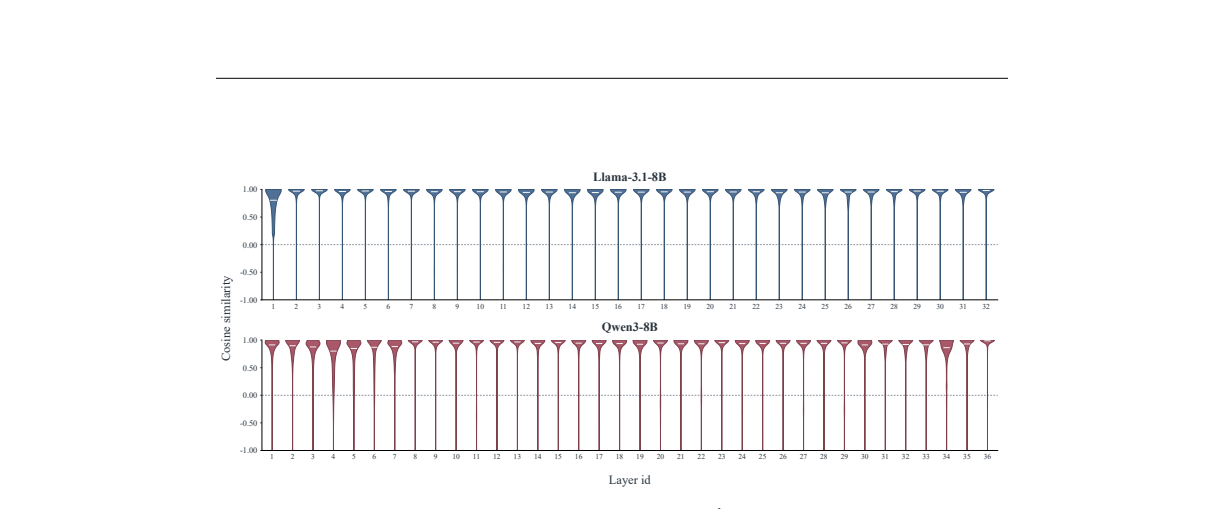
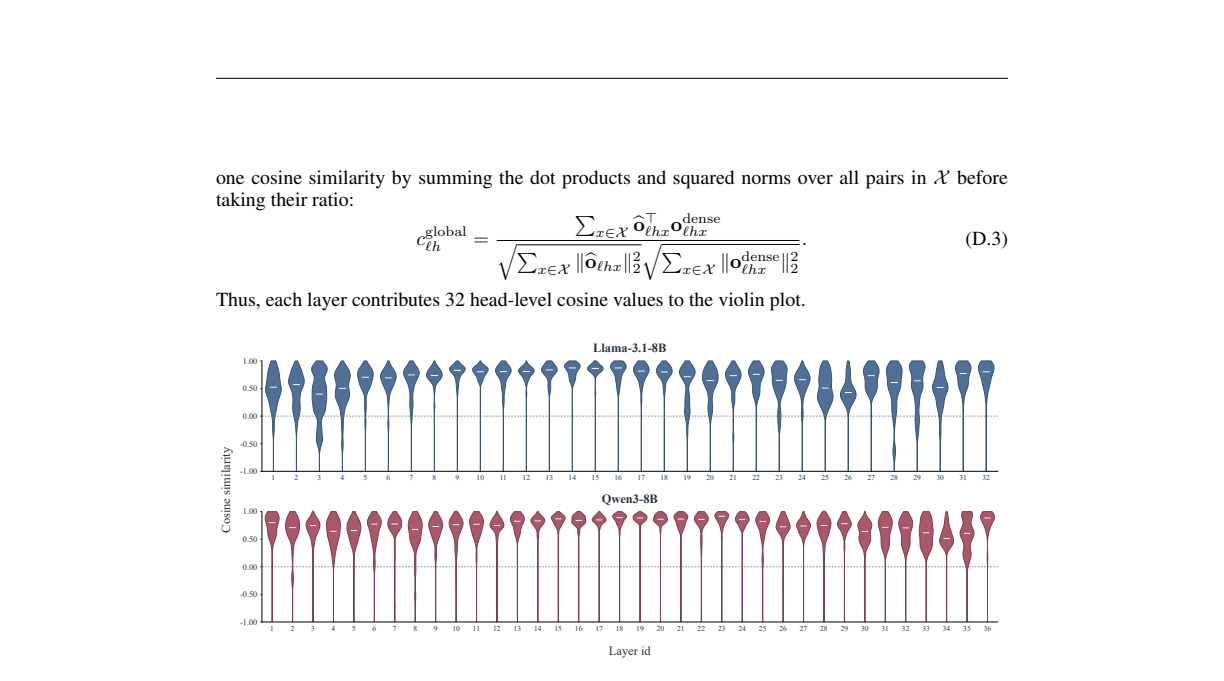
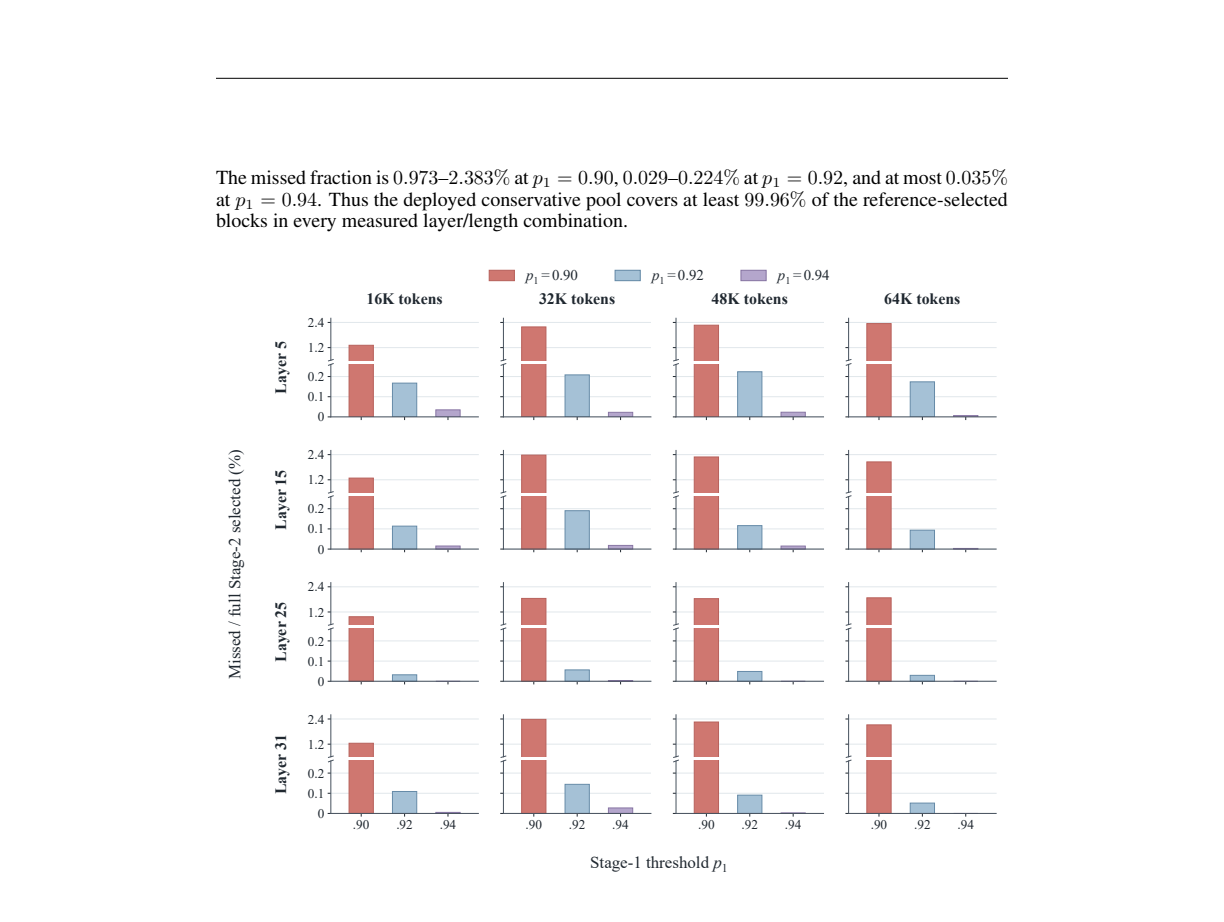
The load-bearing gap is the one the stress-test flags. The practical score in Eq. 6 replaces the exact block output with a pooled-query Taylor estimate and the exact dense output with a mass-only coarse reference. The paper's own diagnostics show median cosine is good but several heads have low or negative cosine, and the authors explicitly acknowledge that cosine does not guarantee ranking preservation (b387) and that the prior gives limited output information in less-aligned cases (b397). What is missing is a direct check: does selection by the Eq. 6 proxy agree with selection by the exact I_ib on the blocks that survive Stage 2? The Stage 1 coverage diagnostic in D.3 helps — the candidate pool contains at least 99.96% of reference-selected blocks at p1=0.94 — but that covers preselection, not reranking. This gap is real but not fatal; the method still works in aggregate, and the authors state the approximation's limits themselves. For a revision, I would ask for the ranking-fidelity diagnostic and a statement on whether the proxy's failures on weakly aligned heads matter empirically.
Who is this for? People building training-free sparse prefilling kernels and those comparing block-selection proxies. I would send it to peer review rather than desk-reject, with a request for code and the missing ranking experiment.
The strongest objection
The central theoretical step is sound: Section 4.1 identifies the per-block quantity I_ib = m_ib ||vbar_ib - o_i|| as the object to rank, and Eq. A.18 derives the exact removal error. The load-bearing approximation is the practical score in Eq. 6 and B.1, which replaces vbar_ib by the pooled-query first-order Taylor estimate vhat_ib = vbar_b + (qbar_i / sqrt(d_h)) C_b and replaces the dense head output o_i by the mass-only coarse reference ohat_i = sum_b a_ib vbar_b. If this proxy ranks blocks differently from the exact output deviation on the blocks that matter, the two-stage selection is not genuinely output-relative and the claimed advantage over mass-only and value-aware baselines is not established. The paper's own Appendices D.1-D.2 show that while median cosine alignment is good, several heads have low or negative cosine; D.1 explicitly states that cosine does not guarantee that approximate scores preserve the exact block ranking (b387), and D.2 concedes that the prior provides limited output information in less-aligned cases (b397). No experiment compares selection by Eq. 6 with selection by the exact I_ib, nor checks ranking agreement on the blocks that survive Stage 2. Table 5 shows that the practical deviation term helps, but a helpful heuristic can correlate with output deviation without faithfully approximating it. On weakly aligned heads the deviation term could be noise or anti-correlated, so the paper's principal conceptual contribution remains the least-tested link in the argument.
The reader's verdict is CONDITIONAL with moderate confidence, and I find that framing appropriate. The exact identity in Eq. A.18, the two-stage procedure, and the offline calibration protocol are internally coherent, and the experimental evidence is broadly consistent with the claimed benefit of adding an output-deviation term, especially the Table 5 module ablation. The single most load-bearing unresolved point is the fidelity of the practical score in Eq. 6 / B.1 to the exact quantity I_ib that the theory identifies. The paper replaces both the block output and the dense output reference with approximations and provides cosine diagnostics that are reassuring on average but explicitly not sufficient to establish ranking fidelity, with several low- or negative-cosine heads. Because the output-relative score is the paper's principal novelty and the stated reason it beats mass-only and value-aware baselines, this is where the central claim is least secure. The concrete exact-replacement check proposed above would settle whether the approximation is the bottleneck: if exact scoring does not beat the practical score, the reported gains are not yet attributable to the stated output-relative mechanism. This concern does not move the verdict: the reader already identified essentially the same crux and chose CONDITIONAL, which is the right level. The remaining issues, including absent code and calibration artifacts, missing error bars, and the larger RULER 128K gaps relative to dense attention, are real but secondary and are already reflected in the conditional verdict.
The referee's report
If the central claim holds, POEM identifies a real limitation of mass-only and value-aware selection proxies: renormalization makes the removal error depend on output deviation, and the paper gives an exact identity and a clean upper bound that justify the proposed score. The empirical package is careful in several respects: the exact output-error identity is derived cleanly, the ablations decompose the contribution of the covariance correction and the output reference, the calibration split in Appendix F is held out from the benchmark test instances, and the memory accounting in Appendix E is verified against instrumented measurements. The method's advantage over mass-only selection is demonstrated both end-to-end and with a module ablation. However, the aggregate RULER gains over MInference are small (0.17, 0.03, and 0.05 points on the three models), and the strongest differences appear at 128K. More importantly, the practical score in Eq. 6 is an approximation of the exact importance I_ib, and the paper does not directly test whether that approximation preserves the block ranking on the blocks that survive Stage 2.
Pith's reading of the paper (a machine's summary, not the authors')
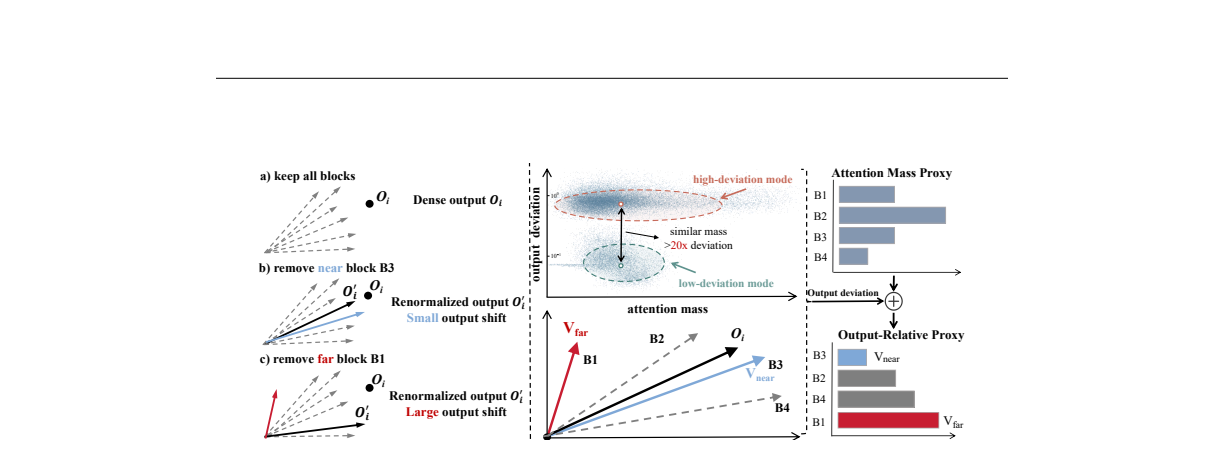
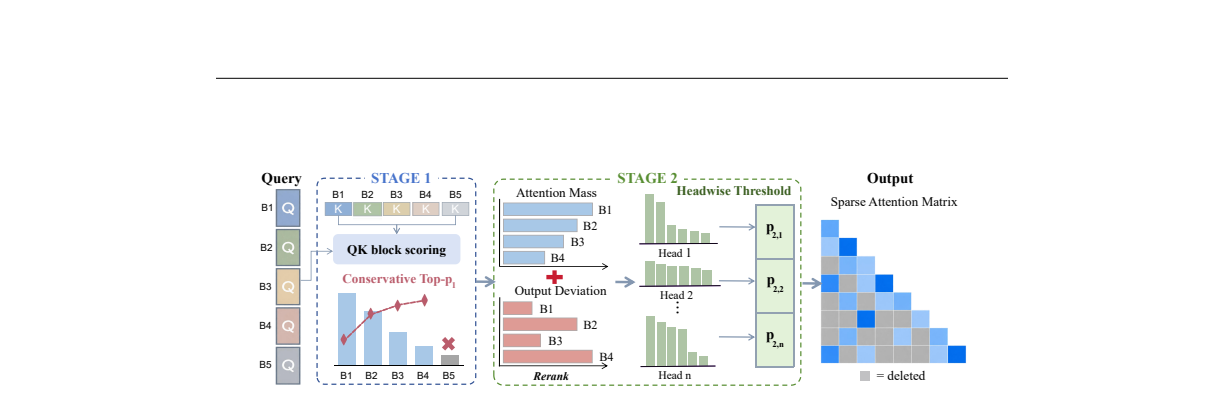
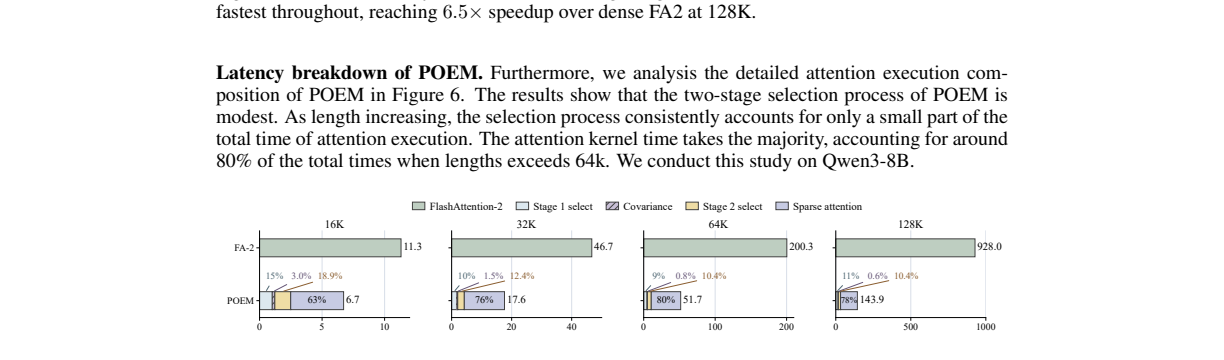
The paper introduces POEM, a training-free block-sparse attention method for long-context LLM prefill. It argues that existing sparsity proxies (attention mass, value norms) fail because they ignore how softmax renormalization compensates for removed blocks; the real cost of discarding a block depends on both its attention mass and the distance between its output and the dense output (output deviation). POEM combines these into an output-relative block score, uses a two-stage pipeline (mass-based candidate pool, then output-relative reranking) to keep computation low, and calibrates per-head retention thresholds offline via a sensitivity-weighted bound on predictive divergence. On LongBench and RULER at up to 128K context, POEM matches dense attention accuracy while achieving up to 6.5× speedup over FlashAttention-2, outperforming mass-only and value-aware baselines.
What carries the argument. The output-relative block score s_ib = (q_i·k_b)/√d_h + β log ||ṽ_ib - õ_i||_2, where the first term estimates block-level attention mass via antidiagonal QK scoring, and the second term approximates the block's output deviation from a coarse global reference õ_i. The block output is approximated by a first-order Taylor expansion ṽ_ib ≈ v̄_b + (q̄_i/√d_h) C_b, where C_b is the block's key–value covariance, avoiding expensive token-level computation. This score is the load-bearing mechanism that replaces mass-only or value-aware proxies.
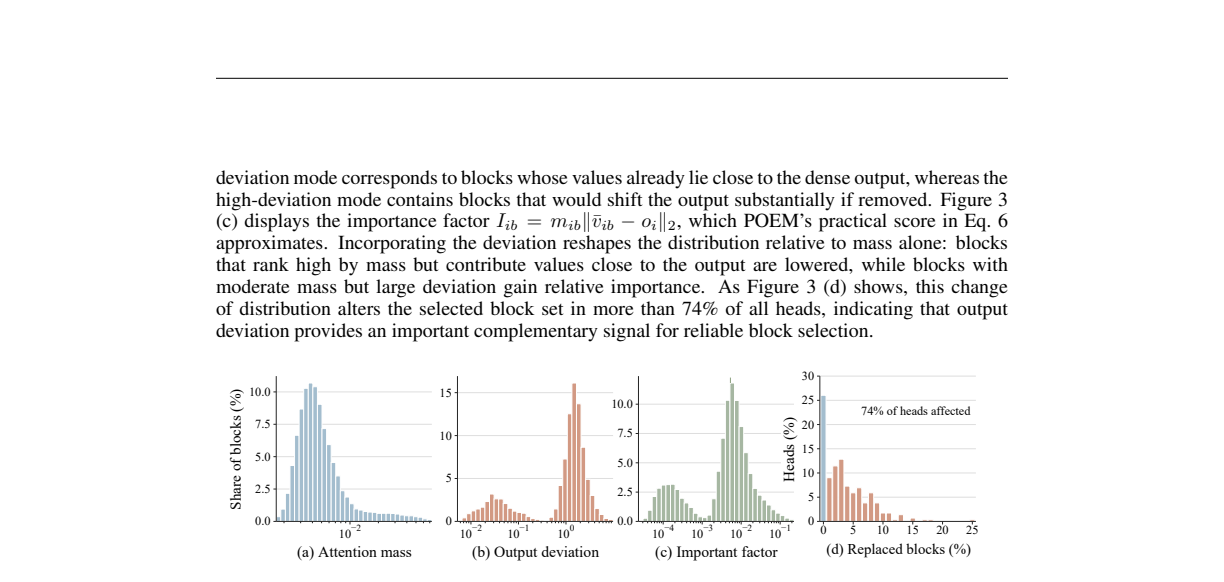
Core claim. The paper establishes that the output error from dropping a KV block in sparse attention is not proportional to the block's attention mass or its value contribution alone, because softmax renormalization amplifies retained blocks. The key quantity is the block's output deviation: the distance between the block's output and the dense attention output. Blocks with similar mass can differ by over 20× in output deviation. POEM therefore scores each block by mass × output deviation (output-relative), selects blocks via a two-stage pipeline that first builds a cheap mass-based candidate pool and then reranks with the output-relative score, and calibrates per-head thresholds offline using a bound that weights each head's output error by its sensitivity to the final prediction. The method is training-free and achieves accuracy parity with dense attention at high sparsity.
The premise it rests on. The practical output-relative score approximates the true output deviation with a first-order Taylor expansion and a coarse global reference; if this approximation ranks blocks differently from the exact deviation on the blocks that matter, the two-stage selection fails to be truly output-relative and the claimed advantage over mass-only proxies can disappear.
If the paper is right (Pith's inferences, not the authors')
POEM can be applied to any pretrained LLM without retraining or fine-tuning, making long-context acceleration accessible for existing models.
At 128K context, POEM reduces attention prefill latency by 6.5× over FlashAttention-2, with accuracy matching dense attention, enabling longer-context applications with the same hardware.
The output-relative scoring principle generalizes beyond block-sparse prefill to KV-cache eviction during decoding and potentially to trainable sparse attention, as the authors note.
The headwise threshold calibration via sensitivity-weighted bounds provides a principled way to allocate sparsity budgets across heads, which could be adopted by other sparse attention methods.
The output-deviation term may be particularly beneficial for tasks where a few far-field KV blocks carry critical information (e.g., needle-in-a-haystack retrieval), because mass-only proxies would discard them. The RULER 128K results support this: POEM gains 2.4 points over its mass-only baseline.
The two-stage design (mass-based pool then output-relative rerank) is a practical compromise that could inspire similar hybrid approaches in other domains where a cheap proxy can safely filter most candidates before a more expensive but accurate criterion is applied.
The paper's derivation of the predictive-divergence bound (Eq. 9) provides a theoretical justification for headwise threshold calibration, but the calibration procedure itself is empirical (bisection on a held-out search set) and the bound's constants are not computed; a tighter integration of the bound into the calibration could yield further gains or reduce the need for a search set.
Check this review
Pith stored no record of this review's passes and took no fingerprint of it. Reviews made by code from 13 Nov 2026 on carry both.
How often reviews like this one are right
Reviews like this one: written by deepseek-v4-flash, where what was read was not recorded.
How often objections from reviews like this one are right: not yet measured
Reviews by people
This review was written by a machine. No person has reviewed this paper on Pith yet. A scientist listed on Pith can review it for a fee, and their review is published here whatever it concludes.
The paper
Abstract
Large language models (LLMs) have shown strong capabilities across diverse applications, making both safety and utility essential for reliable deployment. Jailbreak attacks use diverse forms of adversarial prompting to bypass alignment safeguards and induce LLMs to generate harmful responses. Some representation-based defenses regulate internal activations using predefined steering directions or learned safety regions. However, adapting intervention to each input without a predefined representational target while limiting over-refusal remains a challenge. In this paper, we propose Target-free Entropy-guided Residual Modulation (TERM), an inference-time defense that uses prompt-calibrated attention entropy deviations to guide adaptive modulation of the model's own residual updates. Attention patterns vary across prompts and decoding steps, making raw entropy values difficult to interpret as a consistent signal for intervention. We therefore calibrate attention entropy against each prompt's own prefill baseline to establish an input-specific reference for reducing unnecessary intervention on benign requests. Adaptive scale normalization and temporal accumulation then account for differences in deviation scale and persistence to determine intervention strength. The resulting signal controls bounded scaling of the model's own residual updates, without relying on a predefined safety direction. We compare our method with seven defenses on seven jailbreak attacks and two over-refusal benchmarks across Llama, Qwen, and Gemma models, including Qwen3 models from 0.6B to 32B. Results show our method improves jailbreak robustness while maintaining low over-refusal on benign safety-sensitive requests with modest inference overhead.
The paper's own sentences, arranged, kept beside the review and separate from it. Each label is drawn from a closed vocabulary; the number beside it is the probability the classifier gave that label. No sentence in this record was written by a model.
abstract compiled · 2026-11-11
The authors' main claim, as the classifier picked it out 1.00
“Results show our method improves jailbreak robustness while maintaining low over-refusal on benign safety-sensitive requests with modest inference overhead.”
How the main claim is stated: asserted 1.00
What the abstract itself states, as probabilities: claims first 0.05 · states limitation 0.48 · human participants 0.03 · controlled comparison 0.75 · randomized assignment 0.02 · states quantitative result 0.47 · compares with prior results 0.98 · mentions code or data availability 0.03
The abstract, sentence by sentence
This table labels the abstract only (arXiv listing abstract v1). The number is the probability the classifier gave the label.
| Sentence | Role | The authors' own work | States the main conclusion | Strength |
|---|---|---|---|---|
| Large language models (LLMs) have shown strong capabilities across diverse applications, making both safety and utility essential for reliable deployment. | background 1.00 | 0.04 | 0.02 | asserted 1.00 |
| Jailbreak attacks use diverse forms of adversarial prompting to bypass alignment safeguards and induce LLMs to generate harmful responses. | background 1.00 | 0.03 | 0.02 | asserted 1.00 |
| Some representation-based defenses regulate internal activations using predefined steering directions or learned safety regions. | background 1.00 | 0.03 | 0.01 | asserted 1.00 |
| However, adapting intervention to each input without a predefined representational target while limiting over-refusal remains a challenge. | gap 1.00 | 0.04 | 0.03 | asserted 0.99 |
| In this paper, we propose Target-free Entropy-guided Residual Modulation (TERM), an inference-time defense that uses prompt-calibrated attention entropy deviations to guide adaptive modulation of the model's own residual updates. | contribution 0.88 | 0.89 | 0.11 | asserted 0.99 |
| Attention patterns vary across prompts and decoding steps, making raw entropy values difficult to interpret as a consistent signal for intervention. | background 0.57 | 0.26 | 0.02 | asserted 1.00 |
| We therefore calibrate attention entropy against each prompt's own prefill baseline to establish an input-specific reference for reducing unnecessary intervention on benign requests. | method 0.98 | 0.82 | 0.04 | asserted 0.98 |
| Adaptive scale normalization and temporal accumulation then account for differences in deviation scale and persistence to determine intervention strength. | method 1.00 | 0.81 | 0.03 | asserted 1.00 |
| The resulting signal controls bounded scaling of the model's own residual updates, without relying on a predefined safety direction. | method 0.99 | 0.75 | 0.08 | asserted 1.00 |
| We compare our method with seven defenses on seven jailbreak attacks and two over-refusal benchmarks across Llama, Qwen, and Gemma models, including Qwen3 models from 0.6B to 32B. | method 0.90 | 0.95 | 0.05 | asserted 0.85 |
| Results show our method improves jailbreak robustness while maintaining low over-refusal on benign safety-sensitive requests with modest inference overhead. | result 1.00 | 0.96 | 0.91 | asserted 1.00 |
What kind of paper the classifier reports this is: method or tool 1.00 · evidence from observation or experiment 0.95
What was examined, and what was not
Sources read
- arXiv listing abstract v1
Not examined
- full text
- figures and tables
- references and citing sentences
- relations to other papers
Levels run
- P abstract
Not run
- S sections
- T body sentences
- C citations
- R cross-paper relations
How the labels were made
Compiled by classifier-1.13.0 via TypeSafe API, question bank abstract-p1-20260923, 2026-11-11: 1 request, 8,198 input tokens.
Every quoted sentence on this record is the authors'. Every label is from Pith's closed vocabulary, with the probability shown beside it. This record as JSON
Figures (12)
Figures are the authors', reproduced from the paper.
References (32)
- [1] Joshua Ainslie, James Lee-Thorp, Michiel De Jong, Yury Zemlyanskiy, Federico Lebr´on, and Sumit Sanghai. Gqa: Training generalized multi-query transformer models from multi-head check- points. InProceedings of the 2023 conference on empirical methods in natural language proces... on Pith
- [4] doi: 10.52202/085713-2038. Rewon Child, Scott Gray, Alec Radford, and Ilya Sutskever. Generating long sequences with sparse transformers.arXiv preprint arXiv:1904.10509, on PithPith's reviewarXiv
- [7] Leo Gao, Jonathan Tow, Baber Abbasi, Stella Biderman, Sid Black, Anthony DiPofi, Charles Fos- ter, Laurence Golding, Jeffrey Hsu, Alain Le Noac’h, Haonan Li, Kyle McDonell, Niklas Muen- nighoff, Chris Ociepa, Jason Phang, Laria Reynolds, Hailey Schoelkopf, Aviya Skowron, Linta... on PithPith's reviewarXiv
- [8] Raghavv Goel, Junyoung Park, Mukul Gagrani, Dalton Jones, Matthew Morse, Harper Langston, Mingu Lee, and Chris Lott. Caote: Kv cache selection for llms via attention output error-based token eviction.arXiv preprint arXiv:2504.14051, on PitharXiv
- [9] Aaron Grattafiori, Abhimanyu Dubey, Abhinav Jauhri, Abhinav Pandey, Abhishek Kadian, Ahmad Al-Dahle, Aiesha Letman, Akhil Mathur, Alan Schelten, Alex Vaughan, et al. The llama 3 herd of models.arXiv preprint arXiv:2407.21783, on PithPith's reviewarXiv
- [10] Ali Hatamizadeh, Yejin Choi, and Jan Kautz. Gated deltanet-2: Decoupling erase and write in linear attention.arXiv preprint arXiv:2605.22791, on PithPith's reviewarXiv
- [12] Xiang Hu, Xinyu Wei, Hao Gu, Minshen Zhang, Tian Liang, Huayang Li, Lei Zhu, Yan Wang, Sirui Han, Yushi Bai, et al. Hierarchical sparse attention done right: Toward infinite context modeling. arXiv preprint arXiv:2607.02980, on PithPith's reviewarXiv
- [13] Xiaodong Ji, Hailin Zhang, Fangcheng Fu, and Bin Cui. Sale: Low-bit estimation for efficient sparse attention in long-context llm prefilling.arXiv preprint arXiv:2505.24179, on PithPith's reviewarXiv
- [14] Xunhao Lai, Jianqiao Lu, Yao Luo, Yiyuan Ma, and Xun Zhou. Flexprefill: A context-aware sparse attention mechanism for efficient long-sequence inference.arXiv preprint arXiv:2502.20766, on PithPith's reviewarXiv
- [15] Hoang Anh Duy Le, Sahil Joshi, Zeyu Yang, Zhaozhuo Xu, and Anshumali Shrivastava. Scout before you attend: Sketch-and-walk sparse attention for efficient llm inference.arXiv preprint arXiv:2602.07397, on PitharXiv
- [16] 11 Zhiwei Li, Lei Zhu, Hao Gu, Xiang Hu, Yan Wang, Haitao Mi, Sirui Han, Leo Liang, and Zhijiang Guo. Sas: Simple attention sparsification via end-to-end optimization of context ranking.arXiv preprint arXiv:2609.13141, on PithPith's reviewarXiv
- [17] Aixin Liu, Aoxue Mei, Bangcai Lin, Bing Xue, Bingxuan Wang, Bingzheng Xu, Bochao Wu, Bowei Zhang, Chaofan Lin, Chen Dong, et al. Deepseek-v3. 2: Pushing the frontier of open large language models.arXiv preprint arXiv:2512.02556, 2025a. Siran Liu, Zane Cao, and Yongchao He. A u... on PithPith's reviewarXiv
- [18] Lin Niu, Xin Luo, Linchuan Xie, Yifu Sun, Guanghua Yu, Jianchen Zhu, and S. Kevin Zhou. Stem: Rethinking causal information flow in sparse attention.arXiv preprint arXiv:2603.06274, on PithPith's reviewarXiv
- [19] Alexander Novikov, Ngˆan V ˜u, Marvin Eisenberger, Emilien Dupont, Po-Sen Huang, Adam Zsolt Wagner, Sergey Shirobokov, Borislav Kozlovskii, Francisco JR Ruiz, Abbas Mehrabian, et al. Alphaevolve: A coding agent for scientific and algorithmic discovery.arXiv preprint arXiv:2506.13131, on PithPith's reviewarXiv
- [20] Jack W Rae, Anna Potapenko, Siddhant M Jayakumar, Chloe Hillier, and Timothy P Lillicrap. Compressive transformers for long-range sequence modelling.arXiv preprint arXiv:1911.05507, on PithPith's reviewarXiv
- [21] Isaac Rehg. Kv-compress: Paged kv-cache compression with variable compression rates per atten- tion head.arXiv preprint arXiv:2410.00161, on PithPith's reviewarXiv
- [23] Hugo Touvron, Thibaut Lavril, Gautier Izacard, Xavier Martinet, Marie-Anne Lachaux, Timoth ´ee Lacroix, Baptiste Rozi `ere, Naman Goyal, Eric Hambro, Faisal Azhar, Aurelien Rodriguez, Ar- mand Joulin, Edouard Grave, and Guillaume Lample. LLaMA: Open and efficient foundation la... on PithPith's reviewarXiv
- [24] Guanzhi Wang, Yuqi Xie, Yunfan Jiang, Ajay Mandlekar, Chaowei Xiao, Yuke Zhu, Linxi Fan, and Anima Anandkumar. V oyager: An open-ended embodied agent with large language models. arXiv preprint arXiv:2305.16291, on PithPith's reviewarXiv
- [25] Xinghao Wang, Pengyu Wang, Xiaoran Liu, Fangxu Liu, Jason Chu, Kai Song, and Xipeng Qiu. Prism: Spectral-aware block-sparse attention, 2026a. Xinghao Wang, Pengyu Wang, Dong Zhang, Chenkun Tan, Shaojun Zhou, Zhaoxiang Liu, Shiguo Lian, Fangxu Liu, Kai Song, and Xipeng Qiu. Spa... on PithPith's reviewarXiv
- [26] Yutaro Yamada, Robert Tjarko Lange, Cong Lu, Shengran Hu, Chris Lu, Jakob Foerster, Jeff Clune, and David Ha. The ai scientist-v2: Workshop-level automated scientific discovery via agentic tree search.arXiv preprint arXiv:2504.08066, on PithPith's reviewarXiv
show 12 more
- [27] An Yang, Anfeng Li, Baosong Yang, Beichen Zhang, Binyuan Hui, Bo Zheng, Bowen Yu, Chang Gao, Chengen Huang, Chenxu Lv, et al. Qwen3 technical report.arXiv preprint arXiv:2505.09388, on PithPith's reviewarXiv
- [28] Jenny Zhang, Shengran Hu, Cong Lu, Robert Lange, and Jeff Clune. Darwin g ¨odel machine: open- ended evolution of self-improving agents. InInternational Conference on Learning Representa- tions, volume 2026, pp. 104223–104294, on Pith
- [29] Jintao Zhang, Chendong Xiang, Haofeng Huang, Jia Wei, Haocheng Xi, Jun Zhu, and Jianfei Chen. Spargeattention: Accurate and training-free sparse attention accelerating any model inference. arXiv preprint arXiv:2502.18137, on PitharXiv
- [30] Weilin Zhao, Zihan Zhou, Chaojun Xiao, Yuxuan Li, Yanghao Li, Yudi Zhang, Weilun Zhao, Zhen Li, Yuxiang Huang, Ao Sun, et al. Infllm-v2: Dense-sparse switchable attention for seamless short-to-long adaptation. InInternational Conference on Learning Representations, volume 2026... on Pith
- [31] Differentiating the same log-partition expression once andthen once more keeps the calculation in one chain: ∂a(z) ∂zc = exp(zc)P j exp(zj) =p c, ∂2a(z)∂zc∂zd =p cI[c=d]−p d , ∇a(zdi ) =p di ,∇ 2a(zdi ) = Diag(pdi )−p di (pdi )⊤ =F i. (A.5) Expanding the log-partition function... on Pith
- [32] and Qwen3- 8B/14B (Yang et al., 2025). Model parameters remain frozen. The long-context Qwen runs use YaRN (Peng et al., on Pith
- [2019] Tri Dao. Flashattention-2: Faster attention with better parallelism and work partitioning. InInter- national Conference on Learning Representations, volume 2024, pp. 35549–35562, on Pith
- [2021] doi: 10.1162/tacl a 00353. Yutao Sun, Zhenyu Li, Yike Zhang, Tengyu Pan, Bowen Dong, Yuyi Guo, and Jianyong Wang. Efficient attention mechanisms for large language models: A survey.arXiv preprint arXiv:2507.19595, on PitharXiv
- [2023] Yongqi An, Chang Lu, Kuan Zhu, Tao Yu, Chaoyang Zhao, Hong Wu, Ming Tang, and Jinqiao Wang. Rest-kv: Robust kv cache eviction with layer-wise output reconstruction and spatial- temporal smoothing.arXiv preprint arXiv:2605.08840, on PithPith's reviewarXiv
- [2024] Yao Fu. Challenges in deploying long-context transformers: A theoretical peak performance analy- sis.arXiv preprint arXiv:2405.08944, on PithPith's reviewarXiv
- [2025] Tom Brown, Benjamin Mann, Nick Ryder, Melanie Subbiah, Jared D Kaplan, Prafulla Dhariwal, Arvind Neelakantan, Pranav Shyam, Girish Sastry, Amanda Askell, et al. Language models are few-shot learners.Advances in neural information processing systems, 33:1877–1901, on Pith
- [2026] Cheng-Ping Hsieh, Simeng Sun, Samuel Kriman, Shantanu Acharya, Dima Rekesh, Fei Jia, Yang Zhang, and Boris Ginsburg. Ruler: What’s the real context size of your long-context language models?arXiv preprint arXiv:2404.06654, on PithPith's reviewarXiv
Challenges and discussion
Disagree with the review, or know something it missed? Leave a comment, or challenge this review formally: a challenge becomes a permanent entry in this paper's record, and its decision is published here.
Come back by email
A short list of the week's newly reviewed papers. Nothing is sent until you confirm from your inbox, and every email has a link that stops it. No account.
No comments yet.
Sign in to comment