Cryptography and Security · arXiv:2611.13965 v1 · submitted 10 Nov 2026 · 14 references
Comparing WeChat and Telegram MiniApp Security Architectures: Toward Cross-Platform Analysis
The paper says
“MiniApps are increasingly central to super-app ecosystems, yet architectural differences complicate the transfer of security analysis techniques across platforms. Existing WeChat analyzers rely on packaged applications and platform-specific APIs, limiting their direct applicability to Telegram's web-based MiniApps.”
more of the abstract
We present a qualitative comparison of WeChat Mini Programs and Telegram MiniApps, grounded in official documentation, prior research, and manual analysis of a specific Telegram Android source revision. Using a shared taxonomy of security controls, assets, and threat sources, we examine execution environments, communication paths, and trust boundaries. WeChat provides a dedicated MiniApp runtime; Telegram combines web execution with host controls. Both retain developer responsibilities for backend authentication and resource authorization. Two worked examples derive requirements for cross-platform analysis: distinguishing credential roles and validation boundaries, and associating host capabilities with concrete execution contexts and permission handlers. These findings inform future automated analysis without ranking the ecosystems by security or claiming validated vulnerability detection.
from the abstract
Pith says
Machine review · deepseek-v4-flash · 11 Nov 2026 · what was read was not recorded · not checked by a person
It can be wrong. Challenge this review or reply to it.
Holds up. A carefully scoped qualitative systematization whose Telegram-side bridge findings are concrete and new; the version-specific limits are acknowledged and the claims hold as scoped, so it deserves referee time. This line is wrong
1 major objection · 4 minor
How often objections from reviews like this one are right: not yet measured
Not checked: figures, code, what the 14 references say.
The paper says, at Sec. 7.4, Table 1 (E3–E5), Sec. 8 (Worked Example 2)
The review did not quote this passage.
Pith says: Objection 1 of 1 · major
The derivation of modeling requirement 2, and Worked Example 2 in particular, is grounded in a manual reading of a single Telegram Android commit (62b56a07ca7e30e39f7fd00a6728d6bbd716ca1c). The authors properly acknowledge this (Sec. 3; b96, b350) and scope source-backed statements to the inspected revision (e.g., b259: 'In the inspected revision...'), which mitigates but does not resolve the concern.
more of objection 1
What remains unaddressed is the relationship between version-specific implementation details and the generality of the derived requirements: the paper never states which properties of the E3–E5 evidence (the dual-proxy registration under the same interface name, the write-access existing-authorization/confirmation branches, the ArticleViewer non-bot navigation path) are load-bearing for requirement 2 and which are illustrative, nor does it discuss the stability of these code areas across releases. I recommend adding a short paragraph in Sec. 8 that separates the structural invariant (an analyzer must resolve the concrete bridge implementation and navigation context before assigning host capabilities) from the version-specific instantiations, and that states explicitly what a counterexample from a different revision would and would not change. This would convert the acknowledged limitation into a precise falsifiability statement without expanding the paper's empirical scope.
4 minor objections
The paper says, at Data availability statement
Pith says: minor objection 1 of 4
The data availability statement says 'Table 1 provides source locations and permanent links to selected implementation paths,' but Table 1 as printed contains only file/line references and a commit hash, with no hyperlinks to those lines. Either add GitHub permalinks anchored to the cited lines or rephrase the sentence to say 'source locations' only.
The paper says, at Sec. 7.2 / Table 3
Pith says: minor objection 2 of 4
The control label 'S02 Secure Protocol' for MTProto asserts a security property that the paper does not establish and that is contested in the literature; consider renaming the control 'S02 MTProto' or 'S02 Encrypted Transport Protocol' to avoid endorsing the protocol's security.
show 2 more
The paper says, at Sec. 3 (Methodology)
Pith says: minor objection 3 of 4
Because the manual source inspection is the load-bearing evidence for the Telegram claims, the methodology would be more reproducible if it briefly described the analysis workflow (e.g., static navigation from BotWebViewContainer to nested classes, the specific search terms or call-graph steps used). A few sentences on tooling would strengthen the reproducibility of the E3–E5 findings.
The paper says, at Sec. 6.2 / Figure 5
Pith says: minor objection 4 of 4
The layered permission model is described as 'adapted from the W3C MiniApp Standardization White Paper'; please state explicitly which elements come from the W3C model and which are the authors' additions, since Figure 5 is subsequently used as a comparative frame for the WeChat architecture.
What would settle it
Inspect the same code areas (BotWebViewContainer, ArticleViewer, bridge registration, permission handlers, multi-window navigation) in the current HEAD of the Telegram Android repository and in at least two earlier tagged releases (e.g., v10.x, v9.x). If the bridge registration pattern (E3), write-access permission flow (E4), or new-window routing (E5) differ materially from the inspected commit, then the paper's modeling requirements for Telegram are version-specific and cannot be assumed to hold cross-platform without a version-adaptation layer.
from the skeptic's reading
How the review went
4 readings by deepseek-v4-flash · 11 Nov 2026
- Reader holds up
- Skeptic agrees
- Editor wrote the verdict above
- Referee minor revision: 1 major objection, 4 minor
Not run on this paper: the simulated authors' defence.
Pith did not check this review's objections against the paper.
The review in full
The review in brief, machine-written
Short version: this is a careful, honestly-scoped qualitative comparison of WeChat and Telegram MiniApp security architectures. It does not claim to be a detection study and says so repeatedly. The genuinely new material is the Telegram-side manual source reading—the bridge name TelegramWebviewProxy resolving to different concrete implementations depending on context, and the separate new-window routing path through ArticleViewer—which is concrete, tied to a named commit, and gives cross-platform tooling two specific modeling requirements: distinguish credential roles from validation boundaries, and associate host capabilities with concrete execution contexts and handlers.
What it does well: the shared taxonomy (controls, assets, threats) is applied consistently on both sides; Table 1 traces each claim to an evidence location, including line numbers in a named commit; and the authors are disciplined about not ranking ecosystems by security. The distinction between platform mediation, credential-based authentication, web execution, and backend authorization is genuinely useful for anyone trying to build cross-platform analyzers.
Soft spots, in proportion: the biggest is exactly what the stress-test notes—the Telegram findings rest on one manual reading of one Android commit. The authors acknowledge this (b350, b96), but acknowledgment does not change that E3–E5 are load-bearing for Worked Example 2. If the inspected revision is atypical or those code paths have moved, the derived modeling requirements lose their concrete grounding. A second revision or even a brief note on the stability of those code areas would have materially strengthened it. The WeChat side leans entirely on documentation and prior work—reasonable given closed source, but it means the comparison is only as good as its secondary sources. None of this is hidden; it is all stated, which is more than most papers this type manage.
I largely agree with the reader: soundness 7 is about right, and the central architectural claims hold within their stated scope. The audience is people building MiniApp analysis tooling or entering the Telegram MiniApp security space and needing a map of trust boundaries. Send it to peer review; it is a solid, useful contribution in a young area, with traceability the community can build on.
The strongest objection
The paper's most concrete and novel claims about Telegram's security architecture (E3–E5 in Table 1) are derived from a manual reading of a single commit (62b56a07ca7e30e39f7fd00a6728d6bbd716ca1c) of the Telegram Android client. The authors explicitly acknowledge this scope limitation (Section 3, b96, b350). However, the load-bearing nature of this limitation is deeper than a typical scope note: the central argument that cross-platform analyzers must distinguish bridge implementations, operation-specific permission checks, and navigation contexts (Worked Example 2) rests entirely on the correctness and representativeness of this single-revision reading. If the inspected revision is atypical, or if the code paths have changed in subsequent releases (Telegram updates frequently), then the architectural distinctions that the paper elevates to modeling requirements may not hold for current or future Telegram MiniApps. The paper does not provide evidence that the inspected patterns are stable across versions, nor does it discuss the rate of change in the relevant code areas. This is not a flaw in the qualitative method per se, but it means the central claim about Telegram's architecture is empirically fragile: a single counterexample from a different revision would undermine the generality of the derived requirements.
The reader's weakest_assumption correctly identifies that the Telegram-specific findings rest on a single manual reading of one commit. I agree that this is the most load-bearing concern. The paper is transparent about this limitation, and the verdict ACCEPT with HIGH confidence is reasonable given the paper's stated scope as a qualitative systematization. However, I want to emphasize that the concern is not merely an acknowledged scope limit; it is structurally load-bearing because the paper's most distinctive and actionable claims (E3–E5, Worked Example 2) depend on the correctness and stability of that single-revision reading. If the code changes, the modeling requirements lose their concrete grounding. The concrete test I propose would settle whether this concern actually lands: if the patterns are stable across versions, the concern is mitigated; if they are not, the paper's central architectural claims about Telegram are version-specific and the derived requirements would need qualification. I recommend UNCHANGED because the paper already states the limitation and does not overclaim generality. The reader's verdict is appropriate; my analysis reinforces the same concern rather than identifying a new one.
The referee's report
If correct, the paper's central distinction—that platform mediation, credential-based authentication, web execution, and backend authorization protect different boundaries and should be modeled separately (Sec. 9)—gives designers of cross-platform MiniApp analyzers a concrete, actionable decomposition, and it correctly explains why existing WeChat-oriented tools (WEMINT, MiniCAT, TaintMini) do not transfer directly to Telegram. The paper's strengths are its evidence hygiene and scoping: Table 1 anchors claims to file/line locations in a named commit, the WeChat/Telegram evidence asymmetry is explicitly acknowledged (Sec. 3), source-backed statements are scoped to the inspected revision, and the authors repeatedly state that detection effectiveness is unevaluated (b332, b348, b358). The two worked examples are illustrative and structurally falsifiable. The main residual risk is the single-revision grounding of the Telegram-specific evidence (E3–E5); the authors acknowledge this limitation, and I assess it as substantially mitigated by the scoping and by the abstraction level of the derived requirements, as detailed in the major comment.
Pith's reading of the paper (a machine's summary, not the authors')
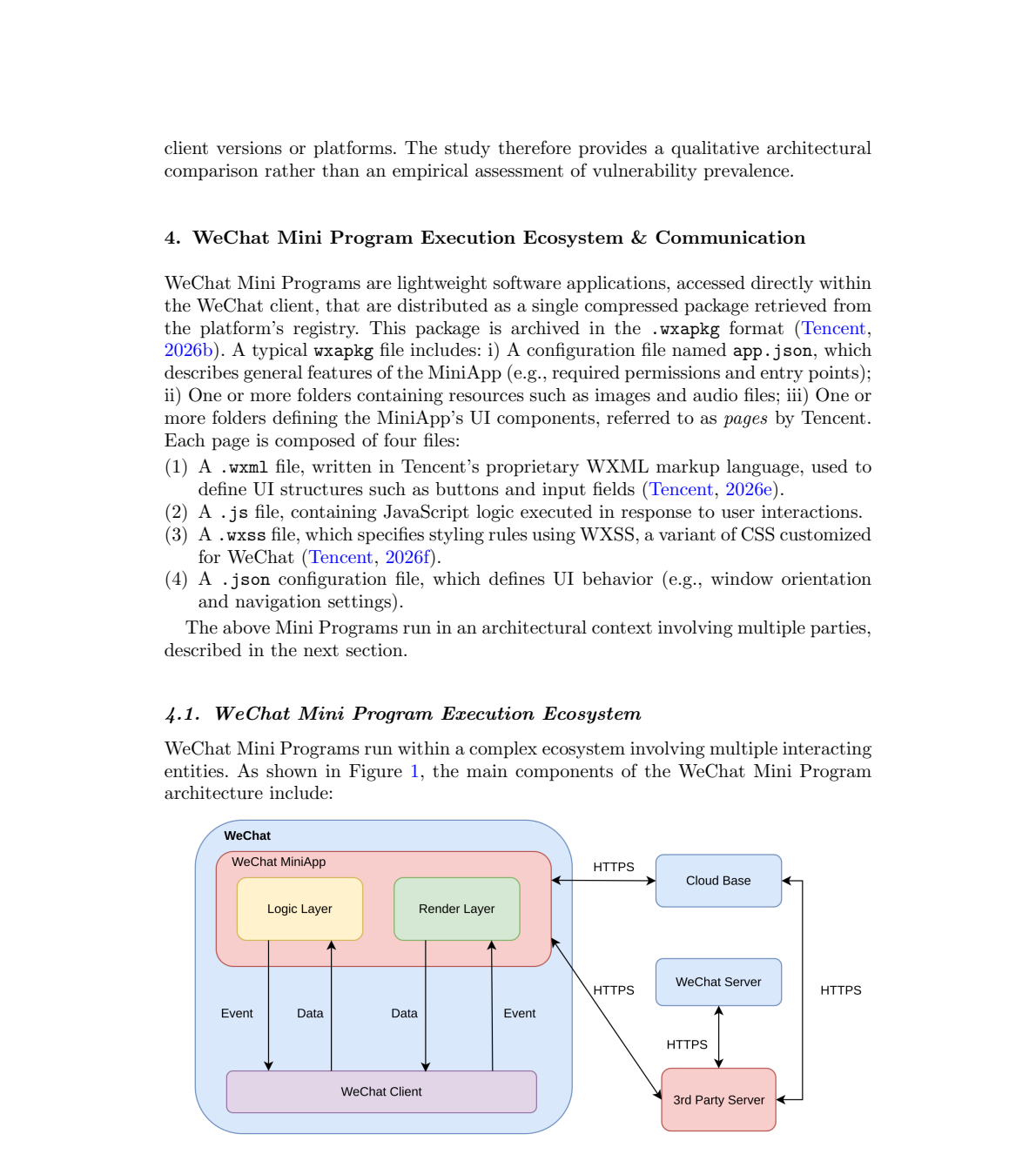
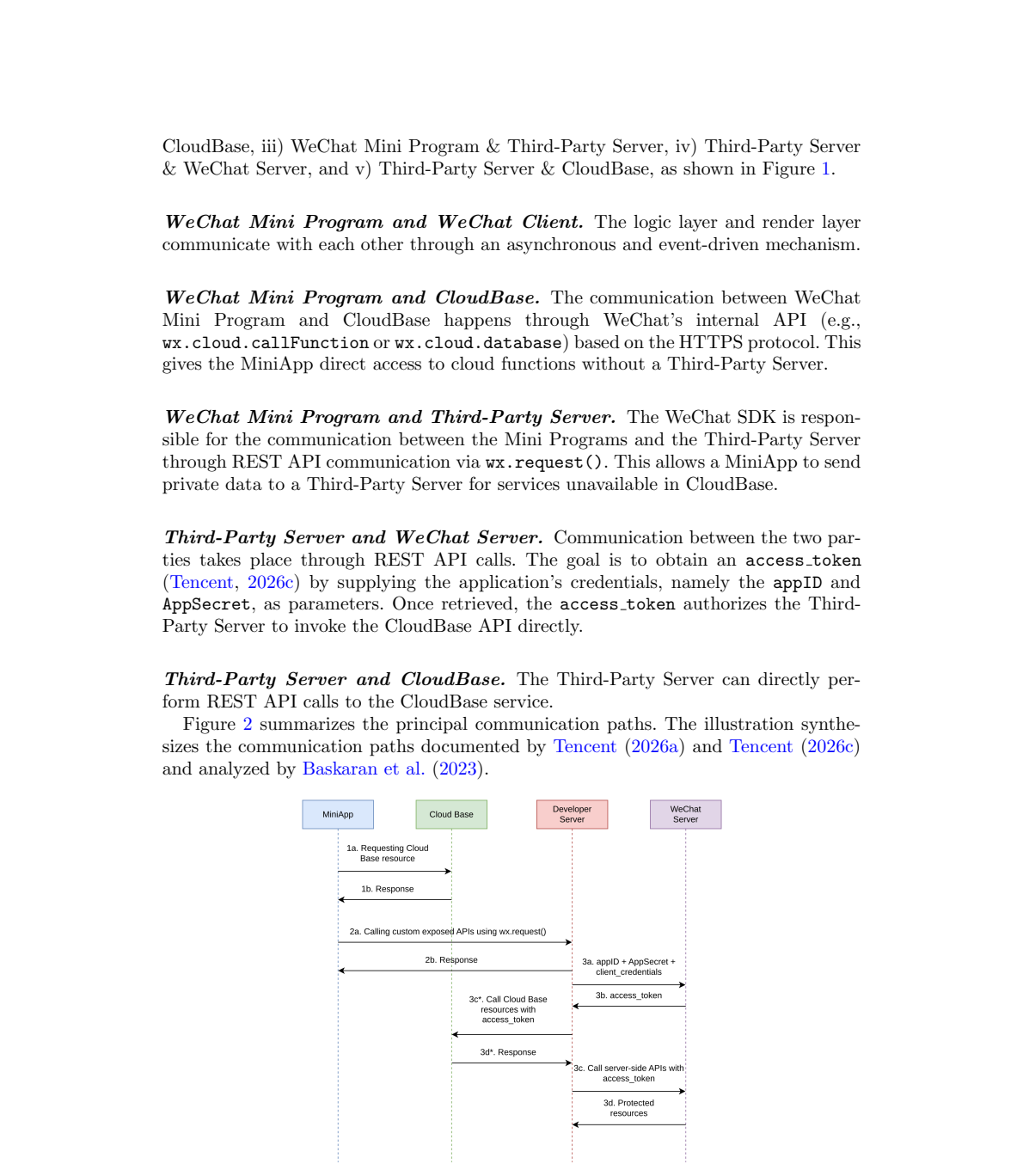
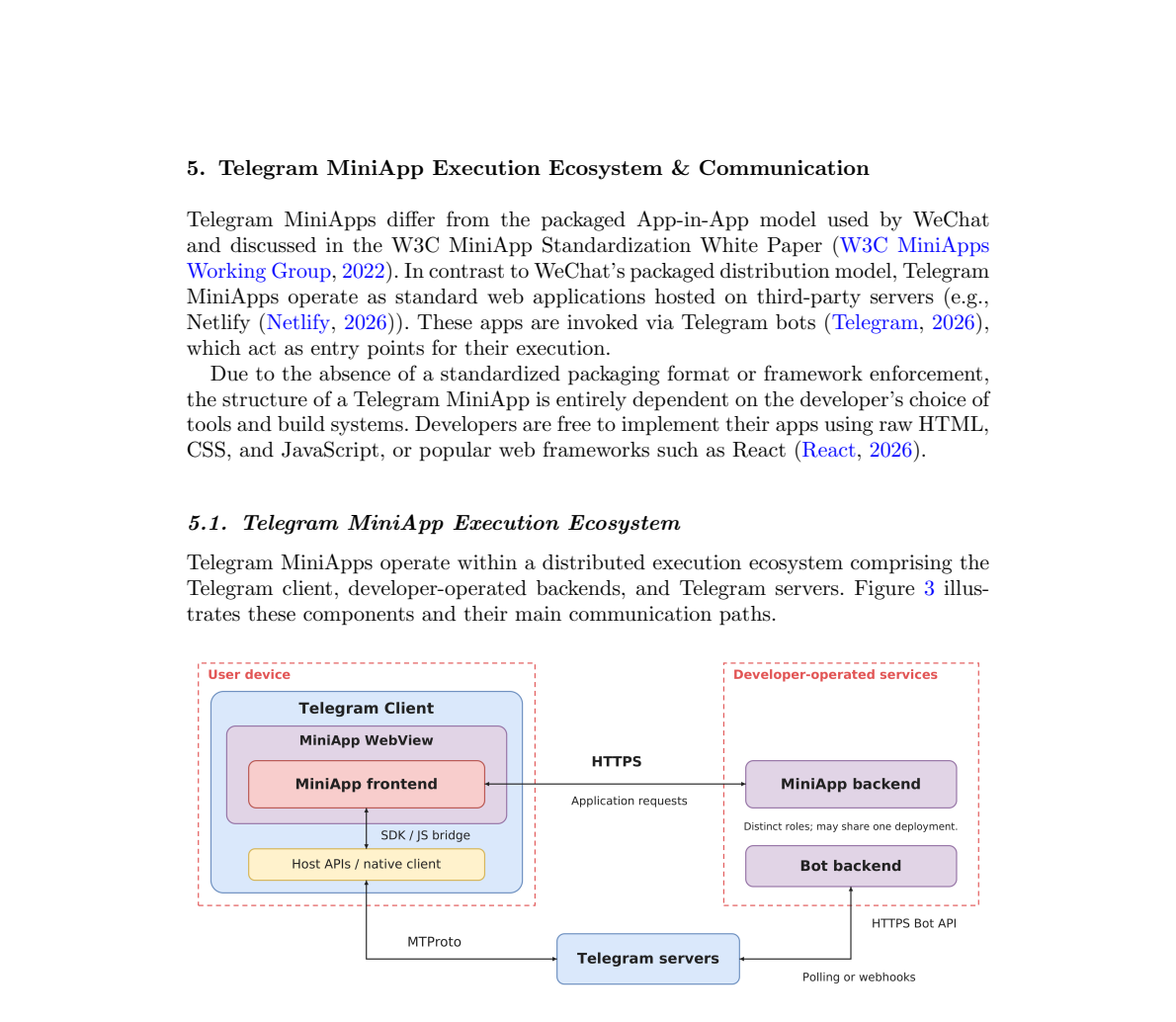
This paper tries to establish that MiniApp security is decided by which component actually enforces each control, the host platform or the developer, so cross-platform analyzers must model platform mediation, credential-based authentication, web execution, and backend authorization separately. WeChat runs packaged Mini Programs in a dedicated runtime with layered permission mediation and several distinct credentials, while Telegram loads plain web apps into a WebView and exposes host capabilities through a JavaScript bridge whose behavior changes with execution context. The paper's core warning is that a bridge name, token, or navigation event does not grant capability by itself: the same interface name maps to different handlers, and each credential protects a different boundary. Two worked examples turn this into concrete modeling requirements: credential-role analysis and context-dependent permission mediation. This matters because WeChat-only analyzers need architectural adapters before they can say anything useful about Telegram MiniApps, and neither platform's controls replace developer-side backend authorization.
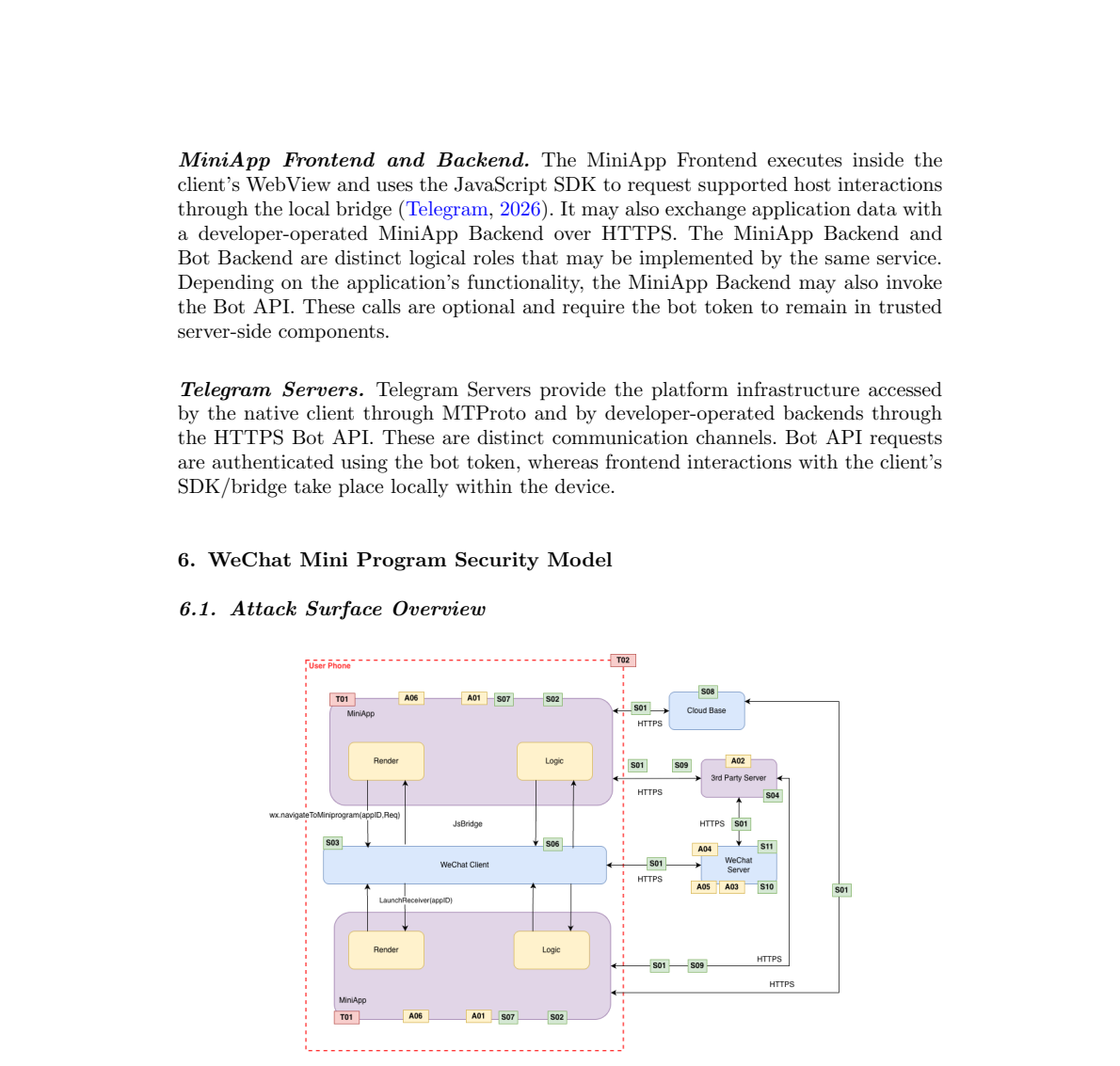
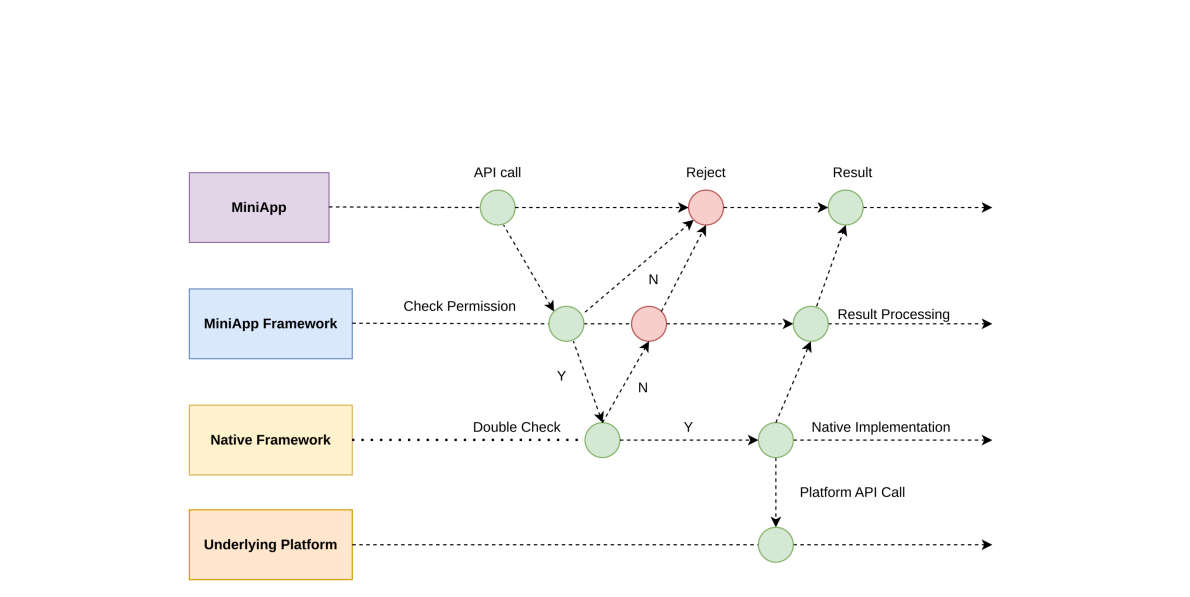
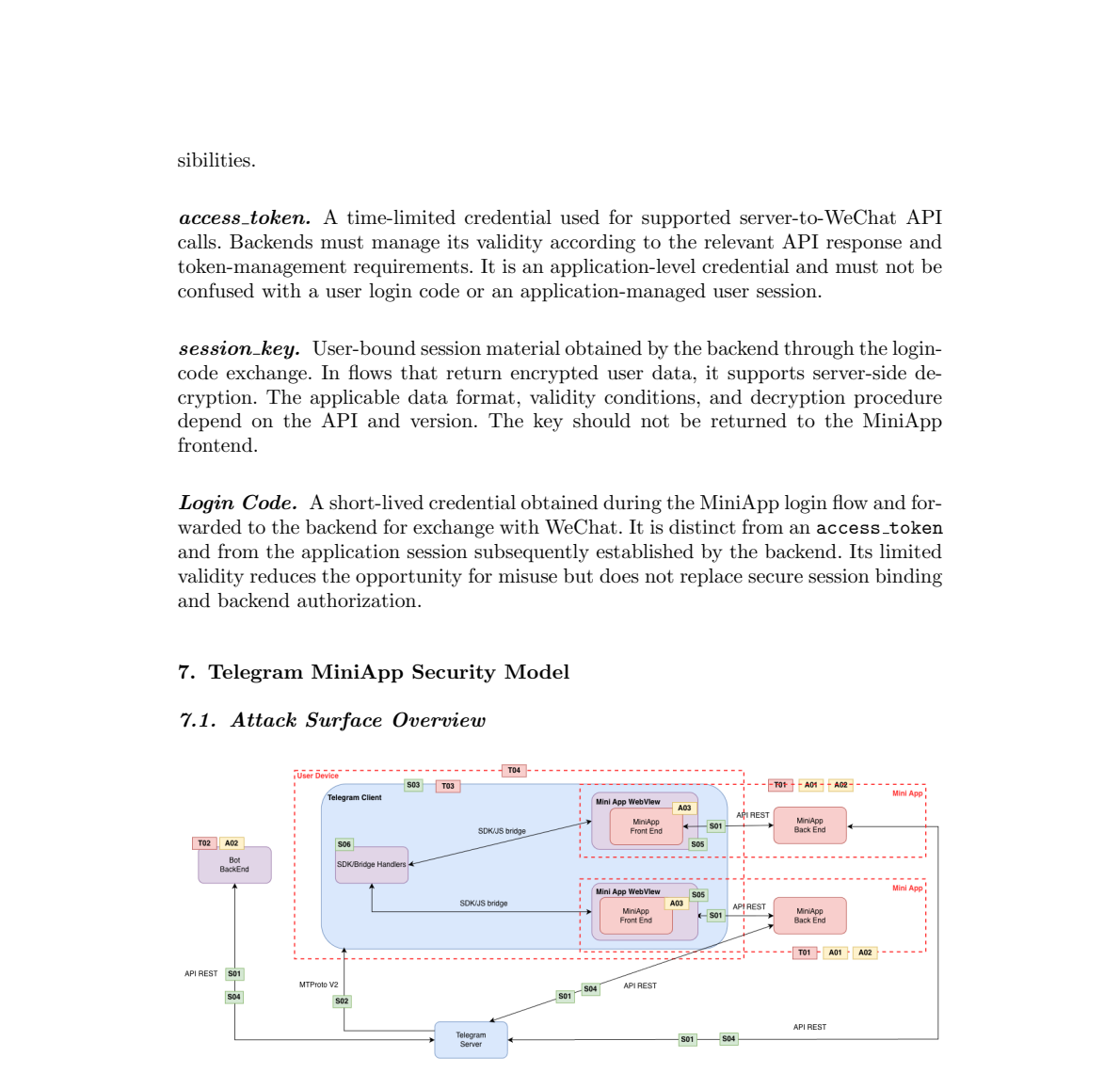
What carries the argument. The mechanism carrying the argument is a shared taxonomy of security controls, assets, and threat sources applied across execution environment, communication paths, and trust boundaries, with Table 1 mapping each selected claim (E1-E6) to its evidence and its implication for analysis. For Telegram, the load-bearing pieces are concrete code paths in the inspected Android client: bot-flag-dependent bridge registration in BotWebViewContainer, the operation-specific write-access handler with its existing-authorization and user-confirmation branches, and multi-window navigation through MyWebView, ArticleViewer, and onOpenUri. For WeChat, the machinery is the layered permission model adapted from the W3C MiniApp white paper plus the credential typology. The taxonomy makes the two ecosystems commensurable so the worked examples can turn architectural facts into requirements for future automated analysis.
Core claim. The paper's central claim is that the security responsibilities of a MiniApp ecosystem split between host platform and developer-operated components, and the split differs sharply between WeChat and Telegram. WeChat Mini Programs are packaged applications in a dedicated runtime: logic and render layers communicate through platform-managed channels, permissions are mediated in layers, and credentials (appID, AppSecret, access token, session key, login code) participate in different authentication flows. Telegram MiniApps are ordinary web applications loaded into an Android WebView, with host capabilities exposed through a local JavaScript bridge; in the inspected Telegram Android revision, the interface name TelegramWebviewProxy is registered in both bot and non-bot containers but dispatches to different handlers, write-access requests follow an operation-specific consent path, and new-window navigation takes a separate ArticleViewer and Browser route. From these architectures the paper derives two modeling requirements: distinguish the principal and validation boundary of each credential use, and associate host capabilities with concrete execution contexts and handlers. The paper scopes its Telegram findings to the inspected revision, does not rank the ecosystems by security, and does not claim validated vulnerability detection.
The premise it rests on. The comparison assumes that one manual reading of Telegram Android commit 62b56a07ca7e30e39f7fd00a6728d6bbd716ca1c correctly captures bridge, write-access, and navigation behavior, and that Tencent's documentation plus prior peer-reviewed studies accurately describe WeChat's enforcement mechanisms.
If the paper is right (Pith's inferences, not the authors')
WeChat-only analysis tools need platform adapters that reconstruct execution contexts and bridge handlers before they can be applied to Telegram MiniApps.
Analyzers must trace each credential use to its validating principal and endpoint; a platform token, verified initData, or TLS encryption cannot by itself establish backend resource authorization.
A bridge name or window.open() event is not evidence of a permission bypass; the concrete bridge object, container mode, and operation-specific check path must be resolved first.
In both ecosystems, backend authentication and resource authorization remain developer responsibilities that no host-platform control replaces.
The taxonomy supplies a shared vocabulary and two modeling requirements that future automated cross-platform analyzers can be built on and evaluated against.
A cheap behavioral test follows from the E3 finding: dynamically compare event dispatch for the same bridge call in bot versus non-bot WebView contexts; if onEventReceived and onWebEventReceived do not differ, the context-dependence claim would need revision.
The credential-role schema (holder, principal, endpoint, operation) may generalize beyond WeChat and Telegram; applying it to Alipay or Baidu could test whether the taxonomy is a genuine cross-platform abstraction.
If platform tokens do not imply backend authorization, token-exposure scanners should pair exposure signals with reachability of protected operations, or they will over-report vulnerabilities in deployments whose backends still authorize.
Because the same bot token authenticates both Bot API calls and the HMAC integrity check over initData, an exposed token has two damage profiles; modeling separate flow edges would sharpen consequence analysis.
Check this review
Pith stored no record of this review's passes and took no fingerprint of it. Reviews made by code from 13 Nov 2026 on carry both.
How often reviews like this one are right
Reviews like this one: written by deepseek-v4-flash, where what was read was not recorded.
How often objections from reviews like this one are right: not yet measured
Reviews by people
This review was written by a machine. No person has reviewed this paper on Pith yet. A scientist listed on Pith can review it for a fee, and their review is published here whatever it concludes.
The paper
Abstract
MiniApps are increasingly central to super-app ecosystems, yet architectural differences complicate the transfer of security analysis techniques across platforms. Existing WeChat analyzers rely on packaged applications and platform-specific APIs, limiting their direct applicability to Telegram's web-based MiniApps. We present a qualitative comparison of WeChat Mini Programs and Telegram MiniApps, grounded in official documentation, prior research, and manual analysis of a specific Telegram Android source revision. Using a shared taxonomy of security controls, assets, and threat sources, we examine execution environments, communication paths, and trust boundaries. WeChat provides a dedicated MiniApp runtime; Telegram combines web execution with host controls. Both retain developer responsibilities for backend authentication and resource authorization. Two worked examples derive requirements for cross-platform analysis: distinguishing credential roles and validation boundaries, and associating host capabilities with concrete execution contexts and permission handlers. These findings inform future automated analysis without ranking the ecosystems by security or claiming validated vulnerability detection.
The paper's own sentences, arranged, kept beside the review and separate from it. Each label is drawn from a closed vocabulary; the number beside it is the probability the classifier gave that label. No sentence in this record was written by a model.
abstract compiled · 2026-11-11
The authors' main claim, as the classifier picked it out 0.56
“These findings inform future automated analysis without ranking the ecosystems by security or claiming validated vulnerability detection.”
How the main claim is stated: asserted 0.65
What the abstract itself states, as probabilities: claims first 0.05 · states limitation 0.96 · human participants 0.05 · controlled comparison 0.10 · randomized assignment 0.01 · states quantitative result 0.03 · compares with prior results 0.42 · mentions code or data availability 0.04
The abstract, sentence by sentence
This table labels the abstract only (arXiv listing abstract v1). The number is the probability the classifier gave the label.
| Sentence | Role | The authors' own work | States the main conclusion | Strength |
|---|---|---|---|---|
| MiniApps are increasingly central to super-app ecosystems, yet architectural differences complicate the transfer of security analysis techniques across platforms. | background 0.94 | 0.06 | 0.04 | asserted 1.00 |
| Existing WeChat analyzers rely on packaged applications and platform-specific APIs, limiting their direct applicability to Telegram's web-based MiniApps. | gap 0.65 | 0.08 | 0.03 | asserted 1.00 |
| We present a qualitative comparison of WeChat Mini Programs and Telegram MiniApps, grounded in official documentation, prior research, and manual analysis of a specific Telegram Android source revision. | contribution 0.81 | 0.95 | 0.07 | asserted 0.99 |
| Using a shared taxonomy of security controls, assets, and threat sources, we examine execution environments, communication paths, and trust boundaries. | method 0.98 | 0.88 | 0.05 | asserted 0.96 |
| WeChat provides a dedicated MiniApp runtime; Telegram combines web execution with host controls. | result 0.99 | 0.73 | 0.14 | asserted 1.00 |
| Both retain developer responsibilities for backend authentication and resource authorization. | result 1.00 | 0.67 | 0.06 | asserted 1.00 |
| Two worked examples derive requirements for cross-platform analysis: distinguishing credential roles and validation boundaries, and associating host capabilities with concrete execution contexts and permission handlers. | contribution 0.57 | 0.94 | 0.16 | asserted 0.99 |
| These findings inform future automated analysis without ranking the ecosystems by security or claiming validated vulnerability detection. | limitation 0.48 | 0.65 | 0.40 | asserted 0.65 |
What kind of paper the classifier reports this is: review 0.43 · evidence from literature 0.65
What was examined, and what was not
Sources read
- arXiv listing abstract v1
Not examined
- full text
- figures and tables
- references and citing sentences
- relations to other papers
Levels run
- P abstract
Not run
- S sections
- T body sentences
- C citations
- R cross-paper relations
How the labels were made
Compiled by classifier-1.13.0 via TypeSafe API, question bank abstract-p1-20260923, 2026-11-11: 1 request, 6,103 input tokens.
Every quoted sentence on this record is the authors'. Every label is from Pith's closed vocabulary, with the probability shown beside it. This record as JSON
Figures (6)
Figures are the authors', reproduced from the paper.
References (14)
- [1] Alipay. (2026).Alipay.Retrieved May 25, 2026, fromhttps://mobile.alipay.com Baidu. (2026).Baidu.Retrieved May 25, 2026, fromhttps://www.baidu.com/ on Pith
- [2] Baskaran, S., Zhao, L., Mannan, M., & Youssef, A. (2023). Measuring the leakage and exploitability of authentication secrets in super-apps: The WeChat case. InProceedings of the 26th International Symposium on Research in Attacks, Intrusions and Defenses(pp. 727–743) on Pith
- [3] Ferrari, L., Ceccato, M., & Verderame, L. (2026).TeleGapper: On the (Un)reliability of privacy policies in Telegram Mini Apps.arXiv preprint arXiv:2608.13390 on PithPith's reviewarXiv
- [4] Han, Y., Ji, X., Wang, Z., & Zhang, J. (2023). Systematic analysis of security and vulnerabil- ities in miniapps. InProceedings of the 2023 ACM Workshop on Secure and Trustworthy Superapps(pp. 1–9) on Pith
- [5] Mehta, I. (2025, March).Telegram founder Pavel Durov says app now has 1B users, calls What- sApp a “cheap, watered down imitation ”.Retrieved fromhttps://techcrunch.com/2025/ 03/19/telegram-founder-pavel-durov-says-app-now-has-1b-users-calls-whatsapp -a-cheap-watered-down-imitation on Pith
- [6] Meng, S., Wang, L., Wang, S., Wang, K., Xiao, X., Bai, G., & Wang, H. (2023). WeMinT: Tainting sensitive data leaks in WeChat mini-programs. In2023 38th IEEE/ACM Interna- tional Conference on Automated Software Engineering (ASE)(pp. 1403–1415). 22 on Pith
- [7] Mohammadi, K., Moradi, A., & Atani, R. E. (2025). Security analysis of MiniApps: Vulnerabil- ities, exploits, and a tailored mitigation framework. In2025 15th International Conference on Computer and Knowledge Engineering (ICCKE)(pp. 1–8). Netlify. (2026).Netlify: Push your id... on Pith
- [8] Schreieck, M., Ou, A., & Krcmar, H. (2023). Mini-app ecosystems.Business & Information Systems Engineering,65(1), 85–93. Telegram. (2026).Telegram Mini Apps.Retrieved May 26, 2026, fromhttps://core .telegram.org/bots/webapps Tencent. (2026a).Weixin docs: Cloudbase, getting sta... on Pith
- [9] Wang, C., Ko, R., Zhang, Y., Yang, Y., & Lin, Z. (2023). TaintMini: Detecting flow of sensitive data in mini-programs with static taint analysis. In2023 IEEE/ACM 45th International Conference on Software Engineering (ICSE)(pp. 932–944) on Pith
- [10] Wang, C., Zhang, Y., & Lin, Z. (2023). One size does not fit all: Uncovering and exploiting cross platform discrepant APIs in WeChat. In32nd USENIX Security Symposium (USENIX Security 23)(pp. 6629–6646) on Pith
- [11] Yang, Y., Zhang, Y., & Lin, Z. (2022). Cross miniapp request forgery: Root causes, attacks, and vulnerability detection. InProceedings of the 2022 ACM SIGSAC Conference on Computer and Communications Security(pp. 3079–3092) on Pith
- [12] Zhang, Y., Turkistani, B., Yang, A. Y., Zuo, C., & Lin, Z. (2021). A measurement study of WeChat mini-apps.Proceedings of the ACM on Measurement and Analysis of Computing Systems,5(2), 1–25 on Pith
- [13] Zhang, Y., Yang, Y., & Lin, Z. (2023). Don’t leak your keys: Understanding, measuring, and exploiting the AppSecret leaks in mini-programs. InProceedings of the 2023 ACM SIGSAC Conference on Computer and Communications Security(pp. 2411–2425) on Pith
- [14] Zhang, Z., Hou, Q., Ying, L., Diao, W., Gu, Y., Li, R., . . . Duan, H. (2024). MiniCAT: Understanding and detecting cross-page request forgery vulnerabilities in mini-programs. InProceedings of the 2024 ACM SIGSAC Conference on Computer and Communications Security(pp. 525–539). 23 on Pith
Challenges and discussion
Disagree with the review, or know something it missed? Leave a comment, or challenge this review formally: a challenge becomes a permanent entry in this paper's record, and its decision is published here.
Come back by email
A short list of the week's newly reviewed papers. Nothing is sent until you confirm from your inbox, and every email has a link that stops it. No account.
No comments yet.
Sign in to comment