Computation and Language · arXiv:2611.17766 v1 · submitted 13 Nov 2026 · 67 references
GDP.xlsx: Benchmarking Frontier Models on Professional Workbooks
The paper says
“We introduce GDP_xlsx, a benchmark of 70 realistic workplace requests written by professionals in 13 domains, each paired with an expert rubric of binary criteria and with the complete workbook or CSV file it refers to.”
more of the abstract
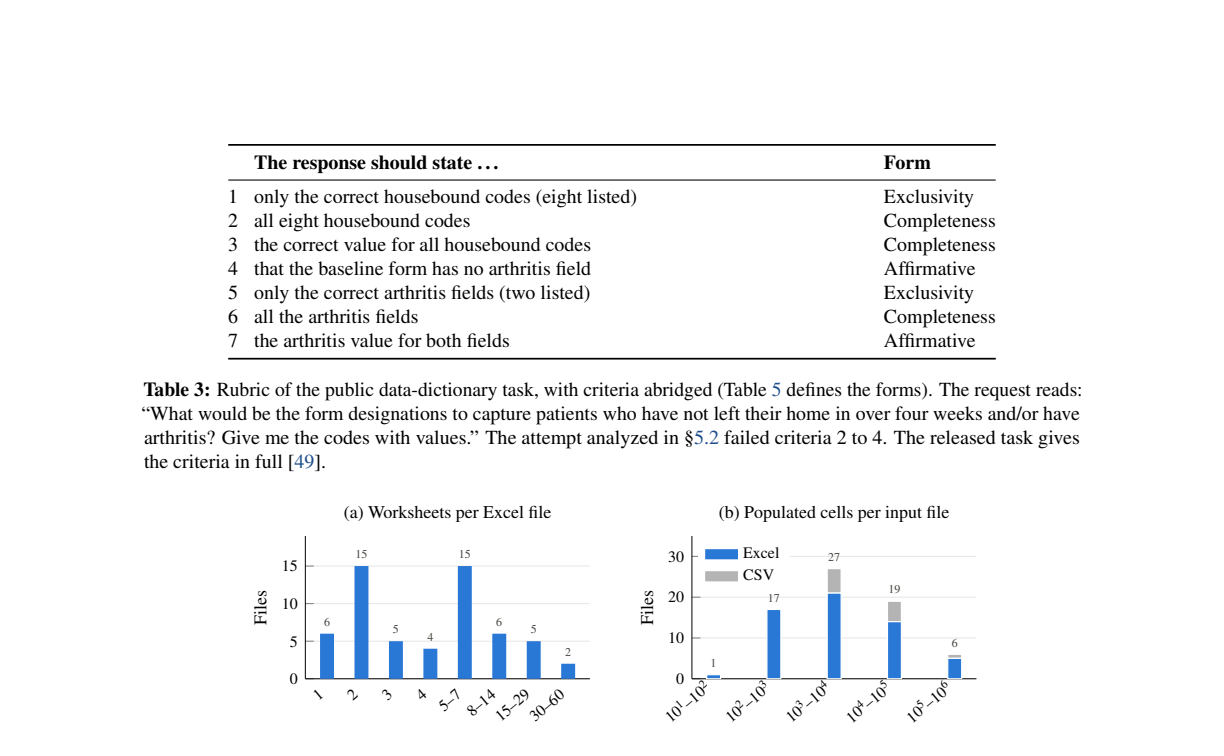
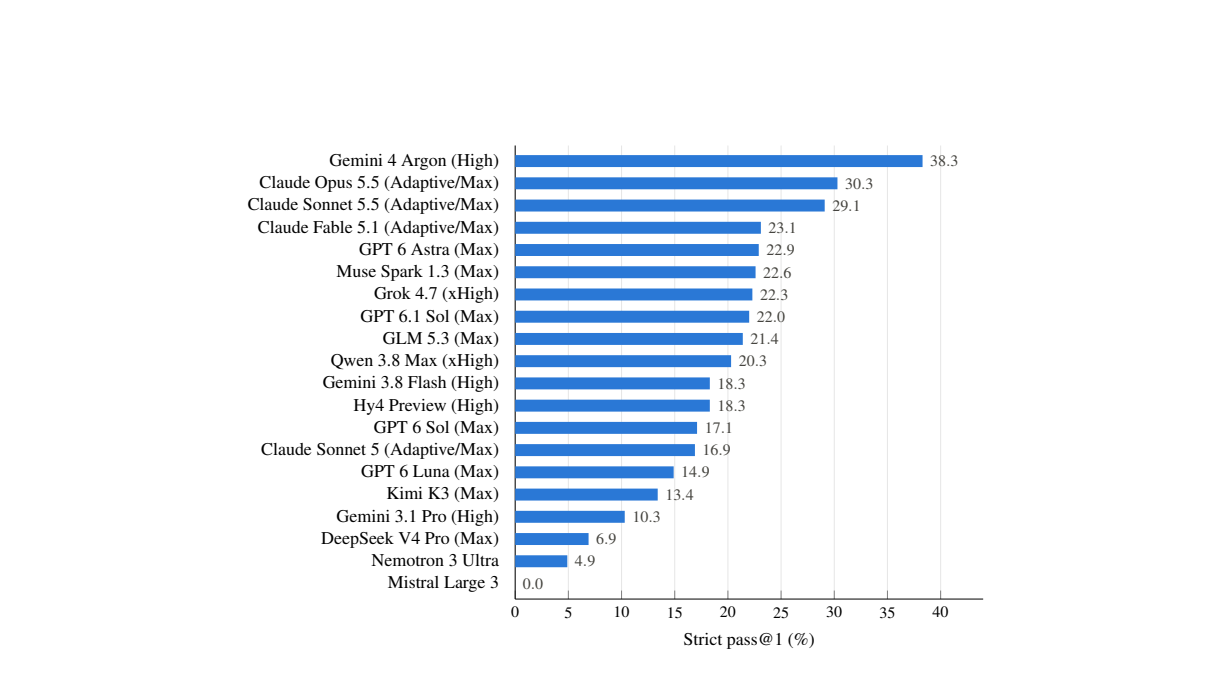
Together the files hold 2.18 million populated cells, and the rubrics 791 criteria. Agents work in a container with spreadsheet tools, and an agentic judge that can open the file applies the rubric. Completeness and exclusivity criteria require set-valued answers to be found in full and with nothing extra. We rank models by strict pass@1, the share of attempts that meet every criterion. Across 20 model configurations, including frontier models from Google, Anthropic, and OpenAI, the top-scoring one, Gemini 4 Argon, passes only 38.3% of attempts, and the median score is 19.3%, leaving wide headroom. We release the evaluation harness and three public tasks; the other 67 are held out to protect the leaderboard from contamination.
from the abstract
Pith says
Machine review · deepseek-v4-flash · 16 Nov 2026 · read the full text (63,405 characters) · not checked by a person
It can be wrong. Challenge this review or reply to it.
Holds up, with conditions. GDP.xlsx is a well-constructed benchmark of 70 professional spreadsheet requests with expert rubrics; its main weakness is that the agentic judge used to grade responses is not validated against human judgments. This line is wrong
8 minor
How often objections from reviews like this one are right: not yet measured
The paper, first character to last
The reviewer was given the whole text, 63,405 characters. Not checked: figures, code, what the 67 references say.
8 minor objections
The paper says, at §3.2 Construction and review
Pith says: minor objection 1 of 8
The paper states that tasks passed three rounds of review but does not describe the review process in detail. What was checked in each round? Who performed the reviews? This would help assess the quality of the benchmark.
The paper says, at §3.5 Rubrics
Pith says: minor objection 2 of 8
Table 5 (Rubric criteria by form) is informative, but the example for the 'Permissive' form ('may state that there is only one DC auxiliary power cabinet in the asset') seems to be a statement that could also be an affirmative criterion. Clarify the distinction between permissive and affirmative forms.
show 6 more
The paper says, at §4.1 Harness
Pith says: minor objection 3 of 8
The harness provides Python with openpyxl, pandas, LibreOffice, and Tesseract OCR. It would be helpful to specify which version of these tools were used, as behavior may vary.
The paper says, at §5.2 Failure analysis
Pith says: minor objection 4 of 8
The failure analysis is insightful but only covers four attempts. A more systematic analysis of failure modes across all tasks would strengthen the paper. For example, what proportion of failures are due to incomplete recall vs. other errors?
The paper says, at §3.4 Task demands
Pith says: minor objection 5 of 8
Table 4 lists eight demands but does not provide a quantitative breakdown of how many tasks require each demand. The text says 'about three on average' but a table or figure showing the distribution would be more informative.
The paper says, at §3.5 Rubrics
Pith says: minor objection 6 of 8
The paper states that 'conditional, prohibition, and permissive forms... are marked by fixed phrases such as 'If the response', 'should avoid', and 'may state'.' It would be helpful to provide the exact fixed phrases used in the rubrics to ensure reproducibility.
The paper says, at §6 Discussion
Pith says: minor objection 7 of 8
The discussion suggests that exhaustive search strategies could improve performance, but this is speculative. The paper could strengthen this by testing a simple baseline that enumerates all tabs and objects before answering.
The paper says, at §3.6 Release and contamination controls
Pith says: minor objection 8 of 8
The canary string is included in the paper, which is good practice. However, the paper does not discuss whether the public tasks (3 of 70) are representative of the full benchmark. A brief comparison of their properties would be useful.
What would settle it
If a human expert evaluation of the same responses showed that the judge's verdicts disagree with expert judgments on a substantial fraction of criteria (e.g., more than 10% of criteria), the ranking of models could change, undermining the central claim about which models perform best and how much headroom remains.
from Pith's summary of the paper
How the review went
5 passes by deepseek-v4-flash · 16 Nov 2026
- Reader holds up, with conditions
- Skeptic concern withdrawn: Pith's reviewer misread the paper
- Referee 8 minor
- Check against the paper kept 0 of 5 objections
- Editor wrote the verdict above
Not run on this paper: the simulated authors' defence.
Pith's passes raised 5 objections. A check against the paper's text kept 0 and withdrew 5 (5 Pith's reviewer misread the paper).
The review in full
The review in brief, machine-written
This paper introduces GDP.xlsx, a benchmark of 70 realistic workplace requests over complete Excel workbooks and CSV files, written by domain professionals. Each request comes with an expert rubric of binary criteria, and the benchmark uses an agentic judge (OpenCode) that can open the file to verify answers. The benchmark is carefully constructed: tasks were written by professionals, went through three rounds of review, and cover 13 domains. The rubrics include completeness and exclusivity criteria that require full recall and full precision on set-valued answers, which is a meaningful design choice. The results show that frontier models score low (top 38.3%, median 19.3%), indicating substantial headroom.
The main soft spot is that the agentic judge's reliability is not independently validated. The paper states that the judge 'may open the input file and run code to verify claims' but provides no evidence that its verdicts are accurate or consistent with expert human grading. This is load-bearing because the entire ranking depends on the judge's correctness. The authors should provide calibration data against human judgments, or at minimum a sample of judge verdicts with inter-rater agreement. Without this, the soundness of the rankings is uncertain.
Other concerns are minor: the benchmark is from a single group (Surge AI), and the held-out tasks (67 of 70) mean independent verification is limited. The paper acknowledges these controls. The benchmark is a solid contribution to AI evaluation for spreadsheet comprehension, and the methodology is clearly described.
This paper deserves a serious referee. The benchmark fills a gap in evaluating AI agents on realistic professional spreadsheet tasks, and the construction is thorough. The main issue—judge validation—is fixable. I would recommend conditional acceptance pending evidence of judge reliability.
The stress test's concern
Withdrawn: Pith's reviewer misread the paper.
The paper says
“After the agent finishes, an agentic judge runs in the same container. It is the OpenCode agent~\citep{opencode2026}, and the same judge model and instructions grade every attempt of every configuration. In one session the judge receives the request, the name of the input file, and all criteria. It reads the response and may open the input file and run code to verify claims, but it may not complete the task itself or credit content the response does not contain. It must write its reasoning before each binary verdict and tie every failing verdict to the part of the response it concerns. Its instructions, released with each public task~\citep{surge2026gdpxlsxhf}, define how to grade compound criteria, equivalent expressions, surplus content, and untriggered conditions.”
The referee's report
Not published. Pith's referee wrote this assessment before its objections were checked against the paper, and 4 of its 4 major objections did not survive that check.
Pith's reading of the paper (a machine's summary, not the authors')
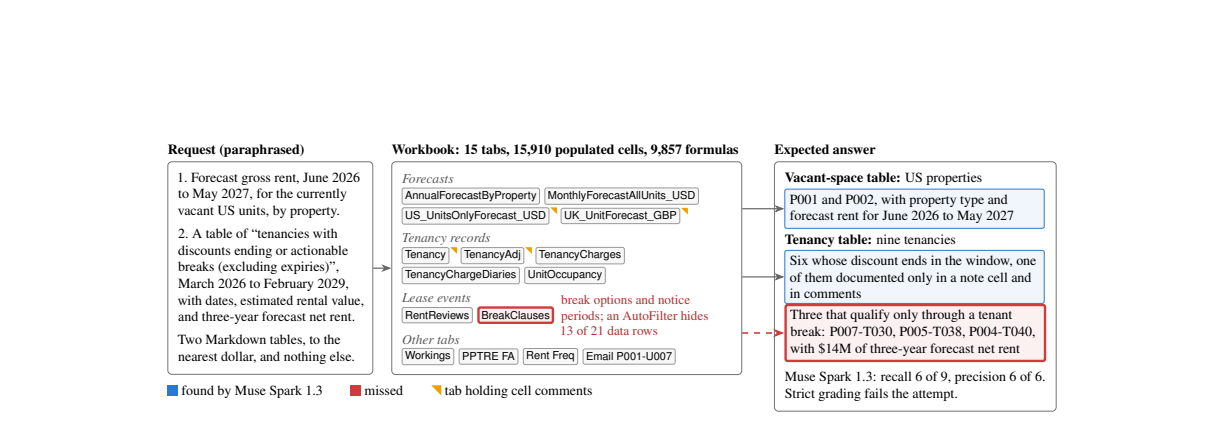
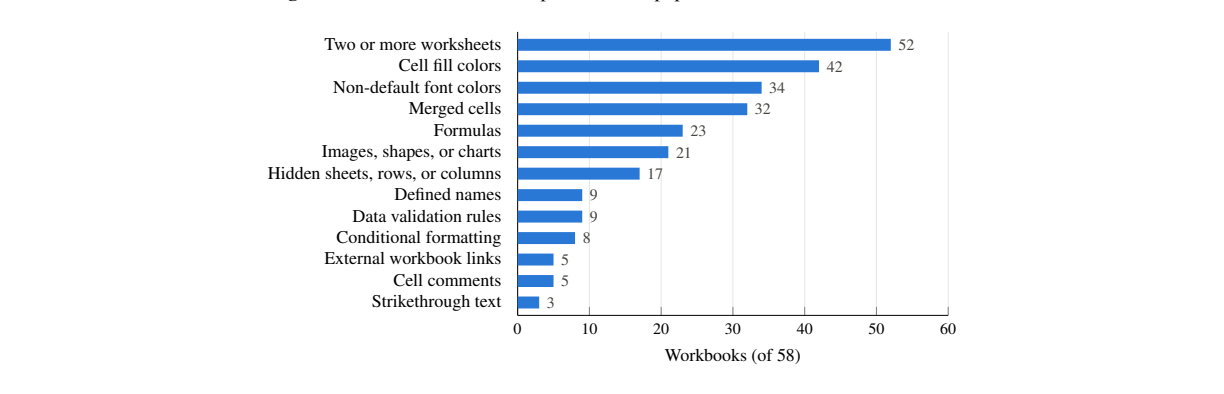
The paper introduces GDP.xlsx, a benchmark of 70 realistic workplace requests written by professionals in 13 domains, each paired with an expert rubric of binary criteria and with the complete workbook or CSV file it refers to. The files together hold 2.18 million populated cells, and the rubrics contain 791 criteria. Agents work in a container with spreadsheet tools, and an agentic judge that can open the file applies the rubric. The paper ranks models by strict pass@1, the share of attempts that meet every criterion. Across 20 model configurations, including frontier models from Google, Anthropic, and OpenAI, the top-scoring one, Gemini 4 Argon, passes only 38.3% of attempts, and the median score is 19.3%, leaving wide headroom. The paper argues that this benchmark captures the retrieval and comprehension demands of professional spreadsheet work, where evidence is often spread across tabs or held in formatting, comments, filters, or images, and answers are often sets that must be found in full and with nothing extra.
What carries the argument. The central object is the GDP.xlsx benchmark itself: a set of 70 tasks, each consisting of a request, an input file (Excel workbook or CSV), and an expert rubric of binary criteria. The key mechanism is the strict pass@1 metric, where an attempt passes only if it meets every criterion in the rubric. The rubrics include completeness criteria (requiring every item of a set) and exclusivity criteria (forbidding any other item), so the answer must achieve both full recall and full precision. An agentic judge (OpenCode agent) applies the rubric by opening the file and running code to verify claims.
Core claim. The paper claims that GDP.xlsx is a benchmark that measures whether language agents can answer realistic workplace requests about complete workbooks and CSV files, with expert rubrics that require full recall and full precision on set-valued answers. The paper reports that frontier models score low, with the top configuration (Gemini 4 Argon) passing only 38.3% of attempts and the median score at 19.3%, indicating substantial room for improvement. The paper argues that the benchmark captures demands that existing evaluations do not, including cross-sheet linkage, reading evidence from structure and formatting, and recognizing when the file cannot answer the request.
The premise it rests on. The paper assumes that the agentic judge (OpenCode agent) can reliably and correctly apply the rubrics to grade responses, including handling compound criteria, equivalent expressions, and untriggered conditions, but the judge's performance is not independently validated or calibrated against human judgments in this paper.
If the paper is right (Pith's inferences, not the authors')
If the benchmark accurately measures professional spreadsheet comprehension, then frontier models are far from reliable for real-world workbook tasks, and progress can be tracked by scores on this benchmark.
The low scores suggest that current agents lack systematic retrieval strategies, such as enumerating all tabs, comments, and embedded objects before answering, which the paper identifies as a key failure mode.
The benchmark's structure, with held-out tasks and a canary string, is designed to resist contamination and support a durable leaderboard for tracking model improvements over time.
The paper's analysis of four failed attempts shows that models often miss set members or evidence in non-cell locations (diagrams, comments, filters), pointing to specific capabilities that need improvement.
The benchmark could be extended to include tasks that require modifying the workbook (not just answering questions), which would test a different aspect of professional spreadsheet work.
The reliance on an agentic judge that is not independently validated against human judgments is a limitation; future work could calibrate the judge against expert human grading to establish its reliability.
The paper's finding that models miss evidence in diagrams and formatting suggests that current multimodal capabilities are insufficient for professional documents, which may motivate new approaches to structure-aware encoding or retrieval-augmented pipelines.
The benchmark's focus on recall-oriented retrieval (completeness and exclusivity criteria) could inform the design of training data or reinforcement learning rewards for agents that need to perform exhaustive search.
Check this review
What was read
The passes were given all 63,405 characters of the paper's LaTeX source.
Fingerprint of that text (SHA-256): 7a5c241d3c41b3f08a0788a1ebf5752a9e5451c9ea47e39f31cf5cf4ce407977
Pith does not keep that text. Rebuilt from the paper's source or PDF by the same code, it has this fingerprint if it is the same text. From a copy of Pith's code:
PYTHONPATH=. python scripts/review_input_check.py 2611.17766
The passes, in the order they ran
- Reader deepseek-v4-flash · medium effort · $0.0029 · instructions of the Reader, fingerprint f9ead7300382…
- Skeptic deepseek-v4-flash · medium effort · $0.0021 · instructions of the Skeptic, fingerprint 8f88c0f61488…
- Referee deepseek-v4-flash · medium effort · $0.0023 · instructions of the Referee, fingerprint a852d99aea0d…
- Check against the paper deepseek-v4-flash · medium effort · $0.0026 · instructions of the Check against the paper, fingerprint 6c7a6883d551…
- Editor deepseek-v4-flash · medium effort · $0.0021 · instructions of the Editor, fingerprint e7211f6a3d27…
- Circularity check deepseek-v4-flash · medium effort · $0.0025 · instructions of the Circularity check, fingerprint e9946e39d67b…
- Summary for the page deepseek-v4-flash · medium effort · temperature 0.2 · $0.0024 · instructions of the Summary for the page, fingerprint e4f56bf568e7…
The passes cost $0.017 in model calls together.
Version stamped on this review: pith-pipeline@v1.4.1-daily-deepseek-or-medium+deepseek/deepseek-v4-flash+p.d60f54226f00
Each link opens a pass's instructions as plain text, the exact bytes its fingerprint was taken over. Every stored set of instructions.
curl -s https://pith.science/methodology/prompts/f9ead730038216984cfb56d7cb34332bdf691828296a1de4245f3d6667d4bf56 | sha256sum
prints the fingerprint of the reader's instructions. The same works for every pass.
The receipt
The review's fingerprint was taken on 16 Nov 2026. The review you are reading still matches it.
Fingerprint of the review (SHA-256): 78ecb2b584555e1c7c97fffb2e44b1e271afde310e1a63166e343bf4333a76d2
curl -s 'https://pith.science/api/v1/verdicts/2611.17766?form=canonical' | sha256sum
prints the fingerprint of the review as it stands now. The rule, in four steps.
A matching fingerprint shows the review has not changed since that date. It does not show that the review is right.
How often reviews like this one are right
Reviews like this one: written by deepseek-v4-flash, from the paper's LaTeX source.
How often objections from reviews like this one are right: not yet measured
Reviews by people
This review was written by a machine. No person has reviewed this paper on Pith yet. A scientist listed on Pith can review it for a fee, and their review is published here whatever it concludes.
How Pith checks papers · The full audit of this paper · Review history (2 versions)
The paper
Abstract
We introduce GDP_xlsx, a benchmark of 70 realistic workplace requests written by professionals in 13 domains, each paired with an expert rubric of binary criteria and with the complete workbook or CSV file it refers to. Together the files hold 2.18 million populated cells, and the rubrics 791 criteria. Agents work in a container with spreadsheet tools, and an agentic judge that can open the file applies the rubric. Completeness and exclusivity criteria require set-valued answers to be found in full and with nothing extra. We rank models by strict pass@1, the share of attempts that meet every criterion. Across 20 model configurations, including frontier models from Google, Anthropic, and OpenAI, the top-scoring one, Gemini 4 Argon, passes only 38.3% of attempts, and the median score is 19.3%, leaving wide headroom. We release the evaluation harness and three public tasks; the other 67 are held out to protect the leaderboard from contamination.
The paper's own sentences, arranged, kept beside the review and separate from it. Each label is drawn from a closed vocabulary; the number beside it is the probability the classifier gave that label. No sentence in this record was written by a model.
abstract compiled · 2026-11-16
The authors' main claim, as the classifier picked it out 1.00
“Across 20 model configurations, including frontier models from Google, Anthropic, and OpenAI, the top-scoring one, Gemini 4 Argon, passes only 38.3% of attempts, and the median score is 19.3%, leaving wide headroom.”
How the main claim is stated: asserted 1.00
What the abstract itself states, as probabilities: claims first 0.08 · states limitation 0.72 · human participants 0.36 · controlled comparison 0.08 · randomized assignment 0.02 · states quantitative result 0.99 · compares with prior results 0.38 · mentions code or data availability 0.95
The abstract, sentence by sentence
This table labels the abstract only (arXiv listing abstract v1). The number is the probability the classifier gave the label.
| Sentence | Role | The authors' own work | States the main conclusion | Strength |
|---|---|---|---|---|
| We introduce GDP_xlsx, a benchmark of 70 realistic workplace requests written by professionals in 13 domains, each paired with an expert rubric of binary criteria and with the complete workbook or CSV file it refers to. | contribution 1.00 | 0.93 | 0.06 | asserted 1.00 |
| Together the files hold 2.18 million populated cells, and the rubrics 791 criteria. | contribution 0.69 | 0.87 | 0.03 | asserted 1.00 |
| Agents work in a container with spreadsheet tools, and an agentic judge that can open the file applies the rubric. | method 1.00 | 0.62 | 0.03 | asserted 0.98 |
| Completeness and exclusivity criteria require set-valued answers to be found in full and with nothing extra. | method 0.99 | 0.44 | 0.02 | asserted 0.99 |
| We rank models by strict pass@1, the share of attempts that meet every criterion. | method 1.00 | 0.86 | 0.05 | asserted 0.95 |
| Across 20 model configurations, including frontier models from Google, Anthropic, and OpenAI, the top-scoring one, Gemini 4 Argon, passes only 38.3% of attempts, and the median score is 19.3%, leaving wide headroom. | result 0.99 | 0.96 | 0.72 | asserted 1.00 |
| We release the evaluation harness and three public tasks; the other 67 are held out to protect the leaderboard from contamination. | contribution 0.96 | 0.94 | 0.05 | asserted 0.99 |
What kind of paper the classifier reports this is: dataset or benchmark 1.00 · evidence from observation or experiment 0.91
What was examined, and what was not
Sources read
- arXiv listing abstract v1
Not examined
- full text
- figures and tables
- references and citing sentences
- relations to other papers
Levels run
- P abstract
Not run
- S sections
- T body sentences
- C citations
- R cross-paper relations
How the labels were made
Compiled by classifier-1.13.0 via TypeSafe API, question bank abstract-p1-20260923, 2026-11-16: 1 request, 5,621 input tokens.
Every quoted sentence on this record is the authors'. Every label is from Pith's closed vocabulary, with the probability shown beside it. This record as JSON
Figures (4)
Figures are the authors', reproduced from the paper.
References (67)
- [1] Samuel Joseph Amouyal, Tomer Wolfson, Ohad Rubin, Ori Yoran, Jonathan Herzig, and Jonathan Berant. QAMPARI: A benchmark for open-domain questions with many answers. InProceedings of the Third Workshop on Natural Language Generation, Evaluation, and Metrics (GEM), pages 97–110, 2023 on Pith
- [2] Rahul K. Arora, Jason Wei, Rebecca Soskin Hicks, Preston Bowman, Joaquin Quiñonero-Candela, Foivos Tsimpourlas, et al. HealthBench: Evaluating large language models towards improved human health.arXiv preprintarXiv:2505.08775, 2025 on PithPith's reviewarXiv
- [3] Wenhu Chen, Hongmin Wang, Jianshu Chen, Yunkai Zhang, Hong Wang, Shiyang Li, Xiyou Zhou, and William Yang Wang. TabFact: A large-scale dataset for table-based fact verification. InInternational Con- ference on Learning Representations (ICLR), 2020 on Pith
- [4] Xinyun Chen, Petros Maniatis, Rishabh Singh, Charles Sutton, Hanjun Dai, Max Lin, and Denny Zhou. SpreadsheetCoder: Formula prediction from semi-structured context. InInternational Conference on Machine Learning (ICML), pages 1661–1672, 2021 on Pith
- [5] Zhiyu Chen, Wenhu Chen, Charese Smiley, Sameena Shah, Iana Borova, Dylan Langdon, et al. FinQA: A dataset of numerical reasoning over financial data. InProceedings of the Conference on Empirical Methods in Natural Language Processing (EMNLP), pages 3697–3711, 2021 on Pith
- [6] Yibin Chen, Yifu Yuan, Zeyu Zhang, Yan Zheng, Jinyi Liu, Fei Ni, et al. SheetAgent: Towards a generalist agent for spreadsheet reasoning and manipulation via large language models. InProceedings of the ACM Web Conference (WWW), pages 158–177, 2025. 10 on Pith
- [7] Zhoujun Cheng, Haoyu Dong, Zhiruo Wang, Ran Jia, Jiaqi Guo, Yan Gao, et al. HiTab: A hierarchical table dataset for question answering and natural language generation. InProceedings of the Annual Meeting of the Association for Computational Linguistics (ACL), pages 1094–1110, 2022 on Pith
- [8] Haoyu Dong, Jianbo Zhao, Yuzhang Tian, Junyu Xiong, Mengyu Zhou, Yun Lin, et al. Encoding spreadsheets for large language models. InProceedings of the Conference on Empirical Methods in Natural Language Processing (EMNLP), pages 20728–20748, 2024 on Pith
- [9] Haoyu Dong, Pengkun Zhang, Yan Gao, Xuanyu Dong, Yilin Cheng, Mingzhe Lu, Adina Yakefu, and Shuxin Zheng. Finch: Benchmarking finance & accounting across spreadsheet-centric enterprise workflows. InFindings of the Association for Computational Linguistics: ACL 2026, pages 1076... on Pith
- [10] Alexandre Drouin, Maxime Gasse, Massimo Caccia, Issam H. Laradji, Manuel Del Verme, Tom Marty, et al. WorkArena: How capable are web agents at solving common knowledge work tasks? InInternational Conference on Machine Learning (ICML), pages 11642–11662, 2024 on Pith
- [11] Stephanie Finley, Liudas Panavas, Thomas Mikkelson, Cam Hinton, Stacey Ganss, Bradley Monton, et al. DAYJOB: A benchmark for long-horizon professional work.arXiv preprintarXiv:2610.01306, 2026 on PithPith's reviewarXiv
- [12] Suhaas Garre, Chris Mutty, Sushant Mehta, and Edwin Chen. Chartography: A benchmark for professional chart understanding.arXiv preprintarXiv:2608.10677, 2026 on PithPith's reviewarXiv
- [13] Suhaas Garre, Emily Ritchie, Sushant Mehta, and Edwin Chen. GDP.pdf: Benchmarking grounded multimodal reasoning over professional PDF documents.arXiv preprintarXiv:2607.11192, 2026 on PithPith's reviewarXiv
- [14] Neel Guha, Julian Nyarko, Daniel E. Ho, Christopher Ré, Adam Chilton, Aditya Narayana, et al. LegalBench: A collaboratively built benchmark for measuring legal reasoning in large language models. InAdvances in Neural Information Processing Systems (NeurIPS), Datasets and Bench... on Pith
- [15] Anmol Gulati, Sahil Sen, Waqar Sarguroh, and Kevin Paul. From rows to reasoning: A retrieval-augmented multimodal framework for spreadsheet understanding.arXiv preprintarXiv:2601.08741, 2026 on PitharXiv
- [16] Harbor Framework Team. Harbor: A framework for evaluating and optimizing agents and models in container environments. Software, version 0.22.0, 2026.https://doi.org/10.5281/zenodo.22052497 on Pithdoi:10.5281/zenodo.22052497
- [17] Yun He, Wenzhe Li, Hejia Zhang, Songlin Li, Karishma Mandyam, Sopan Khosla, et al. AdvancedIF: Rubric- based benchmarking and reinforcement learning for advancing LLM instruction following. InProceedings of the Annual Meeting of the Association for Computational Linguistics (A... on Pith
- [18] Felienne Hermans and Emerson Murphy-Hill. Enron’s spreadsheets and related emails: A dataset and analysis. In Proceedings of the International Conference on Software Engineering (ICSE), Software Engineering in Practice, pages 7–16, 2015 on Pith
- [19] Felienne Hermans, Martin Pinzger, and Arie van Deursen. Detecting and visualizing inter-worksheet smells in spreadsheets. InProceedings of the International Conference on Software Engineering (ICSE), pages 441–451, 2012 on Pith
- [20] Thomas Herndon, Michael Ash, and Robert Pollin. Does high public debt consistently stifle economic growth? A critique of Reinhart and Rogoff.Cambridge Journal of Economics, 38(2):257–279, 2014 on Pith
show 47 more
- [21] Xueyu Hu, Ziyu Zhao, Shuang Wei, Ziwei Chai, Qianli Ma, Guoyin Wang, et al. InfiAgent-DABench: Evaluating agents on data analysis tasks. InInternational Conference on Machine Learning (ICML), pages 19544–19572, 2024 on Pith
- [22] Yiming Huang, Jianwen Luo, Yan Yu, Yitong Zhang, Fangyu Lei, Yifan Wei, et al. DA-Code: Agent data science code generation benchmark for large language models. InProceedings of the Conference on Empirical Methods in Natural Language Processing (EMNLP), pages 13487–13521, 2024 on Pith
- [23] Carlos E. Jimenez, John Yang, Alexander Wettig, Shunyu Yao, Kexin Pei, Ofir Press, and Karthik Narasimhan. SWE-bench: Can language models resolve real-world GitHub issues? InInternational Conference on Learning Representations (ICLR), pages 54107–54157, 2024 on Pith
- [24] Liqiang Jing, Zhehui Huang, Xiaoyang Wang, Wenlin Yao, Wenhao Yu, Kaixin Ma, et al. DSBench: How far are data science agents from becoming data science experts? InInternational Conference on Learning Representations (ICLR), pages 32597–32649, 2025 on Pith
- [25] Harshit Joshi, Abishai Ebenezer, José Cambronero Sanchez, Sumit Gulwani, Aditya Kanade, Vu Le, Ivan Radiˇcek, and Gust Verbruggen. FLAME: A small language model for spreadsheet formulas. InProceedings of the AAAI Conference on Artificial Intelligence (AAAI), pages 12995–13003,... on Pith
- [26] Najoung Kim, Phu Mon Htut, Samuel R. Bowman, and Jackson Petty. (QA) 2: Question answering with questionable assumptions. InProceedings of the Annual Meeting of the Association for Computational Linguistics (ACL), pages 8466–8487, 2023 on Pith
- [27] Polina Kirichenko, Mark Ibrahim, Kamalika Chaudhuri, and Samuel J. Bell. AbstentionBench: Reasoning LLMs fail on unanswerable questions. InAdvances in Neural Information Processing Systems (NeurIPS), Datasets and Benchmarks Track, 2025 on Pith
- [28] Srivatsa Kundurthy, Clara Na, Colton Moraine, Anoushka Mohta, Case Winter, George Fang, et al. BlueFin: Benchmarking LLM agents on financial spreadsheets.arXiv preprintarXiv:2605.30907, 2026 on PithPith's reviewarXiv
- [29] Fangyu Lei, Jixuan Chen, Yuxiao Ye, Ruisheng Cao, Dongchan Shin, Hongjin Su, et al. Spider 2.0: Evaluating language models on real-world enterprise text-to-SQL workflows. InInternational Conference on Learning Representations (ICLR), pages 28691–28735, 2025 on Pith
- [30] Hongxin Li, Jingran Su, Yuntao Chen, Qing Li, and Zhaoxiang Zhang. SheetCopilot: Bringing software productivity to the next level through large language models. InAdvances in Neural Information Processing Systems (NeurIPS), pages 4952–4984, 2023 on Pith
- [31] Zheng Li, Yang Du, Mao Zheng, and Mingyang Song. MiMoTable: A multi-scale spreadsheet benchmark with meta operations for table reasoning. InProceedings of the International Conference on Computational Linguistics (COLING), pages 2548–2560, 2025 on Pith
- [32] Zeyao Ma, Bohan Zhang, Jing Zhang, Jifan Yu, Xiaokang Zhang, Xiaohan Zhang, et al. SpreadsheetBench: Towards challenging real world spreadsheet manipulation. InAdvances in Neural Information Processing Systems (NeurIPS), Datasets and Benchmarks Track, pages 94871–94908, 2024 on Pith
- [33] Sushant Mehta, Liudas Panavas, Eleanor Fleming, Paul Mains, and Edwin Chen. Complex-IF and beyond: Expert rubrics for RLVR. InProceedings of the Fifth Workshop on Generation, Evaluation and Metrics (GEM), pages 668–677, 2026 on Pith
- [34] Grégoire Mialon, Clémentine Fourrier, Craig Swift, Thomas Wolf, Yann LeCun, and Thomas Scialom. GAIA: A benchmark for general AI assistants. InInternational Conference on Learning Representations (ICLR), pages 9025–9049, 2024 on Pith
- [35] OpenCode. OpenCode: An open-source AI coding agent. Software, version 1.18.14, 2026. https://github.com/anomalyco/opencode/releases/tag/v1.18.14 on Pith
- [36] Vaishali Pal, Andrew Yates, Evangelos Kanoulas, and Maarten de Rijke. MultiTabQA: Generating tabular answers for multi-table question answering. InProceedings of the Annual Meeting of the Association for Computational Linguistics (ACL), pages 6322–6334, 2023 on Pith
- [37] Liudas Panavas, Sebastian Minus, Bradley Monton, Derek Ray, Suhaas Garre, Sushant Mehta, and Edwin Chen. HANDBOOK.md: A benchmark for long-context agentic instruction following.arXiv preprintarXiv:2607.25398, 2026 on PithPith's reviewarXiv
- [38] Raymond R. Panko. What we know about spreadsheet errors.Journal of End User Computing, 10(2):15–21, 1998 on Pith
- [39] Raymond R. Panko. What we don’t know about spreadsheet errors today: The facts, why we don’t believe them, and what we need to do. InProceedings of the European Spreadsheet Risks Interest Group Conference (EuSpRIG), pages 79–93, 2015 on Pith
- [40] Panupong Pasupat and Percy Liang. Compositional semantic parsing on semi-structured tables. InProceedings of the Annual Meeting of the Association for Computational Linguistics and the International Joint Conference on Natural Language Processing (ACL-IJCNLP), pages 1470–1480, 2015 on Pith
- [41] Tejal Patwardhan, Rachel Dias, Elizabeth Proehl, Grace Kim, Michele Wang, Olivia Watkins, et al. GDPval: Evaluating AI model performance on real-world economically valuable tasks. InInternational Conference on Learning Representations (ICLR), pages 24005–24040, 2026 on Pith
- [42] Justin Payan, Swaroop Mishra, Mukul Singh, Carina Negreanu, Christian Poelitz, Chitta Baral, et al. InstructExcel: A benchmark for natural language instruction in Excel. InFindings of the Association for Computational Linguistics: EMNLP 2023, pages 4026–4043, 2023 on Pith
- [43] Yiwei Qin, Kaiqiang Song, Yebowen Hu, Wenlin Yao, Sangwoo Cho, Xiaoyang Wang, et al. InFoBench: Evaluating instruction following ability in large language models. InFindings of the Association for Computational Linguistics: ACL 2024, pages 13025–13048, 2024. 12 on Pith
- [44] David Rein, Betty Li Hou, Asa Cooper Stickland, Jackson Petty, Richard Yuanzhe Pang, Julien Dirani, Julian Michael, and Samuel R. Bowman. GPQA: A graduate-level Google-proof Q&A benchmark. InConference on Language Modeling (COLM), 2024 on Pith
- [45] Giulio Starace, Oliver Jaffe, Dane Sherburn, James Aung, Chan Jun Shern, Leon Maksin, et al. PaperBench: Evaluating AI’s ability to replicate AI research. InInternational Conference on Machine Learning (ICML), pages 56843–56873, 2025 on Pith
- [46] Yuan Sui, Mengyu Zhou, Mingjie Zhou, Shi Han, and Dongmei Zhang. Table meets LLM: Can large language models understand structured table data? A benchmark and empirical study. InProceedings of the ACM International Conference on Web Search and Data Mining (WSDM), pages 645–654, 2024 on Pith
- [47] Surge AI. GDP.xlsx: Can agents understand the spreadsheets that run the world? Blog post, September 30, 2026. https://surgehq.ai/blog/gdp-xlsx. Accessed November 7, 2026 on Pith
- [48] Surge AI. GDP.xlsx evaluation harness. Software, commit ecb9576, 2026. https://github.com/ surge-ai/gdp-xlsx on Pith
- [49] Surge AI. GDP.xlsx public tasks and dataset card. Dataset, revision7cdb540, 2026. https://huggingface.co/datasets/surgeai/GDP.xlsx on Pith
- [50] Surge AI. GDP.xlsx leaderboard. Web page, 2026. https://surgehq.ai/benchmarks/gdp-xlsx . Accessed November 7, 2026 on Pith
- [51] Zilong Wang, Yuedong Cui, Li Zhong, Zimin Zhang, Da Yin, Bill Yuchen Lin, and Jingbo Shang. OfficeBench: Benchmarking language agents across multiple applications for office automation.arXiv preprint arXiv:2407.19056, 2024 on PithPith's reviewarXiv
- [52] Xingyao Wang, Boxuan Li, Yufan Song, Frank F. Xu, Xiangru Tang, Mingchen Zhuge, et al. OpenHands: An open platform for AI software developers as generalist agents. InInternational Conference on Learning Representations (ICLR), pages 65882–65919, 2025 on Pith
- [53] Xingyao Wang, Simon Rosenberg, Juan Michelini, Calvin Smith, Hoang Tran, Engel Nyst, et al. The OpenHands Software Agent SDK: A composable and extensible foundation for production agents. InProceedings of Machine Learning and Systems (MLSys), pages 1843–1855, 2026 on Pith
- [54] Ziwei Wang, Jiayuan Su, Mengyu Zhou, Huaxing Zeng, Mengni Jia, Xiao Lv, et al. SheetBrain: A neuro-symbolic agent for accurate reasoning over complex and large spreadsheets. InProceedings of the AAAI Conference on Artificial Intelligence (AAAI), pages 33800–33808, 2026 on Pith
- [55] Bingbing Wen, Jihan Yao, Shangbin Feng, Chenjun Xu, Yulia Tsvetkov, Bill Howe, and Lucy Lu Wang. Know your limits: A survey of abstention in large language models.Transactions of the Association for Computational Linguistics, 13:529–556, 2025 on Pith
- [56] Jian Wu, Linyi Yang, Dongyuan Li, Yuliang Ji, Manabu Okumura, and Yue Zhang. MMQA: Evaluating LLMs with multi-table multi-hop complex questions. InInternational Conference on Learning Representations (ICLR), pages 48626–48643, 2025 on Pith
- [57] Xianjie Wu, Jian Yang, Linzheng Chai, Ge Zhang, Jiaheng Liu, Xeron Du, et al. TableBench: A comprehensive and complex benchmark for table question answering. InProceedings of the AAAI Conference on Artificial Intelligence (AAAI), pages 25497–25506, 2025 on Pith
- [58] Tianbao Xie, Danyang Zhang, Jixuan Chen, Xiaochuan Li, Siheng Zhao, Ruisheng Cao, et al. OSWorld: Benchmarking multimodal agents for open-ended tasks in real computer environments. InAdvances in Neural Information Processing Systems (NeurIPS), Datasets and Benchmarks Track, pa... on Pith
- [59] Frank F. Xu, Yufan Song, Boxuan Li, Yuxuan Tang, Kritanjali Jain, Mengxue Bao, et al. TheAgentCompany: Benchmarking LLM agents on consequential real world tasks. InAdvances in Neural Information Processing Systems (NeurIPS), Datasets and Benchmarks Track, 2025 on Pith
- [60] Zhilin Yang, Peng Qi, Saizheng Zhang, Yoshua Bengio, William W. Cohen, Ruslan Salakhutdinov, and Christo- pher D. Manning. HotpotQA: A dataset for diverse, explainable multi-hop question answering. InProceedings of the Conference on Empirical Methods in Natural Language Proces... on Pith
- [61] Xinyan Velocity Yu, Sewon Min, Luke Zettlemoyer, and Hannaneh Hajishirzi. CREPE: Open-domain question answering with false presuppositions. InProceedings of the Annual Meeting of the Association for Computational Linguistics (ACL), pages 10457–10480, 2023. 13 on Pith
- [62] Yilun Zhao, Yunxiang Li, Chenying Li, and Rui Zhang. MultiHiertt: Numerical reasoning over multi hierarchical tabular and textual data. InProceedings of the Annual Meeting of the Association for Computational Linguistics (ACL), pages 6588–6600, 2022 on Pith
- [63] Lianmin Zheng, Wei-Lin Chiang, Ying Sheng, Siyuan Zhuang, Zhanghao Wu, Yonghao Zhuang, et al. Judging LLM-as-a-Judge with MT-Bench and Chatbot Arena. InAdvances in Neural Information Processing Systems (NeurIPS), Datasets and Benchmarks Track, pages 46595–46623, 2023 on Pith
- [64] Shuyan Zhou, Frank F. Xu, Hao Zhu, Xuhui Zhou, Robert Lo, Abishek Sridhar, et al. WebArena: A realistic web environment for building autonomous agents. InInternational Conference on Learning Representations (ICLR), pages 15585–15606, 2024 on Pith
- [65] Fengbin Zhu, Wenqiang Lei, Youcheng Huang, Chao Wang, Shuo Zhang, Jiancheng Lv, Fuli Feng, and Tat-Seng Chua. TAT-QA: A question answering benchmark on a hybrid of tabular and textual content in finance. In Proceedings of the Annual Meeting of the Association for Computational... on Pith
- [66] Jian Zhu, Yuzheng Zhang, Zeyao Ma, Bohan Zhang, Armin Schoepf, Daniel Woloch, et al. SpreadsheetBench 2: Evaluating agents on end-to-end business spreadsheet workflows.arXiv preprintarXiv:2606.29955, 2026 on PithPith's reviewarXiv
- [67] Mingchen Zhuge, Changsheng Zhao, Dylan R. Ashley, Wenyi Wang, Dmitrii Khizbullin, Yunyang Xiong, et al. Agent-as-a-Judge: Evaluate agents with agents. InInternational Conference on Machine Learning (ICML), pages 80569–80611, 2025. 14 on Pith
Challenges and discussion
Disagree with the review, or know something it missed? Leave a comment, or challenge this review formally: a challenge becomes a permanent entry in this paper's record, and its decision is published here.
Come back by email
A short list of the week's newly reviewed papers. Nothing is sent until you confirm from your inbox, and every email has a link that stops it. No account.
No comments yet.
Sign in to comment