Quantum Physics · arXiv:2611.19715 v1 · submitted 15 Nov 2026 · 56 references
Proxima: Optimizing Syndrome Extraction Circuit Scheduling for Practical Quantum LDPC Codes
The paper says
“The fault-tolerant performance of quantum error correction codes relies critically on the scheduling of parity checks in syndrome extraction circuits (SECs).”
more of the abstract
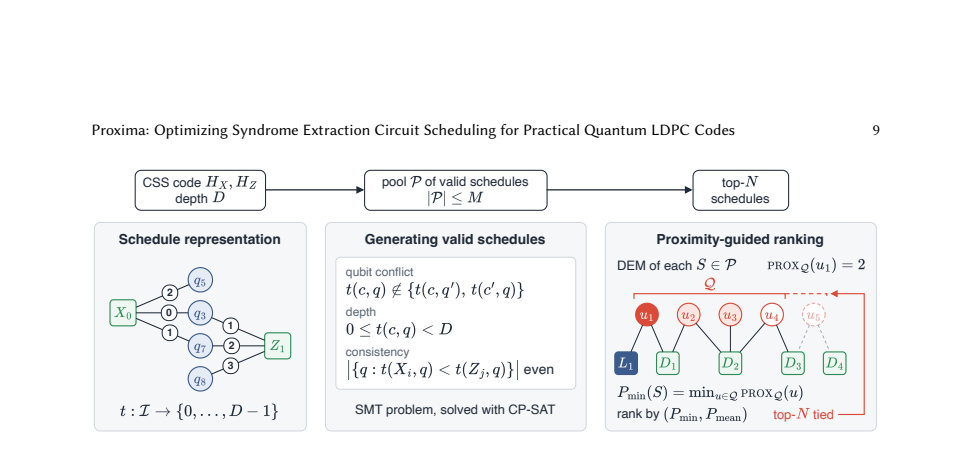
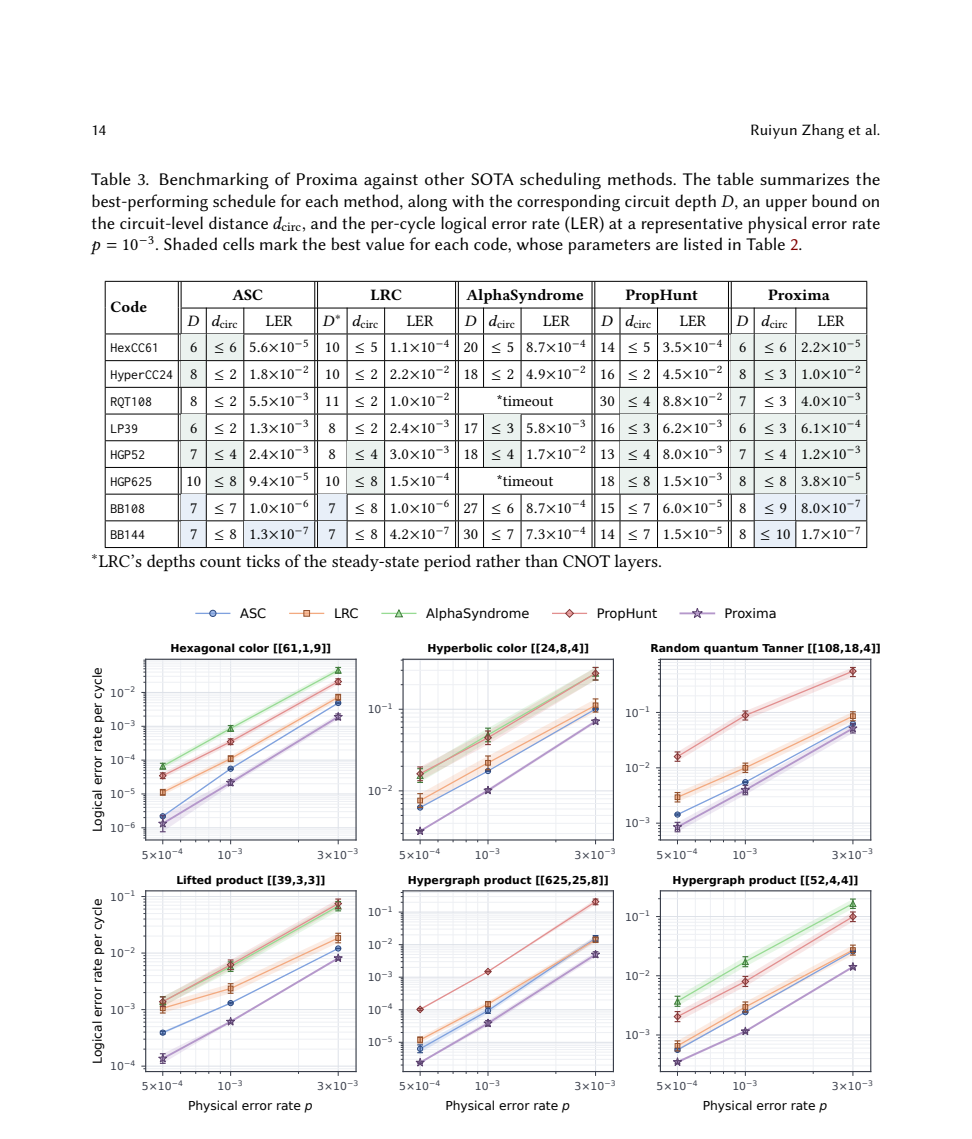
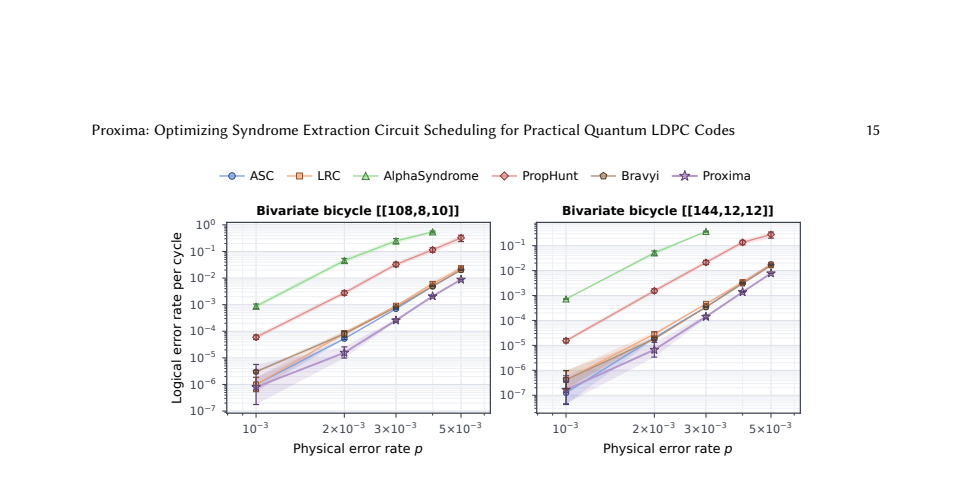
For general CSS-type quantum low-density parity-check (qLDPC) codes, the vast scheduling space and intricate error-propagation patterns make it computationally prohibitive to directly optimize the logical error rate (LER) or the exact circuit-level distance (dcirc). To address this challenge, we introduce Proxima, a highly effective automated SEC scheduling framework guided by a distance-related metric termed proximity. Defined directly on the detector error model (DEM), proximity quantifies the minimum number of additional faults required to complete a seed fault to an undetectable logical failure, naturally capturing arbitrary circuit-level fault mechanisms and bounding dcirc from above. Proxima synthesizes a pool of valid schedules at a target depth and ranks them by evaluating proximity within small, graph-local DEM fault subsets, progressively enlarging the subset only to break ties among top-ranked candidates. Across a broad spectrum of qLDPC code families, Proxima consistently attains low circuit depths and high circuit-level distance bounds, reducing LER by 1.4–2.6× over the strongest automated baseline and up to 40 × over others while generalizing robustly across noise models and decoders. Furthermore, by exploiting translational symmetry via a compact monomial representation, Proxima discovers depth-8 uniform schedules for bivariate bicycle codes that surpass even IBM's depth-7 reference schedule [Nature, 2024] by 2.1–5.1×, establishing the DEM-level proximity as a practical objective for fault-tolerant compilation.
from the abstract
Pith says
Machine review · deepseek-v4-flash · 17 Nov 2026 · read the full text (100,780 characters) · not checked by a person
It can be wrong. Challenge this review or reply to it.
Holds up, with conditions. Proxima introduces a practical, DEM-based surrogate metric (proximity) for ranking syndrome extraction circuit schedules, and the empirical evidence shows consistent LER reductions across a wide range of qLDPC codes. This line is wrong
no objections raised
How often objections from reviews like this one are right: not yet measured
The paper, first character to last
The reviewer was given the whole text, 100,780 characters. Not checked: figures, code, what the 56 references say.
What would settle it
For a specific qLDPC code (e.g., the [[72,12,6]] BB code), one could generate all valid depth-8 uniform schedules, compute their proximity profiles, and then simulate their LERs. If the schedule ranked best by proximity does not have the lowest LER among all schedules (within statistical confidence), the claim that proximity ranking correlates with LER would be falsified for that code.
from Pith's summary of the paper
How the review went
5 passes by deepseek-v4-flash · 17 Nov 2026
- Reader holds up, with conditions
- Skeptic concern not confirmed: listed as an open question
- Referee no objections raised
- Check against the paper kept 0 of 1 objection
- Editor wrote the verdict above
Not run on this paper: the simulated authors' defence.
Pith's passes raised 1 objection. A check against the paper's text kept 0 and left 1 as a question.
The review in full
The review in brief, machine-written
This paper presents Proxima, a framework for scheduling syndrome extraction circuits in CSS-type qLDPC codes. The core idea is a new metric called proximity, defined on the detector error model (DEM), which measures how many additional faults are needed to turn a given fault into an undetectable logical failure. Proxima generates a pool of valid schedules at a target depth and ranks them by evaluating proximity on progressively enlarged local neighborhoods of the DEM graph. The approach is well-motivated: it avoids the prohibitive cost of full LER simulation or exact circuit-level distance computation, while capturing all circuit-level fault mechanisms.
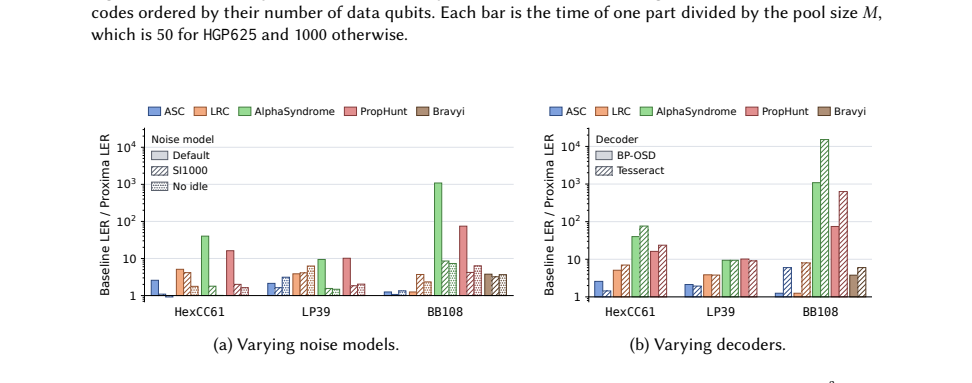
The empirical evaluation is the paper's main strength. Proxima is tested on eight codes spanning six families, against four automated baselines (ASC, LRC, AlphaSyndrome, PropHunt) plus IBM's hand-crafted schedule for BB codes. The results show consistent LER reductions: 1.4-2.6x over the strongest baseline (ASC) and larger margins over others, with the advantage holding across alternative noise models and decoders. The ablation study (RQ3) and sensitivity analysis (RQ5) are well-designed and support the claims. The specialized treatment of BB codes using translational symmetry is clever and yields a depth-8 schedule that outperforms IBM's depth-7 reference.
The soft spots are real but not fatal. First, the paper relies on several concurrent preprints for baselines and tools (LRC, AlphaSyndrome, PropHunt, tropidist) that are not yet peer-reviewed; the comparisons are as fair as possible given the state of the field, but the baselines may evolve. Second, the code and data are not provided (the repo is anonymous and empty), which limits reproducibility. Third, the scalability analysis shows that the method times out on some schedules for HexCC61 and uses a small pool for HGP625, indicating that the approach is not yet turnkey for large codes. Fourth, the proximity metric is an empirical heuristic; the paper acknowledges that the bound from restricted proximity is not tight if the chosen subset does not contain a minimum-weight fault set. The ranking works well in practice but lacks a theoretical guarantee.
Overall, this is a solid and useful contribution. The paper is well-written, the methodology is clear, and the experiments are thorough. The central claim—that proximity-guided ranking finds schedules with lower LER than existing automated methods—is supported by the evidence. The paper deserves a serious peer review. I recommend acceptance after the authors address the reproducibility concern (release code and data) and clarify the limitations of the proximity bound more explicitly in the main text.
The stress test's concern
Not confirmed. Pith could not check this concern against the text of the paper it was given; it is listed as an open question, not a finding.
The referee's report
If the claims hold, this is a significant contribution to fault-tolerant quantum computing compilation. The proximity metric is a novel, analytically motivated surrogate that captures full circuit-level fault mechanisms while being computationally tractable via local neighborhoods. The empirical results are strong, showing consistent improvements across diverse code families, noise models, and decoders. The framework is automated and general, addressing a key bottleneck in practical qLDPC code implementation. The work is timely given the rapid progress in qLDPC codes and the need for practical compilation tools.
Pith's reading of the paper (a machine's summary, not the authors')
The paper introduces Proxima, an automated framework for scheduling the CNOT gates in syndrome extraction circuits (SECs) for CSS-type quantum LDPC codes. The central claim is that Proxima consistently finds schedules with lower logical error rates (LER) than existing automated schedulers (ASC, LRC, AlphaSyndrome, PropHunt) across a broad spectrum of qLDPC code families. The key innovation is a metric called "proximity," defined on the detector error model (DEM), which quantifies how close a single circuit fault is to forming an undetectable logical error. Proxima generates a pool of valid schedules at a target depth, ranks them by proximity evaluated on small, local DEM fault subsets, and progressively enlarges the subset only to break ties. The paper reports that Proxima reduces LER by 1.4–2.6× over the strongest baseline and up to 40× over others, and for bivariate bicycle (BB) codes it discovers depth-8 uniform schedules that surpass IBM's depth-7 reference schedule by 2.1–5.1×. If true, this establishes DEM-level proximity as a practical, structure-aware compiler objective for fault-tolerant quantum computing, bridging the gap between scalable circuit synthesis and physical fault tolerance.
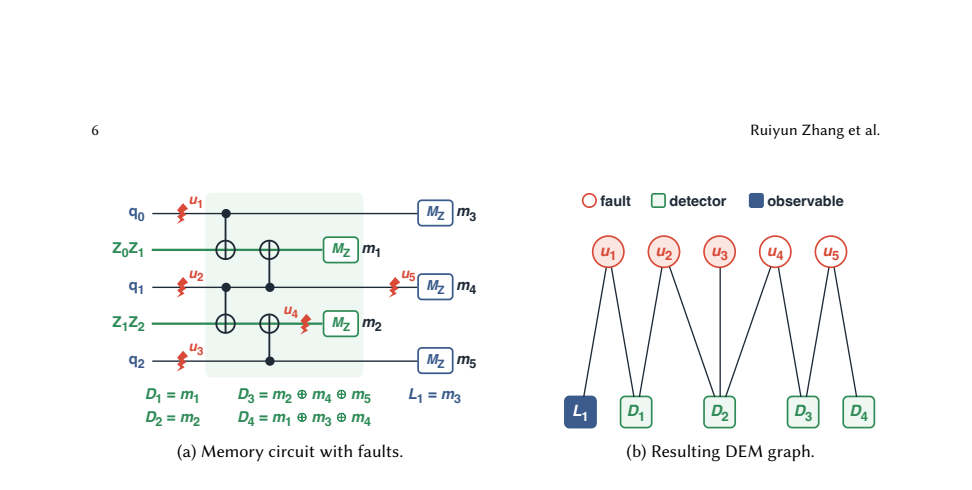
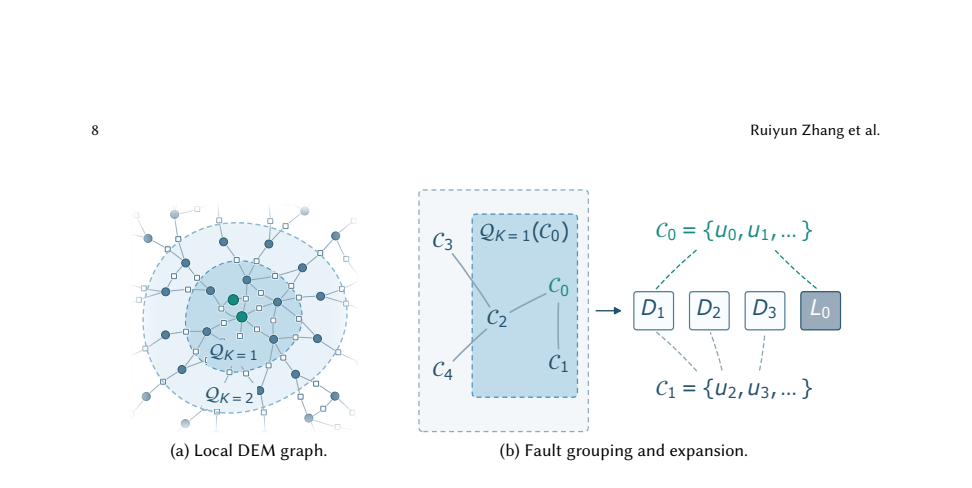
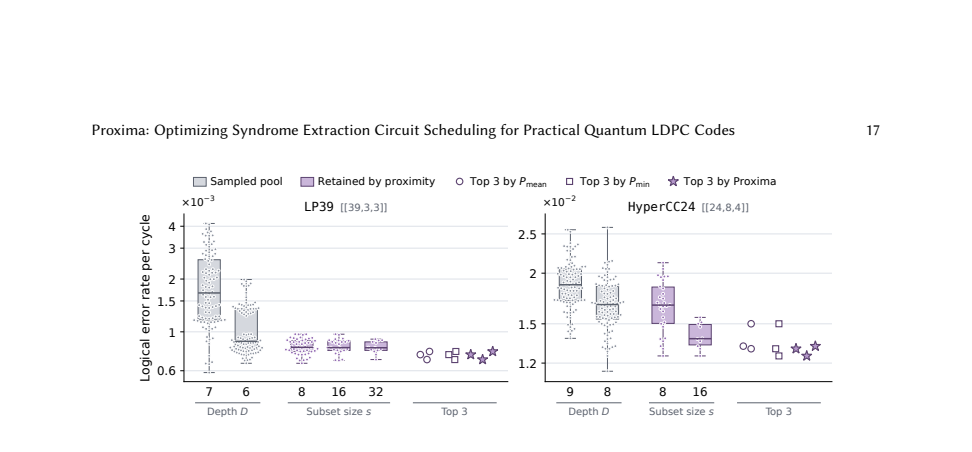
What carries the argument. The central object is the "proximity" metric, defined on the detector error model (DEM) of a syndrome extraction circuit. Proximity of a fault $u_i$ is the minimum number of additional faults needed to complete $u_i$ to an undetectable logical fault set. This metric bounds the circuit-level distance from above and can be evaluated on small, graph-local subsets of the DEM, making it a tractable surrogate for ranking schedules. The framework uses SMT solving to generate a pool of valid schedules at a target depth, then ranks them by proximity, progressively enlarging the fault subset only to break ties among top-ranked candidates.
Core claim. The paper claims that Proxima, an automated SEC scheduling framework guided by the proximity metric, consistently finds schedules with lower logical error rates than existing automated schedulers (ASC, LRC, AlphaSyndrome, PropHunt) across a broad spectrum of qLDPC code families, reducing LER by 1.4–2.6× over the strongest baseline and up to 40× over others, while generalizing robustly across noise models and decoders. For BB codes, it discovers depth-8 uniform schedules that surpass IBM's depth-7 reference schedule by 2.1–5.1×.
The premise it rests on. The proximity metric, computed on a restricted fault subset, provides a ranking that correlates with the true logical error rate across different schedules, and the minimum and mean proximity within a local neighborhood are sufficient to select schedules that will have the lowest LER when simulated and decoded.
If the paper is right (Pith's inferences, not the authors')
Proxima could be integrated into quantum compilers to automatically optimize syndrome extraction circuits for arbitrary CSS qLDPC codes, reducing the need for code-specific heuristics.
The proximity metric provides a way to compare schedules without expensive simulation and decoding, enabling larger-scale schedule optimization.
For BB codes, the monomial representation and uniform schedules found by Proxima could become the new standard baseline for fault-tolerant memory experiments.
The framework's ability to find schedules with lower LER even at the same circuit depth and distance bound suggests that proximity captures finer-grained fault-propagation structure than previous metrics.
The proximity metric could be adapted to optimize other fault-tolerant circuit components, such as state preparation or logical gate operations, where similar DEM-based analysis applies.
The progressive neighborhood enlargement strategy suggests a general principle for surrogate-based optimization in large search spaces: start with a cheap, coarse ranking and refine only the top candidates.
The success of uniform schedules for BB codes hints that translational symmetry may be a powerful heuristic for other structured qLDPC families, potentially reducing the search space dramatically.
The paper's sensitivity analysis shows that Proxima's advantage persists under different noise models and decoders, implying that the proximity metric captures intrinsic fault structure rather than overfitting to a specific decoder or noise assumption.
Check this review
What was read
The passes were given all 100,780 characters of the paper's LaTeX source.
Fingerprint of that text (SHA-256): 756506f7ef1e1cb6fe55b6bd970becfac5097cf4692ab691ec6cf724ab204478
Pith does not keep that text. Rebuilt from the paper's source or PDF by the same code, it has this fingerprint if it is the same text. From a copy of Pith's code:
PYTHONPATH=. python scripts/review_input_check.py 2611.19715
The passes, in the order they ran
- Reader deepseek-v4-flash · medium effort · $0.0041 · instructions of the Reader, fingerprint f9ead7300382…
- Skeptic deepseek-v4-flash · medium effort · $0.0031 · instructions of the Skeptic, fingerprint 8f88c0f61488…
- Referee deepseek-v4-flash · medium effort · $0.0030 · instructions of the Referee, fingerprint a852d99aea0d…
- Check against the paper deepseek-v4-flash · medium effort · $0.0037 · instructions of the Check against the paper, fingerprint 6c7a6883d551…
- Editor deepseek-v4-flash · medium effort · $0.0031 · instructions of the Editor, fingerprint e7211f6a3d27…
- Circularity check deepseek-v4-flash · medium effort · $0.0030 · instructions of the Circularity check, fingerprint e9946e39d67b…
- Summary for the page deepseek-v4-flash · medium effort · temperature 0.2 · $0.0034 · instructions of the Summary for the page, fingerprint e4f56bf568e7…
The passes cost $0.023 in model calls together.
Version stamped on this review: pith-pipeline@v1.4.1-daily-deepseek-or-medium+deepseek/deepseek-v4-flash+p.d60f54226f00
Each link opens a pass's instructions as plain text, the exact bytes its fingerprint was taken over. Every stored set of instructions.
curl -s https://pith.science/methodology/prompts/f9ead730038216984cfb56d7cb34332bdf691828296a1de4245f3d6667d4bf56 | sha256sum
prints the fingerprint of the reader's instructions. The same works for every pass.
The receipt
The review's fingerprint was taken on 17 Nov 2026. The review you are reading still matches it.
Fingerprint of the review (SHA-256): 8f49dc93388719c2d13f0b76fec975185c14aa23eed6125ecdff29a562084749
curl -s 'https://pith.science/api/v1/verdicts/2611.19715?form=canonical' | sha256sum
prints the fingerprint of the review as it stands now. The rule, in four steps.
A matching fingerprint shows the review has not changed since that date. It does not show that the review is right.
How often reviews like this one are right
Reviews like this one: written by deepseek-v4-flash, from the paper's LaTeX source.
How often objections from reviews like this one are right: not yet measured
Reviews by people
This review was written by a machine. No person has reviewed this paper on Pith yet. A scientist listed on Pith can review it for a fee, and their review is published here whatever it concludes.
The paper
Abstract
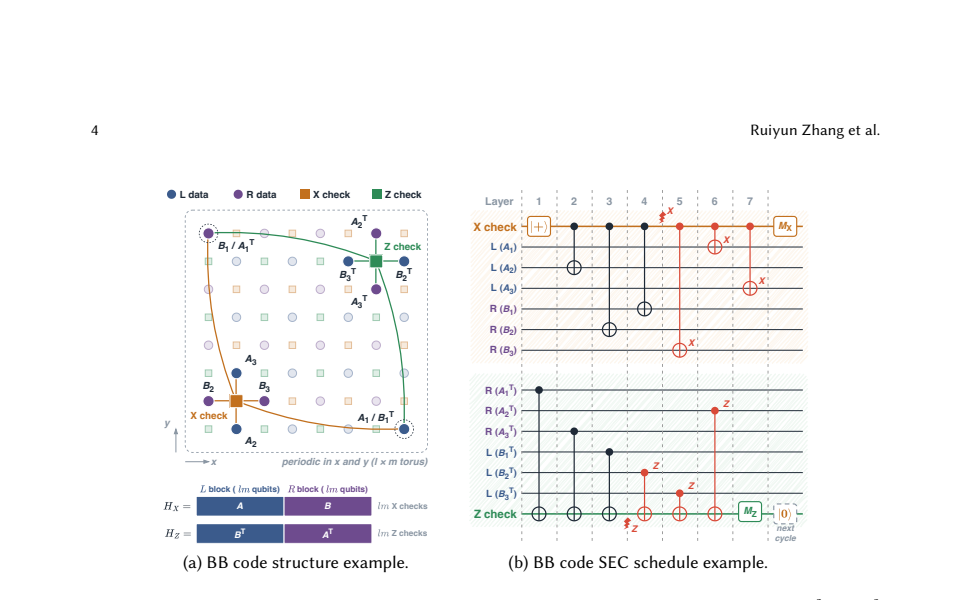
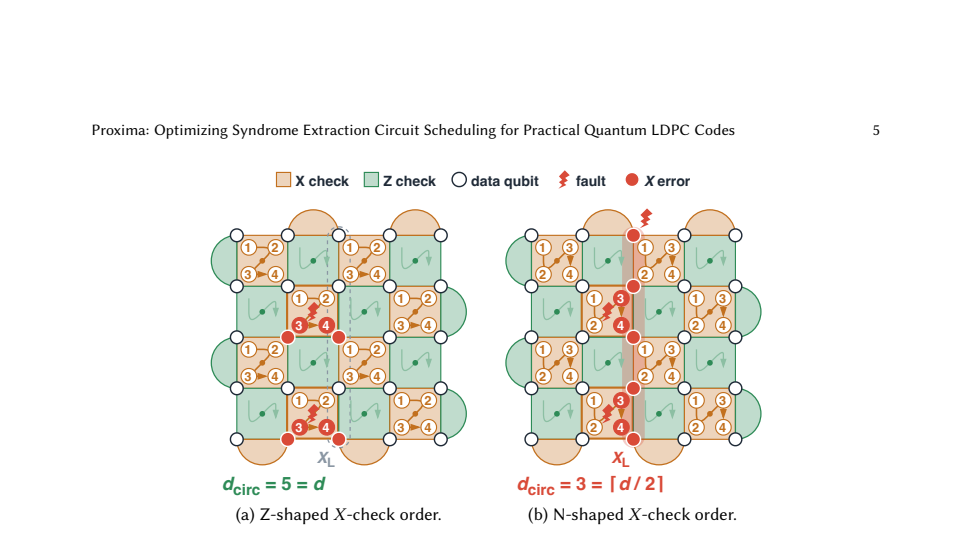
The fault-tolerant performance of quantum error correction codes relies critically on the scheduling of parity checks in syndrome extraction circuits (SECs). For general CSS-type quantum low-density parity-check (qLDPC) codes, the vast scheduling space and intricate error-propagation patterns make it computationally prohibitive to directly optimize the logical error rate (LER) or the exact circuit-level distance (dcirc). To address this challenge, we introduce Proxima, a highly effective automated SEC scheduling framework guided by a distance-related metric termed proximity. Defined directly on the detector error model (DEM), proximity quantifies the minimum number of additional faults required to complete a seed fault to an undetectable logical failure, naturally capturing arbitrary circuit-level fault mechanisms and bounding dcirc from above. Proxima synthesizes a pool of valid schedules at a target depth and ranks them by evaluating proximity within small, graph-local DEM fault subsets, progressively enlarging the subset only to break ties among top-ranked candidates. Across a broad spectrum of qLDPC code families, Proxima consistently attains low circuit depths and high circuit-level distance bounds, reducing LER by 1.4–2.6× over the strongest automated baseline and up to 40 × over others while generalizing robustly across noise models and decoders. Furthermore, by exploiting translational symmetry via a compact monomial representation, Proxima discovers depth-8 uniform schedules for bivariate bicycle codes that surpass even IBM's depth-7 reference schedule [Nature, 2024] by 2.1–5.1×, establishing the DEM-level proximity as a practical objective for fault-tolerant compilation.
The paper's own sentences, arranged, kept beside the review and separate from it. Each label is drawn from a closed vocabulary; the number beside it is the probability the classifier gave that label. No sentence in this record was written by a model.
abstract compiled · 2026-11-17
The authors' main claim, as the classifier picked it out 0.78
“Across a broad spectrum of qLDPC code families, Proxima consistently attains low circuit depths and high circuit-level distance bounds, reducing LER by 1.4--2.6$\times$ over the strongest automated baseline and up to $40\times$ over others while generalizing robustly across noise models and decoders.”
How the main claim is stated: asserted 1.00
What the abstract itself states, as probabilities: claims first 0.07 · states limitation 0.25 · human participants 0.01 · controlled comparison 0.92 · randomized assignment 0.01 · states quantitative result 0.99 · compares with prior results 0.98 · mentions code or data availability 0.03
The abstract, sentence by sentence
This table labels the abstract only (arXiv listing abstract v1). The number is the probability the classifier gave the label.
| Sentence | Role | The authors' own work | States the main conclusion | Strength |
|---|---|---|---|---|
| The fault-tolerant performance of quantum error correction codes relies critically on the scheduling of parity checks in syndrome extraction circuits (SECs). | background 1.00 | 0.06 | 0.03 | asserted 1.00 |
| For general CSS-type quantum low-density parity-check (qLDPC) codes, the vast scheduling space and intricate error-propagation patterns make it computationally prohibitive to directly optimize the logical error rate (LER) or the exact circuit-level distance ($d_{\mathrm{circ}}$). | background 0.52 | 0.09 | 0.02 | asserted 1.00 |
| To address this challenge, we introduce Proxima, a highly effective automated SEC scheduling framework guided by a distance-related metric termed proximity. | contribution 0.99 | 0.92 | 0.14 | asserted 1.00 |
| Defined directly on the detector error model (DEM), proximity quantifies the minimum number of additional faults required to complete a seed fault to an undetectable logical failure, naturally capturing arbitrary circuit-level fault mechanisms and bounding $d_{\mathrm{circ}}$ from above. | method 0.83 | 0.81 | 0.07 | asserted 1.00 |
| Proxima synthesizes a pool of valid schedules at a target depth and ranks them by evaluating proximity within small, graph-local DEM fault subsets, progressively enlarging the subset only to break ties among top-ranked candidates. | method 1.00 | 0.94 | 0.07 | asserted 1.00 |
| Across a broad spectrum of qLDPC code families, Proxima consistently attains low circuit depths and high circuit-level distance bounds, reducing LER by 1.4--2.6$\times$ over the strongest automated baseline and up to $40\times$ over others while generalizing robustly across noise models and decoders. | result 1.00 | 0.96 | 0.62 | asserted 1.00 |
| Furthermore, by exploiting translational symmetry via a compact monomial representation, Proxima discovers depth-8 uniform schedules for bivariate bicycle codes that surpass even IBM's depth-7 reference schedule [Nature, 2024] by 2.1--5.1$\times$, establishing the DEM-level proximity as a practical objective for fault-tolerant compilation. | result 0.96 | 0.92 | 0.42 | asserted 1.00 |
What kind of paper the classifier reports this is: method or tool 1.00 · evidence from simulation or computation 1.00
What was examined, and what was not
Sources read
- arXiv listing abstract v1
Not examined
- full text
- figures and tables
- references and citing sentences
- relations to other papers
Levels run
- P abstract
Not run
- S sections
- T body sentences
- C citations
- R cross-paper relations
How the labels were made
Compiled by classifier-1.13.0 via TypeSafe API, question bank abstract-p1-20260923, 2026-11-17: 1 request, 6,017 input tokens.
Every quoted sentence on this record is the authors'. Every label is from Pith's closed vocabulary, with the probability shown beside it. This record as JSON
Figures (10)
Figures are the authors', reproduced from the paper.
References (56)
- [1] Laleh Aghababaie Beni, Oscar Higgott, and Noah Shutty. 2025. Tesseract: A search-based decoder for quantum error correction.arXiv preprint arXiv:2503.10988(2025) on PithPith's reviewarXiv
- [2] Francesco Battistel, Christopher Chamberland, Kauser Johar, Ramon WJ Overwater, Fabio Sebastiano, Luka Skoric, Yosuke Ueno, and Muhammad Usman. 2023. Real-time decoding for fault-tolerant quantum computing: Progress, challenges and outlook.Nano Futures7, 3 (2023), 032003 on Pith
- [3] H Bombin. 2013. An introduction to topological quantum codes.arXiv preprint arXiv:1311.0277(2013) on PithPith's reviewarXiv
- [4] Hector Bombin and Miguel Angel Martin-Delgado. 2006. Topological quantum distillation.Physical review letters97, 18 (2006), 180501 on Pith
- [5] H Bombin and M A Martin-Delgado. 2007. Exact topological quantum order in D=3 and beyond: Branyons and brane-net condensates.Physical Review B75, 7 (2007), 075103 on Pith
- [6] Sergey Bravyi, Andrew W Cross, Jay M Gambetta, Dmitri Maslov, Patrick Rall, and Theodore J Yoder. 2024. High- threshold and low-overhead fault-tolerant quantum memory.Nature627, 8005 (2024), 778–782 on Pith
- [7] Nikolas P Breuckmann and Jens Niklas Eberhardt. 2021. Quantum low-density parity-check codes.PRX Quantum2, 4 (2021), 040101 on Pith
- [8] A Robert Calderbank and Peter W Shor. 1996. Good quantum error-correcting codes exist.Physical Review A54, 2 (1996), 1098–1105 on Pith
- [9] Bin Cheng, Naixu Guo, and Feng Pan. 2026. Certifying quantum code and circuit distances at scale.arXiv preprint arXiv:2611.08247(2026) on PithPith's reviewarXiv
- [10] Richard Cole, Kirstin Ost, and Stefan Schirra. 2001. Edge-coloring bipartite multigraphs in𝑂(𝐸log𝐷) time.Combina- torica21, 1 (2001), 5–12 on Pith
- [11] Dripto M Debroy, Matt McEwen, Craig Gidney, Noah Shutty, and Adam Zalcman. 2025. LUCI in the surface code with dropouts.Quantum9 (2025), 1936 on Pith
- [12] Eric Dennis, Alexei Kitaev, Andrew Landahl, and John Preskill. 2002. Topological quantum memory.J. Math. Phys.43, 9 (2002), 4452–4505 on Pith
- [13] Peter-Jan H S Derks, Alex Townsend-Teague, Ansgar G Burchards, and Jens Eisert. 2025. Designing fault-tolerant circuits using detector error models.Quantum9 (2025), 1905 on Pith
- [14] Eugenio Durazo Rocha, Olai Å. Mostad, Hsuan-Yin Lin, and Eirik Rosnes. 2026. Local automorphism-aware syndrome compilation for general quantum LDPC codes.arXiv preprint arXiv:2609.40319(2026) on PithPith's reviewarXiv
- [15] Austin G Fowler, Matteo Mariantoni, John M Martinis, and Andrew N Cleland. 2012. Surface codes: Towards practical large-scale quantum computation.Physical Review A86, 3 (2012), 032324 on Pith
- [16] György P Gehér, Ophelia Crawford, and Earl T Campbell. 2024. Tangling schedules eases hardware connectivity requirements for quantum error correction.PRX Quantum5, 1 (2024), 010348 on Pith
- [17] Craig Gidney. 2021. Stim: A fast stabilizer circuit simulator.Quantum5 (2021), 497 on Pith
- [18] Craig Gidney, Michael Newman, Austin Fowler, and Michael Broughton. 2021. A fault-tolerant honeycomb memory. Quantum5 (2021), 605. 22 Ruiyun Zhang et al on Pith
- [19] Google. 2024. OR-Tools: Google’s operations research tools. https://developers.google.com/optimization/. Accessed: 2025-04 on Pith
- [20] Daniel Gottesman. 1997.Stabilizer codes and quantum error correction. Ph. D. Dissertation. California Institute of Technology on Pith
show 36 more
- [21] Daniel Gottesman. 2014. Fault-tolerant quantum computation with constant overhead.Quantum Information and Computation14, 15–16 (2014), 1338–1372 on Pith
- [22] Daniel Gottesman. 2024. Surviving as a quantum computer in a classical world.Textbook manuscript preprint(2024) on Pith
- [23] Oscar Higgott and Craig Gidney. 2025. Sparse Blossom: Correcting a million errors per core second with minimum- weight matching.Quantum9 (2025), 1600 on Pith
- [24] Yuga Hirai, Shota Ikari, Yosuke Ueno, and Yasunari Suzuki. 2026. No more hooks in the surface code: Distance- preserving syndrome extraction for arbitrary layouts at minimum depth.arXiv preprint arXiv:2603.01628(2026) on PithPith's reviewarXiv
- [25] Gilad Kishony and Austin Fowler. 2026. Surface code off-the-hook: Diagonal syndrome-extraction scheduling.arXiv preprint arXiv:2602.09099(2026) on PitharXiv
- [26] Seok-Hyung Lee, Andrew Li, and Stephen D Bartlett. 2025. Color code decoder with improved scaling for correcting circuit-level noise.Quantum9 (2025), 1609 on Pith
- [27] Anthony Leverrier and Gilles Zémor. 2022. Quantum Tanner codes.arXiv preprint arXiv:2202.13641(2022) on PithPith's reviewarXiv
- [28] Yuhao Liu, Shuohao Ping, Junyu Zhou, Ethan Decker, Justin Kalloor, Mathias Weiden, Kean Chen, Yunong Shi, Ali Javadi-Abhari, Costin Iancu, and Gushu Li. 2026. AlphaSyndrome: Tackling the syndrome measurement circuit scheduling problem for QEC codes. InProceedings of the 31st A... on Pith
- [29] Argyris Giannisis Manes and Jahan Claes. 2025. Distance-preserving stabilizer measurements in hypergraph product codes.Quantum9 (2025), 1618 on Pith
- [30] Matt McEwen, Dave Bacon, and Craig Gidney. 2023. Relaxing hardware requirements for surface code circuits using time-dynamics.Quantum7 (2023), 1172 on Pith
- [31] Minh T P Nguyen, Maximilian Rimbach-Russ, and Stefano Bosco. 2026. Disassembling qLDPC codes for depth-optimal parity-check circuits.arXiv preprint arXiv:2608.19917(2026) on PithPith's reviewarXiv
- [32] Michael A Nielsen and Isaac L Chuang. 2010.Quantum Computation and Quantum Information. Cambridge University Press on Pith
- [33] Pavel Panteleev and Gleb Kalachev. 2021. Degenerate quantum LDPC codes with good finite length performance. Quantum5 (2021), 585 on Pith
- [34] Tom Peham, Ludwig Schmid, Lucas Berent, Markus Müller, and Robert Wille. 2025. Automated synthesis of fault- tolerant state preparation circuits for quantum error-correction codes.PRX Quantum6, 2 (2025), 020330 on Pith
- [35] Rebecca Katharina Radebold, Stephen D Bartlett, and Andrew C Doherty. 2025. Explicit instances of quantum Tanner codes.arXiv preprint arXiv:2508.05095(2025) on PitharXiv
- [36] Joschka Roffe. 2022. LDPC: Python tools for low density parity check codes. https://pypi.org/project/ldpc/ on Pith
- [37] Joschka Roffe, David R White, Simon Burton, and Earl Campbell. 2020. Decoding across the quantum low-density parity-check code landscape.Physical Review Research2, 4 (2020), 043423 on Pith
- [38] C. Ryan-Anderson, J. G. Bohnet, K. Lee, D. Gresh, A. Hankin, J. P. Gaebler, D. Francois, A. Chernoguzov, D. Lucchetti, N. C. Brown, T. M. Gatterman, S. K. Halit, K. Gilmore, J. A. Gerber, B. Neyenhuis, D. Hayes, and R. P. Stutz. 2021. Realization of real-time fault-tolerant qu... on Pith
- [39] Shintaro Sato and Yasunari Suzuki. 2025. Scheduling of syndrome measurements with a few ancillary qubits.arXiv preprint arXiv:2508.07913(2025) on PithPith's reviewarXiv
- [40] Mackenzie H Shaw and Barbara M Terhal. 2025. Lowering connectivity requirements for bivariate bicycle codes using morphing circuits.Physical Review Letters134, 9 (2025), 090602 on Pith
- [41] Andrew M Steane. 1996. Error correcting codes in quantum theory.Physical Review Letters77, 5 (1996), 793–797 on Pith
- [42] Armands Strikis, Dan E Browne, and Michael E Beverland. 2026. High-performance syndrome extraction circuits for quantum codes.arXiv preprint arXiv:2603.05481(2026) on PithPith's reviewarXiv
- [43] Daniel Bochen Tan, J. Pablo Bonilla Ataides, Varun Menon, Jin Ming Koh, Andrei C. Diaconu, and Mikhail D. Lukin on Pith
- [44] Yu Tomita and Krysta M Svore. 2014. Low-distance surface codes under realistic quantum noise.Physical Review A90, 6 (2014), 062320 on Pith
- [45] Maxime A Tremblay, Nicolas Delfosse, and Michael E Beverland. 2022. Constant-overhead quantum error correction with thin planar connectivity.Physical Review Letters129, 5 (2022), 050504 on Pith
- [46] Alexander Vardy. 1997. The intractability of computing the minimum distance of a code.IEEE Transactions on Information Theory43, 6 (1997), 1757–1766. Proxima: Optimizing Syndrome Extraction Circuit Scheduling for Practical Quantum LDPC Codes 23 on Pith
- [47] Joshua Viszlai, Satvik Maurya, Swamit Tannu, Margaret Martonosi, and Frederic T Chong. 2026. PropHunt: Automated optimization of quantum syndrome measurement circuits. InProceedings of the 31st ACM International Conference on Architectural Support for Programming Languages and... on Pith
- [48] Q. Xu, J. P. Bonilla Ataides, C. A. Pattison, N. Raveendran, D. Bluvstein, J. Wurtz, B. Vasić, M. D. Lukin, L. Jiang, and H. Zhou. 2024. Constant-overhead fault-tolerant quantum computation with reconfigurable atom arrays.Nature Physics 20 (2024), 1084 on Pith
- [49] John Zhuoyang Ye, Aarav Pabla, and Jens Palsberg. 2026. Reinforcement learning for syndrome extraction.arXiv preprint arXiv:2609.12020(2026) on PithPith's reviewarXiv
- [50] Keyi Yin, Hezi Zhang, Xiang Fang, Yunong Shi, Travis S Humble, Ang Li, and Yufei Ding. 2025. QECC-Synth: A layout synthesizer for quantum error correction codes on sparse architectures. InProceedings of the 30th ACM International Conference on Architectural Support for Program... on Pith
- [51] Theodore J Yoder and Isaac H Kim. 2017. The surface code with a twist.Quantum1 (2017), 2 on Pith
- [52] Kai Zhang, Dingchao Gao, Zhaohui Yang, Runshi Zhou, Fangming Liu, Zhengfeng Ji, and Jianxin Chen. 2026. Optimal compilation of syndrome extraction circuits for general quantum LDPC codes. In2026 Design, Automation & Test in Europe Conference (DATE). IEEE, 1–7 on Pith
- [53] Youwei Zhao, Yangsen Ye, He-Liang Huang, Yiming Zhang, Dachao Wu, Huijie Guan, Qingling Zhu, Zuolin Wei, Tan He, Sirui Cao, Fusheng Chen, Tung-Hsun Chung, Hui Deng, Daojin Fan, Ming Gong, Cheng Guo, Shaojun Guo, Lianchen Han, Na Li, Shaowei Li, Yuan Li, Futian Liang, Jin Lin, ... on Pith
- [54] Runshi Zhou, Fang Zhang, Linghang Kong, Feng Wu, Hui-Hai Zhao, and Jianxin Chen. 2026. Routing-based technique for defect mitigation in quantum error correction.Physical Review A113, 3 (2026), 032401 on Pith
- [55] Chenghong Zhu, Jiahan Chen, Keming He, Hongshun Yao, Zhaohui Yang, Jin-Guo Liu, Anbang Wu, Xiaotong Ni, Xingsheng Luan, Zhuo Fu, Shenggen Zheng, and Xin Wang. 2026. Quantum compiler design for fault-tolerant quantum computing.arXiv preprint arXiv:2609.17465(2026) on PithPith's reviewarXiv
- [2026] Syndrome extraction circuits with near-optimal depths for practical quantum error correcting code families. In Proceedings of the 63rd ACM/IEEE Design Automation Conference (DAC). 1–7 on Pith
Challenges and discussion
Disagree with the review, or know something it missed? Leave a comment, or challenge this review formally: a challenge becomes a permanent entry in this paper's record, and its decision is published here.
Come back by email
A short list of the week's newly reviewed papers. Nothing is sent until you confirm from your inbox, and every email has a link that stops it. No account.
No comments yet.
Sign in to comment