Quantum Physics · arXiv:2611.08247 v1 · submitted 5 Nov 2026 · 69 references
Certifying quantum code and circuit distances at scale
The paper says
“Code and circuit distances characterize how strongly quantum error correction suppresses logical errors and guide code comparisons, schedule choices and resource estimates. Yet many published distances are only upper bounds from heuristic searches.”
more of the abstract
Here, we express both distances as tropical partition functions and evaluate them with rank-based dynamic programming and weight-bounded search. Circuit reductions and relaxations shrink the problems, and proved lower bounds with explicit logical errors of matching weight certify exact values. On two benchmarks, our method certifies more instances than all other tested exact solvers combined. We certify distances for codes with up to 31,200 qubits, such as Google's modular hyperbolic codes, and for memory circuits with up to 8 × 10⁵ fault mechanisms, such as those of high-rate Cornucopia codes. Our audit of 26 recent papers identifies overestimated distances and non-tight upper bounds in 10 papers, with a maximum discrepancy of at least eight. Certified distances also guide circuit design and show which defective chips remain usable. In particular, we certify circuit distance 16 for IBM's two-gross memory circuits with the standard schedule, not the assumed 18, whereas redesigned schedules reach 18 at one noisy cycle, at the cost of one more timestep per cycle. At 99.98% junction yield, keeping gross-code memory blocks with dead checks that are certified at distance 10 or more raises the estimated usable share from 53% for perfect blocks alone to 94% with an improved schedule.
from the abstract
Pith says
Machine review · deepseek-v4-flash · 6 Nov 2026 · what was read was not recorded · not checked by a person
It can be wrong. Challenge this review or reply to it.
The passes disagreed. Reader: holds up, with conditions. Skeptic: agrees with the reader. Referee: accept.
A carefully built exact-distance solver that certifies code and circuit distances at hardware scale, corrects 22 published values in 10 papers (including IBM's two-gross 16 vs 18), and ships its certificates; worth a serious referee, with reconstruction fidelity as the main thing to verify. This line is wrong
5 minor
How often objections from reviews like this one are right: not yet measured
Not checked: figures, code, what the 69 references say.
5 minor objections
The paper says, at Results, 'Reassessing published code and circuit distances'
Pith says: minor objection 1 of 5
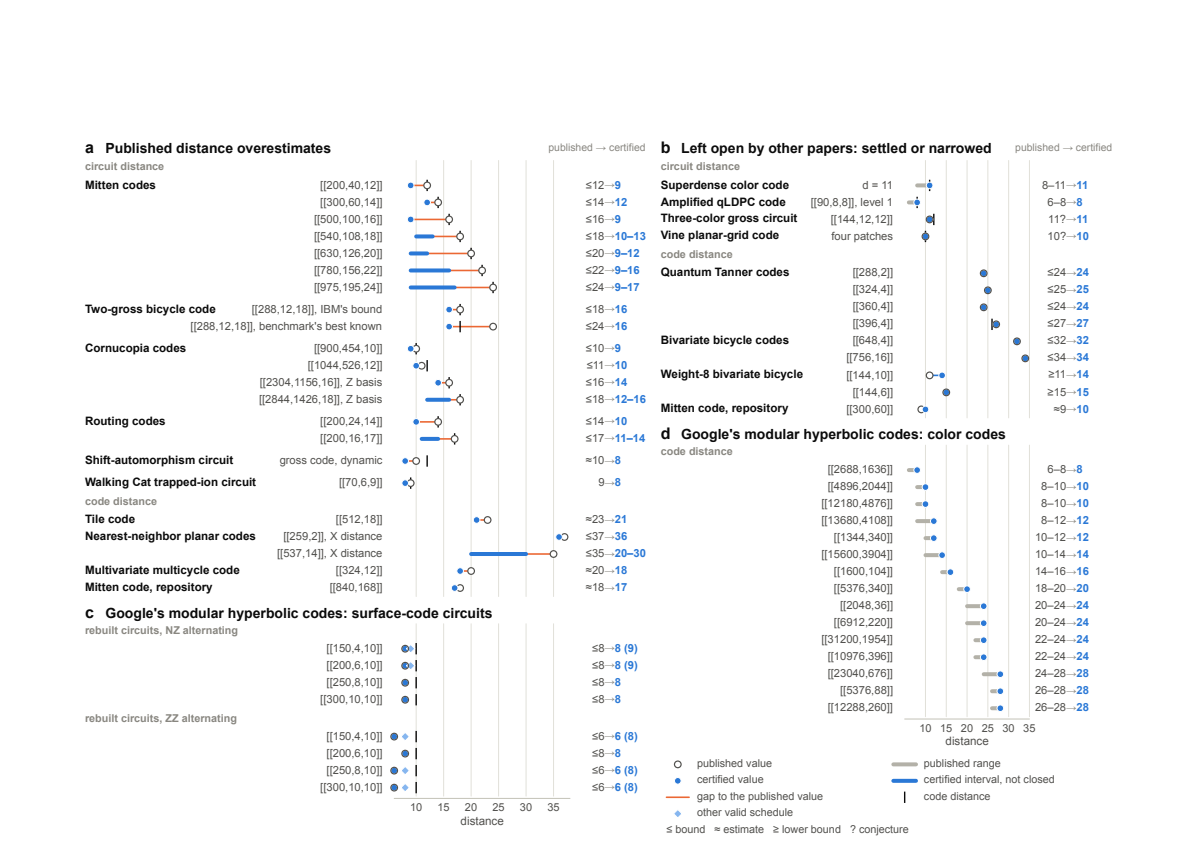
The sentence 'The affected values comprise 17 circuit distances from 7 papers and 5 code distances from 4 papers' followed by 'In 10 papers' can puzzle a reader because 7 plus 4 is 11; please add one sentence explaining the overlap, for example that the mitten repository contributes both a circuit value and a code value in the same entry.
The paper says, at Fig. 3 and Supplementary Section 7
Pith says: minor objection 2 of 5
For the modular hyperbolic codes in Fig. 3d, the exact values are all at the upper endpoints of the published intervals; the figure legend states this only indirectly, so please state explicitly in the caption or in the text that every certified value equals the published range's upper endpoint.
show 3 more
The paper says, at Methods, 'Choosing an evaluator'
Pith says: minor objection 3 of 5
The configuration name 'dp=2' is used before its components are motivated for a reader who does not follow the benchmark section; a single sentence summarizing that this configuration hands a certified lower bound to the truncated DP after the search has had a predicted share of the time budget would make the default configuration self-contained.
This objection may describe the copy Pith gave the reviewer, not the paper.
The paper says, at Data and code availability
Pith says: minor objection 4 of 5
The GitHub repository link is adequate, but since the paper makes strong reproducibility claims, a versioned release with a persistent identifier or a tagged commit corresponding to the reported runs would make the audit and benchmark results easier to verify in the long term.
The paper says, at Supplementary Section 5.5.2
Pith says: minor objection 5 of 5
The description of the earlier kernel bug and the forced-collision test is welcome and unusually transparent, but it is currently embedded in the main correctness argument; consider moving it to a clearly marked implementation note or reproducibility remark so that readers do not mistake a historical defect for a caveat about the reported values.
What would settle it
Run the repository's certificate verifier on the two headline circuits: for the Cornucopia [[2304,1156,16]] 8-cycle Z-basis circuit, replay the recorded weight-14 fault set in the full unreduced Stim circuit and re-run the weight-13 exclusion on the collapsed problem, then programmatically verify the identical-round condition by comparing detector error model columns across rounds; for the IBM [[288,12,18]] 18-cycle circuit, similarly replay the weight-16 error and verify the full-circuit lower-bound record. If any replay fails, or any round differs, the corresponding certified value is unsupported.
from the skeptic's reading
How the review went
4 readings by deepseek-v4-flash · 6 Nov 2026
- Reader holds up, with conditions
- Skeptic partly agrees
- Editor wrote the verdict above
- Referee accept: 5 minor
Not run on this paper: the simulated authors' defence.
Pith did not check this review's objections against the paper.
The review in full
The review in brief, machine-written
Read this one. The headline result is that exact, certified distance computation is now practical at the scale of proposed hardware, and the audit corrects 22 published values in 10 papers — most notably IBM's two-gross memory circuit at 16, not the 18 the architecture study assumes, and not the 24 the distance-methods benchmark lists. If those numbers stand, resource estimates and logical-rate extrapolations inherit exact values where they previously used heuristic upper bounds.
What is actually new: the distance problems are expressed as tropical partition functions and evaluated by three exact evaluators (rank DP, truncated rank DP, weight-bounded search) with reductions, lower bounds, and lifting; every certificate pairs a proved lower bound with an explicit matching-weight error replayed in Stim. The scale is real: codes up to 31,200 qubits, circuits up to 8e5 fault mechanisms, plus an exhaustive schedule study covering 33,984 certified distances. The paper also discloses its own limitations in detail — provenance classes A/P/R, intervals where exact values remain out of reach, and numbering-dependent values excluded unless every numbering agrees. That honesty raises my confidence in the parts that remain.
The soft spots are in proportion. The largest circuit instances rest on the time-collapse reduction, which assumes identical syndrome rounds that carry data errors through unchanged; the paper states the condition, proves the collapsed distance is a lower bound for any round count, and lifts to fixed round counts. That is a stated premise, not a hidden one, but a round-dependent or permuting schedule would break it. The second risk is mechanical reconstruction fidelity of the R-class circuits (Cornucopia, routing, Walking Cat, planar codes). Rebuilding from the text and matching one published exact value is good hygiene, but it does not guarantee every check-term numbering matches the original intended circuit. The authors handle numbering sensitivity carefully; the remaining work is spot-checking the rebuilds, not fixing a structural gap. The chip-yield estimates mix sampled chips with binomial interpolation — the text says so, but those percentages should not be quoted without the modeling assumptions.
I do not find a load-bearing flaw, and I disagree with treating the round-collapse premise as one: it is proved in the supplement with its hypotheses stated. The conditions are verification tasks. This paper is for anyone doing qLDPC architecture studies, schedule design, or logical-rate extrapolation, and for the exact-distance solver community. Send it to peer review; it deserves a serious referee, and the audit needs checking and, if it holds, adopting.
The strongest objection
The central claim is that exact certified distances are computable at hardware scale and that the audit's corrected values are correct. The most scrutiny-sensitive part is the round-collapse reduction underlying the largest circuit instances. The paper does not leave this as a bare assumption: Supplementary Section 5.4 states the identical-round condition (repeated identical rounds that carry every Pauli error on the data qubits through unchanged), proves that the collapsed distance is a lower bound for any number of rounds, and explicitly notes that a round permuting the data qubits would break the argument. Exactness is then obtained by lifting minimum collapsed solutions to circuit fault sets for a fixed number of rounds, with every reported error checked against the matrices and, for circuits, inserted into the noiseless Stim circuit. The sector reduction is likewise stated with its exactness condition, and the authors say it is checked for every circuit (Fig. 1b and Methods). The audit's provenance risk is disclosed through the A/P/R classes, and values depending on unspecified check-term numberings are excluded unless every numbering agrees. The remaining unknown values are acknowledged as intervals or lower bounds, including Cornucopia [[2844,1426,18]], mitten circuits from n=540, planar [[537,14]], and IBM [[756,16,34]]. I therefore do not find a load-bearing flaw; the reader's conditions are verification tasks rather than identified failures.
The reader's weakest assumption points to the right place: the time-collapse reduction is what lets the method reach 8e5-mechanism circuits, so it deserves scrutiny. I checked the supplement rather than stopping at the main-text summary. Section 5.4 gives the reduction as a proved statement with explicit hypotheses, and the Methods describe lifting as a separate fixed-round step, so exact headline values do not rest on one-cycle upper bounds alone. The audit's reconstruction choices are documented in Supplementary Section 7, and values that depend on unpublished numberings are excluded unless robust to all numberings. The paper also states its limitations plainly, including intervals that remain open. In view of the benchmark comparisons, the independent benchmark agreement, and the explicit certificate format, the central claim appears structurally sound. The remaining risks are mechanical: confirming that the shipped scripts reproduce the recorded certificates and that every audited circuit satisfies the stated identical-round condition. That is a verification task, not a demonstrated flaw, so the reader's CONDITIONAL verdict should stand without strengthening.
The referee's report
If the reported results hold, this is a substantial methodological advance: circuit and code distances in hardware-relevant regimes are obtained as certified exact values rather than heuristic upper bounds, and the explicit minimum fault sets yield decoder-independent consequences for logical error rates. The claimed scales are meaningful for current architecture proposals and for resource estimates. The paper's strengths include explicit certificates for every reported value, fault sets replayed in Stim, a public software repository, a reproducible benchmark harness, and an audit that first reproduces previously exact published values before reporting corrections. The main modeling premise behind the largest circuit instances, the identical-round time collapse, is not left implicit: Supplementary Section 5.4 states the condition, proves that the collapsed distance is a valid lower bound for any number of identical rounds, and notes that a round permuting the data qubits would break the argument; the sector-lifting condition is stated to be checked for every circuit.
Pith's reading of the paper (a machine's summary, not the authors')
This paper claims that the two numbers governing how strongly quantum error correction suppresses errors — code distance and circuit distance — can be computed exactly and certified at the scale of current hardware proposals, instead of being merely upper-bounded by heuristic searches. The authors unify both distances as a single tropical partition function and evaluate it with three exact algorithms, pairing each proved lower bound with an explicit minimum-weight error; circuit fault sets are replayed in simulation. They certify code distances up to 31,200 qubits and circuit distances for memories with up to $8\times 10^5$ fault mechanisms, and on two benchmarks certify more instances than all other tested exact solvers combined. Their audit of 26 recent papers finds 22 published distance values in 10 papers are overestimates, including circuit distance 16 rather than the assumed 18 for IBM's two-gross memory with the standard schedule, and they show that redesigned schedules reach 18 on one noisy cycle at the cost of one extra timestep per cycle. If correct, resource estimates, code comparisons, and logical-error-rate extrapolations for planned machines inherit proven distances, and defective fabricated chips certified at distance 10 or more lift the usable share of gross-code memory blocks from 53% to 94%.
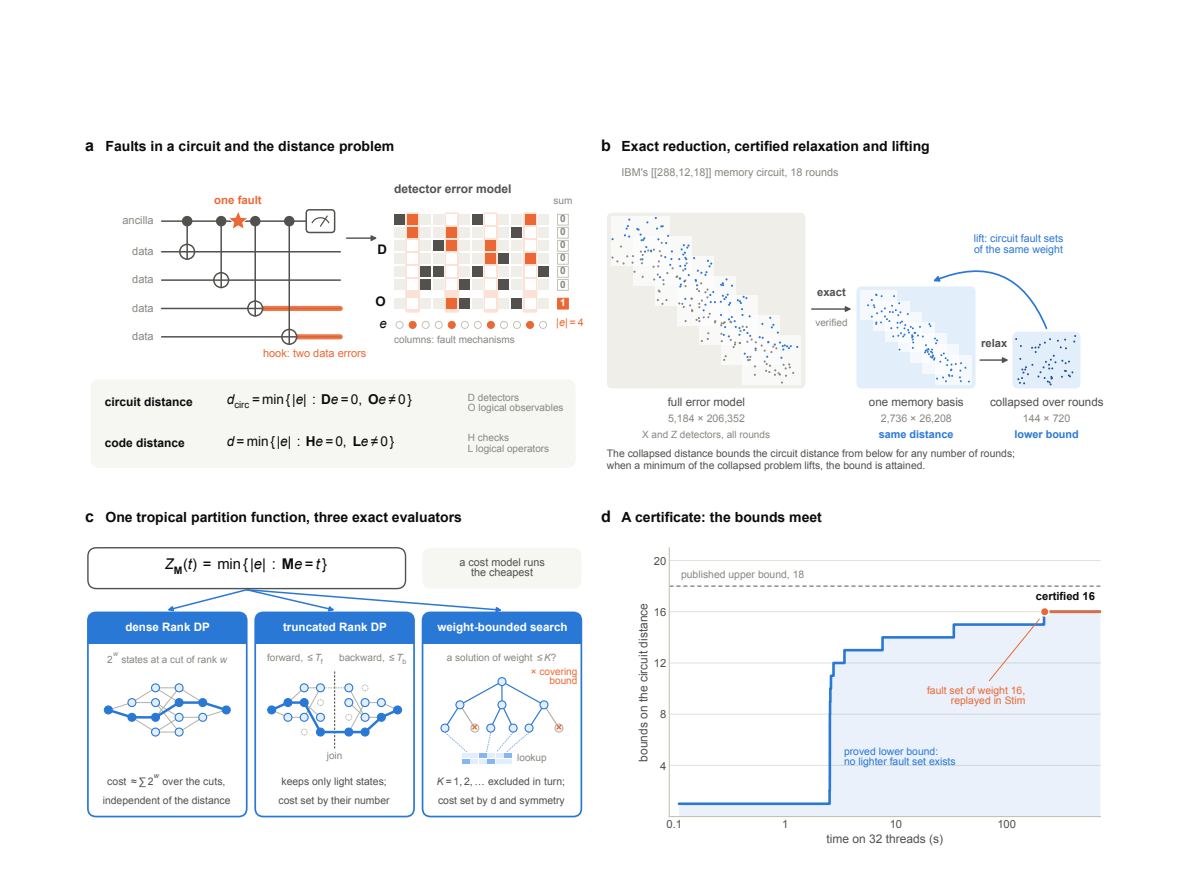
What carries the argument. The central object is the tropical partition function $Z_M(t)=\min\{|e|: Me=t\}$, the least weight of a binary vector satisfying a linear system, which unifies the code distance (least weight of a zero-syndrome logical error) and the circuit distance (least weight of an undetectable fault set in a detector error model). Three exact evaluators carry the computation: a dense rank-based dynamic program whose table has $2^{\omega}$ states at a cut of rank $\omega$; a weight-truncated bidirectional rank DP that merges only light partial solutions; and a weight-bounded search that branches on an unsatisfied syndrome row, prunes with a covering bound, and finishes with a completion-table lookup. Two reductions supply the scale: sector reduction restricts a memory circuit to one measurement basis and is exact when every column lifts without firing detectors outside the sector, and time collapse sums each check's detectors over repeated identical rounds, yielding a lower bound for any number of rounds that becomes certified exact when a minimum collapsed solution lifts to a circuit fault set of the same weight. A certificate pairs a proved lower bound with a verified error of matching weight, replayed for circuits in simulation.
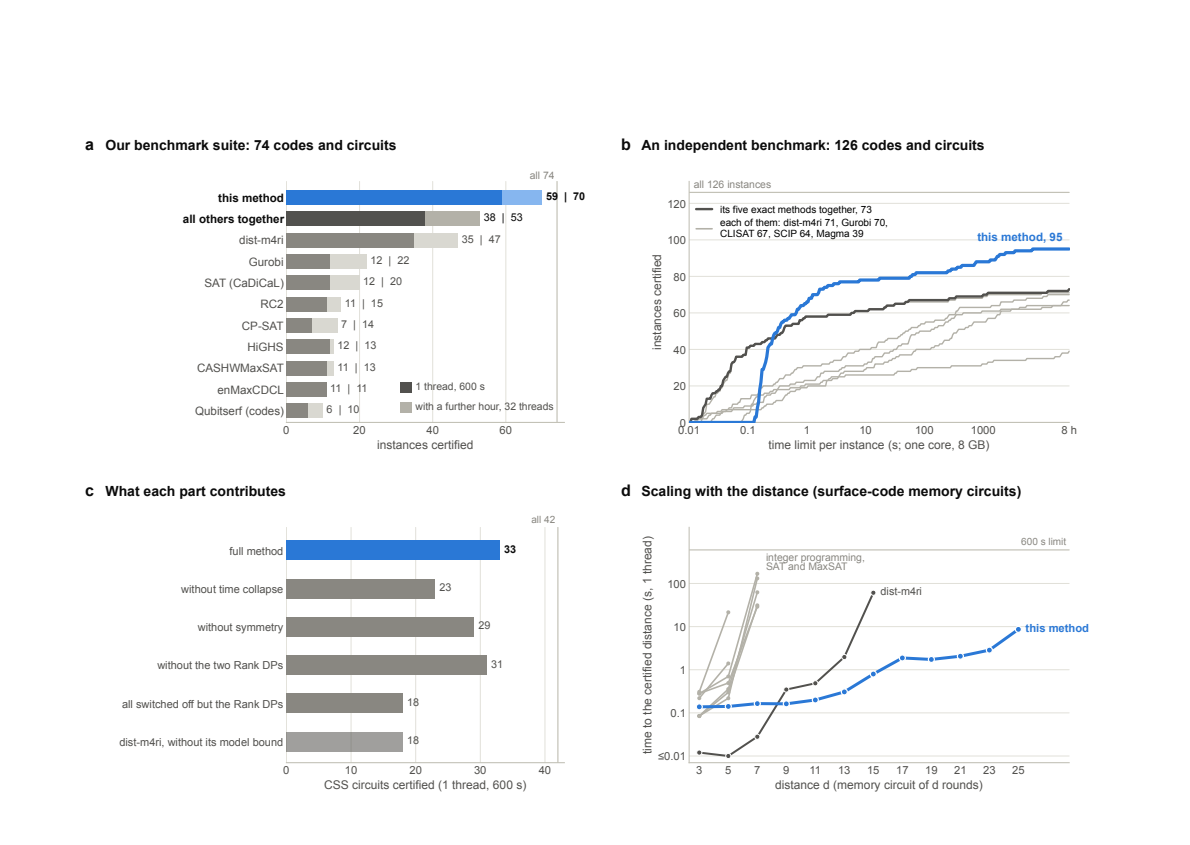
Core claim. The paper's central claim is that the minimum-weight problems behind both quantities — the least error vector with zero syndrome that flips a logical observable — are solvable exactly, with certificates, at the sizes of circuits now proposed for hardware. Distances are expressed as tropical partition functions, the zero-temperature limit of a free energy in the min-plus semiring, and evaluated by a dense rank-based dynamic program whose cost is set by cut rank, a weight-truncated bidirectional dynamic program, and a weight-bounded search; a certified value consists of a proof that no lighter error exists plus an explicit error of that weight. On the paper's own suite the method certifies 70 of 74 instances across two tiers, against 53 for all other exact solvers combined, and 95 of 126 instances on an independent benchmark whose five exact methods together certify 73. The audit concludes that 22 reported values in 10 papers overestimate the true distance, while previously open or bracketed values — the superdense color-code circuit at 11, quantum Tanner code distances up to 26, modular hyperbolic code distances up to 24 — are settled exactly. For hardware, the paper certifies circuit distance 16 for IBM's two-gross memory with the standard schedule rather than the assumed 18, shows that some eight-fault configurations make every decoder fail under that schedule, and certifies that an improved eight-timestep schedule keeps distance 10 on gross-code chips with dead checks, raising the estimated usable share of blocks to 94% at 99.98% junction yield.
The premise it rests on. The large certified circuit distances assume that every audited memory consists of identical, unpermuted syndrome rounds in which data errors pass through unchanged, so that summing each check's detectors over rounds yields a lower bound that lifts exactly; a published circuit whose rounds are round-dependent or permuting would not automatically inherit the certified value.
If the paper is right (Pith's inferences, not the authors')
Architecture studies that assume distances, such as the assumed 18 for IBM's two-gross memory, must be re-evaluated: the certified value 16 changes the leading exponent of the predicted logical error rate, and the Cornucopia [[2844,1426,18]] extrapolation's leading order becomes at most $p^8$, not $p^9$.
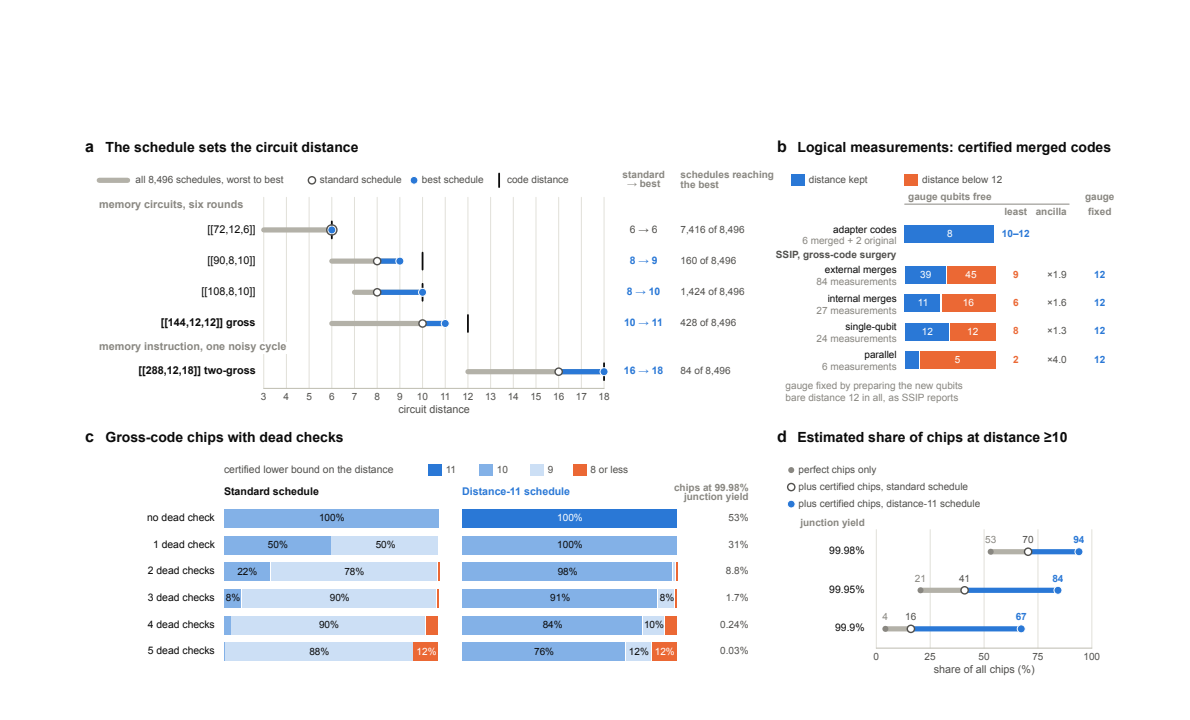
Schedule design can be exhaustive rather than heuristic: computing all 8,496 uniform depth-seven one-ancilla schedules of four bivariate bicycle codes shows the standard schedule is optimal for only one of them, and 84 redesigned two-gross schedules reach circuit distance 18 on one noisy cycle.
Logical-measurement constructions carry protocol-dependent distances: SSIP's merged gross-code blocks are all at bare distance 12, but dressed distance falls below 12 in 78 of 141 measurements unless the gauge qubits are fixed, so a certificate-bearing tool can choose the smallest ancilla system that keeps the claimed distance.
Chip certification converts fabrication defects into usable resources: gross-code blocks with dead checks certified at distance 10 or more raise the estimated usable share from 53% to 94% at 99.98% junction yield when a distance-11 schedule is used.
Explicit minimum fault sets give decoder-independent error-rate bounds: with the standard schedule, every decoder fails on some eight-fault configurations of the two-gross memory, whereas the architecture study's extrapolation assumed nothing fails below nine faults.
Editorial extension: the audit's pattern — the largest gaps occur where schedules were claimed to preserve the code distance on the strength of a randomized estimator — supports treating any heuristic distance value for high-weight-check qLDPC circuits as an upper bound until certified.
Editorial extension: the certificate format (proved lower bound plus an explicit minimum error set replayed in simulation) is a natural artifact standard for future code and circuit publications, letting architecture studies consume proven distances instead of trusting search outputs.
Editorial extension: the round-collapse premise implies that non-uniform schedules — round-dependent gate orders, permuting rounds, or mid-memory idling patterns — each need their own certification, so extending the pipeline to genuinely time-varying memories is the direct next test.
Editorial extension: the same minimum-weight machinery transfers to classical quasi-cyclic LDPC codes and to the light-vector search problems underlying code-based cryptography, where certified distances of small structured instances could probe security estimates without approaching cryptographic sizes.
Check this review
Pith stored no record of this review's passes and took no fingerprint of it. Reviews made by code from 13 Nov 2026 on carry both.
How often reviews like this one are right
Reviews like this one: written by deepseek-v4-flash, where what was read was not recorded.
How often objections from reviews like this one are right: not yet measured
Reviews by people
This review was written by a machine. No person has reviewed this paper on Pith yet. A scientist listed on Pith can review it for a fee, and their review is published here whatever it concludes.
The paper
Abstract
Code and circuit distances characterize how strongly quantum error correction suppresses logical errors and guide code comparisons, schedule choices and resource estimates. Yet many published distances are only upper bounds from heuristic searches. Here, we express both distances as tropical partition functions and evaluate them with rank-based dynamic programming and weight-bounded search. Circuit reductions and relaxations shrink the problems, and proved lower bounds with explicit logical errors of matching weight certify exact values. On two benchmarks, our method certifies more instances than all other tested exact solvers combined. We certify distances for codes with up to 31,200 qubits, such as Google's modular hyperbolic codes, and for memory circuits with up to 8 × 10⁵ fault mechanisms, such as those of high-rate Cornucopia codes. Our audit of 26 recent papers identifies overestimated distances and non-tight upper bounds in 10 papers, with a maximum discrepancy of at least eight. Certified distances also guide circuit design and show which defective chips remain usable. In particular, we certify circuit distance 16 for IBM's two-gross memory circuits with the standard schedule, not the assumed 18, whereas redesigned schedules reach 18 at one noisy cycle, at the cost of one more timestep per cycle. At 99.98% junction yield, keeping gross-code memory blocks with dead checks that are certified at distance 10 or more raises the estimated usable share from 53% for perfect blocks alone to 94% with an improved schedule.
The paper's own sentences, arranged, kept beside the review and separate from it. Each label is drawn from a closed vocabulary; the number beside it is the probability the classifier gave that label. No sentence in this record was written by a model.
abstract compiled · 2026-11-06
The authors' main claim, as the classifier picked it out 0.41
“On two benchmarks, our method certifies more instances than all other tested exact solvers combined.”
How the main claim is stated: asserted 1.00
What the abstract itself states, as probabilities: claims first 0.07 · states limitation 0.25 · human participants 0.02 · controlled comparison 0.49 · randomized assignment 0.01 · states quantitative result 0.99 · compares with prior results 0.97 · mentions code or data availability 0.03
The abstract, sentence by sentence
This table labels the abstract only (arXiv listing abstract v1). The number is the probability the classifier gave the label.
| Sentence | Role | The authors' own work | States the main conclusion | Strength |
|---|---|---|---|---|
| Code and circuit distances characterize how strongly quantum error correction suppresses logical errors and guide code comparisons, schedule choices and resource estimates. | background 1.00 | 0.05 | 0.04 | asserted 1.00 |
| Yet many published distances are only upper bounds from heuristic searches. | gap 0.98 | 0.05 | 0.03 | asserted 0.95 |
| Here, we express both distances as tropical partition functions and evaluate them with rank-based dynamic programming and weight-bounded search. | method 0.88 | 0.96 | 0.11 | asserted 1.00 |
| Circuit reductions and relaxations shrink the problems, and proved lower bounds with explicit logical errors of matching weight certify exact values. | method 0.99 | 0.87 | 0.15 | asserted 1.00 |
| On two benchmarks, our method certifies more instances than all other tested exact solvers combined. | result 0.99 | 0.96 | 0.26 | asserted 1.00 |
| We certify distances for codes with up to 31,200 qubits, such as Google's modular hyperbolic codes, and for memory circuits with up to $8\times10^5$ fault mechanisms, such as those of high-rate Cornucopia codes. | result 0.91 | 0.95 | 0.19 | asserted 1.00 |
| Our audit of 26 recent papers identifies overestimated distances and non-tight upper bounds in 10 papers, with a maximum discrepancy of at least eight. | result 0.97 | 0.93 | 0.14 | asserted 1.00 |
| Certified distances also guide circuit design and show which defective chips remain usable. | interpretation 0.90 | 0.65 | 0.11 | asserted 1.00 |
| In particular, we certify circuit distance 16 for IBM's two-gross memory circuits with the standard schedule, not the assumed 18, whereas redesigned schedules reach 18 at one noisy cycle, at the cost of one more timestep per cycle. | result 1.00 | 0.94 | 0.11 | asserted 1.00 |
| At 99.98% junction yield, keeping gross-code memory blocks with dead checks that are certified at distance 10 or more raises the estimated usable share from 53% for perfect blocks alone to 94% with an improved schedule. | result 0.80 | 0.90 | 0.12 | asserted 1.00 |
What kind of paper the classifier reports this is: method or tool 1.00 · evidence from simulation or computation 0.98
What was examined, and what was not
Sources read
- arXiv listing abstract v1
Not examined
- full text
- figures and tables
- references and citing sentences
- relations to other papers
Levels run
- P abstract
Not run
- S sections
- T body sentences
- C citations
- R cross-paper relations
How the labels were made
Compiled by classifier-1.13.0 via TypeSafe API, question bank abstract-p1-20260923, 2026-11-06: 1 request, 7,624 input tokens.
Every quoted sentence on this record is the authors'. Every label is from Pith's closed vocabulary, with the probability shown beside it. This record as JSON
Figures (4)
Figures are the authors', reproduced from the paper.
References (69)
- [1] Beverland, M. E.et al.Assessing requirements to scale to practical quantum advantage. Preprint at https: //arxiv.org/abs/2211.07629 (2022) on PithPith's reviewarXiv
- [2] Gidney, C. How to factor 2048 bit RSA integers with less than a million noisy qubits. Preprint at https: //arxiv.org/abs/2505.15917 (2025) on PithPith's reviewarXiv
- [3] Shor, P. W. Scheme for reducing decoherence in quantum computer memory.Phys. Rev. A52, R2493–R2496 (1995) on Pith
- [4] Dennis, E., Kitaev, A., Landahl, A. & Preskill, J. Topological quantum memory.J. Math. Phys.43, 4452–4505 (2002) on Pith
- [5] Fowler, A. G., Mariantoni, M., Martinis, J. M. & Cleland, A. N. Surface codes: towards practical large-scale quantum computation.Phys. Rev. A86, 032324 (2012) on Pith
- [6] Google Quantum AI and Collaborators. Quantum error correction below the surface code threshold.Nature638, 920–926 (2025) on Pith
- [7] Bluvstein, D.et al.Logical quantum processor based on reconfigurable atom arrays.Nature626, 58–65 (2024) on Pith
- [8] Gottesman, D. Fault-tolerant quantum computation with constant overhead.Quantum Inf. Comput.14, 1338–1372 (2014) on Pith
- [9] Breuckmann, N. P. & Eberhardt, J. N. Quantum low-density parity-check codes.PRX Quantum2, 040101 (2021) on Pith
- [10] Bravyi, S.et al.High-threshold and low-overhead fault-tolerant quantum memory.Nature627, 778–782 (2024) on Pith
- [11] Yoder, T. J.et al.Tour de gross: a modular quantum computer based on bivariate bicycle codes. Preprint at https://arxiv.org/abs/2506.03094 (2025) on PithPith's reviewarXiv
- [12] IBM Quantum. IBM Quantum roadmap (2025). https://www.ibm.com/quantum-computing/roadmap, accessed October 2026 on Pith
- [13] McEwen, M., Bacon, D. & Gidney, C. Relaxing hardware requirements for surface code circuits using time- dynamics.Quantum7, 1172 (2023) on Pith
- [14] Gidney, C. Stim: a fast stabilizer circuit simulator.Quantum5, 497 (2021) on Pith
- [15] Vardy,A. Theintractabilityofcomputingtheminimumdistanceofacode.IEEETrans.Inf.Theory43,1757–1766 (1997) on Pith
- [16] Roffe, J., White, D. R., Burton, S. & Campbell, E. T. Decoding across the quantum LDPC code landscape.Phys. Rev. Res.2, 043423 (2020) on Pith
- [17] Pryadko, L. P., Shabashov, V. A. & Kozin, V. K. QDistRnd: A GAP package for computing the distance of quantum error-correcting codes.J. Open Source Softw.7, 4120 (2022) on Pith
- [18] Beni, L. A., Higgott, O. & Shutty, N. Tesseract: a search-based decoder for quantum error correction. Preprint at https://arxiv.org/abs/2503.10988 (2025) on PithPith's reviewarXiv
- [19] Dumer, I., Kovalev, A. A. & Pryadko, L. P. Distance verification for classical and quantum LDPC codes.IEEE Trans. Inf. Theory63, 4675–4686 (2017) on Pith
- [20] dist-m4ri (2026). Version 0.14.7 (commit bed621e); github.com/QEC-pages/dist-m4ri on Pith
show 49 more
- [21] Webster, M., Jacob, A. & Higgott, O. Distance-finding algorithms for quantum codes and circuits. Preprint at https://arxiv.org/abs/2603.22532 (2026) on PithPith's reviewarXiv
- [22] Liu, J.-G., Wang, L. & Zhang, P. Tropical tensor network for ground states of spin glasses.Phys. Rev. Lett.126, 090506 (2021) on Pith
- [23] Sommers, G. M., Huse, D. A. & Gullans, M. J. Dynamically generated concatenated codes and their phase diagrams.Phys. Rev. Res.7, 023086 (2025) on Pith
- [24] Cheng, B. & Pan, F. Exact maximum likelihood decoding beyond treewidth via rank-decomposition dynamic programming. Preprint at https://arxiv.org/abs/2609.39556 (2026) on PithPith's reviewarXiv
- [25] Cunningham, W. H. & Geelen, J. On integer programming and the branch-width of the constraint matrix. In Integer Programming and Combinatorial Optimization (IPCO 2007), vol. 4513 ofLecture Notes in Computer Science, 158–166 (Springer, 2007) on Pith
- [26] Kashyap, N. On minimal tree realizations of linear codes.IEEE Trans. Inf. Theory55, 3501–3519 (2009) on Pith
- [27] Forney, G. D. Dimension/length profiles and trellis complexity of linear block codes.IEEE Trans. Inf. Theory40, 1741–1752 (1994) on Pith
- [28] Jeong, J., Kim, E. J. & Oum, S. The “art of trellis decoding” is fixed-parameter tractable.IEEE Trans. Inf. Theory 63, 7178–7205 (2017). 16 on Pith
- [29] Bocharova, I. E., Handlery, M., Johannesson, R. & Kudryashov, B. D. A BEAST for prowling in trees.IEEE Trans. Inf. Theory50, 1295–1302 (2004) on Pith
- [30] Stern, J. A method for finding codewords of small weight. InCoding Theory and Applications, vol. 388 ofLecture Notes in Computer Science, 106–113 (Springer, 1989) on Pith
- [31] Strikis, A., Browne, D. E. & Beverland, M. E. High-performance syndrome extraction circuits for quantum codes. Preprint at https://arxiv.org/abs/2603.05481 (2026) on PithPith's reviewarXiv
- [32] Liang, Z., Gu, B., Chen, Y.-A., Eisert, J. & Wang, Z. Ultra-high-distance quantum memories from amplified qLDPC codes. Preprint at https://arxiv.org/abs/2609.37231 (2026) on PithPith's reviewarXiv
- [33] Qubitserf (2026). Version 0.1.0 (commit ab96b9c); github.com/Quantinuum/Qubitserf on Pith
- [34] Huangfu, Q. & Hall, J. A. J. Parallelizing the dual revised simplex method.Math. Program. Comput.10, 119–142 (2018) on Pith
- [35] Perron, L. & Didier, F. CP-SAT (2026). Google OR-Tools, version 9.15; developers.google.com/optimization on Pith
- [36] Gurobi Optimization, LLC. Gurobi Optimizer Reference Manual (2026). Version 13.0.3; www.gurobi.com on Pith
- [37] Biere,A.etal.CaDiCaL2.0. InComputerAidedVerification(CAV2024),vol.14681ofLectureNotesinComputer Science, 133–152 (Springer, 2024) on Pith
- [38] Ignatiev, A., Morgado, A. & Marques-Silva, J. PySAT: A Python toolkit for prototyping with SAT oracles. In Theory and Applications of Satisfiability Testing (SAT 2018), vol. 10929 ofLecture Notes in Computer Science, 428–437 (Springer, 2018) on Pith
- [39] Ignatiev, A., Morgado, A. & Marques-Silva, J. RC2: an efficient MaxSAT solver.J. Satisf. Boolean Model. Comput.11, 53–64 (2019) on Pith
- [40] MaxSAT Evaluation 2023 (2023). Solver CASHWMaxSAT-CorePlus; maxsat-evaluations.github.io/2023 on Pith
- [41] enMaxCDCL (2026). github.com/zjl9959/enMaxCDCL_CP26 on Pith
- [42] Higgott, O.et al.Low-overhead quantum error correction with boundary-connected planar modules. Preprint at https://arxiv.org/abs/2610.03682 (2026) on PithPith's reviewarXiv
- [43] Bhardwaj, A.et al.High-rate qLDPC processors. Preprint at https://arxiv.org/abs/2607.28795 (2026) on PithPith's reviewarXiv
- [44] Lu, Z., Li, W. & Deng, D.-L. Quantum error correction at ultra-low overhead. Preprint at https://arxiv.org/abs/ 2608.02773 (2026) on PithPith's reviewarXiv
- [45] Zhang,J.etal.Routingcodes: high-ratequantumLDPCcodeswithshort,parallelnon-localconnectivity. Preprint at https://arxiv.org/abs/2606.25330 (2026) on PithPith's reviewarXiv
- [46] Kim, Y., Gicev, S., Sevior, M. & Usman, M. Time-dynamic circuits for fault-tolerant shift automorphisms in quantum LDPC codes. Preprint at https://arxiv.org/abs/2601.09911 (2026) on PitharXiv
- [47] Tripier, F.et al.Fault-tolerant quantum computing with trapped ions: the Walking Cat architecture. Preprint at https://arxiv.org/abs/2604.19481 (2026) on PithPith's reviewarXiv
- [48] Nixon, G. M., McLauchlan, C. K. & van Rest, C. C. L. Vine codes: low-overhead quantum LDPC codes on a planar square grid. Preprint at https://arxiv.org/abs/2606.20263 (2026) on PithPith's reviewarXiv
- [49] Steffan, V., Choe, S. H., Breuckmann, N. P., Pereira, F. R. F. & Eberhardt, J. N. Tile codes: high-efficiency quantum codes on a lattice with boundary.Phys. Rev. Lett.135, 170601 (2025) on Pith
- [50] Gu, B.et al.Nearest-neighbour gates are all you need: high-rate quantum low-density parity-check codes on a planar grid. Preprint at https://arxiv.org/abs/2606.19482 (2026) on PithPith's reviewarXiv
- [51] Mian, F. A., Gwilliam, O. & Krastanov, S. Multivariate multicycle codes for complete single-shot decoding. Preprint at https://arxiv.org/abs/2601.18879 (2026) on PithPith's reviewarXiv
- [52] Lu, L., Yang, R. & Guo, G. Quantum bivariate bicycle codes with weight-8 checks surpassing the BB benchmark. Preprint at https://arxiv.org/abs/2609.06572 (2026) on PithPith's reviewarXiv
- [53] tesseract-decoder (2025). Commit 4fd104d; github.com/quantumlib/tesseract-decoder on Pith
- [54] Lu,Z.etal.AmodularquantumcomputerbasedonCornucopiacodes. Preprintathttps://arxiv.org/abs/2610.19073 (2026) on PithPith's reviewarXiv
- [55] Swaroop, E., Jochym-O’Connor, T. & Yoder, T. J. Universal adapters between quantum low-density parity check codes.PRX Quantum7, 010324 (2026) on Pith
- [56] Cowtan, A. SSIP: automated surgery with quantum LDPC codes. Preprint at https://arxiv.org/abs/2407.09423 (2024) on PithPith's reviewarXiv
- [57] Liang, Z. & Chen, Y.-A. Self-dual bivariate bicycle codes with transversal Clifford gates.npj Quantum Inf.(2026) on Pith
- [58] Yang, W., Duckering, C. & Dua, A. Designer codes from GALA: compact, self-dual, and rate-1/2 QEC on reconfigurable atom arrays. Preprint at https://arxiv.org/abs/2608.07431 (2026) on PithPith's reviewarXiv
- [59] Beverland, M. E., Carroll, M., Cross, A. W. & Yoder, T. J. Fail fast: techniques to probe rare events in quantum error correction. Preprint at https://arxiv.org/abs/2511.15177 (2025) on PitharXiv
- [60] Goto, H. High-performance fault-tolerant quantum computing with many-hypercube codes.Science Advances10, eadp6388 (2024). 17 on Pith
- [61] Cruz-Benito, J., Cross, A. W., Kremer, D. & Faro, I. Evolutionary discovery of bivariate bicycle codes with LLM-guided search. Preprint at https://arxiv.org/abs/2606.02418 (2026) on PithPith's reviewarXiv
- [62] McEliece, R. J. A public-key cryptosystem based on algebraic coding theory (1978). DSN Progress Report 42–44, 114–116, Jet Propulsion Laboratory on Pith
- [63] Alagic, G.et al.Status report on the fourth round of the NIST post-quantum cryptography standardization process (2025). NIST IR 8545, National Institute of Standards and Technology on Pith
- [64] Oum, S. Rank-width and vertex-minors.J. Comb. Theory Ser. B95, 79–100 (2005) on Pith
- [65] Ollivier, H. & Tillich, J.-P. Trellises for stabilizer codes: definition and uses.Phys. Rev. A74, 032304 (2006) on Pith
- [66] Ott, K. R., Hetényi, B. & Beverland, M. E. Decision-tree decoders for general quantum LDPC codes. Preprint at https://arxiv.org/abs/2502.16408 (2025) on PithPith's reviewarXiv
- [67] Korf, R. E. Depth-first iterative-deepening: an optimal admissible tree search.Artif. Intell.27, 97–109 (1985) on Pith
- [68] Culberson, J. C. & Schaeffer, J. Pattern databases.Comput. Intell.14, 318–334 (1998) on Pith
- [69] Pan, F. tropidist: certified code and circuit distances (2026). github.com/Fanerst/tropidist. 18 Supplementary Information Certifying quantum code and circuit distances at scale Contents 1 Preliminaries 19 2 Code and circuit distance 21 3 Tropical Rank DP for distance 23 4 Wei... on Pith
Cited by 2 Pith papers
Reviewed papers on Pith that cite this one. The full citation record
Challenges and discussion
Disagree with the review, or know something it missed? Leave a comment, or challenge this review formally: a challenge becomes a permanent entry in this paper's record, and its decision is published here.
Come back by email
A short list of the week's newly reviewed papers. Nothing is sent until you confirm from your inbox, and every email has a link that stops it. No account.
No comments yet.
Sign in to comment