Artificial Intelligence · arXiv:2611.22030 v1 · submitted 17 Nov 2026 · 83 references
What Does an Agent Need? Bundle-Aware Agent Resource Composition
The paper says
“An agent resource's value depends on its backbone and companion resources and is known only after execution. Token-based generators remain tied to their training catalog, while independent resource scoring misses complementarities and reused bundles target other tasks.”
more of the abstract
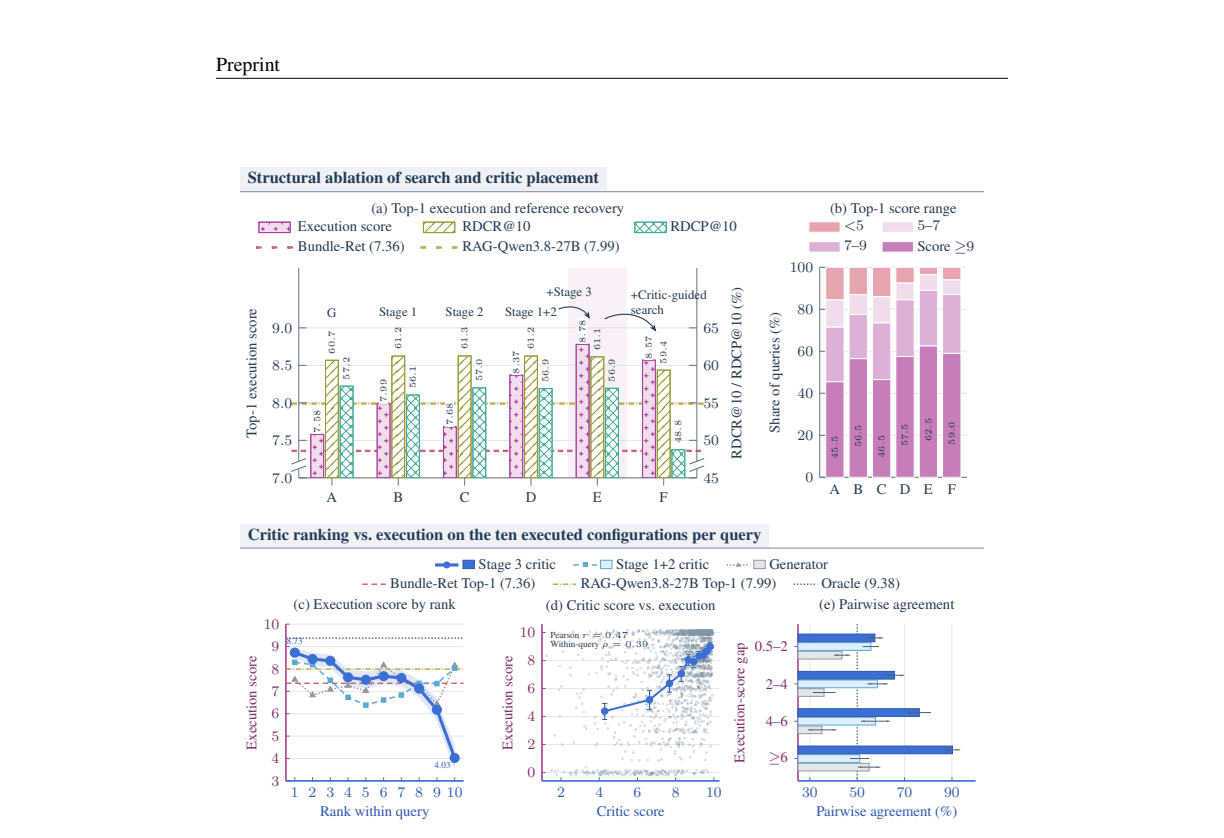
We formulate Task-Conditioned Agent Resource Composition (AgentComposition): jointly selecting a backbone model and a tool-skill bundle to maximize end-to-end execution utility. Our Retrieval-Grounded Bundle-Aware Agent Generation retrieves candidate resources and past configurations of similar tasks. A fine-tuned generator reads resource descriptions and recombines candidates through constrained beam search, allowing new resources without retraining. A bundle-aware critic ranks complete configurations using a large language model (LLM) teacher and historically successful configurations as execution proxies, and adapts to execution feedback when available. We evaluate reference recovery, offline execution with judged and native rewards, and online recommendation with real execution, building AgentSelect-Exec with 5,060 executed configurations. Our method recovers the complete reference configuration within ten candidates for 67.73% of AgentSelect queries, nearly twice the strongest baseline, and leads all baselines on SkillsBench. The proxy-trained critic raises the top-ranked agent's execution score from 7.58 to 8.37 out of 10; execution feedback increases it to 8.78, above the strongest baselines. Four target-domain queries suffice to adapt the generator to SkillsBench. Agents recommended online outperform the strongest baselines under both an LLM judge and native verifiers. These results support learning and transferring joint resource composition from task experience.
from the abstract
Pith says
Machine review · deepseek-v4-flash · 18 Nov 2026 · read the full text (115,205 characters) · not checked by a person
It can be wrong. Challenge this review or reply to it.
Holds up, with conditions. A thorough study of joint backbone and tool-skill bundle selection for agent configuration, with consistent evidence across five datasets and no confirmed defect, the open items being the small online sample and evaluation assets that are not yet public. This line is wrong
14 minor · 4 open questions
How often objections from reviews like this one are right: not yet measured
The paper, first character to last
The reviewer was given the whole text, 115,205 characters. Not checked: figures, code, what the 83 references say.
14 minor objections
The paper says, at §1, abstract
Pith says: minor objection 1 of 14
The abstract in the manuscript (page 1) differs slightly from the arXiv metadata abstract. The manuscript abstract includes the sentence 'These results establish resource composition as a learnable and transferable capability...' which is not in the arXiv metadata. This is fine, but the paper should ensure consistency if the arXiv metadata is used for indexing.
The paper says, at §3.2, Eq. (1)
Pith says: minor objection 2 of 14
The generator loss (Eq. 1) is a standard cross-entropy on the tokenized reference configuration. The paper states that the bundle is an unordered set but the serialization follows a supervised order. It would be helpful to clarify whether the order is arbitrary (e.g., alphabetical) or based on some heuristic, and whether the generator is sensitive to order during training.
show 12 more
The paper says, at §4.3, Figure 2
Pith says: minor objection 3 of 14
Figure 2 is not visible in the supplied text. The caption describes execution analysis results. The paper should ensure that the figure is legible and that all subplots (a-e) are clearly labeled. The text references 'Figure 2a-b' and 'Figure 2c-e' but the caption does not describe each subplot individually.
The paper says, at §4.4, Figure 3
Pith says: minor objection 4 of 14
Figure 3 (SkillsBench transfer loss) is a wrapfigure and the caption mentions 'Llama is shown in orange.' The paper should ensure that the figure is readable when printed in grayscale, as many readers may not have color access.
The paper says, at §4.5, Table 4
Pith says: minor objection 5 of 14
Table 4 reports execution scores for different rankers (A-F). The table is not visible in the supplied text (only the caption is present). The paper should ensure that the table clearly shows the scores and the 95% bootstrap intervals mentioned in the caption of Figure 2.
The paper says, at §5, Conclusion
Pith says: minor objection 6 of 14
The conclusion mentions future work using the adapted critic as a reinforcement-learning reward for the generator. This is a promising direction, but the paper does not discuss potential challenges, such as the critic's bias toward configurations seen during training or the stability of RL training with a learned reward model.
The paper says, at Appendix A.4, Critic Training
Pith says: minor objection 7 of 14
The critic training details mention that Stage 1 uses 'four epochs of teacher-supervised pairwise ranking plus a pointwise loss weighted by 0.1' and that the checkpoint is selected by 'highest validation NDCG@10.' However, NDCG@10 is not defined in the evaluation metrics section (Appendix A.8). The paper should define NDCG@10 or clarify that it is a standard information retrieval metric.
The paper says, at Appendix A.8, Evaluation Metrics
Pith says: minor objection 8 of 14
The metric definitions are clear, but the paper uses 'RDCR@10' and 'RDCP@10' as primary metrics. These are rank-discounted recall and precision. The discount factor w_r = 1/log2(r+1) is a standard logarithmic discount. However, the paper does not justify why this particular discount is chosen over alternatives (e.g., exponential discount). A brief justification would be helpful.
The paper says, at Appendix A.10, Sensitivity Analysis
Pith says: minor objection 9 of 14
The sensitivity analysis in Appendix A.10 uses a weighted sum of critic and generator scores (with weight alpha_c) to study the impact of the critic. However, the final method uses the critic alone (alpha_c effectively infinite). The analysis shows that once the critic is used, its weight matters little. This is consistent with the final design. The paper should mention this in the main text to justify using the critic alone.
The paper says, at Appendix A.11, Decoding Validity
Pith says: minor objection 10 of 14
Table 7 shows that constrained decoding yields 100% valid outputs on both AgentSelect and SkillsBench, while free decoding produces 3% invalid on AgentSelect and 51.3% invalid on SkillsBench. This is a strong argument for constrained decoding. The paper should consider moving this table to the main text or at least referencing it more prominently.
The paper says, at General
Pith says: minor objection 11 of 14
The paper uses many acronyms (RDCR, RDCP, CR-Hit, CR-MRR, etc.) that are defined in Appendix A.8. The main text should either define them on first use or provide a brief reminder in the caption of Table 1. Currently, Table 1 uses these acronyms without definition in the main text.
The paper says, at §2, Related Work
Pith says: minor objection 12 of 14
The related work section is comprehensive but could benefit from a brief discussion of how AgentComposition differs from agent architecture search (e.g., AgentSquare). The paper mentions this in the introduction but does not elaborate in the related work section.
The paper says, at Appendix A.13, Case Study
Pith says: minor objection 13 of 14
The case study in Appendix A.13 is illustrative but uses raw critic scores that are not calibrated (e.g., -5.56, 0.11, 1.42, 3.14). The paper should clarify whether these are the raw output of the critic head or after some transformation. The critic is trained with a sigmoid output (Eq. 3 and Eq. 5), so the raw scores may not be on a meaningful scale.
The paper says, at §4.7, Online Execution
Pith says: minor objection 14 of 14
The online execution study uses 25 AgentSelect test queries and 5 SkillsBench test queries. The sample size is small, and the paper reports per-task results in Appendix A.12. The paper should acknowledge that the online results are preliminary and may not generalize. The statistical test (one-sided sign test, p=0.039) is marginal.
Open questions (4)
Pith raised these and could not confirm them against the text of the paper it read. They are questions for the authors, not findings.
- §4.2, Table 1 (AgentSelect-Exec splits) Could the authors report a paired significance test (e.g., Wilcoxon signed-rank or paired bootstrap) comparing the top-1 execution scores of Stage 1+2 critic versus Stage 3 critic to confirm that the improvement is statistically significant?
- §3.3, Eq. (3) and (4); §4.5, Table 4 Could the authors specify how many preference pairs are generated per query in Stage 2, whether the perturbation procedure is deterministic or randomized, and report validation metrics for each stage to assess the cost-effectiveness of Stage 2 refinement?
- §4.6, Table 5 (BFCL and SWE-Skills-Bench) Could the authors clarify that the transfer results on BFCL and SWE-Skills-Bench demonstrate critic transfer (ranking) rather than generator transfer (generation), and discuss whether the generator's composition ability transfers to these domains without fine-tuning?
- §3.1, Appendix A.9 Could the authors provide a sensitivity analysis showing how retrieval recall affects downstream metrics (e.g., RDCR@10 conditioned on whether all reference tools are retrieved) to quantify the impact of retrieval failure on final recommendation?
What would settle it
If a task requires a tool that is not in the retrieved candidates (e.g., due to low retrieval recall), the method cannot include it in any configuration, so the top-ranked configuration would miss that tool. The paper's retrieval analysis (Appendix A.9) shows that individual-tool retrieval covers only 48.30% of reference tools at K=10, so one could test whether the method's performance degrades on queries where the reference tools are not retrieved.
from Pith's summary of the paper
How the review went
5 passes by deepseek-v4-flash · 18 Nov 2026
- Reader holds up, with conditions
- Skeptic concern not confirmed: listed as an open question
- Referee 14 minor
- Check against the paper kept 0 of 5 objections
- Editor wrote the verdict above
Not run on this paper: the simulated authors' defence.
Pith's passes raised 5 objections. A check against the paper's text kept 0 and left 5 as questions.
The review in full
The review in brief, machine-written
This paper takes a real bottleneck — choosing which backbone and which tools or skills an agent should use together, when a resource's value depends on its companions and is known only after execution — and treats it as a joint selection problem it calls AgentComposition. The genuinely new move is composing the backbone and the tool–skill bundle as one unit rather than scoring resources one at a time. The design choice that matters is that generation reads resource descriptions rather than learned tokens, so a new resource is usable as soon as it is indexed, which directly addresses a known weakness of token-based generators tied to their training catalog.
What is done well. The evaluation is unusually thorough: reference recovery, offline execution under both an LLM judge and native rewards, transfer to new domains, and a small online study with real runs. The critic story is the strongest part. Proxy training (an LLM teacher plus reference-based refinement) lifts the top-ranked configuration's execution score from 7.58 to 8.37; execution feedback raises it to 8.78, and the paper shows the critic belongs at the end of search, not guiding it. AgentSelect-Exec, 5,060 executed and judged configurations built at a reported cost of about 50M tokens with a judge blinded to rank and backbone, is a real contribution on its own. The retrieval analysis is honest: individual-tool recall at K=10 is reported as 48%, and the authors state plainly that the method is limited by retrieval recall.
Soft spots, in proportion. The online study runs 25 AgentSelect and 5 SkillsBench queries — enough to demonstrate the procedure, thin for headline claims; the only significance test reported is a sign test on within-list ordering. The evaluation rests on AgentSelect and AgentEmbedding, which are not yet public artifacts, and AgentSelect-Exec is new here; a code link is given, but no data or models, so independent verification is not yet possible. The Stage-2 critic trains on reference configurations, which touches the reference-recovery evaluation; the paper largely disarms the worry by showing the critic slightly lowers recovery while improving execution, but the contact deserves a sentence. None of these is a confirmed defect; all are things I would want settled before trusting the strongest claims.
This is serious, well-scoped work on agent construction with a solid experimental core. It deserves a rigorous peer review, and I would send it out.
The stress test's concern
Not confirmed. Pith could not check this concern against the text of the paper it was given; it is listed as an open question, not a finding.
The referee's report
Not published. Pith's referee wrote this assessment before its objections were checked against the paper, and 4 of its 4 major objections did not survive that check.
Pith's reading of the paper (a machine's summary, not the authors')
The paper formulates AgentComposition: given a task, jointly select a backbone LLM and compose a tool-skill bundle to maximize execution utility. The authors propose a retrieval-grounded, bundle-aware generation framework. A fine-tuned generator recombines retrieved resources via constrained beam search, and a bundle-aware critic ranks complete configurations, learning from proxy signals (LLM teacher, historical configurations) and adapting to execution feedback when available. The central claim is that composing a configuration as a whole outperforms selecting resources one by one, and that a critic adapted to execution feedback ranks configurations as execution does. If true, this would shift agent resource selection from individual relevance to joint task suitability, enabling agents to adapt to changing resource ecosystems.
What carries the argument. The central mechanism is Retrieval-Grounded Bundle-Aware Agent Generation, which consists of three components: (1) retrieval context that gathers candidate resources and past configurations of similar tasks; (2) a fine-tuned generator (Meta-Llama-3-8B with LoRA) that composes configurations through constrained beam search, choosing each tool given the backbone and already-chosen tools; (3) a bundle-aware critic that estimates execution quality from proxy signals (LLM teacher, historical configurations) and adapts to execution feedback when available. The generator reads resources from their descriptions, enabling use of new resources without retraining. The critic ranks complete configurations, and the final ranking uses the critic alone after search completes.
Core claim. The paper's central claim is that composing a backbone model and a tool-skill bundle jointly (AgentComposition) outperforms selecting resources individually, and that a critic adapted to execution feedback can rank configurations by execution quality. The authors demonstrate this through reference recovery, offline execution, transfer to new domains, and online execution experiments. Their method recovers complete reference configurations within ten candidates for 67.73% of AgentSelect queries, nearly twice the strongest baseline. The proxy-trained critic raises the top-ranked agent's execution score from 7.58 to 8.37 out of 10, and execution feedback lifts it to 8.78, above the strongest baselines. The learned composition transfers to new domains with few target queries.
The premise it rests on. The retrieval context (candidate resources and past configurations of similar tasks) must contain the necessary resources for the generator and critic to produce good configurations; if retrieval fails to include the needed resources, the method cannot compose them.
If the paper is right (Pith's inferences, not the authors')
If the central claim is correct, agent resource selection can shift from scoring individual tools to composing configurations as a whole, potentially improving agent performance on complex tasks.
The method's ability to transfer to new domains with few target queries suggests that learned composition skills can generalize across different resource ecosystems.
The critic's adaptation to execution feedback provides a mechanism for agents to improve their resource selection over time through accumulated task experience.
The constrained beam search approach enables the use of new resources without retraining, which is important for keeping up with changing tool catalogs.
The finding that the critic works best as a final reranker (not during search) has implications for how to integrate learned quality estimates into generative search processes.
The paper's approach could be extended to other types of agent resources beyond LLMs and tools, such as memory modules, planning strategies, or external knowledge sources, as long as they can be described textually.
The critic's ability to rank configurations by execution quality, even without execution feedback (using proxy signals), suggests that learned preferences from historical data can substitute for expensive execution in many cases.
The method's reliance on retrieval recall (acknowledged as a limitation) implies that improving retrieval coverage could directly improve composition quality, potentially through iterative retrieval or active learning.
The transfer results suggest that composition skills learned on one domain (AgentSelect) can be applied to others (SkillsBench, BFCL, SWE-Skills-Bench), which could reduce the need for domain-specific training data.
Check this review
What was read
The passes were given all 115,205 characters of the paper's LaTeX source.
Fingerprint of that text (SHA-256): 54a4465922d35476c8b1643390278e939943247115d089db206dee9f93dbcc79
Pith does not keep that text. Rebuilt from the paper's source or PDF by the same code, it has this fingerprint if it is the same text. From a copy of Pith's code:
PYTHONPATH=. python scripts/review_input_check.py 2611.22030
The passes, in the order they ran
- Reader deepseek-v4-flash · medium effort · $0.014 · instructions of the Reader, fingerprint f9ead7300382…
- Skeptic deepseek-v4-flash · medium effort · $0.0036 · instructions of the Skeptic, fingerprint 8f88c0f61488…
- Referee deepseek-v4-flash · medium effort · $0.0040 · instructions of the Referee, fingerprint a852d99aea0d…
- Check against the paper deepseek-v4-flash · medium effort · $0.0039 · instructions of the Check against the paper, fingerprint 6c7a6883d551…
- Editor deepseek-v4-flash · medium effort · $0.0022 · instructions of the Editor, fingerprint e7211f6a3d27…
- Summary for the page deepseek-v4-flash · medium effort · temperature 0.2 · $0.0039 · instructions of the Summary for the page, fingerprint e4f56bf568e7…
The passes cost $0.031 in model calls together.
Version stamped on this review: pith-pipeline@v1.4.1-daily-deepseek-or-medium+deepseek/deepseek-v4-flash+p.0ef1a750a3e3
Each link opens a pass's instructions as plain text, the exact bytes its fingerprint was taken over. Every stored set of instructions.
curl -s https://pith.science/methodology/prompts/f9ead730038216984cfb56d7cb34332bdf691828296a1de4245f3d6667d4bf56 | sha256sum
prints the fingerprint of the reader's instructions. The same works for every pass.
The receipt
The review's fingerprint was taken on 18 Nov 2026. The review you are reading still matches it.
Fingerprint of the review (SHA-256): 799bb99ce64a74b9e6389975202e7459612bf51793b35ca3978c1039f0954bd3
curl -s 'https://pith.science/api/v1/verdicts/2611.22030?form=canonical' | sha256sum
prints the fingerprint of the review as it stands now. The rule, in four steps.
A matching fingerprint shows the review has not changed since that date. It does not show that the review is right.
How often reviews like this one are right
Reviews like this one: written by deepseek-v4-flash, from the paper's LaTeX source.
How often objections from reviews like this one are right: not yet measured
Reviews by people
This review was written by a machine. No person has reviewed this paper on Pith yet. A scientist listed on Pith can review it for a fee, and their review is published here whatever it concludes.
The paper
Abstract
An agent resource's value depends on its backbone and companion resources and is known only after execution. Token-based generators remain tied to their training catalog, while independent resource scoring misses complementarities and reused bundles target other tasks. We formulate Task-Conditioned Agent Resource Composition (AgentComposition): jointly selecting a backbone model and a tool-skill bundle to maximize end-to-end execution utility. Our Retrieval-Grounded Bundle-Aware Agent Generation retrieves candidate resources and past configurations of similar tasks. A fine-tuned generator reads resource descriptions and recombines candidates through constrained beam search, allowing new resources without retraining. A bundle-aware critic ranks complete configurations using a large language model (LLM) teacher and historically successful configurations as execution proxies, and adapts to execution feedback when available. We evaluate reference recovery, offline execution with judged and native rewards, and online recommendation with real execution, building AgentSelect-Exec with 5,060 executed configurations. Our method recovers the complete reference configuration within ten candidates for 67.73% of AgentSelect queries, nearly twice the strongest baseline, and leads all baselines on SkillsBench. The proxy-trained critic raises the top-ranked agent's execution score from 7.58 to 8.37 out of 10; execution feedback increases it to 8.78, above the strongest baselines. Four target-domain queries suffice to adapt the generator to SkillsBench. Agents recommended online outperform the strongest baselines under both an LLM judge and native verifiers. These results support learning and transferring joint resource composition from task experience.
The paper's own sentences, arranged, kept beside the review and separate from it. Each label is drawn from a closed vocabulary; the number beside it is the probability the classifier gave that label. No sentence in this record was written by a model.
abstract compiled · 2026-11-18
The authors' main claim, as the classifier picked it out 0.98
“These results support learning and transferring joint resource composition from task experience.”
How the main claim is stated: asserted 0.62
What the abstract itself states, as probabilities: claims first 0.09 · states limitation 0.22 · human participants 0.07 · controlled comparison 0.94 · randomized assignment 0.02 · states quantitative result 0.99 · compares with prior results 0.98 · mentions code or data availability 0.05
The abstract, sentence by sentence
This table labels the abstract only (arXiv listing abstract v1). The number is the probability the classifier gave the label.
| Sentence | Role | The authors' own work | States the main conclusion | Strength |
|---|---|---|---|---|
| An agent resource's value depends on its backbone and companion resources and is known only after execution. | background 0.97 | 0.15 | 0.04 | asserted 1.00 |
| Token-based generators remain tied to their training catalog, while independent resource scoring misses complementarities and reused bundles target other tasks. | gap 0.84 | 0.08 | 0.03 | asserted 1.00 |
| We formulate Task-Conditioned Agent Resource Composition (AgentComposition): jointly selecting a backbone model and a tool-skill bundle to maximize end-to-end execution utility. | contribution 0.94 | 0.76 | 0.11 | asserted 0.98 |
| Our Retrieval-Grounded Bundle-Aware Agent Generation retrieves candidate resources and past configurations of similar tasks. | method 0.99 | 0.86 | 0.03 | asserted 0.98 |
| A fine-tuned generator reads resource descriptions and recombines candidates through constrained beam search, allowing new resources without retraining. | method 1.00 | 0.88 | 0.03 | asserted 1.00 |
| A bundle-aware critic ranks complete configurations using a large language model (LLM) teacher and historically successful configurations as execution proxies, and adapts to execution feedback when available. | method 0.99 | 0.87 | 0.05 | asserted 1.00 |
| We evaluate reference recovery, offline execution with judged and native rewards, and online recommendation with real execution, building AgentSelect-Exec with 5,060 executed configurations. | method 0.75 | 0.97 | 0.04 | asserted 0.99 |
| Our method recovers the complete reference configuration within ten candidates for 67.73% of AgentSelect queries, nearly twice the strongest baseline, and leads all baselines on SkillsBench. | result 1.00 | 0.97 | 0.27 | asserted 1.00 |
| The proxy-trained critic raises the top-ranked agent's execution score from 7.58 to 8.37 out of 10; execution feedback increases it to 8.78, above the strongest baselines. | result 1.00 | 0.96 | 0.15 | asserted 1.00 |
| Four target-domain queries suffice to adapt the generator to SkillsBench. | result 0.99 | 0.92 | 0.05 | asserted 1.00 |
| Agents recommended online outperform the strongest baselines under both an LLM judge and native verifiers. | result 1.00 | 0.95 | 0.17 | asserted 1.00 |
| These results support learning and transferring joint resource composition from task experience. | interpretation 1.00 | 0.59 | 0.85 | asserted 0.62 |
What kind of paper the classifier reports this is: method or tool 1.00 · evidence from observation or experiment 0.99
What was examined, and what was not
Sources read
- arXiv listing abstract v1
Not examined
- full text
- figures and tables
- references and citing sentences
- relations to other papers
Levels run
- P abstract
Not run
- S sections
- T body sentences
- C citations
- R cross-paper relations
How the labels were made
Compiled by classifier-1.13.0 via TypeSafe API, question bank abstract-p1-20260923, 2026-11-18: 1 request, 8,845 input tokens.
Every quoted sentence on this record is the authors'. Every label is from Pith's closed vocabulary, with the probability shown beside it. This record as JSON
Figures (8)



Figures are the authors', reproduced from the paper.
References (83)
- [2] Hao, Yupu and Cao, Pengfei and Jin, Zhuoran and Liao, Huanxuan and Chen, Yubo and Liu, Kang and Zhao, Jun. Evaluating Personalized Tool-Augmented LLM s from the Perspectives of Personalization and Proactivity. Proceedings of the 63rd Annual Meeting of the Association for Compu... on Pithdoi:10.18653/v1/2025.acl-long.1064
- [4] Liu, Marianne Menglin and Garcia, Daniel and Parllaku, Fjona and Upadhyay, Vikas and Shah, Syed Fahad Allam and Roth, Dan. T ool S cope: Enhancing LLM Agent Tool Use through Tool Merging and Context-Aware Filtering. Proceedings of the 64th Annual Meeting of the A ssociation fo... on Pithdoi:10.18653/v1/2026.acl-long.1573
- [5] Agent Harness , year = on Pith
- [6] The Next Evolution of the Agents SDK , year = on Pith
- [7] Effective Harnesses for Long-Running Agents , year = on Pith
- [8] Language Models are Unsupervised Multitask Learners , author=. 2019 , url= on Pith
- [9] Brown, Tom and Mann, Benjamin and Ryder, Nick and Subbiah, Melanie and Kaplan, Jared D and Dhariwal, Prafulla and Neelakantan, Arvind and Shyam, Pranav and Sastry, Girish and Askell, Amanda and Agarwal, Sandhini and Herbert-Voss, Ariel and Krueger, Gretchen and Henighan, Tom a... on Pith
- [10] ReAct: Synergizing Reasoning and Acting in Language Models , author=. The Eleventh International Conference on Learning Representations , year= on Pith
- [11] Toolformer: Language Models Can Teach Themselves to Use Tools , author=. Thirty-seventh Conference on Neural Information Processing Systems , year= on Pith
- [12] Yujia Qin and Shihao Liang and Yining Ye and Kunlun Zhu and Lan Yan and Yaxi Lu and Yankai Lin and Xin Cong and Xiangru Tang and Bill Qian and Sihan Zhao and Lauren Hong and Runchu Tian and Ruobing Xie and Jie Zhou and Mark Gerstein and dahai li and Zhiyuan Liu and Maosong Sun... on Pith
- [13] Introducing the Model Context Protocol , year = on Pith
- [14] Equipping Agents for the Real World with Agent Skills , year = on Pith
- [15] Agent Skills for Large Language Models: Architecture, Acquisition, Security, and the Path Forward , author=. First Workshop on Agent Skills , year= on Pith
- [16] Agentic AI: a comprehensive survey of architectures, applications, and future directions , author=. Artificial Intelligence Review , volume=. 2025 , publisher= on Pith
- [17] Du, Yu and Wei, Fangyun and Zhang, Hongyang , booktitle =. 2024 , volume = on Pith
- [18] Changle Qu and Sunhao Dai and Xiaochi Wei and Hengyi Cai and Shuaiqiang Wang and Dawei Yin and Jun Xu and Ji-Rong Wen , title =. Proceedings of the 33rd ACM International Conference on Information and Knowledge Management , pages =. 2024 , doi = on Pith
- [19] Yuan, Lifan and Chen, Yangyi and Wang, Xingyao and Fung, Yi R. and Peng, Hao and Ji, Heng , booktitle =. 2024 , url = on Pith
- [20] Darwin G\"odel Machine: Open-Ended Evolution of Self-Improving Agents , author=. The Fourteenth International Conference on Learning Representations , year= on Pith
- [22] Efficient and Scalable Estimation of Tool Representations in Vector Space , author =. 2024 , eprint = on Pith
- [23] ToolGen: Unified Tool Retrieval and Calling via Generation , author =. The Thirteenth International Conference on Learning Representations , year = on Pith
show 63 more
- [24] ToolWeaver: Weaving Collaborative Semantics for Scalable Tool Use in Large Language Models , author =. The Fourteenth International Conference on Learning Representations , year = on Pith
- [26] Shibo Hao and Tianyang Liu and Zhen Wang and Zhiting Hu , booktitle=. Toolken. 2023 , url= on Pith
- [31] AgentSelect: Benchmark for Narrative Query-to-Agent Recommendation , author=. Forty-third International Conference on Machine Learning , year= on Pith
- [33] Wu, Bin and Kim, To Eun and Feng, Yue and Diaz, Fernando and Ren, Zhaochun and Yilmaz, Emine , title =. 2026 , isbn =. doi:10.1145/3805712.3808653 , booktitle = on Pithdoi:10.1145/3805712.3808653
- [34] AgentSearchBench: A Benchmark for AI Agent Search in the Wild , author=. 2026 , eprint= on Pith
- [36] Burges, Chris and Shaked, Tal and Renshaw, Erin and Lazier, Ari and Deeds, Matt and Hamilton, Nicole and Hullender, Greg , title =. Proceedings of the 22nd International Conference on Machine Learning , pages =. 2005 , isbn =. doi:10.1145/1102351.1102363 , abstract = on Pithdoi:10.1145/1102351.1102363
- [37] Rendle, Steffen and Freudenthaler, Christoph and Gantner, Zeno and Schmidt-Thieme, Lars , title =. Proceedings of the Twenty-Fifth Conference on Uncertainty in Artificial Intelligence , pages =. 2009 , isbn = on Pith
- [39] Discrete Diffusion for Bundle Construction , author=. The Fourteenth International Conference on Learning Representations , year= on Pith
- [40] SkillsBench: Benchmarking How Well Agent Skills Work Across Diverse Tasks , author=. 2026 , eprint= on Pith
- [41] Yu Shang and Yu Li and Keyu Zhao and Likai Ma and Jiahe Liu and Fengli Xu and Yong Li , booktitle=. AgentSquare: Automatic. 2025 , url= on Pith
- [42] Isaac Ong and Amjad Almahairi and Vincent Wu and Wei-Lin Chiang and Tianhao Wu and Joseph E. Gonzalez and M Waleed Kadous and Ion Stoica , booktitle=. Route. 2025 , url= on Pith
- [43] Skill Expansion and Composition in Parameter Space , author=. The Thirteenth International Conference on Learning Representations , year= on Pith
- [44] Shinn, Noah and Cassano, Federico and Gopinath, Ashwin and Narasimhan, Karthik and Yao, Shunyu , booktitle =. Reflexion: language agents with verbal reinforcement learning , url =. doi:10.52202/075280-0377 , editor = on Pithdoi:10.52202/075280-0377
- [46] Automated Design of Agentic Systems , author =. The Thirteenth International Conference on Learning Representations , year = on Pith
- [47] Zheng, Boyuan and Fatemi, Michael Y. and Jin, Xiaolong and Wang, Zora Zhiruo and Gandhi, Apurva and Song, Yueqi and Gu, Yu and Srinivasa, Jayanth and Liu, Gaowen and Neubig, Graham and Su, Yu , journal =. 2025 , url = on Pith
- [48] Konstantin Yakovlev and Sergey Nikolenko and Andrey Bout , booktitle=. Toolken+: Improving. 2024 , url= on Pith
- [49] Patil, Shishir G. and Mao, Huanzhi and Yan, Fanjia and Ji, Charlie and Suresh, Vishnu and Stoica, Ion and Gonzalez, Joseph E. , booktitle =. The Berkeley Function Calling Leaderboard (. 2025 , url = on Pith
- [50] Han, Tingxu and Zhang, Yi and Song, Wei and Fang, Chunrong and Chen, Zhenyu and Sun, Youcheng and Hu, Lijie , journal = on Pith
- [51] Anthropic . Introducing the model context protocol, 2024. URL https://www.anthropic.com/news/model-context-protocol on Pith
- [52] Anthropic . Effective harnesses for long-running agents. https://www.anthropic.com/engineering/effective-harnesses-for-long-running-agents, November 2025 a on Pith
- [53] Anthropic . Equipping agents for the real world with agent skills, 2025 b . URL https://www.anthropic.com/engineering/equipping-agents-for-the-real-world-with-agent-skills on Pith
- [54] Tom Brown, Benjamin Mann, Nick Ryder, Melanie Subbiah, Jared D Kaplan, Prafulla Dhariwal, Arvind Neelakantan, Pranav Shyam, Girish Sastry, Amanda Askell, Sandhini Agarwal, Ariel Herbert-Voss, Gretchen Krueger, Tom Henighan, Rewon Child, Aditya Ramesh, Daniel Ziegler, Jeffrey W... on Pith
- [55] Jianxin Chang, Chen Gao, Xiangnan He, Depeng Jin, and Yong Li. Bundle recommendation with graph convolutional networks. In Proceedings of the 43rd International ACM SIGIR Conference on Research and Development in Information Retrieval, SIGIR '20, pp.\ 1673–1676, New York, NY, ... on Pithdoi:10.1145/3397271.3401198
- [56] Tingwei Chen, Yunxiao Shi, Zhengdong Chu, Qingsong Wen, and Min Xu. Adapting embedding models for agent capability retrieval. arXiv preprint arXiv:2607.17347, 2026. Accepted for oral presentation at the AgentSearch Workshop, SIGIR 2026 on PithPith's reviewarXiv
- [57] Zihao Cheng, Hongru Wang, Zeming Liu, Yuhang Guo, Yuanfang Guo, Yunhong Wang, and Haifeng Wang. T ool S pectrum: Towards personalized tool utilization for large language models. In Wanxiang Che, Joyce Nabende, Ekaterina Shutova, and Mohammad Taher Pilehvar (eds.), Findings of ... on Pithdoi:10.18653/v1/2025.findings-acl.1063
- [58] Yu Du, Fangyun Wei, and Hongyang Zhang. A ny T ool: Self-reflective, hierarchical agents for large-scale API calls. In Proceedings of the 41st International Conference on Machine Learning, volume 235 of Proceedings of Machine Learning Research, pp.\ 11812--11829. PMLR, 2024. U... on Pith
- [59] Bowen Fang, Wen Ye, Yunyue Su, Jinghao Zhang, Qiang Liu, Yesheng Liu, Xin Sun, Shu Wu, Jiabing Yang, Baole Wei, and Liang Wang. Toolweaver: Weaving collaborative semantics for scalable tool use in large language models. In The Fourteenth International Conference on Learning Re... on PitharXiv
- [60] Zhicheng Guo, Sijie Cheng, Yuchen Niu, Hao Wang, Sicheng Zhou, Wenbing Huang, and Yang Liu. S table T ool B ench- M irror API : Modeling tool environments as mirrors of 7,000+ real-world API s. In Wanxiang Che, Joyce Nabende, Ekaterina Shutova, and Mohammad Taher Pilehvar (eds... on Pithdoi:10.18653/v1/2025.findings-acl.273
- [61] Tingxu Han, Yi Zhang, Wei Song, Chunrong Fang, Zhenyu Chen, Youcheng Sun, and Lijie Hu. SWE-Skills-Bench : Do agent skills actually help in real-world software engineering? arXiv preprint arXiv:2603.15401, 2026 on PithPith's reviewarXiv
- [62] Shibo Hao, Tianyang Liu, Zhen Wang, and Zhiting Hu. Toolken GPT : Augmenting frozen language models with massive tools via tool embeddings. In Thirty-seventh Conference on Neural Information Processing Systems, 2023. URL https://openreview.net/forum?id=BHXsb69bSx on Pith
- [63] Yupu Hao, Pengfei Cao, Zhuoran Jin, Huanxuan Liao, Yubo Chen, Kang Liu, and Jun Zhao. Evaluating personalized tool-augmented LLM s from the perspectives of personalization and proactivity. In Wanxiang Che, Joyce Nabende, Ekaterina Shutova, and Mohammad Taher Pilehvar (eds.), P... on Pith
- [64] Juntong Hu, Shixuan Zhu, Chuan Cui, Qi Shen, Yu Ji, and Zhihua Wei. Text2bundle: Towards personalized query-based bundle generation. ACM Trans. Recomm. Syst., 4 0 (2), November 2025 a . doi:10.1145/3706125. URL https://doi.org/10.1145/3706125 on Pithdoi:10.1145/3706125
- [65] Shengran Hu, Cong Lu, and Jeff Clune. Automated design of agentic systems. In The Thirteenth International Conference on Learning Representations, 2025 b . URL https://arxiv.org/abs/2408.08435 on PithPith's reviewarXiv
- [66] Xiangyi Li, Yimin Liu, Wenbo Chen, Bingran You, Zonglin Di, Yifeng He, Shenghan Zheng, Kyoung Whan Choe, Jiankai Sun, Shuyi Wang, Chujun Tao, Binxu Li, Xuandong Zhao, Hejia Geng, Xiaojun Wu, Junwei Zhou, Xiaokun Chen, Hanwen Xing, Yubo Li, Qunhong Zeng, Di Wang, Yuanli Wang, R... on PithPith's reviewarXiv
- [67] Marianne Menglin Liu, Daniel Garcia, Fjona Parllaku, Vikas Upadhyay, Syed Fahad Allam Shah, and Dan Roth. T ool S cope: Enhancing LLM agent tool use through tool merging and context-aware filtering. In Maria Liakata, Viviane P. Moreira, Jiajun Zhang, and David Jurgens (eds.), ... on Pith
- [68] Tenglong Liu, Jianxiong Li, Yinan Zheng, Haoyi Niu, Yixing Lan, Xin Xu, and Xianyuan Zhan. Skill expansion and composition in parameter space. In The Thirteenth International Conference on Learning Representations, 2025. URL https://openreview.net/forum?id=GLWf2fq0bX on Pith
- [69] Yunshan Ma, Yingzhi He, An Zhang, Xiang Wang, and Tat-Seng Chua. Crosscbr: Cross-view contrastive learning for bundle recommendation. In Proceedings of the 28th ACM SIGKDD Conference on Knowledge Discovery and Data Mining, KDD '22, pp.\ 1233–1241, New York, NY, USA, 2022. Asso... on Pithdoi:10.1145/3534678.3539229
- [70] Microsoft . Agent harness. https://learn.microsoft.com/agent-framework/agents/harness, 2026. Microsoft Agent Framework on Pith
- [71] Lorenzo Molfetta, Giacomo Frisoni, Nicol \`o Monaldini, and Gianluca Moro. PORTS : Preference-optimized retrievers for tool selection with large language models. In Proceedings of the 2025 Conference on Empirical Methods in Natural Language Processing, Suzhou, China, 2025. Ass... on Pithdoi:10.18653/v1/2025.emnlp-main.507
- [72] Suhong Moon, Siddharth Jha, Lutfi Eren Erdogan, Sehoon Kim, Woosang Lim, Kurt Keutzer, and Amir Gholami. Efficient and scalable estimation of tool representations in vector space, 2024. URL https://arxiv.org/abs/2409.02141 on PithPith's reviewarXiv
- [73] Isaac Ong, Amjad Almahairi, Vincent Wu, Wei-Lin Chiang, Tianhao Wu, Joseph E. Gonzalez, M Waleed Kadous, and Ion Stoica. Route LLM : Learning to route LLM s from preference data. In The Thirteenth International Conference on Learning Representations, 2025. URL https://openrevi... on Pith
- [74] OpenAI . The next evolution of the agents sdk. https://openai.com/index/the-next-evolution-of-the-agents-sdk/, April 2026 on Pith
- [75] Shishir G. Patil, Huanzhi Mao, Fanjia Yan, Charlie Ji, Vishnu Suresh, Ion Stoica, and Joseph E. Gonzalez. The berkeley function calling leaderboard ( BFCL ): From tool use to agentic evaluation of large language models. In International Conference on Machine Learning, 2025. UR... on Pith
- [76] Yujia Qin, Shihao Liang, Yining Ye, Kunlun Zhu, Lan Yan, Yaxi Lu, Yankai Lin, Xin Cong, Xiangru Tang, Bill Qian, Sihan Zhao, Lauren Hong, Runchu Tian, Ruobing Xie, Jie Zhou, Mark Gerstein, dahai li, Zhiyuan Liu, and Maosong Sun. Tool LLM : Facilitating large language models to... on Pith
- [77] Yujia Qin, Shihao Liang, Yining Ye, Kunlun Zhu, Lan Yan, Yaxi Lu, Yankai Lin, Xin Cong, Xiangru Tang, Bill Qian, Sihan Zhao, Lauren Hong, Runchu Tian, Ruobing Xie, Jie Zhou, Mark Gerstein, dahai li, Zhiyuan Liu, and Maosong Sun. Tool LLM : Facilitating large language models to... on Pith
- [78] Changle Qu, Sunhao Dai, Xiaochi Wei, Hengyi Cai, Shuaiqiang Wang, Dawei Yin, Jun Xu, and Ji-Rong Wen. Towards completeness-oriented tool retrieval for large language models. In Proceedings of the 33rd ACM International Conference on Information and Knowledge Management, pp.\ 1... on Pithdoi:10.1145/3627673.3679847
- [79] Alec Radford, Jeff Wu, Rewon Child, David Luan, Dario Amodei, and Ilya Sutskever. Language models are unsupervised multitask learners. 2019. URL https://api.semanticscholar.org/CorpusID:160025533 on Pith
- [80] Xubin Ren and Chao Huang. E asy R ec: Simple yet effective language models for recommendation. In Christos Christodoulopoulos, Tanmoy Chakraborty, Carolyn Rose, and Violet Peng (eds.), Proceedings of the 2025 Conference on Empirical Methods in Natural Language Processing, pp.\... on Pithdoi:10.18653/v1/2025.emnlp-main.894
- [81] Timo Schick, Jane Dwivedi-Yu, Roberto Dessi, Roberta Raileanu, Maria Lomeli, Eric Hambro, Luke Zettlemoyer, Nicola Cancedda, and Thomas Scialom. Toolformer: Language models can teach themselves to use tools. In Thirty-seventh Conference on Neural Information Processing Systems... on Pith
- [82] Yu Shang, Yu Li, Keyu Zhao, Likai Ma, Jiahe Liu, Fengli Xu, and Yong Li. Agentsquare: Automatic LLM agent search in modular design space. In The Thirteenth International Conference on Learning Representations, 2025. URL https://openreview.net/forum?id=mPdmDYIQ7f on Pith
- [83] Yunxiao Shi, Wujiang Xu, Tingwei Chen, Haoning Shang, Ling Yang, Yunfeng Wan, Zhuo Cao, Xing Zi, Dimitris N. Metaxas, and Min Xu. Agentselect: Benchmark for narrative query-to-agent recommendation. In Forty-third International Conference on Machine Learning, 2026. URL https://... on Pith
- [84] Zhengliang Shi, Yuhan Wang, Lingyong Yan, Pengjie Ren, Shuaiqiang Wang, Dawei Yin, and Zhaochun Ren. Retrieval models aren't tool-savvy: Benchmarking tool retrieval for large language models. In Findings of the Association for Computational Linguistics: ACL 2025, pp.\ 24497--2... on Pithdoi:10.18653/v1/2025.findings-acl.1258
- [85] Meng Sun, Lin Li, Ming Li, Xiaohui Tao, Dong Zhang, Qing Xie, Peipei Wang, and Jimmy Xiangji Huang. A survey on bundle recommendation: Methods, applications, and challenges. ACM Comput. Surv., 58 0 (11), May 2026. ISSN 0360-0300. doi:10.1145/3802820. URL https://doi.org/10.114... on Pithdoi:10.1145/3802820
- [86] Zhu Sun, Kaidong Feng, Jie Yang, Xinghua Qu, Hui Fang, Yew-Soon Ong, and Wenyuan Liu. Adaptive in-context learning with large language models for bundle generation. In Proceedings of the 47th International ACM SIGIR Conference on Research and Development in Information Retriev... on Pithdoi:10.1145/3626772.3657808
- [87] Teng Tu, Ai Li, Yunshan Ma, Shuo Xu, Xiaohao Liu, Haokai Ma, Liang Pang, and Tat-Seng Chua. Discrete diffusion for bundle construction. In The Fourteenth International Conference on Learning Representations, 2026. URL https://openreview.net/forum?id=dKyhgfe50H on Pith
- [88] Renxi Wang, Xudong Han, Lei Ji, Shu Wang, Timothy Baldwin, and Haonan Li. Toolgen: Unified tool retrieval and calling via generation. In The Thirteenth International Conference on Learning Representations, 2025. URL https://openreview.net/forum?id=XLMAMmowdY on Pith
- [89] Bin Wu, Arastun Mammadli, Xiaoyu Zhang, and Emine Yilmaz. Agentsearchbench: A benchmark for ai agent search in the wild, 2026 a . URL https://arxiv.org/abs/2604.22436 on PithPith's reviewarXiv
- [90] Bin Wu, Edgar Meij, and Emine Yilmaz. Beyond static toolsets: Self-evolving LLM tool agents via continual documentation adaptation. In Maria Liakata, Viviane P. Moreira, Jiajun Zhang, and David Jurgens (eds.), Findings of the A ssociation for C omputational L inguistics: ACL 2... on Pithdoi:10.18653/v1/2026.findings-acl.1082
- [91] Renjun Xu and Yang Yan. Agent skills for large language models: Architecture, acquisition, security, and the path forward. In First Workshop on Agent Skills, 2026. URL https://openreview.net/forum?id=Er0p92BsmW on Pith
- [92] Konstantin Yakovlev, Sergey Nikolenko, and Andrey Bout. Toolken+: Improving LLM tool usage with reranking and a reject option. In Findings of the Association for Computational Linguistics: EMNLP 2024, 2024. URL https://arxiv.org/abs/2410.12004 on PithPith's reviewarXiv
- [93] Shunyu Yao, Jeffrey Zhao, Dian Yu, Nan Du, Izhak Shafran, Karthik R Narasimhan, and Yuan Cao. React: Synergizing reasoning and acting in language models. In The Eleventh International Conference on Learning Representations, 2023. URL https://openreview.net/forum?id=WE_vluYUL-X on Pith
- [94] Lifan Yuan, Yangyi Chen, Xingyao Wang, Yi R. Fung, Hao Peng, and Heng Ji. CRAFT : Customizing LLM s by creating and retrieving from specialized toolsets. In The Twelfth International Conference on Learning Representations, 2024. URL https://openreview.net/forum?id=G0vdDSt9XM on Pith
- [95] Boyuan Zheng, Michael Y. Fatemi, Xiaolong Jin, Zora Zhiruo Wang, Apurva Gandhi, Yueqi Song, Yu Gu, Jayanth Srinivasa, Gaowen Liu, Graham Neubig, and Yu Su. SkillWeaver : Web agents can self-improve by discovering and honing skills. arXiv preprint arXiv:2504.07079, 2025. URL ht... on PithPith's reviewarXiv
Challenges and discussion
Disagree with the review, or know something it missed? Leave a comment, or challenge this review formally: a challenge becomes a permanent entry in this paper's record, and its decision is published here.
Come back by email
A short list of the week's newly reviewed papers. Nothing is sent until you confirm from your inbox, and every email has a link that stops it. No account.
No comments yet.
Sign in to comment