Machine Learning · arXiv:2611.23718 v1 · submitted 18 Nov 2026 · 59 references
HypoLoop: Revising Weight-Editing Plans from Scientific Feedback
The paper says
“Scientific experiments continually reveal prediction errors. Effective updates depend on which parameters change and which errors drive the correction. We introduce HypoLoop, a family of native weight-editing methods that connects these choices to experimental feedback.”
more of the abstract
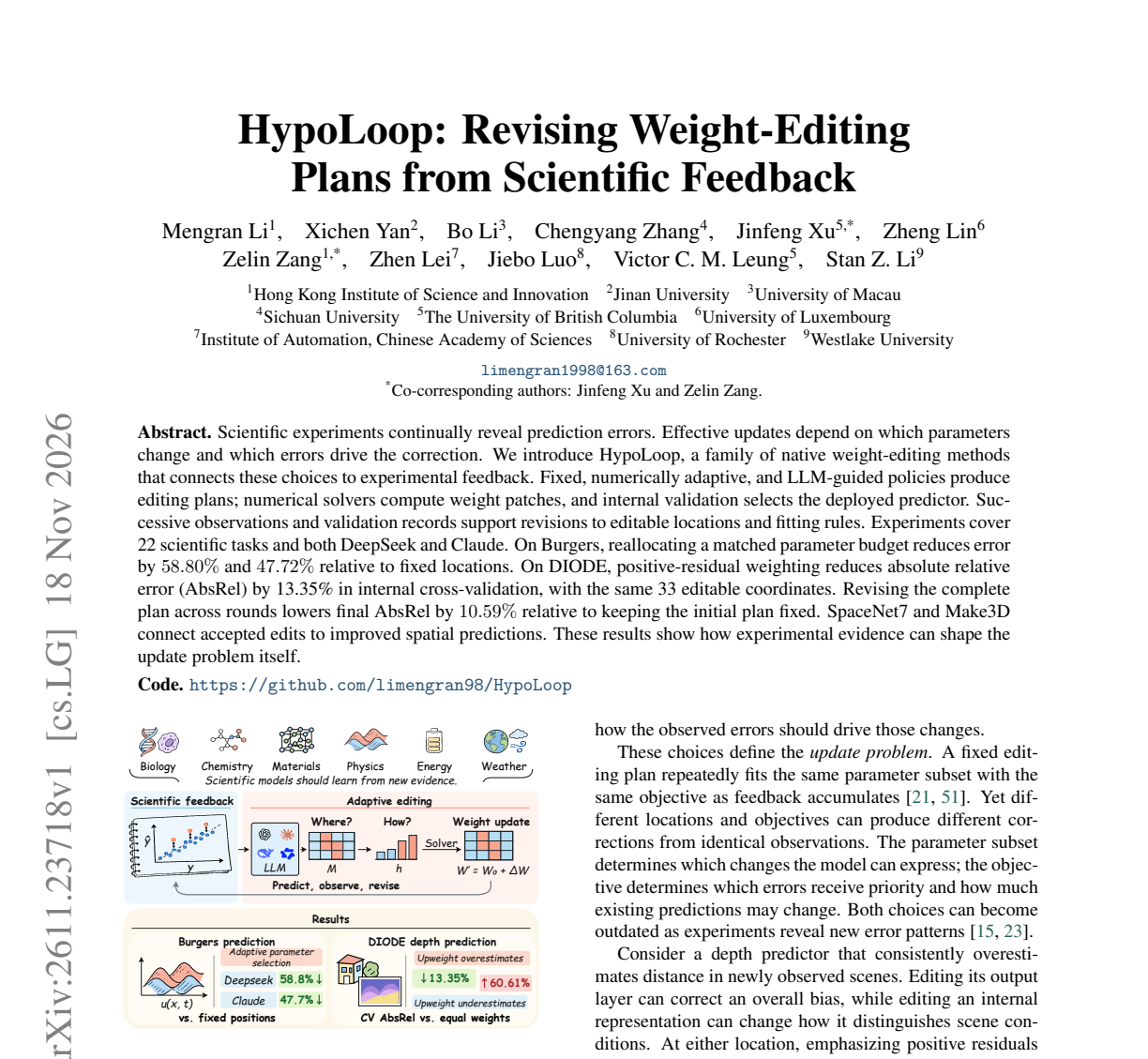
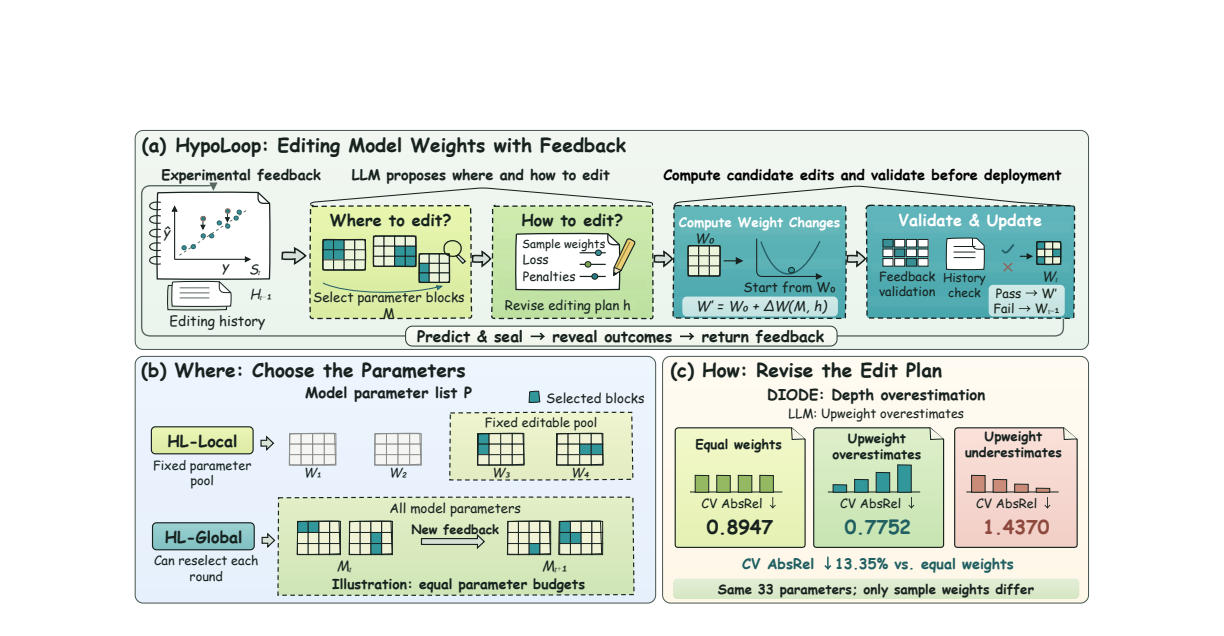
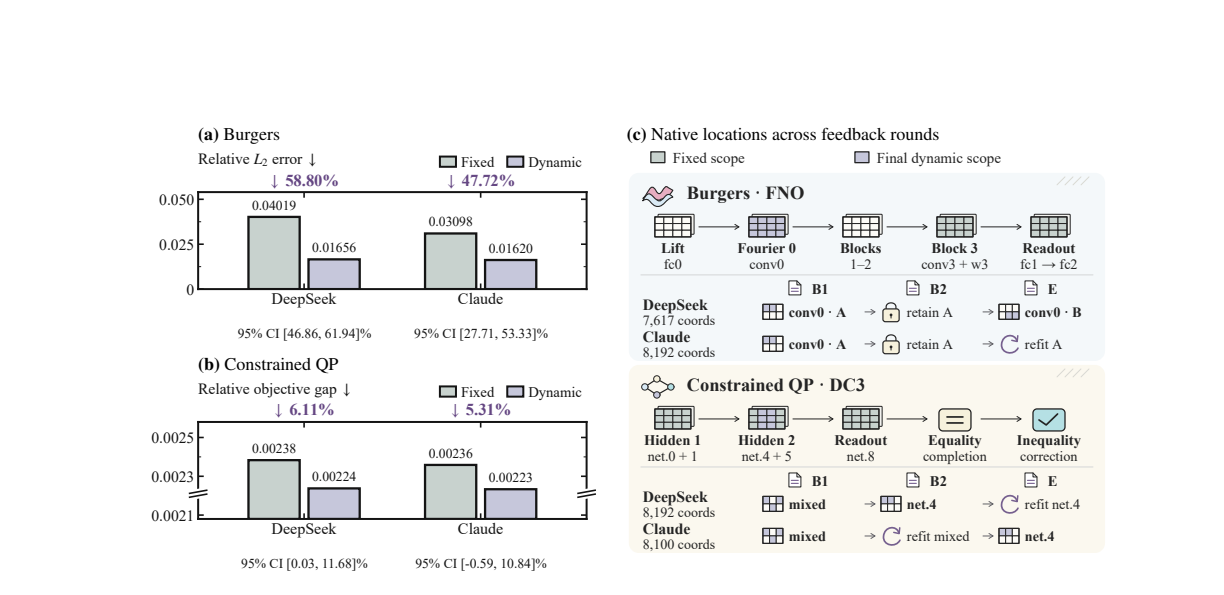
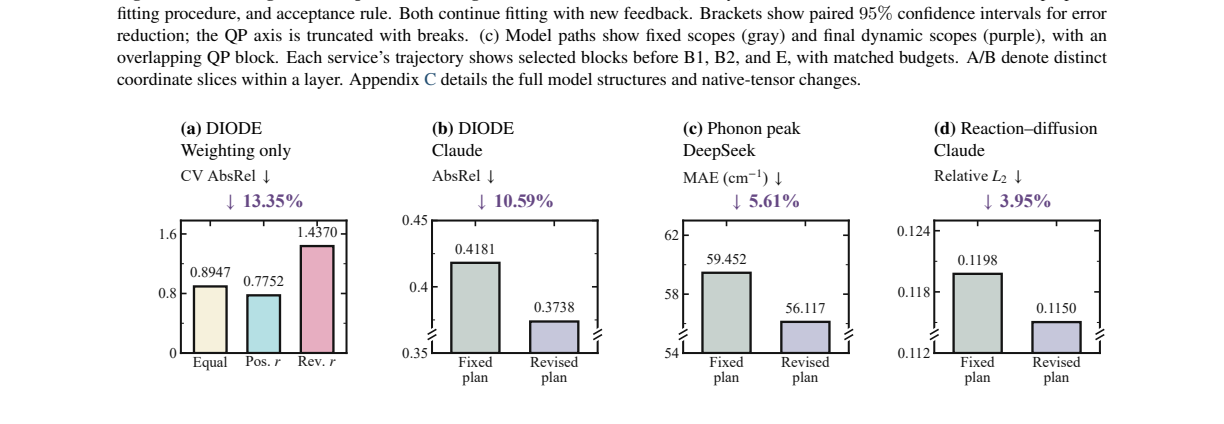
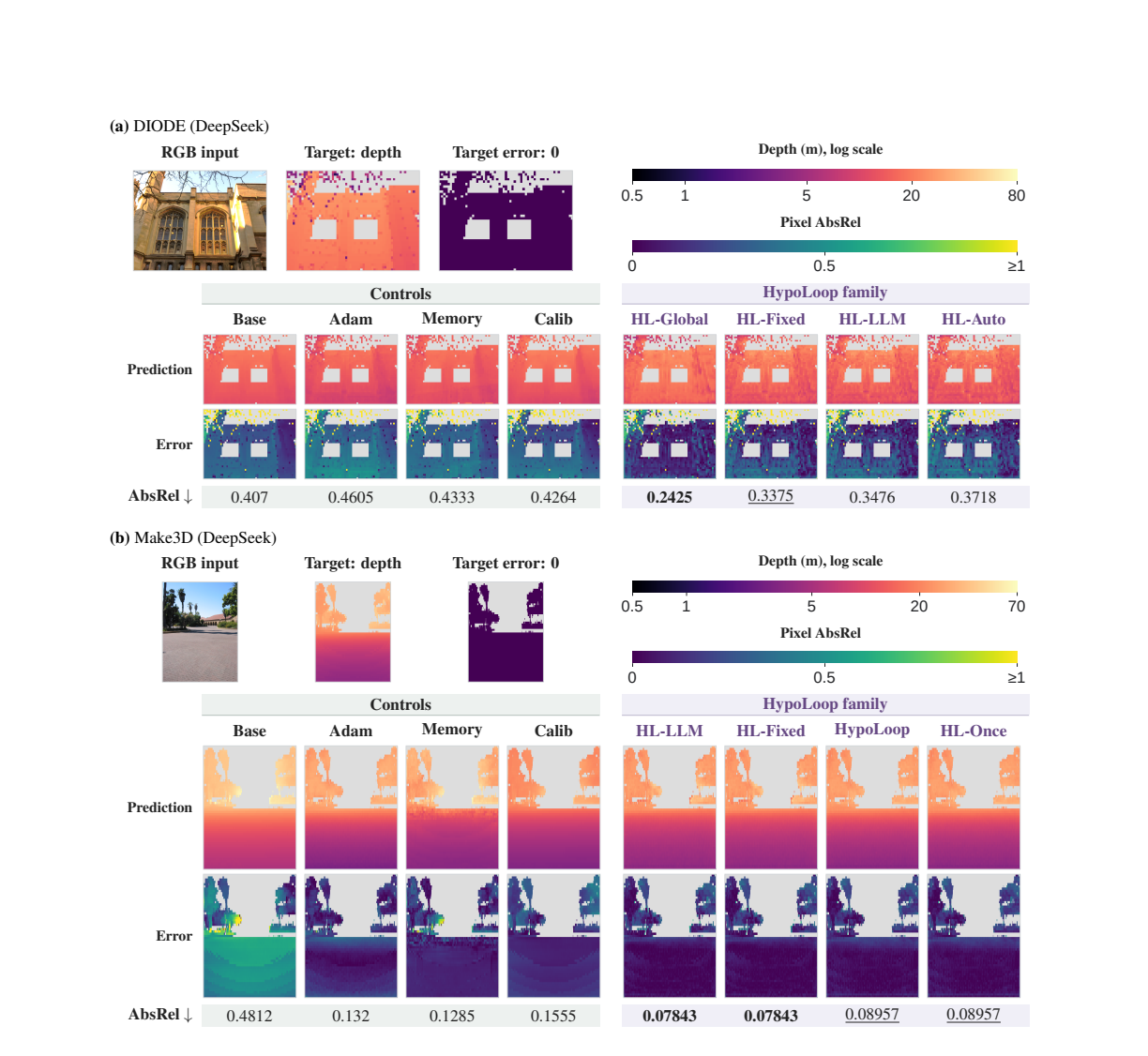
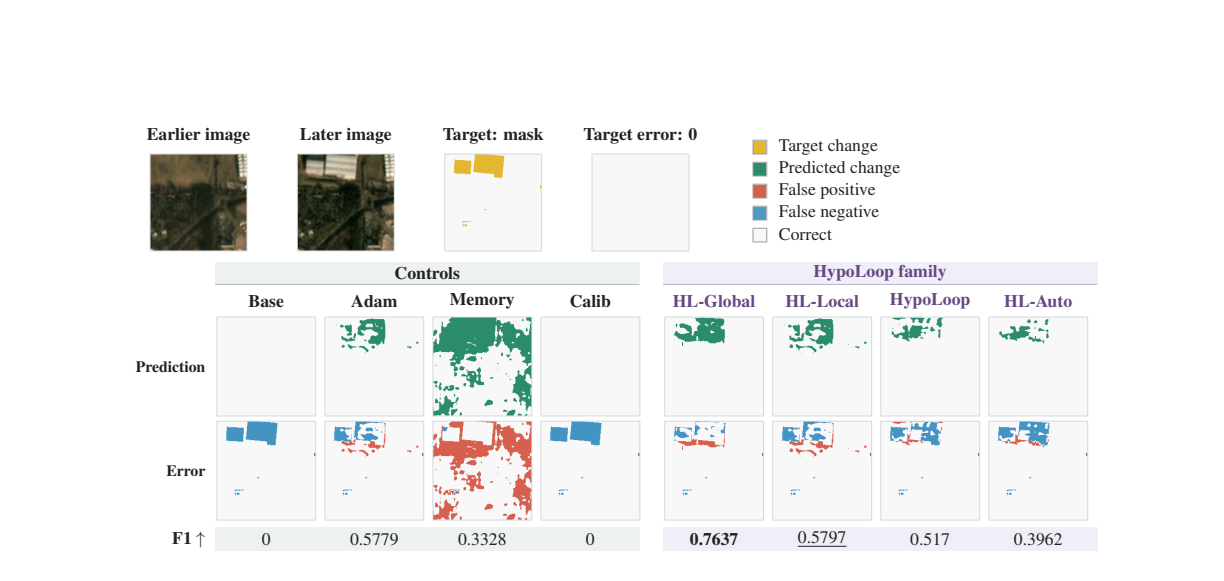
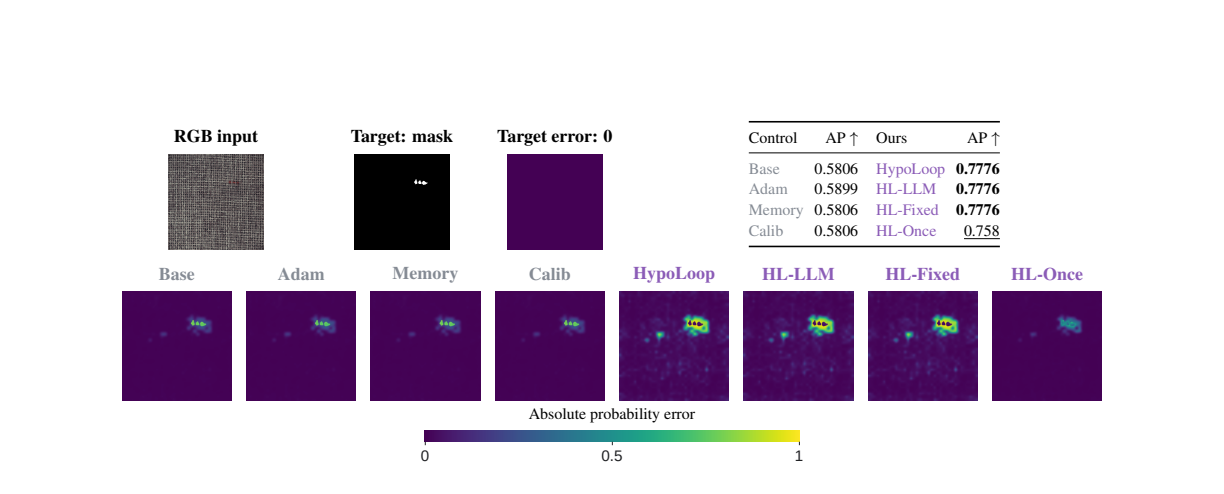
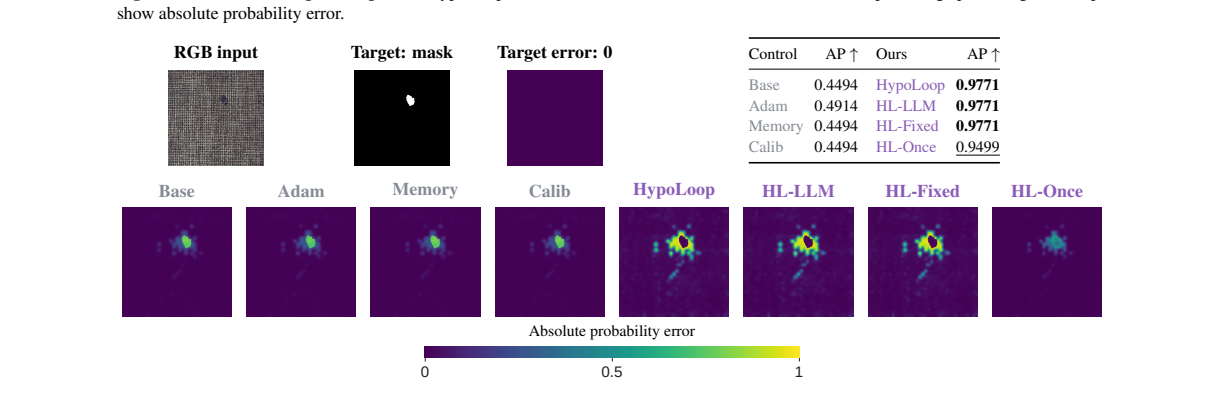
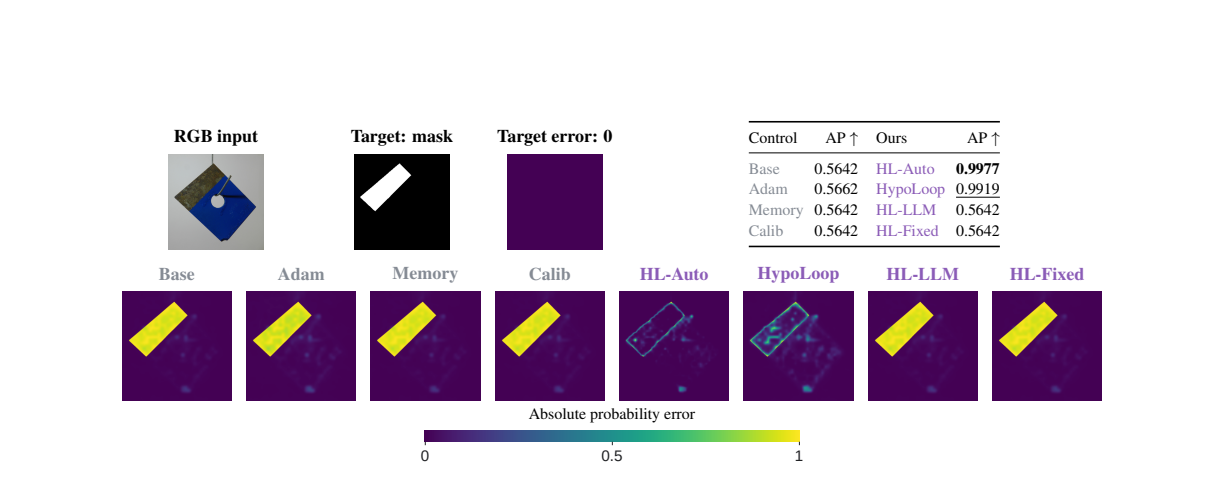
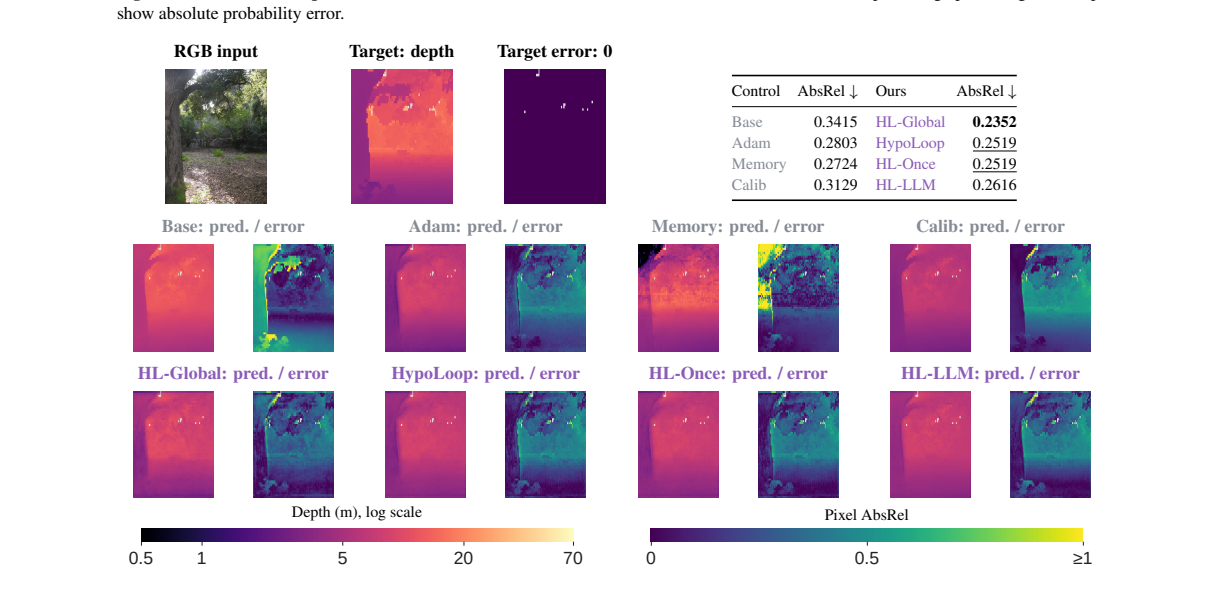
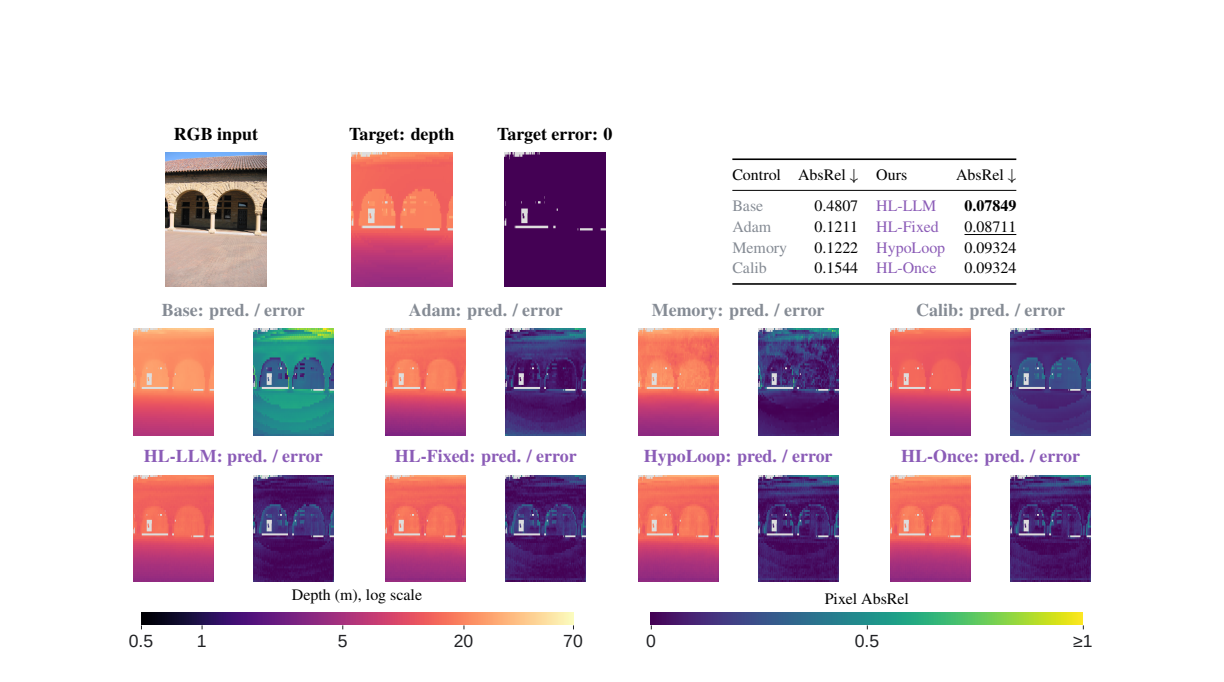
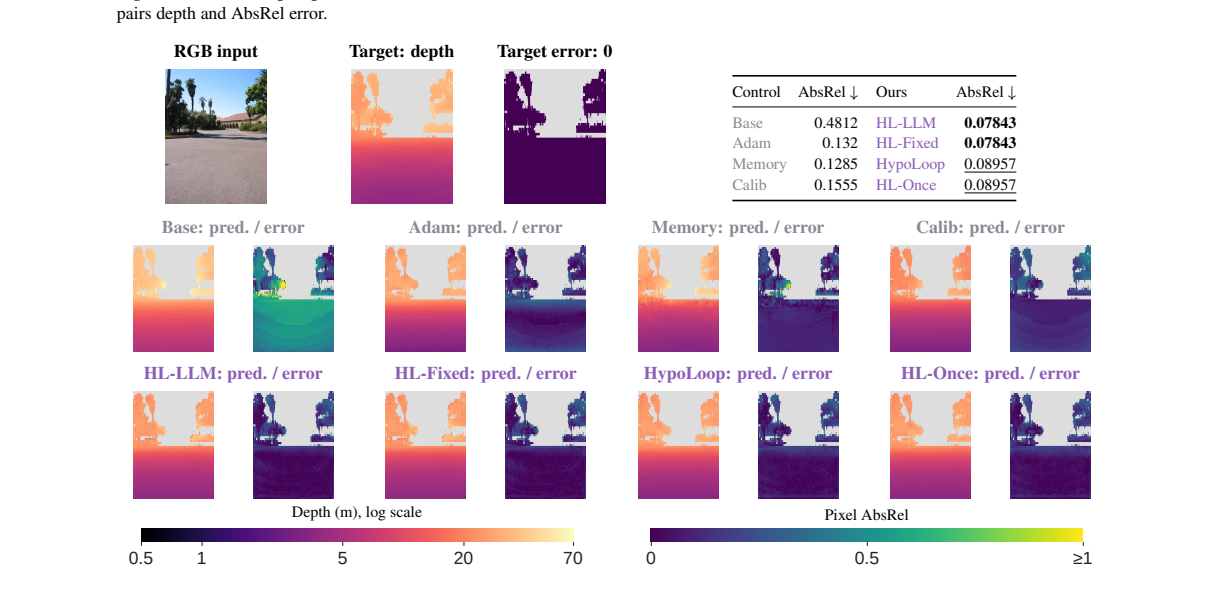
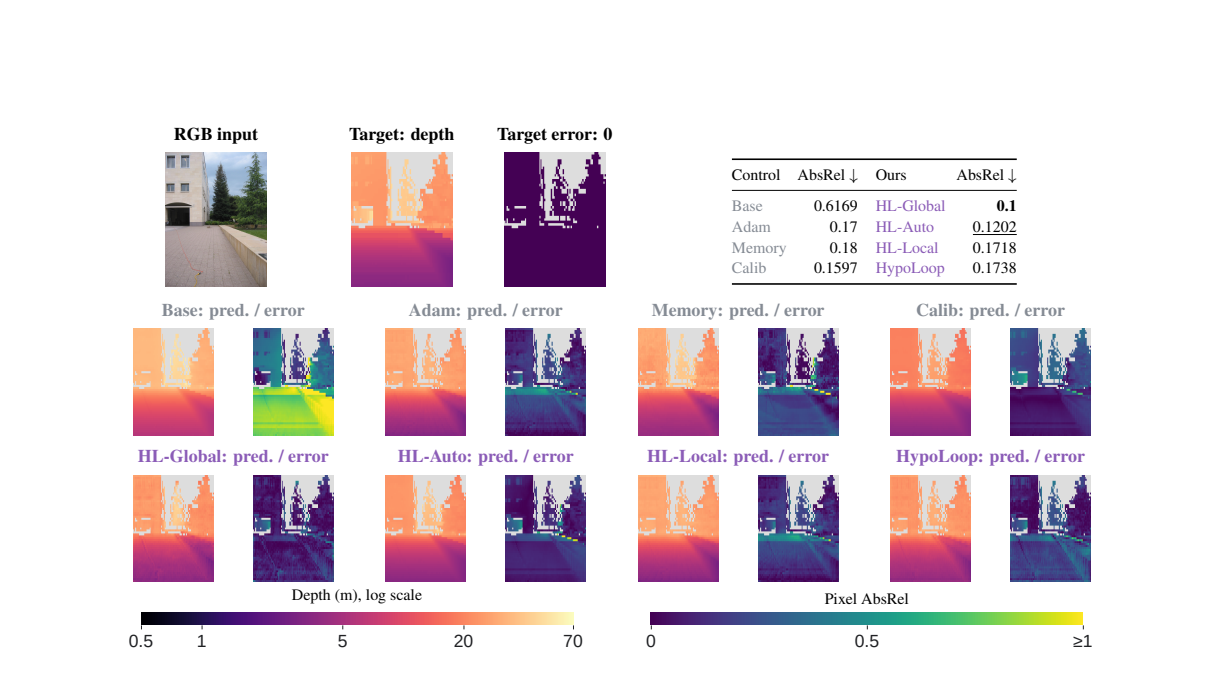
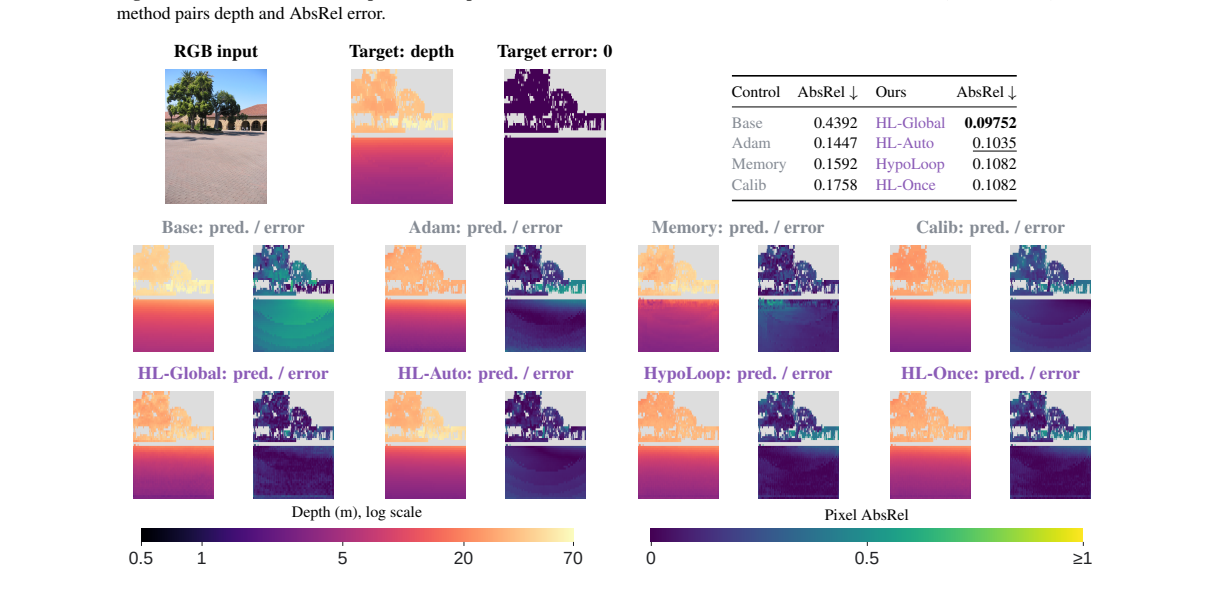
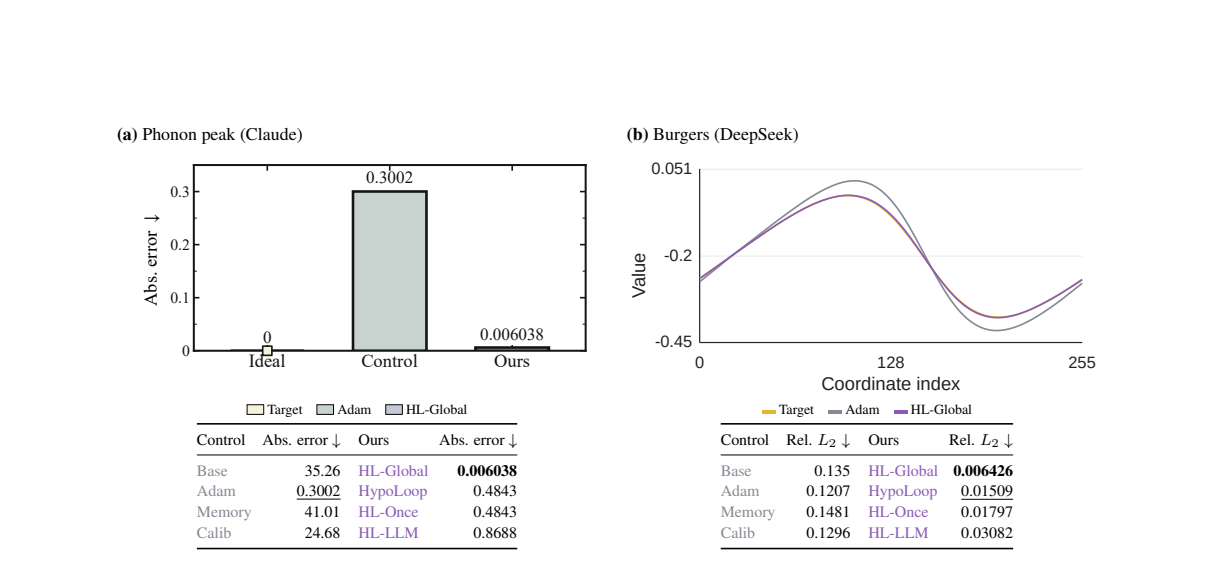
Fixed, numerically adaptive, and LLM-guided policies produce editing plans; numerical solvers compute weight patches, and internal validation selects the deployed predictor. Successive observations and validation records support revisions to editable locations and fitting rules. Experiments cover 22 scientific tasks and both DeepSeek and Claude. On Burgers, reallocating a matched parameter budget reduces error by 58.80% and 47.72% relative to fixed locations. On DIODE, positive-residual weighting reduces absolute relative error (AbsRel) by 13.35% in internal cross-validation, with the same 33 editable coordinates. Revising the complete plan across rounds lowers final AbsRel by 10.59% relative to keeping the initial plan fixed. SpaceNet7 and Make3D connect accepted edits to improved spatial predictions. These results show how experimental evidence can shape the update problem itself. Code: https://github.com/limengran98/HypoLoop.
from the abstract
Pith says
Machine review · deepseek-v4-flash · 19 Nov 2026 · read the full text (213,009 characters) · not checked by a person
It can be wrong. Challenge this review or reply to it.
Holds up, with conditions. HypoLoop shows that experimental feedback can guide both where and how to edit a model's weights, with solid empirical evidence across 22 tasks, though the gains are often modest and the LLM-guided variants are not fully reproducible. This line is wrong
5 minor · 1 open question
How often objections from reviews like this one are right: not yet measured
The paper, first character to last
The reviewer was given the whole text, 213,009 characters. Not checked: figures, code, what the 59 references say.
5 minor objections
The paper says, at §1
Pith says: minor objection 1 of 5
The abstract in the manuscript differs slightly from the arXiv metadata. The manuscript abstract includes the sentence 'Code: https://github.com/limengran98/HypoLoop' which is not in the arXiv metadata abstract. This is minor but should be consistent.
The paper says, at §4.2, Table 1
Pith says: minor objection 2 of 5
The table is very dense and uses many color codes. It is difficult to read in print or for color-blind readers. Consider using a simpler format or providing a grayscale-friendly version.
show 3 more
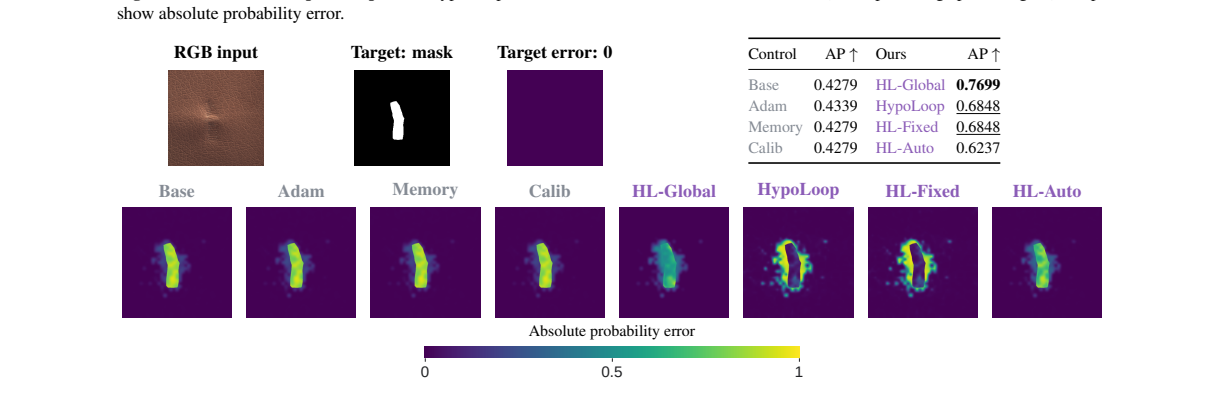
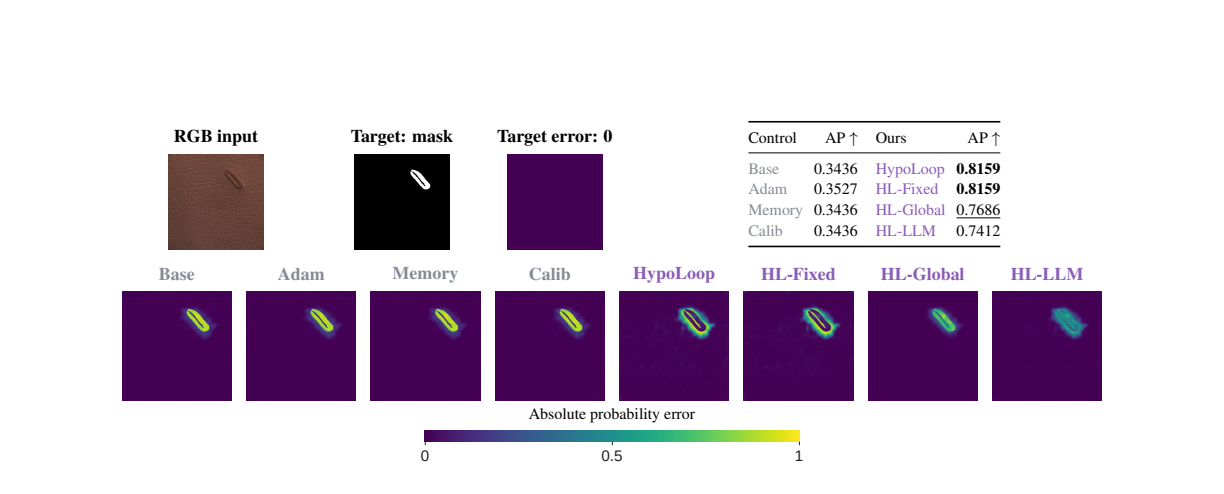
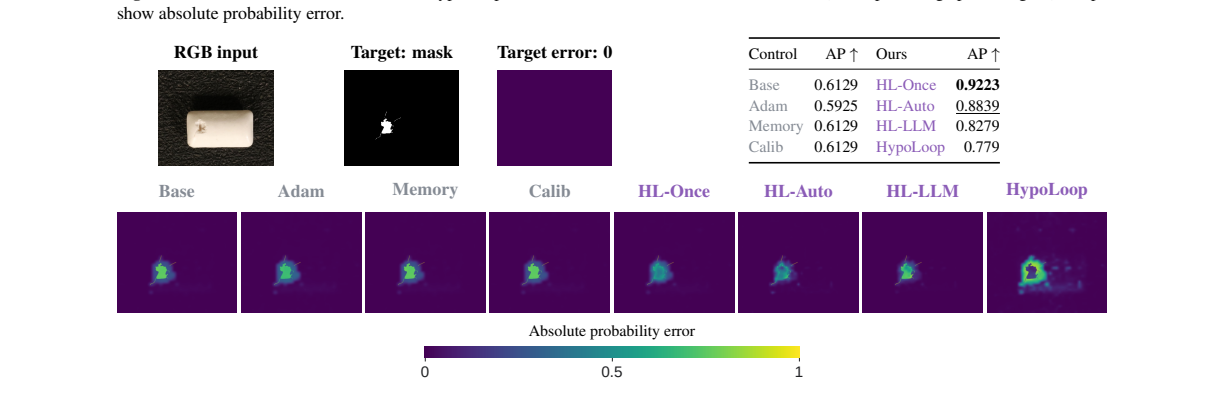
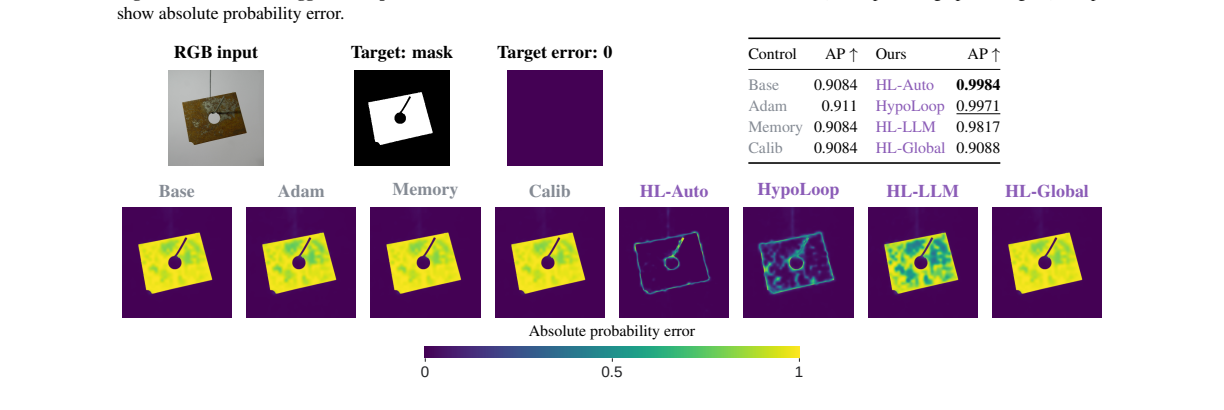
The paper says, at §4.3, Figure 3
Pith says: minor objection 3 of 5
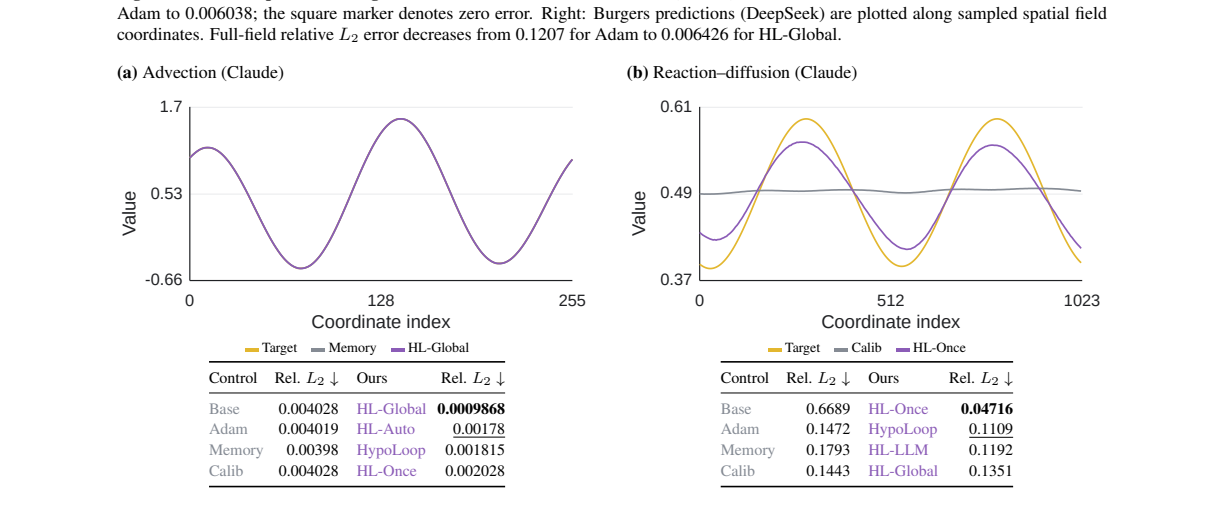
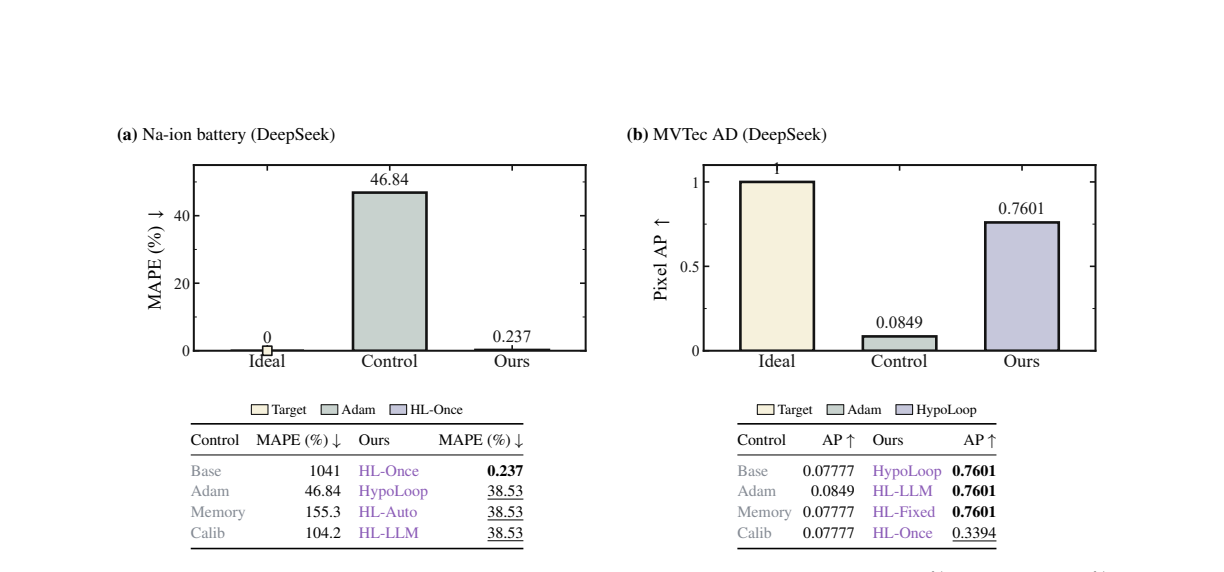
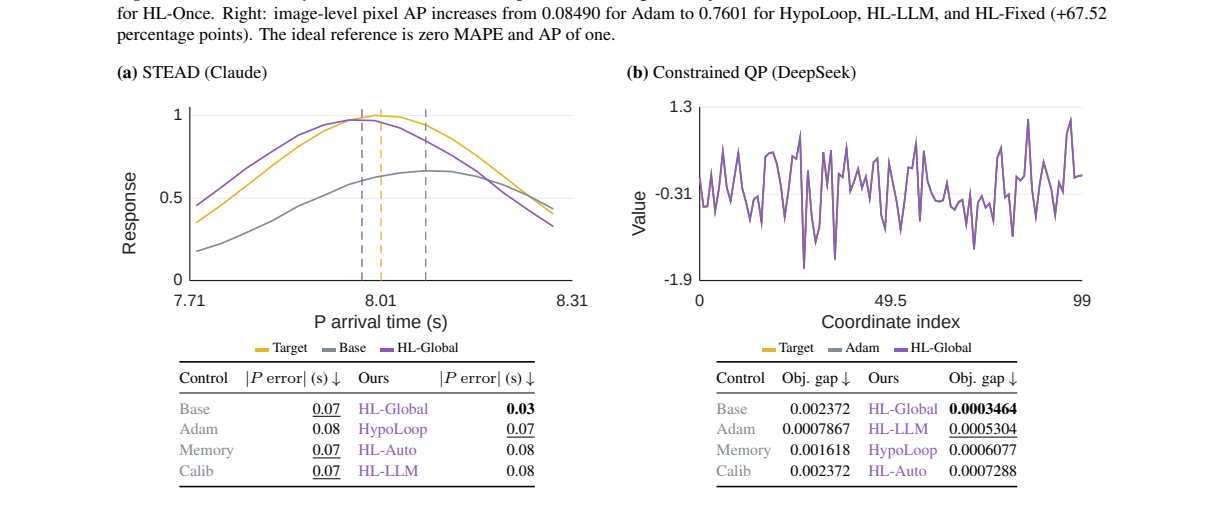
The figure captions are very long and contain detailed results. It would be better to keep captions concise and move the detailed numbers to the main text or a table.
The paper says, at §4.4, Equation (4)
Pith says: minor objection 4 of 5
The weighting rule in Equation (4) uses a clipped exponential. The justification for this specific form is not given. Why exponential? Why clip at 0.2 and 5? A brief explanation would help.
The paper says, at §6
Pith says: minor objection 5 of 5
The conclusion is very brief and does not discuss limitations or future work. The paper would benefit from a discussion of limitations, such as the computational cost of the LLM-guided variants, the sensitivity to hyperparameters, or the scope of tasks where the method is applicable.
Open questions (1)
Pith raised these and could not confirm them against the text of the paper it read. They are questions for the authors, not findings.
- §4.2, Table 1 Pith raised a concern here that it could not check against the text of the paper it was given, so it is not published as an objection.
What would settle it
A concrete test would be to run the same experimental protocol on a new scientific task not in the paper's 22-task set, comparing HL-LLM against HL-Auto and HL-Fixed. If HL-LLM consistently underperforms the simpler variants, the claim that LLM-guided revision provides additional benefit would be weakened. The paper already shows some cases where HL-LLM underperforms HL-Auto or HL-Fixed.
from Pith's summary of the paper
How the review went
5 passes by deepseek-v4-flash · 19 Nov 2026
- Reader holds up, with conditions
- Skeptic concern not confirmed: listed as an open question
- Referee 5 minor
- Check against the paper kept 0 of 5 objections
- Editor wrote the verdict above
Not run on this paper: the simulated authors' defence.
Pith's passes raised 5 objections. A check against the paper's text kept 0, withdrew 3 (3 Pith's reviewer misread the paper) and left 2 as questions.
The review in full
The review in brief, machine-written
This paper introduces HypoLoop, a family of methods that uses experimental feedback to decide which parameters to edit and how to fit the correction. The core idea—treating location selection and fitting-rule revision as separate decisions informed by validation—is a legitimate extension of prior work on model editing and test-time adaptation. The paper's main strength is its breadth: 22 scientific tasks across biology, chemistry, materials, physics, energy, depth estimation, seismology, optimization, time series, industrial inspection, and remote sensing. The experiments are extensive, with clear metrics and comparisons to several baselines. The strongest results come from HL-Global, which can reselect parameter blocks from the full inventory each round, yielding large improvements on Burgers (71% error reduction) and STEAD (88% MAE reduction). The controlled studies on location allocation and residual weighting convincingly show that these choices matter.
The soft spots are in proportion. The baselines are relatively weak: Adam on a fixed subset, memory-based correction, and output calibration. Full fine-tuning or more sophisticated test-time adaptation methods would be stronger comparisons. The LLM-guided variants (HL-LLM) are not fully reproducible—the exact prompts are not specified, and LLM responses are non-deterministic. The improvements are often modest (a few percent), and the paper does not report statistical significance tests. The theoretical analysis in Appendix A is sound but does not directly support the empirical claims. The paper acknowledges that HL-Global is computationally expensive.
This paper is for researchers working on model editing, test-time adaptation, and scientific machine learning. It deserves a serious referee. The central claim is plausible and supported by evidence, but the weaknesses should be addressed before acceptance. I recommend peer review with a request for stronger baselines, more detailed LLM implementation, and statistical significance testing.
The stress test's concern
Not confirmed. Pith could not check this concern against the text of the paper it was given; it is listed as an open question, not a finding.
The referee's report
Not published. Pith's referee wrote this assessment before its objections were checked against the paper, and 4 of its 4 major objections did not survive that check.
Pith's reading of the paper (a machine's summary, not the authors')
The paper introduces HypoLoop, a family of methods that uses experimental feedback to decide both which model parameters to edit and how to weight prediction errors when fitting corrections. The authors argue that these two choices—where to allocate an editing budget and how observed errors should drive the update—can be revised as new measurements arrive, and that doing so improves predictions across a diverse set of scientific tasks. On Burgers, reallocating a matched parameter budget reduces error by 58.80% and 47.72% relative to fixed locations. On DIODE, positive-residual weighting reduces absolute relative error by 13.35% in internal cross-validation with the same 33 editable coordinates. Revising the complete plan across rounds lowers final AbsRel by 10.59% relative to keeping the initial plan fixed. The paper demonstrates these improvements across 22 tasks spanning biology, chemistry, materials, physics, energy, depth estimation, seismology, constrained optimization, time-series forecasting, industrial inspection, and remote sensing.
What carries the argument. The central mechanism is the editing plan (M, h), where M identifies editable native coordinates and h specifies the fitting configuration (sample weighting, loss, regularization, reference preservation, and patch scale). A proposal policy π uses model structure, error statistics, and editing history to produce plans. Numerical solvers compute weight patches via local linear approximation or nonlinear optimization. Internal cross-validation selects the deployed predictor. The paper provides theoretical analysis (Propositions 1-3) showing that location-dependent corrections depend on the alignment of residuals with selected response directions, that weighting changes the fitted patch direction, and that a sufficient condition for native error reduction exists for sufficiently small patch scales.
Core claim. The paper claims that experimental feedback can be used to guide two key decisions in model updating: which parameters to edit (where) and how prediction errors should drive the correction (how). The authors propose HypoLoop, a family of methods that connects these choices to experimental feedback through fixed, numerically adaptive, and LLM-guided policies. The central claim is that revising these editing plans based on accumulated feedback and validation results leads to better predictions than keeping the initial plan fixed. The paper supports this with controlled experiments: reallocating a matched parameter budget reduces Burgers error by 58.80% and 47.72% relative to fixed locations; positive-residual weighting reduces DIODE AbsRel by 13.35% at the same 33 editable coordinates; and revising the complete plan across rounds lowers final DIODE AbsRel by 10.59% relative to keeping the initial plan fixed. The paper also provides theoretical analysis showing that location-dependent corrections depend on the alignment of residuals with selected response directions, and that weighting changes the fitted patch direction.
The premise it rests on. The LLM-guided variants assume that a large language model can reliably propose effective editing plans based on textual descriptions of the model structure, prediction errors, and editing history, but the paper does not provide evidence that the LLM's proposals are consistently better than simple fixed or numerically adapted policies.
If the paper is right (Pith's inferences, not the authors')
If the paper's claims are correct, scientific model updating can be improved by treating the editing plan as something that should be revised based on experimental feedback, rather than fixed in advance.
The paper's results suggest that both location selection and error weighting matter for effective model updates, and that these choices can be guided by feedback without requiring full retraining.
The paper demonstrates that LLM-guided plan revision can improve over fixed plans on some tasks, though the LLM variants sometimes underperform simpler numerical adaptation.
The theoretical analysis provides a framework for understanding when and why location and weighting choices affect the quality of weight edits.
The paper's framework could be extended to other domains where models are updated sequentially from observations, such as robotics, autonomous driving, or medical diagnosis, though the paper only tests scientific tasks.
The reliance on LLMs for plan proposals introduces cost, latency, and reproducibility concerns that the paper acknowledges but does not fully address; future work could develop more deterministic proposal policies.
The paper's theoretical results (Propositions 1-3) could serve as a foundation for developing adaptive algorithms that automatically select editing locations and weighting schemes without requiring LLM guidance.
The paper's approach of treating the update problem itself as something that can be revised based on feedback suggests a broader principle: the formulation of a learning problem can be as important as the optimization algorithm used to solve it.
Check this review
What was read
The passes were given all 213,009 characters of the paper's LaTeX source.
Fingerprint of that text (SHA-256): ba26ed8ab07570a0125b499737c1005cfc12c3ff19064b8e7071d119eea07c09
Pith does not keep that text. Rebuilt from the paper's source or PDF by the same code, it has this fingerprint if it is the same text. From a copy of Pith's code:
PYTHONPATH=. python scripts/review_input_check.py 2611.23718
The passes, in the order they ran
- Reader deepseek-v4-flash · medium effort · $0.0082 · instructions of the Reader, fingerprint f9ead7300382…
- Skeptic deepseek-v4-flash · medium effort · $0.0075 · instructions of the Skeptic, fingerprint 8f88c0f61488…
- Referee deepseek-v4-flash · medium effort · $0.0092 · instructions of the Referee, fingerprint a852d99aea0d…
- Check against the paper deepseek-v4-flash · medium effort · $0.0079 · instructions of the Check against the paper, fingerprint 6c7a6883d551…
- Editor deepseek-v4-flash · medium effort · $0.0075 · instructions of the Editor, fingerprint e7211f6a3d27…
- Circularity check deepseek-v4-flash · medium effort · $0.0075 · instructions of the Circularity check, fingerprint e9946e39d67b…
- Summary for the page deepseek-v4-flash · medium effort · temperature 0.2 · $0.0078 · instructions of the Summary for the page, fingerprint e4f56bf568e7…
The passes cost $0.056 in model calls together.
Version stamped on this review: pith-pipeline@v1.4.1-daily-deepseek-or-medium+deepseek/deepseek-v4-flash+p.d60f54226f00
Each link opens a pass's instructions as plain text, the exact bytes its fingerprint was taken over. Every stored set of instructions.
curl -s https://pith.science/methodology/prompts/f9ead730038216984cfb56d7cb34332bdf691828296a1de4245f3d6667d4bf56 | sha256sum
prints the fingerprint of the reader's instructions. The same works for every pass.
The receipt
The review's fingerprint was taken on 19 Nov 2026. The review you are reading still matches it.
Fingerprint of the review (SHA-256): 6da059ef10957075cea0479fdc5546d1d7ccb79b9d3662743f7be1a5da8dc51e
curl -s 'https://pith.science/api/v1/verdicts/2611.23718?form=canonical' | sha256sum
prints the fingerprint of the review as it stands now. The rule, in four steps.
A matching fingerprint shows the review has not changed since that date. It does not show that the review is right.
How often reviews like this one are right
Reviews like this one: written by deepseek-v4-flash, from the paper's LaTeX source.
How often objections from reviews like this one are right: not yet measured
Reviews by people
This review was written by a machine. No person has reviewed this paper on Pith yet. A scientist listed on Pith can review it for a fee, and their review is published here whatever it concludes.
The paper
Abstract
Scientific experiments continually reveal prediction errors. Effective updates depend on which parameters change and which errors drive the correction. We introduce HypoLoop, a family of native weight-editing methods that connects these choices to experimental feedback. Fixed, numerically adaptive, and LLM-guided policies produce editing plans; numerical solvers compute weight patches, and internal validation selects the deployed predictor. Successive observations and validation records support revisions to editable locations and fitting rules. Experiments cover 22 scientific tasks and both DeepSeek and Claude. On Burgers, reallocating a matched parameter budget reduces error by 58.80% and 47.72% relative to fixed locations. On DIODE, positive-residual weighting reduces absolute relative error (AbsRel) by 13.35% in internal cross-validation, with the same 33 editable coordinates. Revising the complete plan across rounds lowers final AbsRel by 10.59% relative to keeping the initial plan fixed. SpaceNet7 and Make3D connect accepted edits to improved spatial predictions. These results show how experimental evidence can shape the update problem itself. Code: https://github.com/limengran98/HypoLoop.
The paper's own sentences, arranged, kept beside the review and separate from it. Each label is drawn from a closed vocabulary; the number beside it is the probability the classifier gave that label. No sentence in this record was written by a model.
abstract compiled · 2026-11-19
The authors' main claim, as the classifier picked it out 1.00
“These results show how experimental evidence can shape the update problem itself.”
How the main claim is stated: asserted 1.00
What the abstract itself states, as probabilities: claims first 0.06 · states limitation 0.08 · human participants 0.04 · controlled comparison 0.90 · randomized assignment 0.02 · states quantitative result 0.99 · compares with prior results 0.89 · mentions code or data availability 0.98
The abstract, sentence by sentence
This table labels the abstract only (arXiv listing abstract v1). The number is the probability the classifier gave the label.
| Sentence | Role | The authors' own work | States the main conclusion | Strength |
|---|---|---|---|---|
| Scientific experiments continually reveal prediction errors. | background 1.00 | 0.09 | 0.02 | asserted 1.00 |
| Effective updates depend on which parameters change and which errors drive the correction. | background 0.96 | 0.09 | 0.05 | asserted 1.00 |
| We introduce HypoLoop, a family of native weight-editing methods that connects these choices to experimental feedback. | contribution 1.00 | 0.88 | 0.10 | asserted 1.00 |
| Fixed, numerically adaptive, and LLM-guided policies produce editing plans; numerical solvers compute weight patches, and internal validation selects the deployed predictor. | method 0.97 | 0.73 | 0.07 | asserted 1.00 |
| Successive observations and validation records support revisions to editable locations and fitting rules. | method 0.90 | 0.61 | 0.16 | asserted 0.97 |
| Experiments cover 22 scientific tasks and both DeepSeek and Claude. | method 0.90 | 0.89 | 0.03 | asserted 0.98 |
| On Burgers, reallocating a matched parameter budget reduces error by 58.80% and 47.72% relative to fixed locations. | result 1.00 | 0.94 | 0.07 | asserted 1.00 |
| On DIODE, positive-residual weighting reduces absolute relative error (AbsRel) by 13.35% in internal cross-validation, with the same 33 editable coordinates. | result 1.00 | 0.93 | 0.06 | asserted 1.00 |
| Revising the complete plan across rounds lowers final AbsRel by 10.59% relative to keeping the initial plan fixed. | result 1.00 | 0.94 | 0.13 | asserted 1.00 |
| SpaceNet7 and Make3D connect accepted edits to improved spatial predictions. | result 1.00 | 0.88 | 0.07 | asserted 1.00 |
| These results show how experimental evidence can shape the update problem itself. | interpretation 1.00 | 0.51 | 0.79 | asserted 1.00 |
| Code: https://github.com/limengran98/HypoLoop. | contribution 0.75 | 0.38 | 0.02 | unclear 0.95 |
What kind of paper the classifier reports this is: method or tool 1.00 · evidence from observation or experiment 0.73
What was examined, and what was not
Sources read
- arXiv listing abstract v1
Not examined
- full text
- figures and tables
- references and citing sentences
- relations to other papers
Levels run
- P abstract
Not run
- S sections
- T body sentences
- C citations
- R cross-paper relations
How the labels were made
Compiled by classifier-1.13.0 via TypeSafe API, question bank abstract-p1-20260923, 2026-11-19: 1 request, 8,624 input tokens.
Every quoted sentence on this record is the authors'. Every label is from Pith's closed vocabulary, with the probability shown beside it. This record as JSON
Figures (26)
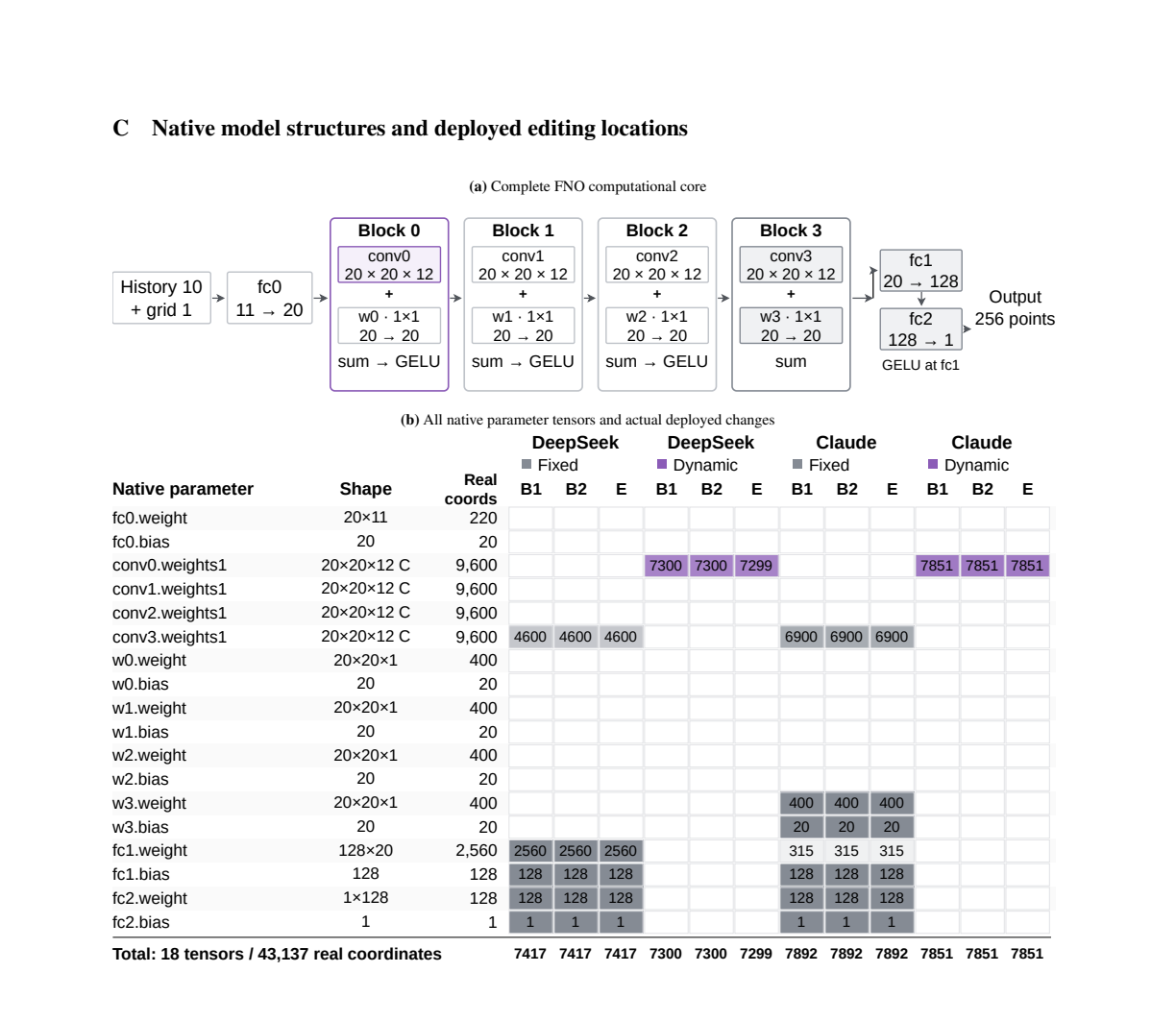
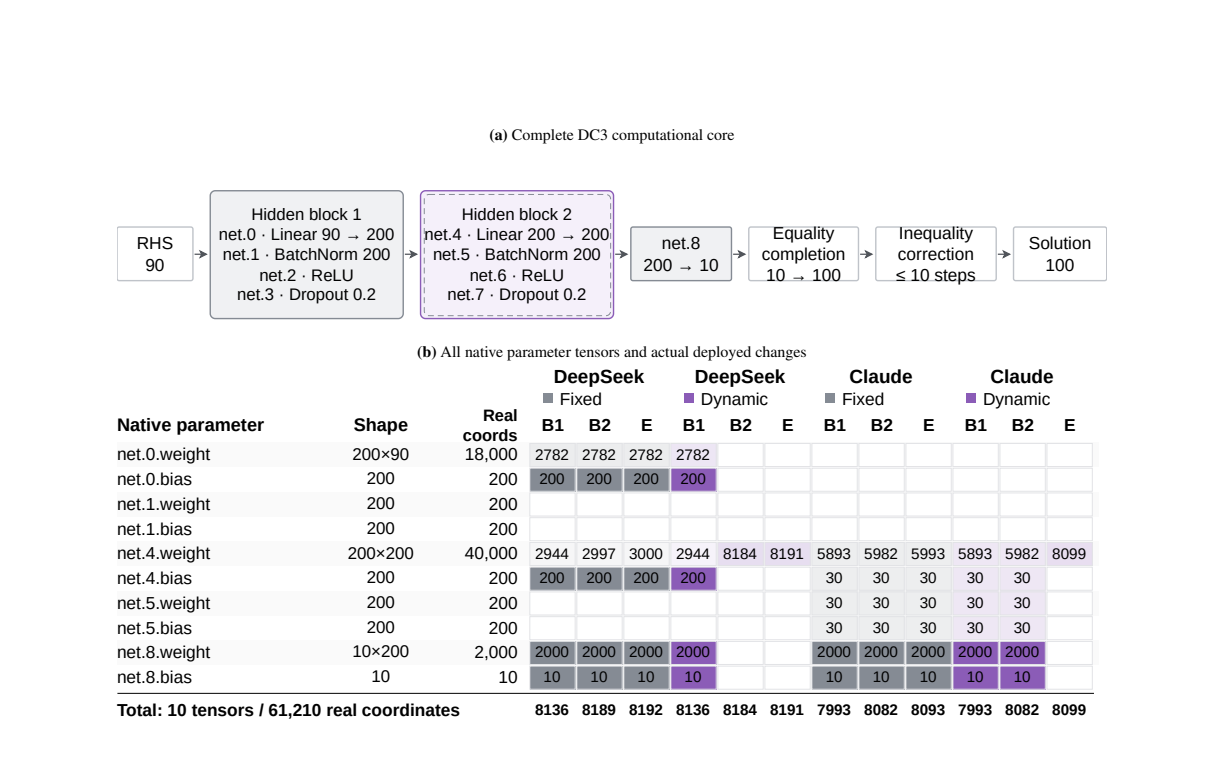
Figures are the authors', reproduced from the paper.
References (59)
- [1] Marcin Andrychowicz, Misha Denil, Sergio Gómez, Matthew W. Hoffman, David Pfau, Tom Schaul, Brendan Shillingford, and Nando de Freitas. Learning to learn by gradient descent by gradient descent. InAdvances in Neural Information Processing Systems, volume 29, 2016. https://pape... on Pith
- [2] Jonathan T. Barron. A General and Adaptive Robust Loss Function.Proceedings of the IEEE/CVF Conference on Computer Vision and Pattern Recognition, pages 4331–4339, 2019. https://openaccess.thecvf.com/content_CVPR_ 2019/html/Barron_A_General_and_Adaptive_ Robust_Loss_Function_C... on Pith
- [3] Paul Bergmann, Michael Fauser, David Sattlegger, and Carsten Steger. MVTec AD—A Comprehensive Real-World Dataset for Unsupervised Anomaly Detection.CVPR, pages 9592–9600, 2019.https://openaccess.thecvf.com/ content_CVPR_2019/html/Bergmann_MVTec_AD_-- _A_Comprehensive_Real-Worl... on Pith
- [4] Paul Bergmann, Kilian Batzner, Michael Fauser, David Sattlegger, and Carsten Steger. Beyond Dents and Scratches: Logical Constraints in Unsupervised Anomaly Detection and Localization.International Journal of Computer Vision, 2022. https://doi.org/10.1007/s11263-022-01578-9 on Pithdoi:10.1007/s11263-022-01578-9
- [5] Rafael Bischof and Michael A. Kraus. Multi-Objective Loss Balancing for Physics-Informed Deep Learning.Computer Methods in Applied Mechanics and Engineering, 439:117914, 2025. https://doi.org/10.1016/j.cma.2025.117914 on Pithdoi:10.1016/j.cma.2025.117914
- [6] Hongruixuan Chen, Jian Song, Chengxi Han, Junshi Xia, and Naoto Yokoya. ChangeMamba: Remote Sensing Change Detection With Spatiotemporal State Space Model. IEEE Transactions on Geoscience and Remote Sensing, 62:1–20, 2024. https://doi.org/10.1109/TGRS.2024.3417253 on Pithdoi:10.1109/tgrs.2024.3417253
- [7] Song Chen. Beijing Multi-Site Air Quality.UCI Machine Learning Repository dataset, 2017. https://doi.org/10.24432/C5RK5G on Pithdoi:10.24432/c5rk5g
- [8] A. P. Dawid. Present Position and Potential Developments: Some Personal Views: Statistical Theory: The Prequential Approach.Journal of the Royal Statistical Society: Series A (General), 147(2):278–290, 1984. https://doi.org/10.2307/2981683 on Pithdoi:10.2307/2981683
- [9] John S. Delaney. ESOL: Estimating Aqueous Solubility Directly from Molecular Structure.Journal of Chemical Information and Computer Sciences, 44(3):1000–1005, 2004.https://doi.org/10.1021/ci034243x on Pithdoi:10.1021/ci034243x
- [10] Priya L. Donti, David Rolnick, and J. Zico Kolter. DC3: A learning method for optimization with hard constraints. ICLR, 2021. https://openreview.net/forum?id=V1ZHVxJ6dSS on Pith
- [11] Alexander Dunn, Qi Wang, Alex Ganose, Daniel Dopp, and Anubhav Jain. Benchmarking materials property prediction methods: The Matbench test set and Automatminer reference algorithm.npj Computational Materials, 6:138, 2020. https://doi.org/10.1038/s41524-020-00406-3 on Pithdoi:10.1038/s41524-020-00406-3
- [12] Chris J. Frangieh et al. Multimodal pooled Perturb-CITE-seq screens in patient models define mechanisms of cancer immune evasion.Nature Genetics, 53:332–341, 2021. https://doi.org/10.1038/s41588-021-00779-1 on PithPith's reviewdoi:10.1038/s41588-021-00779-1
- [13] Harry R. Glahn and Dale A. Lowry. The Use of Model Output Statistics (MOS) in Objective Weather Forecasting. Journal of Applied Meteorology, 11(8):1203–1211, 1972. https://journals.ametsoc.org/view/journals/ apme/11/8/1520- 0450_1972_011_1203_tuomos_2_0_co_2.xml on Pith
- [14] Chuan Guo, Geoff Pleiss, Yu Sun, and Kilian Q. Weinberger. On Calibration of Modern Neural Networks. In Proceedings of the 34th International Conference on Machine Learning, volume 70 ofProceedings of Machine Learning Research, pages 1321–1330, 2017. https://proceedings.mlr.pr... on Pith
- [15] Joshua E. Hammond, Tyler A. Soderstrom, Brian A. Korgel, and Michael Baldea. A selective Kalman filtering approach to online neural network updating under system drift. Scientific Reports, 15(1):43577, 2025. https://doi.org/10.1038/s41598-025-24558-8 on Pithdoi:10.1038/s41598-025-24558-8
- [16] Junru Hu, Cheng Tang, Wei Li, Hongze Zhu, Chun-Mei Feng, Qi Zhang, Yirong Chen, and Ming Hu. Exploring Weight-Space Programming: Capabilities, Generalization, and Limitations.arXiv:2611.09382, 2026. https://arxiv.org/abs/2611.09382 on PithPith's reviewarXiv
- [17] Chanhwi Jeong, Inhwan Bae, Jin-Hwi Park, and Hae-Gon Jeon. Test-Time Prompt Tuning for Zero-Shot Depth Completion. InProceedings of the IEEE/CVF International Conference on Computer Vision, pages 9443–9454, 2025. https://openaccess.thecvf.com/content/ ICCV2025/html/Jeong_Test-... on Pith
- [18] Stepan Jezek, Martin Jonak, Radim Burget, Pavel Dvorak, and Milos Skotak. Deep learning-based defect detection of metal parts: Evaluating current methods in complex conditions.ICUMT, pages 66–71, 2021.https: //doi.org/10.1109/ICUMT54235.2021.9631567 on Pithdoi:10.1109/icumt54235.2021.9631567
- [19] Sanchit Kabra, Nikhil Abhyankar, Saaketh Desai, Prasad P. Iyer, and Chandan K. Reddy. LLM-AutoSciLab: Closed-Loop Scientific Discovery via Active Experimentation with LLMs.arXiv:2605.24043, 2026. https://arxiv.org/abs/2605.24043 on PithPith's reviewarXiv
- [20] Diederik P. Kingma and Jimmy Ba. Adam: A Method for Stochastic Optimization.ICLR, 2015. https://arxiv.org/abs/1412.6980. 9 on PithPith's reviewarXiv
show 39 more
- [21] Yoonho Lee, Annie S. Chen, Fahim Tajwar, Ananya Kumar, Huaxiu Yao, Percy Liang, and Chelsea Finn. Surgical Fine-Tuning Improves Adaptation to Distribution Shifts. In International Conference on Learning Representations, 2023. https://openreview.net/forum?id=APuPRxjHvZ on Pith
- [22] Mengran Li, Bo Li, Weijing Zhao, Chengyang Zhang, Boyu Zhang, Jinfeng Xu, Zelin Zang, Victor C. M. Leung, and Stan Z. Li. WeightLoop: Weight-Space Programming with Experimental Feedback.arXiv preprint arXiv:2611.07319, 2026.https://arxiv.org/abs/2611.07319 on PithPith's reviewarXiv
- [23] Xingwang Li, Fei Teng, Cong Zhou, and Qiang Duan. Beyond Uniform Updates: Drift Pattern Aware Online Time Series Forecasting Under Delayed Feedback. In Proceedings of the Thirty-Fifth International Joint Conference on Artificial Intelligence, pages 4518–4526, 2026.https://ijca... on Pith
- [24] Zongyi Li, Nikola Kovachki, Kamyar Azizzadenesheli, Burigede Liu, Kaushik Bhattacharya, Andrew Stuart, and Anima Anandkumar. Fourier Neural Operator for Parametric Partial Differential Equations.ICLR, 2021. https://openreview.net/forum?id=c8P9NQVtmnO on Pith
- [25] Chris Lu, Samuel Holt, Claudio Fanconi, Alex J. Chan, Jakob Foerster, Mihaela van der Schaar, and Robert Tjarko Lange. Discovering Preference Optimization Algorithms with and for Large Language Models. InAdvances in Neural Information Processing Systems, volume 37, 2024. https... on Pith
- [26] Kevin Meng, David Bau, Alex Andonian, and Yonatan Belinkov. Locating and Editing Factual Associations in GPT. InAdvances in Neural Information Processing Systems, volume 35, 2022. https://papers.neurips.cc/paper_files/paper/ 2022/hash/6f1d43d5a82a37e89b0665b33bf3a182- Abstract... on Pith
- [27] Clayton Miller et al. The Building Data Genome Project 2, energy meter data from the ASHRAE Great Energy Predictor III competition.Scientific Data, 7:368, 2020. https://doi.org/10.1038/s41597-020-00712-x on Pithdoi:10.1038/s41597-020-00712-x
- [28] S. Mostafa Mousavi, Yixiao Sheng, Weiqiang Zhu, and Gregory C. Beroza. STanford EArthquake Dataset (STEAD): A Global Data Set of Seismic Signals for AI. IEEE Access, 2019. https://doi.org/10.1109/ACCESS.2019.2947848 on Pithdoi:10.1109/access.2019.2947848
- [29] Hyoungseob Park, Anjali Gupta, and Alex Wong. Test-Time Adaptation for Depth Completion. In Proceedings of the IEEE/CVF Conference on Computer Vision and Pattern Recognition, pages 20519–20529, 2024. https://openaccess.thecvf.com/content/ CVPR2024/html/Park_Test-Time_Adaptatio... on Pith
- [30] Sylvestre-Alvise Rebuffi, Hakan Bilen, and Andrea Vedaldi. Learning multiple visual domains with residual adapters. Advances in Neural Information Processing Systems, volume 30, 2017.https: //proceedings.neurips.cc/paper_files/paper/ 2017/hash/e7b24b112a44fdd9ee93bdf998c6ca0e-... on Pith
- [31] Mengye Ren, Wenyuan Zeng, Bin Yang, and Raquel Urtasun. Learning to Reweight Examples for Robust Deep Learning. InProceedings of the 35th International Conference on Machine Learning, volume 80 of Proceedings of Machine Learning Research, pages 4334–4343, 2018. https://proceed... on Pith
- [32] David R. Roberts, V olker Bahn, Simone Ciuti, Mark S. Boyce, Jane Elith, Gurutzeta Guillera-Arroita, Severin Hauenstein, José J. Lahoz-Monfort, Boris Schröder, Wilfried Thuiller, David I. Warton, Brendan A. Wintle, Florian Hartig, and Carsten F. Dormann. Cross-validation strat... on Pithdoi:10.1111/ecog.02881
- [33] Yusuf Roohani, Kexin Huang, and Jure Leskovec. Predicting transcriptional outcomes of novel multigene perturbations with GEARS.Nature Biotechnology, 42:927–935, 2024 (published online in 2023). https://doi.org/10.1038/s41587-023-01905-6 on Pithdoi:10.1038/s41587-023-01905-6
- [34] Ashutosh Saxena, Min Sun, and Andrew Y . Ng. Make3D: Learning 3D Scene Structure from a Single Still Image. IEEE Transactions on Pattern Analysis and Machine Intelligence, 31(5):824–840, 2009. https://doi.org/10.1109/TPAMI.2008.132 on Pithdoi:10.1109/tpami.2008.132
- [35] Donald Shepard. A two-dimensional interpolation function for irregularly-spaced data. InProceedings of the 1968 23rd ACM National Conference, pages 517–524, 1968. https://doi.org/10.1145/800186.810616 on Pithdoi:10.1145/800186.810616
- [36] Jeongju Sohn, Sungmin Kang, and Shin Yoo. Arachne: Search-Based Repair of Deep Neural Networks.ACM Transactions on Software Engineering and Methodology, 32(4):1–26, 2023.https://doi.org/10.1145/3563210 on Pithdoi:10.1145/3563210
- [37] Yu Sun, Xiaolong Wang, Zhuang Liu, John Miller, Alexei Efros, and Moritz Hardt. Test-Time Training with Self-Supervision for Generalization under Distribution Shifts. InProceedings of the 37th International Conference on Machine Learning, volume 119 ofProceedings of Machine Le... on Pith
- [38] Makoto Takamoto, Timothy Praditia, Raphael Leiteritz, Daniel MacKinlay, Francesco Alesiani, Dirk Pflüger, and Mathias Niepert. PDEBench: An Extensive Benchmark for Scientific Machine Learning.NeurIPS Datasets and Benchmarks, 2022.https: //proceedings.neurips.cc/paper_files/pap... on Pith
- [39] Rikiya Takehi, Jayden Teoh, Alex Zhang, and Omar Khattab. Sparks of Weight-Space Programming: LLMs can natively read & write neural network weights.Author blog, November 2, 2026. https://rikiyat.github.io/blog/weight-space- programming/. 10 on Pith
- [40] Ruifeng Tan, Weixiang Hong, Jiayue Tang, Xibin Lu, Ruijun Ma, Xiang Zheng, Jia Li, Jiaqiang Huang, and Tong-Yi Zhang. BatteryLife: A Comprehensive Dataset and Benchmark for Battery Life Prediction.Proceedings of the 31st ACM SIGKDD Conference on Knowledge Discovery and Data Mi... on Pithdoi:10.1145/3711896.3737372
- [41] Ruifeng Tan, Weixiang Hong, Jia Li, Jiaqiang Huang, and Tong-Yi Zhang. Pretrained battery transformer (PBT): A foundation model for battery life prediction.Energy & Environmental Science, 2026. https://doi.org/10.1039/D6EE03446B on Pithdoi:10.1039/d6ee03446b
- [42] Ruifeng Tan et al. BatteryLife_Processed, version v9. Zenodo dataset, 2025. Includes the Na-ion subset. https://doi.org/10.5281/zenodo.17958489 on Pithdoi:10.5281/zenodo.17958489
- [43] Adam Van Etten, Daniel Hogan, Jesus Martinez Manso, Jacob Shermeyer, Nicholas Weir, and Ryan Lewis. The Multi-Temporal Urban Development SpaceNet Dataset. CVPR, pages 6398–6407, 2021. https://openaccess.thecvf.com/content/ CVPR2021/html/Van_Etten_The_Multi- Temporal_Urban_Deve... on Pith
- [44] Dara Varam, Taraneh Aminosharieh Najafi, and David Atienza. Mixed Signals: Weight-Space Programming for EEG and ECG.arXiv:2611.13758, 2026. https://arxiv.org/abs/2611.13758 on PithPith's reviewarXiv
- [45] Igor Vasiljevic et al. DIODE: A Dense Indoor and Outdoor DEpth Dataset.arXiv:1908.00463, 2019. https://arxiv.org/abs/1908.00463 on PithPith's reviewarXiv
- [46] Zifeng Wang, Zheng Zhan, Yifan Gong, Geng Yuan, Wei Niu, Tong Jian, Bin Ren, Stratis Ioannidis, Yanzhi Wang, and Jennifer Dy. SparCL: Sparse Continual Learning on the Edge. InAdvances in Neural Information Processing Systems, volume 35, 2022.https: //proceedings.neurips.cc/pap... on Pith
- [47] Zhenqin Wu et al. MoleculeNet: A benchmark for molecular machine learning.Chemical Science, 9:513–530, 2018.https://doi.org/10.1039/C7SC02664A on Pithdoi:10.1039/c7sc02664a
- [48] Tian Xie and Jeffrey C. Grossman. Crystal Graph Convolutional Neural Networks for an Accurate and Interpretable Prediction of Material Properties.Physical Review Letters, 120:145301, 2018.https: //doi.org/10.1103/PhysRevLett.120.145301 on Pithdoi:10.1103/physrevlett.120.145301
- [49] Sijie Yan, Yuanjun Xiong, Kaustav Kundu, Shuo Yang, Siqi Deng, Meng Wang, Wei Xia, and Stefano Soatto. Positive-Congruent Training: Towards Regression-Free Model Updates. InProceedings of the IEEE/CVF Conference on Computer Vision and Pattern Recognition, pages 14299–14308, 20... on Pith
- [50] Lihe Yang, Bingyi Kang, Zilong Huang, Zhen Zhao, Xiaogang Xu, Jiashi Feng, and Hengshuang Zhao. Depth Anything V2.NeurIPS, 2024.https: //proceedings.neurips.cc/paper_files/paper/ 2024/hash/26cfdcd8fe6fd75cc53e92963a656c58- Abstract-Conference.html on Pith
- [51] Yunqiao Yang, Long-Kai Huang, Shengzhuang Chen, Kede Ma, and Ying Wei. Learning Where to Edit Vision Transformers. InAdvances in Neural Information Processing Systems, volume 37, 2024.https: //proceedings.neurips.cc/paper_files/paper/ 2024/hash/f269520d5f111719dd82b36667997d49... on Pith
- [52] Ailing Zeng, Muxi Chen, Lei Zhang, and Qiang Xu. Are Transformers Effective for Time Series Forecasting?AAAI, 2023.https://doi.org/10.1609/aaai.v37i9.26317 on Pithdoi:10.1609/aaai.v37i9.26317
- [53] Gengmo Zhou, Zhifeng Gao, Qiankun Ding, Hang Zheng, Hongteng Xu, Zhewei Wei, Linfeng Zhang, and Guolin Ke. Uni-Mol: A Universal 3D Molecular Representation Learning Framework.ICLR, 2023. https://openreview.net/forum?id=6K2RM6wVqKu on Pith
- [54] Jingbo Zhou et al. SDWPF: A Dataset for Spatial Dynamic Wind Power Forecasting over a Large Turbine Array. Scientific Data, 11:649, 2024. https://doi.org/10.1038/s41597-024-03427-5 on Pithdoi:10.1038/s41597-024-03427-5
- [55] Qihang Zhou, Guansong Pang, Yu Tian, Shibo He, and Jiming Chen. AnomalyCLIP: Object-agnostic Prompt Learning for Zero-shot Anomaly Detection.ICLR, 2024. https: //proceedings.iclr.cc/paper_files/paper/2024/ hash/d7b50b8ac2c781a12f26155f48310d8d- Abstract-Conference.html on Pith
- [56] Weiqiang Zhu and Gregory C. Beroza. PhaseNet: A deep-neural-network-based seismic arrival-time picking method.Geophysical Journal International, 216(1):261–273, 2019. https://doi.org/10.1093/gji/ggy423 on Pithdoi:10.1093/gji/ggy423
- [57] Yang Zou, Jongheon Jeong, Latha Pemula, Dongqing Zhang, and Onkar Dabeer. SPot-the-Difference Self-Supervised Pre-training for Anomaly Detection and Segmentation.ECCV , 2022. https://www.ecva.net/papers/eccv_2022/papers_ ECCV/html/2149_ECCV_2022_paper.php on Pith
- [58] Anthropic. Claude Fable 5.Claude Platform Documentation, 2026.https://platform.claude.com/ docs/en/models/fable-5/overview. Accessed November 17, 2026 on Pith
- [59] DeepSeek. Models & Pricing.DeepSeek API Documentation, 2026.https://api- docs.deepseek.com/quick_start/pricing/. Accessed November 17, 2026. 11 Supplementary Material A Experimental details A.1 Datasets and base predictors Biology.BIO01 predicts transcriptional responses to ge... on Pith
Challenges and discussion
Disagree with the review, or know something it missed? Leave a comment, or challenge this review formally: a challenge becomes a permanent entry in this paper's record, and its decision is published here.
Come back by email
A short list of the week's newly reviewed papers. Nothing is sent until you confirm from your inbox, and every email has a link that stops it. No account.
No comments yet.
Sign in to comment