Machine Learning · arXiv:2611.13758 v1 · submitted 10 Nov 2026 · 30 references
Mixed Signals: Weight-Space Programming for EEG and ECG
The paper says
“Weight-space programming allows language models to read a trained neural network's weights and edit them. This opens the door to “training” by reasoning rather than through gradient descent.”
more of the abstract
Prior work has demonstrated its functionality and promise for game-playing networks and fixing specific failures in language models, even extending to diffusion models. In this work, we present its applicability to models trained on biosignal data, specifically EEG and ECG data. We show that frontier models are not only able to debug specific faults planted in biosignal-based models without being told what these faults are, but are even capable of writing all the weights of a network from scratch, given only the architecture, the task, and a minimal set of training subjects. In particular, in one set of experiments, a language model was able to match standard gradient-descent training using 6 × fewer training subjects, through reasoning alone and without any gradient descent step. Networks written by Claude Opus 5.5 also scored higher than classic hand-crafted EEG pipelines (alpha band power, and common spatial patterns with linear discriminant analysis) when built from the same 5 subjects. We also highlight some of the limitations, which include the inability of language models to improve already well-trained classification models, and their incapacity to reliably recognize, from the weights alone, the task a network was trained on. Overall, our results indicate that weight-space programming can be useful for small networks, such as those deployed on edge devices and wearables, but the concept still requires further investigation before it can be used in practice.
from the abstract
Pith says
Machine review · deepseek-v4-flash · 11 Nov 2026 · what was read was not recorded · not checked by a person
It can be wrong. Challenge this review or reply to it.
Holds up, with conditions. A genuinely interesting and unusually honest first WSP-on-biosignals study, but the headline 6x-fewer-subjects claim is fragile: the paper's own experiment 1 shows the model already knows these public datasets, the key difference is not significant, and the result rests on single runs of one proprietary model. This line is wrong
3 major objections · 5 minor
How often objections from reviews like this one are right: not yet measured
Not checked: figures, code, what the 30 references say.
The paper says, at II-A, II-C, III-A, III-E, IV
The review did not quote this passage.
A classifier read this sentence of the paper as acknowledging the concern (probability 0.90):
“Third, both PhysioNet datasets are public and likely part of the training corpora of the LLMs (Opus recognized the EEG dataset in experiment 1), so part of what we refer to as prior knowledge of physiology may be knowledge of these specific datasets.”
Pith says: Objection 1 of 3 · major
The data-efficiency headline (abstract, Sec. III-E) presupposes that the weights written by Opus come from general physiological reasoning plus the five practice subjects, yet the paper itself supplies direct evidence that Opus knows this specific dataset: in experiment 1 it recognized the EEG dataset from the electrode layout and sampling rate alone (Sec.
more of objection 1
III-A). Both PhysioNet datasets are public and are acknowledged to be likely part of the LLM training corpora (Sec. IV, stated as the third limitation), so the guarantee that results are judged on data the model never saw holds for the editing session, not for pretraining; this applies equally to the 65 test subjects in experiment 5. The Fig. 1 comparison is therefore potentially between an LLM pretrained on a large public EEG collection plus five labeled subjects and a network trained from scratch on five subjects, which would make the '6x fewer subjects' framing misleading. The authors state this limitation and suggest private-data replication, but no such control is run. I request a control experiment on a non-public in-house EEG and ECG dataset under the same protocol, or at minimum a direct memorization probe (for example, asking the model for subject-level or distributional statistics of the datasets it demonstrably recognizes). Without such a control, the central claim is not established.
The paper says, at III-E, Fig. 1, Table I, IV
The review did not quote this passage.
A classifier read this sentence of the paper as acknowledging the concern (probability 0.92):
“First, experiments 3 (ECG), 4 and 5 use a single run per model and setting, so their run-to-run variation is not investigated yet.”
Pith says: Objection 2 of 3 · major
The headline comparison rests on a single writing run of Opus per task (Table I), which the authors acknowledge as their first limitation. The reported 95% CI [0.794, 0.872] is computed across the 65 test subjects and therefore does not capture run-to-run variation in the weight-writing process, and the CI of the difference against 30-subject gradient descent is +0.028 [-0.016, +0.074], i.e., consistent with a tie.
more of objection 2
The abstract's 'match using 6x fewer subjects' is a defensible reading of that interval, but the Fig. 1 caption ('Training needs 30 subjects to match what Claude wrote from 5') asserts directional superiority beyond the evidence, and Sec. III-E itself uses the more careful wording 'on par.' I recommend running several independent writing runs per setting to estimate writing-process variance, and rephrasing the claim as 'numerically above gradient descent on 5-10 subjects and statistically indistinguishable from gradient descent on 30 subjects' unless repeated-run data support more.
The paper says, at II-F, III-E, Table II, IV
The review did not quote this passage.
A classifier read this sentence of the paper as acknowledging the concern (probability 0.96):
“Finally, the two hand-crafted baselines of experiment 5 were added after the LLM runs, so, unlike the other comparisons, their success rule was not fixed in advance.”
Pith says: Objection 3 of 3 · major
The claim that Opus's written networks beat classic hand-crafted EEG pipelines (abstract contribution bullet) rests on baselines whose success rule was not fixed in advance: alpha power with a threshold and CSP+LDA were added after the LLM runs (footnote to Table II and the fourth limitation in Sec.
more of objection 3
IV). The disclosure is proper, but a comparison rule chosen after seeing the outcomes cannot carry the same evidential weight as the prespecified comparisons, and the baseline selection is not visibly neutral: on the fist task CSP+LDA is at chance (0.509), which the authors attribute to 3 of the 5 practice subjects carrying little left-versus-right signal. I suggest presenting the hand-crafted comparison as exploratory, re-running it with the pipeline list and success rule fixed before the LLM runs, or at minimum carrying the same qualification into the abstract.
5 minor objections
The paper says, at II-F, IV
Pith says: minor objection 1 of 5
The textual-answer grading by a single LLM (gpt-oss-120b) is acknowledged as a limitation; since experiments 3 and 4 lean on mechanism naming, a manual check of a random subset or a second grader should be added in the revision rather than only promised.
The paper says, at Fig. 7, III-E
Pith says: minor objection 2 of 5
The gradient-descent learning curves in Fig. 7 show individual seeds as dots but no uncertainty interval around the mean, while the written networks and hand-crafted pipelines are shown with 95% CIs; adding a range or CI across seeds would make the comparisons visually honest.
show 3 more
The paper says, at II-D, II-E(b)
Pith says: minor objection 3 of 5
The evaluate feedback in experiments 2 and 3 is said to vary by about ±4 points across batches of 128 trials, while the experiment-2 success rule is a mean gain of at least 2 points; a sentence explaining how the 30-call budget is aggregated, and whether this noise was accounted for when fixing the success rule, would remove ambiguity.
The paper says, at Abstract, II-E(d), References
Pith says: minor objection 4 of 5
Small editorial issues: 'using6×' is missing a space in the abstract; the footnote attached to 'fix it 1' in Sec. II-E(d) is typeset mid-sentence and easy to miss; and several load-bearing references ([1], [6]-[8], [10], [11]) are blog posts, so the repository of prompts and reasoning traces referenced in Sec. II should be archived and cited stably for verifiability.
The paper says, at V
Pith says: minor objection 5 of 5
The concluding sentence that the models 'succeed not by fitting data, but by recalling structural priors' should be qualified: whether those priors are generic physiology or familiarity with the specific public datasets is precisely the unresolved question raised in Sec. IV.
What would settle it
Repeat experiment 5, task A, with the protocol of §II-E unchanged except that the data are a private, never-published 64-channel resting EEG eyes-open/eyes-closed dataset recorded in-house, with the same TinyEEGNet architecture, same prompt format (channel names, 3D positions, and preprocessing adapted to the new montage), five practice subjects, and 65 held-out test subjects. If Opus's written network achieves balanced accuracy at or below the 0.704 obtained by gradient descent on five subjects from the same private data, pretraining exposure to PhysioNet is the parsimonious explanation for the original 0.834. If the private-data balanced accuracy remains above roughly 0.80, the memorization concern is largely resolved.
from the skeptic's reading
How the review went
4 readings by deepseek-v4-flash · 11 Nov 2026
- Reader holds up, with conditions
- Skeptic agrees
- Editor wrote the verdict above
- Referee major revision: 3 major objections, 5 minor
Not run on this paper: the simulated authors' defence.
Pith did not check this review's objections against the paper.
The review in full
The review in brief, machine-written
Two things to know before you read it. It is the first systematic evaluation of weight-space programming on biosignals, and it is considerably more honest than the WSP material it builds on. And the headline claim—that a language model can match 30-subject gradient training using 6x fewer subjects—is real but fragile, for reasons the authors mostly disclose without fully controlling.
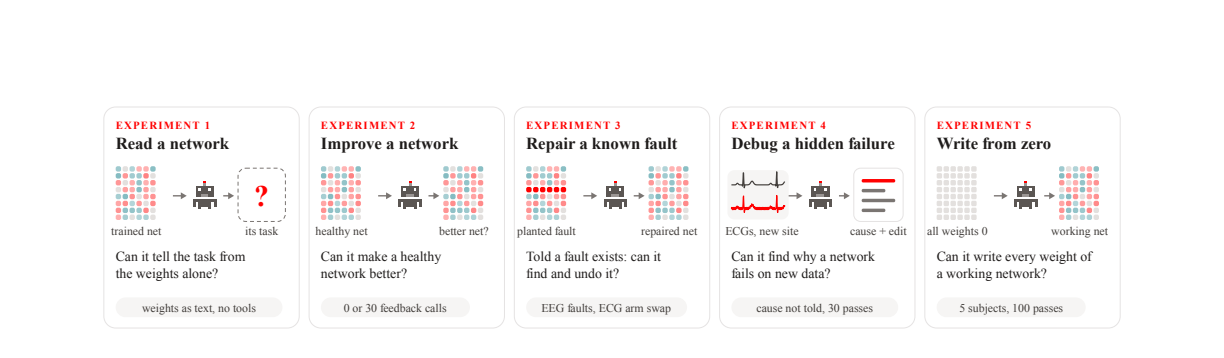
What is actually new: five experiments over EEG and ECG, three LLMs, success rules fixed in advance, and negative results reported as prominently as the positives. No model could infer a network's task from weights alone, none could improve a healthy network, and in the hidden-artifact experiment no edit beat the best standard fix once the cause was known. The authors put these failures in the abstract. They also report costs plainly: writing one network took 38 minutes and about $9 in API fees, versus seconds of A100 time for gradient descent.
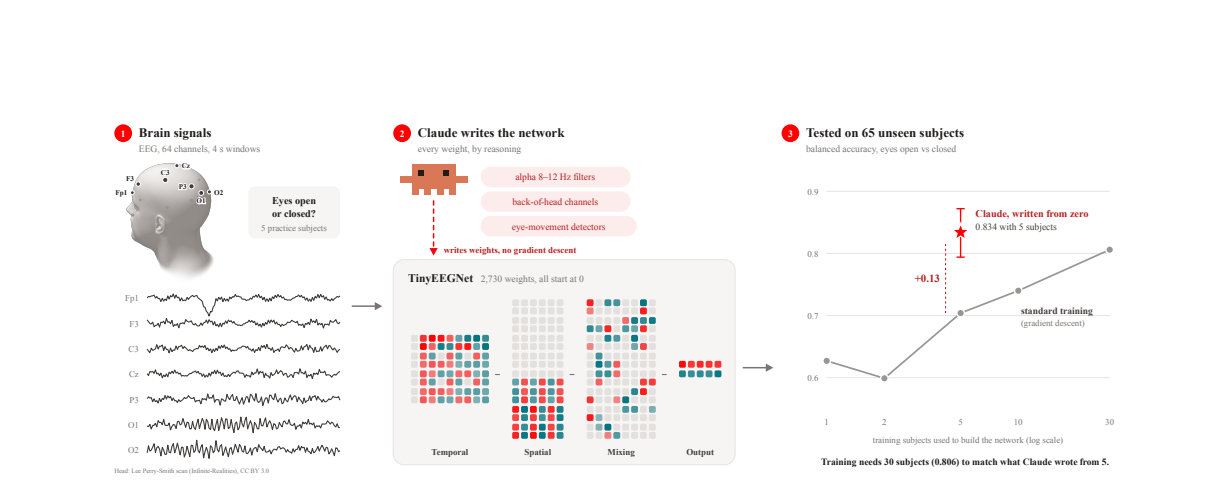
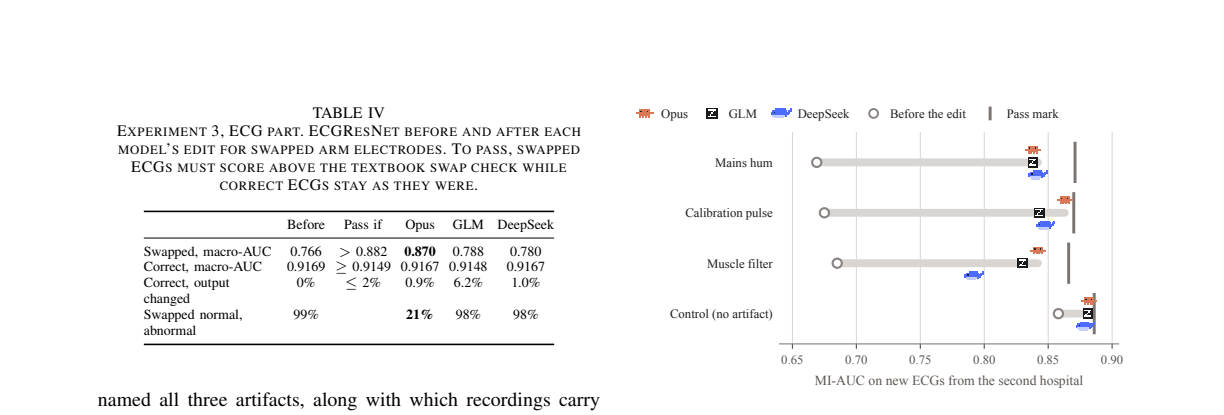
The two positive results worth attention. First, experiment 5: Claude Opus 5.5 wrote all 2,730 weights of TinyEEGNet from five practice subjects and reached 0.834 balanced accuracy on 65 unseen subjects, against 0.704 for gradient descent on five subjects and 0.806 on thirty. The written network is a recognizably sensible design—alpha-band detectors over posterior electrodes—which is evidence of physiological reasoning, not just number-filling. Second, experiment 4: the models named three hidden recording artifacts from weights and practice data and disabled them, cutting artifact-flipped MI calls from 75–91% to near zero. Opus's description of the muscle filter (flat to 21 Hz, half-strength at 25, empty above 29, true values 20/25/30) is the kind of detail that makes you take the capability seriously.
The soft spots, in proportion. The contamination threat lands. The paper's own experiment 1 shows Opus recognized the EEG dataset from electrode layout and sampling rate alone, then picked its best-known task regardless of the weights. That is direct evidence the model knows these public datasets, so the "6x fewer subjects" comparison may pit a model with test-set familiarity plus five labeled subjects against gradient descent from scratch. The authors acknowledge this and suggest private-data replication, but do not run it. Separately, the 0.834 versus 0.806 difference has a confidence interval including zero, and the headline rests on one run of one proprietary model. Both are disclosed; neither is cured by disclosure. Two smaller items: the hand-crafted EEG baselines were added after the LLM runs, and a single LLM graded the textual answers. Both acknowledged in the limitations.
Who this is for: anyone working on tiny wearable classifiers or on what pretraining exposure does to capability evaluations. It deserves a serious referee. The right referee will ask for private in-house data, multiple runs, and a sharper statistical treatment of the experiment-5 comparison. I would not cite the data-efficiency result as established, but I would want this discussed and replicated.
The strongest objection
The central claim is [b41]: Opus writes all 2,730 weights of TinyEEGNet from five practice subjects and reaches balanced accuracy 0.834, versus 0.704 for gradient descent on five subjects, supporting the '6× fewer subjects' conclusion [b5]. That conclusion requires the written network to come from general physiological reasoning plus the five practice subjects, not from pretraining exposure to the public PhysioNet EEG Motor Movement/Imagery dataset. The paper cannot currently rule this out: both PhysioNet datasets are public and likely in the LLM training corpora, and Opus recognized the EEG dataset from electrode layout and sampling rate alone in experiment 1 [b137]. The authors explicitly acknowledge this limitation [b214] and suggest private-data replication [b215], but no such control is run. This is not a minor caveat: if Opus has seen the PhysioNet corpus, the comparison is between a model pretrained on a large public EEG collection plus five labeled subjects and a network trained from scratch on five subjects, so the '6× fewer subjects' framing misstates what is being compared. The interpretable alpha-band design of the written network is consistent with both generic physiology and dataset familiarity, so it does not discriminate. The experiment-4 artifact diagnosis claims are similarly exposed to PTB-XL familiarity, though they are secondary. The single-run design [b212] compounds the uncertainty but is not the primary threat.
The reader's weakest assumption is exactly the most load-bearing threat to the paper's headline: the public PhysioNet datasets may be in the LLM's training corpus, so the write-from-zero result and the artifact diagnoses could reflect dataset familiarity rather than in-context physiological reasoning. I reach the same conclusion from the paper's own evidence: experiment 1 shows Opus identifying the dataset from electrode layout and sampling rate rather than from the weights [b137], which is direct evidence that dataset-level priors are available to the model. The paper is transparent about this [b214], but transparency does not resolve the threat. The hand-crafted baselines added after the experiment [b216] and the single-run design [b212] are also acknowledged and would matter for secondary claims, but the decisive issue remains the absence of a private-data control. Because the reader already issued a CONDITIONAL verdict, my read does not move the verdict; it strengthens the case for making the private-data replication a condition of accepting the data-efficiency and hidden-artifact claims as established.
The referee's report
If the claims hold, this is the first demonstration of WSP on physiological signals and a striking data-efficiency result for tiny networks, with concrete relevance to edge and wearable deployment. The paper has real strengths: success rules fixed before the runs (Table I), a wide set of gradient-based and placebo baselines, inclusion of two open-weight models, release of prompts and reasoning traces, an interpretability analysis showing that the written EEG networks correspond to textbook physiology (alpha-band detection over posterior electrodes, mirror-symmetric motor-cortex features), and an unusually candid limitations section. The largest threat to validity is external: the LLMs are evaluated on the same public PhysioNet datasets that Opus demonstrably recognizes from layout and sampling rate alone (Sec. III-A), so the cleanest interpretation of the data-efficiency result requires a control the paper acknowledges but does not run. Because that control (a private-dataset replication or a memorization probe) is feasible and is already identified by the authors as the right next step, the central claim is defensible pending major revision rather than invalid.
Pith's reading of the paper (a machine's summary, not the authors')
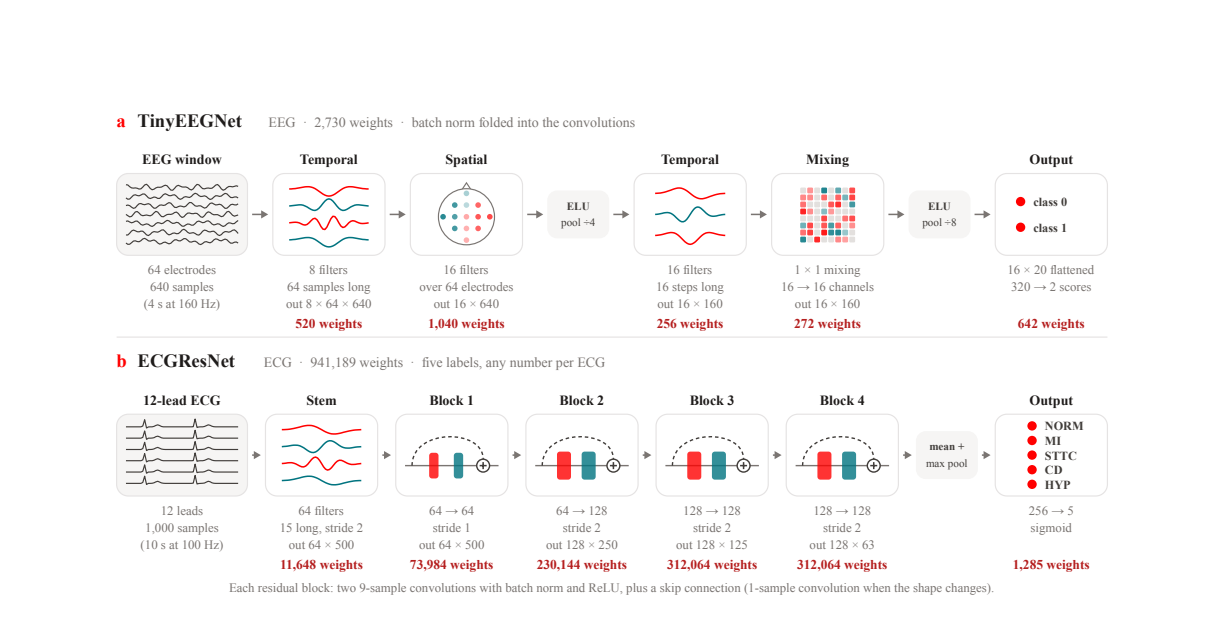
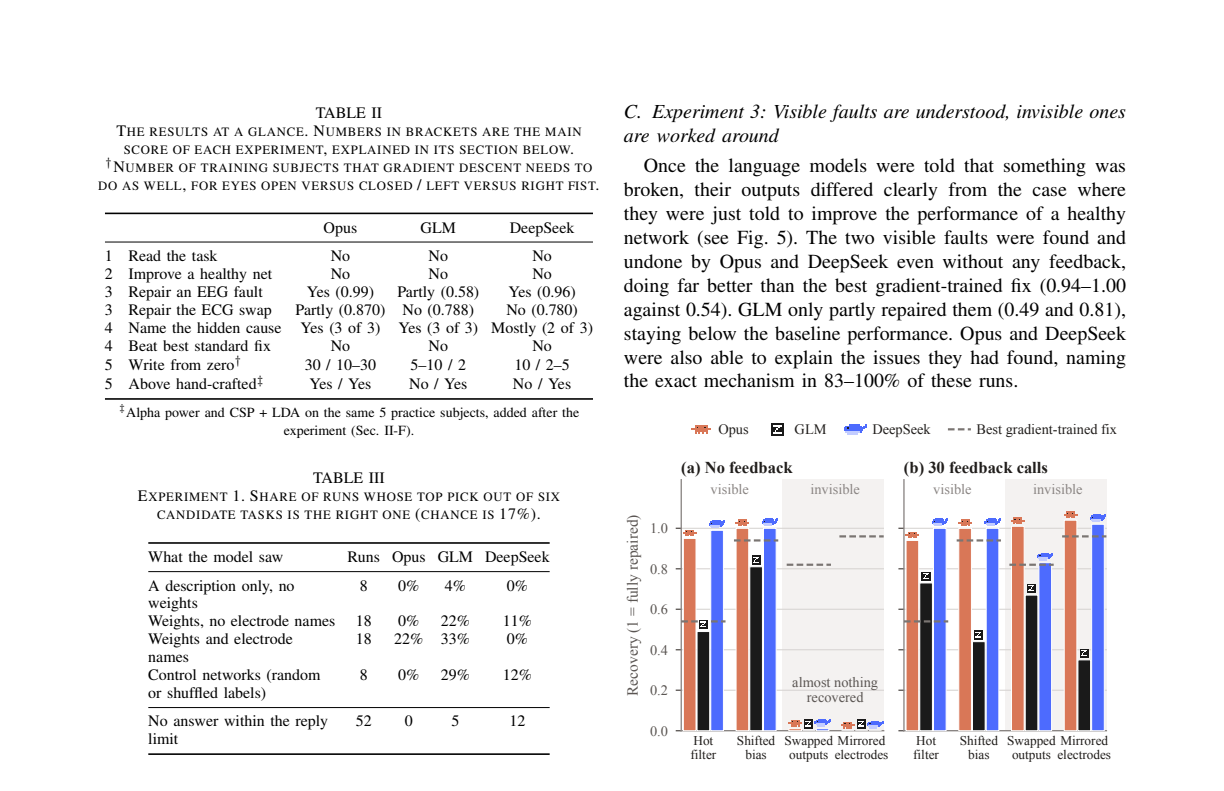
This paper asks whether a large language model can act as the author of a trained neural network's weights, replacing gradient descent with reasoning about physiology. It applies that idea, called weight-space programming, to EEG (brain) and ECG (heart) classifiers, where labels are scarce, subjects vary, and the small networks deployed on wearables are small enough for every weight to be read. Given only the architecture, the task, and five practice subjects, Claude Opus 5.5 wrote all 2,730 weights of a tiny EEG network from zero, reaching a balanced accuracy of 0.834 on 65 unseen test subjects, on par with gradient descent trained on 30 subjects and above the best hand-crafted pipeline (0.779). The same models named three hidden recording artifacts, said which recordings carried them, and switched them off in the weights, raising heart-attack (MI) detection on new ECGs from 0.67-0.69 to 0.83-0.86. The authors state the boundaries plainly: the models could not improve a healthy, well-trained network, could not name a network's task from its weights alone, and the headline results are single runs on public datasets the language models may have memorized.
What carries the argument. The carrying mechanism is weight-space programming itself: weights are serialized as text, the LLM reads them and reasons about what the computation does, then writes replacement values, with no gradient step. The load-bearing object is TinyEEGNet, a 2,730-weight EEGNet-style classifier small enough that every weight can be inspected and rewritten, with batch normalization folded into the convolutions so each weight is an ordinary multiply-and-add; a second object, ECGResNet (941,189 weights), carries the ECG repair and debugging experiments. Between the LLM and the network sits a feedback loop in a sandboxed Python session that only runs the network forward: an evaluate call returns one accuracy number on practice recordings, and a pass returns per-recording scores, activations, and paired original-versus-edited comparisons with standard errors, with optimizers and iterative fitting explicitly forbidden. Success is judged on held-out subjects the model never saw, against baselines fixed in advance, gradient descent on 1 to 30 subjects, bias recalibration, fine-tuning, last-layer retraining, and two hand-crafted EEG pipelines (relative alpha-band power with a threshold; CSP with shrinkage LDA). The reasoning the models apply is textbook physiology, posterior alpha rhythm for eyes closed, mirror-symmetric motor-cortex slow potentials and beta desynchronization for fist movement, and standard ECG lead relationships for the arm swap, which is what makes the written networks interpretable unit by unit.
Core claim. The paper argues that weight-space programming, having a language model read a network's weights as text and write new ones, works on physiological signals, and that for small networks an LLM's prior knowledge of physiology can stand in for much of the labeled data that gradient descent needs. Its flagship result: with all 2,730 weights of a TinyEEGNet (an EEGNet-style classifier) set to zero, and with only five practice subjects whose recordings it could run through the network, Claude Opus 5.5 wrote every weight by hand, reaching 0.834 balanced accuracy on 65 unseen test subjects for eyes-open-versus-closed. The same architecture trained by gradient descent reaches 0.704 with five subjects and 0.806 with thirty, so the written network matches standard training at a $6\times$ data saving, and it also out-scores the $\alpha$-band-power and CSP+LDA hand-crafted pipelines fitted on the same five subjects (at most 0.779). The paper's second claim is that the same models debug hidden failures: without being told anything was wrong, Opus and GLM named each of three planted recording artifacts (mains hum, calibration pulse, muscle filter), said which recordings carried it and where the shortcut lived in the weights, and edited the network so the artifact flipped 0-3% of MI calls after the edit (versus 75-91% before), raising MI-AUC on new ECGs from 0.67-0.69 to 0.83-0.86. The authors state the boundaries on the same page: no model could improve a healthy, well-trained network, none could name a network's task from its weights alone, and no edit beat the best gradient-based fix once the cause was known.
The premise it rests on. The load-bearing premise is that the language models are reasoning from general physiology rather than from having memorized the public PhysioNet datasets and their test subjects during pretraining; the authors acknowledge that Opus recognized the EEG dataset in experiment 1, so the data-saving and diagnosis results could partly reflect dataset familiarity rather than physiological insight.
If the paper is right (Pith's inferences, not the authors')
Wearable and edge biosignal models could be produced with far fewer labeled subjects when the underlying physiology is well understood; the paper's headline case needs five practice subjects to match a thirty-subject gradient-descent training run.
Deployment debugging without a labeled failure set becomes plausible: the models named three hidden recording artifacts from practice recordings alone and disabled them in the weights, so a network that fails at a new site could be repaired by asking an LLM what the network latched onto.
LLM-written networks are interpretable unit by unit, alpha bands, spatial electrode comparisons, motor-cortex cues, because the writing process reasons in physiological terms; this contrasts with gradient-descent networks whose features are not named.
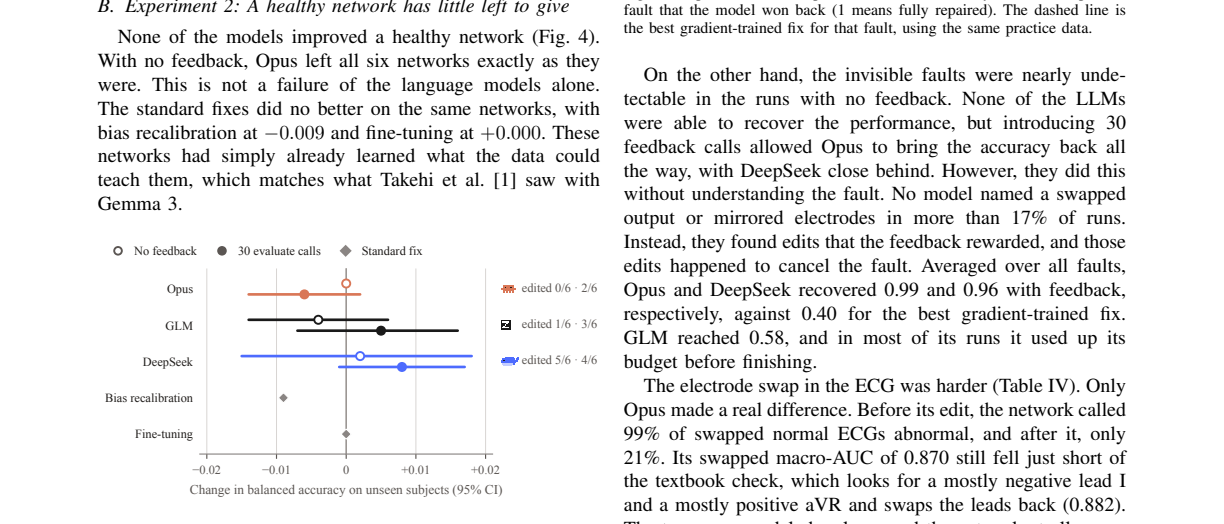
The negative results bound the method's niche: it does not improve already well-trained networks, cannot infer a task from weights alone, and does not beat the best gradient-based fix once the failure cause is known, so the realistic use is fresh small models, not mature ones.
The cost structure changes shape: writing the network took 38-39 minutes and a few dollars of API fees versus 2-5 seconds of GPU time for gradient descent, so the practical value of weight-space programming is data efficiency and interpretability rather than speed.
If dataset memorization rather than physiological reasoning is doing the work, the risk the authors flag, the $6\times$ advantage should shrink or vanish on a private dataset with an unfamiliar montage; that replication is the single most decisive next experiment, and it is not reported here.
The asymmetry between experiment 1 (models cannot say what a trained network does) and experiment 5 (models can write a working network for a stated task) suggests LLMs are far stronger at generating weights from textual priors than at inverting weights back into a task; feeding the written networks back through experiment 1 would quantify that gap directly.
Read as an engineering result, weight-space programming trades wall-clock time and API cost for labeled data and auditability, and that trade only pays off when labels are the scarce resource, which argues for pursuing it on rare-condition biosignals such as seizure types or MI subforms rather than on high-resource classification tasks.
Check this review
Pith stored no record of this review's passes and took no fingerprint of it. Reviews made by code from 13 Nov 2026 on carry both.
How often reviews like this one are right
Reviews like this one: written by deepseek-v4-flash, where what was read was not recorded.
How often objections from reviews like this one are right: not yet measured
Reviews by people
This review was written by a machine. No person has reviewed this paper on Pith yet. A scientist listed on Pith can review it for a fee, and their review is published here whatever it concludes.
The paper
Abstract
Weight-space programming allows language models to read a trained neural network's weights and edit them. This opens the door to “training” by reasoning rather than through gradient descent. Prior work has demonstrated its functionality and promise for game-playing networks and fixing specific failures in language models, even extending to diffusion models. In this work, we present its applicability to models trained on biosignal data, specifically EEG and ECG data. We show that frontier models are not only able to debug specific faults planted in biosignal-based models without being told what these faults are, but are even capable of writing all the weights of a network from scratch, given only the architecture, the task, and a minimal set of training subjects. In particular, in one set of experiments, a language model was able to match standard gradient-descent training using 6 × fewer training subjects, through reasoning alone and without any gradient descent step. Networks written by Claude Opus 5.5 also scored higher than classic hand-crafted EEG pipelines (alpha band power, and common spatial patterns with linear discriminant analysis) when built from the same 5 subjects. We also highlight some of the limitations, which include the inability of language models to improve already well-trained classification models, and their incapacity to reliably recognize, from the weights alone, the task a network was trained on. Overall, our results indicate that weight-space programming can be useful for small networks, such as those deployed on edge devices and wearables, but the concept still requires further investigation before it can be used in practice.
The paper's own sentences, arranged, kept beside the review and separate from it. Each label is drawn from a closed vocabulary; the number beside it is the probability the classifier gave that label. No sentence in this record was written by a model.
abstract compiled · 2026-11-11
The authors' main claim, as the classifier picked it out 0.97
“Overall, our results indicate that weight-space programming can be useful for small networks, such as those deployed on edge devices and wearables, but the concept still requires further investigation before it can be used in practice.”
How the main claim is stated: hedged possibility 0.99
What the abstract itself states, as probabilities: claims first 0.13 · states limitation 0.98 · human participants 0.86 · controlled comparison 0.86 · randomized assignment 0.02 · states quantitative result 0.98 · compares with prior results 0.96 · mentions code or data availability 0.03
The abstract, sentence by sentence
This table labels the abstract only (arXiv listing abstract v1). The number is the probability the classifier gave the label.
| Sentence | Role | The authors' own work | States the main conclusion | Strength |
|---|---|---|---|---|
| Weight-space programming allows language models to read a trained neural network's weights and edit them. | background 1.00 | 0.07 | 0.03 | asserted 1.00 |
| This opens the door to ``training'' by reasoning rather than through gradient descent. | background 0.93 | 0.07 | 0.04 | hedged possibility 0.70 |
| Prior work has demonstrated its functionality and promise for game-playing networks and fixing specific failures in language models, even extending to diffusion models. | background 1.00 | 0.03 | 0.03 | asserted 0.99 |
| In this work, we present its applicability to models trained on biosignal data, specifically EEG and ECG data. | contribution 0.99 | 0.56 | 0.06 | asserted 0.98 |
| We show that frontier models are not only able to debug specific faults planted in biosignal-based models without being told what these faults are, but are even capable of writing all the weights of a network from scratch, given only the architecture, the task, and a minimal set of training subjects. | result 0.70 | 0.95 | 0.52 | asserted 1.00 |
| In particular, in one set of experiments, a language model was able to match standard gradient-descent training using $6\times$ fewer training subjects, through reasoning alone and without any gradient descent step. | result 1.00 | 0.95 | 0.18 | asserted 1.00 |
| Networks written by Claude Opus 5.5 also scored higher than classic hand-crafted EEG pipelines (alpha band power, and common spatial patterns with linear discriminant analysis) when built from the same 5 subjects. | result 1.00 | 0.93 | 0.09 | asserted 1.00 |
| We also highlight some of the limitations, which include the inability of language models to improve already well-trained classification models, and their incapacity to reliably recognize, from the weights alone, the task a network was trained on. | limitation 1.00 | 0.89 | 0.08 | asserted 1.00 |
| Overall, our results indicate that weight-space programming can be useful for small networks, such as those deployed on edge devices and wearables, but the concept still requires further investigation before it can be used in practice. | interpretation 0.89 | 0.79 | 0.84 | hedged possibility 0.99 |
What kind of paper the classifier reports this is: empirical study 0.94 · evidence from observation or experiment 0.94
What was examined, and what was not
Sources read
- arXiv listing abstract v1
Not examined
- full text
- figures and tables
- references and citing sentences
- relations to other papers
Levels run
- P abstract
Not run
- S sections
- T body sentences
- C citations
- R cross-paper relations
How the labels were made
Compiled by classifier-1.13.0 via TypeSafe API, question bank abstract-p1-20260923, 2026-11-11: 1 request, 7,056 input tokens.
Every quoted sentence on this record is the authors'. Every label is from Pith's closed vocabulary, with the probability shown beside it. This record as JSON
Figures (7)

Figures are the authors', reproduced from the paper.
References (30)
- [1] R. Takehiet al., “Sparks of weight-space programming: LLMs can natively read & write neural network weights,” Blog post, MIT CSAIL, Nov. 2026. [Online]. Available: https://rikiyat.github.io/blog/weight-spa ce-programming/ on Pith
- [2] OpenAI, “GPT-6 Astra,” Large language model, 2026. [Online]. Available: https://chatgpt.com/ on Pith
- [3] K. Young and T. Tian, “MinAtar: An Atari-inspired testbed for thorough and reproducible reinforcement learning experiments,”arXiv preprint arXiv:1903.03176, 2019 on PithPith's reviewarXiv
- [4] J. Schulmanet al., “Proximal policy optimization algorithms,”arXiv preprint arXiv:1707.06347, 2017 on PithPith's reviewarXiv
- [5] Anthropic, “Claude Opus 5.5,” Large language model, 2026. [Online]. Available: https://claude.ai on Pith
- [6] S. Chhabria, “Can Opus 5.5 teach an image model what “no” means?” Blog post (work in progress), Nov. 2026. [Online]. Available: https://sabhyachhabria.com/writing/weight-space-negation/ on Pith
- [7] C. Singh, “Weight-space programming from scratch on simple tasks,” Technical report, Nov. 2026. [Online]. Available: https://csinva.io/weig ht-space-programming-autoresearch/analyze/toy_examples/report.html on Pith
- [8] S. Willison, “Qwen 3.8 27B on my laptop can interpret model weights, too,” Blog post, Nov. 2026. [Online]. Available: https: //simonwillison.net/2026/Nov/3/qwen-can-interpret-model-weights/ on Pith
- [9] Gemma Team, “Gemma 3 technical report,”arXiv preprint arXiv:2503.19786, 2025 on PithPith's reviewarXiv
- [10] S. Goedecke, “LLMs are not superhuman at reading and writing neural network weights,” Blog post, Nov. 2026. [Online]. Available: https://www.seangoedecke.com/llms-are-not-superhuman-at-reading-a nd-writing-neural-network-weights/ on Pith
- [11] M. Honnibal, “The ‘Astra can read and write weights to improve Qwen’ post is misleading,” Blog post, Nov. 2026. [Online]. Available: https://honnibal.dev/blog/astra-read-write-misleading on Pith
- [12] K. Menget al., “Locating and editing factual associations in GPT,” in Proc. Adv. Neural Inf. Process. Syst. (NeurIPS), vol. 35, 2022 on Pith
- [13] D. Lindneret al., “Tracr: Compiled transformers as a laboratory for interpretability,” inProc. Adv. Neural Inf. Process. Syst. (NeurIPS), vol. 36, 2023 on Pith
- [14] Y . Royet al., “Deep learning-based electroencephalography analysis: A systematic review,”J. Neural Eng., vol. 16, no. 5, p. 051001, 2019 on Pith
- [15] R. Geirhoset al., “Shortcut learning in deep neural networks,”Nat. Mach. Intell., vol. 2, no. 11, pp. 665–673, 2020 on Pith
- [16] J. R. Zechet al., “Variable generalization performance of a deep learning model to detect pneumonia in chest radiographs: A cross-sectional study,”PLOS Med., vol. 15, no. 11, p. e1002683, 2018 on Pith
- [17] A. J. DeGraveet al., “AI for radiographic COVID-19 detection selects shortcuts over signal,”Nat. Mach. Intell., vol. 3, no. 7, pp. 610–619, 2021 on Pith
- [18] V . J. Lawhernet al., “EEGNet: A compact convolutional neural network for EEG-based brain–computer interfaces,”J. Neural Eng., vol. 15, no. 5, p. 056013, 2018 on Pith
- [19] D. Sopicet al., “e-Glass: A wearable system for real-time detection of epileptic seizures,” inProc. IEEE Int. Symp. Circuits Syst. (ISCAS), 2018, pp. 1–5 on Pith
- [20] G. Schalket al., “BCI2000: A general-purpose brain-computer interface (BCI) system,”IEEE Trans. Biomed. Eng., vol. 51, no. 6, pp. 1034–1043, 2004 on Pith
show 10 more
- [21] A. L. Goldbergeret al., “PhysioBank, PhysioToolkit, and PhysioNet: Components of a new research resource for complex physiologic sig- nals,”Circulation, vol. 101, no. 23, pp. e215–e220, 2000 on Pith
- [22] P. Wagneret al., “PTB-XL, a large publicly available electrocardiogra- phy dataset,”Sci. Data, vol. 7, p. 154, 2020 on Pith
- [23] D. P. Kingma and J. Ba, “Adam: A method for stochastic optimization,” inProc. Int. Conf. Learn. Represent. (ICLR), 2015 on Pith
- [24] I. Loshchilov and F. Hutter, “Decoupled weight decay regularization,” inProc. Int. Conf. Learn. Represent. (ICLR), 2019 on Pith
- [25] Zhipu AI, “GLM-5.3,” Large language model, 2026 on Pith
- [26] A. Xuet al., “DeepSeek-V4.1-Flash: Pushing the limits of KV cache compression,”arXiv preprint arXiv:2609.19969, 2026 on PitharXiv
- [27] S. Agarwalet al., “gpt-oss-120b & gpt-oss-20b model card,”arXiv preprint arXiv:2508.10925, 2025 on PithPith's reviewarXiv
- [28] V . N. Batchvarovet al., “Incorrect electrode cable connection during electrocardiographic recording,”Europace, vol. 9, no. 11, pp. 1081– 1090, 2007 on Pith
- [29] P. Kirichenkoet al., “Last layer re-training is sufficient for robustness to spurious correlations,” inProc. Int. Conf. Learn. Represent. (ICLR), 2023 on Pith
- [30] C. Yanget al., “Large language models as optimizers,” inProc. Int. Conf. Learn. Represent. (ICLR), 2024 on Pith
Cited by 2 Pith papers
Reviewed papers on Pith that cite this one. The full citation record
Challenges and discussion
Disagree with the review, or know something it missed? Leave a comment, or challenge this review formally: a challenge becomes a permanent entry in this paper's record, and its decision is published here.
Come back by email
A short list of the week's newly reviewed papers. Nothing is sent until you confirm from your inbox, and every email has a link that stops it. No account.
No comments yet.
Sign in to comment