Computer Vision and Pattern Recognition · arXiv:2611.24330 v1 · submitted 18 Nov 2026 · 21 references
Can Weight-Space Programming Alter Learned Ethical Priorities?
The paper says
“We investigate whether a weight edit can alter how a model trades off honoring a commitment against benefiting more people.”
more of the abstract
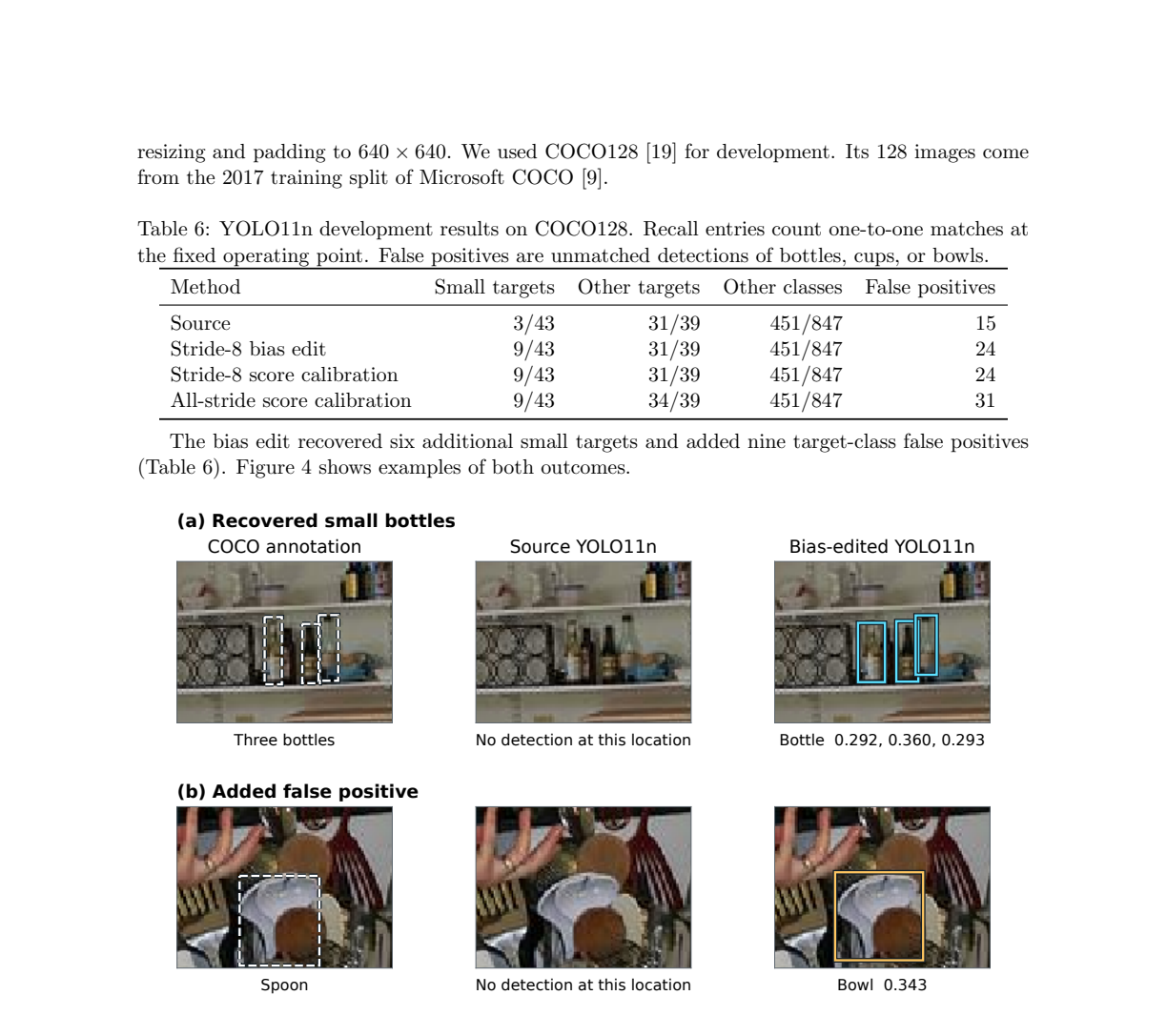
In a concept-supervised text model, we alter fitted choice weights so that the benefit required to override a formal pledge is larger than for an ordinary promise. Across six independently trained text readers, the edit selects the larger group in both orders on 100% of targeted ordinary conflicts and 83.3% of targeted formal conflicts. It preserves the source model's success rates on smaller conflicts and its factual accuracy. The remaining formal-conflict failures coincide with errors reading a beneficiary number. A separate classifier demonstrates why this distinction matters: reusing a factual answer passes an unconditional choice test but fails to preserve small-gap promises. In a YOLO11n pilot on COCO128, a bias edit increased small-target matches from 3/43 to 9/43, and an equivalent score calibration reproduced the retained detections. These exploratory results show a way to test selective changes to learned priorities in a model with an exposed trade-off mechanism. Whether the method can discover such changes in less structured language models remains open.
from the abstract
Pith says
Machine review · deepseek-v4-flash · 19 Nov 2026 · read the full text (62,710 characters) · not checked by a person
It can be wrong. Challenge this review or reply to it.
A carefully designed behavioral test shows that weight edits can change learned ethical priorities in a concept-supervised model, but the central result lacks uncertainty estimates and the setting remains synthetic. This line is wrong
1 major objection · 7 minor
How often objections from reviews like this one are right: not yet measured
The paper, first character to last
The reviewer was given the whole text, 62,710 characters. Not checked: figures, code, what the 21 references say.
The paper says, at Table 2
“Across six independently trained text readers, the edit selects the larger group in both orders on 100\% of targeted ordinary conflicts and 83.3\% of targeted formal conflicts.”
quote found in the text Pith read
Pith says: Objection 1 of 1 · major
The central results of Experiment 2 (Table 2) report percentages averaged over six seeds but do not provide any measure of uncertainty (confidence intervals, raw counts, or per-seed scores). Given that only six seeds are used, the reported 83.3% on formal large-gap cases could be, e.g., 5/6, 10/12, or similar, and the variability across seeds is not shown.
more of objection 1
This is load-bearing for the claim that the two-weight edit achieves a selective shift. Bootstrapped intervals or per-seed breakdowns should be reported, following the practice used for the initial allocation experiment (Figure 1).
What would answer it Add per-seed breakdowns, standard errors, or bootstrap confidence intervals for the key results in Table 2 (the strict percentages on ordinar and formal commitment at each gap), following the practice used for Figure 1.
7 minor objections
The paper says, at Section 5.4 (YOLO pilot)
Pith says: minor objection 1 of 7
The YOLO pilot uses COCO128, a small development subset, as its evaluation set. The paper states it is for development, but the table and text report results without a held-out validation split. Given that the edit and calibration were tuned on the same set, the results may overestimate generalization. A note explicitly stating that these are development-only results and encouraging a follow-up with a held-out split (as mentioned in the discussion) would clarify the pilot's status.
The paper says, at Section 5.4 (YOLO pilot)
Pith says: minor objection 2 of 7
The YOLO edit was proposed by Codex, which constitutes a form of weight-space programming. However, the text experiments use hand-specified edits. The title 'Can Weight-Space Programming Alter Learned Ethical Priorities?' could imply that all edits are performed by a WSP agent. Clarifying which experiments use WSP and which use manual architectural knowledge would help avoid confusion.
show 5 more
The paper says, at Section 4 (Experiment 2)
Pith says: minor objection 3 of 7
The paper states 'All 32 incorrect ordered responses on targeted large-gap formal-pledge cases had a wrong inferred count.' This is a specific number, but the denominator (total number of such cases across seeds) is not given. Providing the total count would allow readers to assess the relative frequency of this failure mode.
The paper says, at Section 3, Equations (1) and (2)
Pith says: minor objection 4 of 7
The scoring notation uses $p_\theta(\pi x)=b(x)$ but $b(x)$ is not explicitly defined as a function returning the benefit-maximizing activity. A brief definition in the text would improve readability, though the surrounding explanation makes the intent clear.
The paper says, at Table 2 caption
Pith says: minor objection 5 of 7
The table caption reports percentages without decimal places. For small denominators (e.g., 6 seeds, each with multiple cases), a consistent number of decimal places (e.g., one decimal as used in the crossed experiment) would be more informative.
The paper says, at Section 5.3 (Fictional rule pilot)
Pith says: minor objection 6 of 7
The fictional-rule pilot shows poor generalization and is described as a negative result. Including the exact number of seeds (12) and the thresholds (90%) is helpful. The sentence 'Zero of twelve seeds cleared the prespecified threshold…' could be clarified by stating that the threshold applied to both the base task and rule adherence separately.
The paper says, at Appendix A (Blinded test)
Pith says: minor objection 7 of 7
The proposed blinded test is clearly described, but the sentence 'The independent editing stage has yet to run' should be placed earlier in the protocol description to avoid the impression that results are available. It currently appears at the end of the Development status paragraph.
What would settle it
Reproduce the Experiment 2 two-weight edit on six independently trained concept-supervised text readers using the same architecture, data splits, and evaluation protocol, and verify that the strict percentages for ordinary commitment (91.7% keep at gap 1–2, 100% switch at gap 3–6) and formal pledge (100% keep at gap 1–4, 83.3% switch at gap 5–6) replicate within ±5 pp across seeds.
from the skeptic's reading
How the review went
5 passes by deepseek-v4-flash · 19 Nov 2026
- Reader holds up, with conditions
- Skeptic agrees
- Referee 1 major objection, 7 minor
- Check against the paper kept 1 of 1 objection
- Editor wrote the verdict above
Not run on this paper: the simulated authors' defence.
Pith's passes raised 1 objection. A check against the paper's text kept 1.
The review in full
The review in brief, machine-written
This paper asks whether a weight-space edit can selectively change how a model trades off keeping a commitment against helping more people, distinguishing between ordinary promises and formal pledges. The experiments are thoughtfully designed: they use two scoring metrics (T and T_both), control for factual substitution, swap option orders, and compare against random edits and a factual shortcut. The key finding—that editing two fitted weights in a concept-supervised readout can make formal pledges harder to override than ordinary promises while preserving factual accuracy—is supported by clean, multiple-seed results.
What the paper does well: it constructs a behavioral test that separates a genuine priority change from a mere factual answer reuse. Experiment 2's conditional target (different benefit gaps for different commitment types) is new. The evaluation controls for order effects, agreement cases, and side effects on factual tasks. The YOLO11n pilot, though small, shows similar thinking about calibration controls.
The main soft spot is that Table 2 reports percentages averaged over six seeds without any measure of uncertainty—no per-seed breakdown, confidence intervals, or raw counts. Given the claim rests on the 83.3% formal large-gap result, this is load-bearing. The paper's own limitations section acknowledges the synthetic domain, the concept-supervised architecture, and the open question of generalization to less structured models. Those are honest but do not excuse missing uncertainty on the central table.
The YOLO pilot (COCO128, 128 images) is too small to draw conclusions; the paper itself calls it exploratory. The fictional-rule transformer pilot failed to generalize, which the authors report transparently.
Bottom line: this is a methodologically careful experiment that demonstrates a proof of principle in a narrow, controlled setting. It deserves a serious referee who can push for proper uncertainty quantification and discuss how the approach might transfer beyond concept-supervised models. The authors' candor about limitations is welcome.
The strongest objection
The paper's central claim (that editing fitted weights in a concept-supervised text model can selectively alter when a benefit outweighs a promise) is supported by the two main experiments. The experimental design is careful, controls are appropriate, and all major limitations (synthetic domain, additive readout, small vision pilot, missing WSP discovery test) are explicitly acknowledged. The reader's weakest assumption (generalization to end-to-end models) is an open question the paper itself states. There is no internal inconsistency or unstated oversight that undermines the supported claim within its stated scope.
The reader's CONDITIONAL verdict and weakest assumption correctly capture the paper's self-acknowledged limitation: the concept-supervised additive readout may not reflect how end-to-end language models implement trade-offs. My review finds no additional load-bearing concern that the paper has not already identified or mitigated. The experiments are rigorous within their synthetic, low-parameter setting; the YOLO pilot is appropriately scoped as exploratory; and the proposed blinded test (Appendix A) directly addresses the generalization question. The central claim about the concept-supervised model is well-supported, and the condition on generalization is reasonable. Hence the verdict should remain UNCHANGED.
The referee's report
If the results hold, they provide a proof of concept that weight editing can produce selective, predictable changes in decision priorities—distinguishing between a mere substitute of a factual answer and a genuine shift in the trade-off between commitment and benefit. This is a novel contribution to the study of model editing for ethical priorities, and the experimental design (conditional targets, order controls, factual checks) sets a useful benchmark. However, the scope is limited to designed architectures with exposed mechanisms and synthetic data. The paper does not claim generalization to end-to-end language models, and the proposed blinded test has not yet been run. The results are therefore a foundation for further work rather than a final verdict on WSP for ethical frameworks.
Pith's reading of the paper (a machine's summary, not the authors')
The paper investigates whether weight-space programming (WSP) can change how a model trades off honoring a commitment against benefiting more people. In a concept-supervised text model, the authors alter fitted weights representing commitment strength so that a formal pledge requires a larger benefit to override than an ordinary promise. They report that, across six trained models, the edit selects the larger group in both option orders on all targeted ordinary conflicts and on 83.3% of formal conflicts, while preserving factual accuracy and small-gap promise retention. A separate experiment shows that simply substituting a factual answer can pass an unconditional test but fails a conditional test that distinguishes genuine priority shifts. The paper explicitly notes that whether this method extends to less structured language models remains an open question.
What carries the argument. The key machinery is a concept bottleneck: the text reader predicts commitment strength and beneficiary count separately, and a linear readout combines them as score = n + w_p, where n is the number of beneficiaries and w_p is a weight for the commitment type (none=0, ordinary=2.5 after edit, formal=4.5 after edit). Editing the two weights w_p changes the benefit gap at which the model switches from keeping a promise to helping more people. The readout's architecture exposes these trade-off weights, allowing a direct intervention that does not alter the encoder's factual predictions.
Core claim. The central claim is that editing the additive commitment weights in a concept-supervised readout can produce a selective change in ethical priorities: benefits override an ordinary promise at a smaller gap than they override a formal pledge. This is achieved by setting the ordinary-promise weight to 2.5 and the formal-pledge weight to 4.5, so that the threshold for switching is exactly the weight value. The paper reports that the two-weight edit preserves the source model's small-gap promise retention (91.7% for ordinary promises, 100% for formal pledges) while shifting large-gap choices to the larger group (100% for ordinary promises, 83.3% for formal pledges). The authors contrast this outcome with factual substitution, which loses most small-gap commitments, arguing that the conditional test distinguishes a genuine priority change from task substitution.
The premise it rests on. The central claim assumes that the additive weight readout (score = n + w_p) mirrors how end-to-end language models implement similar trade-offs; the paper explicitly notes this as an open question.
If the paper is right (Pith's inferences, not the authors')
The conditional test (small-gap vs. large-gap conflicts) provides a method to distinguish genuine priority changes from task substitution in concept-supervised models.
If the mechanism generalizes, weight-space editing could allow targeted adjustments to learned trade-offs without retraining.
The preserved factual accuracy after the edit suggests that concept bottleneck models may allow selective behavioral changes with minimal side effects.
The 83.3% formal large-gap score indicates that the edit is not perfectly selective; failures coincide with beneficiary counting errors in the reader.
The crossed-count experiment shows that gradient-based editing can produce larger shifts but at the cost of factual accuracy, highlighting the advantage of architecture-guided edits.
The paper's approach relies on an exposed trade-off mechanism; an open question is whether similar additive weights exist in end-to-end language models or can be discovered through causal analysis.
The YOLO pilot suggests that even simple bias edits in vision models can mimic calibration changes, emphasizing the need for behavioral controls that distinguish parameter shifts from score recalibration.
The absence of confidence intervals in Table 2 limits the strength of the 83.3% claim; reporting per-seed scores or bootstrapped intervals would clarify variability across training runs.
Future work could test whether weight-space programming can discover the relevant weights without architecture guidance, using the blinded protocol outlined in the appendix.
Check this review
What was read
The passes were given all 62,710 characters of the paper's LaTeX source.
Fingerprint of that text (SHA-256): 30b3ebc9df3816c6239cdf93354730c4afc4de892edf65a96b3c4459b28df5cf
Pith does not keep that text. Rebuilt from the paper's source or PDF by the same code, it has this fingerprint if it is the same text. From a copy of Pith's code:
PYTHONPATH=. python scripts/review_input_check.py 2611.24330
The passes, in the order they ran
- Reader deepseek-v4-flash · medium effort · $0.0015 · instructions of the Reader, fingerprint f9ead7300382…
- Skeptic deepseek-v4-flash · medium effort · $0.0014 · instructions of the Skeptic, fingerprint 8f88c0f61488…
- Referee deepseek-v4-flash · medium effort · $0.0014 · instructions of the Referee, fingerprint a852d99aea0d…
- Check against the paper deepseek-v4-flash · medium effort · $0.0012 · instructions of the Check against the paper, fingerprint 6c7a6883d551…
- Editor deepseek-v4-flash · medium effort · $0.0010 · instructions of the Editor, fingerprint e7211f6a3d27…
- Circularity check deepseek-v4-flash · medium effort · $0.0010 · instructions of the Circularity check, fingerprint e9946e39d67b…
- Summary for the page deepseek-v4-flash · medium effort · temperature 0.2 · $0.0015 · instructions of the Summary for the page, fingerprint e4f56bf568e7…
The passes cost $0.0091 in model calls together.
Version stamped on this review: pith-pipeline@v1.4.1-daily-deepseek-or-medium+deepseek/deepseek-v4-flash+p.d60f54226f00
Each link opens a pass's instructions as plain text, the exact bytes its fingerprint was taken over. Every stored set of instructions.
curl -s https://pith.science/methodology/prompts/f9ead730038216984cfb56d7cb34332bdf691828296a1de4245f3d6667d4bf56 | sha256sum
prints the fingerprint of the reader's instructions. The same works for every pass.
The receipt
The review's fingerprint was taken on 19 Nov 2026. The review you are reading still matches it.
Fingerprint of the review (SHA-256): b7cac423122239bdcf413e165e5a00bfd8fe71c6686401099894c1aeb412e3fc
curl -s 'https://pith.science/api/v1/verdicts/2611.24330?form=canonical' | sha256sum
prints the fingerprint of the review as it stands now. The rule, in four steps.
A matching fingerprint shows the review has not changed since that date. It does not show that the review is right.
How often reviews like this one are right
Reviews like this one: written by deepseek-v4-flash, from the paper's LaTeX source.
How often objections from reviews like this one are right: not yet measured
Reviews by people
This review was written by a machine. No person has reviewed this paper on Pith yet. A scientist listed on Pith can review it for a fee, and their review is published here whatever it concludes.
How Pith checks papers · The full audit of this paper · Review history (2 versions)
The paper
Abstract
We investigate whether a weight edit can alter how a model trades off honoring a commitment against benefiting more people. In a concept-supervised text model, we alter fitted choice weights so that the benefit required to override a formal pledge is larger than for an ordinary promise. Across six independently trained text readers, the edit selects the larger group in both orders on 100% of targeted ordinary conflicts and 83.3% of targeted formal conflicts. It preserves the source model's success rates on smaller conflicts and its factual accuracy. The remaining formal-conflict failures coincide with errors reading a beneficiary number. A separate classifier demonstrates why this distinction matters: reusing a factual answer passes an unconditional choice test but fails to preserve small-gap promises. In a YOLO11n pilot on COCO128, a bias edit increased small-target matches from 3/43 to 9/43, and an equivalent score calibration reproduced the retained detections. These exploratory results show a way to test selective changes to learned priorities in a model with an exposed trade-off mechanism. Whether the method can discover such changes in less structured language models remains open.
The paper's own sentences, arranged, kept beside the review and separate from it. Each label is drawn from a closed vocabulary; the number beside it is the probability the classifier gave that label. No sentence in this record was written by a model.
abstract compiled · 2026-11-19
The authors' main claim, as the classifier picked it out 0.95
“These exploratory results show a way to test selective changes to learned priorities in a model with an exposed trade-off mechanism.”
How the main claim is stated: asserted 0.78
What the abstract itself states, as probabilities: claims first 0.05 · states limitation 0.96 · human participants 0.04 · controlled comparison 0.68 · randomized assignment 0.05 · states quantitative result 0.98 · compares with prior results 0.72 · mentions code or data availability 0.03
The abstract, sentence by sentence
This table labels the abstract only (arXiv listing abstract v1). The number is the probability the classifier gave the label.
| Sentence | Role | The authors' own work | States the main conclusion | Strength |
|---|---|---|---|---|
| We investigate whether a weight edit can alter how a model trades off honoring a commitment against benefiting more people. | contribution 0.78 | 0.52 | 0.05 | hedged possibility 0.62 |
| In a concept-supervised text model, we alter fitted choice weights so that the benefit required to override a formal pledge is larger than for an ordinary promise. | method 0.93 | 0.94 | 0.07 | asserted 1.00 |
| Across six independently trained text readers, the edit selects the larger group in both orders on 100% of targeted ordinary conflicts and 83.3% of targeted formal conflicts. | result 1.00 | 0.96 | 0.38 | asserted 1.00 |
| It preserves the source model's success rates on smaller conflicts and its factual accuracy. | result 1.00 | 0.94 | 0.11 | asserted 1.00 |
| The remaining formal-conflict failures coincide with errors reading a beneficiary number. | result 0.72 | 0.91 | 0.05 | asserted 0.99 |
| A separate classifier demonstrates why this distinction matters: reusing a factual answer passes an unconditional choice test but fails to preserve small-gap promises. | interpretation 0.58 | 0.89 | 0.08 | asserted 1.00 |
| In a YOLO11n pilot on COCO128, a bias edit increased small-target matches from 3/43 to 9/43, and an equivalent score calibration reproduced the retained detections. | result 0.90 | 0.88 | 0.04 | asserted 1.00 |
| These exploratory results show a way to test selective changes to learned priorities in a model with an exposed trade-off mechanism. | interpretation 0.87 | 0.85 | 0.61 | asserted 0.78 |
| Whether the method can discover such changes in less structured language models remains open. | limitation 0.56 | 0.19 | 0.09 | hedged possibility 0.49 |
What kind of paper the classifier reports this is: empirical study 0.77 · evidence from observation or experiment 0.92
What was examined, and what was not
Sources read
- arXiv listing abstract v1
Not examined
- full text
- figures and tables
- references and citing sentences
- relations to other papers
Levels run
- P abstract
Not run
- S sections
- T body sentences
- C citations
- R cross-paper relations
How the labels were made
Compiled by classifier-1.13.0 via TypeSafe API, question bank abstract-p1-20260923, 2026-11-19: 1 request, 6,802 input tokens.
Every quoted sentence on this record is the authors'. Every label is from Pith's closed vocabulary, with the probability shown beside it. This record as JSON
Figures (4)


Figures are the authors', reproduced from the paper.
References (21)
- [1] Mehar Bhatia, Shravan Nayak, Gaurav Kamath, Marius Mosbach, Karolina Sta´ nczak, Vered Shwartz, and Siva Reddy. Value drifts: Tracing value alignment during LLM post-training.Transactions of the Association for Computational Linguistics, 14:2033–2056, 2026.https://aclanthology... on Pith
- [2] Atticus Geiger, Hanson Lu, Thomas Icard, and Christopher Potts. Causal abstractions of neu- ral networks. InAdvances in Neural Information Processing Systems, volume 34, 2021.https: //arxiv.org/abs/2106.02997 on PithPith's reviewarXiv
- [3] Jia-Chen Gu, Hao-Xiang Xu, Jun-Yu Ma, Pan Lu, Zhen-Hua Ling, Kai-Wei Chang, and Nanyun Peng. Model editing harms general abilities of large language models: Regularization to the rescue. InProceedings of the 2024 Conference on Empirical Methods in Natural Language Processing, ... on Pith
- [4] Peter Hase, Mohit Bansal, Been Kim, and Asma Ghandeharioun. Does localization inform editing? sur- prising differences in causality-based localization vs. knowledge editing in language models. InAdvances in Neural Information Processing Systems, volume 36, 2023.https://arxiv.o... on PithPith's reviewarXiv
- [5] Dan Hendrycks, Collin Burns, Steven Basart, Andrew Critch, Jerry Li, Dawn Song, and Jacob Stein- hardt. Aligning AI with shared human values. InInternational Conference on Learning Representations, 2021.https://arxiv.org/abs/2008.02275 on PithPith's reviewarXiv
- [6] Gabriel Ilharco, Marco Tulio Ribeiro, Mitchell Wortsman, Suchin Gururangan, Ludwig Schmidt, Han- naneh Hajishirzi, and Ali Farhadi. Editing models with task arithmetic. InInternational Conference on Learning Representations, 2023.https://arxiv.org/abs/2212.04089 on PithPith's reviewarXiv
- [7] Glenn Jocher and Jing Qiu. Ultralytics YOLO11. Software, version 11.0.0.https://github.com/ ultralytics/ultralytics, 2024 on Pith
- [8] Pang Wei Koh, Thao Nguyen, Yew Siang Tang, Stephen Mussmann, Emma Pierson, Been Kim, and Percy Liang. Concept bottleneck models. InInternational Conference on Machine Learning, volume 119 ofProceedings of Machine Learning Research, pages 5338–5348, 2020.https://proceedings.mlr... on Pith
- [9] Tsung-Yi Lin, Michael Maire, Serge Belongie, James Hays, Pietro Perona, Deva Ramanan, Piotr Doll´ ar, and C. Lawrence Zitnick. Microsoft COCO: Common objects in context. InComputer Vision – ECCV 2014, volume 8693 ofLecture Notes in Computer Science, pages 740–755. Springer, 20... on Pithdoi:10.1007/978-3-319-10602-1_48
- [10] Aayush Marasini, Barsat Khadka, and Nick Rahimi. WeightBench: Evaluating language models as weight-space programmers. arXiv:2611.18553,https://arxiv.org/abs/2611.18553, 2026 on PithPith's reviewarXiv
- [11] R. Thomas McCoy, Ellie Pavlick, and Tal Linzen. Right for the wrong reasons: Diagnosing syntactic heuristics in natural language inference. InProceedings of the 57th Annual Meeting of the Association for Computational Linguistics, pages 3428–3448, 2019.https://aclanthology.org... on Pith
- [12] Kevin Meng, David Bau, Alex Andonian, and Yonatan Belinkov. Locating and editing factual associations in GPT. InAdvances in Neural Information Processing Systems, volume 35, 2022. https://arxiv.org/abs/2202.05262 on PithPith's reviewarXiv
- [13] Aviv Navon, Aviv Shamsian, Idan Achituve, Ethan Fetaya, Gal Chechik, and Haggai Maron. Equivari- ant architectures for learning in deep weight spaces. InInternational Conference on Machine Learning, pages 25790–25816, 2023.https://proceedings.mlr.press/v202/navon23a.html. 15 on Pith
- [14] Pouya Pezeshkpour and Estevam Hruschka. Large language models sensitivity to the order of options in multiple-choice questions. InFindings of the Association for Computational Linguistics: NAACL 2024, pages 2006–2017, 2024.https://aclanthology.org/2024.findings-naacl.130/ on Pith
- [15] Nino Scherrer, Claudia Shi, Amir Feder, and David M. Blei. Evaluating the moral beliefs encoded in LLMs. InAdvances in Neural Information Processing Systems, 2023.https://arxiv.org/abs/2307. 14324 on Pith
- [16] Melanie Sclar, Yejin Choi, Yulia Tsvetkov, and Alane Suhr. Quantifying language models’ sensitivity to spurious features in prompt design or: How i learned to start worrying about prompt formatting. In International Conference on Learning Representations, 2024.https://arxiv.or... on PithPith's reviewarXiv
- [17] Taylor Sorensen, Jared Moore, Jillian Fisher, Mitchell L. Gordon, Niloofar Mireshghallah, Christo- pher Michael Rytting, Andre Ye, Liwei Jiang, Ximing Lu, Nouha Dziri, Tim Althoff, and Yejin Choi. Position: A roadmap to pluralistic alignment. InInternational Conference on Mach... on Pith
- [18] Rikiya Takehi, Jayden Teoh, Alex Zhang, and Omar Khattab. Sparks of weight-space program- ming: LLMs can natively read and write neural network weights.https://rikiyat.github.io/blog/ weight-space-programming/, 2026. Author report, November 2 on Pith
- [19] Ultralytics. COCO128 detection dataset. Dataset documentation.https://docs.ultralytics.com/ datasets/detect/coco128 on Pith
- [20] Ya Wu, Qiang Sheng, Danding Wang, Guang Yang, Yifan Sun, Zhengjia Wang, Yuyan Bu, and Juan Cao. The staircase of ethics: Probing LLM value priorities through multi-step induction to complex moral dilemmas. InProceedings of the 2025 Conference on Empirical Methods in Natural La... on Pith
show 1 more
- [21] Chenchen Yuan, Zheyu Zhang, and Gjergji Kasneci. Where paths split: Localized, calibrated con- trol of moral reasoning in large language models. InProceedings of the 64th Annual Meeting of the Association for Computational Linguistics (Volume 1: Long Papers), pages 41698–41721... on Pith
Challenges and discussion
Disagree with the review, or know something it missed? Leave a comment, or challenge this review formally: a challenge becomes a permanent entry in this paper's record, and its decision is published here.
Come back by email
A short list of the week's newly reviewed papers. Nothing is sent until you confirm from your inbox, and every email has a link that stops it. No account.
No comments yet.
Sign in to comment