Computer Vision and Pattern Recognition · arXiv:2611.26408 v1 · submitted 19 Nov 2026 · 42 references
Training Vision Models for LLM-Driven Weight-Space Programming
The paper says
“It has been demonstrated that, in certain settings, large language models can perform weight-space programming to directly modify the weights of neural networks.”
more of the abstract
However, it is unknown how dedicated training of these networks can contribute to the successes of weight-space programming. We present a benchmark of LLM-driven weight-space programming on vision models, in which five LLMs edit convolutional networks and vision transformers on relabeling and error-correction tasks on Waterbirds, CIFAR-100, PACS and Entity-30. We report more than 2,600 such edit processes, whereby each edit is scored on held-out images for success, side effects and accuracy loss. We compare standard training with label smoothing, gradient-based editable training, and our Edit-Ready Training (ERT), a novel method that rehearses the direct, closed-form weight edits LLMs perform. We show that preparing networks for editing raises the success of LLM edits substantially where standard networks are hard to edit. ERT further achieves the highest mean score for GPT-6 Astra and Claude Opus 5.5 across all evaluated baselines. We will release our LLM testing framework alongside all tasks, editing trajectories and scores. Project page: https://viscom.uni-ulm.de/wsp
from the abstract
Pith says
Machine review · deepseek-v4-flash · 20 Nov 2026 · read the full text (107,338 characters) · not checked by a person
It can be wrong. Challenge this review or reply to it.
Holds up. Edit-Ready Training (ERT) achieves the highest mean net score for GPT-6 Astra and Claude Opus 5.5 across a systematic benchmark of LLM-driven weight-space programming, with gains of +0.12 over standard training, though the advantage over the second-best method (ENN) is small (+0.03–0.04) and not significant. This line is wrong
2 minor
How often objections from reviews like this one are right: not yet measured
The paper, first character to last
The reviewer was given the whole text, 107,338 characters. Not checked: figures, code, what the 42 references say.
2 minor objections
The paper says, at Table 1
Pith says: minor objection 1 of 2
The mean column is an unweighted average over the nine settings, which is reasonable but could be stated explicitly in the table caption (the supplementary mentions this, but the main table currently omits it).
The paper says, at 4.1
Pith says: minor objection 2 of 2
The hyperparameter tuning section states that ViT models reuse ResNet-18 tuned hyperparameters. It would be helpful to note whether any setting-specific adjustment (e.g., a different learning rate for ViT) was considered, or why transfer was assumed to hold. The paper already acknowledges this as a limitation, but the text could be more explicit about the rationale.
What would settle it
As a sanity check on the hyperparameter transfer assumption, re-run ERT hyperparameter tuning on Waterbirds ViT-B/16 using Opus as the evaluator (not scripted editors), holding all other training details fixed. If the net score changes by more than ~0.05 relative to the transferred settings, the claim's robustness to tuning choices would need qualification; otherwise it stands.
from the skeptic's reading
How the review went
5 passes by deepseek-v4-flash · 20 Nov 2026
- Reader holds up
- Skeptic partly agrees
- Referee 2 minor
- Check against the paper
- Editor wrote the verdict above
Not run on this paper: the simulated authors' defence.
Pith checked this review's objections against the text of the paper it read.
The review in full
The review in brief, machine-written
This paper studies how training affects LLM agents' ability to edit vision classifiers by directly modifying weights (weight-space programming). The authors introduce Edit-Ready Training (ERT), which rehearses during training the kind of closed-form head edits that LLMs later perform. They evaluate four training methods across nine settings (ResNets and ViT on Waterbirds, CIFAR-100, PACS, Entity-30) with five LLM editors, logging over 2,600 edit processes and 75,000 tool calls.
The methodological care is a strength. Comparisons are paired, statistical tests are sign-flip tests with bootstrap intervals, and seed ablations confirm low network variance. The benchmark and agent transcripts are released, providing useful infrastructure for the field. The central result: ERT has the highest mean net score for the leading editors (0.74 vs. 0.71 for ENN for Astra; 0.72 vs. 0.68 for Opus). Gains over standard training (+0.12 for both editors) are significant in paired tests; the advantage over ENN (+0.03–0.04) is not. Gains concentrate on the hardest settings (Waterbirds, Entity-30 confusion fix) and are negligible where standard networks are already easy to edit. Open-weight editors gain little from any preparation method. The paper honestely acknowledges its own scope: single network per cell for most settings, hyperparameter tuning with scripted rather than LLM editors, edit rehearsal patterns based on a pre-study of Opus that may not transfer to other editors or future editing strategies. These are real but well-stated limits. The work is a sound, reproducible contribution to an emerging area. It deserves a serious refere. Send it to review.
The strongest objection
The paper's central claim—that ERT achieves the highest mean net score for the two main LLM editors—is supported by the reported data. Differences over ENN are small (0.03–0.04) and not statistically significant, but the directional consistency across editors and settings, together with significant gains over ERM on hard settings, justifies the claim as stated. The rehearsed head-edit design is grounded in an extensive pre-study and confirmed by analysis of 600+ edit processes; ablation experiments show that varying the edit rule does not degrade performance, indicating robustness to future editor shifts. Hyperparameter tuning was done with scripted editors on ResNet-18 and transferred, but the resulting networks are still evaluated under the same protocol and show competitive results across architectures. Limitations (small cell counts, single networks per cell, accuracy loss) are acknowledged. I find no internal inconsistency, selective reporting, or logical gap that undermines the main conclusion.
The reader's weakest assumption correctly identifies that ERT was designed around observed head-edit patterns and that hyperparameters were tuned with scripted editors. However, (1) the paper provides direct evidence that these patterns are stable across settings and editors, (2) ablations show that altering the rehearsed edit does not affect Opus's score, and (3) the tuned parameters lead to strong performance on all architectures, including ViT where they were not retuned. The concern is therefore not load-bearing: even if future editors deviate or the tuning is suboptimal, the current empirical evidence for ERT's advantage is substantial and internally consistent. The small ERT-vs-ENN gap is a limitation, not a flaw, and is honestly reported. I adjust no aspect of the verdict.
The referee's report
This is the first large-scale study of how classifier training affects the editability of vision models by LLM weight-space programming. The findings are practically important: they show that standard networks can be made substantially easier for LLMs to edit through dedicated training, especially on hard tasks. The ERT method is simple, requiring only a pre-study of typical edit patterns, and the paper's ablation experiments suggest that the precise form of the simulated edit is not critical. The released benchmark will facilitate future research. The evaluation is rigorous, with appropriate statistical tests and ablations for seed variance, budget, and edit rules.
Pith's reading of the paper (a machine's summary, not the authors')
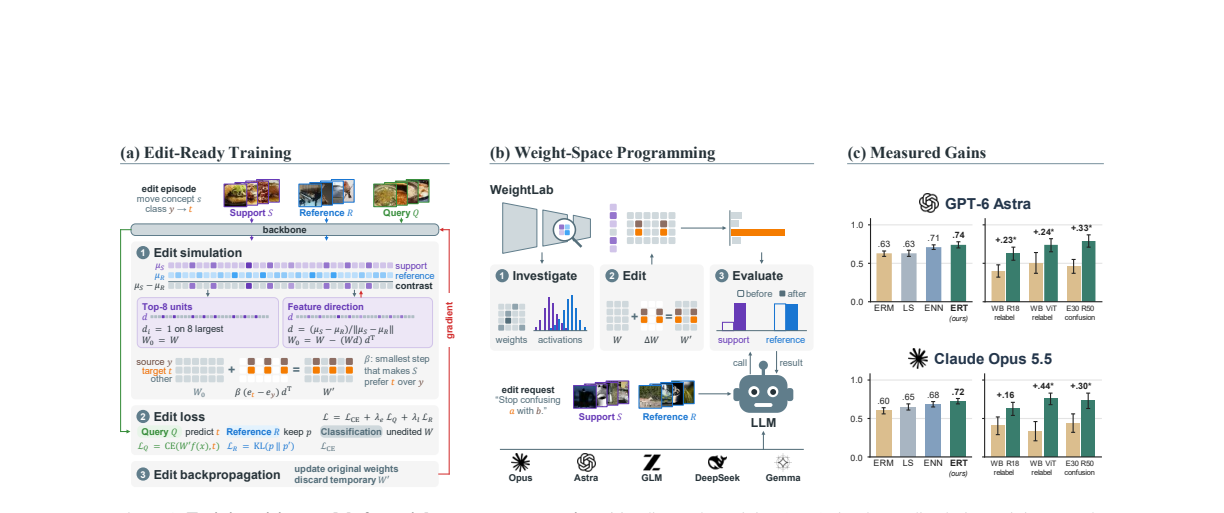
The paper investigates whether dedicated training of vision classifiers can make them easier for large language models to edit directly in weight space. The authors introduce Edit-Ready Training (ERT), which simulates during training the kind of closed-form head edits that LLM editors typically perform—sparse rank-one changes along the contrast between support and reference features. Over more than 2,600 edit processes with five LLMs, ERT raises the net edit score on the hardest settings by +0.16 to +0.44 over standard training, and achieves the highest mean score for both GPT-6 Astra and Claude Opus 5.5 among all baselines. The study reveals that LLM editors almost exclusively edit the classifier head with rank-one contrast-based updates, and that training methods that prepare for this pattern help most where standard networks resist editing.
What carries the argument. Edit-Ready Training (ERT) is the central mechanism. During each training step, it repeatedly simulates a head-only weight edit: it computes the mean backbone features of a few support images and reference images, forms an edit vector d either by selecting the top-8 contrast units (set to 1) or by normalizing the contrast direction, and writes the edit as a rank-one perturbation β (e_t − e_y) d^⊤ to the classifier head. The step size β is determined by a closed-form rule that ensures the support images exceed a margin of 1. The post-edit network is evaluated on held-out query images (cross-entropy to the target class) and on reference images (KL divergence to preserve prior predictions), and the total loss gradient is backpropagated through the edit into all network weights. This forces the backbone to produce features that can be corrected by small, sparse, contrast-based head edits.
Core claim. The paper seeks to establish that a training procedure called Edit-Ready Training (ERT) makes vision classifiers substantially more amenable to LLM-driven weight-space programming. ERT works by rehearsing during training the exact type of weight edits that LLM agents later perform: during each training step, it simulates a head-only edit (either setting top-8 feature units or adjusting the feature direction), computes the post-edit loss on held-out query images, and backpropagates through the closed-form edit into all weights. The result is that on the hardest settings (Waterbirds ResNet-18, Waterbirds ViT, Entity-30 confusion fix), ERT lifts the net edit score by +0.16 to +0.44 over standard training for both GPT-6 Astra and Claude Opus 5.5, while causing no significant loss on easier settings. Across nine dataset–backbone–task combinations, ERT achieves the highest average net score for both leading editors (0.74 for Astra, 0.72 for Opus), and its gain over standard training is the only one that remains significant when each setting is treated as a single observation (p=0.047 for Opus).
The premise it rests on. That the head-only, closed-form edits rehearsed during ERT training adequately simulate the full range of edits that LLM agents will later perform, and that tuning hyperparameters with scripted editors on two ResNet-18 settings transfers to other backbones, datasets, and tasks.
If the paper is right (Pith's inferences, not the authors')
If ERT is adopted, vision models that need frequent post-deployment fixes (e.g., correcting confusions or relabeling fine-grained concepts) can be prepared so that an LLM agent can perform the edit with fewer probes and smaller weight changes, reducing side effects.
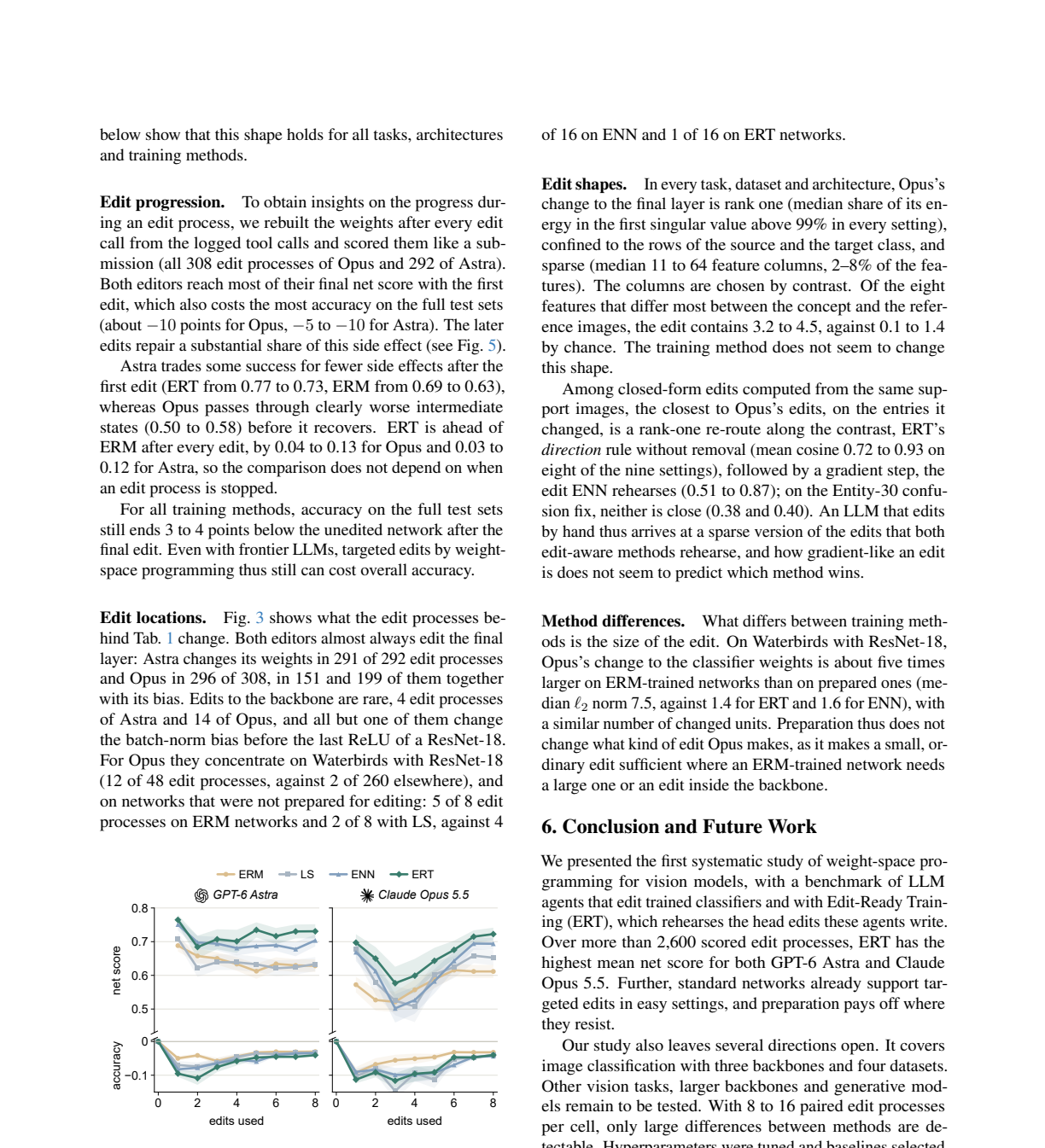
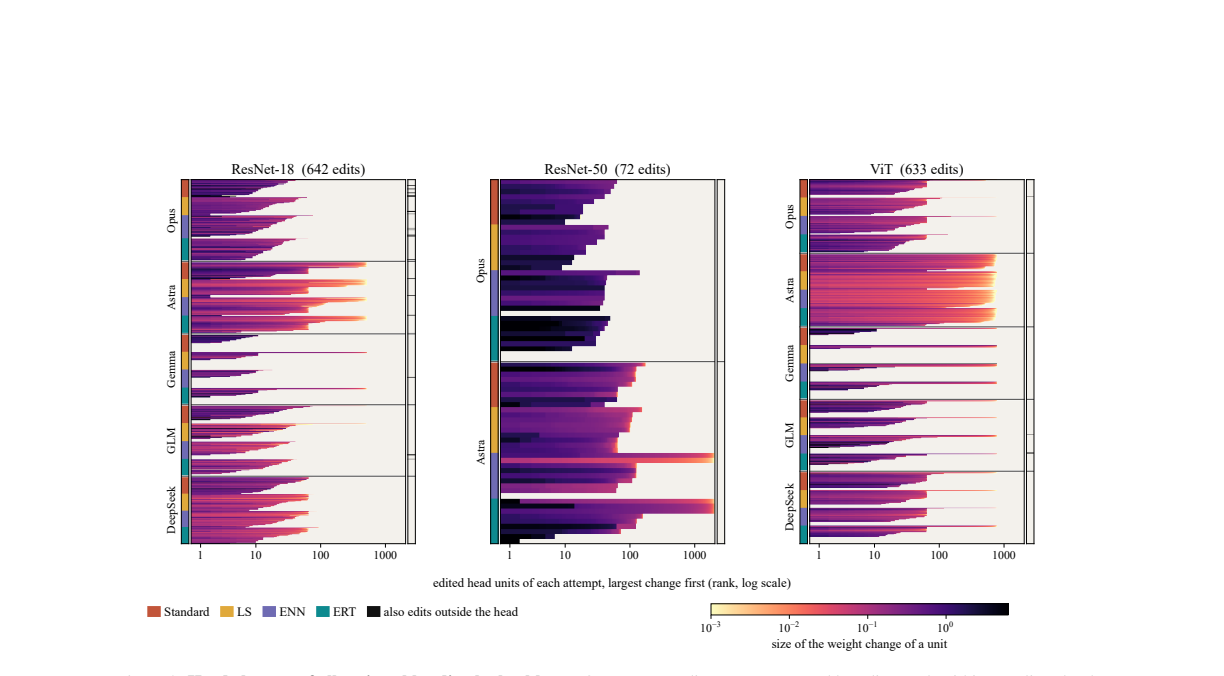
The finding that LLM editors overwhelmingly (296/308 for Opus) edit only the classifier head with sparse rank-one contrast updates suggests that future edit-aware training methods can focus on the head alone, and that backbone rehearsal may be unnecessary unless the editor's strategy shifts.
Since ERT's benefit persists even when the rehearsed edit rule is varied (differences −0.06 to +0.06, none significant), the key property ERT imparts is generic feature alignment for small head edits, not specific edit pattern matching.
The benchmark of more than 2,600 edit processes with five LLMs provides a standardized evaluation protocol for weight-space programming, allowing future work to compare editing methods and training strategies directly.
The observation that even frontier LLMs (Astra, Opus) lose 3–4 points of test accuracy after editing indicates that weight-space programming still degrades overall performance, motivating research into loss-preserving editing techniques.
The dependence of ERT's gain on the standard network's editability score (rank correlation −0.83) provides a practical diagnostic: a few cheap LLM probes on a standard network can tell practitioners whether training for editability is worth the effort.
Because Opus's edits on ERT networks are about five times smaller in ℓ₂ norm than on ERM networks (median 1.4 vs 7.5), ERT may reduce the risk of large catastrophic side effects even when the net score gain is modest.
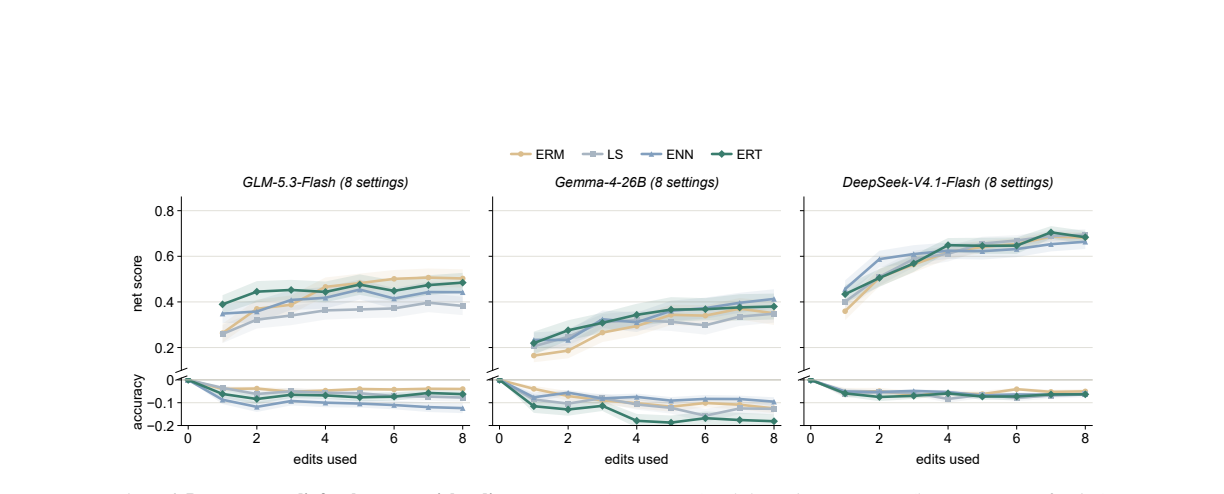
The strong correlation (0.78) between Astra and Opus rankings across settings, but weak or negative correlation with open-weight editors, suggests that editability gains from training are editor-specific and that conclusions about 'how editable a model is' depend on which LLM does the editing.
The ERT training pipeline is computationally cheap (adds a forward-backward pass per episode to each training step) and could be integrated into standard fine-tuning workflows without requiring additional data or labels beyond the existing training set.
Check this review
What was read
The passes were given all 107,338 characters of the paper's LaTeX source.
Fingerprint of that text (SHA-256): 4c7ee8dffcfb59569e487da8ac650824590f283821a9194c8f5df13069e280eb
Pith does not keep that text. Rebuilt from the paper's source or PDF by the same code, it has this fingerprint if it is the same text. From a copy of Pith's code:
PYTHONPATH=. python scripts/review_input_check.py 2611.26408
The passes, in the order they ran
- Reader deepseek-v4-flash · medium effort · $0.0062 · instructions of the Reader, fingerprint f9ead7300382…
- Skeptic deepseek-v4-flash · medium effort · $0.0063 · instructions of the Skeptic, fingerprint 8f88c0f61488…
- Referee deepseek-v4-flash · medium effort · $0.0054 · instructions of the Referee, fingerprint a852d99aea0d…
- Editor deepseek-v4-flash · medium effort · $0.0052 · instructions of the Editor, fingerprint e7211f6a3d27…
- Circularity check deepseek-v4-flash · medium effort · $0.0050 · instructions of the Circularity check, fingerprint e9946e39d67b…
- Summary for the page deepseek-v4-flash · medium effort · temperature 0.2 · $0.0053 · instructions of the Summary for the page, fingerprint e4f56bf568e7…
The passes cost $0.033 in model calls together.
Version stamped on this review: pith-pipeline@v1.4.1-daily-deepseek-or-medium+deepseek/deepseek-v4-flash+p.505d180dcaef
Each link opens a pass's instructions as plain text, the exact bytes its fingerprint was taken over. Every stored set of instructions.
curl -s https://pith.science/methodology/prompts/f9ead730038216984cfb56d7cb34332bdf691828296a1de4245f3d6667d4bf56 | sha256sum
prints the fingerprint of the reader's instructions. The same works for every pass.
The receipt
The review's fingerprint was taken on 20 Nov 2026. The review you are reading still matches it.
Fingerprint of the review (SHA-256): 6f9db66f6f20adb6f60c9f3ef8e2ad8f23b0007ef08ebed49452a19ff2e42074
curl -s 'https://pith.science/api/v1/verdicts/2611.26408?form=canonical' | sha256sum
prints the fingerprint of the review as it stands now. The rule, in four steps.
A matching fingerprint shows the review has not changed since that date. It does not show that the review is right.
How often reviews like this one are right
Reviews like this one: written by deepseek-v4-flash, from the paper's LaTeX source.
How often objections from reviews like this one are right: not yet measured
Reviews by people
This review was written by a machine. No person has reviewed this paper on Pith yet. A scientist listed on Pith can review it for a fee, and their review is published here whatever it concludes.
How Pith checks papers · The full audit of this paper · Review history (2 versions)
The paper
Abstract
It has been demonstrated that, in certain settings, large language models can perform weight-space programming to directly modify the weights of neural networks. However, it is unknown how dedicated training of these networks can contribute to the successes of weight-space programming. We present a benchmark of LLM-driven weight-space programming on vision models, in which five LLMs edit convolutional networks and vision transformers on relabeling and error-correction tasks on Waterbirds, CIFAR-100, PACS and Entity-30. We report more than 2,600 such edit processes, whereby each edit is scored on held-out images for success, side effects and accuracy loss. We compare standard training with label smoothing, gradient-based editable training, and our Edit-Ready Training (ERT), a novel method that rehearses the direct, closed-form weight edits LLMs perform. We show that preparing networks for editing raises the success of LLM edits substantially where standard networks are hard to edit. ERT further achieves the highest mean score for GPT-6 Astra and Claude Opus 5.5 across all evaluated baselines. We will release our LLM testing framework alongside all tasks, editing trajectories and scores. Project page: https://viscom.uni-ulm.de/wsp
The paper's own sentences, arranged, kept beside the review and separate from it. Each label is drawn from a closed vocabulary; the number beside it is the probability the classifier gave that label. No sentence in this record was written by a model.
abstract compiled · 2026-11-20
The authors' main claim, as the classifier picked it out 1.00
“We show that preparing networks for editing raises the success of LLM edits substantially where standard networks are hard to edit.”
How the main claim is stated: asserted 1.00
What the abstract itself states, as probabilities: claims first 0.09 · states limitation 0.18 · human participants 0.04 · controlled comparison 0.95 · randomized assignment 0.02 · states quantitative result 0.96 · compares with prior results 0.97 · mentions code or data availability 0.89
The abstract, sentence by sentence
This table labels the abstract only (arXiv listing abstract v1). The number is the probability the classifier gave the label.
| Sentence | Role | The authors' own work | States the main conclusion | Strength |
|---|---|---|---|---|
| It has been demonstrated that, in certain settings, large language models can perform weight-space programming to directly modify the weights of neural networks. | background 1.00 | 0.06 | 0.03 | asserted 0.98 |
| However, it is unknown how dedicated training of these networks can contribute to the successes of weight-space programming. | gap 1.00 | 0.06 | 0.03 | asserted 0.71 |
| We present a benchmark of LLM-driven weight-space programming on vision models, in which five LLMs edit convolutional networks and vision transformers on relabeling and error-correction tasks on Waterbirds, CIFAR-100, PACS and Entity-30. | contribution 0.72 | 0.94 | 0.04 | asserted 0.96 |
| We report more than 2,600 such edit processes, whereby each edit is scored on held-out images for success, side effects and accuracy loss. | method 0.90 | 0.97 | 0.04 | asserted 0.99 |
| We compare standard training with label smoothing, gradient-based editable training, and our Edit-Ready Training (ERT), a novel method that rehearses the direct, closed-form weight edits LLMs perform. | method 0.89 | 0.87 | 0.06 | asserted 0.69 |
| We show that preparing networks for editing raises the success of LLM edits substantially where standard networks are hard to edit. | result 0.99 | 0.95 | 0.77 | asserted 1.00 |
| ERT further achieves the highest mean score for GPT-6 Astra and Claude Opus 5.5 across all evaluated baselines. | result 1.00 | 0.94 | 0.23 | asserted 1.00 |
| We will release our LLM testing framework alongside all tasks, editing trajectories and scores. | future work 0.71 | 0.43 | 0.02 | asserted 0.86 |
| Project page: https://viscom.uni-ulm.de/wsp | future work 0.75 | 0.23 | 0.01 | unclear 0.74 |
What kind of paper the classifier reports this is: dataset or benchmark 0.44 · evidence from observation or experiment 0.98
What was examined, and what was not
Sources read
- arXiv listing abstract v1
Not examined
- full text
- figures and tables
- references and citing sentences
- relations to other papers
Levels run
- P abstract
Not run
- S sections
- T body sentences
- C citations
- R cross-paper relations
How the labels were made
Compiled by classifier-1.13.0 via TypeSafe API, question bank abstract-p1-20260923, 2026-11-20: 1 request, 6,874 input tokens.
Every quoted sentence on this record is the authors'. Every label is from Pith's closed vocabulary, with the probability shown beside it. This record as JSON
Figures (9)




Figures are the authors', reproduced from the paper.
References (42)
- [1] Nazmus Sakib Ahmed. Can an LLM actually reason and program about neural network’s weights or is it just memo- rization on steroids? Exploring “weight-space programming”. arXiv:2611.08070, 2026. 2 on PithPith's reviewarXiv
- [2] David Bau, Bolei Zhou, Aditya Khosla, Aude Oliva, and An- tonio Torralba. Network dissection: Quantifying interpretabil- ity of deep visual representations. InIEEE Conference on Computer Vision and Pattern Recognition, 2017. 2 on Pith
- [3] David Bau, Steven Liu, Tongzhou Wang, Jun-Yan Zhu, and Antonio Torralba. Rewriting a deep generative model. In European Conference on Computer Vision, 2020. 2 on Pith
- [4] Nicola De Cao, Wilker Aziz, and Ivan Titov. Editing factual knowledge in language models. InConference on Empirical Methods in Natural Language Processing, pages 6491–6506, on Pith
- [5] Jia Deng, Wei Dong, Richard Socher, Li-Jia Li, Kai Li, and Li Fei-Fei. ImageNet: A large-scale hierarchical image database. InIEEE Conference on Computer Vision and Pattern Recog- nition, 2009. 5 on Pith
- [6] Alexey Dosovitskiy, Lucas Beyer, Alexander Kolesnikov, Dirk Weissenborn, Xiaohua Zhai, Thomas Unterthiner, Mostafa Dehghani, Matthias Minderer, Georg Heigold, Syl- vain Gelly, Jakob Uszkoreit, and Neil Houlsby. An image is worth 16x16 words: Transformers for image recognition ... on Pith
- [7] Gabriel Eilertsen, Daniel Jönsson, Timo Ropinski, Jonas Unger, and Anders Ynnerman. Classifying the classifier: Dissecting the weight space of neural networks. InEuropean Conference on Artificial Intelligence, 2020. 2 on Pith
- [8] Chelsea Finn, Pieter Abbeel, and Sergey Levine. Model- agnostic meta-learning for fast adaptation of deep networks. InInternational Conference on Machine Learning, 2017. 2 on Pith
- [9] Pierre Foret, Ariel Kleiner, Hossein Mobahi, and Behnam Neyshabur. Sharpness-aware minimization for efficiently improving generalization. InInternational Conference on Learning Representations, 2021. 5 on Pith
- [10] Rohit Gandikota, Joanna Materzy ´nska, Jaden Fiotto- Kaufman, and David Bau. Erasing concepts from diffusion models. InIEEE International Conference on Computer Vision, 2023. 2 on Pith
- [11] David Ha, Andrew Dai, and Quoc V . Le. HyperNetworks. In International Conference on Learning Representations, 2017. 2 on Pith
- [12] Kaiming He, Xiangyu Zhang, Shaoqing Ren, and Jian Sun. Deep residual learning for image recognition. InIEEE Con- ference on Computer Vision and Pattern Recognition, 2016. 1, 4 on Pith
- [13] Evan Hernandez, Sarah Schwettmann, David Bau, Teona Bagashvili, Antonio Torralba, and Jacob Andreas. Natural language descriptions of deep visual features. InInternational Conference on Learning Representations, 2022. 2 on Pith
- [14] Qian Huang, Jian V ora, Percy Liang, and Jure Leskovec. MLAgentBench: Evaluating language agents on machine learning experimentation. InInternational Conference on Machine Learning, 2024. 2 on Pith
- [15] Gabriel Ilharco, Marco Tulio Ribeiro, Mitchell Wortsman, Suchin Gururangan, Ludwig Schmidt, Hannaneh Hajishirzi, and Ali Farhadi. Editing models with task arithmetic. In International Conference on Learning Representations, 2023. 2 on Pith
- [16] Krishna Kabra, Constantin Venhoff, and Christian Schroeder de Witt. Weight oracles: Reading neural network weights with language models. InNeurIPS 2026 Workshop on Neural Network Artifacts as a New Data Modality, 2026. 2 on Pith
- [17] Polina Kirichenko, Pavel Izmailov, and Andrew Gordon Wil- son. Last layer re-training is sufficient for robustness to spu- rious correlations. InInternational Conference on Learning Representations, 2023. 2 on Pith
- [18] Pang Wei Koh, Thao Nguyen, Yew Siang Tang, Stephen Muss- mann, Emma Pierson, Been Kim, and Percy Liang. Concept bottleneck models. InInternational Conference on Machine Learning, 2020. 5 on Pith
- [19] Alex Krizhevsky. Learning multiple layers of features from tiny images. Technical report, University of Toronto, 2009. 1, 5 on Pith
- [20] Da Li, Yongxin Yang, Yi-Zhe Song, and Timothy M. Hospedales. Deeper, broader and artier domain generaliza- tion. InIEEE International Conference on Computer Vision, on Pith
show 22 more
- [21] Houjun Liu, John Bauer, and Christopher D. Manning. Drop dropout on single epoch language model pretraining. InFind- ings of the Association for Computational Linguistics: ACL 2025, 2025. 2 on Pith
- [22] Kevin Meng, David Bau, Alex Andonian, and Yonatan Be- linkov. Locating and editing factual associations in GPT. In Advances in Neural Information Processing Systems, 2022. 1, 2 on Pith
- [23] Kevin Meng, Arnab Sen Sharma, Alex J. Andonian, Yonatan Belinkov, and David Bau. Mass-editing memory in a trans- former. InInternational Conference on Learning Representa- tions, 2023. 2 on Pith
- [24] Eric Mitchell, Charles Lin, Antoine Bosselut, Chelsea Finn, and Christopher D. Manning. Fast model editing at scale. In International Conference on Learning Representations, 2022. 1, 2 on Pith
- [25] Rafael Müller, Simon Kornblith, and Geoffrey Hinton. When does label smoothing help? InAdvances in Neural Informa- tion Processing Systems, 2019. 2, 4 on Pith
- [26] Aviv Navon, Aviv Shamsian, Idan Achituve, Ethan Fetaya, Gal Chechik, and Haggai Maron. Equivariant architectures for learning in deep weight spaces. InInternational Conference on Machine Learning, 2023. 2 on Pith
- [27] Tuomas Oikarinen and Tsui-Wei Weng. CLIP-Dissect: Au- tomatic description of neuron representations in deep vision networks. InInternational Conference on Learning Repre- sentations, 2023. 2 on Pith
- [28] Chris Olah, Nick Cammarata, Ludwig Schubert, Gabriel Goh, Michael Petrov, and Shan Carter. Zoom in: An introduction to circuits.Distill, 2020. 2 on Pith
- [29] Shauli Ravfogel, Yanai Elazar, Hila Gonen, Michael Twiton, and Yoav Goldberg. Null it out: Guarding protected attributes by iterative nullspace projection. InAnnual Meeting of the Association for Computational Linguistics, 2020. 2 on Pith
- [30] Shiori Sagawa, Pang Wei Koh, Tatsunori B. Hashimoto, and Percy Liang. Distributionally robust neural networks for group shifts: On the importance of regularization for worst- case generalization. InInternational Conference on Learning Representations, 2020. 1, 5 on Pith
- [31] Shibani Santurkar, Dimitris Tsipras, Mahalaxmi Elango, David Bau, Antonio Torralba, and Aleksander Madry. Editing a classifier by rewriting its prediction rules. InAdvances in Neural Information Processing Systems, 2021. 1, 2 on Pith
- [32] Shibani Santurkar, Dimitris Tsipras, and Aleksander Madry. BREEDS: Benchmarks for subpopulation shift. InInterna- tional Conference on Learning Representations, 2021. 1, 5 on Pith
- [33] Konstantin Schürholt, Dimche Kostadinov, and Damian Borth. Self-supervised representation learning on neural network weights for model characteristic prediction. InAdvances in Neural Information Processing Systems, 2021. 2 on Pith
- [34] Konstantin Schürholt, Diyar Taskiran, Boris Knyazev, Xavier Giró-i Nieto, and Damian Borth. Model zoos: A dataset of diverse populations of neural network models. InAdvances in Neural Information Processing Systems, 2022. 2 on Pith
- [35] Tamar Rott Shaham, Sarah Schwettmann, Franklin Wang, Achyuta Rajaram, Evan Hernandez, Jacob Andreas, and An- tonio Torralba. A multimodal automated interpretability agent. InInternational Conference on Machine Learning, 2024. 2 on Pith
- [36] Anton Sinitsin, Vsevolod Plokhotnyuk, Dmitriy Pyrkin, Sergei Popov, and Artem Babenko. Editable neural networks. InInternational Conference on Learning Representations, on Pith
- [37] Nitish Srivastava, Geoffrey Hinton, Alex Krizhevsky, Ilya Sutskever, and Ruslan Salakhutdinov. Dropout: A simple way to prevent neural networks from overfitting.Journal of Machine Learning Research, 15:1929–1958, 2014. 5 on Pith
- [38] Christian Szegedy, Vincent Vanhoucke, Sergey Ioffe, Jon Shlens, and Zbigniew Wojna. Rethinking the inception archi- tecture for computer vision. InIEEE Conference on Computer Vision and Pattern Recognition, 2016. 2, 4 on Pith
- [39] Rikiya Takehi, Jayden Teoh, Alex Zhang, and Omar Khat- tab. Sparks of weight-space programming: LLMs can na- tively read and write neural network weights. Research blog post, MIT CSAIL, 2 November 2026, 2026. https: / / rikiyat . github . io / blog / weight - space - programmi... on Pith
- [40] Thomas Unterthiner, Daniel Keysers, Sylvain Gelly, Olivier Bousquet, and Ilya Tolstikhin. Predicting neural network accuracy from weights.arXiv preprint arXiv:2002.11448, on PithPith's reviewarXiv
- [41] Eric Wong, Shibani Santurkar, and Aleksander Madry. Lever- aging sparse linear layers for debuggable deep networks. In International Conference on Machine Learning, 2021. 2, 5 on Pith
- [42] Allan Zhou, Kaien Yang, Kaylee Burns, Adriano Cardace, Yiding Jiang, Samuel Sokota, J. Zico Kolter, and Chelsea Finn. Permutation equivariant neural functionals. InAdvances in Neural Information Processing Systems, 2023. 2 10 This appendix provides the details that the main te... on Pith
Cited by 1 Pith paper
Reviewed papers on Pith that cite this one. The full citation record
Challenges and discussion
Disagree with the review, or know something it missed? Leave a comment, or challenge this review formally: a challenge becomes a permanent entry in this paper's record, and its decision is published here.
Come back by email
A short list of the week's newly reviewed papers. Nothing is sent until you confirm from your inbox, and every email has a link that stops it. No account.
No comments yet.
Sign in to comment