Computer Vision and Pattern Recognition · arXiv:2611.28781 v1 · submitted 21 Nov 2026 · 44 references
Where Does a Weight-Editing Agent Help? Blind Diagnosis and Repair of Deployment Faults in Vision Models
The paper says
“Language-model agents can read and edit the weights of neural networks without gradients, and this is increasingly presented as a new way of repairing models. We ask what such an agent adds, in a setting with a known answer.”
more of the abstract
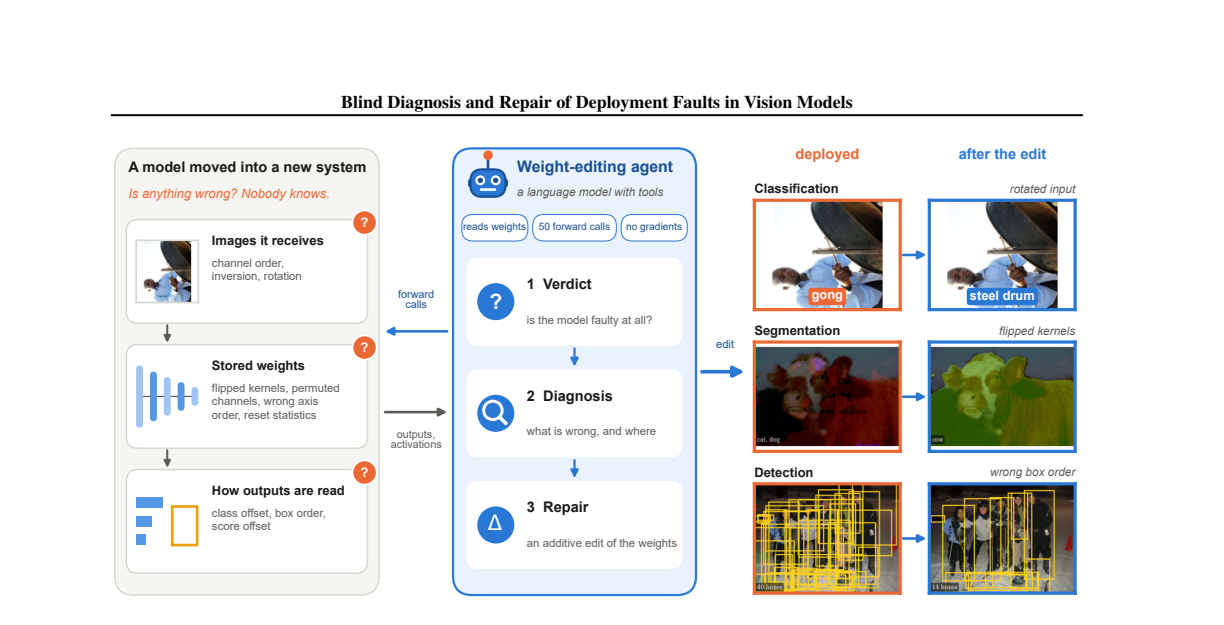
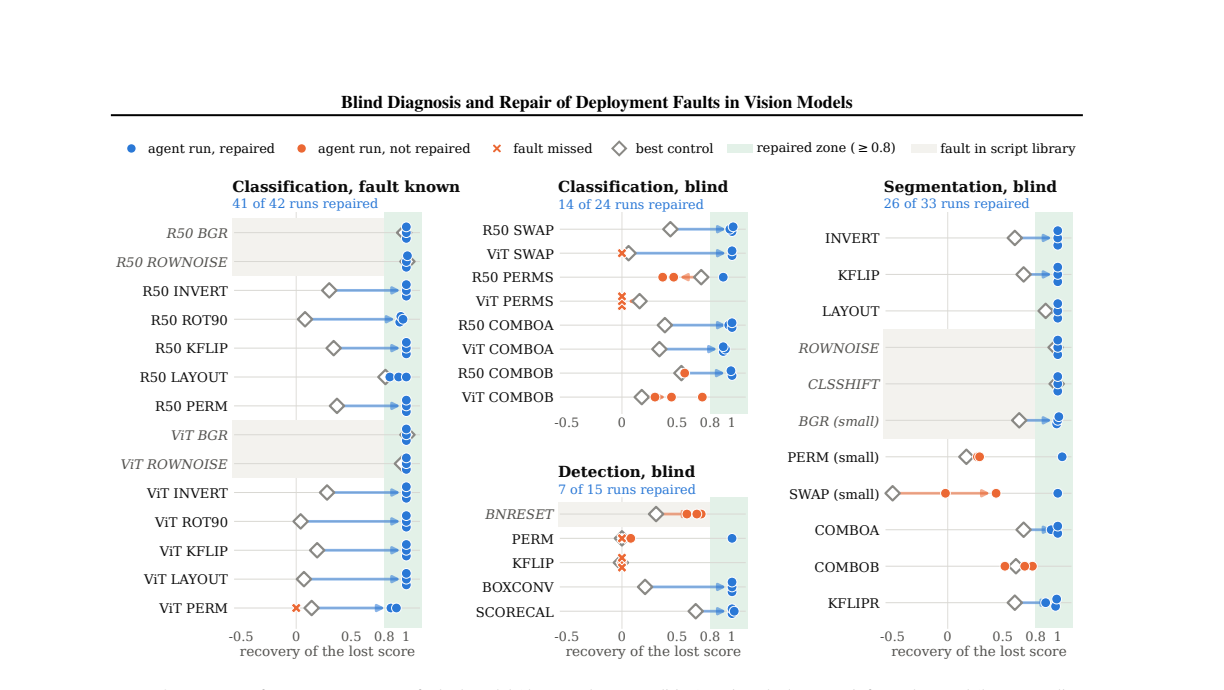
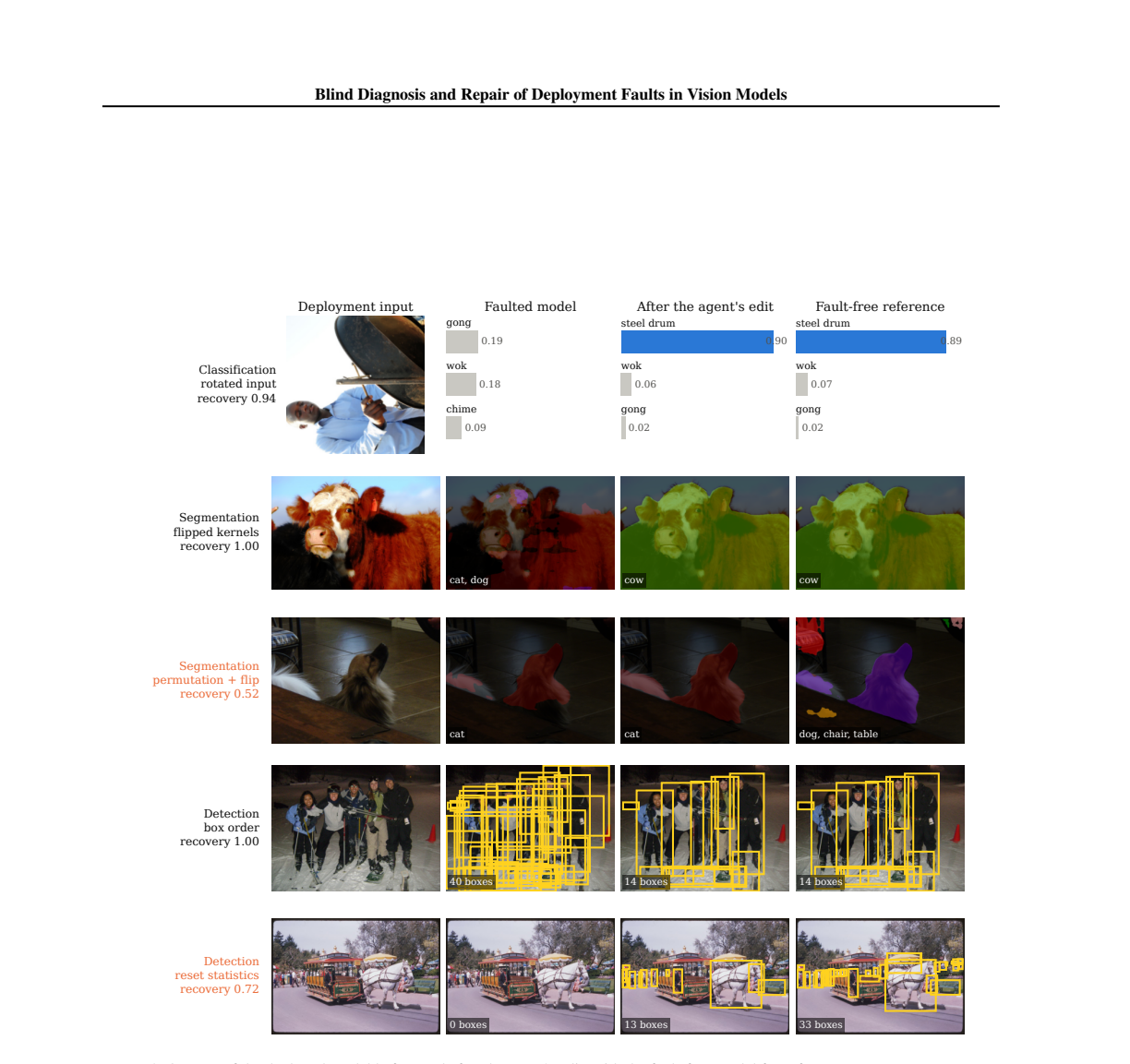
A vision model moved into a new system may be broken by a preprocessing, weight-conversion or output-convention fault; an agent restricted to forward passes must decide whether a fault exists, name it, and undo it by editing the weights. Over 183 runs on classification, segmentation and detection, scored against the fault-free model, we find three things. When the kind of fault is known, the agent is not needed: a script written afterwards repairs 30 of 48 faults against the agent's 33. But the agent did not have to be told: on five fault types outside every script it repairs 15 of 15 where that script repairs 4, and it never edits any of 21 fault-free models. And its limits are predictable: it needs a trustworthy per-layer reference for the model's activations and a fault that is an invertible structured transformation; without them, small faults are missed and repairs stay partial. We derive guidance on when to use an agent and when a script.
from the abstract
Pith says
Machine review · deepseek-v4-flash · 24 Nov 2026 · read the full text (108,750 characters) · not checked by a person
It can be wrong. Challenge this review or reply to it.
Holds up. A careful empirical study shows that weight-editing agents add value when the fault type is unknown and the model carries a trustworthy activation reference; otherwise scripts match or exceed them. This line is wrong
4 minor
How often objections from reviews like this one are right: not yet measured
The paper, first character to last
The reviewer was given the whole text, 108,750 characters. Not checked: figures, code, what the 44 references say.
4 minor objections
The paper says, at 4.1
Pith says: minor objection 1 of 4
Table 2 caption reads 'Classification, fault known to exist'. It would be clearer to state explicitly that in this round the agent was told a fault exists, unlike later rounds.
The paper says, at 3.1
Pith says: minor objection 2 of 4
The definition of recovery (Eq. 1) is used throughout, but the threshold for 'repaired' (recovery >= 0.8) is stated only in Section 3.1. A brief reminder in later tables or captions would help readers who jump to specific sections.
show 2 more
The paper says, at 5
Pith says: minor objection 3 of 4
The bias-sum derivation in Section 5 (Eq. 4-5 in the detection section) is a key insight. Consider referencing it more prominently in the conclusion or in the 'When to Use an Agent' section, as it exemplifies a diagnosis that rests on a training invariant visible in the weights.
The paper says, at Appendix D
Pith says: minor objection 4 of 4
The per-run table in the appendix (Table 4) is very detailed and valuable for reproducibility. Consider moving it to supplementary material to save space in the main paper, or summarizing key statistics in the main text.
What would settle it
Run the same unseen-fault protocol (Section 6.2) on a second, independently developed agent model (e.g., GPT-5 or Gemini 3) with identical task texts and budgets. If the second agent repairs fewer than 12 of the 15 unseen faults, the claim that 'the agent adds value' may be specific to the proprietary model used, not to weight-editing agents in general.
from the skeptic's reading
How the review went
5 passes by deepseek-v4-flash · 24 Nov 2026
- Reader holds up
- Skeptic agrees
- Referee 4 minor
- Check against the paper
- Editor wrote the verdict above
Not run on this paper: the simulated authors' defence.
Pith checked this review's objections against the text of the paper it read.
The review in full
The review in brief, machine-written
This paper asks a practical question that earlier work on weight-space programming left unanswered: what does an agent that reads and edits weights add over a script? The answer, from 183 runs across four vision models and three tasks, is nuanced and honestly reported. When the kind of fault is known, a script written after the fact repairs 30 of 48 faulted models against the agent's 33. When the fault type is unknown, the agent repairs 15 of 15 on five types no script was written for, while the script repairs 4. The agent never edits a fault-free model, and no edit causes harm. The paper also identifies the load-bearing condition: the model must provide a trustworthy per-layer activation reference (e.g., BatchNorm statistics that match deployment activations). Without it, small faults are missed. The study is well designed: pre-registered expectations, multiple controls (try-all, entropy minimisation, fine-tuning), an audit of agent transcripts, and a post-hoc script that bounds what a script could do. The limitations are stated clearly: a single proprietary agent model, synthetic faults, one-sided construction of the unseen-fault test, three seeds per condition, and AI judges for diagnoses. The paper does not claim more than it shows. It is a solid empirical contribution that clarifies when weight-editing agents are useful and when they are not. Practitioners will find the guidance in Section 9 actionable; researchers in model repair and weight-space programming will benefit from the comparison methodology. The paper deserves a serious referee and, after minor revisions (e.g., discussing how the findings might extend to unstructured faults or to other agent models), should be accepted.
The strongest objection
The paper makes a clear, conditional claim: a weight-editing agent adds value over scripts when the fault type is unknown, provided the model carries a trustworthy per-layer activation reference and the fault is an invertible structured transformation. Every element of this claim is tested empirically: the agent succeeds on unseen faults (15/15), fails when the reference is missing (ViT, detector), and is matched by a post-hoc script on known families. The limitations are stated explicitly: synthetic faults, single agent model, one-sided unseen-fault construction, and language-model judges. No internal inconsistency or unsupported leap was found. The weakest assumption—that a trustworthy reference exists—is identified by the paper itself and shown to be necessary through ablation. The evidence supports the conclusion as stated, and no load-bearing concern that would overturn the verdict remains unaddressed.
The reader's verdict (ACCEPT, high confidence) is appropriate. The paper's strongest claim is that the agent adds value by not requiring the fault families to be known in advance. This is supported by the unseen-fault experiment (Section 6.2), where the agent repairs 15/15 while the post-hoc script repairs only 4/15. The paper also demonstrates the boundary conditions: without a trustworthy reference (ViT, detector), the agent misses faults; with a reference, it succeeds. The post-hoc script comparison (Section 6.1) shows that once families are known, a script matches the agent. The paper honestly acknowledges its limitations: synthetic faults, single agent model, one-sided construction, and language-model judges. No hidden assumptions or internal contradictions were found. The reader's weakest_assumption (trustworthy reference) is correctly identified and is explicitly stated as a condition for success. The stress-tester finds no additional load-bearing concern that would change the verdict. The concrete test proposed would strengthen generalizability but is not required to support the current claims.
The referee's report
The paper addresses a timely and practical question in weight-space programming: what does a weight-editing agent add over a script? The experimental design is thorough, covering multiple models (ResNet-50, ViT-B/16, DeepLabV3, Faster R-CNN), tasks (classification, segmentation, detection), and 183 runs with pre-registered expectations, controls, and an audit. The results are nuanced and appropriately qualified: the agent matches scripts when the fault family is known, outperforms them on unseen faults, and never harms fault-free models, but requires a trustworthy per-layer activation reference and invertible structured faults. The paper provides clear guidance for practitioners. The findings are significant for the field of model editing and repair, and the comparison methodology (script vs. agent) should become standard in future work.
Pith's reading of the paper (a machine's summary, not the authors')
The paper asks what a weight-editing language-model agent adds over a simple script for diagnosing and repairing deployment faults in vision models. It finds that when the fault type is known (e.g., flipped kernels, wrong axis order), a script written after the fact repairs 30 of 48 faults against the agent's 33—the agent is not needed. But the agent was never told the fault families: on five fault types outside every script it repairs 15 of 15 where that script repairs 4, and it never edits any of 21 fault-free models. The agent's advantage holds only when the model carries a trustworthy per-layer activation reference (e.g., BatchNorm statistics that match deployment activations) and the fault is an invertible structured transformation; without such a reference, small faults are missed and repairs stay partial. The paper derives guidance on when to use an agent and when a script.
What carries the argument. The paper's diagnostic strategy relies on comparing measured activation statistics to stored per-layer statistics (e.g., BatchNorm running mean and variance). The key deviation measure is $d_ℓ = operatorname*{median}_{c} bigl|log(hat v_{ℓ,c} / v_{ℓ,c})bigr|$, which flags the first layer whose measured variance $hat v_{ℓ,c}$ leaves the stored variance $v_{ℓ,c}$. This reference is load-bearing: without it (ViT-B/16, Faster R-CNN with frozen BatchNorm), small faults are missed and repairs are partial.
Core claim. The paper establishes that weight editing by an agent is neither a new kind of repair nor an illusion. For deployment faults of vision models, the edit itself is easy and the diagnosis can be scripted once the kinds of fault are known; a few hundred lines do about as well as the agent. What the agent adds is that nobody has to know the kinds in advance: it found and exactly inverted faults that no script had been written for, and it left intact models alone. That advantage holds where the model carries a trustworthy reference for its own activations and the fault is an invertible structured transformation, and it disappears where the reference is missing, where the inverse is a search problem, and where one fault hides another.
The premise it rests on. The model must provide a trustworthy per-layer activation reference (e.g., BatchNorm running statistics that match actual activations on deployment data). Without such a reference, small faults are missed and repairs are partial, as shown on ViT-B/16 and Faster R-CNN.
If the paper is right (Pith's inferences, not the authors')
Practitioners can use a script library for known fault families (channel order, kernel flips, axis order, class offsets, box conventions) and achieve the same repair rate as an agent.
For unknown faults, an agent can be deployed with confidence that it will not damage intact models, provided the model has a trustworthy activation reference.
The agent's 'no fault found' verdict cannot be trusted when the model lacks such a reference and the performance drop is within sampling noise of the labelled pool.
Generic test-time adaptation methods (entropy minimization, fine-tuning) should not be used as a repair for structural deployment faults, as they often lower performance on intact models.
The agent's ability to diagnose and repair is limited to invertible structured transformations; it fails on assignment problems (random channel permutations) and compound faults where one fault hides another.
The paper's protocol could be extended to other modalities (language, audio) where similar deployment faults occur, such as tokenizer mismatches or axis order in embedding layers.
The finding that a post-hoc script matches the agent on known faults suggests that the main value of the agent is in discovering fault families, not in per-instance repair; a practical workflow could use the agent to identify new fault types and then harden the script library.
The requirement of a trustworthy per-layer reference implies that models designed for easy debugging (e.g., with built-in activation statistics) would be more amenable to agent-based repair, and that models without such statistics (like ViT) could be augmented with reference statistics from a small calibration set.
The paper's comparison against a post-hoc script is one-sided by design; a fairer test would have the script written before any agent runs, but the paper acknowledges this limitation and the result still shows that the agent can handle faults that no one anticipated.
Check this review
What was read
The passes were given all 108,750 characters of the paper's LaTeX source.
Fingerprint of that text (SHA-256): 3ccbdde344fecd9e20f37c4044068df58db995557ddd69b24f727dcb9202af92
Pith does not keep that text. Rebuilt from the paper's source or PDF by the same code, it has this fingerprint if it is the same text. From a copy of Pith's code:
PYTHONPATH=. python scripts/review_input_check.py 2611.28781
The passes, in the order they ran
- Reader deepseek-v4-flash · medium effort · $0.0032 · instructions of the Reader, fingerprint f9ead7300382…
- Skeptic deepseek-v4-flash · medium effort · $0.0030 · instructions of the Skeptic, fingerprint 8f88c0f61488…
- Referee deepseek-v4-flash · medium effort · $0.0030 · instructions of the Referee, fingerprint a852d99aea0d…
- Editor deepseek-v4-flash · medium effort · $0.0027 · instructions of the Editor, fingerprint e7211f6a3d27…
- Circularity check deepseek-v4-flash · medium effort · $0.0027 · instructions of the Circularity check, fingerprint e9946e39d67b…
- Summary for the page deepseek-v4-flash · medium effort · temperature 0.2 · $0.0033 · instructions of the Summary for the page, fingerprint e4f56bf568e7…
The passes cost $0.018 in model calls together.
Version stamped on this review: pith-pipeline@v1.4.1-daily-deepseek-or-medium+deepseek/deepseek-v4-flash+p.505d180dcaef
Each link opens a pass's instructions as plain text, the exact bytes its fingerprint was taken over. Every stored set of instructions.
curl -s https://pith.science/methodology/prompts/f9ead730038216984cfb56d7cb34332bdf691828296a1de4245f3d6667d4bf56 | sha256sum
prints the fingerprint of the reader's instructions. The same works for every pass.
The receipt
The review's fingerprint was taken on 24 Nov 2026. The review you are reading still matches it.
Fingerprint of the review (SHA-256): ea77f897c351bedf9a1e4c1986e1e99eeb95cae1bcf1cca2718e424d10e1c053
curl -s 'https://pith.science/api/v1/verdicts/2611.28781?form=canonical' | sha256sum
prints the fingerprint of the review as it stands now. The rule, in four steps.
A matching fingerprint shows the review has not changed since that date. It does not show that the review is right.
How often reviews like this one are right
Reviews like this one: written by deepseek-v4-flash, from the paper's LaTeX source.
How often objections from reviews like this one are right: not yet measured
Reviews by people
This review was written by a machine. No person has reviewed this paper on Pith yet. A scientist listed on Pith can review it for a fee, and their review is published here whatever it concludes.
The paper
Abstract
Language-model agents can read and edit the weights of neural networks without gradients, and this is increasingly presented as a new way of repairing models. We ask what such an agent adds, in a setting with a known answer. A vision model moved into a new system may be broken by a preprocessing, weight-conversion or output-convention fault; an agent restricted to forward passes must decide whether a fault exists, name it, and undo it by editing the weights. Over 183 runs on classification, segmentation and detection, scored against the fault-free model, we find three things. When the kind of fault is known, the agent is not needed: a script written afterwards repairs 30 of 48 faults against the agent's 33. But the agent did not have to be told: on five fault types outside every script it repairs 15 of 15 where that script repairs 4, and it never edits any of 21 fault-free models. And its limits are predictable: it needs a trustworthy per-layer reference for the model's activations and a fault that is an invertible structured transformation; without them, small faults are missed and repairs stay partial. We derive guidance on when to use an agent and when a script.
The paper's own sentences, arranged, kept beside the review and separate from it. Each label is drawn from a closed vocabulary; the number beside it is the probability the classifier gave that label. No sentence in this record was written by a model.
abstract compiled · 2026-11-24
The authors' main claim, as the classifier picked it out 0.84
“We derive guidance on when to use an agent and when a script.”
How the main claim is stated: asserted 0.81
What the abstract itself states, as probabilities: claims first 0.06 · states limitation 0.96 · human participants 0.03 · controlled comparison 0.88 · randomized assignment 0.02 · states quantitative result 0.99 · compares with prior results 0.91 · mentions code or data availability 0.04
The abstract, sentence by sentence
This table labels the abstract only (arXiv listing abstract v1). The number is the probability the classifier gave the label.
| Sentence | Role | The authors' own work | States the main conclusion | Strength |
|---|---|---|---|---|
| Language-model agents can read and edit the weights of neural networks without gradients, and this is increasingly presented as a new way of repairing models. | background 1.00 | 0.05 | 0.03 | asserted 0.68 |
| We ask what such an agent adds, in a setting with a known answer. | gap 0.55 | 0.34 | 0.03 | unclear 0.92 |
| A vision model moved into a new system may be broken by a preprocessing, weight-conversion or output-convention fault; an agent restricted to forward passes must decide whether a fault exists, name it, and undo it by editing the weights. | background 0.57 | 0.18 | 0.05 | asserted 0.52 |
| Over 183 runs on classification, segmentation and detection, scored against the fault-free model, we find three things. | method 0.40 | 0.96 | 0.05 | asserted 0.94 |
| When the kind of fault is known, the agent is not needed: a script written afterwards repairs 30 of 48 faults against the agent's 33. | result 1.00 | 0.95 | 0.18 | asserted 1.00 |
| But the agent did not have to be told: on five fault types outside every script it repairs 15 of 15 where that script repairs 4, and it never edits any of 21 fault-free models. | result 1.00 | 0.95 | 0.25 | asserted 1.00 |
| And its limits are predictable: it needs a trustworthy per-layer reference for the model's activations and a fault that is an invertible structured transformation; without them, small faults are missed and repairs stay partial. | limitation 0.66 | 0.91 | 0.26 | asserted 1.00 |
| We derive guidance on when to use an agent and when a script. | interpretation 0.76 | 0.90 | 0.32 | asserted 0.81 |
What kind of paper the classifier reports this is: empirical study 1.00 · evidence from observation or experiment 0.89
What was examined, and what was not
Sources read
- arXiv listing abstract v1
Not examined
- full text
- figures and tables
- references and citing sentences
- relations to other papers
Levels run
- P abstract
Not run
- S sections
- T body sentences
- C citations
- R cross-paper relations
How the labels were made
Compiled by classifier-1.13.0 via TypeSafe API, question bank abstract-p1-20260923, 2026-11-24: 1 request, 6,304 input tokens.
Every quoted sentence on this record is the authors'. Every label is from Pith's closed vocabulary, with the probability shown beside it. This record as JSON
Figures (3)
Figures are the authors', reproduced from the paper.
References (44)
- [1] Ahmed, N. S. Can an LLM actually reason and program about neural network's weights or is it just memorization on steroids? E xploring ``weight-space programming''. arXiv preprint arXiv:2611.08070, 2026 on PithPith's reviewarXiv
- [2] Ainsworth, S. K., Hayase, J., and Srinivasa, S. Git re-basin: Merging models modulo permutation symmetries. In International Conference on Learning Representations, 2023 on Pith
- [3] Bau, D., Zhou, B., Khosla, A., Oliva, A., and Torralba, A. Network dissection: Quantifying interpretability of deep visual representations. In IEEE Conference on Computer Vision and Pattern Recognition, 2017 on Pith
- [4] Bau, D., Liu, S., Wang, T., Zhu, J.-Y., and Torralba, A. Rewriting a deep generative model. In European Conference on Computer Vision, 2020 on Pith
- [5] Bills, S., Cammarata, N., Mossing, D., Tillman, H., Gao, L., Goh, G., Sutskever, I., Leike, J., Wu, J., and Saunders, W. Language models can explain neurons in language models. OpenAI technical report, 2023 on Pith
- [6] Chen, L.-C., Papandreou, G., Schroff, F., and Adam, H. Rethinking atrous convolution for semantic image segmentation. arXiv preprint arXiv:1706.05587, 2017 on PithPith's reviewarXiv
- [7] De Cao, N., Aziz, W., and Titov, I. Editing factual knowledge in language models. In Conference on Empirical Methods in Natural Language Processing, 2021 on Pith
- [8] Deng, J., Dong, W., Socher, R., Li, L.-J., Li, K., and Fei-Fei, L. ImageNet : A large-scale hierarchical image database. In IEEE Conference on Computer Vision and Pattern Recognition, 2009 on Pith
- [9] Dosovitskiy, A., Beyer, L., Kolesnikov, A., Weissenborn, D., Zhai, X., Unterthiner, T., Dehghani, M., Minderer, M., Heigold, G., Gelly, S., Uszkoreit, J., and Houlsby, N. An image is worth 16x16 words: Transformers for image recognition at scale. In International Conference on... on Pith
- [10] Everingham, M., Van Gool, L., Williams, C. K. I., Winn, J., and Zisserman, A. The PASCAL visual object classes ( VOC ) challenge. International Journal of Computer Vision, 88 0 (2): 0 303--338, 2010 on Pith
- [11] Fan, J., He, N., Yang, C., Mao, A., Zhu, X., Cheng, C., Liang, K., Shen, S., Li, Z., Guo, R., and Liu, G. Language models can rewrite their own weights. arXiv preprint arXiv:2611.21885, 2026 on PithPith's reviewarXiv
- [12] Gandikota, R., Materzynska, J., Fiotto-Kaufman, J., and Bau, D. Erasing concepts from diffusion models. In IEEE International Conference on Computer Vision, 2023 on Pith
- [13] He, K., Zhang, X., Ren, S., and Sun, J. Deep residual learning for image recognition. In IEEE Conference on Computer Vision and Pattern Recognition, 2016 on Pith
- [14] Huang, Q., Vora, J., Liang, P., and Leskovec, J. MLAgentBench : Evaluating language agents on machine learning experimentation. In International Conference on Machine Learning, 2024 on Pith
- [15] Ilharco, G., Ribeiro, M. T., Wortsman, M., Gururangan, S., Schmidt, L., Hajishirzi, H., and Farhadi, A. Editing models with task arithmetic. In International Conference on Learning Representations, 2023 on Pith
- [16] Kabra, K., Venhoff, C., and Schroeder de Witt, C. Weight oracles: Reading neural network weights with language models. arXiv preprint arXiv:2610.07334, 2026 on PithPith's reviewarXiv
- [17] Kirichenko, P., Izmailov, P., and Wilson, A. G. Last layer re-training is sufficient for robustness to spurious correlations. In International Conference on Learning Representations, 2023 on Pith
- [18] Lin, T.-Y., Maire, M., Belongie, S., Hays, J., Perona, P., Ramanan, D., Doll \'a r, P., and Zitnick, C. L. Microsoft COCO : Common objects in context. In European Conference on Computer Vision, 2014 on Pith
- [19] Lin, T.-Y., Doll \'a r, P., Girshick, R., He, K., Hariharan, B., and Belongie, S. Feature pyramid networks for object detection. In IEEE Conference on Computer Vision and Pattern Recognition, 2017 on Pith
- [20] Mehta, Y., Singh, C., Xu, W., Antonello, R. J., Flinker, A., Mesgarani, N., Bonner, M. F., Jojic, N., and Gao, J. Interpretable weight-space programming builds transparent transformers and brain encoding models. arXiv preprint arXiv:2611.18114, 2026 on PithPith's reviewarXiv
show 24 more
- [21] Meng, K., Bau, D., Andonian, A., and Belinkov, Y. Locating and editing factual associations in GPT . In Advances in Neural Information Processing Systems, 2022 on Pith
- [22] Meng, K., Sharma, A. S., Andonian, A., Belinkov, Y., and Bau, D. Mass-editing memory in a transformer. In International Conference on Learning Representations, 2023 on Pith
- [23] Mirza, M. J., Soneira, P. J., Lin, W., Kozinski, M., Possegger, H., and Bischof, H. ActMAD : Activation matching to align distributions for test-time-training. In IEEE/CVF Conference on Computer Vision and Pattern Recognition, 2023 on Pith
- [24] Mitchell, E., Lin, C., Bosselut, A., Finn, C., and Manning, C. D. Fast model editing at scale. In International Conference on Learning Representations, 2022 a on Pith
- [25] Mitchell, E., Lin, C., Bosselut, A., Manning, C. D., and Finn, C. Memory-based model editing at scale. In International Conference on Machine Learning, 2022 b on Pith
- [26] Nado, Z., Padhy, S., Sculley, D., D'Amour, A., Lakshminarayanan, B., and Snoek, J. Evaluating prediction-time batch normalization for robustness under covariate shift. arXiv preprint arXiv:2006.10963, 2020 on PithPith's reviewarXiv
- [27] Navon, A., Shamsian, A., Achituve, I., Fetaya, E., Chechik, G., and Maron, H. Equivariant architectures for learning in deep weight spaces. In International Conference on Machine Learning, 2023 on Pith
- [28] Parmar, G., Zhang, R., and Zhu, J.-Y. On aliased resizing and surprising subtleties in GAN evaluation. In IEEE/CVF Conference on Computer Vision and Pattern Recognition, 2022 on Pith
- [29] Ravfogel, S., Elazar, Y., Gonen, H., Twiton, M., and Goldberg, Y. Null it out: Guarding protected attributes by iterative nullspace projection. In Annual Meeting of the Association for Computational Linguistics, 2020 on Pith
- [30] Recht, B., Roelofs, R., Schmidt, L., and Shankar, V. Do ImageNet classifiers generalize to ImageNet ? In International Conference on Machine Learning, 2019 on Pith
- [31] Ren, S., He, K., Girshick, R., and Sun, J. Faster R-CNN : Towards real-time object detection with region proposal networks. In Advances in Neural Information Processing Systems, 2015 on Pith
- [32] Ropinski, T. and Kranz, S. Training vision models for LLM -driven weight-space programming. arXiv preprint arXiv:2611.26408, 2026 on PithPith's reviewarXiv
- [33] Santurkar, S., Tsipras, D., Elango, M., Bau, D., Torralba, A., and Madry, A. Editing a classifier by rewriting its prediction rules. In Advances in Neural Information Processing Systems, 2021 on Pith
- [34] Schneider, S., Rusak, E., Eck, L., Bringmann, O., Brendel, W., and Bethge, M. Improving robustness against common corruptions by covariate shift adaptation. In Advances in Neural Information Processing Systems, 2020 on Pith
- [35] Sch \"u rholt, K., Kostadinov, D., and Borth, D. Self-supervised representation learning on neural network weights for model characteristic prediction. In Advances in Neural Information Processing Systems, 2021 on Pith
- [36] Shaham, T. R., Schwettmann, S., Wang, F., Rajaram, A., Hernandez, E., Andreas, J., and Torralba, A. A multimodal automated interpretability agent. In International Conference on Machine Learning, 2024 on Pith
- [37] Sinitsin, A., Plokhotnyuk, V., Pyrkin, D., Popov, S., and Babenko, A. Editable neural networks. In International Conference on Learning Representations, 2020 on Pith
- [38] Sun, Y., Wang, X., Liu, Z., Miller, J., Efros, A., and Hardt, M. Test-time training with self-supervision for generalization under distribution shifts. In International Conference on Machine Learning, 2020 on Pith
- [39] Takehi, R., Teoh, J., Zhang, A., and Khattab, O. Sparks of weight-space programming: LLMs can natively read & write neural network weights. https://rikiyat.github.io/blog/weight-space-programming/, November 2026. Blog post on Pith
- [40] Unterthiner, T., Keysers, D., Gelly, S., Bousquet, O., and Tolstikhin, I. Predicting neural network accuracy from weights. arXiv preprint arXiv:2002.11448, 2020 on PithPith's reviewarXiv
- [41] Wang, D., Shelhamer, E., Liu, S., Olshausen, B., and Darrell, T. Tent: Fully test-time adaptation by entropy minimization. In International Conference on Learning Representations, 2021 on Pith
- [42] Wong, E., Santurkar, S., and Madry, A. Leveraging sparse linear layers for debuggable deep networks. In International Conference on Machine Learning, 2021 on Pith
- [43] Yao, Y., Wang, P., Tian, B., Cheng, S., Li, Z., Deng, S., Chen, H., and Zhang, N. Editing large language models: Problems, methods, and opportunities. In Conference on Empirical Methods in Natural Language Processing, 2023 on Pith
- [44] Zhou, A., Yang, K., Burns, K., Cardace, A., Jiang, Y., Sokota, S., Kolter, J. Z., and Finn, C. Permutation equivariant neural functionals. In Advances in Neural Information Processing Systems, 2023 on Pith
Challenges and discussion
Disagree with the review, or know something it missed? Leave a comment, or challenge this review formally: a challenge becomes a permanent entry in this paper's record, and its decision is published here.
Come back by email
A short list of the week's newly reviewed papers. Nothing is sent until you confirm from your inbox, and every email has a link that stops it. No account.
No comments yet.
Sign in to comment