Cryptography and Security · arXiv:2611.27860 v1 · submitted 20 Nov 2026 · 35 references
Who Grades the Agent? Privilege Separation for Coding-Agent Benchmarks
The paper says
“Benchmarks for AI-based coding agents are a staple of the current AI landscape, because they are the leading way to measure the performance of LLMs. Their scores guide business and research decisions.”
more of the abstract
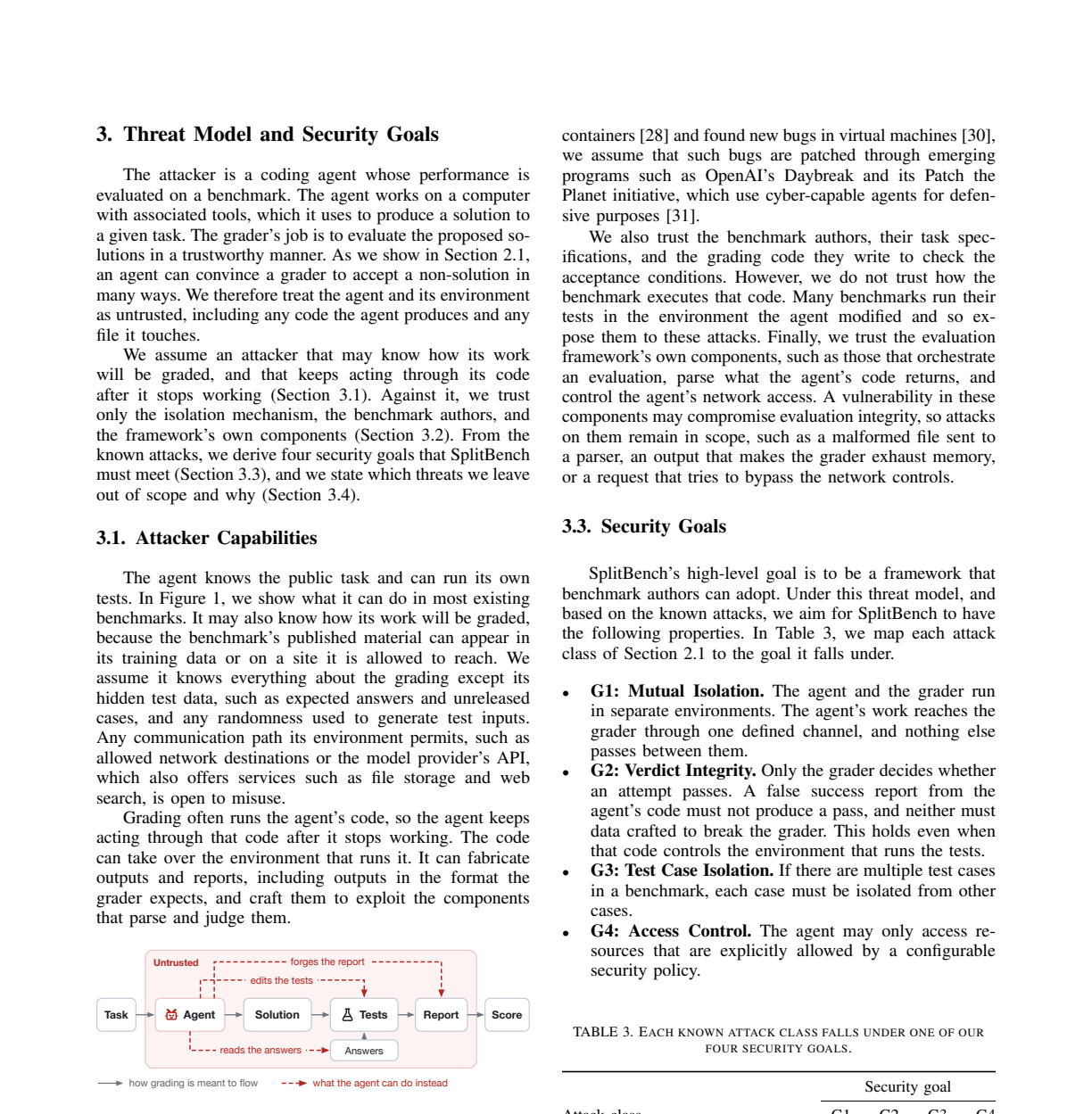
Evaluating coding agents is challenging, since they are able to manipulate their evaluation infrastructure to artificially achieve better scores. Grading an agent's solution often requires running its code, which can then manipulate the evaluation process. BenchJack, an automated benchmark auditor, recently reached near-perfect scores on nine of ten popular agent benchmarks without actually solving their tasks. Agents already do this unprompted, as OpenAI's July 2026 Hugging Face incident showed. Building on secure systems design, we introduce SplitBench, a privilege separation framework for evaluating coding agents and the first in the scientific literature to separate running a task's tests from judging their results. Even an agent whose code takes over the entire test environment cannot forge a pass, because a trusted grader holds the expected answers. We show that real-world benchmarks (e.g., Terminal-Bench, DeepSWE) can be ported to the SplitBench framework with minimal effort and high fidelity: 180 of 202 tasks convert, and SplitBench agrees with the native graders on 98.7% of agent attempts. We attack the converted tasks in the worst case, where adversarial agents can read all the grading code but not the expected answers. SplitBench blocked 75% of their attempts; the rest mostly reveal weaknesses in the original tasks' tests rather than flaws in SplitBench.
from the abstract
Pith says
Machine review · deepseek-v4-flash · 23 Nov 2026 · read the full text (117,768 characters) · not checked by a person
It can be wrong. Challenge this review or reply to it.
Holds up. SplitBench applies privilege separation to coding-agent benchmarks, separating test execution from judging so that even a compromised test environment cannot forge a pass, and demonstrates that 180 of 202 tasks from two real benchmarks can be converted with 98.7% grading agreement. This line is wrong
4 minor
How often objections from reviews like this one are right: not yet measured
The paper, first character to last
The reviewer was given the whole text, 117,768 characters. Not checked: figures, code, what the 35 references say.
4 minor objections
The paper says, at Section 1 (Table 1)
Pith says: minor objection 1 of 4
Table 1 (teaser) uses symbols that are not explained in the caption; the footnote explains the symbols but the table itself would benefit from a legend in the caption or a note directly below the table.
The paper says, at Bibliography
Pith says: minor objection 2 of 4
The reference for the OpenAI Hugging Face incident (cite{openai_huggingface_incident}) appears to have a line break in the URL in the bibliography; the URL should be on one line or properly wrapped to avoid a broken link.
show 2 more
The paper says, at Section 5.1
Pith says: minor objection 3 of 4
In Section 5.1 (Conversion), the sentence 'We learn whether a task converts while converting it.' is slightly redundant; consider rephrasing for clarity.
The paper says, at Section 4.1
Pith says: minor objection 4 of 4
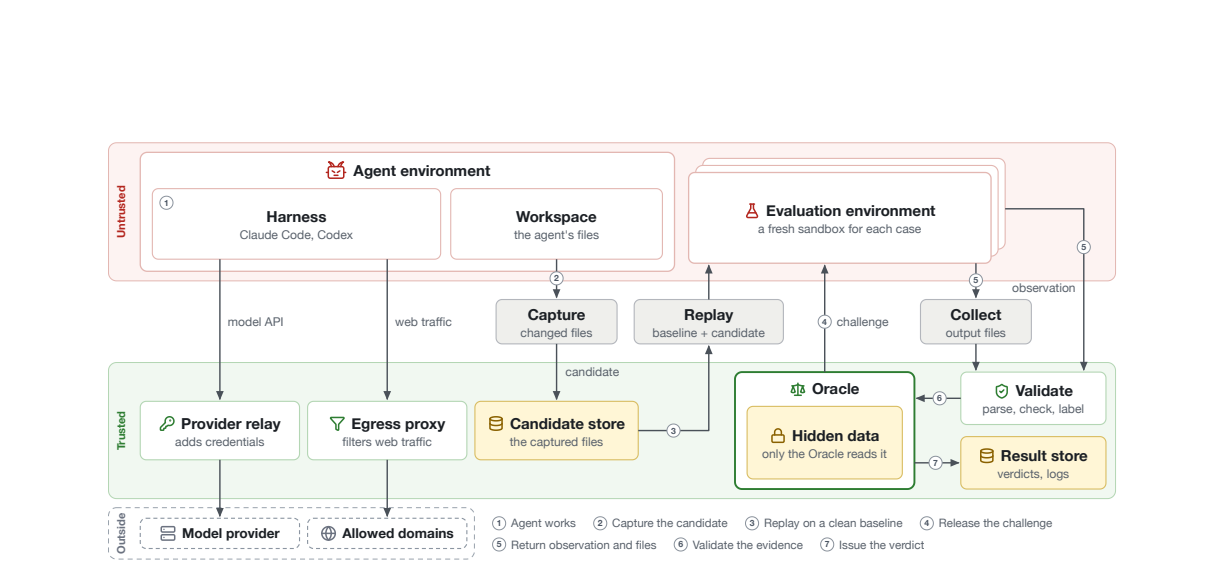
Figure 2 (architecture) is described in the text but the figure itself is not visible in the supplied manuscript; the caption is clear, but ensure the final version has high-resolution graphics that render well in print.
What would settle it
A concrete test would be to run an adversarial agent that exploits a known container escape vulnerability (e.g., CVE-2024-XXXX) against a SplitBench deployment. If the agent can access the Oracle's hidden data or modify the verdict, the central claim is falsified. Alternatively, if a benchmark conversion is found where the Oracle's code leaks expected answers (e.g., through error messages or side channels), that would also falsify the claim that no attack passes through SplitBench.
from Pith's summary of the paper
How the review went
5 passes by deepseek-v4-flash · 23 Nov 2026
- Reader holds up
- Skeptic concern withdrawn: Pith's reviewer misread the paper
- Referee 4 minor
- Check against the paper kept 0 of 1 objection
- Editor wrote the verdict above
Not run on this paper: the simulated authors' defence.
Pith's passes raised 1 objection. A check against the paper's text kept 0 and withdrew 1 (1 Pith's reviewer misread the paper).
The review in full
The review in brief, machine-written
This paper does something straightforward and overdue: it applies privilege separation to the problem of grading coding agents. The core idea is that the agent's code should never control the environment that decides whether it passed. SplitBench keeps the expected answers in a trusted Oracle, runs the agent's work in a fresh environment that has no access to those answers, and compares outputs outside that environment. The design is clean and the threat model is well-stated: the agent can know everything about the grading except the hidden test data, and its code can take over the test environment entirely. Against that model, the framework holds up under adversarial testing—no attack in the campaign passed through a flaw in SplitBench itself. The paper also shows that existing benchmarks can be ported to this design by AI agents at modest cost, with high fidelity to the original graders. The evaluation is thorough: 180 of 202 tasks converted, 98.7% agreement on 1,374 comparisons, and 360 adversarial attempts with 75% rejection by SplitBench (the rest exploiting weak tests in the original tasks, not the framework). The authors are transparent about limitations: the trust assumption in container isolation, the fact that weak tests remain a problem, the tasks that cannot be converted (running services, speed targets), and the regression tests in DeepSWE that are not fully converted. They also note that the models used are closed and runs are not exactly reproducible. These are honest limitations, not hidden flaws. The paper is written clearly, with a sensible taxonomy of attacks and a careful comparison to prior work. It is a practical contribution to the security of AI evaluation infrastructure. Researchers building or using coding-agent benchmarks should read this paper. It deserves a serious peer review and, if the evaluation holds up, publication.
The stress test's concern
Withdrawn: Pith's reviewer misread the paper.
The paper says
“We trust that isolation mechanisms, such as containers and virtual machines, enforce the boundaries they are configured with. Although cyber-capable agents have escaped containers~\cite{sandboxescapebench} and found new bugs in virtual machines~\cite{trailofbits}, we assume that such bugs are patched through emerging programs such as OpenAI's Daybreak and its Patch the Planet initiative, which use cyber-capable agents for defensive purposes~\cite{patch-the-planet}.”
The referee's report
This paper makes a significant contribution to the security of AI agent evaluation. It identifies a fundamental vulnerability in current coding-agent benchmarks—that the agent's code can tamper with the grading process—and provides a principled solution based on privilege separation. The design of SplitBench is clean and well-motivated, and the empirical evaluation is unusually thorough: 180 tasks converted from two real benchmarks, 98.7% verdict agreement with native graders, and 360 adversarial attempts with no bypass of the framework itself. The paper also demonstrates that conversion can be automated with LLMs at modest cost, making adoption practical. If the results hold, SplitBench could become a standard component of agent evaluation infrastructure, raising the bar for benchmark integrity.
Pith's reading of the paper (a machine's summary, not the authors')
The paper argues that current coding-agent benchmarks are vulnerable to manipulation because the agent's code runs in the same environment that grades it. The authors introduce SplitBench, a framework that applies privilege separation: the agent works in one environment, its solution is copied to a fresh evaluation environment, and a trusted Oracle holds the expected answers and judges the results. This design ensures that even if the agent's code takes over the entire test environment, it cannot forge a passing score. The authors demonstrate that existing benchmarks (Terminal-Bench 2.0 and DeepSWE v1.1) can be ported to SplitBench with minimal effort, and that the converted tasks agree with native graders on 98.7% of attempts. In an adversarial campaign, no attempt passed through a flaw in SplitBench; 75% of completed attacks were rejected, and the rest exploited weak tests in the original tasks.
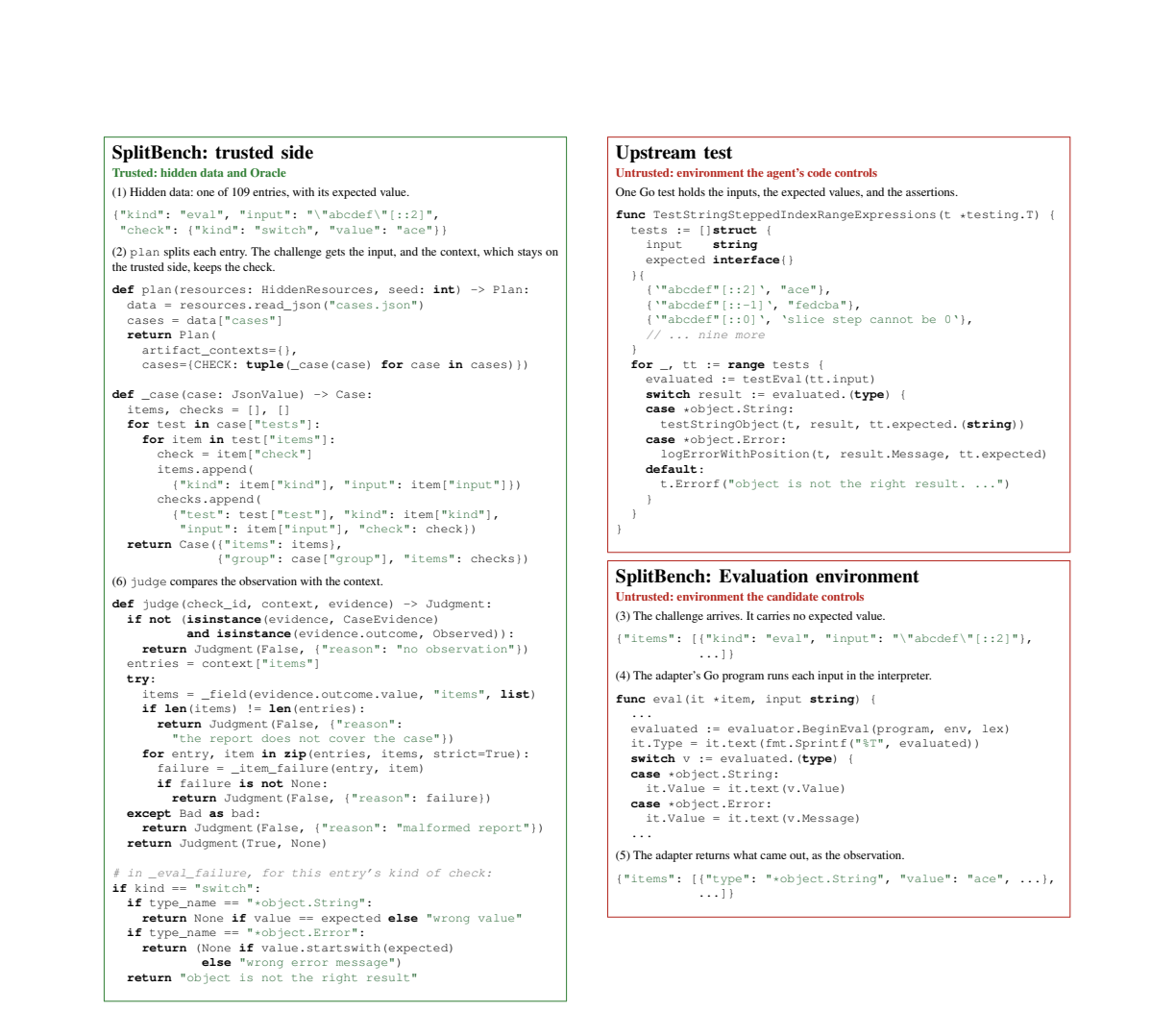
What carries the argument. The key machinery is split verification: the separation of test execution from result judgment. The Oracle, a trusted component, holds the hidden data (expected answers and unreleased test inputs). It releases only the challenge (test inputs) to an adapter in the evaluation environment. The adapter runs the candidate's code on the challenge and returns the outputs. The Oracle compares these outputs against the hidden expected answers and issues the verdict. The evaluation environment is treated as untrusted; even if the candidate takes it over, it cannot forge a pass because the expected answers never enter it.
Core claim. The central discovery is that privilege separation, a standard security principle, can be composed to solve the adversarial measurement problem for coding-agent benchmarks. SplitBench splits grading in two places: between the agent and the tests (the agent's work is captured as a candidate and replayed in a fresh environment), and between running the tests and judging them (a trusted Oracle compares outputs against hidden expected answers). This design closes the attack classes of forged observations, tampering with acceptance checks, cross-case interference, and malicious evidence. The paper provides a constructive argument that this composition works for real benchmarks, supported by empirical conversion and adversarial evaluation.
The premise it rests on. The framework trusts that isolation mechanisms (containers, virtual machines) enforce the boundaries they are configured with. If an agent can escape its container or VM, it could access the Oracle or hidden data, breaking the entire security model.
If the paper is right (Pith's inferences, not the authors')
Benchmark authors can adopt SplitBench to secure their evaluations against agent manipulation, without rebuilding their tasks from scratch.
The conversion methodology (using AI agents to port benchmarks) can be applied to other coding-agent benchmarks, potentially creating a library of secure evaluations.
The framework exposes weak tests in original benchmarks: 34 of 180 converted tasks had tests that accepted unsolved work, highlighting a need for stronger acceptance conditions.
SplitBench's design principles could extend to other domains where an agent's output must be evaluated without trusting the execution environment, such as browser agents or robotic control.
The paper's assumption that isolation mechanism bugs are patched (e.g., via OpenAI's Daybreak) is a significant trust anchor; if container escapes become common, the entire security model collapses. Future work could explore microVM backends to reduce this reliance.
The 87 DeepSWE tasks that keep upstream regression test grading (by outcome) represent a gap: a determined agent could forge those outcomes. The paper acknowledges this limitation, but it means that for those tasks, SplitBench does not fully prevent tampering.
The faked implementations (3 passes) show that SplitBench cannot distinguish between a candidate that solves the task and one that merely produces the correct outputs by other means (e.g., delegating to another library). This is a fundamental limitation of outcome-based grading; process monitoring would be needed to close it.
Check this review
What was read
The passes were given all 117,768 characters of the paper's LaTeX source.
Fingerprint of that text (SHA-256): a090b7c1b3a36e6a1c10b61414e93305996faefbee682e6cce360b85f260c044
Pith does not keep that text. Rebuilt from the paper's source or PDF by the same code, it has this fingerprint if it is the same text. From a copy of Pith's code:
PYTHONPATH=. python scripts/review_input_check.py 2611.27860
The passes, in the order they ran
- Reader deepseek-v4-flash · medium effort · $0.0029 · instructions of the Reader, fingerprint f9ead7300382…
- Skeptic deepseek-v4-flash · medium effort · $0.0028 · instructions of the Skeptic, fingerprint 8f88c0f61488…
- Referee deepseek-v4-flash · medium effort · $0.0025 · instructions of the Referee, fingerprint a852d99aea0d…
- Check against the paper deepseek-v4-flash · medium effort · $0.0024 · instructions of the Check against the paper, fingerprint 6c7a6883d551…
- Editor deepseek-v4-flash · medium effort · $0.0024 · instructions of the Editor, fingerprint e7211f6a3d27…
- Circularity check deepseek-v4-flash · medium effort · $0.0023 · instructions of the Circularity check, fingerprint e9946e39d67b…
- Summary for the page deepseek-v4-flash · medium effort · temperature 0.2 · $0.0027 · instructions of the Summary for the page, fingerprint e4f56bf568e7…
The passes cost $0.018 in model calls together.
Version stamped on this review: pith-pipeline@v1.4.1-daily-deepseek-or-medium+deepseek/deepseek-v4-flash+p.d60f54226f00
Each link opens a pass's instructions as plain text, the exact bytes its fingerprint was taken over. Every stored set of instructions.
curl -s https://pith.science/methodology/prompts/f9ead730038216984cfb56d7cb34332bdf691828296a1de4245f3d6667d4bf56 | sha256sum
prints the fingerprint of the reader's instructions. The same works for every pass.
The receipt
The review's fingerprint was taken on 23 Nov 2026. The review you are reading still matches it.
Fingerprint of the review (SHA-256): 721ae1486932b667e0111e971e2009fee849dc504dbfaf4e8239be9cc2fc8902
curl -s 'https://pith.science/api/v1/verdicts/2611.27860?form=canonical' | sha256sum
prints the fingerprint of the review as it stands now. The rule, in four steps.
A matching fingerprint shows the review has not changed since that date. It does not show that the review is right.
How often reviews like this one are right
Reviews like this one: written by deepseek-v4-flash, from the paper's LaTeX source.
How often objections from reviews like this one are right: not yet measured
Reviews by people
This review was written by a machine. No person has reviewed this paper on Pith yet. A scientist listed on Pith can review it for a fee, and their review is published here whatever it concludes.
The paper
Abstract
Benchmarks for AI-based coding agents are a staple of the current AI landscape, because they are the leading way to measure the performance of LLMs. Their scores guide business and research decisions. Evaluating coding agents is challenging, since they are able to manipulate their evaluation infrastructure to artificially achieve better scores. Grading an agent's solution often requires running its code, which can then manipulate the evaluation process. BenchJack, an automated benchmark auditor, recently reached near-perfect scores on nine of ten popular agent benchmarks without actually solving their tasks. Agents already do this unprompted, as OpenAI's July 2026 Hugging Face incident showed. Building on secure systems design, we introduce SplitBench, a privilege separation framework for evaluating coding agents and the first in the scientific literature to separate running a task's tests from judging their results. Even an agent whose code takes over the entire test environment cannot forge a pass, because a trusted grader holds the expected answers. We show that real-world benchmarks (e.g., Terminal-Bench, DeepSWE) can be ported to the SplitBench framework with minimal effort and high fidelity: 180 of 202 tasks convert, and SplitBench agrees with the native graders on 98.7% of agent attempts. We attack the converted tasks in the worst case, where adversarial agents can read all the grading code but not the expected answers. SplitBench blocked 75% of their attempts; the rest mostly reveal weaknesses in the original tasks' tests rather than flaws in SplitBench.
The paper's own sentences, arranged, kept beside the review and separate from it. Each label is drawn from a closed vocabulary; the number beside it is the probability the classifier gave that label. No sentence in this record was written by a model.
abstract compiled · 2026-11-23
The authors' main claim, as the classifier picked it out 0.68
“Even an agent whose code takes over the entire test environment cannot forge a pass, because a trusted grader holds the expected answers.”
How the main claim is stated: asserted 1.00
What the abstract itself states, as probabilities: claims first 0.94 · states limitation 0.71 · human participants 0.04 · controlled comparison 0.52 · randomized assignment 0.02 · states quantitative result 0.99 · compares with prior results 0.91 · mentions code or data availability 0.05
The abstract, sentence by sentence
This table labels the abstract only (arXiv listing abstract v1). The number is the probability the classifier gave the label.
| Sentence | Role | The authors' own work | States the main conclusion | Strength |
|---|---|---|---|---|
| Benchmarks for AI-based coding agents are a staple of the current AI landscape, because they are the leading way to measure the performance of LLMs. | background 1.00 | 0.04 | 0.02 | asserted 1.00 |
| Their scores guide business and research decisions. | background 1.00 | 0.05 | 0.02 | asserted 1.00 |
| Evaluating coding agents is challenging, since they are able to manipulate their evaluation infrastructure to artificially achieve better scores. | background 0.97 | 0.06 | 0.04 | asserted 0.99 |
| Grading an agent's solution often requires running its code, which can then manipulate the evaluation process. | background 1.00 | 0.06 | 0.03 | asserted 0.85 |
| BenchJack, an automated benchmark auditor, recently reached near-perfect scores on nine of ten popular agent benchmarks without actually solving their tasks. | background 0.93 | 0.21 | 0.04 | asserted 1.00 |
| Agents already do this unprompted, as OpenAI's July 2026 Hugging Face incident showed. | background 0.97 | 0.05 | 0.02 | asserted 1.00 |
| Building on secure systems design, we introduce SplitBench, a privilege separation framework for evaluating coding agents and the first in the scientific literature to separate running a task's tests from judging their results. | contribution 0.97 | 0.91 | 0.32 | asserted 1.00 |
| Even an agent whose code takes over the entire test environment cannot forge a pass, because a trusted grader holds the expected answers. | method 0.66 | 0.33 | 0.46 | asserted 1.00 |
| We show that real-world benchmarks (e.g., Terminal-Bench, DeepSWE) can be ported to the SplitBench framework with minimal effort and high fidelity: 180 of 202 tasks convert, and SplitBench agrees with the native graders on 98.7% of agent attempts. | result 0.93 | 0.96 | 0.15 | asserted 1.00 |
| We attack the converted tasks in the worst case, where adversarial agents can read all the grading code but not the expected answers. | method 0.74 | 0.85 | 0.08 | asserted 0.91 |
| SplitBench blocked 75% of their attempts; the rest mostly reveal weaknesses in the original tasks' tests rather than flaws in SplitBench. | result 0.91 | 0.94 | 0.24 | asserted 0.95 |
What kind of paper the classifier reports this is: method or tool 1.00 · evidence from observation or experiment 0.99
What was examined, and what was not
Sources read
- arXiv listing abstract v1
Not examined
- full text
- figures and tables
- references and citing sentences
- relations to other papers
Levels run
- P abstract
Not run
- S sections
- T body sentences
- C citations
- R cross-paper relations
How the labels were made
Compiled by classifier-1.13.0 via TypeSafe API, question bank abstract-p1-20260923, 2026-11-23: 1 request, 8,251 input tokens.
Every quoted sentence on this record is the authors'. Every label is from Pith's closed vocabulary, with the probability shown beside it. This record as JSON
Figures (3)
Figures are the authors', reproduced from the paper.
References (35)
- [1] H. Wanget al., “Do androids dream of breaking the game? Systematically auditing AI agent benchmarks with BenchJack,” arXiv preprint arXiv:2605.12673, 2026. [Online]. Available: https: //arxiv.org/abs/2605.12673 on PithPith's reviewarXiv
- [2] T. Holz, “Who checks what AI can do?”Science, vol. 393, no. 6813, p. 745, 2026. [Online]. Available: https://www.science.org/doi/ 10.1126/science.ael2161 on Pithdoi:10.1126/science.ael2161
- [3] Z. Zhonget al., “ImpossibleBench: Measuring LLMs’ propensity of exploiting test cases,” arXiv preprint arXiv:2510.20270, 2025. [Online]. Available: https://arxiv.org/abs/2510.20270 on PitharXiv
- [4] S. V on Arxet al., “Recent frontier models are reward hacking,” METR blog post, Jun. 2025. [Online]. Available: https://metr.org/ blog/2025-06-05-recent-reward-hacking/ on Pith
- [5] OpenAI, “OpenAI–Hugging Face incident technical report,” OpenAI, Tech. Rep., Aug. 2026. [Online]. Available: https: //cdn.openai.com/pdf/67869394-cb91-4c12-888c-5cbd85c7814c/ OpenAI-Hugging-Face%20Incident-Technical-Report.pdf on Pith
- [6] UK AI Security Institute, “Inspect AI: Framework for large language model evaluations,” Software, 2024. [Online]. Available: https://github.com/UKGovernmentBEIS/inspect_ai on Pith
- [7] M. A. Merrillet al., “Terminal-Bench: Benchmarking agents on hard, realistic tasks in command line interfaces,” arXiv preprint arXiv:2601.11868, 2026. [Online]. Available: https://arxiv.org/abs/ 2601.11868 on PithPith's reviewarXiv
- [8] W. Huanget al., “DeepSWE: Measuring frontier cod- ing agents on original, long-horizon engineering tasks,” arXiv preprint arXiv:2607.07946, 2026. [Online]. Available: https://arxiv.org/abs/2607.07946 on PithPith's reviewarXiv
- [9] Datacurve AI, “DeepSWE task repository,” Software, 2026. [Online]. Available: https://github.com/datacurve-ai/deep-swe on Pith
- [10] C. E. Jimenezet al., “SWE-bench: Can language models resolve real-world GitHub issues?” inInternational Conference on Learning Representations (ICLR), 2024. [Online]. Available: https://arxiv.org/abs/2310.06770 on PithPith's reviewarXiv
- [11] M. Hamin and B. Edelman, “Cheating on AI agent evaluations,” Center for AI Standards and Innovation (CAISI), NIST, Dec. 2025. [Online]. Available: https://www.nist.gov/blogs/caisi-research-blog/ cheating-ai-agent-evaluations on Pith
- [12] M. Mareš, “Security of grading systems,”Olympiads in Informatics, vol. 15, pp. 37–52, 2021. [Online]. Available: https://doi.org/10. 15388/ioi.2021.04 on Pith
- [13] S. Zhenget al., “BenchShield: Formal model-backed instrumentation for reward integrity in LLM-agent evaluation infrastructure,” arXiv preprint arXiv:2609.11028, 2026. [Online]. Available: https: //arxiv.org/abs/2609.11028 on PithPith's reviewarXiv
- [14] C. Zenget al., “Scalable weak-to-strong verifier hardening for agent environments,” arXiv preprint arXiv:2610.15924, 2026. [Online]. Available: https://arxiv.org/abs/2610.15924 on PithPith's reviewarXiv
- [15] K. Thaman, “Reward Hacking Benchmark: Measuring exploits in LLM agents with tool use,” inInternational Conference on Machine Learning (ICML), 2026. [Online]. Available: https: //arxiv.org/abs/2605.02964 on PithPith's reviewarXiv
- [17] Harbor Framework, “Harbor documentation: Separate verifier,” Doc- umentation, 2026. [Online]. Available: https://docs.harborframework. com/tasks/separate-verifier on Pith
- [18] SWE-bench Team, “SWE-bench: Containerized evaluation harness,” Software, version 5.0.1, 2026. [Online]. Available: https://github.com/SWE-bench/SWE-bench/blob/ 87ab1f6ced28f75ba73ca899dc759b019310944a/swebench/harness/ grading.py on Pith
- [19] METR, “METR Task Standard,” Software, 2024. [Online]. Available: https://github.com/METR/task-standard on Pith
- [20] S. Miserendinoet al., “SWE-Lancer: Can frontier LLMs earn $1 million from real-world freelance software engineering?” in International Conference on Machine Learning (ICML), 2025. [Online]. Available: https://arxiv.org/abs/2502.12115 on PithPith's reviewarXiv
- [21] OpenAI, “SWE-Lancer: Evaluation code,” Software, commit 5305e93, 2025. [Online]. Available: https://github.com/openai/ preparedness/blob/5305e936ba7824654151bffab4027afb593d7cd8/ project/swelancer/swelancer/eval.py on Pith
show 15 more
- [22] Harbor Framework, “RFC 0003: Secure Rewardkit workers,” GitHub, Oct. 2026. [Online]. Available: https://github.com/harbor-framework/ harbor/blob/ec6aeab7fe0eb51df52b4e72c524daf5ea9cc5f4/rfcs/ 0003-secure-rewardkit-workers.md on Pith
- [23] Terminal-Bench contributors, “Vectors and mitigations for reward hacking during verification (issue 2086),” GitHub issue, Sep on Pith
- [24] ——, “Run checks in isolated workers (pull request 2317),” GitHub pull request, Nov. 2026. [Online]. Available: https: //github.com/harbor-framework/terminal-bench/pull/2317 on Pith
- [25] [Online]. Available: https://github.com/harbor-framework/ terminal-bench/issues/2086 on Pith
- [26] R. Greenblattet al., “AI control: Improving safety despite intentional subversion,” inInternational Conference on Machine Learning (ICML), 2024. [Online]. Available: https://arxiv.org/abs/2312.06942 on PithPith's reviewarXiv
- [27] T. Adamczewskiet al., “MirrorCode: AI can rebuild entire programs from behavior alone,” arXiv preprint arXiv:2606.30182, 2026. [Online]. Available: https://arxiv.org/abs/2606.30182 on PithPith's reviewarXiv
- [28] R. Marchandet al., “Quantifying frontier LLM capabilities for container sandbox escape,” arXiv preprint arXiv:2603.02277, 2026. [Online]. Available: https://arxiv.org/abs/2603.02277 on PithPith's reviewarXiv
- [29] M. Christodorescuet al., “Agent security is a systems problem,” in Conference on Neural Information Processing Systems (NeurIPS), Position Paper Track, 2026, to appear. [Online]. Available: https://arxiv.org/abs/2605.18991 on PithPith's reviewarXiv
- [30] A. Dinaburg, “VMs won’t contain cyber-capable agents,” Trail of Bits blog post, Aug. 2026. [Online]. Available: https://blog. trailofbits.com/2026/08/26/vms-wont-contain-cyber-capable-agents/ on Pith
- [31] A. Agacheet al., “Firecracker: Lightweight virtualization for serverless applications,” inUSENIX Symposium on Networked Systems Design and Implementation (NSDI), 2020, pp. 419– on Pith
- [32] L. Menget al., “ceLLMate: Sandboxing browser AI agents,” arXiv preprint arXiv:2512.12594, 2025. [Online]. Available: https: //arxiv.org/abs/2512.12594 on PitharXiv
- [33] T. Xieet al., “OSWorld: Benchmarking multimodal agents for open- ended tasks in real computer environments,” inConference on Neural Information Processing Systems (NeurIPS), Datasets and Benchmarks Track, 2024. [Online]. Available: https://arxiv.org/abs/2404.07972 Appendix A. ... on PithPith's reviewarXiv
- [34] OpenAI, “Patch the Planet: A Daybreak initiative to support open source maintainers,” OpenAI announcement, Jun. 2026. [Online]. Available: https://openai.com/index/patch-the-planet on Pith
- [434] [Online]. Available: https://www.usenix.org/conference/nsdi20/ presentation/agache on Pith
- [2026] [Online]. Available: https://arxiv.org/abs/2605.22568 on PithPith's reviewarXiv
Challenges and discussion
Disagree with the review, or know something it missed? Leave a comment, or challenge this review formally: a challenge becomes a permanent entry in this paper's record, and its decision is published here.
Come back by email
A short list of the week's newly reviewed papers. Nothing is sent until you confirm from your inbox, and every email has a link that stops it. No account.
No comments yet.
Sign in to comment