Artificial Intelligence · arXiv:2611.29807 v1 · submitted 22 Nov 2026 · 17 references
Blind to What They Can Fix: A Detection Gap in Self-Improving Agents
The paper says
“AI agents can write programs that carry out a task without calling a model at every step, so the task runs fast and its logic stays open to inspection.”
more of the abstract
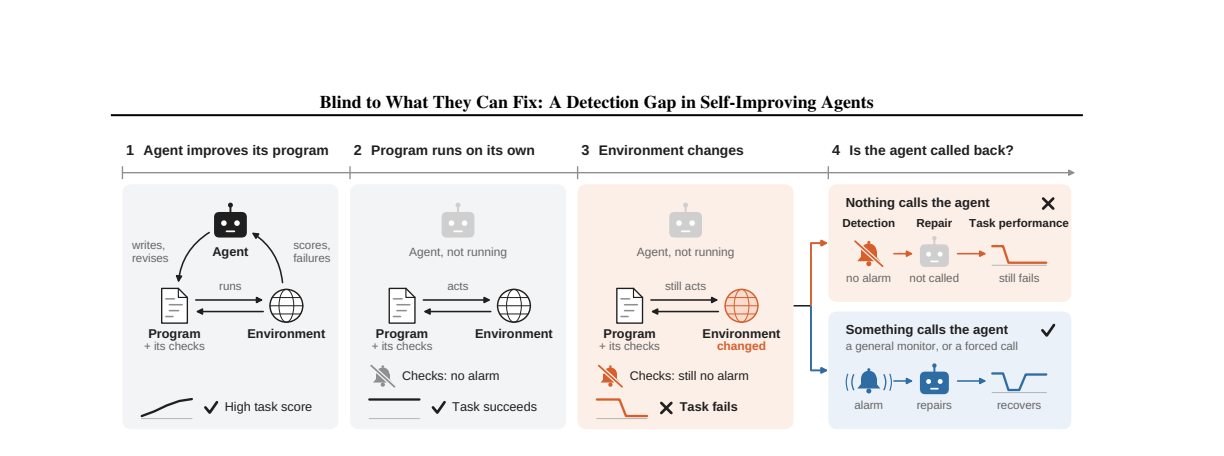
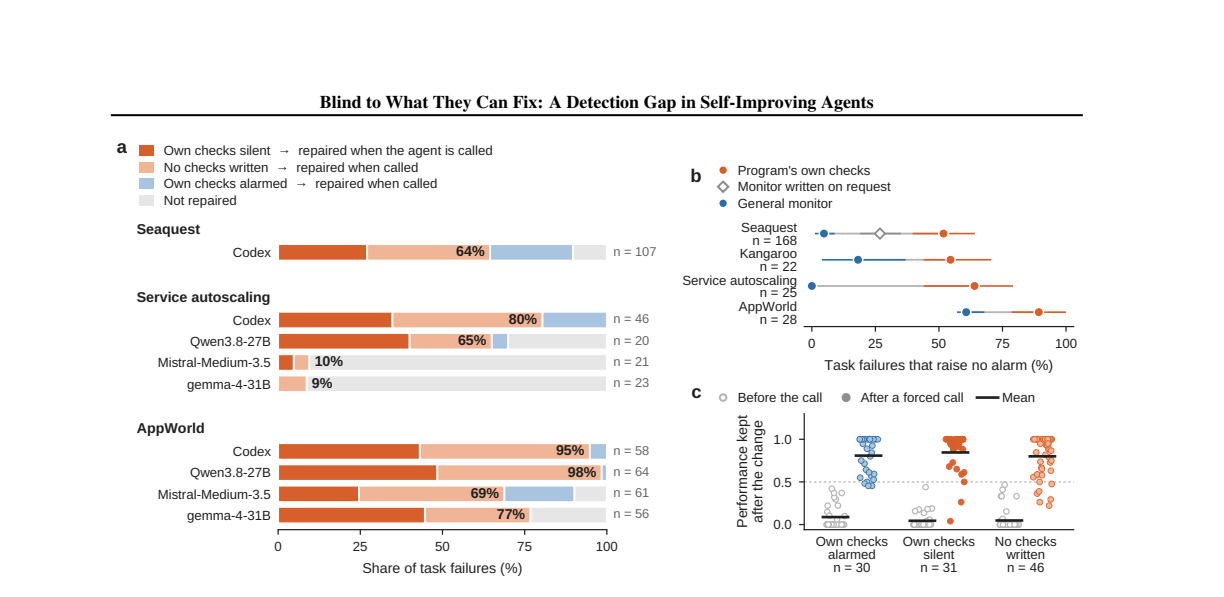
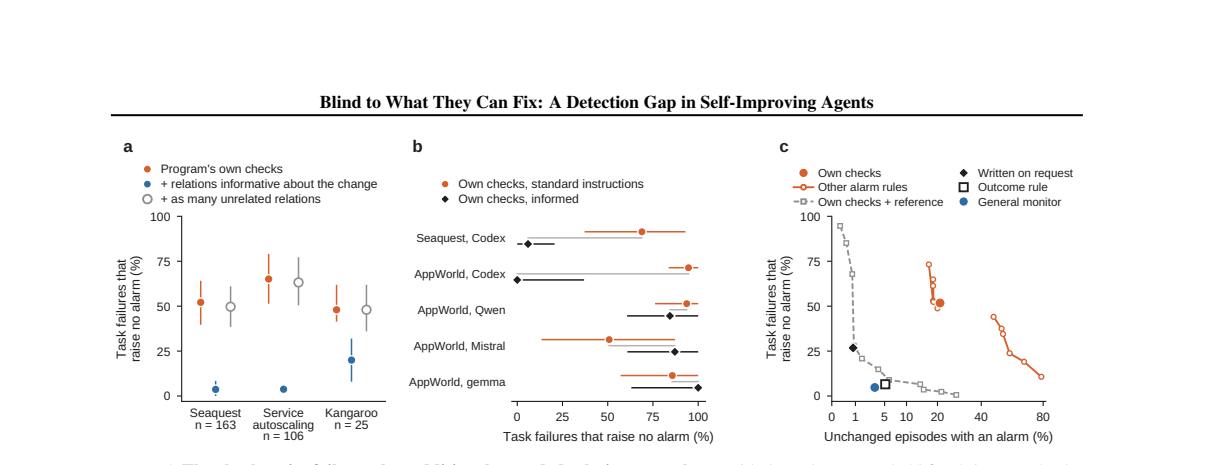
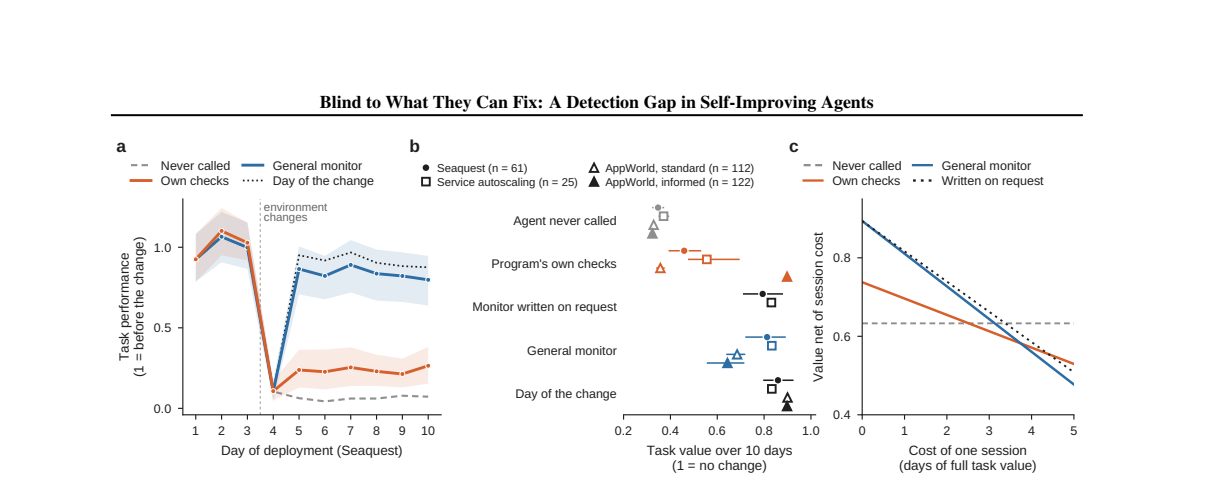
Agents improve these programs by running them, studying their failures, and revising the code, a form of recursive self-improvement (RSI). We ask whether this process also yields runtime checks that can be trusted. In five task domains, with up to seven author models, agents bring their programs to high scores. Yet when the environment changes, the checks they were told to write stay silent on half or more of the resulting failures in four domains. These failures can be detected and repaired: a monitor built from records of normal runs catches most of them in three domains, and the same agents usually repair them once called. The checks do not examine the recorded relations that reveal the failures, and the strongest agent writes checks that catch most of them once told that its checks are the only thing that calls it back. An unreported failure stays unrepaired, which limits what self-improvement is worth in autonomous operation. Evaluations of self-improvement should measure not only scores but also whether a system notices its own failures.
from the abstract
Pith says
Machine review · deepseek-v4-flash · 24 Nov 2026 · read the full text (164,350 characters) · not checked by a person
It can be wrong. Challenge this review or reply to it.
Holds up. Self-improving agents that reach high scores do not write checks that detect most of their own failures, a careful empirical study shows. This line is wrong
4 minor
How often objections from reviews like this one are right: not yet measured
The paper, first character to last
The reviewer was given the whole text, 164,350 characters. Not checked: figures, code, what the 17 references say.
4 minor objections
The paper says, at §3.1
Pith says: minor objection 1 of 4
The term 'blind changes' is defined in §3.1 but the definition could be restated more prominently when the results are first discussed in §4.1, to remind the reader that these changes were written without seeing the programs or their results.
The paper says, at Table 1
Pith says: minor objection 2 of 4
Table 1 caption refers to 'Own + ref.' but the column is labelled 'Own + ref.' in the table; the caption text says 'Own + ref.' which is consistent. However, the meaning of 'ref.' (reference episodes) is explained only in the appendix; a brief note in the caption would help.
show 2 more
The paper says, at §4.3
Pith says: minor objection 3 of 4
In §4.3, the sentence 'An example shows how.' is followed by a colon and then the example. The colon could be replaced by a period for clarity, as the example is a separate paragraph.
The paper says, at §3.3
Pith says: minor objection 4 of 4
The paper uses 'Codex' as a model name throughout; it might be helpful to state explicitly that Codex is a version of GPT (gpt-6.1-sol) as given in §3.3, but that is already there. No change needed.
What would settle it
Generate a new set of 12 blind changes for Seaquest using a different model (e.g., Claude Code) or human experts, following the same blind-change protocol. Evaluate the 20 Codex programs with checks on these new changes and compute the own-checks miss rate. If the miss rate falls below 30% (i.e., the lower bound of the current interval for blind changes, 35%), the detection gap may be sensitive to the specific change catalogue; if it remains above 50%, the claim is robust to catalogue choice.
from the skeptic's reading
How the review went
5 passes by deepseek-v4-flash · 24 Nov 2026
- Reader holds up
- Skeptic agrees
- Referee 4 minor
- Check against the paper
- Editor wrote the verdict above
Not run on this paper: the simulated authors' defence.
Pith checked this review's objections against the text of the paper it read.
The review in full
The review in brief, machine-written
This paper asks a question that sounds obvious once you hear it: when an agent improves a program by its task score, does the program also learn to notice when it starts failing? The answer, across five domains and several models, is no. The checks that agents write under standard instructions miss half or more of the induced failures in four of five domains, even though the same agents repair most of those failures when called, and even though a simple rule on the task outcome catches most of them. The gap is real, and it matters: in replayed deployments, the program's own checks recover a quarter to two-fifths of the value that a timely external monitor recovers, and a perfect repairer behind the own checks adds almost nothing. The paper earns its claims. The framework is clean: blind environment changes written without seeing the programs, an independent evaluator, bootstrap intervals, and extensive pre-registration with 120 predictions reported honestly, including the ones that failed. The coverage intervention and the informed-instruction experiment trace the gap to what the checks examine, and the deployment replay shows the practical cost. The limitations are stated openly: small catalogues, concentrated failures, coverage tests that rely on knowledge of the change or on settings chosen on evaluation data, and a general monitor developed on one domain. The central result—that high task scores from recursive self-improvement do not imply the ability to detect new failures—is well supported within the studied domains. The paper is for anyone working on agent reliability, runtime monitoring, or autonomous maintenance. It deserves a serious referee and will likely change how evaluations of self-improving systems are designed.
The strongest objection
The paper is unusually thorough: it pre-registers predictions, reports failures honestly, runs blind changes, tests multiple models and domains, and acknowledges its own limitations explicitly. The central claim—that under standard instructions the program's own checks miss half or more of induced failures—is well supported within the studied domains and change catalogues. The weakest point, representativeness of the change catalogues, is disclosed and bounded by bootstrap intervals. The paper does not claim that the gap is a necessary property of all self-improvement; it states that it holds under the tested conditions and that evaluations should measure detection. No internal inconsistency or unsupported leap was found. The evidence is strong enough to accept the claim as stated.
The reader's verdict is ACCEPT with high confidence, and the weakest assumption (representativeness of catalogues and formats) is exactly the limitation the paper itself stresses. The stress-tester's review confirms that the paper's methodology is disciplined, the results are internally consistent, and the limitations are honestly reported. No new load-bearing concern beyond what the paper already acknowledges was identified. The concrete test proposed would further probe the representativeness concern, but the current evidence already supports the claim within the stated scope. Therefore the verdict should remain UNCHANGED.
The referee's report
The paper identifies a practically important gap in self-improving agent systems: agents that achieve high task scores do not necessarily write runtime checks that detect task failures when the environment changes. The finding is supported by careful experiments across five domains, multiple models, pre-registered predictions, and honest reporting of failed predictions. If correct, the result has direct implications for the safe deployment of autonomous agents, as it shows that task performance alone is an insufficient metric for reliability. The paper also provides a framework for measuring detection and repair separately, which could become a standard evaluation practice.
Pith's reading of the paper (a machine's summary, not the authors')
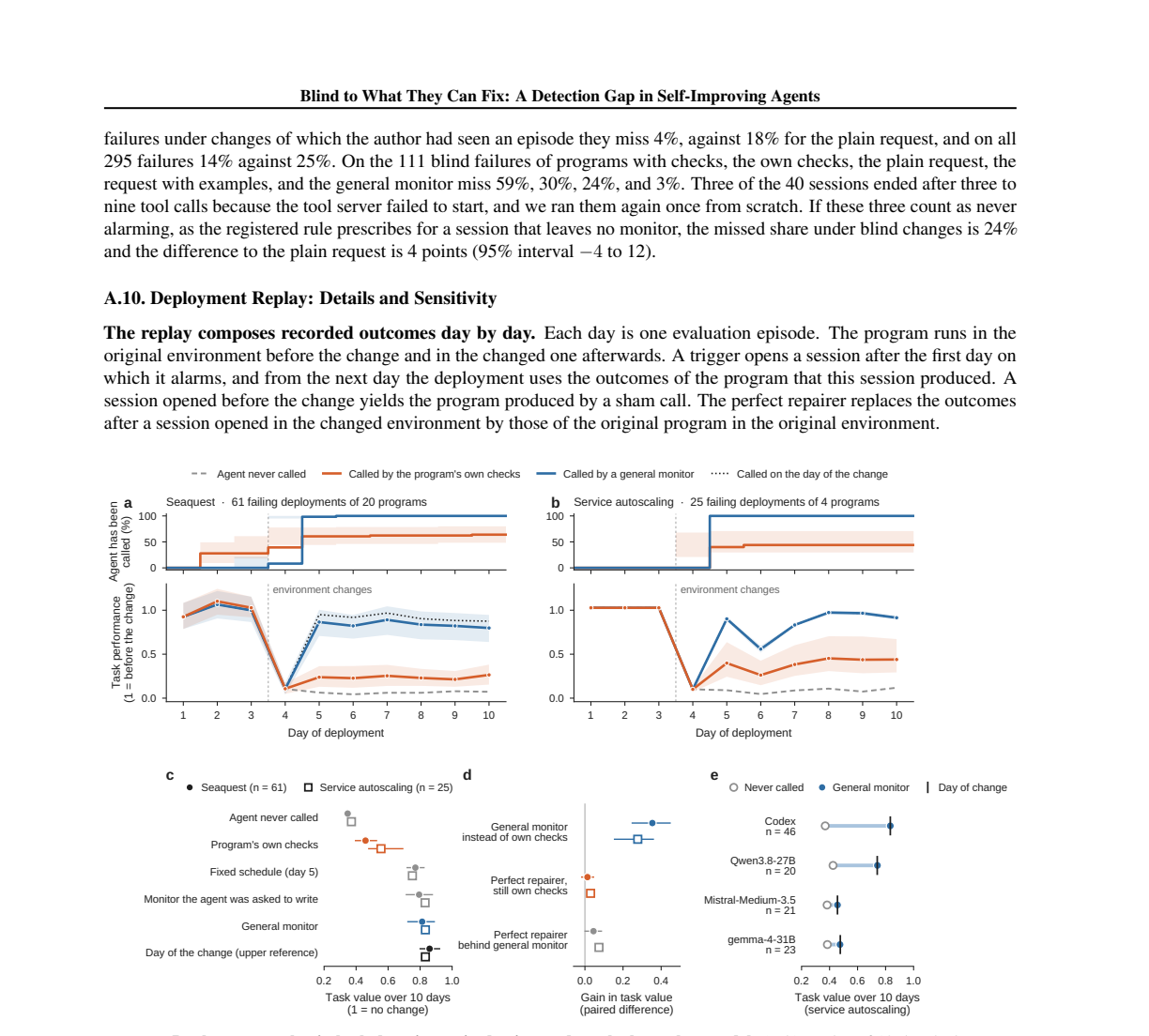
The paper argues that high task scores from recursive self-improvement do not imply the ability to detect new failures. In five task domains, agents improved programs to high scores, yet the runtime checks they were told to write missed half or more of task failures in four domains when the environment changed. The failures are detectable from execution records and the same agents repair most of them when called, so the bottleneck is detection, not repair. This matters because an unreported failure stays unrepaired, limiting what autonomous self-improvement is worth. The paper traces the gap to what the checks cover and shows that Codex can close it when told the purpose of checks, while open models cannot.
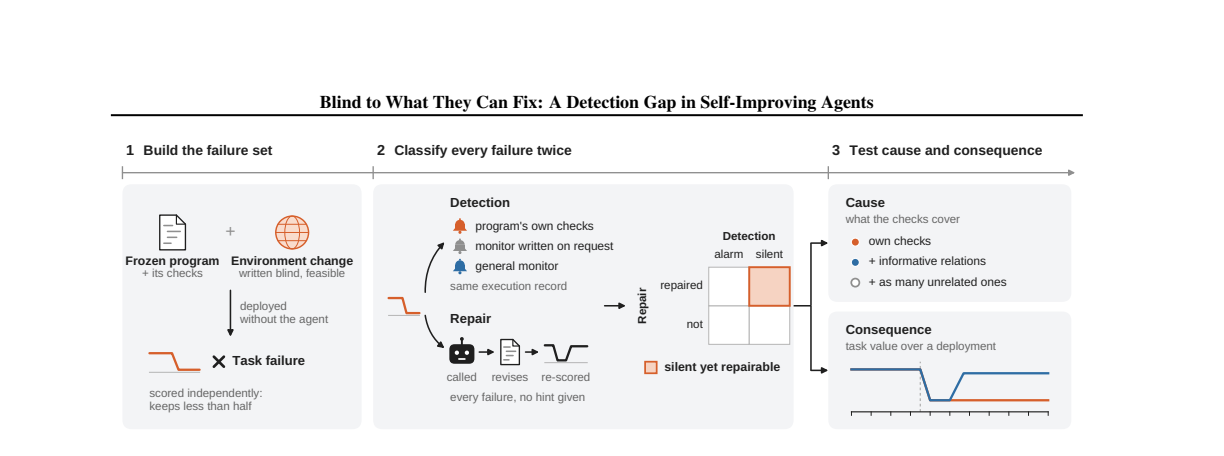
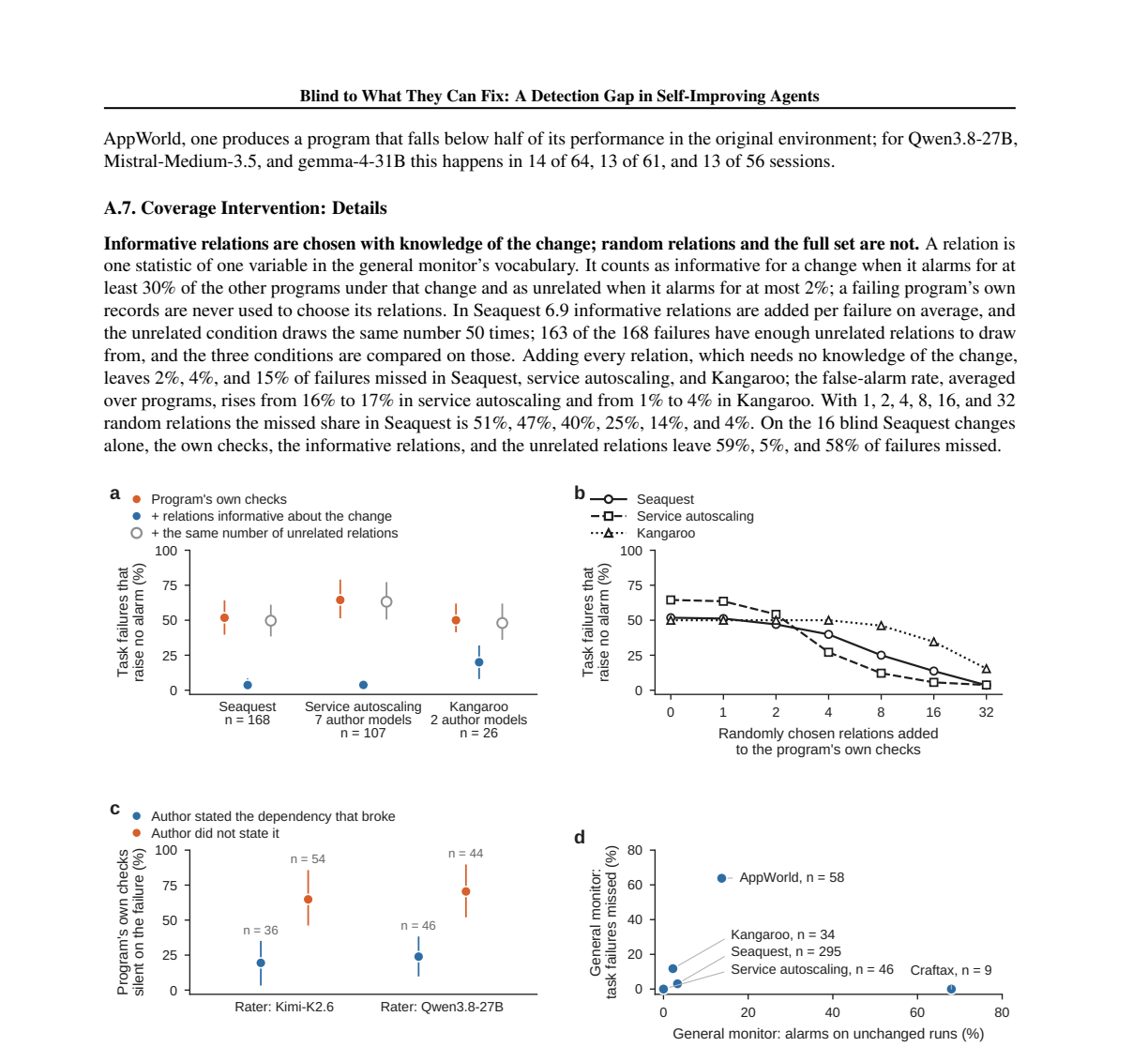
What carries the argument. The central object is the 'detection gap' measured by a controlled framework: for each failure (a frozen program under an environment change), the paper records whether the program's own checks alarm and whether the authoring agent can repair the program when called. The key mechanism is the coverage of checks: the checks examine too few of the relations in execution records that reveal failures. Adding informative or random relations to the checks removes most misses, showing the records contain the signal but the checks do not look at it.
Core claim. The paper identifies a detection gap in recursive self-improvement: agents that improve programs to high task scores do not write runtime checks that reliably detect task failures when the environment changes. In four of five domains (Seaquest, Kangaroo, service autoscaling, AppWorld), the checks agents were told to write miss 52% to 95% of failures, while a general-purpose monitor built from normal execution records detects most of them. The same agents repair most of the missed failures when called, showing the bottleneck is detection, not repair. The gap persists across multiple author models and is traced to what the checks cover: they examine too few of the relations in execution records that reveal failures.
The premise it rests on. The measured gap size depends on the representativeness of the environment changes and program formats: five changes account for most failures, and the checks exist only in formats that ask for them. If operational distribution shifts differ in kind from these blind mutations, the fraction of missed failures could change.
If the paper is right (Pith's inferences, not the authors')
Evaluations of self-improving systems should measure detection (whether the system reports its own failures) alongside task scores.
Autonomous deployment of self-improving agents requires a separate monitoring mechanism or explicit instructions about the purpose of checks.
The detection gap is not fixed by better repair ability; repair is useless if the system never knows it is failing.
Codex can close the gap when told the purpose of checks, but open models cannot, suggesting a capability gap in following such instructions.
The results suggest that current recursive self-improvement loops, which select versions by task performance alone, may actively select against writing sensitive checks because false alarms would waste the agent's attention or cause unnecessary repair sessions.
The detection gap may be larger in domains where the program cannot observe its own outcome (like AppWorld), requiring cross-checks or external monitors that the standard instructions do not produce.
The finding that random relations added to checks remove most misses implies that a simple, domain-agnostic monitor that records many statistics could serve as a reliable alarm, at the cost of more false alarms on harmless changes.
The gap between Codex and open models when told the purpose of checks suggests that following such instructions requires a level of instruction-following or reasoning that current open models lack.
Check this review
What was read
The passes were given all 164,350 characters of the paper's LaTeX source.
Fingerprint of that text (SHA-256): 18d48ea309d07639b6bcc9b76e5752b5a28719b63d0bae223623d828c4d3d66f
Pith does not keep that text. Rebuilt from the paper's source or PDF by the same code, it has this fingerprint if it is the same text. From a copy of Pith's code:
PYTHONPATH=. python scripts/review_input_check.py 2611.29807
The passes, in the order they ran
- Reader deepseek-v4-flash · medium effort · $0.0010 · instructions of the Reader, fingerprint f9ead7300382…
- Skeptic deepseek-v4-flash · medium effort · $0.0037 · instructions of the Skeptic, fingerprint 8f88c0f61488…
- Referee deepseek-v4-flash · medium effort · $0.0036 · instructions of the Referee, fingerprint a852d99aea0d…
- Editor deepseek-v4-flash · medium effort · $0.0035 · instructions of the Editor, fingerprint e7211f6a3d27…
- Circularity check deepseek-v4-flash · medium effort · $0.0034 · instructions of the Circularity check, fingerprint e9946e39d67b…
- Summary for the page deepseek-v4-flash · medium effort · temperature 0.2 · $0.0037 · instructions of the Summary for the page, fingerprint e4f56bf568e7…
The passes cost $0.019 in model calls together.
Version stamped on this review: pith-pipeline@v1.4.1-daily-deepseek-or-medium+deepseek/deepseek-v4-flash+p.505d180dcaef
Each link opens a pass's instructions as plain text, the exact bytes its fingerprint was taken over. Every stored set of instructions.
curl -s https://pith.science/methodology/prompts/f9ead730038216984cfb56d7cb34332bdf691828296a1de4245f3d6667d4bf56 | sha256sum
prints the fingerprint of the reader's instructions. The same works for every pass.
The receipt
The review's fingerprint was taken on 24 Nov 2026. The review you are reading still matches it.
Fingerprint of the review (SHA-256): e0f1b1c3bac001c128a3cf5a8f23687dc3bb210638421e80f7120e7b9df4a11f
curl -s 'https://pith.science/api/v1/verdicts/2611.29807?form=canonical' | sha256sum
prints the fingerprint of the review as it stands now. The rule, in four steps.
A matching fingerprint shows the review has not changed since that date. It does not show that the review is right.
How often reviews like this one are right
Reviews like this one: written by deepseek-v4-flash, from the paper's LaTeX source.
How often objections from reviews like this one are right: not yet measured
Reviews by people
This review was written by a machine. No person has reviewed this paper on Pith yet. A scientist listed on Pith can review it for a fee, and their review is published here whatever it concludes.
The paper
Abstract
AI agents can write programs that carry out a task without calling a model at every step, so the task runs fast and its logic stays open to inspection. Agents improve these programs by running them, studying their failures, and revising the code, a form of recursive self-improvement (RSI). We ask whether this process also yields runtime checks that can be trusted. In five task domains, with up to seven author models, agents bring their programs to high scores. Yet when the environment changes, the checks they were told to write stay silent on half or more of the resulting failures in four domains. These failures can be detected and repaired: a monitor built from records of normal runs catches most of them in three domains, and the same agents usually repair them once called. The checks do not examine the recorded relations that reveal the failures, and the strongest agent writes checks that catch most of them once told that its checks are the only thing that calls it back. An unreported failure stays unrepaired, which limits what self-improvement is worth in autonomous operation. Evaluations of self-improvement should measure not only scores but also whether a system notices its own failures.
The paper's own sentences, arranged, kept beside the review and separate from it. Each label is drawn from a closed vocabulary; the number beside it is the probability the classifier gave that label. No sentence in this record was written by a model.
abstract compiled · 2026-11-24
The authors' main claim, as the classifier picked it out 0.81
“An unreported failure stays unrepaired, which limits what self-improvement is worth in autonomous operation.”
How the main claim is stated: asserted 0.99
What the abstract itself states, as probabilities: claims first 0.04 · states limitation 0.85 · human participants 0.05 · controlled comparison 0.19 · randomized assignment 0.02 · states quantitative result 0.97 · compares with prior results 0.37 · mentions code or data availability 0.04
The abstract, sentence by sentence
This table labels the abstract only (arXiv listing abstract v1). The number is the probability the classifier gave the label.
| Sentence | Role | The authors' own work | States the main conclusion | Strength |
|---|---|---|---|---|
| AI agents can write programs that carry out a task without calling a model at every step, so the task runs fast and its logic stays open to inspection. | background 1.00 | 0.10 | 0.02 | asserted 0.85 |
| Agents improve these programs by running them, studying their failures, and revising the code, a form of recursive self-improvement (RSI). | background 0.90 | 0.12 | 0.03 | asserted 1.00 |
| We ask whether this process also yields runtime checks that can be trusted. | gap 0.71 | 0.14 | 0.03 | unclear 0.83 |
| In five task domains, with up to seven author models, agents bring their programs to high scores. | result 0.96 | 0.86 | 0.04 | asserted 1.00 |
| Yet when the environment changes, the checks they were told to write stay silent on half or more of the resulting failures in four domains. | result 0.97 | 0.90 | 0.35 | asserted 1.00 |
| These failures can be detected and repaired: a monitor built from records of normal runs catches most of them in three domains, and the same agents usually repair them once called. | result 0.97 | 0.91 | 0.13 | asserted 0.98 |
| The checks do not examine the recorded relations that reveal the failures, and the strongest agent writes checks that catch most of them once told that its checks are the only thing that calls it back. | result 0.90 | 0.87 | 0.20 | asserted 1.00 |
| An unreported failure stays unrepaired, which limits what self-improvement is worth in autonomous operation. | interpretation 0.97 | 0.61 | 0.58 | asserted 0.99 |
| Evaluations of self-improvement should measure not only scores but also whether a system notices its own failures. | future work 0.76 | 0.20 | 0.61 | asserted 0.99 |
What kind of paper the classifier reports this is: empirical study 1.00 · evidence from observation or experiment 0.94
What was examined, and what was not
Sources read
- arXiv listing abstract v1
Not examined
- full text
- figures and tables
- references and citing sentences
- relations to other papers
Levels run
- P abstract
Not run
- S sections
- T body sentences
- C citations
- R cross-paper relations
How the labels were made
Compiled by classifier-1.13.0 via TypeSafe API, question bank abstract-p1-20260923, 2026-11-24: 1 request, 6,827 input tokens.
Every quoted sentence on this record is the authors'. Every label is from Pith's closed vocabulary, with the probability shown beside it. This record as JSON
Figures (7)
Figures are the authors', reproduced from the paper.
References (17)
- [1] Balloch, J., Lin, Z., Hussain, M., Srinivas, A., Wright, R., Peng, X., Kim, J., and Riedl, M. NovGrid: A flexi- ble grid world for evaluating agent response to novelty. arXiv:2203.12117, on PithPith's reviewarXiv
- [6] URL https://arxiv.org/abs/2605.09487. Cemri, M., Pan, M. Z., Yang, S., Agrawal, L. A., Chopra, B., Tiwari, R., Keutzer, K., Parameswaran, A., Klein, D., Ramchandran, K., Zaharia, M., Gonzalez, J. E., and Stoica, I. Why do multi-agent LLM systems fail? arXiv:2503.13657, on PithPith's reviewarXiv
- [7] Delfosse, Q., Bl¨uml, J., Gregori, B., and Kersting, K. Hack- Atari: Atari learning environments for robust and contin- ual reinforcement learning. arXiv:2406.03997, on PithPith's reviewarXiv
- [9] URL https: //arxiv.org/abs/2610.23650. Dinella, E., Ryan, G., Mytkowicz, T., and Lahiri, S. K. TOGA: A neural method for test oracle generation. In Proceedings of the 44th International Conference on Soft- ware Engineering, pp. 2130–2141, on PithPith's reviewarXiv
- [11] URL https:// arxiv.org/abs/2608.02464. Endres, M., Fakhoury, S., Chakraborty, S., and Lahiri, S. K. Can large language models transform natural language intent into formal method postconditions?Proceedings of the ACM on Software Engineering, 1(FSE):1889–1912, on PithPith's reviewarXiv
- [13] URL https://arxiv. org/abs/2610.02994. Jia, Y . and Harman, M. An analysis and survey of the development of mutation testing.IEEE Transactions on Software Engineering, 37(5):649–678, on PithPith's reviewarXiv
- [15] URL https: //arxiv.org/abs/2610.05701. Kang, D., Raghavan, D., Bailis, P., and Zaharia, M. Model assertions for monitoring and improving ML models. In Proceedings of Machine Learning and Systems, volume 2, pp. 481–496, on PithPith's reviewarXiv
- [18] URLhttps://arxiv.org/abs/2303.17651. Matthews, M., Beukman, M., Ellis, B., Samvelyan, M., Jackson, M., Coward, S., and Foerster, J. Craftax: A lightning-fast benchmark for open-ended reinforcement learning. InInternational Conference on Machine Learn- ing, on PithPith's reviewarXiv
- [20] URL https://arxiv. org/abs/2610.16661. Page, E. S. Continuous inspection schemes.Biometrika, 41 (1/2):100–115, on PithPith's reviewarXiv
- [23] URL https://arxiv. org/abs/2609.39045. 11 Blind to What They Can Fix: A Detection Gap in Self-Improving Agents Zelikman, E., Lorch, E., Mackey, L., and Kalai, A. T. Self- taught optimizer (STOP): Recursively self-improving code generation. InConference on Language Model- ing, on PithPith's reviewarXiv
- [25] URL https://arxiv.org/abs/2606.08596. Zhang, J., Hu, S., Lu, C., Lange, R., and Clune, J. Darwin G¨odel Machine: Open-ended evolution of self-improving agents. arXiv:2505.22954, 2025a. URL https:// arxiv.org/abs/2505.22954. Zhang, S., Yin, M., Zhang, J., Liu, J., Han, Z., Zhan... on PithPith's reviewarXiv
- [26] Any detector whose alarm depends only onzthen satisfies TPR≤FPR + TV(P1, P0),(8) where TV is total variation distance. This standard testing bound follows directly by applying the definition of total variation to the event on which the detector alarms. In particular, identical... on Pith
- [27] and are within 0.10 of a call on the day of the change +0.54 [0.52, 0.56]; gap 0.00 held AppWorld, new programs (E6-B3) Replay: standard own checks gain≤0.10 over never calling +0.03 held Seaquest (R16-1) Informed programs under the nine developer-written changes: ≥12 failures... on Pith
- [1986] doi: 10.1109/TSE.1986. 6312924. Langosco, L., Koch, J., Sharkey, L. D., Pfau, J., and Krueger, D. Goal misgeneralization in deep reinforcement learning. InProceedings of the 39th International Conference on Machine Learning, pp. 12004–12019, on Pithdoi:10.1109/tse.1986
- [2015] doi: 10.1109/TSE.2014.2372785. Boult, T. E., Grabowicz, P. A., Prijatelj, D. S., Stern, R., Holder, L., Alspector, J., Jafarzadeh, M., Ahmad, T., Dhamija, A. R., Li, C., Cruz, S., Shrivastava, A., V on- drick, C., and Scheirer, W. J. Towards a unifying frame- work for formal t... on Pithdoi:10.1109/tse.2014.2372785
- [2016] Shinn, N., Cassano, F., Berman, E., Gopinath, A., Narasimhan, K., and Yao, S. Reflexion: Language agents with verbal reinforcement learning. arXiv:2303.11366, on PithPith's reviewarXiv
- [2026] URL https:// arxiv.org/abs/2610.12375. Barr, E. T., Harman, M., McMinn, P., Shahbaz, M., and Yoo, S. The oracle problem in software testing: A survey. IEEE Transactions on Software Engineering, 41(5):507– 525, on PithPith's reviewarXiv
Challenges and discussion
Disagree with the review, or know something it missed? Leave a comment, or challenge this review formally: a challenge becomes a permanent entry in this paper's record, and its decision is published here.
Come back by email
A short list of the week's newly reviewed papers. Nothing is sent until you confirm from your inbox, and every email has a link that stops it. No account.
No comments yet.
Sign in to comment