Machine Learning · arXiv:2611.32143 v1 · submitted 24 Nov 2026 · 52 references
Calibrated Reading of Latent Reasoning and Communication
The paper says
“Latent reasoning and key-value communication store intermediate information in continuous representations, limiting direct inspection of model behavior. Existing activation readers trade the low cost of task-specific probes against the flexibility of language-model decoders.”
more of the abstract
We propose the Calibrated Latent Reader, CLR, a compact transformer that predicts reasoning outcomes and message content through task-conditioned interactions between states and candidate answers. Source adapters support transfer across models, while conformal calibration provides coverage and false-alarm guarantees under exchangeability. On two CODI models, CLR improves accuracy over MLP and attention probes by 4-18 percentage points for final-answer prediction and reference-value membership. On CODI-GPT-2, it achieves accuracy comparable to a 1.7B LatentQA-based verbalizer using 437-648 times fewer inference FLOPs. On synthetic Qwen3-4B communications, comparing decoded facts with public commitments detects 93.1% of message substitutions at a nominal 5% false-positive rate.
from the abstract
Pith says
Machine review · deepseek-v4-flash · 25 Nov 2026 · read the full text (103,174 characters) · not checked by a person
It can be wrong. Challenge this review or reply to it.
Holds up. CLR offers a practical, calibrated method for reading latent reasoning and communication, with strong empirical results and clear theoretical grounding. This line is wrong
4 minor
How often objections from reviews like this one are right: not yet measured
The paper, first character to last
The reviewer was given the whole text, 103,174 characters. Not checked: figures, code, what the 52 references say.
4 minor objections
The paper says, at 4.1
Pith says: minor objection 1 of 4
Section 4.1 describes the LatentQA verbalizer as 'Our LatentQA verbalizer [31]'. Since reference [31] is the original LatentQA paper, it would be clearer to state explicitly that this is a reimplementation following the same approach, to avoid any confusion about provenance.
The paper says, at 4.2
Pith says: minor objection 2 of 4
Table 1 includes rows 'CLR, single step', 'CLR', and 'CLR, joint'. The caption or a footnote should briefly define these variants (e.g., single step uses only the current latent state, joint trains on both CODI sources simultaneously) so that readers can interpret the comparison without cross-referencing the main text.
show 2 more
The paper says, at 1
Pith says: minor objection 3 of 4
Figure 1 and the associated text report FLOPs ratios (437–648× fewer). It would be helpful to state explicitly whether these FLOPs include only the reader's computation or also the source model's forward pass, since the source model is shared across methods.
The paper says, at 3.4
Pith says: minor objection 4 of 4
Section 3.4 states 'If the required rank exceeds n_g, the threshold is +∞ and all answers are retained.' This is correct, but it may be worth noting that this situation arises when the calibration set is too small for the desired α, which is relevant for the HiddenBench evaluation in Appendix G.
What would settle it
Replicate the conformal calibration evaluation on a held-out dataset with a known covariate shift (e.g., ASDiv) using the same calibration set from GSM8K, and check if empirical coverage drops below 85%. The paper reports coverage within 5 points of nominal for such shifts; a direct replication with a different random split would confirm robustness.
from the skeptic's reading
How the review went
5 passes by deepseek-v4-flash · 25 Nov 2026
- Reader holds up
- Skeptic agrees
- Referee 4 minor
- Check against the paper
- Editor wrote the verdict above
Not run on this paper: the simulated authors' defence.
Pith checked this review's objections against the text of the paper it read.
The review in full
The review in brief, machine-written
This paper introduces CLR, a compact transformer that predicts reasoning outcomes and message content from latent states by scoring candidate answers jointly with the observed representation. The key innovations are explicit state–candidate interactions, unbiased continuation-value labels, and conformal calibration for answer sets and false-alarm control. The empirical work is thorough: experiments on two CODI models show 4–18 point improvements over probes, and on CODI-GPT-2 CLR matches a 1.7B verbalizer's accuracy at 437–648× fewer FLOPs. The content auditing framework detects 93.1% of KV-message substitutions at 5% FPR. The paper also provides theoretical propositions (unbiased labels, conformal coverage, null-space blind spot) and extensive ablations. The conformal guarantees rely on exchangeability within strata, which the authors acknowledge may not hold under distribution shift; they evaluate shifts empirically but without theoretical coverage. The adaptive attack analysis uses finite PGD, so the reported evasion rates are lower bounds. The sibling ranking limitation (Proposition 3) is correctly identified and experimentally confirmed. These are minor concerns in an otherwise solid paper. Researchers working on interpretability of latent reasoning models, especially those interested in efficient, calibrated reading of continuous representations, will find this paper valuable. It deserves a serious referee; the claims are supported, the limitations are stated, and the work is well-structured.
The strongest objection
The paper is thorough, with clear theoretical propositions, extensive experiments, and explicit limitations. The central claim that CLR improves prediction accuracy over probes and approaches a verbalizer's accuracy at lower cost is well-supported by the evidence. The main potential concern about exchangeability for conformal calibration is acknowledged by the authors and empirically evaluated under several distribution shifts, with coverage remaining within 5 points of nominal. No hidden assumptions or internal inconsistencies were found that would undermine the central claim.
The reader's verdict is ACCEPT with high confidence, and the weakest assumption identified (exchangeability for conformal calibration) is already acknowledged and empirically addressed by the authors. The paper provides multiple lines of evidence: comparisons with probes and verbalizers, ablations, transfer experiments, and content auditing. The limitations are clearly stated, including the lack of theoretical coverage under distribution shift and the null-space blind spot for adaptive attacks. Given the thoroughness and transparency, no additional load-bearing concern beyond what the reader identified was found. The concrete test proposed would further validate the robustness of the conformal calibration under a different shift, but is not necessary to support the current verdict.
The referee's report
The paper addresses an important problem: inspecting latent reasoning and communication in a calibrated, efficient manner. CLR provides a practical alternative to generative readers, with explicit state–candidate interactions, source adapters, and conformal calibration. The experimental evaluation is thorough, covering multiple models, tasks, transfer settings, and robustness to adaptive attacks. Theoretical propositions support the empirical findings. The work is likely to be of interest to researchers working on interpretability, monitoring, and safety of latent reasoning models.
Pith's reading of the paper (a machine's summary, not the authors')
The paper proposes the Calibrated Latent Reader (CLR), a compact transformer that predicts reasoning outcomes and message content from latent states by evaluating candidate answers jointly with the observed representation. It aims to provide a low-cost, calibrated alternative to large language-model decoders for inspecting continuous reasoning and latent communication. The authors claim that CLR improves accuracy over probes by 4–18 points, approaches a 1.7B verbalizer's accuracy with 437–648 times fewer FLOPs, and enables content auditing with controlled false alarms. A sympathetic reader would care because latent reasoning and key-value communication are increasingly used but opaque, and CLR offers a practical, calibrated way to inspect them.
What carries the argument. The Calibrated Latent Reader (CLR) is a compact bidirectional transformer with attention masking that evaluates each candidate answer against the latent and task context without cross-candidate attention. Its scorer combines a candidate marker, the last normalized latent state, and numeric features. Conformal calibration is applied per task type and reasoning step to produce answer sets with coverage guarantees. For content auditing, a linear projection of selected KV-cache layers is read, and factual decomposition compares decoded facts with commitment-implied answers.
Core claim. The paper claims that the Calibrated Latent Reader (CLR), a compact transformer that evaluates candidate answers jointly with the observed latent representation, improves final-answer and membership prediction accuracy over MLP and attention probes by 4–18 percentage points across two CODI models. On CODI-GPT-2, CLR achieves accuracy comparable to a 1.7B-parameter LatentQA-based verbalizer while using 437–648 times fewer inference FLOPs. For content auditing of latent messages, CLR with factual decomposition detects 93.1% of KV-cache substitutions at a nominal 5% false-positive rate on synthetic Qwen3-4B communications. Conformal calibration provides coverage and false-alarm guarantees under exchangeability within task and step strata.
The premise it rests on. The conformal calibration guarantees require exchangeability within each stratum (task type and step), which may not hold under distribution shift; the paper evaluates shifts empirically but does not provide theoretical coverage. This assumption is load-bearing for the calibrated answer sets and false-alarm control.
If the paper is right (Pith's inferences, not the authors')
Latent reasoning states in continuous-thought models can be inspected with low computational cost and calibrated uncertainty, enabling monitoring of model behavior during inference.
Adapter-only transfer allows a trained CLR to read from a different source model with as few as 100–300 labels, outperforming probes and readers trained from scratch.
Content auditing of latent messages via factual decomposition can detect substitutions with controlled false alarms, complementing authenticated transport mechanisms.
The identified limits—that between-problem prediction does not imply sibling ranking, and that linear message compression leaves a null space invisible to the auditor—inform the design of future readers and auditors.
The null-space blind spot for linear compression suggests that content auditing should use nonlinear or multi-projection methods to close the gap between detectable and undetectable perturbations.
The sibling ranking limitation implies that search over latent continuations may require finer-grained value estimation than current readers provide, possibly through dedicated ranking losses or larger candidate sets.
The empirical coverage under distribution shift, though not theoretically guaranteed, suggests that Mondrian conformal prediction may be robust to certain shifts in practice, warranting further theoretical analysis.
The approach could be extended to other modalities (e.g., vision or audio) where latent states are used for reasoning or communication, provided a suitable candidate answer space is defined.
Check this review
What was read
The passes were given all 103,174 characters of the text of the paper's PDF.
Fingerprint of that text (SHA-256): 71cf4263e1d873c599d1383de2ec3947e0ad57761f101f0998a44515a3c9b14b
Pith does not keep that text. Rebuilt from the paper's source or PDF by the same code, it has this fingerprint if it is the same text. From a copy of Pith's code:
PYTHONPATH=. python scripts/review_input_check.py 2611.32143
The passes, in the order they ran
- Reader deepseek-v4-flash · medium effort · $0.0033 · instructions of the Reader, fingerprint f9ead7300382…
- Skeptic deepseek-v4-flash · medium effort · $0.0032 · instructions of the Skeptic, fingerprint 8f88c0f61488…
- Referee deepseek-v4-flash · medium effort · $0.0032 · instructions of the Referee, fingerprint a852d99aea0d…
- Editor deepseek-v4-flash · medium effort · $0.0029 · instructions of the Editor, fingerprint e7211f6a3d27…
- Circularity check deepseek-v4-flash · medium effort · $0.0028 · instructions of the Circularity check, fingerprint e9946e39d67b…
- Summary for the page deepseek-v4-flash · medium effort · temperature 0.2 · $0.0031 · instructions of the Summary for the page, fingerprint e4f56bf568e7…
The passes cost $0.018 in model calls together.
Version stamped on this review: pith-pipeline@v1.4.1-daily-deepseek-or-medium+deepseek/deepseek-v4-flash+p.505d180dcaef
Each link opens a pass's instructions as plain text, the exact bytes its fingerprint was taken over. Every stored set of instructions.
curl -s https://pith.science/methodology/prompts/f9ead730038216984cfb56d7cb34332bdf691828296a1de4245f3d6667d4bf56 | sha256sum
prints the fingerprint of the reader's instructions. The same works for every pass.
The receipt
The review's fingerprint was taken on 25 Nov 2026. The review you are reading still matches it.
Fingerprint of the review (SHA-256): dfd2a286ce037b616df2254896ac4cf3854e3788b5e424b1d77e03d0cae0d322
curl -s 'https://pith.science/api/v1/verdicts/2611.32143?form=canonical' | sha256sum
prints the fingerprint of the review as it stands now. The rule, in four steps.
A matching fingerprint shows the review has not changed since that date. It does not show that the review is right.
How often reviews like this one are right
Reviews like this one: written by deepseek-v4-flash, from the text of the paper's PDF.
How often objections from reviews like this one are right: not yet measured
Reviews by people
This review was written by a machine. No person has reviewed this paper on Pith yet. A scientist listed on Pith can review it for a fee, and their review is published here whatever it concludes.
The paper
Abstract
Latent reasoning and key-value communication store intermediate information in continuous representations, limiting direct inspection of model behavior. Existing activation readers trade the low cost of task-specific probes against the flexibility of language-model decoders. We propose the Calibrated Latent Reader, CLR, a compact transformer that predicts reasoning outcomes and message content through task-conditioned interactions between states and candidate answers. Source adapters support transfer across models, while conformal calibration provides coverage and false-alarm guarantees under exchangeability. On two CODI models, CLR improves accuracy over MLP and attention probes by 4-18 percentage points for final-answer prediction and reference-value membership. On CODI-GPT-2, it achieves accuracy comparable to a 1.7B LatentQA-based verbalizer using 437-648 times fewer inference FLOPs. On synthetic Qwen3-4B communications, comparing decoded facts with public commitments detects 93.1% of message substitutions at a nominal 5% false-positive rate.
The paper's own sentences, arranged, kept beside the review and separate from it. Each label is drawn from a closed vocabulary; the number beside it is the probability the classifier gave that label. No sentence in this record was written by a model.
abstract compiled · 2026-11-25
The authors' main claim, as the classifier picked it out 0.76
“On two CODI models, CLR improves accuracy over MLP and attention probes by 4-18 percentage points for final-answer prediction and reference-value membership.”
How the main claim is stated: asserted 1.00
What the abstract itself states, as probabilities: claims first 0.06 · states limitation 0.24 · human participants 0.03 · controlled comparison 0.91 · randomized assignment 0.02 · states quantitative result 0.99 · compares with prior results 0.98 · mentions code or data availability 0.03
The abstract, sentence by sentence
This table labels the abstract only (arXiv listing abstract v1). The number is the probability the classifier gave the label.
| Sentence | Role | The authors' own work | States the main conclusion | Strength |
|---|---|---|---|---|
| Latent reasoning and key-value communication store intermediate information in continuous representations, limiting direct inspection of model behavior. | background 0.96 | 0.06 | 0.03 | asserted 1.00 |
| Existing activation readers trade the low cost of task-specific probes against the flexibility of language-model decoders. | background 0.94 | 0.04 | 0.03 | asserted 1.00 |
| We propose the Calibrated Latent Reader, CLR, a compact transformer that predicts reasoning outcomes and message content through task-conditioned interactions between states and candidate answers. | contribution 0.67 | 0.87 | 0.25 | asserted 1.00 |
| Source adapters support transfer across models, while conformal calibration provides coverage and false-alarm guarantees under exchangeability. | method 0.88 | 0.66 | 0.06 | asserted 0.99 |
| On two CODI models, CLR improves accuracy over MLP and attention probes by 4-18 percentage points for final-answer prediction and reference-value membership. | result 1.00 | 0.95 | 0.29 | asserted 1.00 |
| On CODI-GPT-2, it achieves accuracy comparable to a 1.7B LatentQA-based verbalizer using 437-648 times fewer inference FLOPs. | result 1.00 | 0.94 | 0.15 | asserted 1.00 |
| On synthetic Qwen3-4B communications, comparing decoded facts with public commitments detects 93.1% of message substitutions at a nominal 5% false-positive rate. | result 1.00 | 0.91 | 0.14 | asserted 1.00 |
What kind of paper the classifier reports this is: method or tool 1.00 · evidence from observation or experiment 0.97
What was examined, and what was not
Sources read
- arXiv listing abstract v1
Not examined
- full text
- figures and tables
- references and citing sentences
- relations to other papers
Levels run
- P abstract
Not run
- S sections
- T body sentences
- C citations
- R cross-paper relations
How the labels were made
Compiled by classifier-1.13.0 via TypeSafe API, question bank abstract-p1-20260923, 2026-11-25: 1 request, 5,574 input tokens.
Every quoted sentence on this record is the authors'. Every label is from Pith's closed vocabulary, with the probability shown beside it. This record as JSON
Figures (12)




Figures are the authors', reproduced from the paper.
References (52)
- [1] Guillaume Alain and Yoshua Bengio. Understanding inter- mediate layers using linear classifier probes.arXiv preprint arXiv:1610.01644, 2016 on PithPith's reviewarXiv
- [2] Anastasios N. Angelopoulos and Stephen Bates. Conformal prediction: A gentle introduction.Foundations and Trends in Machine Learning, 16(4):494–591, 2023 on Pith
- [3] Carlos Andr ´e Antunes, Aldry Albuquerque, Gabriel de Melo Schmith, Nat ˜a Batista, Pedro Oziel Escobar da Silva, Stefano Benko Rossi, Lingrid Dietrich Lorenz da Silva, Fl´avia Cristina da Costa, Thiago Bertotto, and Luis Fer- nando Fausto. Narrow decision models: A System-1 a... on PithPith's reviewarXiv
- [4] Sadia Asif, Mohammad Mohammadi Amiri, Momin Abbas, Prasanna Sattigeri, and Karthikeyan Natesan Ramamurthy. LCGuard: Latent communication guard for safe KV sharing in multi-agent systems.arXiv preprint arXiv:2605.22786, 2026 on PithPith's reviewarXiv
- [5] Anish Athalye, Logan Engstrom, Andrew Ilyas, and Kevin Kwok. Synthesizing robust adversarial examples. InPro- ceedings of the 35th International Conference on Machine Learning, pages 284–293. PMLR, 2018 on Pith
- [6] Abhijith Babu, Ramneet Kaur, Vishal Pramanik, Olivera Kotevska, Nathaniel D Bastian, Susmit Jha, Sunny Raj, Yanzhao Wu, Sumit Kumar Jha, and Anirban Roy. Con- silience: Conformally calibrated communication control for hidden-profile multi-agent reasoning.arXiv preprint arXiv:2... on PithPith's reviewarXiv
- [7] Bowen Baker, Joost Huizinga, Leo Gao, Zehao Dou, Melody Y Guan, Aleksander Madry, Wojciech Zaremba, Jakub Pachocki, and David Farhi. Monitoring reasoning models for misbehavior and the risks of promoting obfus- cation.arXiv preprint arXiv:2503.11926, 2025 on PithPith's reviewarXiv
- [8] Yonatan Belinkov. Probing classifiers: Promises, shortcom- ings, and advances.Computational Linguistics, 48(1):207– 219, 2022 on Pith
- [9] Nora Belrose, Igor Ostrovsky, Lev McKinney, Zach Furman, Logan Smith, Danny Halawi, Stella Biderman, and Jacob Steinhardt. Eliciting latent predictions from transformers with the tuned lens.arXiv preprint arXiv:2303.08112, 2023 on PithPith's reviewarXiv
- [10] Lu ´ıs Brito and Carlos Baquero. When latent agents lie: KV- cache integrity in multi-agent LLM collaboration.arXiv preprint arXiv:2606.28958, 2026 on PithPith's reviewarXiv
- [11] Haozhe Chen, Carl V ondrick, and Chengzhi Mao. SelfIE: Self-interpretation of large language model embeddings. In Proceedings of the 41st International Conference on Ma- chine Learning, pages 7373–7388. PMLR, 2024 on Pith
- [12] Jiaming Cheng, Subhransu Das, and Rajiv Ramnath. When does latent communication pay? a causal audit of re- layed KV caches in multi-agent LLMs.arXiv preprint arXiv:2608.04893, 2026 on PithPith's reviewarXiv
- [13] Karl Cobbe, Vineet Kosaraju, Mohammad Bavarian, Mark Chen, Heewoo Jun, Lukasz Kaiser, Matthias Plappert, Jerry Tworek, Jacob Hilton, Reiichiro Nakano, Christopher Hesse, and John Schulman. Training verifiers to solve math word problems.arXiv preprint arXiv:2110.14168, 2021 on PithPith's reviewarXiv
- [14] Yuntian Deng, Kiran Prasad, Roland Fernandez, Paul Smolensky, Vishrav Chaudhary, and Stuart Shieber. Implicit chain of thought reasoning via knowledge distillation.arXiv preprint arXiv:2311.01460, 2023 on PithPith's reviewarXiv
- [15] Hanwen Du, Yuxin Dong, and Xia Ning. Latent think- ing optimization: Your latent reasoning language model se- cretly encodes reward signals in its latent thoughts. InIn- ternational Conference on Learning Representations, pages 101000–101032, 2026 on Pith
- [16] Tianyu Fu, Zihan Min, Hanling Zhang, Jichao Yan, Guo- hao Dai, Wanli Ouyang, and Yu Wang. Cache-to-cache: Di- rect semantic communication between large language mod- els. InInternational Conference on Learning Representa- tions, pages 43130–43158, 2026 on Pith
- [17] Jonas Geiping, Sean McLeish, Neel Jain, John Kirchenbauer, Siddharth Singh, Brian Bartoldson, Bhavya Kailkhura, Ab- hinav Bhatele, and Tom Goldstein. Scaling up test-time com- pute with latent reasoning: A recurrent depth approach. In Advances in Neural Information Processing ... on Pith
- [18] Asma Ghandeharioun, Avi Caciularu, Adam Pearce, Lucas Dixon, and Mor Geva. Patchscopes: A unifying framework for inspecting hidden representations of language models. InProceedings of the 41st International Conference on Ma- chine Learning, pages 15466–15490. PMLR, 2024 on Pith
- [19] Chuan Guo, Geoff Pleiss, Yu Sun, and Kilian Q Weinberger. On calibration of modern neural networks. InProceedings of the 34th International Conference on Machine Learning, pages 1321–1330. PMLR, 2017 on Pith
- [20] Shibo Hao, Sainbayar Sukhbaatar, DiJia Su, Xian Li, Zhit- ing Hu, Jason Weston, and Yuandong Tian. Training large language models to reason in a continuous latent space. In Second Conference on Language Modeling, 2025 on Pith
show 32 more
- [21] John Hewitt and Percy Liang. Designing and interpreting probes with control tasks. InProceedings of the 2019 Con- ference on Empirical Methods in Natural Language Process- ing and the 9th International Joint Conference on Natural Language Processing, pages 2733–2743, 2019 on Pith
- [22] Byungwoo Jeon, Yoonwoo Jeong, Hyunseok Lee, Minsu Cho, and Jinwoo Shin. Vision-aligned latent reasoning for 9 multi-modal large language model. InProceedings of the 43rd International Conference on Machine Learning, pages 51151–51168. PMLR, 2026 on Pith
- [23] Tomek Korbak, Mikita Balesni, Elizabeth Barnes, Yoshua Bengio, Joe Benton, Joseph Bloom, Mark Chen, Alan Cooney, Allan Dafoe, Anca Dragan, et al. Chain of thought monitorability: A new and fragile opportunity for AI safety. arXiv preprint arXiv:2507.11473, 2025 on PithPith's reviewarXiv
- [24] Lorenz Kuhn, Yarin Gal, and Sebastian Farquhar. Semantic uncertainty: Linguistic invariances for uncertainty estima- tion in natural language generation. InInternational Confer- ence on Learning Representations, 2023 on Pith
- [25] Millicent Li, Alberto Mario Ceballos Arroyo, Giordano Rogers, Naomi Saphra, and Byron C Wallace. Do activa- tion verbalization methods convey privileged information? InProceedings of the 43rd International Conference on Ma- chine Learning, pages 66102–66142. PMLR, 2026 on Pith
- [26] Xianzhi Li and Xiaodan Zhu. HSRM: Hidden-state reward models for test-time verification. InProceedings of the 2026 Conference on Empirical Methods in Natural Language Pro- cessing, pages 39947–39962, 2026 on Pith
- [27] Zhenwen Liang, Ruosen Li, Yujun Zhou, Linfeng Song, Dian Yu, Xinya Du, Haitao Mi, and Dong Yu. CLUE: Non-parametric verification from experience via hidden- state clustering.arXiv preprint arXiv:2510.01591, 2025 on PitharXiv
- [28] Hunter Lightman, Vineet Kosaraju, Yuri Burda, Harrison Ed- wards, Bowen Baker, Teddy Lee, Jan Leike, John Schulman, Ilya Sutskever, and Karl Cobbe. Let’s verify step by step. InInternational Conference on Learning Representations, pages 39578–39601, 2024 on Pith
- [29] Aleksander Madry, Aleksandar Makelov, Ludwig Schmidt, Dimitris Tsipras, and Adrian Vladu. Towards deep learn- ing models resistant to adversarial attacks. InInternational Conference on Learning Representations, 2018 on Pith
- [30] Shen-Yun Miao, Chao-Chun Liang, and Keh-Yih Su. A diverse corpus for evaluating and developing English math word problem solvers. InProceedings of the 58th Annual Meeting of the Association for Computational Linguistics, pages 975–984, 2020 on Pith
- [31] Alexander Pan, Lijie Chen, and Jacob Steinhardt. Laten- tQA: Teaching LLMs to decode activations into natural lan- guage. InInternational Conference on Learning Represen- tations, pages 78726–78759, 2026 on Pith
- [32] Arkil Patel, Satwik Bhattamishra, and Navin Goyal. Are NLP models really able to solve simple math word prob- lems? InProceedings of the 2021 Conference of the North American Chapter of the Association for Computational Lin- guistics: Human Language Technologies, pages 2080–2094, 2021 on Pith
- [33] Jingjie Qiu, Sheldon Yu, Xunyi Jiang, Jiajin Liu, Zihan Huang, Zhendong Chu, Tong Yu, Julian McAuley, and Junda Wu. Does latent chain-of-thought actually reason? a sin- gle, unifying taxonomy for latent reasoning.arXiv preprint arXiv:2610.21182, 2026 on PithPith's reviewarXiv
- [34] Sharan Ramjee. Ulterior motives: Detecting misaligned reasoning in continuous thought models.arXiv preprint arXiv:2604.23460, 2026 on PithPith's reviewarXiv
- [35] Yaniv Romano, Matteo Sesia, and Emmanuel J. Cand `es. Classification with valid and adaptive coverage. InAd- vances in Neural Information Processing Systems, pages 3581–3591, 2020 on Pith
- [36] Zhenyi Shen, Hanqi Yan, Linhai Zhang, Zhanghao Hu, Yali Du, and Yulan He. CODI: Compressing chain-of-thought into continuous space via self-distillation. InProceedings of the 2025 Conference on Empirical Methods in Natural Lan- guage Processing, pages 677–693, 2025 on Pith
- [37] Charlie Snell, Jaehoon Lee, Kelvin Xu, and Aviral Ku- mar. Scaling LLM test-time compute optimally can be more effective than scaling parameters for reasoning. InIn- ternational Conference on Learning Representations, pages 10131–10165, 2025 on Pith
- [38] Ryan J. Tibshirani, Rina Foygel Barber, Emmanuel J. Cand`es, and Aaditya Ramdas. Conformal prediction under covariate shift. InAdvances in Neural Information Process- ing Systems, pages 2526–2536, 2019 on Pith
- [39] Federico Torrielli, Peter Schneider-Kamp, and Lukas Galke Poech. Confidence and calibration of activation oracles for reliable interpretation of language model internals.arXiv preprint arXiv:2605.26045, 2026 on PithPith's reviewarXiv
- [40] Miles Turpin, Julian Michael, Ethan Perez, and Samuel Bow- man. Language models don’t always say what they think: Unfaithful explanations in chain-of-thought prompting. In Advances in Neural Information Processing Systems, pages 74952–74965, 2023 on Pith
- [41] Vladimir V ovk, Alexander Gammerman, and Glenn Shafer. Algorithmic learning in a random world. Springer New York, 2005 on Pith
- [42] Chenxi Wang, Ruiyang Huang, Jiayan Sun, Lei Wei, and Yi- fan Wu. Out of sight, not out of mind: Unveiling latent at- tack in latent-based multi-agent systems. InProceedings of the 2026 Conference on Empirical Methods in Natural Lan- guage Processing, pages 47668–47696, 2026 on Pith
- [43] Peiyi Wang, Lei Li, Zhihong Shao, Runxin Xu, Damai Dai, Yifei Li, Deli Chen, Yu Wu, and Zhifang Sui. Math- Shepherd: Verify and reinforce LLMs step-by-step with- out human annotations. InProceedings of the 62nd Annual Meeting of the Association for Computational Linguistics (V... on Pith
- [44] Jason Wei, Xuezhi Wang, Dale Schuurmans, Maarten Bosma, Brian Ichter, Fei Xia, Ed H. Chi, Quoc V . Le, and Denny Zhou. Chain-of-thought prompting elicits reasoning in large language models. InAdvances in Neural Information Processing Systems, pages 24824–24837, 2022 on Pith
- [45] An Yang, Anfeng Li, Baosong Yang, Beichen Zhang, Binyuan Hui, Bo Zheng, Bowen Yu, Chang Gao, Chengen Huang, Chenxu Lv, et al. Qwen3 technical report.arXiv preprint arXiv:2505.09388, 2025 on PithPith's reviewarXiv
- [46] Zeyuan Yang, Xueyang Yu, Delin Chen, Maohao Shen, and Chuang Gan. Machine mental imagery: Empower multi- modal reasoning with latent visual tokens. InProceedings of the IEEE/CVF Conference on Computer Vision and Pattern Recognition, pages 33510–33520, 2026 on Pith
- [47] Huixiang Zhang and Mahzabeen Emu. Do latent channels actually communicate? a causal audit of latent multi-agent LLM.arXiv preprint arXiv:2607.26773, 2026. 10 on PithPith's reviewarXiv
- [48] Haiyan Zhao, Zirui He, Guanchu Wang, Ali Payani, Ying- cong Li, and Mengnan Du. Universal activation verbalizer: A unified framework for cross-model activation explanation. InProceedings of the 2026 Conference on Empirical Meth- ods in Natural Language Processing, pages 11931–... on Pith
- [49] Haiyan Zhao, Zirui Hei, Wei Shi, Huiqi Deng, Na Zou, and Mengnan Du. Faithful activation verbalization: Reducing hallucinations in LLM representation interpretation.arXiv preprint arXiv:2609.34033, 2026 on PithPith's reviewarXiv
- [50] Rui-Jie Zhu, Tianhao Peng, Tianhao Cheng, Xingwei Qu, Jinfa Huang, Dawei Zhu, Hao Wang, Kaiwen Xue, Xuan- liang Zhang, Yong Shan, et al. A survey on latent reasoning. arXiv preprint arXiv:2507.06203, 2025 on PithPith's reviewarXiv
- [51] Jiaru Zou, Ruizhong Qiu, Gaotang Li, Xiyuan Yang, Kather- ine Tieu, Pan Lu, Ke Shen, Hanghang Tong, Yejin Choi, Jin- grui He, James Zou, Mengdi Wang, and Ling Yang. Latent collaboration in multi-agent systems. InProceedings of the 43rd International Conference on Machine Learn... on Pith
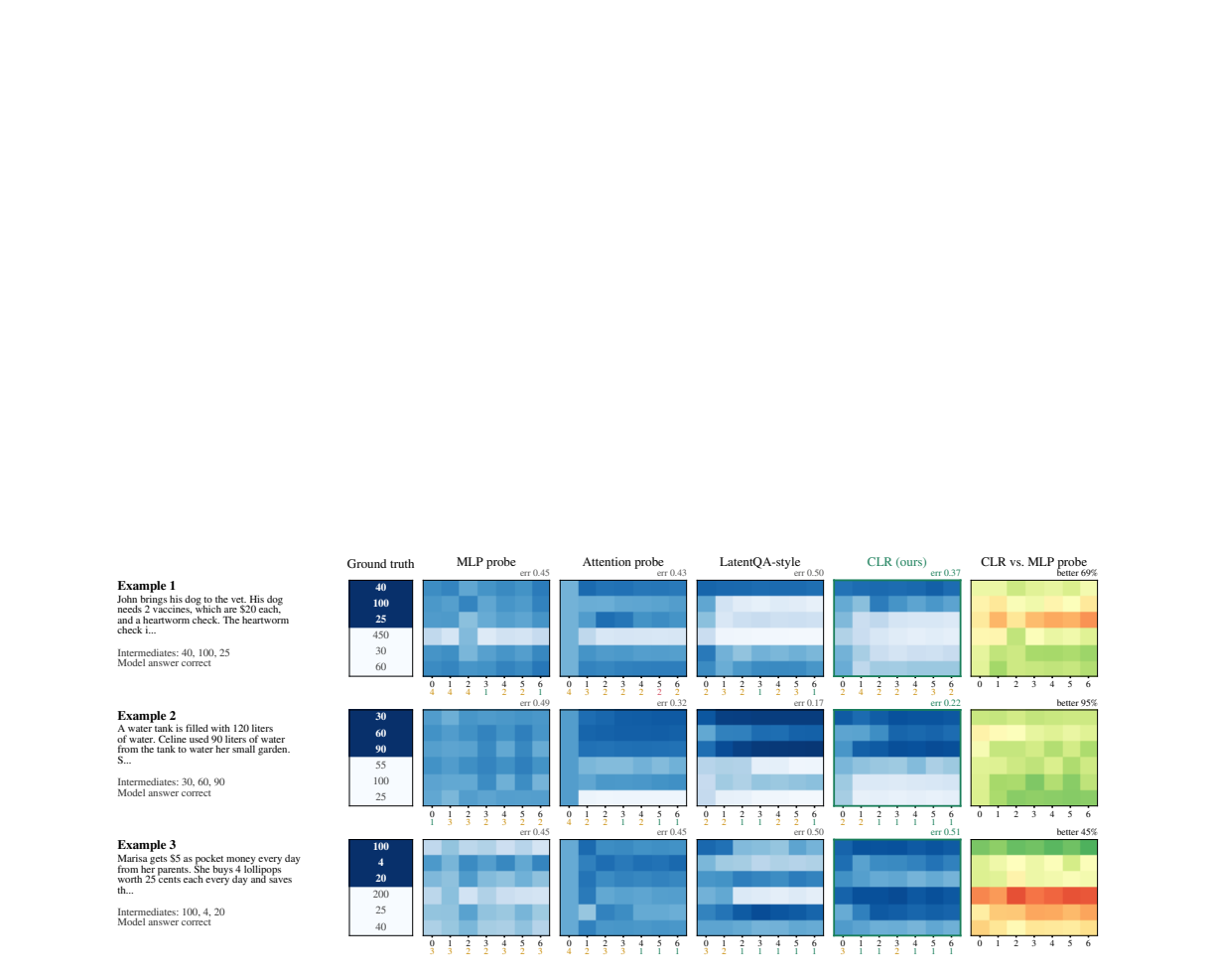
- [52] receive high probability. 23 Example 1 John brings his dog to the vet. His dog needs 2 vaccines, which are $20 each, and a heartworm check. The heartworm check i... Intermediates: 40, 100, 25 Model answer correct 40 100 25 450 30 60 Ground truth 0 1 2 3 4 5 6 4 4 4 1 2 2 1 err... on Pith
Challenges and discussion
Disagree with the review, or know something it missed? Leave a comment, or challenge this review formally: a challenge becomes a permanent entry in this paper's record, and its decision is published here.
Come back by email
A short list of the week's newly reviewed papers. Nothing is sent until you confirm from your inbox, and every email has a link that stops it. No account.
No comments yet.
Sign in to comment