Machine Learning · arXiv:2611.33479 v1 · submitted 24 Nov 2026 · 72 references
On the Impact of Extra Information in Bandit Learning: More is Not Always Merrier
The paper says
“More data is commonly assumed to improve learning performance, however, we show that this intuition can surprisngly fail in sequential decision-making.”
more of the abstract
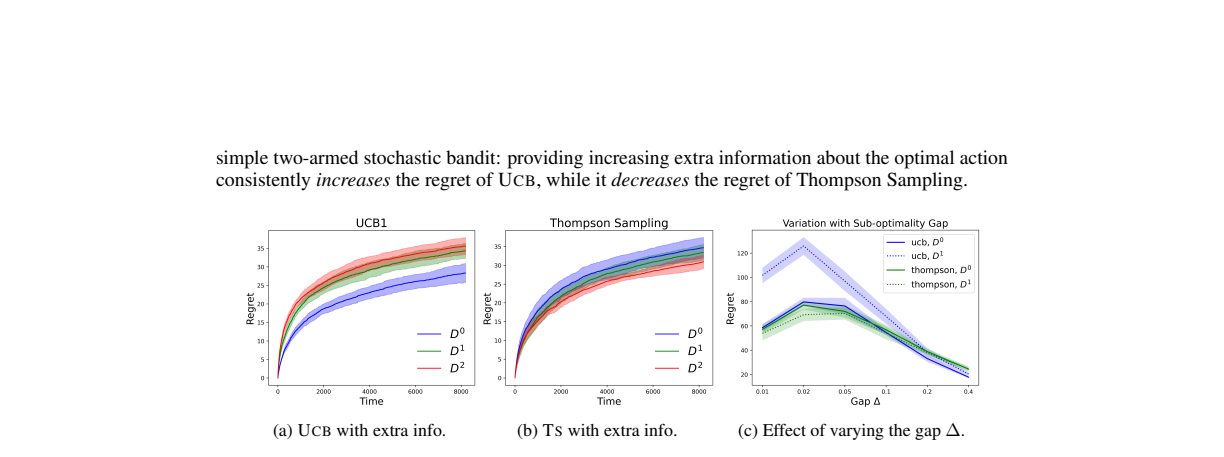
Considering a stochastic bandits setup with exogenous extra information, we ask if the free and unbiased extra reward samples are guaranteed to reduce the regret of the learner. We introduce a formal notion of `non-degradation under extra information' and demonstrate that the widely used Upper Confidence Bound algorithm (UCB) violates this property, i.e., there exist benign extra-information under which UCB incurs strictly higher regret than when run without extra information. We contrast this behaviour with Thompson Sampling and Explore-Then-Commit, which appear to benefit from the same extra information. Constructively, we propose a meta-algorithm that provably enforces non-degradation for a broad class of bandit algorithms. We also run empirical simulations to study our meta-algorithm.
from the abstract
Pith says
Machine review · deepseek-v4-flash · 26 Nov 2026 · read the full text (151,837 characters) · not checked by a person
It can be wrong. Challenge this review or reply to it.
Holds up, with conditions. This paper proves that providing extra unbiased reward samples can increase the regret of the UCB algorithm, overturning the intuition that more data always helps in sequential decision-making. This line is wrong
1 major objection · 2 minor · 1 open question
How often objections from reviews like this one are right: not yet measured
The paper, first character to last
The reviewer was given the whole text, 151,837 characters. Not checked: figures, code, what the 72 references say.
The paper says, at Appendix, Proof of Theorem 3 (EtcMonotone)
“We assume, as elsewhere in the paper, unit-variance Gaussian reward distributions”
quote found in the text Pith read
Pith says: Objection 1 of 1 · major
Theorem 3 (ETC monotonicity) is proven only under the assumption of Gaussian rewards (stated in Appendix Section 5: 'We assume, as elsewhere in the paper, unit-variance Gaussian reward distributions'). The theorem statement in the main text does not include this assumption, which is misleading. The authors should either state the assumption explicitly in the theorem or provide a proof that works for sub-Gaussian distributions.
What would answer it State Theorem 3 (EtcMonotone) under the assumption of unit-variance Gaussian reward distributions, or provide a proof that works for sub-Gaussian distributions.
2 minor objections
The paper says, at Abstract
Pith says: minor objection 1 of 2
Typographical errors: 'surprisngly' (abstract), 'algortithm' (Section 1), 'incurrs' (abstract), 'statitics' (Section 1.2), 'guassian' (Appendix), 'infomation' (Section 3), 'relateive' (Section 3), 'counter' (Appendix), 'couters' (Appendix).
The paper says, at NeurIPS Paper Checklist
Pith says: minor objection 2 of 2
The NeurIPS checklist is not properly formatted; the macros such as 'answerYes{}' are not expanded, leaving raw LaTeX code visible.
Open questions (1)
Pith raised these and could not confirm them against the text of the paper it read. They are questions for the authors, not findings.
- Appendix, Proof of Theorem 1, after Eq. (unlucky-tape) Pith raised a concern here that it could not check against the text of the paper it was given, so it is not published as an objection.
What would settle it
Run UCB on the two-armed Gaussian bandit with means (0.6, 0.5) and provide s=1 extra sample of the optimal action at time 0. If the average regret over many trials is not higher than without extra information, the paper's claim that UCB can degrade would be contradicted.
from Pith's summary of the paper
How the review went
5 passes by deepseek-v4-flash · 26 Nov 2026
- Reader holds up
- Skeptic concern withdrawn: Pith's reviewer misread the paper
- Referee 1 major objection, 2 minor
- Check against the paper kept 1 of 5 objections
- Editor wrote the verdict above
Not run on this paper: the simulated authors' defence.
Pith's passes raised 5 objections. A check against the paper's text kept 1, withdrew 3 (3 Pith's reviewer misread the paper) and left 1 as a question.
The review in full
The review in brief, machine-written
The paper shows that the widely used UCB algorithm can suffer higher regret when given free, unbiased extra reward samples—a surprising result that contradicts the usual supervised-learning intuition. The authors formalize a notion of non-degradation under extra information, prove that UCB violates it via a coupling argument, and contrast this with Thompson Sampling and Explore-Then-Commit, which benefit from the same extra data. They also propose a meta-algorithm that enforces monotonicity for any algorithm satisfying a mild 'better than random' property. The theoretical analysis is rigorous, the proofs are provided in the appendix, and the empirical simulations support the claims. The main result is significant and non-obvious. The soft spots are minor: the ETC monotonicity proof assumes Gaussian rewards, which is stated in the appendix but not in the theorem statement in the main text; the meta-algorithm's guarantee depends on an instance-dependent threshold that is not explicitly characterized; and the zero-noise degradation bound uses Taylor approximations (acknowledged by the authors). None of these undermine the central finding. This paper is valuable for bandit theorists and practitioners who rely on UCB-style algorithms. It deserves a serious peer review, and I recommend acceptance after a minor revision to make the Gaussian assumption explicit in the ETC theorem statement.
The stress test's concern
Withdrawn: Pith's reviewer misread the paper.
The paper says
“The black-box algorithm $\alg$'s trajectory is not affected by the side-information design. This is because the meta-algorithm $\nondegalg$ delays the consumption of side-information such that it is fed to $\alg$ only when $\alg$ naturally requires to play that action. From $\alg$'s point of view, it is identical to get the action outcome by playing the action in the environment and or to get it from the side-information buffer.”
The referee's report
Not published. Pith's referee wrote this assessment before its objections were checked against the paper, and 3 of its 4 major objections did not survive that check.
Pith's reading of the paper (a machine's summary, not the authors')
The paper studies stochastic multi-armed bandits where the learner receives free, unbiased extra reward samples from the environment. The authors introduce a formal notion of non-degradation under extra information and show that the widely used UCB algorithm violates it: there exist benign extra-information designs under which UCB incurs strictly higher regret than without extra information. In contrast, Thompson Sampling and Explore-Then-Commit benefit from the same extra information, though the ETC monotonicity result is proven under Gaussian rewards. The authors also propose a meta-algorithm that enforces non-degradation for any bandit algorithm satisfying a mild 'better than random' property. The paper concludes that more data is not always beneficial in sequential decision-making.
What carries the argument. The key machinery is the upper confidence bound (UCB) index, which combines an empirical mean with a confidence bonus that shrinks as the sample count increases. Extra information increases the sample count, lowering the bonus and suppressing optimism. The paper also uses a coupling argument with a fixed outcome tape to compare runs with and without extra information.
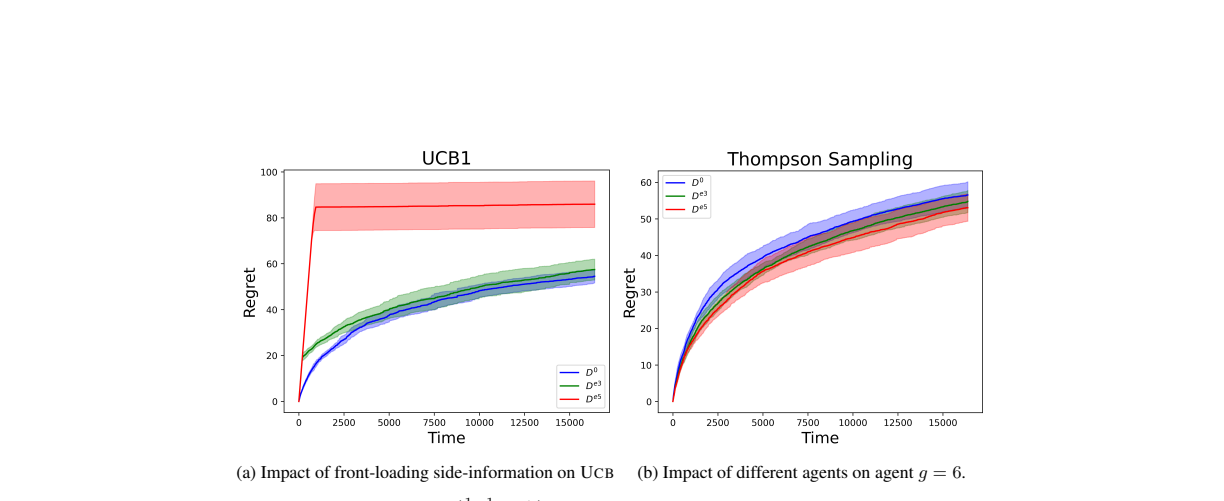
Core claim. The central discovery is that optimism-based exploration, as used by UCB, can be distorted by extra information. When extra samples of the optimal action are provided, UCB's confidence bound for that action shrinks, making it less attractive to play. This leads to over-exploration of suboptimal actions and increased regret. The paper constructs a two-armed bandit instance where front-loading samples of the optimal action causes UCB to never play the optimal action, while without extra information it eventually does. Thompson Sampling, by contrast, concentrates its posterior around the true means and benefits from the same extra information. The paper also proves that Explore-Then-Commit is monotone under Gaussian rewards, and provides a meta-algorithm that ensures monotonicity for any algorithm that eventually outperforms uniform exploration.
The premise it rests on. The meta-algorithm's guarantee relies on the black-box algorithm being 'better than random', which requires that after some time the algorithm's per-round regret is bounded by that of uniform exploration; this threshold may depend on the instance and is not explicitly characterized.
If the paper is right (Pith's inferences, not the authors')
If UCB is used in applications where additional unbiased data may arrive (e.g., from multiple agents or historical logs), practitioners should be aware that naive incorporation can hurt performance.
The meta-algorithm provides a safe way to incorporate extra information without risking degradation, at the cost of delaying consumption of the extra samples.
Thompson Sampling and Explore-Then-Commit are safer choices when extra information is expected, as they naturally benefit from it.
The results suggest that algorithms with deterministic exploration schedules may be more susceptible to degradation than randomized ones.
The paper's findings imply that the common practice of warm-starting bandit algorithms with offline data should be done cautiously, especially for UCB-like algorithms.
The meta-algorithm's balanced consumption condition suggests that the timing and allocation of extra information matter as much as its quantity.
An open question is whether there exists a fundamental trade-off between regret optimality and robustness to extra information, or whether algorithms can achieve both.
Check this review
What was read
The passes were given all 151,837 characters of the paper's LaTeX source.
Fingerprint of that text (SHA-256): 8b7a163eb05b3539f8b1538e3b3f42b18933c195185a5beb2300b6ce833a0f3d
Pith does not keep that text. Rebuilt from the paper's source or PDF by the same code, it has this fingerprint if it is the same text. From a copy of Pith's code:
PYTHONPATH=. python scripts/review_input_check.py 2611.33479
The passes, in the order they ran
- Reader deepseek-v4-flash · medium effort · $0.0044 · instructions of the Reader, fingerprint f9ead7300382…
- Skeptic deepseek-v4-flash · medium effort · $0.0042 · instructions of the Skeptic, fingerprint 8f88c0f61488…
- Referee deepseek-v4-flash · medium effort · $0.0045 · instructions of the Referee, fingerprint a852d99aea0d…
- Check against the paper deepseek-v4-flash · medium effort · $0.0087 · instructions of the Check against the paper, fingerprint 6c7a6883d551…
- Editor deepseek-v4-flash · medium effort · $0.0039 · instructions of the Editor, fingerprint e7211f6a3d27…
- Circularity check deepseek-v4-flash · medium effort · $0.0039 · instructions of the Circularity check, fingerprint e9946e39d67b…
- Summary for the page deepseek-v4-flash · medium effort · temperature 0.2 · $0.0044 · instructions of the Summary for the page, fingerprint e4f56bf568e7…
The passes cost $0.034 in model calls together.
Version stamped on this review: pith-pipeline@v1.4.1-daily-deepseek-or-medium+deepseek/deepseek-v4-flash+p.d60f54226f00
Each link opens a pass's instructions as plain text, the exact bytes its fingerprint was taken over. Every stored set of instructions.
curl -s https://pith.science/methodology/prompts/f9ead730038216984cfb56d7cb34332bdf691828296a1de4245f3d6667d4bf56 | sha256sum
prints the fingerprint of the reader's instructions. The same works for every pass.
The receipt
The review's fingerprint was taken on 26 Nov 2026. The review you are reading still matches it.
Fingerprint of the review (SHA-256): d8a011a7166c6b06ba03dc8bce14dc2ea731a50af14b670264e8fe6d45fef5a9
curl -s 'https://pith.science/api/v1/verdicts/2611.33479?form=canonical' | sha256sum
prints the fingerprint of the review as it stands now. The rule, in four steps.
A matching fingerprint shows the review has not changed since that date. It does not show that the review is right.
How often reviews like this one are right
Reviews like this one: written by deepseek-v4-flash, from the paper's LaTeX source.
How often objections from reviews like this one are right: not yet measured
Reviews by people
This review was written by a machine. No person has reviewed this paper on Pith yet. A scientist listed on Pith can review it for a fee, and their review is published here whatever it concludes.
The paper
Abstract
More data is commonly assumed to improve learning performance, however, we show that this intuition can surprisngly fail in sequential decision-making. Considering a stochastic bandits setup with exogenous extra information, we ask if the free and unbiased extra reward samples are guaranteed to reduce the regret of the learner. We introduce a formal notion of `non-degradation under extra information' and demonstrate that the widely used Upper Confidence Bound algorithm (UCB) violates this property, i.e., there exist benign extra-information under which UCB incurs strictly higher regret than when run without extra information. We contrast this behaviour with Thompson Sampling and Explore-Then-Commit, which appear to benefit from the same extra information. Constructively, we propose a meta-algorithm that provably enforces non-degradation for a broad class of bandit algorithms. We also run empirical simulations to study our meta-algorithm.
The paper's own sentences, arranged, kept beside the review and separate from it. Each label is drawn from a closed vocabulary; the number beside it is the probability the classifier gave that label. No sentence in this record was written by a model.
abstract compiled · 2026-11-26
The authors' main claim, as the classifier picked it out 0.73
“More data is commonly assumed to improve learning performance, however, we show that this intuition can surprisngly fail in sequential decision-making.”
How the main claim is stated: asserted 0.81
What the abstract itself states, as probabilities: claims first 0.06 · states limitation 0.28 · human participants 0.02 · controlled comparison 0.80 · randomized assignment 0.03 · states quantitative result 0.07 · compares with prior results 0.94 · mentions code or data availability 0.03
The abstract, sentence by sentence
This table labels the abstract only (arXiv listing abstract v1). The number is the probability the classifier gave the label.
| Sentence | Role | The authors' own work | States the main conclusion | Strength |
|---|---|---|---|---|
| More data is commonly assumed to improve learning performance, however, we show that this intuition can surprisngly fail in sequential decision-making. | background 0.72 | 0.67 | 0.60 | asserted 0.81 |
| Considering a stochastic bandits setup with exogenous extra information, we ask if the free and unbiased extra reward samples are guaranteed to reduce the regret of the learner. | background 0.58 | 0.20 | 0.05 | unclear 0.73 |
| We introduce a formal notion of `non-degradation under extra information' and demonstrate that the widely used Upper Confidence Bound algorithm (UCB) violates this property, i.e., there exist benign extra-information under which UCB incurs strictly higher regret than when run without extra information. | result 0.72 | 0.95 | 0.72 | asserted 1.00 |
| We contrast this behaviour with Thompson Sampling and Explore-Then-Commit, which appear to benefit from the same extra information. | result 0.98 | 0.78 | 0.07 | hedged possibility 0.89 |
| Constructively, we propose a meta-algorithm that provably enforces non-degradation for a broad class of bandit algorithms. | contribution 0.83 | 0.96 | 0.17 | asserted 1.00 |
| We also run empirical simulations to study our meta-algorithm. | method 0.61 | 0.95 | 0.02 | asserted 0.68 |
What kind of paper the classifier reports this is: theoretical result 0.68 · evidence from proof or derivation 0.99
What was examined, and what was not
Sources read
- arXiv listing abstract v1
Not examined
- full text
- figures and tables
- references and citing sentences
- relations to other papers
Levels run
- P abstract
Not run
- S sections
- T body sentences
- C citations
- R cross-paper relations
How the labels were made
Compiled by classifier-1.13.0 via TypeSafe API, question bank abstract-p1-20260923, 2026-11-26: 1 request, 4,945 input tokens.
Every quoted sentence on this record is the authors'. Every label is from Pith's closed vocabulary, with the probability shown beside it. This record as JSON
Figures (3)
Figures are the authors', reproduced from the paper.
References (72)
- [1] Bandit algorithms , author=. 2020 , publisher= on Pith
- [2] Computational geometry: an introduction , author=. 2012 , publisher= on Pith
- [3] Introduction to multi-armed bandits , author=. Foundations and Trends. 2019 , publisher= on Pith
- [4] Finite-time. Machine Learning , author =. 2002 , keywords =. doi:10.1023/A:1013689704352 , abstract = on Pithdoi:10.1023/a:1013689704352
- [5] From bandits to experts: On the value of side-observations , author=. Advances in Neural Information Processing Systems , volume= on Pith
- [6] Asymptotically-optimal Gaussian bandits with side observations , author=. International Conference on Machine Learning , pages=. 2022 , organization= on Pith
- [7] Online learning with feedback graphs: Beyond bandits , author=. Conference on Learning Theory , pages=. 2015 , organization= on Pith
- [8] Bandits with feedback graphs and switching costs , author=. Advances in Neural Information Processing Systems , volume= on Pith
- [9] Online learning with gaussian payoffs and side observations , author=. Advances in Neural Information Processing Systems , volume= on Pith
- [10] Online learning with noisy side observations , author=. Artificial Intelligence and Statistics , pages=. 2016 , organization= on Pith
- [11] Online learning with sleeping experts and feedback graphs , author=. International Conference on Machine Learning , pages=. 2019 , organization= on Pith
- [12] Online learning with dependent stochastic feedback graphs , author=. International Conference on Machine Learning , pages=. 2020 , organization= on Pith
- [13] Stochastic bandits with side observations on networks , author=. The 2014 ACM international conference on Measurement and modeling of computer systems , pages= on Pith
- [14] Online learning with feedback graphs without the graphs , author=. International Conference on Machine Learning , pages=. 2016 , organization= on Pith
- [15] Feedback graph regret bounds for Thompson sampling and UCB , author=. Algorithmic Learning Theory , pages=. 2020 , organization= on Pith
- [16] Stochastic graphical bandits with heavy-tailed rewards , author=. Uncertainty in Artificial Intelligence , pages=. 2023 , organization= on Pith
- [17] Understanding bandits with graph feedback , author=. Advances in Neural Information Processing Systems , volume= on Pith
- [18] Simultaneously learning stochastic and adversarial bandits with general graph feedback , author=. International Conference on Machine Learning , pages=. 2022 , organization= on Pith
- [19] Warm starting bandits with side information from confounded data , author=. arXiv preprint arXiv:2002.08405 , year= on PithPith's reviewarXiv
- [20] Learning Across the Gap: Hybrid Multi-armed Bandits with Heterogeneous Offline and Online Data , author=. The Thirty-ninth Annual Conference on Neural Information Processing Systems , year= on Pith
show 52 more
- [21] Cutting to the chase with warm-start contextual bandits , author=. Knowledge and Information Systems , volume=. 2023 , publisher= on Pith
- [22] Efficient algorithms for multi-armed bandits with additional feedbacks: Modeling and algorithms , author=. Information Sciences , volume=. 2023 , publisher= on Pith
- [23] Warm-starting contextual bandits: Robustly combining supervised and bandit feedback , author=. arXiv preprint arXiv:1901.00301 , year= on PithPith's reviewarXiv
- [24] User cold-start problem in multi-armed bandits: When the first recommendations guide the user’s experience , author=. ACM Transactions on Recommender Systems , volume=. 2023 , publisher= on Pith
- [25] Fair exploration via axiomatic bargaining , author=. Advances in Neural Information Processing Systems , volume= on Pith
- [26] The externalities of exploration and how data diversity helps exploitation , author=. Conference on Learning Theory , pages=. 2018 , organization= on Pith
- [27] Distributed Bandit Learning: Near-Optimal Regret with Efficient Communication , author=. International Conference on Learning Representations , year= on Pith
- [28] Multi-agent multi-armed bandits with limited communication , author=. Journal of Machine Learning Research , volume=. 2022 , annote= on Pith
- [29] Online learning for cooperative multi-player multi-armed bandits , author=. 2022 IEEE 61st Conference on Decision and Control (CDC) , pages=. 2022 , organization= on Pith
- [30] Multiagent online source seeking using bandit algorithm , author=. IEEE Transactions on Automatic Control , volume=. 2022 , publisher= on Pith
- [31] Near-Optimal Regret Bounds for Federated Multi-armed Bandits with Fully Distributed Communication , author=. 2025 , booktitle= on Pith
- [32] A distributed algorithm for multi-armed bandit with homogeneous rewards over directed graphs , author=. 2021 American Control Conference (ACC) , pages=. 2021 , organization= on Pith
- [33] Decentralized upper confidence bound algorithms for homogeneous multi-agent multi-armed bandits , author=. IEEE Transactions on Automatic Control , year= on Pith
- [34] Cooperative multi-agent bandits with heavy tails , author=. International conference on machine learning , pages=. 2020 , organization= on Pith
- [35] Private and Byzantine-Proof Cooperative Decision-Making , author=. Proceedings of the 19th International Conference on Autonomous Agents and MultiAgent Systems , pages= on Pith
- [36] Byzantine-resilient decentralized multi-armed bandits , author=. Transactions on machine learning research , year= on Pith
- [37] Contrastive ucb: Provably efficient contrastive self-supervised learning in online reinforcement learning , author=. International Conference on Machine Learning , pages=. 2022 , organization= on Pith
- [38] Multi-agent reinforcement learning for a random access game , author=. IEEE Transactions on Vehicular Technology , volume=. 2022 , publisher= on Pith
- [39] Safe Cooperative Multi-Agent Reinforcement Learning with Function Approximation , author=. Proceedings of Machine Learning Research vol , volume= on Pith
- [40] PrELIN: Provably Efficient Local-Information Networked Multi-Agent Reinforcement Learning , author=. 2025 IEEE 64th Conference on Decision and Control (CDC) , pages=. 2025 , organization= on Pith
- [41] Ucb momentum q-learning: Correcting the bias without forgetting , author=. International Conference on Machine Learning , pages=. 2021 , organization= on Pith
- [42] Harper, F. Maxwell and Konstan, Joseph A. , title =. 2015 , issue_date =. doi:10.1145/2827872 , journal = on Pithdoi:10.1145/2827872
- [43] An overview of statistical learning theory , author=. IEEE transactions on neural networks , volume=. 1999 , publisher= on Pith
- [44] The elements of statistical learning: data mining, inference, and prediction , author=. 2009 , publisher= on Pith
- [45] Understanding machine learning: From theory to algorithms , author=. 2014 , publisher= on Pith
- [46] Reinforcement learning: An introduction , author=. 1998 , publisher= on Pith
- [47] On the likelihood that one unknown probability exceeds another in view of the evidence of two samples , author=. Biometrika , volume=. 1933 , publisher= on Pith
- [48] Asymptotically efficient adaptive allocation rules , author=. Advances in applied mathematics , volume=. 1985 , publisher= on Pith
- [49] Agrawal, Rajeev , journal=. Sample mean based index policies with. 1995 , doi= on Pith
- [50] Anonymous , title=. 2026 , note= on Pith
- [51] On the Impact of Side-Information in Bandit Learning: More Is Not Always Merrier , author=. Advances in Neural Information Processing Systems , year= on Pith
- [52] Leveraging side observations in stochastic bandits , author=. Proceedings of the Twenty-Eighth Conference on Uncertainty in Artificial Intelligence , pages= on Pith
- [53] Bandits with side observations: Bounded vs. logarithmic regret , author=. Proceedings of the Thirty-Fourth Conference on Uncertainty in Artificial Intelligence , pages= on Pith
- [54] Online transfer learning: Negative transfer and effect of prior knowledge , author=. 2021 IEEE International Symposium on Information Theory (ISIT) , year= on Pith
- [55] Multi-armed bandit models for the optimal design of clinical trials: benefits and challenges , author=. Statistical Science , volume=. 2015 , publisher= on Pith
- [56] Distributed algorithms for learning and cognitive medium access with logarithmic regret , author=. IEEE Journal on Selected Areas in Communications , volume=. 2011 , publisher= on Pith
- [57] Near-optimal regret bounds for reinforcement learning , author=. Journal of Machine Learning Research , volume= on Pith
- [58] Dynamic pricing and learning: Historical origins, current research, and new directions , author=. Surveys in Operations Research and Management Science , volume=. 2015 , publisher= on Pith
- [59] Iterated logarithm inequalities , author=. Proceedings of the National Academy of Sciences , volume=. 1967 , publisher= on Pith
- [60] Sharp finite-time iterated-logarithm martingale concentration , author=. arXiv preprint arXiv:1405.2639 , year= on PithPith's reviewarXiv
- [61] lil'UCB: An optimal exploration algorithm for multi-armed bandits , author=. Conference on Learning Theory , pages=. 2014 , organization= on Pith
- [62] Time-uniform, nonparametric, nonasymptotic confidence sequences , author=. The Annals of Statistics , volume=. 2021 , publisher= on Pith
- [63] Creator Incentives in Recommender Systems: A Cooperative Game-Theoretic Approach for Stable and Fair Collaboration in Multi-Agent Bandits , author=. International Conference on Artificial Intelligence and Statistics , year= on Pith
- [64] Investigating therapies of potentially great benefit: ECMO , author=. Statistical Science , volume=. 1989 , publisher= on Pith
- [65] Stochastic Processes , author=. 1953 , publisher= on Pith
- [66] Minimax Regret Bounds for Reinforcement Learning , author=. Proceedings of the 34th International Conference on Machine Learning , pages=. 2017 , publisher= on Pith
- [67] Multi-armed Bandit Problems with History , author=. Proceedings of the Fifteenth International Conference on Artificial Intelligence and Statistics , volume=. 2012 , publisher= on Pith
- [68] Artificial Replay: A Meta-Algorithm for Harnessing Historical Data in Bandits , author=. arXiv preprint arXiv:2210.00025 , year= on PithPith's reviewarXiv
- [69] Bandits with Mean Bounds , author=. Transactions on Machine Learning Research , year= on Pith
- [70] A Closer Look at the Worst-case Behavior of Multi-armed Bandit Algorithms , author=. Advances in Neural Information Processing Systems , volume= on Pith
- [71] Han, Qiyang and Khamaru, Koulik and Zhang, Cun-Hui , year=. 2412.06126 , archivePrefix= on PithPith's reviewarXiv
- [72] Collaborative. Reinforcement Learning Journal , author = on Pith
Challenges and discussion
Disagree with the review, or know something it missed? Leave a comment, or challenge this review formally: a challenge becomes a permanent entry in this paper's record, and its decision is published here.
Come back by email
A short list of the week's newly reviewed papers. Nothing is sent until you confirm from your inbox, and every email has a link that stops it. No account.
No comments yet.
Sign in to comment