REVIEW 3 major objections 5 minor 16 cited by
A Survey on Vision-Language-Action Models for Autonomous Driving
T0 review · 3 major / 5 minor · reviewed 2026-08-06 · deepseek-v4-flash
Pith's one-line read This survey organizes the emerging field of vision-language-action driving models into a four-stage taxonomy and defines the shared architecture behind them.
desk verdict A useful and overdue survey map of VLA4AD, but its flagship Stage-1 example contradicts its own table and the cited paper, so it needs a correction round before I'd fully trust it. read the letter →
The pith
A machine-rendered reading of the paper's core claim, the machinery that carries it, and where it could break.
The reading
What carries the argument
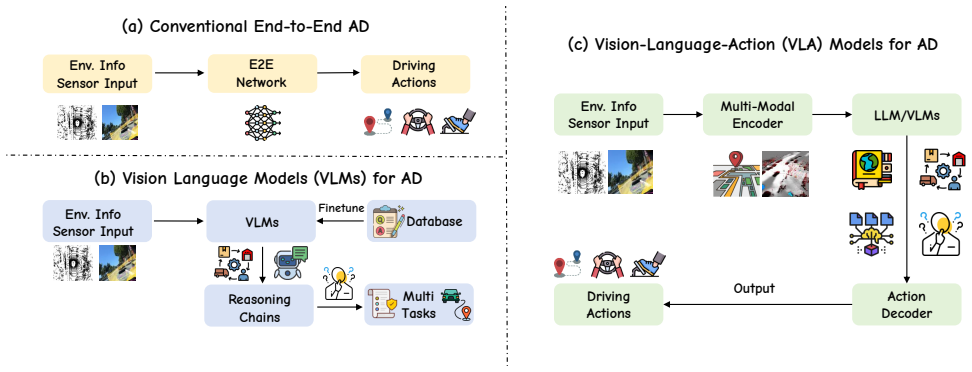
The organizing machinery is the four-stage evolutionary taxonomy together with the architectural triad of vision encoder, language processor, and action decoder. The taxonomy is what lets the survey claim a unified field: each system is placed by how language enters the pipeline (description, intermediate representation, direct input, or reasoning memory) and by how action exits (low-level control tokens, waypoint trajectories, or hierarchical plans). The action-decoder variants, including autoregressive tokenizers, diffusion heads, and flow-based controllers, are the concrete mechanisms that close the loop between words and motion.
What would settle it
A reader could rerun a systematic search over the same period using the survey's own inclusion criteria and classify every returned system into the four stages. If a substantial number of systems fall outside the stages, or if an end-to-end VLA predates the modular stage, the taxonomy's claim to describe the field's evolution would be false.
Extended reading notes
Core claim
On the paper's own terms, the central discovery is that a coherent research paradigm exists: VLA for autonomous driving (VLA4AD). The paper argues that the field has moved through four identifiable stages: pre-VLA explainers that narrate scenes without touching the controls, modular VLA systems that turn language into intermediate plans, unified end-to-end VLA networks that map sensors directly to trajectories, and reasoning-augmented VLA agents that insert chain-of-thought, memory, and tool use into the control loop. It further claims that all of these systems share a common architecture of vision encoder, language processor, and action decoder, and that the remaining bottlenecks are robustness, real-time throughput, and formal verification rather than basic feasibility.
Load-bearing premise
The survey's story depends on the selected systems being representative of the field as of mid-2025 and the four stages genuinely capturing their development; because the paper does not report a systematic search protocol, that representativeness is asserted rather than demonstrated.
Editorial extensions
If this is right
- New work can be described by its stage and compared on fixed axes, such as input sensors, language interface, and output form.
- Evaluation can move from measuring control and language separately to protocols that jointly score safety, instruction fidelity, and explanation quality.
- The open-challenge list sets a concrete agenda: keeping reasoning inside a real-time control loop, formally verifying language-conditioned policies, and building a unified AI driver's test.
- If the trend continues, future production systems will embed chain-of-thought reasoning and memory as core parts of the driving policy rather than as an external explanation layer.
Reading between the lines
- My inference: the four-stage ordering may be a retrospective organizing device rather than a proven chronology, because systems developed in parallel can be sorted into stages only after the fact.
- My inference: a testable consequence of the reasoning-augmented stage is that adding explicit reasoning tokens before action output should improve closed-loop safety beyond what data scaling alone delivers; that comparison is not made in the survey.
- My inference: the survey's camera-centric emphasis suggests that making LiDAR, radar, and map data first-class tokens in the language-action loop is a promising direction, with early evidence in the 3D-focused systems it cites.
Editorial analysis
A structured set of objections, weighed in public.
Referee Report
Summary. The manuscript presents a survey of Vision-Language-Action (VLA) models for autonomous driving, coining the term VLA4AD. It proposes a four-stage evolution taxonomy (Pre-VLA language-as-explainer, Modular VLA, End-to-end VLA, Reasoning-Augmented VLA), formalizes architectural building blocks (vision encoder, language processor, action decoder), compares over 20 models in Table 1, reviews datasets and benchmarks, and discusses training/evaluation strategies, open challenges, and future directions. The authors claim this is the first comprehensive survey specifically for VLA models in autonomous driving.
Significance. If validated, this survey would provide a useful organizing reference for a rapidly growing field: it offers a common terminology, a consolidated model table, a structured comparison of training and evaluation protocols, and an explicit list of open problems. The paper's strengths include broad coverage of very recent primary sources (mostly 2024-2025 arXiv preprints), a clear architectural decomposition, and a practical GitHub repository. However, the central contributions—the four-stage taxonomy and the 'first comprehensive' claim—are not yet supported as stated: the defining example of Stage 1 contradicts the stage's own definition, and the model selection process is not reproducible from the manuscript. These issues need to be fixed before the survey can serve as a reliable reference.
major comments (3)
- [Section 4.1 and Table 1] Section 4.1 defines Stage 1 (Pre-VLA) as producing no direct control, stating that 'the actual vehicle control was still handled by conventional modules (PID controllers, etc.)' and that language was 'an overlay rather than integral to decision-making'. This is directly contradicted by Table 1, which lists DriveGPT-4's output as LLC (low-level control), and by the cited source (Xu et al., DriveGPT4, arXiv:2310.01412), which predicts steering, throttle, and brake tokens and evaluates them closed-loop in CARLA. Since DriveGPT-4 is the only concrete exemplar offered for this stage, the stage boundary fails at its own instance. The authors should either reclassify DriveGPT-4, revise the Stage 1 definition to state the actual distinguishing criterion (e.g., whether the action head is jointly trained with the language model), or both. In addition, Table 1 should include a stage column so that every model's assignment is auditable.
- [Section 4 and Table 1 (survey methodology)] The Abstract and Introduction claim that this is 'the first comprehensive survey' of VLA4AD, but no literature search methodology is reported. The paper does not state the databases searched, the date of the search, the keywords used, or the inclusion/exclusion criteria that produced the 20+ models in Table 1. Without this information, the comprehensiveness claim is untestable: a reader cannot check whether important works were omitted or whether the four-stage taxonomy was fitted to a non-representative sample. Please add a methodology paragraph describing the search protocol and explicitly describing how each model was assigned to a stage.
- [Sections 4.2-4.4 and Table 1] The boundaries between the four stages are not operationalized. For example, RAG-Driver is placed in Stage 2 (Modular VLA) yet outputs low-level control, while SimLingo and AutoVLA in Stages 3/4 output a mix of LLC and trajectory; conversely, ORION in Stage 4 is described as both reasoning-augmented and end-to-end. With no explicit decision rule for stage assignment, the evolutionary narrative is not checkable from within the paper. Please provide a per-stage definition in terms of architectural or training properties (e.g., whether the action head is backpropagated through the language model, whether an intermediate language representation is consumed by a separate planner) and apply that rule consistently to all entries in Table 1.
minor comments (5)
- [Throughout] Several typos need correction: 'V AD' in Section 2.2 should be 'VAD'; 'CarLLaV A' in Section 4.3 should be 'CarLLaVA'; 'exemplifing' (Section 2.4) should be 'exemplifying'; 'remainspassive' (Section 1) should be 'remains passive'; 'outputing' and 'explaning' (Section 4.4) should be 'outputting' and 'explaining'.
- [References] The bibliography contains duplicate entries: nuScenes appears as [7] and [8], UniAD as [43] and [44], ORION as [30] and [31], and LLaMA as [120] and [121]. This causes inconsistent in-text numbering (e.g., ORION is cited as [30] in Section 4.4 but as [31] in Table 1). Deduplicate and renumber the references.
- [Section 3.2] The text 'LLaMA2 [121]' cites the wrong reference: [121] is the original LLaMA paper, while LLaMA-2 is [122]. Correct this citation.
- [Section 6.2] In the evaluation metrics paragraph, 'TS-VLM cuts compute by ~90% through token pooling [167]' should cite [11] (TS-VLM) rather than [167] (DynRsl-VLM); the same confusion appears in Section 1 where [167] is used to support a claim about TS-VLM.
- [Figure 3 and Section 4] Stage names are inconsistent between Figure 3's caption ('VLM-as-explainer', 'Modular VLA for AD', 'Augmented VLA for AD', 'End-to-end VLA for AD') and the text in Section 4 ('Explanatory Language Models', 'Modular VLA4AD', 'End-to-end VLA4AD', 'Reasoning-Augmented VLA4AD'). Align the terminology across the figure and the text.
Circularity Check
No significant circularity: the survey contains no fitted-value or self-citation-reduced derivation; the four-stage taxonomy is an organizing narrative rather than a derivation, though its Stage 1 exemplar contradicts its own definition.
full rationale
This is a survey paper; there is no quantitative derivation chain, no fitted parameter renamed as prediction, and no equation reducing an output to an input. The central product is a taxonomy (Pre-VLA explainers, Modular VLA, End-to-end VLA, Reasoning-augmented VLA) and a comparative table. The taxonomy is not derived from a first-principles model; it is an interpretation imposed on the literature, so the usual circularity modes (self-definitional, fitted-input-called-prediction, uniqueness-imported-from-authors) do not apply. Self-citations appear (e.g., AgentThink [99], FasionAD++ [100], and [61] in a control-method list), but they are descriptive citations in the narrative, not load-bearing evidence for the taxonomy or for any quantitative claim, so they do not raise the circularity score above 2. The paper's own inconsistency involving DriveGPT-4 is worth flagging as a correctness risk: Section 4.1 defines Stage 1 as 'without directly outputting control' and says DriveGPT-4's 'actual vehicle control was still handled by conventional modules,' while Table 1 lists DriveGPT-4's Output as 'LLC' and the cited DriveGPT4 paper predicts steering/throttle/brake tokens. This undermines the exemplar's fit to the stage definition and makes the evolutionary narrative harder to audit, but it is a factual/classification inconsistency, not a circular reduction: the stage claim does not become true by definition, and no result is being derived from the very datum it is supposed to predict. Similarly, the 'first comprehensive survey' claim is not backed by a reported search protocol, but absence of methodology is an evidentiary/completeness limitation, not circularity. Overall the derivation chain, such as it is, is not circular; score 2 reflects the minor self-citations and the need to correct the Stage 1 exemplar.
Assumptions & free parameters
assumptions (1)
- domain assumption The VLA4AD paradigm is a distinct, coherent research direction that warrants a separate survey.
Cite this review
Pith. "Pith review of A Survey on Vision-Language-Action Models for Autonomous Driving." pith.science (2026). https://pith.science/paper/2ACEYQLK
@misc{pith2026250624044,
  author       = {Pith},
  title        = {Pith review of: A Survey on Vision-Language-Action Models for Autonomous Driving},
  year         = {2026},
  howpublished = {\url{https://pith.science/paper/2ACEYQLK}},
  note         = {Machine review of arXiv:2506.24044}
}
read the original abstract
The rapid progress of multimodal large language models (MLLM) has paved the way for Vision-Language-Action (VLA) paradigms, which integrate visual perception, natural language understanding, and control within a single policy. Researchers in autonomous driving are actively adapting these methods to the vehicle domain. Such models promise autonomous vehicles that can interpret high-level instructions, reason about complex traffic scenes, and make their own decisions. However, the literature remains fragmented and is rapidly expanding. This survey offers the first comprehensive overview of VLA for Autonomous Driving (VLA4AD). We (i) formalize the architectural building blocks shared across recent work, (ii) trace the evolution from early explainer to reasoning-centric VLA models, and (iii) compare over 20 representative models according to VLA's progress in the autonomous driving domain. We also consolidate existing datasets and benchmarks, highlighting protocols that jointly measure driving safety, accuracy, and explanation quality. Finally, we detail open challenges - robustness, real-time efficiency, and formal verification - and outline future directions of VLA4AD. This survey provides a concise yet complete reference for advancing interpretable socially aligned autonomous vehicles. Github repo is available at \href{https://github.com/JohnsonJiang1996/Awesome-VLA4AD}{SicongJiang/Awesome-VLA4AD}.
Figures


Forward citations
Cited by 16 Pith papers
-
Steadily moving semi-infinite fracture in plane poroelasticity
A new coupled boundary integral method models steadily moving semi-infinite fractures in plane poroelasticity, solving for mechanical deformation and fluid exchange with verification on analytical test cases.
-
MoRAL: Sensor-Grounded BEV Reasoning for Compact VLMs toward Edge-Oriented Autonomous Driving
A 2B VLM fine-tuned in two stages on a physics-encoded bird's-eye view image outperforms a zero-shot 8B VLM on eight driving-reasoning question types and raises emergency-braking recall from 10.8% to 47.8%.
-
MVPruner: Dynamic Token Pruning for Accelerating Multi-view Vision-Language Models in Autonomous Driving
MVPruner is a two-stage dynamic token pruning technique that uses view diversity for initial budget allocation and instruction text for task-aligned selection, delivering 87.3% FLOPs reduction and 4.97x prefilling spe...
-
EgoDyn-Bench: Evaluating Ego-Motion Understanding in Vision-Centric Foundation Models for Autonomous Driving
EgoDyn-Bench finds a Perception Bottleneck: foundation models hold ego-motion logic in language but misalign it with vision, underperforming geometric baselines until given explicit trajectories.
-
EgoDyn-Bench: Evaluating Ego-Motion Understanding in Vision-Centric Foundation Models for Autonomous Driving
EgoDyn-Bench reveals a perception bottleneck in vision-centric foundation models: ego-motion logic derives from language while visual input adds negligible signal, with explicit trajectories restoring consistency.
-
From Representational Complementarity to Dual Systems: Synergizing VLM and Vision-Only Backbones for End-to-End Driving
A VLM-based and a vision-only end-to-end planner are behaviorally complementary in a long tail of driving scenarios; selecting the better trajectory lifts NAVSIM PDMS from 90.80 to 92.10 at modest compute.
-
LinMU: Multimodal Understanding Made Linear
LinMU achieves linear-complexity multimodal understanding by swapping self-attention for an M-MATE dual-branch block and distilling from a frozen teacher VLM, matching accuracy with up to 2.7x faster TTFT and 9x highe...
-
VLSA: Vision-Language-Action Models with Plug-and-Play Safety Constraint Layer
AEGIS wraps VLA robot policies in a CBF-based safety layer that uses VLM obstacle identification, raising collision avoidance from 18.69% to 77.85% and task success by 17.25 points on the new SafeLIBERO benchmark.
-
E3AD: An Emotion-Aware Vision-Language-Action Model for Human-Centric End-to-End Autonomous Driving
An emotion-aware vision-language-action driving model estimates VAD emotion from commands and uses it to improve grounding and waypoint planning.
-
PriorEye: Geospatial Visual Priors for End-to-End Autonomous Driving
PriorEye augments end-to-end driving models with a dual-memory architecture that stores and gates geospatial visual priors to improve performance and robustness to sensor corruption on NAVSIM-v2.
-
MVPruner: Dynamic Token Pruning for Accelerating Multi-view Vision-Language Models in Autonomous Driving
MVPruner is a two-stage adaptive token pruning technique for multi-view VLMs that achieves 87.3% FLOPs reduction and 4.97x prefilling speedup while retaining 98.5% accuracy on DriveLM.
-
Steadily moving semi-infinite fracture in plane poroelasticity
XEmbodied achieves SOTA on 18 embodied VQA benchmarks by fusing 3D geometric tokens and distilled physical cues into a 30B VLM with progressive curriculum training.
-
XEmbodied: A Foundation Model with Enhanced Geometric and Physical Cues for Large-Scale Embodied Environments
XEmbodied is a foundation model that integrates 3D geometric and physical signals into VLMs using a 3D Adapter and Efficient Image-Embodied Adapter, plus progressive curriculum and RL post-training, to improve spatial...
-
Efficient Vision-Language-Action Models for Embodied Manipulation: A Systematic Survey
A survey that groups VLA efficiency techniques into four categories: model architecture, perception features, action generation, and training/inference strategies.
-
A Review of Learning-Based Motion Planning: Toward a Data-Driven Optimal Control Approach
A position/review paper argues data-driven model predictive control is the best route to safe, adaptive, human-like autonomous-driving motion planning, but provides no new derivation or experiment.
-
Research Challenges and Progress in the End-to-End V2X Cooperative Autonomous Driving Competition
This paper summarizes the CVPR 2025 V2X cooperative driving challenge, its winning solutions, and the open research problems it reveals.
Reference graph
Works this paper leans on
-
[1]
Flamingo: a visual language model for few-shot learn- ing
Jean-Baptiste Alayrac, Jeff Donahue, Pauline Luc, An- toine Miech, Iain Barr, Yana Hasson, Karel Lenc, Arthur Mensch, Katherine Millican, Malcolm Reynolds, et al. Flamingo: a visual language model for few-shot learn- ing. Advances in neural information processing systems , 35:23716–23736, 2022. 3
2022
-
[2]
An lstm net- work for highway trajectory prediction
Florent Altch ´e and Arnaud de La Fortelle. An lstm net- work for highway trajectory prediction. In 2017 IEEE 20th international conference on intelligent transportation sys- tems (ITSC), pages 353–359. IEEE, 2017. 2
2017
-
[3]
Vavim and vavam: Autonomous driving through video generative modeling
Florent Bartoccioni, Elias Ramzi, Victor Besnier, Shashanka Venkataramanan, Tuan-Hung Vu, Yihong Xu, Loick Chambon, Spyros Gidaris, Serkan Odabas, David Hurych, et al. Vavim and vavam: Autonomous driving through video generative modeling. arXiv preprint arXiv:2502.15672, 2025. 5, 8
arXiv 2025
-
[4]
pi0: A vision-language- action flow model for general robot control
Kevin Black, Noah Brown, Danny Driess, Adnan Esmail, Michael Equi, Chelsea Finn, Niccolo Fusai, Lachy Groom, Karol Hausman, Brian Ichter, et al. pi0: A vision-language- action flow model for general robot control. arXiv preprint arXiv:2410.24164, 2024. 4
-
[5]
Fine-grained affective processing capabilities emerging from large lan- guage models
Joost Broekens, Bernhard Hilpert, Suzan Verberne, Kim Baraka, Patrick Gebhard, and Aske Plaat. Fine-grained affective processing capabilities emerging from large lan- guage models. In 2023 11th international conference on af- fective computing and intelligent interaction (ACII) , pages 1–8. IEEE, 2023. 4
2023
-
[6]
Language models are few-shot learners
Tom Brown, Benjamin Mann, Nick Ryder, Melanie Sub- biah, Jared D Kaplan, Prafulla Dhariwal, Arvind Neelakan- tan, Pranav Shyam, Girish Sastry, Amanda Askell, et al. Language models are few-shot learners. Advances in neu- ral information processing systems , 33:1877–1901, 2020. 5
1901
-
[7]
nuscenes: A multimodal dataset for autonomous driving
Holger Caesar, Alex Bankiti, Orien Lang, et al. nuscenes: A multimodal dataset for autonomous driving. In CVPR,
-
[8]
nuscenes: A mul- timodal dataset for autonomous driving
Holger Caesar, Varun Bankiti, Alex H Lang, Sourabh V ora, Venice Erin Liong, Qiang Xu, Anush Krishnan, Yu Pan, Giancarlo Baldan, and Oscar Beijbom. nuscenes: A mul- timodal dataset for autonomous driving. In Proceedings of the IEEE/CVF conference on computer vision and pattern recognition, pages 11621–11631, 2020. 4
2020
Show all 166 references
-
[9]
Learning from all vehi- cles
Dian Chen and Philipp Kr ¨ahenb¨uhl. Learning from all vehi- cles. In Proceedings of the IEEE/CVF Conference on Com- puter Vision and Pattern Recognition, pages 17222–17231,
-
[10]
Insight: Enhancing autonomous driving safety through vision-language models on context-aware hazard detection and edge case evaluation
Dianwei Chen, Zifan Zhang, Yuchen Liu, and Xian- feng Terry Yang. Insight: Enhancing autonomous driving safety through vision-language models on context-aware hazard detection and edge case evaluation. arXiv e-prints, pages arXiv–2502, 2025. 4
2025
-
[11]
Ts- vlm: Text-guided softsort pooling for vision-language models in multi-view driving reasoning
Lihong Chen, Hossein Hassani, and Soodeh Nikan. Ts- vlm: Text-guided softsort pooling for vision-language models in multi-view driving reasoning. arXiv preprint arXiv:2505.12670, 2025. 2, 6, 8, 10
2025 arXiv
-
[12]
What data do we need for training an av motion planner? In 2021 IEEE Inter- national Conference on Robotics and Automation (ICRA) , pages 1066–1072
Long Chen, Lukas Platinsky, Stefanie Speichert, Bła ˙zej Osi´nski, Oliver Scheel, Yawei Ye, Hugo Grimmett, Luca Del Pero, and Peter Ondruska. What data do we need for training an av motion planner? In 2021 IEEE Inter- national Conference on Robotics and Automation (ICRA) , pag...
2021
-
[13]
End-to-end autonomous driving: Challenges and frontiers
Li Chen, Penghao Wu, Kashyap Chitta, Bernhard Jaeger, Andreas Geiger, and Hongyang Li. End-to-end autonomous driving: Challenges and frontiers. IEEE Transactions on Pattern Analysis and Machine Intelligence, 2024. 3
2024
-
[14]
Vadv2: End-to-end vectorized au- tonomous driving via probabilistic planning
Shaoyu Chen, Bo Jiang, Hao Gao, Bencheng Liao, Qing Xu, Qian Zhang, Chang Huang, Wenyu Liu, and Xinggang Wang. Vadv2: End-to-end vectorized au- tonomous driving via probabilistic planning. arXiv preprint arXiv:2402.13243, 2024. 3
2024 arXiv
-
[15]
Asynchronous large language model en- hanced planner for autonomous driving
Yuan Chen, Zi-han Ding, Ziqin Wang, Yan Wang, Lijun Zhang, and Si Liu. Asynchronous large language model en- hanced planner for autonomous driving. In European Con- ference on Computer Vision, pages 22–38. Springer, 2024. 3
2024
-
[16]
Ppad: Iterative interactions of prediction and planning for end-to-end autonomous driving
Zhili Chen, Maosheng Ye, Shuangjie Xu, Tongyi Cao, and Qifeng Chen. Ppad: Iterative interactions of prediction and planning for end-to-end autonomous driving. In European Conference on Computer Vision, pages 239–256. Springer,
-
[17]
CoVLA: Comprehensive vision-language-action dataset for au- tonomous driving
Haohan Chi, Huan-ang Gao, Ziming Liu, et al. CoVLA: Comprehensive vision-language-action dataset for au- tonomous driving. In WACV, 2025. 1, 4, 6, 7, 8, 9
2025
-
[18]
Impromptu vla: Open weights and open data for driving vision- language-action models
Haohan Chi, Huan-ang Gao, Ziming Liu, et al. Impromptu vla: Open weights and open data for driving vision- language-action models. arXiv preprint arXiv:2505.23757,
-
[19]
Neat: Neural attention fields for end-to-end autonomous driving
Kashyap Chitta, Aditya Prakash, and Andreas Geiger. Neat: Neural attention fields for end-to-end autonomous driving. In Proceedings of the IEEE/CVF International Conference on Computer Vision, pages 15793–15803, 2021. 2
2021
-
[20]
Transfuser: Imita- tion with transformer-based sensor fusion for autonomous driving
Kashyap Chitta, Aditya Prakash, Bernhard Jaeger, Zehao Yu, Katrin Renz, and Andreas Geiger. Transfuser: Imita- tion with transformer-based sensor fusion for autonomous driving. IEEE transactions on pattern analysis and machine intelligence, 45(11):12878–12895, 2022. 2, 3, 4
2022
-
[21]
Talk2bev: Language-enhanced bird’s- eye view maps for autonomous driving
Tushar Choudhary, Vikrant Dewangan, Shivam Chand- hok, Shubham Priyadarshan, Anushka Jain, Arun K Singh, Siddharth Srivastava, Krishna Murthy Jatavallabhula, and K Madhava Krishna. Talk2bev: Language-enhanced bird’s- eye view maps for autonomous driving. In2024 IEEE Inter- nat...
2024
-
[22]
A survey on multimodal large lan- guage models for autonomous driving
Can Cui, Yunsheng Ma, Xu Cao, Wenqian Ye, Yang Zhou, Kaizhao Liang, Jintai Chen, Juanwu Lu, Zichong Yang, Kuei-Da Liao, et al. A survey on multimodal large lan- guage models for autonomous driving. In Proceedings of the IEEE/CVF Winter Conference on Applications of Com- puter ...
2024
-
[23]
Chain-of-thought for autonomous driving: A comprehensive survey and future prospects
Yixin Cui, Haotian Lin, Shuo Yang, Yixiao Wang, Yanjun Huang, and Hong Chen. Chain-of-thought for autonomous driving: A comprehensive survey and future prospects. arXiv preprint arXiv:2505.20223, 2025. 2, 4
2025 arXiv
-
[24]
Hint-ad: Holistically aligned interpretability in end-to-end autonomous driving
Kairui Ding, Boyuan Chen, Yuchen Su, Huan-ang Gao, Bu Jin, Chonghao Sima, Wuqiang Zhang, Xiaohui Li, Paul Barsch, Hongyang Li, et al. Hint-ad: Holistically aligned interpretability in end-to-end autonomous driving. arXiv preprint arXiv:2409.06702, 2024. 3
2024 arXiv
-
[25]
Dualad: Disentangling the dynamic and static world for end-to-end driving
Simon Doll, Niklas Hanselmann, Lukas Schneider, Richard Schulz, Marius Cordts, Markus Enzweiler, and Hendrik Lensch. Dualad: Disentangling the dynamic and static world for end-to-end driving. In Proceedings of the IEEE/CVF Conference on Computer Vision and Pattern Recognition,...
2024
-
[26]
Carla: An open urban driv- ing simulator
Alexey Dosovitskiy, German Ros, Felipe Codevilla, Anto- nio Lopez, and Vladlen Koltun. Carla: An open urban driv- ing simulator. InConference on robot learning, pages 1–16. PMLR, 2017. 9
2017
-
[27]
On the road to portability: Compressing end-to-end motion planner for autonomous driving
Kaituo Feng, Changsheng Li, Dongchun Ren, Ye Yuan, and Guoren Wang. On the road to portability: Compressing end-to-end motion planner for autonomous driving. In Pro- ceedings of the IEEE/CVF Conference on Computer Vision and Pattern Recognition, pages 15099–15108, 2024. 2
2024
-
[28]
Polarpoint-bev: Bird-eye- view perception in polar points for explainable end-to-end autonomous driving
Yuchao Feng and Yuxiang Sun. Polarpoint-bev: Bird-eye- view perception in polar points for explainable end-to-end autonomous driving. IEEE Transactions on Intelligent Ve- hicles, 2024. 3
2024
-
[29]
Drive like a human: Rethinking autonomous driving with large language models
Daocheng Fu, Xin Li, Licheng Wen, Min Dou, Pinlong Cai, Botian Shi, and Yu Qiao. Drive like a human: Rethinking autonomous driving with large language models. In 2024 IEEE/CVF Winter Conference on Applications of Computer Vision Workshops (WACVW), pages 910–919. IEEE, 2024. 3
2024
-
[31]
Orion: A holis- tic end-to-end autonomous driving framework by vision- language instructed action generation
Haoyu Fu, Diankun Zhang, Zongchuang Zhao, Jianfeng Cui, Dingkang Liang, Chong Zhang, Dingyuan Zhang, Hongwei Xie, Bing Wang, and Xiang Bai. Orion: A holis- tic end-to-end autonomous driving framework by vision- language instructed action generation. arXiv preprint arXiv:2503.1...
2025 arXiv
-
[32]
A survey for foun- dation models in autonomous driving
Haoxiang Gao, Zhongruo Wang, Yaqian Li, Kaiwen Long, Ming Yang, and Yiqing Shen. A survey for foun- dation models in autonomous driving. arXiv preprint arXiv:2402.01105, 2024. 2
2024 arXiv
-
[33]
Lang- coop: Collaborative driving with language
Xiangbo Gao, Yuheng Wu, Rujia Wang, et al. Lang- coop: Collaborative driving with language. arXiv preprint arXiv:2504.13406, 2025. 5, 6, 8, 9
2025 arXiv
-
[34]
A review of motion planning techniques for au- tomated vehicles
David Gonz ´alez, Joshu´e P´erez, Vicente Milan´es, and Fawzi Nashashibi. A review of motion planning techniques for au- tomated vehicles. IEEE Transactions on intelligent trans- portation systems, 17(4):1135–1145, 2015. 2
2015
-
[35]
ipad: Iterative proposal-centric end-to-end autonomous driving
Ke Guo, Haochen Liu, Xiaojun Wu, Jia Pan, and Chen Lv. ipad: Iterative proposal-centric end-to-end autonomous driving. arXiv preprint arXiv:2505.15111, 2025. 3
2025 arXiv
-
[36]
End-to-end autonomous driving without costly modularization and 3d manual annotation
Mingzhe Guo, Zhipeng Zhang, Yuan He, Ke Wang, and Liping Jing. End-to-end autonomous driving without costly modularization and 3d manual annotation. arXiv preprint arXiv:2406.17680, 2024. 3
2024 arXiv
-
[37]
Drivem- llm: A benchmark for spatial understanding with multi- modal large language models in autonomous driving.arXiv preprint arXiv:2411.13112, 2024
Xianda Guo, Ruijun Zhang, Yiqun Duan, Yuhang He, Chenming Zhang, Shuai Liu, and Long Chen. Drivem- llm: A benchmark for spatial understanding with multi- modal large language models in autonomous driving.arXiv preprint arXiv:2411.13112, 2024. 3
2024 arXiv
-
[38]
Dme-driver: Integrating human decision logic and 3d scene perception in autonomous driving
Wencheng Han, Dongqian Guo, Cheng-Zhong Xu, and Jianbing Shen. Dme-driver: Integrating human decision logic and 3d scene perception in autonomous driving. In Proceedings of the AAAI Conference on Artificial Intelli- gence, volume 39, pages 3347–3355, 2025. 4
2025
-
[39]
Driveaction: A benchmark for exploring human-like driving decisions in vla models
Yuhan Hao, Zhengning Li, Lei Sun, Weilong Wang, Naixin Yi, Sheng Song, Caihong Qin, Mofan Zhou, Yifei Zhan, Peng Jia, et al. Driveaction: A benchmark for exploring human-like driving decisions in vla models. arXiv preprint arXiv:2506.05667, 2025. 9
2025
-
[40]
Urban driving with conditional imitation learning
Jeffrey Hawke, Richard Shen, Corina Gurau, Siddharth Sharma, Daniele Reda, Nikolay Nikolov, Przemysław Mazur, Sean Micklethwaite, Nicolas Griffiths, Amar Shah, et al. Urban driving with conditional imitation learning. In 2020 IEEE International Conference on Robotics and Au- t...
2020
-
[41]
Driveagent: Multi-agent structured reasoning with llm and multimodal sensor fusion for autonomous driving
Xinmeng Hou, Wuqi Wang, Long Yang, Hao Lin, Jinglun Feng, Haigen Min, and Xiangmo Zhao. Driveagent: Multi-agent structured reasoning with llm and multimodal sensor fusion for autonomous driving. arXiv preprint arXiv:2505.02123, 2025. 5
2025 arXiv
-
[42]
Lora: Low-rank adaptation of large language models
Edward J Hu, Yelong Shen, Phillip Wallis, Zeyuan Allen- Zhu, Yuanzhi Li, Shean Wang, Lu Wang, Weizhu Chen, et al. Lora: Low-rank adaptation of large language models. ICLR, 1(2):3, 2022. 5
2022
-
[43]
Planning-oriented autonomous driving
Yihan Hu, Jiazhi Yang, Li Chen, Keyu Li, Chonghao Sima, Xizhou Zhu, Siqi Chai, Senyao Du, Tianwei Lin, Wenhai Wang, et al. Planning-oriented autonomous driving. InPro- ceedings of the IEEE/CVF conference on computer vision and pattern recognition, pages 17853–17862, 2023. 2
2023
-
[44]
Planning-oriented autonomous driving
Yihan Hu, Jiazhi Yang, Li Chen, Keyu Li, Chonghao Sima, Xizhou Zhu, Siqi Chai, Senyao Du, Tianwei Lin, Wenhai Wang, et al. Planning-oriented autonomous driving. InPro- ceedings of the IEEE/CVF conference on computer vision and pattern recognition, pages 17853–17862, 2023. 3, 5
2023
-
[45]
A survey on trajectory-prediction methods for autonomous driving
Yanjun Huang, Jiatong Du, Ziru Yang, Zewei Zhou, Lin Zhang, and Hong Chen. A survey on trajectory-prediction methods for autonomous driving. IEEE Transactions on Intelligent Vehicles, 7(3):652–674, 2022. 2
2022
-
[46]
Drivemm: All-in-one large multimodal model for au- tonomous driving
Zhijian Huang, Chengjian Feng, Feng Yan, Baihui Xiao, Zequn Jie, Yujie Zhong, Xiaodan Liang, and Lin Ma. Drivemm: All-in-one large multimodal model for au- tonomous driving. arXiv preprint arXiv:2412.07689, 2024. 3
2024 arXiv
-
[47]
Vlm-rl: A unified vision language models and reinforcement learning framework for safe autonomous driving
Zilin Huang, Zihao Sheng, Yansong Qu, Junwei You, and Sikai Chen. Vlm-rl: A unified vision language models and reinforcement learning framework for safe autonomous driving. arXiv preprint arXiv:2412.15544, 2024. 3
2024 arXiv
-
[48]
Nora: A small open-sourced generalist vision lan- guage action model for embodied tasks
Chia-Yu Hung, Qi Sun, Pengfei Hong, Amir Zadeh, Chuan Li, U Tan, Navonil Majumder, Soujanya Poria, et al. Nora: A small open-sourced generalist vision lan- guage action model for embodied tasks. arXiv preprint arXiv:2504.19854, 2025. 5
2025 arXiv
-
[49]
Yolo-v1 to yolo-v8, the rise of yolo and its complementary nature toward digital manufacturing and industrial defect detection
Muhammad Hussain. Yolo-v1 to yolo-v8, the rise of yolo and its complementary nature toward digital manufacturing and industrial defect detection. Machines, 11(7):677, 2023. 2
2023
-
[50]
Emma: End-to-end mul- timodal model for autonomous driving
Jyh-Jing Hwang, Runsheng Xu, Hubert Lin, Wei-Chih Hung, Jingwei Ji, Kristy Choi, Di Huang, Tong He, Paul Covington, Benjamin Sapp, et al. Emma: End-to-end mul- timodal model for autonomous driving. arXiv preprint arXiv:2410.23262, 2024. 5, 6, 8
-
[51]
Drivelmm-o1: A step-by-step reasoning dataset and large multimodal model for driving scenario understanding
Ayesha Ishaq, Jean Lahoud, Ketan More, Omkar Thawakar, Ritesh Thawkar, Dinura Dissanayake, Noor Ahsan, Yuhao Li, Fahad Shahbaz Khan, Hisham Cholakkal, et al. Drivelmm-o1: A step-by-step reasoning dataset and large multimodal model for driving scenario understanding. arXiv prep...
2025 arXiv
-
[52]
Narrate: Versatile lan- guage architecture for optimal control in robotics
Seif Ismail, Antonio Arbues, Ryan Cotterell, Ren ´e Zurbr¨ugg, and Carmen Amo Alonso. Narrate: Versatile lan- guage architecture for optimal control in robotics. In 2024 IEEE/RSJ International Conference on Intelligent Robots and Systems (IROS), pages 9628–9635. IEEE, 2024. 2
2024
-
[53]
Adriver-i: A general world model for autonomous driving
Fan Jia, Weixin Mao, Yingfei Liu, Yucheng Zhao, Yuqing Wen, Chi Zhang, Xiangyu Zhang, and Tiancai Wang. Adriver-i: A general world model for autonomous driving. arXiv preprint arXiv:2311.13549, 2023. 1, 6, 8
2023 arXiv
-
[54]
Think twice be- fore driving: Towards scalable decoders for end-to-end au- tonomous driving
Xiaosong Jia, Penghao Wu, Li Chen, Jiangwei Xie, Con- ghui He, Junchi Yan, and Hongyang Li. Think twice be- fore driving: Towards scalable decoders for end-to-end au- tonomous driving. In Proceedings of the IEEE/CVF Con- ference on Computer Vision and Pattern Recognition, page...
2023
-
[55]
Bench2drive: Towards multi-ability bench- marking of closed-loop end-to-end autonomous driving
Xiaosong Jia, Zhenjie Yang, Qifeng Li, Zhiyuan Zhang, and Junchi Yan. Bench2drive: Towards multi-ability bench- marking of closed-loop end-to-end autonomous driving. arXiv preprint arXiv:2406.03877, 2024. 4, 7, 9, 10
2024 arXiv
-
[56]
Drivetransformer: Unified transformer for scalable end-to- end autonomous driving
Xiaosong Jia, Junqi You, Zhiyuan Zhang, and Junchi Yan. Drivetransformer: Unified transformer for scalable end-to- end autonomous driving. arXiv preprint arXiv:2503.07656,
-
[57]
Diffvla: Vision- language guided diffusion planning for autonomous driv- ing
Anqing Jiang, Yu Gao, Zhigang Sun, et al. Diffvla: Vision- language guided diffusion planning for autonomous driv- ing. arXiv preprint arXiv:2505.19381, 2025. 1, 4, 5, 6, 8, 10
2025 arXiv
-
[58]
Senna: Bridging large vision-language mod- els and end-to-end autonomous driving
Bo Jiang, Shaoyu Chen, Bencheng Liao, Xingyu Zhang, Wei Yin, Qian Zhang, Chang Huang, Wenyu Liu, and Xing- gang Wang. Senna: Bridging large vision-language mod- els and end-to-end autonomous driving. arXiv preprint arXiv:2410.22313, 2024. 3, 6
-
[59]
Vad: Vectorized scene rep- resentation for efficient autonomous driving
Bo Jiang, Shaoyu Chen, Qing Xu, Bencheng Liao, Jia- jie Chen, Helong Zhou, Qian Zhang, Wenyu Liu, Chang Huang, and Xinggang Wang. Vad: Vectorized scene rep- resentation for efficient autonomous driving. In Proceed- ings of the IEEE/CVF International Conference on Com- puter Vi...
2023
-
[60]
Koma: Knowledge-driven multi- agent framework for autonomous driving with large lan- guage models
Kemou Jiang, Xuan Cai, Zhiyong Cui, Aoyong Li, Yi- long Ren, Haiyang Yu, Hao Yang, Daocheng Fu, Licheng Wen, and Pinlong Cai. Koma: Knowledge-driven multi- agent framework for autonomous driving with large lan- guage models. IEEE Transactions on Intelligent Vehicles,
-
[61]
Communication-aware reinforcement learning for cooperative adaptive cruise control
Sicong Jiang, Seongjin Choi, and Lijun Sun. Communication-aware reinforcement learning for cooperative adaptive cruise control. arXiv preprint arXiv:2407.08964, 2024. 2
2024 arXiv
-
[62]
Learning to drive in a day
Alex Kendall, Jeffrey Hawke, David Janz, Przemyslaw Mazur, Daniele Reda, John-Mark Allen, Vinh-Dieu Lam, Alex Bewley, and Amar Shah. Learning to drive in a day. In 2019 international conference on robotics and automa- tion (ICRA), pages 8248–8254. IEEE, 2019. 2
2019
-
[63]
Jinkyu Kim, Z. Li, B. Floyd, et al. Textual explanations for self-driving vehicles. In ECCV, 2018. 4, 7, 9
2018
-
[64]
Fine-tuning vision-language-action models: Optimizing speed and suc- cess
Moo Jin Kim, Chelsea Finn, and Percy Liang. Fine-tuning vision-language-action models: Optimizing speed and suc- cess. arXiv preprint arXiv:2502.19645, 2025. 5
2025 arXiv
-
[65]
Open- vla: An open-source vision-language-action model
Moo Jin Kim, Karl Pertsch, Siddharth Karamcheti, Ted Xiao, Ashwin Balakrishna, Suraj Nair, Rafael Rafailov, Ethan Foster, Grace Lam, Pannag Sanketi, et al. Open- vla: An open-source vision-language-action model. arXiv preprint arXiv:2406.09246, 2024. 4
2024 arXiv
-
[66]
A survey on motion prediction and risk assessment for in- telligent vehicles
St ´ephanie Lef`evre, Dizan Vasquez, and Christian Laugier. A survey on motion prediction and risk assessment for in- telligent vehicles. ROBOMECH journal, 1:1–14, 2014. 2
2014
-
[67]
Pointvla: Injecting the 3d world into vision-language-action models
Chengmeng Li, Junjie Wen, Yan Peng, Yaxin Peng, Feifei Feng, and Yichen Zhu. Pointvla: Injecting the 3d world into vision-language-action models. arXiv preprint arXiv:2503.07511, 2025. 4, 5
2025 arXiv
-
[68]
Does end-to-end autonomous driving really need perception tasks? arXiv preprint arXiv:2409.18341, 2024
Peidong Li and Dixiao Cui. Does end-to-end autonomous driving really need perception tasks? arXiv preprint arXiv:2409.18341, 2024. 3
2024 arXiv
-
[69]
Enhancing end-to- end autonomous driving with latent world model
Yingyan Li, Lue Fan, Jiawei He, Yuqi Wang, Yuntao Chen, Zhaoxiang Zhang, and Tieniu Tan. Enhancing end-to- end autonomous driving with latent world model. arXiv preprint arXiv:2406.08481, 2024. 3
2024 arXiv
-
[70]
Recogdrive: A reinforced cognitive framework for end-to-end autonomous driving, 2025
Yongkang Li, Kaixin Xiong, Xiangyu Guo, Fang Li, Sixu Yan, Gangwei Xu, Lijun Zhou, Long Chen, Haiyang Sun, Bing Wang, Guang Chen, Hangjun Ye, Wenyu Liu, and Xinggang Wang. Recogdrive: A reinforced cognitive framework for end-to-end autonomous driving, 2025. 5
2025
-
[71]
Hydra-mdp: End-to-end multimodal plan- ning with multi-target hydra-distillation
Zhenxin Li, Kailin Li, Shihao Wang, Shiyi Lan, Zhid- ing Yu, Yishen Ji, Zhiqi Li, Ziyue Zhu, Jan Kautz, Zux- uan Wu, et al. Hydra-mdp: End-to-end multimodal plan- ning with multi-target hydra-distillation. arXiv preprint arXiv:2406.06978, 2024. 3
2024 arXiv
-
[72]
Generalized trajectory scor- ing for end-to-end multimodal planning
Zhenxin Li, Wenhao Yao, Zi Wang, Xinglong Sun, Joshua Chen, Nadine Chang, Maying Shen, Zuxuan Wu, Shiyi Lan, and Jose M Alvarez. Generalized trajectory scor- ing for end-to-end multimodal planning. arXiv preprint arXiv:2506.06664, 2025. 3
2025 arXiv
-
[73]
Pnpnet: End-to-end per- ception and prediction with tracking in the loop
Ming Liang, Bin Yang, Wenyuan Zeng, Yun Chen, Rui Hu, Sergio Casas, and Raquel Urtasun. Pnpnet: End-to-end per- ception and prediction with tracking in the loop. In Pro- ceedings of the IEEE/CVF Conference on Computer Vision and Pattern Recognition, pages 11553–11562, 2020. 2
2020
-
[74]
Visual instruction tuning
Haotian Liu, Chunyuan Li, Qingyang Wu, and Yong Jae Lee. Visual instruction tuning. Advances in neural infor- mation processing systems , 36:34892–34916, 2023. 1, 3, 5
2023
-
[75]
Mtd-gpt: A multi-task decision-making gpt model for autonomous driving at unsignalized intersections
Jiaqi Liu, Peng Hang, Xiao Qi, Jianqiang Wang, and Jian Sun. Mtd-gpt: A multi-task decision-making gpt model for autonomous driving at unsignalized intersections. In 2023 IEEE 26th International Conference on Intelligent Trans- portation Systems (ITSC) , pages 5154–5161. IEEE, 2023. 3
2023
-
[76]
Robomamba: Ef- ficient vision-language-action model for robotic reasoning and manipulation
Jiaming Liu, Mengzhen Liu, Zhenyu Wang, Pengju An, Xiaoqi Li, Kaichen Zhou, Senqiao Yang, Renrui Zhang, Yandong Guo, and Shanghang Zhang. Robomamba: Ef- ficient vision-language-action model for robotic reasoning and manipulation. Advances in Neural Information Pro- cessing Sys...
2024
-
[77]
Two tasks, one goal: Uniting motion and planning for excellent end to end autonomous driving performance
Lin Liu, Ziying Song, Hongyu Pan, Lei Yang, and Caiyan Jia. Two tasks, one goal: Uniting motion and planning for excellent end to end autonomous driving performance. arXiv preprint arXiv:2504.12667, 2025. 3
2025 arXiv
-
[78]
Vlm-e2e: Enhancing end-to-end autonomous driv- ing with multimodal driver attention fusion
Pei Liu, Haipeng Liu, Haichao Liu, Xin Liu, Jinxin Ni, and Jun Ma. Vlm-e2e: Enhancing end-to-end autonomous driv- ing with multimodal driver attention fusion. arXiv preprint arXiv:2502.18042, 2025. 4
2025
-
[79]
Reasonplan: Unified scene prediction and decision reasoning for closed-loop au- tonomous driving
Xueyi Liu, Zuodong Zhong, Yuxin Guo, Yun-Fu Liu, Zhiguo Su, Qichao Zhang, Junli Wang, Yinfeng Gao, Yupeng Zheng, Qiao Lin, et al. Reasonplan: Unified scene prediction and decision reasoning for closed-loop au- tonomous driving. arXiv preprint arXiv:2505.20024, 2025. 4
2025
-
[80]
Bevfusion: Multi-task multi-sensor fusion with unified bird’s-eye view representation
Zhijian Liu, Haotian Tang, Alexander Amini, Xinyu Yang, Huizi Mao, Daniela L Rus, and Song Han. Bevfusion: Multi-task multi-sensor fusion with unified bird’s-eye view representation. In 2023 IEEE international conference on robotics and automation (ICRA), pages 2774–2781. IEEE,
2023
-
[81]
Vlm-mpc: Vision language foundation model (vlm)-guided model predictive controller (mpc) for autonomous driving
Keke Long, Haotian Shi, Jiaxi Liu, and Xiaopeng Li. Vlm-mpc: Vision language foundation model (vlm)-guided model predictive controller (mpc) for autonomous driving. arXiv preprint arXiv:2408.04821, 2024. 3
2024 arXiv
-
[82]
Activead: Planning-oriented active learning for end-to-end autonomous driving
Han Lu, Xiaosong Jia, Yichen Xie, Wenlong Liao, Xi- aokang Yang, and Junchi Yan. Activead: Planning-oriented active learning for end-to-end autonomous driving. arXiv preprint arXiv:2403.02877, 2024. 3
2024 arXiv
-
[83]
Fast and fu- rious: Real time end-to-end 3d detection, tracking and mo- tion forecasting with a single convolutional net
Wenjie Luo, Bin Yang, and Raquel Urtasun. Fast and fu- rious: Real time end-to-end 3d detection, tracking and mo- tion forecasting with a single convolutional net. In Pro- ceedings of the IEEE conference on Computer Vision and Pattern Recognition, pages 3569–3577, 2018. 2
2018
-
[84]
Dolphins: Multimodal language model for driving
Yingzi Ma, Yulong Cao, Jiachen Sun, Marco Pavone, and Chaowei Xiao. Dolphins: Multimodal language model for driving. In European Conference on Computer Vision, pages 403–420. Springer, 2024. 3
2024
-
[85]
A survey on vision-language-action models for embodied ai
Yueen Ma, Zixing Song, Yuzheng Zhuang, Jianye Hao, and Irwin King. A survey on vision-language-action models for embodied ai. arXiv preprint arXiv:2405.14093, 2024. 4
2024 arXiv
-
[86]
Leapvad: A leap in autonomous driving via cogni- tive perception and dual-process thinking
Yukai Ma, Tiantian Wei, Naiting Zhong, Jianbiao Mei, Tao Hu, Licheng Wen, Xuemeng Yang, Botian Shi, and Yong Liu. Leapvad: A leap in autonomous driving via cogni- tive perception and dual-process thinking. arXiv preprint arXiv:2501.08168, 2025. 3
2025 arXiv
-
[87]
Gpt-driver: Learning to drive with gpt
Jiageng Mao, Yuxi Qian, Junjie Ye, Hang Zhao, and Yue Wang. Gpt-driver: Learning to drive with gpt. arXiv preprint arXiv:2310.01415, 2023. 3
2023 arXiv
-
[88]
A language agent for autonomous driving
Jiageng Mao, Junjie Ye, Yuxi Qian, Marco Pavone, and Yue Wang. A language agent for autonomous driving. arXiv preprint arXiv:2311.10813, 2023. 4, 5
2023 arXiv
-
[89]
Lingoqa: Visual question answering for autonomous driving
Ana-Maria Marcu, Long Chen, Jan H ¨unermann, Alice Karnsund, Benoit Hanotte, Prajwal Chidananda, Saurabh Nair, Vijay Badrinarayanan, Alex Kendall, Jamie Shotton, et al. Lingoqa: Visual question answering for autonomous driving. In European Conference on Computer Vision , pages...
2024
-
[90]
Continuously learning, adapting, and im- proving: A dual-process approach to autonomous driving
Jianbiao Mei, Yukai Ma, Xuemeng Yang, Licheng Wen, Xinyu Cai, Xin Li, Daocheng Fu, Bo Zhang, Pinlong Cai, Min Dou, et al. Continuously learning, adapting, and im- proving: A dual-process approach to autonomous driving. arXiv preprint arXiv:2405.15324, 2024. 3
2024 arXiv
-
[91]
Chatmpc: Natural language based mpc personalization
Yuya Miyaoka, Masaki Inoue, and Tomotaka Nii. Chatmpc: Natural language based mpc personalization. In 2024 American Control Conference (ACC) , pages 3598–3603. IEEE, 2024. 3
2024
-
[92]
Data scaling laws for end-to-end autonomous driving
Alexander Naumann, Xunjiang Gu, Tolga Dimlioglu, Mar- iusz Bojarski, Alperen Degirmenci, Alexander Popov, De- vansh Bisla, Marco Pavone, Urs M¨uller, and Boris Ivanovic. Data scaling laws for end-to-end autonomous driving. arXiv preprint arXiv:2504.04338, 2025. 3
2025 arXiv
-
[93]
Rea- son2drive: Towards interpretable and chain-based reason- ing for autonomous driving
Ming Nie, Renyuan Peng, Chunwei Wang, et al. Rea- son2drive: Towards interpretable and chain-based reason- ing for autonomous driving. ECCV, 2024. 4, 8, 9, 10
2024
-
[94]
Dinov2: Learning robust visual features without supervi- sion
Maxime Oquab, Timoth ´ee Darcet, Th ´eo Moutakanni, Huy V o, Marc Szafraniec, Vasil Khalidov, Pierre Fernandez, Daniel Haziza, Francisco Massa, Alaaeldin El-Nouby, et al. Dinov2: Learning robust visual features without supervi- sion. arXiv preprint arXiv:2304.07193, 2023. 4, 5
2023 arXiv
-
[95]
A survey of motion planning and control techniques for self-driving urban vehicles
Brian Paden, Michal ˇC´ap, Sze Zheng Yong, Dmitry Yer- shov, and Emilio Frazzoli. A survey of motion planning and control techniques for self-driving urban vehicles. IEEE Transactions on intelligent vehicles, 1(1):33–55, 2016. 2
2016
-
[96]
Vlp: Vision language planning for autonomous driving
Chenbin Pan, Burhaneddin Yaman, Tommaso Nesti, Ab- hirup Mallik, Alessandro G Allievi, Senem Velipasalar, and Liu Ren. Vlp: Vision language planning for autonomous driving. In Proceedings of the IEEE/CVF Conference on Computer Vision and Pattern Recognition , pages 14760– 1476...
2024
-
[97]
Lego-drive: Language-enhanced goal-oriented closed-loop end-to-end autonomous driving
Pranjal Paul, Anant Garg, Tushar Choudhary, Arun Ku- mar Singh, and K Madhava Krishna. Lego-drive: Language-enhanced goal-oriented closed-loop end-to-end autonomous driving. In 2024 IEEE/RSJ International Con- ference on Intelligent Robots and Systems (IROS) , pages 10020–1002...
2024
-
[98]
Fast: Efficient action tokeniza- tion for vision-language-action models
Karl Pertsch, Kyle Stachowicz, Brian Ichter, Danny Driess, Suraj Nair, Quan Vuong, Oier Mees, Chelsea Finn, and Sergey Levine. Fast: Efficient action tokeniza- tion for vision-language-action models. arXiv preprint arXiv:2501.09747, 2025. 5
2025 arXiv
-
[99]
Agentthink: A unified framework for tool-augmented chain-of-thought reasoning in vision- language models for autonomous driving
Kangan Qian, Sicong Jiang, Yang Zhong, Ziang Luo, Zilin Huang, Tianze Zhu, Kun Jiang, Mengmeng Yang, Zheng Fu, Jinyu Miao, et al. Agentthink: A unified framework for tool-augmented chain-of-thought reasoning in vision- language models for autonomous driving. arXiv preprint arX...
2025
-
[100]
Fasionad++: Integrating high-level instruc- tion and information bottleneck in fat-slow fusion systems for enhanced safety in autonomous driving with adaptive feedback
Kangan Qian, Ziang Luo, Sicong Jiang, Zilin Huang, Jinyu Miao, Zhikun Ma, Tianze Zhu, Jiayin Li, Yangfan He, Zheng Fu, et al. Fasionad++: Integrating high-level instruc- tion and information bottleneck in fat-slow fusion systems for enhanced safety in autonomous driving with a...
2025 arXiv
-
[101]
Spatialvla: Exploring spatial represen- tations for visual-language-action model
Delin Qu, Haoming Song, Qizhi Chen, Yuanqi Yao, Xinyi Ye, Yan Ding, Zhigang Wang, JiaYuan Gu, Bin Zhao, Dong Wang, et al. Spatialvla: Exploring spatial represen- tations for visual-language-action model. arXiv preprint arXiv:2501.15830, 2025. 5
2025 arXiv
-
[102]
Learn- ing transferable visual models from natural language super- vision
Alec Radford, Jong Wook Kim, Chris Hallacy, Aditya Ramesh, Gabriel Goh, Sandhini Agarwal, Girish Sastry, Amanda Askell, Pamela Mishkin, Jack Clark, et al. Learn- ing transferable visual models from natural language super- vision. In International conference on machine learning...
2021
-
[103]
Direct preference optimization: Your language model is secretly a reward model
Rafael Rafailov, Archit Sharma, Eric Mitchell, Christo- pher D Manning, Stefano Ermon, and Chelsea Finn. Direct preference optimization: Your language model is secretly a reward model. Advances in Neural Information Processing Systems, 36:53728–53741, 2023. 5
2023
-
[104]
Simlingo: Vision-only closed-loop autonomous driving with language-action alignment
Katrin Renz, Long Chen, Elahe Arani, and Oleg Sinavski. Simlingo: Vision-only closed-loop autonomous driving with language-action alignment. In Proceedings of the Computer Vision and Pattern Recognition Conference , pages 11993–12003, 2025. 6
2025
-
[105]
Carllava: Vision language models for camera- only closed-loop driving
Katrin Renz, Long Chen, Ana-Maria Marcu, Jamie Shot- ton, et al. Carllava: Vision language models for camera- only closed-loop driving. In CVPR, 2025. 1, 2, 4, 6, 8, 9, 10, 11
2025
-
[106]
Plant: Ex- plainable planning transformers via object-level represen- tations
Katrin Renz, Kashyap Chitta, Otniel-Bogdan Mercea, A Koepke, Zeynep Akata, and Andreas Geiger. Plant: Ex- plainable planning transformers via object-level represen- tations. arXiv preprint arXiv:2210.14222, 2022. 2
2022 arXiv
-
[107]
Perceive, predict, and plan: Safe motion planning through interpretable se- mantic representations
Abbas Sadat, Sergio Casas, Mengye Ren, Xinyu Wu, Pranaab Dhawan, and Raquel Urtasun. Perceive, predict, and plan: Safe motion planning through interpretable se- mantic representations. In Computer Vision–ECCV 2020: 16th European Conference, Glasgow, UK, August 23– 28, 2020, Pr...
2020
-
[108]
Vision-language-action models: Con- cepts, progress, applications and challenges
Ranjan Sapkota, Yang Cao, Konstantinos I Roumeliotis, and Manoj Karkee. Vision-language-action models: Con- cepts, progress, applications and challenges. arXiv preprint arXiv:2505.04769, 2025. 4
2025
-
[109]
Planning and decision-making for autonomous vehicles
Wilko Schwarting, Javier Alonso-Mora, and Daniela Rus. Planning and decision-making for autonomous vehicles. Annual Review of Control, Robotics, and Autonomous Sys- tems, 1(1):187–210, 2018. 2
2018
-
[110]
Lmdrive: Closed-loop end-to-end driving with large language mod- els
Hao Shao, Yuxuan Hu, Letian Wang, Guanglu Song, Steven L Waslander, Yu Liu, and Hongsheng Li. Lmdrive: Closed-loop end-to-end driving with large language mod- els. In Proceedings of the IEEE/CVF Conference on Com- puter Vision and Pattern Recognition, pages 15120–15130,
-
[111]
Safety-enhanced autonomous driving using inter- pretable sensor fusion transformer
Hao Shao, Letian Wang, Ruobing Chen, Hongsheng Li, and Yu Liu. Safety-enhanced autonomous driving using inter- pretable sensor fusion transformer. In Conference on Robot Learning, pages 726–737. PMLR, 2023. 2, 3
2023
-
[112]
Reasonnet: End-to-end driving with temporal and global reasoning
Hao Shao, Letian Wang, Ruobing Chen, Steven L Waslan- der, Hongsheng Li, and Yu Liu. Reasonnet: End-to-end driving with temporal and global reasoning. In Proceed- ings of the IEEE/CVF conference on computer vision and pattern recognition, pages 13723–13733, 2023. 2
2023
-
[113]
Deepseekmath: Pushing the limits of math- ematical reasoning in open language models.arXiv preprint arXiv:2402.03300, 2024
Zhihong Shao, Peiyi Wang, Qihao Zhu, Runxin Xu, Junx- iao Song, Xiao Bi, Haowei Zhang, Mingchuan Zhang, YK Li, Y Wu, et al. Deepseekmath: Pushing the limits of math- ematical reasoning in open language models.arXiv preprint arXiv:2402.03300, 2024. 5
2024 arXiv
-
[114]
Utilizing navigation paths to generate target points for enhanced end-to-end autonomous driving planning
Yuanhua Shen and Jun Li. Utilizing navigation paths to generate target points for enhanced end-to-end autonomous driving planning. arXiv preprint arXiv:2406.08349, 2024. 3
2024 arXiv
-
[115]
Driv- elm: Driving with graph visual question answering
Chonghao Sima, Katrin Renz, Kashyap Chitta, et al. Driv- elm: Driving with graph visual question answering. ECCV,
-
[116]
Scalability in perception for autonomous driving: Waymo open dataset
Pei Sun, Henrik Kretzschmar, Xerxes Dotiwalla, Aure- lien Chouard, Vijaysai Patnaik, Paul Tsui, James Guo, Yin Zhou, Yuning Chai, Benjamin Caine, et al. Scalability in perception for autonomous driving: Waymo open dataset. In Proceedings of the IEEE/CVF conference on computer ...
2020
-
[117]
Sparsedrive: End-to-end au- tonomous driving via sparse scene representation
Wenchao Sun, Xuewu Lin, Yining Shi, Chuang Zhang, Haoran Wu, and Sifa Zheng. Sparsedrive: End-to-end au- tonomous driving via sparse scene representation. arXiv preprint arXiv:2405.19620, 2024. 3
2024 arXiv
-
[118]
Tokenize the world into object-level knowledge to address long-tail events in autonomous driving
Ran Tian, Boyi Li, Xinshuo Weng, Yuxiao Chen, Edward Schmerling, Yue Wang, Boris Ivanovic, and Marco Pavone. Tokenize the world into object-level knowledge to address long-tail events in autonomous driving. arXiv preprint arXiv:2407.00959, 2024. 3
2024 arXiv
-
[119]
Drivevlm: The convergence of autonomous driving and large vision-language models
Xiaoyu Tian, Junru Gu, Bailin Li, Yicheng Liu, Yang Wang, Zhiyong Zhao, Kun Zhan, Peng Jia, Xianpeng Lang, and Hang Zhao. Drivevlm: The convergence of autonomous driving and large vision-language models. arXiv preprint arXiv:2402.12289, 2024. 3, 5
2024 arXiv
-
[121]
Llama: Open and efficient foundation language mod- els
Hugo Touvron, Thibaut Lavril, Gautier Izacard, Xavier Martinet, Marie-Anne Lachaux, Timoth ´ee Lacroix, Bap- tiste Rozi `ere, Naman Goyal, Eric Hambro, Faisal Azhar, et al. Llama: Open and efficient foundation language mod- els. arXiv preprint arXiv:2302.13971, 2023. 5
2023 arXiv
-
[122]
Llama 2: Open foundation and fine-tuned chat models
Hugo Touvron, Louis Martin, Kevin Stone, Peter Albert, Amjad Almahairi, Yasmine Babaei, Nikolay Bashlykov, Soumya Batra, Prajjwal Bhargava, Shruti Bhosale, et al. Llama 2: Open foundation and fine-tuned chat models. arXiv preprint arXiv:2307.09288, 2023. 3
2023 arXiv
-
[123]
Autonomous driving in traffic: Boss and the urban challenge
Chris Urmson, Chris Baker, John Dolan, Paul Rybski, Bryan Salesky, William “Red” Whittaker, Dave Ferguson, and Michael Darms. Autonomous driving in traffic: Boss and the urban challenge. AI Magazine, 30(2):17–28, 2009. 2
2009
-
[124]
Drivecot: Integrating chain-of-thought reasoning with end-to-end driving
Tianqi Wang, Enze Xie, Ruihang Chu, Zhenguo Li, and Ping Luo. Drivecot: Integrating chain-of-thought reasoning with end-to-end driving. arXiv preprint arXiv:2403.16996,
-
[125]
Drive anywhere: Generalizable end-to-end autonomous driving with multi-modal foundation models
Tsun-Hsuan Wang, Alaa Maalouf, Wei Xiao, Yutong Ban, Alexander Amini, Guy Rosman, Sertac Karaman, and Daniela Rus. Drive anywhere: Generalizable end-to-end autonomous driving with multi-modal foundation models. In 2024 IEEE International Conference on Robotics and Automation (...
2024
-
[126]
Drivemlm: Align- ing multi-modal large language models with behavioral planning states for autonomous driving
Wenhai Wang, Jiangwei Xie, ChuanYang Hu, Haoming Zou, Jianan Fan, Wenwen Tong, Yang Wen, Silei Wu, Hanming Deng, Zhiqi Li, et al. Drivemlm: Align- ing multi-modal large language models with behavioral planning states for autonomous driving. arXiv preprint arXiv:2312.09245, 2023. 3
2023
-
[127]
S4tp: Social- suitable and safety-sensitive trajectory planning for au- tonomous vehicles
Xiao Wang, Ke Tang, Xingyuan Dai, Jintao Xu, Quancheng Du, Rui Ai, Yuxiao Wang, and Weihao Gu. S4tp: Social- suitable and safety-sensitive trajectory planning for au- tonomous vehicles. IEEE Transactions on Intelligent Ve- hicles, 9(2):3220–3231, 2023. 3
2023
-
[128]
Driv- ingdojo dataset: Advancing interactive and knowledge- enriched driving world model
Yuqi Wang, Ke Cheng, Jiawei He, Qitai Wang, Hengchen Dai, Yuntao Chen, Fei Xia, and Zhao-Xiang Zhang. Driv- ingdojo dataset: Advancing interactive and knowledge- enriched driving world model. Advances in Neural Infor- mation Processing Systems, 37:13020–13034, 2024. 4
2024
-
[129]
Occllama: An occupancy-language-action generative world model for au- tonomous driving
Julong Wei, Shanshuai Yuan, Pengfei Li, Qingda Hu, Zhongxue Gan, and Wenchao Ding. Occllama: An occupancy-language-action generative world model for au- tonomous driving. arXiv preprint arXiv:2409.03272, 2024. 4
2024 arXiv
-
[130]
Diffusion-vla: Scaling robot founda- tion models via unified diffusion and autoregression
Junjie Wen, Minjie Zhu, Yichen Zhu, Zhibin Tang, Jinming Li, Zhongyi Zhou, Chengmeng Li, Xiaoyu Liu, Yaxin Peng, Chaomin Shen, et al. Diffusion-vla: Scaling robot founda- tion models via unified diffusion and autoregression. arXiv preprint arXiv:2412.03293, 2024. 5
2024 arXiv
-
[131]
Dilu: A knowledge-driven approach to au- tonomous driving with large language models
Licheng Wen, Daocheng Fu, Xin Li, Xinyu Cai, Tao Ma, Pinlong Cai, Min Dou, Botian Shi, Liang He, and Yu Qiao. Dilu: A knowledge-driven approach to au- tonomous driving with large language models. arXiv preprint arXiv:2309.16292, 2023. 4
2023 arXiv
-
[132]
Para-drive: Parallelized architecture for real-time autonomous driving
Xinshuo Weng, Boris Ivanovic, Yan Wang, Yue Wang, and Marco Pavone. Para-drive: Parallelized architecture for real-time autonomous driving. In Proceedings of the IEEE/CVF Conference on Computer Vision and Pattern Recognition, pages 15449–15458, 2024. 3
2024
-
[133]
Argoverse 2: Next generation datasets for self-driving perception and forecasting
Benjamin Wilson, William Qi, Tanmay Agarwal, John Lambert, Jagjeet Singh, Siddhesh Khandelwal, Bowen Pan, Ratnesh Kumar, Andrew Hartnett, Jhony Kaesemodel Pontes, et al. Argoverse 2: Next generation datasets for self-driving perception and forecasting. arXiv preprint arXiv:230...
2023 arXiv
-
[134]
Bev- driver: Leveraging bev maps in llms for robust closed-loop driving
Katharina Winter, Mark Azer, and Fabian B Flohr. Bev- driver: Leveraging bev maps in llms for robust closed-loop driving. arXiv preprint arXiv:2503.03074, 2025. 3, 4
2025 arXiv
-
[135]
Con- vnext v2: Co-designing and scaling convnets with masked autoencoders
Sanghyun Woo, Shoubhik Debnath, Ronghang Hu, Xinlei Chen, Zhuang Liu, In So Kweon, and Saining Xie. Con- vnext v2: Co-designing and scaling convnets with masked autoencoders. In Proceedings of the IEEE/CVF conference on computer vision and pattern recognition, pages 16133– 161...
2023
-
[136]
Are vlms ready for autonomous driving? an empirical study from the reliability, data, and metric per- spectives
Shaoyuan Xie, Lingdong Kong, Yuhao Dong, Chonghao Sima, Wenwei Zhang, Qi Alfred Chen, Ziwei Liu, and Liang Pan. Are vlms ready for autonomous driving? an empirical study from the reliability, data, and metric per- spectives. arXiv preprint arXiv:2501.04003, 2025. 3
2025 arXiv
-
[137]
Autoregressive models in vision: A survey
Jing Xiong, Gongye Liu, Lun Huang, Chengyue Wu, Taiqiang Wu, Yao Mu, Yuan Yao, Hui Shen, Zhongwei Wan, Jinfa Huang, et al. Autoregressive models in vision: A survey. arXiv preprint arXiv:2411.05902, 2024. 5
2024 arXiv
-
[138]
M2da: multi-modal fusion transformer incorporating driver attention for autonomous driving
Dongyang Xu, Haokun Li, Qingfan Wang, Ziying Song, Lei Chen, and Hanming Deng. M2da: multi-modal fusion transformer incorporating driver attention for autonomous driving. arXiv preprint arXiv:2403.12552, 2024. 2
2024 arXiv
-
[139]
Chatbev: A visual language model that understands bev maps
Qingyao Xu, Siheng Chen, Guang Chen, Yanfeng Wang, and Ya Zhang. Chatbev: A visual language model that understands bev maps. arXiv preprint arXiv:2503.13938 ,
-
[140]
Vlm-ad: End-to-end autonomous driving through vision-language model supervision
Yi Xu, Yuxin Hu, Zaiwei Zhang, Gregory P Meyer, Siva Karthik Mustikovela, Siddhartha Srinivasa, Eric M Wolff, and Xin Huang. Vlm-ad: End-to-end autonomous driving through vision-language model supervision. arXiv preprint arXiv:2412.14446, 2024. 3, 4
2024 arXiv
-
[141]
Drivegpt4: Interpretable end-to-end autonomous driving via large language model
Zhenhua Xu, Yujia Zhang, Enze Xie, Zhen Zhao, Yong Guo, Kwan-Yee K Wong, Zhenguo Li, and Hengshuang Zhao. Drivegpt4: Interpretable end-to-end autonomous driving via large language model. IEEE Robotics and Au- tomation Letters, 2024. 4, 6, 8
2024
-
[142]
Lidar-llm: Exploring the potential of large language models for 3d lidar understanding
Senqiao Yang, Jiaming Liu, Renrui Zhang, Mingjie Pan, Ziyu Guo, Xiaoqi Li, Zehui Chen, Peng Gao, Hongsheng Li, Yandong Guo, et al. Lidar-llm: Exploring the potential of large language models for 3d lidar understanding. InPro- ceedings of the AAAI Conference on Artificial Intel...
2025
-
[143]
Drivemoe: Mixture-of-experts for vision-language-action model in end-to-end autonomous driving
Zhenjie Yang, Yilin Chai, Xiaosong Jia, Yuqian Shao, et al. Drivemoe: Mixture-of-experts for vision-language-action model in end-to-end autonomous driving. arXiv preprint arXiv:2505.16278, 2025. 5, 6, 7, 8, 9, 10, 11
2025 arXiv
-
[144]
Drivesuprim: To- wards precise trajectory selection for end-to-end planning
Wenhao Yao, Zhenxin Li, Shiyi Lan, Zi Wang, Xinglong Sun, Jose M Alvarez, and Zuxuan Wu. Drivesuprim: To- wards precise trajectory selection for end-to-end planning. arXiv preprint arXiv:2506.06659, 2025. 3
2025
-
[145]
Fusionad: Multi-modality fusion for prediction and planning tasks of autonomous driving
Tengju Ye, Wei Jing, Chunyong Hu, Shikun Huang, Ling- ping Gao, Fangzhen Li, Jingke Wang, Ke Guo, Wencong Xiao, Weibo Mao, et al. Fusionad: Multi-modality fusion for prediction and planning tasks of autonomous driving. arXiv preprint arXiv:2308.01006, 2023. 2
2023 arXiv
-
[146]
Visual object recognition with 3d-aware features in kitti urban scenes
J Javier Yebes, Luis M Bergasa, and Miguel ´Angel Garc´ıa- Garrido. Visual object recognition with 3d-aware features in kitti urban scenes. Sensors, 15(4):9228–9250, 2015. 4
2015
-
[147]
Bdd100k: A diverse driving video database with scal- able annotation tooling
Fisher Yu, Wenqi Xian, Yingying Chen, Fangchen Liu, Mike Liao, Vashisht Madhavan, Trevor Darrell, et al. Bdd100k: A diverse driving video database with scal- able annotation tooling. arXiv preprint arXiv:1805.04687, 2(5):6, 2018. 7, 9
2018 arXiv
-
[148]
Rag- driver: Generalisable driving explanations with retrieval- augmented in-context learning in multi-modal large lan- guage model
Jianhao Yuan, Shuyang Sun, Daniel Omeiza, Bo Zhao, Paul Newman, Lars Kunze, and Matthew Gadd. Rag- driver: Generalisable driving explanations with retrieval- augmented in-context learning in multi-modal large lan- guage model. arXiv preprint arXiv:2402.10828, 2024. 4, 5, 6, 8, 11
2024
-
[149]
End-to- end interpretable neural motion planner
Wenyuan Zeng, Wenjie Luo, Simon Suo, Abbas Sadat, Bin Yang, Sergio Casas, and Raquel Urtasun. End-to- end interpretable neural motion planner. In Proceedings of the IEEE/CVF conference on computer vision and pattern recognition, pages 8660–8669, 2019. 2
2019
-
[150]
World knowledge-enhanced reasoning using instruction-guided interactor in autonomous driving
Mingliang Zhai, Cheng Li, Zengyuan Guo, Ningrui Yang, Xiameng Qin, Sanyuan Zhao, Junyu Han, Ji Tao, Yuwei Wu, and Yunde Jia. World knowledge-enhanced reasoning using instruction-guided interactor in autonomous driving. In Proceedings of the AAAI Conference on Artificial Intel-...
2025
-
[151]
Sparsead: Sparse query-centric paradigm for efficient end-to-end au- tonomous driving
Diankun Zhang, Guoan Wang, Runwen Zhu, Jianbo Zhao, Xiwu Chen, Siyu Zhang, Jiahao Gong, Qibin Zhou, Wenyuan Zhang, Ningzi Wang, et al. Sparsead: Sparse query-centric paradigm for efficient end-to-end au- tonomous driving. arXiv preprint arXiv:2404.06892, 2024. 3
2024 arXiv
-
[152]
Minidrive: More efficient vision-language models with multi-level 2d features as text tokens for autonomous driving
Enming Zhang, Xingyuan Dai, Yisheng Lv, and Qinghai Miao. Minidrive: More efficient vision-language models with multi-level 2d features as text tokens for autonomous driving. arXiv preprint arXiv:2409.07267, 2024. 5
2024 arXiv
-
[153]
Safeauto: Knowledge-enhanced safe autonomous driving with multimodal foundation models
Jiawei Zhang, Xuan Yang, Taiqi Wang, Yu Yao, Aleksandr Petiushko, and Bo Li. Safeauto: Knowledge-enhanced safe autonomous driving with multimodal foundation models. arXiv preprint arXiv:2503.00211, 2025. 4, 6, 7, 8, 9, 10, 11
2025 arXiv
-
[154]
Instruct large language models to drive like humans
Ruijun Zhang, Xianda Guo, Wenzhao Zheng, Chenming Zhang, Kurt Keutzer, and Long Chen. Instruct large language models to drive like humans. arXiv preprint arXiv:2406.07296, 2024. 3
2024 arXiv
-
[155]
Analysis of a modu- lar autonomous driving architecture: The top submis- sion to carla leaderboard 2.0 challenge
Weize Zhang, Mohammed Elmahgiubi, Kasra Rezaee, Behzad Khamidehi, Hamidreza Mirkhani, Fazel Arasteh, Chunlin Li, Muhammad Ahsan Kaleem, Eduardo R Corral- Soto, Dhruv Sharma, et al. Analysis of a modu- lar autonomous driving architecture: The top submis- sion to carla leaderboa...
2024 arXiv
-
[156]
Graphad: Interaction scene graph for end-to-end autonomous driving
Yunpeng Zhang, Deheng Qian, Ding Li, Yifeng Pan, Yong Chen, Zhenbao Liang, Zhiyao Zhang, Shurui Zhang, Hongxu Li, Maolei Fu, et al. Graphad: Interaction scene graph for end-to-end autonomous driving. arXiv preprint arXiv:2403.19098, 2024. 3
2024 arXiv
-
[157]
Bev- erse: Unified perception and prediction in birds-eye-view for vision-centric autonomous driving
Yunpeng Zhang, Zheng Zhu, Wenzhao Zheng, Junjie Huang, Guan Huang, Jie Zhou, and Jiwen Lu. Bev- erse: Unified perception and prediction in birds-eye-view for vision-centric autonomous driving. arXiv preprint arXiv:2205.09743, 2022. 2
2022 arXiv
-
[158]
Mp- drive: Improving spatial understanding with marker-based prompt learning for autonomous driving
Zhiyuan Zhang, Xiaofan Li, Zhihao Xu, Wenjie Peng, Zi- jian Zhou, Miaojing Shi, and Shuangping Huang. Mp- drive: Improving spatial understanding with marker-based prompt learning for autonomous driving. In Proceedings of the Computer Vision and Pattern Recognition Conference ,...
2025
-
[159]
Sce2drivex: A generalized mllm framework for scene-to-drive learning.arXiv preprint arXiv:2502.14917, 2025
Rui Zhao, Qirui Yuan, Jinyu Li, Haofeng Hu, Yun Li, Chengyuan Zheng, and Fei Gao. Sce2drivex: A generalized mllm framework for scene-to-drive learning.arXiv preprint arXiv:2502.14917, 2025. 3
2025 arXiv
-
[160]
Extending large vision- language model for diverse interactive tasks in autonomous driving
Zongcai Zhao, Yue Zhao, et al. Extending large vision- language model for diverse interactive tasks in autonomous driving. arXiv preprint arXiv:2505.08725, 2025. 2, 8, 9, 10
2025 arXiv
-
[161]
3d-vla: A 3d vision-language-action generative world model.arXiv preprint arXiv:2403.09631, 2024
Haoyu Zhen, Xiaowen Qiu, Peihao Chen, Jincheng Yang, Xin Yan, Yilun Du, Yining Hong, and Chuang Gan. 3d-vla: A 3d vision-language-action generative world model.arXiv preprint arXiv:2403.09631, 2024. 5
2024 arXiv
-
[162]
Genad: Generative end-to-end au- tonomous driving
Wenzhao Zheng, Ruiqi Song, Xianda Guo, Chenming Zhang, and Long Chen. Genad: Generative end-to-end au- tonomous driving. In European Conference on Computer Vision, pages 87–104. Springer, 2024. 3
2024
-
[163]
Preliminary investigation into data scaling laws for imitation learning-based end-to-end autonomous driving
Yupeng Zheng, Zhongpu Xia, Qichao Zhang, Teng Zhang, Ben Lu, Xiaochuang Huo, Chao Han, Yixian Li, Mengjie Yu, Bu Jin, et al. Preliminary investigation into data scaling laws for imitation learning-based end-to-end autonomous driving. arXiv preprint arXiv:2412.02689, 2024. 3
2024
-
[164]
Enhance planning with physics-informed safety controller for end-to-end autonomous driving
Hang Zhou, Haichao Liu, Hongliang Lu, Jun Ma, and Yid- ing Ji. Enhance planning with physics-informed safety controller for end-to-end autonomous driving. In 2024 IEEE International Conference on Robotics and Biomimet- ics (ROBIO), pages 1775–1782. IEEE, 2024. 3, 4
2024
-
[165]
Opendrivevla: Towards end-to-end au- tonomous driving with large vision language action model
Xingcheng Zhou, Xuyuan Han, Feng Yang, Yunpu Ma, and Alois C Knoll. Opendrivevla: Towards end-to-end au- tonomous driving with large vision language action model. arXiv preprint arXiv:2503.23463, 2025. 1, 5, 6, 8
2025
-
[166]
Vision language models in autonomous driving: A survey and out- look
Xingcheng Zhou, Mingyu Liu, Ekim Yurtsever, Bare Luka Zagar, Walter Zimmer, Hu Cao, and Alois C Knoll. Vision language models in autonomous driving: A survey and out- look. IEEE Transactions on Intelligent Vehicles, 2024. 2, 4
2024
-
[167]
Dynrsl- vlm: Enhancing autonomous driving perception with dy- namic resolution vision-language models
Xirui Zhou, Lianlei Shan, and Xiaolin Gui. Dynrsl- vlm: Enhancing autonomous driving perception with dy- namic resolution vision-language models. arXiv preprint arXiv:2503.11265, 2025. 2, 4, 6, 10, 11
2025 arXiv
-
[168]
Zhao, Yun Zhang, Zhiyu Huang, Bolei Zhou, and Jiaqi Ma
Zewei Zhou, Tianhui Cai, Seth Z. Zhao, Yun Zhang, Zhiyu Huang, Bolei Zhou, and Jiaqi Ma. Autovla: A vision- language-action model for end-to-end autonomous driv- ing with adaptive reasoning and reinforcement fine-tuning,
Reviewed August 6, 2026 · model on record in the stance chip above.
Discussion (0). Sign in to comment.