REVIEW 3 major objections 5 minor 17 references
The Lock-in Hypothesis: Stagnation by Algorithm
T0 review · 3 major / 5 minor · reviewed 2026-08-07 · deepseek-v4-flash
Pith's one-line read The paper argues that when users trust an AI adviser enough, the feedback loop of AI learning from and reinforcing user beliefs makes convergence on a false belief inevitable.
desk verdict The WildChat diversity analysis and the lineage metric are real, but the paper's flagship theorem is mis-stated: it proves non-convergence for aggregate beliefs ν̂ while claiming it for private beliefs μ̂, which converge by the law of large numbers. read the letter →
The pith
A machine-rendered reading of the paper's core claim, the machinery that carries it, and where it could break.
The reading
What carries the argument
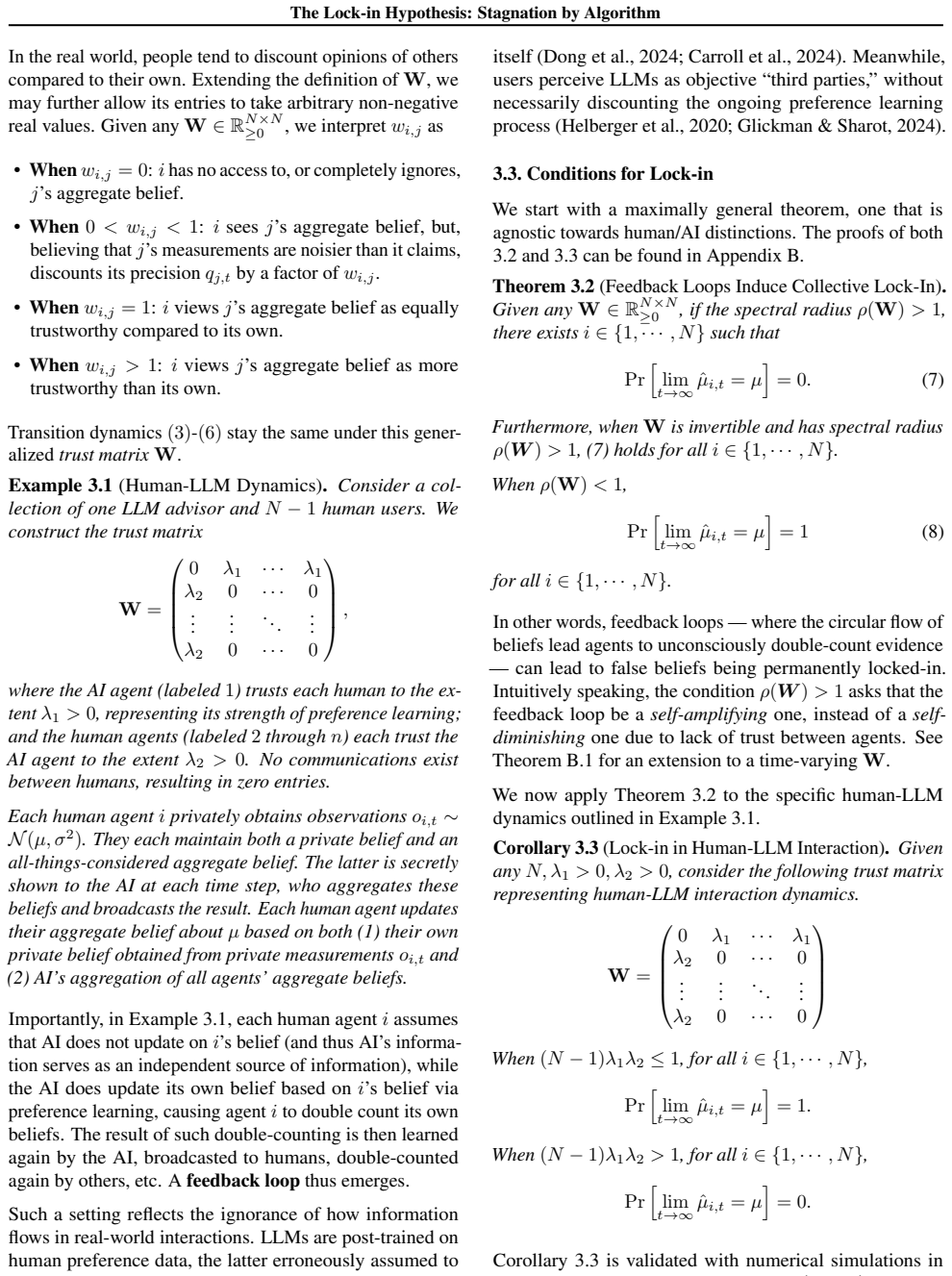
The load-bearing object is the trust matrix $W$ and its spectral radius. The recurrence for aggregate precision is $q_{t+1}=p_{t+1}+Wq_t$; when $\rho(W)>1$ the confidence vector grows exponentially while the measurement-driven private part grows only linearly, so the aggregate belief is dominated by its own past output rather than by evidence. The proof then shows that the error term $e_t=\hat\nu_t-\mu\mathbf{1}$ has non-vanishing variance and $\Pr[e_t=0]=0$, giving a false limit. Corollary 3.3 specializes $W$ to a rank-two matrix with eigenvalues $\pm\sqrt{(N-1)\lambda_1\lambda_2}$ and $0$, which locates the phase boundary exactly at $(N-1)\lambda_1\lambda_2=1$.
What would settle it
A randomized deployment that discloses to users that the assistant's answer is an aggregate of their own past inputs would settle the mechanism: if diversity loss and false convergence persist under explicit disclosure, the double-counting story is not the active cause, while stabilization under disclosure would confirm the independence assumption as the load-bearing step.
Extended reading notes
Core claim
On its own terms, the paper's central result is a phase transition in collective Bayesian belief dynamics. Agents observe a fixed quantity with independent noise and maintain private posteriors; they also form aggregate beliefs by combining their private posterior with the aggregate beliefs of agents they trust, encoded by a matrix $W$. When the spectral radius $\rho(W)>1$, at least one agent's posterior cannot converge to the truth, and when $W$ is invertible every agent's posterior fails to converge; when $\rho(W)<1$, all agents converge to truth with probability one. For one AI adviser and $N-1$ human users the matrix has eigenvalues $\pm\sqrt{(N-1)\lambda_1\lambda_2}$ and $0$, so the critical condition is $(N-1)\lambda_1\lambda_2>1$, a threshold the paper calls weak because it holds even for small trust values in moderately large groups. The mechanism is double counting: each human treats the AI's broadcast as independent evidence even though it includes their own prior belief, the AI re-learns the inflated belief, broadcasts it again, and the loop amplifies until the aggregate estimate locks onto a false value.
Load-bearing premise
The load-bearing premise is that human users treat the AI's broadcast as independent evidence and never discount it for already containing their own prior belief; if they did, the feedback loop would not double-count and the spectral-radius condition would not bite.
Editorial extensions
If this is right
- No extreme gullibility is required: with 100 humans plus one AI, the threshold is crossed when each side discounts the other's belief by a factor of only 0.1.
- Diversity loss in natural-language user messages is a usable early indicator of lock-in, visible before the group has fully converged.
- Because the product $(N-1)\lambda_1\lambda_2$ enters symmetrically, either reducing user trust in the AI or reducing the AI's weight on user preferences can push a system back below the threshold and restore convergence to truth.
- In real deployment logs, new GPT versions that succeed earlier versions are followed by statistically detectable discontinuous drops in conceptual diversity, which the paper reads as the fingerprint of iterative training on human data.
Reading between the lines
- If the double-counting mechanism is the true cause, a testable prediction follows: telling users that the assistant's reply aggregates their own past inputs should damp the effect, because it replaces the independence assumption with a discounting rule; this can be run in the paper's own agent simulation by adding one sentence to the prompt.
- The same spectral-radius argument is not specific to language models: any service that learns from aggregate user feedback and broadcasts a consensus, such as news ranking or recommendation, should exhibit the same phase transition, so lock-in may be a general failure mode of learn-from-users algorithms rather than an LLM peculiarity.
- The paper leaves ground truth out of value-laden domains; an extension of the theorem would replace 'false belief' with a fixed point of the dynamics, making the model predict which stances survive under a given trust pattern rather than which are true.
- A natural next experiment is to use the WildChat-style diversity metric on a controlled population where model version updates are randomized, which the paper itself identifies as a path to stronger causal evidence.
Editorial analysis
A structured set of objections, weighed in public.
Referee Report
Summary. This paper proposes a "lock-in hypothesis" for human-LLM interaction: LLMs learn user beliefs, reinforce them through generated content, and reabsorb them, eventually locking a population into confident false beliefs and reducing conceptual diversity. The authors develop a Bayesian social-learning model with a trust matrix W, claim a phase transition at spectral radius ρ(W)=1, specialize it to the threshold (N−1)λ1λ2=1 for one LLM and N−1 human users, and report agent-based LLM simulations plus an observational analysis of WildChat showing drops in user-message concept diversity after GPT model-version releases. The intended contribution is a mechanistic formal condition for lock-in and an early real-world signal for monitoring it.
Significance. If the formal result were correct as stated, this paper would provide a rare simple, non-data-fitted condition under which an LLM-mediated echo chamber produces inevitable false consensus, together with a real-world metric for observing it. The manuscript has clear strengths: an explicit formal model with a clean threshold, publicly released code and data, a portfolio of diversity metrics with sensitivity analyses, and an unusually candid limitations section. These make the paper worth serious consideration. However, the main theorem as stated is inconsistent with the model's own definitions, and the empirical design does not identify the feedback-loop mechanism it claims to support. With a corrected theorem statement, a careful explanation of what is meant by "belief", and a properly qualified empirical interpretation, the paper could make a useful contribution; in its current form it overstates both the formal and the empirical results.
major comments (3)
- [§3.1–§3.3, Theorem 3.2 and Appendix B.3] Theorem 3.2 as stated is contradicted by the model's own definitions. In §3.1, μ̂_{i,t} is the private posterior mean, and equation (4), together with p_{i,t}=tσ_i^{-2}, implies μ̂_{i,t}=(1/t)Σ_{s=1}^t o_{i,s}, the running sample mean of i.i.d. N(μ,σ_i²) observations. By the strong law of large numbers, Pr(lim_{t→∞} μ̂_{i,t}=μ)=1 for every trust matrix W. Hence equation (7) in Theorem 3.2, and the corresponding statement in Corollary 3.3, cannot hold for μ̂. Appendix B.3 actually proves a statement about the aggregate belief ν̂, defining e_t := ν̂_t − μ1 and analyzing its variance. The formal contribution is salvageable by replacing every occurrence of μ̂ with ν̂ in Theorem 3.2 and Corollary 3.3 and by explicitly stating that the object of study is the aggregate all-things-considered posterior, not the private posterior. As written, however, the paper's central theorem is invalid, and the claim of "inevitable false consensus" is not supported by the stated mathematics.
- [§5.4, Figure 5, Table 1] The regression-kink design tests only for a discontinuous change in the slope of user-message conceptual diversity at GPT version-switch dates. Such a discontinuity is consistent with the hypothesized human-LLM feedback loop, but it is equally consistent with a direct change in model behavior (for example, different output style, different topic steering, new safety filters) or with changes in the user population, because the diversity metric is computed over user messages, not over beliefs measured after exposure. The paper's Limitations section concedes that "we aren't yet certain why there are such drops" and that RKD "may suffer from temporal confounders in general." To support the specific feedback-loop mechanism, the analysis would need an additional pathway measurement—for instance, showing that the diversity drop is mediated by model outputs that reflect users' earlier concepts, or that the same users exhibit persistent belief change after controlling for model-output changes. Without this, the empirical evidence cannot carry the paper's claim of "first real-world evidence supporting the existence of a human-LLM feedback loop."
- [§3.2, Example 3.1] The formal result's strength comes from a specific and strong behavioral assumption: that each human treats the AI's broadcast as an independent source of evidence even though the broadcast is a deterministic function of the humans' own previous aggregate beliefs. This is stated explicitly in Example 3.1 and is the mechanism that creates double-counting. No evidence is provided that real users behave this way, and the assumption is not a theorem: if users discount the broadcast for the portion that reflects their own prior beliefs, the double-counting term is reduced and the spectral-radius condition no longer implies divergence. The paper should present the result as a sufficient condition under a testable model of user naivete, and it should discuss whether the "inevitability" claim survives when users have partial awareness of the loop. As it stands, the conclusion is one step removed from the stated model assumptions.
minor comments (5)
- [Appendix B.3, Eq. (27)] The displayed variance recursion appears to have a typo: Var[e_t] appears on both sides of the equation; presumably the right-hand side should involve the variance of the measurement noise ε_k. Please clarify the derivation and state explicitly that e_t is Gaussian with positive variance so that Pr(e_t=0)=0 follows from standard properties of Gaussian variables.
- [§5.3, Eq. (9)] The lineage diversity Dlineage is not defined for |C|<2, because the expectation over pairs of concepts is undefined for a singleton corpus. Please specify a convention for small corpora (for example, Dlineage=1 for a singleton set).
- [§5.4 and Figure 5] Figure 5 shows "No Data" for the GPT-4-1106-preview release, but Table 1 includes columns for both GPT-4-0125 and GPT-3.5-turbo-0613 and discusses three release dates. Please clarify which releases are actually analyzed and why one release has no data.
- [§5, Table 1 and Appendix A] Several thresholds in the empirical pipeline—the top 2.5% value-laden cutoff, the 1% topic cluster threshold for topic entropy, and the 75-character/75-conversation templated-message filter—are fixed rather than varied. A sensitivity analysis over these thresholds would strengthen the robustness claims.
- [§3, Appendix C] There are several typos that should be corrected: "pobabilistic inference" in §3, "groupd beliefs" in the simulation prompts in Appendix C, and "sufferred" in Appendix D.3. These do not affect the technical content but should be cleaned up before publication.
Circularity Check
No circular derivation: the lock-in threshold is a spectral-radius consequence of the stated update rules, and the WildChat analysis is an independent measurement exercise; the main formal risk is a statement/proof mismatch (private belief vs. aggregate belief), which is a correctness issue rather than a circularity.
full rationale
The derivation chain is not circular. Theorem 3.2 and Corollary 3.3 derive the condition rho(W) > 1 from the trust matrix and the Bayesian update equations (3)-(6); the threshold (N-1)lambda1*lambda2 = 1 is a computed spectral-radius property, not a fitted parameter or a renamed input. The numerical simulations in Figure 1 implement the same equations, so they serve as a consistency check rather than an independent empirical test, but they do not feed fitted values back into the theorem. The empirical section tests diversity loss on WildChat using a concept hierarchy built from that same corpus; this is a measurement scaffold, not a circular derivation, because the hypotheses concern real-world discontinuities at GPT version-release dates and are evaluated with regression and RKD, not derived from the formal model. The paper does contain self-citations (e.g., Qiu et al. 2024 for the term 'lock-in', Jin et al. 2024 for pluralistic alignment), but none is load-bearing: removing them would not change the theorem, the simulations, or the empirical estimates. The serious formal problem is that Theorem 3.2 states a claim about the private posterior mean mu-hat, which by equation (4) is the running sample mean of i.i.d. observations and therefore converges to mu almost surely by the strong law of large numbers, while the proof in Appendix B.3 actually analyzes the aggregate belief error e_t := nu-hat_t - mu*1. This is a statement/proof mismatch and a correctness risk, not a circular reduction: the conclusion contradicts the model's own definitions rather than being equivalent to them. The paper's own Limitations section appropriately flags the WildChat evidence as early-stage and notes uncertainty about the cause of the diversity drops, further supporting the assessment that the empirical claims are not presented as forced by the model. Overall, no load-bearing step reduces, by construction or by self-citation, to its own inputs.
Assumptions & free parameters
free parameters (3)
- value-laden concept cutoff =
top 2.5%
- templated-message filter thresholds =
prefix length 75, more than 75 duplicates
- topic cluster threshold for entropy and Jaccard metrics =
1% of all concepts
assumptions (6)
- standard math Gaussian observations and conjugate Bayesian updating with known variance
- domain assumption Each agent has access only to others' aggregate beliefs, not their private measurements
- ad hoc to paper Humans and AI treat the broadcast belief as independent evidence, ignoring that it contains their own past beliefs
- domain assumption WildChat user messages are approximately representative of global GPT usage
- domain assumption The learned concept hierarchy and LLM concept extraction faithfully represent semantic content of user messages
- domain assumption Regression kink design identifies causal effects because temporal confounders are smooth at model release dates
Cite this review
Pith. "Pith review of The Lock-in Hypothesis: Stagnation by Algorithm." pith.science (2026). https://pith.science/paper/2CSI55RW
@misc{pith2026250606166,
  author       = {Pith},
  title        = {Pith review of: The Lock-in Hypothesis: Stagnation by Algorithm},
  year         = {2026},
  howpublished = {\url{https://pith.science/paper/2CSI55RW}},
  note         = {Machine review of arXiv:2506.06166}
}
read the original abstract
The training and deployment of large language models (LLMs) create a feedback loop with human users: models learn human beliefs from data, reinforce these beliefs with generated content, reabsorb the reinforced beliefs, and feed them back to users again and again. This dynamic resembles an echo chamber. We hypothesize that this feedback loop entrenches the existing values and beliefs of users, leading to a loss of diversity and potentially the lock-in of false beliefs. We formalize this hypothesis and test it empirically with agent-based LLM simulations and real-world GPT usage data. Analysis reveals sudden but sustained drops in diversity after the release of new GPT iterations, consistent with the hypothesized human-AI feedback loop. Code and data available at https://thelockinhypothesis.com
Figures


Figures from the paper (11 more)


Reference graph
Works this paper leans on
-
[1]
Extracting concepts (e.g., computer, environmental protection, world cup) mentioned or implied in each conversation, with the Llama-3.1-8B-Instruct model (Dubey et al., 2024)
work page 2024
-
[2]
Perform lemmatization on the concepts with the WordNet Lemmatizer (Miller, 1995; Bird, 2006)
work page 1995
-
[3]
Obtain D = 256-dimensional embeddings for each concept using the voyage-3-large model
-
[4]
Perform hierarchical clusterization with the HDBSCAN algorithm (McInnes et al., 2017). This would produce a tree with specific concepts at the bottom, and generic concept clusters at the top. The root node is an all-encompassing cluster that captures all concepts. Given the size of the hierarchy, please refer to our codebase to view its content. The READM...
work page 2017
-
[5]
supt v(t+1) |v(t+1)|1 − v(t) |v(t)|1 1 ≤ ψ for some ψ >0, where v(t) is the Perron vector of W(t). Then, if ϵ, ψ < h(c, L, U, N, δ), for all i ∈ {1, · · ·, N}, we have Pr h lim t→∞ ˆµi,t = µ i = 0. (15) Proof. We imitate the proof of Theorem 3.2. To do that, we only need to show lim m→+∞ (W(m)W(m − 1) · · ·W(0)v)i = +∞, ∀i, ∀v ∈ RN ≥0 \ {0}. (16) For that...
work page 1991
-
[8]
It is found that diversity tend to decrease with engagement for high-engagement users, while the trend is opposite for low-engagement users. Self-selection bias is a likely confounder here. Users who find GPT’s responses less diverse and less helpful tend to stop engaging with it (or engage less), thereby reversing the direction of causality. We believe i...
-
[9]
∥W(t + 1) − W(t)∥1 ≤ ϵ for some constant ϵ >0
-
[10]
ρ(W(t)) ≥ c for some constant c >1
Show all 17 references
-
[11]
non-zero entries of W(t) are lower- and upper-bounded by positive constants 0 < L < U <+∞
-
[12]
for each W(t), all its non-leading eigenvalues are no larger than 1 − δ, for some constant δ >0
-
[14]
Embedding: Obtain 256-dimensional embeddings for each knowledge item using the voyage-3-large model
-
[15]
Clustering: Perform clusterization with the HDBSCAN algorithm (McInnes et al., 2017) on all knowledge bases combined
2017
-
[16]
Dimensionality Reduction: Perform UMAP to reduce the dimensions of embeddings to draw a projection of clusters on 2D primary components (McInnes et al., 2018)
2018
-
[17]
epigenetic modification
Diversity Evaluation: Perform Euclidean Distance evaluation on all pairs of embeddings of knowledge items on a given knowledge base. 38 The Lock-in Hypothesis: Stagnation by Algorithm D.2.3. R ESULTS Out of three independent simulation runs, two see the eventual collapse of th...
1900
-
[1979]
for heteroscedasticity, and upon positive result, use the HC3 and the Driscoll & Kraay standard error (Cribari-Neto & da Silva, 2011; Driscoll & Kraay, 1998), given the heavy-tailed nature of user interaction statistics and therefore the potential for high leverage. We control...
2011
-
[1999]
with the following steps:
-
[2024]
Williams, M., Carroll, M., Narang, A., Weisser, C., Mur- phy, B., and Dragan, A
URL https://github.com/pymc-labs/ CausalPy/. Williams, M., Carroll, M., Narang, A., Weisser, C., Mur- phy, B., and Dragan, A. On targeted manipulation and deception when optimizing llms for user feedback. arXiv preprint ArXiv:2411.02306, 2024. Wittgenstein, L. Philosophical in...
2024 arXiv
Reviewed August 7, 2026 · model on record in the stance chip above.
Discussion (0). Sign in to comment.