REVIEW 2 major objections 5 minor 66 references
When training on private synthetic data, fix fairness after training, not before.
Reviewed by Pith at T0; open to challenge. T0 means a machine referee read the full paper against a public rubric. the ladder, T0–T4 →
T0 review · deepseek-v4-flash
2026-08-02 08:01 UTC pith:2HHBHDR5
load-bearing objection Solid, carefully executed benchmark on fairness interventions under DP synthetic data; the headline claim about post-processing is well supported qualitatively, but the formal scalarization is sensitive to untested weights. the 2 major comments →
Where to Intervene? Benchmarking Fairness-Aware Learning on Differentially Private Synthetic Tabular Data
The pith
A machine-rendered reading of the paper's core claim, the machinery that carries it, and where it could break.
Core claim
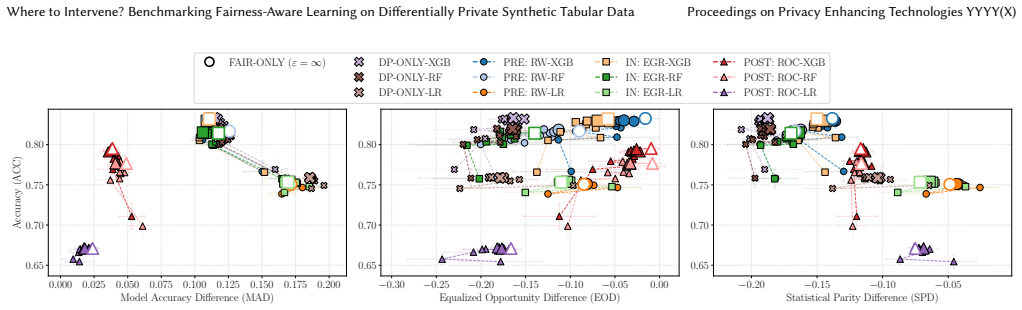
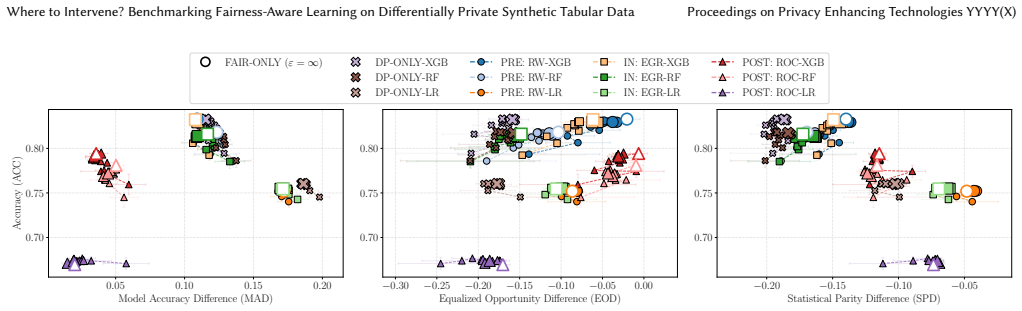
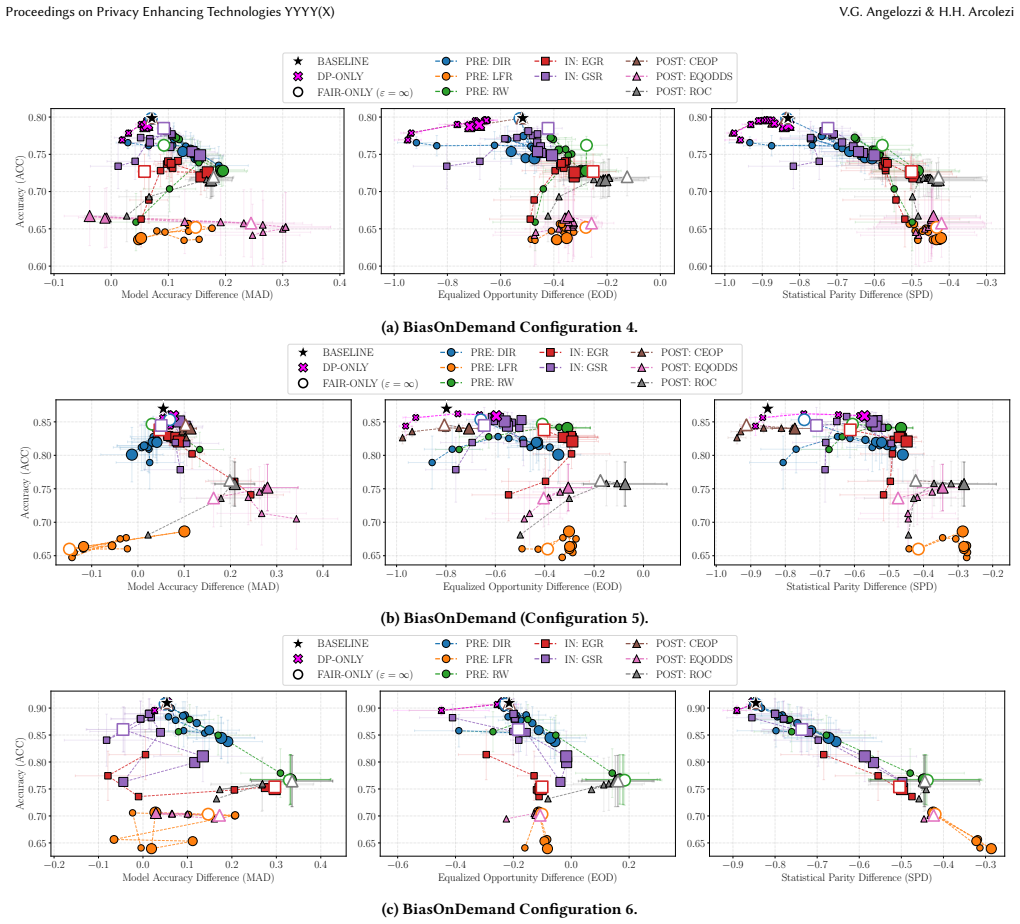
The paper's central claim is that the stage of intervention matters more than the specific mechanism: when classifiers are trained on differentially private synthetic data, fairness post-processing, which treats the model as a black box and adjusts its outputs, provides the strongest fairness–utility trade-offs, specifically for equalized opportunity difference (EOD) and statistical parity difference (SPD). This conclusion is supported by paired one-sided Wilcoxon signed-rank tests comparing the best post-processing method against the best pre- and in-processing methods on a scalarized distance to the ideal point (utility 1, disparity 0). The tests show post-processing is significantly close
What carries the argument
The argument is carried by the intervention-stage comparison and a scalarized trade-off score. For each configuration, the authors compute a weighted Euclidean distance to the ideal point (perfect utility, zero disparity) with equal weights on utility and fairness, then take the best-performing mechanism within each stage (e.g., ROC or EqOdds for post-processing). Paired Wilcoxon signed-rank tests compare the best-stage scores across post- versus pre- and in-processing. The conceptual load-bearing identity is the DP post-processing property: any fairness intervention applied after the DP data release is itself DP post-processing and cannot weaken the privacy guarantee, so post-processing is
Load-bearing premise
The stage ranking rests on a single score that weights fairness and utility equally; the paper does not test how the ranking changes if utility is weighted more heavily.
What would settle it
Recompute the post-processing-versus-other comparison while varying the fairness weight in the distance score or using Pareto dominance counts. If a pre- or in-processing method becomes closest to the ideal for a substantial range of weights, the headline claim that post-processing is the strongest stage would fail.
If this is right
- Pairing a high-utility DP synthesizer with post-processing (ROC or EqOdds) yields the most favorable fairness–utility trade-offs when accuracy matters.
- Strong parity constraints can be met by aggressive pre-processing like learning fair representations, but at substantial utility cost and occasional training instability under DP noise.
- In-processing methods such as exponentiated gradient reduction give only bounded, stable fairness gains; grid search reduction is often indistinguishable from doing nothing.
- Fairness recovery under DP is metric-specific: equal opportunity and statistical parity improve significantly, while model accuracy difference does not.
- With a lower-utility synthesizer like MST, DP synthetic data imposes a structural utility ceiling that fairness interventions cannot overcome.
Where Pith is reading between the lines
- The equal weighting in the trade-off scalarization is a choice, not a law; re-running the analysis with weights favoring utility could re-rank stages, since in-processing preserves utility best. A sensitivity analysis over weights would test the robustness of the post-processing recommendation.
- The benchmark only covers marginal-based DP synthesizers; deep generative DP synthesizers have lower residual signal, so post-processing's edge may shrink or vanish there, an untested boundary of the conclusion.
- The findings suggest fairness can be treated as a post-production step in DP synthetic data pipelines, meaning developers do not need to redesign the DP generator to address downstream bias.
- A natural testable extension: on the same data, compare the post-processing recommendation against jointly fair-and-private training; the paper's evidence implies the former is more practical, but the head-to-head is open.
Editorial analysis
A structured set of objections, weighed in public.
Referee Report
Summary. The paper presents a benchmark study of fairness-aware interventions applied to classifiers trained on differentially private synthetic tabular data. It compares pre-, in-, and post-processing fairness mechanisms across four datasets, three classifiers, and twelve privacy budgets, using AIM as the primary DP synthesizer and MST as a secondary one. The central claim is that DP-only training degrades both utility and fairness, that fairness interventions can partially recover fairness, and that post-processing methods—particularly ROC and EqOdds—offer the most favorable and stable fairness–utility trade-offs, while pre- and in-processing methods are either more utility-damaging or more limited in disparity reduction. The paper includes paired Wilcoxon signed-rank tests for two claims: (1) DP+Fair reduces EOD/SPD relative to DP-only, and (2) POST outperforms PRE/IN on a scalarized EOD/SPD-oriented fairness–utility measure. Code and data are released.
Significance. If the findings hold, this is a useful and timely benchmark for practitioners choosing where to intervene when training on DP synthetic data. The experimental design is strong: 20 random seeds, fixed splits, paired statistical tests with confidence intervals, a DP-compliant calibration ablation, hyperparameter sensitivity for in-processing methods, and appendices covering MST and multiple classifiers. The release of code, data, and artifacts is a concrete reproducibility asset. The main weakness is that the headline stage-level conclusion rests on one particular scalarization with equal weights, and the paper does not show that the ordering is robust to the relative importance of utility versus fairness.
major comments (2)
- [§6, Eq. (1), Table 2] Claim 2, which is presented as a central statistical validation, is established only for the scalarization S with w_U = w_F = 0.5. No sensitivity analysis over w is reported. The two summands have different scales: in the reported regimes (1-U) is typically 0.1–0.3, while |EOD| and |SPD| can reach 0.4–0.5, so equal weights effectively prioritize fairness over utility. A practitioner who weights utility more heavily (e.g., w_U = 0.9, w_F = 0.1) may find a utility-preserving in-processing method such as EGR closer to the ideal than ROC/EqOdds, reversing the headline ordering. Since the abstract and Section 6 state that post-processing is the strongest intervention stage without this caveat, the claim is not robust as stated. Please add a weight sweep (e.g., w_U ∈ {0.1, 0.3, 0.5, 0.7, 0.9}) and report the ranges in which POST wins, or explicitly qualify the conclusion to the equal-weight ca
- [§6, Claim 2 construction, Table 2] The comparison 'POST vs PRE/IN' is asymmetric. POST is defined as the minimum S over only ROC and EqOdds, while PRE and IN are defined as the minimum over all methods in the stage, including weak performers such as DIR and GSR. This gives POST a structural advantage in the paired comparison. Please report the result with CEOP included in POST, or justify the exclusion explicitly and restate the claim as being about the 'best of ROC/EqOdds' rather than about the post-processing stage as a whole.
minor comments (5)
- [Definition 3, §4.5] Typo: 'Eqal Opportunity Difference' should be 'Equal Opportunity Difference'.
- [§6, first paragraph of Discussion] Duplicate word: 'Overall,Overall, the Pareto-front analysis suggests...' should be 'Overall, the Pareto-front analysis suggests...'.
- [§4.6 and Appendix B.1] The description of the DP-compliant calibration ablation is confusing: it says D_temp 'undergoes differential privacy preprocessing' and is then split into train and calibration sets. Clarify that a DP synthetic calibration set is generated from D_temp under ε-DP, and that the synthetic records are then used for calibration.
- [Tables 1 and 2] Please define 'Win rate' explicitly (e.g., the proportion of paired comparisons for which d_i < 0) and state whether any seeds or configurations were excluded from the paired tests.
- [Eq. (1)] The square root expression is a scaled Euclidean distance; it may help to state explicitly that w_U + w_F = 1 and to note the practical ranges of (1-U) and |m| so readers can interpret the equal-weight default.
Circularity Check
No significant circularity: benchmark conclusions rest on external data, released code, and standard fairness/DP methods; the equal-weight scalarization is a robustness caveat, not a circular deduction.
full rationale
The paper's central claims are empirical findings from a benchmark, not derivations from a fitted model. Claim 1 compares DP+Fair to DP-only using paired Wilcoxon tests on absolute disparities; Claim 2 uses a weighted Euclidean score in Eq. (1), but that scalarization is an externally chosen evaluation criterion, not an object fitted to the outcome, and the test compares measured S values for interventions from independent implementations (AIF360, SmartNoise). The post-processing advantage is reported as an observed pattern across datasets and privacy budgets, supported by a DP-compliant calibration ablation (App. B.1) and an in-processing hyperparameter sweep (App. B.2), so the conclusion is not forced by construction. The authors cite their own prior work (refs [7], [41], [42]) only as related work on privacy/fairness, not to justify the benchmark's validity; no uniqueness theorem or ansatz is imported from those citations. The equal-weight choice w_U = w_F = 0.5 is an arbitrary methodological parameter and could change which stage ranks first under different utility weights, but that is a sensitivity/robustness weakness, not a circularity: nothing in Eq. (1) is defined in terms of the conclusion, and no fitted parameter is renamed as a prediction. Hence no circular step meets the quote-and-reduction standard.
Axiom & Free-Parameter Ledger
free parameters (1)
- Logistic Regression hyperparameters =
solver=saga, penalty=elasticnet, l1_ratio=0.5, C=0.8, max_iter=10000
axioms (4)
- standard math DP post-processing property (Proposition 1)
- domain assumption AIF360 implementations are faithful and appropriate for all interventions
- domain assumption Binary classification and binary protected attributes are the canonical setting for group-fairness evaluation
- domain assumption AIM is state-of-the-art for tabular DP synthesis as asserted by cited tutorials/benchmarks
read the original abstract
Machine learning models are increasingly deployed in high-stakes domains, raising concerns about both privacy and fairness. Differential Privacy (DP) has become a gold standard for privacy-preserving data analysis, while fairness-aware mechanisms aim to mitigate discrimination against underrepresented groups. However, these objectives can conflict: DP often amplifies disparities across demographic groups, and little is known about whether established fairness interventions remain effective under DP constraints. In this work, we present, to our knowledge, the first systematic evaluation of fairness interventions on differentially private synthetic tabular data. Our benchmark centers on the Adaptive Iterative Mechanism (AIM), identified as the state-of-the-art marginal-based DP synthesizer (Cormode et al. 2025). We thus evaluate fairness interventions across four datasets, multiple group fairness metrics, and three categories of mitigation strategies (pre-processing, in-processing, and post-processing) under a wide range of privacy budgets. We compare four pipeline configurations: (Baseline) training on original data; (DP-only) training on DP synthetic data; (Fair-only) applying fairness mechanisms on original data; and (DP+Fair) combining fairness mechanisms with DP synthetic data. Our results demonstrate that while DP alone can degrade both utility and fairness, applying fairness interventions can partially restore equitable outcomes. Among them, post-processing methods tend to provide more stable fairness-utility trade-offs across privacy budgets and synthesizers, achieving strong fairness improvements while preserving competitive utility relative to other intervention stages. We release all code, data, and experimental artifacts in an open-source repository to ensure full reproducibility and to support future research on the privacy-fairness-utility trade-off.
Figures







Reference graph
Works this paper leans on
-
[1]
Tumult Labs
2024. Tumult Labs. https://www.tmlt.io/differentially-private-synthetic-data
2024
-
[2]
2024. YData. https://ydata.ai/products/synthesizer.html
2024
-
[3]
Jan Aalmoes, Vasisht Duddu, and Antoine Boutet. 2025. On the Alignment of Group Fairness with Attribute Privacy. InInternational Conference on Web Information Systems Engineering. Springer, 333–348. https://doi.org/10.1007/978- 981-96-0567-5_24
doi:10.1007/978- 2025
-
[4]
Brendan McMahan, Ilya Mironov, Kunal Talwar, and Li Zhang
Martin Abadi, Andy Chu, Ian Goodfellow, H. Brendan McMahan, Ilya Mironov, Kunal Talwar, and Li Zhang. 2016. Deep Learning with Differential Privacy. In Proceedings of the 2016 ACM SIGSAC Conference on Computer and Communications Security(Vienna, Austria)(CCS ’16). Association for Computing Machinery, New York, NY, USA, 308–318. https://doi.org/10.1145/297...
arXiv 2016
-
[5]
Alekh Agarwal, Alina Beygelzimer, Miroslav Dudik, John Langford, and Hanna Wallach. 2018. A Reductions Approach to Fair Classification. InProceedings of the 35th International Conference on Machine Learning (Proceedings of Machine Learning Research, Vol. 80), Jennifer Dy and Andreas Krause (Eds.). PMLR, 60–69. https://proceedings.mlr.press/v80/agarwal18a.html
2018
-
[6]
Julia Angwin, Jeff Larson, Surya Mattu, and Lauren Kirchner. 2022. Machine bias. InEthics of data and analytics. Auerbach Publications, 254–264
2022
-
[7]
Héber H Arcolezi, Mina Alishahi, Adda-Akram Bendoukha, and Nesrine Kaaniche
-
[8]
Eugene Bagdasaryan, Omid Poursaeed, and Vitaly Shmatikov. 2019. Differential privacy has disparate impact on model accuracy.Advances in neural information processing systems32 (2019)
2019
-
[9]
2023.Fairness and Machine Learning: Limitations and Opportunities
Solon Barocas, Moritz Hardt, and Arvind Narayanan. 2023.Fairness and Machine Learning: Limitations and Opportunities. MIT Press
2023
-
[10]
Joachim Baumann, Alessandro Castelnovo, Riccardo Crupi, Nicole Inverardi, and Daniele Regoli. 2023. Bias on Demand: A Modelling Framework That Generates Synthetic Data With Bias. InProceedings of the 2023 ACM Conference on Fairness, Accountability, and Transparency(Chicago, IL, USA)(FAccT ’23). Association for Computing Machinery, New York, NY, USA, 1002–...
arXiv 2023
-
[11]
Barry Becker and Ronny Kohavi. 1996. Adult. UCI Machine Learning Repository. DOI: https://doi.org/10.24432/C5XW20
doi:10.24432/c5xw20 1996
-
[12]
Rachel KE Bellamy, Kuntal Dey, Michael Hind, Samuel C Hoffman, Stephanie Houde, Kalapriya Kannan, Pranay Lohia, Jacquelyn Martino, Sameep Mehta, Aleksandra Mojsilovic, et al . 2018. AI Fairness 360: An extensible toolkit for detecting, understanding, and mitigating unwanted algorithmic bias
2018
-
[13]
Leo Breiman. 2001. Random forests.Machine learning45, 1 (2001), 5–32
2001
-
[14]
Blake Bullwinkel, Kristen Grabarz, Lily Ke, Scarlett Gong, Chris Tanner, and Joshua Allen. 2022. Evaluating the fairness impact of differentially private syn- thetic data.arXiv preprint arXiv:2205.04321(2022)
Pith/arXiv arXiv 2022
-
[15]
Toon Calders, Faisal Kamiran, and Mykola Pechenizkiy. 2009. Building Classifiers with Independency Constraints. In2009 IEEE International Conference on Data Mining Workshops. 13–18. https://doi.org/10.1109/ICDMW.2009.83
-
[16]
Hongyan Chang and Reza Shokri. 2021. On the Privacy Risks of Algorithmic Fairness. In2021 IEEE European Symposium on Security and Privacy (EuroS&P). 292–303. https://doi.org/10.1109/EuroSP51992.2021.00028
arXiv 2021
-
[17]
Tianqi Chen and Carlos Guestrin. 2016. Xgboost: A scalable tree boosting system. InProceedings of the 22nd acm sigkdd international conference on knowledge discovery and data mining. 785–794
2016
-
[18]
CNIL. 2026. AI system development: CNIL’s recommendations to comply with the GDPR. https://www.cnil.fr/en/ai-system-development-cnils-recommendations- comply-gdpr
2026
-
[19]
1999.Practical nonparametric statistics
William Jay Conover. 1999.Practical nonparametric statistics. john wiley & sons
1999
-
[20]
Graham Cormode, Shripad Gade, Samuel Maddock, and Enayat Ullah. 2025. Synthetic Tabular Data: Methods, Attacks and Defenses.Proc. VLDB Endow.18, 12 (Sept. 2025), 5448–5450. https://doi.org/10.14778/3750601.3750692
arXiv 2025
-
[21]
Frances Ding, Moritz Hardt, John Miller, and Ludwig Schmidt. 2021. Retiring adult: New datasets for fair machine learning.Advances in Neural Information Processing Systems34 (2021)
2021
-
[22]
Cynthia Dwork, Moritz Hardt, Toniann Pitassi, Omer Reingold, and Richard Zemel. 2012. Fairness through awareness. InProceedings of the 3rd Innovations in Theoretical Computer Science Conference (ITCS ’12). Association for Comput- ing Machinery, New York, NY, USA, 214–226. https://doi.org/10.1145/2090236. 2090255
doi:10.1145/2090236 2012
-
[23]
Cynthia Dwork, Frank McSherry, Kobbi Nissim, and Adam Smith. 2006. Cali- brating Noise to Sensitivity in Private Data Analysis. InTheory of Cryptography, Shai Halevi and Tal Rabin (Eds.). Springer Berlin Heidelberg, Berlin, Heidelberg, 265–284
2006
-
[24]
Cynthia Dwork and Aaron Roth. 2014. The algorithmic foundations of differential privacy.Foundations and Trends®in Theoretical Computer Science9, 3–4 (2014), 211–407
2014
-
[25]
European Parliament and Council. 2024. Regulation (EU) 2024/1689 of the Euro- pean Parliament and of the Council of 13 June 2024 laying down harmonised rules on artificial intelligence and amending Regulations (EC) No 300/2008, (EU) No 167/2013, (EU) No 168/2013, (EU) 2018/858, (EU) 2018/1139 and (EU) 2019/2144 and Directives 2014/90/EU, (EU) 2016/797 and...
2024
-
[26]
Tom Farrand, Fatemehsadat Mireshghallah, Sahib Singh, and Andrew Trask
-
[27]
Friedler, John Moeller, Carlos Scheidegger, and Suresh Venkatasubramanian
Michael Feldman, Sorelle A. Friedler, John Moeller, Carlos Scheidegger, and Suresh Venkatasubramanian. 2015. Certifying and Removing Disparate Impact. InProceedings of the 21th ACM SIGKDD International Conference on Knowledge Discovery and Data Mining (KDD ’15). Association for Computing Machinery, New York, NY, USA, 259–268. https://doi.org/10.1145/27832...
arXiv 2015
-
[28]
Ferdinando Fioretto, Cuong Tran, Pascal Van Hentenryck, and Keyu Zhu. 2022. Differential Privacy and Fairness in Decisions and Learning Tasks: A Survey. In Proceedings of the Thirty-First International Joint Conference on Artificial Intelli- gence. IJCAI. https://doi.org/10.24963/ijcai.2022/766
-
[29]
FSA. 2023. Feedback Statement on Synthetic Data Call for Input. https://www.fca.org.uk/publications/feedback-statements/fs23-1-feedback- statement-synthetic-data-call-for-input
2023
-
[30]
Georgi Ganev and Emiliano De Cristofaro. 2025. The Inadequacy of Similarity- Based Privacy Metrics: Privacy Attacks Against “Truly Anonymous” Synthetic Datasets. In2025 IEEE Symposium on Security and Privacy (SP). 4007–4025. https: //doi.org/10.1109/SP61157.2025.00218
arXiv 2025
-
[31]
Georgi Ganev, Bristena Oprisanu, and Emiliano De Cristofaro. 2022. Robin hood and matthew effects: Differential privacy has disparate impact on synthetic data. InInternational Conference on Machine Learning. PMLR, 6944–6959
2022
-
[32]
Georgi Ganev, Kai Xu, and Emiliano De Cristofaro. 2024. Graphical vs. Deep Generative Models: Measuring the Impact of Differentially Private Mechanisms and Budgets on Utility. InProceedings of the 2024 on ACM SIGSAC Conference on Computer and Communications Security(Salt Lake City, UT, USA)(CCS ’24). Association for Computing Machinery, New York, NY, USA,...
arXiv 2024
-
[33]
Matteo Giomi, Franziska Boenisch, Christoph Wehmeyer, and Borbála Tasnádi
-
[34]
Moritz Hardt, Eric Price, and Nati Srebro. 2016. Equality of opportunity in supervised learning.Advances in neural information processing systems29 (2016)
2016
-
[35]
Yuzheng Hu, Fan Wu, Qinbin Li, Yunhui Long, Gonzalo Munilla Garrido, Chang Ge, Bolin Ding, David Forsyth, Bo Li, and Dawn Song. 2024. SoK: Privacy- Preserving Data Synthesis. In2024 IEEE Symposium on Security and Privacy (SP). 4696–4713. https://doi.org/10.1109/SP54263.2024.00002
arXiv 2024
-
[36]
James Jordon, Lukasz Szpruch, Florimond Houssiau, Mirko Bottarelli, Giovanni Cherubin, Carsten Maple, Samuel N Cohen, and Adrian Weller. 2022. Synthetic Data–what, why and how?arXiv preprint arXiv:2205.03257(2022)
Pith/arXiv arXiv 2022
-
[37]
Faisal Kamiran, Asim Karim, and Xiangliang Zhang. 2012. Decision theory for discrimination-aware classification. In2012 IEEE 12th international conference on data mining. IEEE, 924–929
2012
-
[38]
Soyeon Kim, Yuji Roh, Geon Heo, and Steven Euijong Whang. 2025. PFGuard: A Generative Framework with Privacy and Fairness Safeguards. InThe Thirteenth International Conference on Learning Representations
2025
-
[39]
Tongyu Liu, Ju Fan, Guoliang Li, Nan Tang, and Xiaoyong Du. 2024. Tabular data synthesis with generative adversarial networks: design space and optimizations. The VLDB Journal33, 2 (2024), 255–280. 14 Where to Intervene? Benchmarking Fairness-Aware Learning on Differentially Private Synthetic Tabular Data Proceedings on Privacy Enhancing Technologies 2026(4)
2024
-
[40]
Andrew Lowy, Zhuohang Li, Jing Liu, Toshiaki Koike-Akino, Kieran Parsons, and Ye Wang. 2024. Why does differential privacy with large epsilon defend against practical membership inference attacks?arXiv preprint arXiv:2402.09540(2024)
Pith/arXiv arXiv 2024
-
[41]
Karima Makhlouf, Heber H Arcolezi, Sami Zhioua, Ghassen Ben Brahim, and Catuscia Palamidessi. 2024. On the impact of multi-dimensional local differential privacy on fairness.Data Mining and Knowledge Discovery38, 4 (2024), 2252–2275. https://doi.org/10.1007/s10618-024-01031-0
-
[42]
Arcolezi, and Catuscia Palamidessi
Karima Makhlouf, Tamara Stefanović, Héber H. Arcolezi, and Catuscia Palamidessi. 2024. A Systematic and Formal Study of the Impact of Local Dif- ferential Privacy on Fairness: Preliminary Results. In2024 IEEE 37th Computer Security Foundations Symposium (CSF). 1–16. https://doi.org/10.1109/CSF61375. 2024.00039
arXiv 2024
-
[43]
Ryan McKenna, Gerome Miklau, and Daniel Sheldon. 2021. Winning the NIST contest: A scalable and general approach to differentially private synthetic data. arXiv preprint arXiv:2108.04978(2021)
Pith/arXiv arXiv 2021
-
[44]
Ryan McKenna, Brett Mullins, Daniel Sheldon, and Gerome Miklau. 2022. AIM: an adaptive and iterative mechanism for differentially private synthetic data.Proc. VLDB Endow.15, 11 (July 2022), 2599–2612. https://doi.org/10.14778/3551793. 3551817
doi:10.14778/3551793 2022
-
[45]
Ryan McKenna, Daniel Sheldon, and Gerome Miklau. 2019. Graphical-model based estimation and inference for differential privacy. InInternational Conference on Machine Learning. PMLR, 4435–4444
2019
-
[46]
2023.Probabilistic machine learning: Advanced topics
Kevin P Murphy. 2023.Probabilistic machine learning: Advanced topics. MIT press
2023
-
[47]
Nicolas Papernot, Shuang Song, Ilya Mironov, Ananth Raghunathan, Kunal Tal- war, and Ulfar Erlingsson. 2018. Scalable Private Learning with PATE. InInterna- tional Conference on Learning Representations
2018
-
[48]
Mayana Pereira, Meghana Kshirsagar, Sumit Mukherjee, Rahul Dodhia, Juan Lavista Ferres, and Rafael de Sousa. 2024. Assessment of differentially private synthetic data for utility and fairness in end-to-end machine learning pipelines for tabular data.PLOS ONE19, 2 (Feb. 2024), e0297271. https://doi.org/10.1371/ journal.pone.0297271
2024
-
[49]
Dana Pessach and Erez Shmueli. 2022. A Review on Fairness in Machine Learning. ACM Comput. Surv.55, 3, Article 51 (Feb. 2022), 44 pages. https://doi.org/10. 1145/3494672
2022
-
[50]
Geoff Pleiss, Manish Raghavan, Felix Wu, Jon Kleinberg, and Kilian Q Wein- berger. 2017. On Fairness and Calibration. InAdvances in Neural Infor- mation Processing Systems, I. Guyon, U. Von Luxburg, S. Bengio, H. Wal- lach, R. Fergus, S. Vishwanathan, and R. Garnett (Eds.), Vol. 30. Curran Associates, Inc. https://proceedings.neurips.cc/paper_files/paper/...
2017
-
[51]
Zhaozhi Qian, Rob Davis, and Mihaela Van Der Schaar. 2023. Synthcity: a benchmark framework for diverse use cases of tabular synthetic data.Advances in neural information processing systems36 (2023), 3173–3188
2023
-
[52]
Lucas Rosenblatt, Bernease Herman, Anastasia Holovenko, Wonkwon Lee, Joshua Loftus, Elizabeth McKinnie, Taras Rumezhak, Andrii Stadnik, Bill Howe, and Julia Stoyanovich. 2023. Epistemic Parity: Reproducibility as an Evaluation Metric for Differential Privacy.Proc. VLDB Endow.16, 11 (July 2023), 3178–3191. https://doi.org/10.14778/3611479.3611517
arXiv 2023
-
[53]
Theresa Stadler, Bristena Oprisanu, and Carmela Troncoso. 2022. Synthetic Data – Anonymisation Groundhog Day. In31st USENIX Security Symposium (USENIX Security 22). USENIX Association, Boston, MA, 1451–1468. https: //www.usenix.org/conference/usenixsecurity22/presentation/stadler
2022
-
[54]
Yuchao Tao, Ryan McKenna, Michael Hay, Ashwin Machanavajjhala, and Gerome Miklau. 2021. Benchmarking differentially private synthetic data generation algorithms.arXiv preprint arXiv:2112.09238(2021)
Pith/arXiv arXiv 2021
-
[55]
Reihaneh Torkzadehmahani, Peter Kairouz, and Benedict Paten. 2019. Dp-cgan: Differentially private synthetic data and label generation. InProceedings of the IEEE/CVF Conference on Computer Vision and Pattern Recognition Workshops. 0–0
2019
-
[56]
Archit Uniyal, Rakshit Naidu, Sasikanth Kotti, Sahib Singh, Patrik Joslin Kenfack, Fatemehsadat Mireshghallah, and Andrew Trask. 2021. Dp-sgd vs pate: Which has less disparate impact on model accuracy?arXiv preprint arXiv:2106.12576 (2021)
Pith/arXiv arXiv 2021
-
[57]
Census Bureau
U.S. Census Bureau. 2023. 2023 ACS 1-Year Public Use Microdata Sample (PUMS) Code Lists. https://www2.census.gov/programs-surveys/acs/tech_docs/pums/ code_lists/ACSPUMS2023CodeLists.xls. Accessed: 2025-09-06
2023
-
[58]
Lei Xu, Maria Skoularidou, Alfredo Cuesta-Infante, and Kalyan Veeramachaneni
-
[59]
Kai Yao and Marc Juarez. 2025. SoK: What Makes Private Learning Unfair?. In2025 IEEE Conference on Secure and Trustworthy Machine Learning. 841–857. https://doi.org/10.1109/SaTML64287.2025.00052
arXiv 2025
-
[60]
Zexi Yao, Nataša Krčo, Georgi Ganev, and Yves-Alexandre de Montjoye. 2025. The DCR delusion: measuring the privacy risk of synthetic data. InEuropean Symposium on Research in Computer Security. Springer, 469–487. https://doi.org/ 10.1007/978-3-032-07884-1_24
-
[61]
Rich Zemel, Yu Wu, Kevin Swersky, Toni Pitassi, and Cynthia Dwork. 2013. Learning fair representations. InInternational conference on machine learning. PMLR, 325–333
2013
-
[62]
Male”sexto 1 and others to 0; (ii) maps “White
Jun Zhang, Graham Cormode, Cecilia M. Procopiuc, Divesh Srivastava, and Xiaokui Xiao. 2017. PrivBayes: Private Data Release via Bayesian Networks. ACM Trans. Database Syst.42, 4, Article 25 (Oct. 2017), 41 pages. https://doi.org/ 10.1145/3134428 A Classifiers, Datasets, & Data Pre-Processing This section provides complementary details to support the repro...
doi:10.1145/3134428 2017
-
[2019]
Modeling tabular data using conditional gan.Advances in neural information processing systems32 (2019)
2019
-
[2020]
InProceedings of the 2020 workshop on privacy-preserving machine learning in practice
Neither private nor fair: Impact of data imbalance on utility and fairness in differential privacy. InProceedings of the 2020 workshop on privacy-preserving machine learning in practice. 15–19
2020
-
[2023]
Proceedings on Privacy Enhancing Technologies2 (2023), 312–328
A Unified Framework for Quantifying Privacy Risk in Synthetic Data. Proceedings on Privacy Enhancing Technologies2 (2023), 312–328
2023
-
[2025]
InECAI 2025
Fair Play for Individuals, Foul Play for Groups? Auditing Anonymization’s Impact on ML Fairness. InECAI 2025. IOS Press, 1009–1018. https://doi.org/10. 3233/FAIA250909
2025
discussion (0)
Sign in with ORCID, Apple, or X to comment. Anyone can read and Pith papers without signing in.