REVIEW 4 major objections 5 minor 2 cited by
Discovering Hierarchical Latent Capabilities of Language Models via Causal Representation Learning
T0 review · 4 major / 5 minor · reviewed 2026-08-07 · deepseek-v4-flash
Pith's one-line read Language-model benchmark results trace a causal chain from general capability through instruction-following to math.
desk verdict A transparent, useful look at low-rank structure and heterogeneity in LLM benchmarks, but the claimed causal hierarchy is an artifact of the triangular parametrization, not a discovery. read the letter →
The pith
A machine-rendered reading of the paper's core claim, the machinery that carries it, and where it could break.
The reading
What carries the argument
Hierarchical Component Analysis (HCA) is the central object. It starts with independent component analysis (ICA) on each base-model domain to obtain an unmixing matrix $M_k$ that maps observed benchmarks to independent sources, and it exploits the decomposition $M_k = P_k B_k H$, where $B_k$ is the domain-specific lower-triangular structural weight matrix and $H$ is the shared unmixing inverse of the mixing matrix $G$. The algorithm's key step is row-residual extraction: after guessing an order, it projects each row of $M_k$ onto the span of earlier rows and requires the projected residuals across domains to be rank 1, recovering the next row of $H$ as the top singular vector; it then searches over row permutations and fits the best lower-triangular $B_k$'s, selecting the configuration with the smallest maximum inexactness coefficient. The paper proves that under an exact linear SCM with non-Gaussian sources and enough generic domains, $H$ is identifiable up to a left lower-triangular factor for $K \ge d$, and it relaxes the setting to $\alpha$-inexact SCMs measured by MIC, with the four-domain fit achieving MIC 0.04.
What would settle it
Take one of the four base models, fine-tune it only on instruction-following examples that contain no mathematical content, and compare its MATH Lvl 5 score against a control model fine-tuned on an equal number of non-instruction paragraphs; the claimed causal chain predicts a significantly larger math gain in the instruction group, so a null or reversed result would refute it.
Extended reading notes
Core claim
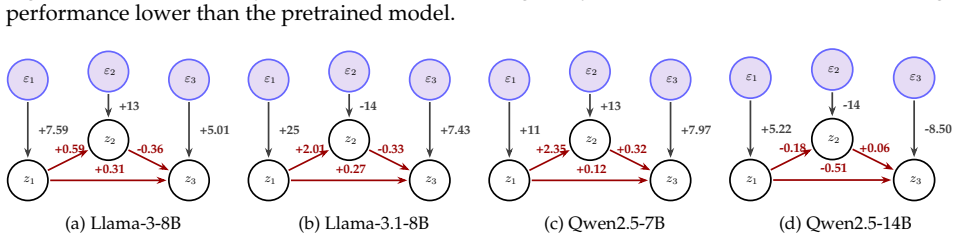
The paper's central claim is that, within the four base models that share an invariant subspace, observed benchmark vectors $x$ are approximately $G z$ for a shared mixing matrix $G$ and three latent capability factors $z_1, z_2, z_3$, and that within each base model those factors follow a linear structural causal model with one common directed graph: $z_1$ influences $z_2$ and $z_2$ influences $z_3$. The recovered factors align tightly with benchmarks, $z_1$ to BBH and MMLU-Pro (general problem solving), $z_2$ to IFEval (instruction following), and $z_3$ to MATH Lvl 5 (advanced mathematical reasoning), with the $z_3$ alignment reaching $R^2 = 1.00$. The paper supports the causal reading with an intervention-style comparison: fine-tuning on IFEval raises both IFEval and MATH scores while leaving other benchmarks roughly unchanged, and this transfer is stronger for Qwen models than for Llama models, matching the recovered edge weights. The identifiability guarantee holds only up to ancestor mixtures and recovers the graph as its transitive closure, so the direct claim is the ancestor ordering rather than the presence of every individual edge.
Load-bearing premise
The load-bearing premise is that the six benchmark scores of all models built from the four base models are, up to a small residual, a fixed linear mixture of the same three latent factors, and that inside each base model those factors follow one shared causal chain with nearly independent noise sources.
Editorial extensions
If this is right
- The same post-training recipe can no longer be assumed to transfer across base models, because the recovered causal graphs have different edge weights for different base models.
- Math-score gains should not be read purely as mathematical reasoning gains, since part of the effect is predicted to run through instruction-following; fine-grained and conditional scores are needed.
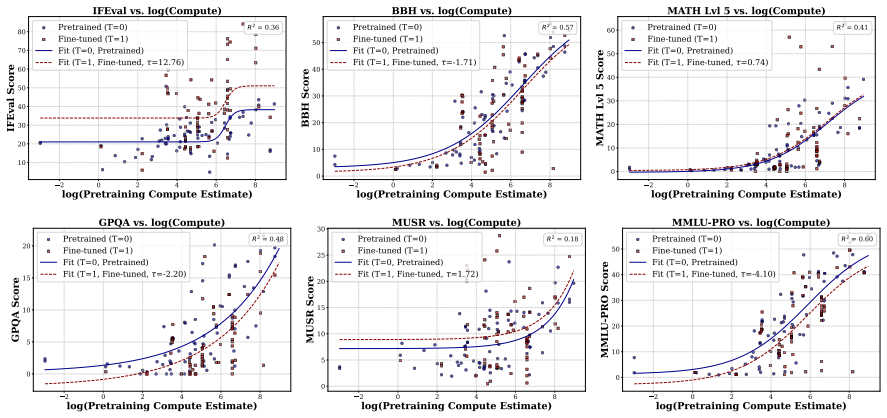
- Scaling pretraining compute is the primary lever for the general capability node, whereas instruction-following and math are more responsive to fine-tuning, so budget allocation between pretraining and post-training can target whichever node is the bottleneck.
- The HCA pipeline offers a no-retraining evaluation route: recover latent factors from existing leaderboard data, then test causal hypotheses with small targeted fine-tuning runs instead of full retraining sweeps.
Reading between the lines
- Beyond the paper: applying HCA to newer or larger base-model families would test whether the recovered chain is a stable property of post-training or specific to this leaderboard cohort.
- Beyond the paper: a clean mediation test would fine-tune only on instruction-following data stripped of mathematical content and compare MATH gains against a token-matched control, separating genuine mediation from generic fine-tuning effects.
- Beyond the paper: if the hierarchy is a structural law, math gains from instruction-following should eventually saturate as the general capability node becomes the bottleneck, a predicted nonlinearity the current data do not estimate.
- Beyond the paper: the recovered ancestor ordering suggests a curriculum for post-training, general capability first, then instruction-following, then math specialization, which the paper motivates but does not test.
Editorial analysis
A structured set of objections, weighed in public.
Referee Report
Summary. The paper proposes a causal representation learning framework, Hierarchical Component Analysis (HCA), to recover latent capability factors from benchmark performance data of LLMs. The model assumes a shared linear mixing matrix across base models, with latent factors following a linear structural causal model per base model. Applied to Open LLM Leaderboard data for four base models, the authors report a three-node causal structure with direction from general problem-solving (z1), through instruction-following (z2), to mathematical reasoning (z3), supported by a minimal inexactness coefficient (MIC) of 0.04 and by SFT experiments. The paper also includes analyses of base-model heterogeneity, matrix completion, and MMLU subtasks.
Significance. The idea of using multi-domain heterogeneity to identify latent causal capabilities is timely and addresses a real gap in causal evaluation of LLMs. The HCA algorithm is novel and comes with theoretical identifiability results, and the code is publicly released. The additional experiments on base-model-controlled matrix completion and the stability analysis are useful contributions. However, the central claim of a sparse causal direction is not supported by the identification result (which recovers only a transitive closure) or by the empirical evidence; this substantially weakens the paper's contribution as a causal discovery result.
major comments (4)
- [§C.1, §C.2, Theorem 1, Figure 7] The identifiability guarantee of HCA only identifies the latent factors up to a lower-triangular transformation, i.e., up to the transitive closure of the true graph. In Section C.1 the authors explicitly state that HCA 'only recovers a transitive closure Ḡ of the true graph G' and that, 'for simplicity and due to the fundamental inexactness of our model', they do not test which edges exist, instead constraining each Bk to be upper-triangular. Consequently, the graph in Figure 7 includes all edges consistent with a total order, such as an edge z1→z3, and the sparse chain z1→z2→z3 claimed in the abstract is not identified. Theorem 1 itself is stated and proved for a complete DAG with all lower-triangular edges, so it certifies recovery only of the total order, not of sparsity. The 'clear causal direction' in the abstract is therefore a post hoc reading of an unverified modeling assumption.
- [§4.1, Figure 8, Table 3] The semantic labels of the latent factors are assigned by an OLS procedure that selects, for each factor, the benchmark maximizing R². The reported R²=1.00 for z3 versus MATH Lvl 5 is an in-sample fitting outcome, not a predictive validation. This circularity means the strong correlations cannot be used as evidence for the causal interpretation of the factors, and the apparent near-perfect alignment with MATH is partly a consequence of the label-selection procedure.
- [§4.2, Table 2] The SFT experiments do not provide direct interventional evidence for the specific z2→z3 edge. Fine-tuning on IFEval is an intervention on the whole model, not on the isolated latent factor z2, and the measured MATH improvements are small and inconsistent: Gemma-2-9B shows a decrease from 0.13 to 0.12 after IFEval SFT, and Llama-3-8B stays at 0.05. The 'Instruct' rows in Table 2 are observational leaderboard entries subject to selection bias, so they cannot serve as controlled causal evidence.
- [§4.1, Figure 18] The text states that 'running our algorithm on the subset of {1,2,4,5}, with Qwen2-7B excluded, achieves a minimal MIC of 0.04.' Figure 18, however, shows size-3 domain subsets with MIC values as low as 0.02. This inconsistency undermines the reported model selection: if other subsets yield smaller MIC, then the choice of {1,2,4,5} and the associated causal graph are not justified as the best-fitting model.
minor comments (5)
- [§3 (Definitions 1, 2) and §3.1] There are typos: 'wuth' should be 'with' in Definitions 1 and 2, and 'varisbles' should be 'variables' in Section 3.1. Also, 'benhmark' in Appendix G.3 should be 'benchmark'.
- [§2.1] The text defines Sinv = {1,2,4,5,6} as 'the index set of these seven models', but the set has only five elements; this should say 'five models'.
- [§4.1] The OLS formula is presented with 'P' instead of a summation symbol: 'zi ≈ P j<i ajzj +γ BxB +c'. The description of the adjustment could be more precise about what is being residualized and why.
- [Figure 2a caption] The caption labels 'Explained Variance Ratio' and 'Cumulative Explained Variance' in a way that appears to be swapped relative to the plot content; please check the labeling.
- [Appendix H] The sensitivity analysis shows that the z1 factor is not stable when the domain set is expanded, and the authors themselves note that 'it is hard to argue which one makes more sense.' This instability is not flagged in the main text, where z1 is described as 'foundational general capability.'
Circularity Check
Headline 'z2→z3' is not identified: HCA imposes a triangular order and the benchmark labels are fitted by in-sample R² maximization.
-
fitted input called prediction
[Section 4.1 (Figure 8a and Figure 8d)]
"Moreover, in view of the ambiguity discussed in Section 3.1, we run an OLS zi ≈ P j<i ajzj + γB xB + c where xB represents the performance on benchmark B. For each i, we pick B that maximizes the R2 and replace zi with zi − P j<i ajzj to attain best-possible alignment between the recovered latent factors and their most indicative benchmarks."
The capability labels are not predicted but selected: for each recovered factor z_i, the benchmark B with the largest in-sample R² is chosen, and the factor is then rotated toward that benchmark. Figure 8d reports R²=1.00 for z3 against MATH Lvl 5, so the claim that z3 'represents advanced mathematical reasoning' is a fitting outcome of this OLS selection step. The abstract's phrasing 'culminating in mathematical reasoning ability' thus restates the fitting procedure rather than an independent empirical finding.
-
self definitional
[Appendix C.1, Section 3.1, and Figure 7]
"Compared with LiNGCReL, HCA only recovers a transitive closure ¯G of the true graph G. It is still possible to infer whether each edge in ¯G indeed exists in G (see appendix). For simplicity and due to the fundamental inexactness of our model, we do not perform this step here. Equivalently, we are only imposing the constraint that each Bk is upper-triangular, without assuming that any other entries are also zero."
The paper's headline causal chain z1→z2→z3 is not a recovered structure: HCA deliberately does not test which edges of the transitive closure exist and instead constrains every Bk to be triangular (a total order). The nonzero weights in Figure 7 are therefore fitted coefficients of this imposed triangular model, not discovered edges. Theorem 1 guarantees recovery only up to left multiplication by a lower-triangular matrix, i.e., up to the transitive closure of a total order; the sparse direction 'instruction following → math' is an untested modeling assumption that the abstract then presents as a 'clear causal direction.'
full rationale
The central scientific claim—that latent capabilities form a chain z1→z2→z3 with instruction following causally improving math—is only partially supported by the paper's own derivation. The identifiability guarantee (Theorem 1) applies to an exact SCM and certifies recovery only up to a lower-triangular transformation, i.e., up to the transitive closure of a total order. Appendix C.1 states that the algorithm does not test which edges exist and instead imposes triangularity; hence the directed edges in Figure 7 are fitted parameters of an assumed order, not discoveries. Independently, the semantic labels (z1≈BBH, z2≈IFEval, z3≈MATH) are produced by an OLS step that selects, for each factor, the benchmark maximizing in-sample R²; the reported R²=1.00 between z3 and MATH is a fitting outcome. The abstract's 'clear causal direction... culminating in mathematical reasoning ability' therefore combines an imposed ordering with a post hoc labeling of the factors. The external SFT-on-IFEval experiment is a genuine intervention and provides some independent evidence that instruction tuning can raise MATH performance, which prevents a higher circularity score; however, it is not a quantitative test of the fitted model and is interpreted only as 'consistent with' the fitted weights. The subset choice (excluding Qwen2-7B after inspecting MIC) and the reliance on a shared mixing matrix across only four base models are post hoc selection steps that further limit the generality of the reported structure, though they are not definitional circularity. The self-citation to the same authors' JS24 for the 'intrinsic' nature of the ambiguity is context for why the paper treats the unidentified direction as benign, but the paper also contains its own proof, so the main circularity is the fitted-label and imposed-triangle reduction.
Assumptions & free parameters
free parameters (4)
- latent dimension d0 =
3
- alignment benchmark per factor =
z1: BBH, z2: IFEval, z3: MATH Lvl 5
- domain subset =
{1,2,4,5} (four base models)
- sigmoid scaling law parameters L,k,C0,b,tau =
reported per benchmark in Figure 15
assumptions (6)
- domain assumption Shared linear mixing: x = Gz with common G across base models (Hypothesis 1)
- domain assumption Linear SCM with independent or nearly independent sources within each domain and shared graph (Hypothesis 2)
- domain assumption Node-level non-degeneracy across domains (Assumption 1)
- standard math Sources are non-Gaussian with different distributions (Assumption 2)
- ad hoc to paper Total-order parametrization: each Bk is upper-triangular (complete DAG)
- domain assumption Base model is the only confounder and is correctly determined from model metadata
invented entities (1)
-
Latent capability factors z1, z2, z3
Cite this review
Pith. "Pith review of Discovering Hierarchical Latent Capabilities of Language Models via Causal Representation Learning." pith.science (2026). https://pith.science/paper/2I3JERYW
@misc{pith2026250610378,
  author       = {Pith},
  title        = {Pith review of: Discovering Hierarchical Latent Capabilities of Language Models via Causal Representation Learning},
  year         = {2026},
  howpublished = {\url{https://pith.science/paper/2I3JERYW}},
  note         = {Machine review of arXiv:2506.10378}
}
read the original abstract
Faithful evaluation of language model capabilities is crucial for deriving actionable insights that can inform model development. However, rigorous causal evaluations in this domain face significant methodological challenges, including complex confounding effects and prohibitive computational costs associated with extensive retraining. To tackle these challenges, we propose a causal representation learning framework wherein observed benchmark performance is modeled as a linear transformation of a few latent capability factors. Crucially, these latent factors are identified as causally interrelated after appropriately controlling for the base model as a common confounder. Applying this approach to a comprehensive dataset encompassing over 1500 models evaluated across six benchmarks from the Open LLM Leaderboard, we identify a concise three-node linear causal structure that reliably explains the observed performance variations. Further interpretation of this causal structure provides substantial scientific insights beyond simple numerical rankings: specifically, we reveal a clear causal direction starting from general problem-solving capabilities, advancing through instruction-following proficiency, and culminating in mathematical reasoning ability. Our results underscore the essential role of carefully controlling base model variations during evaluation, a step critical to accurately uncovering the underlying causal relationships among latent model capabilities.
Figures


Figures from the paper (30 more)








Forward citations
Cited by 2 Pith papers
-
Domain-Aware Scaling Laws Uncover Data Synergy
Domain-aware scaling laws with fitted γ and σ synergy terms recover stable code-math interactions from observational LLM mixtures and correctly predict mixture rankings in controlled small-scale trainings.
-
Prescriptive Scaling Reveals the Evolution of Language Model Capabilities
For most benchmarks, the best achievable post-training accuracy follows a stable sigmoid curve in pre-training compute; math reasoning is the exception, with a boundary that keeps rising over time.
Reference graph
Works this paper leans on
-
[1]
Josh Achiam, Steven Adler, Sandhini Agarwal, Lama Ahmad, Ilge Akkaya, Florencia Leoni Aleman, Diogo Almeida, Janko Altenschmidt, Sam Altman, Shyamal Anadkat, et al. Gpt-4 technical report. arXiv preprint arXiv:2303.08774 , 2023
arXiv 2023
-
[2]
Phi-3 technical report: A highly capable language model locally on your phone
Marah Abdin, Jyoti Aneja, Hany Awadalla, Ahmed Awadallah, Ammar Ahmad Awan, Nguyen Bach, Amit Bahree, Arash Bakhtiari, Jianmin Bao, Harkirat Behl, et al. Phi-3 technical report: A highly capable language model locally on your phone. arXiv preprint arXiv:2404.14219 , 2024
arXiv 2024
-
[3]
An integrated theory of the mind
John R Anderson, Daniel Bothell, Michael D Byrne, Scott Douglass, Christian Lebiere, and Yulin Qin. An integrated theory of the mind. Psychological review , 111(4):1036, 2004
work page 2004
-
[4]
Martin Arjovsky, L \'e on Bottou, Ishaan Gulrajani, and David Lopez-Paz. Invariant risk minimization. arXiv preprint arXiv:1907.02893 , 2019
arXiv 1907
-
[5]
A theory for emergence of complex skills in language models
Sanjeev Arora and Anirudh Goyal. A theory for emergence of complex skills in language models. arXiv preprint arXiv:2307.15936 , 2023
arXiv 2023
-
[6]
Act: A simple theory of complex cognition
John R Anderson. Act: A simple theory of complex cognition. American psychologist , 51(4):355, 1996
work page 1996
-
[7]
Claude 3.5 sonnet
Anthropic. Claude 3.5 sonnet. https://www.anthropic.com/news/claude-3-5-sonnet, 2024
2024
-
[8]
Invariant risk minimization games
Kartik Ahuja, Shiori Sagawa, Harikrishnan Ramaswamy, Edward Kung, Yair Carmon, David Kr \"u ger, Amy Zhang, and Percy Liang. Invariant risk minimization games. In 38th International Conference on Machine Learning (ICML) , volume 139 of Proceedings of Machine Learning Research , pages 145--159, 2021
work page 2021
Show all 79 references
-
[9]
Sample complexity of interventional causal representation learning
Emre Acart \"u rk, Burak Var c , Karthikeyan Shanmugam, and Ali Tajer. Sample complexity of interventional causal representation learning. Advances in Neural Information Processing Systems , 37:39350--39385, 2024
2024
-
[10]
An empirical study of scaling laws for transfer
Matthew Barnett. An empirical study of scaling laws for transfer. arXiv preprint arXiv:2408.16947 , 2024
2024 arXiv
-
[11]
Sparks of artificial general intelligence: Early experiments with gpt-4, 2023
S \'e bastien Bubeck, Varun Chadrasekaran, Ronen Eldan, Johannes Gehrke, Eric Horvitz, Ece Kamar, Peter Lee, Yin Tat Lee, Yuanzhi Li, Scott Lundberg, et al. Sparks of artificial general intelligence: Early experiments with gpt-4, 2023
2023
-
[12]
Functional magnetic resonance imaging evidence for a hierarchical organization of the prefrontal cortex
David Badre and Mark D'Esposito. Functional magnetic resonance imaging evidence for a hierarchical organization of the prefrontal cortex. Journal of cognitive neuroscience , 19(12):2082--2099, 2007
2007
-
[13]
Johann Brehmer, Pim de Haan, Phillip Lippe, and Taco S. Cohen. Weakly supervised causal representation learning. In Advances in Neural Information Processing Systems 35 (NeurIPS) , pages 17066--17079, 2022
2022
-
[14]
Training a helpful and harmless assistant with reinforcement learning from human feedback
Yuntao Bai, Andy Jones, Kamal Ndousse, Amanda Askell, Anna Chen, Nova DasSarma, Dawn Drain, Stanislav Fort, Deep Ganguli, Tom Henighan, et al. Training a helpful and harmless assistant with reinforcement learning from human feedback. arXiv preprint arXiv:2204.05862 , 2022
2022 arXiv
-
[15]
Language models are few-shot learners
Tom Brown, Benjamin Mann, Nick Ryder, Melanie Subbiah, Jared D Kaplan, Prafulla Dhariwal, Arvind Neelakantan, Pranav Shyam, Girish Sastry, Amanda Askell, et al. Language models are few-shot learners. Advances in neural information processing systems , 33:1877--1901, 2020
1901
-
[16]
Doubly robust estimation in missing data and causal inference models
Heejung Bang and James M Robins. Doubly robust estimation in missing data and causal inference models. Biometrics , 61(4):962--973, 2005
2005
-
[17]
Learning linear causal representations from interventions under general nonlinear mixing
Simon Buchholz, Goutham Rajendran, Elan Rosenfeld, Bryon Aragam, Bernhard Sch \"o lkopf, and Pradeep Ravikumar. Learning linear causal representations from interventions under general nonlinear mixing. Advances in Neural Information Processing Systems , 36:45419--45462, 2023
2023
-
[18]
Rethink reporting of evaluation results in ai
Ryan Burnell, Wout Schellaert, John Burden, Tomer D Ullman, Fernando Martinez-Plumed, Joshua B Tenenbaum, Danaja Rutar, Lucy G Cheke, Jascha Sohl-Dickstein, Melanie Mitchell, et al. Rethink reporting of evaluation results in ai. Science , 380(6641):136--138, 2023
2023
-
[19]
Human cognitive abilities: A survey of factor-analytic studies
John Bissell Carroll. Human cognitive abilities: A survey of factor-analytic studies . Cambridge university press, 1993
1993
-
[20]
Structured matrix completion with applications to genomic data integration
Tianxi Cai, T Tony Cai, and Anru Zhang. Structured matrix completion with applications to genomic data integration. Journal of the American Statistical Association , 111(514):621--633, 2016
2016
-
[21]
Scaling instruction-finetuned language models
Hyung Won Chung, Le Hou, Shayne Longpre, Barret Zoph, Yi Tay, William Fedus, Yunxuan Li, Xuezhi Wang, Mostafa Dehghani, Siddhartha Brahma, et al. Scaling instruction-finetuned language models. Journal of Machine Learning Research , 25(70):1--53, 2024
2024
-
[22]
Skills-in-context prompting: Unlocking compositionality in large language models
Jiaao Chen, Xiaoman Pan, Dian Yu, Kaiqiang Song, Xiaoyang Wang, Dong Yu, and Jianshu Chen. Skills-in-context prompting: Unlocking compositionality in large language models. arXiv preprint arXiv:2308.00304 , 2023
2023 arXiv
-
[23]
The rising costs of training frontier ai models, 2024
Ben Cottier, Robi Rahman, Loredana Fattorini, Nestor Maslej, and David Owen. The rising costs of training frontier ai models, 2024
2024
-
[24]
Fundamental safety-capability trade-offs in fine-tuning large language models
Pin-Yu Chen, Han Shen, Payel Das, and Tianyi Chen. Fundamental safety-capability trade-offs in fine-tuning large language models. arXiv preprint arXiv:2503.20807 , 2025
2025 arXiv
-
[25]
Dorner, and Moritz Hardt
Ricardo Dominguez-Olmedo, Florian E. Dorner, and Moritz Hardt. Training on the test task confounds evaluation and emergence. In The Thirteenth International Conference on Learning Representations , 2025
2025
-
[26]
Identifiability, separability, and uniqueness of linear ica models
Jan Eriksson and Visa Koivunen. Identifiability, separability, and uniqueness of linear ica models. IEEE signal processing letters , 11(7):601--604, 2004
2004
-
[27]
Principal stratification in causal inference
Constantine E Frangakis and Donald B Rubin. Principal stratification in causal inference. Biometrics , 58(1):21--29, 2002
2002
-
[28]
Cognitive behaviors that enable self-improving reasoners, or, four habits of highly effective stars
Kanishk Gandhi, Ayush Chakravarthy, Anikait Singh, Nathan Lile, and Noah D Goodman. Cognitive behaviors that enable self-improving reasoners, or, four habits of highly effective stars. arXiv preprint arXiv:2503.01307 , 2025
2025 arXiv
-
[29]
The llama 3 herd of models
Aaron Grattafiori, Abhimanyu Dubey, Abhinav Jauhri, Abhinav Pandey, Abhishek Kadian, Ahmad Al-Dahle, Aiesha Letman, Akhil Mathur, Alan Schelten, Alex Vaughan, et al. The llama 3 herd of models. arXiv preprint arXiv:2407.21783 , 2024
2024 arXiv
-
[30]
A closer look at the limitations of instruction tuning
Sreyan Ghosh, Chandra Kiran Reddy Evuru, Sonal Kumar, Deepali Aneja, Zeyu Jin, Ramani Duraiswami, Dinesh Manocha, et al. A closer look at the limitations of instruction tuning. arXiv preprint arXiv:2402.05119 , 2024
2024 arXiv
-
[31]
Time travel in llms: Tracing data contamination in large language models
Shahriar Golchin and Mihai Surdeanu. Time travel in llms: Tracing data contamination in large language models. arXiv preprint arXiv:2308.08493 , 2023
2023 arXiv
-
[32]
The false promise of imitating proprietary llms
Arnav Gudibande, Eric Wallace, Charlie Snell, Xinyang Geng, Hao Liu, Pieter Abbeel, Sergey Levine, and Dawn Song. The false promise of imitating proprietary llms. arXiv preprint arXiv:2305.15717 , 2023
2023 arXiv
-
[33]
Deepseek-r1: Incentivizing reasoning capability in llms via reinforcement learning
Daya Guo, Dejian Yang, Haowei Zhang, Junxiao Song, Ruoyu Zhang, Runxin Xu, Qihao Zhu, Shirong Ma, Peiyi Wang, Xiao Bi, et al. Deepseek-r1: Incentivizing reasoning capability in llms via reinforcement learning. arXiv preprint arXiv:2501.12948 , 2025
2025 arXiv
-
[34]
Measuring massive multitask language understanding
Dan Hendrycks, Collin Burns, Steven Basart, Andy Zou, Mantas Mazeika, Dawn Song, and Jacob Steinhardt. Measuring massive multitask language understanding. arXiv preprint arXiv:2009.03300 , 2020
2009 arXiv
-
[35]
Training compute-optimal large language models
Jordan Hoffmann, Sebastian Borgeaud, Arthur Mensch, Elena Buchatskaya, Trevor Cai, Eliza Rutherford, Diego de Las Casas, Lisa Anne Hendricks, Johannes Welbl, Aidan Clark, et al. Training compute-optimal large language models. arXiv preprint arXiv:2203.15556 , 2022
2022 arXiv
-
[36]
A sober look at progress in language model reasoning: Pitfalls and paths to reproducibility
Andreas Hochlehnert, Hardik Bhatnagar, Vishaal Udandarao, Samuel Albanie, Ameya Prabhu, and Matthias Bethge. A sober look at progress in language model reasoning: Pitfalls and paths to reproducibility. arXiv preprint arXiv:2504.07086 , 2025
2025
-
[37]
Does rlhf scale? exploring the impacts from data, model, and method
Zhenyu Hou, Pengfan Du, Yilin Niu, Zhengxiao Du, Aohan Zeng, Xiao Liu, Minlie Huang, Hongning Wang, Jie Tang, and Yuxiao Dong. Does rlhf scale? exploring the impacts from data, model, and method. arXiv preprint arXiv:2412.06000 , 2024
2024 arXiv
-
[38]
a rinen, Jarmo Hurri, Patrik O Hoyer, Aapo Hyv \
Aapo Hyv \"a rinen, Jarmo Hurri, Patrik O Hoyer, Aapo Hyv \"a rinen, Jarmo Hurri, and Patrik O Hoyer. Independent component analysis . Springer, 2009
2009
-
[39]
Causal discovery from heterogeneous/nonstationary data
Biwei Huang, Kun Zhang, Jiji Zhang, Joseph Ramsey, Ruben Sanchez-Romero, Clark Glymour, and Bernhard Sch \"o lkopf. Causal discovery from heterogeneous/nonstationary data. Journal of Machine Learning Research , 21(89):1--53, 2020
2020
-
[40]
Learning linear causal representations from general environments: Identifiability and intrinsic ambiguity
Jikai Jin and Vasilis Syrgkanis. Learning linear causal representations from general environments: Identifiability and intrinsic ambiguity. In The Thirty-eighth Annual Conference on Neural Information Processing Systems , 2024
2024
-
[41]
Mistral 7b
Albert Qiaochu Jiang, Alexandre Sablayrolles, Arthur Mensch, Chris Bamford, Devendra Singh Chaplot, Diego de Las Casas, Florian Bressand, Gianna Lengyel, Guillaume Lample, Lucile Saulnier, L'elio Renard Lavaud, Marie-Anne Lachaux, Pierre Stock, Teven Le Scao, Thibaut Lavril, T...
-
[42]
The construct of creativity: Structural model for self-reported creativity ratings
James C Kaufman, Jason C Cole, and John Baer. The construct of creativity: Structural model for self-reported creativity ratings. The Journal of Creative Behavior , 43(2):119--134, 2009
2009
-
[43]
Scaling laws for neural language models
Jared Kaplan, Sam McCandlish, Tom Henighan, Tom B Brown, Benjamin Chess, Rewon Child, Scott Gray, Alec Radford, Jeffrey Wu, and Dario Amodei. Scaling laws for neural language models. arXiv preprint arXiv:2001.08361 , 2020
2001 arXiv
-
[44]
The architecture of cognitive control in the human prefrontal cortex
Etienne Koechlin, Chrystele Ody, and Fr \'e d \'e rique Kouneiher. The architecture of cognitive control in the human prefrontal cortex. Science , 302(5648):1181--1185, 2003
2003
-
[45]
Solving quantitative reasoning problems with language models
Aitor Lewkowycz, Anders Johan Andreassen, David Dohan, Ethan Dyer, Henryk Michalewski, Vinay Venkatesh Ramasesh, Ambrose Slone, Cem Anil, Imanol Schlag, Theo Gutman-Solo, Yuhuai Wu, Behnam Neyshabur, Guy Gur-Ari, and Vedant Misra. Solving quantitative reasoning problems with l...
2022
-
[46]
Holistic evaluation of language models
Percy Liang, Rishi Bommasani, Tony Lee, Dimitris Tsipras, Dilara Soylu, Michihiro Yasunaga, Yian Zhang, Deepak Narayanan, Yuhuai Wu, Ananya Kumar, et al. Holistic evaluation of language models. Transactions on Machine Learning Research , 2023
2023
-
[47]
Not-just-scaling laws: Towards a better understanding of the downstream impact of language model design decisions
Emmy Liu, Amanda Bertsch, Lintang Sutawika, Lindia Tjuatja, Patrick Fernandes, Lara Marinov, Michael Chen, Shreya Singhal, Carolin Lawrence, Aditi Raghunathan, et al. Not-just-scaling laws: Towards a better understanding of the downstream impact of language model design decisi...
2025
-
[48]
a tsch, Bernhard Sch \
Francesco Locatello, Ben Poole, Gunnar R \"a tsch, Bernhard Sch \"o lkopf, Olivier Bachem, and Michael Tschannen. Weakly-supervised disentanglement without compromises. In 37th International Conference on Machine Learning (ICML) , volume 119 of Proceedings of Machine Learning ...
2020
-
[49]
Sewon Min, Xinxi Lyu, Ari Holtzman, Mikel Artetxe, Mike Lewis, Hannaneh Hajishirzi, and Luke Zettlemoyer. Rethinking the role of demonstrations: What makes in-context learning work? In Yoav Goldberg, Zornitsa Kozareva, and Yue Zhang, editors, Proceedings of the 2022 Conference...
2022
-
[50]
Ian R. McKenzie, Alexander Lyzhov, Michael Martin Pieler, Alicia Parrish, Aaron Mueller, Ameya Prabhu, Euan McLean, Xudong Shen, Joe Cavanagh, Andrew George Gritsevskiy, Derik Kauffman, Aaron T. Kirtland, Zhengping Zhou, Yuhui Zhang, Sicong Huang, Daniel Wurgaft, Max Weiss, Al...
2023
-
[51]
Training language models to follow instructions with human feedback
Long Ouyang, Jeffrey Wu, Xu Jiang, Diogo Almeida, Carroll Wainwright, Pamela Mishkin, Chong Zhang, Sandhini Agarwal, Katarina Slama, Alex Ray, et al. Training language models to follow instructions with human feedback. Advances in neural information processing systems , 35:277...
2022
-
[52]
Causal diagrams for empirical research
Judea Pearl. Causal diagrams for empirical research. Biometrika , 82(4):669--688, 1995
1995
-
[53]
On the identifiability of bayesian factor analytic models
Panagiotis Papastamoulis and Ioannis Ntzoufras. On the identifiability of bayesian factor analytic models. Statistics and Computing , 32(2):23, 2022
2022
-
[54]
Sloth: scaling laws for llm skills to predict multi-benchmark performance across families
Felipe Maia Polo, Seamus Somerstep, Leshem Choshen, Yuekai Sun, and Mikhail Yurochkin. Sloth: scaling laws for llm skills to predict multi-benchmark performance across families. arXiv preprint arXiv:2412.06540 , 2024
2024
-
[55]
Evolm: In search of lost language model training dynamics, 2025
Zhenting Qi, Fan Nie, Alexandre Alahi, James Zou, Himabindu Lakkaraju, Yilun Du, Eric Xing, Sham Kakade, and Hanlin Zhang. Evolm: In search of lost language model training dynamics, 2025. Manuscript
2025
-
[56]
Safetywashing: Do ai safety benchmarks actually measure safety progress? Advances in Neural Information Processing Systems , 37:68559--68594, 2025
Richard Ren, Steven Basart, Adam Khoja, Alice Gatti, Long Phan, Xuwang Yin, Mantas Mazeika, Alexander Pan, Gabriel Mukobi, Ryan Kim, et al. Safetywashing: Do ai safety benchmarks actually measure safety progress? Advances in Neural Information Processing Systems , 37:68559--68...
2025
-
[57]
A simpler approach to matrix completion
Benjamin Recht. A simpler approach to matrix completion. Journal of Machine Learning Research , 12(12), 2011
2011
-
[58]
Maddison, and Tatsunori Hashimoto
Yangjun Ruan, Chris J. Maddison, and Tatsunori Hashimoto. Observational scaling laws and the predictability of langauge model performance. In The Thirty-eighth Annual Conference on Neural Information Processing Systems , 2024
2024
-
[59]
The architecture of complexity
Herbert A Simon. The architecture of complexity. In The Roots of Logistics , pages 335--361. Springer, 2012
2012
-
[60]
Toward causal representation learning
Bernhard Sch \"o lkopf, Francesco Locatello, Stefan Bauer, Nan Rosemary Ke, Nal Kalchbrenner, Anirudh Goyal, and Yoshua Bengio. Toward causal representation learning. Proceedings of the IEEE , 109(5):612--634, 2021
2021
-
[61]
Are emergent abilities of large language models a mirage? Advances in Neural Information Processing Systems , 36:55565--55581, 2023
Rylan Schaeffer, Brando Miranda, and Sanmi Koyejo. Are emergent abilities of large language models a mirage? Advances in Neural Information Processing Systems , 36:55565--55581, 2023
2023
-
[62]
Linear causal disentanglement via interventions
Chandler Squires, Anna Seigal, Salil S Bhate, and Caroline Uhler. Linear causal disentanglement via interventions. In International conference on machine learning , pages 32540--32560. PMLR, 2023
2023
-
[63]
Challenging big-bench tasks and whether chain-of-thought can solve them
Mirac Suzgun, Nathan Scales, Nathanael Sch \"a rli, Sebastian Gehrmann, Yi Tay, Hyung Won Chung, Aakanksha Chowdhery, Quoc V Le, Ed H Chi, Denny Zhou, et al. Challenging big-bench tasks and whether chain-of-thought can solve them. arXiv preprint arXiv:2210.09261 , 2022
-
[64]
Matching methods for causal inference: A review and a look forward
Elizabeth A Stuart. Matching methods for causal inference: A review and a look forward. Statistical science: a review journal of the Institute of Mathematical Statistics , 25(1):1, 2010
2010
-
[65]
Multitask prompted training enables zero-shot task generalization
Victor Sanh, Albert Webson, Colin Raffel, Stephen Bach, Lintang Sutawika, Zaid Alyafeai, Antoine Chaffin, Arnaud Stiegler, Arun Raja, Manan Dey, M Saiful Bari, Canwen Xu, Urmish Thakker, Shanya Sharma Sharma, Eliza Szczechla, Taewoon Kim, Gunjan Chhablani, Nihal Nayak, Debajyo...
2022
-
[66]
How to grow a mind: Statistics, structure, and abstraction
Joshua B Tenenbaum, Charles Kemp, Thomas L Griffiths, and Noah D Goodman. How to grow a mind: Statistics, structure, and abstraction. science , 331(6022):1279--1285, 2011
2011
-
[67]
Gemma 2: Improving open language models at a practical size
Gemma Team, Morgane Riviere, Shreya Pathak, Pier Giuseppe Sessa, Cassidy Hardin, Surya Bhupatiraju, L \'e onard Hussenot, Thomas Mesnard, Bobak Shahriari, Alexandre Ram \'e , et al. Gemma 2: Improving open language models at a practical size. arXiv preprint arXiv:2408.00118 , 2024
2024 arXiv
-
[68]
Reliable and efficient amortized model-based evaluation
Sang Truong, Yuheng Tu, Percy Liang, Bo Li, and Sanmi Koyejo. Reliable and efficient amortized model-based evaluation. arXiv preprint arXiv:2503.13335 , 2025
2025 arXiv
-
[69]
u gelgen, Michel Besserve, Liang Wendong, Luigi Gresele, Armin Keki \'c , Elias Bareinboim, David Blei, and Bernhard Sch \
Julius von K \"u gelgen, Michel Besserve, Liang Wendong, Luigi Gresele, Armin Keki \'c , Elias Bareinboim, David Blei, and Bernhard Sch \"o lkopf. Nonparametric identifiability of causal representations from unknown interventions. Advances in Neural Information Processing Syst...
2023
-
[70]
Yixin Wang and Michael I. Jordan. Desiderata for representation learning: A causal perspective. arXiv , 2022
2022
-
[71]
Emergent abilities of large language models
Jason Wei, Yi Tay, Rishi Bommasani, Colin Raffel, Barret Zoph, Sebastian Borgeaud, Dani Yogatama, Maarten Bosma, Denny Zhou, Donald Metzler, et al. Emergent abilities of large language models. arXiv preprint arXiv:2206.07682 , 2022
2022 arXiv
-
[72]
Skill-mix: A flexible and expandable family of evaluations for ai models
Dingli Yu, Simran Kaur, Arushi Gupta, Jonah Brown-Cohen, Anirudh Goyal, and Sanjeev Arora. Skill-mix: A flexible and expandable family of evaluations for ai models. arXiv preprint arXiv:2310.17567 , 2023
2023 arXiv
-
[73]
An Yang, Baosong Yang, Beichen Zhang, Binyuan Hui, Bo Zheng, Bowen Yu, Chengyuan Li, Dayiheng Liu, Fei Huang, Haoran Wei, et al. Qwen2. 5 technical report. arXiv preprint arXiv:2412.15115 , 2024
2024 arXiv
-
[74]
Unveiling the impact of coding data instruction fine-tuning on large language models reasoning
Xinlu Zhang, Zhiyu Zoey Chen, Xi Ye, Xianjun Yang, Lichang Chen, William Yang Wang, and Linda Ruth Petzold. Unveiling the impact of coding data instruction fine-tuning on large language models reasoning. In Proceedings of the AAAI Conference on Artificial Intelligence , volume...
2025
-
[75]
Identifiability guarantees for causal disentanglement from soft interventions
Jiaqi Zhang, Kristjan Greenewald, Chandler Squires, Akash Srivastava, Karthikeyan Shanmugam, and Caroline Uhler. Identifiability guarantees for causal disentanglement from soft interventions. Advances in Neural Information Processing Systems , 36:50254--50292, 2023
2023
-
[76]
When scaling meets llm finetuning: The effect of data, model and finetuning method
Biao Zhang, Zhongtao Liu, Colin Cherry, and Orhan Firat. When scaling meets llm finetuning: The effect of data, model and finetuning method. In The Twelfth International Conference on Learning Representations , 2024
2024
-
[77]
Echo chamber: Rl post-training amplifies behaviors learned in pretraining
Rosie Zhao, Alexandru Meterez, Sham Kakade, Cengiz Pehlevan, Samy Jelassi, and Eran Malach. Echo chamber: Rl post-training amplifies behaviors learned in pretraining. arXiv preprint arXiv:2504.07912 , 2025
2025 arXiv
-
[78]
Investigating the catastrophic forgetting in multimodal large language models
Yuexiang Zhai, Shengbang Tong, Xiao Li, Mu Cai, Qing Qu, Yong Jae Lee, and Yi Ma. Investigating the catastrophic forgetting in multimodal large language models. arXiv preprint arXiv:2309.10313 , 2023
2023 arXiv
-
[79]
Causal representation learning from multiple distributions: A general setting
Kun Zhang, Shaoan Xie, Ignavier Ng, and Yujia Zheng. Causal representation learning from multiple distributions: A general setting. In Forty-first International Conference on Machine Learning , 2024
2024
Reviewed August 7, 2026 · model on record in the stance chip above.
Discussion (0). Sign in to comment.