REVIEW 4 major objections 5 minor 6 cited by
A robot can be trained from unlabeled video and random exploration alone to follow language instructions for tabletop tasks, reaching 83% average success on the LIBERO benchmark.
Reviewed by Pith at T0; open to challenge. T0 means a machine referee read the full paper against a public rubric. the ladder, T0–T4 →
GVF-TAPE predicts future RGB-D frames from an image and text, then extracts end-effector poses to control a robot, achieving strong success rates without action-labeled data.
T0 review reviewed 2026-08-05 challenge →
load-bearing objection A genuinely label-light pipeline with a plausibly load-bearing pose estimator; the numbers are strong but the weak link is the one that goes unmeasured. the 4 major comments →
Generative Visual Foresight Meets Task-Agnostic Pose Estimation in Robotic Table-Top Manipulation
The pith
A machine-rendered reading of the paper's core claim, the machinery that carries it, and where it could break.
The reading
Core claim
GVF-TAPE learns the mapping f: (x0, c) → T from a side-view RGB image x0 and language instruction c to a pose trajectory, each T_i = (p_i, q_i, g_i) holding 3D position, orientation quaternion, and gripper state. A rectified-flow video model generates six future RGB-D frames; depth is inferred implicitly and supervised by an off-the-shelf monocular depth estimator, allowing pretraining on RGB-only human videos. A cross-attention ViT pose estimator, trained only on uniformly sampled random exploration data, regresses each frame's 8-dimensional pose independently. Executing the predicted trajectory, re-observing, and re-planning closes the loop. The paper reports 83.00% LIBERO average success
What carries the argument
The load-bearing mechanism is the decoupling of visual planning from action execution. The foresight module is a rectified-flow velocity model built on a 3D U-Net, conditioned by a CLIP text encoder; it interpolates between noise and a clean future RGB-D sequence and predicts the displacement, giving strong video with only three sampling steps. Because depth is part of the generated output and is supervised by Video Depth Anything, the model can be pretrained on RGB-only human videos. The pose module is a cross-attention ViT: the depth encoder's CLS token queries the RGB encoder's patch tokens, and a three-layer MLP regresses the 8-dimensional end-effector pose. Trained on uniform random exp
Load-bearing premise
The pose estimator must generalize from the random-exploration poses it saw in training to the poses the robot actually takes during task execution—including occluded grippers, held objects, and dynamic contacts—because any wrong per-frame pose produces a wrong control command.
What would settle it
Run GVF-TAPE on a LIBERO-Goal drawer task with the pose estimator frozen, and record per-frame pose error on frames where the gripper is occluded; if the error there is much larger than on random-exploration frames and the success rate stays near the reported 66.8%, the central claim that random-exploration training generalizes to task poses is falsified.
If this is right
- Pose supervision comes from random exploration, not expert demos, so data collection is fully automatic and scales across robots and environments.
- Depth is generated, not sensed: the foresight model outputs RGB-D and uses a monocular depth estimator for supervision, so training can start from RGB-only videos, including human hand videos, and transfer to the robot.
- Data efficiency: with only 20% of LIBERO demonstrations plus pretraining on LIBERO-90, GVF-TAPE matches or beats ATM, which uses 100% of the action-labeled data; pretraining adds 9.2% success.
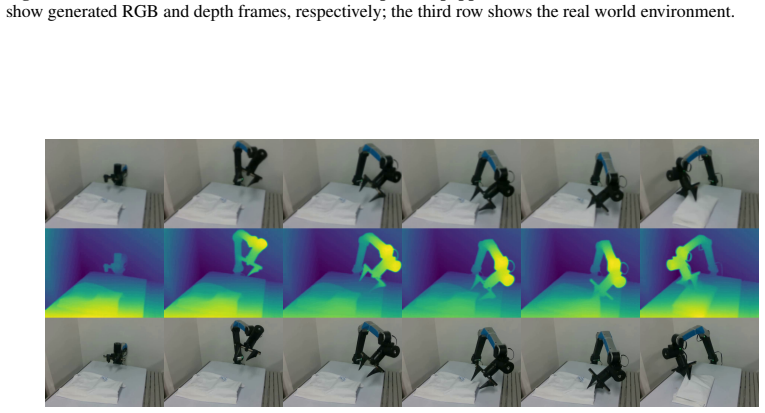
- Human-video pretraining raises real-world success from 56% to 86%, showing cross-embodiment transfer from unlabeled human manipulation videos.
- Closed-loop replanning provides failure recovery: when the first attempt misses (e.g., grabbing a tissue), the next video-generation cycle sees the failed state and re-plans toward the goal.
Where Pith is reading between the lines
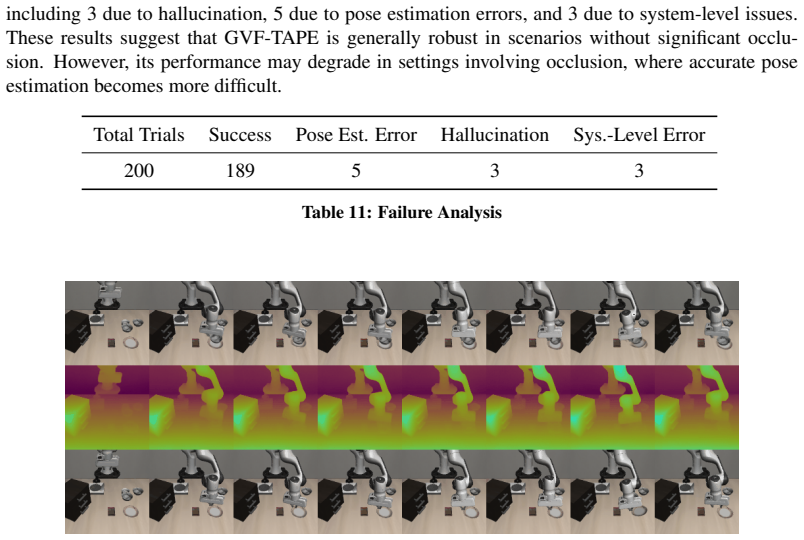
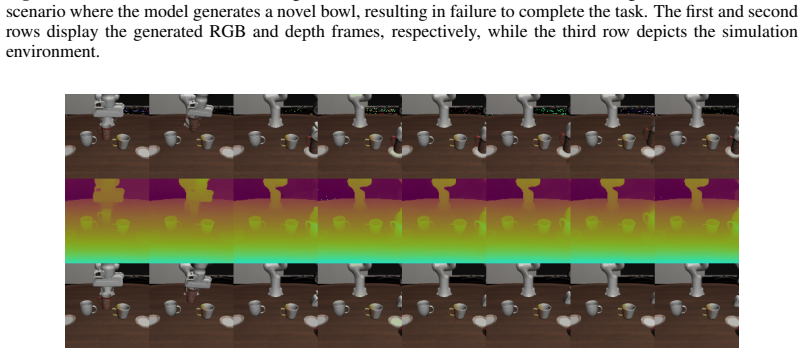
- The paper's own failure analysis (Table 11: 5 of 11 LIBERO-Spatial failures are pose-estimation errors, only 3 are hallucination) suggests that the bottleneck is not video prediction but the pose estimator's generalization; adding a wrist camera or multi-view input would most directly attack the reported failures.
- Because pose training poses are sampled uniformly in workspace bounds, performance should degrade on trajectories that spend significant time in occluded or out-of-view regions (as seen in LIBERO-Goal and LIVING-ROOM-SCENE-5); a curriculum that samples more poses near contact or occlusion is a testable fix that does not require changing the architecture.
- If depth is inferred by Video Depth Anything, then systematic depth errors in cluttered or transparent scenes will propagate into pose and therefore control; measuring pose error on generated vs. real frames would quantify how much the closed loop masks this.
- The ability to pretrain the foresight module on human videos opens a route to web-scale RGB video pretraining, since only a text instruction and RGB observation are needed—no robot embodiment or action labels.
Editorial analysis
A structured set of objections, weighed in public.
Referee Report
Summary. This paper introduces GVF-TAPE, a closed-loop manipulation framework that decouples visual foresight from action execution. A rectified-flow 3D U-Net conditioned on a single side-view RGB image and a CLIP text embedding predicts six future RGB-D frames; a transformer pose estimator trained on uniformly sampled random exploration poses regresses 6-DoF end-effector pose plus gripper state from each predicted RGB-D frame, and a low-level controller executes these poses via inverse kinematics. The pipeline is evaluated in LIBERO (Spatial/Object/Goal and living-room scenes) and on a real ARX-5 with five plus two deformable-object tasks. Headline results: 83.00% LIBERO overall success with no action labels (Table 1), 79.4% on the living-room comparison (Table 2), and 56%/86% real-world success without/with human-video pretraining (Table 3). Ablations motivate rectified flow, monocular depth, and cross-embodiment pretraining.
Significance. If the results hold, GVF-TAPE is a meaningful step toward scalable manipulation learning because it removes expert action labels for the policy and replaces them with automatically collected random-exploration pose data plus video demonstrations. The paper's strongest assets are the breadth of experiments, the explicit failure analysis, and the reproducibility details in the appendix (model architecture, random exploration algorithm, inference times). The central claim, however, rests on an unquantified generalization assumption: the pose estimator must succeed on distribution-shifted generated frames containing occlusions, held objects, and contacts. The failure analysis in Table 11 and the real-world per-task variability in Table 3 suggest this assumption is the fragile link. The manuscript would be substantially strengthened by reporting pose-estimation error on task-distribution frames and by presenting real-world results with confidence intervals. With those additions the contribution would be credible.
major comments (4)
- [Section 3.4, Tables 11 and 3] The pose estimator is the only link between predicted frames and executable commands. It is trained on random exploration poses sampled uniformly within a fixed workspace (Algorithm 1), where the gripper is usually empty and scenes are uncluttered. During deployment, the input distribution shifts to generated frames containing held objects, occluded grippers, dynamic contacts, and arm configurations outside the training support. Since each frame is processed independently, a per-frame pose error directly produces an incorrect controller target and is not averaged away. The paper never reports pose accuracy (position, orientation, gripper) on task-distribution frames, despite Table 11 listing pose-estimation error as the leading failure cause (5 of 11 LIBERO-Spatial failures) and Table 3 showing the largest real-world failures precisely in tasks with deformable/occluded interactions (grab
- [Sections 3.3-3.4 and 7.7-7.8, Eq. (4), Table 4] Depth is not measured but synthesized. The real-world pose-estimation training set uses Video-Depth-Anything labels (Section 7.7), and the simulation pipeline also passes rendered data through a monocular depth estimator (Section 7.8). The video model outputs an RGB-D prediction whose depth channel is a generated quantity. The paper does not compare this estimated depth against sensor depth (the D435i is available), nor does it quantify how depth error propagates to pose error. Table 4 isolates the benefit of w/ depth versus w/o depth, but not the cost of using estimated depth instead of true depth. Since the pose estimator's cross-attention uses the depth CLS token as the query (Eq. 4), depth quality is load-bearing. Please report depth accuracy and/or run an ablation with ground-truth or sensor depth.
- [Table 1 and Fig. 4] Table 1 compares GVF-TAPE to baselines that use 20% action-labeled data (10 action trajectories plus 50 video demos), but it does not state how many video demonstrations or what pretraining GVF-TAPE uses in that table. Section 4.1 mentions 50 video demos for baselines, Section 4.2 says 20 demos for the living-room comparison, and Fig. 4 says 20% data corresponds to 10 demos. It is therefore unclear whether the Table 1 headline (83.00%, outperforms the next-best by 11.56%) is obtained with 10, 20, or 50 demonstrations per task, and whether LIBERO-90 pretraining is included. Please specify the exact data budget for each reported GVF-TAPE result, including a column in Table 1, so the comparison is auditable.
- [Section 4.3, Table 3] Real-world success rates are based on 10 trials per task with no confidence intervals, and the seven-condition protocol (5 close, 2 far, 2 distractors, 1 lighting) conflates condition and task. With n=10, differences such as 30% vs 70% cannot be distinguished from chance, so the claim that human-video pretraining consistently improves performance and the average 56% to 86% gain is not statistically supported. Please report binomial confidence intervals or per-condition results, and consider increasing trials or pooling across tasks appropriately.
minor comments (5)
- [Section 7.10.3] Occultation should be Occlusion. Also, the method name AVDC is written as A VDC in Table 2 and in several places; unify the spelling.
- [Algorithm 1] The while-condition logic (resample while current is close to desired) is unconventional and should be commented in the pseudocode. Specify the units and value of the threshold DT and how the initial samples are drawn within workspace W.
- [Eq. (3)] The pose estimator uses a SmoothL1 loss on an 8-dimensional output that includes a quaternion. Unit quaternions require special handling; please state how the quaternion is normalized or whether the loss is applied to raw outputs.
- [Section 7.8] A gripper aperture threshold is mentioned but its value and sensitivity are not reported. Since it directly affects grasp success and is a free parameter, provide the chosen value and, ideally, a short sensitivity study.
- [Table 5] The VLA baseline results in Table 5 are reported without standard deviations. If these numbers are taken from prior papers, cite the source; if re-evaluated, report variability.
Circularity Check
No circularity found: all reported results are held-out empirical evaluations, and neither the pose estimator nor the video model is fitted to task outcomes.
full rationale
GVF-TAPE's central claims are measured success rates on LIBERO and real-world rollouts (Tables 1, 2, 3, 10, 11), not quantities derived from training targets. The video model minimizes Eq. (2) against ground-truth future RGB-D frames from demonstrations, while the pose estimator minimizes Eq. (3) against poses sampled by random exploration (Sec. 3.4, Algorithm 1); at test time the same pose model is applied to generated frames. No parameter is fitted to the reported success rates, and no equation defines the benchmark outcome in terms of the model's own inputs. The failure analysis (Table 11) and Limitations section candidly attribute failures to pose-estimation error, hallucination, and occlusion, which are generalization and robustness concerns rather than circular reductions. Author self-citations (e.g., Refs. [38,43,44]) appear only in pose-estimation background and are not load-bearing for the framework's derivation. The depth signal is synthesized by Video Depth Anything at both training and inference, a consistency choice that raises metric-depth validity questions but does not make the success prediction equivalent to an input. Thus no circular step is present; the paper is self-contained with respect to its empirical evaluation.
Axiom & Free-Parameter Ledger
free parameters (3)
- Gripper aperture threshold =
not reported
- Number of future frames per prediction =
6
- Maximum replanning cycles =
15 (real-world)
axioms (5)
- domain assumption Randomly sampled exploration poses are representative of the pose distribution needed for task execution
- domain assumption Video Depth Anything provides depth maps consistent enough for pose estimation
- standard math Rectified flow converges to a valid generative video model
- domain assumption CLIP text embeddings accurately encode task semantics
- domain assumption The low-level IK controller can execute any feasible pose trajectory
Cite this review
Pith. "Pith review of Generative Visual Foresight Meets Task-Agnostic Pose Estimation in Robotic Table-Top Manipulation." pith.science (2026). https://pith.science/paper/2KEIHSYF
@misc{pith2026250900361,
  author       = {Pith},
  title        = {Pith review of: Generative Visual Foresight Meets Task-Agnostic Pose Estimation in Robotic Table-Top Manipulation},
  year         = {2026},
  howpublished = {\url{https://pith.science/paper/2KEIHSYF}},
  note         = {Machine review of arXiv:2509.00361}
}
read the original abstract
Robotic manipulation in unstructured environments requires systems that can generalize across diverse tasks while maintaining robust and reliable performance. We introduce {GVF-TAPE}, a closed-loop framework that combines generative visual foresight with task-agnostic pose estimation to enable scalable robotic manipulation. GVF-TAPE employs a generative video model to predict future RGB-D frames from a single side-view RGB image and a task description, offering visual plans that guide robot actions. A decoupled pose estimation model then extracts end-effector poses from the predicted frames, translating them into executable commands via low-level controllers. By iteratively integrating video foresight and pose estimation in a closed loop, GVF-TAPE achieves real-time, adaptive manipulation across a broad range of tasks. Extensive experiments in both simulation and real-world settings demonstrate that our approach reduces reliance on task-specific action data and generalizes effectively, providing a practical and scalable solution for intelligent robotic systems.
Figures





Forward citations
Cited by 6 Pith papers
-
From Video to Control: A Survey of Learning Manipulation Interfaces from Temporal Visual Data
Video-to-robot control methods cluster into three interface families, and the field’s main bottleneck is grounding video-derived predictions into dependable closed-loop robot behavior.
-
From Video to Control: A Survey of Learning Manipulation Interfaces from Temporal Visual Data
A survey introduces an interface-centric taxonomy for video-to-control methods in robotic manipulation and identifies the robotics integration layer as the central open challenge.
-
From World Models to World Action Models: A Concise Tutorial for Robotics
World models are action-conditioned predictors of task-relevant futures; world action models couple those futures to robot actions via four paradigms: imagine-then-execute, feature-conditioned, joint, and auxiliary pr...
-
From World Models to World Action Models: A Concise Tutorial for Robotics
A tutorial that categorizes world models into observation-space and state-space types and outlines four paradigms for world action models connecting predictions to robot actions.
-
From World Models to World Action Models: A Concise Tutorial for Robotics
A tutorial defining world models and world action models for robotics, with design axes and a four-paradigm taxonomy of prediction-action coupling.
-
From World Models to World Action Models: A Concise Tutorial for Robotics
A tutorial taxonomizes world models for robotics into observation-space and state-space types and introduces world action models via four paradigms linking predictions to executable actions.
Reference graph
Works this paper leans on
-
[1]
A. Pilacinski, A. Vandenberghe, G. Andrietta, and G. Vannuscorps. Humans underestimate the movement range of their own hands. Communications Psychology, 2(1):104, 2024. ISSN 2731 - 9121. doi:10.1038/s44271-024-00153-x. URL https://doi.org/10.1038/ s44271-024-00153-x
-
[2]
K. C. Dieter, B. Hu, D. C. Knill, R. Blake, and D. Tadin. Kinesthesis can make an invisible hand visible. Psychological Science, 25(1):66 – 75, 2014. doi:10.1177/0956797613497968. URL https://doi.org/10.1177/0956797613497968
-
[3]
N. Faivre, R. Salomon, and O. Blanke. Visual consciousness and bodily self - consciousness. Curr Opin Neurol, 28(1):23–28, 02 2015. doi:10.1097/WCO.0000000000000160
-
[4]
T. Yokosaka, S. Kuroki, S. Nishida, and J. Watanabe. Apparent time interval of visual stimuli is compressed during fast hand movement. PLoS One, 10(4):e0124901, 04 2015. doi:10.1371/ journal.pone.0124901
work page 2015
-
[5]
M. J. Kim, K. Pertsch, S. Karamcheti, T. Xiao, A. Balakrishna, S. Nair, R. Rafailov, E. Foster, G. Lam, P. Sanketi, Q. Vuong, T. Kollar, B. Burchfiel, R. Tedrake, D. Sadigh, S. Levine, P. Liang, and C. Finn. Openvla: An open-source vision-language-action model, 2024. URL https://arxiv.org/abs/2406.09246
Pith/arXiv arXiv 2024
-
[6]
Ghosh, H
Octo Model Team, D. Ghosh, H. Walke, K. Pertsch, K. Black, O. Mees, S. Dasari, J. Hejna, C. Xu, J. Luo, T. Kreiman, Y . Tan, L. Y . Chen, P. Sanketi, Q. Vuong, T. Xiao, D. Sadigh, C. Finn, and S. Levine. Octo: An open-source generalist robot policy. In Proceedings of Robotics: Science and Systems, Delft, Netherlands, 2024
2024
-
[7]
A. Brohan, N. Brown, J. Carbajal, Y . Chebotar, J. Dabis, C. Finn, K. Gopalakrishnan, K. Haus- man, A. Herzog, J. Hsu, J. Ibarz, B. Ichter, A. Irpan, T. Jackson, S. Jesmonth, N. J. Joshi, R. Julian, D. Kalashnikov, Y . Kuang, I. Leal, K.-H. Lee, S. Levine, Y . Lu, U. Malla, D. Man- junath, I. Mordatch, O. Nachum, C. Parada, J. Peralta, E. Perez, K. Pertsc...
Pith/arXiv arXiv 2023
-
[8]
A. Brohan, N. Brown, J. Carbajal, Y . Chebotar, X. Chen, K. Choromanski, T. Ding, D. Driess, A. Dubey, C. Finn, P. Florence, C. Fu, M. G. Arenas, K. Gopalakrishnan, K. Han, K. Hausman, A. Herzog, J. Hsu, B. Ichter, A. Irpan, N. Joshi, R. Julian, D. Kalashnikov, Y . Kuang, I. Leal, L. Lee, T.-W. E. Lee, S. Levine, Y . Lu, H. Michalewski, I. Mordatch, K. Pe...
Pith/arXiv arXiv 2023
-
[9]
K. Black, N. Brown, D. Driess, A. Esmail, M. Equi, C. Finn, N. Fusai, L. Groom, K. Haus- man, B. Ichter, S. Jakubczak, T. Jones, L. Ke, S. Levine, A. Li-Bell, M. Mothukuri, S. Nair, K. Pertsch, L. X. Shi, J. Tanner, Q. Vuong, A. Walling, H. Wang, and U. Zhilinsky. π0: A vision-language-action flow model for general robot control, 2024. URL https://arxiv. ...
Pith/arXiv arXiv 2024
-
[10]
S. Nair, A. Rajeswaran, V . Kumar, C. Finn, and A. Gupta. R3m: A universal visual represen- tation for robot manipulation, 2022. URL https://arxiv.org/abs/2203.12601
Pith/arXiv arXiv 2022
-
[11]
G. Jiang, Y . Sun, T. Huang, H. Li, Y . Liang, and H. Xu. Robots pre-train robots: Manipulation- centric robotic representation from large-scale robot dataset.arXiv preprint arXiv:2410.22325, 2024. 10
Pith/arXiv arXiv 2024
-
[12]
S. Ye, J. Jang, B. Jeon, S. Joo, J. Yang, B. Peng, A. Mandlekar, R. Tan, Y .-W. Chao, B. Y . Lin, L. Liden, K. Lee, J. Gao, L. Zettlemoyer, D. Fox, and M. Seo. Latent action pretraining from videos, 2024. URL https://arxiv.org/abs/2410.11758
Pith/arXiv arXiv 2024
-
[13]
K. Black, M. Nakamoto, P. Atreya, H. Walke, C. Finn, A. Kumar, and S. Levine. Zero-shot robotic manipulation with pretrained image-editing diffusion models, 2023. URL https: //arxiv.org/abs/2310.10639
Pith/arXiv arXiv 2023
-
[14]
Y . Du, M. Yang, B. Dai, H. Dai, O. Nachum, J. B. Tenenbaum, D. Schuurmans, and P. Abbeel. Learning universal policies via text-guided video generation. arXiv e-prints , pages arXiv– 2302, 2023
work page 2023
-
[15]
Q. Bu, J. Zeng, L. Chen, Y . Yang, G. Zhou, J. Yan, P. Luo, H. Cui, Y . Ma, and H. Li. Closed- loop visuomotor control with generative expectation for robotic manipulation, 2024. URL https://arxiv.org/abs/2409.09016
Pith/arXiv arXiv 2024
-
[16]
C. Wen, X. Lin, J. So, K. Chen, Q. Dou, Y . Gao, and P. Abbeel. Any-point trajectory modeling for policy learning, 2024. URL https://arxiv.org/abs/2401.00025
Pith/arXiv arXiv 2024
-
[17]
M. Xu, Z. Xu, Y . Xu, C. Chi, G. Wetzstein, M. Veloso, and S. Song. Flow as the cross-domain manipulation interface, 2024. URL https://arxiv.org/abs/2407.15208
Pith/arXiv arXiv 2024
-
[19]
P.-C. Ko, J. Mao, Y . Du, S.-H. Sun, and J. B. Tenenbaum. Learning to Act from Actionless Videos through Dense Correspondences. arXiv:2310.08576, 2023
Pith/arXiv arXiv 2023
- [20]
-
[21]
J. Liang, R. Liu, E. Ozguroglu, S. Sudhakar, A. Dave, P. Tokmakov, S. Song, and C. V ondrick. Dreamitate: Real-world visuomotor policy learning via video generation, 2024. URLhttps: //arxiv.org/abs/2406.16862
Pith/arXiv arXiv 2024
-
[22]
M. Shridhar, Y . L. Lo, and S. James. Generative image as action models, 2024. URLhttps: //arxiv.org/abs/2407.07875
Pith/arXiv arXiv 2024
-
[23]
Y . Tian, S. Yang, J. Zeng, P. Wang, D. Lin, H. Dong, and J. Pang. Predictive inverse dynamics models are scalable learners for robotic manipulation, 2024. URL https://arxiv.org/ abs/2412.15109
Pith/arXiv arXiv 2024
-
[24]
C.-L. Cheang, G. Chen, Y . Jing, T. Kong, H. Li, Y . Li, Y . Liu, H. Wu, J. Xu, Y . Yang, H. Zhang, and M. Zhu. Gr-2: A generative video-language-action model with web-scale knowledge for robot manipulation, 2024. URL https://arxiv.org/abs/2410.06158
Pith/arXiv arXiv 2024
-
[25]
H. Wu, Y . Jing, C. Cheang, G. Chen, J. Xu, X. Li, M. Liu, H. Li, and T. Kong. Unleashing large-scale video generative pre-training for visual robot manipulation, 2023. URL https: //arxiv.org/abs/2312.13139
Pith/arXiv arXiv 2023
-
[26]
N. Merrill, Y . Guo, X. Zuo, X. Huang, S. Leutenegger, X. Peng, L. Ren, and G. Huang. Sym- metry and uncertainty-aware object slam for 6dof object pose estimation. In Proceedings of the IEEE/CVF Conference on Computer Vision and Pattern Recognition (CVPR) , pages 14901–14910, June 2022
work page 2022
- [27]
-
[28]
W. Chen, X. Jia, H. J. Chang, J. Duan, and A. Leonardis. G2L-Net: Global to Local Network for Real-Time 6D Pose Estimation With Embedding Vector Features. InIEEE/CVF Conference on Computer Vision and Pattern Recognition (CVPR), June 2020
work page 2020
-
[29]
Y . He, W. Sun, H. Huang, J. Liu, H. Fan, and J. Sun. Pvn3d: A deep point-wise 3d keypoints voting network for 6dof pose estimation. In IEEE/CVF Conference on Computer Vision and Pattern Recognition (CVPR), June 2020
work page 2020
-
[30]
J. Tremblay, T. To, B. Sundaralingam, Y . Xiang, D. Fox, and S. Birchfield. Deep object pose estimation for semantic robotic grasping of household objects, 2018. URL https: //arxiv.org/abs/1809.10790
Pith/arXiv arXiv 2018
-
[31]
Y . Su, M. Saleh, T. Fetzer, J. Rambach, N. Navab, B. Busam, D. Stricker, and F. Tombari. Zebrapose: Coarse to fine surface encoding for 6dof object pose estimation, 2022. URL https://arxiv.org/abs/2203.09418
work page internal anchor Pith review Pith/arXiv arXiv 2022
-
[32]
S. Zakharov, I. Shugurov, and S. Ilic. DPOD: 6D Pose Object Detector and Refiner. In The IEEE International Conference on Computer Vision (ICCV), October 2019
work page 2019
-
[33]
J. Sun, Z. Wang, S. Zhang, X. He, H. Zhao, G. Zhang, and X. Zhou. Onepose: One-shot object pose estimation without cad models. In Proceedings of the IEEE/CVF Conference on Computer Vision and Pattern Recognition, pages 6825–6834, 2022
work page 2022
-
[34]
H. Chen, P. Wang, F. Wang, W. Tian, L. Xiong, and H. Li. Epro-pnp: Generalized end- to-end probabilistic perspective-n-points for monocular object pose estimation, 2022. URL https://arxiv.org/abs/2203.13254
work page internal anchor Pith review Pith/arXiv arXiv 2022
-
[35]
R. L. Haugaard and A. G. Buch. Surfemb: Dense and continuous correspondence distributions for object pose estimation with learnt surface embeddings.CoRR, abs/2111.13489, 2021. URL https://arxiv.org/abs/2111.13489
Pith/arXiv arXiv 2021
- [36]
-
[37]
J. Zhou, K. Chen, L. Xu, Q. Dou, and J. Qin. Deep fusion transformer network with weighted vector-wise keypoints voting for robust 6d object pose estimation. In Proceedings of the IEEE/CVF International Conference on Computer Vision (ICCV) , pages 13967–13977, Oc- tober 2023
work page 2023
-
[38]
Z. Linfang, L. Ales, T. Tze Ho, Elden, H. Nora, C. Hua, Z. Wei, and C. Hyung Jin. Tp-ae: Temporally primed 6d object pose tracking with auto-encoders. In 2022 IEEE International Conference on Robotics and Automation (ICRA), 2022
work page 2022
-
[39]
M. Tian, M. H. Ang, and G. H. Lee. Shape prior deformation for categorical 6d object pose and size estimation. In European Conference on Computer Vision (ECCV) , pages 530–546. Springer, 2020
work page 2020
-
[40]
T. Lee, B. Lee, I. Shin, J. Choe, U. Shin, I. S. Kweon, and K. Yoon. UDA-COPE: unsupervised domain adaptation for category-level object pose estimation. CoRR, abs/2111.12580, 2021. URL https://arxiv.org/abs/2111.12580
work page internal anchor Pith review Pith/arXiv arXiv 2021
-
[41]
D. Chen, J. Li, Z. Wang, and K. Xu. Learning canonical shape space for category-level 6d object pose and size estimation. In Proceedings of the IEEE/CVF Conference on Computer Vision and Pattern Recognition (CVPR), June 2020
work page 2020
-
[42]
M. Z. Irshad, S. Zakharov, R. Ambrus, T. Kollar, Z. Kira, and A. Gaidon. Shapo: Implicit representations for multi object shape appearance and pose optimization. 2022. URLhttps: //arxiv.org/abs/2207.13691. 12
work page internal anchor Pith review Pith/arXiv arXiv 2022
-
[43]
GeoReF: Geometric Alignment Across Shape Variation for Category-level Object Pose Refinement
L. Zheng, T. H. E. Tse, C. Wang, Y . Sun, H. Chen, A. Leonardis, and W. Zhang. Georef: Geometric alignment across shape variation for category-level object pose refinement, 2024. URL https://arxiv.org/abs/2404.11139
work page internal anchor Pith review Pith/arXiv arXiv 2024
-
[44]
L. Zheng, C. Wang, Y . Sun, E. Dasgupta, H. Chen, A. Leonardis, W. Zhang, and H. J. Chang. Hs-pose: Hybrid scope feature extraction for category-level object pose estimation. In 2023 IEEE/CVF Conference on Computer Vision and Pattern Recognition (CVPR) , pages 17163– 17173, 2023. doi:10.1109/CVPR52729.2023.01646
arXiv 2023
-
[45]
W. Huang, C. Wang, Y . Li, R. Zhang, and L. Fei-Fei. Rekep: Spatio-temporal reasoning of relational keypoint constraints for robotic manipulation, 2024. URL https://arxiv. org/abs/2409.01652
Pith/arXiv arXiv 2024
-
[46]
Y . Zuo, W. Qiu, L. Xie, F. Zhong, Y . Wang, and A. L. Yuille. Craves: Controlling robotic arm with a vision-based, economic system. CVPR, 2019
work page 2019
-
[47]
T. E. Lee, J. Tremblay, T. To, J. Cheng, T. Mosier, O. Kroemer, D. Fox, and S. Birchfield. Camera-to-robot pose estimation from a single image. CoRR, abs/1911.09231, 2019. URL http://arxiv.org/abs/1911.09231
work page internal anchor Pith review Pith/arXiv arXiv 1911
-
[48]
J. Lu, Z. Liang, T. Xie, F. Ritcher, S. Lin, S. Liu, and M. C. Yip. Ctrnet-x: Camera-to- robot pose estimation in real-world conditions using a single camera, 2024. URL https: //arxiv.org/abs/2409.10441
Pith/arXiv arXiv 2024
- [49]
-
[50]
Y . Tian, J. Zhang, G. Huang, B. Wang, P. Wang, J. Pang, and H. Dong. Robokeygen: Robot pose and joint angles estimation via diffusion-based 3d keypoint generation, 2024. URL https://arxiv.org/abs/2403.18259
work page internal anchor Pith review Pith/arXiv arXiv 2024
- [51]
-
[52]
B. Wen, W. Yang, J. Kautz, and S. Birchfield. Foundationpose: Unified 6d pose estimation and tracking of novel objects, 2024. URL https://arxiv.org/abs/2312.08344
Pith/arXiv arXiv 2024
-
[53]
Single-view robot pose and joint angle estimation via render & compare
Y . Labb´e, J. Carpentier, M. Aubry, and J. Sivic. Single-view robot pose and joint angle estima- tion via render & compare, 2021. URL https://arxiv.org/abs/2104.09359
work page internal anchor Pith review Pith/arXiv arXiv 2021
- [54]
-
[55]
T. Wu, J. Zhang, S. Liang, Z. Han, and H. Dong. Foundation feature-driven online end-effector pose estimation: A marker-free and learning-free approach, 2025. URL https://arxiv. org/abs/2503.14051
work page internal anchor Pith review Pith/arXiv arXiv 2025
-
[56]
X. Liu, C. Gong, and Q. Liu. Flow straight and fast: Learning to generate and transfer data with rectified flow, 2022. URL https://arxiv.org/abs/2209.03003
Pith/arXiv arXiv 2022
-
[57]
S. Chen, H. Guo, S. Zhu, F. Zhang, Z. Huang, J. Feng, and B. Kang. Video depth anything: Consistent depth estimation for super-long videos. arXiv:2501.12375, 2025
Pith/arXiv arXiv 2025
-
[58]
A. Radford, J. W. Kim, C. Hallacy, A. Ramesh, G. Goh, S. Agarwal, G. Sastry, A. Askell, P. Mishkin, J. Clark, G. Krueger, and I. Sutskever. Learning transferable visual models from natural language supervision, 2021. URL https://arxiv.org/abs/2103.00020. 13
Pith/arXiv arXiv 2021
- [59]
-
[60]
B. Liu, Y . Zhu, C. Gao, Y . Feng, Q. Liu, Y . Zhu, and P. Stone. Libero: Benchmarking knowl- edge transfer for lifelong robot learning, 2023. URL https://arxiv.org/abs/2306. 03310
work page 2023
-
[61]
A. Dosovitskiy, L. Beyer, A. Kolesnikov, D. Weissenborn, X. Zhai, T. Unterthiner, M. De- hghani, M. Minderer, G. Heigold, S. Gelly, J. Uszkoreit, and N. Houlsby. An image is worth 16x16 words: Transformers for image recognition at scale. CoRR, abs/2010.11929, 2020. URL https://arxiv.org/abs/2010.11929
Pith/arXiv arXiv 2010
-
[62]
C. Chi, S. Feng, Y . Du, Z. Xu, E. Cousineau, B. Burchfiel, and S. Song. Diffusion policy: Visuomotor policy learning via action diffusion. In Proceedings of Robotics: Science and Systems (RSS), 2023
2023
- [63]
-
[64]
J. Song, C. Meng, and S. Ermon. Denoising diffusion implicit models. arXiv preprint arXiv:2010.02502, 2020
Pith/arXiv arXiv 2010
-
[65]
D. Qu, H. Song, Q. Chen, Y . Yao, X. Ye, Y . Ding, Z. Wang, J. Gu, B. Zhao, D. Wang, et al. Spatialvla: Exploring spatial representations for visual-language-action model. arXiv preprint arXiv:2501.15830, 2025
Pith/arXiv arXiv 2025
-
[66]
J. Ho, A. Jain, and P. Abbeel. Denoising diffusion probabilistic models. Advances in neural information processing systems, 33:6840–6851, 2020
2020
-
[67]
R. Zheng, Y . Liang, S. Huang, J. Gao, H. Daum ´e III, A. Kolobov, F. Huang, and J. Yang. Tracevla: Visual trace prompting enhances spatial-temporal awareness for generalist robotic policies. arXiv preprint arXiv:2412.10345, 2024. 14 7 Appendix 7.1 Performance comparison with VLA methods To further evaluate the performance of GVF-TAPE, we compare it with ...
Pith/arXiv arXiv 2024
-
[69]
S. Xu, Y . Wang, C. Xia, D. Zhu, T. Huang, and C. Xu. Vla-cache: Towards efficient vision- language-action model via adaptive token caching in robotic manipulation. arXiv preprint arXiv:2502.02175, 2025
arXiv 2025
-
[2022]
URL https://arxiv.org/abs/2206.11795
-
[2024]
URL https://arxiv.org/abs/2411.07223
This paper was first reviewed by deepseek-v4-flash on August 5, 2026.
discussion (0)
Sign in with ORCID, Apple, or X to comment. Anyone can read and Pith papers without signing in.