SPICE: Scintillation Pipeline for Interferometric Candidate Extraction
Pith reviewed 2026-06-30 02:36 UTC · model grok-4.3
The pith
SPICE pipeline identifies pulsar candidates in GMRT interferometric data through diffractive scintillation signatures.
A machine-rendered reading of the paper's core claim, the machinery that carries it, and where it could break.
Core claim
SPICE integrates standard radio data reduction steps with scintillation-based visibility correlation classification to automate candidate extraction from interferometric visibilities. When run on legacy GMRT and uGMRT archival scans, it recovered the target pulsars and returned scintillation parameters consistent with prior measurements, while showing that RFI and reference-antenna effects can suppress detections in individual scans.
What carries the argument
Scintillation-based visibility correlation searches that classify compact sources after flagging, calibration, and PyBDSF detection.
If this is right
- The GMRT archive can be systematically searched for new compact variable sources including undiscovered pulsars.
- Pulsar searches gain an interferometric route that does not require single-dish time-series data.
- Reproducible scintillation parameter extraction becomes possible across multiple GMRT and uGMRT datasets.
- Pipeline outputs can be cross-checked against time-domain detections to confirm candidates.
Where Pith is reading between the lines
- The same visibility-correlation step could be tested on data from other synthesis arrays to see whether the classification remains robust.
- Non-detections linked to reference-antenna choice suggest that future runs could incorporate multi-antenna reference strategies to raise completeness.
- The pipeline's public release on GitHub allows direct comparison of its output with independent scintillation models for the same lines of sight.
Load-bearing premise
Scintillation visibility signatures stay distinguishable from RFI and other variable sources after the pipeline's flagging, calibration, and detection steps.
What would settle it
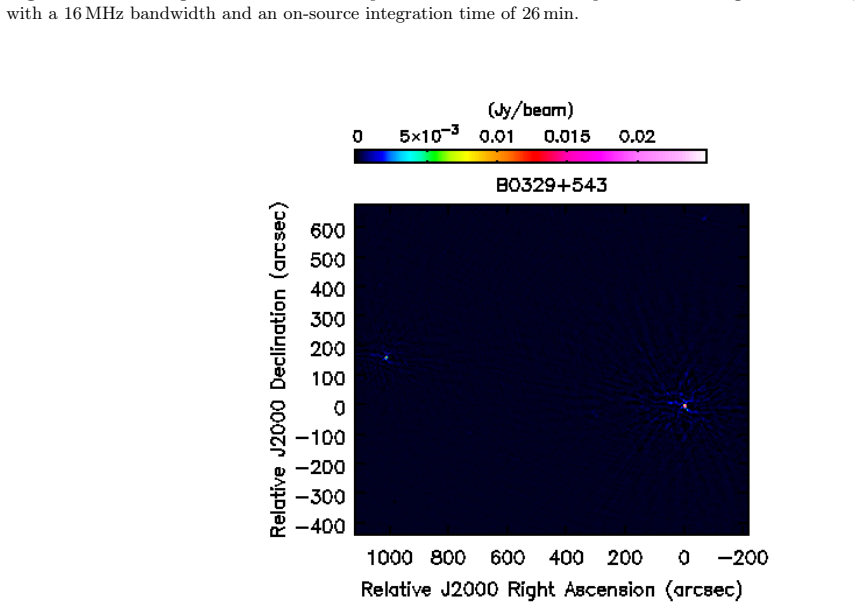
Running SPICE on a GMRT scan of a known pulsar such as PSR B0329+54 and finding zero sources classified as scintillating candidates despite the pulsar being present in the field.
Figures
read the original abstract
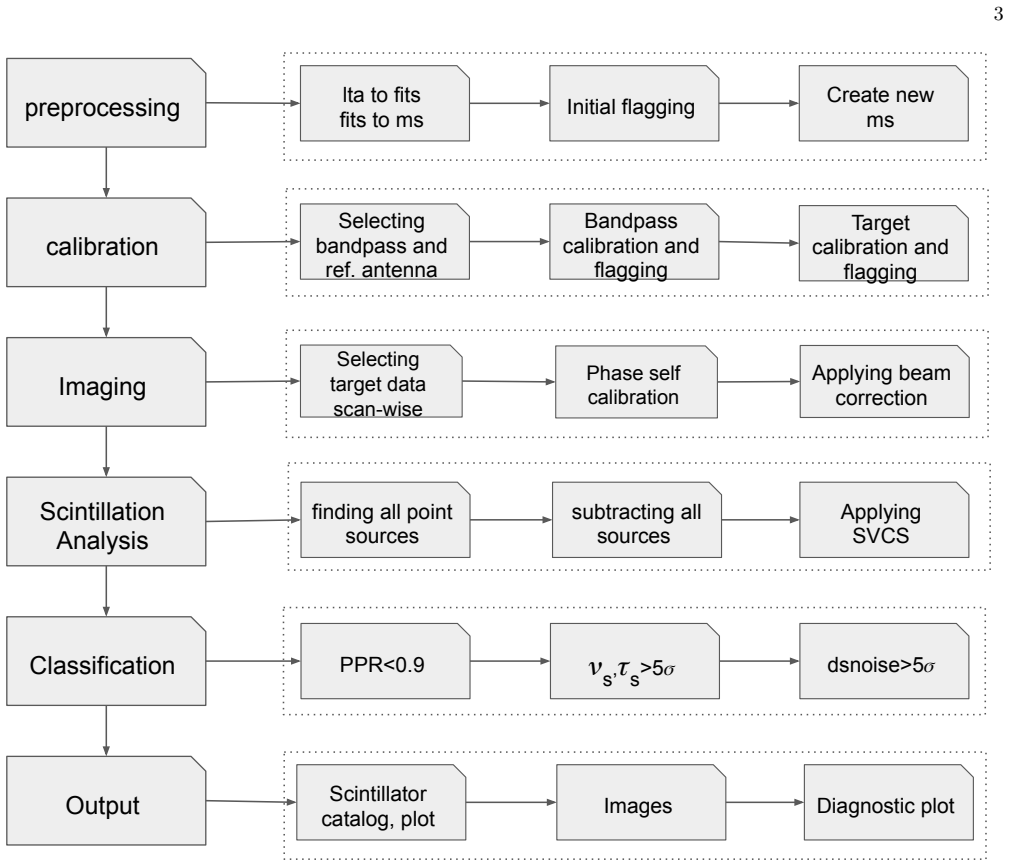
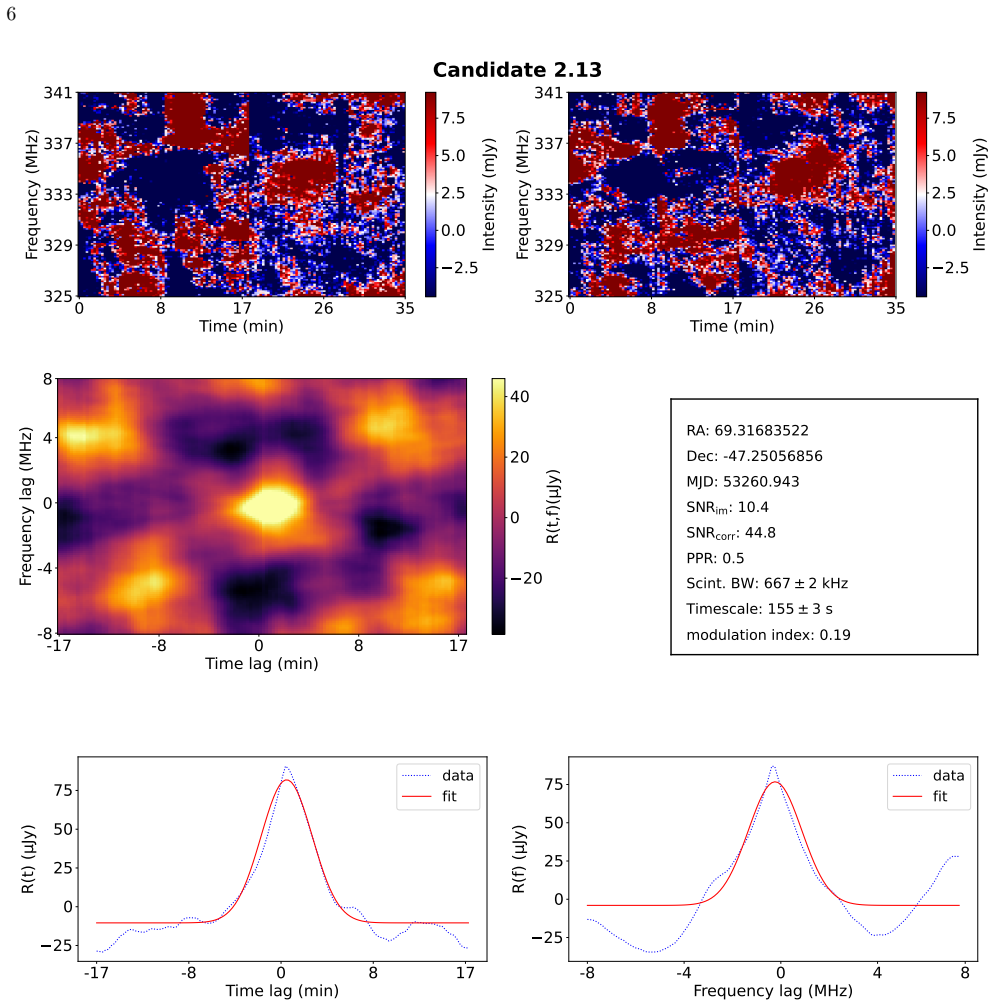
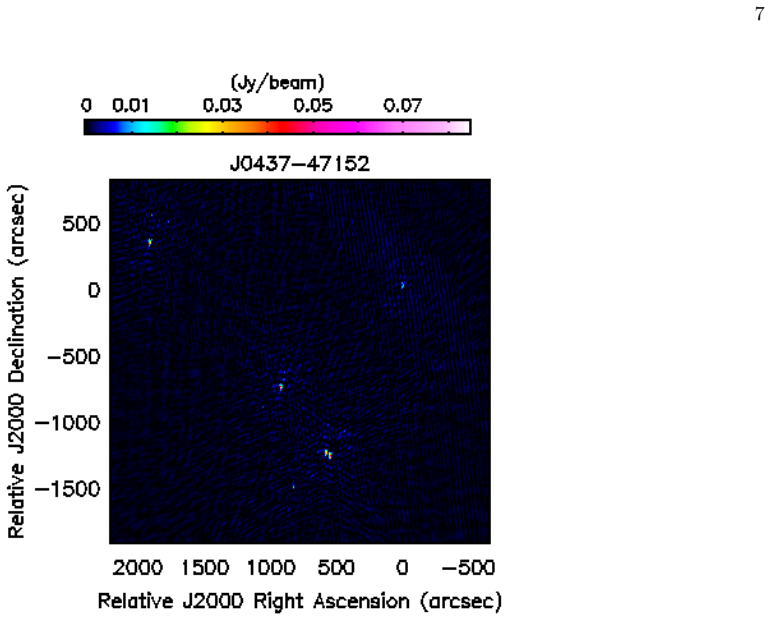
We present Scintillation Pipeline for Interferometric Candidate Extraction (SPICE) an automated CASA-based pipeline developed to identify pulsar candidates in Giant Metrewave Radio Telescope (GMRT) and upgraded GMRT (uGMRT) data through their diffractive interstellar scintillation signatures. SPICE integrates flagging, calibration, imaging, and classification, with robust RFI excision, iterative self-calibration with dynamic reference antenna selection, source detection using PyBDSF, and classification based on our earlier development of scintillation-based visibility correlation searches. SPICE is available publicly on github and is archived on Zenodo. We applied SPICE to archival datasets from both legacy GMRT and uGMRT. The pipeline successfully recovered known pulsars such as PSR 0437-4715, PSR B0450-18, and PSR B0329+54, yielding scintillation parameters consistent with expectations. Non-detections in some scans highlight the influence of pervasive RFI, the dependence on the reference antenna, and the intrinsic variability of the scintillation properties. SPICE complements time-domain searches by enabling reproducible scintillation-based candidate identification in interferometric data. Its application to the GMRT archive opens a pathway for discovering compact variable sources and expanding pulsar searches beyond time-domain searches.
Editorial analysis
A structured set of objections, weighed in public.
Referee Report
Summary. The manuscript presents SPICE, an automated CASA-based pipeline for identifying pulsar candidates in GMRT and uGMRT data using diffractive interstellar scintillation signatures in visibility correlations. It integrates flagging, calibration with dynamic reference antenna, imaging, PyBDSF detection, and classification from prior scintillation methods. Applied to archival data, it recovered known pulsars PSR 0437-4715, PSR B0450-18, and PSR B0329+54 with consistent parameters. Non-detections are noted due to RFI and reference antenna choice. The pipeline is publicly available.
Significance. Should the pipeline prove robust in distinguishing scintillation signatures from RFI and other variables after automated processing, it would provide a useful complementary approach to time-domain pulsar searches by enabling systematic mining of interferometric archives. The public availability of the code supports reproducibility. The current evidence, limited to recovery of three known sources without quantitative false positive assessments, suggests the significance is that of a promising prototype rather than a ready-to-deploy tool.
major comments (2)
- [Application to archival datasets] Application to archival datasets: The recovery of three known pulsars (PSR 0437-4715, PSR B0450-18, PSR B0329+54) with consistent scintillation parameters is shown, but the manuscript provides no quantitative recovery statistics, false-positive rates on control fields, or ablation tests isolating the impact of flagging, self-calibration, and PyBDSF detection on the visibility correlation signature. This is load-bearing for the central claim that the signatures remain distinguishable from RFI after all processing steps under variable data quality.
- [Abstract] Abstract and results description: Non-detections are attributed to pervasive RFI and reference-antenna dependence, yet no metrics are given on the fraction of scans where signatures survive the automated steps or on distinguishability from other variable sources after the full pipeline.
minor comments (1)
- A table summarizing the specific archival datasets processed, number of scans analyzed, and per-scan outcomes would improve clarity on the scale of the demonstration.
Simulated Author's Rebuttal
We thank the referee for the constructive review and the recommendation for major revision. We address each major comment point by point below, agreeing that additional quantitative details would strengthen the presentation of SPICE as a prototype pipeline.
read point-by-point responses
-
Referee: [Application to archival datasets] Application to archival datasets: The recovery of three known pulsars (PSR 0437-4715, PSR B0450-18, PSR B0329+54) with consistent scintillation parameters is shown, but the manuscript provides no quantitative recovery statistics, false-positive rates on control fields, or ablation tests isolating the impact of flagging, self-calibration, and PyBDSF detection on the visibility correlation signature. This is load-bearing for the central claim that the signatures remain distinguishable from RFI after all processing steps under variable data quality.
Authors: We agree that the absence of quantitative recovery statistics, false-positive rates, and ablation tests represents a limitation for claims about robustness after automated processing. The manuscript demonstrates successful recovery of three known pulsars with consistent parameters on archival data but does not include systematic control-field tests or ablation studies. In revision, we have added a new subsection quantifying the fraction of scans yielding detections for the tested pulsars and a discussion of the practical difficulties in performing false-positive assessments on heterogeneous archival data without dedicated control observations. Full ablation tests are noted as beyond the scope of the current prototype demonstration but are flagged for future work. revision: partial
-
Referee: [Abstract] Abstract and results description: Non-detections are attributed to pervasive RFI and reference-antenna dependence, yet no metrics are given on the fraction of scans where signatures survive the automated steps or on distinguishability from other variable sources after the full pipeline.
Authors: We acknowledge that the abstract and results section would benefit from explicit metrics. We have revised the abstract to state the detection fractions for the recovered pulsars across the processed scans and added corresponding quantitative statements in the results section. Distinguishability is addressed by noting that the recovered scintillation parameters match independent literature values, providing a basis for separation from RFI or other variables in the tested cases. revision: yes
Circularity Check
Minor self-citation for classification; pipeline validation is empirical
specific steps
-
self citation load bearing
[Abstract]
"classification based on our earlier development of scintillation-based visibility correlation searches"
The classification component is taken from the authors' prior work; however, because the reported success metric is direct recovery of known sources rather than a derived prediction forced by that prior method, the citation is not load-bearing for the paper's main result.
full rationale
The paper describes an integration of existing CASA tools with the authors' prior scintillation classification method. Validation consists of recovering known pulsars (PSR 0437-4715 etc.) with consistent parameters, which is an external empirical check rather than any equation or fitted quantity reducing to its own inputs by construction. The self-citation appears only in the description of the classification module and does not justify the central claim of pipeline functionality.
Axiom & Free-Parameter Ledger
Reference graph
Works this paper leans on
-
[1]
doi:10.5281/zenodo.20647290 , adsurl =
SPICE: Scintillation Pipeline for Interferometric Candidate Extraction. doi:10.5281/zenodo.20647290 , adsurl =
-
[2]
FLAGCAL:A flagging and calibration package for radio interferometric data
FLAGCAL: a flagging and calibration package for radio interferometric data. Experimental Astronomy , keywords =. doi:10.1007/s10686-011-9279-5 , archivePrefix =. 1111.6415 , primaryClass =
work page internal anchor Pith review Pith/arXiv arXiv doi:10.1007/s10686-011-9279-5
-
[3]
The GMRT 150 MHz All-sky Radio Survey: First Alternative Data Release TGSS ADR1
The GMRT 150 MHz all-sky radio survey. First alternative data release TGSS ADR1. , keywords =. doi:10.1051/0004-6361/201628536 , archivePrefix =. 1603.04368 , primaryClass =
work page internal anchor Pith review Pith/arXiv arXiv doi:10.1051/0004-6361/201628536
-
[4]
Prospects for Identifying Pulsar Candidates in Radio Surveys Using Scintillation. , keywords =. doi:10.3847/1538-4357/ae23c9 , archivePrefix =. 2601.02097 , primaryClass =
-
[5]
, year = 1955, month = jan, volume =
The Luminosity Function and Stellar Evolution. , year = 1955, month = jan, volume =. doi:10.1086/145971 , adsurl =
-
[6]
A Giant Metrewave Radio Telescope survey of radio-loud broad absorption line quasars. , keywords =. doi:10.1093/mnras/stae1008 , archivePrefix =. 2404.07726 , primaryClass =
-
[7]
, year = 1931, month = jul, volume =
The Maximum Mass of Ideal White Dwarfs. , year = 1931, month = jul, volume =. doi:10.1086/143324 , adsurl =
-
[8]
Interplanetary scintillation studies with the Murchison Widefield Array III: comparison of source counts and densities for radio sources and their sub-arcsecond components at 162 MHz. , keywords =. doi:10.1093/mnras/sty1665 , archivePrefix =. 1806.08061 , primaryClass =
work page internal anchor Pith review Pith/arXiv arXiv doi:10.1093/mnras/sty1665
-
[9]
Crawford, D. F. and Robertson, J. G. and Davidson, G. , journal=. Variance imaging in radio astronomy , year=
-
[10]
CHIME All-sky Multiday Pulsar Stacking Search (CHAMPSS): System Overview and First Discoveries. , keywords =. doi:10.3847/1538-4357/adeb51 , archivePrefix =. 2504.16293 , primaryClass =
-
[11]
Searching for pulsars using image pattern recognition
Searching for Pulsars Using Image Pattern Recognition. , keywords =. doi:10.1088/0004-637X/781/2/117 , archivePrefix =. 1309.0776 , primaryClass =
work page internal anchor Pith review Pith/arXiv arXiv doi:10.1088/0004-637x/781/2/117
-
[12]
Survey status, pulsar census, and first pulsar discoveries
The Southern-sky MWA Rapid Two-metre (SMART) pulsar survey II. Survey status, pulsar census, and first pulsar discoveries. , keywords =. doi:10.1017/pasa.2023.18 , archivePrefix =. 2302.11920 , primaryClass =
-
[13]
Discovery of an RRAT-like Pulsar via Its Single Pulses in a Murchison Widefield Array Imaging Survey. , keywords =. doi:10.3847/1538-4357/adb27f , archivePrefix =. 2502.02130 , primaryClass =
-
[14]
TRAPUM discovery of 13 new pulsars in NGC 1851 using MeerKAT. , keywords =. doi:10.1051/0004-6361/202143006 , archivePrefix =. 2203.12302 , primaryClass =
-
[15]
arXiv e-prints , keywords =
The TRAPUM Large Magellanic Cloud pulsar survey with MeerKAT II: 12 new discoveries and timing solutions for 7 pulsars. arXiv e-prints , keywords =
-
[16]
Discovery of seven new pulsars and two Pulsar Wind Nebula associations
The TRAPUM Small Magellanic Cloud pulsar survey with MeerKAT - I. Discovery of seven new pulsars and two Pulsar Wind Nebula associations. , keywords =. doi:10.1093/mnras/stae1310 , archivePrefix =. 2405.12029 , primaryClass =
-
[17]
Theory of Parabolic Arcs in Interstellar Scintillation Spectra
Theory of Parabolic Arcs in Interstellar Scintillation Spectra. , keywords =. doi:10.1086/498332 , archivePrefix =. astro-ph/0407072 , primaryClass =
work page internal anchor Pith review Pith/arXiv arXiv doi:10.1086/498332
-
[18]
Scattering analysis of single-component pulsars
The Thousand-Pulsar-Array programme on MeerKAT ─ V. Scattering analysis of single-component pulsars. , keywords =. doi:10.1093/mnras/stab980 , archivePrefix =. 2104.01081 , primaryClass =
-
[19]
Pulsar scintillation through thick and thin: bow shocks, bubbles, and the broader interstellar medium. , keywords =. doi:10.1093/mnras/stad3683 , archivePrefix =. 2309.13809 , primaryClass =
-
[20]
Long-Term Scintillation Studies of Pulsars. I. Observations and Basic Results. , keywords =. doi:10.1086/313198 , archivePrefix =. astro-ph/9810354 , primaryClass =
work page internal anchor Pith review Pith/arXiv arXiv doi:10.1086/313198
-
[21]
The Australia Telescope National Facility Pulsar Catalogue. , keywords =. doi:10.1086/428488 , archivePrefix =. astro-ph/0412641 , primaryClass =
work page internal anchor Pith review Pith/arXiv arXiv doi:10.1086/428488
-
[22]
A radio spectral index map and catalogue at 147-1400 MHz covering 80 per cent of the sky
A radio spectral index map and catalogue at 147-1400 MHz covering 80 per cent of the sky. , keywords =. doi:10.1093/mnras/stx3125 , archivePrefix =. 1711.11367 , primaryClass =
work page internal anchor Pith review Pith/arXiv arXiv doi:10.1093/mnras/stx3125
-
[23]
A Search for Pulsars in Steep-spectrum Radio Sources toward the Galactic Center. , keywords =. doi:10.3847/1538-4357/ab11c8 , adsurl =
-
[24]
Scintillation time-scale measurement of the highly active FRB20201124A. , keywords =. doi:10.1093/mnras/stab3218 , archivePrefix =. 2108.00052 , primaryClass =
-
[25]
Associations between Scattering Screens and Interstellar Medium Filaments. , keywords =. doi:10.3847/1538-4357/ada1d8 , archivePrefix =. 2407.16876 , primaryClass =
-
[26]
Faint Scattering Around Pulsars: Probing the Interstellar Medium on Solar System Size Scales
Faint Scattering Around Pulsars: Probing the Interstellar Medium on Solar System Size Scales. , keywords =. doi:10.1086/319133 , archivePrefix =. astro-ph/0010363 , primaryClass =
work page internal anchor Pith review Pith/arXiv arXiv doi:10.1086/319133
-
[27]
Interstellar scattering - New diagnostics of pulsars and the ISM
Interstellar scattering New diagnostics of pulsars and the ISM. Neutron Stars and Pulsars: Challenges and Opportunities after 80 years , year = 2013, editor =. doi:10.1017/S1743921312023708 , archivePrefix =. 1210.7891 , primaryClass =
work page internal anchor Pith review Pith/arXiv arXiv doi:10.1017/s1743921312023708 2013
-
[28]
Predicting Pulsar Scintillation from Refractive Plasma Sheets
Predicting pulsar scintillation from refractive plasma sheets. , keywords =. doi:10.1093/mnras/sty1140 , archivePrefix =. 1703.06855 , primaryClass =
work page internal anchor Pith review Pith/arXiv arXiv doi:10.1093/mnras/sty1140
-
[29]
Statistics of interpulse radio pulsars - the key to solving the alignment/counter-alignment problem
Statistics of interpulse radio pulsars: the key to solving the alignment/counter-alignment problem. , keywords =. doi:10.1093/mnras/stw3139 , archivePrefix =. 1612.04820 , primaryClass =
work page internal anchor Pith review Pith/arXiv arXiv doi:10.1093/mnras/stw3139
-
[30]
Astronomische Nachrichten , keywords =
A short review on the pulsar magnetic inclination angles. Astronomische Nachrichten , keywords =. doi:10.1002/asna.20220111 , archivePrefix =. 2404.13857 , primaryClass =
-
[31]
Radiative pulsar magnetospheres: aligned rotator. , keywords =. doi:10.1093/mnrasl/slz162 , archivePrefix =. 1910.10207 , primaryClass =
-
[32]
The NANOGrav 15-year Data Set: Evidence for a Gravitational-Wave Background
The NANOGrav 15 yr Data Set: Evidence for a Gravitational-wave Background. , keywords =. doi:10.3847/2041-8213/acdac6 , archivePrefix =. 2306.16213 , primaryClass =
work page internal anchor Pith review Pith/arXiv arXiv doi:10.3847/2041-8213/acdac6 2041
-
[33]
Tests of general relativity from timing the double pulsar
Tests of General Relativity from Timing the Double Pulsar. Science , keywords =. doi:10.1126/science.1132305 , archivePrefix =. astro-ph/0609417 , primaryClass =
work page internal anchor Pith review Pith/arXiv arXiv doi:10.1126/science.1132305
-
[34]
Neutron Star Equation of State Constraints from NICER and Multimessenger Gravitational Wave Observations. Neutron Star Astrophysics at the Crossroads: Magnetars and the Multimessenger Revolution , year = 2023, editor =. doi:10.1017/S1743921322001144 , adsurl =
-
[35]
The Equation of State of Neutron Stars: Theoretical Models, Observational Constraints, and Future Perspectives. arXiv e-prints , keywords =. doi:10.48550/arXiv.2502.05513 , archivePrefix =. 2502.05513 , primaryClass =
-
[36]
Magnetospheric origin of a fast radio burst constrained using scintillation. , keywords =. doi:10.1038/s41586-024-08297-w , archivePrefix =. 2406.11053 , primaryClass =
-
[37]
Science China Physics, Mechanics, and Astronomy , keywords =
Scintillation Arc from FRB 20220912A. Science China Physics, Mechanics, and Astronomy , keywords =. doi:10.1007/s11433-023-2186-2 , archivePrefix =. 2304.14697 , primaryClass =
-
[38]
Populating the Galaxy with pulsars - I. Stellar and binary evolution. , keywords =. doi:10.1111/j.1365-2966.2008.13402.x , archivePrefix =. 0805.0059 , primaryClass =
-
[39]
Born to be recycled: a comprehensive population synthesis of the Galactic millisecond pulsars. arXiv e-prints , keywords =. doi:10.48550/arXiv.2510.15661 , archivePrefix =. 2510.15661 , primaryClass =
-
[40]
Pulsar Scintillation Arcs. I. Frequency Dependence. , keywords =. doi:10.1086/379191 , adsurl =
-
[41]
Fourier domain excision of periodic radio frequency interference. , keywords =. doi:10.1051/0004-6361/202040164 , archivePrefix =. 2012.11630 , primaryClass =
-
[42]
Diffractive Interstellar Scintillation Timescales and Velocities. , keywords =. doi:10.1086/306358 , adsurl =
-
[43]
Bow shock and Local Bubble plasma unveiled by the scintillating millisecond pulsar J0437 - 4715. Nature Astronomy , keywords =. doi:10.1038/s41550-025-02534-6 , archivePrefix =. 2410.21390 , primaryClass =
-
[44]
Eight new millisecond pulsars from the first MeerKAT globular cluster census. , keywords =. doi:10.1093/mnras/stab790 , archivePrefix =. 2103.04800 , primaryClass =
-
[45]
Fourier Techniques for Very Long Astrophysical Time Series Analysis
Fourier Techniques for Very Long Astrophysical Time-Series Analysis. , keywords =. doi:10.1086/342285 , archivePrefix =. astro-ph/0204349 , primaryClass =
work page internal anchor Pith review Pith/arXiv arXiv doi:10.1086/342285
-
[46]
Revised Pulsar Spin-down. , keywords =. doi:10.1086/501161 , archivePrefix =. astro-ph/0512002 , primaryClass =
work page internal anchor Pith review Pith/arXiv arXiv doi:10.1086/501161
-
[47]
The geometry of a radio pulsar beam
The geometry of a radio pulsar beam. , keywords =. doi:10.1093/mnrasl/slx120 , archivePrefix =. 1705.05133 , primaryClass =
work page internal anchor Pith review Pith/arXiv arXiv doi:10.1093/mnrasl/slx120
-
[48]
Evidence for the spin-kick alignment of pulsars from the statistics of their magnetic inclinations. , keywords =. doi:10.1017/pasa.2025.10069 , archivePrefix =. 2412.12017 , primaryClass =
-
[49]
Rocking the Lighthouse: Circumpulsar Asteroids and Radio Intermittency
Rocking the Lighthouse: Circumpulsar Asteroids and Radio Intermittency. , keywords =. doi:10.1086/589425 , archivePrefix =. astro-ph/0605145 , primaryClass =
work page internal anchor Pith review Pith/arXiv arXiv doi:10.1086/589425
-
[50]
Science with ASKAP - the Australian Square Kilometre Array Pathfinder
Science with ASKAP. The Australian square-kilometre-array pathfinder. Experimental Astronomy , keywords =. doi:10.1007/s10686-008-9124-7 , archivePrefix =. 0810.5187 , primaryClass =
work page internal anchor Pith review Pith/arXiv arXiv doi:10.1007/s10686-008-9124-7
-
[51]
The DSA-2000 -- A Radio Survey Camera
The DSA-2000 A Radio Survey Camera. Bulletin of the American Astronomical Society , year = 2019, volume =. doi:10.48550/arXiv.1907.07648 , archivePrefix =. 1907.07648 , primaryClass =
work page internal anchor Pith review Pith/arXiv arXiv doi:10.48550/arxiv.1907.07648 2000
-
[52]
Ionospheric calibration of low frequency radio interferometric observations using the peeling scheme. I. Method description and first results. , keywords =. doi:10.1051/0004-6361/200811094 , archivePrefix =. 0904.3975 , primaryClass =
work page internal anchor Pith review Pith/arXiv arXiv doi:10.1051/0004-6361/200811094
-
[53]
SPAM: Source Peeling and Atmospheric Modeling
-
[54]
An image-based search for pulsars among Fermi unassociated LAT sources
An image-based search for pulsars among Fermi unassociated LAT sources. , keywords =. doi:10.1093/mnras/stx3281 , archivePrefix =. 1712.06609 , primaryClass =
work page internal anchor Pith review Pith/arXiv arXiv doi:10.1093/mnras/stx3281
-
[55]
Image-based searches for pulsar candidates using MWA VCS data. , keywords =. doi:10.1017/pasa.2022.59 , archivePrefix =. 2212.06982 , primaryClass =
-
[56]
Searching for pulsars associated with polarised point sources using LOFAR: Initial discoveries from the TULIPP project. , keywords =. doi:10.1051/0004-6361/202142636 , archivePrefix =. 2203.08331 , primaryClass =
-
[57]
Interstellar Scintillation of PSR J0437-4715 on Two Scales
Interstellar scintillation of PSR J0437-4715 on two scales. , keywords =. doi:10.1051/0004-6361:20054280 , archivePrefix =. astro-ph/0204367 , primaryClass =
work page internal anchor Pith review Pith/arXiv arXiv doi:10.1051/0004-6361:20054280
-
[58]
Pulsar Flux Stability and Refractive Interstellar Scintillation. , keywords =. doi:10.1086/168528 , adsurl =
-
[59]
A statistical analysis of the nulling pulsar population. , keywords =. doi:10.1093/mnras/stab282 , archivePrefix =. 2102.00045 , primaryClass =
-
[60]
Scintillation Velocities of Five Millisecond Pulsars. , keywords =. doi:10.1086/308450 , adsurl =
-
[61]
Small-scale electron density turbulence in the interstellar medium. , keywords =. doi:10.1086/162784 , adsurl =
-
[62]
Pulsar scintillation studies with LOFAR. I. The census. , keywords =. doi:10.1051/0004-6361/202142980 , archivePrefix =. 2203.10409 , primaryClass =
-
[63]
Identifying Pulsar Candidates in Interferometric Radio Images Using Scintillation. , keywords =. doi:10.3847/1538-4357/ad65e8 , archivePrefix =. 2407.17764 , primaryClass =
-
[64]
An in-depth investigation of 11 pulsars discovered by FAST. , keywords =. doi:10.1093/mnras/staa1328 , archivePrefix =. 2005.09171 , primaryClass =
-
[65]
The Parkes multi-beam pulsar survey - I. Observing and data analysis systems, discovery and timing of 100 pulsars. , keywords =. doi:10.1046/j.1365-8711.2001.04751.x , archivePrefix =. astro-ph/0106522 , primaryClass =
-
[66]
The High Time Resolution Universe Pulsar Survey - I. System configuration and initial discoveries. , keywords =. doi:10.1111/j.1365-2966.2010.17325.x , archivePrefix =. 1006.5744 , primaryClass =
-
[67]
The High Time Resolution Universe Pulsar Survey VIII: The Galactic millisecond pulsar population
The High Time Resolution Universe Pulsar Survey -VIII. The Galactic millisecond pulsar population. , keywords =. doi:10.1093/mnras/stt1103 , archivePrefix =. 1306.4190 , primaryClass =
work page internal anchor Pith review Pith/arXiv arXiv doi:10.1093/mnras/stt1103
-
[68]
Pulsar science with the Five hundred metre Aperture Spherical Telescope
Pulsar science with the Five hundred metre Aperture Spherical Telescope. , keywords =. doi:10.1051/0004-6361/200911939 , archivePrefix =. 0908.1689 , primaryClass =
work page internal anchor Pith review Pith/arXiv arXiv doi:10.1051/0004-6361/200911939
-
[69]
The Parkes multibeam pulsar survey - VII. Timing of four millisecond pulsars and the underlying spin-period distribution of the Galactic millisecond pulsar population. , keywords =. doi:10.1093/mnras/stv804 , archivePrefix =. 1501.05516 , primaryClass =
work page internal anchor Pith review Pith/arXiv arXiv doi:10.1093/mnras/stv804
-
[70]
Interstellar Scattering Effects on the Detection of Narrow-Band Signals. , keywords =. doi:10.1086/170261 , adsurl =
-
[71]
NE2001.I. A New Model for the Galactic Distribution of Free Electrons and its Fluctuations
NE2001.I. A New Model for the Galactic Distribution of Free Electrons and its Fluctuations. arXiv e-prints , keywords =. doi:10.48550/arXiv.astro-ph/0207156 , archivePrefix =. astro-ph/0207156 , primaryClass =
work page internal anchor Pith review Pith/arXiv arXiv doi:10.48550/arxiv.astro-ph/0207156
-
[72]
Scatter broadening measurements of 124 pulsars at 327 MHz
Scatter Broadening Measurements of 124 Pulsars At 327 Mhz. , keywords =. doi:10.1088/0004-637X/804/1/23 , archivePrefix =. 1501.05401 , primaryClass =
work page internal anchor Pith review Pith/arXiv arXiv doi:10.1088/0004-637x/804/1/23
-
[73]
2006, MNRAS, 372, 233, doi: 10.1111/j.1365-2966.2006.10840.x
The Parkes Multibeam Pulsar Survey - VI. Discovery and timing of 142 pulsars and a Galactic population analysis. , keywords =. doi:10.1111/j.1365-2966.2006.10887.x , archivePrefix =. astro-ph/0607640 , primaryClass =
-
[74]
A New Electron Density Model for Estimation of Pulsar and FRB Distances
A New Electron-density Model for Estimation of Pulsar and FRB Distances. , keywords =. doi:10.3847/1538-4357/835/1/29 , archivePrefix =. 1610.09448 , primaryClass =
work page internal anchor Pith review Pith/arXiv arXiv doi:10.3847/1538-4357/835/1/29
-
[75]
PsrPopPy: An open-source package for pulsar population simulations
PSRPOPPy: an open-source package for pulsar population simulations. , keywords =. doi:10.1093/mnras/stu157 , archivePrefix =. 1311.3427 , primaryClass =
work page internal anchor Pith review Pith/arXiv arXiv doi:10.1093/mnras/stu157
-
[76]
Revealing the Physics and Evolution of Galaxies and Galaxy Clusters with SKA Continuum Surveys
Revealing the Physics and Evolution of Galaxies and Galaxy Clusters with SKA Continuum Surveys. Advancing Astrophysics with the Square Kilometre Array (AASKA14) , year = 2015, month = apr, eid =. doi:10.22323/1.215.0067 , archivePrefix =. 1412.6512 , primaryClass =
work page internal anchor Pith review Pith/arXiv arXiv doi:10.22323/1.215.0067 2015
-
[77]
EMU: Evolutionary Map of the Universe
EMU: Evolutionary Map of the Universe. , keywords =. doi:10.1071/AS11021 , archivePrefix =. 1106.3219 , primaryClass =
work page internal anchor Pith review Pith/arXiv arXiv doi:10.1071/as11021
-
[78]
A Cosmic Census of Radio Pulsars with the SKA
A Cosmic Census of Radio Pulsars with the SKA. Advancing Astrophysics with the Square Kilometre Array (AASKA14) , year = 2015, month = apr, eid =. doi:10.22323/1.215.0040 , archivePrefix =. 1501.00056 , primaryClass =
work page internal anchor Pith review Pith/arXiv arXiv doi:10.22323/1.215.0040 2015
-
[79]
Shapiro delay measurement of a two solar mass neutron star
A two-solar-mass neutron star measured using Shapiro delay. , keywords =. doi:10.1038/nature09466 , archivePrefix =. 1010.5788 , primaryClass =
work page internal anchor Pith review Pith/arXiv arXiv doi:10.1038/nature09466
-
[80]
Testing General Relativity with Pulsar Timing
Testing General Relativity with Pulsar Timing. Living Reviews in Relativity , keywords =. doi:10.12942/lrr-2003-5 , archivePrefix =. astro-ph/0307536 , primaryClass =
work page internal anchor Pith review Pith/arXiv arXiv doi:10.12942/lrr-2003-5 2003
discussion (0)
Sign in with ORCID, Apple, or X to comment. Anyone can read and Pith papers without signing in.