REVIEW 2 major objections 5 minor 67 references
Detecting the topological winding of superconducting nodes via Local Density of States
T0 review · 2 major / 5 minor · reviewed 2026-08-11 · deepseek-v4-flash
Pith's one-line read The topological winding of superconducting nodes can be read from impurity-induced LDOS ripples, whose Fourier transform carries a vortex of strength equal to the winding difference.
desk verdict A useful generalization of QPI dislocation detection to nodal superconductors, with a concrete NbSe2 proposal, but the key projection step is deferred and needs verification. read the letter →
The pith
A machine-rendered reading of the paper's core claim, the machinery that carries it, and where it could break.
The reading
What carries the argument
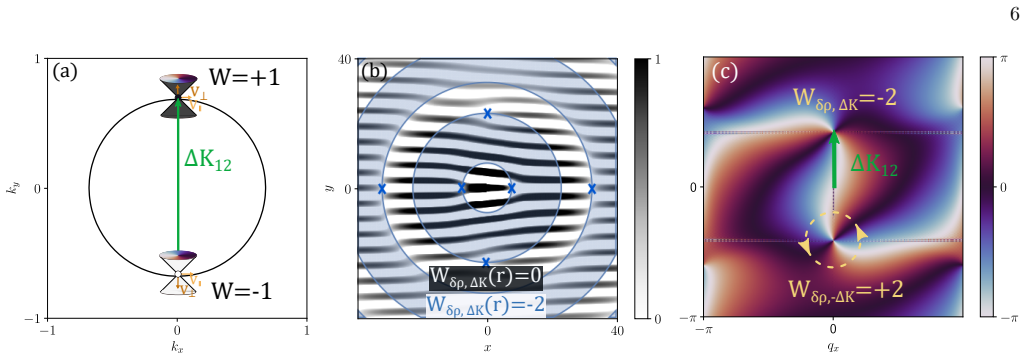
The central object is the real-space phase function $\theta_{K_i}(r) = \arctan[(v_\parallel/v_\perp) \tan(W_{K_i} \theta_r + \phi_i)]$, which inherits the node's winding number $W_{K_i}$ from the linearized dispersion and appears in the off-diagonal propagator $g_1$. Writing the scattering-induced LDOS as $\mathrm{Re}[\varrho(r)e^{i\varphi_r}]$ with $\varphi_r = \Delta K_{ij}\cdot r + \mathrm{Arg}[I_0 + I_\Delta e^{i\Delta\theta} + I_{-\Delta} e^{-i\Delta\theta}]$, the winding of $\mathrm{Arg}[\cdot]$ around the impurity yields the dislocation charge $W_{\delta\rho} = \pm\Delta W$. The conditions for a non-zero $W_{\delta\rho}$ reduce to two chirality-preference ratios: $\chi_M = M_A/M_B$ for the tip and $\chi_V = V_A/V_B$ for the impurity, with the requirement $|h_1(\chi_M+\chi_V)| > |h_0(\chi_M\chi_V+1)|$ and $\chi_M \neq \pm\chi_V$.
What would settle it
Compute the full Bogoliubov-de Gennes Green's function without cone-band projection for the NbSe2 model, generate the impurity LDOS, and take its Fourier transform; if the vortex vorticity at any ΔKij differs from the winding difference predicted by the projected theory, the central claim collapses.
Extended reading notes
Core claim
In a chiral Hamiltonian written in a basis of A and B eigenstates, the complex phase θn(k) of the off-diagonal Q-matrix carries the winding. After linearizing around a node and projecting to the cone band, the real-space Green's function g1(r) acquires the same phase as a function of the real-space polar angle θr, so the cone's winding WKi appears in the phase of the propagator. Scattering between two nodes i and j by an impurity then contributes LDOS terms cos(ΔKij·r ± Δθij(θr)) to the wavefront, and when the tip and impurity have different chirality preferences, the phase Δθij winds ΔW = WKi - WKj times, creating a dislocation of strength ±ΔW in real space. Crucially, in the Fourier transform of the LDOS this becomes a single vortex at ΔKij whose vorticity equals the total enclosed dislocation charge, a quantity that is robust to finite field of view. The paper's application to the twelve-node nodal superconductor proposed for monolayer NbSe2 under an in-plane field shows that a magnetic impurity combined with a spin-polarized STM tip satisfies the winding conditions, so each node's winding is in principle measurable.
Load-bearing premise
The argument assumes that after a gauge choice putting all winding into the cone band, no gapped band carries any of the node's winding, so the projected propagator measures the true node winding; the authors state that a full numerical Green's function check without projection is still needed.
Editorial extensions
If this is right
- A single STM measurement, not quantized transport, can extract the winding numbers of superconducting nodes, which are otherwise inaccessible experimentally.
- In a nodal superconductor such as NbSe2, the measured winding differences can discriminate pairing symmetries, since only certain pairing functions yield non-zero windings at the nodes.
- The method extends beyond superconductors to any chiral system with linearly dispersing nodes, including graphene-like semimetals, and to nodal lines in three dimensions.
- Momentum-space vortices remain observable even when real-space dislocations are masked by other defects, because the vorticity at ΔKij accumulates all dislocation charges inside the field of view.
- The explicit chirality-preference conditions provide a recipe to choose an impurity and tip (or functionalized tip) for any candidate material.
Reading between the lines
- Beyond the paper: a decisive numerical test would be a full, unprojected Green's function calculation of the impurity LDOS in NbSe2; if the vortex vorticity at each ΔKij still equals the total winding difference, the projection to the cone band is validated.
- Beyond the paper: the same scattering mechanism could be used on the surfaces of three-dimensional Weyl semimetals or nodal-line superconductors, where the projected surface LDOS may carry winding signatures from the bulk nodes.
- Beyond the paper: the requirement that tip and impurity prefer opposite chiralities suggests that functionalized or spin-polarized STM tips could act as chirality filters, potentially enabling detection of higher-winding Dirac points or multi-band nodes with |W| > 1.
- Beyond the paper: if confirmed, the technique gives a local, real-space probe of topological invariants that does not require edge states or global Berry curvature cancellation, which could be applied to disordered or small samples.
Editorial analysis
A structured set of objections, weighed in public.
Referee Report
Summary. The paper develops a general theory for extracting the difference of chiral winding numbers of two Dirac nodes in a 2D nodal chiral system from impurity-induced LDOS modulations. Using a chiral-basis Green's function and the T-matrix/Born approximation, it derives conditions on the chirality preferences of an STM tip and an impurity under which the LDOS at a scattering vector ΔKij displays a wavefront dislocation in real space and a phase vortex in momentum space with charge equal to the winding difference ΔW = WKi - WKj. The method is applied to the proposed nodal Ising superconducting phase of monolayer NbSe2 under an in-plane magnetic field, where the authors predict that a magnetic impurity combined with a spin-polarized STM tip can reveal the winding of all 12 nodes. The paper also discusses anisotropy corrections, the relative robustness of momentum-space vortices versus real-space dislocations, and the experimental feasibility including a quantitative Born-approximation estimate.
Significance. If the central correspondence is fully substantiated, the paper provides a concrete experimental route to measure a lower-dimensional topological invariant—the winding of superconducting nodes—via STM, which is currently lacking. The work extends the graphene wavefront-dislocation technique to superconductors and other chiral nodal systems, and it gives explicit, falsifiable predictions for a specific material (NbSe2). Strengths include the detailed analytical derivation of the conditions, the generalization to anisotropic cones and complex chirality parameters, the careful treatment of experimental resolution, and the honest enumeration of approximations. The authors also provide a quantitative estimate for the Fe impurity in NbSe2, showing that the Born approximation is marginally reasonable (G0V ≈ 0.3). These features make the paper a valuable contribution if the identified gaps are addressed.
major comments (2)
- [III.C, Eqs. (27)-(36)] The general conditions for a non-zero dislocation charge are misstated for complex chirality preferences. With IΔ = h1 χM and I−Δ = h1 χV (Eq. (30)), the requirement |IΔ| ≠ |I−Δ| in Eq. (28) is equivalent to |χM| ≠ |χV|, not to χM ≠ ±χV as claimed in Eq. (36). Equation (34b) as written only excludes χM = χV. For instance, χM = 1, χV = i satisfies both Eq. (34b) and Eq. (36) yet has equal magnitudes, so the dislocation is absent. The correct conditions for complex χ are Eqs. (A8a)-(A8b) of Appendix A 2; the main text should either adopt them or explicitly restrict the derivation to real-valued χ.
- [III.B and Appendix C1, Eqs. (7), (13)-(16)] The central identification of the measured LDOS vortex charge with the physical node winding difference ΔW is not yet established, because the derivation projects the Green's function onto the single cone band n = 1 after fixing a gauge in which all winding sits in that band. As the authors state in Appendix C1, the winding number is defined only as a total over bands (Eq. (7)) and "we may reshuffle the non-trivial winding between the different bands n"; the projection to n = 1 can therefore remove winding contributions. The exact Green's function (8) includes the gapped bands, and the impurity/tip operators act in the full Hilbert space, so the weight of each band in the LDOS need not match the n = 1 projection. The paper explicitly defers the decisive check to "a full (numerical) calculation of the Green's function including the gapped bands, without projection." Since the claimed correspondence between the measured vortex and the node winding is the paper's central result, this gap must be closed, either by a rigorous argument that the gapped bands do not alter the winding of the LDOS phase at the relevant scattering vector, or by a numerical evaluation of the unprojected Green's function for a concrete model (e.g., the NbSe2 model of Eq. (39)).
minor comments (5)
- [I. Introduction] The statement that "their total in the Brillouin zone must vanish" is used to argue that all windings follow from the pairwise differences; a brief justification or reference for this topological constraint would be helpful.
- [III.A] The full T-matrix expression is written for a local impurity potential, but the text does not explicitly state that the impurity is local until later; a sentence clarifying this would avoid ambiguity.
- [III.B, Eqs. (11) and (15)] The same symbol θKi is used for the momentum-space phase in Eq. (11) and the real-space phase in Eq. (15); consider using a different notation (e.g., θKi^(q) and θKi^(r)) to avoid confusion.
- [III.E, footnote 53] Two references appear as unresolved placeholders "[?]" in the footnote about the Su-Schrieffer-Heeger chain and Theorem 1; these need to be completed.
- [Fig. 2 caption] The caption refers to green and purple vectors, but the figure may be rendered in grayscale; please ensure the color coding is clear for all readers or label the vectors directly.
Circularity Check
No significant circularity: the vortex-winding correspondence is derived from the model Hamiltonian via the Green's function; the projection/gauge caveat is an acknowledged assumption, not a circular reduction.
full rationale
The paper's central derivation is self-contained rather than circular. The node winding is defined from the phases of the Q-matrix eigenvalues of the chiral Hamiltonian (Eqs. 6-7), and the real-space propagator phase in Eq. (15) is obtained by Fourier-transforming the linearized cone Green's function, so the appearance of WKi in θKi(r) is a derived consequence, not an input fitted to the LDOS. The dislocation/vortex condition (Eqs. 27-29, 34-37) is obtained by an explicit analysis of the interference terms I0, IΔ, I−Δ, with no parameter tuned to force the NbSe2 result. The NbSe2 application computes the winding from the model Hamiltonian (Wn=1=±1, Wn=2=0 under the stated basis choice) and then evaluates the LDOS from the analytic expression Eq. (35); both sides come from the same model, but that is forward modeling, not circularity. The one substantive caveat is the projection onto the n=1 cone band and the gauge choice that places all winding in that band. Appendix C1 states this explicitly: 'we may reshuffle the non-trivial winding between the different bands n. The projection to n = 1 may therefore remove some winding contributions from the Green's function,' and the authors defer the decisive check: 'a full (numerical) calculation of the Green's function including the gapped bands, without projection, may be used to confirm the validity of the projection procedure.' This is an acknowledged unverified assumption about the physical LDOS, which is a correctness risk, not a circular reduction: the paper does not define the node winding in terms of the LDOS vortex, nor does it fit the winding from the LDOS. References to prior work (Dutreix et al., Ref. 22) are external experimental/theoretical support for the general mechanism, not a self-citation chain carrying the present derivation. No fitted parameter is renamed as a prediction, and no result is forced by definition. Accordingly, the circularity score is 0.
Assumptions & free parameters
free parameters (3)
- NbSe2 model parameters (λ, h, Δ, μ, ω) =
λ = 0.15, h = 0.06, Δ = 0.02, μ = 0.25, ω = 0.01 (units m = 1, a = 1)
- STM tip magnetization ratio Mx/My =
Mx = 0.1 My (tip about 6° from the y-axis)
- Fe impurity potential strength V =
V ≈ 100 meV, taken from YSR literature (Refs. 56-57)
assumptions (6)
- domain assumption The bulk Hamiltonian has chiral symmetry Γ with {Γ, H} = 0, protecting the node windings.
- domain assumption Around each node only one band n = 1 is linear and isolated: En≠1(Ki+q) ≥ ΔEn ≫ vKi·q.
- ad hoc to paper The chiral-basis gauge is fixed so that all winding is assigned to the cone band n = 1, with θn>1 trivial.
- domain assumption Born approximation: the T-matrix of the impurity equals the bare potential V.
- domain assumption Impurity and tip preserve chirality ([Γ, V] = [Γ, M] = 0), so A-B scattering matrix elements vanish.
- domain assumption Isotropic-cone approximation for the Hankel integrals (vKi(θq) → vKi).
Cite this review
Pith. "Pith review of Detecting the topological winding of superconducting nodes via Local Density of States." pith.science (2026). https://pith.science/paper/3AIOHLVV
@misc{pith2026241213042,
  author       = {Pith},
  title        = {Pith review of: Detecting the topological winding of superconducting nodes via Local Density of States},
  year         = {2026},
  howpublished = {\url{https://pith.science/paper/3AIOHLVV}},
  note         = {Machine review of arXiv:2412.13042}
}
read the original abstract
Many systems are topologically trivial in the bulk, but still have non-trivial wavefunctions locally in the Brillouin zone. For example, in a small-gap Dirac material the Berry curvature is strongly peaked, but cancels over the full Brillouin zone, while in semimetals and in nodal superconductors there may be a lower-dimensional winding topology associated to the nodes. Experimentally, it is difficult to directly observe such topology. We consider general bulk Hamiltonians with nodes and chiral symmetry, extending to them the method developed in Dutreix et al. [Nature, 574(7777):219-222 (2019)], which in particular detected the winding around Dirac cones in graphene using charge modulations around an impurity. We apply our method to nodal superconductors in 2d, in presence of a (non)magnetic impurity, measured by standard or spin-polarized STM tip. We derive general conditions on the impurity scattering and on the STM tip, expressed in terms of their preference among the two chiralities, for when the measurement near the impurity captures the winding difference between any chosen pair of (Bogoliubon) Dirac cones. We emphasize the robustness of observing vortices in momentum space, in contrast to dislocations in real space, in STM data. Testing the conditions on the topological nodal superconductor proposed for monolayer NbSe2 under an in-plane magnetic field, we find that spin-polarized STM on a magnetic impurity can detect the winding of each of the 12 nodes. We conclude that a judicious choice of impurity can be a powerful tool to determine topological quantities in 2d superconducting systems as well as any nodal chiral system.
Figures


Figures from the paper (3 more)


Reference graph
Works this paper leans on
-
[1]
The eigenstates |k, α⟩ at each node are expressed in the chiral basis, given by |A(k)⟩, |B(k)⟩
-
[2]
With the STM tip described by a scattering matrix ˆM , and the impurity by the matrix ˆT , one quan- tifies how much a scattering prefers to connect the chiral states A over connecting the states B, e.g., by finding the ratio of ⟨Ai| ˆM |Aj⟩ and ⟨Bi| ˆM |Bj⟩
-
[3]
The winding difference ±∆W is present in LDOS if the tip and the impurity have different scattering preferences. Since the chiral symmetry has many different physical realizations, the interpretation of scattering preference should be done for a given system. In an example of nodal semimetals with sublattice chirality (such as graphene), the scattering pr...
-
[4]
A toy model of two cones In Fig. 1a we sketch a generic model dispersion with only two nodes ( i = 1 , 2) with equal linear dispersions, having windings W1/2 = ±1, and located at a distance ∆K12 in momentum space. We then assume an impu- rity with χ(1,2) V = 1 (scatters the AK1 state to AK2 with equal probability as it does BK1 to BK2 ), and a tip with χ(...
-
[5]
Adatom on graphene The two Dirac cones in graphene have a chiral basis corresponding to the two sublattices A/B in the unit cell. An ideal impurity such as adatom that scatters only in B (meaning that VA = 0), and with a tip that couples equally to A and B states, gives us χM = 1 and χV = 0. Hence this system is a realization of our previous toy model, wi...
-
[6]
Nodal one-band d-wave superconductor One example of a system where we cannot find a chirality-selective scattering that can make the ∆ W ap- parent in a dislocation in LDOS, is the case of nodes of a one-band d-wave superconductor[44, 45]. Around each node there is a winding number given by the winding of the eigenvalues of the Q-matrix: ξk,± = ϵk ± i∆k ≈...
-
[7]
Anisotropy in the bulk propagator Realistically there is some effect from the anisotropy in the Hankel functions as there is an angular dependence of E(q, θq) which appears in gAA(Ki, r, ω) = Z d2q (2π)2 ei(K+q)·r ω ω2 − (vKi,θq q)2 (A1) gAB(Ki, r, ω) = Z d2q (2π)2 ei(K+q)·r qeiθq ω2 − (vKi,θq q)2 (A2) In polar coordinates the Fourier transform is eiq·r =...
-
[8]
Anisotropy in the conditions for dislocations, and complexity of chiral ratios We introduce an anisotropy factor for each node αv,Ki = v∥,Ki /v⊥,Ki , so that vKi /v⊥,Ki = q 1 + α2 v,Ki . The anisotropy enters into the previous winding conditions from the topological winding θKi (r) = θKi (θr) = arctan (αv,Ki tan (wKi θr + ϕi)). If the anisotropy is the sa...
Show all 67 references
-
[9]
5 does not fix the Q-matrix uniquely
Chiral basis and projection procedure, illustrated on the example of NbSe 2 We observe that the off-diagonal form of a chiral Hamiltonian in Eq. 5 does not fix the Q-matrix uniquely. Consid- ering a generic choice for Q, there are two key issues: (1) Q is non-Hermitian, so the...
-
[10]
Cancellation of scattering term For the choice of impurity and STM tip in section IV A there is an additional non-zero matrix element between A and B states, ⟨Aβ| ˆVx|Bβ⟩ = 0, ⟨Aβ| ˆMx|Bβ⟩ = 1 2 , ⟨Aβ| ˆMy|Bβ⟩ = 0, (C7) for nodes on the same Fermi surface. There is thus an add...
-
[11]
The more wavefronts observed the better the resolution of the Fourier transform is
Size of sample and resolution The number of wavefronts that are observed in an experiment will depend on the wavelength of the Friedel oscilla- tions λ∆K = 2π/|∆K|. The more wavefronts observed the better the resolution of the Fourier transform is. The most 17 (a) (b) (c) FIG....
-
[12]
Aharonov and D
Y. Aharonov and D. Bohm, Significance of electromag- netic potentials in the quantum theory, Phys. Rev. 115, 485 (1959)
1959
-
[13]
M. V. Berry, Quantal phase factors accompanying adia- batic changes, Proceedings of the Royal Society of Lon- don. A. Mathematical and Physical Sciences 392, 45 (1984)
1984
-
[14]
D. J. Thouless, M. Kohmoto, M. P. Nightingale, and M. den Nijs, Quantized hall conductance in a two- dimensional periodic potential, Phys. Rev. Lett. 49, 405 (1982)
1982
-
[15]
C.-K. Chiu, J. C. Y. Teo, A. P. Schnyder, and S. Ryu, Classification of topological quantum matter with sym- metries, Rev. Mod. Phys. 88, 035005 (2016)
2016
-
[16]
Hoˇ rava, Stability of fermi surfaces andk theory, Phys
P. Hoˇ rava, Stability of fermi surfaces andk theory, Phys. Rev. Lett. 95, 016405 (2005)
2005
-
[17]
B´ eri, Topologically stable gapless phases of time- reversal-invariant superconductors, Phys
B. B´ eri, Topologically stable gapless phases of time- reversal-invariant superconductors, Phys. Rev. B 81, 134515 (2010)
2010
-
[18]
Matsuura, P.-Y
S. Matsuura, P.-Y. Chang, A. P. Schnyder, and S. Ryu, Protected boundary states in gapless topological phases, New Journal of Physics 15, 065001 (2013)
2013
-
[19]
Bernevig, H
A. Bernevig, H. Weng, Z. Fang, and X. Dai, Recent progress in the study of topological semimetals, Journal of the Physical Society of Japan 87, 041001 (2018)
2018
-
[20]
N. P. Armitage, E. J. Mele, and A. Vishwanath, Weyl and dirac semimetals in three-dimensional solids, Rev. Mod. Phys. 90, 015001 (2018)
2018
-
[21]
Huang, J
S.-J. Huang, J. Yu, and R.-X. Zhang, Classification of interacting dirac semimetals, Phys. Rev. B 110, 035134 (2024)
2024
-
[22]
Volovik, Zeros in the fermion spectrum in superfluid systems as diabolical points, JETP Lett 46, 98 (1987)
G. Volovik, Zeros in the fermion spectrum in superfluid systems as diabolical points, JETP Lett 46, 98 (1987)
1987
-
[23]
Sato, Nodal structure of superconductors with time- reversal invariance and 𭟋2 topological number, Phys
M. Sato, Nodal structure of superconductors with time- reversal invariance and 𭟋2 topological number, Phys. Rev. B 73, 214502 (2006)
2006
-
[24]
Kao, S.-M
J.-T. Kao, S.-M. Huang, C.-Y. Mou, and C. C. Tsuei, Tunneling spectroscopy and Majorana modes emergent from topological gapless phases in high- Tc cuprate su- perconductors, Phys. Rev. B 91, 134501 (2015)
2015
-
[25]
L. Wang, T. O. Rosdahl, and D. Sticlet, Platform for nodal topological superconductors in monolayer molyb- denum dichalcogenides, Phys. Rev. B 98, 205411 (2018)
2018
-
[26]
Fukaya, S
Y. Fukaya, S. Tamura, K. Yada, Y. Tanaka, P. Gentile, and M. Cuoco, Spin-orbital hallmarks of unconventional superconductors without inversion symmetry, Phys. Rev. B 100, 104524 (2019)
2019
-
[27]
A. K. Nayak, A. Steinbok, Y. Roet, J. Koo, G. Mar- galit, I. Feldman, A. Almoalem, A. Kanigel, G. A. Fiete, B. Yan, Y. Oreg, N. Avraham, and H. Beidenkopf, Ev- idence of topological boundary modes with topological nodal-point superconductivity, Nature Physics 17, 1413 (2021)
2021
-
[28]
Margalit, E
G. Margalit, E. Berg, and Y. Oreg, Theory of multi- orbital topological superconductivity in transition metal dichalcogenides, Annals of Physics 435, 1 (2021)
2021
-
[29]
D. V. Chichinadze and A. V. Chubukov, Winding num- bers of nodal points in Fe-based superconductors, Phys. Rev. B 97, 094501 (2018)
2018
-
[30]
Friedel, Metallic alloys, Il Nuovo Cimento (1955-1965) 7, 287 (1958)
J. Friedel, Metallic alloys, Il Nuovo Cimento (1955-1965) 7, 287 (1958)
1958
-
[31]
Lounis, P
S. Lounis, P. Zahn, A. Weismann, M. Wenderoth, R. G. Ulbrich, I. Mertig, P. H. Dederichs, and S. Bl¨ ugel, Theory of real space imaging of fermi surface parts, Phys. Rev. B 83, 035427 (2011)
2011
-
[32]
Alloul, J
H. Alloul, J. Bobroff, M. Gabay, and P. J. Hirschfeld, Defects in correlated metals and superconductors, Rev. Mod. Phys. 81, 45 (2009)
2009
-
[33]
Dutreix, H
C. Dutreix, H. Gonz´ alez-Herrero, I. Brihuega, M. I. Kat- snelson, C. Chapelier, and V. T. Renard, Measuring the Berry phase of graphene from wavefront dislocations in Friedel oscillations, Nature 574, 219 (2019)
2019
-
[34]
Zhang, J
S.-H. Zhang, J. Yang, D.-F. Shao, Z. Wu, and W. Yang, Robust wavefront dislocations of Friedel oscillations in 19 gapped graphene, Phys. Rev. B 103, L161407 (2021)
2021
-
[35]
Dutreix and M
C. Dutreix and M. I. Katsnelson, Friedel oscillations at the surfaces of rhombohedral N -layer graphene, Phys. Rev. B 93, 035413 (2016)
2016
-
[36]
Y. W. Liu, Y. C. Zhuang, Y. N. Ren, C. Yan, X. F. Zhou, Q. Yang, Q. F. Sun, and L. He, Visualizing a single wave- front dislocation induced by orbital angular momentum in graphene, Nature Communications 15, 1 (2024)
2024
-
[37]
Zhang, J
S.-H. Zhang, J. Yang, D.-F. Shao, J.-J. Zhu, W. Yang, and K. Chang, Geometric amplitude accompanying lo- cal responses: Spinor phase information from the am- plitudes of spin-polarized stm measurements, Phys. Rev. Lett. 133, 036204 (2024)
2024
-
[38]
Gambari, S
E. Gambari, S. Meyer, S. Guesne, P. David, F. Debon- tridder, L. Limot, F. Scheurer, C. Brun, B. Dup´ e, T. Cren, and M. Herv´ e, Higher order topological defects in a moir´ e lattice, Advanced Functional Materials 34, 2407438 (2024)
2024
-
[39]
Wu and J
H. Wu and J. Lan, Spin wave vortex as topological probe of magnetic texture (2024), arXiv:2405.03566
2024 arXiv
-
[40]
Pereg-Barnea and M
T. Pereg-Barnea and M. Franz, Magnetic-field depen- dence of quasiparticle interference peaks in a d-wave superconductor with weak disorder, Phys. Rev. B 78, 020509 (2008)
2008
-
[41]
T. S. Nunner, W. Chen, B. M. Andersen, A. Melikyan, and P. J. Hirschfeld, Fourier transform spectroscopy ofd- wave quasiparticles in the presence of atomic scale pairing disorder, Phys. Rev. B 73, 104511 (2006)
2006
-
[42]
L. Chen, P. Cheng, and K. Wu, Quasiparticle interfer- ence in unconventional 2D systems, Journal of Physics: Condensed Matter 29, 103001 (2017)
2017
-
[44]
M. P. Allan, F. Massee, D. Morr, J. Van Dyke, A. W. Rost, A. Mackenzie, C. Petrovic, and J. C. Davis, Imag- ing cooper pairing of heavy fermions in cecoin5, Nature physics 9, 468 (2013)
2013
-
[45]
P. J. Hirschfeld, D. Altenfeld, I. Eremin, and I. I. Mazin, Robust determination of the superconducting gap sign structure via quasiparticle interference, Phys. Rev. B 92, 184513 (2015)
2015
-
[46]
D. A. Khokhlov and R. S. Akzyanov, Quasiparticle in- terference in doped topological insulators with nematic superconductivity, Physica E: Low-Dimensional Systems and Nanostructures 133, 114800 (2021)
2021
-
[47]
Uldemolins, A
M. Uldemolins, A. Mesaros, and P. Simon, Quasiparti- cle focusing of bound states in two-dimensional s-wave superconductors, Phys. Rev. B 105, 144503 (2022)
2022
-
[48]
W.-Y. He, B. T. Zhou, J. J. He, N. F. Q. Yuan, T. Zhang, and K. T. Law, Magnetic field driven nodal topolog- ical superconductivity in monolayer transition metal dichalcogenides, Communications Physics 1, 40 (2018)
2018
-
[49]
Shaffer, J
D. Shaffer, J. Kang, F. J. Burnell, and R. M. Fernandes, Crystalline nodal topological superconductivity and Bo- golyubov Fermi surfaces in monolayer NbSe2, Phys. Rev. B 101, 224503 (2020)
2020
-
[50]
Seshadri, M
R. Seshadri, M. Khodas, and D. Meidan, Josephson junctions of topological nodal superconductors, SciPost Physics 12, 1 (2022)
2022
-
[51]
Cohen, R
G. Cohen, R. Seshadri, M. Khodas, and D. Meidan, Josephson junction of nodal superconductors with a rashba and ising spin-orbit coupling, Phys. Rev. B 109, 165427 (2024)
2024
-
[52]
Dutreix and P
C. Dutreix and P. Delplace, Geometrical phase shift in Friedel oscillations, Phys. Rev. B 96, 195207 (2017)
2017
-
[53]
T. O. Wehling, A. V. Balatsky, M. I. Katsnelson, A. I. Lichtenstein, K. Scharnberg, and R. Wiesendanger, Lo- cal electronic signatures of impurity states in graphene, Phys. Rev. B 75, 125425 (2007)
2007
-
[54]
Nye, Dislocations in wave trains, Proceedings of the Royal Society of London
B. Nye, Dislocations in wave trains, Proceedings of the Royal Society of London. A. Mathematical and Physical Sciences 336, 165 (1974)
1974
-
[55]
Nakayama, T
T. Nakayama, T. Shishidou, and D. F. Agterberg, Nodal topology in d-wave superconducting monolayer FeSe, Phys. Rev. B 98, 214503 (2018)
2018
-
[56]
A. V. Chubukov, O. Vafek, and R. M. Fernandes, Dis- placement and annihilation of Dirac gap nodes in d-wave iron-based superconductors, Phys. Rev. B 94, 174518 (2016)
2016
-
[57]
In case of a nodal semimetal, the entire resulting LDOS pattern forms the Friedel oscilla- tions
The oscillations in Ii(r, ω) have a wavevector propor- tional to ω/vF , and are hence the envelope oscillations defining the annuli, while the underlying fast oscillations with wavevector ∆Kij are the ones in which the wave- front dislocations occur. In case of a nodal semimet...
-
[58]
Abulafia, A
Y. Abulafia, A. Goft, N. Orion, and E. Akkermans, Wave- fronts dislocations measure topology in graphene with defects (2023), arXiv:2307.05185 [cond-mat.mes-hall]
2023 arXiv
-
[59]
We note that both Refs. [41, 47] work exclusively with the charge-LDOS, hence in our setup a trivial tip matrix ˆM = 11, in absence of any superconductivity, and without considering the general chirality constraints on scattering from an arbitrary type of impurity
-
[60]
C.-w. Cho, J. Lyu, L. An, T. Han, K. T. Lo, C. Y. Ng, J. Hu, Y. Gao, G. Li, M. Huang, N. Wang, J. Schmalian, and R. Lortz, Nodal and Nematic Super- conducting Phases in NbSe2 Monolayers from Competing Superconducting Channels, Phys. Rev. Lett. 129, 087002 (2022)
2022
-
[61]
Akbari and P
A. Akbari and P. Thalmeier, Rashba spin-orbit coupling effects in quasiparticle interference of non-centrosymmetric superconductors, Epl 102, 10.1209/0295-5075/102/57008 (2013)
2013 doi
-
[62]
B¨ oker, M
J. B¨ oker, M. A. Sulangi, A. Akbari, J. C. S. Davis, P. J. Hirschfeld, and I. M. Eremin, Phase-sensitive determina- tion of nodal d-wave order parameter in single-band and multiband superconductors, Phys. Rev. B 101, 214505 (2020)
2020
-
[63]
M. P. Allan, F. Massee, D. K. Morr, J. V. Dyke, A. W. Rost, A. P. Mackenzie, C. Petrovic, and J. C. Davis, Imaging Cooper pairing of heavy fermions in CeCoIn 5, Nature Physics 9, 468 (2013)
2013
-
[64]
A concrete simple example is the edge state of the Su- Schrieffer-Heeger chain due to a winding number pro- tected by chiral symmetry[? ]. When the chirality is bro- ken by a mass term such as in the Rice-Mele extension of the model, an in-gap edge state survives (although not...
-
[65]
Schneider, P
L. Schneider, P. Beck, J. Wiebe, and R. Wiesendanger, Atomic-scale spin-polarization maps using functionalized superconducting probes, Science Advances 7, eabd7302 (2021). 20
2021
-
[66]
Chiu and A
C.-K. Chiu and A. P. Schnyder, Classification of reflection-symmetry-protected topological semimetals and nodal superconductors, Phys. Rev. B 90, 205136 (2014)
2014
-
[67]
G. C. M´ enard, S. Guissart, C. Brun, S. Pons, V. S. Stolyarov, F. Debontridder, M. V. Leclerc, E. Janod, L. Cario, D. Roditchev, P. Simon, and T. Cren, Coherent long-range magnetic bound states in a superconductor, Nature Physics 11, 1013 (2015)
2015
-
[68]
Liebhaber, S
E. Liebhaber, S. Acero Gonz´ alez, R. Baba, G. Reecht, B. W. Heinrich, S. Rohlf, K. Rossnagel, F. von Op- pen, and K. J. Franke, Yu–shiba–rusinov states in the charge-density modulated superconductor nbse2, Nano Letters 20, 339 (2020), pMID: 31842547, https://doi.org/10.1021/a...
2020 doi
Reviewed August 11, 2026 · model on record in the stance chip above.
Discussion (0). Continue with ORCID to comment.