REVIEW 4 major objections 5 minor 2 cited by
Taking Flight with Dialogue: Enabling Natural Language Control for PX4-based Drone Agent
T0 review · 4 major / 5 minor · reviewed 2026-08-07 · deepseek-v4-flash
Pith's one-line read The paper argues that a fully local open-source stack can translate natural-language instructions into PX4 flight commands, with the best pairing completing 40 percent of search-and-approach missions.
desk verdict A genuinely useful open-source integration paper whose headline metrics (100% valid commands) measure syntax only; the real evidence is a 40% mission success rate over 20 episodes, so the accuracy claim outruns the data. read the letter →
The pith
A machine-rendered reading of the paper's core claim, the machinery that carries it, and where it could break.
The reading
What carries the argument
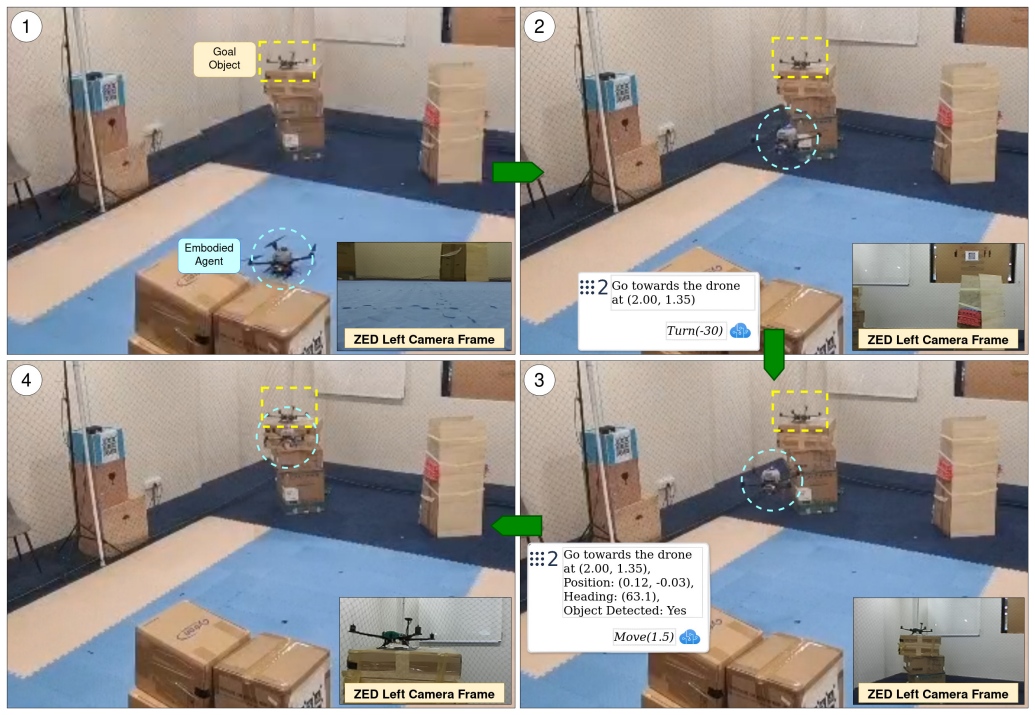
The load-bearing mechanism is a closed agentic loop: a ROS2 wrapper exposes locally hosted models through Ollama, a visual-question-answering node converts each camera frame into a Yes/No presence answer, an action-history node supplies the five most recent valid commands, and a path-planning node turns the model's output into PX4 OFFBOARD actions. The loop is deliberately constrained to two deterministic motion primitives, `Turn($\theta$)` with $\theta \in [-90^\circ, 90^\circ]$ and `Move($d$)` with $d \in [-3.0, 3.0]$ m, which makes command generation a grammar-restricted task that any compliant model output can execute. The fixed-history, low-temperature, chain-of-thought-suppressed prompting is what keeps model outputs deterministic enough to be scored on validity.
What would settle it
Replay the same 20-episode benchmark while logging, at every step, the true bearing and distance to the goal and comparing them with the issued Turn and Move magnitudes; if a random generator of valid commands matches the 40 percent success rate, or if issued magnitudes are uncorrelated with the ideal values, then the reported validity scores do not establish accurate natural-language command execution.
Extended reading notes
Core claim
The paper's central claim is that a fully local stack—PX4 autopilot, ROS2 middleware, and Ollama-served open models—can close the loop from natural-language dialogue to physical drone flight in both simulation and on a custom quadcopter. On the constrained action space of `Turn($\theta$)` with $\theta$ in $[-90^\circ, 90^\circ]$ and `Move($d$)` with $d$ in $[-3.0, 3.0]$ m, most tested LLMs emitted grammatically valid commands at near-perfect rates, and all VLMs answered object-presence queries with valid Yes/No responses 97–100 percent of the time. The authors therefore claim that local open-source models are a viable backbone for natural-language UAV control, with the 40 percent mission success ceiling attributed to imperfect angle and distance magnitudes, false object detections, and occasional repeated commands rather than to a failure of language-to-command mapping.
Load-bearing premise
The load-bearing premise is that a syntactically valid Turn or Move command is a meaningful sign of correct natural-language execution; yet the paper explicitly did not check the arithmetic of angle and distance values or the correctness of the VLM's object detections.
Editorial extensions
If this is right
- If the claim holds, natural-language drone control can run entirely on local hardware over a local network, with no per-token cost, no cloud API dependency, and no transmission of camera imagery to a remote service.
- A 100 percent valid-command rate does not by itself imply reliable mission execution: even perfect syntax and near-perfect detection leave the best mission success at 40 percent, so the bottleneck is command quality, not command form.
- Model selection is decisive: DeepSeek-LLM's 38 percent command validity collapses mission success to 0–5 percent, while the Gemma, Qwen, and Llama pairings cluster in the 30–40 percent range.
- The real-world evidence is a single demonstration with the Gemma pairing, meaning the sim-to-real conclusion is that transfer is possible at least once, not that all local model families transfer equally.
Reading between the lines
- Beyond the paper's benchmark, the 40 percent ceiling is a natural target for ablation: swapping the LLM for a script that draws random valid Turn/Move commands would reveal how much of mission success actually comes from linguistic reasoning rather than from the constrained action space and obstacle layout.
- A further extension the paper only gestures at is replacing the VLM's Yes/No presence queries with an object detector that returns bounding boxes; that would give the planner spatial grounding and would likely separate false-detection failures from command-magnitude failures.
- Because the whole stack is local, the framework implicitly supports privacy-sensitive and connectivity-denied deployments such as indoor inspection in factories or search in disaster zones, an operational benefit that deserves its own evaluation.
Signed reviews
Editorial analysis
A structured set of objections, weighed in public.
Referee Report
Summary. The paper presents an open-source agentic framework for natural-language control of PX4-based drones, integrating ROS2, Isaac Sim, and locally hosted Ollama models. It benchmarks four LLM families for command generation and three VLM families for scene understanding, both in simulation and on a custom quadcopter platform. The headline results are that Gemma3, Qwen2.5, and Llama-3.2 produce 100% syntactically valid Turn/Move commands; the VLM valid binary response rates range from 97% to 100%; and the best mission success rate is 40%, achieved by the Gemma3 LLM-VLM pairing over 20 episodes per model combination. A qualitative real-world demonstration is also reported using Gemma models only. The authors are candid about the small number of episodes, the lack of statistical testing, and the fact that command-value precision and object-detection correctness were not evaluated.
Significance. The paper's main strength is engineering integration: a modular, open-source pipeline that connects PX4 flight control, ROS2, and local open-source language and vision models, with source code, model configurations, and prompt templates released publicly. If the empirical claims were substantiated, this would be a useful step toward democratizing natural-language UAV control without cloud APIs. However, at present the headline validity metrics are format-compliance checks rather than correctness checks, and the only task-level correctness signal, a best mission success rate of 40% over 20 episodes with no baseline, is too thin to support the conclusion that the models execute commands accurately. The paper's own limitations section and small-sample caveats are appropriate, but they underscore that the central empirical claim is not yet established.
major comments (4)
- [IV. Results and Discussion, Table I] The 100% LLM valid-command metric measures syntactic format compliance only. The paper states that 'the LLMs were not evaluated based on the arithmetic precision of angle calculations or movement distance estimations' and 'Object detection correctness was not considered.' Yet the task defined by Eqs. (1)-(3) requires numerically appropriate Turn(theta) and Move(d) values and reliable target detection for the quadcopter to approach the goal. The paper itself attributes mission failures to 'suboptimal command values' and false positive/negative object detections. Therefore, the 40% mission success rate is the only reported quantity that actually bears on command accuracy, and the conclusion's phrase 'accurate natural language-based command execution' is not supported by the validity metrics.
- [IV. Results and Discussion, Table I] The best mission success rate is 40% over only 20 episodes per model pairing, with no confidence intervals, no significance tests, and no baseline (e.g., random actions or a simple heuristic like 'move toward the goal'). The authors acknowledge that the modest differences between Gemma, Qwen, and Llama 'may reflect random variation.' Without a baseline or statistical treatment, the claimed association between valid-command rate and mission success is not established. At minimum, the paper should report per-pairing success counts and exact binomial confidence intervals, and compare against a nontrivial baseline to show the LLM/VLM contributes beyond task randomness.
- [IV. Results and Discussion, VLM evaluation] The VLM 'valid detection' metric is also a format check: it records whether the model answered 'Yes' or 'No,' not whether the answer matched the true presence of the target object. The paper explicitly excludes object-detection correctness. Since the navigation policy relies on the VLM's output to decide whether to approach or search, a VLM that always answered 'Yes' could achieve high validity without providing useful information. The paper should report precision/recall or F1 against ground-truth target presence per frame or per episode, which would also quantify the false positives and negatives cited as causes of mission failure.
- [IV. Results and Discussion, real-world deployment] The real-world component is qualitative only: Figure 4 illustrates one successful sequence, and the text says 'only Gemma was chosen' without presenting quantitative success rates, episode counts, or failure modes for the physical platform. If the abstract's claim of evaluation 'both in simulation and on a custom quadcopter platform' is to be quantified, the real-world trials need at least the same success-rate reporting as the simulation, or the paper should explicitly label the real-world portion as a feasibility demonstration rather than a performance evaluation.
minor comments (5)
- [Throughout] The text contains several instances of 'UA V' with an erroneous space (abstract, Index Terms, and Section II); these should be corrected to 'UAV.'
- [III. Methodology, Mission success criterion] Please clarify whether the '0.5 m radius' success criterion is in the horizontal plane at the fixed 1 m altitude or in full 3D space; this affects how close the quadcopter must be to the target.
- [III. Methodology, safety fallback] State explicitly how an episode is scored when the human operator switches to POSITION mode during a real-world trial: as a failure, an abort, or a restart? This is needed to interpret real-world success rates.
- [IV. Results and Discussion, evaluation details] The paper would benefit from an in-text example of the exact Turn/Move grammar and a sample prompt, in addition to the linked repository, to make the validity criteria reproducible without consulting external material.
- [IV. Results and Discussion, limitations] The limitations paragraph already acknowledges missing latency, token-usage, and path-optimality analyses; adding one or two of these quantitative metrics in the revised version would strengthen the practical contribution.
Circularity Check
No circular derivation: the reported command-validity and mission-success rates are empirical measurements; weak construct validity is a correctness risk, not circularity.
full rationale
The paper does not present a derivation chain whose outputs reduce to its inputs. It reports an open-source framework and measures model behavior in simulation and on hardware. The principal metrics are (a) the fraction of LLM outputs that are syntactically valid Turn/Move commands within predefined ranges and (b) the binary Yes/No validity of VLM object-presence responses, with mission success separately defined as approaching the target within 0.5 m. These are empirical outcomes, not quantities constructed from the models' own definitions. The paper explicitly acknowledges limitations: 'the LLMs were not evaluated based on the arithmetic precision of angle calculations or movement distance estimations' and 'Object detection correctness was not considered.' Those limitations weaken the evidential value of the 100% validity claims for the conclusion about 'accurate natural language-based command execution,' but they do not make the validity metric a restatement of the output format by construction. No parameter is fitted to a subset of data and then relabeled as a prediction. No load-bearing self-citation appears: the references cite external prior work, and none of the authors' own prior results are invoked to justify the framework's design or conclusions. The modest mission-success rates are reported as measured outcomes, with the authors themselves noting that differences among high-validity models 'may reflect random variation.' Thus, while the evaluation design raises legitimate concerns about what the 100% validity metric proves, it does not exhibit circular reasoning.
Assumptions & free parameters
free parameters (5)
- LLM/VLM sampling temperature =
0.2
- Maximum inference steps Kmax =
20
- Number of episodes per model pairing =
20
- Action space bounds for Turn and Move =
Turn +/- 90 degrees, Move +/- 3.0 m
- History length N =
5
assumptions (4)
- domain assumption PX4 dynamics in Eq. (2) faithfully model the real quadcopter in simulation and real flight.
- domain assumption The goal coordinates given to the LLM as text correspond to the actual target location.
- domain assumption VLM binary yes/no presence reports are a sufficient visual signal for the LLM to choose navigation actions.
- domain assumption Low sampling temperature (0.2) and fixed history of five commands produce outputs representative of each model family.
Cite this review
Pith. "Pith review of Taking Flight with Dialogue: Enabling Natural Language Control for PX4-based Drone Agent." pith.science (2026). https://pith.science/paper/3DTSZ7UH
@misc{pith2026250607509,
  author       = {Pith},
  title        = {Pith review of: Taking Flight with Dialogue: Enabling Natural Language Control for PX4-based Drone Agent},
  year         = {2026},
  howpublished = {\url{https://pith.science/paper/3DTSZ7UH}},
  note         = {Machine review of arXiv:2506.07509}
}
read the original abstract
Recent advances in agentic and physical artificial intelligence (AI) have largely focused on ground-based platforms such as humanoid and wheeled robots, leaving aerial robots relatively underexplored. Meanwhile, state-of-the-art unmanned aerial vehicle (UAV) multimodal vision-language systems typically rely on closed-source models accessible only to well-resourced organizations. To democratize natural language control of autonomous drones, we present an open-source agentic framework that integrates PX4-based flight control, Robot Operating System 2 (ROS 2) middleware, and locally hosted models using Ollama. We evaluate performance both in simulation and on a custom quadcopter platform, benchmarking four large language model (LLM) families for command generation and three vision-language model (VLM) families for scene understanding.
Figures


Forward citations
Cited by 2 Pith papers
-
RT-SHCUA: Real-Time Self-Hosted Computer-Use Agent for UAV Control
An architecture that mediates LLM computer-use agents for UAV control by compiling agent decisions into validated, time-bounded, evidence-logged skill invocations, with a prototype on OpenClaw/PX4/OP-TEE.
-
Foundation Model Driven Robotics: A Comprehensive Review
A review of foundation-model-driven robotics that synthesizes recent work across perception, planning, control, HRI, simulation, and sim-to-real transfer, and highlights open challenges.
Reference graph
Works this paper leans on
-
[1]
R. Tallat, A. Hawbani, X. Wang, A. Al-Dubai, L. Zhao, Z. Liu, G. Min, A. Y . Zomaya, and S. Hamood Alsamhi, “Navigating industry 5.0: A survey of key enabling technologies, trends, challenges, and opportunities,” IEEE Communications Surveys & Tutorials , vol. 26, no. 2, pp. 1080–1126, 2024
work page 2024
-
[2]
Large language models for uavs: Current state and pathways to the future,
S. Javaid, H. Fahim, B. He, and N. Saeed, “Large language models for uavs: Current state and pathways to the future,” IEEE Open Journal of V ehicular Technology, vol. 5, pp. 1166–1192, 2024
work page 2024
-
[3]
Open x- embodiment: Robotic learning datasets and rt-x models: Open x- embodiment collaboration 0,
A. O’Neill, A. Rehman, A. Maddukuri, Gupta et al. , “Open x- embodiment: Robotic learning datasets and rt-x models: Open x- embodiment collaboration 0,” in 2024 IEEE International Conference on Robotics and Automation (ICRA) . IEEE, 2024, pp. 6892–6903
work page 2024
-
[4]
Large (vision) language models for autonomous vehicles: Current trends and future directions,
H. Tian, K. Reddy, Y . Feng, M. Quddus, Y . Demiris, and P. Angeloudis, “Large (vision) language models for autonomous vehicles: Current trends and future directions,” 10 2024
work page 2024
-
[5]
Uavs meet llms: Overviews and perspectives toward agentic low-altitude mobility,
Y . Tian, F. Lin, Y . Li, T. Zhang, Q. Zhang, X. Fu, J. Huang, X. Dai, Y . Wang, C. Tian, B. Li, Y . Lv, L. Kov´acs, and F.-Y . Wang, “Uavs meet llms: Overviews and perspectives toward agentic low-altitude mobility,”
-
[6]
Scaling cross- embodied learning: One policy for manipulation, navigation, locomotion and aviation,
R. Doshi, H. Walke, O. Mees, S. Dasari, and S. Levine, “Scaling cross- embodied learning: One policy for manipulation, navigation, locomotion and aviation,” arXiv preprint arXiv:2408.11812 , 2024
arXiv 2024
-
[7]
Visual language maps for robot navigation,
C. Huang, O. Mees, A. Zeng, and W. Burgard, “Visual language maps for robot navigation,” in Proceedings of the IEEE International Conference on Robotics and Automation (ICRA) , London, UK, 2023
2023
-
[8]
Rt-1: Robotics transformer for real-world control at scale,
A. Brohan, N. Brown, J. Carbajal, Y . Chebotar, J. Dabis, C. Finn, K. Gopalakrishnan, K. Hausman, A. Herzog, J. Hsu et al. , “Rt-1: Robotics transformer for real-world control at scale,” arXiv preprint arXiv:2212.06817, 2022
arXiv 2022
Show all 20 references
-
[9]
Rt-2: Vision-language- action models transfer web knowledge to robotic control,
A. Brohan, N. Brown, J. Carbajal, Y . Chebotar, X. Chen, K. Choroman- ski, T. Ding, D. Driess, A. Dubey, C. Finn et al., “Rt-2: Vision-language- action models transfer web knowledge to robotic control,” arXiv preprint arXiv:2307.15818, 2023
2023 arXiv
-
[10]
Do as i can, not as i say: Grounding language in robotic affordances,
M. Ahn, A. Brohan, N. Brown, K. Chebotar, K. Hausman et al., “Do as i can, not as i say: Grounding language in robotic affordances,” arXiv preprint arXiv:2204.01691, 2022
2022 arXiv
-
[11]
Saytap: Lan- guage to quadrupedal locomotion,
Y . Tang, W. Yu, J. Tan, H. Zen, A. Faust, and T. Harada, “Saytap: Lan- guage to quadrupedal locomotion,” arXiv preprint arXiv:2306.07580 , 2023
2023 arXiv
-
[12]
Aerialvln: Vision-and-language navigation for uavs,
S. Liu, H. Zhang, Y . Qi, P. Wang, Y . Zhang, and Q. Wu, “Aerialvln: Vision-and-language navigation for uavs,” 2023. [Online]. Available: https://arxiv.org/abs/2308.06735
2023 arXiv
-
[13]
Citynav: Language-goal aerial navigation dataset with geographic information,
J. Lee, T. Miyanishi, S. Kurita, K. Sakamoto, D. Azuma, Y . Matsuo, and N. Inoue, “Citynav: Language-goal aerial navigation dataset with geographic information,” 2024. [Online]. Available: https: //arxiv.org/abs/2406.14240
2024 arXiv
-
[14]
Aeroverse: Uav-agent benchmark suite for simulating, pre-training, finetuning, and evaluating aerospace embodied world models,
F. Yao, Y . Yue, Y . Liu, X. Sun, and K. Fu, “Aeroverse: Uav-agent benchmark suite for simulating, pre-training, finetuning, and evaluating aerospace embodied world models,” 2024. [Online]. Available: https://arxiv.org/abs/2408.15511
2024
-
[15]
Aerial vision-and-dialog navigation,
Y . Fan, W. Chen, T. Jiang, C. Zhou, Y . Zhang, and X. E. Wang, “Aerial vision-and-dialog navigation,” arXiv preprint arXiv:2205.12219 , 2022
2022 arXiv
-
[16]
Towards realistic uav vision-language navigation: Platform, benchmark, and methodology,
X. Wang, D. Yang, Z. Wang, H. Kwan, J. Chen, W. Wu, H. Li, Y . Liao, and S. Liu, “Towards realistic uav vision-language navigation: Platform, benchmark, and methodology,” arXiv preprint arXiv:2410.07087 , 2024
2024 arXiv
-
[17]
Im- plementation of natural language uav control using openai’s chatgpt in a simulated university environment,
Y . Muradova, J. Amachree, L. Henry, and A. G. Bourgeois, “Im- plementation of natural language uav control using openai’s chatgpt in a simulated university environment,” in 2024 17th International Conference on Security of Information and Networks (SIN) , 2024, pp. 1–5
2024
-
[18]
From words to flight: Integrat- ing openai chatgpt with px4/gazebo for natural language-based drone control,
M. L. Tazir, M. Mancas, and T. Dutoit, “From words to flight: Integrat- ing openai chatgpt with px4/gazebo for natural language-based drone control,” 07 2023
2023
-
[19]
Enabling novel mission operations and interactions with rosa: The robot operating system agent,
R. Royce, M. Kaufmann, J. Becktor, S. Moon, K. Carpenter, K. Pak, A. Towler, R. Thakker, and S. Khattak, “Enabling novel mission operations and interactions with rosa: The robot operating system agent,” 2025. [Online]. Available: https://arxiv.org/abs/2410.06472
2025 arXiv
-
[2025]
Available: https://arxiv.org/abs/2501.02341
[Online]. Available: https://arxiv.org/abs/2501.02341
Reviewed August 7, 2026 · model on record in the stance chip above.
Discussion (0). Continue with ORCID to comment.