REVIEW 4 major objections 4 minor 41 references
Analytical Retrieval of Material Parameters in Monolayer Transition-Metal Dichalcogenides Based on a Solvable Exciton Model
T0 review · 4 major / 4 minor · reviewed 2026-08-01 · deepseek-v4-flash
Pith's one-line read This paper claims that just three measured exciton energies plus magnetic-field shifts uniquely determine the bandgap, screening length, reduced mass, and dielectric constant of monolayer TMDCs, then analytically predict all higher exciton
desk verdict Useful Kratzer inversion formulas, but the 'no additional fitting' claim has a visible counterexample in Table I. read the letter →
The pith
A machine-rendered reading of the paper's core claim, the machinery that carries it, and where it could break.
The reading
What carries the argument
The load-bearing object is the modified Kratzer exciton spectrum, εₙ = −η/(n−1/2+ξ)²Ry, where ξ captures dielectric screening and is tied to the screening length r₀ via ξ = g√η r₀/a₀. The inversion hinges on the ratio Δ(ξ) = (ε₃−ε₂)/(ε₃−ε₁), which is independent of both the bandgap and the energy scale; substituting the measured energies turns it into the cubic 3λ−4λ³=δ, solved trigonometrically to yield ξ. The magnetoexciton side uses an interpolation formula Eₙ(B) = E_g + εₙ + σₙB²/(1+σₙβₙ⁻¹B), with diamagnetic coefficients computed from the model's Laguerre-based wavefunctions, and the equality between measured and theoretical field-induced shifts closes a cubic equation for μ. Two empiri
What would settle it
Measure exciton energies and magnetoexciton shifts for a monolayer TMDC in a deliberately different dielectric environment (for example, on a high-κ substrate or with an added encapsulating layer), retrieve r₀ and μ using the paper's formulas, and compare against independently measured values (e.g., from scanning tunneling spectroscopy or cyclotron resonance). If the retrieved parameters deviate from the independent measurements by more than the quoted uncertainties, the universality of g² and c is falsified.
Extended reading notes
Core claim
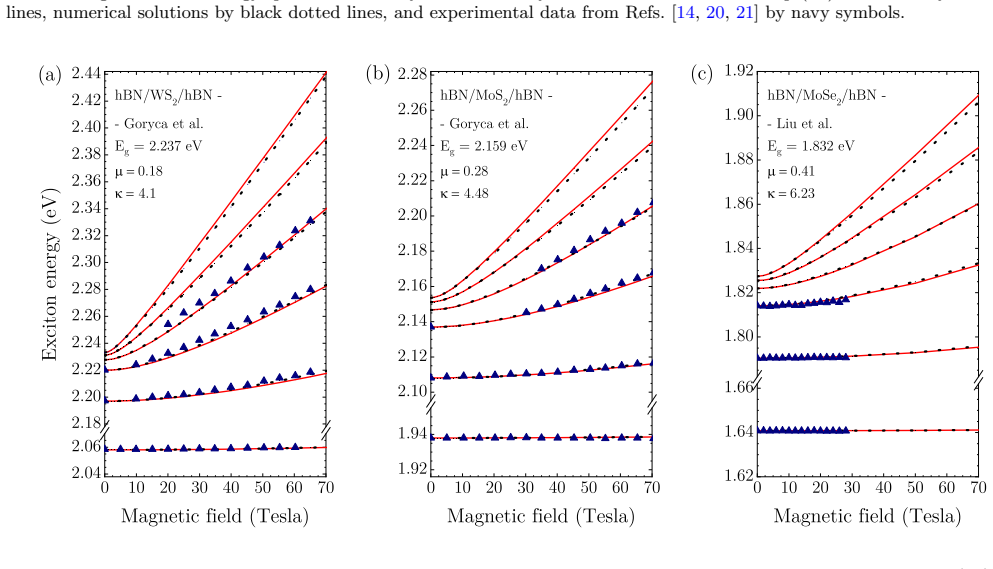
The central claim is that the modified Kratzer model—a hydrogen-like spectrum with an effective screening parameter ξ added to the principal quantum number—admits an exact inverse problem. From the measured energies of the three lowest s-state excitons, the ratio Δ=(E₃−E₂)/(E₃−E₁) isolates ξ through a trigonometric solution of a cubic equation, after which explicit formulas give the energy scaling factor η, the quasiparticle bandgap E_g, and the screening length r₀. Separately, an analytical interpolation for magnetoexciton energies, calibrated so that the strong-field Landau limit is reproduced, yields a cubic equation whose solution gives the reduced exciton mass μ, and hence the dielectri
Load-bearing premise
The whole procedure stands on the assumption that the modified Kratzer model with the fixed universal constants g²=0.205 and c=0.905 faithfully represents the true Rytova–Keldysh exciton for every TMDC material and dielectric environment; if either constant varies, the retrieved screening length or reduced mass will be systematically biased.
Editorial extensions
If this is right
- If the inversion is reliable, material parameters can be extracted from a single optical spectrum plus one magneto-optical measurement, enabling high-throughput screening of 2D semiconductors without specialized fitting software.
- The framework predicts higher Rydberg-state energies, exciton radii, and diamagnetic coefficients that have not yet been measured, giving concrete targets for future magneto-optical experiments.
- Because the retrieval uses only energy differences, it is insensitive to absolute energy-calibration offsets, making it robust across different experimental setups.
- The close agreement between the modified Kratzer and Rytova–Keldysh descriptions suggests that the simpler model can serve as a fast surrogate for the standard RK model in the experimentally relevant parameter range.
- The same analytical machinery could be applied to other quasi-2D excitonic systems, such as monolayers of other semiconducting compounds, as long as the universal constants remain valid.
Reading between the lines
- A natural testable extension would be to calibrate g² per material family (W-based vs. Mo-based) or per dielectric environment; the paper's own comparison suggests g² may drift slightly, and a material-dependent g² could remove the systematic bias it reports in retrieved r₀.
- The cubic equation for the reduced mass (Eq. 24) may admit multiple real roots; the paper does not discuss uniqueness criteria, so an editor-level inference is that physical selection rules (e.g., positivity, comparison with known mass ranges) become a practical requirement for automated use.
- The analytical bridge between Kratzer and RK established here hints that a fully analytical inversion directly from the Rytova–Keldysh potential might be achievable—something the authors themselves flag as future work—which would eliminate the universal-g² approximation entirely.
- For samples on very high-κ substrates or with strong environmental inhomogeneity, the universal crossover constant c=0.905, calibrated up to ~90 T, may need re-calibration; extending the formula to higher fields could either confirm or falsify the universality of this parameter.
Signed reviews
Editorial analysis
A structured set of objections, weighed in public.
Referee Report
Summary. The paper develops an analytical two-stage procedure to retrieve quasiparticle bandgap, screening length, reduced exciton mass, and dielectric constant of monolayer TMDCs from the three lowest measured s-state exciton energies and from magnetoexciton energy shifts. The first stage inverts a modified Kratzer model (Molas et al.) to obtain ξ, η, and Eg directly, then converts ξ to the screening length r0 using a universal coefficient g^2 = 0.205. The second stage uses an analytical magnetoexciton interpolation (Eq. 14) with a calibrated crossover constant c = 0.905 to retrieve μ from magnetic-field data, and then κ from η. The framework is applied to a wide range of experimental datasets for WSe2, WS2, MoS2, MoSe2, and MoTe2 in different dielectric environments. The retrieved parameters are compared with literature RK values and with the authors' earlier RK-based analytical retrieval, and the predicted diamagnetic coefficients, radii, and magnetoexciton spectra are compared with experiment and numerical solutions.
Significance. If the central claim were fully substantiated, the paper would offer a valuable, computationally inexpensive alternative to numerical RK fitting for extracting material parameters from excitonic spectra. The analytical inversion formulas are explicit and the algebra is internally coherent. The authors also provide independent-looking tests of predictive quantities (diamagnetic coefficients, radii, magnetoexciton spectra) that do not enter the retrieval. However, the strength of the claim is moderated by two calibrated constants that directly enter the retrieved r0 and μ, by the absence of propagated uncertainties, and by at least one clear predictive failure (Chen et al. E4 in Table I). The validation is also largely against the authors' own earlier RK retrieval rather than fully independent benchmarks. These issues are load-bearing for the paper's central 'parameter-free prediction' claim, but they are addressable in revision.
major comments (4)
- [Table I, Chen et al. row] The Chen et al. hBN-encapsulated WSe2 dataset lists measured E4 = 1.918 eV, but the retrieval using E1–E3 predicts E4 = 1.893 eV, a 25 meV discrepancy, and also yields Eg = 1.906 eV, which is below the measured E4. Thus the model would treat the measured 4s state as unbound. The text only discusses the Molas dataset as having the largest deviations and does not address this failure. This directly contradicts the claim that higher Rydberg states are predicted without additional fitting. The authors should either correct the table, explain why 1.918 eV is not the 4s state, or explicitly restrict the prediction claim.
- [§II B and §II C, Eqs. (12) and (24)] The retrieval of r0 uses the universal coefficient g^2 = 0.205, and the retrieval of μ uses the calibrated crossover factor c = 0.905 in the cubic Eq. (24). These constants are fitted to the same class of materials/experiments that the retrieval is applied to, so the 'without additional fitting parameters' claim in the abstract and §II D is overstated: the model itself has two fitted parameters, and any inaccuracy in their universality (as the authors acknowledge for g^2 in §III C) directly biases r0 and μ. The paper should provide a sensitivity analysis (e.g., how r0 and μ change when g^2 ranges over 0.195–0.216 and c over ±5%) and should clearly distinguish model calibration from parameter-free prediction.
- [Tables I–III and §III A] The validation is largely against the authors' own earlier RK-based retrieval (rows labeled 'Retrieval [32]') rather than fully independent benchmarks. For several datasets the agreement with 'Retrieval [32]' is excellent, but this is not an independent check because the same experimental inputs and similar analytical approximations are used. The paper should more clearly separate independent experimental/theoretical benchmarks from the authors' own previous results, and should include propagated experimental uncertainties for the retrieved quantities (currently no error bars are given for Eg, r0, μ, κ in the 'This work' rows).
- [§III A, Chen et al. and other Rydberg predictions] Even outside the Chen case, the paper's predictive claim for E4 and E5 rests on the assumption that the modified Kratzer model with a single universal g^2 reproduces the Rydberg series for every material and environment. The paper does not quantify the accuracy of this assumption across the full table; for example, in the Chernikov WS2 row the predicted E4 (2.329 eV) is 15 meV below the experimental 2.344 eV. A systematic table of residuals (predicted minus measured) for all available higher states would allow the reader to assess the actual predictive power, and would likely require a more cautious statement in the conclusion.
minor comments (4)
- [Before Eq. (7)] The prose defines λ = (2ξ+1)δ/(2ξ+3), but solving that relation for ξ gives (δ−3λ)/(2(λ−δ)), not the displayed Eq. (8) ξ = (3δ−λ)/(2(λ−δ)). The displayed formulas appear self-consistent, but the textual definition should be corrected or reconciled with Eq. (8).
- [General] Several typos and unfinished cross-references remain: 'T ransition' in the title/abstract, 'Tabe' in the text, 'detailled', 'konstant', 'reponsible', 'root-meam-square', and 'Subsecs. III A and ??'. Figure captions 3 and 4 refer to 'Eq. (??)' instead of Eq. (14).
- [Data availability] The data availability statement says data are available 'upon reasonable request.' For a paper whose central contribution is a quantitative retrieval procedure, providing the numerical values of all retrieved parameters (with uncertainties) and the per-dataset residuals in a machine-readable table or repository would strengthen reproducibility.
- [Notation] The symbol ξ is called 'effective screening parameter' in Eq. (1), but the relation to the physical screening length r0 in Eq. (3) is model-dependent. The paper would benefit from an explicit statement that ξ is not directly the RK screening length, particularly for readers applying the formulas to new materials.
Circularity Check
Partial circularity: the 'predicted' diamagnetic coefficients for magneto-optical datasets are a restatement of the same magnetoexciton fit used to retrieve μ, and the absolute r0 scale is set by g^2=0.205 calibrated on the same class of exciton spectra.
-
fitted input called prediction
[Sec. III B / Table III; Eqs. (18), (21)–(24)]
"Since neither the diamagnetic coefficients nor the exciton radii enters the retrieval procedure described in Subsection III A, they provide independent tests of the analytical model."
For the datasets with magneto-optical data (Stier, Liu, Goryca), μ is solved from the field-dependent energies via Eq. (24), whose coefficients are built from the same α_n that enters the diamagnetic-coefficient formula Eq. (18): σ_n = α_n(ξ)/(8ημ^2) μB^2/Ry. Thus σ_n for the same state n is algebraically fixed by the fitted μ; reporting it as an 'independent test' is a transformation of the magnetoexciton fit, not a new prediction. Only states whose energies were not used in the μ retrieval would provide an independent check.
-
other
[Sec. II A / Eq. (12); Sec. III C]
"We found that the experimental exciton energies are well reproduced by taking g^2 in the narrow interval 0.195−0.216, i.e., 0.205(±5%). Therefore, throughout this work, we adopt the universal value g^2 = 0.205."
The screening length is obtained from Eq. (12), r0 = ξ^2 a0/(g^2 η), where g^2 is a constant fitted to the same class of experimental exciton spectra that also determines ξ and η. Consequently the absolute scale of every retrieved r0 is inherited from a global fit to the target data class, not derived from the individual spectrum alone. Varying g^2 within the stated 5% interval rescales all reported r0 values, so the 'retrieved' screening length is partly an assumed calibration.
full rationale
The core algebraic inversion is not circular: Eqs. (8)–(11) genuinely determine Eg, ξ, and η from the three measured s-state energies, and the μ cubic (24) inverts the magnetoexciton formula. The higher-state energies E4/E5 are extrapolations rather than re-statements of inputs; notably, the Chen et al. row in Table I has a 25 meV miss (1.893 vs 1.918 eV) and Eg=1.906 eV below the measured 4s energy, which is a predictive failure and correctness concern, not circularity. The main circularity is narrower: for samples with magneto-optical spectra, the 'predicted' diamagnetic coefficients in Table III are algebraically dependent on the same μ fit, so their agreement is not an independent verification as claimed. The g^2=0.205 calibration similarly makes r0 a calibrated output rather than a parameter-free derivation. These are partial circularities in the retrieval/prediction chain, but the central bandgap and mass inversions retain independent content.
Assumptions & free parameters
free parameters (2)
- g^2 (universal coefficient in the modified Kratzer potential) =
0.205 (range 0.195–0.216)
- c (crossover factor in the magnetoexciton interpolation) =
0.905
assumptions (5)
- domain assumption The modified Kratzer spectrum ε_n = −η/(n−1/2+ξ)^2 Ry (Eq. 1) accurately describes the low-lying s exciton states of monolayer TMDCs.
- ad hoc to paper ξ = g√η r0/a0 with universal g^2=0.205 (Eq. 3).
- ad hoc to paper The magnetoexciton energy interpolation En(B)=Eg+εn+σnB²/(1+σnβn⁻¹B) (Eq. 14), with βn containing c=0.905, accurately reproduces field-dependent exciton energies.
- standard math Diamagnetic coefficients are given by first-order perturbation theory with Kratzer wavefunctions (Eqs. 15–19).
- domain assumption The experimental E1, E2, E3 used as inputs are reliable 1s, 2s, 3s exciton energies; for several datasets values are digitized from published spectra.
Cite this review
Pith. "Pith review of Analytical Retrieval of Material Parameters in Monolayer Transition-Metal Dichalcogenides Based on a Solvable Exciton Model." pith.science (2026). https://pith.science/paper/3KJLZ6CC
@misc{pith2026260719698,
  author       = {Pith},
  title        = {Pith review of: Analytical Retrieval of Material Parameters in Monolayer Transition-Metal Dichalcogenides Based on a Solvable Exciton Model},
  year         = {2026},
  howpublished = {\url{https://pith.science/paper/3KJLZ6CC}},
  note         = {Machine review of arXiv:2607.19698}
}
abstract
We develop an analytical procedure to retrieve fundamental material parameters of monolayer transition-metal dichalcogenides from optical and magneto-optical exciton spectra, based on the solvable modified Kratzer model. The proposed retrieval procedure naturally consists of two complementary stages. In the first stage, explicit inversion formulas determine the quasiparticle bandgap, effective screening parameter, and energy scaling factor directly from the experimentally measured energies of the three lowest excitonic states, from which the screening length is subsequently obtained. In the second stage, an analytical expression for the magnetic-field dependence of the exciton energies independently yields the reduced exciton mass, from which the surrounding dielectric constant is then calculated. Once the complete set of material parameters has been retrieved, the framework analytically predicts the diamagnetic coefficients, exciton radii, and complete magnetoexciton spectra without introducing additional fitting parameters or matrix diagonalization. The method is applied to a broad range of experimental samples for WSe$_2$, WS$_2$, MoS$_2$, MoSe$_2$, and MoTe$_2$ monolayers embedded in different dielectric environments. The retrieved material parameters are in good agreement with independent experimental measurements and previous Rytova--Keldysh (RK) calculations, while the predicted excitonic properties accurately reproduce available magneto-optical observations. The proposed analytical theory provides an efficient, physically transparent alternative to conventional numerical fitting procedures and offers an effective tool for the rapid characterization of two-dimensional semiconductors via excitonic spectroscopy.
Figures


Figures from the paper (2 more)

Reference graph
Works this paper leans on
-
[32]
Y. Hu, M. Wu, M. Yuan, Y. Wen, P. Ren, S. Ye, F. Liu, B. Zhou, H. Fang, R. Wang, Z. Ji, and R. Huang, Accurate prediction of dielectric properties and bandgaps in materials with a machine learn- ing approach, Appl. Phys. Lett. 125, 152905 (2024) , https://doi.org/10.1063/5.0223890
-
[1]
We found that the experimental exciton energies are well repro- duced by taking g2 in the narrow interval 0 .195 − 0.216, i.e., 0 .205(±5%)
and ( 3) to a large number of TMDC monolayers embedded in different dielectric environments. We found that the experimental exciton energies are well repro- duced by taking g2 in the narrow interval 0 .195 − 0.216, i.e., 0 .205(±5%). Therefore, throughout this work, we adopt the universal value g2 = 0 .205, which provides a good balance between universalit...
-
[2]
X. Chen, Z. Lian, Y. Meng, L. Ma, and S.-F. Shi, Excitonic complexes in two-dimensional transition metal dichalcogenides, Nat. Commun. 14, 8233 (2023) , https://doi.org/10.1038/s41467-023-44119-9
-
[3]
(17) Here, An = √ n!/(n + 2ξ)!/(2n + 2ξ + 1) is the normal- ization constant, L2ξ n (x) denotes the generalized Laguerre polynomials, and ω = 4/(2n + 2ξ + 1)κ, see Appendix A
defined as ⟨r2⟩n = +∞∫ 0 R2 n(r) r3 dr (16) with the field-free s-state radial wave function obtained within the solvable modified Kratzer model [ 33] as Rn(r) = An ωξ+1 e−ωr/2 rξ L2ξ n (ωr). (17) Here, An = √ n!/(n + 2ξ)!/(2n + 2ξ + 1) is the normal- ization constant, L2ξ n (x) denotes the generalized Laguerre polynomials, and ω = 4/(2n + 2ξ + 1)κ, see Appe...
-
[4]
A. Champagne, J. B. Haber, S. Pokawanvit, D. Y. Qiu, S. Biswas, H. A. Atwater, F. H. da Jor- nada, and J. B. Neaton, Quasiparticle and opti- cal properties of carrier-doped monolayer MoTe 2 from first principles, Nano Lett. 23, 4274 (2023) , https://doi.org/10.1021/acs.nanolett.3c00386
-
[5]
leads to an equation ∆exp = ε3 − ε2 ε3 − ε1 = 1 2 − 3 2(2ξ + 3) + 2 (2ξ + 3)3 . (6) Equation ( 6) is the key equation in the present analyt- ical retrieval procedure, as it determines the effective screening parameter independently of both the band gap and the energy scaling factor. Figure 1 plots the ratio ∆(ξ) = ( ε3 − ε2)/(ε3 − ε1) as a function of ξ an...
-
[6]
directly to the measured magnetoexci- ton energies. However, unlike our previous implementa- tion [ 25], where each trial value of µ required numerically solving the Schr¨ odinger equation, the present approach is entirely analytical, making the fitting procedure signif- icantly faster and more convenient. 5 D. Two-stage analytical retrieval workflow The co...
1973
-
[7]
G. Wang, A. Chernikov, M. M. Glazov, T. F. Heinz, X. Marie, T. Amand, and B. Urbaszek, Collo- quium: Excitons in atomically thin transition metal dichalcogenides, Rev. Mod. Phys. 90, 021001 (2018) , https://doi.org/10.1103/RevModPhys.90.021001
Show all 41 references
-
[8]
Huang, J.-H
C.-H. Huang, J.-H. Fu, and V. Tung, Ultraclean monolayers from a van der waals confinement, Nat. Mater. 10.1038/s41563-026-02503-y (2026), (2026) https://doi.org/10.1038/s41563-026-02503-y
2026 doi
-
[9]
Biswas, A
S. Biswas, A. Champagne, J. B. Haber, S. Pokawan- vit, J. Wong, H. Akbari, S. Krylyuk, K. Watan- abe, T. Taniguchi, A. V. Davydov, Z. Y. Al Balushi, D. Y. Qiu, F. H. da Jornada, J. B. Neaton, and H. A. Atwater, Rydberg excitons and tri- ons in monolayer MoTe 2, ACS Nano 17, 76...
2023 doi
-
[10]
Chernikov, T
A. Chernikov, T. C. Berkelbach, H. M. Hill, A. Rigosi, Y. Li, O. B. Aslan, D. R. Reich- man, M. S. Hybertsen, and T. F. Heinz, Exciton binding energy and nonhydrogenic Rydberg series in monolayer WS 2, Phys. Rev. Lett. 113, 076802 (2014) , https://doi.org/10.1103/PhysRevLett.1...
2014 doi
-
[11]
S. C. Gillespie, M. van der Laan, D. Poonia, S. Maiti, S. Kinge, L. D. A. Siebbeles, and P. Schall, Optical signatures of charge- and energy transfer in TMDC/TMDC and TMDC/perovskite heterostructures, 2D Mater. 11, 022005 (2024) , https://doi.org/10.1088/2053-1583/ad341c
2024 doi
-
[12]
de la Fuente Pico, J
D. de la Fuente Pico, J. Levinsen, E. Laird, M. M. Parish, and F. M. Marchetti, Rydberg excitons and po- laritons in monolayer transition metal dichalcogenides in a magnetic field, Phys. Rev. B 111, 035432 (2025) , https://doi.org/10.1103/PhysRevB.111.035432
2025 doi
-
[13]
E. Paik, L. Zhang, K. F. Mak, J. Shan, and H. Deng, Excitons and polaritons in two- dimensional transition metal dichalcogenides: a tutorial, Adv. Opt. Photon. 16, 1064 (2024) , https://doi.org/10.1364/AOP.504035
2024 doi
-
[14]
provides a direct approach for determining the reduced exciton mass µ from experimental magnetoexciton energies. For convenience, we rewrite the magnetic contribution to the exciton energies ∆ En(B) = σnB2/(1 + σnβ−1 n B) in the form ∆En(γ) = 1 8µ αnγ2 ηµ + αnγ 4(2nc − 1) Ry, ...
-
[15]
T. C. Berkelbach, M. S. Hybertsen, and D. R. Reichman, Theory of neutral and charged excitons in monolayer transition metal dichalcogenides, Phys. Rev. B 88, 045318 (2013) , https://doi.org/10.1103/PhysRevB.88.045318
2013 doi
-
[16]
R. Y. Kezerashvili and A. Spiridonova, Magne- toexcitons in transition metal dichalcogenides monolayers, bilayers, and van der waals het- erostructures, Phys. Rev. Res. 3, 033078 (2021) , https://doi.org/10.1103/PhysRevResearch.3.033078
2021 doi
-
[17]
K. He, N. Kumar, L. Zhao, Z. Wang, K. F. Mak, H. Zhao, and J. Shan, Tightly bound excitons in monolayer wse 2, Phys. Rev. Lett. 113, 026803 (2014) , https://doi.org/10.1103/PhysRevLett.113.026803
2014 doi
-
[18]
H. M. Hill, A. F. Rigosi, C. Roquelet, A. Chernikov, T. C. Berkelbach, D. R. Reichman, M. S. Hy- bertsen, L. E. Brus, and T. F. Heinz, Obser- vation of excitonic Rydberg states in monolayer MoS2 and WS 2 by photoluminescence excita- tion spectroscopy, Nano Lett. 15, 2992 (2015...
2015 doi
-
[19]
A. V. Stier, N. P. Wilson, G. Clark, X. Xu, and S. A. Crooker, Probing the influence of dielectric en- vironment on excitons in monolayer WSe 2: Insight from high magnetic fields, Nano Lett. 16, 7054 (2016) , https://doi.org/10.1021/acs.nanolett.6b03276
2016 doi
-
[20]
S.-Y. Chen, Z. Lu, T. Goldstein, J. Tong, A. Chaves, J. Kunstmann, L. S. R. Cavalcante, T. Wo´ zniak, G. Seifert, D. R. Reichman, T. Taniguchi, K. Watanabe, D. Smirnov, and J. Yan, Lu- minescent emission of excited rydberg excitons from monolayer WSe 2, Nano Lett. 19, 2464 (20...
2019 doi
-
[21]
for ∆En. Equating the theoretical and experimental values, δtheo mag (µ) = δexp mag, (23) yields a cubic equation for the reduced exciton mass, µ3 + Aµ2 + Bµ + C = 0 (24) with A = αn(γ1 + γ2) 4η(2nc − 1) , B = α2 nγ1γ2 16η2(2nc − 1)2 − γ1 + γ2 8ηδ exp mag , (25) C = − αnγ1γ2 3...
-
[22]
E. Liu, J. van Baren, Z. Lu, T. Taniguchi, K. Watan- abe, D. Smirnov, Y.-C. Chang, and C. H. Lui, Exciton-polaron rydberg states in monolayer MoSe2 and WSe 2, Nat. Commun. 12, 6131 (2021) , https://doi.org/10.1038/s41467-021-26304-w
2021 doi
-
[23]
Ly, D.-N
D.-N. Ly, D.-N. Le, N.-H. Phan, and V.- H. Le, Thermal effect on magnetoexciton en- ergy spectra in monolayer transition metal dichalcogenides, Phys. Rev. B 107, 155410 (2023) , https://doi.org/10.1103/PhysRevB.107.155410
2023 doi
-
[24]
T. Zhu, C. Zheng, L. Xu, and M. Yang, Ex- citon dissociation in two-dimensional transition metal dichalcogenides: Excited states and sub- strate effects, Phys. Rev. B 110, 155416 (2024) , https://doi.org/10.1103/PhysRevB.110.155416
2024 doi
-
[25]
J. Li, R. Yang, R. Li, and C. P. Grigoropoulos, Exciton dynamics in 2d transition metal dichalco- genides, Adv. Opt. Mater. 13, 2403137 (2025) , https://doi.org/10.1002/adom.202403137
2025 doi
-
[26]
A. V. Stier, N. P. Wilson, K. A. Velizhanin, J. Kono, X. Xu, and S. A. Crooker, Magnetooptics 15 of exciton Rydberg states in a monolayer semi- conductor, Phys. Rev. Lett. 120, 057405 (2018) , https://doi.org/10.1103/PhysRevLett.120.057405
2018 doi
-
[27]
E. Liu, J. van Baren, T. Taniguchi, K. Watan- abe, Y.-C. Chang, and C. H. Lui, Magnetopho- toluminescence of exciton Rydberg states in monolayer WSe 2, Phys. Rev. B 99, 205420 (2019) , https://doi.org/10.1103/PhysRevB.99.205420
2019 doi
-
[28]
D.-A. P. Nguyen, D.-N. Ly, D.-N. Le, N.-T. D. Hoang, and V.-H. Le, High-accuracy energy spectra of a two-dimensional exciton screened by reduced dimen- sionality with the presence of a constant magnetic field, Physica E: Low-dimensional Systems and Nanostructures 113, 152 (2019...
2019 doi
-
[29]
Goryca, J
M. Goryca, J. Li, A. V. Stier, T. Taniguchi, K. Watanabe, E. Courtade, S. Shree, C. Robert, B. Urbaszek, X. Marie, and S. A. Crooker, Revealing exciton masses and di- electric properties of monolayer semiconductors with high magnetic fields, Nat. Commun. 10, 4172 (2019) , https...
2019 doi
-
[30]
W.-T. Hsu, J. Quan, C.-Y. Wang, L.-S. Lu, M. Campbell, W.-H. Chang, L.-J. Li, X. Li, and C.-K. Shih, Dielectric impact on exciton bind- ing energy and quasiparticle bandgap in mono- layer WS 2 and WSe 2, 2D Mater. 6, 025028 (2019) , https://doi.org/10.1088/2053-1583/ab072a
2019 doi
-
[31]
Ly, D.-N
D.-N. Ly, D.-N. Le, D.-A. P. Nguyen, N.-T. D. Hoang, N.-H. Phan, H.-M. L. Nguyen, and V.- H. Le, Retrieval of material properties of mono- layer transition metal dichalcogenides from magnetoex- citon energy spectra, Phys. Rev. B 107, 205304 (2023) , https://doi.org/10.1103/Phy...
2023 doi
-
[33]
Takahashi, S
S. Takahashi, S. Kusaba, K. Watanabe, T. Taniguchi, K. Yanagi, and K. Tanaka, 3d hydrogen-like screening effect on excitons in hbn-encapsulated monolayer tran- sition metal dichalcogenides, Sci. Rep. 14, 27286 (2024) , https://doi.org/10.1038/s41598-024-77625-x
2024 doi
-
[34]
Seksaria, A
H. Seksaria, A. Kishore, and A. De Sarkar, Probing 2d exciton dynamics of non-hydrogenic anisotropic rydberg spectra in anomalous screen- ing regime, J. Phys. Chem. C 128, 6487 (2024) , https://doi.org/10.1021/acs.jpcc.4c01023
2024 doi
-
[35]
N. S. Rytova, Screened potential of a point charge in a thin film, Moscow Univ. Phys. Bull. 3, 30 (1967)
1967
-
[36]
L. V. Keldysh, Coulomb interaction in thin semiconduc- tor and semimetal films, JETP Lett. 29, 658 (1979), http://www.jetpletters.ac.ru/ps/1458/article-22207.shtml
1979
-
[37]
H. T. Dinh, N.-H. Phan, D.-N. Ly, D.-N. Le, N.-T. D. Hoang, N.-Q. Nguyen, P.-T. Doan, and V.-H. Le, Analytical expression for ex- citon energies in monolayer transition metal dichalcogenides, Phys. Rev. B 111, 035443 (2025) , https://doi.org/10.1103/PhysRevB.111.035443
2025 doi
-
[38]
Ly, D.-N
D.-N. Ly, D.-N. Le, D.-K. D. Le, and V.-H. Le, Retrieval of fundamental material parame- ters of monolayer transition metal dichalcogenides from experimental exciton energies: An analyt- ical approach, Phys. Rev. B 112, 165417 (2025) , https://doi.org/10.1103/gjtj-4ysk
2025 doi
-
[39]
M. R. Molas, A. O. Slobodeniuk, K. Nogajewski, M. Bartos, L. Bala, A. Babinski, K. Watanabe, T. Taniguchi, C. Faugeras, and M. Potemski, Energy spectrum of two-dimensional excitons in a nonuniform dielectric medium, Phys. Rev. Lett. 123, 136801 (2019) , https://doi.org/10.1103...
2019 doi
-
[40]
Kratzer, Die ultraroten rotationsspektren der halo- genwasserstoffe, Zeitschrift f¨ ur Physik3, 289 (1920) , https://doi.org/10.1007/BF01327754
A. Kratzer, Die ultraroten rotationsspektren der halo- genwasserstoffe, Zeitschrift f¨ ur Physik3, 289 (1920) , https://doi.org/10.1007/BF01327754
1920 doi
-
[41]
Ly, N.-T
D.-N. Ly, N.-T. D. Hoang, and V.-H. Le, Highly accurate energies of a plasma-embedded hydrogen atom in a uni- form magnetic field, Phys. Plasmas 28, 063301 (2021) , https://doi.org/10.1063/5.0049564
2021 doi
Reviewed August 1, 2026 · model on record in the stance chip above.
Discussion (0). Continue with ORCID to comment.