REVIEW 4 major objections 5 minor 1 cited by
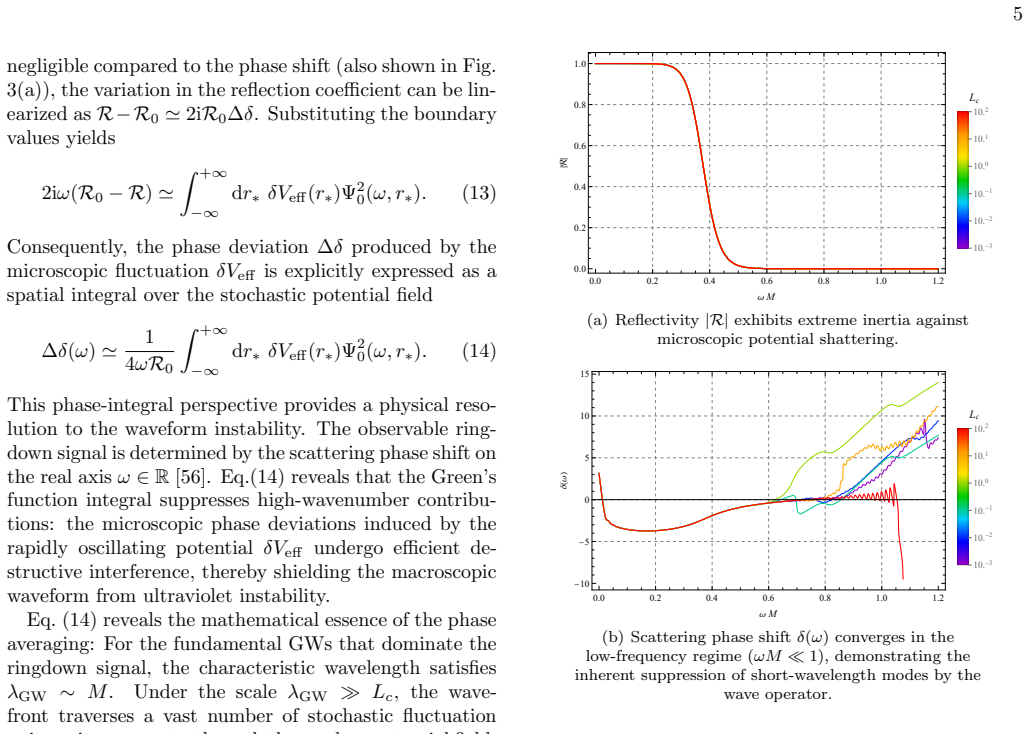
Black hole ringdown waveforms stay nearly identical to the classical prediction even when the horizon is violently rough at microscopic scales, because the wave integral averages out the disorder.
Reviewed by Pith at T0; open to challenge. T0 means a machine referee read the full paper against a public rubric. the ladder, T0–T4 →
T0 review · deepseek-v4-flash
2026-08-03 03:25 UTC pith:3QDUO6OT
load-bearing objection Plausible and useful stochastic model for ringdown robustness, but the static-disorder assumption and single-realization numerics leave the quantitative selection rule softer than the text claims. the 4 major comments →
Waveform stability of black hole ringdown with stochastic horizon structure
The pith
A machine-rendered reading of the paper's core claim, the machinery that carries it, and where it could break.
Core claim
The paper's central claim is that stochastic short-scale structure near the horizon does not destroy the macroscopic ringdown waveform. In a static Schwarzschild background, the authors model horizon microstructure as a quenched random metric fluctuation with root-mean-square amplitude epsilon and Gaussian correlation length L_c, and solve the perturbed Regge-Wheeler equation in both time and frequency domains. They find that even a violently shattered potential barrier with L_c = 0.01 M yields waveforms that overlap the classical ringdown almost perfectly, and that the frequency-domain phase shift collapses onto the general-relativistic profile at low frequencies. The waveform mismatch obey
What carries the argument
The central object is the stochastic perturbation of the Regge-Wheeler potential, delta V_eff(r), generated from a random mass function delta f(r) = epsilon (2M/r)^3 zeta(r_*), where zeta is a Gaussian-correlated random field with correlation length L_c. The load-bearing relation is the first-order Born formula for the scattering phase shift, Delta delta(omega) ~ (1/(4 omega R_0)) ∫ dr_* delta V_eff(r_*) Ψ_0^2(ω, r_*), which reduces waveform robustness to the suppression of a single oscillatory integral. When L_c is much smaller than the probe wavelength ~M, the integrand oscillates rapidly and the Riemann-Lebesgue lemma drives the phase shift to zero—this is the phase-averaging mechanism. T
Load-bearing premise
The central claim rests on the quenched-disorder approximation that the stochastic horizon roughness is static over the ringdown timescale; if the disorder pattern changes significantly during the ~M observation window, the phase-averaging cancellation could fail.
What would settle it
Simulate ringdown with a stochastic potential that evolves in time (correlation time tau_c comparable to M) at fixed L_c ~ M and epsilon = 10^-3; if the waveform mismatch significantly exceeds the M ~ 200 epsilon^2 scaling, the static-field assumption is load-bearing and the observability bound would need revision.
If this is right
- Because phase averaging suppresses sub-wavelength structure, the mathematical instability of quasinormal-mode spectra does not imply observational instability; standard ringdown templates remain valid even with near-horizon disorder.
- The selection rule (L_c ~ M and epsilon >~ 10^-4) means a detected non-GR ringdown would be evidence for macroscopically coherent horizon structure, not generic quantum foam—sharpening the interpretation of future detector data.
- Rough stochastic horizons act as diffuse scattering centers that decohere gravitational-wave echoes over multiple cavity round trips, which could explain the absence of echo signals in current searches.
- The M ~ 200 epsilon^2 scaling gives a concrete benchmark: at resonance, the mismatch should grow quadratically in the fluctuation amplitude over at least two orders of magnitude, as verified numerically in the paper.
Where Pith is reading between the lines
- The phase-averaging argument suggests a broader principle: any real-frequency observable built from scattering data is insensitive to potential structure below the probe wavelength; this could be tested in Kerr or charged backgrounds where the potential shape differs.
- The quenched-disorder assumption is the main limitation; if the horizon disorder itself evolves on the ~M ringdown timescale, phase averaging could be disrupted. A finite correlation-time extension would show whether echoes or broadband deviations reappear.
- The observability bound implies future searches for horizon structure should target long-wavelength, coherent deformations (e.g., surface anisotropy) rather than Planckian roughness, since the latter is exponentially suppressed by phase cancellation.
- The deep-UV regime (L_c ~ 10^-3 M) was only probed with the step approximation, which the paper argues breaks down; a direct continuous-potential simulation in that regime would determine whether phase averaging holds all the way to the Planck scale.
Editorial analysis
A structured set of objections, weighed in public.
Referee Report
Summary. The paper examines whether stochastic horizon-scale structure can observably affect the ringdown waveform of a Schwarzschild black hole. It models the horizon fluctuations as a static, colored random perturbation δf(r) with intensity ε and correlation length L_c, adds the induced correction δV_eff to the Regge-Wheeler potential, and then combines time-domain finite-difference simulations with a first-order Born phase-shift computation. The central claim is a 'phase averaging' mechanism: the wave equation's spatial integral suppresses ultraviolet potential fluctuations, so the macroscopic waveform is robust even when the potential barrier is violently shattered. The paper further proposes a selection rule for observability, requiring both L_c∼M and ε≳10^-4, based on the numerical scaling M≃200ε².
Significance. If the result holds, it offers a concrete mechanism for reconciling the spectral instability of quasinormal modes with the observed stability of ringdown waveforms, and it gives a quantitative criterion for when horizon-scale structure could be detectable. The paper has notable strengths: it combines time-domain and frequency-domain evidence, includes a Born-approximation phase-shift calculation, checks the M∝ε² scaling numerically, and tests robustness with a conservative step-potential approximation. These features make the physical picture appealing. However, the central quantitative claims are currently conditional on several unquantified modeling choices and on single-realization numerics, which need to be addressed before the selection rule can be regarded as established.
major comments (4)
- [Sec. II, Eq. (5)] The quenched-disorder reduction is not quantitatively justified. The text states that over Δv∼M the Wiener-process variance drift ⟨δf²⟩∝Δv is 'relatively negligible,' but no noise amplitude or diffusion timescale is supplied; the ratio σ²M/ε² can be anything. If δf evolves appreciably during ringdown, Eq. (14) and the phase-averaging suppression are not applicable. The authors should derive an explicit timescale from the Einstein-Langevin equation (or state the static assumption as a model assumption and test its sensitivity, e.g., by introducing slow time dependence).
- [Sec. IV, Eq. (14)] The Riemann-Lebesgue argument for phase averaging is incomplete as written. The leading term in δV_eff, Eq. (8), is proportional to dη/dr, whose amplitude grows as εM/L_c as L_c→0. An oscillatory integrand with diverging amplitude is not automatically suppressed. The suppression must be demonstrated by integrating by parts (transferring the derivative to Ψ0²) or by giving an explicit stochastic variance estimate, e.g., Var(∫η f) ∼ L_c. Without this step, the central mechanism is asserted rather than derived; the numerical results may be correct, but the analytic explanation should be repaired.
- [Sec. III, Figs. 2–5] All quantitative statements rest on a single noise realization per L_c, with no error bars or ensemble averaging. The mismatch profile in Fig. 4 and the coefficient M≃200ε² in Fig. 5 are therefore one realization's outcome, and the value could fluctuate significantly across realizations. This directly affects the derived lower bound ε_det≳2×10^-4. The authors should report ensemble statistics (mean ± standard deviation over several independent realizations) or provide an analytic variance estimate for the mismatch.
- [Sec. II, Eq. (9)] The horizon-smoothing operator contains two free parameters, r_cut and Δ, but their numerical values are never stated. Since this smoothing forces δV_eff→0 near the horizon, the low-frequency scattering phase and the mismatch may depend on these choices. Please give the values used and show that the results are robust to reasonable variations of r_cut and Δ.
minor comments (5)
- [Sec. IV, Eq. (15b)] The frequency cutoff is written inconsistently: the text says ω_cut = 0.6/M in one place and 0.6/M² in another. Please clarify the value and the units.
- [Sec. II, Eqs. (6)–(7)] The normalization factor N in Eq. (6) is not specified. To give ε a unique meaning as the rms amplitude of δf, the normalization of ζ should be defined explicitly (e.g., unit variance).
- [Sec. III, Fig. 5] Reporting R²=1 for a fit without error bars and without stating the number of independent realizations is not informative. Please provide the fit residuals and the statistical uncertainty of the slope and intercept.
- [References] Reference [4] is incomplete (no author or title), and several entries are self-citations/preprints ([34], [44], [47]). Please ensure complete bibliographic information.
- [General notation] The index structure and dimensions of ξ^r_v in Eqs. (4)–(5) are not defined before use. A brief definition would improve clarity.
Circularity Check
No significant circularity: the waveform-stability result is derived from a self-contained stochastic model; self-citations are not load-bearing and the only self-referential element is a calibrated scaling coefficient used for an observability threshold.
full rationale
The claimed derivation chain is: stochastic metric perturbation δf (Eqs. 3–5) → effective Regge-Wheeler potential shift (Eqs. 8–9) → first-Born phase shift (Eq. 14) → time/frequency mismatches (Eqs. 15) → scaling law M ∝ ε² and Lc resonance profile → observability threshold ε_det. Each link is computed from the previous one via explicit equations or numerical integration; none of the links is an input to itself by construction. The phase-integral formula is a standard Born-approximation identity, and the numerical solver is externally benchmarked by the GR limit (Lc/M → ∞). The only potentially self-referential element is the coefficient 200 in M ≃ 200ε²: it is obtained from the paper's own time-domain mismatch data at Lc∼M (Fig. 5) and then inverted to give ε_det ≳ 2×10^-4. This is a model-calibrated threshold rather than an independent prediction, and it is not load-bearing for the central claim that ringdown waveforms remain robust; it is not a fitted parameter renamed as a prediction. The quenched-disorder and tanh-smoothing choices are explicit modeling ansätze, and the justification of the static approximation ('the variance drift of the Wiener process... is relatively negligible', Sec. II) is quantitatively under-supported—but this is a correctness/robustness caveat, not circularity, because the approximation is not derived by assuming the conclusion. Self-citations [34,44,47] appear in contextual review statements alongside independent references and do not carry the derivational weight. No step meets the self-definitional, fitted-input-called-prediction, load-bearing self-citation, uniqueness-import, ansatz-via-citation, or renaming criteria.
Axiom & Free-Parameter Ledger
free parameters (7)
- ε (fluctuation intensity) =
benchmark 10^-3; detection threshold ~2×10^-4
- L_c (correlation length) =
scanned 10^-3M to 10^2M (time-domain minimum 10^-2M)
- r_cut and Δ (horizon-smoothing parameters) =
unspecified
- N (noise normalization) =
unspecified
- ω_cut (frequency-domain mismatch cutoff) =
0.6/M
- Coefficient C in M≃200ε² =
≈200
- M_det (detector mismatch threshold) =
10^-5
axioms (6)
- domain assumption Linearized Einstein-Langevin equation (Eqs. 1-2) is a valid effective description of horizon microstate backreaction
- domain assumption Quenched disorder: δf(v,r) is quasi-static over the ringdown timescale
- ad hoc to paper Metric perturbation envelope follows tidal-force scaling (2M/r)^3 (Eq. 7)
- domain assumption First-order Born approximation and neglect of amplitude change (Eqs. 11-14)
- standard math Riemann-Lebesgue suppression applies to the stochastic potential despite δV amplitude ∝1/L_c
- standard math Schwarzschild Regge-Wheeler potential is the external benchmark
invented entities (1)
-
Stochastic mass fluctuation field η(v,r)
no independent evidence
read the original abstract
We examine the robustness of black hole ringdown to stochastic horizon-scale structure within an effective field framework in a proof-of-principle Schwarzschild setup.Consistent with the understanding that the spectral instability of quasinormal modes does not necessarily imply observational breakdown, our results demonstrate that the macroscopic gravitational waveform remains robust. We identify the phase averaging mechanism as the physical origin of this stability, demonstrating that the spatial integration of the wave equation efficiently attenuates ultraviolet geometric details below the resolution limit of the probing wavelength. Building on the scaling law $\mathcal{M} \propto \epsilon^2$ and the characteristic mismatch profile with respect to $L_c$, we propose a geometric selection rule for observability: a detectable signal imposes a strict dual constraint requiring both macroscopic spatial coherence ($L_c \sim M$) and classical-level intensity ($\epsilon \gtrsim 10^{-4}$). This criterion quantitatively rules out the observability of incoherent, high-entropy quantum foam in the present static Schwarzschild model, suggesting that any significant ringdown deviation would instead serve as evidence for macroscopically coherent horizon structures.
Figures




Forward citations
Cited by 1 Pith paper
-
Gravitational Waves from Primordial Black Holes formed by Null Energy Condition Violation during Inflation
A transient null-energy-condition violation during inflation is shown to produce a four-component gravitational-wave background — primordial, scalar-induced, PBH ringdown, and binary-merger — with only the solar-mass ...
Reference graph
Works this paper leans on
-
[1]
B. P. Abbottet al.(LIGO Scientific, Virgo), Phys. Rev. Lett.116, 061102 (2016), arXiv:1602.03837 [gr-qc]
Pith/arXiv arXiv 2016
-
[2]
B. P. Abbottet al.(LIGO Scientific, Virgo), Phys. Rev. D93, 122003 (2016), arXiv:1602.03839 [gr-qc]
Pith/arXiv arXiv 2016
-
[3]
M. Isi, M. Giesler, W. M. Farr, M. A. Scheel, and S. A. Teukolsky, Phys. Rev. Lett.123, 111102 (2019), arXiv:1905.00869 [gr-qc]
Pith/arXiv arXiv 2019
-
[4]
(2025), arXiv:2509.08099 [gr-qc]
Pith/arXiv arXiv 2025
-
[5]
Bertiet al., (2025), arXiv:2505.23895 [gr-qc]
E. Bertiet al., (2025), arXiv:2505.23895 [gr-qc]
Pith/arXiv arXiv 2025
-
[6]
O. Dreyer, B. J. Kelly, B. Krishnan, L. S. Finn, D. Garri- son, and R. Lopez-Aleman, Class. Quant. Grav.21, 787 (2004), arXiv:gr-qc/0309007
Pith/arXiv arXiv 2004
-
[7]
J. Calder´ on Bustillo, P. D. Lasky, and E. Thrane, Phys. Rev. D103, 024041 (2021), arXiv:2010.01857 [gr-qc]
Pith/arXiv arXiv 2021
-
[8]
J. Meidam, M. Agathos, C. Van Den Broeck, J. Veitch, and B. S. Sathyaprakash, Phys. Rev. D90, 064009 (2014), arXiv:1406.3201 [gr-qc]
Pith/arXiv arXiv 2014
-
[9]
S. Bhagwat, X. J. Forteza, P. Pani, and V. Ferrari, Phys. Rev. D101, 044033 (2020), arXiv:1910.08708 [gr-qc]
Pith/arXiv arXiv 2020
-
[10]
S. H. V¨ olkel and A. Dhani, Phys. Rev. D112, 084076 (2025), arXiv:2507.22122 [gr-qc]
arXiv 2025
-
[11]
S. D. Mathur, (2008), arXiv:0810.4525 [hep-th]
Pith/arXiv arXiv 2008
-
[12]
M. Saravani, N. Afshordi, and R. B. Mann, Int. J. Mod. Phys. D23, 1443007 (2015), arXiv:1212.4176 [hep-th]
Pith/arXiv arXiv 2015
-
[13]
Susskind, (2012), arXiv:1208.3445 [hep-th]
L. Susskind, (2012), arXiv:1208.3445 [hep-th]
Pith/arXiv arXiv 2012
-
[14]
D. Harlow and P. Hayden, JHEP06, 085 (2013), arXiv:1301.4504 [hep-th]
Pith/arXiv arXiv 2013
-
[15]
Devin, Galaxies2, 189 (2014), arXiv:1401.0588 [gr- qc]
M. Devin, Galaxies2, 189 (2014), arXiv:1401.0588 [gr- qc]
Pith/arXiv arXiv 2014
-
[16]
S. D. Mathur, Fortsch. Phys.53, 793 (2005), arXiv:hep- th/0502050
arXiv 2005
-
[17]
I. Bena, E. J. Martinec, S. D. Mathur, and N. P. Warner, (2022), arXiv:2204.13113 [hep-th]
Pith/arXiv arXiv 2022
-
[18]
D. R. Mayerson, (2022), arXiv:2202.11394 [hep-th]
Pith/arXiv arXiv 2022
-
[19]
T. Ikeda, M. Bianchi, D. Consoli, A. Grillo, J. F. Morales, P. Pani, and G. Raposo, Phys. Rev. D104, 066021 (2021), arXiv:2103.10960 [gr-qc]
Pith/arXiv arXiv 2021
-
[20]
S. D. Mathur, (2014), arXiv:1401.4097 [hep-th]. 9
Pith/arXiv arXiv 2014
-
[21]
N. Oshita, Class. Quant. Grav.34, 195002 (2017), arXiv:1607.06546 [hep-th]
Pith/arXiv arXiv 2017
-
[22]
M. Bianchi, D. Consoli, A. Grillo, J. F. Morales, P. Pani, and G. Raposo, Phys. Rev. Lett.125, 221601 (2020), arXiv:2007.01743 [hep-th]
Pith/arXiv arXiv 2020
-
[23]
V. Cardoso, S. Hopper, C. F. B. Macedo, C. Palen- zuela, and P. Pani, Phys. Rev. D94, 084031 (2016), arXiv:1608.08637 [gr-qc]
Pith/arXiv arXiv 2016
-
[24]
V. Cardoso and P. Pani, Nature Astron.1, 586 (2017), arXiv:1709.01525 [gr-qc]
Pith/arXiv arXiv 2017
-
[25]
N. Oshita and N. Afshordi, Phys. Rev. D99, 044002 (2019), arXiv:1807.10287 [gr-qc]
Pith/arXiv arXiv 2019
-
[26]
J. Abedi, H. Dykaar, and N. Afshordi, Phys. Rev. D96, 082004 (2017), arXiv:1612.00266 [gr-qc]
Pith/arXiv arXiv 2017
- [27]
-
[28]
Y.-S. Cao, Y. Liu, and D.-F. Zeng, (2025), arXiv:2510.11518 [gr-qc]
arXiv 2025
-
[29]
R. K. L. Lo, T. G. F. Li, and A. J. Weinstein, Phys. Rev. D99, 084052 (2019), arXiv:1811.07431 [gr-qc]
Pith/arXiv arXiv 2019
-
[30]
K. W. Tsang, A. Ghosh, A. Samajdar, K. Chatziioannou, S. Mastrogiovanni, M. Agathos, and C. Van Den Broeck, Phys. Rev. D101, 064012 (2020), arXiv:1906.11168 [gr- qc]
Pith/arXiv arXiv 2020
-
[31]
J. Abedi, Class. Quant. Grav.42, 205004 (2025), arXiv:2301.00025 [gr-qc]
Pith/arXiv arXiv 2025
-
[32]
R. S. Conklin, B. Holdom, and J. Ren, Phys. Rev. D98, 044021 (2018), arXiv:1712.06517 [gr-qc]
Pith/arXiv arXiv 2018
-
[33]
J. Ren and D. Wu, Phys. Rev. D104, 124023 (2021), arXiv:2108.01820 [gr-qc]
Pith/arXiv arXiv 2021
- [34]
-
[35]
J. L. Jaramillo, R. Panosso Macedo, and L. Al Sheikh, Phys. Rev. X11, 031003 (2021), arXiv:2004.06434 [gr- qc]
Pith/arXiv arXiv 2021
-
[36]
V. Boyanov, V. Cardoso, K. Destounis, J. L. Jaramillo, and R. Panosso Macedo, Phys. Rev. D109, 064068 (2024), arXiv:2312.11998 [gr-qc]
Pith/arXiv arXiv 2024
-
[37]
S.-F. Shen, G.-R. Li, R. G. Daghigh, J. C. Morey, M. D. Green, W.-L. Qian, and R.-H. Yue, (2025), arXiv:2507.11663 [gr-qc]
arXiv 2025
-
[38]
N. Oshita, E. Berti, and V. Cardoso, Phys. Rev. Lett. 135, 031401 (2025), arXiv:2503.21276 [gr-qc]
Pith/arXiv arXiv 2025
-
[39]
R.-G. Cai, L.-M. Cao, J.-N. Chen, Z.-K. Guo, L.-B. Wu, and Y.-S. Zhou, Phys. Rev. D111, 084011 (2025), arXiv:2501.02522 [gr-qc]
Pith/arXiv arXiv 2025
-
[40]
K. Destounis, V. Boyanov, and R. Panosso Macedo, Phys. Rev. D109, 044023 (2024), arXiv:2312.11630 [gr- qc]
Pith/arXiv arXiv 2024
-
[41]
L.-M. Cao, M.-F. Ji, L.-B. Wu, and Y.-S. Zhou, (2025), arXiv:2511.17067 [gr-qc]
Pith/arXiv arXiv 2025
- [42]
-
[43]
M. H.-Y. Cheung, K. Destounis, R. P. Macedo, E. Berti, and V. Cardoso, Phys. Rev. Lett.128, 111103 (2022), arXiv:2111.05415 [gr-qc]
Pith/arXiv arXiv 2022
-
[44]
H.-W. Hu, C. Lan, and Z.-K. Guo, (2025), arXiv:2511.21786 [gr-qc]
Pith/arXiv arXiv 2025
-
[45]
J. L. Jaramillo, R. Panosso Macedo, and L. A. Sheikh, Phys. Rev. Lett.128, 211102 (2022), arXiv:2105.03451 [gr-qc]
Pith/arXiv arXiv 2022
-
[46]
L. Xie, L.-B. Wu, and Z.-K. Guo, Phys. Rev. D112, 024054 (2025), arXiv:2505.21303 [gr-qc]
Pith/arXiv arXiv 2025
-
[47]
L.-B. Wu, L. Xie, Y.-S. Zhou, Z.-K. Guo, and R.-G. Cai, (2025), arXiv:2509.20947 [gr-qc]
arXiv 2025
-
[48]
E. Verdaguer, inWorkshop on Differential Geome- try, Global Analysis, Lie Algebras(2000) arXiv:gr- qc/0102034
arXiv 2000
-
[49]
B. L. Hu and E. Verdaguer, Living Rev. Rel.11, 3 (2008), arXiv:0802.0658 [gr-qc]
Pith/arXiv arXiv 2008
-
[50]
J. S. J. Rodr ´ ıguez, E. S. Escobar-Aguilar, and T. Matos, (2025), arXiv:2512.05985 [physics.gen-ph]
Pith/arXiv arXiv 2025
-
[51]
J. S. Cotler, G. Gur-Ari, M. Hanada, J. Polchinski, P. Saad, S. H. Shenker, D. Stanford, A. Streicher, and M. Tezuka, JHEP05, 118 (2017), [Erratum: JHEP 09, 002 (2018)], arXiv:1611.04650 [hep-th]
Pith/arXiv arXiv 2017
-
[52]
S. Das, S. K. Garg, C. Krishnan, and A. Kundu, JHEP 10, 031 (2023), arXiv:2301.11780 [hep-th]
Pith/arXiv arXiv 2023
-
[53]
G. Dvali and C. Gomez, Fortsch. Phys.61, 742 (2013), arXiv:1112.3359 [hep-th]
Pith/arXiv arXiv 2013
-
[54]
C. Gundlach, R. H. Price, and J. Pullin, Phys. Rev. D 49, 883 (1994), arXiv:gr-qc/9307009
Pith/arXiv arXiv 1994
-
[55]
N. Oshita and V. Cardoso, Phys. Rev. D111, 104043 (2025), arXiv:2407.02563 [gr-qc]
Pith/arXiv arXiv 2025
-
[56]
K. Kyutoku, H. Motohashi, and T. Tanaka, Phys. Rev. D107, 044012 (2023), arXiv:2206.00671 [gr-qc]
Pith/arXiv arXiv 2023
-
[57]
A. Ianniccari, A. J. Iovino, A. Kehagias, P. Pani, G. Perna, D. Perrone, and A. Riotto, Phys. Rev. Lett. 133, 211401 (2024), arXiv:2407.20144 [gr-qc]
Pith/arXiv arXiv 2024
-
[58]
N. Oshita, Phys. Rev. D109, 104028 (2024), arXiv:2309.05725 [gr-qc]
Pith/arXiv arXiv 2024
discussion (0)
Sign in with ORCID, Apple, or X to comment. Anyone can read and Pith papers without signing in.