REVIEW 3 major objections 4 minor 30 references
After a global quench in the infinite transverse-field Ising chain, the subsystem's Bures distance to its stationary state decays as a power law with an exponent drawn from a small discrete set, determined by the initial state's excitation
Reviewed by Pith at T0; open to challenge. T0 means a machine referee read the full paper against a public rubric. the ladder, T0–T4 →
T0 review · deepseek-v4-flash
2026-08-01 01:48 UTC pith:3RMXV7FD
load-bearing objection A useful numerical taxonomy of Bures-distance decay exponents, but the 'universal discrete' claim has an unclassified branch that likely admits continuous exponents. the 3 major comments →
Discrete power-law decay of subsystem distance after a quantum quench
The pith
A machine-rendered reading of the paper's core claim, the machinery that carries it, and where it could break.
Core claim
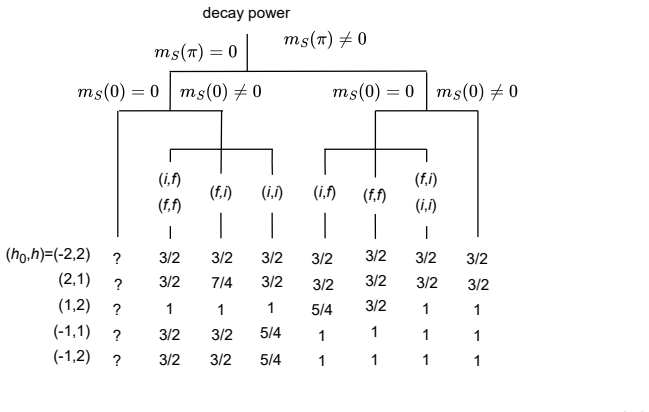
The central discovery is a classification rule. For a fixed pair of transverse fields (h0,h), the late-time exponent λ is determined by whether m_S(φ)=m(φ)+m(-φ)-1 is continuous on [0,π], whether it vanishes at the endpoints, and whether its first derivative is finite or diverges there and at interior points. When m_S is discontinuous, λ=1. When m_S is continuous with finite first derivative, a flowchart built on these boundary and smoothness properties yields λ ∈ {1, 3/2, 2, 5/2, ...}. When m_S is continuous but m'_S diverges, additional exponents 5/4 and 7/4 appear, and the dependence on the antisymmetric part m_A(φ) is left open except for m_A=0. The paper recovers the known t^{-3/2} resu
What carries the argument
The load-bearing object is the symmetric excitation-fraction function m_S(φ) ≡ m(φ)+m(-φ)-1 on φ∈[0,π], which fully encodes the initial eigenstate's role in determining the decay exponent. The other central object is the Bures distance B_A(t), a rigorous metric on density matrices built from Uhlmann fidelity; the paper computes it numerically for subsystem reduced density matrices and reads off λ from power-law fits. The classification is organized as flowchart rules connecting analytic properties of m_S (continuity, endpoint values, C^1 smoothness, divergent derivative) to specific λ values for each of five representative transverse-field pairs.
Load-bearing premise
The classification assumes that the exponents read off from power-law fits over a finite time window (roughly t=1 to 100) are the exact asymptotic exponents and that the five representative transverse-field pairs capture every qualitatively distinct regime; the paper itself notes the rule may break for special states.
What would settle it
Compute B_A(t) over a time window extended well beyond t=10^2 (e.g., t up to 10^4) for a state with m_S(0)=m_S(π)=0 and m'_S divergent at an interior point; if the effective exponent drifts with the fit window or takes a value outside the listed discrete set, the discreteness claim fails. Also, a controlled analytic asymptotic expansion of the reduced density matrix for any allowed m_S that yields a parameter-dependent exponent would falsify the classification.
If this is right
- The t^{-3/2} ground-state decay becomes one point in a discrete family; excited initial states generally relax more slowly or faster depending on m_S.
- The discrete classification survives across at least three distance measures (Bures, trace-squared, relative-entropy), so it appears to be a property of the relaxation process, not of the metric.
- The bound relating magnetization decay exponent to distance exponent implies that the cheaply available magnetization data gives a lower bound on the subsystem-distance exponent; numerically they agree.
- The finite-time fitting over accessible windows predicts exact rational exponents, allowing a direct test at longer times or with analytic methods.
- The classification suggests that in other integrable models, analogous discrete exponents may be governed by similar analytic properties of initial-state functions.
Where Pith is reading between the lines
- If the discrete spectrum of λ is exact, it implies a hidden selection rule in the asymptotic expansion of the reduced density matrix, possibly tracing back to the analytic structure of form factors in the Ising chain; an analytic derivation would likely expose a counting argument.
- The robustness across distance measures suggests the discrete exponents may be extracted from single-particle data alone, potentially making the prediction testable in cold-atom experiments that measure subsystem purity or fidelity.
- The open m_A≠0 branch in the divergent-derivative section hints that the full classification may involve a richer phase diagram; scanning m_A could reveal additional exponents or mergings.
- The tentative α=3/2 scaling in subsystem-size dependence, if confirmed, would add a second discrete exponent to the relaxation law; currently uncertain.
Editorial analysis
A structured set of objections, weighed in public.
Referee Report
Summary. The paper numerically studies the relaxation of the subsystem Bures distance after a global quench in the infinite one-dimensional transverse-field Ising chain. It claims that the late-time decay obeys B_A(t) ~ t^{-λ}, with λ confined to a discrete set {1, 5/4, 3/2, 7/4, 2, 5/2, ...}, and that the value of λ is determined jointly by the pre- and post-quench transverse fields (h0,h) and by analytic properties of the symmetric excitation-fraction function m_S(φ)=m(φ)+m(-φ)-1, such as continuity, boundary values, and first-derivative regularity. A flowchart classification is proposed for continuous m_S(φ) with finite or divergent derivatives, and the known t^{-3/2} ground-state result is recovered as a special case. The paper is explicitly a numerical fitting study, as stated in Sec. 5.
Significance. If the discrete-exponent picture is correct, it would be a striking universal structure for local equilibration in an integrable model, going beyond the earlier ground-state result of Fagotti and Essler. The use of the Bures metric is a methodological improvement, and the consistency check across several distance measures plus the bound λ̃≥λ for the magnetization exponent are valuable. However, the paper's own caveats in Sec. 5—that the results rest on numerical fitting and that the rule may break down for special states—mean that the central universality claim is not yet established. The strongest part of the work is the honest numerical survey; the weakest is the lack of an analytical or robust numerical underpinning for the discreteness of the exponent set.
major comments (3)
- [Sec. 5; Fig. 3] The central claim is that λ takes exact rational values. However, the paper reports no fit uncertainties or goodness-of-fit measures. The fits in Fig. 3 cover roughly t=1 to 100, and the difference between exponents such as 3/2 and 7/4 corresponds to a factor t^{-1/4}, which over one and a half decades is only about a factor 1.5–2. Without residuals, confidence intervals, or a demonstration that subleading corrections are negligible in the fitting window, the assignment of discrete rational exponents is not robust. This is a load-bearing issue because the entire classification depends on the reliability of these assignments.
- [Sec. 4.3; Fig. 4] The branch m_S(0)=m_S(π)=0 is explicitly left unspecified: 'A complete closed-form rule for determining the decay exponent has not yet been established.' This is precisely the branch where the discreteness claim is most vulnerable. Consider an allowed state with m_S(φ)=-sin²φ(1-ε|φ-φ0|^α), with 0<α<1 and φ0∈(0,π). This function is continuous, vanishes at both boundaries, and has a divergent first derivative at an interior point with tunable strength α. A stationary-phase estimate of the contribution from the non-stationary interior singularity gives a late-time tail ~ t^{-1-α}, while boundary stationary points contribute t^{-3/2} or faster. For α<1/2 the interior term dominates, yielding λ=1+α, a continuum. The paper does not test such states, and its examples are smooth. Thus the discrete set may be an artifact of the restricted families of m_S(φ) considered. The authors need either to
- [Sec. 3] The five representative pairs (h0,h)=(-2,2),(2,1),(1,2),(-1,1),(-1,2) are asserted to 'suffice to represent all qualitatively distinct cases.' This is a load-bearing premise: the flowchart in Fig. 2 assigns different exponents to different pairs, so if this set is not exhaustive, the classification is incomplete. The paper gives no systematic proof or exhaustive parameter scan, only examples. At minimum, the authors should state the criterion used to define 'qualitatively distinct' (e.g., critical/non-critical status of h0 and h) and explain why all other quenches reduce to one of these five cases.
minor comments (4)
- [Abstract; Sec. 5] The abstract and Sec. 5 say the exponent is 'confined to discrete values' but also 'potentially further values.' If further discrete values may exist, the set is not closed; if continuous families are possible, the claim is false. Please define precisely what is being claimed and what would falsify it.
- [Fig. 3 caption] The caption says 'Panels from left to right,' but the panels are labeled (a)–(e). Please match the description to the labels.
- [Fig. 2; Sec. 4.2] The notation (s/n, s/n) is used before its definition is clearly introduced. Please define the two-entry label (boundary at φ=0, boundary at φ=π) explicitly in the text or in the caption.
- [Eq. (5.2)] In the inequality |tr[O(ρ-σ)]| ≤ 2 s_O D(ρ,σ), the symbol s_O is presumably the largest singular value of O. This is not defined in the text; a brief definition would help.
Circularity Check
No significant circularity: the mS-to-exponent map is an empirically fitted classification, not a derivation, and the paper explicitly disclaims an analytical derivation.
full rationale
The paper is an explicitly numerical study. The central map from mS(φ) properties to the late-time Bures-distance decay exponent λ is inferred from power-law fits of BA(t) for representative initial states and quench parameters, not derived from those properties. The mS properties (continuity, boundary values, derivative behavior) are defined independently of BA(t) via Eq. (4.1) and characterize pre-quench eigenstates; the exponents are fitted to the post-quench time evolution. There is no equation in which mS is defined in terms of λ or vice versa, and no fitted parameter is renamed as a prediction: the flowchart in Figs. 2 and 4 simply tabulates the observed exponents. The paper is transparent about this in Sec. 5: 'our conclusions are based on the numerically studied examples' and 'our results rest primarily on numerical fitting.' The incompleteness of the mS(0)=mS(π)=0 branch in Sec. 4.3 ('A complete closed-form rule ... has not yet been established') and the lack of fit uncertainties are scientific limitations that bear on the reliability and universality of the discrete-exponent claim, but they are not circularity. The only author-overlapping citations ([26] algorithm, [30] relative distance) are external tools/checks, not premises equivalent to the claim. Hence no significant circularity.
Axiom & Free-Parameter Ledger
free parameters (3)
- late-time decay exponent λ per quench case =
1, 5/4, 3/2, 7/4, 2, 5/2 (depending on case)
- subsystem-size exponent α in B_A ~ ℓ^α / t^λ =
2 (most cases), 1, tentative 3/2
- hand-chosen initial-state functions m(φ) =
e.g., m(φ)=1/2 sin^2(φ/2)
axioms (5)
- standard math TFIM is exactly solvable via Jordan-Wigner, Fourier, and Bogoliubov transformations, and post-quench states remain Gaussian fermionic states.
- domain assumption The infinite-time reduced density matrix equals the GGE reduced density matrix for all considered initial eigenstates.
- domain assumption The algorithm of Ref. [26] computes the Bures distance between fermionic Gaussian states exactly.
- ad hoc to paper The five representative (h0,h) pairs cover all qualitatively different exponent regimes.
- ad hoc to paper The listed properties of mS(φ) (continuity, boundary values, first-derivative regularity) are the only initial-state properties needed to determine λ.
read the original abstract
We present a numerical study of subsystem distance decay following a global quantum quench in the infinite one-dimensional transverse-field Ising chain, using the mathematically rigorous Bures distance $B_A(t)$ to quantify the deviation of the time-evolved reduced density matrix from its stationary generalized Gibbs ensemble state. We show that the late-time decay follows a discrete power law $B_A(t) \sim t^{-\lambda}$, with the exponent $\lambda$ confined to discrete values: $1$, $5/4$, $3/2$, $7/4$, $2$, $5/2$, and potentially further values. The specific exponent is jointly determined by the pre- and post-quench transverse fields, as well as by properties of the symmetric excitation-fraction function $m_S(\varphi)$, defined on $\varphi\in[0,\pi]$ to characterize the pre-quench Hamiltonian eigenstates, including continuity, boundary values, and first-derivative boundary values, among others. The previously established $t^{-3/2}$ decay for the initial ground state of the pre-quench Hamiltonian is naturally recovered as a special case of this general classification. Our results reveal a universal discrete structure governing local equilibration dynamics in integrable quantum systems.
Figures


Reference graph
Works this paper leans on
-
[1]
A. Polkovnikov, K. Sengupta, A. Silva and M. Vengalattore,Nonequilibrium dynamics of closed interacting quantum systems, Rev. Mod. Phys.83, 863 (2011), [arXiv:1007.5331]. 8
Pith/arXiv arXiv 2011
-
[2]
J. Eisert, M. Friesdorf and C. Gogolin,Quantum many-body systems out of equilibrium, Nature Phys.11, 124 (2015), [arXiv:1408.5148]
Pith/arXiv arXiv 2015
-
[3]
L. F. Santos and E. J. Torres-Herrera,Nonequilibrium Many-Body Quantum Dynamics: From Full Random Matrices to Real Systems, pp. 457–479. Springer International Publishing, 2018. arXiv:1803.06012. 10.1007/978-3-319-99046-0_19
Pith/arXiv arXiv 2018
-
[4]
G. Stefanucci and R. van Leeuwen,Nonequilibrium Many-Body Theory of Quantum Systems: A Modern Introduction. Cambridge University Press, 2 ed., 2025, 10.1017/9781009536776
-
[5]
Kinoshita, T
T. Kinoshita, T. Wenger and D. S. Weiss,Observation of a one-dimensional tonks-girardeau gas, Science305, 1125–1128 (2004)
2004
-
[6]
Kinoshita, T
T. Kinoshita, T. Wenger and D. S. Weiss,A quantum Newton’s cradle, Nature440, 900–903 (2006)
2006
-
[7]
Bloch, J
I. Bloch, J. Dalibard and S. Nascimbène,Quantum simulations with ultracold quantum gases, Nature Phys.8, 267–276 (2012)
2012
-
[8]
A. J. Daley, H. Pichler, J. Schachenmayer and P. Zoller,Measuring Entanglement Growth in Quench Dynamics of Bosons in an Optical Lattice, Phys. Rev. Lett.109, 020505 (2012), [arXiv:1205.1521]
Pith/arXiv arXiv 2012
-
[9]
R. Islam, R. Ma, P. M. Preiss, M. E. Tai, A. Lukin, M. Rispoli and M. Greiner,Measuring entanglement entropy through the interference of quantum many-body twins, Nature528, 77 (2015), [arXiv:1509.01160]
Pith/arXiv arXiv 2015
-
[10]
J. M. Deutsch,Quantum statistical mechanics in a closed system, Phys. Rev. A43, 2046–2049 (1991)
2046
-
[11]
Srednicki,Chaos and Quantum Thermalization, Phys
M. Srednicki,Chaos and Quantum Thermalization, Phys. Rev. E50, 888–901 (1994), [arXiv:cond-mat/9403051]
Pith/arXiv arXiv 1994
-
[12]
M. Rigol, V. Dunjko and M. Olshanii,Thermalization and its mechanism for generic isolated quantum systems, Nature452, 854–858 (2008), [arXiv:0708.1324]
Pith/arXiv arXiv 2008
-
[13]
M. Rigol, V. Dunjko, V. Yurovsky and M. Olshanii,Relaxation in a Completely Integrable Many-Body Quantum System: An Ab Initio Study of the Dynamics of the Highly Excited States of 1D Lattice Hard-Core Bosons, Phys. Rev. Lett.98, 050405 (2007), [arXiv:cond-mat/0604476]
Pith/arXiv arXiv 2007
-
[14]
L. Vidmar and M. Rigol,Generalized gibbs ensemble in integrable lattice models, J. Stat. Mech. (2016) 064007, [arXiv:1604.03990]
Pith/arXiv arXiv 2016
-
[15]
P. Calabrese, F. H. L. Essler and M. Fagotti,Quantum Quench in the Transverse Field Ising Chain, Phys. Rev. Lett.106, 227203 (2011), [arXiv:1104.0154]
Pith/arXiv arXiv 2011
-
[16]
P. Calabrese, F. H. Essler and M. Fagotti,Quantum quench in the transverse field ising chain: I. time evolution of order parameter correlators, J. Stat. Mech. (2012) P07016, [arXiv:1204.3911]
Pith/arXiv arXiv 2012
-
[17]
P. Calabrese, F. H. Essler and M. Fagotti,Quantum quenches in the transverse field Ising chain: II. Stationary state properties, J. Stat. Mech. (2012) P07022, [arXiv:1205.2211]
Pith/arXiv arXiv 2012
-
[18]
M. Cheneau, P. Barmettler, D. Poletti, M. Endres, P. Schauß, T. Fukuhara, C. Gross, I. Bloch, C. Kollath and S. Kuhr,Light-cone-like spreading of correlations in a quantum many-body system, Nature481, 484–487 (2012), [arXiv:1111.0776]
Pith/arXiv arXiv 2012
-
[19]
P. Calabrese and J. L. Cardy,Evolution of entanglement entropy in one-dimensional systems, J. Stat. Mech. (2005) P04010, [arXiv:cond-mat/0503393]. 9
Pith/arXiv arXiv 2005
-
[20]
E. H. Lieb, T. Schultz and D. Mattis,Two soluble models of an antiferromagnetic chain, Annals Phys.16, 407 (1961)
1961
-
[21]
Katsura,Statistical mechanics of the anisotropic linear Heisenberg model, Phys
S. Katsura,Statistical mechanics of the anisotropic linear Heisenberg model, Phys. Rev.127, 1508 (1962)
1962
-
[22]
Pfeuty,The one-dimensional Ising model with a transverse field, Annals Phys.57, 79 (1970)
P. Pfeuty,The one-dimensional Ising model with a transverse field, Annals Phys.57, 79 (1970)
1970
-
[23]
L. Bucciantini, M. Kormos and P. Calabrese,Quantum quenches from excited states in the Ising chain, J. Phys. A: Math. Theor.47, 175002 (2014), [arXiv:1401.7250]
Pith/arXiv arXiv 2014
-
[24]
M. Fagotti and F. H. Essler,Reduced density matrix after a quantum quench, Phys. Rev. B87, 245107 (2013), [arXiv:1302.6944]
Pith/arXiv arXiv 2013
-
[25]
M. A. Nielsen and I. L. Chuang,Quantum Computation and Quantum Information. Cambridge University Press, Cambridge, UK, 10th anniversary ed., 2010, 10.1017/CBO9780511976667
-
[26]
Z. Guo, M. A. Rajabpour and J. Zhang,Efficient computation of average subsystem Bures distance between fermionic Gaussian states, Phys. Rev. B113, 205144 (2026), [arXiv:2508.09417]
Pith/arXiv arXiv 2026
-
[27]
V. Alba, M. Fagotti and P. Calabrese,Entanglement entropy of excited states, J. Stat. Mech. (2009) P10020, [arXiv:0909.1999]
Pith/arXiv arXiv 2009
-
[28]
G. Vidal, J. I. Latorre, E. Rico and A. Kitaev,Entanglement in Quantum Critical Phenomena, Phys. Rev. Lett.90, 227902 (2003), [arXiv:quant-ph/0211074]
Pith/arXiv arXiv 2003
-
[29]
J. I. Latorre, E. Rico and G. Vidal,Ground state entanglement in quantum spin chains, Quant. Inf. Comput.4, 48 (2004), [arXiv:quant-ph/0304098]
Pith/arXiv arXiv 2004
-
[30]
J. Zhang, M. A. Rajabpour, M. Heyl and R. Khasseh,Subsystem evolution speed as indicator of relaxation, Phys. Rev. B111, L140410 (2025), [arXiv:2410.17798]. 10
Pith/arXiv arXiv 2025
discussion (0)
Sign in with ORCID, Apple, or X to comment. Anyone can read and Pith papers without signing in.