REVIEW 3 major objections 4 minor 25 cited by
DiffusionDrive: Truncated Diffusion Model for End-to-End Autonomous Driving
T0 review · 3 major / 4 minor · reviewed 2026-08-12 · deepseek-v4-flash
Pith's one-line read A diffusion planner that denoises from 20 clustered anchors instead of pure noise reaches 88.1 PDMS on NAVSIM in 2 steps, at 45 FPS.
desk verdict Real 2-step diffusion planner with anchored Gaussian prior; strong engineering, but anchor coverage and inference sampling need tightening. read the letter →
The pith
A machine-rendered reading of the paper's core claim, the machinery that carries it, and where it could break.
The reading
What carries the argument
The load-bearing object is the truncated diffusion policy: the forward process in Eq. (4), $\tau^i_k = \sqrt{\bar{\alpha}_i}\, a_k + \sqrt{1-\bar{\alpha}_i}\,\epsilon$, diffuses each K-Means anchor trajectory $a_k$ only up to timestep $T_{\text{trunc}}=50$ of the 1000-step schedule, so training and inference work on a mixture of sub-Gaussians around the anchors rather than on pure noise. The second component is the cascade diffusion decoder, a transformer layer that applies deformable spatial cross-attention to BEV or PV features, cross-attends to agent and map queries from the perception module, modulates on the diffusion timestep, and predicts both a confidence score and a trajectory offset per sample; two such layers are stacked with parameters shared across denoising steps. Together they let a variable number of samples $N_{\text{infer}}$ be drawn near the anchors, denoised in two steps with the DDIM update rule, and ranked by the learned confidence score so that the top-1 trajectory carries the final plan.
What would settle it
Run DiffusionDrive on a set of NAVSIM navtest scenarios deliberately chosen to contain maneuvers rare or absent in the training clusters — sharp u-turns, emergency swerves, unusual intersection geometry — and compare PDMS with the reported 88.1; a large drop on those scenes would show the anchored-coverage assumption fails. A cheaper check is to measure, for each denoised trajectory, the distance to the nearest training anchor and correlate high-distance samples with collisions or drivable-area violations.
Extended reading notes
Core claim
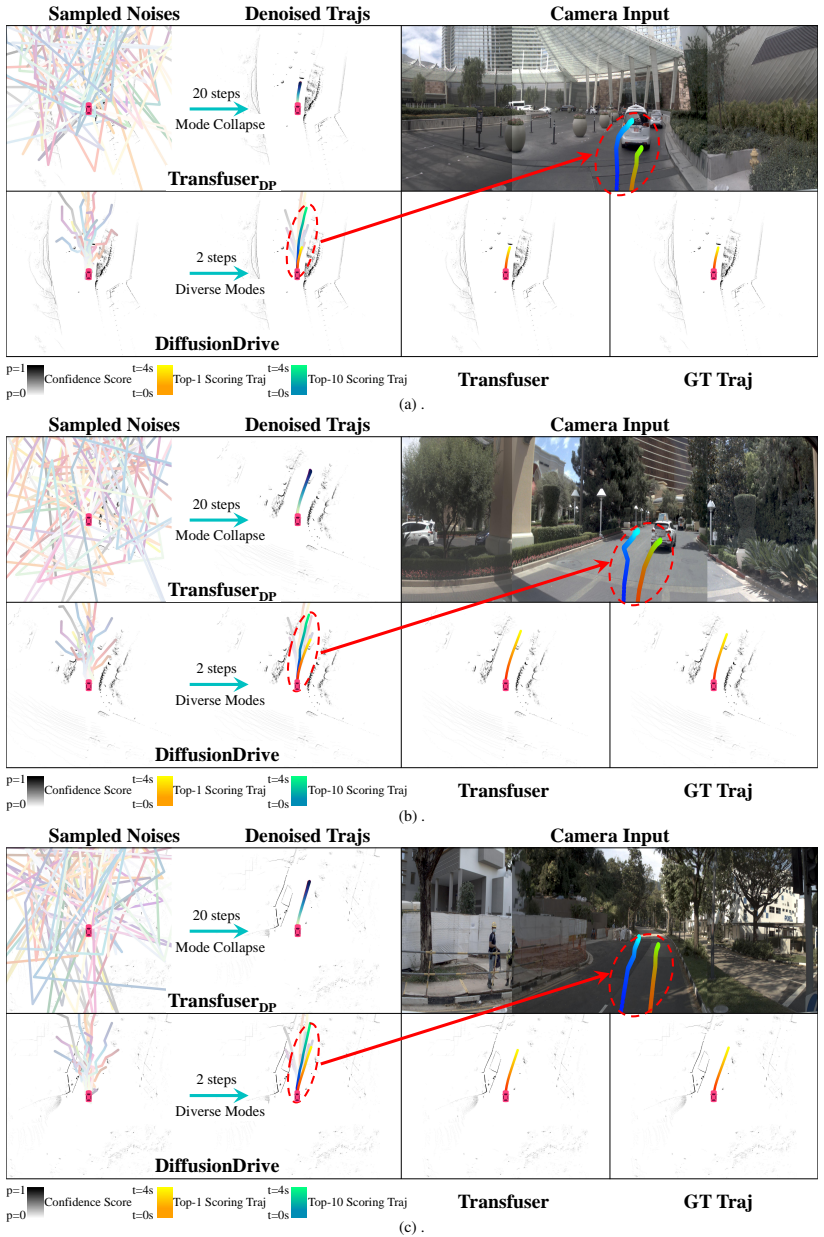
The central claim is that the obstacle to diffusion-based driving is not the generative model itself but the starting distribution: vanilla policies that denoise from random Gaussian noise suffer mode collapse in traffic scenes and need about twenty DDIM steps, dropping frame rate from 60 to 7 FPS. DiffusionDrive instead clusters the training trajectories into 20 anchors via K-Means, truncates the diffusion schedule to the first 50 of 1000 steps so each anchor is perturbed only into a small surrounding sub-Gaussian, and learns to denoise from that anchored distribution in 2 steps. The paper argues that this combines the coverage of a generative model with the structure of human driving patterns, so 20 anchors replace the fixed vocabulary of 8,192 anchors used by VADv2, and the top-1 scored denoised trajectory achieves 88.1 PDMS on the NAVSIM navtest split, 4.1 points above the Transfuser regression baseline and 1.6 points above Hydra-MDP-V8192-W-EP, with the full sampled set showing diverse maneuvers such as lane changes and traffic-light-aware stopping.
Load-bearing premise
The load-bearing premise is that twenty trajectory clusters computed on the training set cover every driving mode the test scenarios will demand; a scene that needs a maneuver far from all anchors falls outside the model's generative range, reproducing the out-of-vocabulary failure the paper attributes to VADv2.
Editorial extensions
If this is right
- A two-step denoising loop at 45 FPS makes generative multi-mode planning viable in real-time on-vehicle systems, where vanilla diffusion's twenty steps (7 FPS) were impractical.
- Replacing a fixed 8,192-anchor vocabulary with 20 learned anchors plus continuous denoising removes the out-of-vocabulary failure the paper attributes to sampling-from-vocabulary planners, while cutting the anchor set 400-fold.
- The cascade diffusion decoder improves PDMS by 2.4 over the UNet-based truncated policy while reducing parameters from 102M to 60M, pointing to the interaction design as the source of planning quality.
- On nuScenes open-loop evaluation the same mechanism lowers average L2 error by 20.8% and collision rate by 63.6% relative to VAD with a ResNet-50 backbone, showing the result is not benchmark-specific.
- Because sample count $N_{\text{infer}}$ and the number of denoising steps are adjustable at inference, the system exposes a direct quality-versus-latency trade-off for deployment.
Reading between the lines
- The twenty-cluster premise invites a stress test the paper does not run: a curated set of test scenes whose ground-truth maneuvers lie far from every training anchor should expose the coverage boundary, and if PDMS degrades sharply there, the method inherits the same out-of-vocabulary failure it attributes to VADv2.
- The truncated-schedule recipe is generic: any policy task where a modest set of prior modes can be derived cheaply from data could start denoising from an anchored distribution, though the benefit should shrink as mode coverage becomes harder to certify with a small cluster count.
- The diversity score $D$ of Eq. (3) measures trajectory spread, not usefulness; a natural extension is to test whether the diverse top-10 trajectories improve closed-loop robustness under reactive agents, which the top-1-based PDMS metric does not capture.
- Because one-step inference already scores 87.9 PDMS, a dynamic step-count scheduler conditioned on scene difficulty is a plausible extension: easy scenes run one denoising step and hard scenes two or three.
Signed reviews
Editorial analysis
A structured set of objections, weighed in public.
Referee Report
Summary. The paper proposes DiffusionDrive, an end-to-end driving planner that replaces the deterministic regression head of Transfuser with a truncated diffusion policy. The method uses K-Means anchors from the training set to define an anchored Gaussian distribution, truncates the diffusion schedule to T_trunc = 50/1000, and performs only 2 denoising steps at inference with a cascade transformer decoder. On the NAVSIM navtest split, DiffusionDrive achieves 88.1 PDMS with a ResNet-34 backbone at 45 FPS on an NVIDIA 4090, and it also reports improved L2 error and collision rate on nuScenes over SparseDrive. The paper includes a controlled roadmap from Transfuser to TransfuserDP to TransfuserTD to DiffusionDrive, ablations of decoder components, and a CARLA transfer experiment for anchor generalization.
Significance. If the central claim holds, the paper makes a meaningful contribution: it shows that a diffusion-based planner can be made real-time (2 steps) while achieving state-of-the-art closed-loop planning performance on NAVSIM and providing diverse multi-mode trajectories. The controlled roadmap and component ablations are strengths, and the CARLA anchor-transfer experiment is a useful step toward validating the generality of the anchor prior. The performance on an externally defined benchmark (NAVSIM navtest) is a significant asset. However, the core claims about avoiding out-of-vocabulary modes and about diversity rest partly on qualitative evidence and on a self-referential diversity score, which need to be substantiated with quantitative analysis.
major comments (3)
- [Section 3.3 / Table 9] The claim that the anchored Gaussian distribution with only 20 K-Means anchors avoids the out-of-vocabulary failure of VADv2's 8192-anchor vocabulary is not quantitatively supported. Since Eq. (4) with T_trunc=50/1000 yields a starting noise concentrated near the anchors, and the training loss in Eq. (6) reconstructs the ground truth only from its closest anchor, a navtest scenario requiring a mode far from every anchor could produce arbitrarily poor top-1 predictions. The CARLA transfer test (Table 9) uses the same NAVSIM anchors on a different dataset and does not measure coverage of navtest modes. Please add a coverage analysis on navtest, such as the distribution of distances from ground-truth trajectories to the nearest anchor, PDMS as a function of anchor count, or a failure-case study for scenarios where the top-1 trajectory deviates from the ground truth.
- [Section 3.4 / Table 3] The ablation in Table 3 does not include a non-diffusion baseline that uses the same cascade decoder and anchor classification but performs a single forward pass without iterative DDIM denoising. As a result, the improvement attributed to the truncated diffusion process could be due to the anchor prior, the classification head, or the transformer decoder itself. Please add such a baseline (e.g., training the decoder to directly regress offsets from anchors with no iterative refinement) to isolate the contribution of the diffusion/denoising mechanism.
- [Section 3.2 / Eq. (3)] The mode diversity score D (Eq. 3) is a spatial-spread measure (1 minus the mean intersection-over-union of sampled trajectories). It is computed on the model's own outputs and is not validated against any notion of plausibility or multi-modality quality; a model that outputs arbitrary scattered trajectories could achieve a high D. Since the paper's central claim includes 'superior diversity and quality,' please validate D against an external criterion (e.g., human ratings, downstream closed-loop performance of the diverse modes, or comparison with trajectory prediction benchmarks) and report D for the non-diffusion baseline as well.
minor comments (4)
- [Section 1] The claim that this work 'firstly introduce[s] the diffusion model to the field of end-to-end autonomous driving' should be reconciled with the cited GenAD [58] and other generative planning works; if GenAD uses a diffusion-style generator, the novelty claim needs to be qualified.
- [Table 2] The column header 'D' is not explained in the caption; define the mode diversity score in the caption or refer explicitly to Eq. (3).
- [Section 4.4] The sentence 'resulting in a total 650x increase in runtime overhead' is correct only when comparing the 20-step UNet to the 1-step MLP; please state the comparison base explicitly.
- [Supplementary Table 8] The caption contains a typo: 'DiffusioDrive' should be 'DiffusionDrive'.
Circularity Check
No significant circularity: the central PDMS result is externally benchmarked and does not reduce to the fitted anchors or to the paper's own definitions.
full rationale
DiffusionDrive's headline claim, 88.1 PDMS on the NAVSIM navtest split, is measured by the external NAVSIM non-reactive closed-loop benchmark. It does not reduce by construction to any fitted quantity in the paper: the anchored Gaussian distribution is built from K-Means clusters of the training set (Sec. 3.3, Eq. 4), but the decoder is trained with the reconstruction-plus-classification loss in Eq. 6 against ground-truth trajectories and evaluated on navtest, so the anchor clustering does not mathematically force the reported PDMS. The only self-referential element is the mode-diversity score D (Eq. 3), which quantifies the spread of the model's own sampled trajectories; it is a descriptive statistic used to support the diversity claim rather than the load-bearing PDMS result, and it is not defined in terms of the property it is used to illustrate. The paper's self-citations to VAD, VADv2, and related works are used as baselines and prior-art context, not as unverified premises for the central result. The CARLA transfer test in Table 9 is an external evaluation of whether NAVSIM-derived anchors generalize to a different dataset, not a circular reduction. The absence of a quantitative coverage analysis for the 20 training-set anchors is a generalization risk, but it is a correctness concern, not circularity. No circular step is exhibited in the derivation chain.
Assumptions & free parameters
free parameters (6)
- anchor count N_anchor =
20 (NAVSIM), 18 (nuScenes)
- truncated diffusion timesteps T_trunc =
50/1000
- inference denoising steps =
2
- cascade decoder stages =
2
- BCE loss weight lambda =
not reported
- number of sampled noises N_infer =
20 (NAVSIM main)
assumptions (5)
- standard math The DDPM/DDIM forward and reverse process described by Eqs. 1 and 2 is correct and applicable to trajectory data.
- domain assumption NAVSIM's non-reactive closed-loop PDMS is a valid proxy for autonomous driving quality and safety.
- domain assumption K-Means anchors on the training set cover the multi-mode action distribution that appears at test time.
- ad hoc to paper The mode diversity score D (Eq. 3) measures plausible multi-modality rather than just spatial spread.
- domain assumption Ablation results in Tabs. 3-6 are reported on a split that does not leak test information into hyperparameter choice.
invented entities (1)
-
Anchored Gaussian distribution
Cite this review
Pith. "Pith review of DiffusionDrive: Truncated Diffusion Model for End-to-End Autonomous Driving." pith.science (2026). https://pith.science/paper/3VHLC7UJ
@misc{pith2026241115139,
  author       = {Pith},
  title        = {Pith review of: DiffusionDrive: Truncated Diffusion Model for End-to-End Autonomous Driving},
  year         = {2026},
  howpublished = {\url{https://pith.science/paper/3VHLC7UJ}},
  note         = {Machine review of arXiv:2411.15139}
}
abstract
Recently, the diffusion model has emerged as a powerful generative technique for robotic policy learning, capable of modeling multi-mode action distributions. Leveraging its capability for end-to-end autonomous driving is a promising direction. However, the numerous denoising steps in the robotic diffusion policy and the more dynamic, open-world nature of traffic scenes pose substantial challenges for generating diverse driving actions at a real-time speed. To address these challenges, we propose a novel truncated diffusion policy that incorporates prior multi-mode anchors and truncates the diffusion schedule, enabling the model to learn denoising from anchored Gaussian distribution to the multi-mode driving action distribution. Additionally, we design an efficient cascade diffusion decoder for enhanced interaction with conditional scene context. The proposed model, DiffusionDrive, demonstrates 10$\times$ reduction in denoising steps compared to vanilla diffusion policy, delivering superior diversity and quality in just 2 steps. On the planning-oriented NAVSIM dataset, with the aligned ResNet-34 backbone, DiffusionDrive achieves 88.1 PDMS without bells and whistles, setting a new record, while running at a real-time speed of 45 FPS on an NVIDIA 4090. Qualitative results on challenging scenarios further confirm that DiffusionDrive can robustly generate diverse plausible driving actions. Code and model will be available at https://github.com/hustvl/DiffusionDrive.
Figures


Figures from the paper (4 more)


Forward citations
Cited by 25 Pith papers
-
Decaying Turbulence and the Riemann Hypothesis: The number theory behind the infinite-time singularity
Freely decaying incompressible turbulence possesses a universal Euler-ensemble attractor whose continuum Mellin spectrum is controlled by the non-trivial zeros of the Riemann zeta function, producing an infinite-time ...
-
Deferred Exposure of Future Trajectories for Verifiable Reasoning in Autonomous Driving VLMs
Hiding future trajectory information until after a driving model forms its decision reduces rationalization and improves verifiable autonomous-driving reasoning in the proposed AD-MCQ and DEFT-RLVR framework.
-
TaCarla: A comprehensive benchmarking dataset for end-to-end autonomous driving
TaCarla releases 2.85M CARLA Leaderboard 2.0 frames with nuScenes-style sensors, multi-task annotations, planning baselines, and a text-based rarity score.
-
From Representational Complementarity to Dual Systems: Synergizing VLM and Vision-Only Backbones for End-to-End Driving
A VLM-based and a vision-only end-to-end planner are behaviorally complementary in a long tail of driving scenarios; selecting the better trajectory lifts NAVSIM PDMS from 90.80 to 92.10 at modest compute.
-
Self-Imitated Diffusion Policy for Efficient and Robust Visual Navigation
SIDP trains a diffusion policy for visual navigation by reward-weighting its own sampled trajectories, improving success rate and cutting inference latency.
-
IRL-VLA: Training an Vision-Language-Action Policy via Reward World Model
IRL-VLA fine-tunes a vision-language-action driving policy with PPO against a learned reward world model trained on NAVSIM's EPDMS metrics, reaching 74.9 EPDMS on navhard-real.
-
NetRoller: Interfacing General and Specialized Models for End-to-End Autonomous Driving
A three-stage adapter extracts early hidden-state features from a driving LLM and injects them into a VAD-based planner, reporting a 16.7% lower collision rate and 12.5% better trajectory similarity on nuScenes.
-
Reinforced Refinement with Self-Aware Expansion for End-to-End Autonomous Driving
R2SE refines pretrained end-to-end driving policies on hard cases via residual LoRA reinforcement learning and switches between specialist and generalist policies using GPD-based uncertainty.
-
RealDrive: Retrieval-Augmented Driving with Diffusion Models
A retrieval-augmented diffusion planner that interpolates retrieved expert demonstrations with current observations reduces collision rate by up to 40% on Waymo open-loop planning benchmarks.
-
TrackVLA: Embodied Visual Tracking in the Wild
A single vision-language-action model jointly trained on recognition and tracking data follows described targets at the best reported levels on a public benchmark and transfers zero-shot from simulation to a real quad...
-
DriveCamSim: Generalizable Camera Simulation via Explicit Camera Modeling for Autonomous Driving
DriveCamSim uses explicit 3D-aware attention to generate multi-view driving video under new camera parameters and frame rates, trained on 2Hz nuScenes data.
-
DiffE2E: Rethinking End-to-End Driving with a Hybrid Action Diffusion and Supervised Policy
DiffE2E reports state-of-the-art closed-loop driving scores in CARLA and NAVSIM by combining a diffusion trajectory decoder with explicit supervision in a single Transformer decoder.
-
SafeMVDrive: Multi-view Safety-Critical Driving Video Synthesis in the Real World Domain
SafeMVDrive generates multi-view, real-world safety-critical driving videos by selecting adversarial vehicles with a GRPO-finetuned vision-language model and simulating collision-evasion trajectories.
-
Fully Unified Motion Planning for End-to-End Autonomous Driving
FUMP trains an end-to-end planner on both ego and surrounding vehicles' trajectories through a perspective-aligning equivariant adapter and a two-stage decoder, reducing NuScenes L2 planning error from 0.61m to 0.39m.
-
LADY: Linear Attention for Autonomous Driving Efficiency without Transformers
LADY shows that an end-to-end driving model using only linear attention can match transformer-based planners on NAVSIM/Bench2Drive while fusing arbitrary-length historical sensor frames at constant per-frame cost.
-
DistillDrive: End-to-End Multi-Mode Autonomous Driving Distillation by Isomorphic Hetero-Source Planning Model
A distillation framework with a ground-truth-annotation teacher, RL status optimization, and generative distribution interaction improves end-to-end planning collisions and closed-loop scores.
-
PriorFusion: Unified Integration of Priors for Robust Road Perception in Autonomous Driving
PriorFusion integrates semantic segmentation, SVD-based shape templates, and a truncated diffusion decoder to improve vectorized road element perception, reporting state-of-the-art mAP on nuScenes.
-
ReAL-AD: Towards Human-Like Reasoning in End-to-End Autonomous Driving
ReAL-AD combines VLM-generated strategy and tactical commands with a two-stage trajectory decoder, cutting open-loop L2 error and collision rate by about a third on nuScenes and Bench2Drive.
-
CogAD: Cognitive-Hierarchy Guided End-to-End Autonomous Driving
CogAD reports state-of-the-art open-loop and closed-loop planning results by combining hierarchical scene-to-instance perception with intent-to-trajectory planning and dual-level uncertainty.
-
Challenger: Affordable Adversarial Driving Video Generation
A framework for automatic generation of photorealistic adversarial driving videos, shown to sharply increase collision rates of end-to-end autonomous driving models.
-
ARTEMIS: Autoregressive End-to-End Trajectory Planning with Mixture of Experts for Autonomous Driving
An autoregressive mixture-of-experts planner for end-to-end driving achieves 87.0 PDMS and 83.1 EPDMS on NAVSIM, with ablations supporting each component.
-
HMAD: Advancing E2E Driving with Anchored Offset Proposals and Simulation-Supervised Multi-target Scoring
HMAD integrates BEVFormer, DiffusionDrive-style anchor offsets, and a Hydra-MDP-style scoring network to achieve 65.94 EPDMS on the NAVSIM warmup benchmark and 44.5% on the CVPR 2025 private test set.
-
DiffVLA: Vision-Language Guided Diffusion Planning for Autonomous Driving
DiffVLA integrates VLM guidance, hybrid sparse-dense BEV perception, and a truncated diffusion policy to achieve 45.0 PDMS on the NAVSIM v2 benchmark.
-
AGI-Elo: How Far Are We From Mastering A Task?
AGI-Elo applies Elo/Glicko-style ratings to model-versus-test-case matches, producing joint difficulty and competency scores and competency-gap estimates across six AI benchmarks.
-
Generative AI for Autonomous Driving: A Review
A review of generative models (VAEs, GANs, diffusion, transformers, LLMs) applied to map generation, scenario generation, trajectory prediction, and motion planning for autonomous driving.
Reference graph
Works this paper leans on
-
[1]
Anurag Ajay, Yilun Du, Abhi Gupta, Joshua B. Tenenbaum, Tommi S. Jaakkola, and Pulkit Agrawal. Is conditional gen- erative modeling all you need for decision making? InICLR,
-
[2]
nuscenes: A multi- modal dataset for autonomous driving
Holger Caesar, Varun Bankiti, Alex H Lang, Sourabh V ora, Venice Erin Liong, Qiang Xu, Anush Krishnan, Yu Pan, Gi- ancarlo Baldan, and Oscar Beijbom. nuscenes: A multi- modal dataset for autonomous driving. In CVPR, 2020. 2, 1
work page 2020
-
[3]
Vadv2: End-to-end vectorized autonomous driving via probabilistic planning
Shaoyu Chen, Bo Jiang, Hao Gao, Bencheng Liao, Qing Xu, Qian Zhang, Chang Huang, Wenyu Liu, and Xinggang Wang. Vadv2: End-to-end vectorized autonomous driving via probabilistic planning. arXiv preprint arXiv:2402.13243,
-
[4]
Polardetr: Polar parametrization for vision-based surround-view 3d detec- tion
Shaoyu Chen, Xinggang Wang, Tianheng Cheng, Qian Zhang, Chang Huang, and Wenyu Liu. Polardetr: Polar parametrization for vision-based surround-view 3d detec- tion. Image and Vision Computing, 156:105438, 2025. 1
work page 2025
-
[5]
Ppad: Iterative interactions of prediction and planning for end-to-end autonomous driving
Zhili Chen, Maosheng Ye, Shuangjie Xu, Tongyi Cao, and Qifeng Chen. Ppad: Iterative interactions of prediction and planning for end-to-end autonomous driving. In ECCV,
-
[6]
Diffusion policy: Visuomotor policy learning via action dif- fusion
Cheng Chi, Zhenjia Xu, Siyuan Feng, Eric Cousineau, Yilun Du, Benjamin Burchfiel, Russ Tedrake, and Shuran Song. Diffusion policy: Visuomotor policy learning via action dif- fusion. In RSS, 2023. 1, 3, 5, 6
work page 2023
-
[7]
Transfuser: Imitation with transformer-based sensor fusion for autonomous driv- ing
Kashyap Chitta, Aditya Prakash, Bernhard Jaeger, Zehao Yu, Katrin Renz, and Andreas Geiger. Transfuser: Imitation with transformer-based sensor fusion for autonomous driv- ing. TPAMI, 2022. 1, 2, 5, 6
work page 2022
-
[8]
Dice: Diverse dif- fusion model with scoring for trajectory prediction
Younwoo Choi, Ray Coden Mercurius, Soheil Mohamad Al- izadeh Shabestary, and Amir Rasouli. Dice: Diverse dif- fusion model with scoring for trajectory prediction. In IV,
Show all 62 references
-
[9]
Openscene: The largest up-to- date 3d occupancy prediction benchmark in autonomous driving
OpenScene Contributors. Openscene: The largest up-to- date 3d occupancy prediction benchmark in autonomous driving. https://github.com/OpenDriveLab/ OpenScene, 2023. 7
2023
-
[10]
Navsim: Data-driven non- reactive autonomous vehicle simulation and benchmarking
Daniel Dauner, Marcel Hallgarten, Tianyu Li, Xinshuo Weng, Zhiyu Huang, Zetong Yang, Hongyang Li, Igor Gilitschenski, Boris Ivanovic, Marco Pavone, Andreas Geiger, and Kashyap Chitta. Navsim: Data-driven non- reactive autonomous vehicle simulation and benchmarking. In NeurIPS,...
2024
-
[11]
Carla: An open urban driv- ing simulator
Alexey Dosovitskiy, German Ros, Felipe Codevilla, Anto- nio Lopez, and Vladlen Koltun. Carla: An open urban driv- ing simulator. In Conference on robot learning, pages 1–16. PMLR, 2017. 1
2017
-
[12]
Producing and leveraging online map uncertainty in trajectory prediction
Xunjiang Gu, Guanyu Song, Igor Gilitschenski, Marco Pavone, and Boris Ivanovic. Producing and leveraging online map uncertainty in trajectory prediction. In CVPR, 2024. 2
2024
-
[13]
Deep residual learning for image recognition
Kaiming He, Xiangyu Zhang, Shaoqing Ren, and Jian Sun. Deep residual learning for image recognition. In CVPR,
-
[14]
Denoising dif- fusion probabilistic models
Jonathan Ho, Ajay Jain, and Pieter Abbeel. Denoising dif- fusion probabilistic models. Advances in neural information processing systems, 33:6840–6851, 2020. 4
2020
-
[15]
St-p3: End-to-end vision-based au- tonomous driving via spatial-temporal feature learning
Shengchao Hu, Li Chen, Penghao Wu, Hongyang Li, Junchi Yan, and Dacheng Tao. St-p3: End-to-end vision-based au- tonomous driving via spatial-temporal feature learning. In ECCV, 2022. 8
2022
-
[16]
Planning-oriented autonomous driving
Yihan Hu, Jiazhi Yang, Li Chen, Keyu Li, Chonghao Sima, Xizhou Zhu, Siqi Chai, Senyao Du, Tianwei Lin, Wenhai Wang, et al. Planning-oriented autonomous driving. In CVPR, 2023. 1, 2, 6, 8
2023
-
[17]
Bevdet: High-performance multi-camera 3d object de- tection in bird-eye-view
Junjie Huang, Guan Huang, Zheng Zhu, Yun Ye, and Dalong Du. Bevdet: High-performance multi-camera 3d object de- tection in bird-eye-view. arXiv preprint arXiv:2112.11790,
-
[18]
Versatile scene- consistent traffic scenario generation as optimization with diffusion
Zhiyu Huang, Zixu Zhang, Ameya Vaidya, Yuxiao Chen, Chen Lv, and Jaime Fern ´andez Fisac. Versatile scene- consistent traffic scenario generation as optimization with diffusion. arXiv preprint arXiv:2404.02524, 2024. 3
2024
-
[19]
Tenenbaum, and Sergey Levine
Michael Janner, Yilun Du, Joshua B. Tenenbaum, and Sergey Levine. Planning with diffusion for flexible behavior synthe- sis. In ICLR, 2022. 1, 3
2022
-
[20]
Vad: Vectorized scene representation for efficient autonomous driving
Bo Jiang, Shaoyu Chen, Qing Xu, Bencheng Liao, Jiajie Chen, Helong Zhou, Qian Zhang, Wenyu Liu, Chang Huang, and Xinggang Wang. Vad: Vectorized scene representation for efficient autonomous driving. In ICCV, 2023. 1, 2, 6, 8
2023
-
[21]
Motiondiffuser: Controllable multi-agent motion prediction using diffusion
Chiyu Jiang, Andre Cornman, Cheolho Park, Benjamin Sapp, Yin Zhou, Dragomir Anguelov, et al. Motiondiffuser: Controllable multi-agent motion prediction using diffusion. In CVPR, 2023. 3
2023
-
[22]
Towards learning-based planning: The nuplan benchmark for real-world autonomous driving
Napat Karnchanachari, Dimitris Geromichalos, Kok Seang Tan, Nanxiang Li, Christopher Eriksen, Shakiba Yaghoubi, Noushin Mehdipour, Gianmarco Bernasconi, Whye Kit Fong, Yiluan Guo, et al. Towards learning-based planning: The nuplan benchmark for real-world autonomous driving. I...
2024
-
[23]
Enhancing end-to-end autonomous driving with latent world model
Yingyan Li, Lue Fan, Jiawei He, Yuqi Wang, Yuntao Chen, Zhaoxiang Zhang, and Tieniu Tan. Enhancing end-to-end autonomous driving with latent world model. arXiv preprint arXiv:2406.08481, 2024. 2
2024 arXiv
-
[24]
Bevformer: Learning bird’s-eye-view representation from multi-camera images via spatiotemporal transformers
Zhiqi Li, Wenhai Wang, Hongyang Li, Enze Xie, Chong- hao Sima, Tong Lu, Yu Qiao, and Jifeng Dai. Bevformer: Learning bird’s-eye-view representation from multi-camera images via spatiotemporal transformers. In ECCV, 2022. 1
2022
-
[25]
Hydra-mdp: End-to-end multimodal planning with multi- target hydra-distillation
Zhenxin Li, Kailin Li, Shihao Wang, Shiyi Lan, Zhiding Yu, Yishen Ji, Zhiqi Li, Ziyue Zhu, Jan Kautz, Zuxuan Wu, et al. Hydra-mdp: End-to-end multimodal planning with multi- target hydra-distillation. arXiv preprint arXiv:2406.06978 ,
-
[26]
Is ego status all you need for open- loop end-to-end autonomous driving? In CVPR, 2024
Zhiqi Li, Zhiding Yu, Shiyi Lan, Jiahan Li, Jan Kautz, Tong Lu, and Jose M Alvarez. Is ego status all you need for open- loop end-to-end autonomous driving? In CVPR, 2024. 2
2024
-
[27]
MapTR: Structured modeling and learning for online vectorized HD map construction
Bencheng Liao, Shaoyu Chen, Xinggang Wang, Tianheng Cheng, Qian Zhang, Wenyu Liu, and Chang Huang. MapTR: Structured modeling and learning for online vectorized HD map construction. In ICLR, 2023. 1
2023
-
[28]
Maptrv2: An end-to-end framework for online vectorized hd map construction
Bencheng Liao, Shaoyu Chen, Yunchi Zhang, Bo Jiang, Qian Zhang, Wenyu Liu, Chang Huang, and Xinggang Wang. Maptrv2: An end-to-end framework for online vectorized hd map construction. IJCV, 2024. 1
2024
-
[29]
Sparse4d: Multi-view 3d object detec- tion with sparse spatial-temporal fusion
Xuewu Lin, Tianwei Lin, Zixiang Pei, Lichao Huang, and Zhizhong Su. Sparse4d: Multi-view 3d object detec- tion with sparse spatial-temporal fusion. arXiv preprint arXiv:2211.10581, 2022. 6
2022 arXiv
-
[30]
Yaron Lipman, Ricky T. Q. Chen, Heli Ben-Hamu, Maxim- ilian Nickel, and Matthew Le. Flow matching for genera- tive modeling. In The Eleventh International Conference on Learning Representations, 2023. 4
2023
-
[31]
Flow straight and fast: Learning to generate and transfer data with rectified flow
Xingchao Liu, Chengyue Gong, and Qiang Liu. Flow straight and fast: Learning to generate and transfer data with rectified flow. arXiv preprint arXiv:2209.03003, 2022. 4
2022 arXiv
-
[32]
Vectormapnet: End-to-end vectorized hd map learning
Yicheng Liu, Tianyuan Yuan, Yue Wang, Yilun Wang, and Hang Zhao. Vectormapnet: End-to-end vectorized hd map learning. In ICML, 2023. 1
2023
-
[33]
High-resolution image synthesis with latent diffusion models
Robin Rombach, Andreas Blattmann, Dominik Lorenz, Patrick Esser, and Bj ¨orn Ommer. High-resolution image synthesis with latent diffusion models. In Proceedings of the IEEE/CVF conference on computer vision and pattern recognition, pages 10684–10695, 2022. 4
2022
-
[34]
U-net: Convolutional networks for biomedical image segmentation
Olaf Ronneberger, Philipp Fischer, and Thomas Brox. U-net: Convolutional networks for biomedical image segmentation. In MICCAI, 2015. 2
2015
-
[35]
Denois- ing diffusion implicit models
Jiaming Song, Chenlin Meng, and Stefano Ermon. Denois- ing diffusion implicit models. In ICLR, 2021. 4, 5, 6
2021
-
[36]
Score-based generative modeling through stochastic differential equa- tions
Yang Song, Jascha Sohl-Dickstein, Diederik P Kingma, Ab- hishek Kumar, Stefano Ermon, and Ben Poole. Score-based generative modeling through stochastic differential equa- tions. In International Conference on Learning Represen- tations, 2021. 4
2021
-
[37]
Nomad: Goal masked diffusion policies for naviga- tion and exploration
Ajay Sridhar, Dhruv Shah, Catherine Glossop, and Sergey Levine. Nomad: Goal masked diffusion policies for naviga- tion and exploration. In ICRA, 2024. 4
2024
-
[38]
Dippest: Diffusion-based path planner for synthesizing tra- jectories applied on quadruped robots
Maria Stamatopoulou, Jianwei Liu, and Dimitrios Kanoulas. Dippest: Diffusion-based path planner for synthesizing tra- jectories applied on quadruped robots. arXiv preprint arXiv:2405.19232, 2024. 4
2024 arXiv
-
[39]
Sparsedrive: End-to-end au- tonomous driving via sparse scene representation
Wenchao Sun, Xuewu Lin, Yining Shi, Chuang Zhang, Hao- ran Wu, and Sifa Zheng. Sparsedrive: End-to-end au- tonomous driving via sparse scene representation. arXiv preprint arXiv:2405.19620, 2024. 2, 6, 8, 1
2024 arXiv
-
[40]
Efficientnet: Rethinking model scaling for convolutional neural networks
Mingxing Tan and Quoc Le. Efficientnet: Rethinking model scaling for convolutional neural networks. In ICML, 2019. 8
2019
-
[41]
Scene as occupancy
Wenwen Tong, Chonghao Sima, Tai Wang, Li Chen, Silei Wu, Hanming Deng, Yi Gu, Lewei Lu, Ping Luo, Dahua Lin, et al. Scene as occupancy. In ICCV, 2023. 8
2023
-
[42]
Detr3d: 3d object detection from multi-view images via 3d-to-2d queries
Yue Wang, Vitor Campagnolo Guizilini, Tianyuan Zhang, Yilun Wang, Hang Zhao, and Justin Solomon. Detr3d: 3d object detection from multi-view images via 3d-to-2d queries. In CoRL, 2022. 1, 6
2022
-
[43]
Driving into the future: Multiview visual forecasting and planning with world model for au- tonomous driving
Yuqi Wang, Jiawei He, Lue Fan, Hongxin Li, Yuntao Chen, and Zhaoxiang Zhang. Driving into the future: Multiview visual forecasting and planning with world model for au- tonomous driving. In CVPR, 2024. 2
2024
-
[44]
Opti- mizing diffusion models for joint trajectory prediction and controllable generation
Yixiao Wang, Chen Tang, Lingfeng Sun, Simone Rossi, Yichen Xie, Chensheng Peng, Thomas Hannagan, Stefano Sabatini, Nicola Poerio, Masayoshi Tomizuka, et al. Opti- mizing diffusion models for joint trajectory prediction and controllable generation. In ECCV, 2024. 3
2024
-
[45]
Para-drive: Parallelized architecture for real- time autonomous driving
Xinshuo Weng, Boris Ivanovic, Yan Wang, Yue Wang, and Marco Pavone. Para-drive: Parallelized architecture for real- time autonomous driving. In CVPR, 2024. 2, 6
2024
-
[46]
Dexdiffuser: Generating dexterous grasps with diffu- sion models
Zehang Weng, Haofei Lu, Danica Kragic, and Jens Lun- dell. Dexdiffuser: Generating dexterous grasps with diffu- sion models. arXiv preprint arXiv:2402.02989, 2024. 4
2024 arXiv
-
[47]
M2diffuser: Diffusion-based trajectory optimization for mobile manipulation in 3d scenes
Sixu Yan, Zeyu Zhang, Muzhi Han, Zaijin Wang, Qi Xie, Zhitian Li, Zhehan Li, Hangxin Liu, Xinggang Wang, and Song-Chun Zhu. M2diffuser: Diffusion-based trajectory optimization for mobile manipulation in 3d scenes. arXiv preprint arXiv:2410.11402, 2024. 4
-
[48]
Diffusion-es: Gradient-free planning with diffusion for autonomous driving and zero-shot instruction following
Brian Yang, Huangyuan Su, Nikolaos Gkanatsios, Tsung- Wei Ke, Ayush Jain, Jeff Schneider, and Katerina Fragki- adaki. Diffusion-es: Gradient-free planning with diffusion for autonomous driving and zero-shot instruction following. In CVPR, 2024. 3
2024
-
[49]
Reconstruction vs
Jingfeng Yao and Xinggang Wang. Reconstruction vs. gener- ation: Taming optimization dilemma in latent diffusion mod- els. arXiv preprint arXiv:2501.01423, 2025. 4
2025 arXiv
-
[50]
Fasterdit: Towards faster diffusion transformers training without architecture modification
Jingfeng Yao, Cheng Wang, Wenyu Liu, and Xinggang Wang. Fasterdit: Towards faster diffusion transformers training without architecture modification. arXiv preprint arXiv:2410.10356, 2024. 4
2024 arXiv
-
[51]
Ldp: A local dif- fusion planner for efficient robot navigation and collision avoidance
Wenhao Yu, Jie Peng, Huanyu Yang, Junrui Zhang, Yifan Duan, Jianmin Ji, and Yanyong Zhang. Ldp: A local dif- fusion planner for efficient robot navigation and collision avoidance. arXiv preprint arXiv:2407.01950, 2024. 4
2024 arXiv
-
[52]
Drama: An efficient end-to-end motion planner for autonomous driving with mamba
Chengran Yuan, Zhanqi Zhang, Jiawei Sun, Shuo Sun, Ze- fan Huang, Christina Dao Wen Lee, Dongen Li, Yuhang Han, Anthony Wong, Keng Peng Tee, et al. Drama: An efficient end-to-end motion planner for autonomous driving with mamba. arXiv preprint arXiv:2408.03601, 2024. 6
2024 arXiv
-
[53]
3d diffusion policy
Yanjie Ze, Gu Zhang, Kangning Zhang, Chenyuan Hu, Muhan Wang, and Huazhe Xu. 3d diffusion policy. In RSS,
-
[54]
Motr: End-to-end multiple- object tracking with transformer
Fangao Zeng, Bin Dong, Yuang Zhang, Tiancai Wang, Xi- angyu Zhang, and Yichen Wei. Motr: End-to-end multiple- object tracking with transformer. In ECCV, 2022. 1
2022
-
[55]
Fairmot: On the fairness of detection and re-identification in multiple object tracking
Yifu Zhang, Chunyu Wang, Xinggang Wang, Wenjun Zeng, and Wenyu Liu. Fairmot: On the fairness of detection and re-identification in multiple object tracking. IJCV, 2021
2021
-
[56]
Bytetrack: Multi-object tracking by associating every detection box
Yifu Zhang, Peize Sun, Yi Jiang, Dongdong Yu, Fucheng Weng, Zehuan Yuan, Ping Luo, Wenyu Liu, and Xinggang Wang. Bytetrack: Multi-object tracking by associating every detection box. In ECCV, 2022. 1
2022
-
[57]
Truncated diffusion probabilistic mod- els and diffusion-based adversarial auto-encoders
Huangjie Zheng, Pengcheng He, Weizhu Chen, and Mingyuan Zhou. Truncated diffusion probabilistic mod- els and diffusion-based adversarial auto-encoders. In The Eleventh International Conference on Learning Representa- tions, 2023. 4
2023
-
[58]
Genad: Generative end-to-end au- tonomous driving
Wenzhao Zheng, Ruiqi Song, Xianda Guo, Chenming Zhang, and Long Chen. Genad: Generative end-to-end au- tonomous driving. In ECCV, 2024. 2
2024
-
[59]
Language-guided traffic simulation via scene-level diffusion
Ziyuan Zhong, Davis Rempe, Yuxiao Chen, Boris Ivanovic, Yulong Cao, Danfei Xu, Marco Pavone, and Baishakhi Ray. Language-guided traffic simulation via scene-level diffusion. In CoRL, 2023. 3
2023
-
[60]
Guided conditional diffusion for controllable traffic simula- tion
Ziyuan Zhong, Davis Rempe, Danfei Xu, Yuxiao Chen, Sushant Veer, Tong Che, Baishakhi Ray, and Marco Pavone. Guided conditional diffusion for controllable traffic simula- tion. In ICRA, 2023. 3
2023
-
[61]
Dig: Scal- able and efficient diffusion models with gated linear atten- tion
Lianghui Zhu, Zilong Huang, Bencheng Liao, Jun Hao Liew, Hanshu Yan, Jiashi Feng, and Xinggang Wang. Dig: Scal- able and efficient diffusion models with gated linear atten- tion. arXiv preprint arXiv:2405.18428, 2024. 4
2024 arXiv
-
[62]
Anchored Dist
Xizhou Zhu, Weijie Su, Lewei Lu, Bin Li, Xiaogang Wang, and Jifeng Dai. Deformable detr: Deformable transformers for end-to-end object detection. In ICLR, 2021. 2, 6 DiffusionDrive: Truncated Diffusion Model for End-to-End Autonomous Driving Supplementary Material A. Further I...
2021
Reviewed August 12, 2026 · model on record in the stance chip above.
Discussion (0). Continue with ORCID to comment.