REVIEW 4 major objections 6 minor 105 references
CP violation in top-pair production is stored in two definite spin-density structures that current LHC data already constrain.
Reviewed by Pith at T0; open to challenge. T0 means a machine referee read the full paper against a public rubric. the ladder, T0–T4 →
T0 review · grok-4.5
2026-07-31 03:02 UTC pith:3WT2IRHY
load-bearing objection Solid production-level framework: CP-odd effects live cleanly in ΔB and C_A; the a_k “beats existing bounds” claim is the soft quantitative spot, not the structure. the 4 major comments →
Quantum detection of CP violation in the tbar{t} system: production
The pith
A machine-rendered reading of the paper's core claim, the machinery that carries it, and where it could break.
Core claim
For the unpolarised production processes considered, after expressing the top and antitop spins in a common basis, CP violation in production is encoded exactly in two independent Fano–Bloch structures: the polarisation difference ΔB = (B − B̄)/2 and the antisymmetric part of the spin-correlation matrix C_A = (C − C^T)/2. Direct observables built from these structures, especially the component a_k, currently give the strongest individual constraint on Im(C_tG) from CMS data.
What carries the argument
The Fano–Bloch decomposition of the two-qubit production density matrix in a common spin basis, which converts CP invariance into the elementary conditions B = B̄ and C = C^T and thereby isolates the two CP-odd markers ΔB and C_A.
Load-bearing premise
The sensitivity claims rest on leading-order production matrices, one-operator scenarios, uncorrelated experimental errors, and a fixed 5 percent uncertainty assigned to projected quantum observables, while quadratic dimension-six terms are kept without the matching dimension-eight operators.
What would settle it
A statistically consistent combination of the full set of measured Fano–Bloch coefficients (including a_k) that either tightens or fails to improve the present interval on Im(C_tG), or a future measurement of concurrence at the few-percent level that does not follow the projected exclusion contours.
If this is right
- Direct CP markers built from ΔB and C_A become standard null tests for new top CP violation at the LHC and future colliders.
- The component a_k of the antisymmetric correlation vector can already improve existing bounds on the imaginary chromoelectric dipole coefficient.
- Projected concurrence measurements with few-percent precision would add competitive sensitivity to both CP-even and CP-odd dipole operators.
- Electron-positron colliders gain an extra CP-odd handle (the polarisation difference ΔB) that is absent in leading-order hadronic production.
- The same production-density-matrix framework extends immediately to tau-pair channels once the corresponding dipole operators are inserted.
Where Pith is reading between the lines
- Once the companion tomography paper is available, production-side and decay-side CP-odd effects can be separated experimentally, turning the two-paper programme into a complete CP diagnostic for top pairs.
- Because magic and concurrence respond differently to real versus imaginary dipole coefficients, a joint measurement of both could help discriminate CP-even from CP-odd new physics even when the direct markers are statistically limited.
- The clean separation of CP-odd entries in the photon-fusion and gluon-fusion correlation matrices suggests that a high-energy photon collider would offer an especially transparent laboratory for top electric-dipole moments.
Editorial analysis
A structured set of objections, weighed in public.
Referee Report
Summary. The paper develops the production-side framework for diagnosing CP violation in top-quark interactions through the two-qubit spin density matrix of the tt̄ pair. Working in a common spin basis, the authors show (Sec. 4.1, App. B) that for unpolarised, CP-self-conjugate production configurations, CP invariance is equivalent to B = B̄ and C = C^T, so that CP violation is encoded in exactly two structures: the polarisation difference ΔB and the antisymmetric correlation matrix C_A (equivalently the vector a). They derive analytic production density matrices via the Bouchiat–Michel formalism for five benchmark channels (scalar decay, e⁺e⁻, γγ, qq̄, gg), retaining linear and quadratic dimension-six SMEFT contributions with complex dipole coefficients, and study the response of discord, concurrence, magic, and a CP-sensitive trace distance. A phenomenological section (Sec. 6) compares against CMS spin-correlation measurements and FCC-ee projections, concluding that the component a_k currently provides the strongest individual constraint on Im(C_tG), and that a_k also leads the projected sensitivity to Im(C_tB) at a 365 GeV lepton collider. A companion paper will treat tomographic reconstruction.
Significance. If the results hold, this is a useful and well-organised contribution to the growing quantum-information program in top physics. Particular strengths: (i) the CP classification is derived from the action of CP on the density matrix itself (App. B) with explicit statements of its basis dependence and its restriction to unpolarised initial states and CP-related kinematics — it is not fitted or assumed; (ii) complete analytic Fano–Bloch coefficients are given for five production channels (App. C), including CP-odd structures at quadratic order, cross-checked against Refs. [23, 42, 59, 122] and verified numerically with the code of Ref. [104]; (iii) the scalar-decay example (Sec. 5.1) cleanly demonstrates that maximal entanglement and maximal CP violation are logically independent, a genuinely instructive result; (iv) the EFT-truncation limitations (quadratic dim-6 retained for positivity without dim-8; LO QCD in the LHC fit; uncorrelated uncertainties) are stated openly in Secs. 6–7 rather than hidden. The main quantitative claim — that a_k beats existing Im(C_tG) intervals — is falsifiable and, if it survives a proper covariance treatment, would be of direct interest to the LHC EFT社区
major comments (4)
- [§6.1.2, Fig. 21] The headline phenomenological claim (Sec. 6.1.2, Fig. 21; repeated in the conclusions, Sec. 7) that a_k 'improves on the representative existing interval' for Im(C_tG) rests on a χ² over the CMS [15] bins in which all bin-to-bin uncertainties are treated as uncorrelated (stated explicitly at the end of Sec. 6.1). Spin-correlation coefficients in neighbouring m_tt–|cos θ| bins share unfolding, luminosity, and modelling systematics, and the CMS analysis provides covariance information via HEPData [106]. Neglecting these correlations generically overstates the constraining power and can also shift the preferred region. Since the 'strongest individual constraint' sentence is load-bearing for the paper's phenomenological punchline, the fit should be redone (or at least bracketed) with the published covariance matrix, or the claim should be downgraded to an illustration under diagonal uncertai
- [§6.1.2, Fig. 21 and Table 3] The comparison underlying the improvement claim mixes normalisations without showing the conversion. Table 3 quotes Im(C_tG)/(y_t g_s) ∈ [−0.33, 0.20] from [12] and Re(C_tG)/g_s from [76], while the fits in Figs. 21–22 bound Im(C_tG) directly in the dim6top_LO convention of [62]. The manuscript never states the explicit mapping used to translate the Table 3 intervals into the (Re C_tG, Im C_tG) plane of Figs. 21–22. A one-line conversion (with the values of y_t, g_s used) is needed in the caption of Fig. 21 or in Sec. 6.1.2; without it, the statement that the a_k contour is 'smaller compared to the experimental bound' is not verifiable from the manuscript.
- [§6.2, Figs. 23–24, footnote 6] In the FCC-ee projections, the CP-sensitive observables ΔB_n and a_k lose all sensitivity to Im(C_tB) near Re(C_tB) ≃ −0.35 and ≃ −1.5 respectively. The text correctly traces this to a cancellation between the O(Λ⁻²) and O(Λ⁻⁴) terms in the numerator (footnote 6). However, the O(Λ⁻⁴) terms are retained only as dim-6-squared contributions, without the dim-8 interference terms of the same formal order — a truncation the authors themselves flag as incomplete (Sec. 5.2, Sec. 7). The blind spots are therefore artifacts of an inconsistent-order numerator, yet they visibly deform the allowed contours in Fig. 23 and propagate into the conclusion that a_k is 'the strongest projected sensitivity' in the range Re(C_tB) ∈ [−1,1]. The contours should either be recomputed at consistent O(Λ⁻²) (accepting possible non-positivity of ρ and restricting observables accordingly) or the regions near the zeros
- [App. C.3 (Eq. C.22) and App. C.4 (Eq. C.25)] The comparison with Refs. [23] and [59] reports that the spin-correlation coefficient C̃_rk 'differs by an overall sign' — and this same unresolved discrepancy is stated identically in App. C.3 (qq̄) and App. C.4 (gg). No origin is identified (convention vs. genuine disagreement). Since C_rk enters the symmetric correlation structure used in the Sec. 6 fits (via the CMS-basis conversion, Eq. 6.5, and the a_n component (C_rk − C_kr)/2), an unresolved sign discrepancy with two independent published computations is a correctness risk that should be settled before publication — e.g., by tracing it to a specific basis or ε-tensor convention, or by a numerical cross-check at a fixed phase-space point against one of the two references.
minor comments (6)
- [App. C.3, Eq. (C.22)] In Eq. (C.22), the Λ⁻² term of C̃^A_kn contains the factor 'βeγgsmt...'; 'eγ' appears to be a typo for ˜γ (cf. the Λ⁻⁴ term of the same coefficient, which correctly carries β˜γ). Please check and correct.
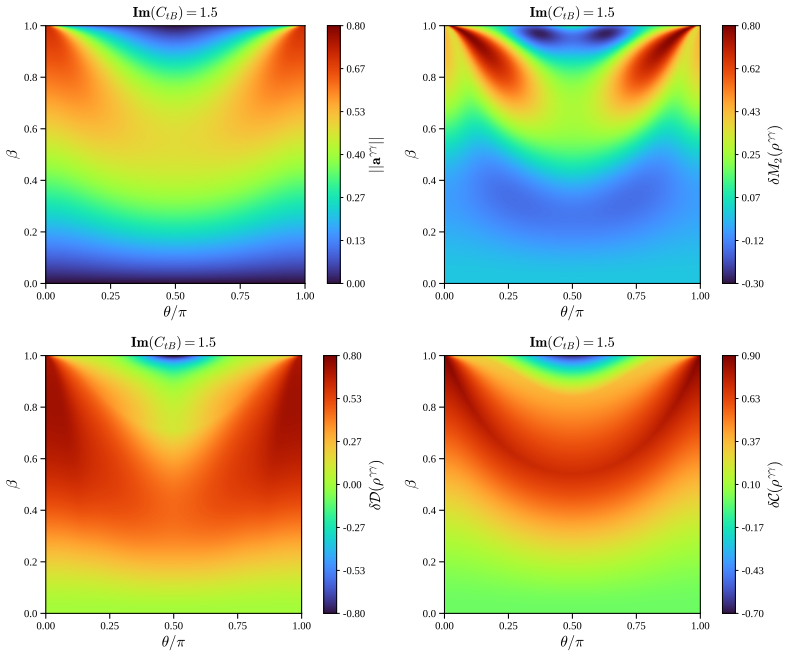
- [Figs. 12–13 captions] The caption of Fig. 12 (and similarly Fig. 13) describes the upper panels as showing ∥a∥ and δM₂, but the figure layout places ∥a∥ and δM₂ in the top row and δD, δC in the bottom row; the wording 'upper panels ... and the lower panels' is ambiguous given the 2×2 arrangement. Please rephrase to 'top row / bottom row'.
- [Reference [73]] The companion-paper reference [73] is a placeholder ('2607.XXXXX') and the fourth author's name is misspelled ('Vrynidou' for 'Vryonidou'). Please update at revision.
- [§4.2.4] Eq. (4.39): the mixed-state SRE₂ formula is used as a 'diagnostic of non-stabilizerness rather than a fully faithful magic monotone' — this caveat is welcome, but it would help the reader to state explicitly whether M₂ can be nonzero for stabilizer mixtures (false positives) or only fail as a monotone, since the phenomenological projections in Sec. 6 treat M₂ as a measurable discriminant.
- [Table 3] Table 3: the caption notes that different normalisations are employed, but does not flag that the two C_tG rows from [12] are quoted per (y_t g_s) while the [76] row is per g_s. A footnote giving the numerical conversion factor used elsewhere in the paper would prevent misreading.
- [§6.1.1, Eq. (6.5)] Sec. 6.1.1: the basis conversion in Eq. (6.5) introduces sgn(cos θ) factors on n̂ and r̂ to match the CMS convention. Since this redefinition is discontinuous at cos θ = 0 and the binning includes |cos θ| ∈ [0, 0.4], one sentence clarifying that the discontinuity lies inside a single bin and does not mix CP-even and CP-odd components would be useful.
Circularity Check
No load-bearing circularity: CP markers follow from symmetry of the density matrix; bounds use external CMS data. Minor self-citations to the authors’ QI/SMEFT programme and companion tomography paper are not inputs to the production-level claims.
specific steps
-
self citation load bearing
[Sec. 1 / Sec. 7; Ref. [73]]
"This establishes the production-level framework whose experimental reconstruction is developed in a companion paper. ... The reconstruction of the same state from the decay products ... is treated in the companion paper [73]."
The companion paper is by the same authors and is repeatedly invoked as the place where tomography and decay-side CP effects will be handled. This is ordinary programme self-citation, not load-bearing for the production density matrices or the CMS-based a_k bounds derived here; the production claims stand without [73]. Flagged only as minor overlapping-author citation, not as a circular reduction.
full rationale
The central structural result—that for unpolarised production in a common spin basis CP invariance requires B=B̄ and C=C^T, so CP-odd information sits in ΔB and C_A—is derived in App. B from the unitary action of CP on the two-qubit density matrix (SWAP in the spin basis). It is a symmetry identity, not a fit or a renaming of data. Analytic Fano–Bloch coefficients for S→tt̄, e⁺e⁻, γγ, q q̄ and gg are obtained from tree-level amplitudes plus SMEFT vertices via the Bouchiat–Michel formulae; they are parameter-free once Wilson coefficients are specified. Phenomenological constraints compare those shapes to external CMS spin-correlation measurements [15] and to independent global-fit intervals in Table 3; the χ² and 5% projection assumptions are methodological choices, not circular reductions of outputs to inputs. Self-citations (companion tomography paper [73], prior QI/SMEFT works) supply context or deferred experimental reconstruction and do not underwrite the production-level CP markers or the a_k bound. No step equates a claimed prediction to a fitted input by construction.
Axiom & Free-Parameter Ledger
free parameters (3)
- Projected relative uncertainty on concurrence and magic (5%) =
5%
- Benchmark Wilson coefficients (e.g. Re/Im C_tB=1.5, Re/Im C_tW=0.1, Re/Im C_tG=−0.2) at Λ=1 TeV =
order-one values within Table 3 ranges
- Global reconstruction efficiency ε_r and hadronic spin-analysing power α_j at FCC-ee =
ε_r=40%, α_j=0.64
axioms (5)
- domain assumption Dimension-six SMEFT truncation with tree-level SM interference; quadratic dim-6 retained for positive-semidefinite ρ without dim-8 operators
- domain assumption Unpolarised initial states; CP maps to B=B̄ and C=C^T in the common spin basis
- domain assumption Absorptive phases and selected operators (four-fermion CP-odd at linear order, triple-gluon, Otφ in massless e/q channels) neglected
- ad hoc to paper Experimental uncertainties on distinct observables treated as uncorrelated in χ² fits
- standard math Standard two-qubit QI definitions (concurrence, geometric discord, stabilizer 2-Rényi entropy, trace distance)
read the original abstract
We investigate how possible new CP-violating top-quark interactions are encoded in the quantum state of a produced $t\bar t$ pair. We derive analytic expressions for the production density matrix in several benchmark channels relevant to hadron, lepton and photon colliders. In a common spin basis, we identify two characteristic CP-odd structures in the Fano--Bloch decomposition: a difference between the top and antitop polarisation vectors and an antisymmetric component of the spin-correlation matrix. We construct observables that directly probe these structures and study how quantum information measures, including discord, concurrence, magic and trace distance, respond to CP-even and CP-odd SMEFT contributions. Finally, using current measurements and future collider projections, we assess the sensitivity of these observables to possible new sources of CP violation in top-quark production. This establishes the production-level framework whose experimental reconstruction is developed in a companion paper.
Figures







Reference graph
Works this paper leans on
-
[1]
Barger, J
V.D. Barger, J. Ohnemus and R.J.N. Phillips,Spin Correlation Effects in the Hadroproduction and Decay of Very Heavy Top Quark Pairs,Int. J. Mod. Phys. A4 (1989) 617
1989
-
[2]
T. Stelzer and S. Willenbrock,Spin correlation in top quark production at hadron colliders,Phys. Lett. B374(1996) 169 [hep-ph/9512292]
Pith/arXiv arXiv 1996
-
[3]
S.J. Parke and Y. Shadmi,Spin correlations in top quark pair production ate +e− colliders,Phys. Lett. B387(1996) 199 [hep-ph/9606419]
Pith/arXiv arXiv 1996
-
[4]
G. Mahlon and S.J. Parke,Improved spin basis for angular correlation studies in single top quark production at the Tevatron,Phys. Rev. D55(1997) 7249 [hep-ph/9611367]
Pith/arXiv arXiv 1997
-
[5]
G. Mahlon and S.J. Parke,Maximizing spin correlations in top quark pair production at the Tevatron,Phys. Lett. B411(1997) 173 [hep-ph/9706304]
Pith/arXiv arXiv 1997
-
[6]
A. Brandenburg, Z.G. Si and P. Uwer,QCD corrected spin analyzing power of jets in decays of polarized top quarks,Phys. Lett. B539(2002) 235 [hep-ph/0205023]. [7]D0collaboration,Measurement of Spin Correlation between Top and Antitop Quarks Produced inp¯pCollisions at √s=1.96 TeV,Phys. Lett. B757(2016) 199 [1512.08818]. [8]CMScollaboration,Measurements oft...
Pith/arXiv arXiv 2002
-
[17]
Fano,Description of States in Quantum Mechanics by Density Matrix and Operator Techniques,Rev
U. Fano,Description of States in Quantum Mechanics by Density Matrix and Operator Techniques,Rev. Mod. Phys.29(1957) 74
1957
-
[18]
Fano,Pairs of two-level systems,Rev
U. Fano,Pairs of two-level systems,Rev. Mod. Phys.55(1983) 855
1983
-
[19]
Y. Afik and J.R.M.n. de Nova,Entanglement and quantum tomography with top quarks at the LHC,Eur. Phys. J. Plus136(2021) 907 [2003.02280]
Pith/arXiv arXiv 2021
-
[20]
M. Fabbrichesi, R. Floreanini and G. Panizzo,Testing Bell Inequalities at the LHC with Top-Quark Pairs,Phys. Rev. Lett.127(2021) 161801 [2102.11883]
Pith/arXiv arXiv 2021
-
[21]
C. Severi, C.D.E. Boschi, F. Maltoni and M. Sioli,Quantum tops at the LHC: from entanglement to Bell inequalities,Eur. Phys. J. C82(2022) 285 [2110.10112]
Pith/arXiv arXiv 2022
-
[22]
C. Severi and E. Vryonidou,Quantum entanglement and top spin correlations in SMEFT at higher orders,JHEP01(2023) 148 [2210.09330]
Pith/arXiv arXiv 2023
-
[23]
R. Aoude, E. Madge, F. Maltoni and L. Mantani,Quantum SMEFT tomography: Top quark pair production at the LHC,Phys. Rev. D106(2022) 055007 [2203.05619]
Pith/arXiv arXiv 2022
-
[24]
Y. Afik and J.R.M.n. de Nova,Quantum information with top quarks in QCD,Quantum 6(2022) 820 [2203.05582]
Pith/arXiv arXiv 2022
-
[25]
J.A. Aguilar-Saavedra and J.A. Casas,Improved tests of entanglement and Bell inequalities with LHC tops,Eur. Phys. J. C82(2022) 666 [2205.00542]
Pith/arXiv arXiv 2022
-
[26]
Y. Afik and J.R.M. de Nova,Quantum Discord and Steering in Top Quarks at the LHC, Phys. Rev. Lett.130(2023) 221801 [2209.03969]
Pith/arXiv arXiv 2023
-
[27]
K. Cheng, T. Han and M. Low,Optimizing fictitious states for Bell inequality violation in bipartite qubit systems with applications to the tt¯system,Phys. Rev. D109(2024) 116005 [2311.09166]
Pith/arXiv arXiv 2024
-
[28]
T. Han, M. Low and T.A. Wu,Quantum entanglement and Bell inequality violation in semi-leptonic top decays,JHEP07(2024) 192 [2310.17696]
Pith/arXiv arXiv 2024
-
[29]
Z. Dong, D. Gon¸ calves, K. Kong and A. Navarro,Entanglement and Bell inequalities with boosted tt¯,Phys. Rev. D109(2024) 115023 [2305.07075]
Pith/arXiv arXiv 2024
- [30]
-
[31]
Aguilar-Saavedra,A closer look at post-decayt ¯tentanglement,Phys
J.A. Aguilar-Saavedra,A closer look at post-decayt ¯tentanglement,Phys. Rev. D109 (2024) 096027 [2401.10988]
Pith/arXiv arXiv 2024
-
[32]
Aguilar-Saavedra,Decay of entangled fermion pairs with post-selection,Phys
J.A. Aguilar-Saavedra,Decay of entangled fermion pairs with post-selection,Phys. Lett. B 848(2024) 138409 [2308.07412]
Pith/arXiv arXiv 2024
-
[33]
Lamba, M
P. Lamba, M. Del Gratta, F. Fabbri, F. Maltoni and D. Pagani,Precise Standard Model predictions for quantum properties inH→ZZ ∗ →4l,Eur. Phys. J. Plus141(2026) 710
2026
-
[34]
J.A. Aguilar-Saavedra and J.A. Casas,Entanglement Autodistillation from Particle Decays,Phys. Rev. Lett.133(2024) 111801 [2401.06854]
Pith/arXiv arXiv 2024
-
[35]
K. Cheng, T. Han and M. Low,Quantum Tomography at Colliders: With or Without Decays,2410.08303
-
[36]
Aguilar-Saavedra,Full quantum tomography of top quark decays,Phys
J.A. Aguilar-Saavedra,Full quantum tomography of top quark decays,Phys. Lett. B855 (2024) 138849 [2402.14725]
Pith/arXiv arXiv 2024
-
[37]
T. Han, M. Low, N. McGinnis and S. Su,Measuring quantum discord at the LHC,JHEP 05(2025) 081 [2412.21158]
Pith/arXiv arXiv 2025
-
[38]
F. Maltoni, C. Severi, S. Tentori and E. Vryonidou,Quantum detection of new physics in top-quark pair production at the LHC,JHEP03(2024) 099 [2401.08751]
Pith/arXiv arXiv 2024
-
[39]
F. Maltoni, C. Severi, S. Tentori and E. Vryonidou,Quantum tops at circular lepton colliders,JHEP09(2024) 001 [2404.08049]
Pith/arXiv arXiv 2024
-
[40]
R. Aoude, H. Banks, C.D. White and M.J. White,Probing new physics in the top sector using quantum information,2505.12522
-
[41]
M. Fabbrichesi, R. Floreanini and L. Marzola,Local vs. nonlocal entanglement in top-quark pairs at the LHC,2505.02902
-
[42]
M.M. Altakach, P. Lamba, F. Maltoni and K. Sakurai,Quantum properties of heavy-fermion pairs at a lepton collider with polarised beams,2601.09558
- [43]
-
[44]
M. Arai, K. Mawatari and N. Okada,Disentangling new physics with quantum entanglement int ¯tproduction at future lepton colliders,2604.21332
-
[45]
Y.-J. Fang, A. Bhoonah, K. Cheng, T. Han, Y. Liu and H. Zhang,Spin Correlation and Quantum Entanglement of Fermion Pairs in Transversely Polarizede −e+ Collisions, 2604.11887
-
[46]
L. Antozzi, E. Chalbaud, F. D´ eliot, F. Fabbri, M.C.N. Fiolhais, B. Fuks et al.,Extracting a Toponium Signal at the LHC with Spin and Quantum Information Tools,2602.23426
-
[47]
Y. Afik, R. Demina, A. Herrera, O. Heinz Hindrichs, J.R.M. de Nova and B. Ravina, Experimental characterization of the hierarchy of quantum correlations in top quark pairs, 2602.15115. 65
-
[48]
Y.-C. Guo, T. Han, M. Low and Y. Su,Quantum Tomography of Fermion Pairs ine +e− Collisions: Longitudinal Beam Polarization Effects,2602.02719
-
[49]
R. Aoude, J.M. Camacho, V. Durupt, G. Garc ´ ıa-Mir, F. Maltoni, M. Moreno Ll´ acer et al., Radiation effects on the entanglement of fermion pairs at colliders,2604.16268
-
[50]
Q. Bonnefoy, E. Gendy, C. Grojean and J.T. Ruderman,Beyond Jarlskog: 699 invariants for CP violation in SMEFT,JHEP08(2022) 032 [2112.03889]
Pith/arXiv arXiv 2022
-
[51]
Kane, G.A
G.L. Kane, G.A. Ladinsky and C.P. Yuan,Using the Top Quark for Testing Standard Model Polarization and CP Predictions,Phys. Rev. D45(1992) 124
1992
-
[52]
Atwood and A
D. Atwood and A. Soni,Analysis for magnetic moment and electric dipole moment form-factors of the top quark via e+ e- —>t anti-t,Phys. Rev. D45(1992) 2405
1992
-
[53]
Bernreuther, O
W. Bernreuther, O. Nachtmann, P. Overmann and T. Schr¨ oder,Angular correlations and distributions for searches of CP violation in top quark production and decay,Nucl. Phys. B388(1992) 53
1992
-
[54]
D. Atwood, S. Bar-Shalom, G. Eilam and A. Soni,CP violation in top physics,Phys. Rept.347(2001) 1 [hep-ph/0006032]
Pith/arXiv arXiv 2001
-
[55]
C. Zhang and S. Willenbrock,Effective-Field-Theory Approach to Top-Quark Production and Decay,Phys. Rev. D83(2011) 034006 [1008.3869]
Pith/arXiv arXiv 2011
-
[56]
Aguilar-Saavedra,A Minimal set of top anomalous couplings,Nucl
J.A. Aguilar-Saavedra,A Minimal set of top anomalous couplings,Nucl. Phys. B812 (2009) 181 [0811.3842]
Pith/arXiv arXiv 2009
-
[57]
S.K. Gupta, A.S. Mete and G. Valencia,CP violating anomalous top-quark couplings at the LHC,Phys. Rev. D80(2009) 034013 [0905.1074]
Pith/arXiv arXiv 2009
-
[58]
W. Bernreuther and Z.-G. Si,Top quark spin correlations and polarization at the LHC: standard model predictions and effects of anomalous top chromo moments,Phys. Lett. B 725(2013) 115 [1305.2066]
Pith/arXiv arXiv 2013
-
[59]
W. Bernreuther, D. Heisler and Z.-G. Si,A set of top quark spin correlation and polarization observables for the LHC: Standard Model predictions and new physics contributions,JHEP12(2015) 026 [1508.05271]
Pith/arXiv arXiv 2015
-
[60]
V. Cirigliano, W. Dekens, J. de Vries and E. Mereghetti,Constraining the top-Higgs sector of the Standard Model Effective Field Theory,Phys. Rev. D94(2016) 034031 [1605.04311]
Pith/arXiv arXiv 2016
-
[61]
V. Cirigliano, W. Dekens, J. de Vries and E. Mereghetti,Is there room for CP violation in the top-Higgs sector?,Phys. Rev. D94(2016) 016002 [1603.03049]
Pith/arXiv arXiv 2016
-
[62]
J.A. Aguilar-Saavedra, C. Degrande, G. Durieux, F. Maltoni, E. Vryonidou and e.a. Zhang, C.,Interpreting top-quark LHC measurements in the standard-model effective field theory,1802.07237
-
[63]
M. de Beurs, E. Laenen, M. Vreeswijk and E. Vryonidou,Effective operators int-channel single top production and decay,Eur. Phys. J. C78(2018) 919 [1807.03576]. 66
Pith/arXiv arXiv 2018
-
[64]
C. Degrande and J. Touch` eque,A reduced basis for CP violation in SMEFT at colliders and its application to diboson production,JHEP04(2022) 032 [2110.02993]
Pith/arXiv arXiv 2022
-
[65]
W. Bernreuther, L. Chen and Z.-G. Si,Binned top quark spin correlation and polarization observables for the LHC at 13.6 TeV,Phys. Rev. D109(2024) 116016 [2403.04371]
Pith/arXiv arXiv 2024
-
[66]
J. de Blas, A. Goncalves, V. Miralles, L. Reina, L. Silvestrini and M. Valli,Constraining new physics effective interactions via a global fit of electroweak, Drell-Yan, Higgs, top, and flavour observables,JHEP03(2026) 013 [2507.06191]
arXiv 2026
-
[67]
T. Armadillo, E. Celada, J. ter Hoeve, F. Maltoni, L. Mantani, J. Rojo et al.,New Physics Reach through Precision at Future Colliders: a Multi-Pronged Approach,2604.16596
-
[68]
R.M. Godbole, S.D. Rindani and R.K. Singh,Lepton distribution as a probe of new physics in production and decay of the t quark and its polarization,JHEP12(2006) 021 [hep-ph/0605100]
Pith/arXiv arXiv 2006
-
[69]
F. Boudjema and R.K. Singh,A Model independent spin analysis of fundamental particles using azimuthal asymmetries,JHEP07(2009) 028 [0903.4705]
Pith/arXiv arXiv 2009
-
[70]
R. Rahaman and R.K. Singh,Breaking down the entire spectrum of spin correlations of a pair of particles involving fermions and gauge bosons,Nucl. Phys. B984(2022) 115984 [2109.09345]
Pith/arXiv arXiv 2022
-
[71]
M. Baumgart and B. Tweedie,A New Twist on Top Quark Spin Correlations,JHEP03 (2013) 117 [1212.4888]
Pith/arXiv arXiv 2013
-
[72]
M. Fischer, S. Groote and J.G. K¨ orner,T-odd correlations in polarized top quark decays in the sequential decayt(↑)→X b +W +(→ℓ + +ν ℓ)and in the quasi three-body decay t(↑)→X b +ℓ + +ν ℓ,Phys. Rev. D97(2018) 093001 [1802.02492]
Pith/arXiv arXiv 2018
-
[73]
Lamba, F
P. Lamba, F. Maltoni, O. Miniati and E. Vrynidou,Quantum detection of CP violation in thet ¯tsystem: tomography,2607.XXXXX
-
[74]
F. Krauss, S. Kuttimalai and T. Plehn,LHC multijet events as a probe for anomalous dimension-six gluon interactions,Phys. Rev. D95(2017) 035024 [1611.00767]
Pith/arXiv arXiv 2017
-
[75]
V. Hirschi, F. Maltoni, I. Tsinikos and E. Vryonidou,Constraining anomalous gluon self-interactions at the LHC: a reappraisal,JHEP07(2018) 093 [1806.04696]
Pith/arXiv arXiv 2018
-
[76]
J. ter Hoeve, L. Mantani, J. Rojo, A.N. Rossia and E. Vryonidou,Connecting scales: RGE effects in the SMEFT at the LHC and future colliders,JHEP06(2025) 125 [2502.20453]. [77]ATLAScollaboration,Constraints on effective field theories via quadruple-differential angular decay rates fromt-channel single-top-quark production at √s= 13TeV with the ATLAS detect...
Pith/arXiv arXiv 2025
-
[80]
Helstrom,Quantum Detection and Estimation Theory, Academic Press (1976)
C.W. Helstrom,Quantum Detection and Estimation Theory, Academic Press (1976)
1976
-
[81]
Nielsen and I.L
M.A. Nielsen and I.L. Chuang,Quantum Computation and Quantum Information: 10th Anniversary Edition, Cambridge University Press (2010)
2010
-
[82]
M. Fabbrichesi, R. Floreanini, E. Gabrielli and L. Marzola,Measuring CP violation using quantum state tomography,2512.07939
-
[83]
H. Ollivier and W.H. Zurek,Introducing Quantum Discord,Phys. Rev. Lett.88(2001) 017901 [quant-ph/0105072]
Pith/arXiv arXiv 2001
-
[84]
S. Hill and W.K. Wootters,Entanglement of a pair of quantum bits,Phys. Rev. Lett.78 (1997) 5022 [quant-ph/9703041]
Pith/arXiv arXiv 1997
-
[85]
S. Bravyi and A. Kitaev,Universal quantum computation with ideal Clifford gates and noisy ancillas,Phys. Rev. A71(2005) 022316 [quant-ph/0403025]
Pith/arXiv arXiv 2005
-
[86]
L. Henderson and V. Vedral,Classical, quantum and total correlations,J. Phys. A34 (2001) 6899 [quant-ph/0105028]. [87]Entropy, relative entropy, and mutual information, inElements of Information Theory, pp. 13–55, John Wiley & Sons, Ltd (2005), DOI [https://onlinelibrary.wiley.com/doi/pdf/10.1002/047174882X.ch2]
Pith/arXiv arXiv 2001
-
[88]
Ferraro, L
A. Ferraro, L. Aolita, D. Cavalcanti, F.M. Cucchietti and A. Ac ´ ın,Almost all quantum states have nonclassical correlations,Phys. Rev. A81(2010) 052318
2010
-
[89]
Luo,Quantum discord for two-qubit systems,Phys
S. Luo,Quantum discord for two-qubit systems,Phys. Rev. A77(2008) 042303
2008
-
[90]
B. Daki´ c, V. Vedral andˇC. Brukner,Necessary and Sufficient Condition for Nonzero Quantum Discord,Phys. Rev. Lett.105(2010) 190502 [1004.0190]
Pith/arXiv arXiv 2010
-
[91]
Wootters,Entanglement of formation of an arbitrary state of two qubits,Phys
W.K. Wootters,Entanglement of formation of an arbitrary state of two qubits,Phys. Rev. Lett.80(1998) 2245 [quant-ph/9709029]
Pith/arXiv arXiv 1998
-
[92]
L. Leone, S.F.E. Oliviero and A. Hamma,Stabilizer R´ enyi Entropy,Phys. Rev. Lett.128 (2022) 050402 [2106.12587]
Pith/arXiv arXiv 2022
-
[93]
X. Turkeshi, A. Dymarsky and P. Sierant,Pauli spectrum and nonstabilizerness of typical quantum many-body states,Phys. Rev. B111(2025) 054301 [2312.11631]
Pith/arXiv arXiv 2025
-
[94]
Gottesman,A Theory of fault tolerant quantum computation,Phys
D. Gottesman,A Theory of fault tolerant quantum computation,Phys. Rev. A57(1998) 127 [quant-ph/9702029]
Pith/arXiv arXiv 1998
discussion (0)
Sign in with ORCID, Apple, or X to comment. Anyone can read and Pith papers without signing in.