REVIEW 2 major objections 2 minor 5 cited by
Bootstrap methods fix mixed correlators with giant gravitons through three loops in N=4 SYM.
Reviewed by Pith at T0; open to challenge. T0 means a machine referee read the full paper against a public rubric. the ladder, T0–T4 →
T0 review · grok-4.3
2026-05-19 16:58 UTC pith:46RGY5KK
load-bearing objection They've extended the f-graph bootstrap to giant gravitons and produced a concrete three-loop result, but the key rules need checking for heavy operators. the 2 major comments →
Bootstrapping Giant Graviton Correlators
The pith
A machine-rendered reading of the paper's core claim, the machinery that carries it, and where it could break.
Core claim
The combination of double-triangle and triangle rules derived from cusp and OPE limits, integrated correlators obtained from supersymmetric localization, and the ten-dimensional hidden symmetry uniquely determines the mixed heavy-light four-point correlator through three loops; for the maximal determinant operator the construction reproduces all previously known results through two loops and yields the full three-loop correction.
What carries the argument
The expansion of the loop integrand in a basis of labelled f-graphs whose coefficients are fixed by bootstrap conditions from cusp and OPE limits, localization, and ten-dimensional hidden symmetry.
Load-bearing premise
The ten-dimensional hidden symmetry and the double-triangle and triangle rules derived from cusp and OPE limits remain valid for correlators containing dimension-N giant graviton operators.
What would settle it
An independent three-loop computation of the maximal-determinant correlator by direct Feynman diagrams or holographic methods that disagrees with the bootstrapped result.
If this is right
- The same inputs fix correlators involving generic chiral primaries via the hidden symmetry.
- The determined correlator satisfies additional non-trivial consistency checks at three loops.
- Known two-loop results for the maximal determinant operator are recovered exactly.
- The three-loop correction for the maximal determinant operator is obtained for the first time.
Where Pith is reading between the lines
- The bootstrap could extend to higher loop orders or to other heavy operators if the underlying rules continue to hold.
- The method may provide cross-checks with holographic calculations of giant-graviton correlators in the dual string theory.
- Similar hidden-symmetry and limit-based constraints might apply to mixed correlators in other conformal theories with integrable structures.
Editorial analysis
A structured set of objections, weighed in public.
Referee Report
Summary. The manuscript develops bootstrap methods for mixed heavy-light four-point correlators ⟨GGOO⟩ in 𝒩=4 super-Yang-Mills at large N, where G denotes giant graviton operators of dimension ∼N (including the maximal determinant) and O is the chiral primary in the stress-tensor multiplet. The loop integrand is expanded in a basis of labelled f-graphs that necessarily includes non-planar topologies; coefficients through three loops are fixed by double-triangle and triangle rules extracted from cusp and OPE limits, integrated correlators obtained via supersymmetric localization, and a ten-dimensional hidden symmetry that also permits extension to generic 𝒪_k. The resulting system is claimed to be closed, reproducing all known two-loop data for the maximal-determinant case and yielding the three-loop correction.
Significance. If the bootstrap closure holds, the work provides the first three-loop results for correlators involving dimension-N operators, extending light-operator bootstrap techniques to a regime relevant for giant-graviton dynamics in AdS/CFT. The explicit reproduction of two-loop benchmarks and the parameter-free character of the 10D symmetry input are strengths that would make the three-loop prediction a useful benchmark for future holographic or integrability-based calculations.
major comments (2)
- [Bootstrap conditions and 10D symmetry section] The central uniqueness claim rests on the double-triangle and triangle rules remaining unmodified when applied to dimension-N giant gravitons. The manuscript invokes these rules (derived from cusp/OPE limits for light operators) to close the linear system in the labelled f-graph basis, yet does not supply an explicit check that 1/N corrections to OPE coefficients or cusp anomalous dimensions do not generate additional contributions at three-loop order. This assumption is load-bearing; without it the system may become under-determined.
- [Results for maximal determinant operator] For the maximal-determinant operator the paper states that known two-loop results are reproduced and the three-loop correction is obtained. The explicit list of all non-vanishing coefficients in the f-graph basis (planar and non-planar) at three loops should be tabulated, together with the rank of the constraint matrix, so that readers can verify that the number of independent conditions equals the number of undetermined coefficients.
minor comments (2)
- [Integrand basis] The notation for labelled f-graphs could be illustrated with one concrete non-planar example at two loops to clarify how the labelling encodes the giant-graviton insertions.
- [Discussion] A short paragraph comparing the size of the three-loop correction to the two-loop term for the maximal-determinant case would help assess the convergence of the perturbative series.
Simulated Author's Rebuttal
We thank the referee for their careful reading of the manuscript and for the constructive comments. We address each major comment below, indicating the revisions made where appropriate.
read point-by-point responses
-
Referee: [Bootstrap conditions and 10D symmetry section] The central uniqueness claim rests on the double-triangle and triangle rules remaining unmodified when applied to dimension-N giant gravitons. The manuscript invokes these rules (derived from cusp/OPE limits for light operators) to close the linear system in the labelled f-graph basis, yet does not supply an explicit check that 1/N corrections to OPE coefficients or cusp anomalous dimensions do not generate additional contributions at three-loop order. This assumption is load-bearing; without it the system may become under-determined.
Authors: We thank the referee for highlighting this point. The bootstrap is performed strictly at leading order in the large-N limit. In this regime the cusp and OPE limits that define the double-triangle and triangle rules receive no corrections from 1/N effects at three-loop order, as any such corrections to OPE coefficients or anomalous dimensions are suppressed by additional powers of 1/N and enter only at higher orders in the expansion. The 10D hidden symmetry supplies an independent constraint that does not rely on these limits. We have added a short clarifying paragraph in the bootstrap-conditions section to make this reasoning explicit. revision: partial
-
Referee: [Results for maximal determinant operator] For the maximal-determinant operator the paper states that known two-loop results are reproduced and the three-loop correction is obtained. The explicit list of all non-vanishing coefficients in the f-graph basis (planar and non-planar) at three loops should be tabulated, together with the rank of the constraint matrix, so that readers can verify that the number of independent conditions equals the number of undetermined coefficients.
Authors: We agree that tabulating the coefficients and reporting the rank of the constraint matrix will allow readers to verify closure directly. In the revised manuscript we have added a new appendix table that lists every non-vanishing coefficient (planar and non-planar) in the labelled f-graph basis at three loops for the maximal-determinant operator, together with the dimension of the basis, the rank of the constraint matrix, and the number of independent conditions. This confirms that the system is fully determined. revision: yes
Circularity Check
No significant circularity; bootstrap inputs remain independent
full rationale
The derivation expands the integrand in a labelled f-graph basis and fixes coefficients via independent constraints: double-triangle/triangle rules obtained from cusp and OPE limits, integrated correlators from supersymmetric localization, and ten-dimensional hidden symmetry. These are applied to close the linear system for the mixed heavy-light correlator. The paper reproduces known two-loop results for the maximal determinant operator as an external consistency check before obtaining the three-loop term, rather than fitting parameters to the target data. No equation or self-citation reduces the three-loop output to the inputs by construction, and the central claim is self-contained against external benchmarks such as prior known results and further non-trivial checks.
Axiom & Free-Parameter Ledger
axioms (3)
- domain assumption N=4 super-Yang-Mills theory at large N with the standard operator spectrum and OPE structure
- domain assumption Validity of double-triangle and triangle rules extracted from cusp and OPE limits for dimension-N operators
- domain assumption Ten-dimensional hidden symmetry extends to mixed GGOO correlators with generic chiral primaries O_k
read the original abstract
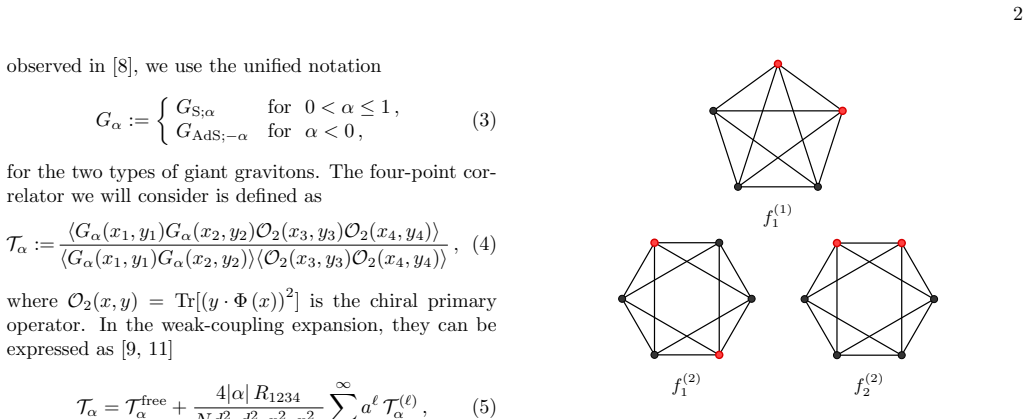
We develop bootstrap methods for mixed heavy-light four-point correlators $\langle GGOO\rangle$ in $\mathcal N=4$ super-Yang--Mills theory at large $N$, where $O\equiv {\cal O}_2$ is the chiral primary operator in the stress-tensor multiplet and $G$ are (dual) giant graviton operators with dimension of order $N$, including the maximal determinant case. The loop integrand is expanded in a basis of labelled $f$-graphs -- necessarily including non-planar topologies due to the dimension-$N$ nature of the giant gravitons -- and the coefficients are fixed by various bootstrap conditions including double-triangle and triangle rules in the cusp and OPE limits, integrated correlators from supersymmetric localization, and a ten-dimensional hidden symmetry, the latter also allowing extension to correlators involving generic chiral primaries $\mathcal{O}_k$. Together, these inputs uniquely determine the correlator through three loops, passing further non-trivial consistency checks. For the maximal determinant operator, we reproduce the known results through two loops and obtain the full three-loop correction.
Figures

Forward citations
Cited by 5 Pith papers
-
A universal scaling function for giant graviton OPE coefficients
In planar N=4 SYM, the large-spin OPE coefficient for two maximal giant gravitons and a twist-two operator scales as S^{d(g)}, with d(g) computed at arbitrary coupling.
-
Quantum Gravity Corrections to Giant Graviton Correlators
One-loop AdS supergravity correction to maximal giant graviton–supergraviton correlators is reconstructed in closed Mellin and position form via defect unitarity, including leading-twist anomalous dimensions.
-
Energy-Energy Correlators at Strong Coupling
The strong-coupling EEC in planar N=4 SYM is now known through λ⁻² for p=2 and through λ⁻³ᐟ² for all half-BPS operators O_p, derived independently from worldsheet and low-energy Wilson-coefficient methods.
-
Notes on the bootstrap of four-point conformal integrals
A leading-singularity bootstrap with single-valued polylog ansätze and region-expansion boundaries evaluates previously intractable four-loop conformal integrals, including non-planar sectors.
-
Notes on the bootstrap of four-point conformal integrals
A leading-singularity bootstrap workflow yields new analytic expressions for four-loop conformal integrals, including previously intractable non-planar sectors.
Reference graph
Works this paper leans on
-
[1]
The integrandF 4+ℓ can be constructed through the chiral Lagrangian-insertion procedure, as has been done for⟨O 2O2O2O2⟩[6, 12]. In this way,F 4+ℓ can be expressed in terms off-graphs, however, unlike the case of⟨O 2O2O2O2⟩, due to the in- sertion of two giant gravitons,F 4+ℓ has reduced permu- tation symmetryS 2 ×S 2+ℓ; we will denote such more generalf-...
-
[2]
Invasion of the Giant Gravitons from Anti-de Sitter Space
John McGreevy, Leonard Susskind, and Nicolaos Toum- bas, “Invasion of the giant gravitons from Anti-de Sitter space,” JHEP06, 008 (2000), arXiv:hep-th/0003075
work page internal anchor Pith review Pith/arXiv arXiv 2000
-
[3]
Large branes in AdS and their field theory dual
Akikazu Hashimoto, Shinji Hirano, and N. Itzhaki, “Large branes in AdS and their field theory dual,” JHEP 08, 051 (2000), arXiv:hep-th/0008016
work page internal anchor Pith review Pith/arXiv arXiv 2000
-
[4]
Exact Correlators of Giant Gravitons from dual N=4 SYM
Steve Corley, Antal Jevicki, and Sanjaye Ramgoolam, “Exact correlators of giant gravitons from dual N=4 SYM theory,” Adv. Theor. Math. Phys.5, 809–839 (2002), arXiv:hep-th/0111222
work page internal anchor Pith review Pith/arXiv arXiv 2002
-
[5]
Giant Graviton Correlators as Defect Systems,
Junding Chen, Yunfeng Jiang, and Xinan Zhou, “Gi- ant Graviton Correlators as Defect Systems,” Phys. Rev. Lett.135, 081602 (2025), arXiv:2503.22987 [hep-th]
-
[6]
All giant graviton two-point functions at two-loops,
Yu Wu, Yunfeng Jiang, Chang Liu, and Yang Zhang, “All giant graviton two-point functions at two-loops,” JHEP03, 097 (2026), arXiv:2509.23161 [hep-th]
-
[7]
Hidden symmetry of four-point correlation functions and amplitudes in N=4 SYM
Burkhard Eden, Paul Heslop, Gregory P. Korchemsky, and Emery Sokatchev, “Hidden symmetry of four-point correlation functions and amplitudes in N=4 SYM,” Nucl. Phys. B862, 193–231 (2012), arXiv:1108.3557 [hep-th]
work page internal anchor Pith review Pith/arXiv arXiv 2012
-
[8]
Song He, Canxin Shi, Yichao Tang, and Yao-Qi Zhang, “The cusp limit of correlators and a new graphical boot- strap for correlators/amplitudes to eleven loops,” JHEP 03, 192 (2025), arXiv:2410.09859 [hep-th]
-
[9]
Universality of giant graviton corre- lators,
Augustus Brown, Daniele Dorigoni, Francesco Galvagno, and Congkao Wen, “Universality of giant graviton corre- lators,” JHEP11, 034 (2025), arXiv:2508.15657 [hep-th]
-
[10]
Partial non-renormalisation of the stress-tensor four-point function in N=4 SYM and AdS/CFT
Burkhard Eden, Anastasios C. Petkou, Christian Schu- bert, and Emery Sokatchev, “Partial nonrenormaliza- tion of the stress tensor four point function in N=4 SYM and AdS / CFT,” Nucl. Phys. B607, 191–212 (2001), arXiv:hep-th/0009106
work page internal anchor Pith review Pith/arXiv arXiv 2001
-
[11]
Structure Constants in N = 4 SYM at Finite Coupling as Worldsheet g-Function,
Yunfeng Jiang, Shota Komatsu, and Edoardo Vescovi, “Structure constants inN= 4 SYM at finite cou- pling as worldsheet g-function,” JHEP07, 037 (2020), arXiv:1906.07733 [hep-th]
-
[12]
Superconformal Ward Identities and their Solution
M. Nirschl and H. Osborn, “Superconformal Ward iden- tities and their solution,” Nucl. Phys. B711, 409–479 (2005), arXiv:hep-th/0407060
work page internal anchor Pith review Pith/arXiv arXiv 2005
-
[13]
Burkhard Eden, Paul Heslop, Gregory P. Korchemsky, and Emery Sokatchev, “Constructing the correlation function of four stress-tensor multiplets and the four- particle amplitude in N=4 SYM,” Nucl. Phys. B862, 450–503 (2012), arXiv:1201.5329 [hep-th]
work page internal anchor Pith review Pith/arXiv arXiv 2012
-
[14]
Giant correlators at quantum level,
Yunfeng Jiang, Yu Wu, and Yang Zhang, “Giant correlators at quantum level,” JHEP05, 345 (2024), arXiv:2311.16791 [hep-th]
-
[15]
The Four-Point Correlator of Planar sYM at Twelve Loops,
Jacob L. Bourjaily, Song He, Canxin Shi, and Yichao Tang, “Four-point correlator of planar supersymmetric Yang-Mills theory at twelve loops,” Phys. Rev. D112, 126029 (2025), arXiv:2503.15593 [hep-th]
-
[16]
Amplitudes and Correlators to Ten Loops Using Simple, Graphical Bootstraps
Jacob L. Bourjaily, Paul Heslop, and Vuong-Viet Tran, “Amplitudes and Correlators to Ten Loops Using Simple, Graphical Bootstraps,” JHEP11, 125 (2016), arXiv:1609.00007 [hep-th]
work page internal anchor Pith review Pith/arXiv arXiv 2016
-
[17]
Wrapping at four loops in N=4 SYM
F. Fiamberti, A. Santambrogio, C. Sieg, and D. Zanon, “Wrapping at four loops in N=4 SYM,” Phys. Lett. B 666, 100–105 (2008), arXiv:0712.3522 [hep-th]
work page internal anchor Pith review Pith/arXiv arXiv 2008
-
[18]
As we will show, this condition is not needed to determine the correlators up to two loops; it first becomes useful at three loops. We also assume that at tree and one-loop level there is a single unprotected operator (or several operators with degenerateγ G′) that dominates the OPE limit
-
[19]
Congkao Wen and Shun-Qing Zhang, “Integrated corre- lators inN= 4 super Yang-Mills and periods,” JHEP 05, 126 (2022), arXiv:2203.01890 [hep-th]
- [20]
-
[21]
Damon J. Binder, Shai M. Chester, Silviu S. Pufu, and Yifan Wang, “N= 4 Super-Yang-Mills correlators at strong coupling from string theory and localization,” JHEP12, 119 (2019), arXiv:1902.06263 [hep-th]
-
[22]
Shai M. Chester and Silviu S. Pufu, “Far beyond the 11 planar limit in strongly-coupledN= 4 SYM,” JHEP 01, 103 (2021), arXiv:2003.08412 [hep-th]
-
[23]
Conformal Four Point Functions and the Operator Product Expansion
F. A. Dolan and H. Osborn, “Conformal four point func- tions and the operator product expansion,” Nucl. Phys. B599, 459–496 (2001), arXiv:hep-th/0011040
work page internal anchor Pith review Pith/arXiv arXiv 2001
-
[24]
Three-loop universal structure constants in N=4 susy Yang-Mills theory
Burkhard Eden, “Three-loop universal structure con- stants in N=4 supersymmetric Yang-Mills theory,” (2012), arXiv:1207.3112 [hep-th]
work page internal anchor Pith review Pith/arXiv arXiv 2012
-
[25]
The package HarmonicSums: Computer Algebra and Analytic aspects of Nested Sums
Jakob Ablinger, “The package HarmonicSums: Com- puter Algebra and Analytic aspects of Nested Sums,” PoSLL2014, 019 (2014), arXiv:1407.6180 [cs.SC]
work page internal anchor Pith review Pith/arXiv arXiv 2014
-
[26]
Defect Approach to Giant Graviton Dynamics,
Junding Chen, Yunfeng Jiang, and Xinan Zhou, “De- fect Approach to Giant Graviton Dynamics,” (2026), arXiv:2602.13570 [hep-th]
-
[27]
Simon Caron-Huot and Frank Coronado, “Ten dimen- sional symmetry ofN= 4 SYM correlators,” JHEP03, 151 (2022), arXiv:2106.03892 [hep-th]
-
[28]
Open-Closed- Open Triality for Heavy Operators I: All-Loop Inte- grands,
Frank Coronado and Shota Komatsu, “Open-Closed- Open Triality for Heavy Operators I: All-Loop Inte- grands,” (2026), to appear
work page 2026
-
[29]
Since theOO-channel OPE only involves the anomalous dimension of the Konishi operator, which does not receive 1/Ncorrections up to three loops [16], this analysis also applies at finiteN, provided one uses the corresponding finite-Nintegrated correlators, as in [39]
-
[30]
The result is in agreement with an independent compu- tation of [27] using twistor Feynman rules [40]. As com- mented earlier, this confirms the 10-dimensional hidden symmetry for generic giant gravitons at two loops
-
[31]
We thank Frank Coro- nado for private communication on this point
This large-spin behavior is consistent with an indepen- dent light-cone bootstrap analysis. We thank Frank Coro- nado for private communication on this point
-
[32]
Many of thesef-graph periods at four loops, includ- ing non-planar ones, have been obtained in [41] and were used to verify the localization computation for ⟨O2O2O2O2⟩beyond the planar limit
-
[33]
Coulomb branch and integrability,
Frank Coronado, Shota Komatsu, and Konstantin Zarembo, “Coulomb branch and integrability,” JHEP10, 143 (2025), arXiv:2506.07222 [hep-th]
-
[34]
Jo˜ ao Caetano, Shota Komatsu, and Yifan Wang, “Large charge ’t Hooft limit ofN= 4 super-Yang-Mills,” JHEP 02, 047 (2024), arXiv:2306.00929 [hep-th]
- [35]
-
[36]
All-loop Heavy-Heavy-Light-Light correlators in N= 4 super Yang-Mills theory,
Augustus Brown, Francesco Galvagno, and Congkao Wen, “All-loop Heavy-Heavy-Light-Light correlators in N= 4 super Yang-Mills theory,” JHEP10, 171 (2024), arXiv:2407.02250 [hep-th]
-
[37]
Simone Giombi and Jonah Hyman, “On the large charge sector in the critical O(N) model at large N,” JHEP09, 184 (2021), arXiv:2011.11622 [hep-th]
-
[38]
Daniele Dorigoni, Michael B. Green, and Congkao Wen, “Exact properties of an integrated correlator inN= 4 SU(N) SYM,” JHEP05, 089 (2021), arXiv:2102.09537 [hep-th]
-
[39]
math.fau.de/person/oliver-schnetz/
Oliver Schnetz,HyperlogProcedures,https://www. math.fau.de/person/oliver-schnetz/
-
[40]
Exact results for giant graviton four-point corre- lators,
Augustus Brown, Francesco Galvagno, and Congkao Wen, “Exact results for giant graviton four-point corre- lators,” JHEP07, 049 (2024), arXiv:2403.17263 [hep-th]
-
[41]
Simon Caron-Huot, Frank Coronado, and Beatrix M¨ uhlmann, “Determinants in self-dualN= 4 SYM and twistor space,” JHEP08, 008 (2023), arXiv:2304.12341 [hep-th]
-
[42]
Zhang,Nonplanar integrated correlator in N=4 SYM,Phys
Shun-Qing Zhang, “Nonplanar integrated correlator in N=4 SYM,” Phys. Rev. D110, 025003 (2024), arXiv:2404.18900 [hep-th]
discussion (0)
Sign in with ORCID, Apple, or X to comment. Anyone can read and Pith papers without signing in.